




Abstract
Abstract
Poly-silicic-cation coagulants (PSiCs) were prepared from industrial wastes. Optimal conditions for synthesis of PSiCs were determined from orthogonal experiments. Coagulation performance was evaluated through jar tests in treatment of pulping and papermaking wastewater, and fractal dimensions of the flocs during coagulation were analyzed on basis of floc images on GRViewer. Results showed that coagulation performance and floc fractal dimension were significantly influenced by the Si/(Fe + Al) molar ratio and the pH of PSiCs. Optimal Si/(Fe + Al) ratio and pH were 0.8 and 1.5, respectively. Turbidity removal rate from pulping and papermaking wastewater decreased with the increasing Si/(Al + Fe) ratio, which increased with the rise of pH, but decreased at high pH. The floc fractal dimension was improved with the increase of silicon dose or pH, but decreased when the Si/(Fe + Al) ratio or pH was high. Adsorption bridging ability of PSiCs played a key role in the aggregation and breakup of flocs.
Introduction
I
Characterization and coagulation performance of IPSCs can be influenced by many factors, such as pH, silicon dose, basicity, aging time, and aging temperature (Gyawali and Rajbhandari, 2012; Li et al., 2013b, 2014). A study about the effects of silicon dose on the structure, morphology, and coagulation efficiency of poly-ferric-aluminum-silicate-sulfate (PFASS) shows that its morphology is largely influenced by the (Al + Fe)/Si molar ratio (Sun et al., 2011). The effects of Zn/Si molar ratio and aging time on the pH and ζ-potential of poly-zinc-silicate-sulfate (PZSS) were investigated systematically (Zeng and Park, 2009). These studies focus on the preparation of IPSCs by composite polymerization or copolymerization, but there is little research on the effects of synthesis conditions on the characterization and coagulation performance of IPSCs prepared by synchro polymerization.
Coagulation is an effective way to remove suspended particles by destroying the structure of stable particles and aggregating small particles into larger flocs (Hogg, 2000; Antov et al., 2012). The removal rate of organic pollutants is influenced by the size and structure of the floc, which is a highly porous and loosely-connected aggregate composed of many primary particles. The structure of flocs is irregular and disorderly, but it exhibits the fractal nature with self-similarity and scale invariance (Johnson et al., 1996; Gregory, 1997). There are some studies about the irregular structure through fractal geometry (Bushell et al., 2002; Wu et al., 2002; Li et al., 2006).
Fractal dimensions can be described as the degree of occupation of the embedding space by the particles composing the aggregates. Fractal dimension Df can be expressed as follows:
where L is the characteristic length of the aggregate; M is perimeter, projected area, and particle number in one, two, and three dimensions, respectively. The commonly used experimental measurements of fractal dimensions of aggregates include scattering (light, X-ray, or neutron), settling, and imaging (Bushell et al., 2002). The interpretation of the scattered intensity pattern is complicated by the strong interaction between light and matters. Settling has long been used to characterize particle behavior, but there is no accurate permeability model. Image analysis could provide abundant information about particle morphology.
In this study, poly-silicic-cation coagulants (PSiCs) were prepared from industrial wastes by synchro-polymerization method. The orthogonal experiments with five factors and five levels were conducted to find out the optimal ratio of raw materials and the optimal conditions for the PSiC synthesis. The effects of Si/(Fe + Al) ratio and pH on floc fractal dimensions of PSiCs were analyzed, and the mechanism of PSiC coagulation was discussed on the basis of the relationship between coagulation performance and floc fractal dimension.
Materials and Methods
Materials
The raw materials include fly ash, pyrite slag, and wasted sulfuric acid, which were obtained from Meixian Sulfuric Acid Plant, Baqiao Thermal Power Plant, and Xi'an Modern Chemistry Research Institute (China), respectively. The compositions of the above raw materials are shown in Table 1.
The pulping and papermaking wastewater with chemical oxygen demand (COD) of 150 mg/L, biochemical oxygen demand of 47 mg/L, SS of 106 mg/L, turbidity of 66 nephelometric turbidity unit, color of 16 times, and pH of 7.5 was obtained from Wanlong Paper Mill. The wastewater was treated by fiber recovery, sedimentation, anaerobic, and aerobic treatment methods before we collected it.
Preparation of PSiCs
PSiCs were prepared in the following steps.
(a) Alkali leaching: About 20–50 g of fly ash and 165 mL of 6 mol/L sodium hydroxide (industrial grade) were added into a beaker and heated under stirring to 80–90°C for 2 h. After that, the leaching liquid was filtered. The insoluble ash particles and 100 mL of water were added into the beaker under stirring and dried.
(b) Acid leaching: Then, 45 g of pyrite slag, 6–10 g of alkali-leached fly ash, and 147 mL of 6 mol/L wasted sulfuric acid were added into a beaker under stirring and heated to 80–90°C for 2 h. Finally, the mixture was filtered.
(c) Polymerization: Different amounts of the solution in step (a) were added at 1.5 mL/min into the solution in step (b) and then the mixed solutions were adjusted to pH 1.2–5 with the waste sulfuric acid. The resulting solutions were aged at normal temperature for 2 days and finally, PSiCs were prepared.
Coagulation performance
Coagulation performance was evaluated through jar tests using a ZR4-6 six-unit stirred system (Zhongrun). The wastewater samples were added with the coagulant (80 mg/L) and then stirred rapidly at 150 r/min for 2 min, followed by 10-min slow stir at 30 r/min and 30-min precipitation. The dosage of coagulant and the coagulation conditions were determined by preexperiments. Finally, the supernatants were collected from 3 cm below the surface of the test wastewater, and then the turbidity was measured by an HI93703 device (Hanna).
Fractal dimension calculation
The 2D floc fractal dimension D2 was measured by image analysis. D2 is defined by the relationship between projected area A and the characteristic length of the aggregate l as follows (Logan and Kilps, 1995):
where k is a constant.
After coagulation experiments, floc samples were dripped onto the glass slides with a pipette with inner diameter of 5 mm and then were observed and photographed by the microscopic imaging system. The perimeters and projected areas of the flocs were computed on the basis of floc images on GRViewer. In this work, a line was plotted using the logarithmic perimeter (ln L) as the x-axis and the logarithmic projected area (ln S) as the y-axis, and its slope is exactly D2 (Equation (2)), where L and S represent the perimeter and projected area of the floc, respectively.
Results and Discussion
Preparation optimization
Distinguishing morphology and chemical structures of polysilicate complex coagulants were found under different preparation conditions, which affect the capacity of wastewater treatment (Li et al., 2013a). An orthogonal experiment with five factors and five levels was conducted to find out the optimal conditions for the PSiC synthesis. The experimental design is presented in Table 2, where A–E stand for SiO2 concentration, Fe/Al molar ratio, Si/(Fe + Al) molar ratio, pH, and polymerization time, respectively. According to the orthogonal array of L25(5)5 in Table 2, the following experiments were performed (Table 3). The results of calculation and variance analysis are shown in Tables 4 and 5. The calculation results show that the influencing orders of these five factors on the turbidity removal rate and COD removal rate are C > D > A > B > E and C > D > B > E > A, respectively. The variance results imply that coagulation performances are more influenced by the ion molar ratios and pH. The comprehensive analysis indicates that the Si/(Fe + Al) ratio and pH play key roles during the polymerization, followed by the Fe/Al ratio. The polymerization time and SiO2 concentration show relatively slight effects. During the synthetic reaction, Fe, Al, and Si were polymerized rather than remaining as a simple mixture of the raw materials. According to the factorial experiments, the optimal combination of key factors C1D4 is obtained, which corresponds to Si/(Fe + Al) ratio of 0.8 and pH 1.5. Subsequently, two independent tests were carried out to evaluate the effects of Si/(Fe + Al) ratio and pH on the coagulation performance of PSiCs. However, PSiC contains reducing substances such as Fe2+. If the coagulation performance is poor, the coagulant will remain in the water and cause the increase of COD. This is the case of PSiC sample no. 9 and 17 in Table 3.
(A) SiO2 concentration; (B) Fe/Al molar ratio; (C) Si/(Fe + Al) molar ratio; (D) pH; and (E) polymerization time.
(
COD, chemical oxygen demand.
(A) SiO2 concentration; (B) Fe/Al molar ratio; (C) Si/(Fe + Al) molar ratio; (D) pH; and (E) polymerization time.
K = (∑turbidity/COD removal rate after coagulation of single factor)/4.
R = max K−min K.
(A) SiO2 concentration; (B) Fe/Al molar ratio; (C) Si/(Fe + Al) molar ratio; (D) pH; and (E) polymerization time.
DOF, degrees of freedom.
Fractal dimension
Orthogonal experiments prove that the Si/(Fe + Al) ratio and pH would modestly affect the pollutant removal efficiency of PSiCs and may also influence the floc characteristics. Figure 1 shows the floc fractal dimensions of PSiCs at different Si/(Fe + Al) ratios. While the Si/(Fe + Al) ratio is augmented from 0.8 to 2.8, the floc fractal dimensions increase from 1.78 to 1.87 and then decrease to 1.64, with credible correlation (R2 > 0.9) (Fig. 1). The floc fractal dimension increases with the increasing dose of silicon and decreases when the Si/(Fe + Al) ratio is too high. During coagulation treatment, pollutants were removed by the coagulant through the charge neutralization ability, adsorption bridging ability, and sweep-floc ability (Ying et al., 2012). These results imply that the relationship between Si/(Fe + Al) ratio and floc fractal dimension may relate to the abilities of the PSiCs.
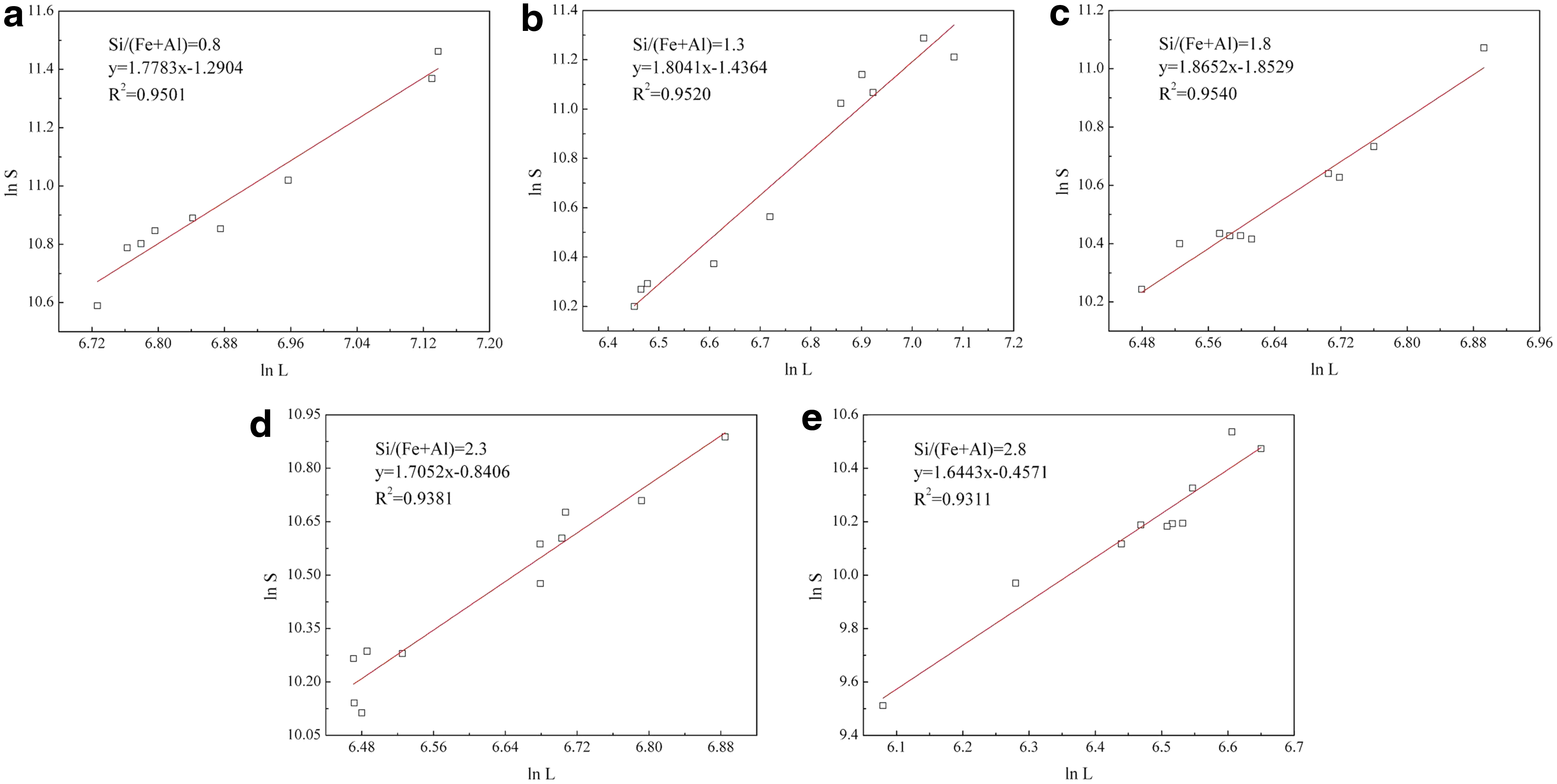
Floc fractal dimension of PSiCs with Si/(AI + Fe) molar ratios of 0.8
Floc fractal dimension of PSiCs at varying pH is shown in Figure 2. Floc fractal dimensions are 1.71, 1.78, 1.79, 1.69, and 1.69 (R2 > 0.9) at pH 1.2, 1.5, 1.8, 2.1, and 5, respectively. The floc fractal dimension increases with the rising pH, but decreases when pH is too high. However, the correlation is not evident compared with the case of pH <1.8, and two flocs had similar fractal dimensions at pH >2.1. These results indicate that floc fractal dimension is less affected by pH of PSiC when it is too high. In a word, the relationship between pH and floc fractal dimension may relate to the ability of the PSiCs.
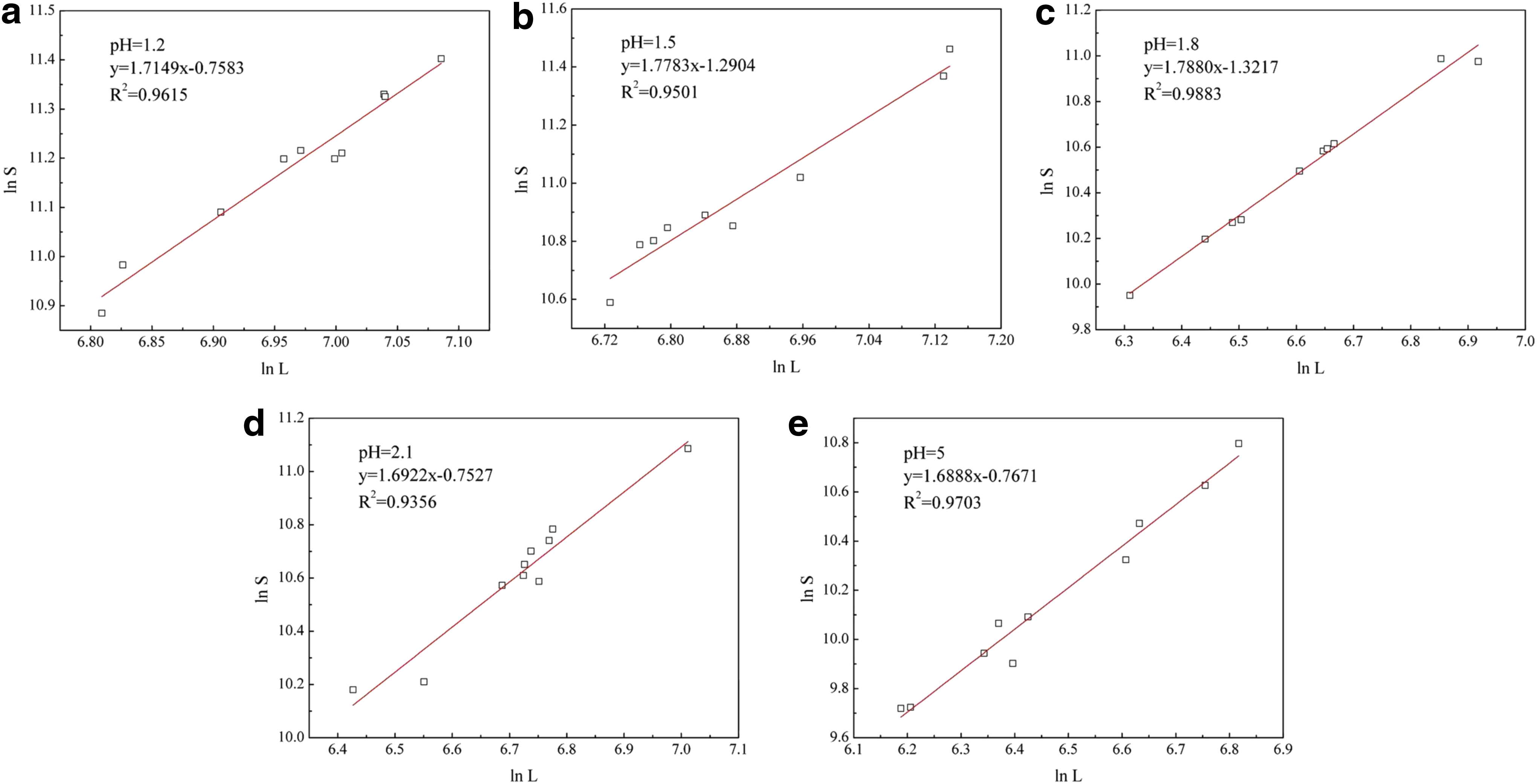
Floc fractal dimension of PSiCs at pH of 1.2
Coagulation mechanism
Figure 3 presents the relationship between coagulation performance and floc fractal dimension of PSiCs with different Si/(Al + Fe) ratios. After the PSiC hydrolyzes, the intermediates are adsorbed onto the particle surface during coagulation. As PSiC is an acidic fluid, H+ with small size and high adsorption ability could destroy the structure of stable particles in wastewater by replacement of Ca2+, Na+, or Mg2+ carried on the surface of soil particles. Besides, metal ions in PS improve the neutralization capacity and also combine the effects of adsorption bridging and sweep floc. PSiC can adsorb, destroy the stable particles, and connect them like a bridge, so as to precipitate and remove the organic pollutants.

Relationship between coagulation performances and floc fractal dimension of PSiCs with different Si/(AI + Fe) molar ratios.
As showed in Figure 3, the turbidity removal rate from pulping and papermaking wastewater decreases with the increasing Si/(Al + Fe) ratio, while the floc fractal dimension is improved with the increase of silicon dose, but decreases at too high Si/(Fe + Al) ratio. PSiC with lower Si/(Al + Fe) ratio contains more cation, so it shows higher charge neutralization ability. The flocs removed by the charge neutralization domain are dense and a large proportion settles down. The charge neutralization ability is weakened with the increasing Si/(Al + Fe) ratio. We have found that with the increasing dose of silicon in PSiC, the contents of the ionic polymerized bonds are decreased, however, the branchy length is increased and the 3D silicate polymer will be gathered into chain and mesh aggregates (Li et al., 2013b). The large and sparse flocs are removed by the adsorption bridging and the sweep-floc domains in this case. Therefore, flocs removed by adsorption bridging and sweep-floc coagulation show higher fractal dimensions than those removed by charge neutralization. This conclusion agrees with the suggestions by Kim et al. (2001). Both the destabilization ability and adsorption bridging ability are weakened when the dose of silicon is too high. The flocs break easily into smaller ones under the turbulent shear stress and thus, the fractal dimension is low.
Coagulation performances of PSiCs with different pH and floc fractal dimensions during different coagulations are shown in Figure 4. The turbidity removal efficiency, as well as floc fractal dimensions are improved with the rise of pH, but are reduced at too high pH (Fig. 4). PSiCs at varying pH contain the same iron content and similar charge neutralization abilities, which suggest that the adsorption bridging and sweep abilities are affected by pH. At pH 1.2, the pollutant removal efficiency and fractal dimensions of the flocs are low. This result implies that the polymerization degree is low and the adsorption bridging ability is poor at low pH. Polymerization of Fe, Al, and Si is enhanced with the increasing pH to enhance adsorption bridging ability, which results in high pollutant removal efficiency and floc fractal dimensions. Fe and Al complexed with Si to form some low polymers at too high pH, which results in lower destabilization ability and adsorption bridging ability, and low pollutant removal efficiency and floc fractal dimensions. These conclusions agree with the morphological analysis, which found that branch-like units of PSiCs are reduced when pH is too low or too high (Li et al., 2014). In addition, the pollutant removal rate and the floc fractal dimensions change similarly, as both decrease at too low or too high pH. This result implies that adsorption bridging can significantly affect the aggregation and breakup of flocs.
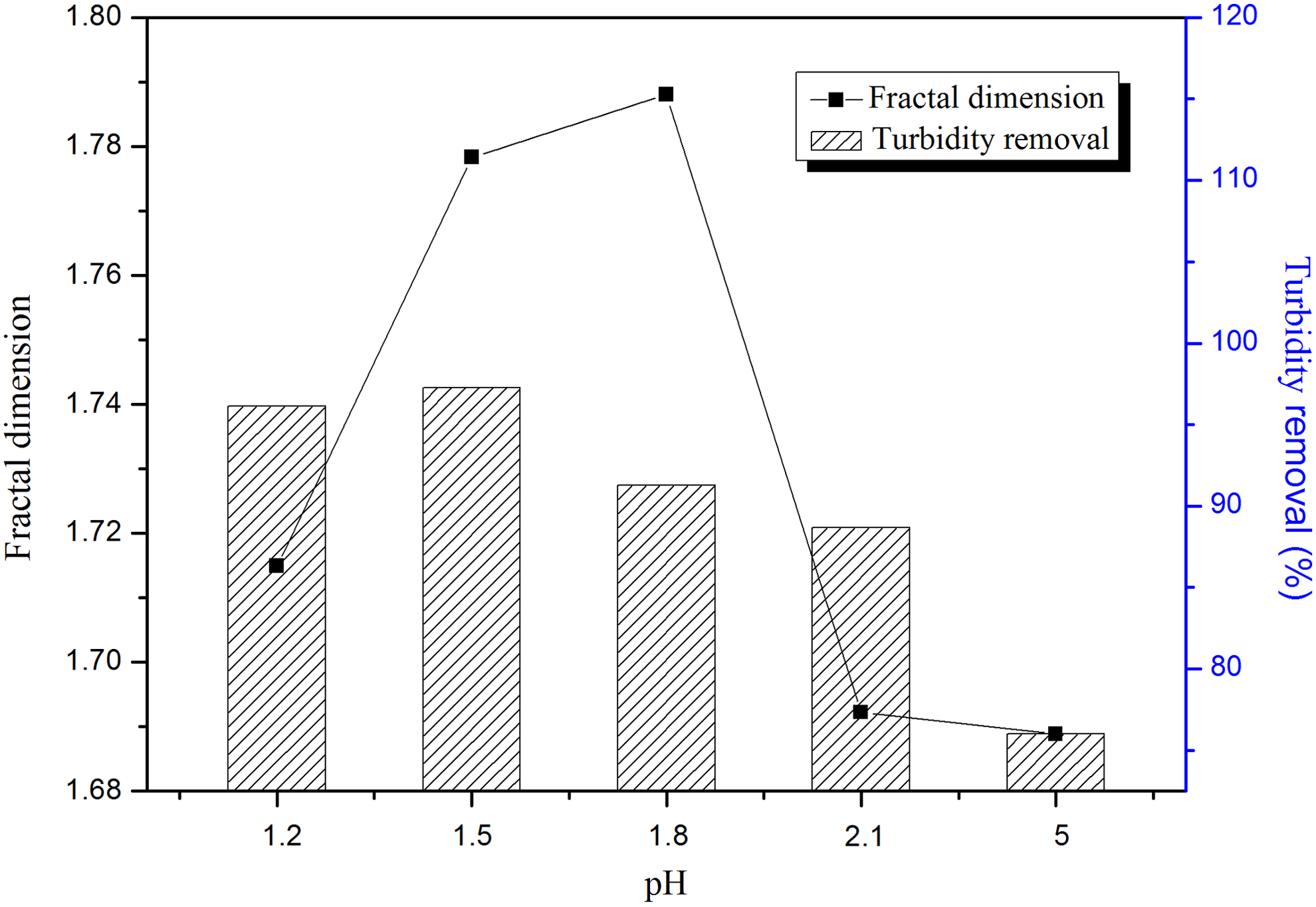
Relationship between coagulation performances and floc fractal dimension of PSiCs at varying pH.
Conclusions
In this study, IPSCs and PSiCs were prepared from industrial wastes. The experiments proved that coagulation performances were more influenced by the Si/(Fe + Al) molar ratio and pH than other preparation conditions. The optimal Si/(Fe + Al) molar ratio and pH are 0.8 and 1.5, respectively. Floc characteristics are also influenced by these two factors. The floc fractal dimension is improved with the increase of silicon dose and decreases when the Si/(Fe + Al) ratio is too high. In comparison, the turbidity removal rate from pulping and papermaking wastewater decreases with the increasing Si/(Al + Fe) ratio. The flocs were removed by the charge neutralization domain at low silicon dose. At high Si/(Al + Fe) molar ratio, the flocs are removed by the adsorption bridging and sweep-floc domains, which are large and break easily into smaller ones under the turbulent shear stress. In addition, the turbidity removal efficiency, as well as floc fractal dimensions, is increased with the rise of pH, but are decreased at too high pH. Coagulation performances and floc fractal dimension measurement are affected by adsorption bridging ability of PSiC.
Footnotes
Acknowledgment
This study was supported by the National Natural Science Foundation of China (Nos. 51504192 and 51304160).
Author Disclosure Statement
No competing financial interests exist.