




Abstract
Abstract
Two functionalized imidazolium ionic liquids (ILs) 1-(2-diethylaminoethyl)-3-methylimidazolium thiocyanate (Et2NEMImSCN) and 1-(2-hydroxyethyl)-3-methylimidazolium thiocyanate (HOEMImSCN) were synthesized, their thermal decomposition temperature, density, viscosity, and conductivity were determined, and their efficiency to absorb SO2 was studied. Results showed that both Et2NEMImSCN and HOEMImSCN had high thermal decomposition temperature as most of imidazolium-based ILs, the density and conductivity data of HOEMImSCN were higher than those of Et2NEMImSCN, while the viscosity data of HOEMImSCN were lower than those of Et2NEMImSCN. In the tested temperature range (from 303.15 to 343.15 K), the relationship of temperature and density is consistent with a linear equation, and temperature-dependent viscosity and conductivity was described by a Vogel–Tammann–Fulcher equation. Absorption processes proceeded smoothly in both ILs, and the solubility of SO2 in Et2NEMImSCN was 1.207 gSO2/gIL at 298.15 K and atmosphere pressure, which is the highest capacity reported to date under the similar conditions. Et2NEMImSCN IL could be easily regenerated and reused at least five times with comparable efficiency. A group contribution method based on the literature data was proposed, with an AAD% = 2.07, to assist researchers in predicting the solubility of SO2 in newly designed ILs.
Introduction
S
Hence, more and more attention had been paid to explore the new absorption process with high absorption capacity, high selectivity, no second pollution, and easy recycle of absorbent.
In recent years, ionic liquids (ILs) have been developed as one of the most promising green solvents for SO2 absorption because of their unique physicochemical properties such as low volatility, low toxicity, high chemical stability, wide liquid range, and tunable solubility.
In 2004, 1,1,3,3-tetramethylguanidinium lactate [TMGL] was first reported by Wu et al., 2004, which showed a high SO2 solubility up to 0.305 gSO2/gTMGL (0.978 mol/mol) at 313.15 K and 1.0 bar (8% SO2 by volume) in 3 h. FT-IR and 1H NMR spectra indicated the nature of insertion reaction between primary amine and SO2 at low SO2 pressure. In 2008, Huang reported that the SO2 solubility of IL can be significantly increased by incorporating hydroxyl groups to the guanidinium fragment (Huang et al., 2008), for example, the solubility of SO2 in [TMGHPO2]BF4 was up to 2.01 mol/mol (about 0.403 gSO2/gIL) at 0.1 MPa and 293.15 K [TMG]BF4 was only 1.27 mol/mol (about 0.401 gSO2/gIL), while the alcohol functionality in the anion part of the TMGL IL did only affect SO2 solubility to a minor extent compared to the cation-functionalized counterpart.
These results indicated that the gas absorption seems to be mainly due to interactions between the gas molecule and the cation rather than the anion. However, the thermal stability of guanidinium-based ILs is low, and the degradation of the ILs may occur during the desorption process of SO2 at high temperatures. Since then, more attentions were focused on common imidazolium-based ILs and pyridinium-based ILs, and the results showed that the solubility in most of them is between 0.5 and 1.5 mol/mol (Anderson et al., 2006; Yu and Chen, 2011). In general, the anion of the ILs plays a decisive effect in SO2 capture. Therefore, a series of ILs with different anions such as tetrazolate (Wang et al., 2011; Cui et al., 2012), lactate (Tian et al., 2013), phosphate (Qu et al., 2013), dicarboxylates (Huang et al., 2013), halogen-substituted phenolate or carboxylate (Cui, et al., 2013; Cui et al., 2015), and thiocyanate (Wang et al., 2013; Zeng et al., 2014) were designed and their efficiency in SO2 absorption was explored.
Properties of ILs can also be adjusted by the introduction of specific functional groups into the cations, and the so-called cation functional ILs had also been explored in the capture of SO2 (Liu et al., 2011, 2013; Cui et al., 2012; Yang et al., 2013; Zhang et al., 2013; Tian et al., 2014; Wang et al., 2014; Zeng et al., 2015). The first type is ether-functionalized ILs (Cui et al., 2012; Zhang et al., 2013; Wang et al., 2014; Zeng et al., 2015). In 2012, Cui et al. designed a new ether-functionalized IL with tetrazolate anion for SO2 capture (Cui et al., 2012), the solubility of SO2 was up to 5.00 mol/mol (about 0.76 gSO2/gIL) at 20°Cand 0.1 MPa. Lately, in 2014, Wang et al. synthesized a series of novel ether-functionalized pyridinium chloride ILs ([EnPy]Cl, n = 2–4) as highly efficient SO2 absorbents, and 1-[2-(2-methoxyethoxy) ethyl] pyridinium chloride showed a relatively high absorption capacity of up to 1.155 gSO2/gIL at 20°C and 0.1 MPa (Wang et al., 2014). The second type is amino-functionalized ILs (Liu et al., 2011; Yang et al., 2013; Tian et al., 2014; Zeng et al., 2015). It is well known that SO2 can react with amine to form salts by acid base neutralization, so the higher SO2 solubility can be speculated by the introduction of an amino group into the cation of ILs (Liu et al., 2011). In 2015, Zeng et al. reported that 1-(N,N-diethylamino-ethyl)-pyridinium thiocyanate [NEt2C2Py][SCN] showed the highest absorption capacity of 1.06 gSO2/gIL under ambient conditions due to a combination of chemical and physical absorption (Zeng et al., 2015), the results showed that [NEt2C2Py][SCN] must be a good candidate for SO2 removal from flue gas.
In our previous work, a series of eutectic ILs (EILs) had been prepared and used for SO2 absorption. It was found that acetamide-KSCN, which EIL gave 0.588 g/g of mass fraction, corresponding to 0.838 mol/mol of mole fraction solubility of SO2 at 293.15 K and 1 atm, shows great potential as an alternative absorbent in the industrial process of FGD for its low cost and high efficiency (Liu et al., 2013). In fact, EILs did have some fatal disadvantages compared to most of traditional ILs such as low chemically inert and high viscosity. Hence, as a successive work to explore more efficient ILs, our research idea was designed by introducing tertiary amino and hydroxyl to imidazolium-based ILs and selecting thiocyanate as anion. Thus, two functionalized imidazolium ILs 1-(2-diethylaminoethyl)-3- methylimidazolium thiocyanate (Et2NEMImSCN) and 1-(2-hydroxyethyl)-3- methylimidazolium thiocyanate (HOEMImSCN) were synthesized. Their properties such as thermal decomposition temperature, density, viscosity, and conductivity were determined and their efficiency in SO2 absorption was explored. At last, to guide us to predict the solubility of SO2 in an unknown IL, a group contribution method based on the literature data was proposed.
Experimental
All the starting materials were commercially available with a purity of at least 99% and were used without further purification. SO2 was prepared from H2SO4 and Na2SO3 and used in situ in our laboratory. The structure of ILs was characterized by FT-IR (Bruker Tencer 27) and 1H NMR (Bruker AC-500).
Preparation of Et2NEMImSCN
Et2NEMImSCN was prepared similarly to the literature method (Fig. 1) (Zeng et al., 2015). 34.54 g (0.2 mol) of Chlorotriethylamine hydrochloride and 17.02 g (0.21 mol) of sodium thiocyanate (NaSCN) were fully mixed in 34 mL of water and the mixture was stirred at room temperature for 30 min. Then, the mixture was extracted three times by 50 mL of dichloromethane, the organic layer was combined, dried by anhydrous magnesium sulfate for 12 h, and the solvent was removed to obtain Chlorotriethylamine thiocyanate with a yield of 99.18%. The obtained Chlorotriethylamine thiocyanate and 17.80 g (0.21 mol) of N-methylimidazole were dissolved in 30 mL acetonitrile, and then, the mixture was stirred at 353.15 K for 5 h. Acetonitrile was removed by rotary evaporation; the left liquid was neutralized with NaOH 20% aqueous solution and extracted three times by 50 mL of dichloromethane. The combined organic phase was dried by anhydrous magnesium sulfate for 12 h, the solvent was removed, and after purified under vacuum (2 mmHg) at 363.15 K for 12 h, 1-(2-diethylaminoethyl)-3-methylimidazolium thiocyanate (Et2NEMImSCN) was obtained as a yellowish liquid with a yield of 59.37%. IR film, cm−1: NH (3087 cm−1); CH (2966, 2810 cm−1); SCN (2083 cm−1) C = C (1566 cm−1); CH (1454, 1379 cm−1); CH (1167 cm−1). 1H NMR (500 MHz, CDCl3, δ, ppm): 9.379 ppm (s,1H, NC-H); 7.633, 7.467 ppm (s, s, 1H, 1H, CH = CH); 4.386 ppm (t, 2H, CH2); 4.103 ppm (s, 1H, NH); 2.885 ppm (t, 2H, CH2); 2.592 ppm (q, 4H, CH2); 0.956 ppm (t, 6H, CH3).
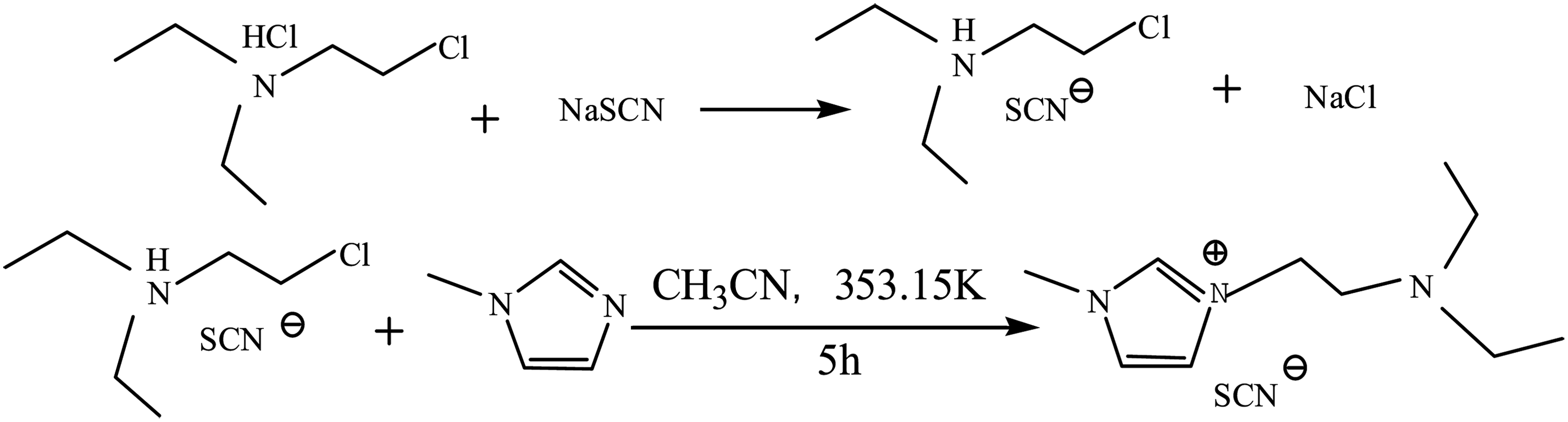
Synthetic route of Et2NEMImSCN.
Preparation of HOEMImSCN
Synthetic route of HOEMImSCN presented in Fig. 2 is similar to the literature method (Brance et al., 2002). Then, 52.82 g (0.64 mol) of N-methylimidazole was dropwise added to 76.47 g (0.95 mol) of 2-chloroethanol in a three-necked flask, stirred at 353.15 K for 24 h, the left 2-chloroethanol was repeatedly rinsed with 50 mL of n-heptane and 30 mL ethyl acetate, the left bottom phase was heated at 353.15 K and reduced pressure (4.24 kPa) for 24 h, and then, the intermediate product 1-(2- hydroxyethyl)-3-methylimidazolium chloride (HOEMImCl) was obtained as a white solid with a yield of 96.54%. Then, 58.35 g of HOEMImCl and 41.39 g of potassium thiocyanate were dissolved in 250 mL of acetonitrile. The mixture was stirred at 353.15 K for 12 h. The solid precipitate was collected by filtration, the solvent was removed by rotary evaporation, purified under vacuum (2 mmHg) at 363.15 K for 12 h, and the target product HOEMImSCN was obtained as a dark red liquid with a yield of 91.90%. IR film, cm−1: OH (3318 cm−1); NH (3104 cm−1); CH (2951, 2877 cm−1); SCN (2057 cm−1) C = C (1572 cm−1); CH (1446 cm−1); CH (1167 cm−1) 1H NMR (500 MHz, DMSO-d6, δ, ppm): 9.045 ppm (s,1H, NC-H); 7.692, 7.665 ppm (t, t, 1H, 1H, CH = CH); 4.188 ppm (t, 2H, CH2); 3.849 ppm (s, 3H, CH3); 3.695 ppm (q, 2H, CH2).

Synthetic route of HOEMImSCN.
Characterization of ILs
Water content of ILs was less than 0.10% by Karl Fischer titration. The final purity of the ILs was estimated from the 1H NMR and found to be no less than 98.0%. The density was determined by the pycnometer method. The conductivity was measured by DDS-11A conductivity detector (Shanghai Leici Xinjing Instrument Company Limited). The decomposition temperature at a weight loss of 10% was determined by the TG-DTA analysis method (under N2 protection, temperature rising rate was 5 K/min). The viscosity was detected by the Pinkevich method (according to GB/T 10247-2008). Uncertainties of density, viscosity, and conductivity were ± 0.001%, ± 0.2%, and ± 0.2%, respectively.
Absorption and desorption of SO2
The experiment was carried out at atmospheric pressure. The SO2 gas stream generated in situ was bubbled into 5 g of EIL, loaded into a 50-mL flask with a mechanical stirrer, and the flow rate was 30 mL/min. The flask was fully immersed in a water bath with the temperature control accuracy of ±0.01 K. A desiccant was used to avoid the influence of water during the process of absorption. The weight of the IL was determined at a regular interval (20 min) by an electronic balance, with a certainty of ±0.01 g until the absorption equilibrium was reached, and then, mass fraction and mole fraction solubility of SO2 in ILs was calculated. For the desorption of SO2, IL solution was heated at 363.15 K under vacuum, and the weight of IL solution was determined at a regular interval during the desorption experiment by an electronic balance, with a certainty of ±0.01 g. The reproducibility of the absorption and desorption experiments was less than ±3%.
Results and Discussion
Physicochemical properties of ILs
Thermal decomposition temperature
Thermal decomposition temperatures of Et2NEMImSCN and HOEMImSCN at a weight loss of 10% are 274.8°C and 232.6°C by TG-DTA analysis (Fig. 3), which indicated that these ILs have a wide liquid range as most of imidazolium-derived ILs (Cao and Mu, 2014). At the same time, the decomposition temperature of Et2NEMImSCN is higher than pyridinium cation-based counterpart Et2NEPySCN (160°c only) (Zeng et al., 2015), which implies Et2NEMImSCN may be a good candidate at the occasions when higher temperature is inevitable.
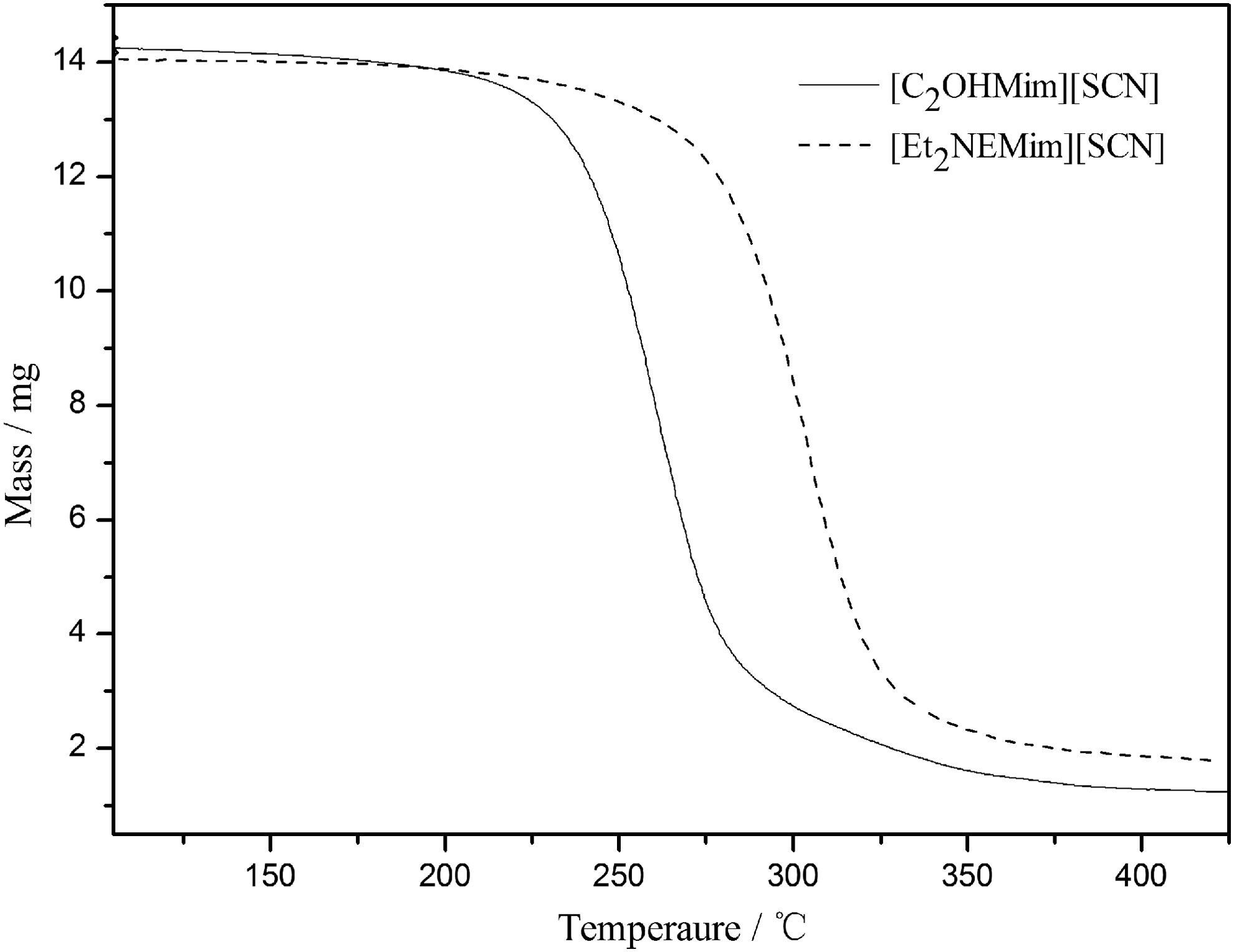
TG-DTA analysis of ILS. ILs, ionic liquids.
Density, viscosity, and conductivity
Density, viscosity, and conductivity of ILs in this work as a function of temperature are shown in Table 1. Comparing with conventional IL 1-ethyl-3-methylimidazolium thiocyanate ([EMim][SCN]), whose density data were 1.10938, 1.10287, 1.09642, 1.08998, and 1.08359 g/cm3 at 303.15, 313.15, 323.15, 333.15, and 343.15 K, respectively, cation-functionalized IL HOEMImSCN showed higher density due to the introduction of hydroxy group on the imidazolium cation (Larriba et al., 2014; Zhang et al., 2014), while amino-functionalized IL Et2NEMImSCN showed lower density, which is very close to that of 1-butyl-3-methylimidazolium thiocyanate ([bmim][SCN]) IL (Larriba et al., 2014). Unfortunately, the introduction of hydroxy group and amino group onto the imidazolium cation led to an increase in viscosity, a trend that had ever been observed in pyridinium-derived functionalized ILs (Zeng et al., 2015). For example, the viscosities of Et2NEMImSCN and HOEMImSCN were 1284.31 cp and 112.15 cp at 303.15 K, respectively, which exhibited much higher viscosities than that of [emim][SCN] (21.33 cp at 303.15 K) (Zhang et al., 2014). The conductivities of Et2NEMImSCN and HOEMImSCN are moderate and comparable with most of the imidazolium-based ILs (Tokuda et al., 2006), which implies they may act as promising alternative solvents in many electrochemical processes.
Standard uncertainties u are as follows: u(P) = ±0.005 MPa, u(T) = ±0.01 K, u(ρ) = ±1·10–3 g/cm3 and the relative standard uncertainties ur in ur(η) = 0.03, ur(δ) = 0.02.
ILs, ionic liquids.
Effect of temperature on density for the ILs is shown in Fig. 4. It can be seen that [C2OHMim][SCN] has a stronger temperature dependence of density than [Et2NEMim][SCN]. The density decreases linearly with increase of temperature and the relationship between density and temperature can be depicted by the following Equation (1):

Temperature dependence of density for ILs. • [Et2NEMim][SCN]: ρ = 1.2594 − 5.94 × 10⁻⁴T, R2 = 0.9998; ▪ [C2OHMim][SCN]: ρ = 1.3906 − 6.22 × 10⁻⁴T, R2 = 1.
where T is absolute temperature, and A and B are adjustable parameters. The fitted parameters of Equation (1) are presented in Fig. 4.
Although it had been certified that the viscosities of the ILs with thiocyanate ion are significantly smaller than that of the common ILs, the ILs prepared in this work had higher viscosities than most of conventional ILs (Zhang et al., 2014). To explore the relationship between the temperature and viscosity, it is important to explore the appropriate conditions for the application of ILs. Hence, the effect of temperature on viscosity for these ILs was also explored and the results are presented in Fig. 5. It can be seen that the detected viscosities decrease with the increase of temperature. The relationship between temperature and viscosity had been expressed by the empirical Vogel–Tammann–Fulcher (VTF) Equation (2) (Zhang et al., 2014):
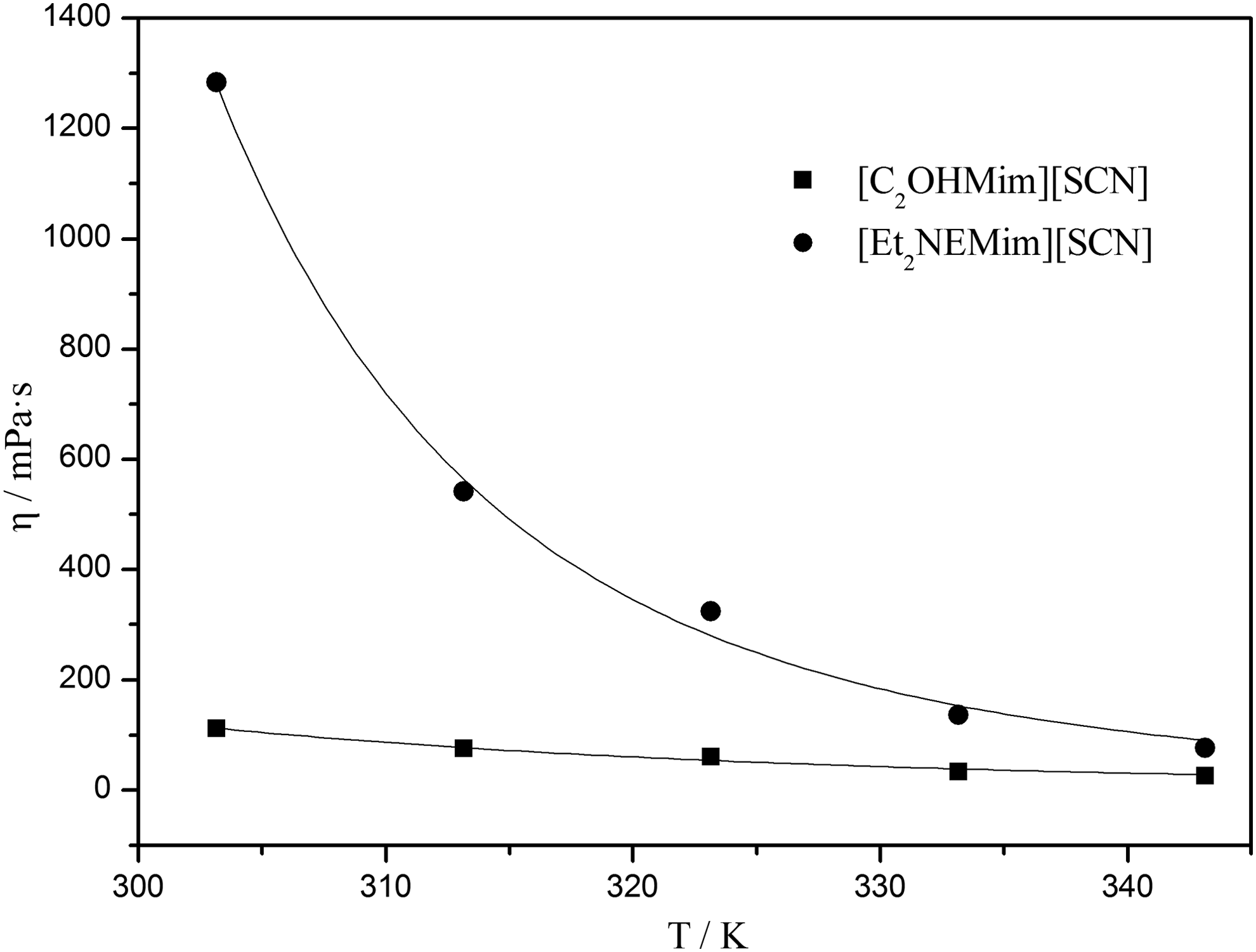
Temperature dependence of viscosity for ILs. • [Et2NEMim][SCN]: a = 4.41 × 10⁻² b = 1184.27, T0 = 187.93, R2 = 0.9938; ▪ [C2OHMim][SCN]: a = 3.18 × 10⁻³, b = 2661.24, T0 = 49.05, R2 = 0.9927.
where T is absolute temperature; a, b, and T0 are the fit coefficients. The fitted parameters a, b, T0 and the correlation coefficients R2 are given in Fig. 5. The correlation coefficients were both >0.9927, indicating that the effect of temperature on the viscosities of the ILs can be well described by the VTF equation.
The temperature dependence of conductivity for these ILs is shown in Fig. 6. At the whole temperature range, the conductivities increase with the increase of temperature. The observed temperature dependence of conductivity is often best described by the empirical VTF Equation (3) (Liu et al., 2013):
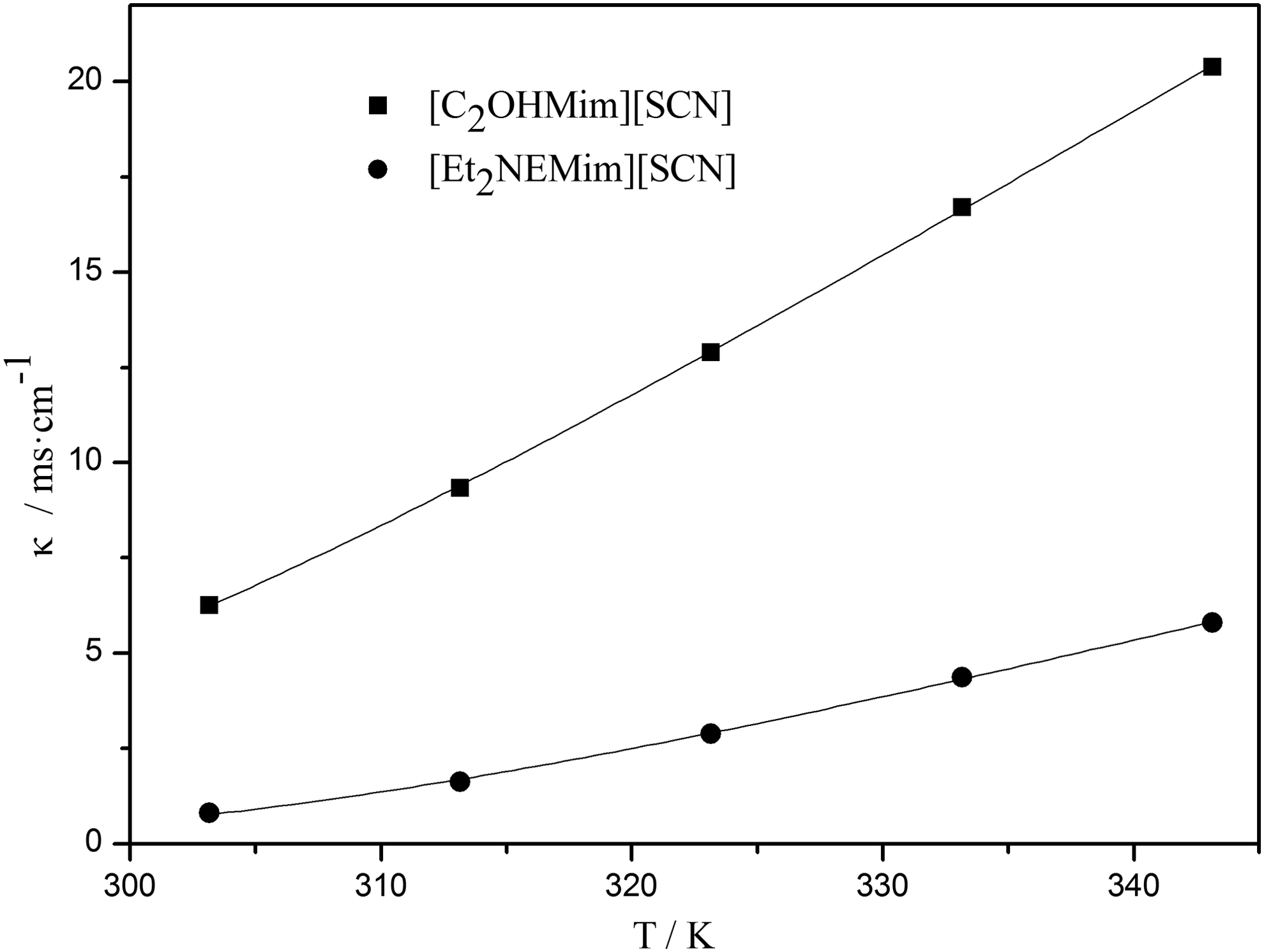
Temperature dependence of conductivity for ILs. • [Et2NEMim][SCN]: κ∞ = 20.71 ms/cm, Ea = 56.07 meV, Tg = 303.2 K, R2 = 0.9796; ▪ [C2OHMim][SCN]: κ∞ = 11.41 ms/cm, Ea = 170.58 meV, Tg I = 249.6 K, R2 = 0.9955.
where κ∞, Ea, kB, and Tg are the maximum electrical conductivity, the activation energy for electrical conduction, the Boltzmann's constant, and ideal glass transition temperature in K, respectively. VTF fitting parameters for the ionic conductivity of ILs and the correlation coefficients R2 are presented in Fig. 6. It can be seen that the temperature dependence of conductivity for these ILs is very well fitted by the VTF equation over the temperature range studied.
Absorption of SO2 in ILs
Effect of temperature
Effect of temperature on solubility of SO2 in [Et2NEMim][SCN] and [C2OHMim][SCN] was determined at 298.15–343.15 K and atmospheric pressure and the results are presented in Table 2 and Fig. 7. It can be seen that the solubility decreases sharply with the increase of temperature, which means that most of the absorbed SO2 can be removed by elevating temperature. At the whole temperature range, the absorption amounts in [Et2NEMim][SCN] are higher than those of [C2OHMim][SCN]. [Et2NEMim][SCN] stayed as a liquid before and after absorption. This means a successive operation process is speculated in practical application. It also can be seen from Fig. 7 that the solubility does not change linearly with temperature. The relationship between solubility and temperature can be described by a third-order polynomial Equation (4):

Effect of temperature on SO2 absorption in ILs. • [Et2NEMim][SCN]: A1 = −2.7629, A2 = 0.0081, A3 = 7.9480 × 10⁻⁶, B = 314.5152, R2 = 0.9986; ▪ [C2OHMim][SCN]: A1 = −1.0277, A2 = 0.0030, A3 = −2.9341 × 10⁻⁶, B = 118.1775, R2 = 0.9839.
Standard uncertainties u are as follows: u(P) = ±0.005 MPa, u(T) = ±0.01 K.
where AM represents the absorption amount (mass fraction); T is absolute temperature; A1, A2, A3, and B are the fit coefficients. The fitted parameters A1, A2, A3, and B and the R2 are shown in Fig. 7.
Effect of H2O
Water is presented in flue gas and its effect on the absorption of SO2 by ILs is always unavoidable, so the absorption of SO2 by IL aqueous solutions at different temperatures and 0.1 MPa of pure SO2 were also investigated and the results are shown in Table 2. It can be seen that the presence of water has a positive impact on SO2 absorption for both ILs. These results were similar to earlier reported IL amino-functionalized pyridinium-based IL [Et2NEPy][SCN] and quite contrary to nitrile-functionalized pyridinium-based IL [C4CNPy][SCN] or ether group-functionalized pyridinium-based IL [C4OPy][SCN] (Zeng et al., 2014). The enhancement of SO2 absorption amount in [Et2NEMim][SCN] can be interpreted by the chemical interaction between the amino group and SO2 by the formation of sulfite salt, which had been certified by IR and 1H NMR analysis of fresh and SO2 saturated IL aqueous solution. [Et2NEMim][SCN] 5% aqueous solution showed promising application prospect for its low viscosity of 172.81 cp and high absorption amount of 0.938 gSO2/gIL at 303.15 K.
Recycle of IL
Recycling of IL is very important for industrial application considering the technical efficiency and economical feasibility. In this work, the reusability of [Et2NEMim][SCN] was studied. Usually, saturated absorption amount was observed in 60 min at 303.15 K and 1 atm, with a stream of 30 mL/min pure SO2, and the captured SO2 can be completely removed in 20 min at 80°C under vacuum (4.24 kPa). The quantitatively recovered [Et2NEMim][SCN] was directly used in the following absorption process. The recycle of SO2 absorption and desorption in [Et2NEMim][SCN] is shown in Fig. 8. The results showed that the absorption is highly reversible, and the loss of absorption ability was not manifested after five consecutive absorption/desorption cycles.

Recycle of [Et2NEMim][SCN].
Comparison with other ILs
To evaluate the efficiency and the potential application in SO2 capture, some typical experimental data from literatures were selected and listed in Table 3. From the limited data, it is easy to find that when [Et2NEMim] was selected as the cation of ILs, the absorption ability decreases in the order: SCN >TeTz> PF6 at the same experimental conditions. This means SCN should be the preferred anion in the design of IL for the purpose of SO2 absorption. It also can be seen that imidazolium-based IL [Et2NEMim][SCN] would be more attractive than pyridinium-based IL [Et2NEPy][SCN] due to the higher absorption amount. For both the imidazolium-based IL and pyridinium-based IL, the introduction of amino group into the cation greatly enhanced the efficiency. The absorption amount of [Et2NEMim][SCN], which is 1.207 g SO2/g IL at 298.15 K and 0.1 MPa of pure SO2, is about six times as high as that of BMImPF6. Meanwhile, SO2 absorption amount of [Et2NEMim][SCN] is even higher than other ILs with SCN as an anion. For example, SO2 absorption amount of 1-ethyl-3-methylimidazolium thiocyanate (EMImSCN) (Wang et al., 2013) and 1-butyl-pyridinium thiocyanate (BPySCN) (Zeng et al., 2014) is 1.13 gSO2/gIL and 0.841 gSO2/gIL at 293.15 K and 0.1 MPa.
Standard uncertainties u are as follows: u(x1) = 0.0001, u(P) = ±0.005 MPa.
Group contribution method to predict solubility of SO2
Although ILs have displayed attractive application prospect in the desulfurization, it is impossible to make a deeply experimental study because the potential ILs are enormous. Hence, it is essential to establish a method to predict the solubility of SO2 in newly designed ILs from extant data. Here, the group contribution method was used to estimate the Henry's law constant of SO2 in various ILs, which method had ever been successfully used to predict another acidic gas CO2 (Cheng et al., 2014). Generally speaking, at constant temperature and low pressure, the gas solubility in the solution is proportional to the gas balance pressure [Eqs. (5)].
where Hi is Henry's law constant, xi is mole fraction solubility of gas, and Pi is balance pressure of gas. The relationship between Henry's law constant and temperature can be described by the following Equation (6):
when n = 1, the Henry's law constant can be expressed by Equation (7).
then, from the known data of ILs, A0 and A1 can be estimated by the group contribution method [Eqs. (8)].
where ni is the number of the group in ILs, and Gi and Gi′ are the contribution parameters of group.
Thirty-eight typical ILs with 49 experimental Henry's law constants are gathered in Table 4. The structure of ILs was divided to 25 basic groups. The fitting parameters Gi and Gi′ for each group are shown in Table 5. The Henry's law constants in different ILs were then calculated from Table 5 and the comparison made with experimental data in Fig. 9. The average absolute deviation is 2.069%, which indicated that the devised group contribution method is efficient to predict the Henry's law constants of SO2 in an unknown IL.
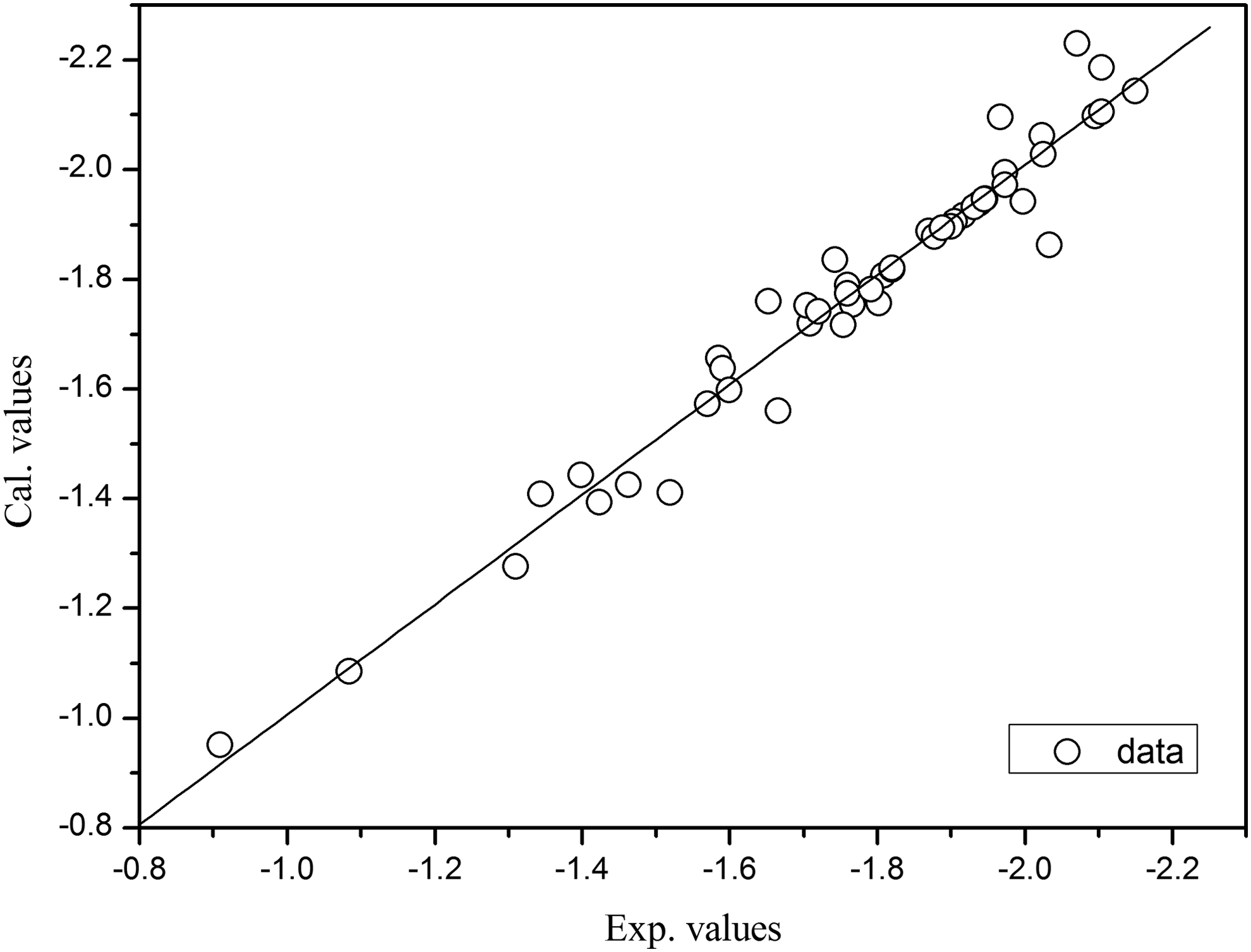
Comparison of experimental values and calculated values by group contribution method.
“a” data in this work. Standard uncertainties u are as follows: u (T) = ±0.01 K, u (P) = ±0.005 MPa.
Conclusions
In summary, two functionalized imidazolium ILs 1-(2-diethylaminoethyl)-3-methylimidazolium thiocyanate (Et2NEMImSCN) and 1-(2-hydroxyethyl)-3-methylimidazolium thiocyanate (HOEMImSCN) were prepared and characterized. These ILs have high thermal decomposition temperature, higher density than water, high viscosity, and moderate conductivity. The relationship between temperature and density can be described by a linear equation and the temperature-dependent viscosity and conductivity is described by a VTF equation. The solubility of SO2 at 298.15 K and atmosphere pressure in Et2NEMImSCN and HOEMImSCN is 1.207 gSO2/gIL and 0.649 gSO2/gIL, respectively. The absorption amount decreased with the increase of temperature, and water had a positive effect on absorption. Et2NEMImSCN seemed to be a more promising alternative candidate absorbent of SO2 for its high efficiency and excellent reversibility. Finally, a group contribution method based on the literature data was proposed to predict the Henry's law constant of SO2 in ILs.
Footnotes
Acknowledgments
This work was financially supported by the Natural Science Foundation of Hebei Province (Project No. 2015208122), the Foundation of the Education Department of Hebei Province (Project No. 2012007), the Foundation of Hebei University of Science & Technology (Project No. 2014PT80), and the Environment Engineering Key Subject Construction Project of Hebei Province. The authors also thank Prof. Ren Qingliang from Shijiazhuang Hospital of Occupational Diseases Prevention and Treatment Central Laboratory for his support and kind advice on this research.
Author Disclosure Statement
No competing financial interests exist.