




Abstract
Abstract
After conventional biological treatment processes, effluents of the coking industry contain high concentration of nonbiodegradable and refractory organic matters, which should be treated to satisfy the discharge water quality standards (chemical oxygen demand [COD] <150 mg/L, NH3–N < 25 mg/L). In this study, post-treatment of coke plant wastewater was treated by the direct Fenton and anodic electro-Fenton (EF-Feox) methods. COD and total organic carbon (TOC) values were selected as the target parameters. COD and TOC removal efficiency was investigated through changing some operating parameters such as initial pH, initial H2O2 concentration, and current density. Under the optimum operating conditions of each progress, COD and TOC were removed more efficiently in the EF-Feox system (90% and 84.4%) compared with that in the Fenton method (61.96% and 48.12%). Influence of H2O2 feeding on removal efficiency was also investigated in this study. Results indicated that gradual addition of H2O2 instead of initial addition was a simple and convenient means of removing COD and TOC effectively. Furthermore, settling characteristics of waste sludge under different operating conditions was studied. In general, the EF-Feox process can be a promising and reasonable method in the post-treatment of coking wastewater.
Introduction
A
Nowadays, the advanced oxidation processes hold the great attention for post-treatment of industrial wastewater owing to a large amount of residual of the hard-to-biodegrade organics in the wastewater (Chou et al., 1999; Lin and Chang, 2000; Irmak et al., 2006; Brillas et al., 2009). Among varieties of AOPs, Fenton reactions, which rely on the hydroxyl radicals (·OH) through the reaction between hydrogen peroxide (H2O2) and ferrous ion (Fe2+), have been given growing interests for wastewater treatment (Benitez et al., 2001; Boye et al., 2002; Pérez et al., 2002; Zhu and Logan, 2013). Based on the Fenton reaction, several kinds of technologies, including classic Fenton treatment, photo-assisted Fenton reaction, and electrochemical Fenton treatment, have been applied to the treatment of various hazardous organic compounds (Qiang et al., 2003; Brillas et al., 2009; Zhao et al., 2010; Yuan et al., 2011). Due to easy operation, wonderful effect, and no discharge of secondary pollution to the environment, eletro-Fenton was considered as a preferable method for degradation of different kinds of wastewater (Liu et al., 2012; Zhang et al., 2012; Ding et al., 2013; Wang et al., 2013; Zhu and Logan, 2013; Bai and Shi, 2013; Xing et al., 2012). The usage of electro-Fenton method was proposed as an alternative method. The approach consists of adding ferrous iron with simultaneous produce of H2O2 by oxygen on many special electrodes. Another approach, termed anodic Fenton (EF-Feox progress), utilizes sacrificed iron anode to provide ferrous combined with H2O2 and then added to form Fenton's reagent. The advantage of EF-Feox is that it has overcome the need to handle a large amount of hygroscopic ferrous salt, which is very readily oxidized (Martins et al., 2006). The EF-Feox process is based on using a sacrificial iron anode as the source of ferrous iron [Eq. (1)]. H2O2 is added to the system to stimulate the Fenton reactions [Eq. (6)]. Moreover, Fe2+ could be continuously regenerated on the surface of the cathode Equation (4).
Anode side:
Cathode side:
In the solution:
This study aimed to investigate the efficiency of direct Fenton and EF-Feox processes for the post-treatment of coking wastewater after the A2O treatment. The COD and total organic carbon (TOC) removal efficiency was investigated through changing some operating parameters, such as initial pH, H2O2 concentration, and current density. The effect of H2O2 feeding type on removal efficiency was also studied in this research. The amount of waste sludge under different operating conditions was compared so as to provide some additional information for industrial usage.
Materials and Methods
Coking wastewater characteristics
Coking wastewater used in this work was taken from the polyethylene bottles from the outlet of a biological treatment unit of a steel company in Wuhan, Hubei province, China. The wastewater taken from biological treatment effluent was used directly in the following treatment. On average, its characteristics are shown in Table 1.
COD, chemical oxygen demand; TOC, total organic carbon.
Experimental system and procedure
A rectangular organic glass reactor (150 × 150 × 200 mm) was used for both Fenton and EF-Feox experiments. A magnetic stirrer (Model HJ-3, China) was used for constant stirring. In each trial, ∼4,000 mL of coking wastewater was added to the glass reactor. All the experiments were performed at constant temperature (25°C).
Oxidation of wastewater by Fenton reagent
A proper concentration of FeSO4 and H2O2 was simultaneously added to the glass reactor. Samples were taken out by syringe at the same time intervals and neutralized to approximately pH 10 by 3 M sodium hydroxide solution. The supernatant of the solution was taken to measure the COD and TOC values after being left alone for 20 min.
Oxidation of wastewater by EF-Feox progress
The anode was a reticular titanium (4 × 10 cm) plate with a thin coating of RuO2. Furthermore, a ferrous plate (4 × 10 cm) was also in parallel with the anode. A stainless steel cylindrical net (the effective surface area of 0.66 m2) was located outside the anode. A laboratory DC power supply was used to support electrolysis current. A suitable amount of hydrogen peroxide was added to study its effects on the COD and TOC removals. After the first drop of hydrogen peroxide was poured into the vessel, the electric power was turned on simultaneously to start the oxidation process. At different time intervals, samples were taken into the beaker with 3 M sodium NaOH to quench the reaction by increasing pH around 10.0. The samples were filtered and then the filtrate was used to measure the COD and TOC values.
Analytical methods
Solution pH was monitored by a portable pH meter (Mettler-Toledo Instruments Co. Ltd., Shanghai). All the analyses were carried out in accordance with the Standard Methods of the APHA (APHA, 1995). COD was determined utilizing a closed reflux spectrophotometric method according to the Standard Methods. The combustion-infrared method using TOC analyzer (Rosemount Dohrmann, Model-190) was used for TOC measurement.
Result and Discussion
Treatment of coking wastewater by direct Fenton
To investigate the effect of H2O2 dosage during the direct Fenton process, a series of experiments were conducted at different concentrations of H2O2, ranging from 1,000 to 8,000 mg/L, and ferrous sulfate concentration was 1,000 mg/L at an initial pH of 3.0. As shown in Fig. 1, only 26.67% COD was removed when the concentration of H2O2 dosage was 1,000 mg/L. Interestingly, the addition of H2O2 would enhance both COD and TOC removal. It may result from more ·OH radicals through the reaction between Fe2+ ions and hydrogen peroxide, which oxidized the organic compounds into smaller molecules. At the initial stage, the rate constant curve increased abruptly, and then, the removal efficiency went to a balance when the dosage reached 6,000 mg/L. It can be seen from Fig. 1 that the optimal H2O2 dosage was 6,000 mg/L with 61.96% COD and 48.12% TOC removal efficiency.
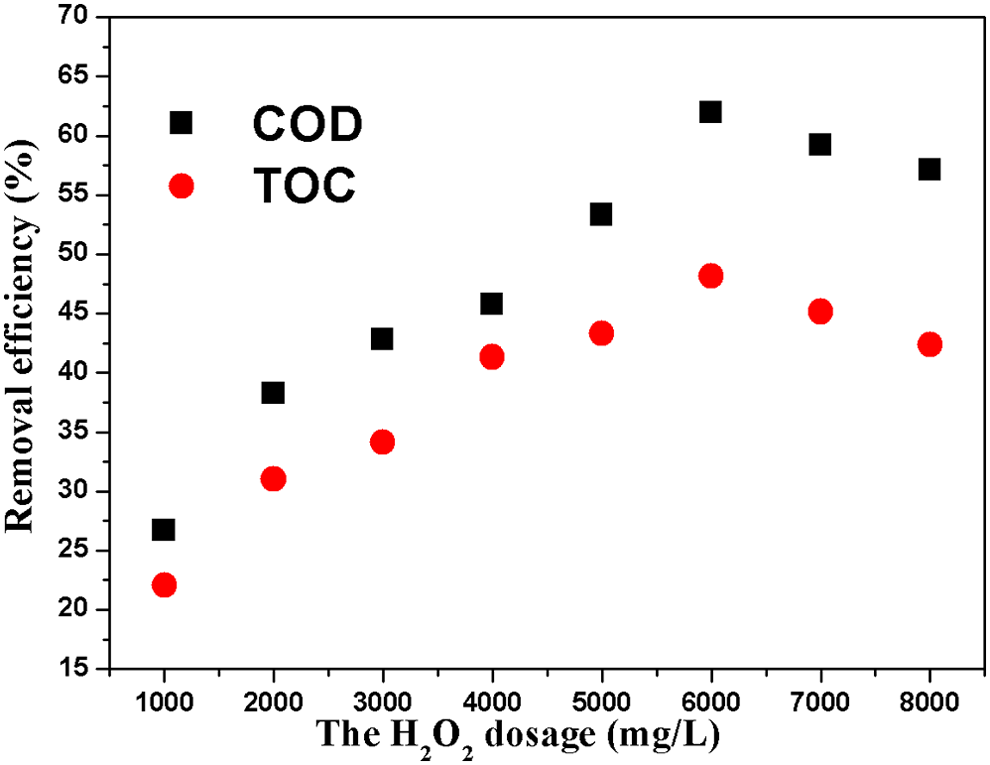
Effect of H2O2 dosage on COD and TOC removal efficiency in Fenton progress (FeSO4 concentration = 1,000 mg/L, initial pH = 3, reaction time = 120 min). COD, chemical oxygen demand; TOC, total organic carbon.
Treatment of coking wastewater by EF-Feox method
The EF-Feox study was focused on determining the optimum values of these parameters, such as initial pH, initial H2O2 concentration, current density, and H2O2 feeding type. Compared with conventional Fenton progress, EF-Feox was found to be more effective.
Effect of initial pH on removal efficiency
To explore the application performance of EF-Feox, the pH range was tested. In the EF-Feox treatment, the pH has been observed to be a significant factor. The effect of initial pH in operating time of 120 min was measured at 40 A/m2 current density, 5,000 mg/L initial H2O2, and initial pH range of 2–7. The pH values were adjusted by the addition of H2SO4 or NaOH. Results obtained from the experiments are presented in Fig. 2. It can be clearly seen that low pH can promote the performance of EF-Feox progress. These results were in favor of other studies on the electrochemical oxidation of organic compounds in wastewater (Wang and Lemley, 2002). Also, under the same operating conditions, TOC removal efficiency was a little lower than COD removal efficiency. When the initial pH was higher than 3.0, lower COD and TOC removal efficiencies were observed. It can be inferred that at pH >3.0, the unstable ferrous ions could easily form ferric ions [Eqs. (6) and (7)], which accelerated the tendency to produce ferric hydroxide complexes. After 120 min of operation time at initial pH 3, the high removal efficiencies of coking wastewater were obtained as 93% for COD and 79% for TOC. It was clear that the removal efficiencies of organic compounds of coking wastewater at initial pH 2–3 increased. This increment, which can be explained with hydroxyl radicals, was produced from Fenton's reactions (6) during the electrochemical treatment. These radicals reacted with organic pollutants in coking wastewater and destroyed them. The present results agreed with previous studies on the degradation of pollutants (Lin and Chang, 2000; Wang and Lemley, 2002).

Effect of initial pH on COD and TOC removal efficiency (current density = 40 A/m2; H2O2 concentration = 5,000 mg/L; reaction time = 120 min).
Effect of current density on removal efficiency
In the EF-Feox process, the amount of Fe2+ released from anode material was decided by the electrolysis time and current density. Therefore, the current density and operating time were important parameters for the process. The effects of current density for treatment of coking wastewater in the EF-Feox process were investigated in the range of 20–50 A/m2 at operating time of 120 min, 5,000 mg/L initial H2O2 concentration, and initial pH 3. In Fig. 3, significant increment in the removal efficiencies of COD and TOC at 60 min could be observed at 20–50 A/m2. The current density increased from 0.8 to 2.0 A with the cell voltage increasing from 5 to 15 V. The removal efficiencies were increased for COD, ranging from 60.15% to 89.3% at 60 min and from 73.15% to 94.40% at 120 min, and for TOC, ranging from 50.15% to 73.35% at 60 min and from 66.15% to 82.42% at 120 min. There was no noticeable change from 60 to 120 min at 40 and 50 A/m2. Along with the increase of current density, a higher concentration of hydroxyl radicals was produced by H2O2 in less time. Furthermore, some refractory organic compounds cannot be further oxidized in the EF-Feox process. As a result, the COD and TOC removal efficiencies could be hardly changed between 60 and 120 min. It also indicates that the optimum current density for the EF-Feox process was 40 A/m2 due to the energy consumption and efficiency.
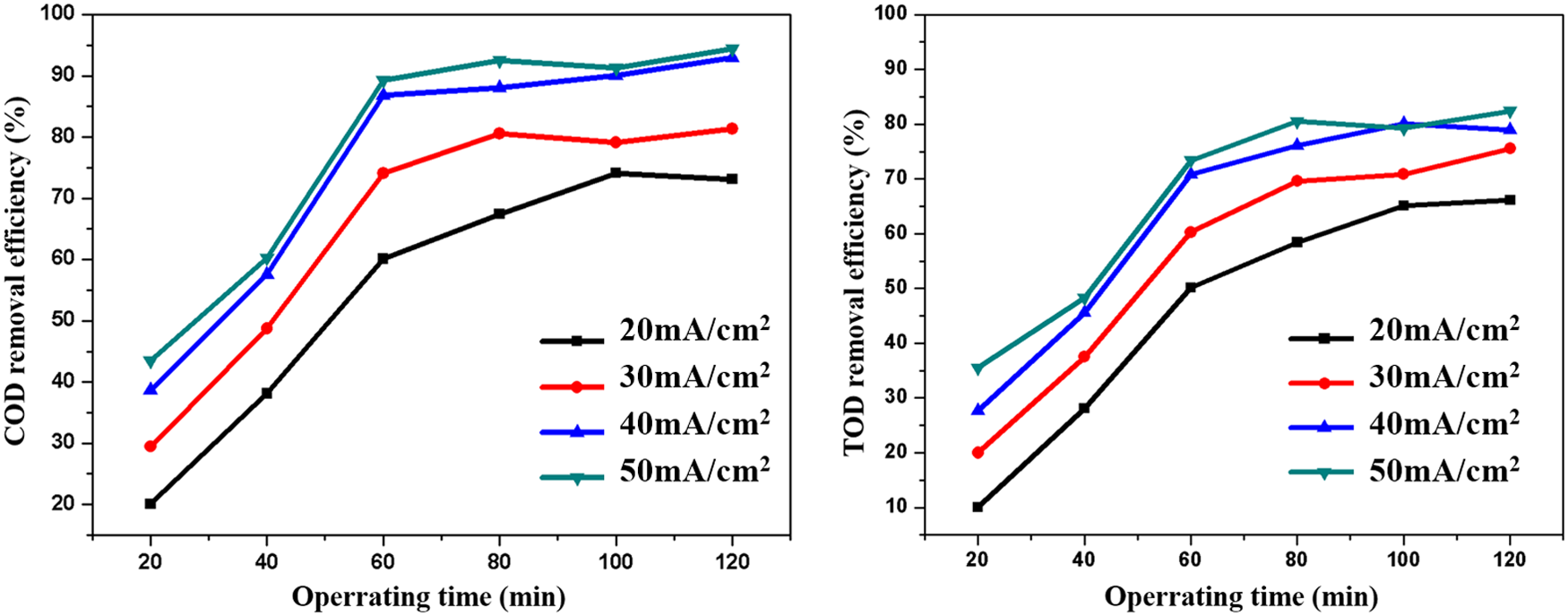
Effect of current density on removal efficiency in EF-Feox progress (H2O2 concentration = 5,000 mg/L; pH = 3; reaction time = 120 min).
Effect of H2O2 initial concentration on removal efficiency
It has been well known that the main source of OH radical is H2O2 used in the EF-Feox process. The optimum H2O2 dosage in the EF-Feox process plays a key role in removal efficiency and economic consideration. The effect of initial H2O2 concentrations on removal efficiencies was investigated in the range of 0–7 g/L on selected optimum conditions (current density of 50 A/m2 and pH of 3). As can be seen in Fig. 4, COD and TOC removal was directly proportional to H2O2 concentration when the current density was high enough. COD removal efficiency increased from 45.85% to 89.30% with H2O2 concentration increasing from 1,000 mg/L to 5,000 mg/L in 60 min and COD removal efficiency at 5,000 mg/L reached 94.40% at 120 min. However, COD and TOC removal efficiency had no significant increment at 7,000 mg/L of initial H2O2 concentration. It could be explained by some percentage that .OH was scavenged by Fe2+ in the media depending on Equation (7). In the EF-Feox process, the optimum H2O2 concentration was 5,000 mg/L. Equation (8) also shows that Fe3+ also reacts with H2O2, resulting in a decrease in COD removal. Consequently, the suitable concentration of H2O2 and current density was an important prerequisite in the electro-Fenton reaction.

Effect of H2O2 concentration on removal efficiency in EF-Feox progress (current density = 50 A/m2; pH = 3; reaction time = 120 min).
Effect of H2O2 feeding type on removal efficiency
Investigation of H2O2 feeding type on removal efficiency of COD and TOC is a feature in our research. At exactly the same experimental conditions (pH = 3, current density = 50 mA/cm2), initial and gradual H2O2 feeding type was discussed in the EF-Feox progress. In the initial type, 4,000 mg/L H2O2 was added to the reactor at the start of trial. In the gradual type, 4,000 mg/L H2O2 was introduced to the reactor both initially and gradually eight times. Gradual addition of H2O2 instead of initial addition was found to be an easy and effective way to increase COD and TOC removal efficiency. As shown in Fig. 5, although a total of 4,000 mg/L H2O2 was used in both processes, the addition of H2O2 step by step can reach higher COD and TOC removal efficiencies. COD and TOC removal of 91.42% and 84.43% was obtained at gradual H2O2 feeding type, whereas they were 82.55% and 72.52% at initial H2O2 feeding. Moreover, both COD and TOC removals reached balance after 60 min in the initial type, while they continued to increase in the gradual type. The results indicated that the electrolysis after 80 min was meaningless in the initial additional type. As shown in Fig. 5, no matter how long the electrolysis continues, more than the limit values (COD removal of 80% and TOC removal of 70%) cannot be reached for the initial type of addition.
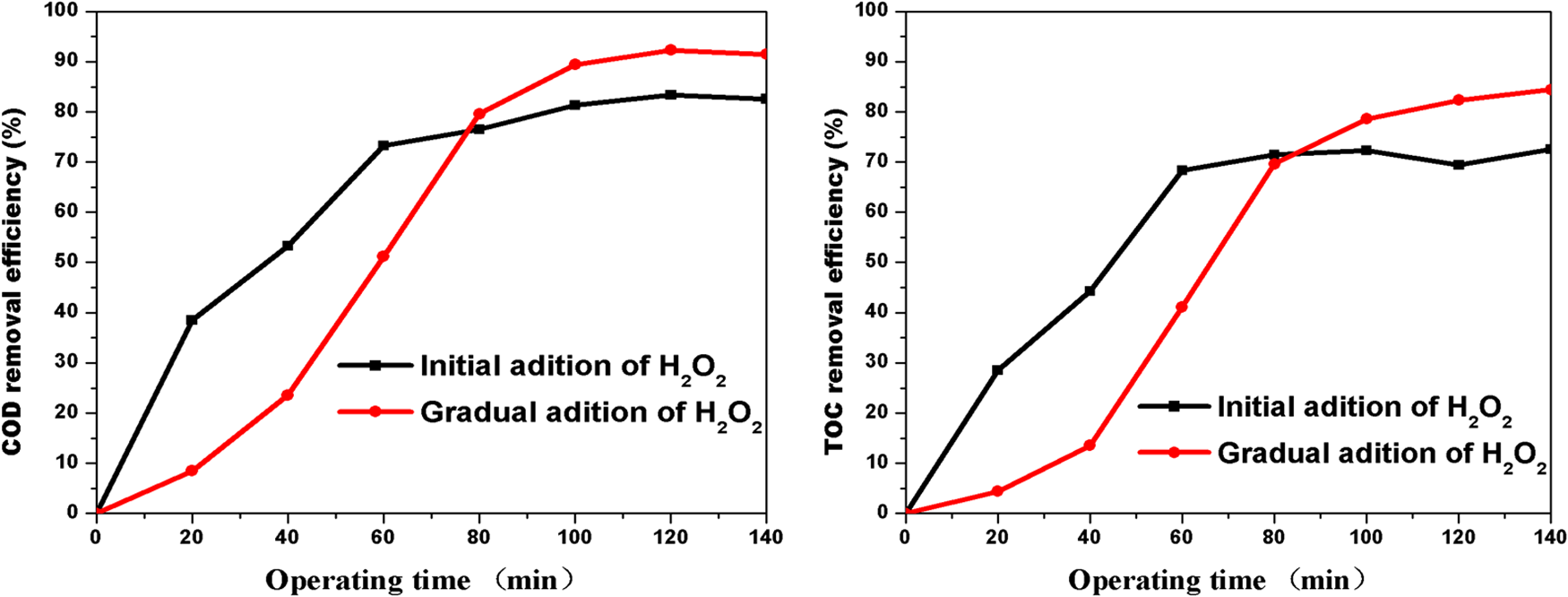
Effect of H2O2 feeding type on removal efficiency in EF-Feox progress (current density = 50 A/m2; pH = 3; reaction time = 140 min).
There are two reasons for the difference of removal efficiency caused by the H2O2 feeding type. First of all, some initially added H2O2 decomposed by itself. Second, there was not enough amount of electro-generated Fe2+ in the system to react with H2O2. In addition, the generated hydroxyl radicals can also be consumed by excess H2O2. However, in the gradual addition of H2O2, Fe2+ was electro-generated consecutively and reacted with newly added H2O2 after each sample was taken out from the reactor. Thus, the hydroxyl radical was continuously formed according to reaction (6) and was degraded into organic compounds.
Amount and settling property of sludge
To estimate the settling property of sludge produce in the EF-Feox progress, the sludge volume index (SVI) parameter value was estimated. Sludge with an SVI value of lower than 100 was considered to have good settling characteristics (George et al., 2013). Compared with the conventional Fenton, one of the most important advantages of EF-Feox progress is the formation of lower amounts of sludge with better settling properties (Zhang et al., 2006). The SVI values estimated in different operating conditions during the EF-Feox progress process are shown in Fig. 6. It was clear that the SVI values decreased with current density ranging from 20 to 50 mA/cm2. The increment of current density caused Fe ions to enter into the reactor quickly. The SVI values were determined to be below 100 in the current density of 40 and 50 mA/cm2. In the initial pH values of 2, 5, and 7, the SVI values were above 100. However, in the initial pH of 3, the SVI values were obtained to be 90. Furthermore, it can be found that the SVI value increased when the initial H2O2 concentration was >5 g/L and current density was >40 mA/cm2. The lowest SVI value was 80 mg/L at pH 3. The reason was that the Fe (OH)3 flocks are larger and more stable under the slight alkali conditions. On the contrary, at low pH, it was hard to form Fe(OH)3 flocks. The amount of sludge produced in the EF-Feox process was obtained as 1.13 kg/m3 under 50 mA/cm2. The sludge production was proportional to current density and operation time. To treat sludge, it was collected and dried at 110°C for 24 h in the oven. The amount of sludge produced in the EF-Feox process at 60 min ranged from 1.19 to 3.23 kg/m3 at 20–50 mA/cm2. This value at the current density of 40 mA/cm2 was obtained as 1.28 kg/m3.

SVI values in different operating conditions in EF-Feox progress. SVI, sludge volume index.
Comparison of Fenton and EF-Feox progress
To give a general idea about what is the characterization before and after this treatment, the characterization of wastewater was also analyzed after treatment and the results are shown in Table 2. We also evaluate the Fenton and EF-Feox method from the economic perspective and application for industrial use. The total operating cost of the EF-Feox progress (4.28 $/m3) is more than twice higher than that in the Fenton system (2.13 $/m3). The EF-Feox progress method not only presents high COD removal ability and catalytic activity but also needs more economic consumption in wastewater treatment. Even so, the major advantage of EF-Feox is that ferrous ion is generated into the reaction system by electrolysis from a sacrificial iron anode. This has overcome the need to handle a large amount of hygroscopic ferrous salt, which is very readily oxidized. Also, this may be convenient for industrial use.
Conclusions
In summary, the post-treatment of coking wastewater was investigated by the Fenton and EF-Feox methods. It was found that the EF-Feox process demonstrated a more remarkable treatment performance than Fenton. Compared with the direct Fenton and EF-Feox processes, the results have indicated that more than 90% of COD removal and 80% of TOC removal were obtained in the EF-Feox method; however, only 61.96% of COD and 48.12% of TOC were removed by Fenton's method.
In the optimization experimentation, the current density and H2O2 concentration have a considerable effect on the efficiency of EF-Feox process. Moreover, the H2O2 feeding type and pH also have strongly influenced the performance of EF-Feox process. The gradual addition of H2O2 was found to be an effective way to increase COD and TOC removal efficiency. The optimum operation conditions for EF-Feox were determined as 50 mA/cm2 current density, 5,000 mg/L H2O2 concentration, and initial pH of 3 for electrolysis process at 120 min. Under these conditions, the COD and TOC removal efficiencies were obtained as 95.3% and 84.4%, respectively. The amount of sludge production of EF-Feox was found to be 1.28 kg/m3. In general, the EF-Feox process can be a promising and reasonable method in the post-treatment of coking wastewater.
Footnotes
Author Disclosure Statement
No competing financial interests exist.