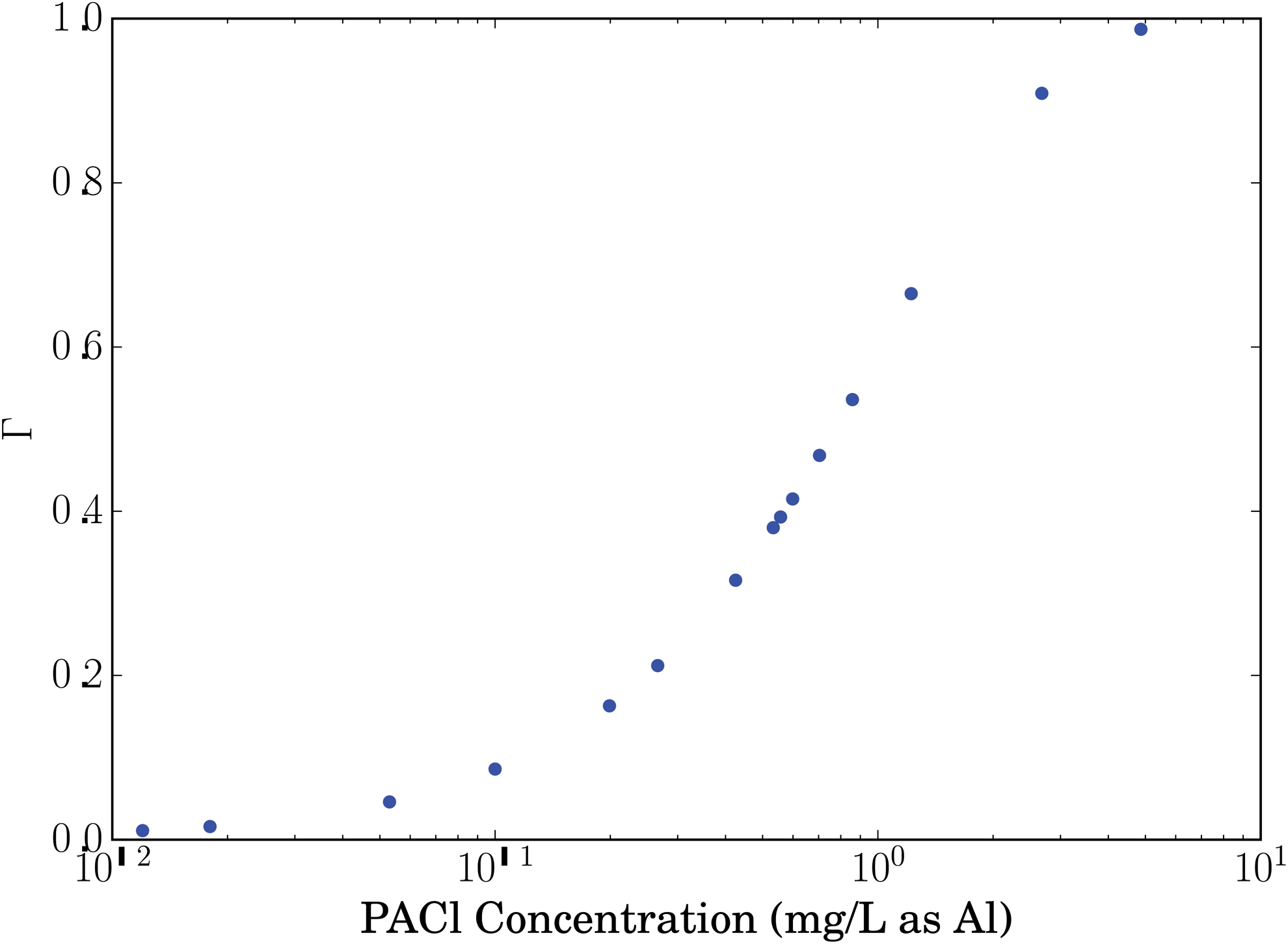
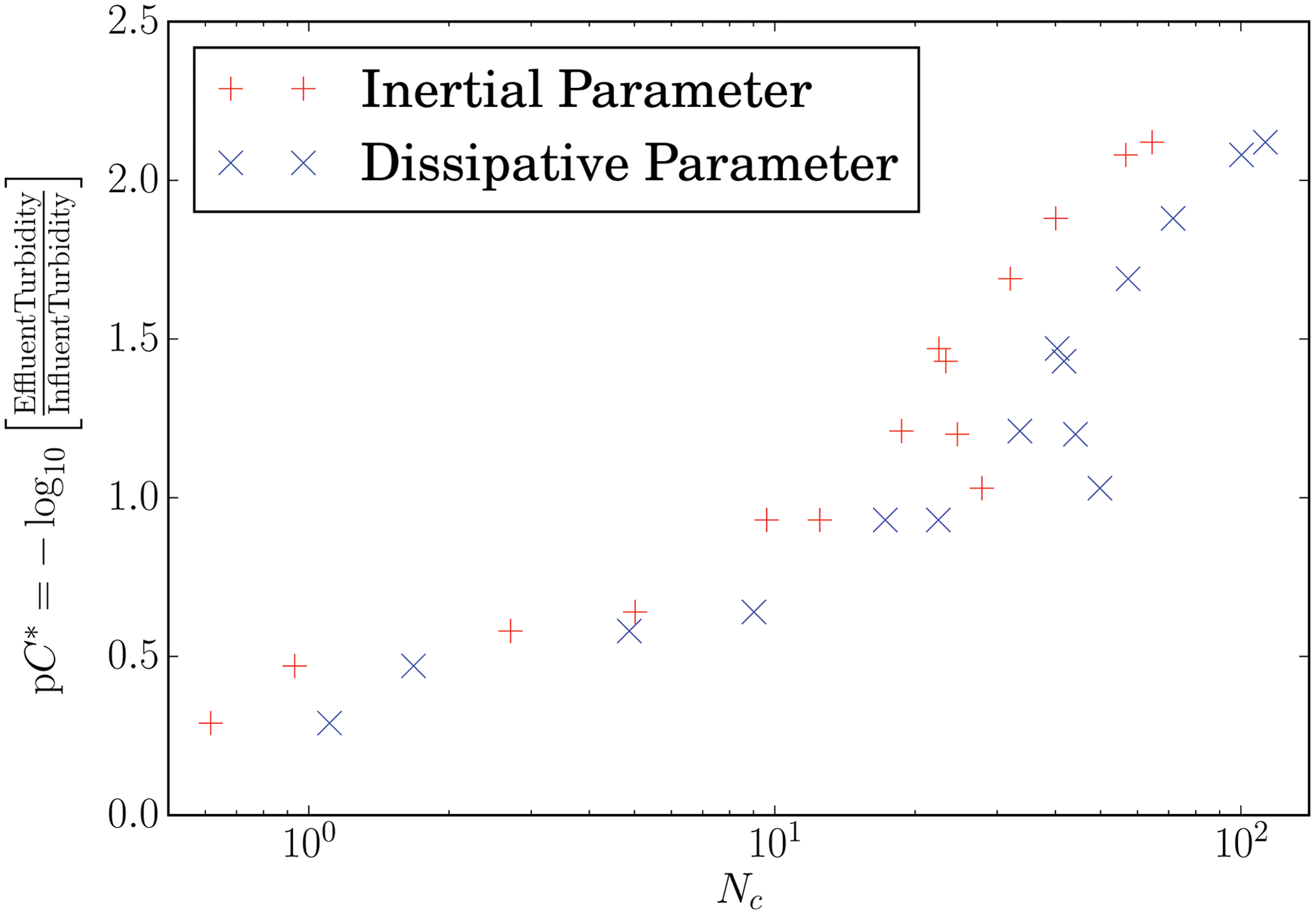
A predictive, mechanistically based performance model for hydraulic flocculation could potentially enable improved design for hydraulic flocculators. Such a model would take characteristics of the flocculator and the suspension as inputs so that designers and operators could rationally consider effects of changing flocculator dimensions or influent water conditions on performance. A performance model exists for laminar flocculators, but a model applicable to turbulent flocculators is still needed, as real scale flocculators operate in the turbulent regime. This article outlines a theoretical approach that suggests the form of two dimensionless composite parameters that account for the influence of raw water turbidity, coagulant dose, flocculator hydraulic residence time, and energy dissipation rate on settled water turbidity. The utility of these parameters in describing turbulent flocculation will require testing and validation. Thus, this article also describes the design of a suitable laboratory test apparatus that produces turbulent flow conditions that mimic those in a baffled hydraulic flocculator. Preliminary experimental results are given.
Introduction
Many municipal drinking water treatment plants could benefit from the reduction in operation and maintenance costs that results from using baffled hydraulic flocculators. Unlike mechanical flocculators, baffled hydraulic flocculators require no electricity to operate and have no moving parts that would need to be serviced or replaced in the normal operation of the plant. Furthermore, fluid movement in baffled hydraulic flocculators approaches plug flow, improving reaction rates and reducing the likelihood of short-circuiting relative to mechanical flocculators, which operate more like continuous flow stirred tank reactors.
Hydraulic flocculators are not widely implemented because they are assumed to be less flexible in operation and design guidelines give preference to mechanical flocculators (Haarhoff, 1998; GLUMRB, 2012). Mechanistically based design guidelines for hydraulic flocculators could lead to more efficient design, more widespread adoption, and decreased costs for municipal drinking water treatment plants.
Weber-Shirk and Lion (2010) developed a fundamentally based, dimensionless composite parameter to estimate the number of successful collisions experienced by a particle in a baffled hydraulic flocculator. This composite parameter can be used to develop a model for flocculator performance that predicts settled water turbidity. The composite parameter was further refined in collaboration with Swetland et al. (2014) under conditions of laminar flow, and is defined as
\documentclass{aastex}\usepackage{amsbsy}\usepackage{amsfonts}\usepackage{amssymb}\usepackage{bm}\usepackage{mathrsfs}\usepackage{pifont}\usepackage{stmaryrd}\usepackage{textcomp}\usepackage{portland, xspace}\usepackage{amsmath, amsxtra}\pagestyle{empty}\DeclareMathSizes{10}{9}{7}{6}\begin{document}
\begin{align*}
{N_c} \propto G \theta { \Gamma } \phi _0^{2 / 3} , \tag{1}
\end{align*}
\end{document}
where \documentclass{aastex}\usepackage{amsbsy}\usepackage{amsfonts}\usepackage{amssymb}\usepackage{bm}\usepackage{mathrsfs}\usepackage{pifont}\usepackage{stmaryrd}\usepackage{textcomp}\usepackage{portland, xspace}\usepackage{amsmath, amsxtra}\pagestyle{empty}\DeclareMathSizes{10}{9}{7}{6}\begin{document}
$${N_c}$$
\end{document} is the potential number of successful collisions of an average particle during the hydraulic residence time, \documentclass{aastex}\usepackage{amsbsy}\usepackage{amsfonts}\usepackage{amssymb}\usepackage{bm}\usepackage{mathrsfs}\usepackage{pifont}\usepackage{stmaryrd}\usepackage{textcomp}\usepackage{portland, xspace}\usepackage{amsmath, amsxtra}\pagestyle{empty}\DeclareMathSizes{10}{9}{7}{6}\begin{document}
$$G$$
\end{document} is the velocity gradient \documentclass{aastex}\usepackage{amsbsy}\usepackage{amsfonts}\usepackage{amssymb}\usepackage{bm}\usepackage{mathrsfs}\usepackage{pifont}\usepackage{stmaryrd}\usepackage{textcomp}\usepackage{portland, xspace}\usepackage{amsmath, amsxtra}\pagestyle{empty}\DeclareMathSizes{10}{9}{7}{6}\begin{document}
$$\left[ { \frac { 1 } { { { \rm { T } } } } } \right]$$
\end{document}, \documentclass{aastex}\usepackage{amsbsy}\usepackage{amsfonts}\usepackage{amssymb}\usepackage{bm}\usepackage{mathrsfs}\usepackage{pifont}\usepackage{stmaryrd}\usepackage{textcomp}\usepackage{portland, xspace}\usepackage{amsmath, amsxtra}\pagestyle{empty}\DeclareMathSizes{10}{9}{7}{6}\begin{document}
$$\theta$$
\end{document} is the hydraulic residence time \documentclass{aastex}\usepackage{amsbsy}\usepackage{amsfonts}\usepackage{amssymb}\usepackage{bm}\usepackage{mathrsfs}\usepackage{pifont}\usepackage{stmaryrd}\usepackage{textcomp}\usepackage{portland, xspace}\usepackage{amsmath, amsxtra}\pagestyle{empty}\DeclareMathSizes{10}{9}{7}{6}\begin{document}
$$\left[ {{ \rm{T}}} \right]$$
\end{document}, and \documentclass{aastex}\usepackage{amsbsy}\usepackage{amsfonts}\usepackage{amssymb}\usepackage{bm}\usepackage{mathrsfs}\usepackage{pifont}\usepackage{stmaryrd}\usepackage{textcomp}\usepackage{portland, xspace}\usepackage{amsmath, amsxtra}\pagestyle{empty}\DeclareMathSizes{10}{9}{7}{6}\begin{document}
$${ \phi_0}$$
\end{document} is the initial volume fraction of particles with a settling velocity less than the capture velocity (critical velocity) of the lamellar sedimentation process.
The initial volume fraction, \documentclass{aastex}\usepackage{amsbsy}\usepackage{amsfonts}\usepackage{amssymb}\usepackage{bm}\usepackage{mathrsfs}\usepackage{pifont}\usepackage{stmaryrd}\usepackage{textcomp}\usepackage{portland, xspace}\usepackage{amsmath, amsxtra}\pagestyle{empty}\DeclareMathSizes{10}{9}{7}{6}\begin{document}
$${ \phi _0}$$
\end{document} is the ratio of the initial volume of particles to the volume of the reactor, defined as \documentclass{aastex}\usepackage{amsbsy}\usepackage{amsfonts}\usepackage{amssymb}\usepackage{bm}\usepackage{mathrsfs}\usepackage{pifont}\usepackage{stmaryrd}\usepackage{textcomp}\usepackage{portland, xspace}\usepackage{amsmath, amsxtra}\pagestyle{empty}\DeclareMathSizes{10}{9}{7}{6}\begin{document}
$$ { \phi _0 } = { \frac { { C_ { { { \rm P } _0 } } } } { { \rho _ { \rm P } } } } $$
\end{document}, where \documentclass{aastex}\usepackage{amsbsy}\usepackage{amsfonts}\usepackage{amssymb}\usepackage{bm}\usepackage{mathrsfs}\usepackage{pifont}\usepackage{stmaryrd}\usepackage{textcomp}\usepackage{portland, xspace}\usepackage{amsmath, amsxtra}\pagestyle{empty}\DeclareMathSizes{10}{9}{7}{6}\begin{document}
$${C_{ \rm{P}}}_0$$
\end{document} is the initial concentration of primary particles in suspension \documentclass{aastex}\usepackage{amsbsy}\usepackage{amsfonts}\usepackage{amssymb}\usepackage{bm}\usepackage{mathrsfs}\usepackage{pifont}\usepackage{stmaryrd}\usepackage{textcomp}\usepackage{portland, xspace}\usepackage{amsmath, amsxtra}\pagestyle{empty}\DeclareMathSizes{10}{9}{7}{6}\begin{document}
$$\left[ { \frac { \rm M } { \rm L^3 } } \right]$$
\end{document} and \documentclass{aastex}\usepackage{amsbsy}\usepackage{amsfonts}\usepackage{amssymb}\usepackage{bm}\usepackage{mathrsfs}\usepackage{pifont}\usepackage{stmaryrd}\usepackage{textcomp}\usepackage{portland, xspace}\usepackage{amsmath, amsxtra}\pagestyle{empty}\DeclareMathSizes{10}{9}{7}{6}\begin{document}
$${ \rho _{ \rm{P}}}$$
\end{document} is the density of the primary particles \documentclass{aastex}\usepackage{amsbsy}\usepackage{amsfonts}\usepackage{amssymb}\usepackage{bm}\usepackage{mathrsfs}\usepackage{pifont}\usepackage{stmaryrd}\usepackage{textcomp}\usepackage{portland, xspace}\usepackage{amsmath, amsxtra}\pagestyle{empty}\DeclareMathSizes{10}{9}{7}{6}\begin{document}
$$\left[ { \frac { \rm M } { \rm L^3 } } \right]$$
\end{document} (Swetland et al., 2014). Last, \documentclass{aastex}\usepackage{amsbsy}\usepackage{amsfonts}\usepackage{amssymb}\usepackage{bm}\usepackage{mathrsfs}\usepackage{pifont}\usepackage{stmaryrd}\usepackage{textcomp}\usepackage{portland, xspace}\usepackage{amsmath, amsxtra}\pagestyle{empty}\DeclareMathSizes{10}{9}{7}{6}\begin{document}
$${ \Gamma }$$
\end{document} is the fraction (between 0 and 1) of primary particle surface that is covered with coagulant precipitates, and it has the same effect as a collision efficiency factor, although with a geometric interpretation. The predictive utility of this parameter on settled water turbidity was verified for laminar flow conditions (Swetland et al., 2014).
To make Equation (1) easier to interpret geometrically, the average separation distance between particles can be substituted for particle volume fraction. First, it is noted that \documentclass{aastex}\usepackage{amsbsy}\usepackage{amsfonts}\usepackage{amssymb}\usepackage{bm}\usepackage{mathrsfs}\usepackage{pifont}\usepackage{stmaryrd}\usepackage{textcomp}\usepackage{portland, xspace}\usepackage{amsmath, amsxtra}\pagestyle{empty}\DeclareMathSizes{10}{9}{7}{6}\begin{document}
$$\phi$$
\end{document} is a ratio of concentration to density, both of which are in units of \documentclass{aastex}\usepackage{amsbsy}\usepackage{amsfonts}\usepackage{amssymb}\usepackage{bm}\usepackage{mathrsfs}\usepackage{pifont}\usepackage{stmaryrd}\usepackage{textcomp}\usepackage{portland, xspace}\usepackage{amsmath, amsxtra}\pagestyle{empty}\DeclareMathSizes{10}{9}{7}{6}\begin{document}
$$ { \frac { \rm M } { \rm L^3 } } $$
\end{document}. For both the concentration and the density, the mass is that of the particles. Therefore, the mass cancels, and \documentclass{aastex}\usepackage{amsbsy}\usepackage{amsfonts}\usepackage{amssymb}\usepackage{bm}\usepackage{mathrsfs}\usepackage{pifont}\usepackage{stmaryrd}\usepackage{textcomp}\usepackage{portland, xspace}\usepackage{amsmath, amsxtra}\pagestyle{empty}\DeclareMathSizes{10}{9}{7}{6}\begin{document}
$$\phi$$
\end{document} is simplified to a ratio of volumes: the combined volume of the particles to the total volume of reactor. Since the desired relationship is agent-based and focuses on a single hypothetical particle, the ratio described previously can be made to be the ratio of the volume of a single particle to the volume of fluid that surrounds that single particle
\documentclass{aastex}\usepackage{amsbsy}\usepackage{amsfonts}\usepackage{amssymb}\usepackage{bm}\usepackage{mathrsfs}\usepackage{pifont}\usepackage{stmaryrd}\usepackage{textcomp}\usepackage{portland, xspace}\usepackage{amsmath, amsxtra}\pagestyle{empty}\DeclareMathSizes{10}{9}{7}{6}\begin{document}
\begin{align*}
\phi = { \frac { { \rlap { - } V_ { \rm { P } } } } { { \rlap { - } V_ { { \rm { Surround } } } } } } = { \frac { \frac { \pi } { 6 } d_ { \rm { P } } ^3 } { { { \Lambda } ^3 } } } , \tag { 2 }
\end{align*}
\end{document}
where \documentclass{aastex}\usepackage{amsbsy}\usepackage{amsfonts}\usepackage{amssymb}\usepackage{bm}\usepackage{mathrsfs}\usepackage{pifont}\usepackage{stmaryrd}\usepackage{textcomp}\usepackage{portland, xspace}\usepackage{amsmath, amsxtra}\pagestyle{empty}\DeclareMathSizes{10}{9}{7}{6}\begin{document}
$${d_{ \rm{P}}}$$
\end{document} is the diameter of a particle [L] (assuming it is spherical), and \documentclass{aastex}\usepackage{amsbsy}\usepackage{amsfonts}\usepackage{amssymb}\usepackage{bm}\usepackage{mathrsfs}\usepackage{pifont}\usepackage{stmaryrd}\usepackage{textcomp}\usepackage{portland, xspace}\usepackage{amsmath, amsxtra}\pagestyle{empty}\DeclareMathSizes{10}{9}{7}{6}\begin{document}
$${ \Lambda }$$
\end{document} is the average separation distance between particles [L].
Choice of velocity gradient, \documentclass{aastex}\usepackage{amsbsy}\usepackage{amsfonts}\usepackage{amssymb}\usepackage{bm}\usepackage{mathrsfs}\usepackage{pifont}\usepackage{stmaryrd}\usepackage{textcomp}\usepackage{portland, xspace}\usepackage{amsmath, amsxtra}\pagestyle{empty}\DeclareMathSizes{10}{9}{7}{6}\begin{document}
$$G$$
\end{document}, as part of the dimensionless composite parameter is based upon the Camp-Stein formulation (Cleasby, 1984). Nevertheless, this is a result that can be anticipated when describing the relative velocities between particles in a laminar flow. Assuming that the primary particles in flocculation have low inertia such that they accelerate with the surrounding fluid (i.e., low Stokes number), the relative velocity \documentclass{aastex}\usepackage{amsbsy}\usepackage{amsfonts}\usepackage{amssymb}\usepackage{bm}\usepackage{mathrsfs}\usepackage{pifont}\usepackage{stmaryrd}\usepackage{textcomp}\usepackage{portland, xspace}\usepackage{amsmath, amsxtra}\pagestyle{empty}\DeclareMathSizes{10}{9}{7}{6}\begin{document}
$${v_{ \rm{r}}}$$
\end{document} can be assumed to be dependent upon the average energy dissipation rate (\documentclass{aastex}\usepackage{amsbsy}\usepackage{amsfonts}\usepackage{amssymb}\usepackage{bm}\usepackage{mathrsfs}\usepackage{pifont}\usepackage{stmaryrd}\usepackage{textcomp}\usepackage{portland, xspace}\usepackage{amsmath, amsxtra}\pagestyle{empty}\DeclareMathSizes{10}{9}{7}{6}\begin{document}
$$\bar \varepsilon$$
\end{document}) of the flow, the kinematic viscosity of the fluid (\documentclass{aastex}\usepackage{amsbsy}\usepackage{amsfonts}\usepackage{amssymb}\usepackage{bm}\usepackage{mathrsfs}\usepackage{pifont}\usepackage{stmaryrd}\usepackage{textcomp}\usepackage{portland, xspace}\usepackage{amsmath, amsxtra}\pagestyle{empty}\DeclareMathSizes{10}{9}{7}{6}\begin{document}
$$\nu$$
\end{document}), and the distance separating the particles (\documentclass{aastex}\usepackage{amsbsy}\usepackage{amsfonts}\usepackage{amssymb}\usepackage{bm}\usepackage{mathrsfs}\usepackage{pifont}\usepackage{stmaryrd}\usepackage{textcomp}\usepackage{portland, xspace}\usepackage{amsmath, amsxtra}\pagestyle{empty}\DeclareMathSizes{10}{9}{7}{6}\begin{document}
$${ \Lambda }$$
\end{document}),
\documentclass{aastex}\usepackage{amsbsy}\usepackage{amsfonts}\usepackage{amssymb}\usepackage{bm}\usepackage{mathrsfs}\usepackage{pifont}\usepackage{stmaryrd}\usepackage{textcomp}\usepackage{portland, xspace}\usepackage{amsmath, amsxtra}\pagestyle{empty}\DeclareMathSizes{10}{9}{7}{6}\begin{document}
\begin{align*}
{v_r} = f ( \bar \varepsilon , v , { \Lambda } ) . \tag{3}
\end{align*}
\end{document}
At the scale of typical separation distance of particles at the time of collision and for flows dominated by viscosity, shear can be approximated as uniform, and thus the relative velocity varies linearly with separation distance between the particles. Therefore, the equation becomes \documentclass{aastex}\usepackage{amsbsy}\usepackage{amsfonts}\usepackage{amssymb}\usepackage{bm}\usepackage{mathrsfs}\usepackage{pifont}\usepackage{stmaryrd}\usepackage{textcomp}\usepackage{portland, xspace}\usepackage{amsmath, amsxtra}\pagestyle{empty}\DeclareMathSizes{10}{9}{7}{6}\begin{document}
$${v_r} = \Lambda f ( \bar \varepsilon , v )$$
\end{document}. In order for the relative velocity to have the proper units \documentclass{aastex}\usepackage{amsbsy}\usepackage{amsfonts}\usepackage{amssymb}\usepackage{bm}\usepackage{mathrsfs}\usepackage{pifont}\usepackage{stmaryrd}\usepackage{textcomp}\usepackage{portland, xspace}\usepackage{amsmath, amsxtra}\pagestyle{empty}\DeclareMathSizes{10}{9}{7}{6}\begin{document}
$$\left( { { \frac { \rm { L } } { \rm { T } } } } \right)$$
\end{document}, \documentclass{aastex}\usepackage{amsbsy}\usepackage{amsfonts}\usepackage{amssymb}\usepackage{bm}\usepackage{mathrsfs}\usepackage{pifont}\usepackage{stmaryrd}\usepackage{textcomp}\usepackage{portland, xspace}\usepackage{amsmath, amsxtra}\pagestyle{empty}\DeclareMathSizes{10}{9}{7}{6}\begin{document}
$$f ( \bar \varepsilon , v )$$
\end{document} must have units of \documentclass{aastex}\usepackage{amsbsy}\usepackage{amsfonts}\usepackage{amssymb}\usepackage{bm}\usepackage{mathrsfs}\usepackage{pifont}\usepackage{stmaryrd}\usepackage{textcomp}\usepackage{portland, xspace}\usepackage{amsmath, amsxtra}\pagestyle{empty}\DeclareMathSizes{10}{9}{7}{6}\begin{document}
$$ \frac { 1 } { { { \rm { T } } } } $$
\end{document}. Because energy dissipation rate has units of \documentclass{aastex}\usepackage{amsbsy}\usepackage{amsfonts}\usepackage{amssymb}\usepackage{bm}\usepackage{mathrsfs}\usepackage{pifont}\usepackage{stmaryrd}\usepackage{textcomp}\usepackage{portland, xspace}\usepackage{amsmath, amsxtra}\pagestyle{empty}\DeclareMathSizes{10}{9}{7}{6}\begin{document}
$$ { \frac { { { \rm { L } } ^2 } } { { \rm { T } } ^3 } } $$
\end{document}, and kinematic viscosity has units of \documentclass{aastex}\usepackage{amsbsy}\usepackage{amsfonts}\usepackage{amssymb}\usepackage{bm}\usepackage{mathrsfs}\usepackage{pifont}\usepackage{stmaryrd}\usepackage{textcomp}\usepackage{portland, xspace}\usepackage{amsmath, amsxtra}\pagestyle{empty}\DeclareMathSizes{10}{9}{7}{6}\begin{document}
$$ { \frac { { \rm { L } } { { } ^2 } } { { \rm { T } } } } $$
\end{document}, the necessary formulation of \documentclass{aastex}\usepackage{amsbsy}\usepackage{amsfonts}\usepackage{amssymb}\usepackage{bm}\usepackage{mathrsfs}\usepackage{pifont}\usepackage{stmaryrd}\usepackage{textcomp}\usepackage{portland, xspace}\usepackage{amsmath, amsxtra}\pagestyle{empty}\DeclareMathSizes{10}{9}{7}{6}\begin{document}
$$f ( \bar \varepsilon , v )$$
\end{document} is \documentclass{aastex}\usepackage{amsbsy}\usepackage{amsfonts}\usepackage{amssymb}\usepackage{bm}\usepackage{mathrsfs}\usepackage{pifont}\usepackage{stmaryrd}\usepackage{textcomp}\usepackage{portland, xspace}\usepackage{amsmath, amsxtra}\pagestyle{empty}\DeclareMathSizes{10}{9}{7}{6}\begin{document}
$$\sqrt { \frac { { \bar \varepsilon } } { v } } $$
\end{document}, which is the definition of \documentclass{aastex}\usepackage{amsbsy}\usepackage{amsfonts}\usepackage{amssymb}\usepackage{bm}\usepackage{mathrsfs}\usepackage{pifont}\usepackage{stmaryrd}\usepackage{textcomp}\usepackage{portland, xspace}\usepackage{amsmath, amsxtra}\pagestyle{empty}\DeclareMathSizes{10}{9}{7}{6}\begin{document}
$$G$$
\end{document},
\documentclass{aastex}\usepackage{amsbsy}\usepackage{amsfonts}\usepackage{amssymb}\usepackage{bm}\usepackage{mathrsfs}\usepackage{pifont}\usepackage{stmaryrd}\usepackage{textcomp}\usepackage{portland, xspace}\usepackage{amsmath, amsxtra}\pagestyle{empty}\DeclareMathSizes{10}{9}{7}{6}\begin{document}
\begin{align*}G = \sqrt \frac {\overline \varepsilon} {{v^{.} }
} \tag { 4 } \end{align*}
\end{document}
Therefore, the relationship in Equation (3) can be defined as
\documentclass{aastex}\usepackage{amsbsy}\usepackage{amsfonts}\usepackage{amssymb}\usepackage{bm}\usepackage{mathrsfs}\usepackage{pifont}\usepackage{stmaryrd}\usepackage{textcomp}\usepackage{portland, xspace}\usepackage{amsmath, amsxtra}\pagestyle{empty}\DeclareMathSizes{10}{9}{7}{6}\begin{document}
\begin{align*}
{v_{ \rm{r}}} \sim{ \Lambda }G \tag{5}
\end{align*}
\end{document}
Remaining terms, \documentclass{aastex}\usepackage{amsbsy}\usepackage{amsfonts}\usepackage{amssymb}\usepackage{bm}\usepackage{mathrsfs}\usepackage{pifont}\usepackage{stmaryrd}\usepackage{textcomp}\usepackage{portland, xspace}\usepackage{amsmath, amsxtra}\pagestyle{empty}\DeclareMathSizes{10}{9}{7}{6}\begin{document}
$$\phi$$
\end{document} and \documentclass{aastex}\usepackage{amsbsy}\usepackage{amsfonts}\usepackage{amssymb}\usepackage{bm}\usepackage{mathrsfs}\usepackage{pifont}\usepackage{stmaryrd}\usepackage{textcomp}\usepackage{portland, xspace}\usepackage{amsmath, amsxtra}\pagestyle{empty}\DeclareMathSizes{10}{9}{7}{6}\begin{document}
$${ \Gamma }$$
\end{document}, were included in \documentclass{aastex}\usepackage{amsbsy}\usepackage{amsfonts}\usepackage{amssymb}\usepackage{bm}\usepackage{mathrsfs}\usepackage{pifont}\usepackage{stmaryrd}\usepackage{textcomp}\usepackage{portland, xspace}\usepackage{amsmath, amsxtra}\pagestyle{empty}\DeclareMathSizes{10}{9}{7}{6}\begin{document}
$${N_c}$$
\end{document} according to the following reasoning. First, the fluid volume that surrounds a floc is related to the separation distance as:
\documentclass{aastex}\usepackage{amsbsy}\usepackage{amsfonts}\usepackage{amssymb}\usepackage{bm}\usepackage{mathrsfs}\usepackage{pifont}\usepackage{stmaryrd}\usepackage{textcomp}\usepackage{portland, xspace}\usepackage{amsmath, amsxtra}\pagestyle{empty}\DeclareMathSizes{10}{9}{7}{6}\begin{document}
\begin{align*}
{ V_ { { \rm { Surround } } } } = \frac { { { \rlap { - } V_ { \rm { P } } } } } { \phi } = \frac { { \pi d_ { \rm { P } } ^3 } } { 6 } { \frac { { \rho _ { \rm { P } } } } { { C_ { \rm { P } } } } } = { { \Lambda } ^3 } , \tag { 6 }
\end{align*}
\end{document}
where \documentclass{aastex}\usepackage{amsbsy}\usepackage{amsfonts}\usepackage{amssymb}\usepackage{bm}\usepackage{mathrsfs}\usepackage{pifont}\usepackage{stmaryrd}\usepackage{textcomp}\usepackage{portland, xspace}\usepackage{amsmath, amsxtra}\pagestyle{empty}\DeclareMathSizes{10}{9}{7}{6}\begin{document}
$${ \rho_{ \rm{P}}}$$
\end{document}, \documentclass{aastex}\usepackage{amsbsy}\usepackage{amsfonts}\usepackage{amssymb}\usepackage{bm}\usepackage{mathrsfs}\usepackage{pifont}\usepackage{stmaryrd}\usepackage{textcomp}\usepackage{portland, xspace}\usepackage{amsmath, amsxtra}\pagestyle{empty}\DeclareMathSizes{10}{9}{7}{6}\begin{document}
$${d_{ \rm{P}}}$$
\end{document}, and \documentclass{aastex}\usepackage{amsbsy}\usepackage{amsfonts}\usepackage{amssymb}\usepackage{bm}\usepackage{mathrsfs}\usepackage{pifont}\usepackage{stmaryrd}\usepackage{textcomp}\usepackage{portland, xspace}\usepackage{amsmath, amsxtra}\pagestyle{empty}\DeclareMathSizes{10}{9}{7}{6}\begin{document}
$${C_{ \rm{P}}}$$
\end{document} are the density, diameter, and concentration of the non-settleable particles, respectively. For this agent-based model, non-settleable particles (particles which will not be removed in the downstream sedimentation process) are the particles of interest. The average properties of the non-settleable particles are assumed to be approximately the same as those of the primary particles. Making the simplifying assumption that particles occupy cubic volumes, Equation (6) gives the average volume of fluid occupied by each particle.
Just as there is an occupied volume associated with each particle, there is a fluid volume associated with each collision (i.e., the volume of water cleared by particle motion before the collision occurred), which is a volume defined by the distance one particle has traveled with respect to the other multiplied by the area of a circle with diameter equal to the sum of the diameters of the particles that collided. The reason for this is that the farthest that two particles can be apart and collide is a distance between their centers equal to the sum of their radii (Saffman and Turner, 1956). For a particle colliding with particles of similar size, the sum of their radii is equal to the diameter of one particle.
Casson and Lawler (1990) experimentally found that similarly sized particles tend to aggregate with one another to a much greater extent than with differently sized particles. Therefore, successful collisions are assumed to occur between similarly sized particles, and thus the collision area is \documentclass{aastex}\usepackage{amsbsy}\usepackage{amsfonts}\usepackage{amssymb}\usepackage{bm}\usepackage{mathrsfs}\usepackage{pifont}\usepackage{stmaryrd}\usepackage{textcomp}\usepackage{portland, xspace}\usepackage{amsmath, amsxtra}\pagestyle{empty}\DeclareMathSizes{10}{9}{7}{6}\begin{document}
$$ \frac { { \pi { { \left( { 2 { d_ { \rm { P } } } } \right) } ^2 } } } { 4 } = \pi d_ { \rm { P } } ^2$$
\end{document} and the volume cleared is as follows:
\documentclass{aastex}\usepackage{amsbsy}\usepackage{amsfonts}\usepackage{amssymb}\usepackage{bm}\usepackage{mathrsfs}\usepackage{pifont}\usepackage{stmaryrd}\usepackage{textcomp}\usepackage{portland, xspace}\usepackage{amsmath, amsxtra}\pagestyle{empty}\DeclareMathSizes{10}{9}{7}{6}\begin{document}
\begin{align*}
{\rlap { -} V_{{ \rm{Cleared}}}} = \pi d_{ \rm{P}}^2{v_{ \rm{r}}}{t_c} , \tag{7}
\end{align*}
\end{document}
where \documentclass{aastex}\usepackage{amsbsy}\usepackage{amsfonts}\usepackage{amssymb}\usepackage{bm}\usepackage{mathrsfs}\usepackage{pifont}\usepackage{stmaryrd}\usepackage{textcomp}\usepackage{portland, xspace}\usepackage{amsmath, amsxtra}\pagestyle{empty}\DeclareMathSizes{10}{9}{7}{6}\begin{document}
$${t_c}$$
\end{document} is the time it takes for one collision to occur (Delichatsios and Probstein, 1975).
The product \documentclass{aastex}\usepackage{amsbsy}\usepackage{amsfonts}\usepackage{amssymb}\usepackage{bm}\usepackage{mathrsfs}\usepackage{pifont}\usepackage{stmaryrd}\usepackage{textcomp}\usepackage{portland, xspace}\usepackage{amsmath, amsxtra}\pagestyle{empty}\DeclareMathSizes{10}{9}{7}{6}\begin{document}
$${v_{ \rm{r}}}{t_c}$$
\end{document} is analogous to the mean free path and is the characteristic distance between particle collisions (Crowe, 2005). The characteristic collision time can be considered the time it takes for the volume cleared to equal the suspension volume occupied by a particle. While the actual ratio of \documentclass{aastex}\usepackage{amsbsy}\usepackage{amsfonts}\usepackage{amssymb}\usepackage{bm}\usepackage{mathrsfs}\usepackage{pifont}\usepackage{stmaryrd}\usepackage{textcomp}\usepackage{portland, xspace}\usepackage{amsmath, amsxtra}\pagestyle{empty}\DeclareMathSizes{10}{9}{7}{6}\begin{document}
$$ {\rlap {-} V_{{\rm Cleared}}} $$
\end{document} to \documentclass{aastex}\usepackage{amsbsy}\usepackage{amsfonts}\usepackage{amssymb}\usepackage{bm}\usepackage{mathrsfs}\usepackage{pifont}\usepackage{stmaryrd}\usepackage{textcomp}\usepackage{portland, xspace}\usepackage{amsmath, amsxtra}\pagestyle{empty}\DeclareMathSizes{10}{9}{7}{6}\begin{document}
$${\rlap{ -} V_{{ \rm{Surround}}}}$$
\end{document} might be lesser than or greater than 1 for any given collision, the condition that the ratio is equal to 1 defines a characteristic time scale for collisions. Substituting and rearranging this equality, the characteristic collision time is defined as follows:
\documentclass{aastex}\usepackage{amsbsy}\usepackage{amsfonts}\usepackage{amssymb}\usepackage{bm}\usepackage{mathrsfs}\usepackage{pifont}\usepackage{stmaryrd}\usepackage{textcomp}\usepackage{portland, xspace}\usepackage{amsmath, amsxtra}\pagestyle{empty}\DeclareMathSizes{10}{9}{7}{6}\begin{document}
\begin{align*}
{ t_c } = { \frac { { { \Lambda } ^3 } } { \pi d_ { \rm { P } } ^2 { v_ { \rm { r } } } } } . \tag { 8 }
\end{align*}
\end{document}
Substituting Equation (5) into Equation (8) gives a characteristic collision time for particle collisions dominated by viscosity:
\documentclass{aastex}\usepackage{amsbsy}\usepackage{amsfonts}\usepackage{amssymb}\usepackage{bm}\usepackage{mathrsfs}\usepackage{pifont}\usepackage{stmaryrd}\usepackage{textcomp}\usepackage{portland, xspace}\usepackage{amsmath, amsxtra}\pagestyle{empty}\DeclareMathSizes{10}{9}{7}{6}\begin{document}
\begin{align*}
{ t_c } = { \frac { { { \Lambda } ^2 } } { \pi d_ { \rm { P } } ^2G } } . \tag { 9 }
\end{align*}
\end{document}
Rate of successful collisions that result in aggregation should be inversely proportional to the characteristic collision time. Furthermore, Swetland et al. (2014) found that flocculation performance (which is correlated with the number of successful collisions) is directly proportional to the fractional coverage of particles with coagulant precipitate (\documentclass{aastex}\usepackage{amsbsy}\usepackage{amsfonts}\usepackage{amssymb}\usepackage{bm}\usepackage{mathrsfs}\usepackage{pifont}\usepackage{stmaryrd}\usepackage{textcomp}\usepackage{portland, xspace}\usepackage{amsmath, amsxtra}\pagestyle{empty}\DeclareMathSizes{10}{9}{7}{6}\begin{document}
$${ \Gamma }$$
\end{document}). Therefore, the rate of successful collisions is assumed to be directly proportional to \documentclass{aastex}\usepackage{amsbsy}\usepackage{amsfonts}\usepackage{amssymb}\usepackage{bm}\usepackage{mathrsfs}\usepackage{pifont}\usepackage{stmaryrd}\usepackage{textcomp}\usepackage{portland, xspace}\usepackage{amsmath, amsxtra}\pagestyle{empty}\DeclareMathSizes{10}{9}{7}{6}\begin{document}
$${ \Gamma }$$
\end{document}, and is defined by:
\documentclass{aastex}\usepackage{amsbsy}\usepackage{amsfonts}\usepackage{amssymb}\usepackage{bm}\usepackage{mathrsfs}\usepackage{pifont}\usepackage{stmaryrd}\usepackage{textcomp}\usepackage{portland, xspace}\usepackage{amsmath, amsxtra}\pagestyle{empty}\DeclareMathSizes{10}{9}{7}{6}\begin{document}
\begin{align*} { \frac { { \rm { d } } { N_c } } { { \rm { d } }
t } } = { \frac { \Gamma } { { t_c } } } . \tag { 10 }
\end{align*}
\end{document}
Substituting the collision time found for laminar flows, Equation (9), into Equation (10) gives the differential number of collisions for a laminar flow as follows:
\documentclass{aastex}\usepackage{amsbsy}\usepackage{amsfonts}\usepackage{amssymb}\usepackage{bm}\usepackage{mathrsfs}\usepackage{pifont}\usepackage{stmaryrd}\usepackage{textcomp}\usepackage{portland, xspace}\usepackage{amsmath, amsxtra}\pagestyle{empty}\DeclareMathSizes{10}{9}{7}{6}\begin{document}
\begin{align*}
{ \rm { d } } { N_c } = \pi { \frac { d_ { \rm { P } } ^2 } { { { \Lambda } ^2 } } } { \Gamma } G { \rm { d } } t. \tag { 11 }
\end{align*}
\end{document}
This equation can be converted to a form similar to that shown in Equation (1) by recognizing that the volume fraction of particles is a ratio of volumes [see Eq. (2)]. Taking the cube root of this ratio of volumes and then squaring it shows that the ratio of squared lengths \documentclass{aastex}\usepackage{amsbsy}\usepackage{amsfonts}\usepackage{amssymb}\usepackage{bm}\usepackage{mathrsfs}\usepackage{pifont}\usepackage{stmaryrd}\usepackage{textcomp}\usepackage{portland, xspace}\usepackage{amsmath, amsxtra}\pagestyle{empty}\DeclareMathSizes{10}{9}{7}{6}\begin{document}
$$\Big( { \frac { d_ { \rm { P } } ^2 } { { { \Lambda } ^2 } } } \Big)$$
\end{document} given in Equation (11) is proportional to \documentclass{aastex}\usepackage{amsbsy}\usepackage{amsfonts}\usepackage{amssymb}\usepackage{bm}\usepackage{mathrsfs}\usepackage{pifont}\usepackage{stmaryrd}\usepackage{textcomp}\usepackage{portland, xspace}\usepackage{amsmath, amsxtra}\pagestyle{empty}\DeclareMathSizes{10}{9}{7}{6}\begin{document}
$$ { \phi ^ { \frac { 2 } { 3 } } } $$
\end{document}.
In turbulent flows, it is not theoretically correct to apply one parameter like Equation (1) to all collisions, since eddies of different sizes are influenced by viscosity and inertia to different degrees and would influence the collisions of different particle pair spacings (Cleasby, 1984). Turbulent flow length scales can be divided into the universal equilibrium range and the energy-containing range. The energy-containing range contains eddies of large size, approaching that of the reactor, which are influenced by the reactor geometry (Pope, 2000). In flocculators, the average separation distance of particles (\documentclass{aastex}\usepackage{amsbsy}\usepackage{amsfonts}\usepackage{amssymb}\usepackage{bm}\usepackage{mathrsfs}\usepackage{pifont}\usepackage{stmaryrd}\usepackage{textcomp}\usepackage{portland, xspace}\usepackage{amsmath, amsxtra}\pagestyle{empty}\DeclareMathSizes{10}{9}{7}{6}\begin{document}
$${ \Lambda }$$
\end{document}) is typically far less than the characteristic length of the flocculator, and so the collisions take place in the universal equilibrium range.
The universal equilibrium range is isotropic and can be divided into the dissipation range, where viscous forces dominate, and the inertial subrange, where inertial forces dominate (Pope, 2000). Because viscous forces dominate in the dissipative range, Equation (1), derived for laminar flow, can also theoretically be applied to the dissipative range of turbulent flow. It is not yet clear whether Equation (1) is able to sufficiently describe turbulent flow flocculator performance on its own, so it is necessary to analytically find the composite parameters that would best characterize flocculation in the inertial subrange versus the dissipative range and compare experimental results with these parameters.
The same approach used to derive Equation (1) can be applied to formulate a composite parameter for the number of collisions in turbulent flows for particle separation distances where inertial effects dominate viscous effects. This is true for the inertial subrange of turbulent flow, which is characterized by length scales larger than approximately ten times the Kolmogorov length scale and smaller than the length scales at which eddies become anisotropic and flow geometry significantly influences the turbulence (Pope, 2000; Ishihara et al., 2009). The Kolmogorov length scale is defined as
\documentclass{aastex}\usepackage{amsbsy}\usepackage{amsfonts}\usepackage{amssymb}\usepackage{bm}\usepackage{mathrsfs}\usepackage{pifont}\usepackage{stmaryrd}\usepackage{textcomp}\usepackage{portland, xspace}\usepackage{amsmath, amsxtra}\pagestyle{empty}\DeclareMathSizes{10}{9}{7}{6}\begin{document}
\begin{align*}
\eta = \root 4 \of { \frac { { { \nu ^3 } } } { \varepsilon } } , \tag { 12 }
\end{align*}
\end{document}
and characterizes the length of the smallest dissipative eddies (Pope, 2000).
In the inertial subrange, kinematic viscosity is not anticipated to be an important parameter, since inertial forces will dominate viscous forces. Therefore, the use of velocity gradient, \documentclass{aastex}\usepackage{amsbsy}\usepackage{amsfonts}\usepackage{amssymb}\usepackage{bm}\usepackage{mathrsfs}\usepackage{pifont}\usepackage{stmaryrd}\usepackage{textcomp}\usepackage{portland, xspace}\usepackage{amsmath, amsxtra}\pagestyle{empty}\DeclareMathSizes{10}{9}{7}{6}\begin{document}
$$G$$
\end{document}, in Equation (1) makes it theoretically applicable only to laminar flows or to the dissipative range of turbulent flows (Cleasby, 1984). In the inertial subrange, the relationship for relative velocity becomes \documentclass{aastex}\usepackage{amsbsy}\usepackage{amsfonts}\usepackage{amssymb}\usepackage{bm}\usepackage{mathrsfs}\usepackage{pifont}\usepackage{stmaryrd}\usepackage{textcomp}\usepackage{portland, xspace}\usepackage{amsmath, amsxtra}\pagestyle{empty}\DeclareMathSizes{10}{9}{7}{6}\begin{document}
$${v_r} = f ( \bar \varepsilon , \Lambda )$$
\end{document}, since viscous effects are negligible at these length scales. Because the units of this relationship must be those of velocity, the formulation becomes
\documentclass{aastex}\usepackage{amsbsy}\usepackage{amsfonts}\usepackage{amssymb}\usepackage{bm}\usepackage{mathrsfs}\usepackage{pifont}\usepackage{stmaryrd}\usepackage{textcomp}\usepackage{portland, xspace}\usepackage{amsmath, amsxtra}\pagestyle{empty}\DeclareMathSizes{10}{9}{7}{6}\begin{document}
\begin{align*}
{v_{\rm r}} \sim \root 3 \of { \bar \varepsilon \Lambda} , \tag{13}
\end{align*}
\end{document}
assuming isotropic turbulence (Cleasby, 1984). Thus, while collision rates in laminar flows or in the dissipative range of turbulent flows are proportional to \documentclass{aastex}\usepackage{amsbsy}\usepackage{amsfonts}\usepackage{amssymb}\usepackage{bm}\usepackage{mathrsfs}\usepackage{pifont}\usepackage{stmaryrd}\usepackage{textcomp}\usepackage{portland, xspace}\usepackage{amsmath, amsxtra}\pagestyle{empty}\DeclareMathSizes{10}{9}{7}{6}\begin{document}
$$\sqrt { \bar \varepsilon }$$
\end{document}, collision rates at scales larger than about ten times the Kolmogorov length scale are proportional to \documentclass{aastex}\usepackage{amsbsy}\usepackage{amsfonts}\usepackage{amssymb}\usepackage{bm}\usepackage{mathrsfs}\usepackage{pifont}\usepackage{stmaryrd}\usepackage{textcomp}\usepackage{portland, xspace}\usepackage{amsmath, amsxtra}\pagestyle{empty}\DeclareMathSizes{10}{9}{7}{6}\begin{document}
$$\root 3 \of { \bar \varepsilon }$$
\end{document} (Tennekes and Lumley, 1972). Particles in the dissipative range and the inertial subrange will experience isotropic flow conditions; so these proportionalities should hold for the length scales mentioned (Pope, 2000).
Equation (14) can then be substituted into Equation (10) to give the differential number of collisions for the inertial subrange of a turbulent flow as follows:
\documentclass{aastex}\usepackage{amsbsy}\usepackage{amsfonts}\usepackage{amssymb}\usepackage{bm}\usepackage{mathrsfs}\usepackage{pifont}\usepackage{stmaryrd}\usepackage{textcomp}\usepackage{portland, xspace}\usepackage{amsmath, amsxtra}\pagestyle{empty}\DeclareMathSizes{10}{9}{7}{6}\begin{document}
\begin{align*} {\rm d}{N}_c = \pi \frac {{d}_P^2}
{{\Lambda^2}} \left( \frac {\overline \varepsilon} {\Lambda ^2}
\right) ^ {1 / 3} \Gamma { \rm d } t. \tag { 15 }
\end{align*}
\end{document}
As with the laminar relationship in Equation (11), the successful collision rate in Equation (15) can be shown to be proportional to \documentclass{aastex}\usepackage{amsbsy}\usepackage{amsfonts}\usepackage{amssymb}\usepackage{bm}\usepackage{mathrsfs}\usepackage{pifont}\usepackage{stmaryrd}\usepackage{textcomp}\usepackage{portland, xspace}\usepackage{amsmath, amsxtra}\pagestyle{empty}\DeclareMathSizes{10}{9}{7}{6}\begin{document}
$$\phi$$
\end{document}, to some power. This requires a substitution made possible by manipulating Equation (6) to become
\documentclass{aastex}\usepackage{amsbsy}\usepackage{amsfonts}\usepackage{amssymb}\usepackage{bm}\usepackage{mathrsfs}\usepackage{pifont}\usepackage{stmaryrd}\usepackage{textcomp}\usepackage{portland, xspace}\usepackage{amsmath, amsxtra}\pagestyle{empty}\DeclareMathSizes{10}{9}{7}{6}\begin{document}
\begin{align*} {\frac {\bigwedge} {d_{\rm P}}} = \left( \frac
{{\pi}{\rho}_{\rm p}} {6 C_{\rm P}} \right)^{1/3} = \left( \frac {{\pi}{1}}
{{6} {\phi}} \right)^{1/3}{.} \tag {16}
\end{align*}
\end{document}
Inverting Equation (16), squaring it, and substituting it for the \documentclass{aastex}\usepackage{amsbsy}\usepackage{amsfonts}\usepackage{amssymb}\usepackage{bm}\usepackage{mathrsfs}\usepackage{pifont}\usepackage{stmaryrd}\usepackage{textcomp}\usepackage{portland, xspace}\usepackage{amsmath, amsxtra}\pagestyle{empty}\DeclareMathSizes{10}{9}{7}{6}\begin{document}
$$ { \frac { d_ { \rm { P } } ^2 } { { { \Lambda } ^2 } } } $$
\end{document} quantity brings the particle volume fraction, \documentclass{aastex}\usepackage{amsbsy}\usepackage{amsfonts}\usepackage{amssymb}\usepackage{bm}\usepackage{mathrsfs}\usepackage{pifont}\usepackage{stmaryrd}\usepackage{textcomp}\usepackage{portland, xspace}\usepackage{amsmath, amsxtra}\pagestyle{empty}\DeclareMathSizes{10}{9}{7}{6}\begin{document}
$$\phi$$
\end{document}, into the equation, which is more directly measurable than \documentclass{aastex}\usepackage{amsbsy}\usepackage{amsfonts}\usepackage{amssymb}\usepackage{bm}\usepackage{mathrsfs}\usepackage{pifont}\usepackage{stmaryrd}\usepackage{textcomp}\usepackage{portland, xspace}\usepackage{amsmath, amsxtra}\pagestyle{empty}\DeclareMathSizes{10}{9}{7}{6}\begin{document}
$${ \Lambda }$$
\end{document}. Likewise, solving Equation (16) for \documentclass{aastex}\usepackage{amsbsy}\usepackage{amsfonts}\usepackage{amssymb}\usepackage{bm}\usepackage{mathrsfs}\usepackage{pifont}\usepackage{stmaryrd}\usepackage{textcomp}\usepackage{portland, xspace}\usepackage{amsmath, amsxtra}\pagestyle{empty}\DeclareMathSizes{10}{9}{7}{6}\begin{document}
$${ \Lambda }$$
\end{document}, squaring it, and substituting it for the \documentclass{aastex}\usepackage{amsbsy}\usepackage{amsfonts}\usepackage{amssymb}\usepackage{bm}\usepackage{mathrsfs}\usepackage{pifont}\usepackage{stmaryrd}\usepackage{textcomp}\usepackage{portland, xspace}\usepackage{amsmath, amsxtra}\pagestyle{empty}\DeclareMathSizes{10}{9}{7}{6}\begin{document}
$${{ \Lambda }^2}$$
\end{document} in the denominator of the \documentclass{aastex}\usepackage{amsbsy}\usepackage{amsfonts}\usepackage{amssymb}\usepackage{bm}\usepackage{mathrsfs}\usepackage{pifont}\usepackage{stmaryrd}\usepackage{textcomp}\usepackage{portland, xspace}\usepackage{amsmath, amsxtra}\pagestyle{empty}\DeclareMathSizes{10}{9}{7}{6}\begin{document}
$$ { \left( { { \frac { \bar \varepsilon } { { \Lambda ^2 } } } } \right) ^ { 1 / 3 } } $$
\end{document} quantity puts Equation (15) in terms of \documentclass{aastex}\usepackage{amsbsy}\usepackage{amsfonts}\usepackage{amssymb}\usepackage{bm}\usepackage{mathrsfs}\usepackage{pifont}\usepackage{stmaryrd}\usepackage{textcomp}\usepackage{portland, xspace}\usepackage{amsmath, amsxtra}\pagestyle{empty}\DeclareMathSizes{10}{9}{7}{6}\begin{document}
$$\phi$$
\end{document} and changes it to the following:
\documentclass{aastex}\usepackage{amsbsy}\usepackage{amsfonts}\usepackage{amssymb}\usepackage{bm}\usepackage{mathrsfs}\usepackage{pifont}\usepackage{stmaryrd}\usepackage{textcomp}\usepackage{portland, xspace}\usepackage{amsmath, amsxtra}\pagestyle{empty}\DeclareMathSizes{10}{9}{7}{6}\begin{document}
\begin{align*}{\rm d}{N_c } = ( { 6^ { 11 / 9 } } { \pi ^ { 5
/ 18 } } ) { \phi ^ { 8 / 9 } } { \left( { {\frac { \overline
\varepsilon } { {d } _ { \rm P } ^2 } } } \right) ^ { 1 / 3 } }
\Gamma { \rm d } \it t. \tag { 17 }
\end{align*}
\end{document}
Thus, by analogy with Equation (1), the following dimensionless composite parameter could be useful in analyzing flocculation data for the inertial subrange of turbulent flows:
\documentclass{aastex}\usepackage{amsbsy}\usepackage{amsfonts}\usepackage{amssymb}\usepackage{bm}\usepackage{mathrsfs}\usepackage{pifont}\usepackage{stmaryrd}\usepackage{textcomp}\usepackage{portland, xspace}\usepackage{amsmath, amsxtra}\pagestyle{empty}\DeclareMathSizes{10}{9}{7}{6}\begin{document}
\begin{align*} { N_c } \propto \Gamma \theta { \left( { { \frac
{ \bar \varepsilon } { d_ { \rm P } ^2 } } } \right) ^ { 1 / 3 }
} \phi _0^ { 8 / 9 } . \tag { 18 } \end{align*}
\end{document}
Variable \documentclass{aastex}\usepackage{amsbsy}\usepackage{amsfonts}\usepackage{amssymb}\usepackage{bm}\usepackage{mathrsfs}\usepackage{pifont}\usepackage{stmaryrd}\usepackage{textcomp}\usepackage{portland, xspace}\usepackage{amsmath, amsxtra}\pagestyle{empty}\DeclareMathSizes{10}{9}{7}{6}\begin{document}
$${d_{ \rm{P}}}$$
\end{document} is considered a characteristic diameter of the particles that are not settleable, since these are the particles of interest in the model. The value of \documentclass{aastex}\usepackage{amsbsy}\usepackage{amsfonts}\usepackage{amssymb}\usepackage{bm}\usepackage{mathrsfs}\usepackage{pifont}\usepackage{stmaryrd}\usepackage{textcomp}\usepackage{portland, xspace}\usepackage{amsmath, amsxtra}\pagestyle{empty}\DeclareMathSizes{10}{9}{7}{6}\begin{document}
$${d_{ \rm{P}}}$$
\end{document} is currently taken as the mean diameter of the primary particles entering the flocculator, implying that the characteristic diameter of the non-settlable particles is proportional to the mean diameter of the primary particles. The only value of particle volume fraction that is known at the beginning is the initial value, \documentclass{aastex}\usepackage{amsbsy}\usepackage{amsfonts}\usepackage{amssymb}\usepackage{bm}\usepackage{mathrsfs}\usepackage{pifont}\usepackage{stmaryrd}\usepackage{textcomp}\usepackage{portland, xspace}\usepackage{amsmath, amsxtra}\pagestyle{empty}\DeclareMathSizes{10}{9}{7}{6}\begin{document}
$${ \phi _0}$$
\end{document}, and that is the value used for data reduction and performance prediction. This is consistent with the parameter used by Swetland et al. (2014).
The composite parameter in Equation (18) could be useful in developing a flocculation model for turbulent flows along with Equation (1). Equation (18) would describe the relative motion between particles in the inertial subrange, while Equation (1) would describe their relative motion in the dissipative range. The relationship in Equation (18) is a continuation of one proposed by Weber-Shirk and Lion (2010), who noted that the composite parameter for flocculation in the inertial subrange should be proportional to \documentclass{aastex}\usepackage{amsbsy}\usepackage{amsfonts}\usepackage{amssymb}\usepackage{bm}\usepackage{mathrsfs}\usepackage{pifont}\usepackage{stmaryrd}\usepackage{textcomp}\usepackage{portland, xspace}\usepackage{amsmath, amsxtra}\pagestyle{empty}\DeclareMathSizes{10}{9}{7}{6}\begin{document}
$$\theta { \bar \varepsilon ^ { \frac { 1 } { 3 } } } $$
\end{document}, based on mathematical deduction.
Having proposed a dimensionless composite parameter for flocculation in the inertial subrange in Equation (18) and showing a dimensionless composite parameter for flocculation in the dissipative range in Equation (1), experiments are needed to test the descriptive power of these composite parameters in turbulent flows and their relative importance. This necessitated the creation of a laboratory scale hydraulic flocculator in which flow is turbulent. A discussion of design and construction of the laboratory scale flocculator is given in the following section.
Design of Apparatus
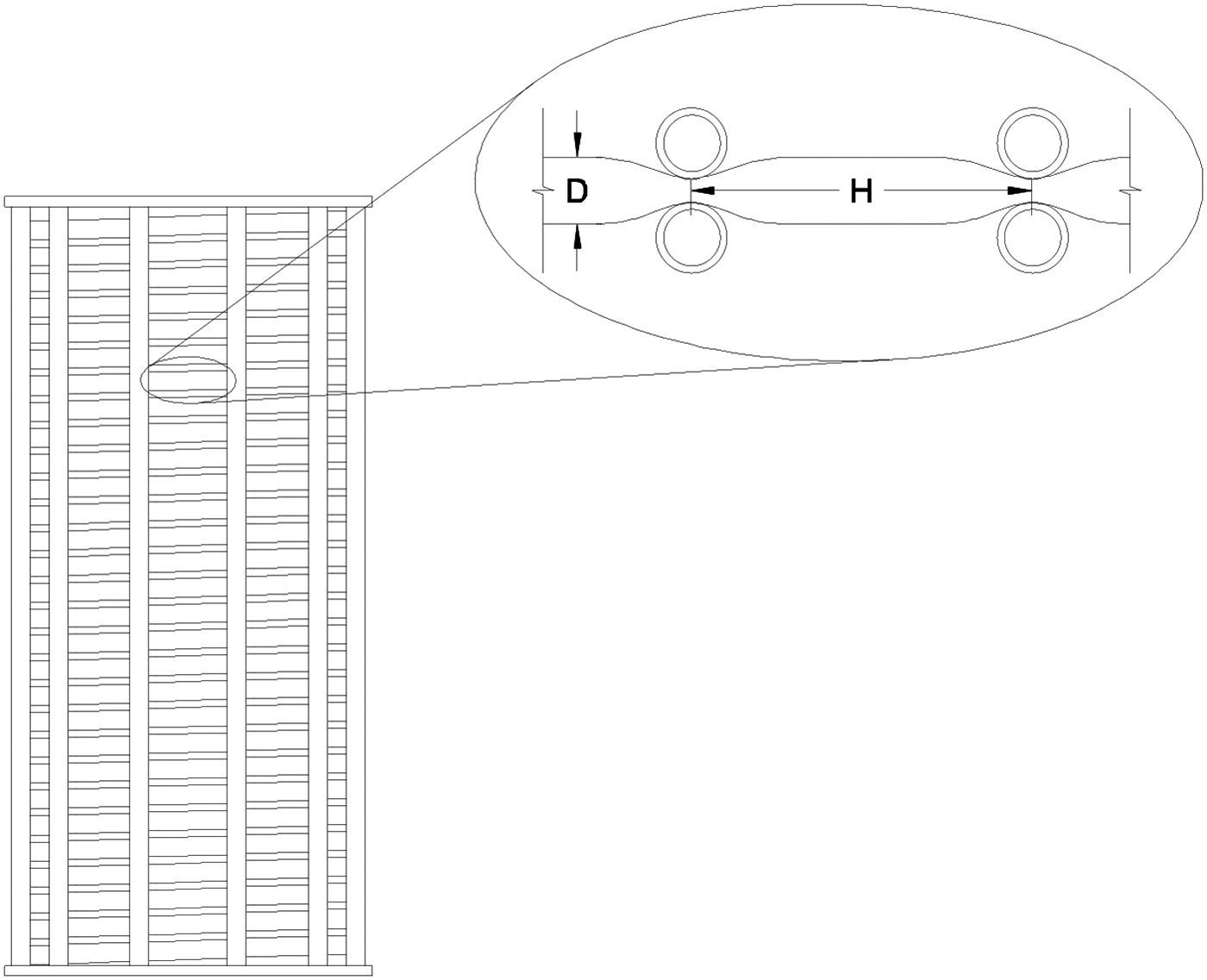
In designing the experimental flocculator, the underlying criterion was that the flocculator needed to be representative of the flocculation conditions present in a full scale baffled hydraulic flocculator. The foremost consideration was that the laboratory scale version must experience turbulent flow and have the majority of the turbulence generated from flow expansions. Likewise, the laboratory apparatus needed to achieve a high Péclet Number to approximate a plug flow reactor, as baffled hydraulic flocculators do in practice. The design chosen to meet these criteria was a coiled tube flocculator, which is illustrated in Fig. 1.
Diagram of apparatus with inset.
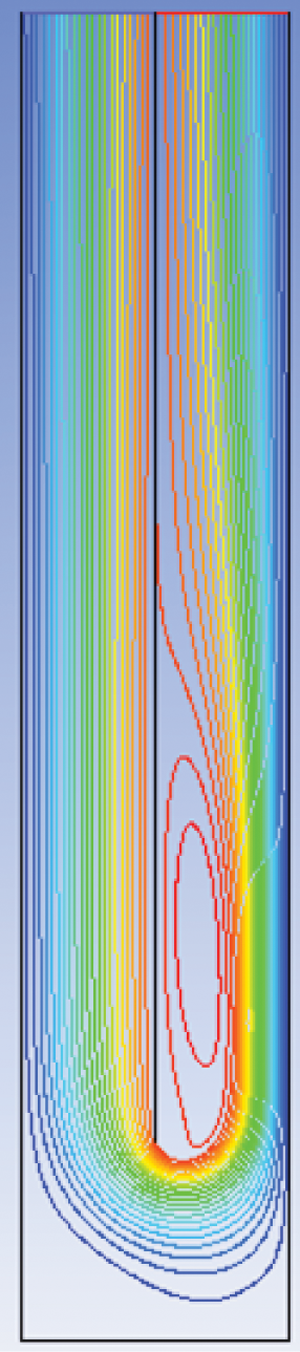
Figure 1 depicts a coiled tube supported by columns. The inset shows that the twelve vertical supports are also used to constrict the tubing. These constrictions achieve turbulent mixing characteristics analogous to those found in baffled hydraulic flocculators. In the regions following baffles, hydraulic flocculators have zones where the flow contracts and later expands as can be seen in Fig. 2. Thus, the tube constrictions serve the place of baffles in causing the flow to contract and expand. Figure 2 was generated with ANSYS Fluent using the Realizable \documentclass{aastex}\usepackage{amsbsy}\usepackage{amsfonts}\usepackage{amssymb}\usepackage{bm}\usepackage{mathrsfs}\usepackage{pifont}\usepackage{stmaryrd}\usepackage{textcomp}\usepackage{portland, xspace}\usepackage{amsmath, amsxtra}\pagestyle{empty}\DeclareMathSizes{10}{9}{7}{6}\begin{document}
$${ \rm{k}} - { \varepsilon}$$
\end{document} model in a 2D analysis of an Re = 10,000 turbulent flow around a single baffle with the length of the flow equal to ten times the width of the flow.
Streamlines of flow rounding a 180° bend.
Minimum dimensions of the flocculator were determined from the minimum Reynolds number of 4,000 for turbulence in pipe flow and the design mean energy dissipation rate of 15 \documentclass{aastex}\usepackage{amsbsy}\usepackage{amsfonts}\usepackage{amssymb}\usepackage{bm}\usepackage{mathrsfs}\usepackage{pifont}\usepackage{stmaryrd}\usepackage{textcomp}\usepackage{portland, xspace}\usepackage{amsmath, amsxtra}\pagestyle{empty}\DeclareMathSizes{10}{9}{7}{6}\begin{document}
$$ { \frac { { \rm { mW } } } { { \rm { kg } } } } $$
\end{document} (Granger, 1995). The use of Re = 4,000 is conservative, since constrictions and bends in the tubing will induce turbulence at lower Reynolds numbers. The average energy dissipation rate of \documentclass{aastex}\usepackage{amsbsy}\usepackage{amsfonts}\usepackage{amssymb}\usepackage{bm}\usepackage{mathrsfs}\usepackage{pifont}\usepackage{stmaryrd}\usepackage{textcomp}\usepackage{portland, xspace}\usepackage{amsmath, amsxtra}\pagestyle{empty}\DeclareMathSizes{10}{9}{7}{6}\begin{document}
$$15 { \frac { { \rm { mW } } } { { \rm { kg } } } } $$
\end{document} is equivalent to a velocity gradient, \documentclass{aastex}\usepackage{amsbsy}\usepackage{amsfonts}\usepackage{amssymb}\usepackage{bm}\usepackage{mathrsfs}\usepackage{pifont}\usepackage{stmaryrd}\usepackage{textcomp}\usepackage{portland, xspace}\usepackage{amsmath, amsxtra}\pagestyle{empty}\DeclareMathSizes{10}{9}{7}{6}\begin{document}
$$G$$
\end{document}, of 123 \documentclass{aastex}\usepackage{amsbsy}\usepackage{amsfonts}\usepackage{amssymb}\usepackage{bm}\usepackage{mathrsfs}\usepackage{pifont}\usepackage{stmaryrd}\usepackage{textcomp}\usepackage{portland, xspace}\usepackage{amsmath, amsxtra}\pagestyle{empty}\DeclareMathSizes{10}{9}{7}{6}\begin{document}
$$ \frac { 1 } { { \rm { s } } } $$
\end{document}, given the viscosity of water is 1 \documentclass{aastex}\usepackage{amsbsy}\usepackage{amsfonts}\usepackage{amssymb}\usepackage{bm}\usepackage{mathrsfs}\usepackage{pifont}\usepackage{stmaryrd}\usepackage{textcomp}\usepackage{portland, xspace}\usepackage{amsmath, amsxtra}\pagestyle{empty}\DeclareMathSizes{10}{9}{7}{6}\begin{document}
$$ { \frac { { \rm { m } } { { \rm { m } } ^2 } } { \rm { s } } } $$
\end{document} (20°C). Recommended values of \documentclass{aastex}\usepackage{amsbsy}\usepackage{amsfonts}\usepackage{amssymb}\usepackage{bm}\usepackage{mathrsfs}\usepackage{pifont}\usepackage{stmaryrd}\usepackage{textcomp}\usepackage{portland, xspace}\usepackage{amsmath, amsxtra}\pagestyle{empty}\DeclareMathSizes{10}{9}{7}{6}\begin{document}
$$G$$
\end{document} for baffled hydraulic flocculators fall in the range of 20 to 100 \documentclass{aastex}\usepackage{amsbsy}\usepackage{amsfonts}\usepackage{amssymb}\usepackage{bm}\usepackage{mathrsfs}\usepackage{pifont}\usepackage{stmaryrd}\usepackage{textcomp}\usepackage{portland, xspace}\usepackage{amsmath, amsxtra}\pagestyle{empty}\DeclareMathSizes{10}{9}{7}{6}\begin{document}
$$ \frac { 1 } { { \rm { s } } } $$
\end{document}; so the experimental flocculator can achieve more intense mixing than traditional hydraulic flocculators (Schulz and Okun, 1984).
One of the aims of this research is to facilitate the development of smaller, more efficient flocculators, and so the ability to explore higher energy dissipation rates is desirable. Lower energy dissipation rates can be achieved by widening of the tube constrictions, and for the initial experiments reported in this study, an average energy dissipation rate of 7.4 \documentclass{aastex}\usepackage{amsbsy}\usepackage{amsfonts}\usepackage{amssymb}\usepackage{bm}\usepackage{mathrsfs}\usepackage{pifont}\usepackage{stmaryrd}\usepackage{textcomp}\usepackage{portland, xspace}\usepackage{amsmath, amsxtra}\pagestyle{empty}\DeclareMathSizes{10}{9}{7}{6}\begin{document}
$$ { \frac { { \rm { mW } } } { { \rm { kg } } } } $$
\end{document} (\documentclass{aastex}\usepackage{amsbsy}\usepackage{amsfonts}\usepackage{amssymb}\usepackage{bm}\usepackage{mathrsfs}\usepackage{pifont}\usepackage{stmaryrd}\usepackage{textcomp}\usepackage{portland, xspace}\usepackage{amsmath, amsxtra}\pagestyle{empty}\DeclareMathSizes{10}{9}{7}{6}\begin{document}
$$G$$
\end{document} = 86 \documentclass{aastex}\usepackage{amsbsy}\usepackage{amsfonts}\usepackage{amssymb}\usepackage{bm}\usepackage{mathrsfs}\usepackage{pifont}\usepackage{stmaryrd}\usepackage{textcomp}\usepackage{portland, xspace}\usepackage{amsmath, amsxtra}\pagestyle{empty}\DeclareMathSizes{10}{9}{7}{6}\begin{document}
$$ \frac { 1 } { { \rm { s } } } $$
\end{document}) was used.
The minimum tube diameter was determined by relating the diameter to the Reynolds number and energy dissipation rate. The derivation of this relationship begins with an expression for average energy dissipation rate, as shown in Equation (19):
\documentclass{aastex}\usepackage{amsbsy}\usepackage{amsfonts}\usepackage{amssymb}\usepackage{bm}\usepackage{mathrsfs}\usepackage{pifont}\usepackage{stmaryrd}\usepackage{textcomp}\usepackage{portland, xspace}\usepackage{amsmath, amsxtra}\pagestyle{empty}\DeclareMathSizes{10}{9}{7}{6}\begin{document}
\begin{align*}
\bar \varepsilon = \frac { { gh_ { \rm l } } } { \theta } , \tag { 19 }
\end{align*}
\end{document}
where \documentclass{aastex}\usepackage{amsbsy}\usepackage{amsfonts}\usepackage{amssymb}\usepackage{bm}\usepackage{mathrsfs}\usepackage{pifont}\usepackage{stmaryrd}\usepackage{textcomp}\usepackage{portland, xspace}\usepackage{amsmath, amsxtra}\pagestyle{empty}\DeclareMathSizes{10}{9}{7}{6}\begin{document}
$$g$$
\end{document} is gravitational acceleration \documentclass{aastex}\usepackage{amsbsy}\usepackage{amsfonts}\usepackage{amssymb}\usepackage{bm}\usepackage{mathrsfs}\usepackage{pifont}\usepackage{stmaryrd}\usepackage{textcomp}\usepackage{portland, xspace}\usepackage{amsmath, amsxtra}\pagestyle{empty}\DeclareMathSizes{10}{9}{7}{6}\begin{document}
$$\left[ { \frac { \rm L } { \rm T^2 } } \right]$$
\end{document} and \documentclass{aastex}\usepackage{amsbsy}\usepackage{amsfonts}\usepackage{amssymb}\usepackage{bm}\usepackage{mathrsfs}\usepackage{pifont}\usepackage{stmaryrd}\usepackage{textcomp}\usepackage{portland, xspace}\usepackage{amsmath, amsxtra}\pagestyle{empty}\DeclareMathSizes{10}{9}{7}{6}\begin{document}
$${h_l}$$
\end{document} is the head loss in the system [L]. The derivation proceeds by substituting terms in Equation (19) with equations for head loss and hydraulic residence time.
The equation for head loss due to expansions \documentclass{aastex}\usepackage{amsbsy}\usepackage{amsfonts}\usepackage{amssymb}\usepackage{bm}\usepackage{mathrsfs}\usepackage{pifont}\usepackage{stmaryrd}\usepackage{textcomp}\usepackage{portland, xspace}\usepackage{amsmath, amsxtra}\pagestyle{empty}\DeclareMathSizes{10}{9}{7}{6}\begin{document}
$$( {h_e} )$$
\end{document},
\documentclass{aastex}\usepackage{amsbsy}\usepackage{amsfonts}\usepackage{amssymb}\usepackage{bm}\usepackage{mathrsfs}\usepackage{pifont}\usepackage{stmaryrd}\usepackage{textcomp}\usepackage{portland, xspace}\usepackage{amsmath, amsxtra}\pagestyle{empty}\DeclareMathSizes{10}{9}{7}{6}\begin{document}
\begin{align*}
{ h_e } = K { \frac { { V^2 } } { 2g } } \tag { 20 }
\end{align*}
\end{document}
was used because the majority of head loss in baffled hydraulic flocculators is caused by losses associated with flow expansion after contractions of the mean flow (as opposed to friction losses - those due to wall shear), and the laboratory scale flocculator will also be dominated by expansion losses (Granger, 1995). The value of \documentclass{aastex}\usepackage{amsbsy}\usepackage{amsfonts}\usepackage{amssymb}\usepackage{bm}\usepackage{mathrsfs}\usepackage{pifont}\usepackage{stmaryrd}\usepackage{textcomp}\usepackage{portland, xspace}\usepackage{amsmath, amsxtra}\pagestyle{empty}\DeclareMathSizes{10}{9}{7}{6}\begin{document}
$$K$$
\end{document} in the expansion loss equation will be the expansion loss coefficient for a single flow constriction. Haarhoff (1998) found the value of \documentclass{aastex}\usepackage{amsbsy}\usepackage{amsfonts}\usepackage{amssymb}\usepackage{bm}\usepackage{mathrsfs}\usepackage{pifont}\usepackage{stmaryrd}\usepackage{textcomp}\usepackage{portland, xspace}\usepackage{amsmath, amsxtra}\pagestyle{empty}\DeclareMathSizes{10}{9}{7}{6}\begin{document}
$$K$$
\end{document} for a 180° bend to be 2.0, which was used for preliminary estimates of expansion losses and average energy dissipation rate in the apparatus. The actual value of \documentclass{aastex}\usepackage{amsbsy}\usepackage{amsfonts}\usepackage{amssymb}\usepackage{bm}\usepackage{mathrsfs}\usepackage{pifont}\usepackage{stmaryrd}\usepackage{textcomp}\usepackage{portland, xspace}\usepackage{amsmath, amsxtra}\pagestyle{empty}\DeclareMathSizes{10}{9}{7}{6}\begin{document}
$$K$$
\end{document} in the turbulent tube flocculator is variable, depending upon the degree to which the tubing is constricted.
Hydraulic residence time, \documentclass{aastex}\usepackage{amsbsy}\usepackage{amsfonts}\usepackage{amssymb}\usepackage{bm}\usepackage{mathrsfs}\usepackage{pifont}\usepackage{stmaryrd}\usepackage{textcomp}\usepackage{portland, xspace}\usepackage{amsmath, amsxtra}\pagestyle{empty}\DeclareMathSizes{10}{9}{7}{6}\begin{document}
$$\theta$$
\end{document}, for Equation (19) was considered to be the time it takes for the flow to travel from one constriction to the next, assuming constriction of the flow volume is negligible, \documentclass{aastex}\usepackage{amsbsy}\usepackage{amsfonts}\usepackage{amssymb}\usepackage{bm}\usepackage{mathrsfs}\usepackage{pifont}\usepackage{stmaryrd}\usepackage{textcomp}\usepackage{portland, xspace}\usepackage{amsmath, amsxtra}\pagestyle{empty}\DeclareMathSizes{10}{9}{7}{6}\begin{document}
$$\theta = \frac { H } { V } $$
\end{document}; where \documentclass{aastex}\usepackage{amsbsy}\usepackage{amsfonts}\usepackage{amssymb}\usepackage{bm}\usepackage{mathrsfs}\usepackage{pifont}\usepackage{stmaryrd}\usepackage{textcomp}\usepackage{portland, xspace}\usepackage{amsmath, amsxtra}\pagestyle{empty}\DeclareMathSizes{10}{9}{7}{6}\begin{document}
$$H$$
\end{document} is the distance between constrictions and \documentclass{aastex}\usepackage{amsbsy}\usepackage{amsfonts}\usepackage{amssymb}\usepackage{bm}\usepackage{mathrsfs}\usepackage{pifont}\usepackage{stmaryrd}\usepackage{textcomp}\usepackage{portland, xspace}\usepackage{amsmath, amsxtra}\pagestyle{empty}\DeclareMathSizes{10}{9}{7}{6}\begin{document}
$$V$$
\end{document} is the mean fluid velocity.
Substituting the two aforementioned relationships for expansion loss and hydraulic residence time into Equation (19) and simplifying yield Equation (21).
\documentclass{aastex}\usepackage{amsbsy}\usepackage{amsfonts}\usepackage{amssymb}\usepackage{bm}\usepackage{mathrsfs}\usepackage{pifont}\usepackage{stmaryrd}\usepackage{textcomp}\usepackage{portland, xspace}\usepackage{amsmath, amsxtra}\pagestyle{empty}\DeclareMathSizes{10}{9}{7}{6}\begin{document}
\begin{align*}
\bar \varepsilon = { \frac { K { V^3 } } { 2H } } \tag { 21 }
\end{align*}
\end{document}
An important parameter in the design of a tubular hydraulic flocculator is the ratio of \documentclass{aastex}\usepackage{amsbsy}\usepackage{amsfonts}\usepackage{amssymb}\usepackage{bm}\usepackage{mathrsfs}\usepackage{pifont}\usepackage{stmaryrd}\usepackage{textcomp}\usepackage{portland, xspace}\usepackage{amsmath, amsxtra}\pagestyle{empty}\DeclareMathSizes{10}{9}{7}{6}\begin{document}
$$H$$
\end{document} and the diameter of the tubing, \documentclass{aastex}\usepackage{amsbsy}\usepackage{amsfonts}\usepackage{amssymb}\usepackage{bm}\usepackage{mathrsfs}\usepackage{pifont}\usepackage{stmaryrd}\usepackage{textcomp}\usepackage{portland, xspace}\usepackage{amsmath, amsxtra}\pagestyle{empty}\DeclareMathSizes{10}{9}{7}{6}\begin{document}
$$D$$
\end{document}, \documentclass{aastex}\usepackage{amsbsy}\usepackage{amsfonts}\usepackage{amssymb}\usepackage{bm}\usepackage{mathrsfs}\usepackage{pifont}\usepackage{stmaryrd}\usepackage{textcomp}\usepackage{portland, xspace}\usepackage{amsmath, amsxtra}\pagestyle{empty}\DeclareMathSizes{10}{9}{7}{6}\begin{document}
$$ { { \Pi } _ { { \rm { HD } } } } = \frac { H } { D } $$
\end{document}. In a computational fluid dynamics analysis of baffled hydraulic flocculators (180° bends), Haarhoff and van der Walt (2001) found the optimal value of \documentclass{aastex}\usepackage{amsbsy}\usepackage{amsfonts}\usepackage{amssymb}\usepackage{bm}\usepackage{mathrsfs}\usepackage{pifont}\usepackage{stmaryrd}\usepackage{textcomp}\usepackage{portland, xspace}\usepackage{amsmath, amsxtra}\pagestyle{empty}\DeclareMathSizes{10}{9}{7}{6}\begin{document}
$${{ \Pi }_{{ \rm{HD}}}}$$
\end{document} (in their case, the ratio of channel length to channel width) to be \documentclass{aastex}\usepackage{amsbsy}\usepackage{amsfonts}\usepackage{amssymb}\usepackage{bm}\usepackage{mathrsfs}\usepackage{pifont}\usepackage{stmaryrd}\usepackage{textcomp}\usepackage{portland, xspace}\usepackage{amsmath, amsxtra}\pagestyle{empty}\DeclareMathSizes{10}{9}{7}{6}\begin{document}
$$\le 6$$
\end{document} for efficient mixing.
Extension of this ratio to the tube flocculator for the case where the constriction of flow is similar to that caused by a 180° bend was supported by geometric calculations based on the spreading rate of plane jets, since the flow after a constriction in a tube flocculator is considered to be a plane jet. The smallest (most conservative) spreading rate found in a literature review by Kotsovinos (1976) was 0.087. Using this spreading rate, the jet was found to expand to the diameter of the tube after traveling a distance less than five diameters in length, as illustrated in Fig. 3. For this apparatus, \documentclass{aastex}\usepackage{amsbsy}\usepackage{amsfonts}\usepackage{amssymb}\usepackage{bm}\usepackage{mathrsfs}\usepackage{pifont}\usepackage{stmaryrd}\usepackage{textcomp}\usepackage{portland, xspace}\usepackage{amsmath, amsxtra}\pagestyle{empty}\DeclareMathSizes{10}{9}{7}{6}\begin{document}
$${{ \Pi }_{{ \rm{HD}}}}$$
\end{document} = 5 was used to design the flocculator.
Diagram of estimated jet expansion geometry.
Substituting \documentclass{aastex}\usepackage{amsbsy}\usepackage{amsfonts}\usepackage{amssymb}\usepackage{bm}\usepackage{mathrsfs}\usepackage{pifont}\usepackage{stmaryrd}\usepackage{textcomp}\usepackage{portland, xspace}\usepackage{amsmath, amsxtra}\pagestyle{empty}\DeclareMathSizes{10}{9}{7}{6}\begin{document}
$${{ \Pi}_{{ \rm{HD}}}}$$
\end{document} into Equation (21) and solving for velocity leads to
\documentclass{aastex}\usepackage{amsbsy}\usepackage{amsfonts}\usepackage{amssymb}\usepackage{bm}\usepackage{mathrsfs}\usepackage{pifont}\usepackage{stmaryrd}\usepackage{textcomp}\usepackage{portland, xspace}\usepackage{amsmath, amsxtra}\pagestyle{empty}\DeclareMathSizes{10}{9}{7}{6}\begin{document}
\begin{align*}
V = \root 3 \of { \frac { { 2 { \Pi _ { \rm HD } } D \bar \varepsilon } } { K } } . \tag { 22 }
\end{align*}
\end{document}
Multiplying both sides of Equation (22) by \documentclass{aastex}\usepackage{amsbsy}\usepackage{amsfonts}\usepackage{amssymb}\usepackage{bm}\usepackage{mathrsfs}\usepackage{pifont}\usepackage{stmaryrd}\usepackage{textcomp}\usepackage{portland, xspace}\usepackage{amsmath, amsxtra}\pagestyle{empty}\DeclareMathSizes{10}{9}{7}{6}\begin{document}
$$ \frac { D } { \nu } $$
\end{document} results in an equation for Reynolds number (Re). The diameter of the tubing can then be expressed as a function of Re, \documentclass{aastex}\usepackage{amsbsy}\usepackage{amsfonts}\usepackage{amssymb}\usepackage{bm}\usepackage{mathrsfs}\usepackage{pifont}\usepackage{stmaryrd}\usepackage{textcomp}\usepackage{portland, xspace}\usepackage{amsmath, amsxtra}\pagestyle{empty}\DeclareMathSizes{10}{9}{7}{6}\begin{document}
$$\bar \varepsilon$$
\end{document}, and \documentclass{aastex}\usepackage{amsbsy}\usepackage{amsfonts}\usepackage{amssymb}\usepackage{bm}\usepackage{mathrsfs}\usepackage{pifont}\usepackage{stmaryrd}\usepackage{textcomp}\usepackage{portland, xspace}\usepackage{amsmath, amsxtra}\pagestyle{empty}\DeclareMathSizes{10}{9}{7}{6}\begin{document}
$${{ \Pi }_{{ \rm{HD}}}}$$
\end{document} by solving Equation (22) for \documentclass{aastex}\usepackage{amsbsy}\usepackage{amsfonts}\usepackage{amssymb}\usepackage{bm}\usepackage{mathrsfs}\usepackage{pifont}\usepackage{stmaryrd}\usepackage{textcomp}\usepackage{portland, xspace}\usepackage{amsmath, amsxtra}\pagestyle{empty}\DeclareMathSizes{10}{9}{7}{6}\begin{document}
$$D$$
\end{document} as
\documentclass{aastex}\usepackage{amsbsy}\usepackage{amsfonts}\usepackage{amssymb}\usepackage{bm}\usepackage{mathrsfs}\usepackage{pifont}\usepackage{stmaryrd}\usepackage{textcomp}\usepackage{portland, xspace}\usepackage{amsmath, amsxtra}\pagestyle{empty}\DeclareMathSizes{10}{9}{7}{6}\begin{document}
\begin{align*}
D = \root 4 \of { { \frac { { { ( v { \mathop { \rm Re } \nolimits } ) } ^3 } K } { 2 { \Pi _ { { \rm HD } } } \bar \varepsilon } } . } \tag { 23 }
\end{align*}
\end{document}
Solving Equation (23) with an average energy dissipation rate (\documentclass{aastex}\usepackage{amsbsy}\usepackage{amsfonts}\usepackage{amssymb}\usepackage{bm}\usepackage{mathrsfs}\usepackage{pifont}\usepackage{stmaryrd}\usepackage{textcomp}\usepackage{portland, xspace}\usepackage{amsmath, amsxtra}\pagestyle{empty}\DeclareMathSizes{10}{9}{7}{6}\begin{document}
$$\bar \varepsilon$$
\end{document}) of 15 \documentclass{aastex}\usepackage{amsbsy}\usepackage{amsfonts}\usepackage{amssymb}\usepackage{bm}\usepackage{mathrsfs}\usepackage{pifont}\usepackage{stmaryrd}\usepackage{textcomp}\usepackage{portland, xspace}\usepackage{amsmath, amsxtra}\pagestyle{empty}\DeclareMathSizes{10}{9}{7}{6}\begin{document}
$$ { \frac { { \rm { mW } } } { { \rm { kg } } } } $$
\end{document} and using the previously mentioned values results in a minimum diameter of 3.0 cm (1.2 in). For the apparatus, tubing with an inner diameter of 3.18 cm (1.25 in) and an outer diameter of 3.81 cm (1.5 in) was chosen.
Design area of constrictions was calculated based on the constriction of flow around a bend in a hydraulic flocculator. When water flows around a 90° bend, its effective area is reduced to 61% of the total flow area, as represented by the contraction coefficient of 0.61 for sluice gates (Kim, 2007). A 180° bend, such as around a flocculator baffle, can be considered two 90° bends (Haarhoff, 1998). Therefore, the effective area of the flow is reduced to 0.61 × 0.61 = 0.37, or 37%, of the total flow area.
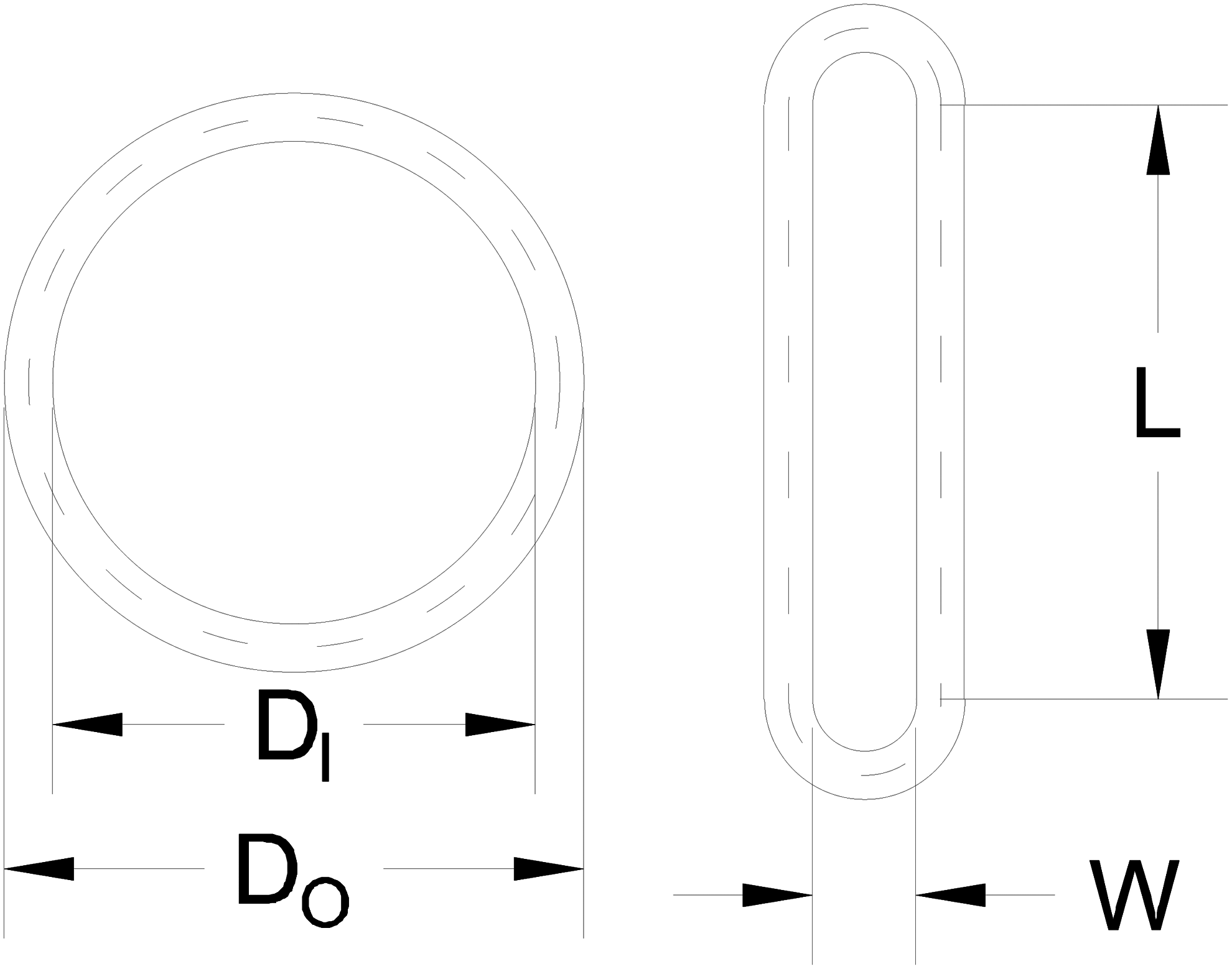
Design constriction width was determined from geometric principles, considering the constricted tubing to approximate a rectangle with two semicircles at its ends as shown in Fig. 4. The problem was formulated as a solution of two simultaneous equations, representing the constraints that the constricted area must be 37% of the unconstricted area and the circumference of the tubing must remain the same for the center of the tubing wall (i.e., the average diameter, \documentclass{aastex}\usepackage{amsbsy}\usepackage{amsfonts}\usepackage{amssymb}\usepackage{bm}\usepackage{mathrsfs}\usepackage{pifont}\usepackage{stmaryrd}\usepackage{textcomp}\usepackage{portland, xspace}\usepackage{amsmath, amsxtra}\pagestyle{empty}\DeclareMathSizes{10}{9}{7}{6}\begin{document}
$$ \frac { { { D_ { \rm { O } } } + { D_ { \rm { I } } } } } { 2 } $$
\end{document}, where \documentclass{aastex}\usepackage{amsbsy}\usepackage{amsfonts}\usepackage{amssymb}\usepackage{bm}\usepackage{mathrsfs}\usepackage{pifont}\usepackage{stmaryrd}\usepackage{textcomp}\usepackage{portland, xspace}\usepackage{amsmath, amsxtra}\pagestyle{empty}\DeclareMathSizes{10}{9}{7}{6}\begin{document}
$${D_{ \rm{O}}}$$
\end{document} and \documentclass{aastex}\usepackage{amsbsy}\usepackage{amsfonts}\usepackage{amssymb}\usepackage{bm}\usepackage{mathrsfs}\usepackage{pifont}\usepackage{stmaryrd}\usepackage{textcomp}\usepackage{portland, xspace}\usepackage{amsmath, amsxtra}\pagestyle{empty}\DeclareMathSizes{10}{9}{7}{6}\begin{document}
$${D_{ \rm{I}}}$$
\end{document} are the outer and inner diameters of the unconstricted tube, respectively). The latter assumption considers the center of the tubing wall to coincide with the neutral plane of the tubing. See Fig. 4 for a diagram of geometry of the problem.
Geometry of tube constriction.
The equation for the length of the centerline of the tubing wall (dashed line in Fig. 4) being constant is expressed as
\documentclass{aastex}\usepackage{amsbsy}\usepackage{amsfonts}\usepackage{amssymb}\usepackage{bm}\usepackage{mathrsfs}\usepackage{pifont}\usepackage{stmaryrd}\usepackage{textcomp}\usepackage{portland, xspace}\usepackage{amsmath, amsxtra}\pagestyle{empty}\DeclareMathSizes{10}{9}{7}{6}\begin{document}
\begin{align*}
\pi \left( { \frac { { { D_ { \rm { O } } } + { D_ { \rm { I } } } } } { 2 } } \right) = 2L + \pi \left( { W + \frac { { { D_ { \rm { O } } } - { D_ { \rm { I } } } } } { 2 } } \right) , \tag { 24 }
\end{align*}
\end{document}
where \documentclass{aastex}\usepackage{amsbsy}\usepackage{amsfonts}\usepackage{amssymb}\usepackage{bm}\usepackage{mathrsfs}\usepackage{pifont}\usepackage{stmaryrd}\usepackage{textcomp}\usepackage{portland, xspace}\usepackage{amsmath, amsxtra}\pagestyle{empty}\DeclareMathSizes{10}{9}{7}{6}\begin{document}
$$W$$
\end{document} is the width of the constricted tube and \documentclass{aastex}\usepackage{amsbsy}\usepackage{amsfonts}\usepackage{amssymb}\usepackage{bm}\usepackage{mathrsfs}\usepackage{pifont}\usepackage{stmaryrd}\usepackage{textcomp}\usepackage{portland, xspace}\usepackage{amsmath, amsxtra}\pagestyle{empty}\DeclareMathSizes{10}{9}{7}{6}\begin{document}
$$L$$
\end{document} is the length of the assumed rectangular portion of the constricted tube. The contraction in the tubing is gradual, and thus it was assumed that there was no additional flow contraction (vena contracta) downstream of the constriction in the tubing. The equation for the area of this flow contraction is given by
\documentclass{aastex}\usepackage{amsbsy}\usepackage{amsfonts}\usepackage{amssymb}\usepackage{bm}\usepackage{mathrsfs}\usepackage{pifont}\usepackage{stmaryrd}\usepackage{textcomp}\usepackage{portland, xspace}\usepackage{amsmath, amsxtra}\pagestyle{empty}\DeclareMathSizes{10}{9}{7}{6}\begin{document}
\begin{align*}
WL + \frac { \pi } { 4 } { W^2 } = { { \Pi } _ { { \rm { AR } } } } \frac { { \pi } } { 4 } D_ { \rm { I } } ^2 , \tag { 25 }
\end{align*}
\end{document}
where \documentclass{aastex}\usepackage{amsbsy}\usepackage{amsfonts}\usepackage{amssymb}\usepackage{bm}\usepackage{mathrsfs}\usepackage{pifont}\usepackage{stmaryrd}\usepackage{textcomp}\usepackage{portland, xspace}\usepackage{amsmath, amsxtra}\pagestyle{empty}\DeclareMathSizes{10}{9}{7}{6}\begin{document}
$${{ \Pi }_{{ \rm{AR}}}}$$
\end{document} is the area ratio, the ratio of the constricted area to the unconstricted area, which is equal to 0.37 in this case. Simultaneous solution of Equations (24) and (25) leads to a quadratic equation that can be solved for W, the width of the constriction as
\documentclass{aastex}\usepackage{amsbsy}\usepackage{amsfonts}\usepackage{amssymb}\usepackage{bm}\usepackage{mathrsfs}\usepackage{pifont}\usepackage{stmaryrd}\usepackage{textcomp}\usepackage{portland, xspace}\usepackage{amsmath, amsxtra}\pagestyle{empty}\DeclareMathSizes{10}{9}{7}{6}\begin{document}
\begin{align*}
{W^2} - 2{D_{ \rm{I}}}W + {{ \Pi }_{{ \rm{AR}}}}D_{ \rm{I}}^2 = 0. \tag{26}
\end{align*}
\end{document}
In the final solution, the outer diameter \documentclass{aastex}\usepackage{amsbsy}\usepackage{amsfonts}\usepackage{amssymb}\usepackage{bm}\usepackage{mathrsfs}\usepackage{pifont}\usepackage{stmaryrd}\usepackage{textcomp}\usepackage{portland, xspace}\usepackage{amsmath, amsxtra}\pagestyle{empty}\DeclareMathSizes{10}{9}{7}{6}\begin{document}
$${D_{ \rm{O}}}$$
\end{document} is canceled out and only the inner diameter \documentclass{aastex}\usepackage{amsbsy}\usepackage{amsfonts}\usepackage{amssymb}\usepackage{bm}\usepackage{mathrsfs}\usepackage{pifont}\usepackage{stmaryrd}\usepackage{textcomp}\usepackage{portland, xspace}\usepackage{amsmath, amsxtra}\pagestyle{empty}\DeclareMathSizes{10}{9}{7}{6}\begin{document}
$${D_{ \rm{I}}}$$
\end{document} matters (i.e., wall thickness does not affect this solution). Solving Equation (26) with \documentclass{aastex}\usepackage{amsbsy}\usepackage{amsfonts}\usepackage{amssymb}\usepackage{bm}\usepackage{mathrsfs}\usepackage{pifont}\usepackage{stmaryrd}\usepackage{textcomp}\usepackage{portland, xspace}\usepackage{amsmath, amsxtra}\pagestyle{empty}\DeclareMathSizes{10}{9}{7}{6}\begin{document}
$${D_{ \rm{I}}}$$
\end{document} as 3.18 cm (1.25 in) gives a constriction width of 0.66 cm (0.26 in). Wall thickness becomes important when selecting the spacing of the vertical bars to constrict the tubing. Adding the difference \documentclass{aastex}\usepackage{amsbsy}\usepackage{amsfonts}\usepackage{amssymb}\usepackage{bm}\usepackage{mathrsfs}\usepackage{pifont}\usepackage{stmaryrd}\usepackage{textcomp}\usepackage{portland, xspace}\usepackage{amsmath, amsxtra}\pagestyle{empty}\DeclareMathSizes{10}{9}{7}{6}\begin{document}
$${D_{ \rm{O}}} - {D_{ \rm{I}}}$$
\end{document} to \documentclass{aastex}\usepackage{amsbsy}\usepackage{amsfonts}\usepackage{amssymb}\usepackage{bm}\usepackage{mathrsfs}\usepackage{pifont}\usepackage{stmaryrd}\usepackage{textcomp}\usepackage{portland, xspace}\usepackage{amsmath, amsxtra}\pagestyle{empty}\DeclareMathSizes{10}{9}{7}{6}\begin{document}
$$W$$
\end{document} gives the distance between the vertical bars of 1.30 cm (0.51 in).
For the preliminary experiments, the spacing between the bars was 1.56 cm (0.61 in), giving a constriction width of 0.93 cm (0.36 in). Because this is a wider spacing than specified, the assumption that the constricted flow will expand to its full area before the next constriction (Fig. 3) is still valid. This spacing achieved a measured average energy dissipation rate of 7.4 \documentclass{aastex}\usepackage{amsbsy}\usepackage{amsfonts}\usepackage{amssymb}\usepackage{bm}\usepackage{mathrsfs}\usepackage{pifont}\usepackage{stmaryrd}\usepackage{textcomp}\usepackage{portland, xspace}\usepackage{amsmath, amsxtra}\pagestyle{empty}\DeclareMathSizes{10}{9}{7}{6}\begin{document}
$$ { \frac { { \rm { mW } } } { { \rm { kg } } } } $$
\end{document} in the flocculator. The spacing between constrictions was 16 cm (6.3 in) based on five times the inner diameter of the tubing.
The design flow rate for the flocculator can be found in a manner similar to the way the minimum diameter was found. Setting the left side of Equation (22) equal to \documentclass{aastex}\usepackage{amsbsy}\usepackage{amsfonts}\usepackage{amssymb}\usepackage{bm}\usepackage{mathrsfs}\usepackage{pifont}\usepackage{stmaryrd}\usepackage{textcomp}\usepackage{portland, xspace}\usepackage{amsmath, amsxtra}\pagestyle{empty}\DeclareMathSizes{10}{9}{7}{6}\begin{document}
$$ \frac { Q } { { \frac { \pi } { 4 } { D^2 } } } $$
\end{document} and solving for Q results in
\documentclass{aastex}\usepackage{amsbsy}\usepackage{amsfonts}\usepackage{amssymb}\usepackage{bm}\usepackage{mathrsfs}\usepackage{pifont}\usepackage{stmaryrd}\usepackage{textcomp}\usepackage{portland, xspace}\usepackage{amsmath, amsxtra}\pagestyle{empty}\DeclareMathSizes{10}{9}{7}{6}\begin{document}
\begin{align*}
Q = \frac { \pi } { 4 } { \left( { \frac { { 2 { \Pi _ { \rm HD } } { D^7 } \bar \varepsilon } } { K } } \right) ^ { 1 / 3 } } \tag { 27 }
\end{align*}
\end{document}
Equation (27) can be used to calculate the apparatus flow rate. With the chosen diameter of 3.18 cm (1.25 in) and using the same values used to calculate the diameter, the design flow rate was 105 \documentclass{aastex}\usepackage{amsbsy}\usepackage{amsfonts}\usepackage{amssymb}\usepackage{bm}\usepackage{mathrsfs}\usepackage{pifont}\usepackage{stmaryrd}\usepackage{textcomp}\usepackage{portland, xspace}\usepackage{amsmath, amsxtra}\pagestyle{empty}\DeclareMathSizes{10}{9}{7}{6}\begin{document}
$$ { \frac { { \rm { mL } } } { \rm { s } } } $$
\end{document}. For initial experiments, a flow rate of 109 \documentclass{aastex}\usepackage{amsbsy}\usepackage{amsfonts}\usepackage{amssymb}\usepackage{bm}\usepackage{mathrsfs}\usepackage{pifont}\usepackage{stmaryrd}\usepackage{textcomp}\usepackage{portland, xspace}\usepackage{amsmath, amsxtra}\pagestyle{empty}\DeclareMathSizes{10}{9}{7}{6}\begin{document}
$$ { \frac { { \rm { mL } } } { \rm { s } } } $$
\end{document} was selected.
As a last step in the design of the flocculator, the tubing length was chosen. This was set at 56.4 m to achieve a similar product of residence time and average energy dissipation rate to the one-third power (\documentclass{aastex}\usepackage{amsbsy}\usepackage{amsfonts}\usepackage{amssymb}\usepackage{bm}\usepackage{mathrsfs}\usepackage{pifont}\usepackage{stmaryrd}\usepackage{textcomp}\usepackage{portland, xspace}\usepackage{amsmath, amsxtra}\pagestyle{empty}\DeclareMathSizes{10}{9}{7}{6}\begin{document}
$$ { \theta { { \bar \varepsilon } ^ { \frac { 1 } { 3 } } } } $$
\end{document}) to that which is used in the Cornell University AguaClara Program design algorithm for baffled hydraulic flocculators that have been constructed in Honduras under the assumption that inertial forces are significant in achieving collisions in surface water treatment. This parameter, identified by Weber-Shirk and Lion (2010), is used in the design of AguaClara flocculators. A summary of the values chosen for the final design of the flocculator can be found in Table 1. A pulse input test conducted on the flocculator found a Péclet number of about 91, indicating that advection dominates dispersion in this reactor, and this flocculator approaches plug flow, as intended.
Flow through an orifice before the flocculator was used to achieve rapid mix of coagulant with the raw water, which was created by adding kaolinite clay to tap water from the Cornell University Water Filtration Plant. The energy dissipation rate was chosen based on the assumption that, for adequate mixing to occur, the Kolmogorov length scale, which describes the smallest dissipative eddies, should be smaller than the average separation distance between clay particles so that all clay particles have similar exposure to coagulant precipitate. Mathematically, this can be stated as \documentclass{aastex}\usepackage{amsbsy}\usepackage{amsfonts}\usepackage{amssymb}\usepackage{bm}\usepackage{mathrsfs}\usepackage{pifont}\usepackage{stmaryrd}\usepackage{textcomp}\usepackage{portland, xspace}\usepackage{amsmath, amsxtra}\pagestyle{empty}\DeclareMathSizes{10}{9}{7}{6}\begin{document}
$$\eta \le { \Lambda }$$
\end{document}. Substituting Equation (12) and (16) (solved for \documentclass{aastex}\usepackage{amsbsy}\usepackage{amsfonts}\usepackage{amssymb}\usepackage{bm}\usepackage{mathrsfs}\usepackage{pifont}\usepackage{stmaryrd}\usepackage{textcomp}\usepackage{portland, xspace}\usepackage{amsmath, amsxtra}\pagestyle{empty}\DeclareMathSizes{10}{9}{7}{6}\begin{document}
$${ \Lambda }$$
\end{document}) into this inequality and solving for energy dissipation rate result in an equation for the minimum energy dissipation rate in a rapid mix system (\documentclass{aastex}\usepackage{amsbsy}\usepackage{amsfonts}\usepackage{amssymb}\usepackage{bm}\usepackage{mathrsfs}\usepackage{pifont}\usepackage{stmaryrd}\usepackage{textcomp}\usepackage{portland, xspace}\usepackage{amsmath, amsxtra}\pagestyle{empty}\DeclareMathSizes{10}{9}{7}{6}\begin{document}
$${ \varepsilon _{{ \rm{RM}}}}$$
\end{document}) for a given concentration of clay:
\documentclass{aastex}\usepackage{amsbsy}\usepackage{amsfonts}\usepackage{amssymb}\usepackage{bm}\usepackage{mathrsfs}\usepackage{pifont}\usepackage{stmaryrd}\usepackage{textcomp}\usepackage{portland, xspace}\usepackage{amsmath, amsxtra}\pagestyle{empty}\DeclareMathSizes{10}{9}{7}{6}\begin{document}
\begin{align*}
{ \varepsilon _ { { \rm { RM } } } } \ge { \frac { { \nu ^3 } } { d_ { \rm { P } } ^4 { { \left( { \frac { \pi } { 6 } { \frac { { \rho _ { \rm { P } } } } { { C_ { \rm { P } } } } } } \right) } ^ { 4 / 3 } } } } . \tag { 28 }
\end{align*}
\end{document}
In calculating the design energy dissipation for rapid mix, \documentclass{aastex}\usepackage{amsbsy}\usepackage{amsfonts}\usepackage{amssymb}\usepackage{bm}\usepackage{mathrsfs}\usepackage{pifont}\usepackage{stmaryrd}\usepackage{textcomp}\usepackage{portland, xspace}\usepackage{amsmath, amsxtra}\pagestyle{empty}\DeclareMathSizes{10}{9}{7}{6}\begin{document}
$${ \rho _{ \rm{P}}}$$
\end{document} was taken as 2.65 \documentclass{aastex}\usepackage{amsbsy}\usepackage{amsfonts}\usepackage{amssymb}\usepackage{bm}\usepackage{mathrsfs}\usepackage{pifont}\usepackage{stmaryrd}\usepackage{textcomp}\usepackage{portland, xspace}\usepackage{amsmath, amsxtra}\pagestyle{empty}\DeclareMathSizes{10}{9}{7}{6}\begin{document}
$$ { \frac { \rm { g } } { { \rm { c } } { { \rm { m } } ^3 } } } $$
\end{document}, representative of the kaolinite particles used in this study. The value of \documentclass{aastex}\usepackage{amsbsy}\usepackage{amsfonts}\usepackage{amssymb}\usepackage{bm}\usepackage{mathrsfs}\usepackage{pifont}\usepackage{stmaryrd}\usepackage{textcomp}\usepackage{portland, xspace}\usepackage{amsmath, amsxtra}\pagestyle{empty}\DeclareMathSizes{10}{9}{7}{6}\begin{document}
$${C_{ \rm{P}}}$$
\end{document} was taken to be 1,000 NTU, because the rapid mix intensity is set by the maximum particle concentration that would be encountered by the flocculator, and 1,000 NTU is the upper limit of sensitivity for the HF Scientific MicroTOL turbidimeter used in the study (HF Scientific, 2015). To convert the turbidity to a mass per volume concentration as required by Equation (28), a proportionality of 100 \documentclass{aastex}\usepackage{amsbsy}\usepackage{amsfonts}\usepackage{amssymb}\usepackage{bm}\usepackage{mathrsfs}\usepackage{pifont}\usepackage{stmaryrd}\usepackage{textcomp}\usepackage{portland, xspace}\usepackage{amsmath, amsxtra}\pagestyle{empty}\DeclareMathSizes{10}{9}{7}{6}\begin{document}
$$ { \frac { { \rm { mg } } } { \rm { L } } } $$
\end{document} = 68 NTU was used (Wei et al., 2015). The diameter of the kaolinite clay was assumed to be 7 μm based on findings of Wei et al. (2015). From this, the minimum energy dissipation rate was calculated to be 45 \documentclass{aastex}\usepackage{amsbsy}\usepackage{amsfonts}\usepackage{amssymb}\usepackage{bm}\usepackage{mathrsfs}\usepackage{pifont}\usepackage{stmaryrd}\usepackage{textcomp}\usepackage{portland, xspace}\usepackage{amsmath, amsxtra}\pagestyle{empty}\DeclareMathSizes{10}{9}{7}{6}\begin{document}
$$ { \frac { { \rm { mW } } } { { \rm { kg } } } } $$
\end{document}, equivalent to a \documentclass{aastex}\usepackage{amsbsy}\usepackage{amsfonts}\usepackage{amssymb}\usepackage{bm}\usepackage{mathrsfs}\usepackage{pifont}\usepackage{stmaryrd}\usepackage{textcomp}\usepackage{portland, xspace}\usepackage{amsmath, amsxtra}\pagestyle{empty}\DeclareMathSizes{10}{9}{7}{6}\begin{document}
$$G$$
\end{document} value of 210 \documentclass{aastex}\usepackage{amsbsy}\usepackage{amsfonts}\usepackage{amssymb}\usepackage{bm}\usepackage{mathrsfs}\usepackage{pifont}\usepackage{stmaryrd}\usepackage{textcomp}\usepackage{portland, xspace}\usepackage{amsmath, amsxtra}\pagestyle{empty}\DeclareMathSizes{10}{9}{7}{6}\begin{document}
$$ \frac { 1 } { { \rm { s } } } $$
\end{document}.
The minimum energy dissipation rate for effective rapid mix is extremely sensitive to the number of particles in the raw water. For example, if the mean clay diameter was 4 μm (more particles for the same mass), then the minimum energy dissipation rate would increase to over 400 \documentclass{aastex}\usepackage{amsbsy}\usepackage{amsfonts}\usepackage{amssymb}\usepackage{bm}\usepackage{mathrsfs}\usepackage{pifont}\usepackage{stmaryrd}\usepackage{textcomp}\usepackage{portland, xspace}\usepackage{amsmath, amsxtra}\pagestyle{empty}\DeclareMathSizes{10}{9}{7}{6}\begin{document}
$$ { \frac { { \rm { mW } } } { { \rm { kg } } } } $$
\end{document}. To safeguard against possible variations in the particle size distributions, a minimum energy dissipation rate value of 400 \documentclass{aastex}\usepackage{amsbsy}\usepackage{amsfonts}\usepackage{amssymb}\usepackage{bm}\usepackage{mathrsfs}\usepackage{pifont}\usepackage{stmaryrd}\usepackage{textcomp}\usepackage{portland, xspace}\usepackage{amsmath, amsxtra}\pagestyle{empty}\DeclareMathSizes{10}{9}{7}{6}\begin{document}
$$ { \frac { { \rm { mW } } } { { \rm { kg } } } } $$
\end{document} was used to guide the rapid mix design.
Inner diameter of the orifice can be derived from the equation for the maximum energy dissipation encountered in a jet. The relationship for the maximum energy dissipation rate in a jet is based on the proportionality described in Equation (13), and thus can be approximated as
\documentclass{aastex}\usepackage{amsbsy}\usepackage{amsfonts}\usepackage{amssymb}\usepackage{bm}\usepackage{mathrsfs}\usepackage{pifont}\usepackage{stmaryrd}\usepackage{textcomp}\usepackage{portland, xspace}\usepackage{amsmath, amsxtra}\pagestyle{empty}\DeclareMathSizes{10}{9}{7}{6}\begin{document}
\begin{align*}
{ \varepsilon _ { { \rm { Max } } } } = { \frac { { { \left( { { { \Pi } _ { { \rm { Jet \ Round } } } } { V_ { { \rm { Jet } } } } } \right) } ^3 } } { { D_ { { \rm { Jet } } } } } } , \tag { 29 }
\end{align*}
\end{document}
where \documentclass{aastex}\usepackage{amsbsy}\usepackage{amsfonts}\usepackage{amssymb}\usepackage{bm}\usepackage{mathrsfs}\usepackage{pifont}\usepackage{stmaryrd}\usepackage{textcomp}\usepackage{portland, xspace}\usepackage{amsmath, amsxtra}\pagestyle{empty}\DeclareMathSizes{10}{9}{7}{6}\begin{document}
$${V_{{ \rm{Jet}}}}$$
\end{document} is the average jet velocity, \documentclass{aastex}\usepackage{amsbsy}\usepackage{amsfonts}\usepackage{amssymb}\usepackage{bm}\usepackage{mathrsfs}\usepackage{pifont}\usepackage{stmaryrd}\usepackage{textcomp}\usepackage{portland, xspace}\usepackage{amsmath, amsxtra}\pagestyle{empty}\DeclareMathSizes{10}{9}{7}{6}\begin{document}
$${D_{{ \rm{Jet}}}}$$
\end{document} is the diameter of the jet, and \documentclass{aastex}\usepackage{amsbsy}\usepackage{amsfonts}\usepackage{amssymb}\usepackage{bm}\usepackage{mathrsfs}\usepackage{pifont}\usepackage{stmaryrd}\usepackage{textcomp}\usepackage{portland, xspace}\usepackage{amsmath, amsxtra}\pagestyle{empty}\DeclareMathSizes{10}{9}{7}{6}\begin{document}
$${{ \Pi }_{{ \rm{Jet \ Round}}}}$$
\end{document} is a coefficient related to the rate at which kinetic energy is transformed into thermal energy in a turbulent round jet and is equal to 0.5. The value of \documentclass{aastex}\usepackage{amsbsy}\usepackage{amsfonts}\usepackage{amssymb}\usepackage{bm}\usepackage{mathrsfs}\usepackage{pifont}\usepackage{stmaryrd}\usepackage{textcomp}\usepackage{portland, xspace}\usepackage{amsmath, amsxtra}\pagestyle{empty}\DeclareMathSizes{10}{9}{7}{6}\begin{document}
$${{ \Pi }_{{ \rm{Jet \ Round}}}}$$
\end{document} was found by applying Equation (29) to data gathered by Baldyga et al. (1995).
The area of a round jet can be expressed as the product of the area of the orifice and the ratio of the vena contracta area to the orifice area (contraction coefficient), \documentclass{aastex}\usepackage{amsbsy}\usepackage{amsfonts}\usepackage{amssymb}\usepackage{bm}\usepackage{mathrsfs}\usepackage{pifont}\usepackage{stmaryrd}\usepackage{textcomp}\usepackage{portland, xspace}\usepackage{amsmath, amsxtra}\pagestyle{empty}\DeclareMathSizes{10}{9}{7}{6}\begin{document}
$${{ \Pi }_{{ \rm{VC}}}}$$
\end{document}, which is 0.62 (Finnemore and Franzini, 2002). Because the area of a circle is proportional to the diameter squared, the diameter of the jet can then be written as
\documentclass{aastex}\usepackage{amsbsy}\usepackage{amsfonts}\usepackage{amssymb}\usepackage{bm}\usepackage{mathrsfs}\usepackage{pifont}\usepackage{stmaryrd}\usepackage{textcomp}\usepackage{portland, xspace}\usepackage{amsmath, amsxtra}\pagestyle{empty}\DeclareMathSizes{10}{9}{7}{6}\begin{document}
\begin{align*}
{D_{{ \rm{Jet}}}} = {D_{{ \rm{Orifice}}}} \sqrt {{{ \Pi }_{{ \rm{VC}}}}} \tag{31}
\end{align*}
\end{document}
an expression for the largest possible orifice diameter that can be used to achieve the target energy dissipation rate.
Based on the chosen flow rate of 109 \documentclass{aastex}\usepackage{amsbsy}\usepackage{amsfonts}\usepackage{amssymb}\usepackage{bm}\usepackage{mathrsfs}\usepackage{pifont}\usepackage{stmaryrd}\usepackage{textcomp}\usepackage{portland, xspace}\usepackage{amsmath, amsxtra}\pagestyle{empty}\DeclareMathSizes{10}{9}{7}{6}\begin{document}
$$ { \frac { { \rm { mL } } } { \rm { s } } } $$
\end{document} and the minimum required maximum energy dissipation rate of 400 \documentclass{aastex}\usepackage{amsbsy}\usepackage{amsfonts}\usepackage{amssymb}\usepackage{bm}\usepackage{mathrsfs}\usepackage{pifont}\usepackage{stmaryrd}\usepackage{textcomp}\usepackage{portland, xspace}\usepackage{amsmath, amsxtra}\pagestyle{empty}\DeclareMathSizes{10}{9}{7}{6}\begin{document}
$$ { \frac { { \rm { mW } } } { { \rm { kg } } } } $$
\end{document}, \documentclass{aastex}\usepackage{amsbsy}\usepackage{amsfonts}\usepackage{amssymb}\usepackage{bm}\usepackage{mathrsfs}\usepackage{pifont}\usepackage{stmaryrd}\usepackage{textcomp}\usepackage{portland, xspace}\usepackage{amsmath, amsxtra}\pagestyle{empty}\DeclareMathSizes{10}{9}{7}{6}\begin{document}
$${D_{{ \rm{Orifice}}}}$$
\end{document} must be no larger than 2.39 cm (0.94 in) according to Equation (32). The orifice was chosen to be 1.88 cm (0.74 in). Using Equation (29), the maximum energy dissipation rate in the chosen rapid mix orifice size is about 510 \documentclass{aastex}\usepackage{amsbsy}\usepackage{amsfonts}\usepackage{amssymb}\usepackage{bm}\usepackage{mathrsfs}\usepackage{pifont}\usepackage{stmaryrd}\usepackage{textcomp}\usepackage{portland, xspace}\usepackage{amsmath, amsxtra}\pagestyle{empty}\DeclareMathSizes{10}{9}{7}{6}\begin{document}
$$ { \frac { { \rm { mW } } } { { \rm { kg } } } } $$
\end{document} and corresponds to a \documentclass{aastex}\usepackage{amsbsy}\usepackage{amsfonts}\usepackage{amssymb}\usepackage{bm}\usepackage{mathrsfs}\usepackage{pifont}\usepackage{stmaryrd}\usepackage{textcomp}\usepackage{portland, xspace}\usepackage{amsmath, amsxtra}\pagestyle{empty}\DeclareMathSizes{10}{9}{7}{6}\begin{document}
$$G$$
\end{document} value of 720 \documentclass{aastex}\usepackage{amsbsy}\usepackage{amsfonts}\usepackage{amssymb}\usepackage{bm}\usepackage{mathrsfs}\usepackage{pifont}\usepackage{stmaryrd}\usepackage{textcomp}\usepackage{portland, xspace}\usepackage{amsmath, amsxtra}\pagestyle{empty}\DeclareMathSizes{10}{9}{7}{6}\begin{document}
$$ \frac { 1 } { { \rm { s } } } $$
\end{document}. This is within the typical range for mechanically mixed rapid mix (600–1,000 \documentclass{aastex}\usepackage{amsbsy}\usepackage{amsfonts}\usepackage{amssymb}\usepackage{bm}\usepackage{mathrsfs}\usepackage{pifont}\usepackage{stmaryrd}\usepackage{textcomp}\usepackage{portland, xspace}\usepackage{amsmath, amsxtra}\pagestyle{empty}\DeclareMathSizes{10}{9}{7}{6}\begin{document}
$$ \frac { 1 } { { \rm { s } } } $$
\end{document}), but lower than the typical range for in-line rapid mixing (3,000–5,000 \documentclass{aastex}\usepackage{amsbsy}\usepackage{amsfonts}\usepackage{amssymb}\usepackage{bm}\usepackage{mathrsfs}\usepackage{pifont}\usepackage{stmaryrd}\usepackage{textcomp}\usepackage{portland, xspace}\usepackage{amsmath, amsxtra}\pagestyle{empty}\DeclareMathSizes{10}{9}{7}{6}\begin{document}
$$ \frac { 1 } { { \rm { s } } } $$
\end{document}) (Mihelcic and Zimmerman, 2010).
To verify that the hydraulic component of the apparatus design was valid, the head loss predicted through the flocculator was calculated and compared with the measured head loss through the system. Based on hydraulic calculations, the total head loss through the flocculator was expected to be around 42.5 cm. Measurements showed the actual head loss to be about 32 cm. The value of K was highly sensitive to measurement of the constriction width, and thus the discrepancy can likely be attributed to inaccuracies as small as 1 mm in setting and measuring the constriction width. In addition, some bowing outward by the vertical supports likely meant that there were lower values of \documentclass{aastex}\usepackage{amsbsy}\usepackage{amsfonts}\usepackage{amssymb}\usepackage{bm}\usepackage{mathrsfs}\usepackage{pifont}\usepackage{stmaryrd}\usepackage{textcomp}\usepackage{portland, xspace}\usepackage{amsmath, amsxtra}\pagestyle{empty}\DeclareMathSizes{10}{9}{7}{6}\begin{document}
$$K$$
\end{document} in the constrictions in the middle of the flocculator. If the average constriction width had been underestimated by 1 mm (0.04 in), the calculated head loss would be 32 cm.
Experimental Protocols
A diagram depicting the layout of the experimental apparatus and the path of the flow is given in Fig. 5. As shown, the water was treated before being used in the experiments. For pretreatment, the water was first passed through a granular activated carbon filter to reduce the concentration of natural organic matter (NOM) present in tap water from the Cornell University Water Filtration Plant. The prior study on laminar flocculation had some variation in performance trends that was hypothesized to be due to NOM variability in the tap water and concomitant consumption of coagulant (Swetland et al., 2014).
Diagram of flow path.
On average, Cornell University tap water has a pH of 7.44, a turbidity of 0.057 NTU, a total hardness of 150 \documentclass{aastex}\usepackage{amsbsy}\usepackage{amsfonts}\usepackage{amssymb}\usepackage{bm}\usepackage{mathrsfs}\usepackage{pifont}\usepackage{stmaryrd}\usepackage{textcomp}\usepackage{portland, xspace}\usepackage{amsmath, amsxtra}\pagestyle{empty}\DeclareMathSizes{10}{9}{7}{6}\begin{document}
$$ { \frac { { \rm { mg } } } { \rm { L } } } $$
\end{document}, a total alkalinity of 108 \documentclass{aastex}\usepackage{amsbsy}\usepackage{amsfonts}\usepackage{amssymb}\usepackage{bm}\usepackage{mathrsfs}\usepackage{pifont}\usepackage{stmaryrd}\usepackage{textcomp}\usepackage{portland, xspace}\usepackage{amsmath, amsxtra}\pagestyle{empty}\DeclareMathSizes{10}{9}{7}{6}\begin{document}
$$ { \frac { { \rm { mg } } } { \rm { L } } } $$
\end{document}, and a dissolved organic carbon concentration of 1.95 \documentclass{aastex}\usepackage{amsbsy}\usepackage{amsfonts}\usepackage{amssymb}\usepackage{bm}\usepackage{mathrsfs}\usepackage{pifont}\usepackage{stmaryrd}\usepackage{textcomp}\usepackage{portland, xspace}\usepackage{amsmath, amsxtra}\pagestyle{empty}\DeclareMathSizes{10}{9}{7}{6}\begin{document}
$$ { \frac { { \rm { mg } } } { \rm { L } } } $$
\end{document} (BP-MWS et al., 2015). This water has sufficiently high buffer intensity for all experiments to have a cicumneutral pH for the experimental conditions in this study (Swetland et al., 2014). After treatment with activated carbon, the water was then aerated to strip out supersaturated dissolved oxygen, which can form bubbles that disrupt sedimentation.
Conditioned water was then sent to a constant head tank, where its level was regulated by a float valve. The flow rate through the system was controlled by adjusting the elevation difference between the water level in the constant head tank and the level of water at the effluent drain. The drain had an adjustable height as well as an opening to the atmosphere so that a free surface (i.e., area with no pressure head) was formed and the outlet water level was constant for the given height setting.
A portion of the water flowing down out of the constant head tank was sampled with a peristaltic pump into a turbidimeter, where it was analyzed for turbidity and then reintroduced upstream of the sampling point. At approximately the same point at which the sampled water was returned to the flow, a concentrated suspension of kaolinite clay (R.T. Vanderbilt Co., Inc., Norwalk, CT) was injected by means of a peristaltic pump. The flow rate of this pump was controlled by a PID control system that took the influent turbidity measurement as an input. For the initial experiments, the influent turbidity was set to be 150 nephelometric turbidity units (NTU).
Just before the turbid flow reached the flocculator, it was dosed with coagulant by a peristaltic pump. The coagulant used in this research was polyaluminum chloride (PACl) manufactured by the Holland Company, Inc. (Adams, MA). The coagulant was injected into the center of the tubing just before the rapid mix, which was the orifice within the tubing described above. The exact dose of coagulant was measured by placing the PACl stock on a balance equipped with a serial port. The mass was recorded at 5 s intervals during experiments and, with the knowledge of the density of the coagulant stock, was used to get an accurate measurement of the coagulant dose.
After the suspension had been flocculated (residence time of about 7 min), a continuous sample of the flocculated suspension was passed through a tube settler and the settled effluent turbidity was used as a measure of flocculation performance. Before settling, the flow passed an air release, a vertical tube with a free surface that allowed bubbles floating along the top of the tubing to rise out of the flow. Air bubbles were removed to avoid interference with the sedimentation process and the nephelometric turbidity readings.
A fraction of the flocculator flow was drawn through the tube settler by a peristaltic pump. The remainder of the flow went to a drain, carrying with it the particles that settled in the tube settler. The flow rate through the tube settler was set by the desired capture velocity for the experiment. The equation for this flow rate is given as follows:
\documentclass{aastex}\usepackage{amsbsy}\usepackage{amsfonts}\usepackage{amssymb}\usepackage{bm}\usepackage{mathrsfs}\usepackage{pifont}\usepackage{stmaryrd}\usepackage{textcomp}\usepackage{portland, xspace}\usepackage{amsmath, amsxtra}\pagestyle{empty}\DeclareMathSizes{10}{9}{7}{6}\begin{document}
\begin{align*}
{ Q_ { { \rm { Settle } } } } = \frac { \pi } { 4 } { D^2 } { V_c } \left( { \frac { L } { D } \cos \alpha + \sin \alpha } \right) ,\tag { 33 }
\end{align*}
\end{document}
where \documentclass{aastex}\usepackage{amsbsy}\usepackage{amsfonts}\usepackage{amssymb}\usepackage{bm}\usepackage{mathrsfs}\usepackage{pifont}\usepackage{stmaryrd}\usepackage{textcomp}\usepackage{portland, xspace}\usepackage{amsmath, amsxtra}\pagestyle{empty}\DeclareMathSizes{10}{9}{7}{6}\begin{document}
$${V_c}$$
\end{document} is the capture velocity, \documentclass{aastex}\usepackage{amsbsy}\usepackage{amsfonts}\usepackage{amssymb}\usepackage{bm}\usepackage{mathrsfs}\usepackage{pifont}\usepackage{stmaryrd}\usepackage{textcomp}\usepackage{portland, xspace}\usepackage{amsmath, amsxtra}\pagestyle{empty}\DeclareMathSizes{10}{9}{7}{6}\begin{document}
$$L$$
\end{document} is the length of the tube settler, \documentclass{aastex}\usepackage{amsbsy}\usepackage{amsfonts}\usepackage{amssymb}\usepackage{bm}\usepackage{mathrsfs}\usepackage{pifont}\usepackage{stmaryrd}\usepackage{textcomp}\usepackage{portland, xspace}\usepackage{amsmath, amsxtra}\pagestyle{empty}\DeclareMathSizes{10}{9}{7}{6}\begin{document}
$$D$$
\end{document} is the diameter of the tube settler, and \documentclass{aastex}\usepackage{amsbsy}\usepackage{amsfonts}\usepackage{amssymb}\usepackage{bm}\usepackage{mathrsfs}\usepackage{pifont}\usepackage{stmaryrd}\usepackage{textcomp}\usepackage{portland, xspace}\usepackage{amsmath, amsxtra}\pagestyle{empty}\DeclareMathSizes{10}{9}{7}{6}\begin{document}
$$\alpha$$
\end{document} is the angle of inclination of the tube settler (Schulz and Okun, 1984). The experimental tube settler had a length of 86 cm, a diameter of 2.7 cm, an angle of inclination of 60°, and a capture velocity of 0.12 \documentclass{aastex}\usepackage{amsbsy}\usepackage{amsfonts}\usepackage{amssymb}\usepackage{bm}\usepackage{mathrsfs}\usepackage{pifont}\usepackage{stmaryrd}\usepackage{textcomp}\usepackage{portland, xspace}\usepackage{amsmath, amsxtra}\pagestyle{empty}\DeclareMathSizes{10}{9}{7}{6}\begin{document}
$$ { \frac { { \rm { mm } } } { \rm { s } } } $$
\end{document}, resulting in a flow rate of 1.14 \documentclass{aastex}\usepackage{amsbsy}\usepackage{amsfonts}\usepackage{amssymb}\usepackage{bm}\usepackage{mathrsfs}\usepackage{pifont}\usepackage{stmaryrd}\usepackage{textcomp}\usepackage{portland, xspace}\usepackage{amsmath, amsxtra}\pagestyle{empty}\DeclareMathSizes{10}{9}{7}{6}\begin{document}
$$ { \frac { { \rm { mL } } } { \rm { s } } } $$
\end{document} according to Equation (33). The effluent from the tube settler was analyzed in an inline turbidimeter and then sent to the drain. In these experiments, control of pumps and data acquisition were accomplished using ProCoDA (Process Control and Data Acquisition) software (Weber-Shirk, 2015).
To determine if the composite parameters were applicable to these experimental conditions (i.e., particle velocity is highly correlated with fluid velocity), the Stokes number needed to be determined to ascertain if it was sufficiently low. The Stokes number is defined as
\documentclass{aastex}\usepackage{amsbsy}\usepackage{amsfonts}\usepackage{amssymb}\usepackage{bm}\usepackage{mathrsfs}\usepackage{pifont}\usepackage{stmaryrd}\usepackage{textcomp}\usepackage{portland, xspace}\usepackage{amsmath, amsxtra}\pagestyle{empty}\DeclareMathSizes{10}{9}{7}{6}\begin{document}
\begin{align*}
{ \rm St } = { \frac { { \tau _r } } { { \tau _ \eta } } } , \tag { 34 }
\end{align*}
\end{document}
Where \documentclass{aastex}\usepackage{amsbsy}\usepackage{amsfonts}\usepackage{amssymb}\usepackage{bm}\usepackage{mathrsfs}\usepackage{pifont}\usepackage{stmaryrd}\usepackage{textcomp}\usepackage{portland, xspace}\usepackage{amsmath, amsxtra}\pagestyle{empty}\DeclareMathSizes{10}{9}{7}{6}\begin{document}
$${ \tau _r}$$
\end{document} is the response time, or the time it takes for the particle to accelerate to a new surrounding velocity, and \documentclass{aastex}\usepackage{amsbsy}\usepackage{amsfonts}\usepackage{amssymb}\usepackage{bm}\usepackage{mathrsfs}\usepackage{pifont}\usepackage{stmaryrd}\usepackage{textcomp}\usepackage{portland, xspace}\usepackage{amsmath, amsxtra}\pagestyle{empty}\DeclareMathSizes{10}{9}{7}{6}\begin{document}
$${ \tau _ \eta }$$
\end{document} is the characteristic time of the flow, which in this case is the Kolmogorov time scale, the characteristic time of the smallest motions of turbulent flow (Crowe, 2005).
The response time, \documentclass{aastex}\usepackage{amsbsy}\usepackage{amsfonts}\usepackage{amssymb}\usepackage{bm}\usepackage{mathrsfs}\usepackage{pifont}\usepackage{stmaryrd}\usepackage{textcomp}\usepackage{portland, xspace}\usepackage{amsmath, amsxtra}\pagestyle{empty}\DeclareMathSizes{10}{9}{7}{6}\begin{document}
$${ \tau _r}$$
\end{document}, is defined as
\documentclass{aastex}\usepackage{amsbsy}\usepackage{amsfonts}\usepackage{amssymb}\usepackage{bm}\usepackage{mathrsfs}\usepackage{pifont}\usepackage{stmaryrd}\usepackage{textcomp}\usepackage{portland, xspace}\usepackage{amsmath, amsxtra}\pagestyle{empty}\DeclareMathSizes{10}{9}{7}{6}\begin{document}
\begin{align*}
{ \tau _r } = \left( { \frac { { { \rho _ { \rm { P } } } } } { \rho } - 1 } \right) { \frac { d_ { \rm { P } } ^2 } { 18 \nu } } , \tag { 35 }
\end{align*}
\end{document}
where \documentclass{aastex}\usepackage{amsbsy}\usepackage{amsfonts}\usepackage{amssymb}\usepackage{bm}\usepackage{mathrsfs}\usepackage{pifont}\usepackage{stmaryrd}\usepackage{textcomp}\usepackage{portland, xspace}\usepackage{amsmath, amsxtra}\pagestyle{empty}\DeclareMathSizes{10}{9}{7}{6}\begin{document}
$$\rho$$
\end{document} and \documentclass{aastex}\usepackage{amsbsy}\usepackage{amsfonts}\usepackage{amssymb}\usepackage{bm}\usepackage{mathrsfs}\usepackage{pifont}\usepackage{stmaryrd}\usepackage{textcomp}\usepackage{portland, xspace}\usepackage{amsmath, amsxtra}\pagestyle{empty}\DeclareMathSizes{10}{9}{7}{6}\begin{document}
$$\nu$$
\end{document} are the density and kinematic viscosity of the fluid (Crowe, 2005). Likewise, the Kolmogorov time scale is defined as
\documentclass{aastex}\usepackage{amsbsy}\usepackage{amsfonts}\usepackage{amssymb}\usepackage{bm}\usepackage{mathrsfs}\usepackage{pifont}\usepackage{stmaryrd}\usepackage{textcomp}\usepackage{portland, xspace}\usepackage{amsmath, amsxtra}\pagestyle{empty}\DeclareMathSizes{10}{9}{7}{6}\begin{document}
\begin{align*}
{ \tau_\eta } = \sqrt { \frac { \nu } { \varepsilon } } = \frac { 1 } { G } \tag { 36 }
\end{align*}
\end{document}
(Tennekes and Lumley, 1972). Solving for the Stokes number for a kaolinite particle in a flow of water with an energy dissipation rate of 7.4 \documentclass{aastex}\usepackage{amsbsy}\usepackage{amsfonts}\usepackage{amssymb}\usepackage{bm}\usepackage{mathrsfs}\usepackage{pifont}\usepackage{stmaryrd}\usepackage{textcomp}\usepackage{portland, xspace}\usepackage{amsmath, amsxtra}\pagestyle{empty}\DeclareMathSizes{10}{9}{7}{6}\begin{document}
$$ { \frac { { \rm { mW } } } { { \rm { kg } } } } $$
\end{document}, the value was found to be \documentclass{aastex}\usepackage{amsbsy}\usepackage{amsfonts}\usepackage{amssymb}\usepackage{bm}\usepackage{mathrsfs}\usepackage{pifont}\usepackage{stmaryrd}\usepackage{textcomp}\usepackage{portland, xspace}\usepackage{amsmath, amsxtra}\pagestyle{empty}\DeclareMathSizes{10}{9}{7}{6}\begin{document}
$$3.9 \times {10^{ - 4}}$$
\end{document}, which is far less than 1, indicating that kaolinite primary particles will accelerate with the fluid.
Results
At the end of each experiment, data like those shown in Fig. 6 were analyzed. For the experiments in this study, the flocculated water was settled at a capture velocity of 0.12 \documentclass{aastex}\usepackage{amsbsy}\usepackage{amsfonts}\usepackage{amssymb}\usepackage{bm}\usepackage{mathrsfs}\usepackage{pifont}\usepackage{stmaryrd}\usepackage{textcomp}\usepackage{portland, xspace}\usepackage{amsmath, amsxtra}\pagestyle{empty}\DeclareMathSizes{10}{9}{7}{6}\begin{document}
$$ { \frac { { \rm { mm } } } { \rm { s } } } $$
\end{document}. With the dose of PACl at 0.53 \documentclass{aastex}\usepackage{amsbsy}\usepackage{amsfonts}\usepackage{amssymb}\usepackage{bm}\usepackage{mathrsfs}\usepackage{pifont}\usepackage{stmaryrd}\usepackage{textcomp}\usepackage{portland, xspace}\usepackage{amsmath, amsxtra}\pagestyle{empty}\DeclareMathSizes{10}{9}{7}{6}\begin{document}
$$ { \frac { { \rm { mg } } } { \rm { L } } } $$
\end{document} as aluminum, the performance was good, reducing the turbidity by almost 1.5 orders of magnitude. The initial spike in effluent turbidity was from the prior experiment.
Example of data from single experiment (PACl dose 0.53 mg/L as aluminum).
After a number of experiments at different coagulant doses were run, the data were analyzed to observe overall trends in performance. Performance was assessed by dividing the settled effluent turbidity by the influent turbidity. The negative log (base 10) of this ratio was then taken to get \documentclass{aastex}\usepackage{amsbsy}\usepackage{amsfonts}\usepackage{amssymb}\usepackage{bm}\usepackage{mathrsfs}\usepackage{pifont}\usepackage{stmaryrd}\usepackage{textcomp}\usepackage{portland, xspace}\usepackage{amsmath, amsxtra}\pagestyle{empty}\DeclareMathSizes{10}{9}{7}{6}\begin{document}
$${ \rm{p}}{C^*}$$
\end{document}:
\documentclass{aastex}\usepackage{amsbsy}\usepackage{amsfonts}\usepackage{amssymb}\usepackage{bm}\usepackage{mathrsfs}\usepackage{pifont}\usepackage{stmaryrd}\usepackage{textcomp}\usepackage{portland, xspace}\usepackage{amsmath, amsxtra}\pagestyle{empty}\DeclareMathSizes{10}{9}{7}{6}\begin{document}
\begin{align*}
{ \rm { p } } { C^* } = - { \log _ { 10 } } \left[ { { \frac { { \rm { Effluent \ Turbidity } } } { { \rm { Influent \ Turbidity } } } } } \right] . \tag { 37 }
\end{align*}
\end{document}
Coagulant dose for each experiment was converted to the approximate composite parameters given by Equation (1) and (18). To do this, values for \documentclass{aastex}\usepackage{amsbsy}\usepackage{amsfonts}\usepackage{amssymb}\usepackage{bm}\usepackage{mathrsfs}\usepackage{pifont}\usepackage{stmaryrd}\usepackage{textcomp}\usepackage{portland, xspace}\usepackage{amsmath, amsxtra}\pagestyle{empty}\DeclareMathSizes{10}{9}{7}{6}\begin{document}
$${ \phi _0}$$
\end{document} and \documentclass{aastex}\usepackage{amsbsy}\usepackage{amsfonts}\usepackage{amssymb}\usepackage{bm}\usepackage{mathrsfs}\usepackage{pifont}\usepackage{stmaryrd}\usepackage{textcomp}\usepackage{portland, xspace}\usepackage{amsmath, amsxtra}\pagestyle{empty}\DeclareMathSizes{10}{9}{7}{6}\begin{document}
$${ \Gamma }$$
\end{document} needed to be calculated. Both values were calculated in the manner described by Swetland et al. (2014) as follows:
The initial value of the volume fraction of particles, \documentclass{aastex}\usepackage{amsbsy}\usepackage{amsfonts}\usepackage{amssymb}\usepackage{bm}\usepackage{mathrsfs}\usepackage{pifont}\usepackage{stmaryrd}\usepackage{textcomp}\usepackage{portland, xspace}\usepackage{amsmath, amsxtra}\pagestyle{empty}\DeclareMathSizes{10}{9}{7}{6}\begin{document}
$${ \phi _0}$$
\end{document}, was determined by considering the contribution of both kaolinite clay and PACl precipitates to the initial particle volume fraction in the flocculator:
\documentclass{aastex}\usepackage{amsbsy}\usepackage{amsfonts}\usepackage{amssymb}\usepackage{bm}\usepackage{mathrsfs}\usepackage{pifont}\usepackage{stmaryrd}\usepackage{textcomp}\usepackage{portland, xspace}\usepackage{amsmath, amsxtra}\pagestyle{empty}\DeclareMathSizes{10}{9}{7}{6}\begin{document}
\begin{align*}
{ \phi _0 } = { \frac { { C_ { { \rm { Coag } } } } { R_ { { \rm { Clay } } } } } { { \rho _ { { \rm { Coag } } } } } } + { \frac { { C_ { { \rm { Cla } } { { \rm { y } } _0 } } } } { { \rho _ { { \rm { Clay } } } } } } , \tag { 38 }
\end{align*}
\end{document}
where \documentclass{aastex}\usepackage{amsbsy}\usepackage{amsfonts}\usepackage{amssymb}\usepackage{bm}\usepackage{mathrsfs}\usepackage{pifont}\usepackage{stmaryrd}\usepackage{textcomp}\usepackage{portland, xspace}\usepackage{amsmath, amsxtra}\pagestyle{empty}\DeclareMathSizes{10}{9}{7}{6}\begin{document}
$${C_{{ \rm{Coag}}}}$$
\end{document} is the concentration of coagulant, \documentclass{aastex}\usepackage{amsbsy}\usepackage{amsfonts}\usepackage{amssymb}\usepackage{bm}\usepackage{mathrsfs}\usepackage{pifont}\usepackage{stmaryrd}\usepackage{textcomp}\usepackage{portland, xspace}\usepackage{amsmath, amsxtra}\pagestyle{empty}\DeclareMathSizes{10}{9}{7}{6}\begin{document}
$${C_{{ \rm{Cla}}{{ \rm{y}}_0}}}$$
\end{document} is the concentration of the clay in the influent (as \documentclass{aastex}\usepackage{amsbsy}\usepackage{amsfonts}\usepackage{amssymb}\usepackage{bm}\usepackage{mathrsfs}\usepackage{pifont}\usepackage{stmaryrd}\usepackage{textcomp}\usepackage{portland, xspace}\usepackage{amsmath, amsxtra}\pagestyle{empty}\DeclareMathSizes{10}{9}{7}{6}\begin{document}
$$ { \frac { { \rm { Mass } } } { { \rm { Volume } } } } $$
\end{document}), \documentclass{aastex}\usepackage{amsbsy}\usepackage{amsfonts}\usepackage{amssymb}\usepackage{bm}\usepackage{mathrsfs}\usepackage{pifont}\usepackage{stmaryrd}\usepackage{textcomp}\usepackage{portland, xspace}\usepackage{amsmath, amsxtra}\pagestyle{empty}\DeclareMathSizes{10}{9}{7}{6}\begin{document}
$${ \rho _{{ \rm{Coag}}}}$$
\end{document} is the density of coagulant precipitates, \documentclass{aastex}\usepackage{amsbsy}\usepackage{amsfonts}\usepackage{amssymb}\usepackage{bm}\usepackage{mathrsfs}\usepackage{pifont}\usepackage{stmaryrd}\usepackage{textcomp}\usepackage{portland, xspace}\usepackage{amsmath, amsxtra}\pagestyle{empty}\DeclareMathSizes{10}{9}{7}{6}\begin{document}
$${ \rho _{{ \rm{Clay}}}}$$
\end{document} is the density of clay particles, and \documentclass{aastex}\usepackage{amsbsy}\usepackage{amsfonts}\usepackage{amssymb}\usepackage{bm}\usepackage{mathrsfs}\usepackage{pifont}\usepackage{stmaryrd}\usepackage{textcomp}\usepackage{portland, xspace}\usepackage{amsmath, amsxtra}\pagestyle{empty}\DeclareMathSizes{10}{9}{7}{6}\begin{document}
$${R_{{ \rm{Clay}}}}$$
\end{document} is the fraction of coagulant precipitates that adhere to clay particles rather than the wall of the flocculator. The value of \documentclass{aastex}\usepackage{amsbsy}\usepackage{amsfonts}\usepackage{amssymb}\usepackage{bm}\usepackage{mathrsfs}\usepackage{pifont}\usepackage{stmaryrd}\usepackage{textcomp}\usepackage{portland, xspace}\usepackage{amsmath, amsxtra}\pagestyle{empty}\DeclareMathSizes{10}{9}{7}{6}\begin{document}
$${R_{{ \rm{Clay}}}}$$
\end{document} was assumed to be the fraction of the total available surface area in the system that is associated with clay particles, or \documentclass{aastex}\usepackage{amsbsy}\usepackage{amsfonts}\usepackage{amssymb}\usepackage{bm}\usepackage{mathrsfs}\usepackage{pifont}\usepackage{stmaryrd}\usepackage{textcomp}\usepackage{portland, xspace}\usepackage{amsmath, amsxtra}\pagestyle{empty}\DeclareMathSizes{10}{9}{7}{6}\begin{document}
$$ { \frac { S { A_ { { \rm { Clay } } } } } { S { A_ { { \rm { Clay } } } } + S { A_ { { \rm { Wall } } } } } } $$
\end{document}, which assumes that the coagulant has equal affinity for clay particles and flocculator walls.
The value of fractional surface coverage of clay particles by coagulant precipitates, Γ, was modeled by Swetland et al. (2014) using a Poisson distribution to account for the possibility of coagulant precipitates adhering on top of previously adhered coagulant precipitates rather than to the particle surface. Thus, \documentclass{aastex}\usepackage{amsbsy}\usepackage{amsfonts}\usepackage{amssymb}\usepackage{bm}\usepackage{mathrsfs}\usepackage{pifont}\usepackage{stmaryrd}\usepackage{textcomp}\usepackage{portland, xspace}\usepackage{amsmath, amsxtra}\pagestyle{empty}\DeclareMathSizes{10}{9}{7}{6}\begin{document}
$${ \Gamma }$$
\end{document} is calculated as
\documentclass{aastex}\usepackage{amsbsy}\usepackage{amsfonts}\usepackage{amssymb}\usepackage{bm}\usepackage{mathrsfs}\usepackage{pifont}\usepackage{stmaryrd}\usepackage{textcomp}\usepackage{portland, xspace}\usepackage{amsmath, amsxtra}\pagestyle{empty}\DeclareMathSizes{10}{9}{7}{6}\begin{document}
\begin{align*}
{ \Gamma } = 1 - { e^ { - \left( { { \frac { d_ { { \rm { Coag } } } ^2 } { S { A_ { { \rm { Clay } } } } } } { N_ { { \rm { per Clay } } } } { R_ { { \rm { Clay } } } } } \right) } } , \tag { 39 }
\end{align*}
\end{document}
where \documentclass{aastex}\usepackage{amsbsy}\usepackage{amsfonts}\usepackage{amssymb}\usepackage{bm}\usepackage{mathrsfs}\usepackage{pifont}\usepackage{stmaryrd}\usepackage{textcomp}\usepackage{portland, xspace}\usepackage{amsmath, amsxtra}\pagestyle{empty}\DeclareMathSizes{10}{9}{7}{6}\begin{document}
$${d_{{ \rm{Coag}}}}$$
\end{document} is the average diameter of coagulant precipitate primary particles, \documentclass{aastex}\usepackage{amsbsy}\usepackage{amsfonts}\usepackage{amssymb}\usepackage{bm}\usepackage{mathrsfs}\usepackage{pifont}\usepackage{stmaryrd}\usepackage{textcomp}\usepackage{portland, xspace}\usepackage{amsmath, amsxtra}\pagestyle{empty}\DeclareMathSizes{10}{9}{7}{6}\begin{document}
$$S{A_{{ \rm{Clay}}}}$$
\end{document} is the total surface area of clay particles in the suspension, \documentclass{aastex}\usepackage{amsbsy}\usepackage{amsfonts}\usepackage{amssymb}\usepackage{bm}\usepackage{mathrsfs}\usepackage{pifont}\usepackage{stmaryrd}\usepackage{textcomp}\usepackage{portland, xspace}\usepackage{amsmath, amsxtra}\pagestyle{empty}\DeclareMathSizes{10}{9}{7}{6}\begin{document}
$${N_{{ \rm{per \ Clay}}}}$$
\end{document} is the average number of coagulant precipitate particles per clay particle, and \documentclass{aastex}\usepackage{amsbsy}\usepackage{amsfonts}\usepackage{amssymb}\usepackage{bm}\usepackage{mathrsfs}\usepackage{pifont}\usepackage{stmaryrd}\usepackage{textcomp}\usepackage{portland, xspace}\usepackage{amsmath, amsxtra}\pagestyle{empty}\DeclareMathSizes{10}{9}{7}{6}\begin{document}
$${R_{{ \rm{Clay}}}}$$
\end{document} is the fraction of coagulant precipitates that adhere to clay particles as previously defined (Swetland et al., 2014). Using a Malvern Zetasizer Nano-ZS to analyze a 138.5 \documentclass{aastex}\usepackage{amsbsy}\usepackage{amsfonts}\usepackage{amssymb}\usepackage{bm}\usepackage{mathrsfs}\usepackage{pifont}\usepackage{stmaryrd}\usepackage{textcomp}\usepackage{portland, xspace}\usepackage{amsmath, amsxtra}\pagestyle{empty}\DeclareMathSizes{10}{9}{7}{6}\begin{document}
$$ { \frac { { \rm { mg } } } { \rm { L } } } $$
\end{document} solution of PACl (as Aluminum), \documentclass{aastex}\usepackage{amsbsy}\usepackage{amsfonts}\usepackage{amssymb}\usepackage{bm}\usepackage{mathrsfs}\usepackage{pifont}\usepackage{stmaryrd}\usepackage{textcomp}\usepackage{portland, xspace}\usepackage{amsmath, amsxtra}\pagestyle{empty}\DeclareMathSizes{10}{9}{7}{6}\begin{document}
$${d_{{ \rm{Coag}}}}$$
\end{document} was measured to be 20 nm (C. Garland, Pers. Comm.). The value of \documentclass{aastex}\usepackage{amsbsy}\usepackage{amsfonts}\usepackage{amssymb}\usepackage{bm}\usepackage{mathrsfs}\usepackage{pifont}\usepackage{stmaryrd}\usepackage{textcomp}\usepackage{portland, xspace}\usepackage{amsmath, amsxtra}\pagestyle{empty}\DeclareMathSizes{10}{9}{7}{6}\begin{document}
$${N_{{ \rm{per \ Clay}}}}$$
\end{document} was estimated as the total volume of clay divided by the total volume of the coagulant,
\documentclass{aastex}\usepackage{amsbsy}\usepackage{amsfonts}\usepackage{amssymb}\usepackage{bm}\usepackage{mathrsfs}\usepackage{pifont}\usepackage{stmaryrd}\usepackage{textcomp}\usepackage{portland, xspace}\usepackage{amsmath, amsxtra}\pagestyle{empty}\DeclareMathSizes{10}{9}{7}{6}\begin{document}
\begin{align*}
{ N_ { { \rm { per \ Clay } } } } = { \frac { \left[ { { C_ { { \rm { Coag } } } } - { C_ { { \rm { Coag } } \left( { { \rm { aq } } } \right) } } } \right] { \rlap { - } V_ { { \rm { Clay } } } } { \rho _ { { \rm { Clay } } } } } { \frac { \pi } { 6 } d_ { { \rm { Coag } } } ^3 { \rho _ { { \rm { Coag } } } } { C_ { { \rm { Cla } } { { \rm { y } } _0 } } } } } \tag { 40 }
\end{align*}
\end{document}
Using the procedure described above, values of \documentclass{aastex}\usepackage{amsbsy}\usepackage{amsfonts}\usepackage{amssymb}\usepackage{bm}\usepackage{mathrsfs}\usepackage{pifont}\usepackage{stmaryrd}\usepackage{textcomp}\usepackage{portland, xspace}\usepackage{amsmath, amsxtra}\pagestyle{empty}\DeclareMathSizes{10}{9}{7}{6}\begin{document}
$${ \Gamma }$$
\end{document} (Fig. 7) and \documentclass{aastex}\usepackage{amsbsy}\usepackage{amsfonts}\usepackage{amssymb}\usepackage{bm}\usepackage{mathrsfs}\usepackage{pifont}\usepackage{stmaryrd}\usepackage{textcomp}\usepackage{portland, xspace}\usepackage{amsmath, amsxtra}\pagestyle{empty}\DeclareMathSizes{10}{9}{7}{6}\begin{document}
$${ \phi _0}$$
\end{document} (ranging from \documentclass{aastex}\usepackage{amsbsy}\usepackage{amsfonts}\usepackage{amssymb}\usepackage{bm}\usepackage{mathrsfs}\usepackage{pifont}\usepackage{stmaryrd}\usepackage{textcomp}\usepackage{portland, xspace}\usepackage{amsmath, amsxtra}\pagestyle{empty}\DeclareMathSizes{10}{9}{7}{6}\begin{document}
$$9.6 \times {10^{ - 5}}$$
\end{document} to \documentclass{aastex}\usepackage{amsbsy}\usepackage{amsfonts}\usepackage{amssymb}\usepackage{bm}\usepackage{mathrsfs}\usepackage{pifont}\usepackage{stmaryrd}\usepackage{textcomp}\usepackage{portland, xspace}\usepackage{amsmath, amsxtra}\pagestyle{empty}\DeclareMathSizes{10}{9}{7}{6}\begin{document}
$$1.1 \times {10^{ - 4}}$$
\end{document}) were found for each experiment. These values were then inserted, along with an average energy dissipation rate (\documentclass{aastex}\usepackage{amsbsy}\usepackage{amsfonts}\usepackage{amssymb}\usepackage{bm}\usepackage{mathrsfs}\usepackage{pifont}\usepackage{stmaryrd}\usepackage{textcomp}\usepackage{portland, xspace}\usepackage{amsmath, amsxtra}\pagestyle{empty}\DeclareMathSizes{10}{9}{7}{6}\begin{document}
$$\bar \varepsilon$$
\end{document}) of 7.4 \documentclass{aastex}\usepackage{amsbsy}\usepackage{amsfonts}\usepackage{amssymb}\usepackage{bm}\usepackage{mathrsfs}\usepackage{pifont}\usepackage{stmaryrd}\usepackage{textcomp}\usepackage{portland, xspace}\usepackage{amsmath, amsxtra}\pagestyle{empty}\DeclareMathSizes{10}{9}{7}{6}\begin{document}
$$ { \frac { { \rm { mW } } } { { \rm { kg } } } } $$
\end{document} and a hydraulic residence time (\documentclass{aastex}\usepackage{amsbsy}\usepackage{amsfonts}\usepackage{amssymb}\usepackage{bm}\usepackage{mathrsfs}\usepackage{pifont}\usepackage{stmaryrd}\usepackage{textcomp}\usepackage{portland, xspace}\usepackage{amsmath, amsxtra}\pagestyle{empty}\DeclareMathSizes{10}{9}{7}{6}\begin{document}
$$\theta$$
\end{document}) of 6.82 min, into Equations (1) and (18) to find the values of the composite parameters for each experiment. Having done this, a plot of the overall change in performance with respect to coagulant dose was created, with performance in terms of \documentclass{aastex}\usepackage{amsbsy}\usepackage{amsfonts}\usepackage{amssymb}\usepackage{bm}\usepackage{mathrsfs}\usepackage{pifont}\usepackage{stmaryrd}\usepackage{textcomp}\usepackage{portland, xspace}\usepackage{amsmath, amsxtra}\pagestyle{empty}\DeclareMathSizes{10}{9}{7}{6}\begin{document}
$${ \rm{p}}{C^*}$$
\end{document} on the ordinate and the coagulant dose and other relevant flocculation parameters included as the composite parameters on the abscissa (Fig. 8).
Value of fractional coverage of clay particles by PACl precipitates versus concentration of PACl.
Data for experiments at 150 NTU influent turbidity, 0.12 mm/s capture velocity, and varying coagulant doses plotted according to dissipative (\documentclass{aastex}\usepackage{amsbsy}\usepackage{amsfonts}\usepackage{amssymb}\usepackage{bm}\usepackage{mathrsfs}\usepackage{pifont}\usepackage{stmaryrd}\usepackage{textcomp}\usepackage{portland, xspace}\usepackage{amsmath, amsxtra}\pagestyle{empty}\DeclareMathSizes{10}{9}{7}{6}\begin{document}
$$G \theta { \Gamma } \phi _0^{2 / 3}$$
\end{document}) and inertial (\documentclass{aastex}\usepackage{amsbsy}\usepackage{amsfonts}\usepackage{amssymb}\usepackage{bm}\usepackage{mathrsfs}\usepackage{pifont}\usepackage{stmaryrd}\usepackage{textcomp}\usepackage{portland, xspace}\usepackage{amsmath, amsxtra}\pagestyle{empty}\DeclareMathSizes{10}{9}{7}{6}\begin{document}
$$\Gamma \theta \left( \frac { \bar { \varepsilon } } { d_ { \rm p } ^2 } \right)^ { 1 / 3 } \phi_0^ { 8 / 9 } $$
\end{document}) composite parameters.
Discussion
Referring to Fig. 8, it is clear that the dissipative and inertial composite parameters differ by a constant for these experimental results, as the two plots are identical except that they are shifted along the abscissa. The identical shape is due to the fact that only \documentclass{aastex}\usepackage{amsbsy}\usepackage{amsfonts}\usepackage{amssymb}\usepackage{bm}\usepackage{mathrsfs}\usepackage{pifont}\usepackage{stmaryrd}\usepackage{textcomp}\usepackage{portland, xspace}\usepackage{amsmath, amsxtra}\pagestyle{empty}\DeclareMathSizes{10}{9}{7}{6}\begin{document}
$${ \Gamma }$$
\end{document} is changing in the experiments. The shift by a constant between the two curves is due to the difference in exponents for initial volume fraction, \documentclass{aastex}\usepackage{amsbsy}\usepackage{amsfonts}\usepackage{amssymb}\usepackage{bm}\usepackage{mathrsfs}\usepackage{pifont}\usepackage{stmaryrd}\usepackage{textcomp}\usepackage{portland, xspace}\usepackage{amsmath, amsxtra}\pagestyle{empty}\DeclareMathSizes{10}{9}{7}{6}\begin{document}
$${ \phi _0}$$
\end{document}, as well as the exponents and the constants used to nondimensionalize the average energy dissipation rate, \documentclass{aastex}\usepackage{amsbsy}\usepackage{amsfonts}\usepackage{amssymb}\usepackage{bm}\usepackage{mathrsfs}\usepackage{pifont}\usepackage{stmaryrd}\usepackage{textcomp}\usepackage{portland, xspace}\usepackage{amsmath, amsxtra}\pagestyle{empty}\DeclareMathSizes{10}{9}{7}{6}\begin{document}
$$\bar \varepsilon$$
\end{document}. For these conditions, the constant is approximately 1.4 and varies slightly with the minute changes in \documentclass{aastex}\usepackage{amsbsy}\usepackage{amsfonts}\usepackage{amssymb}\usepackage{bm}\usepackage{mathrsfs}\usepackage{pifont}\usepackage{stmaryrd}\usepackage{textcomp}\usepackage{portland, xspace}\usepackage{amsmath, amsxtra}\pagestyle{empty}\DeclareMathSizes{10}{9}{7}{6}\begin{document}
$${ \phi _0}$$
\end{document}. Thus, the dissipative composite parameter is greater than the inertial composite parameter owing to the difference in the exponents of \documentclass{aastex}\usepackage{amsbsy}\usepackage{amsfonts}\usepackage{amssymb}\usepackage{bm}\usepackage{mathrsfs}\usepackage{pifont}\usepackage{stmaryrd}\usepackage{textcomp}\usepackage{portland, xspace}\usepackage{amsmath, amsxtra}\pagestyle{empty}\DeclareMathSizes{10}{9}{7}{6}\begin{document}
$${ \phi _0}$$
\end{document} and countered by the difference in exponents and normalizing constants of \documentclass{aastex}\usepackage{amsbsy}\usepackage{amsfonts}\usepackage{amssymb}\usepackage{bm}\usepackage{mathrsfs}\usepackage{pifont}\usepackage{stmaryrd}\usepackage{textcomp}\usepackage{portland, xspace}\usepackage{amsmath, amsxtra}\pagestyle{empty}\DeclareMathSizes{10}{9}{7}{6}\begin{document}
$$\bar \varepsilon$$
\end{document}.
In Fig. 8, a definite trend in the data can be seen. Namely, for sufficiently low coagulant doses (those where Nc ⪅ 10), there is little change in performance with respect to coagulant dose. The lowest performance was achieved by the lowest coagulant dose (0.012 \documentclass{aastex}\usepackage{amsbsy}\usepackage{amsfonts}\usepackage{amssymb}\usepackage{bm}\usepackage{mathrsfs}\usepackage{pifont}\usepackage{stmaryrd}\usepackage{textcomp}\usepackage{portland, xspace}\usepackage{amsmath, amsxtra}\pagestyle{empty}\DeclareMathSizes{10}{9}{7}{6}\begin{document}
$$ { \frac { { \rm { mg } } } { \rm { L } } } $$
\end{document} as aluminum), with a \documentclass{aastex}\usepackage{amsbsy}\usepackage{amsfonts}\usepackage{amssymb}\usepackage{bm}\usepackage{mathrsfs}\usepackage{pifont}\usepackage{stmaryrd}\usepackage{textcomp}\usepackage{portland, xspace}\usepackage{amsmath, amsxtra}\pagestyle{empty}\DeclareMathSizes{10}{9}{7}{6}\begin{document}
$${ \rm{p}}{C^*}$$
\end{document} of 0.29. This approached the performance of flocculation with no coagulant added, which had a \documentclass{aastex}\usepackage{amsbsy}\usepackage{amsfonts}\usepackage{amssymb}\usepackage{bm}\usepackage{mathrsfs}\usepackage{pifont}\usepackage{stmaryrd}\usepackage{textcomp}\usepackage{portland, xspace}\usepackage{amsmath, amsxtra}\pagestyle{empty}\DeclareMathSizes{10}{9}{7}{6}\begin{document}
$${ \rm{p}}{C^*}$$
\end{document} of 0.25.
In the middle range of coagulant doses, where the composite parameter was roughly between 10 and 50 for the inertial parameter or between 20 and 70 for the dissipative parameter (coagulant doses between 0.27 \documentclass{aastex}\usepackage{amsbsy}\usepackage{amsfonts}\usepackage{amssymb}\usepackage{bm}\usepackage{mathrsfs}\usepackage{pifont}\usepackage{stmaryrd}\usepackage{textcomp}\usepackage{portland, xspace}\usepackage{amsmath, amsxtra}\pagestyle{empty}\DeclareMathSizes{10}{9}{7}{6}\begin{document}
$$ { \frac { { \rm { mg } } } { \rm { L } } } $$
\end{document} and 1.22 \documentclass{aastex}\usepackage{amsbsy}\usepackage{amsfonts}\usepackage{amssymb}\usepackage{bm}\usepackage{mathrsfs}\usepackage{pifont}\usepackage{stmaryrd}\usepackage{textcomp}\usepackage{portland, xspace}\usepackage{amsmath, amsxtra}\pagestyle{empty}\DeclareMathSizes{10}{9}{7}{6}\begin{document}
$$ { \frac { { \rm { mg } } } { \rm { L } } } $$
\end{document} as aluminum), there was an approximately linear relationship between performance and coagulant dose (on the log-log plot).
The highest dose of 4.87 \documentclass{aastex}\usepackage{amsbsy}\usepackage{amsfonts}\usepackage{amssymb}\usepackage{bm}\usepackage{mathrsfs}\usepackage{pifont}\usepackage{stmaryrd}\usepackage{textcomp}\usepackage{portland, xspace}\usepackage{amsmath, amsxtra}\pagestyle{empty}\DeclareMathSizes{10}{9}{7}{6}\begin{document}
$$ { \frac { { \rm { mg } } } { \rm { L } } } $$
\end{document} as aluminum resulted in only slightly better performance than the next highest dose of 2.68 \documentclass{aastex}\usepackage{amsbsy}\usepackage{amsfonts}\usepackage{amssymb}\usepackage{bm}\usepackage{mathrsfs}\usepackage{pifont}\usepackage{stmaryrd}\usepackage{textcomp}\usepackage{portland, xspace}\usepackage{amsmath, amsxtra}\pagestyle{empty}\DeclareMathSizes{10}{9}{7}{6}\begin{document}
$$ { \frac { { \rm { mg } } } { \rm { L } } } $$
\end{document} as aluminum. This small improvement in performance with increasing coagulant dose may be due to adequate coverage of the clay particles by coagulant such that additional coagulant dose has a negligible effect on attachment efficiency.
Summaries
In this study, a theoretical basis for the development of a predictive model for flocculation in turbulent flows was described. This analysis led to the proposal of a new dimensionless composite parameter, \documentclass{aastex}\usepackage{amsbsy}\usepackage{amsfonts}\usepackage{amssymb}\usepackage{bm}\usepackage{mathrsfs}\usepackage{pifont}\usepackage{stmaryrd}\usepackage{textcomp}\usepackage{portland, xspace}\usepackage{amsmath, amsxtra}\pagestyle{empty}\DeclareMathSizes{10}{9}{7}{6}\begin{document}
$$\Gamma \theta { \left( { { \frac { \bar \varepsilon } { d_ { \rm P } ^2 } } } \right) ^ { 1 / 3 } } \phi _0^ { 8 / 9 } $$
\end{document}, to describe flocculation in the inertial subrange of turbulent flows. It was also posited that the dimensionless composite parameter previously derived to describe laminar flows, \documentclass{aastex}\usepackage{amsbsy}\usepackage{amsfonts}\usepackage{amssymb}\usepackage{bm}\usepackage{mathrsfs}\usepackage{pifont}\usepackage{stmaryrd}\usepackage{textcomp}\usepackage{portland, xspace}\usepackage{amsmath, amsxtra}\pagestyle{empty}\DeclareMathSizes{10}{9}{7}{6}\begin{document}
$$G \theta { \Gamma } \phi _0^{2 / 3}$$
\end{document}, is descriptive of the dissipative range of turbulent flows.
To test the descriptive power of the inertial parameter and its relative importance in comparison to the composite parameter for the dissipative range in turbulent flow, the design of a laboratory scale turbulent tube flocculator was outlined. This flocculator, which was intended to represent flow conditions in a baffled hydraulic flocculator, was tested at a number of coagulant doses with an influent turbidity of 150 NTU followed by a tube settler with a capture velocity of 0.12 \documentclass{aastex}\usepackage{amsbsy}\usepackage{amsfonts}\usepackage{amssymb}\usepackage{bm}\usepackage{mathrsfs}\usepackage{pifont}\usepackage{stmaryrd}\usepackage{textcomp}\usepackage{portland, xspace}\usepackage{amsmath, amsxtra}\pagestyle{empty}\DeclareMathSizes{10}{9}{7}{6}\begin{document}
$$ { \frac { { \rm { mm } } } { \rm { s } } } $$
\end{document}. Results from these experiments showed settled water turbidity variations consistent with expectations for very low to full surface coverage of colloids with coagulant.
The utility of the inertial and dissipative composite parameters awaits confirmation by future experiments in which initial turbidity, capture velocity, fluid residence time, and energy dissipation rate will be changed in addition to coagulant dose. The experimental apparatus described above permits each of these variables to be modified over a reasonably wide range. The relative significance of the two composite parameters can be judged by comparing experimental data plotted against each.
If either composite parameter completely captures the mechanistic effects of the characteristics that control flocculation in turbulent flow, data from such experiments should converge with one of the curves defined by applying the inertial and dissipative composite parameters to the initial results presented in this article. The scales for plots using the inertial and dissipative parameters will cease to be proportional to each other when \documentclass{aastex}\usepackage{amsbsy}\usepackage{amsfonts}\usepackage{amssymb}\usepackage{bm}\usepackage{mathrsfs}\usepackage{pifont}\usepackage{stmaryrd}\usepackage{textcomp}\usepackage{portland, xspace}\usepackage{amsmath, amsxtra}\pagestyle{empty}\DeclareMathSizes{10}{9}{7}{6}\begin{document}
$$\bar \varepsilon$$
\end{document} and \documentclass{aastex}\usepackage{amsbsy}\usepackage{amsfonts}\usepackage{amssymb}\usepackage{bm}\usepackage{mathrsfs}\usepackage{pifont}\usepackage{stmaryrd}\usepackage{textcomp}\usepackage{portland, xspace}\usepackage{amsmath, amsxtra}\pagestyle{empty}\DeclareMathSizes{10}{9}{7}{6}\begin{document}
$${ \phi _0}$$
\end{document} are used as experimental variables, and so the degree to which future experimental data collapse (or fail to collapse) to these plots will indicate the degree to which each composite parameter describes flocculation in turbulent flows.
Footnotes
Acknowledgments
This material is based upon work supported by the National Science Foundation under Award No. 1437961 and by the National Science Foundation Graduate Research Fellowship Program under Grant No. DGE-1144153. We would like to thank Dr. Andrew Bragg for his consultation on the behavior of low Stokes number particles in turbulence. Several undergraduate and Masters of Engineering professional degree students contributed to the design and construction of the turbulent tube flocculator apparatus, including Jonathan Christensen, Mingze Niu, Stephen Jacobs, Ana Maria Gurgel Oliveira, Amanda Rodriguez, Brooke Pian, and Greta Schneider-Herr. The design team is greatly indebted to Paul Charles and Timothy Brock of Cornell University's CEE Machine Shop for their assistance in assembling the apparatus. The work of Casey Garland in measuring the coagulant precipitate particle diameter is especially appreciated.
Author Disclosure Statement
No competing financial interests exist.
References
1.
BaldygaJ., BourneJ.R., and GholapR.V. (1995). The influence of viscosity on mixing in jet reactors. Chem. Eng. Sci., 50, 1877.
2.
BP-MWS, CIWS, and CUWS. (2015). Drinking Water Quality Report 2015. Ithaca, NY: Bolton Point Municipal Water System, City of Ithaca Water System, Cornell University Water System. Available at: https://energyandsustainability.fs.cornell.edu/file/AWQR_2015.pdf (accessed December9, 2015).
3.
CassonL.W., and LawlerD.F. (1990). Flocculation in turbulent flow: Measurement and modeling of particle size distributions. J. Am. Water Works Assoc., 82, 54.
4.
CleasbyJ. (1984). Is velocity gradient a valid turbulent flocculation parameter?. J. Environ. Eng., 110, 875.
DelichatsiosM.A., and ProbsteinR.F. (1975). Coagulation in turbulent flow: Theory and experiment. J. Coll. Interface Sci., 51, 394.
7.
FinnemoreE.J., and FranziniJ.B. (2002). Fluid Mechanics with Engineering Applications (10th ed.). Boston: McGraw-Hill.
8.
GLUMRB. (2012). Recommended Standards for Water Works (2012th ed.). Albany, NY: Health Research, Inc., Health Education Services Dvision. Available at: http://10statesstandards.com/waterrev2012.pdf
9.
GrangerR.A. (1995). Fluid Mechanics. New York: Dover Publications.
10.
HaarhoffJ. (1998). Design of around-the-end hydraulic flocculators. J. Water Supp. Res. Technol. Aqua., 47, 142.
11.
HaarhoffJ., and van der WaltJ.J. (2001). Towards optimal design parameters for around-the-end hydraulic flocculators. J. Water Supp. Res. Technol. Aqua., 50, 149.
12.
HF Scientific (2015). OWNER'S MANUAL MicroTOL Series Turbidimeter. Owner's Manual OM-24034. Ft. Meyers, FL: HF Scientific.
13.
IshiharaT., GotohT., and KanedaY. (2009). Study of High–Reynolds Number Isotropic Turbulence by Direct Numerical Simulation. Ann. Rev. Fluid Mech., 41, 165.
14.
KimD.-G. (2007). Numerical analysis of free flow past a sluice gate. KSCE J. Civil Eng., 11, 127.
15.
KotsovinosN.E. (1976). A note on the spreading rate and virtual origin of a plane turbulent jet. J. Fluid Mech., 77, 305.
PopeS.B. (2000). Turbulent Flows. Cambridge, MA: Cambridge University Press.
18.
SaffmanP.G., and TurnerJ.S. (1956). On the collision of drops in turbulent clouds. J. Fluid Mech., 1, 16.
19.
SchulzC.R., and OkunD.A. (1984). Surface Water Treatment for Communities in Developing Countries. New York: Wiley.
20.
SwetlandK.A., Weber-ShirkM.L., and LionL.W. (2014). Flocculation-sedimentation performance model for laminar-flow hydraulic flocculation with polyaluminum chloride and aluminum sulfate coagulants. J. Environ. Eng., 140, 04014002.
21.
TennekesH., and LumleyJ. (1972). A First Course in Turbulence. Cambridge, MA: MIT Press.
Weber-ShirkM.L., and LionL.W. (2010). Flocculation model and collision potential for reactors with flows characterized by high Peclet numbers. Water Res. 44, 5180.
24.
WeiN., ZhangZ., LiuD., WuY., WangJ., and WangQ. (2015). Coagulation behavior of polyaluminum chloride: Effects of pH and coagulant dosage. Chin. J. Chem. Eng., 23, 1041.