




Abstract
Abstract
Carbon capture, utilization, and storage, one proposed method of reducing anthropogenic emissions of CO2, relies on low permeability formations, such as shales, above injection formations to prevent upward migration of the injected CO2. Porosity in caprocks evaluated for sealing capacity before injection can be altered by geochemical reactions induced by dissolution of injected CO2 into pore fluids, impacting long-term sealing capacity. Therefore, long-term performance of CO2 sequestration sites may be dependent on both initial distribution and connectivity of pores in caprocks, and on changes induced by geochemical reaction after injection of CO2, which are currently poorly understood. This article presents results from an experimental study of changes to caprock porosity and pore network geometry in two caprock formations under conditions relevant to CO2 sequestration. Pore connectivity and total porosity increased in the Gothic Shale; while total porosity increased but pore connectivity decreased in the Marine Tuscaloosa. Gothic Shale is a carbonate mudstone that contains volumetrically more carbonate minerals than Marine Tuscaloosa. Carbonate minerals dissolved to a greater extent than silicate minerals in Gothic Shale under high CO2 conditions, leading to increased porosity at length scales <∼200 nm that contributed to increased pore connectivity. In contrast, silicate minerals dissolved to a greater extent than carbonate minerals in Marine Tuscaloosa leading to increased porosity at all length scales, and specifically an increase in the number of pores >∼1 μm. Mineral reactions also contributed to a decrease in pore connectivity, possibly as a result of precipitation in pore throats or hydration of the high percentage of clays. This study highlights the role that mineralogy of the caprock can play in geochemical response to CO2 injection and resulting changes in sealing capacity in long-term CO2 storage projects.
Introduction
E
Previous researchers observed iron carbonate, illite, and smectite precipitation and calcite, quartz, illite/smectite, and chlorite dissolution when shale or mudstone caprocks were exposed to CO2 in laboratory experiments (Kaszuba et al., 2005; Andreani et al., 2008; Carroll et al., 2011; Lima et al., 2011). Experimental work has shown that the ratio of CO2 to H2O in the reactive fluid can influence the composition of clay and carbonate precipitates (Kohler et al., 2009). However, very little experimental data exist to make the connection between these geochemical reactions and changes in sealing capacity. In one laboratory study, porosity decreased in limestone and dolomite samples exposed to CO2 (Tarkowski and Wdowin, 2011). It has also been demonstrated that the impact of reaction with CO2 on caprock porosity is a function of the initial porosity and hydraulic conductivity of the samples (Labus and Bujok, 2011). Experimental work has linked geochemical reactions to characteristics of fractures that control fracture permeability in carbonate caprock; cross-sectional area and fracture surface roughness increased in carbonate core exposed to flowing fluids saturated with CO2 (Ellis et al., 2011). In this two-part study, laboratory experiments were performed to investigate the geochemical response of two caprock samples from potential CCUS sites, Gothic Shale and Marine Tuscaloosa Formation, exposed to CO2-saturated brines, and the link between mineralogical reactions and changes to pore network structure. Here, in part I of the study, we describe the impact of geochemical reactions under experimental conditions relevant to CCUS on porosity, pore connectivity, pore size distribution, and surface area. In part II of the study (Miller et al., 2016) the concomitant evolution in brine chemistry provides insight into aqueous geochemistry controls on mineral reactivity and porosity.
Methods and Materials
Caprock samples
Samples were obtained from core from the Southeast and Southwest Regional Carbon Sequestration Partnerships at Phase II CO2 sequestration sites (Litynski et al., 2008). An extensive study by Heath et al. (2011) provides detailed geochemical and pore network characterization of these samples outside of the work performed here. Samples of Gothic Shale were obtained from core of the Aneth Unit H-117 well (API No. 43-037-30153) drilled in the Aneth Unit Enhanced Oil Recovery (within the Greater Aneth oil field in Utah) at 1643 m (5390′) below ground surface. The Gothic Shale, a Pennsylvanian carbonate mudstone containing silt-sized quartz, calcite, dolomite, and mica in a clay matrix of illite and smectite with authigenic pyrite (Fig. 1A), is the reservoir caprock for the Aneth Unit (Chidsey et al., 2009). Total carbonate mineral content in the Gothic Shale typically ranges from 20% to 30% (Hite and Lohmann, 1973; Nuccio and Condon, 1996) with percentages in the nearby Mule 31-K well from 30% to 50% carbonate (Chidsey, 2016); consistent with mineralogical observations of the Gothic Shale samples used in this study. Porosity of the Gothic Formation in the sampled core ranges from 2.7% to 4.3%, permeability ranges from 1.3 × 10⁻¹⁹ to 1.4 × 10⁻¹⁹ m2, and total organic carbon (TOC) ranges from 2.2 to 4.4 weight percent (Heath et al., 2011). The Gothic Shale contains type II and mixed type II–III kerogen (Heath et al., 2011).
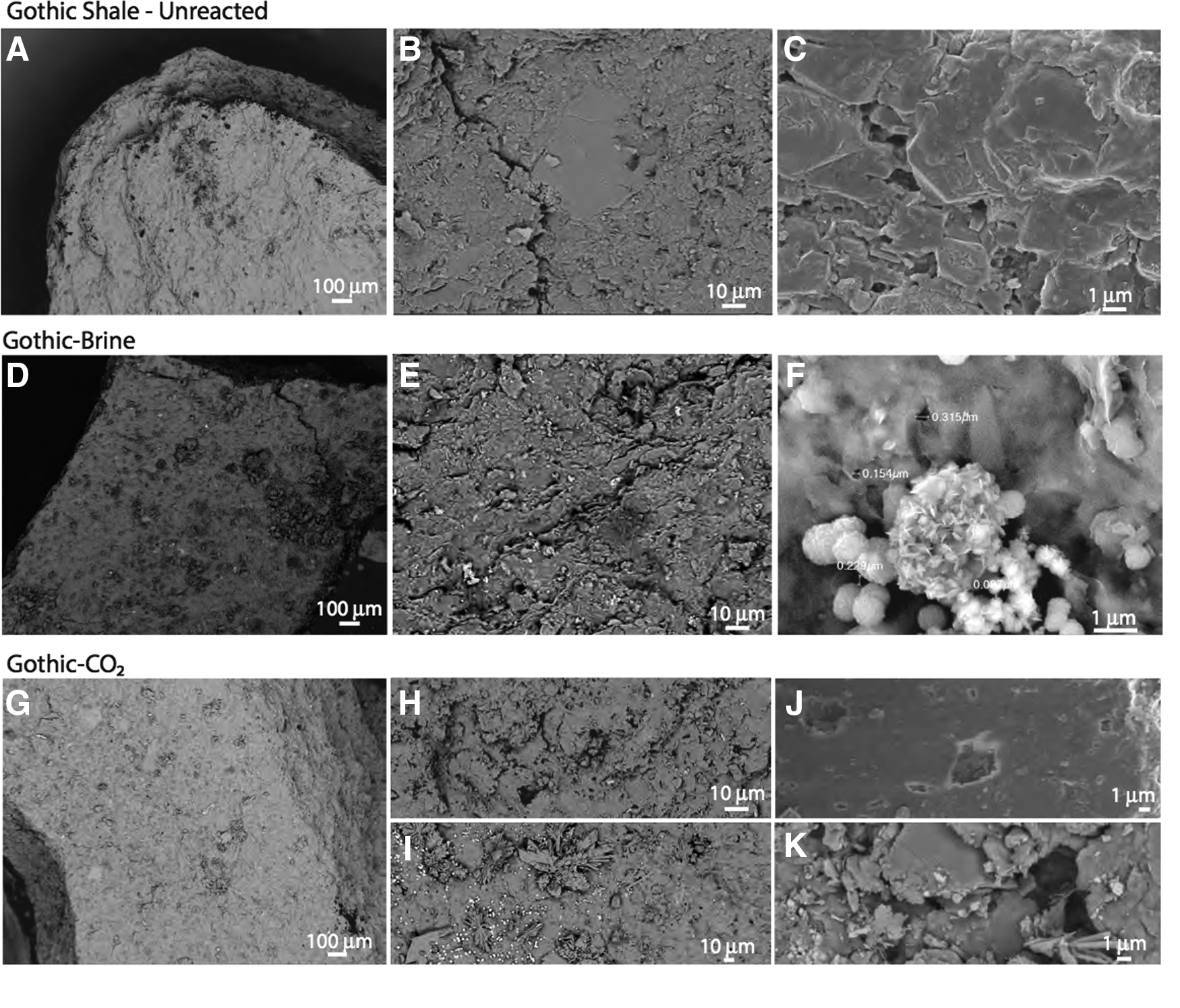
Scanning electron microscope images of Gothic Shale unreacted
A sample of the Cretaceous Marine Shale of the Tuscaloosa Group (Fig. 1B) was taken at 2415 m (7925′) below the ground surface from core collected during drilling of the Mississippi Power Company No. 1 observation well (MPC #11-1; API No. 23-059-20023). The Marine Tuscaloosa (as referred to in this article) is a potential seal for injection into basal lower Tuscaloosa Group sandstones at the Plant Daniel site in Jackson County, Mississippi. In the interval sampled, the Marine Tuscaloosa is a silica-rich mudstone containing quartz (60%), feldspar (14%), chlorite (9%), kaolinite (5%), and illite (5%), with trace calcite (5%) (Heath et al., 2011). The porosity of the sampled interval is ∼2.2%, permeability is ∼1 × 10⁻¹⁹ m2, and TOC is ∼0.73 weight percent (Heath et al., 2011). The Marine Tuscaloosa contains low maturity type II–III kerogen (Heath et al., 2011).
Experimental conditions
One of the challenges encountered in the experimental study of geochemical reactions associated with CO2 sequestration is accurately reproducing the chemical composition of formation brines. In previous experimental studies of geochemical reaction under CCUS conditions, the compositions of brines have been pure water (Busch et al., 2009), NaCl brine (Lima et al., 2011), and more complex brines created to establish equilibrium with minerals in the rocks (Kaszuba et al., 2005; Andreani et al., 2008; Ellis et al., 2011). As this study was focused on understanding how geochemical reactions induced by injection of CO2 change the physical properties of the rocks, the brine composition for each experiment was determined through a series of geochemical modeling exercises to minimize geochemical reactions associated with disequilibrium between the initial brine and minerals in the rocks. The compositions of the synthetic brines were modeled in the React module of the software Geochemists Workbench® (GWB) Standard 8.0 with the resident thermo.dat database (Bethke and Yeakel, 2012). For the Marine Tuscaloosa, brine chemistries reported for from three wells near the Plant Daniel Site at depth analogous to the depth of the Marine Tuscaloosa sample in the National Energy Technology Laboratory (NETL) National Brine Database (Carr et al., 2009) were used as starting composition for the modeling. The NETL database at the time of study did not contain any records suitable for the Gothic Shale sample. Therefore, a brine composition was modeled by fixing equilibrium concentrations of major chemical constituents with minerals present in the Gothic Shale at 160°C. For example, Fe2+, Ca2+, Mg2+, and SiO2(aq) were fixed in equilibrium with the minerals pyrite, calcite, dolomite, and quartz, respectively (Table 1).
Where a mineral phase was used to constrain composition of a given aqueous species, that species is listed in parentheses.
Reactions were modeled between these initial brine compositions for both samples and minerals in the rocks (Table 1) for temperature increases from the approximate in situ temperatures (∼60°C for Gothic Shale and ∼85°C for the Marine Tuscaloosa) to an experiment temperature of up to 200°C. Based on the results from these temperature path models, an experimental temperature of 160°C was chosen and the composition of the brine at that temperature was created in the laboratory for the experiments. At 160°C the important geochemical reactions were accelerated to ensure reaction at laboratory time scales, but the geochemical reactions predicted at 160°C were the same as those predicted at the lower in situ temperatures. However, at temperatures >170°C, predicted stable geochemical phases changed. This approach was successfully used in previous experimental studies (Gunter et al., 1997; Credoz et al., 2009; Alemu et al., 2011). The modeled brine composition at 160°C was in equilibrium with all of the minerals identified in the rocks with the exception of chlorite in the Marine Tuscaloosa. It is possible that chemical variation in natural chlorite not represented by pure end member thermodynamic data in the geochemical modeling database contributed to the predicted disequilibrium, or that chlorite is actually out of equilibrium with the deep brines but the alteration of the chlorite is slow, that is, kinetically controlled. Laboratory grade salts were mixed with de-ionized, argon-deoxygenated water to create the synthetic Ca-Na-Cl brine for the Gothic Shale and the Na-Cl brine for the Marine Tuscaloosa (Table 2). The pH of the resulting brines was measured on filtered samples.
Value at experimental temperature of 160°C.
BDL, below detection limit.
A series of four experiments, two each for the Gothic Shale and the Marine Tuscaloosa, were performed in 300 mL EZE-seal Hastelloy C-276 fixed volume reactors. Each shale (Table 3), its respective brine (Table 2), and supercritical CO2 were reacted at 160°C and 15 MPa for ∼45 days. A thermal sleeve was used to control temperature; pressure was controlled by injection of CO2. Excess CO2 was injected into the reaction chamber to ensure that the two immiscible fluid phases coexisted, and that a constant CO2 fugacity and CO2 saturation of the brine were maintained for the duration of the experiments (Takenouchi and Kennedy, 1964; Shyu et al., 1997; Duan et al., 2006). At 160°C and 15 MPa, CO2 is a supercritical fluid that may react with the shale-brine system. In this article, we refer to these experiments as Gothic-CO2 and Marine-CO2. A pair of control experiments was also performed for both shales. In these experiments, referred to as Gothic-Brine and Marine-Brine, each shale and its respective brine were reacted at 160°C and 15 MPa for ∼35 days. Pressure was controlled by injection of argon, a nonreactive gas, into the reaction chamber. Temperature varied by ±1.9°C in all experiments. Pressure varied by ±0.7 MPa in the CO2-reacted experiments and ±1.9 MPa in the brine-reacted experiments. These procedures are consistent with previous investigations of supercritical carbon dioxide-water-rock reactions (Kaszuba et al., 2003, 2005; Palandri and Kharaka, 2005; Rosenbauer et al., 2005; Chopping and Kaszuba, 2012).
Both rock fragments and powdered rocks were used in all experiments. Use of rock fragments promoted recovery of rocks of sufficient size that scanning electron microscopy (SEM), neutron scattering, and gas adsorption surface area analysis could be performed. Use of rock powders enhanced reactivity and maximized reaction rates. Rock fragments were 0.3–5 mm in size. Rock powders were prepared by grinding in a ceramic mortar and pestle and sieving through a 45 μm sieve. Five grams of shale (4 g of fragments and 1 g of powder) were used in all four experiments. Two hundred seventy grams of brine were used in the two CO2-reacted experiments and 294 g of brine were used in the brine-reacted experiments, yielding initial brine/rock ratios of 54 and 58.8, respectively. The amount of CO2 in the Gothic-CO2 and Marine-CO2 experiments were controlled by the dissolution of CO2 into the brine. In the Gothic-CO2 experiment the CO2/rock mass ratio was 3.4 (total of 17 g of CO2 in the brine), while in the Marine-CO2 experiment the CO2/rock mass ratio was 1.9 (9.5 g of CO2 dissolved into the brine).
Brine samples were extracted during the ongoing experiments 24 h after achieving experimental conditions and subsequently at 7-day intervals. The collected samples were cooled and depressurized to ambient conditions in a few seconds and subsequently processed and analyzed as described by Miller et al. (2016). Measured pH values of the extracted samples were corrected to in situ reactor pH using Geochemist's Workbench and the b-dot ion association model (Miller et al., 2016). Unreacted and reacted whole-rock samples were digested and analyzed for major cation and anion concentrations by ICP-OES (Farrell et al., 1980).
Sample characterization
Small angle neutron scattering was combined with high-resolution SEM and gas adsorption surface area and porosity measurements to quantify changes in porosity and pore connectivity in nanometer to micrometer sized pores in the shales.
Small angle neutron scattering
Neutrons passing through a rock sample scatter from nanoscale objects and internal interfaces of materials if these structures (i.e., pores) possess neutron coherent scattering contrast with the bulk material (a function of the chemistry and density). The scattered intensity as a function of scattering angle contains volume averaged information about the length scales of pores within the rock and their abundance. Small-angle neutron scattering (SANS) data contain statistical information about internal surface features and structures at length scales from ∼1 to 700 nm. Using established modeling approaches, SANS data of rock thin sections provide detailed information about the topology and architecture of nm-size pore networks (Mildner et al., 1986; Radlinski et al., 1999; Radlinski, 2006; Anovitz et al., 2009; Jin et al., 2013; Bazilevskaya et al., 2014; Navarre-Sitchler et al., 2013, 2015). These pore systems are often highly disordered and scale invariant, and can be mathematically described by fractal and polydisperse hard-sphere models, which provide information about the pore size distribution, pore volume, and surface roughness and area (Hinde, 2004; Radlinski, 2006).
Samples of unreacted, CO2-reacted, and brine-reacted Gothic Shale and Marine Tuscaloosa formation were broken in chips <1 mm and packed into quartz cuvettes with 1-mm path length for SANS analysis. SANS data were collected at the High Flux Isotope Reactor (HFIR) facility at Oak Ridge National Laboratory (ORNL) on the General Purpose SANS (CG-2) and Bio SANS (CG-3) beamlines. Data of scattering intensity versus momentum transfer (Q) were taken over a Q range from 0.0008 to 0.86/Å on CG-2 and from 0.0012 to 0.40/Å on CG-3. The raw data were reduced and processed using standard data reduction practices, including background and empty cell correction (a blocked beam and an empty cuvette), background scattering correction, transmission normalized, radially averaged, and normalized to absolute intensities (Kline, 2006, DeBeer-Schmitt and Bailey, 2011). Although shale samples cut perpendicular to the bedding plane often yield asymmetric 2D scattering patterns (Hall and Mildner, 1983; Gu et al., 2015), the random packing of shale chips in the cuvette produced azimuthally symmetric 2D scattering, averaging out asymmetries in the pore shapes. The scattering data were fit to Equation (1) to determine the constant c, which represents the incoherent.
scattering background attributed primarily to hydrogen in the sample. This incoherent scattering was subtracted from the data because it contains no structural information.
The slope m on a log–log plot of the data captures the fractal nature of the scattering. Scattering intensity (I(Q)) is proportional to the square of the difference in scattering length densities (
Here, bci is the bound coherent scattering length of atom i, summed up over all n atoms of a substance, and Vm is the molecular volume (g/mol). The values of the scattering length densities (
Determined from small-angle neutron scattering data.
Determined from BET N2 gas adsorption data.
BET, Brunauer Emmett Taylor.
Samples were soaked with a 75% D2O-H2O mixture with similar scattering contrast as the rock (3.39 × 10⁻⁶ Å−2) and reanalyzed to assess connected (water-accessible) porosity versus unconnected porosity. Samples were equilibrated with contrast-matched fluid for ≥72 h. Connected porosity was determined by difference between the scattering data from the dry samples and the contrast-matched samples.
Scanning electron microscopy
High-resolution images of unreacted and reacted samples were collected using a JEOL Ltd. JSM-7000F field emission scanning electron microscope (FESEM) with EDAX Genesis Energy Dispersive X-Ray (EDAX) Spectrometer at Colorado School of Mines to collect energy dispersive spectra (EDS). The shale chips were mounted on JEOL Ltd. JSM-840 12.5 mm diameter, 10 mm tall aluminum stubs with liquid carbon dag and vacuum sputter gold coated to reduce charging of the surface. Electron backscatter images were collected using a TSL Electron Backscatter Diffraction Detector. Approximately 400 images were collected using an accelerating voltage ranging from 5 to 10 kV.
Gas adsorption
Surface area and porosity were measured with N2 gas on unreacted and reacted samples using Brunauer Emmett Taylor (BET) analysis. Isotherms were measured over a relative pressure range from 3 × 10⁻⁵ to 1 using ∼1 g of sample and a Micromeritics ASAP 2020 surface area analyzer. To enable BET measurement, the samples were ground to particles of diameter ranging from 0.125 to 0.25 mm. A modification of the BET method was used on the Gothic Shale sample due to the high component of pores <2 nm detected in the isotherms (Rouquerol et al., 2007).
Results and Discussion
Changes in pore morphology
Gothic Shale is composed of clay minerals that fill spaces between larger grains of silicate framework and carbonate minerals mixed with organic matter (Fig. 1A, B). At micrometer length scales <10 μm, intergranualar pores parallel to clay sheets (Fig. 1B) and 100 nm to 5 μm length scale pores between grains and clay sheets are observed in SEM images (Fig. 1C). Pores <1 μm in length scale appear to associate with organic material throughout unreacted Gothic Shale samples. While precise measurement of pore length scales at resolution <10 nm was not feasible with the FESEM, qualitatively the Gothic Shale contains numerous <10 nm length scale intergranular and intragranular pores and roughness of mineral surfaces at the same length scale. SEM images of unreacted Gothic Shale are consistent with a low permeability caprock with pores at length scales ranging from <10 nm to 10 μm, and most of the porosity in pores of sub-micron sizes (Fig. 1A–C).
Compositions of the fluids extracted from the Gothic-CO2 experiment vessel are consistent with CO2 dissolution into the brine (decrease in pH by 1.5–2 U below control experiments, ∼5.5 compared to ∼3.5), and subsequent mineral dissolution (Miller et al., 2016). pH in the brine-reacted experiment is higher than in the CO2-reacted experiment providing less chemical drive for mineralogical reactions. High-resolution images of the CO2-reacted and brine-reacted Gothic Shale samples show evidence of geochemical reactions, Fe concentrations in the brines are consistent with dissolution of iron-bearing carbonates in the sample (Miller et al., 2016). Brine-reacted samples contain silicon-rich precipitates (analyzed with EDS) from ∼50 nm spheres to 400 nm plate bundles that are not present in the CO2-reacted samples (Fig. 1F), consistent with silicate mineral dissolution and silica stability (Miller et al., 2016). Precipitates comprised of Na, Al, and Si also were observed as bundles of platy precipitates (Fig. 1F), and are consistent with analcime stability in the control experiments (Miller et al., 2016). In general, small slit-shaped pores (<10 μm) in the unreacted samples grew in diameter during the Gothic-Brine experiment (Fig. 1E) and pores >10 μm appear in the Gothic-Brine samples as well (Fig. 1D). At length scales >10 mm, the Gothic-CO2 does not appear much different from the unreacted Gothic Shale (Fig. 1A, G). However, the small slit-shaped pores appear larger in SEM images (<1 μm in unreacted compared to >1 μm in the reacted samples) and new pores were created at length scales <10 μm (Fig. 1H). Enlarged intergranular pores parallel to and surrounded by clay sheets are abundant in the Gothic-CO2 (Fig. 1H) and there appear to be more intergranular nanopores (>100 nm) between grain boundaries and more precipitates relative to the unreacted samples (Fig. 1K). Clay mineral surfaces in the CO2-reacted samples exhibit pores ∼10 nm to 1 μm in size that are not present in the unreacted or brine-reacted samples (Fig. 1J). Gothic-CO2 samples contain calcium sulfate precipitates with bladed or rosette morphology that are as large as 80 μm (Fig. 1I) and are likely anhydrite (see Miller et al., 2016).
Pores at length scales >10 μm are not apparent in samples of unreacted Marine Tuscaloosa (Fig. 2A). Slit-shaped pores are found at length scales from 100 nm to 10 μm (Fig. 2B, C), and appear to occur predominantly between grains of clay minerals, with very few intragranular pores (Fig. 2C). Like in the Gothic Shale experiments, CO2 injection reduced the pH by ∼2 pH units (from 5.5 to 3.5). No decrease in pH was observed with injection of argon gas in the brine-reacted experiments. Also like in the Gothic Shale samples, both Marine-CO2 and Marine-Brine samples show evidence of geochemical reactions. Marine-Brine samples contain new SiO2-rich, platey precipitates similar to the ones in the Gothic-Brine samples (Fig. 2F, small blade-shaped precipitates), and consistent with Si activity control by solubility of silica precipitates (Miller et al., 2016). There is little visual evidence for mineral dissolution in the Marine-Brine samples (Fig. 2D–F). In contrast, slit-shaped pores at ∼100 nm length scales in the Marine-CO2 appear to increase in size (Fig. 2H) and new intragranular pores appear on the surfaces of minerals (not shown), consistent with silicate mineral dissolution indicated in geochemical analysis of the brine (Miller et al., 2016). SEM images also show evidence of hydration and/or dissolution of clay minerals (Fig. 2J), which was not observed in the Gothic-CO2 samples. Bladed calcium sulfate precipitates are found in the Marine-CO2 (Fig. 2I), but are smaller and fewer than in the Gothic-CO2 samples. In summary, both Gothic-CO2 and Marine-CO2 samples show evidence of mineral dissolution, increases in pore size, and creation of new pores while brine-reacted samples show less evidence of mineral reaction and new pore creation, and precipitates are silica rich. Evidence of mineral dissolution is more abundant in SEM images of the Marine-CO2 compared to the Gothic-CO2 samples, consistent with element release and aqueous chemistry of the brines (see Miller et al., 2016).
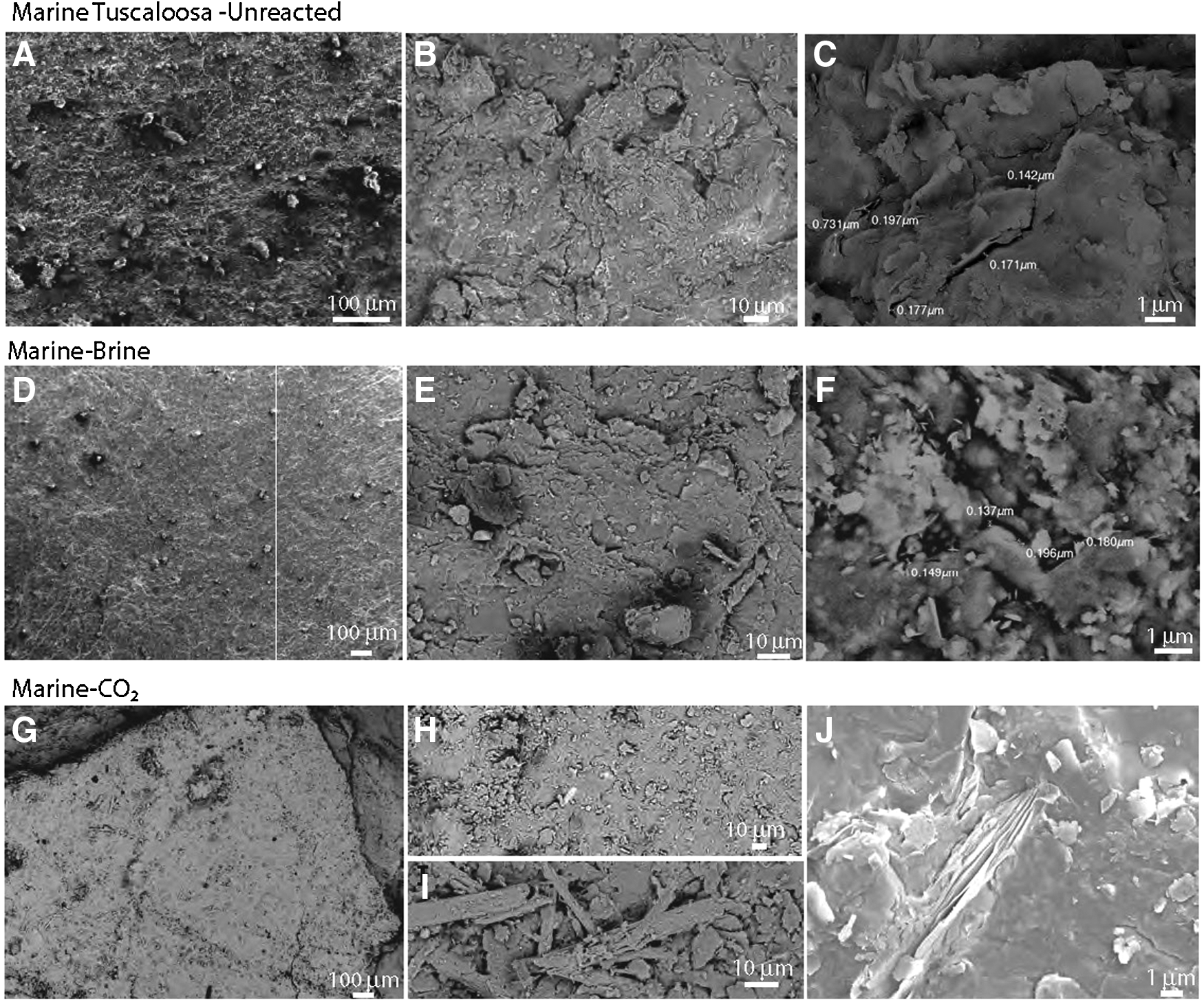
Scanning electron microscope images of unreacted Marine Tuscaloosa
Changes in porosity, pore connectivity, and surface area
FESEM images provide qualitative evidence of mineral dissolution, mineral precipitation, and increased porosity in the CO2-reacted samples of Gothic Shale and Marine Tuscaloosa. Observationally, the results are consistent with experimental results of Labus and Bujok (2011). Small-angle neutron scattering and gas adsorption (BET) data provide quantitative evidence of changes to porosity, pore connectivity, and other important physical aspects of the pore networks. SANS interrogates the internal structure of rock providing information regarding changes to pore structure that is inaccessible through imaging alone.
In unreacted samples of Gothic Shale and Marine Tuscaloosa pores <10 nm in length scale dominate the pore size distribution calculated from neutron scattering data (Fig. 4). The BET data from the Marine Tuscaloosa sample show a similar dominant pore size of <5 nm. BET data from the Gothic Shale samples are inconclusive, presumably due to the high number of angstrom to nm scale pores and high organic carbon content that can be problematic for N2 BET analysis (Sing et al., 1982).
Total and connected porosity in the unreacted Gothic Shale calculated from SANS data are 4.2% and 1.5%, respectively (Fig. 3B). Porosity increased in the Gothic-Brine samples relative to the unreacted Gothic Shale in both the connected and unconnected portions of the pore network (Table 4 and Fig. 3B). Interestingly, the total porosity in the CO2-reacted samples is the same as in the brine-reacted sample, consistent with similar features observed in SEM images of the Gothic-Brine and Gothic-CO2 samples. However, the connected porosity is lower in the Gothic-CO2, consistent with decreased connected porosity in CO2-reacted carbonate rocks reported by Tarkowski and Wdowin (2011). The resulting changes in total and connected porosity are attributed to a combination of a greater degree of mineral dissolution at length scales <1 mm (Fig. 1H), and concomitant precipitation that blocks porosity (Fig. 1I). The combination of simultaneous mineral dissolution and precipitation reactions results in little change in total porosity but decreased connected porosity in the Gothic-CO2. The pore sizes that contribute to the changes in porosity are different in the Gothic-Brine and Gothic-CO2 samples. In the Gothic-Brine, porosity in pores <100 nm diameter did not increase relative to the unreacted Gothic Shale (Fig. 1A). In contrast, in the Gothic-CO2 sample porosity increased at all length scales compared to the unreacted Gothic Shale, and the increase in porosity at length scales >300 nm in the Gothic-CO2 is the same as in the Gothic-Brine (Fig. 4B). Thus, while the total porosity would suggest that the CO2-reacted experiment produced the same results as the brine-reacted sample, the pore size distribution data show important differences in how that porosity was generated.
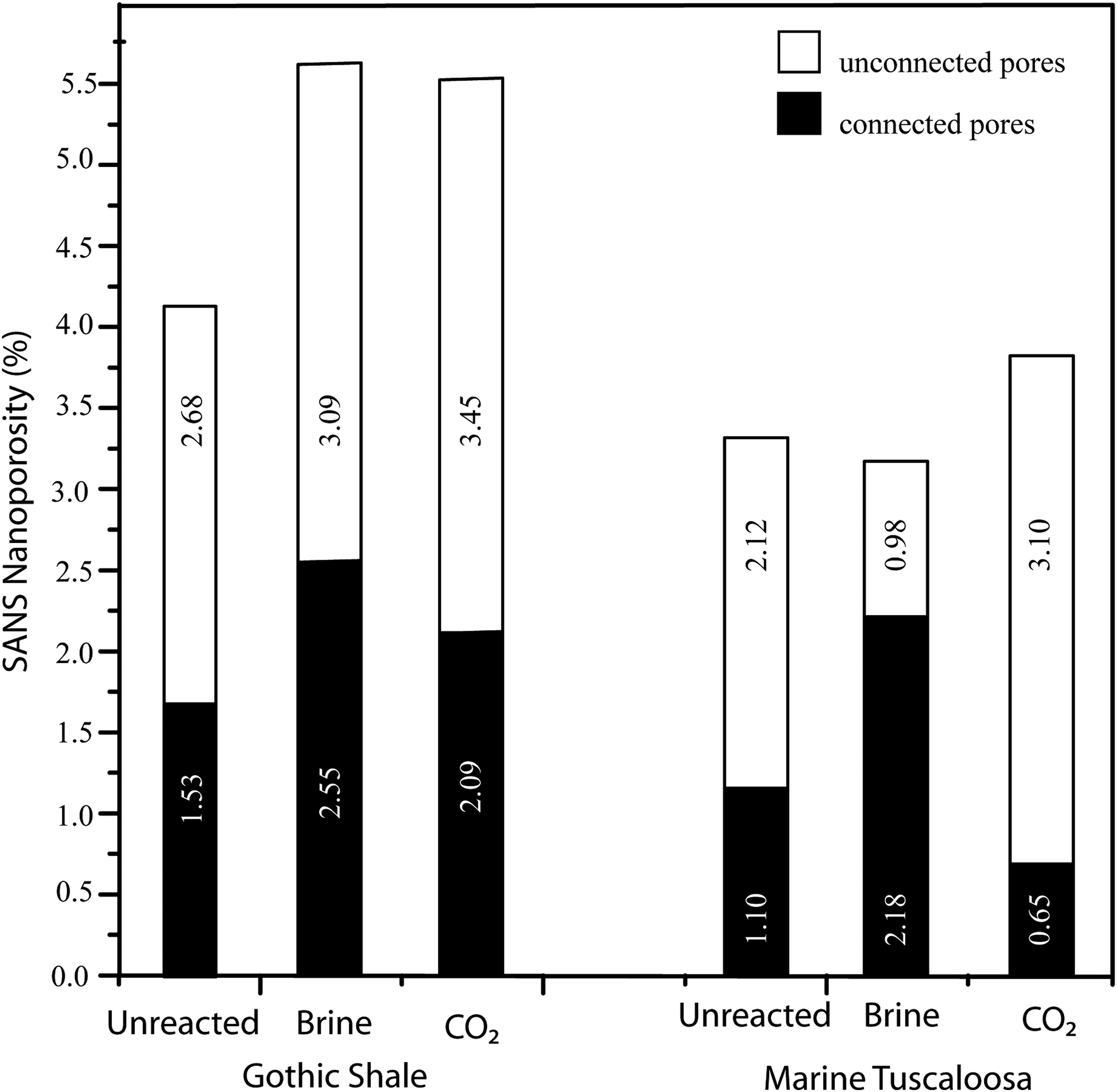
Connected and unconnected pore volume for unreacted samples of Marine Tuscaloosa and Gothic Shale compared to samples from the control and CO2 experiments.

Cumulative porosity for Gothic
Increase in porosity in the Gothic Shale samples is accompanied by an increase in specific surface area from 70.3 m2/g (43% connected) in unreacted samples to 80.2 m2/g (47% connected) in the Gothic-Brine samples, and 91.3 m2/g (49% connected) in Gothic-CO2 samples. Most of the surface area increase is attributed to connected pores that are 14–200 nm in diameter. Median pore size increases from 1.6 nm in the unreacted samples to 2 nm in Gothic-Brine samples and 1.3 nm in the Gothic-CO2 samples. Again, due to the difficulty of BET analysis on the Gothic Shale samples, the BET surface area (<5 m2/g) was significantly less than surface area cal culated from SANS data, and is likely erroneous.
Unlike in the Gothic Shale samples, the Marine-CO2 total porosity is higher than both the unreacted Marine and Marine-Brine total porosities (Fig. 3). The SANS calculated porosities of the unreacted Marine Tuscaloosa and Marine-Brine samples are 3.2%, which increased to 3.8% in the Marine-CO2 samples (Fig. 3). Interestingly, the connected porosity in the brine-reacted samples is higher (2.2%) than both the unreacted (1.1%) and CO2-reacted (0.7%) samples, and the connected porosity is lowest in the CO2-reacted samples. Pores with <10 nm diameter dominate in all samples (Fig. 4A). Neutron scattering showed that porosity increased in both the Marine-CO2 and Marine-Brine samples at nearly all pore sizes, with greater increases in Marine-CO2 compared to the Marine-Brine samples (Fig. 4A). In general, there appears to be no preferential pore size subjected to either dissolution or precipitation in the Marine Tuscaloosa samples. Decrease in connected porosity in the Marine-CO2 may be related to the hydration and alteration of clay minerals at length scales <100 nm observed in SEM images (Fig. 2J). The clay content of the Marine Tuscaloosa (19% clay, 5% calcite) is higher than that of the carbonate-rich Gothic Shale (∼12% clay, ∼45% carbonate average in Gothic Shale near the sample well, data from Chidsey (2016). These differences in mineralogy possibly explain the difference in connected porosities of these two samples after reaction with CO2. Surface area is lower in the Marine-Brine samples (49.3 m2/g, 70% in connected pores), but higher in the Marine-CO2 samples (63.2 m2/g, 63% in connected pores) as compared to the unreacted samples (53.6 m2/g, 78% in connected pores). In both the Gothic-CO2 and Marine-CO2 samples, the median pore diameter is slightly higher (∼4 nm) compared to corresponding unreacted samples (∼3 nm). While we didn't perform permeability tests on the reacted samples due to the small sample sizes, an increase in pore size and porosity can correspond to an increase in permeability. However, the surface area also increases in both CO2-reacted samples, which can contribute to decreases in permeability. Therefore, predictions regarding the changes in permeability of these samples are not possible with the current data.
Conclusions
Samples of caprocks from two different CO2 sequestration pilot projects were experimentally evaluated for evidence of mineral dissolution and precipitation and related changes in porosity, pore connectivity, and surface area as a result of geochemical reaction under simulated CO2 sequestration conditions. Results from the CO2-reacted samples were compared to results from a set of control experiments where argon, not CO2, was used to maintain a pressure of 15 MPa in the autoclave reactor with brine and shale samples. Results from these experiments demonstrate that both the Gothic Shale and Marine Tuscaloosa experience mineral dissolution under CO2 sequestration conditions, and in both sets of experiments more extensive mineral reactions were observed in the CO2 experiments compared to the control experiments. In Brine-experiments silica-rich bladed and/or spherical-shaped mineral precipitates were observed in SEM images compared to Ca-sulfate precipitates in both the Gothic-CO2 and Marine-CO2 experiments. In the Gothic Shale, both total porosity and connected porosity increased under reactive conditions relevant to CO2 sequestration. In the Marine Tuscaloosa, total porosity increased slightly but connected porosity decreased. Despite larger increases in total nanoscale porosity (as measured by SANS) in the Gothic-CO2 compared to the Marine-CO2 samples, overall the Marine-CO2 samples appear the most reacted in SEM images with increased abundance of pores >1 μm. Differences in aqueous geochemistry between the two experiments are also consistent with more reactive Marine Tuscaloosa compared to the Gothic Shale (Miller et al., 2016).
Total porosity, pore connectivity, and surface area increased in both the brine-reacted and CO2-reacted samples Gothic Shale. In contrast, total porosity did not change but connected porosity increased in the brine-reacted Marine Tuscaloosa samples, while the total porosity increased and connected porosity decreased in the CO2-reacted Marine Tuscaloosa samples. SEM images of the Gothic Shale and Marine Tuscaloosa CO2-reacted samples exhibited increased numbers and sizes of pores, consistent with data from small angle neutron scattering and BET analyses. SEM observations of increased numbers of large pores, combined with increased mobilization of solutes and aqueous geochemical evidence presented in Miller et al. (2016) suggest that the Marine Tuscaloosa caprock may be more susceptible to long-term loss of sealing capacity with geochemical reaction compared to the carbonate-rich Gothic Shale. However, neutron scattering analysis demonstrates a decrease in connected porosity in small pores, likely due to precipitation or clay hydration, which may limit the connectivity of any enhanced porosity. It is unclear from SEM images if the increased porosity at larger length scales is connected or unconnected. Dissolution of silicate minerals in the higher pH brine-reacted experiments appeared to result in the formation of silicate precipitates not observed in the CO2 experiments. General agreement between rock and fluid chemistry in these experiments point to aqueous geochemistry as a potentially important source of information about downhole coupled physicochemical processes.
We recommend future research to evaluate porosity changes in intact rock core under in situ lithostatic pressure conditions. These more complicated experiments will shed light on heterogeneous development of pores related to heterogeneity in fluid flow paths through the rock and spatial and temporal evolution of geochemical reactions along fluid flow paths.
Footnotes
Acknowledgments
This research was supported from the United States Department of Energy, Grant number DE-FE0000730 to J.M. and A.K.N.-S. and by an EPA Star Grant R834387 to J.M., R.J. Maxwell, and A.K.N.-S. at the Colorado School of Mines and J.K. at University Of Wyoming. J.K.’s work was also supported by the UW School of Energy Resources. G.R. was supported as part of the Nanoscale Control of Geologic CO2 (NCGC) Center, an Energy Frontier Research Center funded by the U.S. Department of Energy, Office of Science, Office of Basic Energy Science. Q.R.S.M. acknowledges support from the UW School of Energy Resources the Center for Advanced Energy Studies. We would like to thank John Chandler at the Colorado School of Mines Electron Microscopy Laboratory for assistance with collection of FESEM images. The neutron scattering portion of this research at ORNL's High Flux Isotope Reactor was sponsored by the Scientific User Facilities Division, Office of Basic Energy Sciences, the U.S. Department of Energy. We acknowledge Ken Littrell at ORNL for his guidance with the neutron scattering experiments. We also thank three anonymous reviewers, whose suggestions improved the article.
Author Disclosure Statement
No competing financial interests exist.