




Abstract
Abstract
Current practice of wastewater treatment does not recover the full potential of energy present in wastewater. The potential of using anammox bacteria for autotrophic nitrogen removal combined with a desire for energy optimization brings new attention to the A-stage technology for organic carbon harvesting from municipal wastewater. The goal of this research was to investigate operational conditions of four full-scale A-stage processes and gain insight in the optimal conditions to harvest the maximum amount of organics present in sewage as excess sludge from the A stage. Large differences in removal efficiencies and design aspects were found between the four operational A-stage processes in the Netherlands. Biochemical oxygen demand (BOD) removal efficiencies vary between 40% and 80%, indicating that a good removal efficiency is possible, but that local conditions or design can be very influential. An optimal solid retention time (SRT) for maximal sludge production of 0.3 days was found; a longer SRT resulted in more mineralization of the chemical oxygen demand (COD). SRT control might be an important design aspect for the optimization of A-stage process. A short contact time with a minimum of 15 min and sufficient aeration were found to be optimal for soluble COD removal. Iron addition aided the removal of colloidal/suspended COD by coagulation/flocculation. Sludge flocs formed in the A-stage process are weak and sensitive to anaerobic conditions as well as shear due to, for example, pumping. Besides a good design of the A-stage itself, the further processing of the produced sludge also needs careful attention to optimize the sludge production and energy production.
Introduction
W
The AB (Adsorption-Belebung)-process was originally developed to maximize the recovery of organic matter from wastewater for energy production through biogas (Böhnke, 1977). The process consists of a very highly loaded activated sludge process (Adsorption or A-stage) with intermediate clarification, followed by a low-loaded activated sludge process (Belebungs or B-stage). The A-stage is intended for maximal recovery of organic matter, while the B-stage is removing remaining biochemical oxygen demand (BOD) as well as ammonium. Several AB-process wastewater treatment plants (WWTPs) have been constructed in the 1980s in countries like Germany and the Netherlands. In total, about 50 full-scale installations for municipal and industrial wastewater have been realized (Böhnke et al., 1998). Advantages compared to a 1-stage activated sludge system mentioned in the 1980s and 1990s are a small footprint, low energy requirements due to increased biogas production in the sludge digestion and better nitrification process stability for fluctuations in organic composition, pH, and toxic components (Böhnke, 1984; Versprille et al., 1984; Salomé, 1990). Disadvantages of the system are the low denitrification potential in the B-stage due to high removal efficiency of BOD in the A-stage.
More stringent effluent requirements for nitrogen have resulted in a decline in the number of AB-processes by reconfiguration of existing AB-systems for phosphorus and nitrogen removal (Böhnke et al., 1998). The potential of using anammox bacteria for autotrophic nitrogen removal combined with attention for energy optimization brings new attention to the A-stage technology for organic carbon harvesting from municipal wastewater (Kartal et al., 2010). The literature on AB-processes mostly focused on nitrogen removal (Demoulin, 1998) and does not reveal information on the processes occurring in the A-stage. Only one article was found, which describes the effect of low sludge age on wastewater fractionation (Haider et al., 2003).
The goal of this study was to investigate operational conditions of the A-stage process and gain insight in the optimal conditions to harvest a maximum amount of organics present in sewage as excess sludge from the A-stage. Data of four full-scale A-stage processes (yearly average values) and results from batch experiments are presented. Furthermore, design guidelines for an optimal A-stage for maximum carbon recovery are discussed.
Material and Methods
Data collection
Existing WWTPs with AB-processes in the Netherlands were investigated to obtain an overview of process conditions responsible for COD conversion into sludge. Detailed information about the four WWTPs, Nieuwveer, Dokhaven, Utrecht, and Garmerwolde, can be found in the supplementary material and a summary of the information can be found in Table 1. Yearly average values were collected from four WWTPs (total COD, total BOD, Kjeldahl nitrogen, and TP analyses). In addition, 24-h samples were taken during a few weeks and analyzed for suspended and soluble COD (this was not done for WWTP Garmerwolde). Physical processes such as coagulation and flocculation were investigated by batch tests and studying the design and characteristics of the A-stage tanks and intermediate settlers.
WWTP, wastewater treatment plant.
Jar batch tests
Jar batch tests were done at WWTP Dokhaven and Nieuwveer. Biological activity in the A-stage was investigated by batch tests at the WWTPs using fresh active A-stage sludge. A jar batch tester was used with six jars of 1.8 L, which could be stirred and aerated. As far as possible, separate samples were taken from influent to the A-stage and sludge return stream. Sludge and influent of the A-stage were mixed in a ratio of 1:1 in the jars and aerated. Samples were taken at t = 0, 2, 5, 7, 10, 15, and 30 min and analyzed for soluble COD. The jars were sufficiently aerated preventing limitation of oxygen. Separate sampling of influent of the A-stage and sludge was not possible at WWTP Dokhaven. Therefore, a sample from the beginning of the A-stage was taken and on the spot, a small amount of it was filtered as sample at t = 0. Subsequently, the sample was transferred to the jars and aerated. The tests were done in duplicate and always under dry weather conditions (less than 3 mm of rain the day before and no more than 3 mm in forecast on the day itself). Anaerobic batch tests were done to investigate the release of COD when sludge was not aerated. Samples of the end of the A-stage before the entrance to the intermediate settler were taken and transferred anaerobically to the jar tester. In the jars, the mixture was slowly stirred and the jars were covered with Styrofoam to avoid contact with air. Samples were taken at t = 0, 30, 60, and 90 min and analyzed for soluble COD.
To test the effect of aeration and subsequent flocculation by iron addition, these two processes were combined in one test. In eight jars, four different conditions were applied: aerated or not aerated for 30 min and subsequently iron addition [5 mg Fe(III)/L] or no iron addition. After the addition of iron or zero iron, the jars were mixed for 0.5 min at high speed (300 rpm), 3 min at low speed (50 rpm), and subsequently 15 min of settling were applied. The supernatant was analyzed for total COD and soluble COD.
Analyses for batch tests
COD analyses were done using Hach-Lange cuvette tests (LCK 414 and LCK 514). For soluble COD, the samples were filtered using a 0.45 μm filter (Whatman spartan 30/0.45 RC). Suspended solids (SS) were determined according to standard methods (APHA, 1995). Temperature, pH, and dissolved oxygen were measured with a portable meter (Hach Lange pH/Oxi 340i).
Results and Discussion
Removal efficiencies
Generally the total COD to the A-stage consists of a soluble part and a colloidal/particule part. The aim in the A-stage is to convert the soluble COD into colloidal or particulate by biological and physical methods and capture as much as possible of the colloidal and particulate part in the intermediate settler. Therefore, we first researched the removal efficiencies. Large differences in removal efficiencies and design aspects were found between the four operational A-stage processes in the Netherlands (Tables 2 and 3). BOD removal efficiencies vary between 43% and 82% (Table 2), indicating that good removal efficiency is possible, but local conditions or design can be very influential. In the A-stage, 24%–48% of the incoming COD is effectively captured as sludge by biological and physical processes and removed by excess sludge (Table 2), however, a significant fraction of the sludge (up to 50%) can be found in the overflow of the intermediate settler (Table 3). This sludge represents a fraction of the SS leaving the A-stage, which is only affected by settleability.
All WWTPs dose iron (Fe(II) or Fe(III)) in the A-stage for phosphorus removal.
BOD, biochemical oxygen demand; COD, chemical oxygen demand.
SS, suspended solid; SRT, solid retention time.
The highest removal efficiencies in the A-stage were observed at WWTP Dokhaven with up to 74% removal of COD. At this WWTP, an electricity consumption for aeration of 0.17 kWh/kgCOD removed was observed, higher than the value for WWTP Utrecht (0.10 kWh/kgCOD removed). Electricity consumption for aeration for the other two WWTPs could not be obtained from the registered data.
Analysis of the fractions of COD removed in the A-stage showed that WWTP Dokhaven had the highest soluble COD removal in the A-stage, whereas at the other WWTPs, the most soluble COD was not removed in the A-stage (Table 4). Soluble biodegradable COD has to be removed by bioconversions since it will not be easily flocculated or adsorbed in the sludge flocs. The higher energy consumption for aeration at Dokhaven could be related to a higher biological activity for the conversion of soluble COD into biomass. This difference between the four A-stage processes was observed from a COD balance as well, see Figure 1. At WWTP Nieuwveer, the highest percentage of mineralization of COD was observed.

COD mass balance of A-stage at four full-scale WWTPs, based on yearly average values from 2010. Mineralization was calculated as the difference between influent COD and COD in effluent and excess sludge in the A-stage (1 gVSS equals 1.5 g COD). WWTP, wastewater treatment plants; COD, chemical oxygen demand.
Average of 24-h composite samples during dry weather flow in period winter/spring 2011/2012. WWTP Dokhaven: four samples in a period of 4 weeks. WWTP Nieuwveer: 20 samples in period of 5 weeks. WWTP Utrecht: seven samples in a period of 2 weeks. WWTP Nieuwveer applied a large fraction of effluent recirculation (1.6 compared to 0.5 at the other WWTPs).
Amount of soluble COD removed (kg/day) versus total COD load to A-stage (kg/day).
Hydraulic residence time and sludge retention time
The hydraulic residence time was in all four Dutch WWTPs, more or less in accordance to the design guidelines. In the batch tests, it was shown that 15-min contact time (yearly average, including wet weather flow) is enough for most soluble COD removal (Fig. 2). The solid retention time (SRT) seems to have a strong effect on the degree of mineralization. An SRT of 0.3 day results in a lower percentage of mineralization and higher sludge production compared to an SRT of 0.65 day. Jimenez et al. (2015) reported a similar optimal SRT for maximal sludge production of 0.3 days, with a longer SRT leading to more mineralization of the COD. This indicates that the SRT control might be an important design aspect for optimization of the A-stage process; the choice should be such that most soluble COD can be converted to biomass, while minimizing endogenous or hydrolytic processes. Together with a short SRT a high sludge loading can be applied, >3.5 kg BOD/kg TSS/day or 8.3 kgCOD/kgTSS/day. WWTP Dokhaven applies the highest sludge loading, while achieving the highest COD removal efficiency (Table 2).
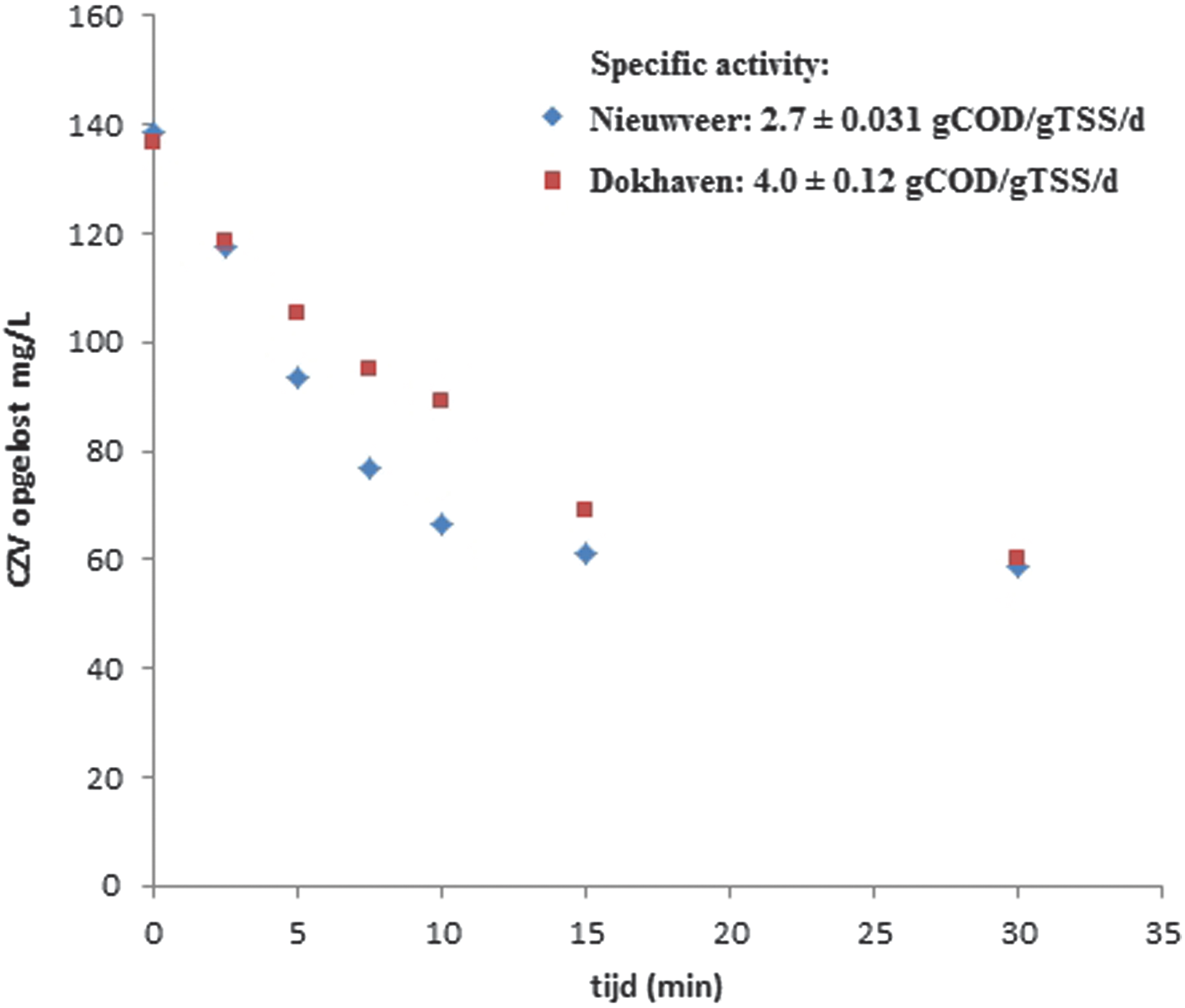
Decrease in soluble COD during biological batch tests using influent of WWTP Nieuwveer in both tests, but two different types of sludge: A-stage return sludge of WWTP Nieuwveer (TSS of 3.9 g/L) and A-stage sludge of WWTP Dokhaven (TSS of 2.0 g/L). Temperature was 10°C.
Composition of total load to A-stage
The composition of the influent to the A-stage seems to be important on the effectiveness of an A-stage. The influent to the A-stage at WWTP Dokhaven contains a large percentage of soluble COD (40%), whereas WWTP Utrecht receives mainly suspended COD (only 18% soluble COD). The short SRT does likely not allow conversion of slowly biodegradable (mainly colloidal and particulate) COD, which is only removed by flocculation and sedimentation. When the A-stage has a low percentage of soluble COD in the influent to the A-stage, the contribution of bioconversion to the total COD removal is limited (Table 4). When comparing the SRT at Nieuwveer and Utrecht, both receiving a low soluble COD influent, it seems that an increased SRT from 0.3 to 0.6 days already gives a significant extra oxidation of nonsoluble biodegradable COD. Likely for treatment plants receiving low soluble COD (chemical enhanced), presettling is sufficient for maximal sludge production, similar removal efficiencies (50–60%) are achieved as for advanced precipitation in a primary settling tank (Mels, 2001; van Nieuwenhuijzen, 2002). The A-stage system has mainly benefits for treatment plants that receive a relatively larger fraction of soluble COD.
The specific soluble conversion capacity was tested for sludges from WWTP Dokhaven and Nieuwveer. In several tests, the sludges were incubated with influent to the A-stage from the treatment plants. The A-stage sludge of Dokhaven had a higher activity in all these tests. This is likely related to the higher sludge loading rate in the Dokhaven plant. When the load of soluble biodegradable COD is higher, the biomass will contain a higher percentage of active biomass. The results of the tests also indicated that a contact time (including sludge return stream) in the plug-flow aeration tank of 15 min is enough for full conversion of the soluble biodegradable COD. In Figure 2, the specific rate of sludge from WWTP Dokhaven and Nieuwveer is compared for its acitivity using the same wastewater as present at WWTP Nieuwveer. The sludge from both plants achieved equal removal of soluble COD, although Dokhaven obtained higher rates.
Aeration
Besides the composition of the load to the A-stage, aeration in the A-stage is also important for soluble COD removal and high sludge activity. An aeration test at the full-scale facility at Dokhaven with eight parallel A-stage lines showed that when minimum aeration was applied, the soluble COD removal was less, compared to the lines where maximum aeration was applied. The results are shown in the supplementary material.
To investigate the effect of aeration on COD removal compared to iron dosing, biological tests and flocculation tests were combined. The results are shown in Figure 3 and it shows that the lowest COD concentration was achieved when the sludge was aerated and iron was dosed. These tests underline that likely soluble COD is mainly removed by the biological activity, while the colloidal/suspended COD is removed by coagulation/flocculation. This is aided by the addition of iron. How far biopolymer formation by growth on the soluble COD enhances the flocculation process should be a subject of future studies.

Total COD at the end of tests. Jars 1–4 were aerated and 5–8 were not aerated. In jars 1, 2, 5, and 6, iron was added and in 3, 4, 7, and 8, no iron was added.
Aeration varied a lot between the four WWTPs, from minimum aeration with surface aerators at WWTP Utrecht to intensive fine-bubble aeration at WWTP Dokhaven. Aeration is important for the removal of soluble COD and it could ideally be controlled based on the soluble COD in the effluent of intermediate settler. WWTP Dokhaven showed that it is possible to remove most soluble COD in the A-stage (Table 4), whereas at other WWTPs, the most soluble COD was removed in the B-stage.
Sludge line
Several sludge settling experiments and visual inspection showed that the A-stage sludge is fragile (Fig. 4, results are shown in supplementary material). Batch tests where sludge was kept anaerobic showed that the soluble COD concentration increased, showing that adsorbed COD is released when the sludge is kept anaerobic for longer than 0.5 h (results are shown in supplementary material). Absence of oxygen and high shear zones should be avoided and a fast separation of sludge and water and subsequent sludge treatment are recommended.
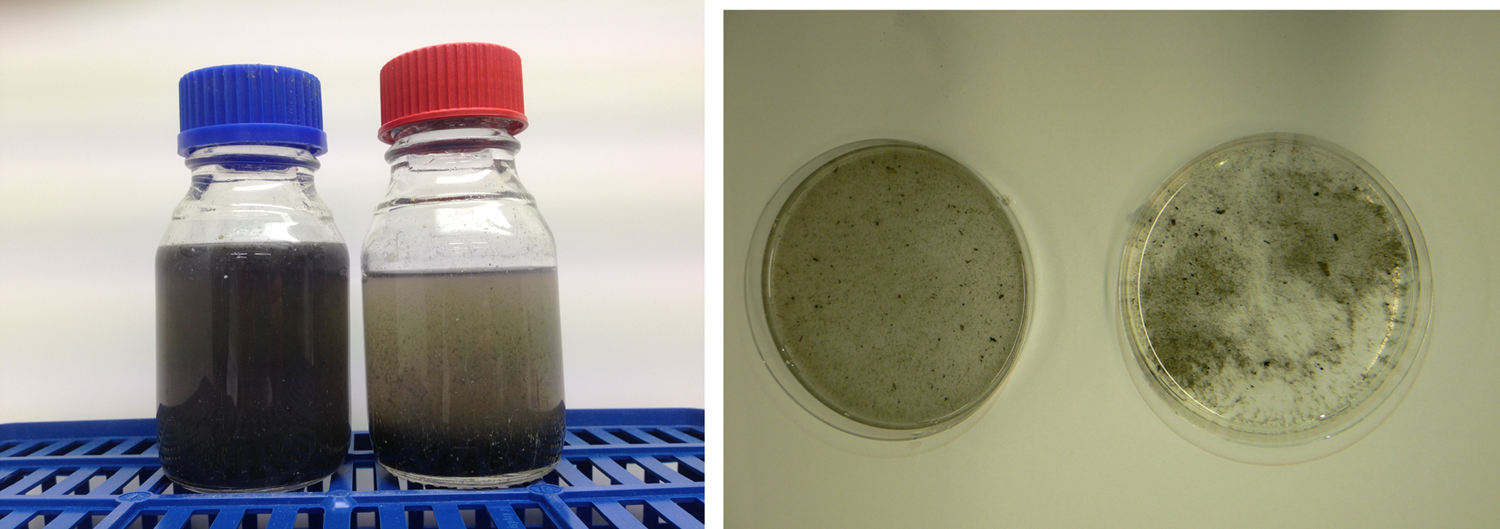
Sludge from A-stage of WWTP Nieuwveer; left the sludge was shaken for 15 min; right the sludge was not shaken, but slowly/gently mixed. Both bottles were allowed 3 min of settling before picture was taken.
At WWTP Dokhaven, for example, the A-stage sludge is transported to the sludge treatment facility, which is at 600 meter distance. Due to the floc disruption during pumping and anaerobic conditions, there was a limited efficiency of the thickener resulting in a relatively large fraction of suspended COD being returned to the A-stage and a reduced output of COD to the digester. To improve the efficiency of the thickener, a small amount of iron was dosed since July 2012. This resulted in an increased output of sludge to the digester and the biogas production was increased by 14% (4.2 million m3 in 2013 compared to 3.7 million m3 on average in 2010 and 2011; in 2013 1.1 m3/day FeCl3 with a concentration of 200 gFe/L was dosed; data from the yearly reports of WWTP Dokhaven). The increase in biogas production equals 0.8 million kg COD, which is about 4% of the COD load of the treatment plant. This shows that it is worth to invest in measures to increase the COD load to the digester.
Table 5 shows the applied designs for the A-stage compared to the original design guidelines by Böhnke.
Further discussion and perspectives
Besides the Netherlands, AB-processes have been mainly applied in Germany and Austria. Most have been rebuilt to a conventional activated sludge system with a primary settler. A few WWTPs show good results applying the A-stage or advanced pretreatment. WWTP Strass in Austria was commissioned in 1999 and equipped with the AB-process. This WWTP has been very successful in reducing its energy requirements by several measures, like active management of the aeration system, implementing energy-efficient side-stream nitrogen removal, and enhanced utilization of the digester gas by converting to a state-of-the-art cogeneration unit. The A-stage of WWTP Strass eliminates 55–65% of the organic load without addition of iron for phosphorus removal (Wett et al., 2007 and personal communication). Using iron addition in the A-stage, the COD removal could be increased, increasing the energy production at WWTP Strass. Advanced precipitation at WWTP Holten resulted, as well, in enough methane production to fulfill the total energy demand of the WWTP for aeration (van Loosdrecht et al., 1997).
Further research should focus on characterizing different fraction of COD entering the A-stage (e.g., VFA analysis, soluble, colloidal, and suspended COD) to gain more insight in which fractions have the highest potential to be recovered for sludge digestion. Furthermore, the A-stage sludge thickening and returning streams to the A-stage should be further characterized to gain insight into the effect of COD removal in the A-stage and the efficiency of sludge thickening.
This research focused on COD removal in the AB-process. When the A-stage is performing optimal, not enough COD is left for conventional nitrogen removal in the B-stage. Applying autotrophic nitrogen removal (“cold anammox”), as is being demonstrated in the CENIRELTA project at WWTP Dokhaven, nitrogen can be removed without using COD (Geilvoet et al., 2014). Phosphorus is removed chemically in the AB-process using iron. Phosphorus and iron can be recovered from the ashes of the sludge incineration plant by several chemical processes (e.g., Ecophos technology, ecophos.com). More research is needed to design an optimal concept for maximum energy and nutrient recovery from wastewater, turning the WWTP into a water resource recovery facility.
Conclusions
Four Dutch WWTPs with the AB-process showed large differences in design and performance of the A-stage. An A-stage process is more effective in COD removal compared to presettling when the influent to the A-stage contains a relatively high fraction (>25%) of soluble COD because of active uptake of soluble COD by the biomass.
For maximal sludge production, an optimal SRT of about 0.3 days was found; a longer SRT resulted in more mineralization of the COD. Short contact time (minimum of 15 min) is sufficient for soluble COD removal. For a good soluble COD conversion, sufficient aeration is essential and it could ideally be controlled based on the soluble COD in the effluent of intermediate settler.
Flocs formed in the A-stage process are weak and sensitive to anaerobic conditions as well as shear due to pumping. This makes that besides a good design of the A-stage itself, further processing of the produced sludge needs careful attention to optimize the energy production. Future research should concentrate on floc formation and sludge handling to optimize the energy recovery from wastewater by A-stages.
Footnotes
Acknowledgments
Leonie Hartog (waterboard Brabantse Delta), Etteke Wypkema (waterboard Brabantse Delta), Willy Poiesz (waterboard Noorderzijlvest), Erik Rekswinkel (waterboard Stichtse Rijnlanden), Chris Reijken (Waternet), and Cora Uijterlinde (Stowa) of the DynaFil guiding committee are thanked for their valuable discussions. This research is part of the DynaFil project in which KWR Watercycle Research Institute, TU Delft, Waternet, STOWA, Logisticon Water Treatment, Waterboard Brabantse Delta, and Bert Daamen participate. The project is partly funded by AgentschapNL under the Energy and Innovation Grant, Effective and Efficient Digestion chain (Grant no: EVTP01084).
Author Disclosure Statement
No competing financial interests exist.
References
Supplementary Material
Please find the following supplemental material available below.
For Open Access articles published under a Creative Commons License, all supplemental material carries the same license as the article it is associated with.
For non-Open Access articles published, all supplemental material carries a non-exclusive license, and permission requests for re-use of supplemental material or any part of supplemental material shall be sent directly to the copyright owner as specified in the copyright notice associated with the article.
