




Abstract
Abstract
Sorption of various contaminants on biochar has been investigated extensively in the literature. However, ash content was generally removed through weak acid or deionized water washing. The objective of this study was to investigate the role of biochar ash content in Cu(II) removal. Twenty-four biochars were prepared from pine chips (PCs) and peanut shells (PSs) at 200–500°C. All the biochars were washed with deionized water or HCl/HF to remove ash contents. Treated and untreated biochar particles were then compared for their physical–chemical properties as well as sorption characteristics for Cu(II). Cation exchange was an important mechanism controlling Cu(II) sorption on biochars. Precipitation was not important for most biochars, but contributed up to 20% for biochars produced from PSs at 500°C. Removal of ash content increased Cu(II) sorption on PC biochars. A significantly positive relationship was observed between ash content and sorption coefficients for Cu(II) for PS biochars. Thus, the impact of ash content on Cu(II) sorption is biochar property dependent. For biochars dominated with anions of PO43−, CO32−, OH−, and SO42−, ash content will play a positive role in Cu(II) removal from aqueous phase. However, for biochars dominated with competitive cations, ash content will play a negative role. Therefore, for the purpose of heavy metal immobilization, removal of ash content is dependent on biochar properties and the composition of ash content.
Introduction
C
Due to its stability and porous structures, biochar has been applied to improve soil nutrients (Uzoma et al., 2011), enhance carbon sequestration and microbial community stability (Jiang et al., 2015), and control environmental pollutants. In laboratory simulation experiments, researchers generally removed ash contents from the biochars to better illustrate the sorption mechanisms of the solid particles. However, it is easy to understand that washing biochar is not practical in the real biochar application system. The role of ash content in the real biochar application system needs to be studied. Previous investigators suggested that the adsorption capacity of Pb ions on biochars was significantly decreased after the removal of ash (Wang et al., 2015), suggesting the importance of mineral compositions in heavy metal removal. The roles of ash contents played in heavy metal sorption are as follows: (1) The released PO43− and CO32− could precipitate heavy metal ions (Malamis et al., 2010; Xu et al., 2013), which contributes to heavy metal removal. (2) The ash content could change aqueous pH values, which results in heavy metal precipitation (Ronsse et al., 2013). (3) Heavy metals could interact with biochars through cation exchange (surface base ions, e.g., K, Ca, Na, and Mg). However, some other researchers reported the decreased heavy metal sorption after ash content removal (Chen et al., 2012; Chen et al., 2015; Wang et al., 2015).
Clearly, the role of ash contents in heavy metal removal is not clearly illustrated. Some more extended work is needed. This study is thus designed to compare the sorption difference of copper on biochars before and after ash content removal.
Experimental Section
Preparation of adsorbents
Pine chips (PCs) and peanut shells (PSs) were collected in Kunming, Yunnan province, China. The collected biomass samples were washed with deionized water three times to remove the surface dust and dried at 60°C. Afterward, the biochars were produced at 200, 300, 400, or 500°C. The biochar yields were calculated through the comparison of the weights of the original biomass and the generated biochars. All the solid particles were grinded to powder and passed through a 0.25 mm sieve.
Obtained solid samples (10 g) were added in a polyethylene bottle with a lid, washed with deionized water to a constant pH (4 days), and then solid particles were dried at 60°C. The samples were referred to by suffix “-W.”
These samples were also washed by HCl and HF. All samples (10 g) were added into the plastic bottle with a lid and soaked in 100 mL of 1 mol/L HCl (Chen et al., 2008) solution at room temperature three times (30 min each time). Then, the solid residues were soaked in 100 mL mixed acid solution (1 mol/L HCl and 1 mol/L HF) at room temperature four times (4 h each time) (Lu et al., 2012b). The treated samples were then washed with deionized water and oven-dried at 60°C. The samples were referred to by suffix “-A.”
Biochar characterization
Elemental (C, H, N, O, S) contents of biochars were analyzed using an elemental analyzer (Vario EL III; Elementar). Biochars were mixed with deionized water (0.8 g vs. 40 mL) for 24 h. After being shaken on a reciprocal shaker for 1 h, the mixtures were separated by centrifugation at 2,500 rpm for 20 min, and filtered through a 0.45 μm Millipore filter (Cao and Harris, 2010). The filtrates were analyzed for water-soluble anions (phosphate and sulfate) on an ion chromatography (HIC-20Asuper; Shimadzu), cations (mostly K, Ca, and Mg) on a flame atomic absorption spectrometry (FAAS) (Z-2000; Hitachi), as well as inorganic carbon on a TOC analyzer (Vario TOC; Elementar). The filtrate was acidified to pH <2 with HNO3 before K, Ca, and Mg analyses.
The specific surface area was measured by the Brunauer–Emmett–Teller (BET) method (ASAP2020M; Micromeritics) using N2 as the carrier gas. Ash content was measured by heating the samples in a muffle furnace at 800°C for 4 h and was calculated based on the residue particles. The pH of all samples was measured in solid/aqueous ratio of 1:50 (W/V) after shaking for 24 h at 120 rpm. The solid particles were also analyzed by an FTIR (Varian 640-IR). Samples were prepared as KBr tablets. In brief, KBr was mixed with biochar particles at 800 mg:1 mg and pressed as a pellet sample. Infrared spectra were collected in the range of 4,000–400 cm−1 at 8 cm−1 resolution and 20 scans per sample.
Scanning electron microanalysis
Change of surface properties after washing was evaluated by the scanning electron microscope (SEM)/energy dispersive X-ray (EDX) data. The samples were mounted onto aluminum stubs using double-sided carbon tape, gold coated with a sputter coater. Samples were analyzed with a Tescan, VEGA3 SBH, Czech Republic, equipped with an EDX Thermo Fisher Noran System 7, Thermo Fisher Scientific. For each analysis, the voltage was set at 20 keV, while the working distance was 9 mm and the dead time for X-ray acquisition was between 20% and 25%. A color code was assigned for the elements; blue for carbon and white for oxygen. Dot maps were acquired at 180× magnification and 600 frames each to optimized electron detection from the surface of the biochar samples.
Sorption experiments
Batch sorption experiments of Cu(II) were conducted for all the solid samples. Cu(II) stock solution (1,000 mg/L) was prepared using analytical reagent Cu(NO3)2·3H2O, which was dissolved in a background solution of 0.01 mol/L NaNO3. This stock solution was diluted by the background solution to eight different concentrations (1.00, 1.39, 1.93, 2.68, 3.73, 5.18, 7.20, and 10.0 mg/L). The pH of all Cu(II) solutions was preadjusted to 4.00 ± 0.05 by adding drops of 0.1 mol/L NaNO3 or NaOH solutions. On the basis of preliminary experiments, the adsorbents were mixed with Cu(II) solutions with aqueous/solid ratio of 1000:1 in 8 mL vials with teflon-lined screw caps. All the vials were shaken in an air-bath shaker at 120 rpm at 25°C for 3 days. According to our previous experiments, the period of 3 days was sufficient to reach apparent sorption equilibrium. After shaking, all mixtures were separated by centrifugation at 3,300 rpm for 10 min, and filtered through a 0.45 μm Millipore filter. The Cu(II) concentration in the solutions was determined by atomic absorbance spectrometer (Z-2000; Hitachi).
Data processes
Model regression was performed using SigmaPlot 12.5 based on two models, namely, Freundlich and Langmuir models:
where Qe (mg/kg) and Ce (mg/L) are the equilibrium solid phase and aqueous phase concentrations, respectively. KF [(mg/kg)/(mg/L) n ] is the Freundlich sorption coefficient and n is the Freundlich nonlinearity factor. KL is the adsorption coefficients of Langmuir model. Qm is the maximum adsorption capacity of the solute (mg/kg).
The coefficient of determination (r2) provides useful information on the performance of the model in describing the date. However, because the number of data points and the number of coefficients in the model are different, the commonly used r2 could not be compared directly (Pan and Xing, 2010). The adjusted r2 (radj2) was thus calculated and compared:
where m is the number of data points used for fitting and b the number of coefficients in the fitting equation.
In this study, correlations were analyzed with the Pearson test (two-tailed) at p = 0.05 by SPSS 17.0.
Results and Discussion
Characteristics of biochars
Selected properties of biochars are presented in Table 1. Yield, ash, and pH of the biochars produced at different temperatures are shown in Supplementary Fig. S1. The yield of biochars was reduced with increasing pyrolysis temperature for both feedstocks (Supplementary Fig. S1a), and ash and pH increased (Supplementary Fig. S1a, b). The original pH value of PSs was higher than that of PCs (Supplementary Fig. S3), which may indicate that PSs contained relatively fewer carboxyl and acidic groups. Another contributing factor to the high pH is the relative high ash content in the biochar (Supplementary Fig. S1b) (Ronsse et al., 2013). Both PCs and PSs have C content of 45%, and their C contents increased with elevated pyrolysis temperatures. In contrast, H and O contents decreased. S and N contents in PSs were higher than in PCs. The decreased ratios of H/C and (O+N)/C with increased pyrolysis temperature may indicate that during carbonization, the biochars have more aromatic structures and less surface polar functional groups (Zheng et al., 2013). Water-soluble ions such as PO43−, SO42−, K, Ca, and Mg in two types of biochars generally showed an increasing followed by a decreasing trend. The pyrolysis first resulted in the release of these ions. However, the increased pyrolysis temperature may generate abundance of inner pores, which strongly adsorb these free ions. In addition, when temperature increased from 300°C to 500°C, the conversion of amorphous to crystallized P-Ca-Mg association [e.g., (Ca,Mg)3(PO4)2] (Cao and Harris, 2010) may also partly contribute to the decreased ion concentrations in the biochar supernatant.
SSA, specific surface area; PCs, pine chips; PSs, peanut shells.
Both DI water washing and acid washing resulted in significant increase of C content (Fig. 1) and decrease of the free ions already mentioned. The concentrations of mineral elements in biochars generally followed the order of PCs > PCs-W > PCs-A and PSs > PSs-W > PSs-A. For example, the concentrations of PO43− were 5.90–55.4 mg/kg in PCs, but were 2.79–5.90 and 0.81–5.50 mg/kg in PCs-W and PCs-A, respectively. This result suggested that acid or deionized water washing can remove mineral compositions of biochar, and acid treatment was more effective.
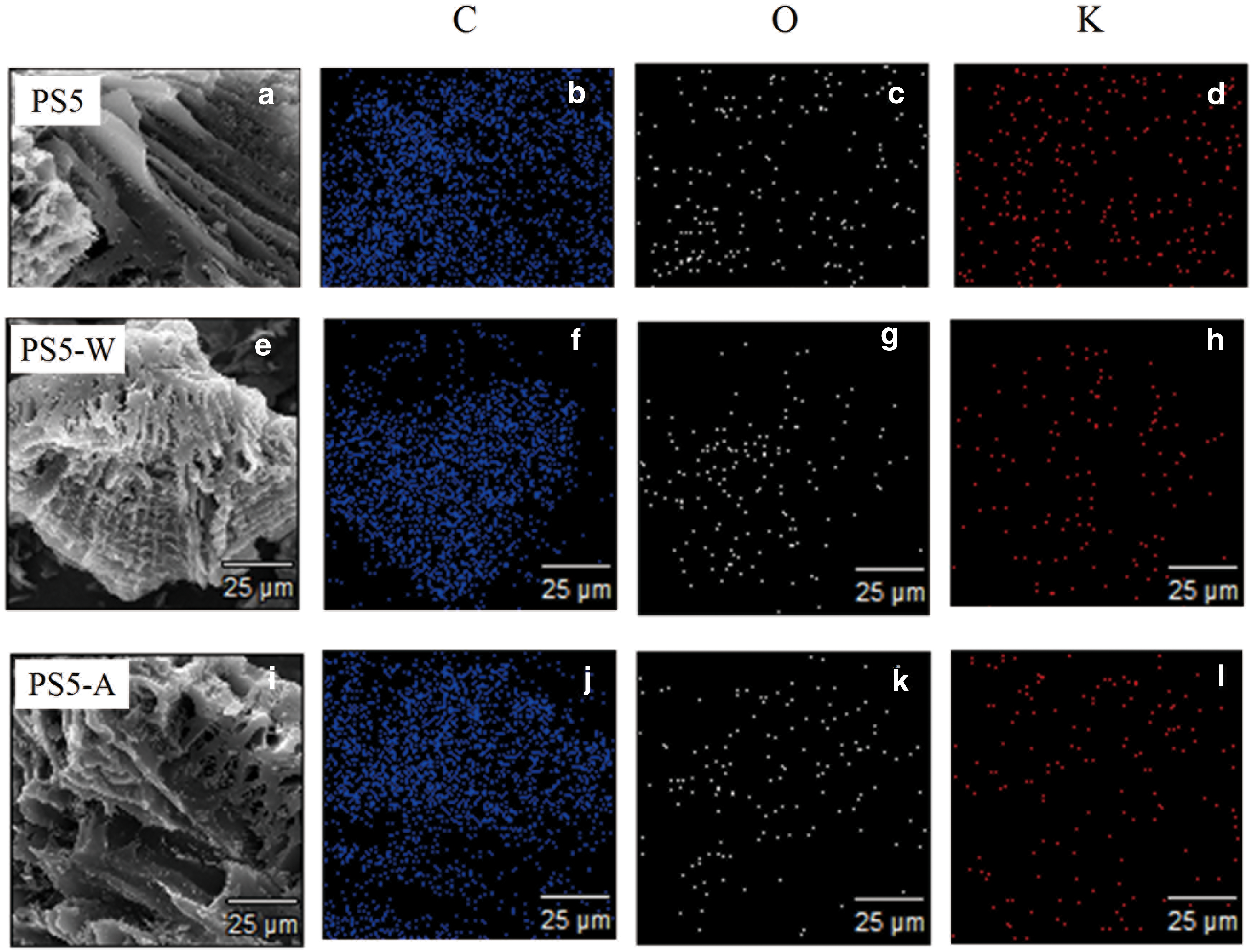
SEM images
Cu(II) sorption in biochars
Sorption isotherms of Cu(II) in biochars are presented in Fig. 2 and Supplementary Fig. S2, and the fitted parameters using FM and LM are listed in Table 2. For the original feedstock of PSs, the sorption curves were well fitted using LM with radj2 ranging between 0.945 and 0.993. The maximum adsorption capacities (Qm) were 12,300, 8,740, and 4,260 mg/kg for PSs, PSs-W, and PSs-A, respectively. For all the other solid particles, radj2 values of FM fitting were mostly higher than 0.95, indicating good fitting performance of the Freundlich equation to the sorption isotherms.
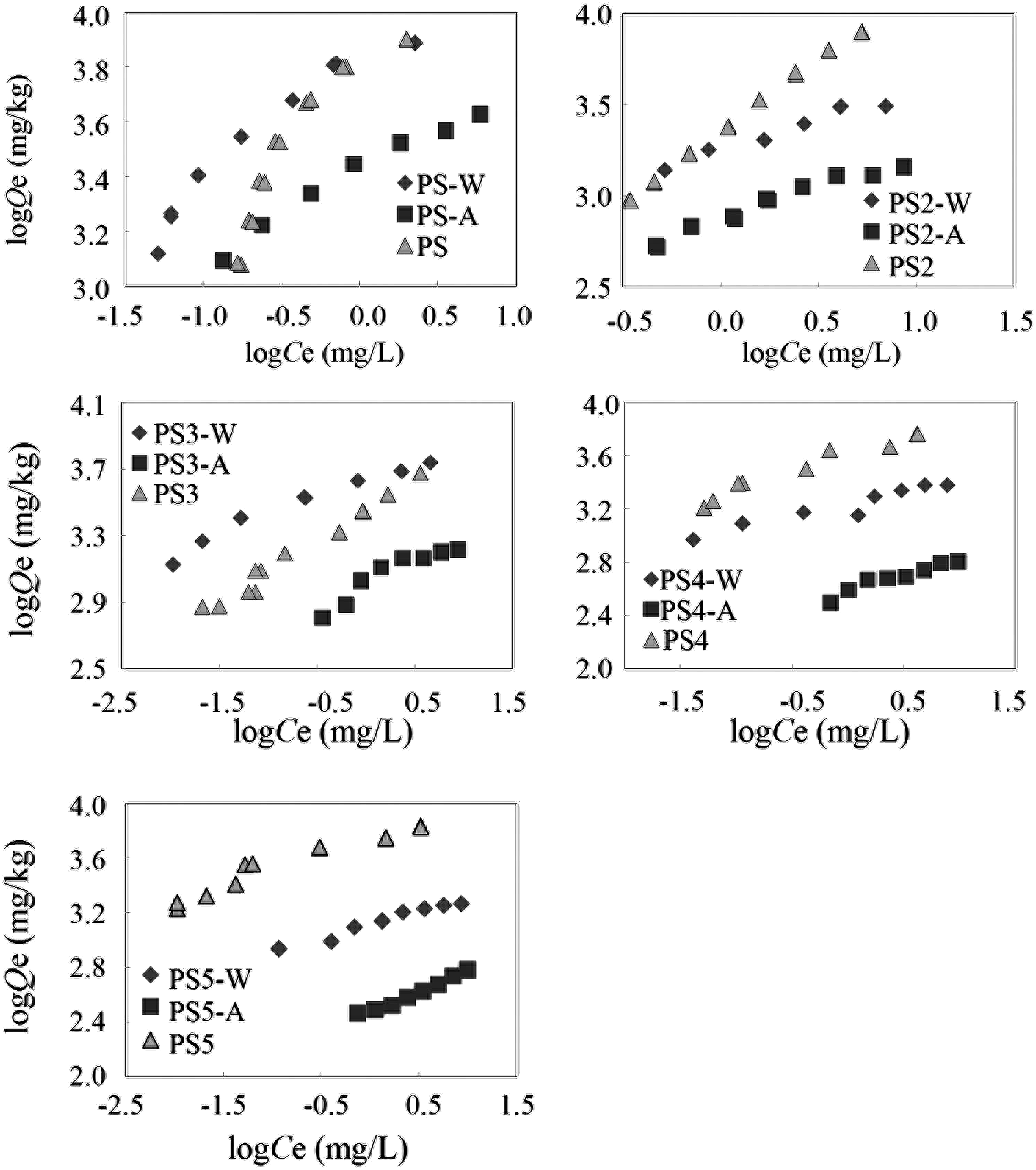
Sorption isotherms of Cu(II) on PS biochars as well as those treated using deionized water and acid. The same batch of sorption isotherms for PC biochars is presented in Supplementary Figure S2. PCs, pine chips; PSs, peanut shells.
PSs, PSs-W, and PSs-A were better fitted using LM. The fitted parameters of Qm (mg/kg) were 12,290 ± 1,187, 8,739 ± 180, and 4,264 ± 115, and fitted parameters of KL (L/mg) were 1.14 ± 0.02, 3.99 ± 0.01, and 2.67 ± 0.04 for PSs, PSs-W, and PSs-A, respectively.
FM, Freundlich model; LM, Langmuir model.
The sorption coefficient, Kd, is generally applied in the literature to indicate the distribution of contaminants in solid phase and aqueous phase, and is widely used for contaminant behavior modeling. To facilitate the comparison of this work and literature results, single-point Kds values (at specific aqueous-phase concentration) were calculated in this study. Kd (Qe/Ce) values were calculated at different Cu(II) concentrations (0.1 and 10 mg/L) and also presented in Table 2. With increasing Cu(II) concentration, the Kd values greatly decreased because of the nonlinear sorption.
Mechanism of Cu(II) adsorption on biochars
Mineral compositions
Regardless of Cu(II) concentrations, acid treatment generally increased Cu(II) sorption for PC biochars as suggested by the Kd values. However, for PS biochars, acid treatment decreased Cu(II) sorption. For example, the Kd values of PS-derived biochars showed positive relations with ash content, with r > 0.77 and p < 0.01 (Fig. 3b, d). This result elucidated that the inorganic fractions in biochars played a positive role in Cu(II) sorption. But for PC-derived biochars, a negative correlation was observed between Kd values and ash content at high concentration (e.g., 10 mg/L) (Fig. 3a). Although not significant, the negative correlation was also observed at low concentration (e.g., 0.1 mg/L) (Fig. 3c). Clearly, ash content may play different roles depending on the sorption system.

Correlation between Kd and ash content calculated at the concentrations of Cu(II) (0.1and 10 mg/L)
To rule out the contribution of Cu(II) precipitation in biochar–Cu(II) interaction systems, Cu(II) precipitation experiments were conducted using the supernatants of biochars. Cu(II) precipitation was only observed in PSs-5, which has the most abundant mineral compositions. According to our calculation, Cu(II) precipitation accounted for up to 20% of the apparently decreased Cu(II) concentrations in the aqueous phase (Fig. 4). This calculation suggested that Cu(II) precipitation could not fully explain the decrease of Cu(II) sorption of over one order of magnitude after acid washing of biochars.
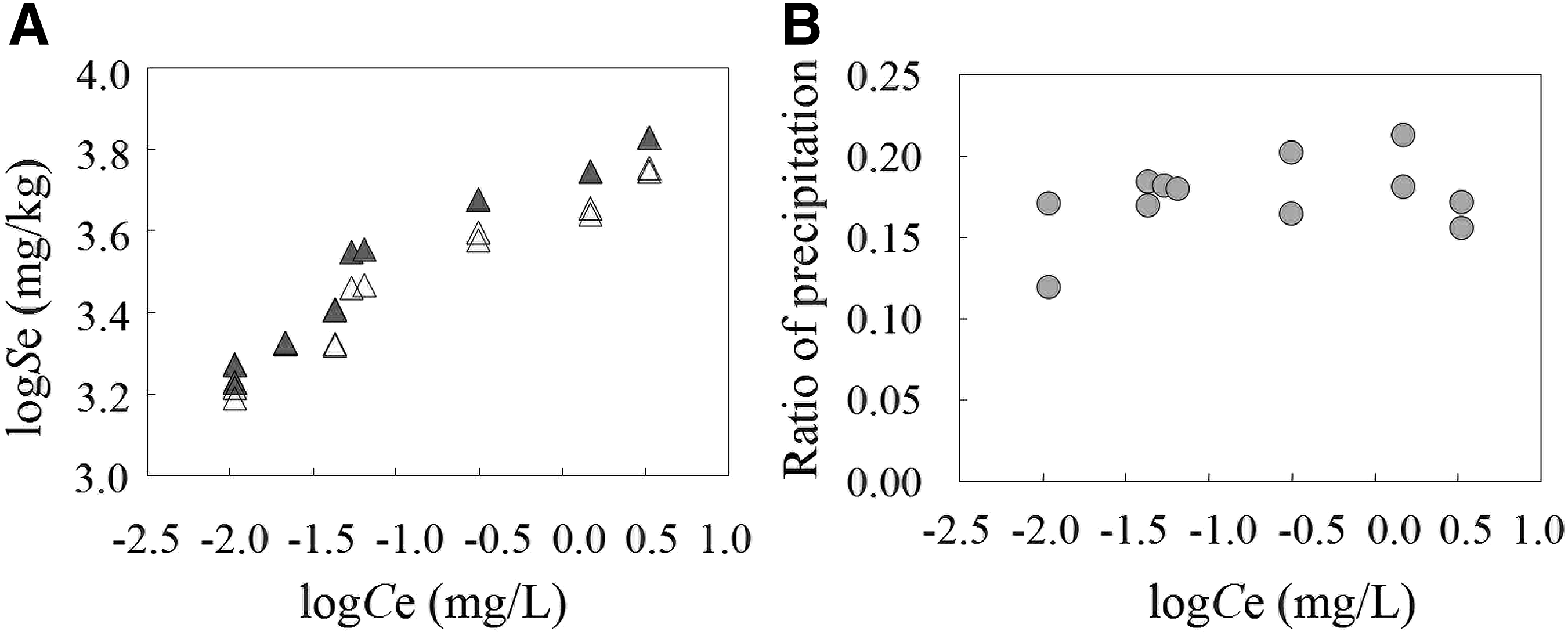
Cu sorption before and after calibration by Cu precipitation in PSs-5 sorption system
In the process of biomass pyrolysis, some cations, such as K+, Ca2+, and Mg2+, were released from the biomass structure and easily dissolved in aqueous phase (Table 1). Cu(II) sorption on biochars was decreased in the presence of these cations, partially because of the competition between cations and Cu(II) on sorption sites. The removal of these cations from biochars will definitely result in the increased apparent sorption of Cu(II). Other studies also presented that anions such as PO43−, CO32−, OH−, and SO42− released from the ash contents of biochars may interact with heavy metals and form precipitations (Xu et al., 2013). In this study, a significant amount of PO43− was determined in PS biochars, up to 5,200 mg/kg. The removal of these anions may decrease the removal efficiency of Cu(II) from the aqueous phase.
Two differences could be observed when comparing the dissolved mineral compositions for PC and PS biochars. (1) The dissolvable mineral compositions were lower for PC biochars than for PS biochars. This observation is consistent with the lower ash content of PC biochars in comparison with PS bichars. (2) Cations K+, Ca2+, and Mg2+ were the dominant species in the dissolved minerals of PC biochars, whereas PO43− was dominant in PS biochars. Thus, for the role of mineral compositions, we propose that the washing of PC biochars resulted in the removal of cations, decreased Cu(II) competitors, and thus resulted in the apparently increased sorption after ash content removal. However, the removal of PO43− from PS biochar particles resulted in decreased Cu(II) retention in solid particles, because of the decreased precipitator.
Before any treatment, PS biochars generally showed sorption one order of magnitude higher to Cu(II) than PC biochars, partially because of their higher ash content. The difference between PC biochars and PS biochars was decreased after washing by deionized water or acid, which confirmed the importance of ash content in Cu(II) removal.
Surface complex
FTIR spectra of all samples and their spectroscopic assignment are shown in Fig. 5. The spectrum of biochar showed an absorbance at 3,800–3,200 cm

FTIR spectra of all solid samples and their spectroscopic assignment.
Conclusion
Mineral composition (e.g., K+, Ca2+, Mg2+, and PO43−) plays an important roles in pollutant immobilization. The role of ash contents in heavy metal removal was investigated in this study through the comparison of biochars before and after ash content removal (using deionized water or acid). The sorption of Cu(II) was dependent on biochar properties resulting from different washing methods. For biochars produced from PCs, removal of ash content increased Cu(II) sorption. However, the opposite impact of ash content removal was observed for biochars produced from PSs. A significantly positive relationship was observed between ash content and sorption coefficients for Cu(II) on PS biochars. Thus, the impact of ash content on Cu(II) sorption is biochar property dependent. Based on the mentioned observation and our discussion on Cu(II) sorption mechanisms, we proposed that classification of biochars is needed to forecast the role of ash content in heavy metal removal. For biochars dominated with anions PO43−, CO32−, OH−, and SO42−, ash content will play a positive role in Cu(II) removal from aqueous phase. However, for biochars dominated with cations, ash content will play a negative role. Therefore, when biochars are used for heavy metal immobilization, the ash content of biomass should be carefully examined, and biomass with high phosphorus content should be selected. The results presented in this study will benefit biochar application as well as evaluation of biochar long-term environmental functions.
Footnotes
Acknowledgments
This research was supported by the National Natural Scientific Foundation of China (41303092, 41361086), Recruitment Program of Highly-Qualified Scholars in Yunnan (2010CI109), and Yunnan applied basic research project (2014FA046).
Author Disclosure Statement
No competing financial interests exist.
References
Supplementary Material
Please find the following supplemental material available below.
For Open Access articles published under a Creative Commons License, all supplemental material carries the same license as the article it is associated with.
For non-Open Access articles published, all supplemental material carries a non-exclusive license, and permission requests for re-use of supplemental material or any part of supplemental material shall be sent directly to the copyright owner as specified in the copyright notice associated with the article.
