




Abstract
Abstract
There are many bare and cut rock slopes resulting from quarrying or highway engineering abandoned in China because of immature outside soil spray seeding (OSSS) engineering techniques. To improve properties of synthetic soil technique to spray on such slopes (gradient >50°), four components of OSSS, that is, cement, inorganic compound fertilizers (ICF), wood bits, and peat soil at four treatment levels for each were mixed into soil using orthogonal array designs OA16 (45). Relationships of each of four components with plant biomass, soil physicochemical and microbial features were explored to determine optimal synthetic soil combinations for OSSS techniques. Significant differences in plant biomass, soil physicochemical properties and microbial activities among 16 different OSSS synthetic soils with different contents of four components were identified. Optimal combination of N10 with higher nutrients (added with 0.8% ICF, 1.5% cement, 1.5% peat soil, and 2.0% wood bits) and N13 with highest viscidity (added with 0.4% ICF, 2.0% cement, 1.5% peat soil, and 2.0% wood bits) than other combinations were obtained to be used in OSSS sprayed soils to reconstruct the bare high- and cut rock slopes, which was supported by results of cluster analysis. On the other hand, based on canonical correlation analysis, redundancy analysis, and discriminant analysis, soil physicochemical properties explained 56.41% of the soil microbial activities and the cement is the most influential factor on soil properties. Among all tested indicators, soil NH4-N, total P, pH, organic C, phenol oxidase, invertase, CM-cellulase, acid phosphatase, alkaline phosphatase, and basal respiration were more responsive to OSSS synthetic soils. Our results have documented improvement of soil physicochemical and microbial features of the OSSS soil under the condition of 2.0% cement content.
Introduction
I
For the outside soil spray seeding (OSSS), to support plant growth, seeds or plant propagules, soil, fertilizer, water-retaining agent or other materials are mixed with certain proportions. Materials are sprayed on the surface of rocky slopes with high pressure spraying equipment, reinforced concrete facilities (Bochet and Garcia-Fayos, 2004; Chen et al., 2007). OSSS generally worked well on the low and gentle rock slopes whose gradients are less than 45°; however, it was not effective on high- and cut rock slopes due to low viscidity and low nutrients of soil sprayed on rocks. Vegetation is only useful for fixed soil against shallow landslides and erosion. However, it is very difficult to maintain and manage plant growth on high- and cut rock slopes after sprayed OSSS synthetic soil. Therefore, OSSS with higher viscidity and more effective nutrients is becoming a research focus.
As there are large number of high- and cut bare rock slopes in China to be restored, cost-effective materials should be primarily considered. To date, cement is still the most low-cost material to improve viscidity of OSSS in the market that can be used to improve artificial OSSS sprayed soil. Although a higher cement level means a higher viscidity, the largest cement content that can be used in OSSS sprayed soil is lower than 2.0 mass percent because of its strong basicity (higher pH) and the 1.0% is widely used in engineering construction. Humus, wood chip, and plant can not only buffer the cement basicity, but also can improve the artificial sprayed soil nutrient and physics properties (Buchanan et al., 2002; Zhang et al., 2003; Ai et al., 2012); however, they decrease the viscidity resulted from cement. Thus, the proportion of these components and their relationships needs to be further reinvestigated.
In 2007, we reported an OSSS with improved sprayed soil mixtures, which realized higher viscidity adhere to cut rock slope more than 50° under the condition of cement amendment of 1.0%–1.5% of soil dry weight (Gao et al., 2007). In that study, we applied the pioneer plant Italian ryegrass (Lolium perenne) to test OSSS soil features, which exhibited stronger resistance against severe environment than many other practical plants such as bahia grass (Paspalum notatum) that is used in this study. However, if the Italian ryegrass was used in OSSS engineering technique to eco-restore high-and-cut slopes, the growing period of Italian ryegrass can only maintain about four months in earlier engineering stage, compared to this, bahia grass could keep growing at all seasons. Therefore, bahia grass was widely used in rock slope engineering construction in China. Therefore, it is necessary to observe the state of bahia grass growth in improved OSSS synthetic soils, moreover, the microbial properties of OSSS sprayed artificial soil remain to be extensively investigated.
For the bare high- and cut rock slope, during the early stages of revegetation, high cohesiveness of artificial OSSS sprayed soil and rapid accumulation of plant biomass are very important. Because of this, in this study, cement, wood bits, peat soil, and ICF were mixed with different concentrations in 16 different OSSS synthetic sprayed soils. It is hypothesized that (1) The cement additive proportion can be increased to over 1.5% or 2.0% of OSSS soil dry weight on the premise of plant growing normally, to therefore significantly increase the viscidity of OSSS sprayed soil; (2) The optimal content of wood bits and peat soil could be added into the OSSS sprayed soil can be determined on the premise of less nutrient loss; (3) Soil microbial activities such as respiration, enzyme activities, and microbial biomass C and P can be improved by addition of four components; (4) Some typical biological or nonbiological indicators to assess the special OSSS synthetic soil properties during early plant biomass accumulation stage can be identified.
Materials and Methods
Experiment designs
This work was carried out in an experimental garden at Qingyuan, Guangdong province, South China (Lat/Lon [WGS 84] 23°31′ N, 111°55′ E). Sixteen different soil combinations were assigned for tray-planted (40 × 30 × 15) experiments by using an orthogonal array designs OA16 (45) matrix with four levels for each mixture component (including ordinary Portland cement, wood chip, peat soil, and inorganic compound fertilizers [ICF, N: P2O5: K2O = 15%: 15%: 15%]) and three replicates for each treatment (Table 1). The bahia grass (Paspalum notatum) was planted as growth indicator. The parent soil was sieved through a 4 mm diameter sieve before uniformly mixing with other four additive components (by dry weight) companied by routine watering twice a week. To decrease soil pH resulting from the effect of cement, phosphate solution that was diluted by industrial phosphoric acid solution for 1,000 times was watered into soils. Plant and soil samples were collected after the plant grew for 100 days.
Plant and soil physicochemical properties analyses
Three samples of plant and soil were taken randomly from each treatment. Dry shoot biomass measurement was oven-dried at 70°C to constant weight. PH was measured in air-dried soil (<1 mm) by electrode (soil: water ratio, 1:2.5) (Smith and Doran, 1996). Organic carbon (OC) was measured using the methods of dichromate oxidation. Bulk density (BD) was determined by the weight of the dry sample by dividing the volume of the soil core. Soil total porosity (TOP) was calculated using the BD and individual grain density data, which was calculated using a specific gravity bottle (Sparke et al., 2011). Total nitrogen (TN) was determined by the method of Kjeldahl (Piotrowska et al., 2011). NH4-N and NO3-N were determined by a steam distillation method. Total phosphorus (TP) was determined using NaOH fusion with the molybdate blue colorimetric method (Keeney and Nelson, 1982) and available phosphorus (AP) was analyzed using the method of icarbonate extraction suggested by Olsen and Sommers (1982).
Soil microbial properties analyses
All enzyme activities were analyzed by using fresh soil samples except for phenol oxidase (PO) by air-dried soil. Invertase (IN) and CM-cellulase (CM) activities were analyzed using the method of Schinner and von Mersi (1990), in which sucrose and CM-cellulase, respectively, were used as substrates. Soil samples were incubated for 24 h at 50°C and pH 5.5. PO activity was analyzed by using pyrogallol as a substrate. Ten milliliters 1% pyrogallol solution was added into 1 g of soil sample that was incubated for 3 h at 30°C (Sinsabaugh et al., 1993). Using casein as a substrate, soil samples were incubated for 2 h at 50°C and pH 8.1. Acid phosphatase (AcdP) and alkaline phosphatase (AlkP) activities were determined using 0.115 M disodium p-nitrophenyl phosphate hexahydrate as substrates and were incubated for 1 h at 37°C (Dick et al., 2000). Microbial basal respiration (BR) and substrate-induced respiration (SIR) were determined by the method of Medina et al. (2004). Microbial biomass C (Cmic) was determined by a chloroform fumigation extraction procedure followed by a 0.5 M K2SO4 extraction (Vance et al., 1987). Microbial biomass phosphorus (Pmic) was similarly determined by fumigation extraction, using 25 mL 0.5 M NaHCO3 extractant (Ivanoff et al., 1998).
Statistical analyses
All data were analyzed by software of SAS 6.12 and SPSS 11.5. The significant difference of four additive factors on soil properties were determined by the analysis of variance (ANOVA) and the least significant difference tests (Dolgen et al., 2004). The whole correlations between 11 soil physicochemical indicators and nine microbial properties were analyzed using canonical correlation analysis (CCA) followed by the redundancy analysis (RA). Normalized data were applied to two sets of variables (one set is related to soil physicochemical indicators, and the other is microbial properties) and the relative representative pairs of canonical functions with maximum Pearson correlation coefficients from each set were extracted (Zhang et al., 2006b).
RA is necessary to ensure proper operation of CCA and determine the largest correlation degree between the two sets of variables. Discriminant analysis (DA) could provide an equation that gives maximum separation or discrimination between 16 OSSS synthetic soils based on plant biomass and all tested soil physicochemical and microbial standardization data, which are mainly used to determine those variables that most effectively distinguish 16 synthetic soils (Kourtev et al., 2002), followed by partial F-statistics and Wilk's Lambda criterion that contribute the most to the canonical discriminant functions (DFs). A subsequent principal components analysis (PCA) was conducted to test what the most important indicators are to distinguish the 16 synthetic soils. The tested 16 synthetic soils were classified by all the plant and soil indicators with cluster analysis. Pearson's test was used to test significance levels (p < 0.05 and p < 0.01) of the correlations among microbial enzyme activities, microbial respire, microbial biomass carbon, and microbial biomass phosphorus. All statistical analysis data used in CCA, RA, DA and PCA are standardized.
Results
Effects of four additive factors on soil physicochemical properties
Orthogonal array ANOVA indicated effects on plant and soil physicochemical properties resulted from different additive components and from interactions of cement × wood bits (p < 0.05, Table 2). The positive contributions of cement to soil pH, NH4-N, BD, and specific gravity (SG) and the negative effects of cement on soil TOP, NO3-N, and TP were significant (p < 0.05, Fig. 1 and Table 3). The effects of ICF to shoot biomass, NO3-N, NH4-N, available nitrogen (AN), TN, AP, and TP were significant (p < 0.05). The contributions of wood bits to all the tested plant and soil physicochemical indicators (except for TN, NH4-N and pH) were significant (p < 0.05), of which, SG, BD, and AP decreased with increment of wood bits, while OC and TOP increased. Especially, AN and NO3-N increased with the content increasing from 0.5% to 1.5%, while decreased at 2.0% of the peat soil and wood bit content. At the same time, TP, AP, and TOP content increased significantly with the increment of peat soil, whereas BD decreased, and the contributions of peat soil to shoot biomass, TOP, OC, NO3-N, NH4-N, AN, AP, and TP were significant (p < 0.05). The contributions of the interaction between cement and wood bits on pH, NO3-N, NH4-N, TP, and AP were also statistically significant (p < 0.05).
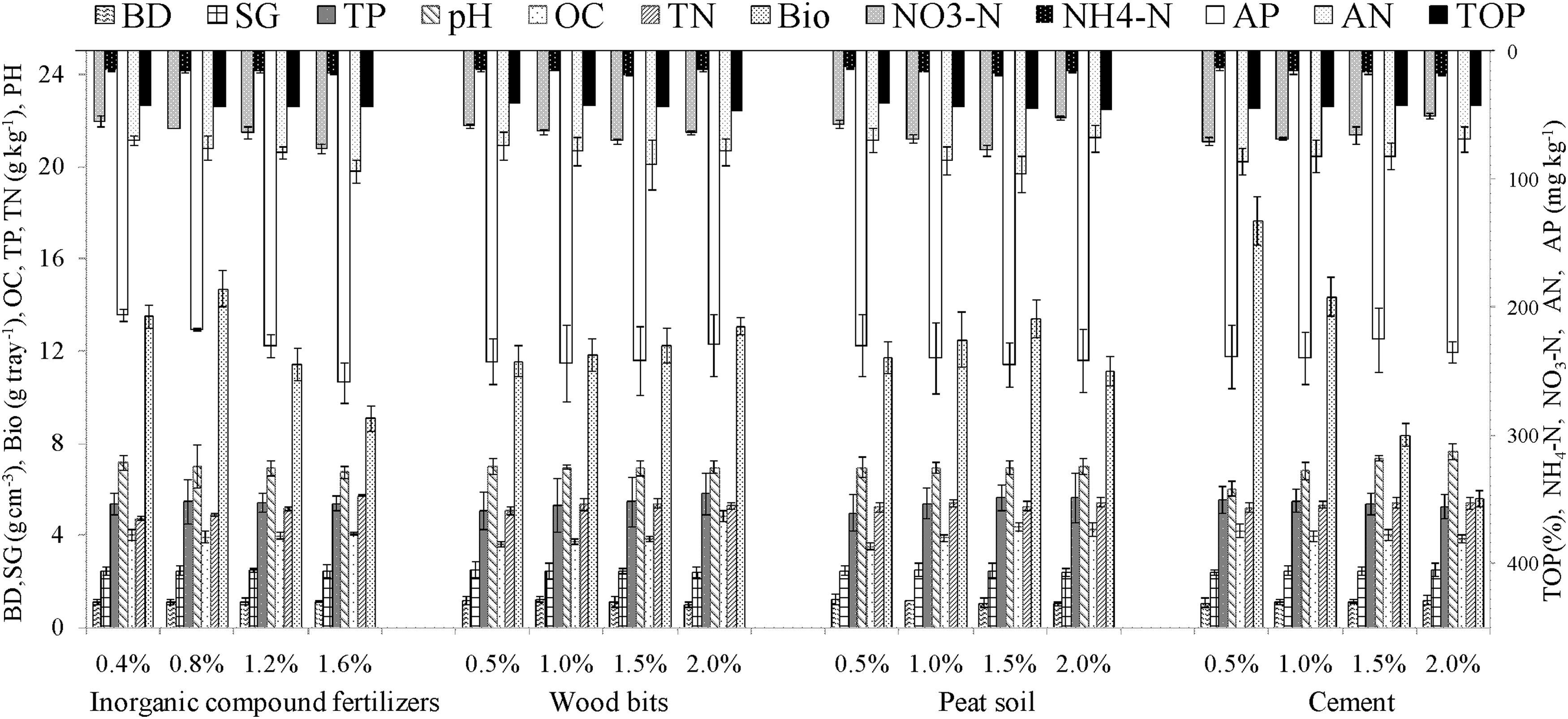
Effects of four additive components at different levels on soil physicochemical properties. AN, available nitrogen; AP, available phosphorus; BD, bulk density; Bio, plant shoot biomass; NH4-N, NH4-nitrogen; NO3-N, NO3-nitrogen; OC, organic carbon; SG, specific gravity; TN, total nitrogen; TOP, total porosity; TP, total phosphorus.
Significant level p < 0.05; **p < 0.01.
AcdP, acid phophatase; AlkP, alkaline phosphatase; AN, available nitrogen; AP, available phosphorus; BD, bulk density; Bio, plant shoot biomass; BR, basal respiration; CM, CM-cellulase; Cmic, microbial carbon; IN, invertase; NH4-N, NH4-nitrogen; NO3-N, NO3-nitrogen; ns, insignificant; OC, organic carbon; Pmic, microbial phosphorus; PO, phenol oxidase; SG, specific gravity; SIR, substrate induced respiration; TN, total nitrogen; TOP, total porosity; TP, total phosphorus.
Different superscript small letters within the same column indicate significant difference between 16 synthetic soil treatments (p < 0.05).
Effects of four additive factors on soil microbial properties
Orthogonal array ANOVA indicated that effects on microbial parameters resulted from different additive components and from interactions of cement × wood bits (p < 0.05, Table 2). The increase in the cement content significantly resulted in a consistent increase in the PO and BR (p < 0.05, Fig. 2 and Table 4), whereas the IN activity, CM activity, AcdP activity, SIR, microbial biomass carbon (Cmic), and microbial biomass phosphorus (Pmic) showed an opposite trend, and the effects on all the tested parameters (except for AlkP) have reached a significant level (p < 0.05). On the contrary, the increase of wood bits led to an increase in all the tested microbial parameters and the integral contributions of wood bits to these properties were significant (p < 0.05). The effect of peat soil from 0.5% to 1.5% on microbial properties was similar to that of wood bits, while CM, SIR, BR and Pmic decreased at the 2.0% of the peat soil. The contributions of ICF to IN, PO, SIR, and BR were significant (p < 0.05). At the same time, the ICF resulted in increments of AcdP and Pmic, while led to decrements of other indicators. Especially, IN increased significantly when content of ICF was more than 1.5% of soil.

Effects of four additive components at different levels on soil microbial properties. AcdP, acid phophatase; AlkP, alkaline phosphatase; BR, basal respiration; CM, CM-cellulase; Cmic, microbial carbon; IN, invertase; Pmic, microbial phosphorus; PO, phenol oxidase; SIR, substrate induced respiration.
Different small letters within the same column indicate significant difference between 16 synthetic soil treatments (p < 0.05).
Correlations between soil physicochemical properties and microbial activities
We used CCA followed by RA to determine the relationship between soil physicochemical properties (i.e., soil pH, OC, NO3-N, NH4-N, AN, TN, BD, SG, TOP, AP, and TP) and soil microbial properties (i.e., PO, IN, CM, AcdP, AlkP, BR, SIR, Cmic, and Pmic) across 16 synthetic soils. We only reported the results for the first pair of canonical variables for each analysis since it showed a high significance level (r2 = 0.964, Wilk's λ = 0.002, F = 6.17, p < 0.01) and the first canonical functions (CF1) explained 84.22% of variance in soil physicochemical properties. Of which, CF1was positively correlated with PO (r = 0.56), AlkP (r = 0.57), and BR (r = 0.59), while negatively correlated with CM (r = 0.94), AcdP (r = 0.93), Pmic (r = 0.75), IN (r = 0.69), SIR (r = 0.60), and Cmic (r = 0.59). Furthermore, redundancy test (RA) demonstrated that index by soil physicochemical properties explained 56.41% of index of soil microbial properties, that is, the influence extent of soil physicochemical properties on soil microbial properties is 56.41%.
Pearson correlations analysis exhibited some significant correlations between IN, CM, and AcdP enzyme activities and Cmic and Pmic (p < 0.05 and p < 0.01, respectively), and negative correlations between PO and AlkP enzyme activities and Cmic and Pmic (p > 0.05 for both comparisons, Table 6). In addition, almost all tested enzyme activities, microbial respire, and soil microbial biomass C and P in OSSS synthetic soils showed positive correlations to wood bits and peat soil increments from 0.5% to 2.0%.
means significant correlations between different indicators at level of p < 0.05; **means significant correlations between different indicators at level of p < 0.01.
AcdP, acid phophatase; AlkP, alkaline phosphatase; BR, Basal respiration; CM, CM-cellulase; Cmic, microbial carbon; IN, invertase; Pmic, microbial phosphorus; PO, phenol oxidase; SIR, substrate induced respiration.
Differentiation of 16 synthetic soils
Comprehensive analyses by DA and cluster analysis with the hierarchical clustering method based on standardization data of plant biomass and soil properties were carried out to screen out the optimal combination from 16 different OSSS synthetic soils and to highlight those indicators more responsive to OSSS soils (Fig. 3). The first two axes of DA explained 87.4% of the data variation, of which DF1 accounted for 76.3% of variance in soil dataset, whereas DF2 explained only 11.1% of the variance. According to the partial F statistics and minimal Wilk' lambda criterion in the stepwise DA, the important factors that contribute most to the DFs in soil dataset were NH4-N, TP, AP, pH, and OC for soil phsico-chemical properties, and those for soil microbial properties were PO, CM, IN, AcdP, Alkp, and BR. In other words, such indicators were the best to evaluate the performance of OSSS synthetic soils in this study.
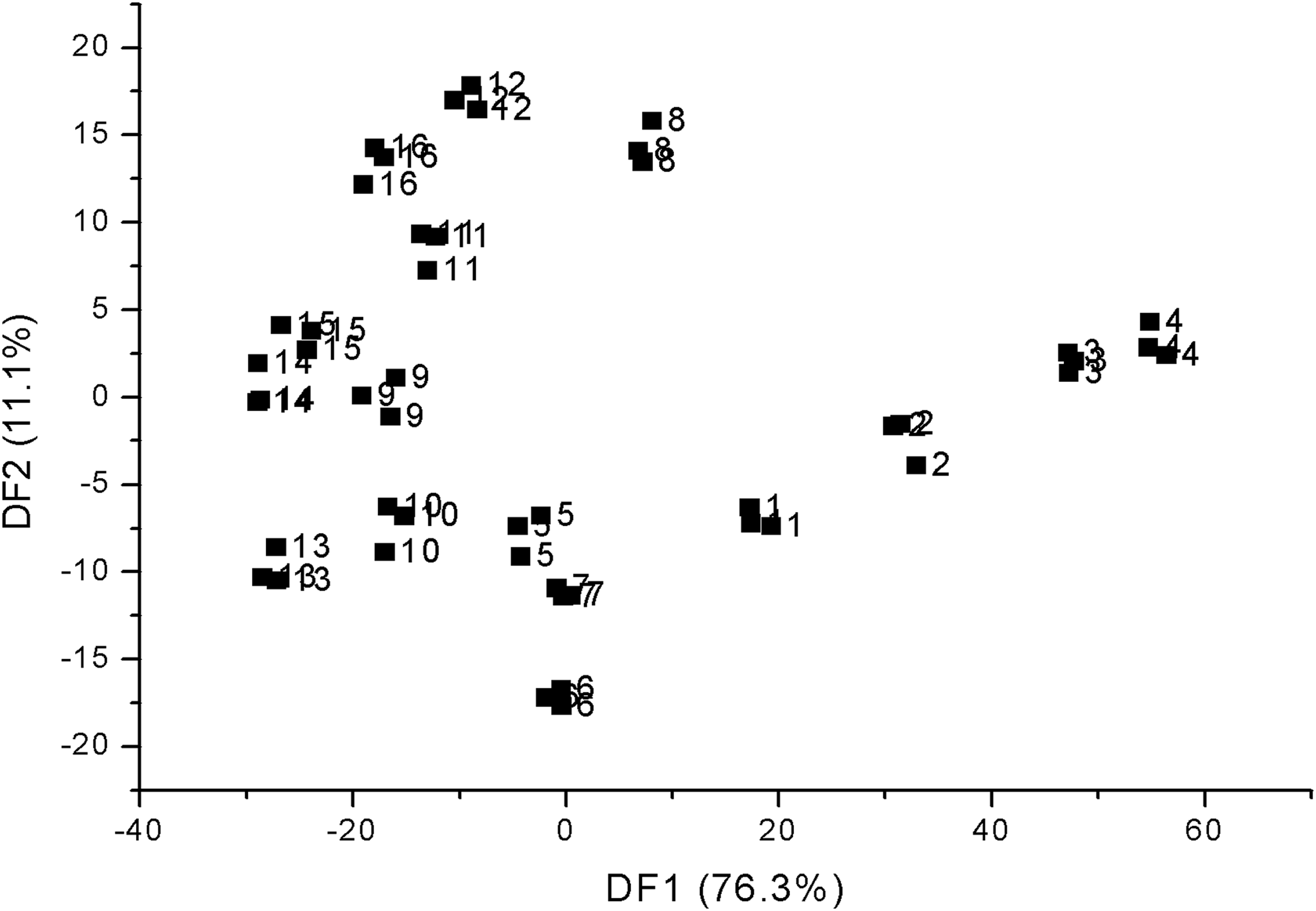
Plots of sample scores extracted by discriminant analyses on soil physicochemical and microbial parameters in the 16 treatments. DF: A discriminant function. Cross signs: the (0, 0) point.
Among 16 OSSS synthetic soils, the combinations of N10 (added with 0.8% ICF, 1.5% cement, 1.5% peat soil, and 2.0% wood bits) and N13 (added with 0.4% ICF, 2.0% cement, 1.5% peat soil, and 2.0% wood bits) exhibited the biggest weight according to the classification based on CF1 and CF2. Furthermore, the tested 16 synthetic soils were categorized into three groups by cluster analysis (Fig. 4 and Table 5). The N10 and N13 combination in group I mixed with 1.5% and 2.0% cement, respectively, not only indicated a higher cohesion, but also exhibited the highest mean values of OC, TP, PO, AlkP, SIR, Cmic, and Pmic. Most synthetic soils in Group III had lower cement content. Especially, the mean of plant shoot biomass, BD and SG in group I reached 12.22 g/tray, 1.06 g/cm3 and 2.46 g/cm3, which were very close to 13.12 g/tray, 1.14 g/cm3 and 2.45 g/cm3 in group III, respectively. Considering both the cement content, which should be used in sprayed soil mixtures with higher proportion due to aforementioned explanation, and normal plant growth, N10 and N13 were the best combinations in 16 synthetic soils. Actually, ≤0.8% ICF and 1.5% peat soil were the optimal content to be beneficial to plant growth, because more than 1.2% ICF and 2.0% peat soil have led to plant shoot biomass decreased (Fig. 1).

Histogram of cluster analysis.
Discussion
Correlations between soil physicochemical properties and four components in OSSS synthetic soils
In this study, we found that hardness and viscidity of the OSSS synthetic soils can be improved through the amendment of cement into soils, which was consistent with the study of Anagnostopoulos (2005). This can be explained by the increase of soil BD and the decrease of the soil porosity that closely related to soil rigidity and viscidity. However, the cement caused a significant increase of soil pH, which is directly related to the high alkalinity in the cement mixture (generally pH: 12–13). Similar results were also observed in the previous studies (Richman et al., 2006; Gao et al., 2007). In this study, to decrease the soil pH, industrial phosphoric acid (diluted to 1000 times) was watered on the OSSS spraying soils at the beginning of our experiment.
Actually, the improvement effect is evident that pH in synthetic soils was controlled below 7.64 under the condition of normal plant growth when cement content reached to 2.0% in soil. If some other possible methods could be used in OSSS synthetic soils to decrease pH, the cement content may be higher than 2.0% as long as pH could be down to the lower limit value to ensure plant growing normally. It was interesting that the soil NO3-N content decreased with the cement amendment, which was not consistent with the report by Ste-Marie and Pare (1999) who observed that an increase of forest floor pH had a positive effect on net nitrification while acidification depressed it. Correspondingly, the decrease in the NO3-N concentration with the cement amendment could be due to less aerobic conditions in the synthetic soils, which resulted in relatively high losses of N through denitrification (Roldan et al., 2005).
Because of strong erosion resulting from wind and rain, along with the difficulties to refertilize on the high- and cut rock slope, sustainability of abundant nutrients was expected in the special synthetic soils to maintain a long-term growth of plants. NO3-N, TN, TP, AP, and NH4-N content all significantly increased with the ICF amendment, which completely in line with our expectations. Specially, the pH decreased with the increase of the soil NO3-N content, which may be due to microbial mineralization of organic nitrogen or when the cation uptake exceeds the anion uptake along plant roots (Xu et al., 2006).
Peat soil and wood bits that can improve soil porosity, increase soil nutrients and enhance soil water retention (Schonberner, 1998) were also included in this study. Both wood bits and peat soil resulted in a significant increase of TOP, AP, and TN content, whereas a decrease of BD. This result indicated that these two amendments not only improved soil aeration, permeability condition, and organic nutrient status, but also increased the proportions of AP, as suggested by Li et al. (2004) and Katterer et al. (2014) that the decomposition of organic matter occurred after the application of amendments to soils. However, it was worthwhile to note that the overabundance of the peat soil and wood bit amendments might result in the further erosion of OSSS because of the increment of TOP, and then lead a decrease of soil viscidity and an increase in synthetic soils nutrient loss (Cerda, 1999). Therefore, for the improvement of inorganic nutrients in OSSS synthetic soils, ICF was better than wood bits or peat soils.
Correlations between soil microbial activities and four components in OSSS synthetic soils
Enzyme activities have been used in a variety of ways to assess environmental quality such as fertility, productivity, pollution effects, and nutrient cycling potential (Izquierdo et al., 2005). In recent years, some researchers have considered soil enzyme activities as the biological index of soil health (Bossio et al., 2006; Li et al., 2008) and as the early and sensitive indicators of alterations in soil quality, because of their rapid response to changes in soil quality (Puglisi et al., 2006). Especially for the microbial carbon biomass and microbial respiration, which have exhibited faster responses to soil quality than soil physicochemical properties (Stamatiadis et al., 1999). In this study, all enzymes in 16 OSSS synthetic soils are found to be important in improving and maintaining soil fertility to ensure plant growth.
Among the four additive factors, the negative effect of cement on microbial activities was highlighted, and the more cement content in synthetic soil processes, the stronger negative response of invertase, CM-cellulase, AcdP, AlkP enzyme activities, soil basic respire, soil microbial biomass C and P to synthetic soils are. This may be explained by the significant increase of soil pH resulting from cement. These results were partly supported by the findings from Acosta-Martinez and Tabatabai (2000) who showed that AcdP and CM-cellulase are predominant in acid soil, while AlkP oxidase are predominant in alkaline soils. However, the PO and microbial BR increased with cement amendment, which was supported by study of Williams et al. (2000) who pointed out that the PO was predominant in the high pH soil. We observed an increase in the BR of these synthetic soils, while a previous study showed that the microbial respiration was negatively related to soil pH (Lee and Jose, 2003).
One explanation for the relationships between the cement amendment and the BR is that the BR increase might be related to development of the fungi in synthetic soils, since the fungal group in soils could have higher tolerance to fluctuation of soil pH than the bacterial group (Rousk et al., 2010; Steven et al., 2014). As a whole, the effects of BD and SG on microbial activities are insignificant, which indicated that although cement increases OSSS soil hardness, the resulting negative impact of cement on microbial activities is minor. That is, the negative response of microbial activities to pH resulting from cement is higher than hardness from cement. Therefore, the cement content could be higher than 2.0% to improve the soil viscidity and hardness as long as the soil microbial activities can keep at a normal level if some other possible methods could be used in OSSS synthetic soils to decrease pH. That is, if cement content in OSSS is increased over 2.0%, the pH would be decreased accordingly.
Wood bits and peat soils could evidently enhanced soil enzyme activities, soil respiration, soil microbial biomass C and P in OSSS synthetic soils inferred from the significant dual relationships between soil microbial properties and soil OC, and between OC and wood bits along with peat soils. Our results are supported by some previous studies that showed organic matter added to soil could result in abundant enzymes and increased soil nutrient and energy sources, and thus improve soil microbial biomass, microbial activities, and accelerate soil decomposition and translation of organic matter (Lagomarsino et al., 2009; Nautiyal et al., 2010). Sun et al. (2007) also reported that activities of soil acid phosphomonoesterase, invertase, and cellulase were stimulated by the addition of cotton tissues, which may be due to increased microbial activity caused by straw addition.
However, PO, soil respire, and soil microbial biomass C and P showed significantly decrement trends when peat soil content increased from 1.5% to 2.0%. This may be due to the higher humus acid formated in the synthetic soils with peat soil amendment, because PO activity is negatively correlated with soil humus formation (Zhou and Zhang, 1980). According to the significant correlations between IN, CM, AcdP enzyme activities, Cmic, and Pmic, we can deduce that IN, CM, AcdP enzyme activities in such OSSS synthetic soils may be mainly explained by the increase of microbial biomass. Such positive correlations were also found in results of Liu et al. (2008).
Out of our expectation, soil microbial metabolism has not been accelerated after adding ICF into soil. On the contrary, some enzyme activities such as PO, microbial basal and substrate-induced respirations, Cmic, and Pmic were restrained. This appeared to be due to the high level of nitrogen detected in the special synthetic soils, which had been up to 5 to 20 times higher compared to numerous previous studies (Hala et al., 2003). The negative effect of high ICF on soil microbial properties was also observed in some previous studies, which showed that abundant nitrogen and phosphorus inhibited soil microbial activities (Thirukkumaran and Parkinson, 2000). As a whole, soil microbial activities such as IN, CM, AcdP, AlkP, SIR, Cmic, and Pmic showed higher positive correlations with both of wood bits and peat soil content than ICF concentration. Therefore, a relative higher ICF content added to soil were still suggested to accelerate plant biomass accumulation in earlier engineering stage.
According to CCA, RA, and DA, at least 56.41% influenced factors on soil microbial activities in 16 OSSS synthetic soils resulted from the tested soil physicochemical properties in this study. Soil NH4-N, TP, AP, pH, and OC were the most important influence factors, which indicated that all the four amendment components in OSSS synthetic soils generated complex effects on soil microbial activities. Besides, wood bits and peat soil would be the major drivers of changed pattern of soil microbial activities, which could be evidenced by the close relationships between soil OC, Cmic, Pmic, IN, CM, and AcdP enzyme activities and both wood bits and peat soil content. Although cement has resulted in the increase of soil pH, and thus has negatively influenced soil IN, CM, and AcdP enzyme activities in this study, such three enzyme activities can still be close to common farmland soil and maintain relatively higher values, such as in rice cultivation soil (Pandey et al., 2014). Therefore, our hypothesis that soil microbial activities can be positively improved by four amendments of wood bits, peat soil, cement, and ICF was supported.
Conclusions
By researching the OSSS synthetic soils added with different content of cement, ICF, wood bits, and peat soil, we found different combinations result in different plant biomass, soil physicochemical and microbial properties. The improvement of soil properties in OSSS spraying synthetic soil by ICF, wood bits, peat soil, and cement were evident. NH4-N, TP, AP, pH, OC, PO, CM, IN, AcdP, Alkp, and BR determined the relative sensitive indicators response to synthetic soils. OSSS combination of N13 with highest cement content of 2.0% is the most optimal combination to spray onto bare high- and cut rock slope because of their outcomes with higher plant biomass, inorganic nutrients, and microbial activities than other combinations.
Footnotes
Acknowledgments
This work was financially supported by the Natural Science Foundation of Guangdong Province (No. 2015A030313849) and supported by Disciplines Plan Project of Guangdong Province' Educational Committee (No. 2014KTSCX197).
Author Disclosure Statement
No competing financial interests exist.