




Abstract
Abstract
Household-scale anaerobic digesters (ADs) are used to stabilize and recover energy from organic wastes generated by rural agricultural communities. These systems are typically operated under ambient conditions and fed intermittently; however, use of ADs in this manner may not be sufficient to inactivate prominent human pathogens such as Ascaris spp. In this study, a mathematical model was developed to describe and predict inactivation of Ascaris suum in household-scale semi-continuous ADs. The model was based on the segregated flow model, which combines the following: (1) an expression for the residence time distribution of semi-continuous reactors in terms of feeding interval (FI) and solids retention time (SRT) and (2) an expression for A. suum inactivation in a batch reactor. Three mathematical expressions for pathogen inactivation in batch reactors are presented based on results of laboratory experiments. The segregated flow model predicted that, under mesophilic conditions (35°C), pathogen inactivation was weakly dependent on FI (61% inactivation when FI = 2 days, 64% when FI = 7 days) but strongly dependent on SRT (40% inactivation when SRT = 15 days, 73% when SRT = 45 days). Comparison of segregated flow model results using different pathogen inactivation expressions suggested that a “sudden-die-off” model offered a conservative approach when detailed laboratory data are not available. Near 100% removal of A. suum can be achieved when the FI exceeds the time required for complete inactivation under ambient conditions. This result identified a potential design and operational strategy for small-scale ADs that are operated in areas afflicted with neglected tropical diseases, such as soil-transmitted helminths.
Introduction
A
One of the main substrates used in household-scale AD is livestock waste, including manure that can contain zoonotic pathogens. It has been estimated that 70% of all human pathogens are zoonotic (Wolfe et al., 2007), that is, they can be transmitted between humans and animals. Well-known examples of zoonotic diseases include tuberculosis, salmonellosis, brucellosis, and rabies. However, other zoonotic human pathogens are commonly found within the manure of livestock including protozoa (Giardia lamblia and Cryptosporidium), bacteria (Escherichia coli and Clostridium perfringens), and soil-transmitted helminths (Ascaris lumbricoides and Trichuris trichiura). Swine, for example, are typically kept in close contact with families and are known to be hosts for human pathogens such as hepatitis E virus, A. lumbricoides, Trichinella spiralis, and Taenia spp. (Holt et al., 2016). The latter three pathogens belong to the soil-transmitted helminth group. The relationship between soil-transmitted helminths and AD is particularly relevant because AD effluent is usually promoted as a soil amendment (NBP, 2011), which directly suits the transmission cycle for soil-transmitted helminths (Hagel and Giusti, 2010). Many disease emergence mechanisms are in part a result of development practices originally intended to increase food and energy security and/or to eliminate poverty (Mihelcic et al., 2016).
The Ascaris species are intestinal roundworms whose ova are deposited in the soil within swine manure (or feces from an open-defecating human host) and are spread from host to host (swine to human; swine to swine; human to swine) through contact with contaminated soil. Globally, ascariasis is classified as a neglected tropical disease and currently infects nearly 800 million people worldwide (Pullan et al., 2014). Recent studies have documented that ADs operated at the household scale in the developing world are not sufficient to inactivate the zoonotic pathogens that may be present in the digester feedstocks, mainly due to inadequate residence times and operating temperatures (Ulrich et al., 2009; Lohri et al., 2010; Kinyua et al., 2016b). Experimental studies also show that soil-transmitted helminths are very robust and can survive under mesophilic conditions (10–35°C) for 22 to 2,555 days (Sanguinetti et al., 2005; Pecson et al., 2007; Manser et al., 2015b).
At the household scale, the digestion temperature of AD systems is often regulated passively by ambient conditions, meaning that the temperature rarely exceeds mid-range mesophilic conditions, or 35°C. For instance, a study from Bolivia reported that when ambient temperatures ranged from 5°C to 25°C, internal temperatures of tubular digesters were found to range between 10°C and 18°C (Martí-Herrero et al., 2015). An inference from this information is that AD temperatures controlled by the local climate require at least several weeks, and possibly up to years, to inactivate prevalent human pathogens found in regions where these systems are being promoted. This is exemplified in a 2011 report from the National Biodigester Program in Cambodia (NBP, 2011), where fixed-dome AD systems installed through development programs reported a range of digestion temperatures 25–31°C in combination with SRTs between 10 to 30 days (Thy et al., 2003). As of 2014, the World Health Organization (WHO) considers Cambodia to be in the highest (>50%) category of prevalence for A. lumbricoides infections (WHO, 2014), indicating that the 19,200 biogas systems installed there at the household scale are potentially facilitating the transmission of a neglected tropical disease. Another example in Peru reported digestion temperatures ranging between 18–30°C combined with SRTs as low as 15 days and as high as 95 days in tubular digesters (Alvarez and Lidén, 2009; Ferrer et al., 2011); the WHO classifies Peru with moderate (20–49%) prevalence for A. lumbricoides infections (WHO, 2014). Similar investigations throughout Asia, Africa, and Latin America would also yield similar outcomes based upon statistics reported by Kinyua et al. (2016a) and what is known about soil-transmitted helminth survival times during AD. These accounts demonstrate a significant unintended consequence of the implementation of AD at the household scale in many developing world regions. It is improbable that the residence time and operating temperature of the system are sufficient to inactivate endemic human pathogens before they are discharged with the effluent and applied to soil.
Given the use of household semi-continuous ADs in the developing world, and the overlap that it has with prevalent human pathogens, substantial research is needed to understand how the systems are truly impacting human health and how to operate the systems more effectively. Mathematical models can simplify this endeavor, but it is not pragmatic to access and analyze both the residence time distribution and pathogen inactivation properties of the many thousands of household-scale AD systems currently in use. Instead, what is needed is a predictive tool that allows estimation of pathogen inactivation or survival in ADs based on information that is likely to be readily available. Model inputs such as how often the digester is “fed,” the average SRT of the system, and the typical ambient temperature under which it is operated are all examples of parameters that can be reasonably measured or estimated to represent the residence time characteristics and pathogen inactivation capabilities of the system. Such a tool can then be used to identify operational strategies that maximize pathogen inactivation and that are based on parameters over which the user has control (SRT and feeding interval [FI]).
Furthermore, household-scale AD systems provide an example of a technology that, if properly designed and operated, has potential to demonstrate an integrative approach to support several Sustainable Development Goals (Mihelcic et al., 2016). Accordingly, the objectives of this article are to (1) develop a mathematical framework to estimate the inactivation of soil-transmitted helminths in small-scale AD systems; (2) use the mathematical framework with previously gathered experimental data to estimate the inactivation of Ascaris suum, a surrogate for a globally prevalent pathogen; (3) quantify how pathogen inactivation depends on operating parameters of the small-scale AD systems, such as FI and SRT; and (4) provide guidance on the geographical locations where small-scale AD systems can be operated to lower or minimize the risk of transmitting helminths in developing regions.
Experimental Protocols
Experimental inactivation data
Six bench-scale semi-continuous ADs were inoculated, operated, and analyzed as described in detail by Manser et al. (2015b). The digesters were maintained at a mesophilic temperature of 35°C with no mixing (except during feeding and wasting) and were operated with average SRTs of either 15, 30, or 45 days. The intention of this setup was to simulate a well-functioning anaerobic system without inhibitory concentrations of ammonia or volatile fatty acids, much like would be found in AD systems in use at the household scale. The semi-continuous configuration was sustained by influent additions and effluent removals occurring either once per 2 days or once per week. The six digesters were identified as E15, E30, E45, W15, W30, and W45, which corresponds to a feeding interval (E: every other day; W: weekly) and the average SRT (15, 30, or 45 days). Viable ova of A. suum were introduced into each of the six digesters using 36 nylon mesh (35 μm) bags (each bag contained ∼900 ova) to enclose the ova during the experiment, but also allow for interaction with the digester environment. A. suum was used as a model for the prevalent human pathogen A. lumbricoides because it is not as infectious to humans and A. lumbricoides and A. suum are closely related and may represent a single species (Leles et al., 2012). Note that there was no correlation between the number of ova introduced to the experimental reactor and the number found in a typical field system as this number can be highly variable depending on local conditions.
Over the following 24 days the bags were removed in triplicate every other day and rinsed with deionized water. The bags were then incubated aerobically for 15 days at 28°C in 0.2 M phosphate-buffered solution, with hand-mixing each day to ensure an aerobic environment was maintained. After incubation the bags were rinsed with deionized water and then opened; the ova were then extracted by pipette and placed upon a glass microscope slide for viability measurements. Using a light microscope with a magnification of 100, a minimum of 360 ova were observed to determine the percentage of the initial 900 ova that remained viable. The detailed set of data used in this study is available from Manser et al. (2015b).
Segregated flow model
Selleck et al. (1970) first published a model [shown in Eq. (1)] to estimate the concentration of a microorganism in reactor effluent (N) that is based upon the influent microorganism concentration (N0), the inactivation kinetics of the organism, and the residence time distribution of the reactor. This model simulates the effects of non-ideal mixing by assuming that the microorganism travels through the reactor in a discrete (segregated) fluid element and reacts with the bulk solution of that element during its residence time (Crittenden et al., 2005).
In Equation (1), the variable
Pathogen survival function, R(tm)
To apply Equation (1), it is necessary to have a mathematical expression for R(tm), the fraction of ova remaining viable after time tm. As tm increases, R(
The slopes k1 and k2, and the critical time
The second model is based on a complementary error function, Equation (4).
Variables α and β are fitting parameters with units of days, and variable
The final model considered is a step function or “sudden die-off” model, Equation (5).
This model assumes that all the pathogens remain viable until a critical time
The quality of fitness for each model was evaluated by the total variance between the 12 experimentally observed values of N/N0 and the associated values of N/N0 predicted by the models.
Semi-continuous residence time distribution [E(tm)]
The other required component to apply Equation (1) is an expression for E(tm), that is, the residence time distribution function of the discretely fed reactor. E(tm) is the fraction of the fluid (or Ascaris ova) that remains in the reactor for exactly tm. To develop the required expression, certain variables are defined: the time interval (or FI) between successive reactor feedings (n), the average hydraulic retention time in the reactor (τ), and the fraction of reactor fluid volume (p) replaced each time the reactor is fed. These variables are related by Equation (7), in which three additional variables are used: Q is the time-averaged flow rate into and out of the reactor, V is the working volume of the reactor, and Vf is the volume of each feeding.
Recalling that the variable m represents the number of FIs over which a discrete fluid element remains in the reactor, then the residence time distribution, E(tm), for the discretely fed reactor can be represented by Equation (8).
This function assumes that the reactor volume is completely mixed between reactor feedings, so that when fluid is extracted from the reactor during a feeding, there is no “memory” of which fluid parcels have been in the reactor for which periods of time. Each fluid parcel is equally likely to be extracted when the reactor is fed. Although mechanical mixers are rarely used in household-scale ADs, the turbulence that occurs when the fluid is added to the digester and the gas bubbles generated during the AD process can also cause mixing to occur as visually observed by Kinyua et al. (2016c).
Geographic inactivation model
A Geographic Information System (GIS) was developed using ArcGIS and the global surface temperature dataset by NASA Goddard Institute for Space Studies (GISTEMP, 2016). The GISTEMP dataset is described and validated by Hansen et al. (2010). ArcMap 10.3.1 was used to model the minimum FI required to inactivate A. suum ova based upon local maximum temperature data and the outcomes of the segregated flow model advanced in this article. All maps were developed in the World Geodetic System (WGS) 1984 coordinate system and had spatial resolution of 0.05° (∼5 km2) or better.
Results and Discussion
Inactivation functions
Three approaches were considered to estimate the inactivation kinetics of A. suum, based on the experimental data: a two-stage linear function, an error function, and a sudden die-off model. A comparison between the fit of the models and the experimental data is shown in Fig. 1.

Predicted inactivation outcome for three inactivation expressions is compared to the observed experimental data. Linear and error function die-off approaches both yield very accurate predictions; however, the conservative overestimation of the sudden die-off approach provides a safety factor that is appropriate given the context of human health.
A two-stage linear die-off model was fit to the experimental data; see Equations (9) and (10), which are based on Equations (2) and (3). Two stages were selected because of the clear difference in the rate of change that occurred before and after day 16 (
Based upon the mathematical expressions for the two relationships, it can be inferred that after day 16 the inactivation rate increased from ∼2% per day to over 11% per day until day 22 when near complete inactivation was observed; this represents a rate increase of over five times. The R2 values for the two linear expressions were 0.9823 and 0.9783, indicating a good fit. When comparing the predicted values to the observed values the average variance was 0.003 indicating that the observations were close to the expected value. Popat et al. (2010) also selected a linear modeling approach when measuring the inactivation of A. suum ova; however, that study was performed under thermophilic temperatures (50°C) so only a single-stage linear function was used as inactivation occurs quickly at that temperature (Table 1). In the case of mesophilic temperatures, the emergence of a two-stage linear relationship is interesting because it implies that ova are resilient for some time (2% inactivation per day for 16 days), but after some point they become less resilient and start dying rapidly (11% inactivation per day after 16 days).
The reported values are from controlled experiments at a pH of 7 and relative humidity of 100%, which best represents a well-functioning anaerobic system without inhibitory concentrations of ammonia or volatile fatty acids.
Additionally, a corrected error function was fit to the data; see Equation (11), which is based on Equation (4). For this particular expression, variable values were estimated with the MATLAB Curve Fitting tool to be as follows:
Finally, a step-function was fit to the data; see Equation (12), which is based on Equation (5) and follows a sudden die-off approach for the microorganism. In this method the assumption carries that all ova present in the effluent are viable up until
As shown in Fig. 1, the step-function predicts that an ovum will be viable if it has been exposed to the digester conditions for 21 days or less. Beyond 22 days, it will be considered to be inactivated. Figure 1 also demonstrates the significant difference in the outcomes predicted by Equation (12) to the observed data. The average variance for this approach was 25%, implying a significant deviation between observations and the model, meaning that this approach is the least accurate of the three inactivation models while also being the most conservative. However, despite the relatively poor fit of Equation (12), the sudden die-off model is nevertheless more practical than Equations (9)–(11), for two reasons. First, Equation (12) involves inactivation data that are easier to obtain for any microbial pathogen that exhibits die-off kinetics similar to those observed in our research (Table 1) than the detailed information needed for the other functions. Second, Equation (12) provides the most reasonable estimate in the context of protecting human health because it provides a safety factor (overestimation of viable pathogens). This is needed because it is impossible to predict the flow path of a single ovum in the system, which is the infective dose for a human (WHO, 2014). Given these two justifications, this study proposes that the sudden die-off approach is the most practical when modeling the fate of human pathogens in semi-continuous household-scale AD systems.
Semi-continuous residence time distribution
Graphical representations of the semi-continuous residence time distributions E(tm) are presented in Fig. 2A (n = 2 days) and 2B (n = 7 days), using Equation (8). The results shown in Fig. 2A and B can be interpreted as the percentage of reactor contents (or effluent) with a particular age. For example, in digester E30 (Fig. 2A, τ = 30 days) the x-axis value when tm is 4 days corresponds to ∼6.2% of the reactor contents, as seen from the y-axis. This means that 6.2% of the effluent was added to the reactor 2 feedings ago (m = tm/n or 4 days/2 days). By adding the discrete values corresponding to days 2, 4, 6, and 8 in digester E30 (6.7%, 6.2%, 5.8%, and 5.4%), it can be concluded that nearly 24% of the effluent has a residence time of ≤8 days. Using the same analysis it can be concluded that over 46% of the digester W15 effluent has an age of exactly 7 days (Fig. 2B, discrete point 1, τ = 15 days). This exercise can be done for any time tm to determine the total fraction of effluent that has a residence time less than or equal to tm.
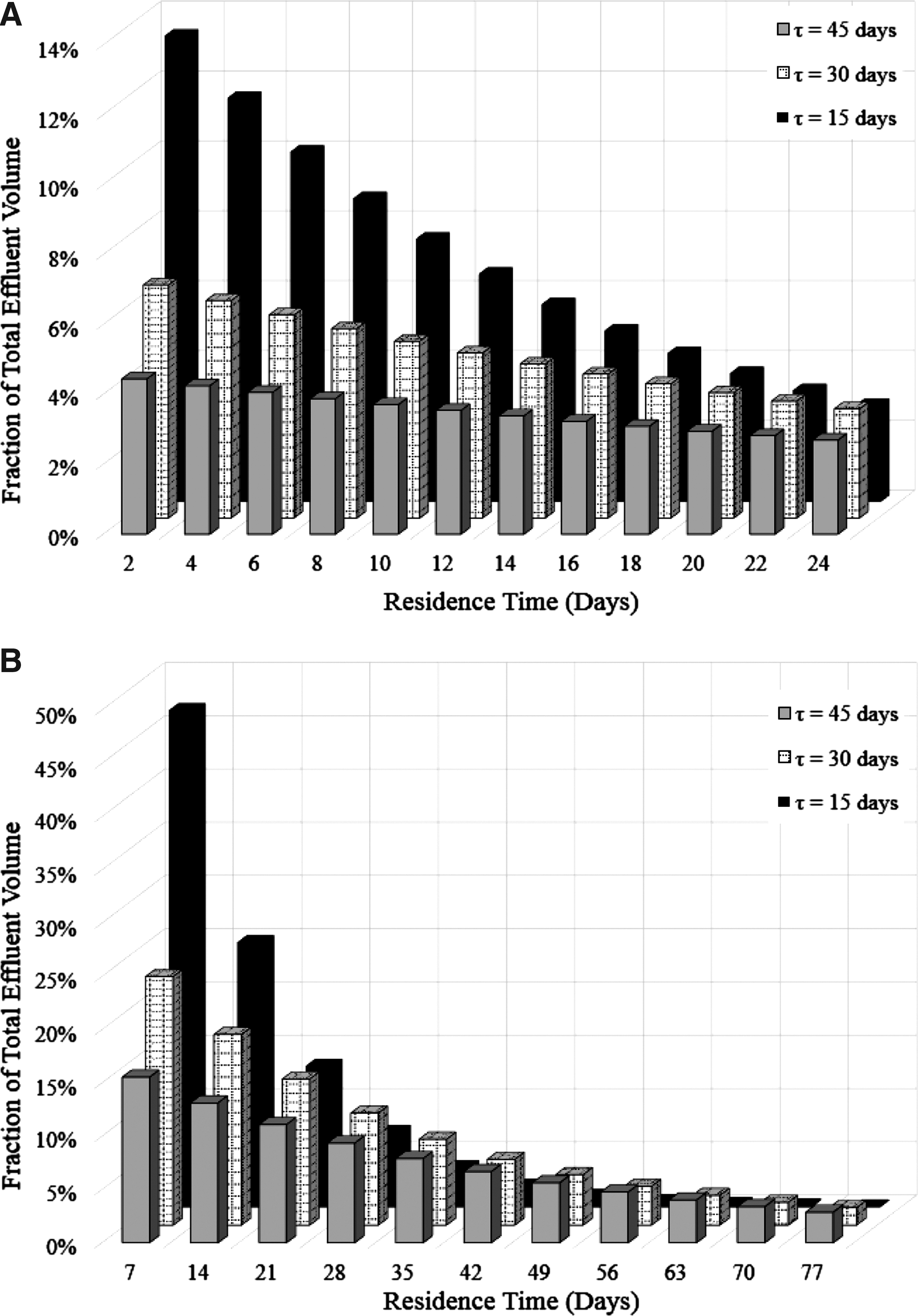
Effect of the FI on the residence time distribution of the system is weak, but apparent when examining Fig. 2A and B when taking into account the total fraction of effluent younger than 14 days in all six digesters (E15 = 63%, E30 = 38%, E45 = 27%, W15 = 72%, W30 = 41%, W45 = 29%). From this example it can be concluded that the shorter FI (2 days compared to 7 days) influences the residence time distribution favorably, meaning that a smaller fraction of the effluent is of the age in question (
Segregated flow model
Figure 3 graphically presents the application of the segregated flow model using the sudden die-off approach to predict the fraction of AD effluent that would contain viable A. suum ova during different combinations of SRT, FI, and digestion temperatures. The use of the conservative sudden die-off method shown in Fig. 3 demonstrates the fundamental issue that household-scale AD systems have in terms of inactivation of resilient pathogens, such as the ova of A. suum. That is, regardless of the FI selected during reactor design, there will be some portion of the digester effluent that has been in the reactor for less than the amount of time required to inactivate the ova—unless the upper end of the mesophilic temperature range can be maintained, or more likely, if the FI exceeds Segregated flow model prediction of the percentage of viable ova that exits the anaerobic digester with the effluent under variations to digestion temperature, solids retention time and feeding interval. Here, solids retention time and temperature are strongly related to ova inactivation, while the feeding interval demonstrates weak correlation.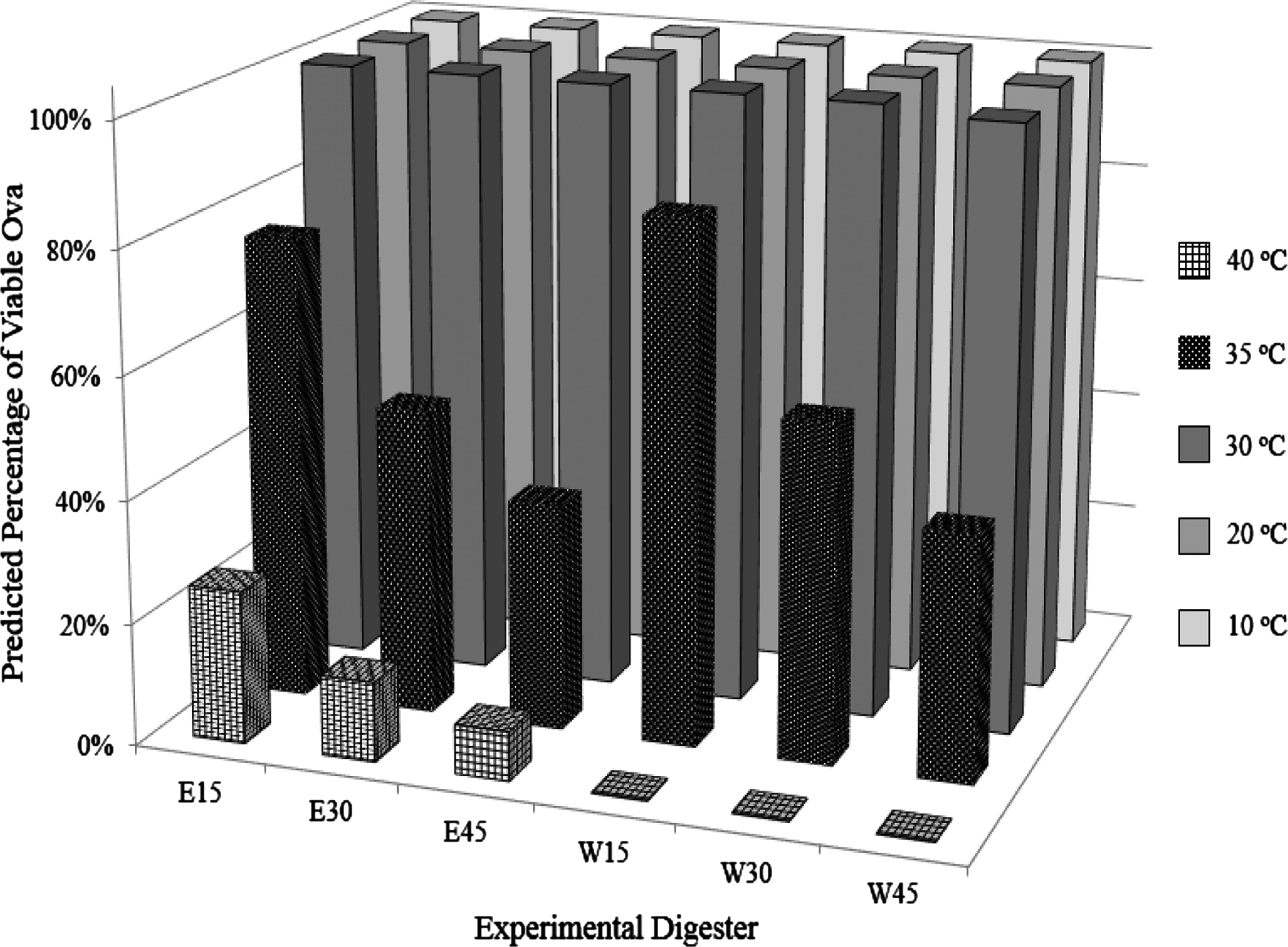
Limitations and challenges of modeling approach
Application of the step function is conservative by overestimating the population of viable ova. However, given the resiliency and infective nature of the ova, this approach is needed to ensure that the biosolids produced from household semi-continuous AD systems are safe. The predictive capabilities of the inactivation function are limited by the lack of current field data to validate assumptions made about
Household-scale AD operation guidance
Household ADs are often built under the direction of development programs using centralized design protocols, much like those sustained by the Food and Agricultural Organization (FAO, 1996). Guidance related to appropriate locations where these types of household-scale AD systems can be safely operated in the field was developed using GIS techniques and is presented in Fig. 4A and B. The suitable minimum FIs for most regions that are currently impacted with Ascaris related illnesses is shown based upon the mathematical framework developed in this article. Unfortunately, the implication of this information is that most regions require lengthy FIs (at least 180 days) to satisfy the relationship shown in Equation (13). A possible solution for this dilemma is the addition of a second digester of equal dimensions. This strategy is already used in alternating dual-pit latrines throughout the developing world (Mehl et al., 2010; Hu et al., 2016). Thus, the operating strategy would be to fill one unit and then switch to the second unit once the first is full. If the design volume is adequate it could be feasible to let the unit sit full for the number of days indicated by Fig. 4A and B.
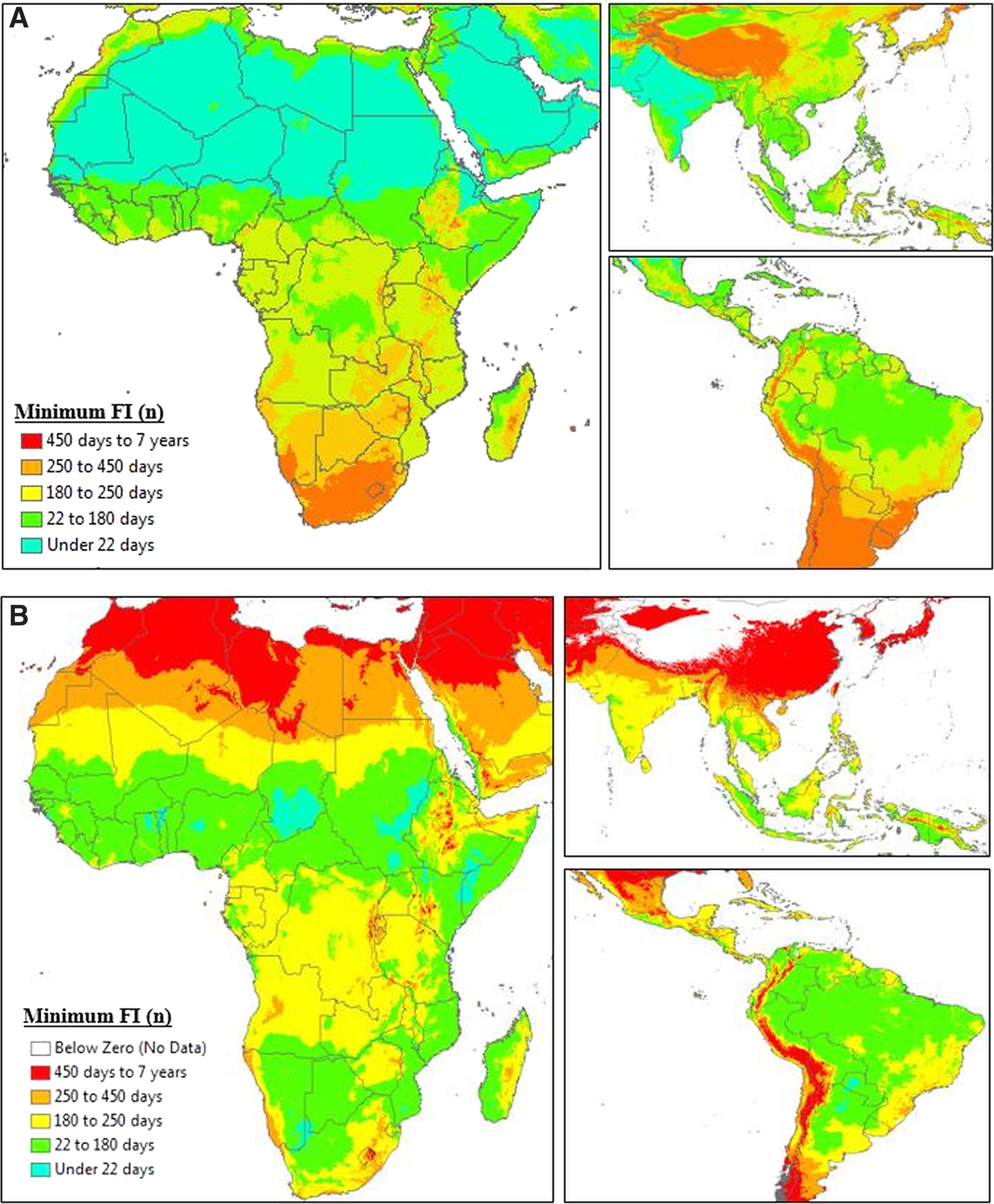
The segregated flow model prediction of the minimum feeding interval needed to completely inactivate A. suum ova during anaerobic digestion based upon June
To assist with the appropriate design volume calculation, Table 2 summarizes the minimum volume of digester needed to inactivate all A. suum ova for every pound of various manure generating animals without any dilution (Barker and Walls, 2002; Rose et al., 2015). In this analysis swine and dairy cows (0.04 L manure/pound·day) require the most AD design volume per pound of animal while humans require the least volume (0.001 L feces/pound·day) regardless of the digestion temperature. To demonstrate the inefficacy of household-scale biogas systems in terms of pathogen removal, at 30°C, 1 ton of swine or dairy cows would exceed the design capacity of a 3 m3 AD by 480% and a 10 m3 system by 44% (2,000 lbs × 7 L/lbs = 14,000 L). These sizes are the typical volumes installed as noted by Bruun et al. (2014). This result highlights the challenges associated with agricultural activities, especially the production of swine because the amount of AD capacity and manure generation is relatively high when compared to other animals, and swine manure can also act as a transport mechanism for human pathogens, such as soil-transmitted helminths. Moving forward, programs that install household-scale biogas systems should size them according to the substrate being fed, with special attention given to ensuring a minimum residence time is achieved instead of maximizing biogas production.
The strategy assumes that two identical digesters are operated in an alternating fashion, meaning that one is filled until full and then allowed to sit undisturbed while the second system is filled.
Rose et al. (2015).
Barker and Walls (2002).
This study demonstrates a need to develop geographically appropriate designs and procedures for the safe handling of resource-rich waste residuals and for development workers to ensure the transfer of resource recovery technologies and strategies between the developed and developing world is mutually beneficial (Mihelcic et al., 2007). Ultimately, it is impossible to recommend the uncontrolled use of waste solids derived from semi-continuous household-scale AD systems in the manner they are currently promoted in regions where persistent human pathogens, such as soil-transmitted helminths, are prevalent. Furthermore, this result supports our hypothesis that the use of the semi-continuous AD configuration at the household-scale can negatively impact human health when wastes containing human or animal pathogens are used as substrate and subsequently applied to soil. Accordingly, more effective methods that incorporate end-of-life concerns into development projects (McConville and Mihelcic, 2007) and also ensure safe disposal and beneficial use of the digested solids should be developed as has been recommended for solids derived from composting latrines in similar geographical locations (Mehl et al., 2010).
Conclusions
The objectives of this article were to (1) develop a mathematical framework to estimate the inactivation of soil-transmitted helminths in small-scale AD systems; (2) use the mathematical framework with previously gathered experimental data to estimate the inactivation of A. suum, a representative pathogen; (3) quantify how pathogen inactivation depends on operating parameters of the small-scale AD systems, such as feeding interval and solids residence time; and (4) provide guidance on the geographical locations where small-scale AD systems can be operated to lower or minimize the risk of transmitting helminths in tropical developing regions. Within the segregated flow model, it was determined that a step-function serves as the best method to predict the survivability of the ova under semi-continuous anaerobic conditions because it provides the most conservative estimate. This is important in the context of the highly persistent and geographically prevalent soil-transmitted helminths, such as A. suum and A. lumbricoides, because Ascaris can infect a human with only one ovum. Overall the model developed in this study is powerful because it can be applied to any semi-continuous system when the reactor parameters and the
Footnotes
Acknowledgment
This material is based upon work supported by the National Science Foundation, under grant numbers 1243510 and 1201981.
Author Disclosure Statement
No competing financial interests exist.