




Abstract
Abstract
Nitrous oxide (N2O) is one of the most powerful greenhouse gases, emitted by ammonia-oxidizing bacteria (AOB) and denitrifier during nitrogen transformation. A laboratory-scale sequencing batch reactor with enriched nitrifiers was developed under oxygen-limited conditions with synthetic wastewater (without organic carbon) to investigate the effect of ammonium (NH4+) concentration on N2O emission. The system achieved 70% conversion of the influent NH4+ to nitrite (NO2−) and the N2O emission factor (ratio between N2O nitrogen emitted and the NH4+ oxidized) was about 17.0%. NH4+ concentration was shown to have a major impact on N2O emission. When influent NH4+ concentrations were 60, 120, and 240 mg·N/L, total N2O emissions were 3.24, 8.75, and 24.59 mg·N/L, respectively. Comprehensive analysis of N2O emission rate on NO2− concentration (Fig. 5) together with the absence of a contribution from heterotrophic denitrifiers suggests that AOB denitrification is the main cause of N2O emission during oxygen-limited autotrophic nitritation processes.
Introduction
N
The United States Protection Agency reported that the amount of N2O emitted from wastewater sector accounts for about 3% of the total global emissions, as the sixth largest contributor (USEPA, 2006). Nitrogen compounds in wastewater are mainly removed by nitrification and denitrification. And N2O emission in the wastewater treatment process can result from the activity of denitrifying microorganisms and ammonia-oxidizing bacteria (AOB) (Firestone et al., 1979; Lipschultz et al., 1981). According to recent research, N2O production by AOB in wastewater is through two main pathways: (1) the reduction of nitrite (NO2−) to N2O through nitric oxide (NO), known as nitrifier or AOB denitrification (Kim et al., 2010); (2) N2O as a side product during incomplete oxidation of hydroxylamine (NH2OH) to NO2− (Chandran et al., 2011; Stein, 2011; Law et al., 2012a).
Based on the anaerobic ammonia oxidation (anammox) process, innovative autotrophic biological nitrogen removal (BNR) technologies have been developed as the enhanced nutrient removal processes in the past decade. Autotrophic nitritation, the pretreatment step for the anammox process, is able to provide as an electron acceptor for subsequent anammox. Autotrophic nitritation can be achieved under oxygen-limited conditions by preventing NO2− oxidation. However, the accumulation of NO2− and low dissolved oxygen (DO) have been found to trigger N2O production (Kong et al., 2013). The autotrophic nitritation process contributes 97.5% to the N2O production during the innovative autotrophic BNR processes (Okabe et al., 2011).
Several factors have been reported to affect N2O production by nitrifier, such as DO concentration, NO2− levels, and the ammonium (NH4+) loading rate (Kim, 2011; Peng et al., 2014, 2015). DO is a very important factor affecting N2O production. AOB can use NO2− rather than oxygen as the electron acceptor during the process of NH4+ oxidation to NH2OH under low oxygen conditions (Peng et al., 2014). The variation of DO has a direct effect on the relative contributions of NH2OH oxidation pathway and AOB denitrification pathway to N2O production during nitritation. NO2− is also thought to be a critical factor influencing N2O production by AOB. It has been found that high NO2− concentration leads to a significant increase of N2O production by stimulating AOB denitrification, but has no or negligible effects on the NH2OH oxidation pathways (Peng et al., 2015).
NH4+ is the substrate for nitrification and the electron donor of AOB denitrification. The variation of NH4+ concentration has a distinct effect on N2O production during biological wastewater treatment for the inhibition of free ammonia (NH3) on nitrification and autotrophic denitrification (Kim et al., 2010). Kampschreur et al. (2008) reported that a NH4+ plus in aerobic condition could increase the production of N2O during biological wastewater treatment. Few studies, however, have been specially carried out on the effect of NH4+ concentration on N2O emission during autotrophic nitritation process.
In this study, the main objective is to clarify the characteristics of N2O emission during autotrophic nitritation under oxygen-limited conditions, as well as the effect of NH4+ concentration on N2O emission with synthetic wastewater. For these purposes, a laboratory-scale partial nitrification sequencing batch reactor (PN-SBR) was operated and N2O emissions were measured at different NH4+ concentrations. The obtained results are expected to improve the current understanding of N2O emission in an autotrophic partial nitrifying system.
Materials and Methods
Seed and synthetic wastewater
The laboratory-scale PN-SBR system was inoculated with the activated sludge collected from the oxidation ditch of a full-scale municipal wastewater treatment plant in Xi'an, China. The concentrations of the mixed liquor suspended solids (MLSS) and mixed liquor volatile suspended solids (MLVSS) during the stable-running phase were about 1,000 and 654 mg/L, respectively. To meet the need of nutrient for AOB cultivation during the startup phase of PN, the synthetic wastewater contained mineral compounds as follows: NH4HCO3 (677 mg/L), KH2PO4 (330 mg/L), MgSO4·7H2O (50 mg/L), CaCl2 (16 mg/L), NaHCO3 (1,500 mg/L), and 1 mL of trace element stock solution per liter (Lovley and Phillips, 1988). No organic carbon was added in this experiment.
System setup and operational strategy
Experiments were performed in a cylindrical laboratory-scale SBR, which was made of plexiglass with a working volume of 7 L (40 cm in height, 16 cm in diameter). Compressed air was supplied to the reactor by an air pump through a porous stone diffuser. The air flow rate was kept constant at 60 mL/min by a flow meter to keep DO low (0.1 mg O2/L). A magnetic stirrer was applied to guarantee the sludge and oxygen fully mixed in the reactor. The temperature of the sludge suspension was controlled at 30°C ± 1°C by using a water bath, as shown in Fig. 1. The SBR was operated in a 12-h cycle during the startup period, which consisted of four successive phases including feeding (10 min), aerating (550 min), settling (30 min), and discharging (10 min). At the end of each settle phase, 3 L of the sludge supernate was decanted from the reactor, resulting in a hydraulic retention time of 28 h. No excess sludge was discharged over the entire experiment in consideration of the long-time multiplication of autotrophic bacteria. Most of the automatic operations and online monitoring of parameters during the experiment were undertaken by several programmable timers (CHINT KG316T, China). After 2 months of cultivation, the system achieved the target of autotrophic PN (70% of the influent NH4+ was converted into NO2−).
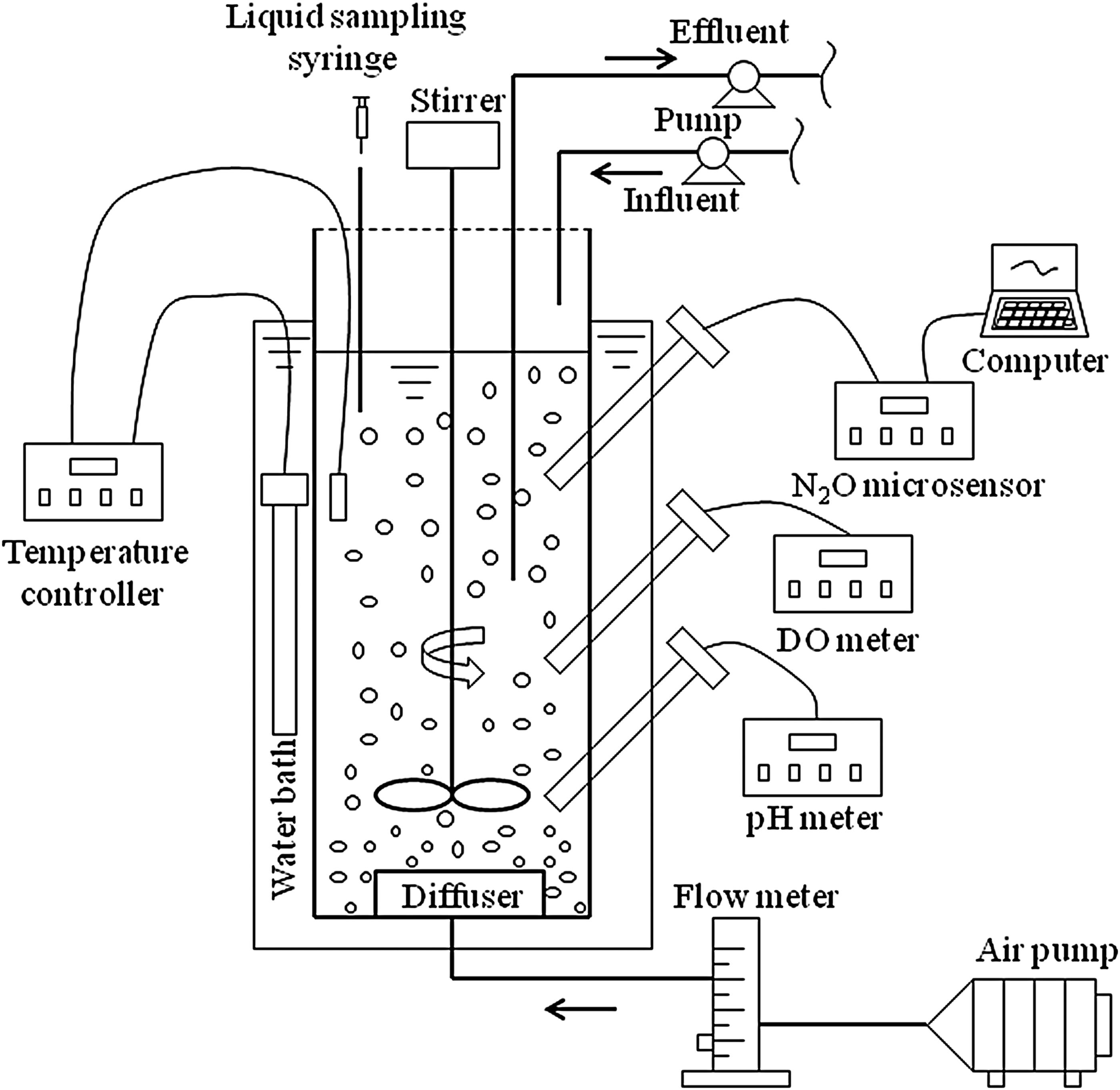
Schematic diagram of sequencing batch reactor system.
Analytical methods
NH4+, NO2−, nitrate (NO3−), MLSS, and MLVSS were analyzed according to the standard methods (APHA, 2005). Online data were continuously monitored by corresponding meters for pH (INESA PHS-3C, China), temperature (siEval TC-05B, China), and DO (HACH HQ30d). A dissolved N2O microsensor (Unisence, Denmark) with date logged every second was adopted for online N2O measurement in the liquid phase.
Calculations of N2O emission rate and emission quantity
Dissolved N2O in the liquid phase emitted to the atmosphere through diffusion and air stripping across air–water interface. Previous studies have shown that the profiles of the diffusion and air striping (diffusion was included) rates of N2O can be described using linear equations with respect to the dissolved N2O concentration (Zhang et al., 2012; Ge et al., 2016; Zhao et al., 2016).
where re is the N2O emission rate [mg N2O-N/(L·min)], CN2O is the soluble N2O concentration (mg N2O-N/L), and K is the N2O emission coefficient (1/min).
The N2O emission coefficients were calculated according to the method described by Zhang et al. (2012). First, the mixed liquor in the reactor was replaced with tap water at the end of the experiment; then moderate N2O gas was ingested into the tap water of the reactor and the decrease of N2O concentrations was measured. The re under a certain condition (nonaeration/aeration) was determined by calculation of the N2O reduction per second; finally, K was obtained by a linear fitting of re and CN2O.
Results showed that the N2O emission coefficient K in this study was 0.0032/min (coefficient of determination: R2 = 0.8705) for N2O emissions through diffusion (in the nonaeration condition) and 0.0087/min through air stripping (including diffusion, in the aeration of 60 mL/min, coefficient of determination: R2 = 0.9503).
From the N2O emission rate, the N2O emission quantity during the period t1–t2 can be calculated from the following equation:
where Q is the N2O emission quantity during the period t1–t2 (mg N2O-N) and V is the effective liquid volume (L).
Results and Discussion
N2O emission characteristics in a typical cycle
Figure 2 shows the profiles of NH4+, NO2−, NO3−, N2O, and DO concentrations and pH level in a typical cycle (NH4+ of 120 mg·N/L) during the stable operation period. As shown in Fig. 2A, NH4+ concentration decreased and NO2− concentration increased after the commencement of aeration. At the end of the aeration stage, the concentrations of NH4+ and NO2− varied from 52.32 and 25.25 mg·N/L to 0.87 and 61.10 mg·N/L, respectively. About 98% of the NH4+ was oxidized and 70% of it was converted into NO2−. The NO3− concentration was lower than 11.7 mg·N/L at all times, indicating that the nitrite-oxidizing bacteria activity was at a minimal in this experiment.
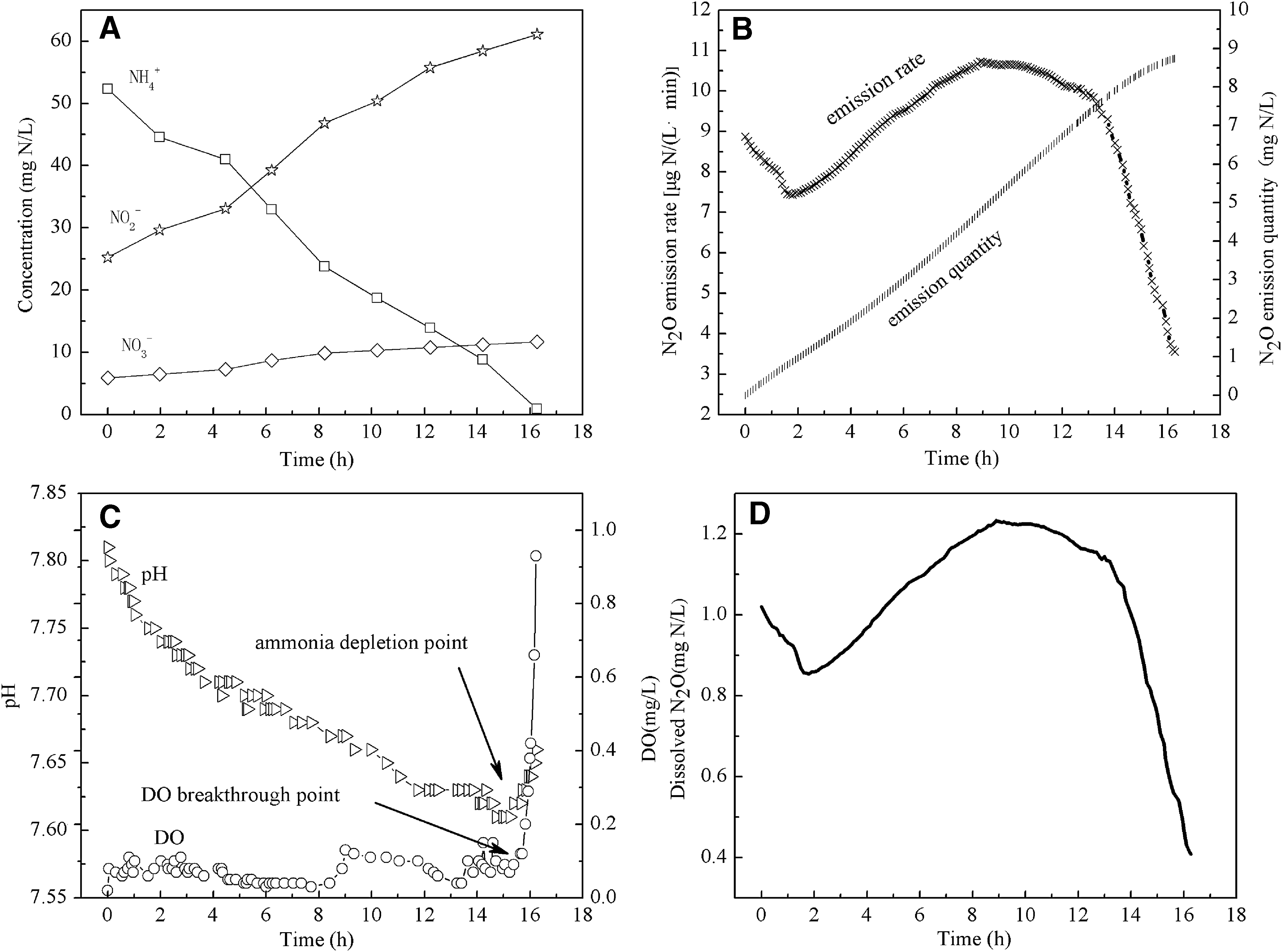
Dynamics of nitrogen pollutants
The variation of pH corresponded to the decrease of NH4+ concentration (Fig 2C). The pH decreased gradually for the consumption of alkalinity result from the NH4+ oxidation during this autotrophic nitritation process. When the NH4+ was completely depleted, the pH increased for the rise of HCO3−/CO2 caused by continuous stripping of CO2. The DO concentration stayed at a plateau of 0.1 mg O2/L for the balance of oxygen delivery and consumption during the process of NH4+ oxidation. When the NH4+ was exhausted, DO breakthrough occurred for the rapid reduction of oxygen consumption, which implied the end of the autotrophic nitritation (Wang et al., 2003; Peng et al., 2004).
N2O can be produced through the endogenous denitrification in the anoxic phase under the limited availability of biodegradable carbon conditions (Itokawa et al., 2001). It is known that the presence of DO has an inhibitory effect on the heterotrophic bacteria activity (Law et al., 2012b). As shown in Fig. 2D, the dissolved N2O concentration dropped after the commencement of aeration and lasted for 1.8 h, indicating that the generation rate of N2O was lower than the emission rate in the initial aeration stage. DO affects the activities of both AOB and heterotrophic denitrifier. N2O emission rate from the AOB denitrification pathway and NH2OH oxidation pathway increased as DO increased from 0 to 0.1 mg O2/L (Peng et al., 2014). After 1.8 h of the influent injection, dissolved N2O concentration increased for the consumption of NH4+ and increase of DO concentration. NH4+ is the electron donor of AOB denitrification and substrate for nitritation. The dissolved N2O concentration decreased again when NH4+ was lower than 20 mg·N/L. N2O generation rate was dynamic during the process of autotrophic nitritation (Ju et al., 2015). Figure 2B shows that the quantity of N2O emission grew quickly at the beginning of PN and then slowed at the end of the cycle operation. The total N2O emission was 8.75 mg·N/L during this nitritation, accounting for about 17.0% of the NH4+ oxidized.
N2O emissions under different feed ammonium concentrations
Figure 3 shows the characteristics of nitrogen pollutants when the influent NH4+ concentration increased from 60 to 240 mg·N/L. As presented in Fig. 3A, the NH4+ oxidizing rates maintained constant under the different NH4+ concentrations injection. It implied that the NH4+ oxidation was a zero order reaction in autotrophic PN under oxygen-limited conditions. Nitritation was controlled by the limited supply of oxygen to the reactor (Kim, 2011), DO concentrations under those three conditions all maintained at 0.08 ± 0.02 mg/L. Longer reaction time is needed at a higher NH4+ concentration for complete PN.
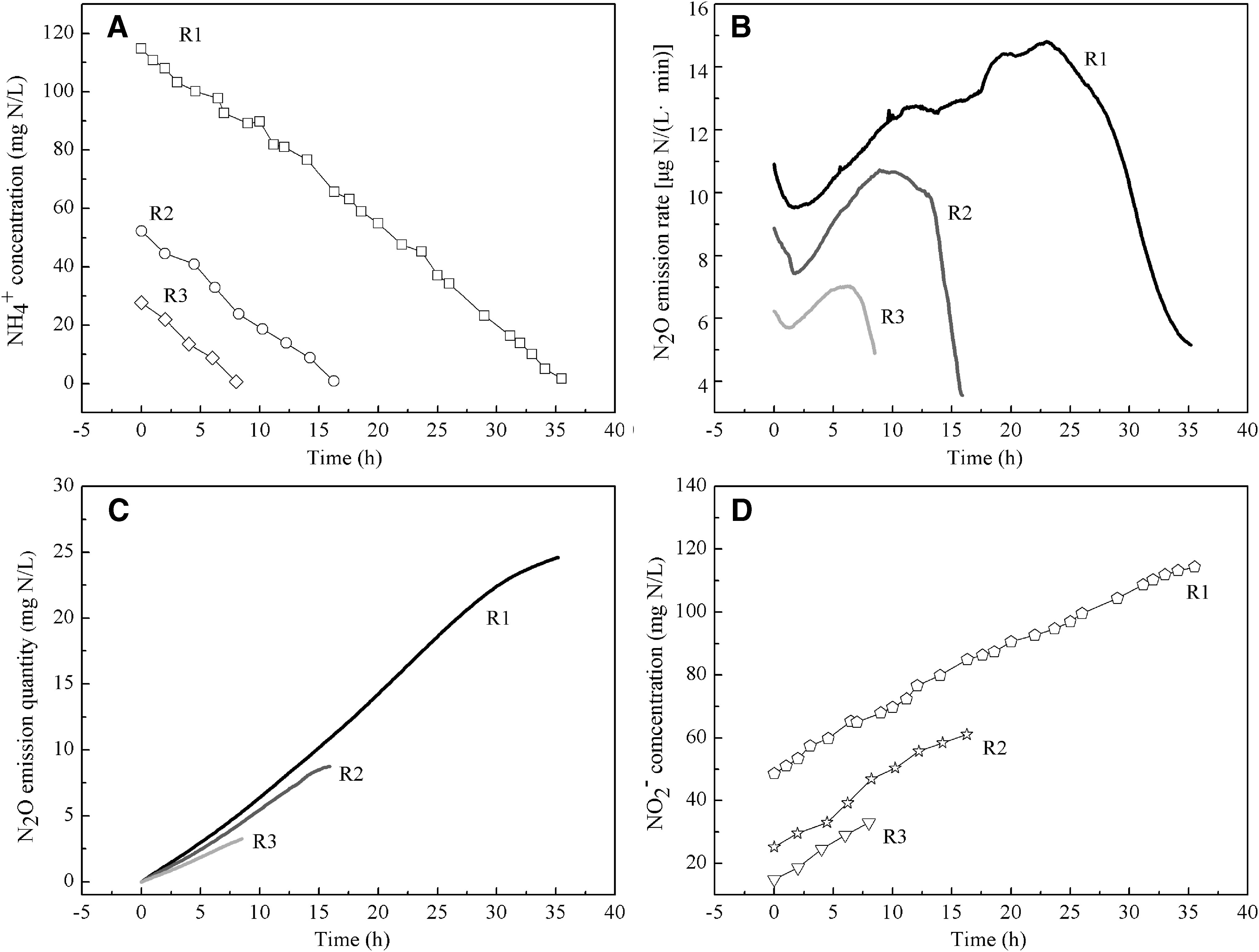
Comparisons of NH4+ concentration
There were 3.24, 8.75, and 24.59 mg·N/L N2O emissions at the influent NH4+ concentrations of 60, 120, and 240 mg·N/L, respectively (Fig. 3C). That means N2O emission increased with the rise of influent NH4+ concentration. Besides, the N2O emission factor increased from 12.0% for the NH4+ concentration of 60 mg·N/L to 17.0% for 120 mg·N/L and 21.7% for 240 mg·N/L. In summary, higher NH4+ concentration in oxygen-limited autotrophic nitritation led to higher N2O emissions.
It has been widely known that there are three main routes for N2O production during the process of biological wastewater treatment: heterotrophic denitrification, NH2OH oxidation, and AOB denitrification (Kampschreur et al., 2009).
Although the presence of a relatively small amount of heterotrophic bacteria was expected (growing on cell lysate), their effects on N2O emission were identified through a control test. During the control test, no NH4+ was added, DO was controlled at 0.1 mg O2/L, and NO2− was kept in normal range. Therefore, the N2O emission in this control test can be attributed to the heterotrophic activity. As shown in Fig. 4, the dissolved N2O concentration nearly remained constant at zero after the commencement of aeration, indicating that the heterotrophic denitrification was very limited as the synthetic wastewater contains no extra organic compound at the DO concentration of 0.1 mg O2/L.

Profile of dissolved N2O concentration in the control test (no NH4+ added at DO level of 0.1 mg O2/L, NO2− in a normal range).
During this experiment, the N2O emission rate from the NH2OH oxidation pathway maintained constant for the same NH4+ oxidation rate (Fig. 3A). In a similar nitrifying culture studied by Peng et al. (2014), the N2O emission rate from the NH2OH oxidation pathway is in positive correlation with DO concentration in the DO range of 0 to 3.0 mg O2/L, and the N2O emission rate through NH2OH oxidation pathway is about 0.15 mg N/h·g VSS at DO of 0.5 mg O2/L. Based on the N2O emission rate through NH2OH oxidation (0.15 mg N/h·g VSS at DO of 0.5 mg O2/L) in the reference, the N2O emissions through NH2OH oxidation in this experiment were calculated as 0.83, 1.56, and 3.44 mg·N/L for the influent NH4+ concentrations of 60, 120, and 240 mg·N/L, respectively. Considering the DO level in this study (0.1 mg O2/L) was lower than 0.5 mg O2/L, we may deduce that the N2O emissions through NH2OH oxidation during this experiment were less than 0.83, 1.56, and 3.44 mg·N/L at corresponding influent NH4+ concentrations. That is, the ratios between the N2O emitted by NH2OH oxidation and the total N2O emission were less than 25.6%, 17.8%, and 14.0% at the influent NH4+ of 60, 120, and 240 mg·N/L, respectively.
Besides, NO2− is considered to be an important factor affecting N2O production through AOB denitrification during nitritation (Peng et al., 2015). Figure 5 shows the dependency of N2O emission rate on NO2− concentration at DO level of 0.1 mg O2/L (during periods where NH4+ was not limiting). N2O emission rate increased linearly relative to NO2− concentration. The large N2O emission rate at high NH4+ concentration may be due to the accumulation of NO2−, which has been demonstrated to have a stimulating effect on AOB denitrification by promoting the expression of the nirK gene (Beaumont et al., 2004). By the comprehensive analysis of N2O emission rate on NO2− concentration (Fig. 5) and the absence of a contribution from heterotrophic denitrifiers, we can draw the conclusion that AOB denitrification is the main cause of N2O emission during the oxygen-limited autotrophic nitritation process.
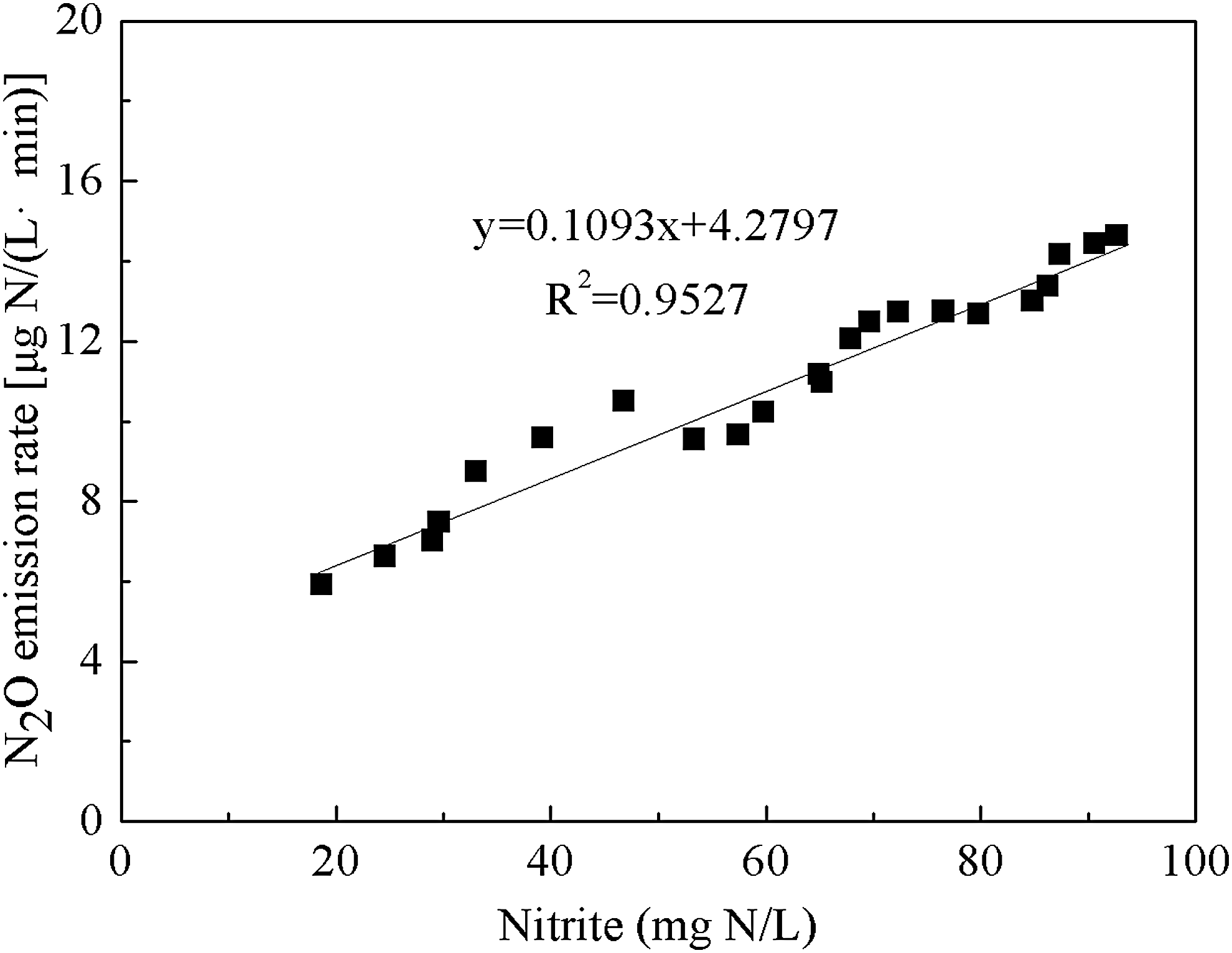
Effect of NO2− concentration on N2O emission rate during oxygen-limited autotrophic nitritation (during periods where NH4+ was not limiting).
Conclusions
A laboratory-scale SBR for autotrophic PN treating synthetic wastewater without organic carbon was operated to investigate the N2O emission characteristics under oxygen-limited conditions. It could be concluded that:
• NH4+ oxidation is a zero order reaction and N2O emission significantly increased with the increase of influent NH4+ concentration due to the large accumulation of NO2− under low oxygen conditions. • AOB denitrification is the main cause of N2O emission during the oxygen-limited autotrophic nitritation process.
Footnotes
Acknowledgment
This work was supported by the Shaanxi Province Science & Technology Development Program (Grant No. 2014K15-03-02).
Author Disclosure Statement
No competing financial interests exist.