




Abstract
Abstract
An innovative microalgal–bacterial symbiotic system (MABS-MS) adopting mesh screen separation to alleviate weakness of microalgae photobioreactor was evaluated. Chlorella sp. and Scenedesmus sp. were cultivated in a photobioreactor to identify optimum conditions for nutrient (nitrogen [N] and phosphorus [P]) removal from municipal wastewater. Under continuous cultivating and optimum conditions in the MABS-MS system, total N (TN) and total P (TP) removal efficiencies of 88.3% and 88.8% were obtained, respectively. The innovative mesh screen separation at settling tank contributed the increased settling velocity of 3.0 m/h due to increased recirculation ratio of microalgal–bacterial-conjugated aggregates enabled by the aid of mesh screen. The MABS-MS system showed the feasibility of an innovative technology using mesh screen for enhanced microalgal–bacterial symbiotic process and suggested overall solutions to constraints of microalgal separation and harvesting for wastewater treatment.
Introduction
C
Furthermore, compared to the physicochemical process, nutrient removal by microalgae assimilation is an economical and less harmful way (Oswald, 2003; Dodd et al., 2008). Thus, there is a distinctive demand of utilizing microalgae for an inexpensive, eco-friendly, and efficient process in nutrient removal at a lower cost.
Nutrient (N and P) removal by Chlorella vulgaris was very effective at the corresponding concentrations below 22 and 7.7 mg/L (molar ratio of N/P of 6.32) in synthetic wastewater (Ruiz-Martinez et al., 2012). Scenedesmus sp. completely removed nutrients (N and P) at the respective concentration of 20–21 and 2.4–3.0 mg/L (N/P of 14.7–19.3) and produced a biomass of 0.3 g/(L·day) at dilution rates of 0.7–1.05/day from municipal wastewater (Harun et al., 2010; Marbelia et al., 2014).
Thus, it is proven that wastewaters are ideal growth media for various types of microalgae. Different types of wastewater have been extensively studied as microalgal growth medium, including municipal, agricultural, industrial, and synthetic wastewaters (Pittman et al., 2011). The conventional activated sludge process can be also tuned to remove N and P by biological nutrient removal through the combination of aerobic process with bacterial–algal symbiotic process (Monclus et al., 2010; Sun et al., 2010). Successful symbiotic wastewater treatment process should remove both the organic contaminants and the nutrients (N and P). However, the difficulties of separating microalgal–bacterial flocs from diluted suspensions have limited the application of microalgal–bacterial symbiotic systems (Shi et al., 2007). Thus, the microalgal–bacterial symbiosis has been studied recently, but little attention has been paid for the engineering aspects of symbiotic systems (Babu et al., 2010; Christenson and Sims, 2011).
In this study, a new innovative design of a microalgal–bacterial symbiotic system consisting of a photobioreactor and settling tank equipped with a mesh screen was proposed. Mesh screen performing a solid–liquid separation alleviated the weakness of biofilm and membrane bioreactor with regard to diffusion limitation of nutrients and membrane biofouling, respectively. Mesh filtration was recently suggested for enhancing membrane filterability for cost benefit (Alibardi et al., 2016). The MABS-MS system using mesh screen for the enhanced microalgal–bacterial symbiotic process is designed to show the feasibility of an innovative technology for the municipal wastewater treatment. Mesh screen is expected to contribute to the reduction of operating cost. Thus, the MABS-MS system suggests an integrated process that can provide overall solutions to constraints of microalgal application to wastewater treatment.
In view of a future application of a wastewater treatment process for organic contaminants and nutrient removal with microalgae, biological batch culture and continuous system tests were carried out on a laboratory scale. Two microalgal strains of Chlorella sp. and Scenedesmus sp. were utilized to explore optimizing conditions and the performance of this novel symbiotic scheme with mesh screen separation for organic carbon and nutrient removal. The aims of the current study were as follows: (1) to investigate the optimum conditions of important factors such as temperature and light intensity (light/dark cycle) on growth and contaminant removal, (2) to explore the ability of contaminant reduction with screened microalgal species showing better potent of growing activity on wastewater, and (3) to demonstrate the potential feasibility of a microalgal–bacterial-based symbiotic scheme with mesh screen separation for wastewater treatment using the local municipal wastewater resources.
Materials and Methods
Microalgae strain and precultures
For contaminant removal from the municipal wastewater, the best configuration along with microalgae growth-promoting bacteria was selected (Sriram and Seenivasan, 2012). The selected microalgae species with the best cell growth configuration was introduced as a suitable strain for nutrient removal. Two strains of Scenedesmus sp. and Chlorella sp. were kindly provided by the KORDI (Korea Ocean Research and Development Institute) as inoculants and precultivated with sterile Blue–Green (BG-11) medium (Dayananda et al., 2007) containing the following components: 1,500 mg/L NaNO3, 40 mg/L K2HPO4, 75 mg/L MgSO4·7H2O, 36 mg/L CaCl2·2H2O, 6 mg/L citric acid, 6 mg/L ferric ammonium citrate, 5 mg/L EDTANa2, 20 mg/L Na2CO3, 2.86 mg/L H3BO3, 1.86 mg/L MnCl2·4H2O, 0.22 mg/L ZnSO4·7H2O, 0.39 mg/L Na2MoO4·2H2O, 0.08 mg/L CuSO4·5H2O, and 0.05 mg/L Co(NO3)2·6H2O.
The pH of medium was titrated to 8.0 with 1 mol/L HCl under temperature condition sustained at 25°C ± 1°C, with the continuous fluorescent light intensity of 240 ± 2 μmol photons/(m2·s) and light–dark cycles (L:D) of 12:12 h for 14 days. All microalgae species were maintained separately with the same media and washed several times to remove the media, before being dispersed in the liquid being tested. The initial microalgae concentration in the photobioreactor was steadily kept at an approximate number of 1.0 × 10⁶ cells/mL.
The photobioreactor was made from acrylic flat plate with three working volumes of 100, 60, and 5 L, respectively. Periodic shakings at 120 rpm were performed three times each day. Two plates of steel angle equipped with three red light emitting diodes (LEDs) (627 nm, LXML-PD01-00040; Phillips) and three blue LEDs (455 nm, LXML-PR01-0275; Phillips) were placed at a distance of 15 cm from the top of each reactor.
Optimizing conditions for microalgal growth
Simulated treated sewage was supplied as feed water for the batch photobioreactors. Simulated treated sewage contained 9.0 g of peptone, 10 g of beef extract, 182 g of NaHCO3, 21 g of KNO3, 6.3 g of NH4NO3, and 0.76 g of NaH2PO4·2H2O per liter.
The photobioreactor made from acrylic flat plate with 6 L of working volume had internal dimensions of 20 × 10 × 40 cm (W × L × H). The reactors were filled to a depth of 30 cm with same volumes of feed water with initial nutrient concentrations. Two of the reactors were then spiked with one of the isolated microalgae each. The third reactor was kept without any microalgae and used as the control. All batch reactors were kept under the same conditions for the duration of the tests. Water samples from the reactor were taken every 6 h for analysis of biomass dry weight (DW) and chlorophyll-a (Chl-a) concentration. All samples were filtered using a 0.45-μm filter paper before analysis. Effects of temperature and light intensity on the growth rate and accumulation of Chl-a were subsequently assessed in Scenedesmus sp. and Chlorella sp. by analyzing DW and accumulation of Chl-a. Each batch test was performed for 8 days, and other operating conditions were the same as those in all batch experiments. The optimum temperature and light intensity (L/D cycle) conditions were explored to achieve the maximum microalgae biomass productivity.
Temperature
Temperature is another major parameter in microalgal growth with metabolic rates generally depending on temperature variations. Photobioreactors were maintained at temperatures calibrated at 10°C ± 1°C, 15°C ± 1°C, 20°C ± 1°C, 25°C ± 1°C, or at 30°C ± 1°C. Effects of temperature on growth rate and accumulation of Chl-a were subsequently assessed in Scenedesmus sp. and Chlorella sp. by cultivation under photon flux density (PFD) of 120 ± 2 μmol photons/(m2·s).
Light intensity
Light intensity affects overall growth rates relevant to photosynthetic growth, CO2 removal rates, and biomass concentrations in any microalgae system. Continuous top illumination (white fluorescent light, PFD of 60, 120, 240, and 300 μmol photons/(m2·s), on the upper surface of the photobioreactors) was provided by fluorescent lamps (Philips 23 W, white light) under a 12:12-h photoperiod. Acclimation to higher light intensities was achieved with a stepwise increase of light intensity from 60 to 300 μmol photons/(m2·s). To evaluate the growth of microalgae based on light intensity, cultures in exponential growth phase were exposed successively to 60, 120, 240, and 300 μmol photons/(m2·s).
Performance test of nutrient removal under symbiotic conditions and continuous operation
All performance tests were conducted in the microalgal–bacterial symbiotic system (MABS-MS) consisting of a photobioreactor for the removal of chemical oxygen demand (COD), N, and P followed by a settling tank with mesh screen, and an internal recycle flow back to the photobioreactor. The settled and separated aggregates with mesh screen were recirculated back to the photobioreactor in the MABS-MS system. The mesh screen filter cartridge was made of nylon and polysulfone material with spiral wound (a mean opening pore size of 50 μm). The mesh screen was installed in the settling tank at 60° to enhance settling velocity and separation control. The continuous operation tests were focused on the determination of organic and nutrient removal using the microalgal–bacterial symbiotic system with mesh screen separation (MABS-MS).
The continuous process used a photobioreactor containing 6 L municipal wastewater inoculated with 2% (inoculum/wastewater, V/V) and settling tank installed with mesh screen. The MABS-MS system was continuously provided by continuous top illumination (white fluorescent light of optimum photons) of fluorescent lamps (Philips 23 W). Light intensity was analyzed with a quantum sensor (LI-COR SA190 PAR). The pH was measured by pH meter of ORION model 3STAR (Orion, Inc.) and sustained to be at pH 7 with controlling by pulse-wise addition of CO2. The temperature was maintained at 25°C ± 1°C with the water bath recycle. A schematic diagram of the test setup designed for this study is shown in Fig. 1.
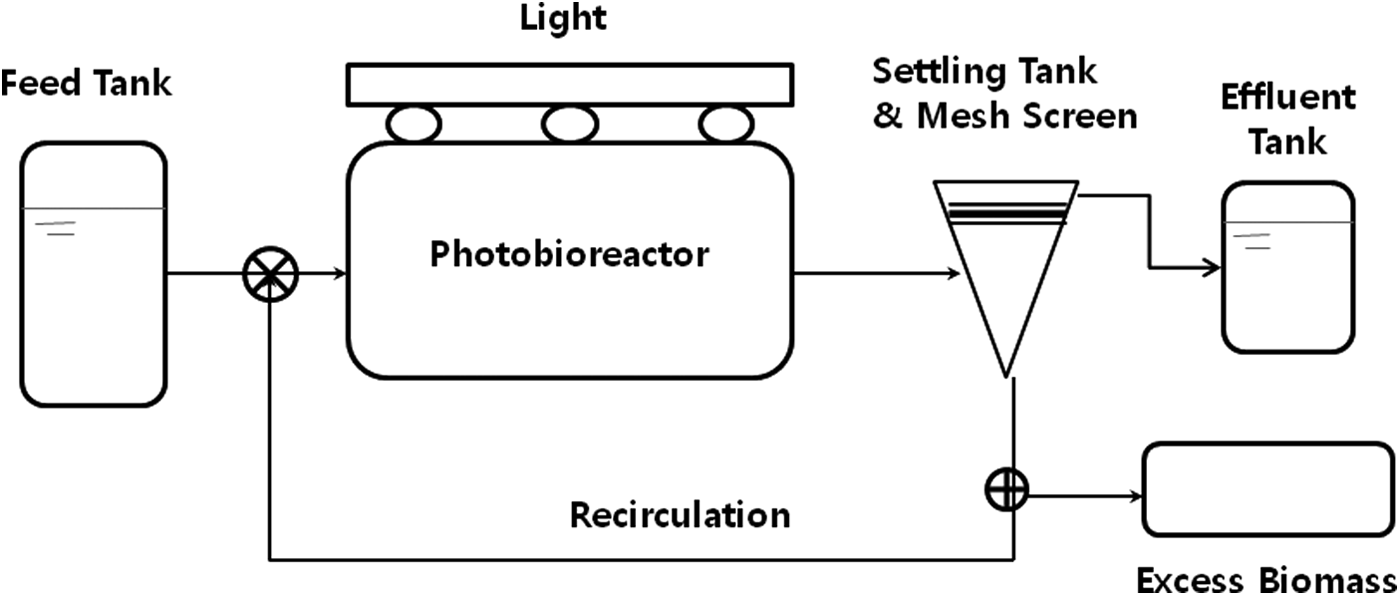
Scheme of test setup (the MABS-MS system).
The feed of municipal wastewater into the MABS-MS system contains organic constituents and nutrients (Table 1). The inflow of municipal wastewater was adjusted to the maximum 1.5 L/day, depending on the planned hydraulic retention time (4 days). The recycle flow from settling tank to symbiotic photobioreactor was controlled to be in the range of 0.15–0.3 L/h, maintaining the maximum mixed liquor suspended solids concentration of 6,000 mg/L in the symbiotic bioreactor. The settling tank volume was 1.5 L and the effective volume of settling tank was adjusted in the range of 0.85–1.45 L. Samples from the effluent were collected and stored for <24 h at 2°C, to analyze COD, total nitrogen (TN), and total phosphorus (TP) in the effluent.
COD, chemical oxygen demand; TN, total nitrogen; TP, total phosphorus.
Analytical methods
The biomass DW, Chl-a, COD, nitrogen, and phosphorus were measured during cultivation. Samples of 10 mL algal suspension were filtered through preweighted glass fiber filters (Whatman GF/F; Aldrich) and washed with the same volume of an isotonic ammonium bicarbonate solution (0.5 M) for DW determination (Zhu and Lee, 1997). Biomass concentration for microalgae production was measured using the method of dry cell weight (DCW) (Ho et al., 2010). For Chl-a measurement, 10 mL of microalgae suspension was taken in the middle of light reaction period and then centrifuged at 2,500 rpm at 4°C for 10 min. Then, centrifuged samples were rinsed with acetone (80%) and centrifuged again for analysis according to Nedbal et al. (2008).
The dissolved oxygen (DO) concentration was determined using a DO meter (YSI 58) for BOD analysis, and the solution pH was measured using an ORION model 3STAR (Orion, Inc.) pH meter. Suspended solids (SS), BOD, COD, TN, and TP analyses were conducted by following the procedures described in the Standard Methods (Eaton et al., 2005).
Results and Discussion
Optimum conditions for microalgal growth under batch culture conditions
Batch cultures of Chlorella sp. and Scenedesmus sp. were tested under same growing conditions for better understanding the optimum cultivation period. Microalgae cells were harvested and measured for DW and Chl-a during the cultivation time (from 144 to 192 h) of the stationary growth phase. Growth rates of Chlorella sp. and Scenedesmus sp. were evaluated with the measurement of DW and Chl-a. Growth rate curves of both species with biomass productivity (DW and Chl-a) are shown in Fig. 2.
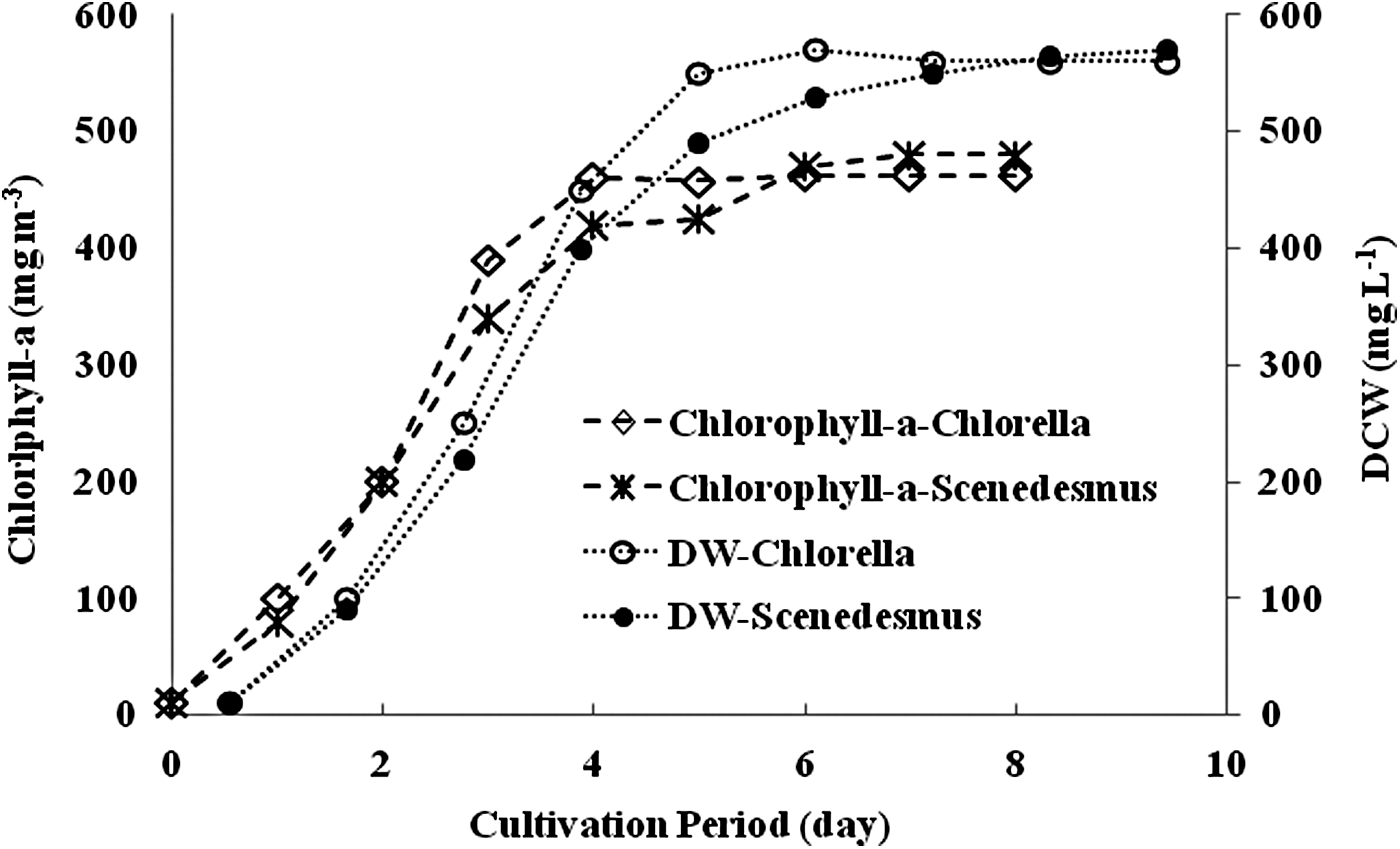
Growth curve of Chlorella sp. and Scenedesmus sp.
The growth rate of Chlorella sp. reached the stationary phase after 6 days of cultivation, but 8 days were required for Scenedesmus sp. Therefore, the optimum period of cultivation for Chlorella sp. and Scenedesmus sp. was 6 and 8 days, respectively. Under this optimum period of cultivation for Chlorella sp. and Scenedesmus sp., batch cultures were operated to better understand the effects of temperature and light intensity (L/D cycle) except CO2 and other factors on microalgal growth and biomass productivity. The CO2 concentration is affected by the thermodynamics and mass transfer in wastewater. In the literature, it was reported that sufficient inorganic carbon can be included in the municipal wastewater effluent enough to support algal growth (Van Vooren et al., 1999). The result of growth and biomass productivity of Chlorella sp. and Scenedesmus sp. at various temperatures during 8 days of cultivation is shown in Table 2.
DW, dry weight.
Temperature affects physicochemical reactions, enzyme activities, and biological reaction rates (Raven and Geider, 1988). The production of DW and Chl-a was obtained at different temperatures, and the effect on Chlorella sp. and Scenedesmus sp. is shown in Table 2. The better results were obtained at the optimum temperature range of 25–30°C. However, lower growth rates were attained when both species were cultivated at the relatively lower temperature range of 10–20°C. This restricted growth may be due to a suboptimal temperature relevant to the biochemical mechanisms of microbial carbon fixation (Jiang and Gao, 2004). A similar restriction was reported in the literature, comparing growth conditions of Isochrysis galbana at the temperature range of 15–30°C (Zhu et al., 1997). There is also another factor affecting microalgae growth activity due to temperature change.
The unsaturation of fatty acids in membrane is increased as the temperature shifts from 20°C to 25°C in the culture medium. In the literature, it was reported that membrane fatty acids (lipids) enhance biological membrane fluidity, which is the main factor affecting the phase transition temperature in biological membranes (Cossins, 1994; Renaud et al., 2002). The production of DW and Chl-a was obtained at different light intensities (PFD, L/D cycle). Photobioreactors were exposed to top illumination [60, 120, 240, and 300 μmol photons/(m2·s)] supplied by fluorescent lamps under 12:12-h L/D cycle. Test results showed photolimitation of cell growth of Chlorella sp. and Scenedesmus sp. under 60, 120, and 300 μmol photons/(m2·s). At 60 μmol photons/(m2·s), production of DW and Chl-a accumulation was less than at higher [120, 240, and 300 μmol photons/(m2·s)] irradiances.
However, the production of DW and Chl-a accumulation reached the stationary phase for Chlorella sp. and Scenedesmus sp. at 240 μmol photons/(m2·s), while the final yield was still maintaining the same stationary phase for Chlorella sp. and Scenedesmus sp. at 300 μmol photons/(m2·s). Thus, it is unclear whether the photosynthetic mechanisms of both species were light saturated at the highest PFD utilized. Light saturation for I. galbana at PFD of 300 μmol photons/(m2·s) was reported in the literature and suggested probable photolimitation when exposed to higher PFD of 500 μmol photons/(m2·s) (Sukenik and Wahnon, 1991). In this study, an increase in the production of DW and Chl-a accumulation was only observed when PFD was increased from 60 to 120 μmol photons/(m2·s) and reached the stationary phase at the higher light intensity of 240 μmol photons/(m2·s). Light intensity is required to be balanced with loading rates to establish a microalgal–bacterial symbiotic system demanding no aeration and removing most nutrients. Thus, the lower irradiance resulted in light limitation, suggesting that the optimum growth for Chlorella sp. and Scenedesmus sp. was obtained at a higher light intensity than PFD of 240 μmol photons/(m2·s).
Nutrient removal in municipal wastewater under optimum conditions
The microalgae, Chlorella sp. and Scenedesmus sp., with the best cell growth configuration as appropriate strains for nutrient removal were cultivated under optimum conditions at 25°C ± 1°C and 240 μmol photons/(m2·s). Micronutrients such as calcium, cobalt, iron, magnesium, potassium, zinc, sulfur, and copper are included in the municipal wastewater, as is often the case when municipal wastewater is used for microalgal growth (Christenson and Sims, 2011). Thus, both strains in the photobioreactor were fed exclusively with municipal wastewater, which provided them with all the dissolved nutrients necessary for growth. As a result of the characteristics of the municipal wastewater fed, there were variations in the concentration of nutrients in the feed.
Concerning nitrogen removal relevant to inorganic forms of ammonium, nitrate, or nitrite, microbial mechanism will primarily start from ammonium until exhaustion, and then the residual forms such as nitrite followed by nitrate (Abdelaziz et al., 2013). Therefore, removal efficiencies of TN were calculated to evaluate nitrogen reduction rates.
Until the first 1–2 days of microbial cultivation, activities of nutrient reduction were regarded as a start-up stage. During this stage, both strains started to inhabit suspension of the photobioreactor, and uptake of TN and TP started to be observed. As the microalgae grew, the TN and TP concentrations reduced further and finally reached stable state between 6 and 8 days. The cumulative removal efficiencies of TN and TP by both strains are listed in Table 3.
Results indicate that Chlorella sp. showed a higher TN uptake rate (39.46%) in municipal wastewater treatment than Scenedesmus sp., and it was more superior in reducing TN within 4 days. This result shows a difference in TN removal efficiency of microalgae in the first phase. This difference is regarded to be relevant to the specific potential of microalgae to absorb metabolite nutrients from municipal wastewater (Rasoul-Amini et al., 2014). Scenedesmus sp. showed the better removal efficiency of 83.42% over 6 days, while shorter time was required for Chlorella sp. to reach stable state; nevertheless, other studies reported that longer time (8 days) has been required for C. vulgaris to deplete nitrogen (Ruiz-Marin et al., 2010). Evidently, complete nutrient reduction requires a longer microalgae-based cultivating time as the initial loading of nutrient to treat is higher. The reduction period depends also on the microalgae strains and their specific growth rate with initial density.
With regard to the characteristics of the municipal wastewater fed, the TP removal rate was utilized to evaluate reduction efficiency of phosphorus due to variations in the concentration of phosphorus in the feed to photobioreactor. The TP reduction efficiencies by Chlorella sp. and Scenedesmus sp. in the photobioreactor are shown in Table 3. It was observed that the TP removal rate increased rapidly due to the fast assimilation by Chlorella sp. and Scenedesmus sp. in the first 3 days. On the contrary, pH was generally raised up around 9 to 10 during Chlorella sp. and Scenedesmus sp. growth in municipal wastewater treatment. Phosphate can be abiotically precipitated in a microalgal cultivation medium as a result of raised pH and produced DO.
Therefore, it should be noted that phosphorus reduction in wastewater treatment is not only accomplished by microalgal reaction but also by the effects of external conditions such as pH and DO (Cai et al., 2013). However, the removal rates of TP in the blank (without microalgae) were <5% and much lower than in all tests with microalgae, as seen in Table 3. Thus, the major process of phosphorus reduction in the cultivation medium is still microalgal uptake for assimilation, despite the difficulty of quantifying the proportion of abiotic precipitation (Su et al., 2012).
The nutrient reduction kinetics is complicated as it can be affected by various culture conditions such as wastewater characteristic, initial nutrient concentration, and the nitrogen/phosphorus ratio. Environmental conditions should also be considered as physical parameters of photobioreactor such as temperature, initial nutrient loading rate, and light intensity (L/D cycle) (Talbot and de la Noüe, 1993; Rai et al., 2000; Oota et al., 2005). Thus, based on the conditions of culture, microbial nutrient reduction can be raised with longer retention time of wastewater. However, a longer retention time may not be a favorable condition in municipal wastewater treatment processes. As a result, further reduction of retention time is a key factor of microalgae application to wastewater treatment processes.
Performance of MABS-MS system
In this section, a continuously operated microalgal–bacterial symbiotic system was tested with Chlorella sp. selected as the optimum strain. Based on the results under optimum conditions, Chlorella sp. is a common microalgae species and showed a relatively higher reduction rate within the 1–4-day period, which was applied as the retention time for the continuous microalgal–bacterial symbiotic system. With regard to enhanced nutrient removal, coincidental reduction of carbon (C), nitrogen (N), and phosphorus (P) via mixotrophic assimilation is superior to conventional biological treatment (Arbib et al., 2014). The first phase concentration of Chlorella sp. was maintained constant, 1.0 × 10⁶ cells/mL, with activated sludge in the supernatant of photobioreactor. Removal rates of COD, TN, and TP in a continuous process with Chlorella sp. and activated sludge are shown in Fig. 3.
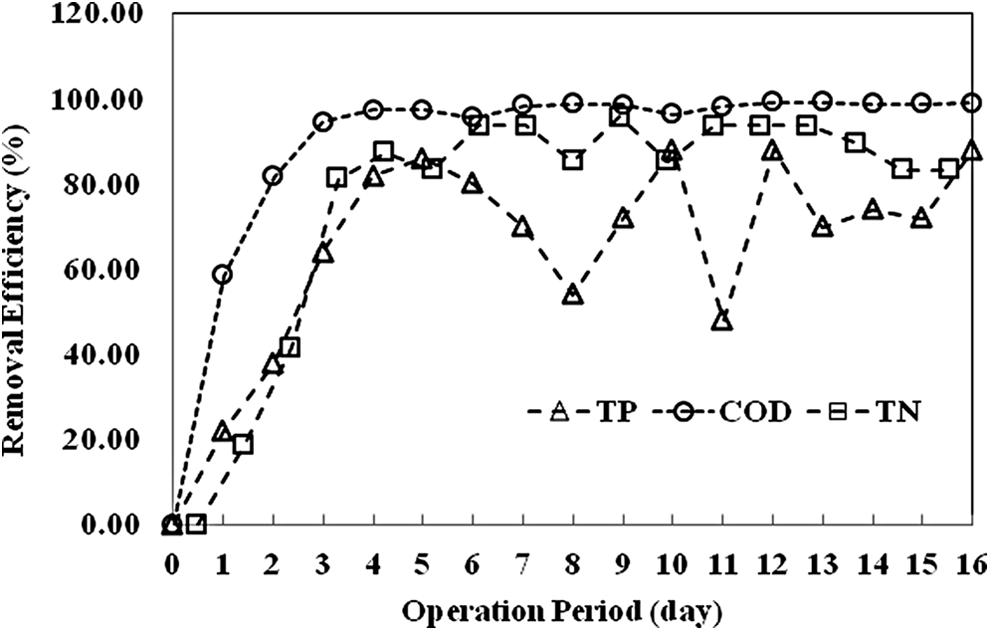
Removal rates of COD, TN, and TP in a continuous process with Chlorella sp. and activated sludge. COD, chemical oxygen demand; TN, total nitrogen; TP, total phosphorus.
Mean removal rate in COD obtained in the photobioreactor was found to be 94.43%, as shown in Fig. 3. The superior synergistic capacity of the microalgal–bacterial symbiosis configuration accomplished a stable COD removal rate of ∼94% with biomass aggregate separation followed by recirculation. The microbial symbiosis in the MABS-MS system, which generates 5% of the overall COD reduced, demonstrates synergistic additional reduction of organic constituents via microbial assimilation (Muñoz et al., 2005). After 16 days of culture operation, a biomass of 3.5 g DW/L and 0.23 g hydrocarbon/L was attained and disposed as excess biomass on the way of recirculation during the entire tests.
In the literature, stoichiometrically, bacteria consume about 80 mg O2/L (2.5 mmol/L) to oxidize 180 mg COD/L, and the corresponding CO2 generation is 113 mg/L (2.6 mmol/L) (Boelee et al., 2011). However, microalgae will utilize 92 mg CO2/L (2.1 mmol/L) to produce 80 mg O2/L. Thus, 92 mg CO2/L consumed by microalgae is less than the 113 mg CO2/L generated by the bacteria. The MABS-MS system using microalgal–bacterial-conjugated aggregates is possible to degrade all COD constituents with no external supply of either O2 or CO2. Based on the wastewater flow rate of 10 m3/day, the MABS-MS system reduced total energy consumption rate from 4.4 to 3.3 kWh/day with installing mesh screen for aeration and filtration for separation. As a result, 25% reduction of operating cost was obtained.
Concerning nitrogen removal with regard to all inorganic forms, microalgae will primarily utilize ammonium until exhaustion and then residual forms such as nitrite followed by nitrate (Abdelaziz et al., 2013). Removal efficiency of TN relied on the degree of the removal rate in NH4+-N, which was the majority of inorganic nitrogen forms for all tests in the MABS-MS system. 81.5% of the TN in the feed municipal wastewater, corresponding to 40 mg/L, was removed by the MABS-MS system. The TN removal rate in the MABS-MS system mainly relied on assimilation at pH of 7.3–7.8, but pH was inter-relatedly lowered with increased NH4+-N oxidation regardless of the enhanced assimilative NH4+-N reduction.
Therefore, optimization of the microbial aggregates recirculation ratio was required to further lower the TN composition in effluent. As a result, TN removal by symbiosis was augmented with an elevated recirculation ratio (from 0.3 to 0.6 of inflow) of microbial aggregates from settling tank to the photobioreactor of MABS-MS system. The mesh screen provided the most effective separation process for recirculation, which contributed to the enhancement of operational cost and system performance. The conjugated aggregates of microalgal–bacterial symbiosis inhabited steadily within the MABS-MS system via recycle due to stable separation by the mesh screen seemed to provide microalgae beneficial environments from any probable negative effect induced by the systematic conditions such as low pH and high NH3 concentrations.
Removal efficiency of 82.0% in TP concentration was obtained by the MABS-MS system and the mean TP concentration resulted in 0.9 mg TP/L in the effluent. The TP removal efficiencies, however, could be fluctuated between 48% and 88% by the affection of the operating conditions in the MABS-MS system. TP reduction by microbial uptake tended to be raised at a higher recirculation ratio of conjugated biomass aggregates and biotical correlation of the symbiosis culture. TP removal efficiency in microbial symbiosis is highly dependable to surrounding conditions such as TP concentration, temperature, and light intensity in the photobioreactor. Phosphorus precipitates with intracellular polyphosphate components at high pH and mediates microalgal–bacterial assimilation in the conjugated biomass aggregates. It has been reported that a luxury phosphate uptake by a mixed microbial consortium resulted three times higher than the raised level from 5 to 15 mg P/L of microbial acid soluble polyphosphate. The TP concentration shown in Fig. 3 fluctuated from 2 to a high of almost 5 mg/L in the feed to the MABS-MS system during the days of entire operation.
Low settleability of most microalgal species often causes problems of effluent solid control with regard to the solid discharge limit at municipal wastewater treatment plants. Therefore, the improvement of low settleability for municipal wastewater treatment is required for innovative sustainable technology adopting microalgal–bacterial symbiosis to implement simultaneous enhancement of contaminant reduction rate and biomass harvesting. Thus, mesh screen was installed at the MABS-MS system to separate biomass in the effluent leaving settling tank. The sludge volume index (SVI) of the microalgal–bacterial-conjugated aggregates from the MABS-MS was obtained to be mean value of 77 ± 3 mL/g, corresponding with mean settling velocity of 1.9 ± 0.2 m/h in the settling tank, which was notably faster than the settling velocity of 0.42 m/h in the literature (De Godos et al., 2014).
After stabilization of the symbiotic system, the SVI decreased further to 42 mL/g in the settling tank, along with the increased settling velocity of 3.0 m/h due to the increased recirculation of the microalgal–bacterial-conjugated aggregates with the aid of mesh screen to the MABS-MS system. The recycle of biomass from settling tank to the photobioreactor in the MABS-MS system increased both the dominance and average floc size of microbial symbiosis aggregates and thus enlarged the size of microalgal–bacterial aggregates (>450 mm). It has been recently reported that 20% improvement of microbial settleability was obtained by increasing the cell retention time via biomass recirculation (Park et al., 2013). Biomass recirculation from settling tank to the photobioreactor resulted in rapid settling of microalgal–bacterial-conjugated aggregates, which improved the effluent quality of suspended solid concentration below the Korean standard discharge limits. As a result, the separation of microalgal–bacterial-conjugated aggregates with mesh screen and recirculation enhanced better settling capacity.
Conclusions
The first phase of microalgal growth forming symbiotic aggregates enhanced nutrient reduction at the first phase of cultivation. Both structural stability and shorter retention time are very important key factors in the continuous cultivation for microalgae application to municipal wastewater treatment. Nutrient reduction by microbial assimilation tended to be enhanced at a higher recirculation ratio of conjugated microbial aggregates and biotical correlation of the symbiosis culture.
Low settleability is an obstacle and challenge for most microalgal species to overcome in terms of effluent solid control for the solid discharge limit at municipal wastewater treatment plants. Mesh screen connected to the symbiotic microalgal–bacterial photobioreactor enhanced further separation of microbial aggregates and recirculation improved better settling capacity.
The MABS-MS system used in this study showed the feasibility of using mesh screen for enhanced microalgal–bacterial symbiotic process as an innovative technology for municipal wastewater treatment. Mesh screen contributed to 25% reduction of operating cost. Thus, the MABS-MS system suggests an integrated process that can provide overall solutions to constraints of microalgal application to wastewater treatment.
Footnotes
Author Disclosure Statement
No competing financial interests exist.