




Abstract
Abstract
The objective of this study was to assess the inhalation risk from carcinogenic elements (Pb, Cd, Ni, Co, Cr, As) bound to fine aerosol particles
Introduction
P
The harmfulness of PM inhalation comes from the so-called heavy metals, for example: mercury, lead, cadmium, nickel, chromium, as well as metalloids (arsenic), which after entering the body tend to accumulate, causing many serious diseases, including lung cancers (Coyle et al., 2006; Wild et al., 2009). Health effects resulting from PM-bound metals depend not only on their air concentration and the sizes of PM particles (which determine metal entry into the respiratory system) (Valiulis et al., 2008; Thomson et al., 2015) but also on their environmental bioavailability (Costa and Dreher, 1997; Schleicher et al., 2011).
For a properly conducted inhalation risk assessment, information regarding its mobility—understood as a concentration of its particular chemical form or association, which may be subjected to mobilization and transport into other components of the environment—is more important than the total ambient concentration of a metal. Considering the fact that wet deposition is the main mechanism responsible for metal removal from the atmosphere, it is highly important to quantify which share of metals occurs in easily water-soluble forms, possibly eluted by rain or snow.
Although the extent to which rainfall influences the inhalation hazards related to PM or PM-bound metals has not been determined yet, the numerous epidemiological studies indicate that seasonal weather variations in PM-bound metal concentrations can significantly influence the incidence of respiratory effects (Gerhardsson et al., 1994; Ikeuchi et al., 2015). It is obvious that wet deposition involving in-cloud and below-cloud scavenging processes (Bae et al., 2012; Feng and Wang, 2012) should significantly mitigate the PM-induced risk. It is not proven, however, that this also applies to fine PM and submicron particles. During precipitation, the atmosphere is being washed out primarily from the coarse particles, while fine particles—the richest in charge of toxic metals—stay in the atmosphere for a relatively long period of time.
Unlike PM10, PM1 remains airborne for days or even weeks, as washout processes are least efficient for cleansing particles in these size bins (Tiwari et al., 2012). There have been several recent studies characterizing ambient concentrations of PM1-bound metals under precipitation and nonprecipitation conditions (Barmpadimos et al., 2011; Akyuz and Cabuk, 2009). Although none of those focuses on the exposure effects of metal inhalation under wet and dry periods. The influence of wash-off precipitation effect is very important in accurate estimation of lifetime inhalation risks.
This work aims to calculate inhalation risk posed by some metals bound to PM1 in two Polish cities differing largely in the amount and structure of PM emissions. It focuses on predicting the level of exposure during rainfall and dry periods.
Knowing that PM1 stays in the atmosphere for a long period of time and hardly undergoes wet scavenging, it could be suspected that locations characterized by great share of fine particles (rich in soluble compounds) and frequent air stagnations will be characterized by greater PM-induced health hazards compared to other areas (Rogula-Kozłowska et al., 2013b; 2014; Pyta and Rogula-Kozłowska, 2016). Other situations will apply to areas characterized by good ventilation conditions, where PM pollution easily undergoes dispersion and where generally concentration of fine PM is low. To check this hypothesis, two locations were selected in this study. First sampling point was situated in Zabrze city, characterized by very high concentrations of PM originating mainly from hard coal combustion (Rogula-Kozłowska et al., 2013b; 2014; Pyta and Rogula-Kozłowska, 2016).
PM concentrations in Zabrze rise especially in winter, when burning coal for heating purposes places large amount of this pollution into the atmosphere. Previous studies concerning PM composition in Zabrze have shown that the mass of ambient particles in this location is dominated mostly by organic matter, elemental carbon, and soluble secondary inorganic aerosol (mainly SO42−, NO3−, and NH4+) (Rogula-Kozłowska et al., 2012). Second sampling point was situated in Warsaw urban background site, affected by road traffic. In this location, the effect of the industrial and municipal emissions of fine particles is much smaller than in Zabrze (Majewski et al., 2015; Majewski and Rogula-Kozłowska, 2016), and additionally, not very dense building favors air pollution dispersion. What is more, PM-bound metals in this location occur rather as nonsoluble oxides and crustal.
Methods
Study area
As an area of the study, two Polish so-called urban background sites were selected (EC, 2008), both of them significantly differing in the share and amount of emission of air pollutants from various sources. The first sampling site was located in Zabrze—a region where the industrial and municipal emission has a big impact on the PM and PM-bound metal air pollution (Rogula-Kozłowska et al., 2013b; 2015). The second sampling site was located in the Warsaw agglomeration, affected mainly by the traffic emission, as well as long-distance air pollutants transported with air masses from southern Poland (Majewski and Rogula-Kozłowska, 2016) (Fig. 1).
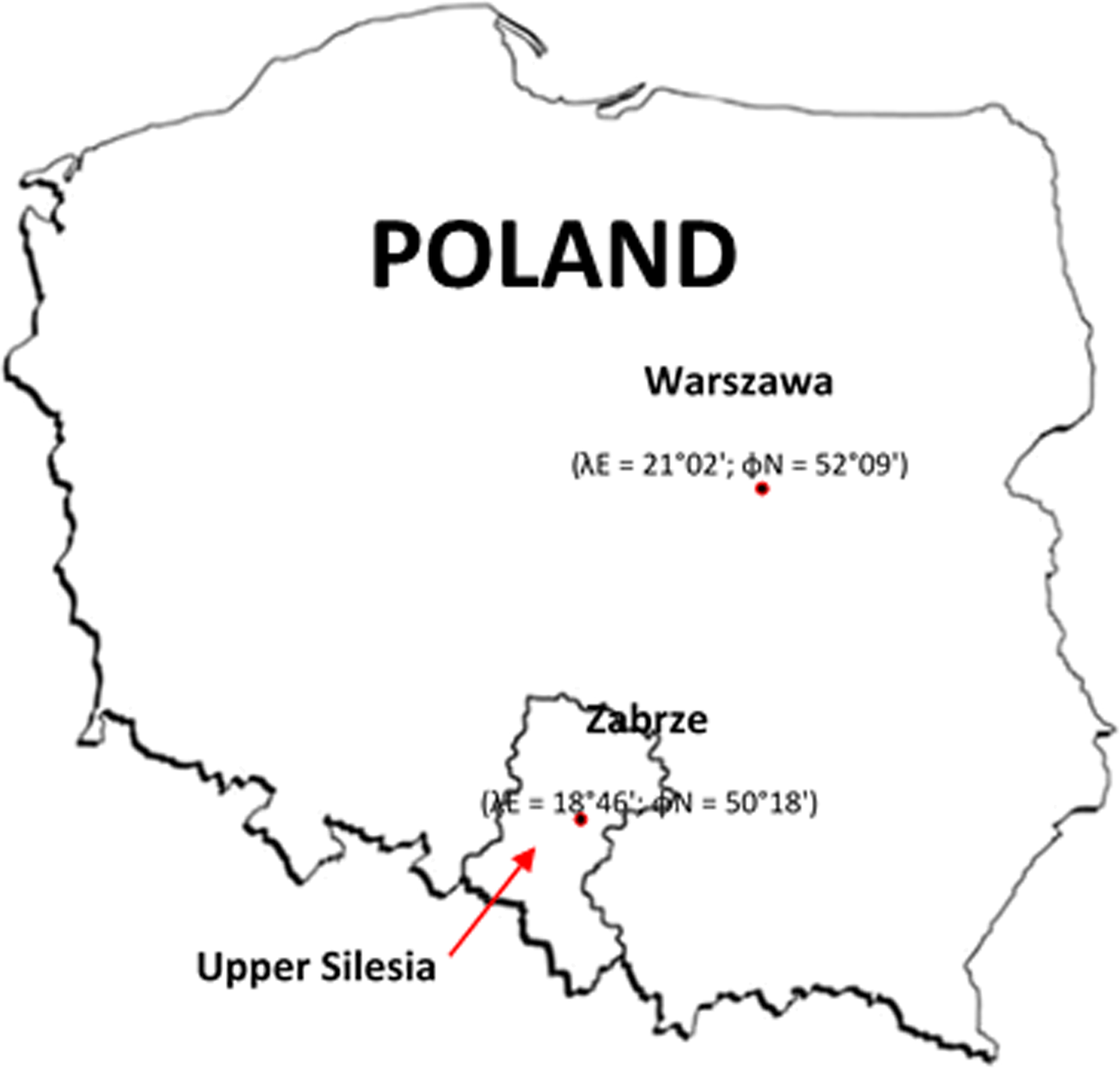
Location of sampling points.
Sample collection
Twenty-four hour PM1 samples were collected in the period from June 24, 2014 to August 22, 2014 (summer; 60 samples) and from January 8, 2015 till March 8, 2015 (winter period; 60 samples). In Poland, the period from January till March is called the heating period due to high PM emissions from burning fossil fuels in domestic stoves, while summer and spring months are those when such emission is greatly reduced.
The PM samples were taken at two sampling sites, that is, in Warsaw and Zabrze, at the same time. They were collected by means of four samplers: two TWIN DUST (Zambelli) models and two MVS (Atmoservice) models equipped with PM1 heads (four identical heads produced by TSI; PM inlet with PM1 jet impactor).
At each sampling site, samples were collected in parallel by one TWIN DUST and one MVS sampler. Samples of PM1 from one sampler were used for elemental analysis (As, Cd, Co, Cr, Ni, and Pb) and from second one for water-soluble ion determinations (SO42−, NO3−, NH4+, and Cl−). PM1 was sampled at a stable air flow rate (2.3 m3/h) onto the 47-mm quartz fiber filters (Quartz Air Sampling Filter, Grade QM-A, 47 mm circle; GE Healthcare Life Sciences Cat. No. 1851-047). A total number of 240 samples were collected.
The masses of the PM1 samples were determined by weighing the filters in a clean weighing room by means of an MYA 5.3YF microbalance (1 mg resolution, RADWAG, Radom, Poland) at a constant temperature of 20°C and relative humidity of 50% (before weighing, samples were conditioned for 48 h).
The adopted method of PM sampling and the subsequent gravimetric analysis of the PM were compliant with EN 14907/2005—standard gravimetric measurement method for the determination of the PM2.5 mass fraction of suspended PM and EN 12341/1998—Air quality-Determination of the PM10 fraction of suspended PM-reference method and field test procedure to demonstrate reference equivalence of measurement methods. The weighing accuracy, determined as three standard deviations from the means obtained from 10 weightings of a blank filter (conditioning performed every 48 h), was 16 μg.
Chemical analyses
Metal quantitative analysis was preceded by sample mineralization in a mixture of spectrally pure (Merck, Ultrapure) acids. Before mineralization, samples were flooded with 5 mL of nitric acid HNO3 (65%), 1 mL of hydrofluoric HF (40%), and 1 mL of perchloric acid HClO4 (70%). Mineralization was carried out in a microwave reaction system, Multiwave 3000 from Anton Paar, in sealed polytetrafluoroethylene PTFE vessels under pressure (mineralization furnace parameters: a pressure rise of 0.3 bar/s; 240°C; pressure 60 bar; mineralization time 50 min). PM1-bound trace metal concentrations were determined by inductively coupled plasma mass spectrometry (ICP–MS, Perkin Elmer DRC–e 6100) equipped with a dynamic reaction cell.
The operating conditions are listed below: ICP RF power: 1125 W; nebulizer gas flow rate: 0.78–0.83 L/min; auxiliary gas flow: 1.15 L/min; plasma gas flow: 15 L/min; sample flow rate: 1 mL/min. All of the samples were measured in triplicate. Certified multielement standard stock solutions Periodic table mix 1 and Transition metal mix 2 (Fluka) were used as calibration solutions.
The analytical method was validated by determination of arsenic, cadmium, cobalt, chromium, nickel, and lead in the Standard Reference Material, SRM 1648a, (urban particulate matter), obtained from the National Institute of Standard and Technology (NIST). The obtained results were corrected by the mean concentrations of metals in blank samples (nonexposed filters). Recovery rates were as follows: As (80%); Cd (83%); Co (113%); Cr (127%) Ni (118%); and Pb (90%). These indicate good agreement between the certified and measured values. High recovery of Cr could be due to the formation of chloride-based polyatomic species (from HClO4 added for digestion), which is known to interfere with the determination of trace levels of chromium (Ma and Tanner, 2008).
Ion content of PM1 was determined using an ion chromatograph (Metrohm AG, Herisau, Switzerland), in accordance with the methodology described in Rogula-Kozłowska et al. (2013c). Each filter was placed in the ROTH extraction container. In the following step, 25 mL of deionized water (Millipore) was added to each container and the containers were tightly capped to prevent leaking during the extraction. Extracts were then placed in an ultrasonic bath (60 min) at a temperature not exceeding 15°C. Then, the extraction containers were placed in a vortex mixer and shaken overnight at about 18°C and 60 cycles per minute. Extracts were then filtered through a CRONUS microporous filter with a PES membrane with a porosity of 0.2 μm.
The ion content in the extracts was determined using Metrohm ion chromatograph (Metrohm Herisau AG, Switzerland), equipped with 818 IC pump, 819 IC detector, 837 IC eluent degasser, 830 IC interface, 820 IC separation center, and Metrodata 2.3 programme. The method was previously validated on the basis of certified reference material (CRM Fluka products Nos. 89316 and 89886), the standard recovery ranged from 92% to 109%. Detection limits were at the level of 0.09 μg/m3 for NH4+, 0.022 μg/m3 for Cl−, and 0.03 μg/m3 for SO42− and NO3−.
Data preparation
Daily data on the PM1 concentrations and PM1-bound metals, as well as PM1-bound water-soluble ions, obtained in each location, were divided into two sets: data from the summer period and the data from the winter period; for both periods, the average data are presented in Table 2. Mean concentrations of PM species were calculated as averages weighted by rainfall amount following Equation (1).
ni—number of days
rain amount—rain amount in the following days
concentration—species concentration in the following days
To check for significant differences in concentrations of PM and PM species between rainfall and nonrainfall periods, a Student's t-test was performed. Test statistic follows a Student's t distribution, concerning both normal distribution and homogeneity of variances. All statistical analyses were performed in statistical package, Statistica 10 (StatSoft). Throughout the study, a p-value of <0.05 was considered to indicate statistical significance.
Next, the data within the summer and winter period were divided into five classification sets, according to the rainfall duration in the day in which they were sampled. Data on the daily precipitation sum and duration were recorded by the national meteorological stations, operated by the Institute of Meteorology and Water Management (IMGW; www.imgw.pl). To examine the time-dependent weathering pattern, the data were divided into those that came from days when (1) there was no precipitation (nonfall); (2) the precipitation lasted longer than 0.1 h, but less than 2 h (>0.1 h); (3) the precipitation lasted from 2 to 6 h (>2 h); (4) from 6 to 8 h (>6 h); and (5) more than 8 h per day (>8 h). The PM1 and PM1-bound metal concentrations were averaged for each of the five sets and illustrated in Fig. 2.
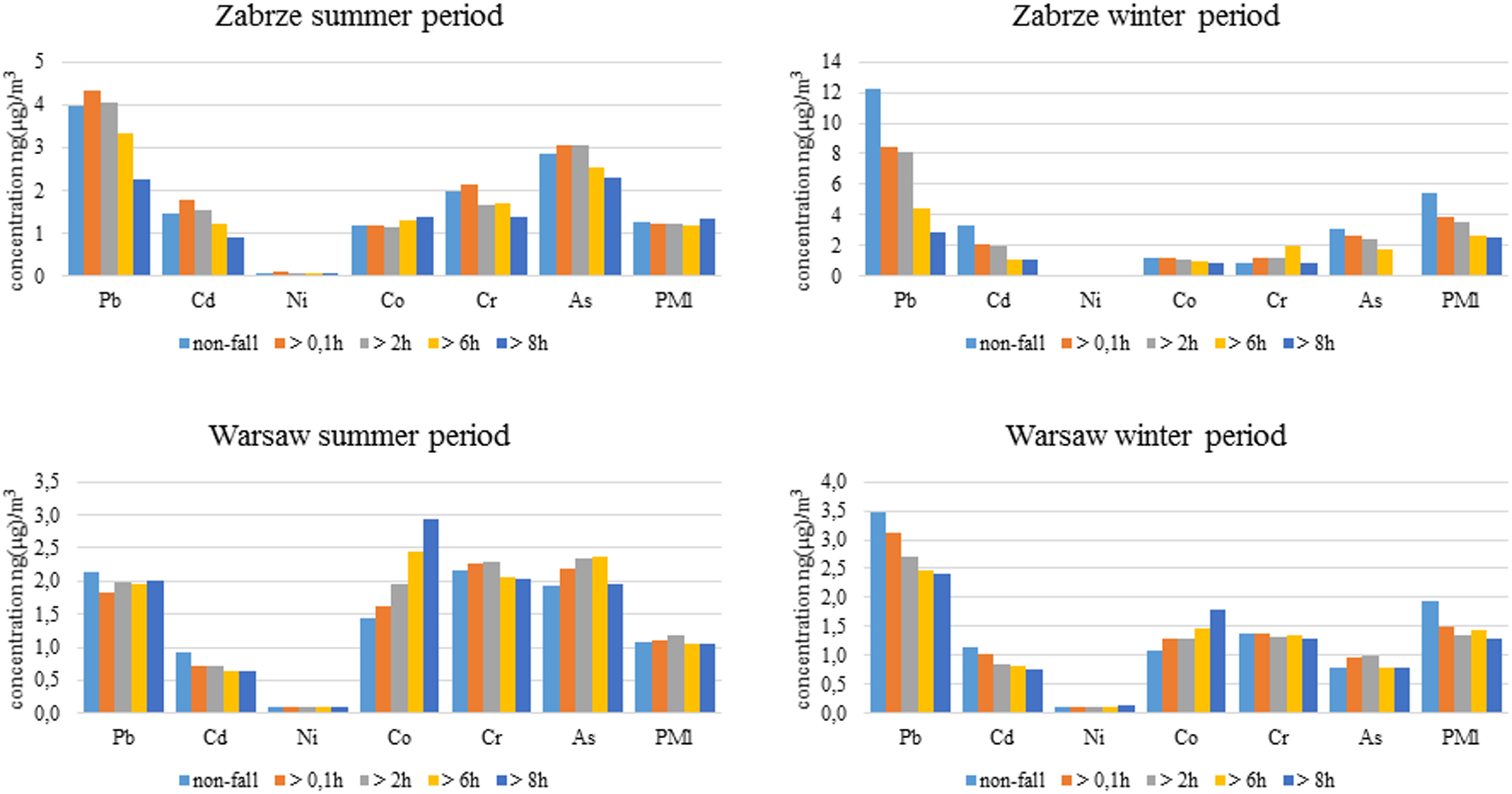
Time-dependent weathering pattern of PM1 and PM1-bound elements (bars represent the average concentrations of those pollutants in days when rain lasted 0.1, 2, 6, and 8 h and during nonfall events). Concentration units are 0.1 μg/m3 for PM1 and Pb and ng/m3 for Cd, Ni, Co, Cr, and As.
The IMGW base also provided data on total precipitation (rain, snow, hail) on each day in the period from January 2005 to December 2014 (Supplementary Tables S1 and S2) and also the data for precipitation intensity calculations (Supplementary Table S3). Data obtained during observation in 2004–2015 were roughly grouped by season in the following way: the summer period was defined as April 1 to September 30, while winter period as October 1 to March 30. This long-term meteorological data were applied to simply characterize the precipitation conditions at both sampling sites (Supplementary Table S1) and to estimate the average number of days with and without precipitation in a one calendar year (Supplementary Table S2), which were further used to quantify inhalation risks independently for dry and fall periods.
Exposure scenario and cancer risk assessment approach
The average concentration of airborne metals and ions in dry and fall periods (independently for summer and winter period) was calculated on the basis of precipitation amount and duration (Supplementary Table S2). These concentrations were used to calculate the average dose of metals inhaled by the inhabitants of Warsaw and Zabrze cities during the dry and fall events.
The aforementioned dose was approximated by the life span of a potential resident of interesting area. In the calculations, the following assumptions were made: (1) the rainy days are those in which the precipitation occurred (the sum of daily precipitation ≥0.1 mm); (2) the period 2004–2015 is treated as a representative for the hypothetical inhabitant's life span; (3) the wet deposition is the only mechanism for the metal removal from the atmosphere (Paramonov et al., 2011); (4) during 2004–2015, metals were removed from the atmosphere with the same efficiency as in the period when the PM1 samples were collected.
On average, during one calendar year, in Warsaw, there are 146 days with precipitation, and 219 without precipitation; while in Zabrze, 154 days with precipitation and 211 days without precipitation (Supplementary Table S2). This means that the average life span for which the hypothetical inhabitant of Warsaw and Zabrze is exposed to the air present with metal concentrations, typical for dry periods, equals, respectively, 60% and 58% of its duration. During the remaining time, the size of inhalation exposure corresponds to the wet period concentrations. The obtained values were used in the risk analysis.
Quantitative assessment of cancer risk was carried out based on US EPA recommendations in line with a deterministic approach [Eq. (2)] (RAGS, 1989). The risk was calculated as a sum of lifelong exposures to metal doses (equal to its airborne concentration) referred to the exposure time and multiplied by inhalation cancer slope factor (CSFi). The calculations were performed for a hypothetical adult resident of Zabrze and Warsaw population, whose life span is 73 years (the average life expectancy for men in Poland).
where Ri—individual lifetime cancer risk (ILCR) resulting from an exposure to i-th metal; C—average airborne metal concentration, ng/m3; ET—exposure time, 24 h/day; EF—exposure frequency, 365 d/yr; ED—exposure duration, yr (for ED the most conservative assumption was used that exposure duration is equal to the life expectancy—73 years human life span), the AT—average time was modeled as AT = 73 × 365, days (GUS, 2015); IR—inhalation rate for adults (the average 95% UCL of IR in the age range 21 years to <81 years is 20.64 m3/day) (US EPA, 2011); BW—body weight (the average 95% UCL of BW in the age range 21 years–<81 years is 70 kg (US EPA, 2011); cf—conversion factor (10−6) (mg/ng); CSFi—slope factor for i-th metal (kg·[day/mg]).
Inhalation Unit Risk multiplication: IUR (μg/m3)−1 × 1000 (μg/mg) × (BW [kg]/IR [m3/day]) was necessary to convert IUR to CSF ([mg/kg]·day)−1 (RAGS, 1989), gdzie: IUR—Inhalation Unit Risk, the amount of additional cancer risk (μg/m3)−1 (Table 1).
International Agency for Research on Cancer (IARC). Monographs on the Evaluation of Carcinogenic Risks to Humans. Available at: http://monographs.iarc.fr/ENG/Classification/index.php (accessed March 21, 2016).
Results and Discussion
Effect of precipitation on PM1 and PM1-bound metal concentration
It was shown that the atmospheric concentration of submicron PM, PM1, and PM1-bound metals was a function of both seasonal and site-specific precipitation characteristics (Table 2). The average 24-h concentration of the PM1, throughout the period of research, reached 28.43 μg/m3 in Zabrze and 13.68 μg/m3 in Warsaw. During the winter period, those average concentrations in Zabrze reached 44.52 and 16.35 μg/m3 in Warsaw, while in summer reached 12.34 and 11.01 μg/m3, respectively. In Zabrze, more than three times higher average concentration of PM1 appears in winter compared to summer period.
Nonfall period—days with precipitation <0.1 mm.
Concentration (C) weighted by rainfall amount.
Fall period—days with precipitation ≥0.1 mm.
Calculated as the difference between average concentration in nonfall and fall period referred to the concentration in nonfall period.
The sum of the rainfall for each measuring period.
WE, washout efficiency.
This phenomenon is caused by the presence of municipal emission from domestic sources, which is due to the existence of the domestic heating systems, near-ground inversions of temperature, and probably low wind speed, which favor the enhancement of PM pollution in the atmosphere (Rogula-Kozłowska et al., 2014). In Warsaw, small differences in PM1 concentrations between summer and winter suggest that they originate mainly from the road traffic. The opposite situation is observed in southern Poland, where the highest concentrations of PM1 occur in winter periods (especially in January), strictly documenting the role of domestic sources (burning coal) in shaping this PM pollution.
In Warsaw, the majority of the households are connected to a central heating network, which significantly reduces emissions from domestic sources (Majewski and Rogula-Kozlowska, 2016). The 24-h ambient concentrations of metal in the whole measuring period could be arranged in descending order Pb>Cr>As>Co>Cd>Ni in Warsaw and in case of Zabrze, Pb>As>Cd>Co>Cr>Ni. In terms of elemental composition, the highest concentration was therefore Pb, which is in agreement with our previous works (Rogula-Kozłowska et al., 2015; Majewski and Rogula-Kozłowska, 2016). Such domination of Pb concentrations in PM samples is often observed close to power plants fueled with hard coal (Zajusz-Zubek and Mainka, 2015).
Higher concentrations of metals, as well as pronounced seasonal variations of their concentrations, occurred in Zabrze, where burning hard and brown coal in domestic furnaces (in winter) is known to be a dominant factor that negatively affects air quality (Rogula-Kozłowska et al., 2013b). In Zabrze, industry also has a clear role in shaping the fine PM-bound metal concentrations (Rogula-Kozłowska et al., 2015).
What is interesting is that the scavenging role of rainfall in the reduction of PM1 and PM1-bound element concentrations was more effective in Zabrze, characterized by much higher PM pollution compared to Warsaw, slightly higher number of rainy days (Tables 2 and Supplementary Table S2), and heavier precipitation intensity, especially in winter (Supplementary Table S3). For example, 24-h average PM1 concentration in a dry:wet period arrangement was 32.8:20.1 μg/m3 in Zabrze and 15.96:12.64 μg/m3 in Warsaw. The washout efficiency (WE) of metals from the atmosphere was generally higher in the winter period (Table 2), characterized paradoxically by a lower sum of rainfall (Table 2). However, it must be noted that this process depends not only on the rainfall amount or its intensity but also at the same time on the PM tendency for hygroscopy and overall chemical composition.
In the Zabrze sampling site, the more efficient PM1 and PM1-bound metal removal from the atmosphere, apart from the influence of the rainfall amount and intensity, should be given to the differences in chemical composition of PM, and, above all, to the presence of water soluble metal compounds, which directly determine their own washout from the atmosphere. This observation was confirmed by the differences in WE between each metal (Table 2).
Student's t-test results revealed a significant (p < 0.05) differences in PM species concentrations between rainfall and nonrainfall events (Table 3, bolded font). Higher mean concentrations in nonfall periods occurred in case of PM1, SO42−, and NH4+ in Warsaw (winter period); Cl−, SO42−, and NH4+ in Zabrze (summer period); and in case of PM1, Pb, Cd, Cl−, SO42−, and NH4+ in Zabrze (winter period). Some species such as As and nitrate (Zabrze, summer season) were higher than in the rainfall period, however, those differences were not statistically significant. Higher concentrations of As during dry periods could be justified by its occurrence in nonsoluble compounds.
Bold values indicate significant p value (p < 0.05).
t, Student's t statistics; df, degrees of freedom; p, probability level; PM, particulate matter.
While Pb and Cd are known to occur mostly in easily soluble forms, As could be possibly found predominately in insoluble and therefore nonwashable fractions. This is in accordance with Zajusz-Zubek et al. (2015), who studied speciation of airborne elements collected in Silesia region (southern Poland) close to the working power plants and found that most (85%) of As bound to PM1 occur in nonmobile form. The depletion or increase in gas/ion concentration, for example, NO3−, cannot be, however, integrated with the rainfall events. Since NO3− is formed in the photochemical reactions from gaseous precursors (Ying and Kleeman, 2006), it will be subjected to an entirely different process of atmospheric washing than solid particles or metals. This suggests that NO3− creation or removal in the atmosphere may occur in complete isolation from rain events.
The greatest concentration differences between the rainy periods and nonrainy ones occurred in the case of PM1 and PM1-bound Cd and Pb (Table 2 and Fig. 2). In the case of days when precipitation lasted 8 h, the percent of PM1 air removal reached 44% in Zabrze and 22% in Warsaw. For lead and cadmium those values reached 68% and 58% (Zabrze), while for Warsaw 21% and 32%. In the case of the other elements, As, Co, Ni, and Cr, there was no significant relationship between the amount of precipitation or its duration and the washing-out effectiveness. The probable cause of this phenomenon is the occurrence of Pb and Cd in PM1 in easily soluble compounds; unlike other elements, this mainly concerns Zabrze.
The confirmation of these assumptions comes from the differences in Pb and Cd washout rates, which highly depend on the given season. The percentage difference in Pb and Cd concentrations between dry and fall periods in the winter season reached 50% (Pb) and 54% (Cd), while during the summer one 27% and 20%, respectively. Hence, during the winter time, the higher washout efficiency of the PM1-bound Pb and Cd was likely due to the dominant presence of the easily soluble forms in the PM composition, such as sulfates or nitrates (e.g., PbSO4) (Rogula-Kozłowska et al., 2013b), released to the atmosphere from the anthropogenic municipal emission and vehicle emissions (sulfates e.g., originate mostly from hard coal combustion) (Pastuszka et al., 2015).
The confirmation of these assumptions is the ambient concentrations of PM1-bound water-soluble ion results (SO42−, NO3−, NH4+, and Cl−), higher in Zabrze samples (Table 2). Our previous work indicates that fine particles collected at the Zabrze site are dominated by sulfates and nitrates, the average mass shares of which constitute even 80% of the total mass of all ions present in PM and that more than 60% of those compounds are related to the particles with an aerodynamic diameter ≤1 μm (Rogula-Kozłowska et al., 2013c).
In Warsaw where municipal emission shows a rather small impact on the final shape of the fine PM and PM-bound metal concentrations during the winter period (just like in other regions of Poland), Pb and Cd originate mostly from the power plants' hard coal combustion and still occur in chemical associations with sulfates and nitrates. The rest of the examined metals, especially during the summer period, probably occur as poorly soluble oxides, or can be enclosed in minerals, including the aluminosilicates (http://acta-arhiv.chem-soc.si/53/53-3-401.pdf). The fact that the rainfall in Zabrze, contrary to Warsaw, may be periodically characterized by the low pH (Hławiczka et al., 2009) is significant; it is well known that lower pH corresponds to higher solubility.
Time-dependent scavenging rates of PM1 and PM1-bound metals in both cities increase with the duration of precipitation and achieve their maximum in the periods lasting 8 h (Fig. 2). The executed comparison of metal concentrations in dry periods and in those days when precipitation lasted 8 h (averaged for the whole measurement period) shows that the individual PM1-bound metal removal rate unfolds in the following manner: Zabrze Pb>As>Cd>Ni>Cr>Co, and for Warsaw sampling site Cd> Pb> Cr> Ni> As> Co. This is in good agreement with the results obtained by Zajusz-Zubek et al. (2015).
After the fractionation of PM1 samples collected in the surroundings of the working power plants in Upper Silesia, those authors reported that the mobile character of PM1-bound elements decreases in the following order Sb>Cd>Pb>Mn>Se>Co>Ni>As>Cr. This was explained by the presence of Pb and Cd mostly in water-soluble fraction (39–64%), while 69–85% of Cr, Ni, As, and Co were found to occur in nonmobile compounds. The previous analysis of Rogula-Kozłowska et al. (2013a) concerning speciation of metals bound to PM2.5 collected in Zabrze also indicates that lead and cadmium were predominantly associated with exchangeable fraction (with environmental mobility of Pb equal to 49% and for Cd, 75%), while, for example, Ni was found nonmobile.
As mentioned earlier, the PM1 and metal washout effectiveness (measured by the initial ambient concentration reduction), even under conditions of ongoing precipitation >8 h, was relatively low and reached a maximum of 44%. What is interesting is that Fig. 2 shows that cobalt in the condition of rain behaves inversely than other metals and its concentration rises together with an increase in precipitation amount, which does not find a clear explanation and should be subjected to further studies. Literature data indicate that wet scavenging coefficient of fine particles with the radius of 0.1 < r < 1.0 μm is quite low, namely “Greenfield gap” (Greenfield, 1957), and much lower compared to coarse particles (Feng and Wang, 2012).
Generally, when the P3h (3-h precipitation amount) is below 1.0 mm, it has very little influence on the concentrations of all kinds of particles. In the case of fine PM1 particles, the scavenging rate (%) for continuous rainfall lasting 3 h (≥10.0 mm) is about 5%, while in the case of shower rainfall, this rate increases to 20% (Feng and Wang, 2012). Another study of Garcia et al. (1994) illustrates that when compared to the initial volume of respirable dust (before rain), it remains at 60% after 12 h of drizzle (0.5 mm/h) or 1 h of heavy rain (25 mm/h). Finest particles such as PM1 are therefore efficiently removed from the atmosphere mostly by heavy rain and thunderstorms, which are relatively rare in the Polish climate.
The presented results clearly show that the most common form of precipitation at both sampling sites is rains characterized by the small sums of daily rainfall amounting to <1 mm per day, and moderate rains in the range between 2.1 and 5 mm per day (Supplementary Table S2), with relatively small intensities of 0.24–7.16 mm/h (Supplementary Table S3). The storm rains occur only in summer, usually in May, July, and August, which is well presented in Supplementary Table S1 as the standard deviation values of monthly precipitation amounts and the associated variation coefficients. Therefore, the precipitation conditions in Zabrze and Warsaw do not probably allow for an effective PM1 removal from the atmosphere.
Risk analyses
Results from risk analyses have shown that the risk strictly depends on the amount of rainfall events. The aggregate health hazards induced by the sum of metals in wet period were 5.65 × 10⁻⁵ in Zabrze and 5.00 × 10⁻⁵ in Warsaw, while during dry periods those risks were 33–37% greater and reached 8.04 × 10⁻⁵ and 7.97 × 10⁻⁵, respectively. Hence, dry periods yield an additional risk of cancers. The number of lung cancer cases attributed to PM1 inhalation was higher than the acceptable risk level of 10−6 established by the United States Environmental Protection Agency, indicating unacceptable potential risks.
The total incremental lifetime cancer risk did not change significantly among Warsaw and Zabrze populations. For Warsaw population, this risk was 1.3 × 10⁻⁴ and slightly lower compared to health hazards calculated for Zabrze residents (1.41 × 10⁻⁴). However, the cancer risk contribution was much differentiated among single metals (Table 4) and mainly dominated by Cr, which poses the highest toxicity among other carcinogenic metals. This result is, however, burdened by the assumption that the mass percentage of Cr(VI) in total Cris is 26% (https://www.researchgate.net/publication/303394578_Cancer_risk_from_arsenic_and_chromium_species_bound_to_PM25_and_PM1_-_Polish_case_study). Even though the assessments of the carcinogenic risks are uncertain because the health risks are evaluated based on a number of assumptions and estimates, including the types of parameters (ED, EF, IUR, etc.), our assessment still offers a valuable evaluation of the health risks associated with the exposure to PM1-bound metals.
ILCR, individual lifetime cancer risk.
Too small data resolution (metal concentrations and time-related rainfall data presented as days and not e.g., hours), as well as relatively short measurement/sampling periods, does not allow for a reliable assessment of metal concentration dynamics and associated inhalation risk and therefore for the determination of functional relationship between its amount and precipitation intensity. Although a decline of the metal concentrations was primarily visible during the winter season and under condition of greater rainfall amounts, those factors cannot be considered as the only determinants of air quality in absolute terms.
Evaluation of a possible association between rainfall and metal-induced cancer risk showed that an increase in rainfall was associated with a decrease in metal concentrations and therefore health risk. However, to mathematically identify to which extent rainfall contributes to decreased inhalation risk, a more detailed analysis will be necessary. Such exploration will require data of higher resolution (e.g., hourly data).
Conclusions
There have been relatively few studies on detailed quantitative evaluation of fine PM removal and its compounds by atmospheric precipitation in terms of health risks (Garcia et al., 1994; D'Amato et al., 2014; Ikeuchi et al., 2015). It is mainly because the precipitation washout effect of PM1 in each rainfall event is difficult to be measured properly and correlated with specific short-term health effect. However, as clearly shown in this study, the efficiency of PM1-bound metal removal from the atmosphere by wet scavenging is affected not only by the duration and intensity of the rainfall but also to a greater extent by chemical speciation of PM-bound metal compounds.
Comparison of metal wet scavenging shows clearly that among tested carcinogenic metals, PM1-bound lead and cadmium are washed out from the air the fastest and in the largest quantities. Their greater solubility causes a great problem, as those metals pose a major concern for the water and soil environment. It is worth mentioning that the influence of precipitation on metal concentrations and associated health risk is difficult to be clearly explained, as this phenomenon is strictly connected with a number of complex interconnections.
The performed calculations are in some way lacking, as they do not take into account the metal removal efficiency by means of dry deposition and do not consider other limitations resulting, for example, from metrological conditions, such as wind velocity. However, the results from risk analysis show the importance of wet scavenging incorporation into health hazard calculations. Tracking different weather events and their impact on PM1 and associated metal concentration is essential for a full understanding of the urban air pollution situation, as well as for the reasonable preventive countermeasure determination.
Footnotes
Acknowledgment
The work was financed within the project of the National Science Centre No. 2012/07/D/ST10/02895.
Author Disclosure Statement
No competing financial interests exist.
References
Supplementary Material
Please find the following supplemental material available below.
For Open Access articles published under a Creative Commons License, all supplemental material carries the same license as the article it is associated with.
For non-Open Access articles published, all supplemental material carries a non-exclusive license, and permission requests for re-use of supplemental material or any part of supplemental material shall be sent directly to the copyright owner as specified in the copyright notice associated with the article.
