




Abstract
Abstract
Extraction of arsenic (As) from adsorbed (ad) and coprecipitated (cpt) As-Fe(OH)3, As-Fe3O4 using phosphate buffer, sodium hydroxide (NaOH), hydrochloric acid (HCl), and oxalate buffer was studied. In addition, the effects of the solution concentrations, sample drying, aging time, and goethite and fresh As-Fe(OH)3 (cpt) mixture on the extraction efficiencies of As were investigated. For fresh As-Fe(OH)3 (ad) and As-Fe(OH)3 (cpt), 100% of the As was extracted by either 1 mol/L (M) phosphate (pH 5.0) or 0.5 M NaOH. Lower As recoveries from As-Fe(OH)3 associations were obtained by lower concentrations of phosphate (pH 5.0, 0.05 and 0.1 M) and NaOH (0.1 M). Drying and aging of the As-Fe (hydr)oxide associations significantly inhibited the extraction ratio and rate of adsorbed and coprecipitated As relative to fresh samples. The slow intraparticle diffusion of phosphate and arsenate in aggregated or crystalized As-bearing Fe (hydr)oxide particles is possibly the dominant cause. Due to readsorption of As onto goethite, the coexistence of goethite with fresh As-Fe(OH)3 (cpt) resulted in an incomplete release of As (∼70%) with either 1 M HCl or 0.2 M oxalate (pH 3.25). However, when a mixture of 0.1 M phosphate and 1 M HCl was used, 100% of the As was recovered, indicating that the addition of a small amount of phosphate into the HCl or oxalate solutions is helpful to completely extract all of the As coprecipitated with amorphous Fe (hydr)oxides.
Introduction
L
Iron (hydr)oxide minerals (such as ferrihydrite, Fe3O4, and goethite) are generally recognized as dominant arsenate carriers in oxic and suboxic environments due to their strong binding affinities for As (Ona-Nguema et al., 2005; Gimenez et al., 2007). Arsenic, predominately in the form of arsenate, is usually adsorbed on Fe (hydr)oxides by bidentate binuclear complexation with surface iron polyhedral (Waychunas et al., 1993). As from the aqueous phase was removed using Fe (hydr)oxides according to two main mechanisms of adsorption and coprecipitation. In the former process, As is adsorbed on the mineral surface. However, in the latter process, As is incorporated into the bulk structure of the particles and adsorbed on their surface simultaneously (Fulghum et al., 1988). Due to encapsulation by Fe (hydr)oxides, As coprecipitated with iron (hydr)oxides is hypothesized to be more stable than As adsorbed on iron (hydr)oxides. The coprecipitation of As with Fe(III) is regarded as one of the most efficient methods for removing As from nonferrous metallurgical effluents (Jia and Demopoulos, 2008; Jia et al., 2012). Arsenic associated with Fe (hydr)oxides is readily released into the aqueous phase by physical–chemical processes, such as ionic competition, As reduction, and the reductive dissolution of Fe (hydr)oxides (Van Geen et al., 2004; Erbs et al., 2010). Therefore, a reasonable method for separating arsenate associated with Fe (hydr)oxides is crucial to understand the geochemical behavior of As in the environment.
Chemical extraction has been widely used to investigate operationally defined speciation and the bioavailability of As in soils and/or sediments, including Fe oxide minerals, due to its operability and sufficient sensitivity (Fedotov et al., 2005; Keimowitz et al., 2005; Beak et al., 2006; Niazi et al., 2011; Wang et al., 2012). From the last 30-year literatures, it seems that identifying “accurate” elemental speciation in soil/sediment is quite an impossible goal for chemical extraction (Bacon and Davidson, 2008). In the past few decades, great efforts have been conducted to optimize chemical extraction methods that are suitable for quantifying solid As species in solid phase (Keon et al., 2001; Hudson-Edwards et al., 2004; Huang and Kretzschmar, 2010). Due to the complexity of natural matrix (soils and sediments), it is difficult to distinguish the influence of extraction parameters, including solution type, solution concentration, pH, extraction time, and temperature, on the extraction efficiency (Hudson-Edwards et al., 2004; Bacon and Davidson, 2008; Wang and Mulligan, 2008). Although the synthetic minerals may have different behaviors of minerals in soil/sediment, they have been widely used to discover their geochemical fate in the environment. Therefore, the use of synthetic minerals provides a reasonable path to develop a chemical extraction method by eliminating potential uncertainties from natural matrix. For instance, Keon et al. (2001) validated the recovery of specific As species from sediments by adding individual synthetic As-bearing minerals into subsamples. Mihaljevic et al. (2003) compared the different chemical extraction methods for simple mineral mixtures containing calcium arsenate, As-bearing goethite, and arsenopyrite. Recently, Huang and Kretzschmar (2010) performed serial validation tests to examine the recovery of different As species and standardize the extraction conditions of each procedure by using synthetic As-bearing minerals. However, very few comparison experiments for extraction parameters of arsenate associated with Fe (oxy)hydroxides have been conducted.
In this study, we tested the extraction efficiencies of phosphate buffer, NaOH, HCl, and oxalate buffer for extraction of arsenate from As adsorbed on Fe(OH)3 [As-Fe(OH)3 (ad)], As coprecipitated with Fe(OH)3 [As-Fe(OH)3 (cpt)], As adsorbed on Fe3O4 [As-Fe3O4 (ad)], and As coprecipitated with Fe3O4 [As-Fe3O4 (cpt)]. In addition, the effects of solution concentrations and various forms of the As-containing media on As release were studied. The media properties depended on drying, aging, and As present as a result of an adsorption or coprecipitation reaction. The aim of this work is to (1) investigate the extraction of arsenate from a simple As-bearing Fe (oxy)hydroxide system under high concentration of extractants and different treatments of samples and (2) to provide a reference for preventing incomplete extraction of arsenate from complex natural matrix (e.g., soils and sediments).
Materials and Methods
Reagents and equipments
Ferric nitrate [Fe(NO3)3·9H2O], ferric chloride (FeCl3·6H2O), ferrous chloride (FeCl2·4H2O), HCl (37%, w/v), NaOH, sodium dihydrogen phosphate (NaH2PO4·H2O), sodium oxalate (Na2C2O4), oxalic acid (H2C2O4·H2O), ascorbic acid (C6H8O6), and sodium arsenate (Na3AsO4·12H2O) were used to prepare the extractants and As-bearing Fe (hydr)oxides. All reagents in this study were of analytical grade without further purification. Deionized water (DIW) was used for all the experiments. All glass ware and polyethylene vessels were carefully cleaned by soaking overnight in 5% HNO3 solution and rinsed thrice with DIW before use.
The equipments that were used for the extraction experiments and the synthesis of the As-bearing compounds included an air-bath rotation shaker, a water-bath rotation shaker, pH meters, pipettes, mechanical stirrers, a vacuum drier, and a freeze drier (ALPHA 1-2/LD).
Synthesis of As-Fe(OH)3 (ad), As-Fe(OH)3 (cpt), As-Fe3O4 (ad), As-Fe3O4 (cpt), goethite, and As-goethite (cpt)
Fe(OH)3 was synthesized by a procedure described previously (Grundl and Delwiche, 1993; Hering et al., 1996; Schwertmann and Cornell, 2000). Briefly, 0.1 mole of FeCl3·6H2O was dissolved into 500 mL of DIW. The pH of the solution was rapidly raised to ∼7.5 using 330 mL of 1 mol/L (M) NaOH with the slurry vigorously mechanically agitated at room temperature and homogenized at this pH for 1 h. This slurry was centrifuged and washed thrice with DIW and resuspended in DIW for adsorption. For As-Fe(OH)3 (ad), the slurry was allowed to equilibrate for 1 h. A Na3AsO4 solution at the same pH was added from a burette in 10 min with mechanical stirring according to Fe/As molar ratios of 50 or 100. The system was controlled at constant pH by addition of NaOH solution and allowed to equilibrate for 24 h (Jia et al., 2006).
Fe3O4 was synthesized using the modified method adapted from Iida et al. (2007). The whole experiments involving Fe3O4 were performed in serum bottles under the protection of high-purity N2 and deoxygenated DIW was used. A Fe(III) and Fe(II) mixed solution at a Fe(III)/Fe(II) molar ratio of 2 was prepared by dissolving FeCl3·6H2O and FeCl2·4H2O into deoxygenated DIW. This solution was quickly titrated to pH 9–10 using 1 M NaOH under magnetic stirring and then the black slurry was formed. The slurry was filtered, washed thrice using DIW, and then resuspended in DIW at pH 9–10 by NaOH. For As-Fe3O4 (ad), a Na3AsO4 solution at pH 9–10 was added into the above-mentioned slurry at Fe/As molar ratios of 50 or 100 with moderate magnetic stirring (Wang et al., 2011). The synthesis of As-Fe(OH)3 (cpt) and As-Fe3O4 (cpt) was similar to As-Fe(OH)3 (ad) and As-Fe3O4 (ad), respectively. However, the sodium arsenate solution was introduced into the Fe solution at Fe/As molar ratios of 50 or 100 before the desired pH adjustment for the synthesis of As-Fe(OH)3 (cpt) (Jia and Demopoulos, 2008) and As-Fe3O4 (cpt) by a method similar to that of Wang et al. (2008). After stabilizing for 24 h (the pH values were monitored and adjusted regularly), each slurry was diluted to a volume of 1 L with DIW before dividing into three equal parts during rigorous agitation. One aliquot represented freshly produced As-bearing Fe (hydr)oxides, while the other two aliquots were placed in sealed bottles and aged for 90 or 180 days at room temperature in the dark. During aging, the aqueous As and Fe concentrations were randomly monitored. The results (data not shown) showed that the aqueous As and Fe concentrations were <1% of the total As and Fe that were added to the mixtures. At different aging time (0, 90, and 180 days), each As-bearing Fe(OH)3 or Fe3O4 slurry was divided into two parts. One part was centrifuged and washed with DIW thrice to remove any electrolyte before freeze-drying. The resulting solids were used for elemental and XRD analysis. The other part was directly used for the chemical extractions.
Goethite was synthesized according to the previous method (Schwertmann and Cornell, 2000). One hundred eighty milliliters of 5 M NaOH solution was added to 100 mL of 1 M Fe(NO3)3 solution in a 2-L Teflon flask during vigorous agitation. The red-brown two-line ferrihydrite suspension was diluted to 2 L with DIW. Next, the flask was heated in an oven at 70°C for 60 h. For the synthesis of As-goethite (cpt) (Pedersen et al., 2006), a sodium arsenate solution and a 1 M Fe(NO)3 solution were mixed into a 2-L Teflon flask at an Fe/As molar ratio of 300. Then, 180 mL of 5 M NaOH solution was introduced into the mixture to produce Fe-As coprecipitate. After that, the suspension was diluted to 2 L with DIW and heated in an oven at 70°C for 60 h. After cooling to room temperature, an aliquot of the supernatant was filtered through a 0.22 μm membrane. Total Fe and As concentrations in the filtrates were measured to determine the As and Fe distribution between the aqueous and solid phases. Approximately, two third of the added As remained in the aqueous phase, while the dissolved Fe was negligible. Thus, the Fe/As molar ratio in the resulting As-goethite (cpt) was ∼1,000. The goethite and As-goethite (cpt) solids were separated by centrifugation and were washed with DIW thrice to remove the electrolytes. Next, the solids were freeze-dried and milled to destroy large aggregations before further elemental analysis, XRD characterization, and chemical extraction.
The XRD spectra of the synthetic As-bearing compounds indicated that the obtained samples were two-line ferrihydrite [Fe(OH)3] (Supplementary Fig. S1a), magnetite (Fe3O4) (Supplementary Fig. S1b), and goethite (Supplementary Fig. S1c), respectively.
Chemical extraction
All chemical extractions were conducted in clean glass conical flasks. For the wet samples, 5 mL of suspension and 95 mL of solution were mixed together. For the dry samples, ∼0.1 g of solid was added to flasks with various solution volumes. The relative extraction parameters were introduced in Supplementary Table S1. All extractions were conducted while rotating at 170 rpm in the dark and at room temperature in an air-bath rotary shaker. During rotation, aliquots of the slurries were collected and filtered through a 0.22-μm membrane at specified intervals. Triplicate suspension or solid samples were digested with 6 M HCl to measure the total As and Fe concentrations in the synthetic compounds. After acidification to 1% with concentrated HNO3 or HCl, all filtrates were preserved in a refrigerator at 4°C until further Fe and As analysis. Duplicate or triplicate experiments were conducted to ensure the reproducibility of the results, and the relative standard deviation was <5%.
Elemental analysis
Approximately, 0.05 mL of the samples before and after chemical extraction in the filtrates were prereduced with 5% ascorbic acid and 5% thiourea solution for at least 8 h and then the total As concentrations were measured using a hydride generation-atomic fluorescence spectrometer (HG-AFS; Haiguang, Beijing, China) with the detection limit of 0.1 μg/L. The total Fe concentrations in the filtrates were determined with a flame atomic absorption spectrometer (FAAS, Varian AA-240) that has a detection limit of 0.2 mg/L. In this study, recovery data for As and Fe are given as percentages (%).
Scanning electron microscopy analysis
Individual air-dried As-Fe(OH)3 (ad) grain extracted by 1 M phosphate solution (pH = 5) for 24 h was fixed in resin and polished until its cross section was exposed. Then, the section of grain was analyzed using a scanning electron microscope (Quanta™ 250; FEI) in low vacuum at an accelerated voltage of 20 kV. Elemental abundances of C, O, As, P, and Fe were measured with the energy-dispersive X-ray spectroscopy system (EDX) attached to the microscope.
Results and Discussion
Solution concentrations
Appropriate solution concentrations play an important role in unambiguously separating different As species associated with Fe (hydr)oxides. However, for same species of As, variable solution concentrations were used according to previously developed methods (Hudson-Edwards et al., 2004). For example, the phosphate solution that was used for extracting exchangeable As ranged from 28 μM to 1 M among the previous methods (Wenzel et al., 2001; Mihaljevic et al., 2009; Huang and Kretzschmar, 2010). To determine the impact of solution concentrations on extraction efficiencies, differences of phosphate (pH 5), NaOH, HCl, and oxalate (pH 3.25) concentrations were used to extract As from freshly prepared As-Fe(hydr)oxide associations (Supplementary Table S1a).
Apparently, greater phosphate and NaOH concentrations have the stronger ability of desorbing As from As-Fe (hydr)oxide associations. Approximately, 30–40% of As was extracted from As-Fe(OH)3 (ad), As-Fe(OH)3 (cpt), and As-Fe3O4 (ad), and only 10% was extracted from As-Fe3O4 (cpt) by 0.05 and 0.1 M phosphate (Fig. 1). In addition, 0.1 M NaOH extracted ∼80% of the As from the As-Fe(OH)3 associations and 20–50% from the As-Fe3O4 associations (Fig. 1). Obviously, the exchangeable As that was adsorbed on the fresh Fe(OH)3 was not completely recovered by the relatively dilute phosphate and NaOH. These results indicated that the previous chemical extraction methods, which used 5 mM–0.1 M of phosphate solutions (Wenzel et al., 2001; Cai et al., 2002; Mihaljevic et al., 2009; Huang and Kretzschmar, 2010) and 0.1 M of NaOH (Van Herreweghe et al., 2003; Beesley et al., 2010), may underestimate the exchangeable As fraction in soils and/or sediments. Almost all the As from As-Fe(OH)3 (Supplementary Tables S2 and S3) and As-Fe3O4 (Supplementary Tables S4 and S5) associations were extracted by 0.5 M NaOH, which could dissolve 3mg/L of Fe (no more than 0.45% of total Fe) in aqueous phases.
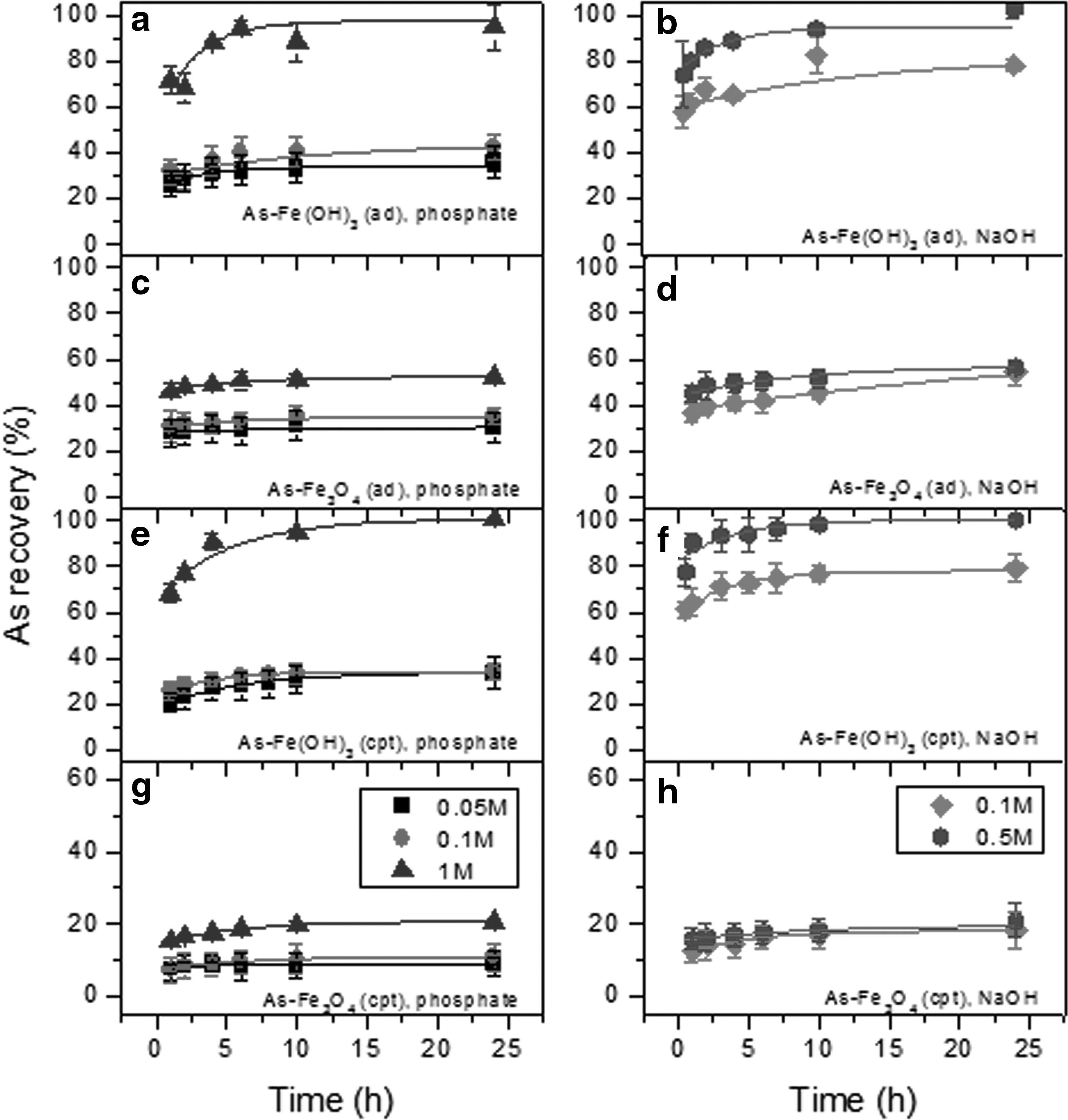
Extraction efficiencies of As from
For As coprecipitated with iron oxides, it is difficult to be extracted though anion exchange. Therefore, high concentration of HCl solutions was commonly selected as reagents to extract As coprecipitated with iron (oxy)hydroxides in soils and/or sediments completely (Keon et al., 2001; Wang and Mulligan, 2008; Huang and Kretzschmar, 2010). Because HCl and oxalate dissolve Fe (hydr)oxides based on different mechanisms (proton dissolution vs. ligand-promoted dissolution), the effects of HCl and oxalate concentrations on As release from As-Fe(OH)3 (cpt) are different. Less than 20% of As-Fe(OH)3 (cpt) was dissolved by 0.1 M HCl and negligible As was released into the aqueous phase. The release of As and Fe increased with the increasing HCl concentrations (Fig. 2a). All the As-Fe(OH)3 (cpt) was dissolved when the HCl concentration was >0.6 mol/L. For oxalate, however, the molar oxalate/Fe ratio appeared to be more influential than concentration. When the molar oxalate/Fe ratio was 6, the release of Fe and As increased with increasing oxalate concentrations. However, when the molar oxalate/Fe ratio was 12, the As-Fe(OH)3 (cpt) was completely dissolved regardless of the oxalate concentrations (Fig. 2b).

Release of As and Fe from fresh As-Fe(OH)3 (cpt) using
In addition to the molar oxalate/Fe ratio, the pH of the oxalate directly impacts the dissolution of As. For example, <80% of the Fe(OH)3 was dissolved (Fig. 2c) by oxalate at pH 5 and only a small fraction of As (< 5%) was released into the aqueous phase (Fig. 2c). However, complete dissolution of As-Fe(OH)3 (cpt) occurred when the pH of the oxalate was 3.25. The ability of oxalate to dissolve As-Fe(OH)3 (cpt) at a lower pH (pH 3.25) was obviously greater than that at a higher pH (pH 5). The impact of oxalate pH on the dissolution of Fe (hydr)oxides is explained by the complexing ability of oxalate. Fe oxides can absorb more oxalate at pH 3.25 than at pH 5, which induces stronger dissolution (Cornell and Schindler, 1987; Schwertmann, 1991).
Effect of drying
To preserve the sediment/soil samples and guarantee the reproducibility of the extraction result, the changes in their physical and chemical properties such as water content and structure, including centrifugation, freezing, drying, and milling, are often adopted before chemical extraction procedures (Wenzel et al., 2001; Van Herreweghe et al., 2003; Huang and Kretzschmar, 2010). We compared the As recoveries extracted from synthetic As-Fe(OH)3(ad) that were pretreated by freezing–melting, centrifugation, freeze-drying, vacuum-drying, and air-drying with fresh As-Fe(OH)3 (ad) suspension by using 1 M phosphate (pH = 5) (Fig. 3a and Supplementary Table S1b). Centrifugation had negligible impacts on the extraction of adsorbed As (one-way analysis of variance [ANOVA], p > 0.5) (Fig. 3a). The freezing and thawing treatment resulted in a slightly lower As recovery of ∼80%. However, all drying processes (freeze-drying, vacuum-drying, and air-drying) significantly depressed extraction of the exchangeable As (<20%) (one-way ANOVA, p < 0.01) (Fig. 3). It has been discovered that drying treatment could reduce the mobility of some metallic elements as well as arsenic in soils and sediments (Szakova et al., 2009; Vasile et al., 2010). Paul et al. (2009) suggested that sediments should not be dried before extracting As that is adsorbed on solid surfaces with phosphate solution. The aggregation of the soil/sediment particles during the drying process may be responsible for the lower As extraction efficiency. Gilbert et al. (2009) discovered that aggregation during the drying process can largely alter two-line ferrihydrite morphology and increase the proportion of higher strength binding sites. We observed that the size of dried As-sorbed Fe(OH)3 particulate increased dramatically from nanoparticulate to 0.1–2 mm. After 24 h of extraction with 1 M phosphate solution (pH = 5), the spatial distributions of As and P in an air-dried As-Fe(OH)3 particle were measured using scanning electron microscopy (SEM)-EDX. The image (Fig. 3b) showed that the percentage of As (molar) remained almost constant (4.7–5.4%) inside the particle, except in the area A (1.93%), indicating that a great amount of As(V) has been encapsulated inside the aggregations of dried ferrihydrite. However, as shown in Fig. 3b, the molar ratio of As/P increased from 1.0 at the surface layer to 2.75 at the depth of ∼150 μm. This indicated that intraparticle diffusion of phosphate and desorption of arsenate are very slow in aggregated ferrihydrite particles. The result is similar to that arsenate transported very slowly in Al hydroxide materials (Mertens et al., 2012). Hence, due to the increase of grain size, arsenate adsorbed on the surface of nanoparticulate ferrihydrite could be encapsulated inside its aggregates during the drying process, leading to the formation of internal micropores (Gilbert et al., 2009). Phosphate may diffuse little into these micropores and block the entrance (Wang and Xing, 2002), causing the lower desorption of arsenate. In addition, lower extraction efficiency may also be a result of incorporation of As into the Fe oxide crystalline structure as the solid dehydrates during drying (Das et al., 2011a).
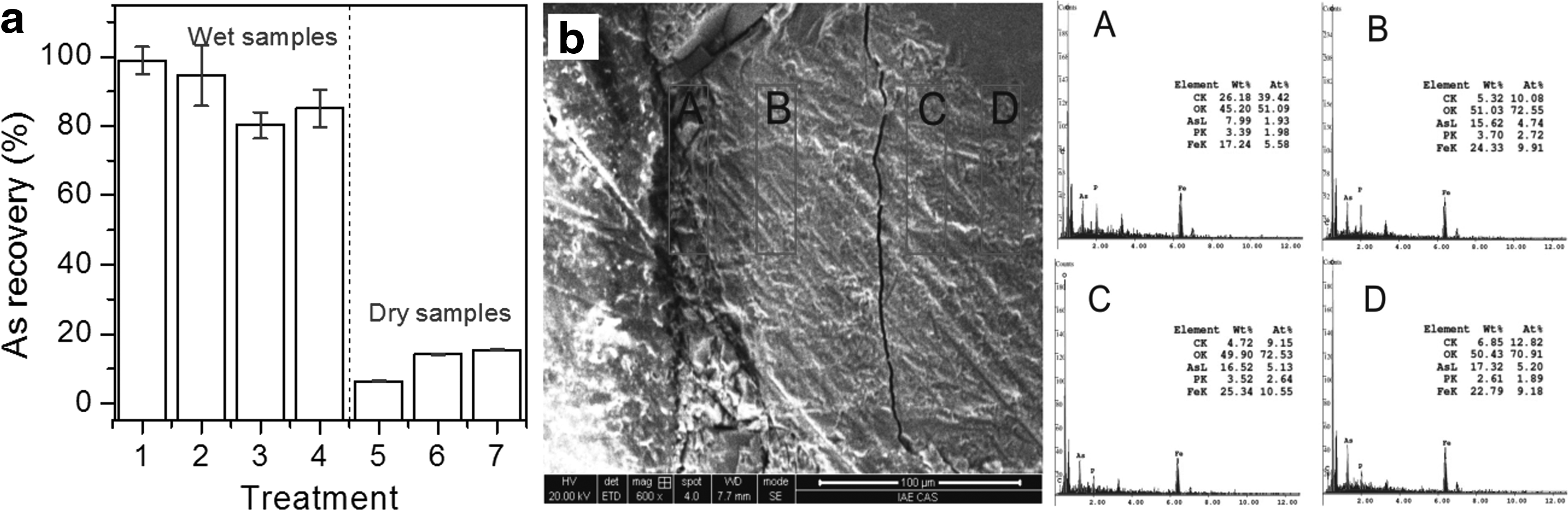
The extraction efficiency of As from As-Fe(OH)3 (ad) using 1 M phosphate (pH = 5) different pretreatments
Effect of aging
Aging is an important factor that influences mobility and bioavailability of toxic elements, including As (Tang et al., 2007; Quazi et al., 2010). Some studies found that the proportion of exchangeable As significantly decreased after an aging period (Tang et al., 2007). The recoveries of As from aged As-Fe (hydr)oxide associations extracted with 1 M phosphate (pH 5) and 0.5 M NaOH are shown (Fig. 4 and Supplementary Table S1c). In general, the results showed that the exchangeable As extracted by 1 M phosphate and 0.5 M NaOH significantly declined after 90 and 180 days of aging. However, different aging impacts were observed between the adsorbed and coprecipitated As species. Although the extractable As in As-Fe (hydr)oxides (ad) was significantly reduced, the extraction efficiencies of As between 90 and 180 days of aging were comparable (Fig. 4a–d). These results indicated that the transformation of As-Fe (hydr)oxides (ad) is fast during the first 90 days, but then slows down. However, for As-Fe (hydr)oxides (cpt), the extractable As decreased following 90 days of aging (Fig. 4e–h). This result implied that the transformation of As-Fe (hydr)oxides (cpt) can influence the release of As for longer periods of time. Previous studies demonstrated that adsorbed As can largely reduce the transformation rate of two-line ferrihydrite into more crystalline phases in acidic (Paige et al., 1997) or alkaline solutions (Das et al., 2011a). This effect may explain the relatively high percentage of exchangeable As (∼70%) that occurred in As-Fe(OH)3 (ad) after 180 days of aging. Faster Fe3O4 crystallization rate (Supplementary Fig. S1a, b) could explain why the exchangeable As fraction in the As-Fe3O4 associations was always lower than in the As-Fe(OH)3 associations. The crystallization of As-Fe3O4 associations may induce the incorporation of arsenate into the Fe3O4 crystal grid. Conversely, the greater Fe3O4 crystallinity may prevent PO43−- and OH− from reaching the adsorption sites and competing with arsenate. These processes would result in lower exchangeable As fraction in As-Fe3O4 associations.
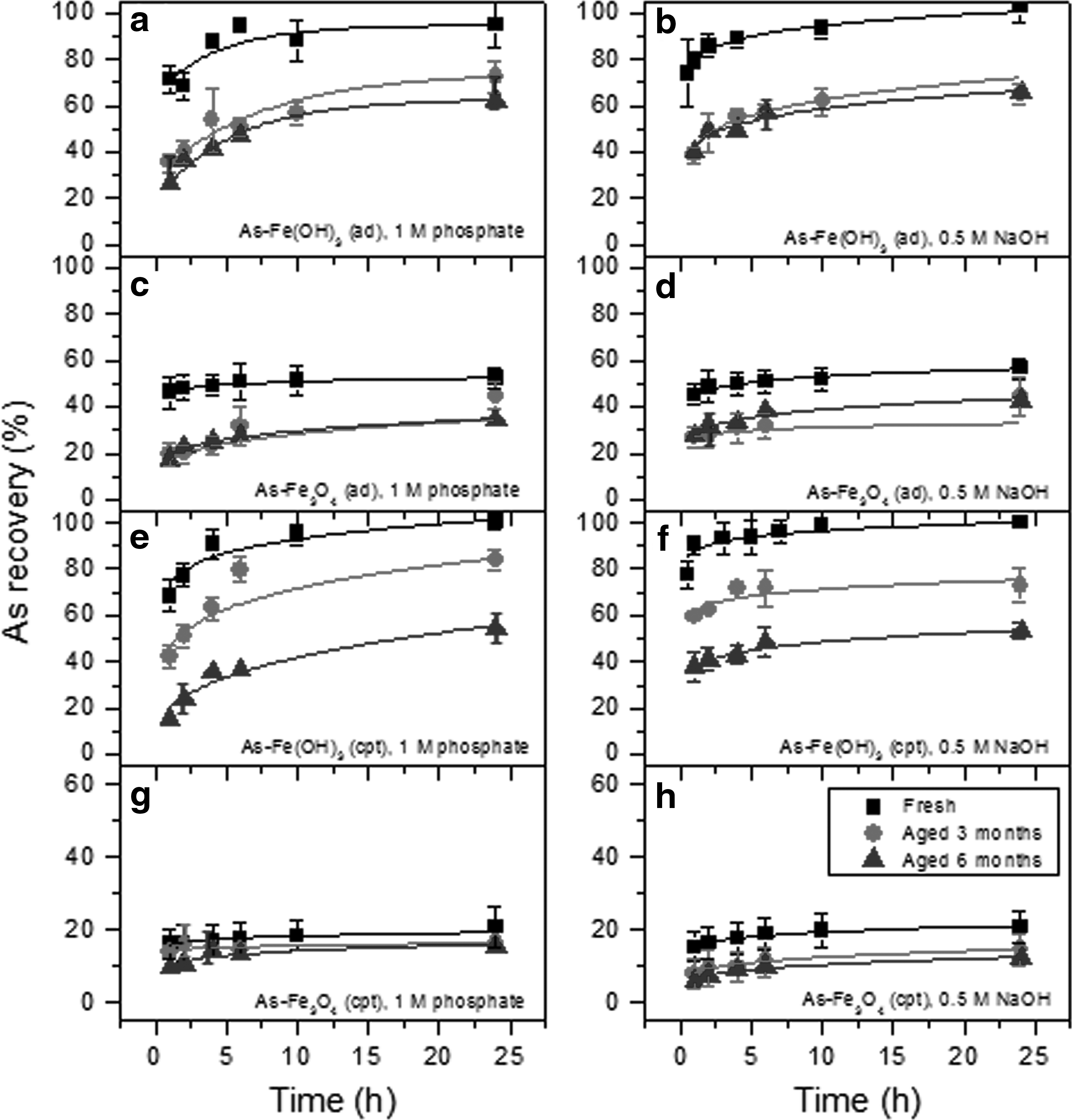
Effect of aging on extraction recoveries of As from As adsorbed on
Aged As-Fe (hydr)oxides (cpt) were dissolved with 1 M HCl and 0.2 M oxalate (pH = 3.25) to quantify the coprecipitated As fraction (Fig. 5 and Supplementary Table S1c). The results showed that aging As-Fe(OH)3 (cpt) for 90 days did not affect the release of As and Fe with both 1 M HCl and 0.2 M oxalate (pH 3.25), relative to the fresh samples (Fig. 5a–d). However, when the aging time was extended to 180 days, the release of As reached equilibrium within ∼10 h (Fig. 5a, c). After 24 h of dissolution, only ∼85% of the As was dissolved from the As-Fe(OH)3 (cpt) with 1 M HCl. However, the release of As by 0.2 M oxalate was 100%. The complete dissolution of As-Fe3O4 (cpt) that was aged for 180 days was not achieved after 24 h of dissolution with 1 M HCl (Fig. 5e, f). All of As-Fe3O4 (cpt) was dissolved within 4 h in 0.2 M oxalate (Fig. 5g, h).

Effect of aging on the release of As (left column) and Fe (right column) from
In previously established methods, 1 M HCl and 0.2 M oxalate (pH 3.25) were often used to quantify the fraction of As coprecipitated with very amorphous and amorphous Fe (hydr)oxides, respectively. Dissolution time of 1 h for 1 M HCl (Keon et al., 2001; Keimowitz et al., 2005) and <4 h for 0.2 M oxalate (Wenzel et al., 2001; Fedotov et al., 2005; Keimowitz et al., 2005) were used. However, our results showed that aging reduced the release of As that adsorbed on or coprecipitated with Fe (hydr)oxides. In addition, aging reduced the dissolution rate of Fe (hydr)oxides by HCl and oxalate. In the first hour, 1 M HCl only dissolved ∼70% of the As from the As-Fe(OH)3 (cpt) that was aged for 180 days and ∼30% and 10% of the As from the As-Fe3O4 (cpt) that was aged for 90 and 180 days, respectively. Because As-Fe(OH)3 (cpt) is still present in amorphous phase after 180 days of aging (Supplementary Fig. S1a), these results show that 1 h is not sufficient for the release of As from amorphous As-Fe(OH)3 (cpt). In addition, an extraction time of 1 h may result in uncertainty when quantifying the fraction of As that is coprecipitated with amorphous Fe (hydr)oxides with 1 M HCl. However, a dissolution time of 4 h is sufficient for the release of As from amorphous As-Fe (hydr)oxides (cpt) in 0.2 M oxalate (pH 3.25) (Fig. 5c, d, g, h).
The effect of the mixture of crystalline Fe oxyhydroxides
In natural sediments and soils, amorphous Fe (hydr)oxides can gradually transform into more thermodynamically stable phases, such as goethite (α-FeOOH) and hematite (Fe2O3) (Das et al., 2011b), which are good arsenate adsorbents (O'Reilly et al., 2001; Ona-Nguema et al., 2005). In addition, Fe concentrations are usually greater than As concentrations by 1–3 orders of magnitude in natural soils and/or sediments. Iron oxide minerals with different degrees of crystallinity can exist simultaneously. Therefore, due to their various solubilities, crystalline Fe oxyhydroxide minerals may impact the extraction of As from amorphous As-Fe (hydr)oxides (cpt). To determine the impact of crystalline Fe oxyhydroxides on the extraction of As from As-Fe (hydr)oxides (cpt), the mixture of As-Fe(OH)3 (cpt) and goethite was used to test the chemical extraction parameters (Supplementary Table S1d).
When the freshly prepared As-Fe(OH)3 (cpt) was mixed with goethite (1:1, m/m), the release of As increased from 0% to 90% in the first 2 h, and then decreased gradually to ∼70% as the dissolution time extended (Fig. 6a, b). These results indicated that the fraction of As that was coprecipitated with amorphous Fe (hydr)oxides in soils and/or sediments was potentially underestimated with either 1 M HCl or 0.2 M oxalate (pH 3.25). Ford (2002) used 0.4 M HCl to distinguish the distribution of As among Fe oxide minerals with different crystallinities and found that lower released As/Fe ratio was obtained after a period of aging. Incorporation of arsenic into more crystal Fe oxides was thought to be the cause. A solution that contained 1 M HCl and 0.1 M phosphate was used to extract As from the mixtures of freshly prepared As-Fe(OH)3 (cpt) and goethite (1:1, m/m) in this study. The addition of phosphate did not promote the dissolution of Fe (hydr)oxides (Fig. 6c). However, the recovery of As increased from 70% to 100% (Fig. 6c), which implied that the readsorption of As on the remaining goethite was significantly inhibited by the addition of phosphate. Our results indicated that the incomplete As extraction from the mixture of As-Fe(OH)3 (cpt) and goethite should be attributed to the readsorption of the released As onto the remained goethite instead of incorporation of As in to goethite grid. Thus, the lower released As/Fe ratio with 0.4 M HCl obtained by Ford (2002) may be, at least partially, attributed to readsorption of arsenic on more crystalline Fe (oxyhydr)oxides. These results suggest that a small amount of phosphate should be added to 1 M HCl and/or 0.2 M oxalate solutions for quantifying the fraction of As coprecipitated with (very) amorphous Fe (hydr)oxides in matrix containing more crystalline Fe oxide minerals.

The release of As and Fe dissolved by
Conclusions
From our study, some preliminary conclusions could be drawn as follows:
(1) The solution concentrations have a significant impact on the extraction of As. The lower phosphate (0.05 and 0.1 M) and NaOH (0.1 M) concentrations are not able to extract all the exchangeable As. (2) The proportion of exchangeable As can be greatly underestimated when samples are dried before chemical extraction (vacuum-drying, freeze-drying, and air-drying). However, the impacts of freezing–thawing cycles and centrifugation on the extraction of As were negligible. Therefore, it is important to retain the original soil and/or sediment sample moisture contents before As extraction, especially for determining the exchangeable As fraction. (3) Aging the As-Fe (hydr)oxide associations significantly reduces the As release. The release of As from aged amorphous As-Fe(OH)3(cpt) for 1 h with 1 M HCl results in a large degree of uncertainty. (4) Because the released As may be readsorbed by remaining Fe oxyhydroxide minerals, the coexistence of amorphous and crystalline Fe (hydr)oxides may lead to uncertainty with respect to the dissolution of As that is coprecipitated with amorphous Fe (hydr)oxides with 1 M HCl or 0.2 M oxalate. Thus, adding a small amount of phosphate into the solutions is recommended to prevent the readsorption of aqueous As by the remaining crystalline Fe (oxyhydr)oxide minerals.
Footnotes
Acknowledgments
This work was financially supported by the National Natural Science Foundation of China (No. 41530643) and the National Natural Science Foundation of China (Nos. 41173119, 41273133, 41303088, and 41473111).
Author Disclosure Statement
No competing financial interests exist.
References
Supplementary Material
Please find the following supplemental material available below.
For Open Access articles published under a Creative Commons License, all supplemental material carries the same license as the article it is associated with.
For non-Open Access articles published, all supplemental material carries a non-exclusive license, and permission requests for re-use of supplemental material or any part of supplemental material shall be sent directly to the copyright owner as specified in the copyright notice associated with the article.
