




Abstract
Abstract
With construction waste and straw waste as the new matrix and water dropwort as the test plant, the vertical flow wetland system was constructed. Six months after operation of the wetland, the matrix and water samples at different depths were collected to explore the spatial distribution of microorganisms and soil enzyme and the distribution characteristics of the pollutants at different depths. The results showed that the removal rate of total phosphorus, total nitrogen, ammonium nitrogen, and chemical oxygen demand (CODcr) of the sewage by the constructed wetland selected in this study reached 85.07%, 66.13%, 87.47%, and 89.54%, respectively. In the matrix at the depth of 0–40 cm, the removal of nitrogen, phosphorus, and organic matter by the constructed wetland was the most rapid. The number of microorganisms in the matrix showed an apparent stratification. The number of microorganisms in the depth of 0–20 cm was the largest, decreasing gradually with the increase of depth. The microbial biomass in the matrix showed a trend of bacteria>fungi>actinomycetes. The functional microorganisms decreased with the increase in the depth of the matrix, that is, nitrification bacteria>ammonia-oxidizing bacteria>denitrification bacteria>inorganic phosphorus bacteria. Ammonia-oxidizing bacteria and nitrification bacteria are mainly distributed in 0–40 cm. Denitrifying bacteria and inorganic phosphorus bacteria are mainly distributed in 60–80 cm. The spatial variation of soil enzyme activity was consistent with the vertical distribution of microorganisms. The soil enzyme activity has a positive correlation with the removal rate of pollutants.
Introduction
W
Constructed wetland (CW) simulates natural wetland ecosystem and purifies sewage through the synergistic effect of aquatic plants, soil, and microorganisms. At present, natural materials and artificial products are generally selected by researchers as the matrix. But such materials are prone to clogs, and thus are not suitable for extensive application especially with high cost. Therefore, appropriate candidate materials with low cost have to be found (Langergraber et al., 2004; Stefanakis et al., 2009). Slags and concrete blocks as construction waste are cheap, pollution-free, and have a better water permeability. Their recycling contributes to both environmental protection and resources saving (Chowdhury et al., 2010). Most existing research on wetland is focused on discussion on types of CW, purification efficiency of wastewater, and correlation between design and operating parameters of CW (Liikanen et al., 2004; Mander et al., 2005; Zhou et al., 2005). There are few systematic studies on the spatial distribution of microorganisms and soil enzyme activity in the matrix of CW ecosystem. With construction waste as the matrix for CW and water dropwort as the test plant, we constructed a wetland system to investigate the spatial distribution characteristics of microorganisms and soil enzyme in the matrix and the effect of their presence on the spatial distribution of pollutants. The purification effect of the wetland ecosystem on domestic wastewater was also studied.
Materials and Methods
Test wastewater
The domestic sewage in this study was selected from a residential quarter in the Institute of Environmental Protection, Ministry of Agriculture of China.
Test matrix and plant
The test matrix was the construction waste and the straw waste was collected from Tianjin, China. The test plant was water dropwort purchased from Hongyun Aquatic Flower Base in Tianjin. The water dropwort was planted on the surface of the CWs with 10–15 plants/m2.
Construction of the wetland
The wetland system constructed in this study was mainly composed of a water tank (1 × 1.5 × 1 m), wetland bed (1 × 2 × 1 m), and water discharge tank (1 × 1.5 × 1 m). The surface hydraulic load was 0.2 m3/(m2·d). The wet/dry period was 7 days, and wet/dry ratio was 3:4. The water distribution pipes were installed at 20 cm above the wetland bed. Water inflow rate was controlled by a submersible pump and a liquid flow meter. Water level was controlled by a level meter. The high water leveler and low water leveler of the system were, respectively, from the bottom of the wetland bed 40 and 85 cm.
The matrix of the wetland bed was filled with red bricks and straw. The particle size of the filler became smaller gradually from bottom to top. The straw was mainly maize straw. The surface layer was 20 cm thick, being filled with red clay bricks and straw. In this layer, particle size was <0.5 cm, whereas the ratio of weight of red clay bricks to weight of straws was 10:1. The second layer, with a thickness of 70 cm, is filled with red clay bricks with the particle size of 0.5–1 cm. The third layer, with a thickness of 5 cm, is filled with red clay bricks with the particle size of 1–3 cm. The bottom supporting layer, with the thickness of 5 cm, is filled with red clay bricks with the particle size of 3–5 cm.
Sample collection and analysis
Six months after operation of the wetland, the whole CW system tended to be stable. Water samples were collected at depths of 0–20, 20–40, 40–60, 60–80, and 80–100 cm for measuring the concentration of CODcr, TN, NH3-N, NO3-N, TP, respectively. Matrix samples were collected at depths of 0–20, 20–40, 40–60, 60–80, and 80–100 cm, respectively, with five replicates for each. The collected matrix samples were immediately stored in a refrigerator at temperature of 4°C for measurement of activity of microorganisms and soil enzyme.
The microbial population was determined according to the microbial manual of analytical methods (Xu, 1986). Nitrification bacteria, ammonia-oxidizing bacteria, denitrification bacteria, and inorganic phosphorus bacteria were determined according to the method of the most probable number (APHA, 1998). Their quantities were represented by the number of colonies per gram in wet soil. Phosphatase was measured with p-sodium phosphate and urease was measured using Nai's colorimetric method. Soil invertase activity was measured using the colorimetric method based on 3,5-dinitro salicylic acid. The water quality indicators (CODcr, TN, NH3-N, NO3-N, and TP) were measured according to the standard stated in Monitoring and Analysis Method of Water and Wastewater (Ministry of Environmental Protection of the People's Republic of China, 2002).
Data analysis
This study adopted SAS statistical software to analyze the test data (with the significance level of 5%). SPSS17.0 software was used for correlation analysis.
Results
Spatial distribution characteristics of bacteria, actinomycetes, and fungi in the matrix
Four months after operation of the wetland, there was an obvious difference among the quantities of microorganisms in the matrix, that is, bacteria>fungi>actinomycetes. The number of bacteria in the matrix was about 1 × 10⁴ times that of fungi and 1 × 10⁶ times that of actinomycetes. Bacteria occupied a dominant position in the wetland. The three types of microorganisms were influenced significantly by the depth of matrix. With the increase in the depth of matrix, the microbial biomass in the matrix decreased (Fig. 1). The number of the three types of microorganisms reached maximum at the depth of 0–20 cm and gradually reduced at the depth of 20–40 cm. The figure decreased drastically at the depth below 40 cm. The number of bacteria, fungi, and actinomycetes in the matrix showed no significant differences at the depths below 60 cm, below 40 cm, and in the range of 41–60 and 61–80 cm, respectively.
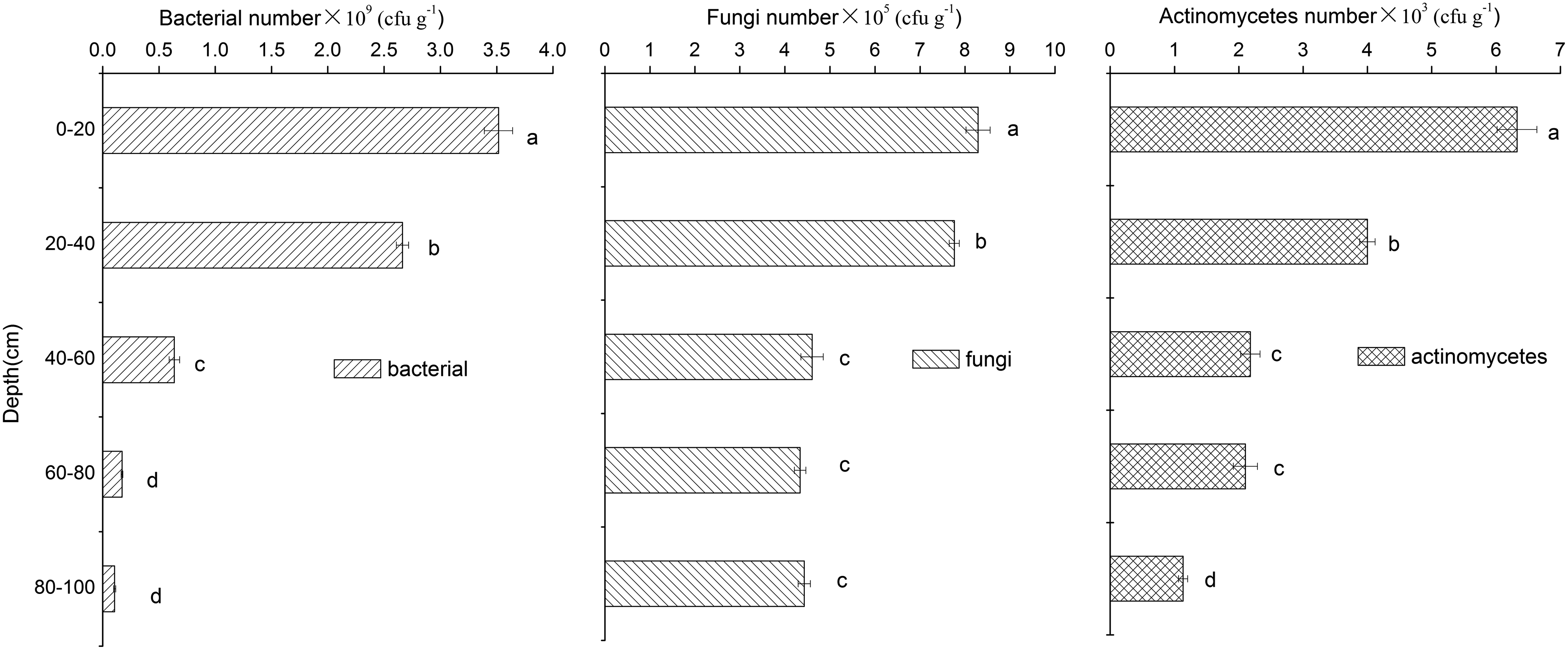
The space distribution properties of fungi, bacteria, and actinomycetes in matrix. Note: different letters in a treatment means significant difference at 5% level.
Major functional microbial species and their distribution in the matrix
Ammonia-oxidizing bacteria, nitrification bacteria, and denitrification bacteria are closely related to the removal of nitrogen element in water. The number of bacteria in the matrix of the four types of functional microorganisms selected in this study decreased with the increase in the depth of the matrix, that is, nitrification bacteria>ammonia-oxidizing bacteria>denitrification bacteria>inorganic phosphorus bacteria (Table 1). The number of bacteria in the matrix of inorganic phosphorus bacteria and denitrification bacteria exhibited no significant difference with an increase in matrix depth when depth reaches above 60 cm. The vertical distribution of bacterial population in the matrix of ammonia-oxidizing bacteria presented no significant change at a depth above 40 cm. By contrast, the population of nitrification bacteria showed a significant difference at various depths in the matrix.
Different superscript letter in a treatment means significant difference at 5% level.
Vertical variation of different enzyme activities in the matrix
The spatial variation of soil enzyme activity was consistent with the vertical distribution of microorganisms. The enzyme activity increased with the increase in the sampling depth, reaching the highest at the depth of 0–20 cm in the matrix, which was significantly higher than that in other layers (Fig. 2). At the sampling depth above 60 cm, the variation of the vertical distribution of enzyme activity was not obvious. At the depth of 0–40 cm, the distribution of plant roots was more intensive, so under the effect of plant roots, the enzyme activity in soil was significantly higher than that in other layers. The phosphatase activity in the matrix at the depth of 0–20 cm was 65.7% higher than that at the depth of 20–40 cm. When the depth of the matrix reaches 20–100 cm, the acid phosphatase activity in the top layer of the matrix was 58.5%, 43.4%, and 37.4% than that in the lower layers with every decrease in depth of 20 cm. Starting from the depth of 0–20 cm, the urease activity in the top layer was 67.9%, 58.5%, 43.4%, and 37.8% higher than that in the lower layers with every decrease in depth of 20 cm. Similarly, the sucrase activity in the top layer was 43.2%, 70.2%, 74.6%, and 5.4%, while the invertase activity was 67.9%, 42.4%, 49.6%, and 21.3%, than that in the lower layers with every decrease in depth of 20 cm.

The space distribution properties of the three enzyme activities in matrix. Note: different letters in a treatment means significant difference at 5% level.
Distribution characteristics of pollutants at different depths of water
Domestic sewage is not only rich in nitrogen and phosphorus but has also excessive chemical oxygen demand (CODcr). The content of nitrogen, phosphorus, and organic matter in the matrix decreased with the increase in the depth of the matrix (Fig. 3). At the depth of 0–40 cm, the total phosphorus and organic matter in water were removed most rapidly. The removal rates of ammonium nitrogen and total nitrogen significantly slowed down at first and then tended to be moderate at a depth of 40–60 cm. Eventually, the rates significantly slowed down again. Compared with the initial water body, the removal rate of the total phosphorus, total nitrogen, ammonium, and COD of the sewage by the CW selected in this study reached 85.07%, 66.13%, 87.47%, and 89.54%, respectively.

The effect of pollutant removal of artificial wetland on the wastewater. Note: different letters in a treatment means significant difference at 5% level.
Discussion
Plants, microorganisms, and matrix are the three inseparable key components of the CW. To evaluate the effectiveness of a wetland system for sewage purification, whether the material flow and energy flow established can function fluently should be investigated. A large number of studies have demonstrated that microorganisms are the main undertakers and drivers for the absorption and degradation of pollutants. Rich microbial resources provide adequate decomposers for wastewater treatment systems in the wetland. Functional microorganisms can decompose large amounts of organic matter in water and accelerate the transformation of nitrogen and phosphorus (Gelsomino et al., 1999; Liang et al., 2003; Faulwetter et al., 2009; Feng et al., 2012). The results of the systematic study on the spatial distribution of microorganisms in the matrix are consistent with those of the studies conducted by other scholars. The number of microorganisms in the matrix shows an apparent stratification and decreases gradually with the increase in depth (Zhou et al., 2005). The number of microorganisms affects the decontamination function of the CW (Sundberg et al., 2007). The change of the matrix is one of the main factors on distribution of microorganisms and enzymes in the CWs. At 0–20 cm, the matrix is composed of straw and bricks, which has more microorganisms and enzymes. The participation of plant roots and straw probably provides nutrients to improve the microenvironment of the wetland rhizosphere, thereby making it conducive to the growth of rhizosphere microorganisms and the activation of enzymes. However, below the 20 cm layer, the matrix is composed of different particle size bricks, it is not conducive to the growth of rhizosphere microorganisms and the soil enzyme has low activity relatively. For all types of wetland, most of the microorganisms are concentrated at the depth of 0–20 cm in the matrix (Yang et al., 2001). The pollutant concentration in the surface of the matrix is high. The organic matter and nutrient substance can stimulate the reproduction of microorganisms (Gao et al., 2010). The interactions improved the microenvironment of the root zone so as to make it advantageous for the growth of plants. The number of microorganisms in soil has an impact on soil enzyme activity and the removal efficiency of pollutants. Positive correlations exist among the three factors. Specifically, microorganisms improved the microenvironment of the matrix and promoted the interactions between plant roots and soil. The existence of functional microorganisms enhanced the decontamination function of the CW (Table 2). In this study, microbial quantity is mainly measured by the microbial plate culture method; this method is used to assess pollution effects because of its simplicity and high cost efficiency (Delille et al., 1997). However, this method exhibits limitations. For example, microorganisms are small and have simple form; as such, pure culture techniques may lead to inadequate separation and incomplete culture of some microorganisms under specific conditions, resulting in inaccurate classification of phenotypic characteristics (Pace, 1997). In this study, the microbial quantity to be measured is defined as culturable. The diversity of the microbial community structure in contaminated soil can be determined using some biochemical and molecular–biological techniques, such as phospholipid fatty acid method (Zelles, 1999), Bolog method (Derry et al., 1998), denatured gradient gel electrophoresis (DGGE) method (Muyzer, 1999), and high-throughput sequencing (Rinke et al., 2013). These methods possess inherent advantages and disadvantages. Therefore, these methods should be combined to complement with one another; this strategy can be used to avoid the inherent inevitable deviation of each method and comprehensively determines changes in the diversity of the microbial community structure and its functions.
In a treatment means significant difference at 5% level.
A, actinomycetes; B, bacteria; AN, ammonia nitrogen; AOB, ammonia-oxidizing bacteria; CODcr, chemical oxygen demand; DB, denitrifying bacteria; F, fungi; IA, invertase activites; IP, inorganic phosphobacteria; NB, nitrifying bacteria; PA, phosphatase activites; UA, urease activities; TN, total nitrogen; TP, total phosphorus.
Domestic sewage contains large amounts of high molecular organic pollutants. Current researches suggest that soil enzymes and functional microorganisms have a synergistic effect on the degradation of polymeric pollutants in the sewage of low molecular nutrients (Shackle et al., 2000). The enzyme activity in the matrix in the root zone reflects the intensity of synergistic effect of plant roots and microorganisms. Different enzymes in the matrix have different effects. Phosphatase promotes the hydrolysis of organic phosphide in the sewage, whereas the released phosphate radicals are absorbed by plants easily (Wu et al., 2001; Newman et al., 2003). Urease is a hydrolytic enzyme of the nonpeptide of linear amide, capable of accelerating the hydrolysis of nitrogenous organic compounds so as to improve the denitrification effect of the wetland (Kan et al., 1998). Sucrase can effectively remove the organic pollutants containing carbons in the sewage. Therefore, the existence of soil enzyme has a certain impact on the decontamination capacity of the wetland. The enzyme activity is also an indicator reflecting the biological activity and conversion efficiency of pollutants in water (Hallberg and Johnson, 2005; Shackle et al., 2006). It can be seen from Table 2 that soil enzyme activity has a positive correlation with the removal rate of pollutants. Types and particle size of the matrix would have an impact on the rate of removal of pollutants and distribution of microbes in CWs. The removal rate of pollutants by the new matrix wetland was higher than that of the CWs with matrix as cinder (Liu et al., 2011), peat (Wang and Zhang, 2009), gravel (Zhang et al., 2006), and so on. In this study, the microbes were mainly distributed in the 10–20 cm layer of the CWs as the depth of decline decreases. The result is consistent with Tietz et al. (2007). They report that the number of fungi and bacteria concentrated in the 0–20 cm layer of the vertical subsurface flow CWs, and below the 20 cm layer, the number of microorganisms stabilizes. Nguyen (2000) and Nurk et al. (2005) found that the number of microbial communities increased with increasing depth in the horizontal subsurface flow CWs. In this study, soil enzyme activity is lower than that in the lakeside wetlands (Xu et al., 2011). The enzyme distribution result in this study is the same as the that in the Yellow River Delta wetland treatment. The result shows that the amount of enzymes in the upper layer is higher than that in the middle layer, which in turn, is higher than that in the lower layer (Li et al., 2008). The higher the soil enzyme activity, the higher the removal rate of soil pollutants. Therefore, enzyme activity can be used as an indicator for the assessment of purification effect and selection of appropriate wetland plants.
Conclusion
The CW with construction waste and straw waste as the new matrix can remove effectively the pollution elements in sewage. The wetland designed in this study has the advantages of low cost, simple design, and good effect of sewage purification, so it is suitable to be popularized and applied in the rural and suburban areas of China.
(1) The CW at the depth of 0–40 cm has an optimal effect on the removal of pollutants. The effect decreases gradually with increase in depth.
(2) The culturable microorganisms were tested. The number of microorganisms at the depth of 0–20 cm was the largest, decreasing gradually with the increase in depth. Ammonia-oxidizing bacteria and nitrification bacteria are mainly distributed at depth of 0–40 cm. Denitrifying bacteria and inorganic phosphorus bacteria are mainly distributed at depth of 60–80 cm.
(3) The spatial variation of soil enzyme activity was consistent with the vertical distribution of microorganisms. The soil enzyme activity has a positive correlation with the removal rate of pollutants. Soil enzyme activity is the highest near the plant root zone; then, it decreases gradually at a depth of below 40 cm.
Footnotes
Acknowledgments
This study was supported by National Key R & D Program of China entitled “Research on Aerobic Fermentation Technology and Intelligent Control Equipment of Agricultural Wastes” (2016YDF0800606) and “Evaluation on the Environment Benefits Caused by Reduced Utilization and Enhanced Effectiveness of Fertilizer and Pesticide” (2016YFD0201207).