




Abstract
Abstract
A novel weakly basic anion exchange resin AEC-5 bearing two differently sized functional groups was prepared through chloromethylated PS-DVB copolymer beads reaction with a mixture of dibutylamine and dimethylamine. To better understand the benefits of AEC-5 for removing benzenesulfonic acid (BSA) from aqueous solution, adsorption properties of BSA on AEC-5 were compared with two monofunctional anion exchange resins, a commercial exchanger D301 derived from dimethylamine and a synthesized resin AEC-4 derived from dibutylamine. Adsorption isotherms and effect of solution pH, temperature, time, and coexisting Na2SO4 on sorption behavior were investigated and column adsorption-regeneration tests were carried out. AEC-5 showed a greater adsorption capacity than both monofunctional anion exchangers for BSA in the presence of Na2SO4. Equilibrium and kinetic data could be well matched with the Langmiur isotherm model and pseudo-second-order model respectively. AEC-5 had better adsorption kinetics than AEC-4. Thermodynamic parameters were also analyzed and results indicate that BSA adsorption on AEC-5 is an exothermic and spontaneous process. AEC-5 is very likely to be a potential alternative adsorbent, which is believed to possess an excellent selectivity for BSA over sulfate, acceptable kinetics, and desorption characteristics, for its application in industrial wastewater treatment.
Introduction
A
The concentrations encountered in wastewaters from chemical industries are often at high levels, and easily result in a great threat to the environment once discharged into the receiving water system (Ayranci and Duman, 2010). Due to their sulfonated nature, ASAs are resistant to microbial breakdown and have been described as poorly biodegradable or even nonbiodegradable (Chen et al., 2012; Shcherbakova et al., 2015). In the past decades, many physical and chemical methods, such as complex extraction, adsorption, oxidation, membrane separation, and others, have been developed to remove ASAs from wastewaters (Qin et al., 2004; Gungor et al., 2008; Taffarel and Rubio, 2010; Ayten et al., 2011; Hsu et al., 2011; Heibati et al., 2016).
Among the applied treatment options, adsorption is one of the most effective treatment methods. Contrary to nonionized organic solutes, ASAs can be ionized at amiable pH conditions and thus are not able to be effectively removed by activated carbon and conventional polymeric sorbents except for polymeric weakly basic anion exchangers, which show satisfactory sorption-desorption properties toward ASAs (Pan et al., 2005; Xu et al., 2011). However, most industrial wastewaters accompanied by the manufacture of ASAs through sulphonation with concentrated sulfuric acid contain not only high-level ASAs but also excessive Na2SO4 or other inorganic salts, which inevitably compete for the active sites, resulting in a significant decrease in adsorption capacity and efficiency of conventional anion exchanger (Pan et al., 2008b).
Thus, highly selective anion exchange resins for ASAs are necessary and highly important to the effectiveness of concerning industrial wastewater treatment. Some researchers have initiated work on the effect of the matrix structure of a resin on sorption selectivity and prepared the modified hypercross-linked polymeric resin with dimethylamine for removal of ASAs from wastewaters with high Na2SO4 contents (Pan et al., 2005, 2008a). The sorption capacity of such resin is limited due to its low anion exchange capacity even though it had improved adsorption selectivity for ASAs. Moreover, the six times higher cost of hypercrosslined resin compared to the common anion exchanger made it less attractive for the field application (Pan et al., 2008a). In fact, besides the framework structure, functional group of an adsorbent plays a key role on its properties (Ling et al., 2010; Guo et al., 2016). However, till date, scarce work related to weakly basic anion exchange group of a resin enhancing selective adsorption of ASAs from saline wastewaters has been reported.
Hence, benzenesulfonic acid (BSA) was selected as a representative of ASAs in this study due to its environmental significance and widespread occurrence in wastewaters. We have compared the sorption behavior of BSA on the different weakly basic anion exchange resins and explored the relationship between resin selectivity and alkyl chain length of the amino group on resins. As a part of this study, it was observed that improving the BSA selectivity by increasing size of the alkyl group could come at the cost of reducing the anion exchange capacity, sorption rate and desorption performance. We thus report here the solution to that problem by preparing a novel resin containing two different exchange sites that possess enhanced selectivity for BSA over SO42− anion, relatively large sorption capacity, and acceptable sorption kinetics and regeneration property.
Materials and Methods
Materials
Macroporous chloromethylated polystyrene-divinylbenzene (Cl-PS-DVB) beads holding 6% of cross-linking degree and 18% of chloride content, and a commercial weakly basic anion exchanger D301 were obtained from Zhengguang Co., Ltd. BSA was purchased from Aladdin Industrial Corporation. Dimethylamine, dibutylamine, and other reagents were purchased from Nanjing Reagent Co., Ltd. All the chemicals are of analytical grade and were used in the study without further purification. Deionized water was used for experiments.
Resin preparation and characterization
In a 250 mL three-necked round-bottomed flask equipped with a mechanical stirrer, a thermometer, and a reflux condenser, 30 g of Cl-PS-DVB beads were swollen in 60 g of benzene at 303 K for 12 h, and then the swollen polymer particles were filtered out of the suspension. In a solution comprised of 43 g of dibutylamine, 15 g of dimethylamine, and 30 g of ethanol, 30 g of water was then gradually added and the mixture was stirred at 318 K for 8 h. Finally, the residual reaction solution was filtered out, and the dual functional weakly basic anion exchanger AEC-5 was obtained. The preparation procedure of AEC-5 is illustrated in Fig. 1. AEC-4 resin was synthesized with similar procedure except for the dibutylamine dosage adjusted to 86 g and without the addition of dimethylamine.

Schematic presentation for the preparation of AEC-5.
Before use, all the resins were packed in separate columns and first rinsed with 10 bed volumes (BV) of 4% HCl, followed by deionized water till neutral pH. The column was then subjected to alkaline flushing by introducing 10 BV of 4% NaOH and again deionized water flushing to neutral pH. To minimize the disturbing effect of quaternary ammonium group bound onto the polymeric matrix, each resin was subjected to three cycles of sorption–desorption process of BSA from aqueous solution according to a previous procedure (Pan et al., 2008a). In fact, the conditioned weakly basic anion exchanger was more representative for its real practical properties when used in field application for removing ASAs. The sorption–desorption process was described briefly as follows: 30 BV of synthetic solution containing 5,000 mg/L BSA flew through the column with the rate of 1.5 BV/h. After sorption, 10 BV of 8% NaOH solution was used as eluate reagent with a flow rate of 1 BV/h at 318 K, and then the resin beads were rinsed with deionized water to neutral pH. Finally, resin beads were extracted for 5 h with ethanol and dried at 318 K under vacuum to constant weight.
Specific surface area and pore structure of the resulting resin were determined by BET methods via the nitrogen adsorption and desorption curves at 77 K using an automatic surface area analyzer (Micromeritics ASAP-2010). Infrared spectra were obtained using an IR spectrometer (Nicolet 5700) employing a pellet of powdered potassium bromide and resin.
Batch adsorption experiments
Batch adsorption tests were carried out in 250 mL glass flasks. About 0.100 g of dry resin was introduced into 100 mL of aqueous solutions with different concentrations of BSA. The flasks were completely sealed and placed in a constant temperature shaker (Guangming Experimental Instrument Co.) at desired temperature and shaken at 150 rpm for 24 h to ensure the adsorption process reaching equilibrium. H2SO4 and NaOH solutions were used to adjust the solution pH and Na2SO4 was introduced into the flask before adsorption when necessary. As for kinetic study, 0.500 g of adsorbent and 500 mL of BSA solution with an initial concentration of 1,000 mg/L were introduced into a 1,000 mL flask quickly and shaken at a speed of 150 rpm at 303 K continuously, and a 0.2 mL aliquot of solution was withdrawn from the flasks at various time intervals to determine adsorption kinetics. The concentration (Ce, mg/L) of the residual aqueous phase was determined using UV-vis spectrometry (Agilent 8453). The equilibrium adsorption capacity (Qe, mg/g) was calculated as follows:
where C0 is the initial BSA concentration (mg/L), W is the mass of resin (g), and V is the volume of solution (L).
Column experiments
Column experiments were carried out with a glass column (18 mm diameter and 200 mm length) equipped with a water bath to maintain a constant temperature. A 10 mL portion of resin was packed into the column for further use. All the column sorption–elution experiments were performed with 2,000 mg/L BSA and 5% Na2SO4 solution. The model solutions were delivered down-flow to the column at a flow rate of 3 BV/h using a peristaltic pump. The elution of BSA from resin was performed using 3 BV 8% NaOH solution followed by 2 BV deionized water at the temperature of 318 K, and the flow rate was controlled at 1 BV/h.
Results and Discussion
Characterization of resins
IR spectra of Cl-PS-DVB polymer before and after amination reaction are presented in Fig. 2. Results show that in the case of Cl-PS-DVB spectra, the strong adsorption band at 675 cm−1 was assigned to C-Cl group, but this peak decreased sharply after the reaction. The absorbance peaks at 2,771 and 2,816 cm−1 corresponded to the C-H stretching vibrations of the alkyl group connecting to amino group on resin and the peak at 1,363 cm−1 assigned to the stretching vibration of C-N were found in the spectra of AEC-5 (Wang et al., 2007). This confirmed the successful synthesis of the novel resin.

FTIR spectra of AEC-5 and Cl-PS-DVB beads.
General properties of the tested resins are listed in Table 1. All the resins having an identical PS-DVB copolymer backbone were prepared in which the architecture of the amino exchange site was varied. The BET surface area was at a similar level, but exchange capacity of the resins was different from each other. The order of the total anion exchange capacity was as follows: D301 > AEC-5 > AEC-4. This trend could be explained by the steric hindrance effect of different functional groups. The increase in functional group size always resulted in an overall decrease in the exchange capacity (Subramonian and Clifford, 1988).
Effect of pH on adsorption
pH value is an important controlling parameter in most adsorption processes. The pH-dependent trend of the sorption capacity at initial BSA concentration of 1,000 mg/L is shown in Fig. 3.
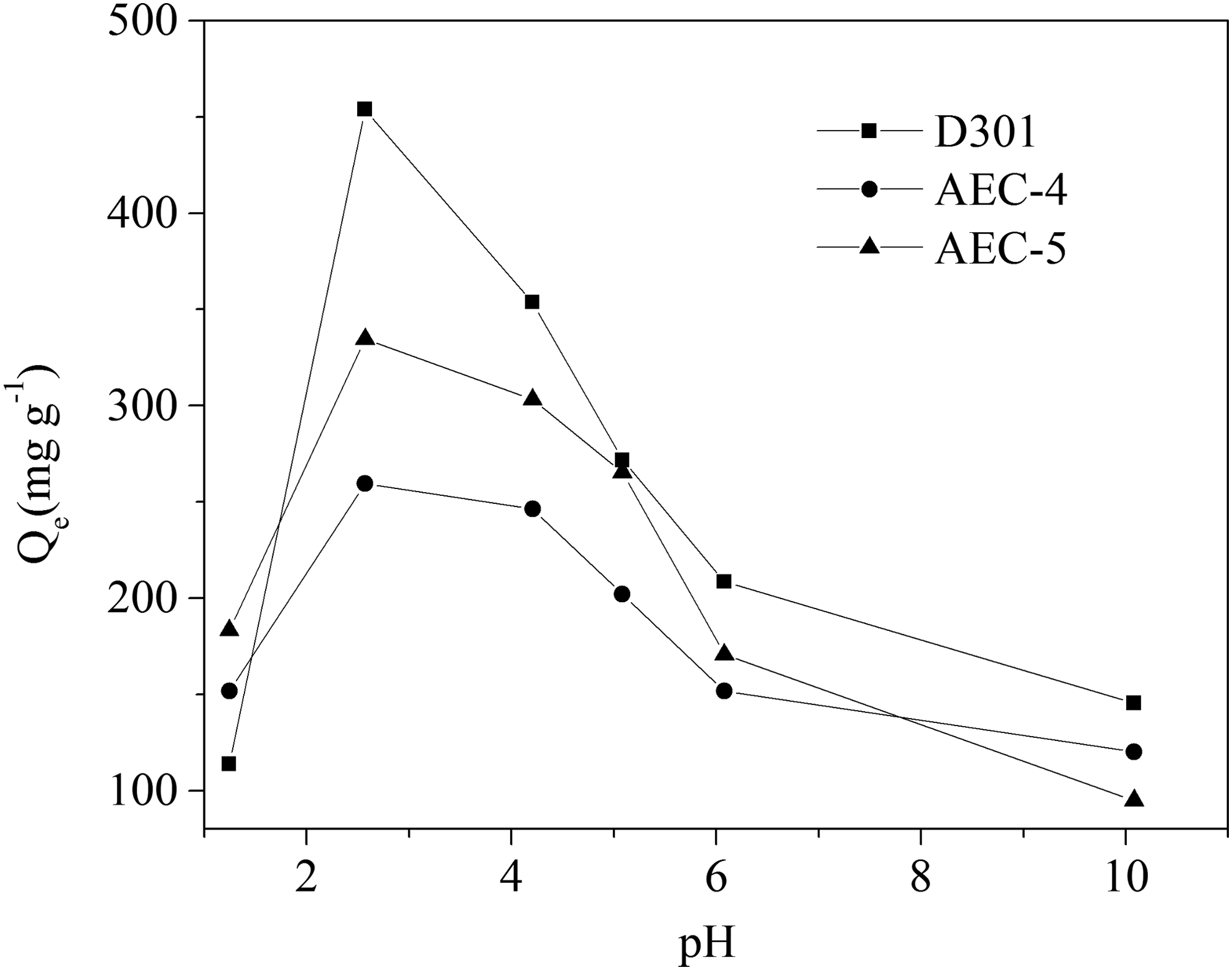
Effect of solution pH on the adsorption of BSA onto resins. BSA, benzenesulfonic acid.
Results revealed that the adsorption capacity of each resin was very sensitive to the solution pH and the uptake initially increased notably raising the pH up to about 2.6 and then decreased further increasing pH. At acidic pH, amino groups on the resins could be protonated and subsequently interact with the negatively charged BSA anions through an electrostatic attraction mechanism. Higher solution pH was unfavorable for protonation of amino group and resulted in a lower sorption capacity. As the solution pH was lower than the optimal pH value, decrease in sorption capacity might be due to the amended SO42− anions for pH adjustment. In fact, SO42− could also be adsorbed on the resins by electrostatic interaction with the protonated amino groups and lead to the competitive sorption with BSA anions (Pan et al., 2008a). The dissociation of BSA molecules in the solution would be restrained with the increase in the acid concentration. The amount of negatively charged BSA would decrease, which could cause the decrease in BSA uptake through electrostatic interaction (Tao et al., 2010). Hence, the following experiments were performed in the solution pH 2.6.
Effect of Na2SO4 and adsorption selectivity
Generally, Na2SO4 often coexists with ASAs in industrial wastewaters at a relatively high level (Pan et al., 2008b). SO42− can act as a competing ion and strongly interferes with sorption process of ASAs resulting in inefficiency. Therefore, selective sorption properties of adsorbents are of particular importance for their application. Figure 4 illustrates the effect of coexisting Na2SO4 on BSA adsorption on the resins from aqueous solutions.
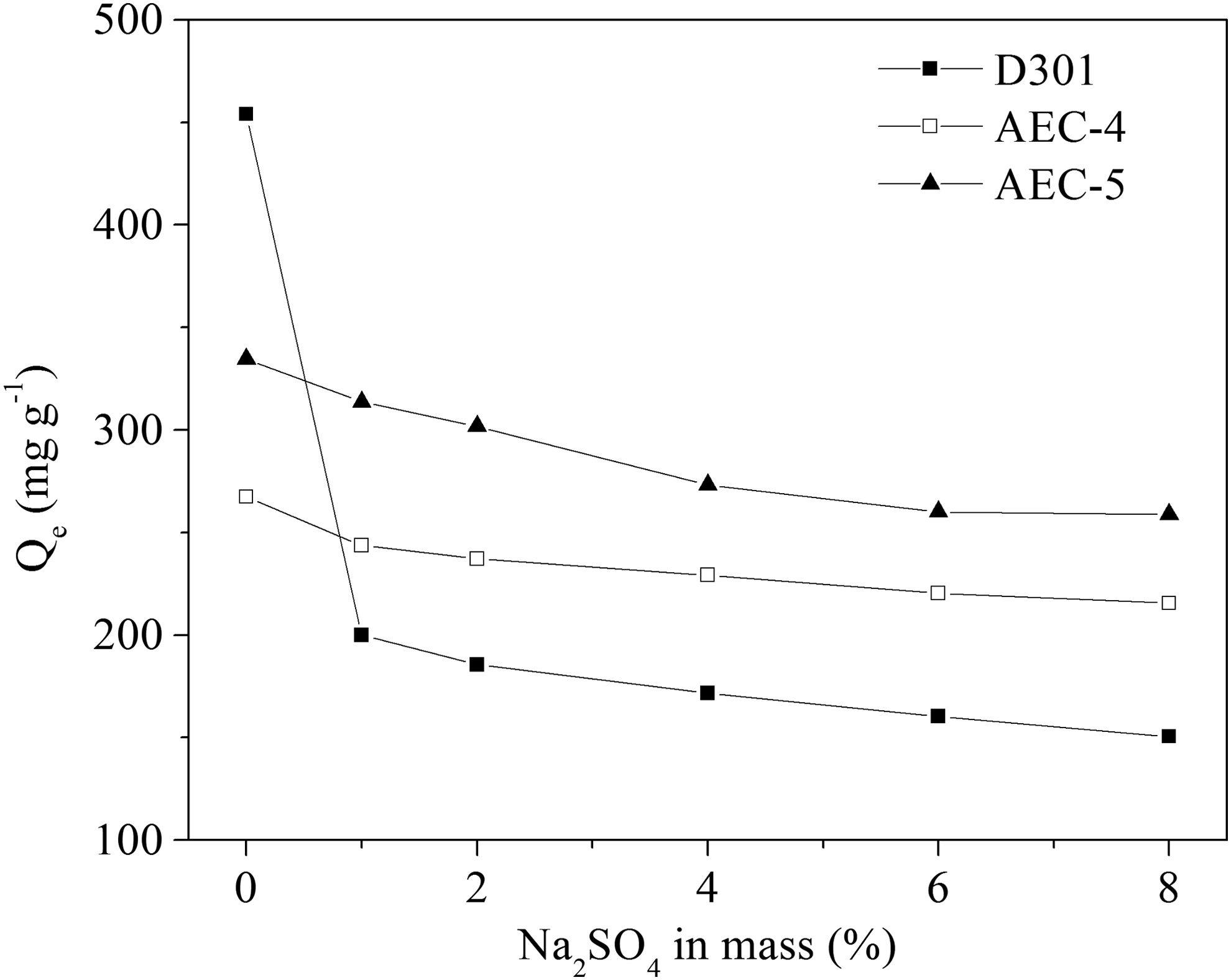
Effect of Na2SO4 concentration in solution on BSA sorption onto resins at 303 K.
As shown in Fig. 4, in the absence of Na2SO4, the adsorption capacity toward BSA decreased in the order of D301 > AEC-5 > AEC-4, which is consistent with total anion exchange capacity of resins. However, BSA adsorption on D301 decreased sharply with Na2SO4 addition due to strong competition effect between SO42− and BSA anion, while only a slight decrease on AEC-5 and AEC-4 could be observed. Taken into account their same PS-DVB matrix and similar surface area, different adsorption performances of D301, AEC-4, and AEC-5 could be attributed to the functional groups of the resins. To quantify the selectivity of the three resins, the distribution coefficient Kd (mL/g) was calculated using the following Equation (Pan et al., 2005):
The resulting Kd values of the employed resins at different Na2SO4 contents are listed in Table 2. The Kd values of AEC-4 were larger than those of D301 at the identical amount of Na2SO4 addition even though the total exchange capacity of AEC-4 was much lower than that of D301, which indicated that increasing the length of the alkyl chain surrounding the anion-exchange site on the resin would improve the sorption selectivity of BSA. One possible explanation is that longer alkyl chain could make AEC-4 more hydrophobic and thus more selective in adsorbing organic anions than inorganic anions such as SO42− with higher hydrophilicity (Luo et al., 2015). Additionally, some earlier study also revealed the effect of chemical surface heterogeneity on the sorption of monovalent inorganic anions such as nitrate and perchlorate on strongly basic anion exchangers and found that the distance between active exchange sites on quaternary amino functional group was an important factor affecting the monovalent-divalent selectivity (Pakzadeh and Batista, 2011). This might be another reason for better sorption selectivity for BSA anion over SO42− of AEC-4 than D301. SO42− is a divalent anion, which needs to be exchanged with two contiguous active sites on the resin. When spacing between the active sites became large, by increasing the bulk of functional groups, SO42− could not be exchanged well. Contrarily, as a monovalent ion, BSA anion was still exchanged in the resin because it needs only one active exchange site. Among the three resins, AEC-5 displayed highest selectivity for BSA over SO42−, and the Kd values of AEC-5 were 82.9% and 41.8% at Na2SO4 content of 1%, while 97.1% and 27.1% at Na2SO4 content of 8%, higher than those of D301 and AEC-4, respectively. This could be explained by the fact that AEC-5 resin contained a mixture of both large amino group, that is, -N(C4H9)2 to enhance the selectivity and smaller amino group, that is, -N(CH3)2 to increase the exchange capacity. The excellent salt-resistance property of AEC-5 suggested that the novel dual functional exchanger was more effective than both the monofunctional resins in removing BSA from a solution containing high levels of competing Na2SO4.
Adsorption isotherms and thermodynamics for AEC-5
The BSA adsorption isotherms at three different temperatures on AEC-5 are presented in Fig. 5. The amount of BSA adsorbed per unit mass of AEC-5 increased with increasing equilibrium concentration and decreasing temperature. The Langmuir [Eq. (3)], Freundlich [Eq. (4)], Temkin [Eq. (5)], and Redlich-Peterson [Eq. (6)] models were employed to describe the adsorption isotherms.

Adsorption isotherms of BSA onto AEC-5 at different temperatures.
where Qe is the equilibrium adsorption capacity of the adsorbent (mg/g), Ce is the equilibrium concentration of BSA (mg/L), and the other parameters represent different isotherm characteristic constants. The correlative relevant parameters and correlation coefficients (R2) of isotherm equations are listed in Table 3.
Data from Table 3 revealed that Langmuir equation was demonstrated to be the best model for BSA adsorption, with the highest correlation coefficient among the four equations.
As the sorption feature followed the Langmuir model, the enthalpy change (ΔH) and entropy change (ΔS) herein were calculated based on the following equation (Sun et al., 2007):
where KL is the constant of the well fitting Langmuir equation, R is the gas constant, and T is the absolute temperature. ΔH and ΔS were then obtained from the slope and intercept of the line plotted by ln KL versus 1/T, and the free energy change (ΔG) could be measured with the Gibbs equation (Sun et al., 2007):
As presented in Table 4, exothermic adsorption process was testified by the negative value of ΔH, consistent with the increase of adsorption capacity as temperature decreased. The negative value of ΔS suggested the decreasing randomness between the solid–solution interface during the sorption process. The values of ΔG were always negative proving that the adsorption process of BSA on AEC-5 was spontaneous, and the decreasing of absolute values of ΔG with the growth of temperature further confirmed that the adsorption was more favorable at low temperature conditions.
Adsorption kinetics
Adsorption kinetics is one of the most important characteristics that represent the adsorption efficiency. Figure 6 shows the adsorption behavior of BSA onto the resins at an initial concentration of 1,000 mg/L as a function of adsorption time.
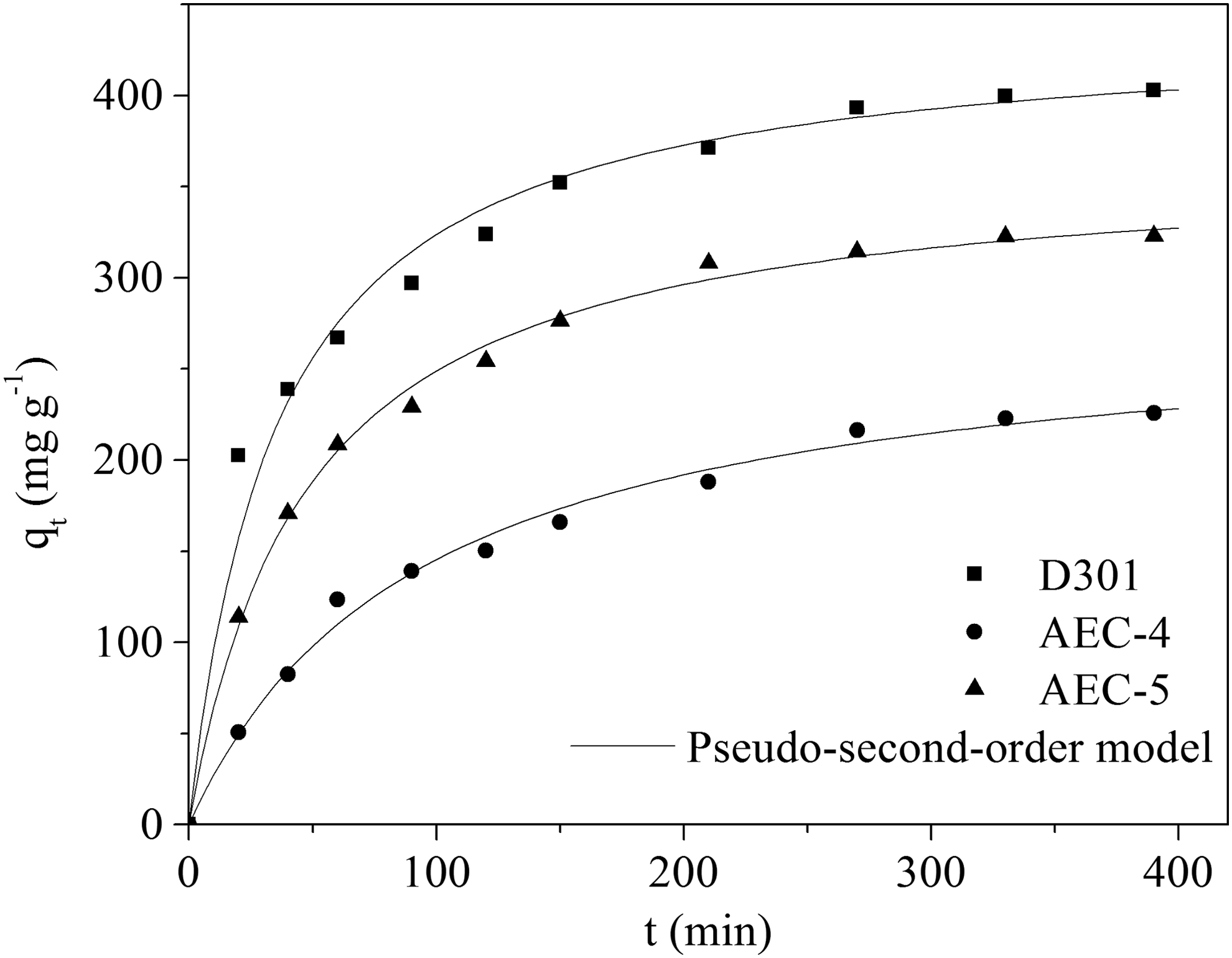
Kinetic curves for the adsorption of BSA on resins at 303 K.
The pseudo-first-order [Eq. (9)], pseudo-second-order [Eq. (10)], Elovich [Eq. (11)] and intra-particle diffusion [Eq. (12)] kinetic equations were used in this work to further interpret the kinetic behaviors of BSA adsorbing onto the resins (Shuang et al., 2012; Yan et al., 2015).
where Qe and qt are the adsorption capacity (mg/g) at equilibrium and at time t (min) respectively, C (mg/g) is a constant, while k1 (min−1), k2 (g/[mg·min]), and kipd (mg [g·min0.5]) are the rate constants for the pseudo-first-order, pseudo-second-order, and intra-particle diffusion equations, respectively. For Elovich equation, α (mg [g·min]) is the initial adsorption rate, and β (g/mg) is the desorption constant. The correlation parameters and coefficients (R2) are listed in Table 5.
It can be deduced from Table 5 that pseudo-second-order model could explain the adsorption processes onto all the resins best because of the highest R2 values and the calculated equilibrium sorption capacities (Qe,cal) close to the experimental ones (Qe,exp). The fact that the k2 value of D301 was larger than that of AEC-4 indicated that increasing alkyl chain length of amino group of a resin could result in a decrease in the BSA adsorption rate. This might be attributed to the improved steric and hydrophobic effect exerted by the large alkyl group substituents on positive nitrogen active site (Abou Taleb et al., 2008; Donia et al., 2011). Similar results were obtained from adsorption of poorly hydrated inorganic ions such as TcO4− and ClO4− by the anion exchangers (Del Cul et al., 1993; Tripp and Clifford, 2000). In other words, superior BSA selectivity could be achieved with the larger amino group but at the expense of slower exchange kinetics. Compared to AEC-4, the dual functional resin AEC-5 exhibited enhanced sorption kinetics property because it had not only the large amino group derived from dibutylamine but also the smaller amino group derived from dimethylamine, which could be favorable for adsorbate diffusion inside the resin beads (Tripp and Clifford, 2000). The nature of the rate-limiting step in a batch system can also be assessed from the properties of the solute and adsorbent, and if intra-particle diffusion is the rate-controlling factor, uptake of the adsorbate varies with the square root of time. From Table 5, values of intercept indicate that the relation plot of qt and t0.5 does not go through the origin. The deviation of straight line from the origin suggests that the pore diffusion is not the sole rate-controlling step, and some other steps such as film diffusion might be along with intra-particle diffusion (Zhang et al., 2013).
Column adsorption and regeneration
Figure 7 illustrates an effluent history of a separate fixed-bed column packed with three resins for a feeding solution containing 2,000 mg/L BSA and 5% competing Na2SO4. The breakthrough points of D301, AEC-4, and AEC-5 occurred at 27, 33, and 42 BV respectively (Fig. 7), while before the significant breakthrough occurred, BSA was completely removed from waters to a nondetectable level. BSA broke through quickly on the commercial exchanger D301, although the total anion exchange capacity of D301 was larger than those of the other resins. More satisfactory breakthrough results were observed for AEC-4 and AEC-5, which could achieve higher number of BVs than D301 by 44% and 67%, respectively. Results reveal that AEC-5 showed the highest run length for BSA removal, which could be explained by its highest BSA selectivity resulted from its unique chemical structure and relatively high ion exchange capacity.
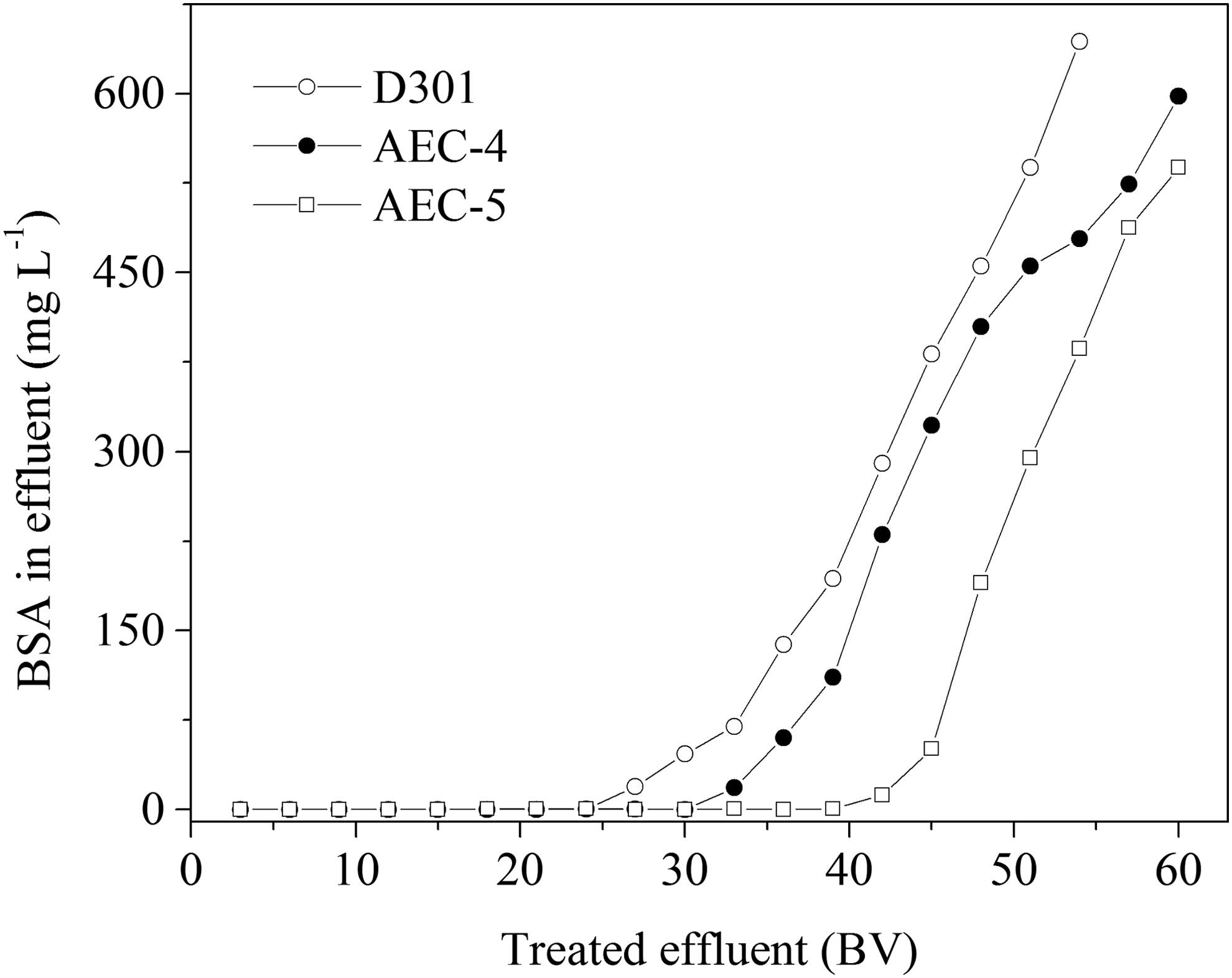
BSA retention by three separate column beds packed with different resins from a synthetic feeding solution.
Afterward, the exhausted resin column was then regenerated first using 3 BV of 8% NaOH solution, followed by rinsing with 2 BV of deionized water at 318 K and the results are presented in Fig. 8. A complete regeneration of D301 was readily achieved within the total 5 BV regeneration agent, while under identical conditions, the desorption efficiency of AEC-4 was no greater than 93% (Fig. 8). This observation indicated that increasing alkyl chain length of the amino group of a resin could result in a decrease in the desorption performance. Compared to AEC-4, the dual functional resin AEC-5 exhibited enhanced desorption performance and the desorption curve of AEC-5 almost coincided with D301, which suggested that the sorption of BSA could be well reversible.
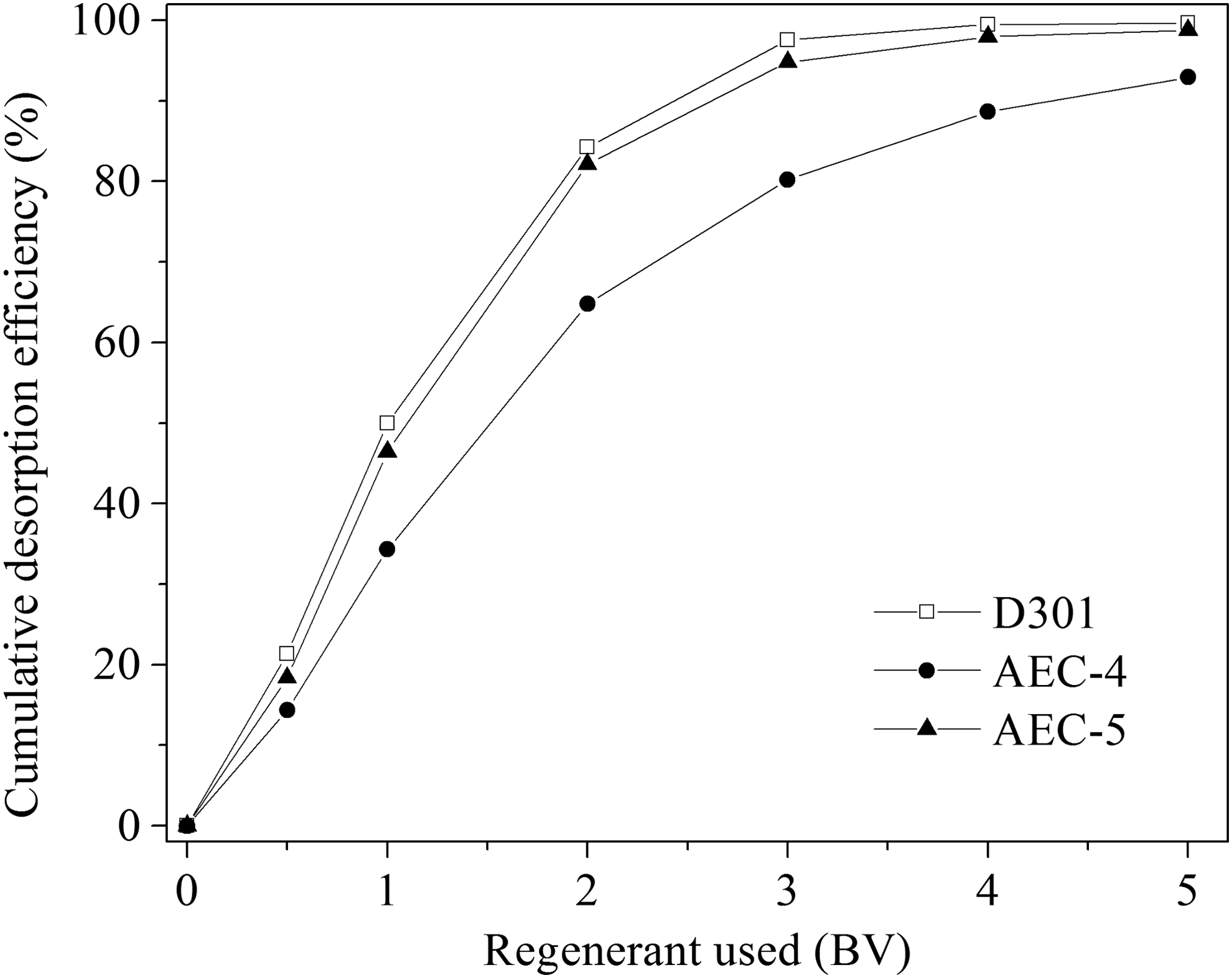
Regeneration of the exhausted column bed packed with resins.
Conclusion
A novel dual functional weakly basic anion exchange resin AEC-5 was successfully synthesized by the reaction of chloromethylated PS-DVB matrix with a mixture of dimethylamine and dibutylamine for BSA removal. Two monofunctional anion exchange resins D301 and AEC-4 that were functionalized with dimethylamine and dibutylamine respectively were selected for comparison purpose. AEC-5 showed a superior adsorption capacity and selectivity for BSA in aqueous solutions containing Na2SO4 at high levels than both the monofunctional resins. Furthermore, AEC-5 possessed faster adsorption kinetics and better desorption performance than AEC-4 containing only one type of large exchange site for selectivity improvement. Thus, AEC-5 might be a potential alternative adsorbent in removing BSA and other similar aromatic sulfonic acids (ASAs) from wastewaters with high concentrations of competing Na2SO4.
Footnotes
Acknowledgments
We greatly acknowledge the financial support by the National Natural Science Foundation of China (No. 51578131), Natural Science Foundation of Jiangsu Province, China (No. BK20131287), and Priority Academic Program Development of Jiangsu Higher Education Institutions (PAPD).
Author Disclosure Statement
No competing financial interests exist.