




Abstract
Abstract
A phytotoxicity study was conducted to determine the maximum accumulation of Fe and Al in Scirpus grossus and to isolate and identify the Fe-Al-resistant rhizobacteria from S. grossus roots. Plants were grown in artificial bauxite mining wastewater containing iron (Fe) and aluminum (Al) (at a mass ratio of 3:1) with five different Fe-Al mixture concentrations (ranging from 90 mg/L Fe + 30 mg/L Al to 450 mg/L Fe + 150 mg/L Al) together with a plant control (without the addition of Fe and Al) for 102 days. Maximum metal accumulation in plants was 53,187 mg Fe/kg and 8,864 mg Al/kg (dry basis), which occurred on day 42 in the 450 mg/L Fe + 150 mg/L Al treatment. Approximately 27 rhizobacteria were isolated from roots of all the treatments on day 102. Among these, three isolates, identified as Bacillus cereus strain NII, Bacillus pumilus strain NII, and Brevibacterium sp. strain NII, showed high resistance and tolerance to the highest Fe-Al concentrations (i.e., 450 mg/L Fe + 150 mg/L Al) in the medium. Thus, they can be considered Fe-Al-resistant rhizobacteria, since they survived and tolerated the most in Fe- and Al-rich medium during screening.
Introduction
B
The waste can contribute to serious human health problems and has adverse ecological effects. Several promising paths for remediation of mine waste, such as phytoremediation by artificial wetland remediation cells (reed beds) and use of microorganisms, are summarized by Hudson-Edwards and Dold (2015).
Artificial wetland remediation cells are engineered systems that promise an economically effective biotechnology that is applicable to both municipal and industrial wastewater treatment. These systems are desirable due to their low costs, simple operation and maintenance, and aesthetic appearance (Yousaf et al., 2011). They involve a phytoremediation process in which plants are used to clean polluted water and soil (Sytar et al., 2016).
Srivastava et al. (2013) reported that the interaction of plants with microbes is an efficient bioremediation process, because it enhances potential metal bioaccumulation, helps degrade contaminants, and/or promotes plant growth.
In a study conducted by Srivastava et al. (2013), Staphylococcus arlettae (an arsenic-hypertolerant strain isolated from an arsenic-contaminated site in West Bengal, India) was inoculated in Brassica juncea (L.) Czern. Var. R-46 grown in arsenic-spiked soil (5, 10, and 15 mg/kg As). The microbial inoculation increased the As concentrations in shoots and roots from 3.73% to 34.16% and from 87.35% to 99.93%, respectively. The experimental results show that the addition of bacteria has the ability to help B. juncea to maximally accumulate As in plant roots; thus, it can be treated as a new bacterium for As phytostabilization.
Another study conducted by Yang et al. (2013) reported that the addition of copper-resistant bacteria, Pseudomonas sp. DGS6, to maize and sunflower grown in pots with soil collected from an agricultural field surrounding the Jiuhua Cu mine greatly improved the accumulation of Cu in plant tissues. In addition, Kiyono et al. (2013) reported that the bacterial heavy metal transporter MerC increased the mercury accumulation in Arabidopsis thaliana grown in medium plates containing 2–10 μM HgCl2, compared with wild-type Arabidopsis.
Another study found that the endophytic bacterium Bacillus thuringiensis GDB-1 improved the efficiency of Alnus firma for remediating heavy metal-contaminated soils, resulting in a removal capacity of 77% for Pb in 100 mg/L Pb, 64% for Zn in 50 mg/L Z, 34% for As in 50 mg/L As, 9% for Cd in 10 mg/L Cd, 8% for Cu in 10 mg/L Cu, and 8% for Ni in 10 mg/L Ni (Babu et al., 2013). Rajkumar et al. (2012) concluded from the findings of other researchers that plant-associated beneficial microbes directly enhance the efficiency of the phytoremediation process by altering the metal accumulation in plant tissues through metal mobilizing/immobilizing metabolites/actions.
The plants and associated microbes release organic and inorganic compounds possessing acidifying, chelating, and/or reductive powers, which indirectly promote shoot and root biomass production (plant growth-promoting rhizobacteria). According to Ma et al. (2010), Psychrobacter sp. SRS8 played an important role in promoting both the growth and phytoextraction efficiency of Ricinus communis and Helianthus annuus. Therefore, this study was conducted to identify Fe-Al-resistant rhizobacteria grown in synthetic bauxite mining wastewater for future phytoremediation enhancement of bauxite mining wastewater by S. grossus.
Rhizobacteria from S. grossus were isolated, screened for their potential to resist high concentrations of Fe and Al in a synthetic wastewater mixture, and identified by using the molecular technique. The Fe-Al-resistant rhizobacteria were screened based on their physical growth in Trypticase (Tryptic) Soy Agar (TSA) after exposure to the Fe-Al mixture in Norris nutrient medium. To date, no studies have been performed on the potential use of bacteria isolated from the S. grossus rhizosphere to enhance the removal of Fe and Al from bauxite mining wastewater through the phytoremediation process.
Therefore, in this study, the objectives were to determine the maximum accumulation of Fe and Al in S. grossus during phytoremediation by exposing the plants with synthetic bauxite mining wastewater for 102 days and to identify Fe-Al-resistant rhizobacteria from S. grossus grown in the synthetic bauxite mining wastewater that has the potential to enhance the performance of the phytoremediation process for Fe and Al in bauxite mining wastewater by conducting a screening test for all isolated rhizobacteria from the plants.
Materials and Methods
Selection of plant species and types of heavy metals
A prior assessment was performed near a bauxite mining area to select plant species and types of heavy metals for use in the phytotoxicity study (Ismail et al., 2013). S. grossus was selected due to its ability to accumulate high concentrations of Fe and Al compared with other plants, and synthetic wastewater was used to simulate the bauxite mining wastewater. It was found that the mass ratio between Fe and Al was approximately 3:1.
Phytotoxicity study of effects of Fe and Al on S. grossus
The phytotoxicity study was conducted to determine the ability of S. grossus to remediate synthetic bauxite mining wastewater contaminated with Fe and Al and to identify potentially effective Fe-Al-resistant rhizobacteria that can enhance the phytoremediation process. In total, 13 crates with dimensions of 58 × 39 × 29.5 cm (L × W × H) were used as batch reactors, and each was layered with sand (top layer) and gravel (bottom layer). S. grossus plants were grown in garden soil under greenhouse conditions for one month; then, healthy S. grossus plants of a similar height (94.325 ± 12.787 cm) were transferred to the sand-gravel layer crates.
Sand was used to minimize the nutrient content, and no additional nutrients were added to encourage plant growth to determine the direct toxicity impact of the heavy metals on the plants. Although no additional nutrients were added, sand usually contains minimal nutrients of 29.2 mg/kg N (nitrate), 1.2 mg/kg K, 13.0 mg/kg SO42−, 86.5 mg/kg Ca, 7.4 mg/kg Mg, 6.4 mg/kg Cl−, 5.5 mg/kg Fe, 0.04 mg/kg Zn, and 1.62 mg/kg Mn, as reported by Titah et al. (2013).
Each crate had 12 S. grossus plants and was subjected to specific concentrations of Fe and Al (Table 1). Each treatment consisted of three crates for replication. The mixture of Fe and Al was prepared by mixing iron (III) chloride hexahydrate (FeCl3·6H2O) (Friendemann Schmidt) and aluminum sulfate (Al2(SO4)3·16H2O) (R & M Marketing) with tap water. The plant control was not exposed to contaminants. The contaminants were added once at the beginning of exposure, and the study was run for 102 days. Approximately 0.5–1.0 L of tap water was added once every 2 days to maintain the sub-surface system throughout the experimental period. The experiment was conducted under greenhouse conditions at an average temperature of 35°C.
• = Scirpus grossus.
PC = Plant control.
R1 = Replicate 1.
R2 = Replicate 2.
R3 = Replicate 3.
Plant sampling was performed on days 1, 7, 14, 42, 72, and 102, with one plant being sampled from each replicate crate (R1, R2, and R3). The whole plant was harvested, rinsed, and dried in a drying oven (MMM Laboratory oven Venticell 707 Comfort) at 70°C. Fe and Al were extracted from plants by using modified procedures from Kalra (1998) and Tangahu et al. (2013a). Approximately 0.1–1 g of dried sample (after being ground using a commercial blender) was added to a digestion tube, and 10 mL of 69% HNO3 (R&M Chemicals) was added to the sample, covered with a watch glass, and left overnight.
Then, the sample was heated in a block digester (AIM 600 Digestion System) to 95°C for 1.5 h. After 1.5 h, it was allowed to cool to 80°C before the addition of 8 mL of 30% H2O2 (R&M Chemicals). It was heated again to 95°C for 2 h. The addition of 2.5 mL of aqua regia (HNO3:HCl = 1:3) was performed after 2 h, and deionized water was then added to achieve a total volume of 50 mL. Filtration through a membrane filter (i.e., 0.45 μm; cellulose acetate) (Whatman) was performed to obtain a clean extracted sample. The Fe and Al contents extracted from the plant tissue of S. grossus were analyzed by using an Optima 7300DV ICP-OES instrument (Perkin Elmer). The instrument was operated with the computer software WinLab32 for ICP (Version 4.0.0.0305).
Details of the operating conditions are as follows: The spectrometer was an Optima 7300DV with a wavelength range of 163–782 nm, a segmented-array charge-coupled device (SCD) detector, a radio frequency power of 1,300 W, a solid-state RF generator (10 L/min), three channels with a 12-roller peristaltic sample pump, a flush pump rate of 100 rpm, a pump stabilization time of 5.00 s, an analysis pump rate of 50 rpm, a sample flush time of 15.00 s (five times), various gas flow rates for coolant (12 L/min), argon (10 L/min), auxiliary gas (0.20 L/min), and nebulizer of Meinhard® Concentric (0.50 L/min), and a cyclonic spray chamber. Fe and Al were measured at wavelengths of 234.349 and 308.215, respectively. The accumulation of Fe and Al was calculated by using Equation (1):
where CM represents the total concentration of Fe or Al analyzed by ICP-OES, MP represents the mass of the plant, and VE represents the extraction volume (0.05 L).
A calibration curve was established by using standard solutions of 0.1, 0.5, 1.0, 5.0, and 10.0 mg/L for both Fe and Al with R2 = 0.99; 2.0 mg/L was used for quality control.
Isolation and screening of Fe-Al-resistant rhizobacteria
Isolation was conducted during the last day of the phytotoxicity study. The bacteria were isolated from the roots of plants with differing iron and aluminum concentrations (i.e., 90 mg/L Fe + 30 mg/L Al, 150 mg/L Fe + 50 mg/L Al, 300 mg/L Fe + 100 mg/L Al, and 450 mg/L Fe + 150 mg/L Al) as well as from the control. The concentrations were selected based on a preliminary study reported in Ismail et al. (2014). The isolation of rhizobacteria followed the method used by Mittal and Johri (2007).
In brief, each S. grossus root was transferred to 100 mL of distilled water (sterile) at 30°C and shaken at 150 rpm for 60 min. The particles were allowed to settle for 1 min, and then serial dilutions (10−1–10−4) were spread on the TSA medium (Difco) to obtain single colony-forming units. The plates were incubated (Incucell) at 30°C for 48 h. Single bacterial colonies were selected and sub-cultured on fresh TSA medium to obtain pure cultures, which were picked to represent colonies with differing morphologies (i.e., visual color, shape, elevation, margin, and texture). Motility tests, Gram stains, and biochemical tests (catalase activity and oxidase activity) were then performed.
Isolates were then screened for tolerance to Fe and Al (i.e., 90 mg/L Fe + 30 mg/L Al, 300 mg/L Fe + 100 mg/L Al, and 450 mg/L Fe + 150 mg/L Al, as well as a negative control) in modified Norris nutrient medium (Norris and Barr, 1985). The mixture concentrations of Fe and Al used during screening were selected based on the concentrations used during the phytotoxicity study. The formulation for the modified Norris nutrient medium (with a pH of 7.56) was 1 L of distilled water, 0.4 g of (NH4)2SO4, 0.4 g/L of K2HPO4, and 0.5 g/L of MgSO4·7H2O. The medium was autoclaved at 121°C for 15 min (Purwanti et al., 2012).
All isolates were spiked on the modified Norris nutrient medium with a predetermined Fe and Al concentration and incubated at 37°C for 5 days (Purwanti et al., 2012). On the last day (i.e., day 5), 1.0 mL of suspension was transferred to 9 mL of 0.85% NaCl solution. Serial dilutions were made to 10−5 and plated on TSA. The plates were incubated at 37°C for 24 h, and the abundance of rhizobacteria present on the TSA plate was scored according to qualitative indicators (Purwanti et al., 2012) ranging from good growth (+5) to poor growth (0) (Table 2).
TSA, Trypticase (Tryptic) Soy Agar.
Identification of Fe-Al-resistant rhizobacteria
Rhizobacteria identification was conducted by using 16S rRNA sequencing. Total genomic DNA was extracted from bacteria samples by using the RTP® Bacteria DNA Mini Kit (STRATEC Molecular GmbH). The 16S rRNA genes were selectively amplified from purified genomic DNA by using oligonucleotide primers: 27F forward primer (5′-AGAGTTTGATCCTGGCTCAG-3′) and 1492R reverse primer (5′-GGTTACCTTGTTACGACTT-3′). PCR reaction conditions were according to the protocol for OneTaq® 2× Master Mix with Standard Buffer (M0482) (New England BioLabs), and the PCR product was purified by using the PureLink™ Quick PCR Purification Kit (Invitrogen). The resulting sequences were compared with the GenBank database by using the Blast search tool from the National Center for Biotechnology Information (NCBI) (www.ncbi.nlm.nih.gov/BLAST/).
Phylogenetic tree construction
Multiple arrangements of 21 different 16S rRNA gene sequences that were highly similar to our strains were retrieved from the database and aligned by using Clustal W (Larkin et al., 2007). A phylogenetic tree was constructed via the neighbor-joining method by using the software package MEGA 6.0 (Tamura et al., 2013), with Photobacterium frigidiphilum strain SL13 as the outgroup. For each algorithm, confidence levels for individual branches within the tree were checked by repeating the MEGA 6.0 analysis with 1000 bootstraps (Singh et al., 2014).
Results and Discussion
Accumulation of Fe and Al by S. grossus
Figure 1 depicts the accumulation of Fe and Al in S. grossus throughout the 102 days of the exposure period. As shown in the graph, the accumulation of Fe and Al increased with the mixture concentration up to day 42. Uptake increased significantly, especially for the higher Fe concentrations, for example, 450 mg/L Fe + 150 mg/L Al. For most conditions, the maximum Fe and Al accumulation occurred on day 42. The highest accumulations were 53,187 mg Fe/kg and 8,864 mg Al/kg, both of which occurred in the mixture with 450 mg/L Fe + 150 mg/L Al.
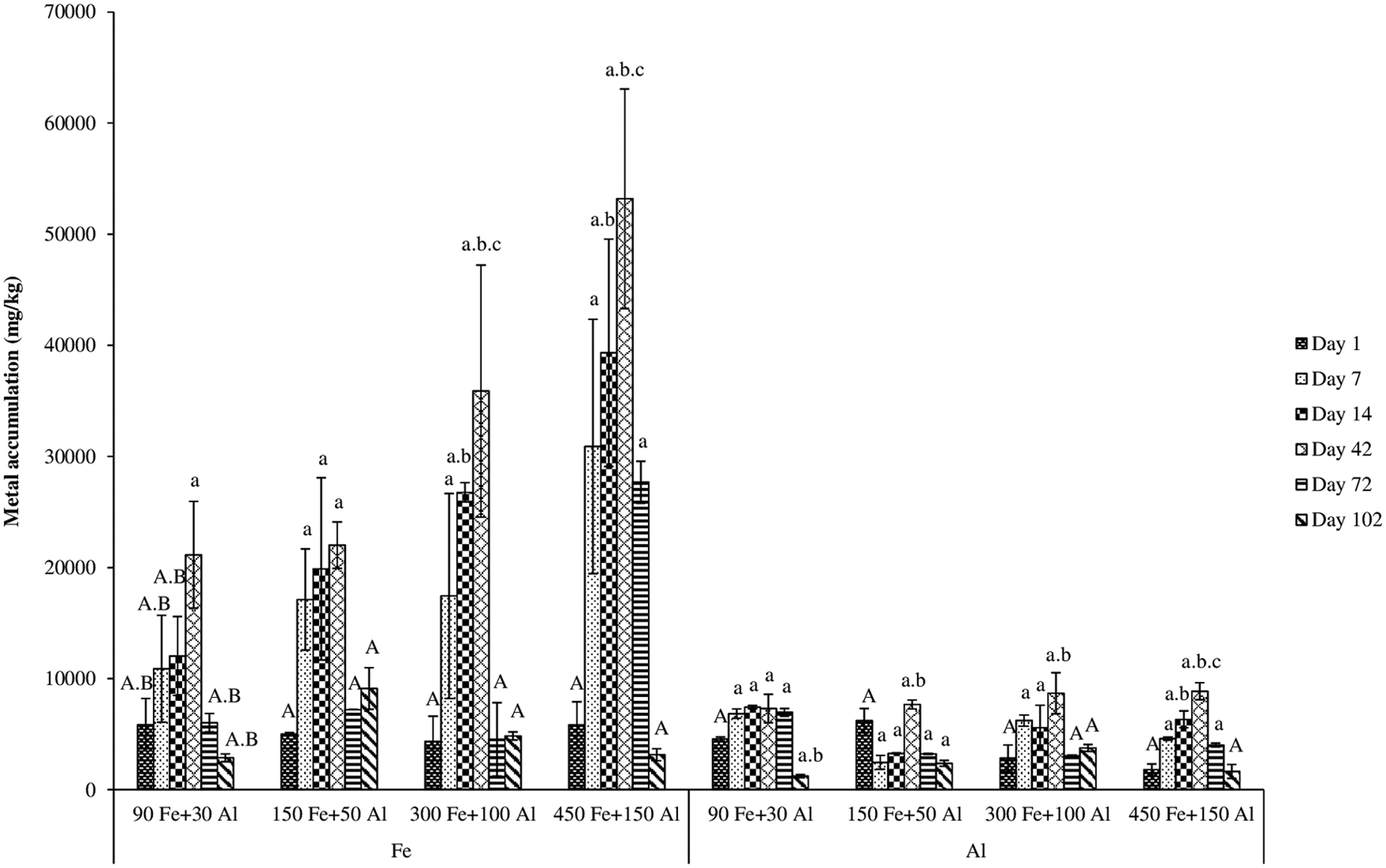
Accumulation of Fe and Al in Scirpus grossus. Vertical bars indicate ± SD of three replicates. Letters A-a, A-a.b, A-a.b.c, A.B-a, a-a.b, and a-a.b.c represent statistically significant differences in metal accumulation (mg/kg) on a specific day when compared with days within metal concentrations of respective mixtures for Fe and Al (p < 0.05).
The accumulation of both Fe and Al decreased after day 42, and similar results were observed during phytoremediation of lead in wastewater using S. grossus in the study by Tangahu et al. (2013b). They found that the accumulation of Pb in plants decreased after day 21. The highest accumulation of Pb in plants was 46,000 mg/kg in association with a Pb concentration of 800 mg/L.
Iram et al. (2012) found that Lemna minor plants could accumulate high concentrations of Fe (3,039 μg/L), with mean concentrations of 2,020 μg/L, indicating that L. minor is a good hyperaccumulator, as it can uptake and accumulate metals in parts of the plant. Pandey (2012) used Azolla caroliniana (i.e., water fern) to study potential phytoremediation of metal-enriched fly ash (FA) ponds, and the results indicated that the efficiency of A. caroliniana phytoremediation of FA ponds ranged from 175 mg/kg to 538 mg/kg and from 86 mg/kg to 753 mg/kg (Cu, Pb, Mn, Ni, Zn, Cr, Cd, and Fe) in roots and fronds, respectively.
Figure 2 depicts the growth of S. grossus throughout the phytotoxicity study. The growth of S. grossus in the 90 mg/L Fe + 30 mg/L Al treatment was not much affected by the contaminants, as the increase in dry weight of the plants was similar to that of the plants in the control crate during the exposure period. However, the final dry weight of the plants in the 90 mg/L Fe + 30 mg/L Al treatment was significantly different (p < 0.05) than that of the control plants. The growth of S. grossus was negatively affected by the metal mixture concentrations (i.e., 150 mg/L Fe + 50 mg/L Al, 300 mg/L Fe + 100 mg/L Al, and 450 mg/L Fe + 150 mg/L Al), presumably due to contaminant toxicity. The dry weights of the S. grossus plants in these metal concentrations decreased significantly (p < 0.05) after 72 days of exposure due to withered leaves and stunted growth. At the higher metal concentrations in the mixture, the dry weights of the plants and metal accumulation by plants decreased significantly (p < 0.05) toward the end of the exposure period (Fig. 2).
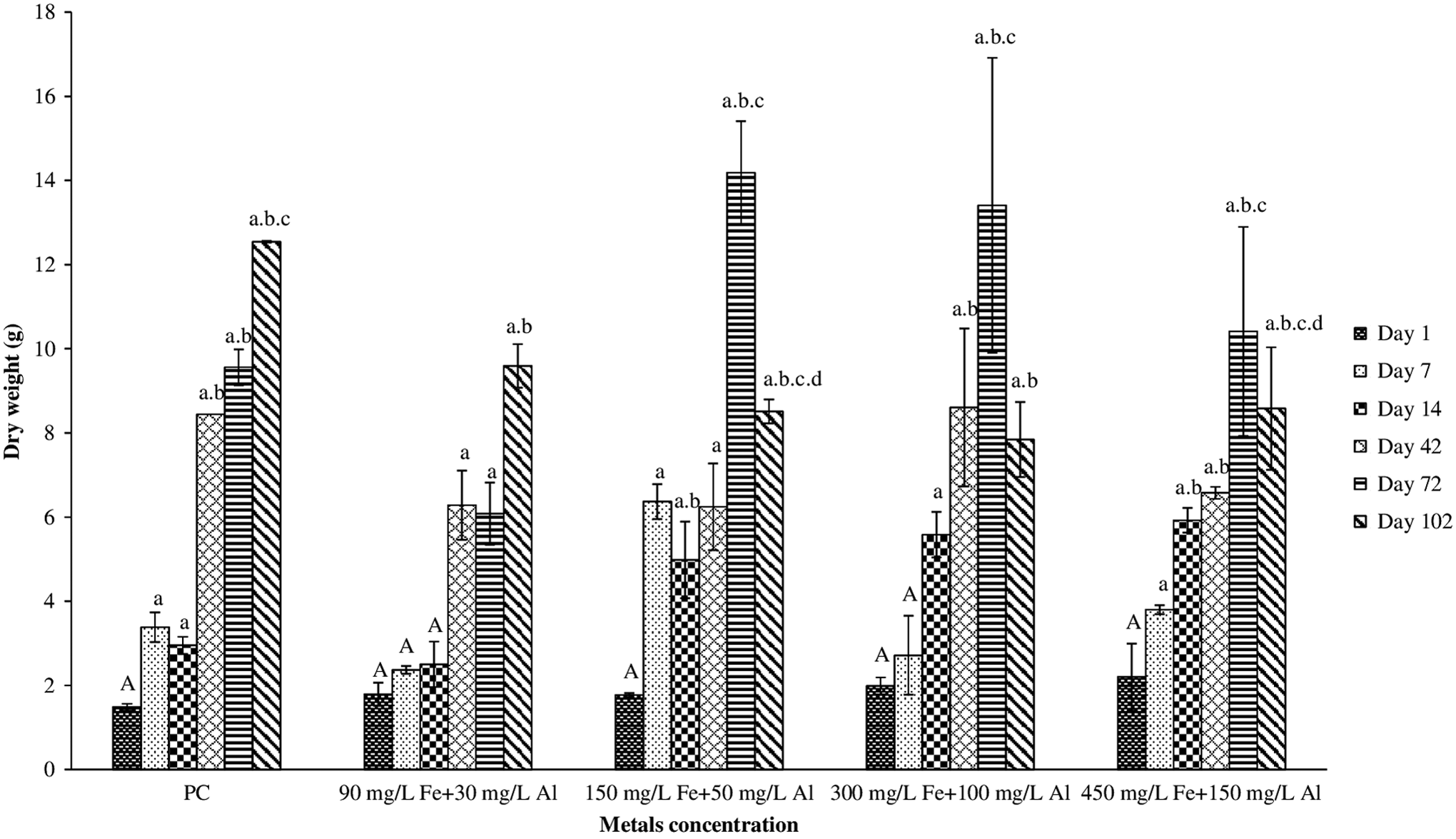
Total dry weight of Scirpus grossus. Vertical bars indicate ± SD of three replicates. Letters A-a, A-a.b, A-a.b.c, A-a.b.c.d, a-a.b, a-a.b.c, a-a.b.c.d, a.b-a.b.c, and a.b-a.b.c.d represent statistically significant differences in dry weight of Scirpus grossus (g) on a specific day when compared with days within metal concentrations of respective mixtures for Fe and Al (p < 0.05).
Isolation and screening of Fe-Al-resistant rhizobacteria
In this study, 31 pure rhizobacteria were isolated from treatment mixtures with different Fe and Al concentrations and from the control. Colonies were analyzed by using morphology, Gram staining, biochemical tests, and motility tests. The results of these tests reduced the number of isolates to 27, and these isolates were tested for Fe-Al resistance in modified Norris nutrient medium spiked with Fe and Al salts at different concentrations (i.e., 90 mg/L Fe + 30 mg/L Al, 300 mg/L Fe + 100 mg/L Al, and 450 mg/L Fe + 150 mg/L Al).
Only three rhizobacteria (coded as Q, T, and U) were able to grow in the mixture with the highest Fe and Al concentrations (Table 3). All three isolates were isolated from the roots of the S. grossus plants that were exposed to the mixture with the highest concentrations of Fe and Al (i.e., 450 mg/L Fe + 150 mg/L Al). These isolates were gram positive, motile (except for Q), and rod shaped. They formed cream-colored circular colonies on the TSA medium and had positive results for oxidase and catalase (Table 4).
Identification of Fe-Al-resistant rhizobacteria
Each 16S rRNA sequence of all three Fe-Al-resistant rhizobacteria was analyzed by using the NCBI Blast search. This step was used to identify bacteria at the genus level but not the species level (Adiguzel et al., 2009). Phylogenetic trees can be used to identify bacteria at both the genus and species levels.
Our phylogenetic tree (Fig. 3) shows high bootstrap values for the rhizobacteria Q (77%) and T (100%). Rhizobacteria Q and T are closely related to Bacillus cereus ATCC 14579 and Bacillus pumilus SAFR-032 strain SAFR-032 with identity values of 100% and 99%, respectively. On the other hand, a low bootstrap value of 63% links isolate U to Brevibacterium halotolerans strain DSM 8802 (identity value of 99%), indicating a weak phylogenetic relationship. Hence, the isolates Q and T were identified as Bacillus cereus strain NII and Bacillus pumilus strain NII, respectively, whereas the isolate U was tentatively identified as Brevibacterium sp. strain NII. The low bootstrap value linking isolate U to the Brevibacterium genus shows that further identification methods are required to identify this isolate at the species level.
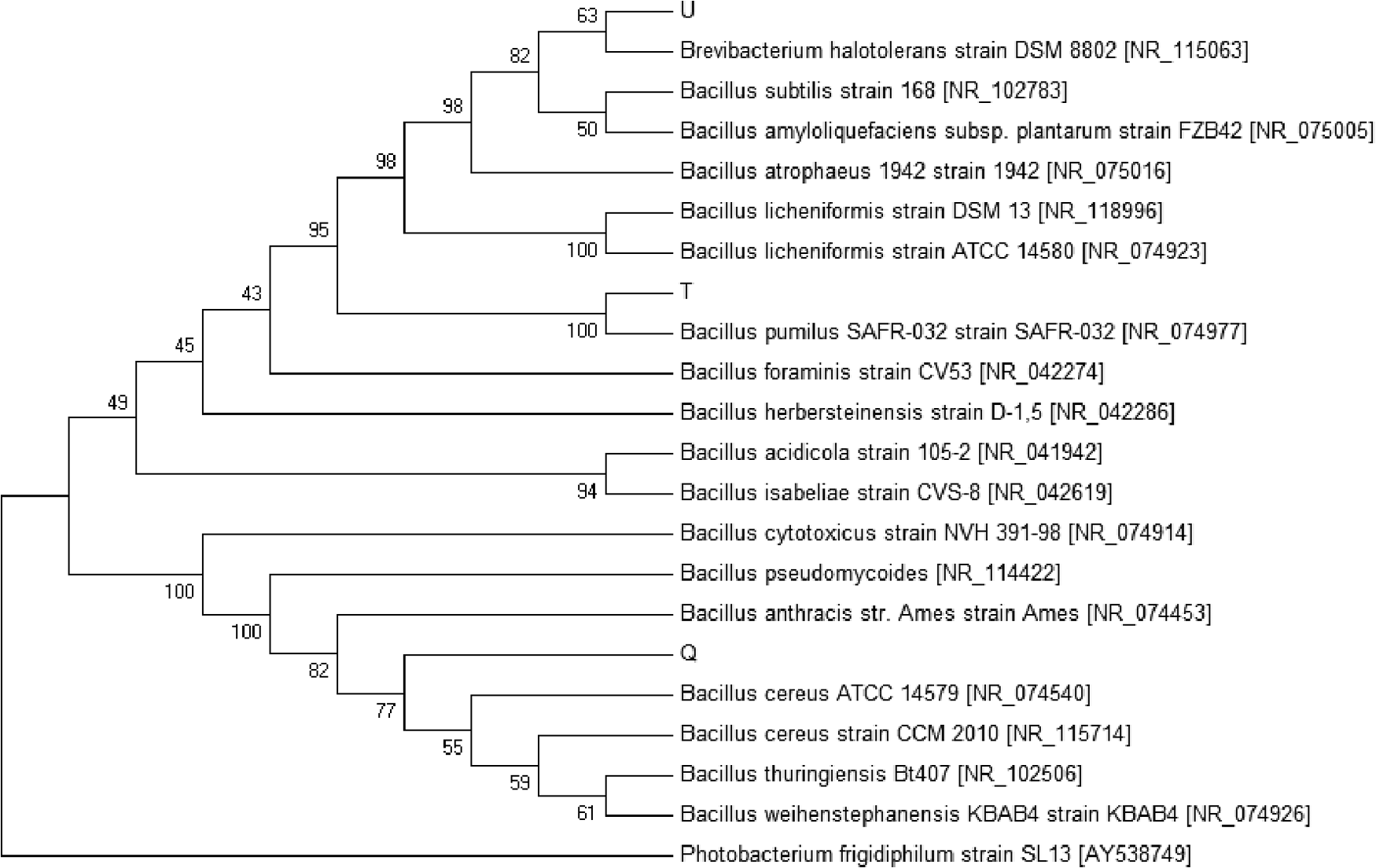
Phylogenetic tree based on the 16S rRNA gene sequences showing the genetic relationship between the isolates and related reference microorganisms obtained from the GenBank database. Photobacterium frigidiphilum strain SL13 is the outgroup. Species names are followed by the accession numbers of 16S rRNA. Internal labels at the branching points refer to the bootstrap value.
In the future, identification of this isolate could be achieved by several additional polyphasic identification methods, such as determination of genomic DNA G + C content (Fournier et al., 2006), DNA–DNA hybridization (Coenye and Vandamme, 2004), and fatty acid profile (Sasser, 2001). Therefore, further studies should be conducted to determine the effectiveness of these potential Fe-Al-resistant rhizobacteria during phytoremediation of bauxite mining wastewater by using S. grossus.
Conclusions
In total, the maximum Fe and Al accumulation in plants occurred on day 42 of the phytotoxicity study, with 53,187 mg Fe/kg and 8,864 mg Al/kg, both of which occurred in the 450 mg/L Fe + 150 mg/L Al treatment. Approximately 31 rhizobacteria were isolated from the roots of S. grossus during this phytotoxicity study. Of these, 27 colonies of rhizobacteria passed the initial test and were characterized by color, colony morphology, Gram staining, and catalase, oxidase, and motility tests. Among these, three isolates showed high resistance to the highest concentrations of Fe and Al in Norris nutrient medium after 5 days of exposure.
Two isolates were identified as Bacillus cereus strain NII and Bacillus pumilus strain NII (isolates Q and T, respectively), whereas isolate U was tentatively identified as Brevibacterium sp. strain NII. In conclusion, these isolates can be considered Fe-Al-resistant rhizobacteria due to their survival in the high Fe and Al concentration treatments during the phytotoxicity study and tolerance of the most Fe- and Al-rich medium during screening. A future study will be conducted to verify whether these Fe-Al-resistant rhizobacteria are plant growth-promoting rhizobacteria that can encourage plants to accumulate the greatest amounts of Fe and Al while continuing to grow.
Footnotes
Acknowledgments
The authors would like to express their gratitude to Universiti Kebangsaan Malaysia (UKM) for granting this project through DIP-2014-020 and the Ministry of Higher Education, Malaysia, through FRGS/1/2015/SG05/UKM/01/1.
Author Disclosure Statement
No competing financial interests exist.