




Abstract
Abstract
In this research work, the degradation of methyl orange (MO) in an aqueous solution by nanometallic particles (NMPs) under a Fenton-like process was studied. NMPs were recovered from the fine fraction of automobile shredder residue. Scanning electron microscopy–energy dispersive X-ray spectroscopy, X-ray photoelectron spectroscopy, and Fourier transform infrared spectroscopy were utilized to illustrate the recovered NMPs. Effects of NMP dosage, initial solution pH, initial concentration of MO, and amount of hydrogen peroxide (H2O2) in the MO degradation process were studied. Results of this study represent that MO degradation rate was increased with an increase in dosages of NMPs and concentration of H2O2 up to a certain limit. However, the degradation rate decreased with an increase in the pH. An acidic pH of the solution was highly favorable for MO degradation under the Fenton-like process. Pseudo-first-order kinetics was well fitted in comparison to pseudo-second-order kinetics for the degradation of MO by NMPs. The value of the pseudo-first-order reaction rate constant (k1) was increased with an increase in the NMPs and H2O2 dosages. In contrast, values of k1 were decreased with an increase in the pH value and the initial concentration of MO. In contrast, the values of k2 were decreased with an increase in the doses of NMPs, pH values, and initial concentration of MO, but increased with increasing concentration of H2O2. The mechanism of MO degradation by NMPs was the oxidation of MO by hydroxyl radicals, which were generated during the reaction. Degradation of MO by NMPs at pH 2.0 and 3.0 under the Fenton-like process was extremely effective.
Introduction
M
Effectiveness of the Fenton reaction depends mainly on the following factors: concentration H2O2 concentration, Fe2+/H2O2 ratio, pH, and reaction time. Furthermore, initial concentration of the pollutant and its character, as well as temperature, have a considerable impact on the competence (Barbusinski, 2009).
Currently, nanoparticles are applied for the removal of azo dye. These particles are zero-valent iron (Fe0) (Shih et al., 2010). Recently, nanometallic particles (NMPs) have been considered a useful agent for the treatment of phenol in wastewater (Fang et al., 2010; Singh et al., 2016a). However, the application of NMPs for degradation of azo dyes is still limited.
Therefore, this study investigated the degradation of methyl orange (MO) by NMPs under a heterogenous Fenton-like process. NMPs were recovered from the fine fraction of automobile shredder residue (ASR), which is highly contaminated with heavy metals (Singh and Lee, 2015a; Singh et al., 2016b). In many countries, ASR waste is dumped into landfills, thus increasing ground water pollution (Singh and Lee, 2015a, 2015b). In this study, the fine fraction of ASR was used because it is considered to contain highly hazardous materials due to the presence of high levels of heavy metals (Singh and Lee, 2015a). The objectives of the study were to recover NMPs from ASR waste and remove MO from wastewater by applying NMPs.
Materials and Methods
Preparation of NMPs
Details of the metal recovery process of NMPs from ASR are available in previous work by the authors (Singh et al., 2016a). The preparation of NMPs was conducted through a reduction method using sodium borohydride (NaBH4). During this process, metal ions were rapidly converted into NMPs after an addition of NaBH4, with the color of the mixture changing to black. The prepared NMPs were separated by centrifugation and then washed with distilled water and ethyl alcohol. The separated NMPs were subsequently dried in a vacuum at 50°C for 24 h.
Batch study for MO degradation
The experiment to assess MO degradation by NMPs was carried out in a 250-mL conical flask at 25°C in a horizontal water bath shaker (SWB-35; Hanyang Scientific Equipment Co., Ltd.) at 50 rpm. An amount of 100 mL of MO solution was put into a flask holding suitable amounts of NMPs and H2O2. The experiment was conducted at different pH levels (2, 3, 4, and 5) of the MO solution. The pH of the MO solution was maintained with 0.1 M of HCl and 0.1 M of NaOH. MO degradation by the NMPs was also checked with the natural pH (6.75) of the solution. To measure the remaining MO concentration in the solution, a 2 mL sample was collected at different time intervals and then filtered through a 0.45 μm filter paper. MO was determined using a calibration curve prepared at the corresponding maximum wavelength (465 nm).
Analytical method
UV-visible spectrophotometer (UV 1601; Shimadzu) was used to determine the residual MO concentration in the solution using a calibration curve at a maximum wavelength (λmax) of 465 nm. Standards and samples were analyzed at least twice. A pH meter (Orion 3 Star; Thermo Scientific) was used to measure the pH of the MO solution. A scanning electron microscopy–energy dispersive X-ray (SEM-EDX, S-4300CX; Hitachi) was used to analyze the morphology and composition of the NMPs. A Fourier transform infrared (FT-IR) analysis of the NMPs was conducted using an FT-IR spectrometer (ISF 66/S; Bruker) to describe the functional groups on the NMPs. X-Ray photo-electron spectroscopy (XPS) of NMPs served to analyze the NMPs with an Escalab-210 electron spectrophotometer. Experiments were repeated thrice. The mean values and standard deviations were calculated by Microsoft Excel 2013, which are represented in the different figures. Statistical analysis of the MO degradation results was done by analysis of variance (ANOVA) using Origin Pro to observe the key differences between experimental conditions.
Kinetic study
Rate of MO degradation by NMPs was verified by a pseudo-first-order reaction model (Singh et al., 2016a),
where C0 is the original concentration of MO (mg/L), Ct represents the residual concentration of MO at time t (min), and k is the pseudo-first-order rate constant (min−1).
The degradation of the MO by NMPs is also analyzed by pseudo-second-order reaction kinetics (Rasheed et al., 2011),
The slope of the plot between 1/Ct and time yields the pseudo-second-order rate constant (k2).
Results and Discussion
Characterization of NMPs
Figure 1a shows an SEM image of the NMPs, indicating that the diameter of the NMPs was less than 50 nm. The results of the SEM analysis found that the particles did not have a spherical shape; moreover, slight clumping arose, likely due to magnetic interaction by the Fe present in the nanoparticles (Singh and Lee, 2015c). An SEM-EDX elemental analysis of the NMPs revealed that Fe, C, Zn, Al, Si, Cu, Mn, Pb, and Cr were present in the NMPs.
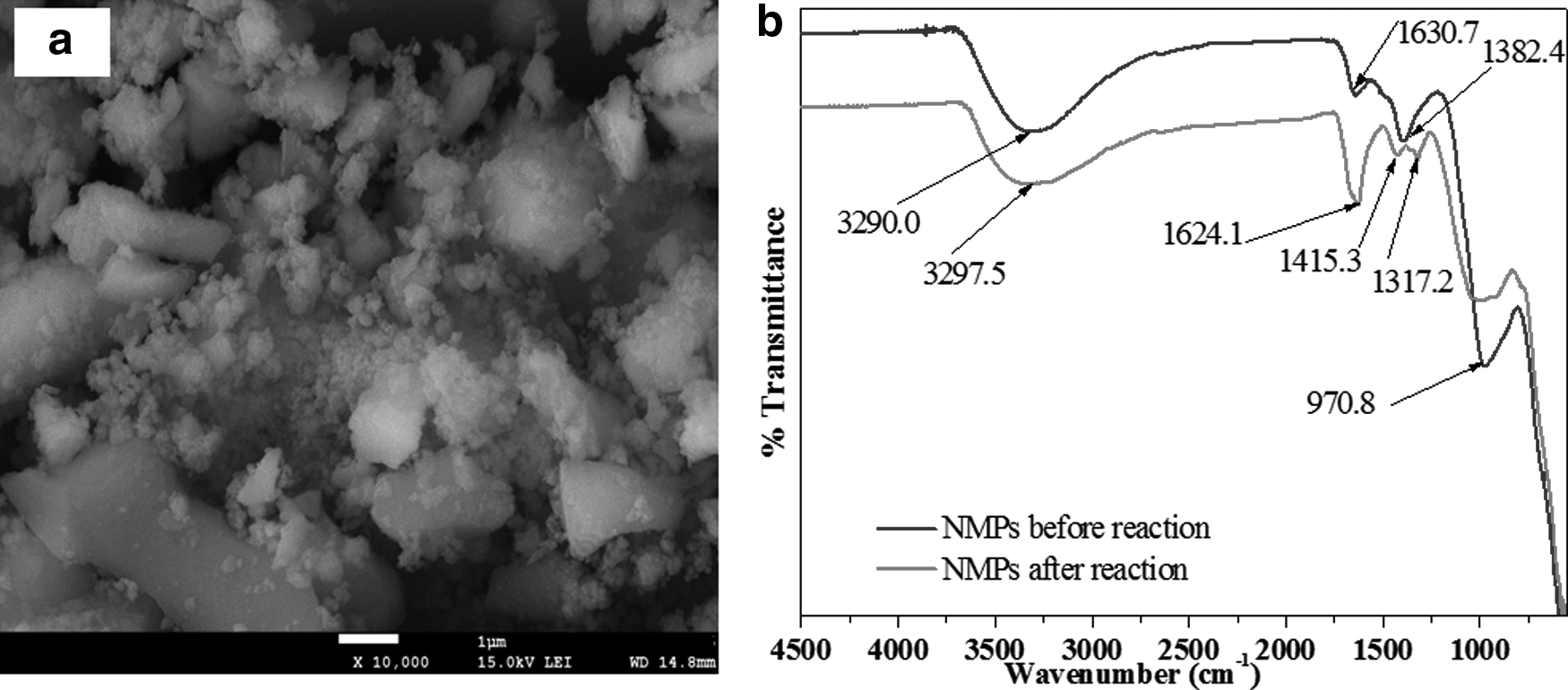
Scanning electron microscopy image (
Figure 1b shows the FT-IR spectra of the NMPs before and after the reaction with MO. A peak was observed at 1,382.4 cm−1, indicating the presence of metals oxide (M-O) bands on the surfaces of the NMPs. However, after the reaction, this peak was found to be smaller. In addition, it shifted at 1,415.3 cm−1. The M-O band represents MO, M2O3, and M3O4, indicative of the partial oxidation of the NMPs (Zha et al., 2014). The FT-IR spectra of the NMPs displayed bands at 3,290 cm−1, providing evidence of O-H stretching (Singh et al., 2016a). This peak was widened and shifted to 3,297.5 cm−1. The peak at 1,630.7 cm−1 indicates O–H bending vibrations; however, the intensity of this peak was increased and shifted to 1,624.1 cm−1 (Yuan and Dai, 2014). However, bands at 970.8 cm−1 were observed after the Fenton-like oxidation of MO, corresponding to Fe-O stretching associated with Fe2O3 (Zha et al., 2014). A new band also appeared at 1,317.2 cm−1, representing the degradation product after the oxidation of MO under the Fenton-like process. XPS was applied to determine the surface chemical state of the elements (Table 1).
BE, binding energy; FWHM, full width half maximum.
Degradation of MO by NMPs
Effect of NMP dosage on the MO degradation outcome
The effects of various NMP dosages (0.05, 0.10, 0.20, 0.30, and 0.40 g/L) on the reaction rate were measured under the following experimental conditions: a pH of 3.0, an initial MO concentration of 10 mg/L, a temperature of 25°C, and a H2O2 concentration of 50 mM (Fig. 2). The degradation efficiency of MO increased with an increase in dose to 0.10 g/L, possibly due to the increased number of reaction sites with increase in the concentration of NMPs (Fang et al., 2010). However, upon a further increase in the dosage, the MO degradation efficiency gradually decreased. An MO degradation efficiency rate of ∼100% was achieved in a reaction time of 210 min with a dose of 0.10 g/L. However, the degradation efficiency of MO was reduced to 45.1% with a dose of 0.4 g/L of NMPs. This may stem from both the clustering of NMPs during the reaction and the scavenging of hydroxyl radicals through unwanted reaction [Eq. (iii)] (Xu and Wang, 2011; Babuponnusami and Muthukumar, 2012).
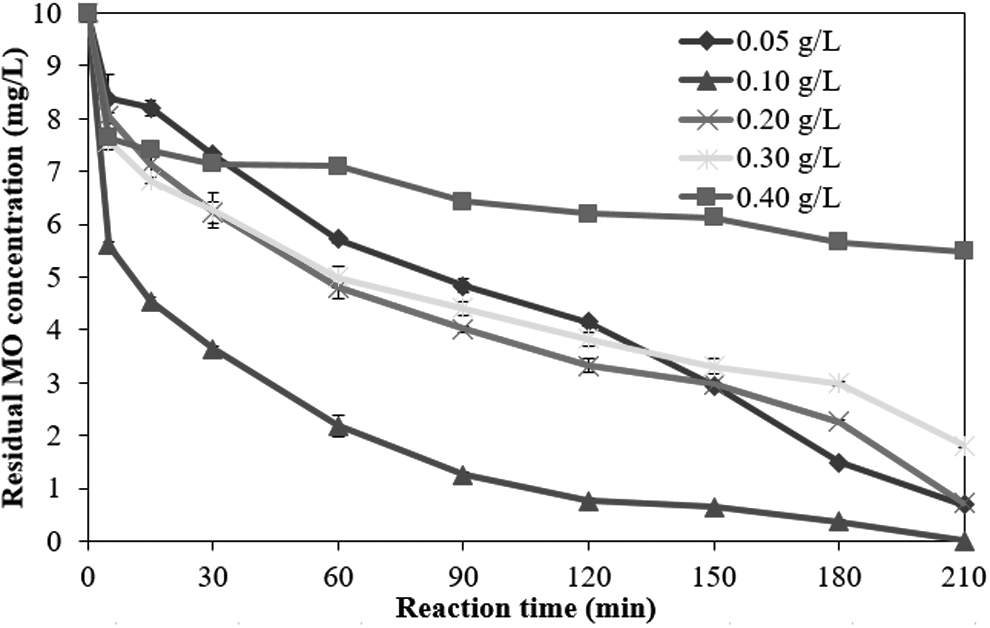
Effects of different dosages of NMPs on MO degradation process (test conditions: MO concentration: 10 mg/L, pH: 3.0, concentration of H2O2: 100 mM, and temperature: 25°C). MO, methyl orange.
where M represents the metal such as Fe.
Babuponnusami and Muthukumar (2012) also observed similar trend for degradation of phenol by nano zerovalent iron. Furthermore, by increasing the dose of NMPs, the initial pH of MO solution was slightly increased, resulting in reduced MO degradation efficiency. NMPs are very efficient when used for MO degradation owing to their small size and relatively large surface area. On the basis of the results as presented in this study, the optimum dosage of NMPs was determined to be 0.10 g/L for the subsequent MO degradation step. Figure 3a shows a plot of ln Ct/C0 versus the reaction time for the degradation of MO with different dosages of NMPs. The values of the pseudo-first-order rate constant (k1), pseudo-second-order rate constant (k2), and R2 for MO degradation with different dosages of NMPs are given in Table 2. The value of k1 increased initially to 54.2% with an increase in dosage to 0.10 g/L, after which it decreased linearly as the dosage was increased. The similar trend was also observed for k2. The differences in MO degradation rate with changing dosages of NMPs were significant (likelihood ratio “F” = 43.78, probability “p” < 0.05).
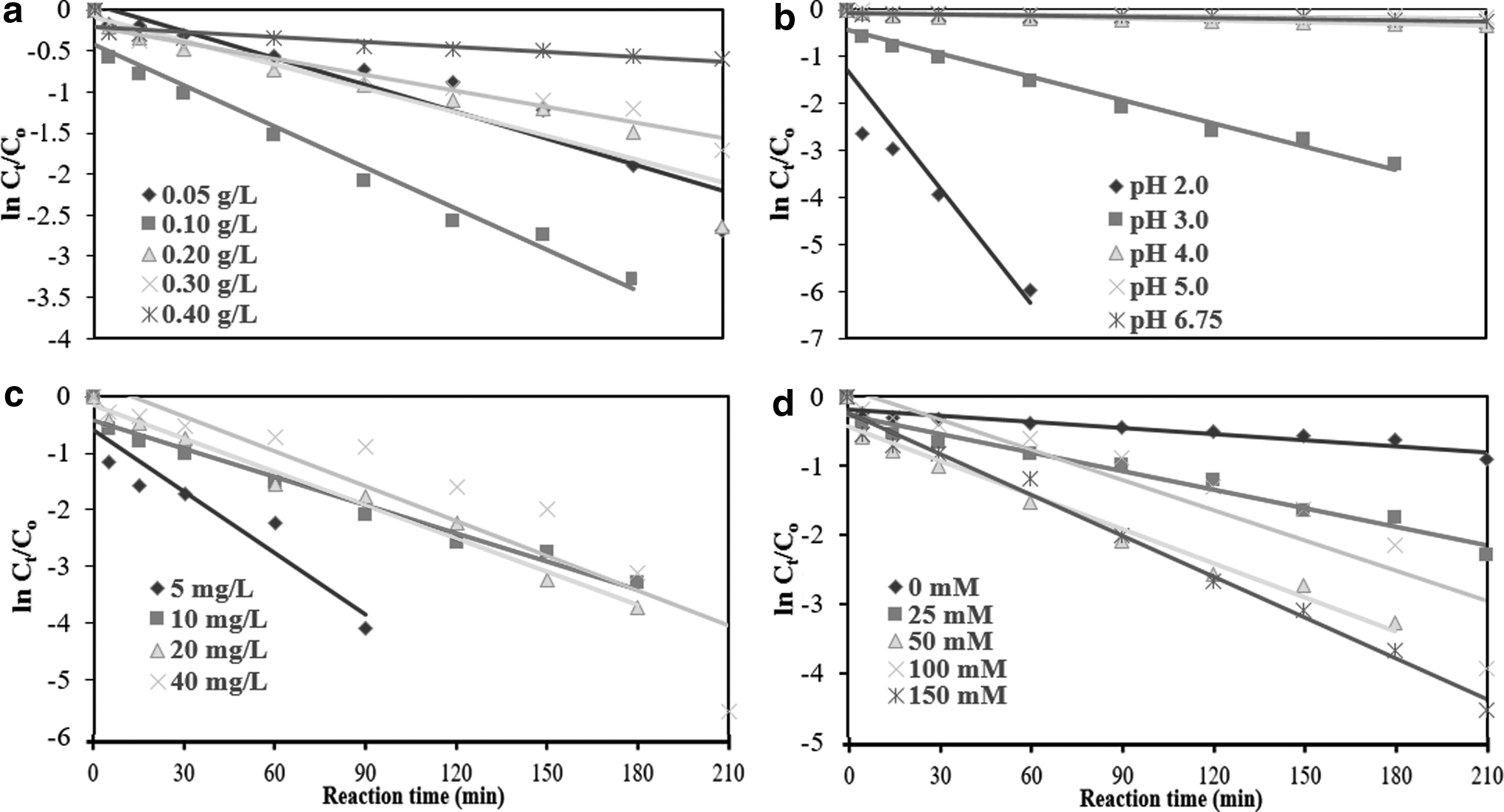
Kinetic study of MO degradation by NMPs with different parameters: NMP dose
NMPs, nano-metallic particles.
Effect of pH level on MO degradation
The pH is a very important parameter that can affect the degradation of organic pollutants with NMPs under an acidic condition. An acidic condition of a solution creates more reactive sites on NMPs, increasing the degradation of organic pollutants. However, a highly acidic pH of a solution (pH <2) causes rapid corrosion of the NMPs, reducing the pollution degradation efficiency (Tian et al., 2009). The effects of different pH values (2.0, 3.0, 4.0, 5.0, and 6.75) on the degradation of MO were studied under the following experimental conditions: an NMP dose of 0.10 g/L, an initial MO concentration of 10 mg/L, a temperature of 25°C, and an H2O2 concentration of 50 mM (Fig. 4). The degradation efficiency of MO reached 100% in a reaction time of 60 min at an initial pH of 2.0.
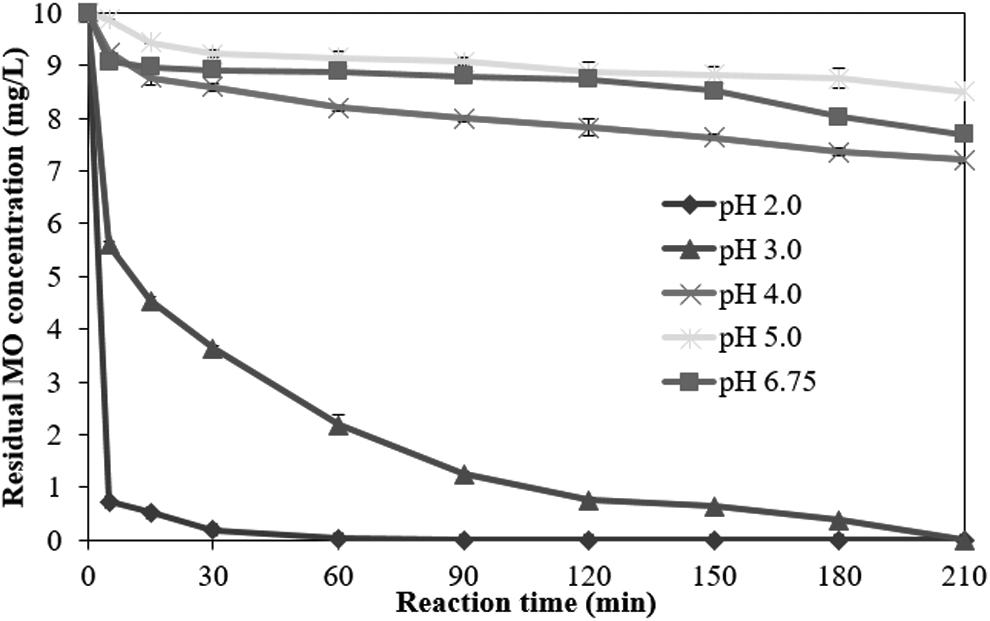
Effects of different pH levels on MO degradation process (test conditions: MO concentration: 10 mg/L, NMP dose: 0.10 g/L, concentration of H2O2: 50 mM, and temperature: 25°C).
Degradation efficiency of MO was decreased from 100% to 14.9% with an increase in the pH from 2 to 5 at a reaction time of 210 min. This can be attributed to the decay of H2O2 and decreased activity of the NMPs (Babuponnusami and Muthukumar, 2012). Figure 3b shows a plot of ln Ct/C0 versus the reaction time for degradation of MO at different pH levels. As shown in Table 2, the values of k1 and k2 were decreased when the pH was increased from 2.0 to 5.0. Noticeably, quick degradation of MO by NMPs was observed at a solution pH of 2.0. These results also show that the reaction rate decreased with an increase in the pH. Furthermore, the oxides on the surfaces of NMPs rapidly dissolved at a low pH and the active sites were free, triggering the corrosion of metals, including Fe (Fang et al., 2010). The generation of hydroxyl radicals was increased due to the decomposition of H2O2 under an acidic condition (Xu and Wang, 2011). The values of k1, k2, and R2 for the degradation rate of MO with different values of pH are given in Table 2. The variations in MO degradation rate with different pH of solution were significant (F = 43.35, p < 0.05).
Effects of initial concentration of MO on degradation of MO
The effects of the initial concentration of MO (5, 10, 20, and 40 mg/L) on the reaction rate were considered under the following experimental conditions: an NMP dose of 0.10 g/L, an initial pH of 3.0, a temperature of 25°C, and H2O2 concentration of 50 mM (Fig. 5). The residual MO concentration was found to be 0.0 at the initial MO concentration of 5–20 mg/L and was found to be 0.04 mg/L at an initial concentration of 40 mg/L. The degradation efficiency of MO was not affected when the initial concentration was increased to 20 mg/L; however, it was reduced slightly at 40 mg/L. Initially, the degradation rate was low with the highest concentration of MO, but after a reaction time of 150 min, the efficiency increased significantly. The active sites of NMPs were limited by the increasing MO concentration. Figure 3c shows a plot of ln Ct/C0 versus the reaction time for the degradation of MO with different concentrations of MO. As shown in Table 2, the values of k1 and k2 were decreased with an increase in the initial MO concentration. The reduction of the MO degradation rate in the initial state can be attributed to the adsorption of MO on the surfaces of the NMPs, which likely blocked the active sites of the particles, subsequently reducing the generation of hydroxyl radicals (Xu and Wang, 2011). The values of k1, k2, and R2 for the degradation rate of MO with different MO concentrations are given in Table 2. In this study, the cost of degradation of MO will not be affected by time duration to remove MO 100% because reaction was conducted at room temperature (25°C). The variations in MO degradation rate with different initial concentrations of MO were significant (F = 42.48, p < 0.05).
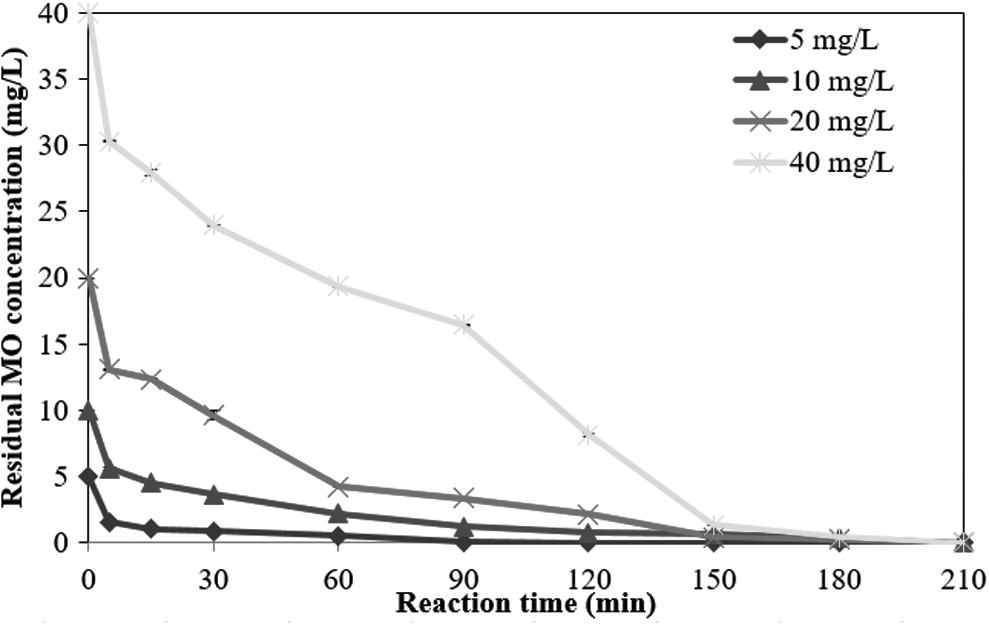
Effects of different initial concentrations of MO on MO degradation process (test conditions: pH: 3.0, NMP dose: 0.10 g/L, concentration of H2O2: 50 mM, and temperature: 25°C).
Effects of addition of H2O2 on MO degradation
The effects of various quantities of H2O2 (0, 25, 50, 100, and 150 mg/L) on the reaction rate were studied under the following experimental conditions: an NMP dose of 0.10 g/L, an initial pH of 3.0, a temperature of 25°C, and an initial MO concentration of 10 mg/L (Fig. 6). The degradation rate of MO by NMPs was very low in the absence of H2O2, likely due to the inadequate or lack of generation of hydroxyl radicals during the reaction. The MO degradation efficiency was increased from 59.5% to 100% with an increase in the amount of H2O2 from 0 to 50 mM; this occurred due to the generation of a considerable number of hydroxyl radicals (Xu and Wang, 2011). However, upon a further increase in the amount of H2O2, the degradation efficiency was reduced, possibly due to recombinations of hydroxyl radicals and the scavenging effect of H2O2, resulting in a decrease in the oxidation of NMPs by H2O2 (Babuponnusami and Muthukumar, 2012). Figure 3d shows a plot of ln Ct/C0 versus the reaction time for the degradation of MO with different amounts of H2O2. The value of k1 was increased when the amount of H2O2 was increased to 50 mM, and with a further increase in the concentration of H2O2, the value of k1 was slightly decreased. Whereas, the value of k2 was increased to 78% when the amount of H2O2 was increased to 150 mM. The degradation of MO was improved significantly with the combination of NMPs and H2O2 compared to that with NMPs alone. The values of k1, k2, and R2 for MO degradation rates with different concentrations of H2O2 are given in Table 2. The variations in MO degradation rate with different concentrations of H2O2 were significant (F = 43.03, p < 0.05).

Effects of different concentrations of H2O2 on the MO degradation process (test conditions: MO concentration: 10 mg/L, pH: 3.0, NMP dose: 0.10 g/L, and temperature: 25°C).
Possible mechanism for degradation of MO by NMPs
Removal efficiency rates of MO with NMPs alone and in combination with H2O2 were studied. The oxidation of MO by hydroxyl radicals is mainly responsible for the degradation of MO in an aqueous solution. Hydroxyl radicals are generated when an electron moves from the surface of the NMPs to H2O2. The NMPs can react with the available H2O2, leading to the generation of many hydroxyl radicals (Cheng et al., 2015). The highest rate of MO degradation was attained at a pH of 2.0, most likely due to the high corrosion of NMPs and availability of many active sites for the reaction with MO. Furthermore, the degradation of MO by NMPs can be attributed to the direct transfer of an electron from the metal surface to the MO dye (Asghar et al., 2015). The oxidation of MO with the application of the oxidizing agent H2O2 in the acidic pH of the solution and an oxic condition was mainly due to the generation of hydroxyl radicals during the reaction (Yang et al., 2010). The removal mechanism of MO using NMPs is expressed as follows (Singh et al., 2016a):
(M = metal, n = number of valences, O = oxides, x and y = number of moles).
Conclusion
An application of NMPs for MO degradation under a Fenton-like process was found to be highly effective. The MO degradation efficiency was increased with an increase in the dosages of the NMPs and concentration of H2O2 up to a certain limit. However, the degradation rate was decreased as the pH was increased. The rate of degradation of MO was reduced at an initial concentration of 40 mg/L in the initial phase, after which it increased rapidly. The optimum conditions for MO degradation were a pH of 3.0, an initial MO concentration of 40 mg/L, an NMP dose of 0.10 g/L, an amount of H2O2 of 50 mM, a temperature of 25°C, and a reaction time of 210 min. The highest removal rate of MO was found to be ∼100% at all initial MO concentrations ranging from 5 to 40 mg/L. The pseudo-first-order kinetics was well fitted compared with pseudo-second-order kinetics for the degradation of MO by NMPs. The degradation rate was very high at the solution pH of 2.0, and the highest value of k (0.083 min−1) was observed at this pH. A feasible mechanism for the degradation of MO by NMPs with H2O2 was the oxidation of MO by hydroxyl radicals. This study concludes that MO was removed significantly with the application of NMPs in a Fenton-like process.
Footnotes
Acknowledgments
This study was conducted with the assistance of a research grant from Kwangwoon University in 2016. This work was also supported by the Korean Ministry of the Environment as part of the “GAIA project” (2014000550003).
Author Disclosure Statement
No competing financial interests exist.