




Abstract
Abstract
Oil and gas exploration activities generate a considerable wastewater, among which produced water is the most relevant. The chemical complexity of this stream (high ammonium and salt concentrations) adversely affects biological treatment and can be detrimental to sensitive organisms such as nitrifiers. This study addressed the nitrification of produced water from a Brazilian oil extraction platform. Laboratory-scale experiments have shown that nitrification activity could not be sustained with raw produced water in the long term. Nevertheless, when produced water was appropriately diluted, detrimental effects on nitrification were significantly reduced. Experiments evaluating effects of increasing salt concentrations on nitrification have shown that complete ammonium removal were achieved even at very high salt concentrations (up to 100 g NaCl/L). At 125 g NaCl/L, however, nitrifiers were completely inhibited and negligible ammonium removal was observed. Additional tests with no biomass and under similar operational conditions to those applied in previous experiments confirmed that biological nitrification was the most important mechanism of ammonium removal.
Introduction
O
Recently in Brazil, oil reserves were found in the so-called presalt region. The presalt region consists of a set of rocks with a high potential for the generation and accumulation of petroleum, located in ultra-deep waters under an extensive layer of salt with a thickness of up to 2,000 m. The presalt was created around 160 million years ago, when the supercontinent Gondwana began to break apart, giving place for the South American and African continents. The deposition of sediments between the two continents created a low energy and high salinity environment (Formigli et al., 2009; Magalhaes et al., 2014).
Produced waters in presalt region are known to have high concentrations of chloride. Depending on the exploration field and age of the oil well, the salinity level can reach 200 g Cl−/L. In addition to salinity, these waste streams present high concentrations of nitrogen in the form of ammonium, which is generated during the natural geological formation of the petroleum reservoir or by means of biological activity (Tibbetts et al., 1992; Swan et al., 1994).
Ammonium is an important source of nitrogen for living beings and is found throughout the environment in the air, soil, and water. Its presence in water bodies can cause numerous negative effects on the environment and aquatic life. High levels of nitrogen induce the occurrence of eutrophication, during which proliferation of harmful cyanobacteria blooms may take place. Loss of species diversity in the affected ecosystem, as well as degradation of recreational resources, is also the potential consequence of eutrophication. In addition to the negative consequences arising from this process, the toxicity posed by free ammonia (NH3) is an important aspect that should be considered in nitrogen-rich wastewaters (Sharma and Ahlert, 1977; Reinbold and Pescitelli, 1982; Fakhru'l-Razi et al., 2009).
Given the importance of avoiding the discharge of nitrogen compounds into the environment to minimize their associated problems in the aquatic ecosystems, nitrogen removal from wastewaters is often implemented in the wastewater treatment plants. One of most sustainable and cost-efficient approach to achieve such a goal involves the use of microorganisms in the so-called biological wastewater treatment processes.
Conventionally, the biological nitrogen removal process is accomplished in two sequential stages: nitrification and denitrification. In the first step, ammonium is oxidized to nitrate with intermediate formation of nitrite. Subsequently, denitrifying organisms reduce the nitrate to nitrogen gas in an anoxic environment (Tchobanoglous, 2003). Nitrification is regarded as the rate-limiting step in the overall biological nitrogen removal process. This autotrophic process is very vulnerable to several environmental conditions (e.g., pH, dissolved oxygen [DO], and temperature) (Kaplan et al., 2000) and wastewater characteristics (Pagga et al., 2006; Bassin et al., 2012). Hence, it has been frequently reported to be the cause of failure of many wastewater treatment plants.
High salt concentration, a common characteristic of many industrial wastewaters (Dahl et al., 1997), is known to adversely affect the metabolic activity of nitrifiers, provoking a reduction in both the microbial growth and ammonium conversion rates (Moussa et al., 2006). Hence, the effect of salt on the nitrification process has been the subject of study in several previous investigations. Most of the research undertaken within this topic involves the use of synthetic saline wastewater prepared in the laboratory (Uygur and Kargi, 2004; Moussa et al., 2006; Pronk et al., 2014). Although this approach allows for more well-controlled experimental conditions, it does not take into account the complexity and variability of real wastewaters. In this sense, the use of real wastewaters provides a more representative picture of the challenges faced in reality.
In fact, the treatment of high salinity wastewater coming from a wide range of industrial processes by biological means has also been reported previously (Lefebvre et al., 2004; Lima et al., 2009). From the aforementioned studies, only Lima et al. (2009) investigated the removal of ammonium from produced waters. However, these authors made use of an electrolytic process to achieve such a goal, while the use of biological process to mediate this conversion was not investigated. The importance of the presalt region and the increasing exploitation of the oil reserves located in this region motivated this work, whereby the effect of increasing salt concentrations on biological nitrification of produced water from the presalt region was addressed. Several experiments were conducted to determine the most appropriate conditions for the establishment of a nitrifying consortium capable of removing ammonium from this complex waste stream.
Materials and Methods
Wastewater source
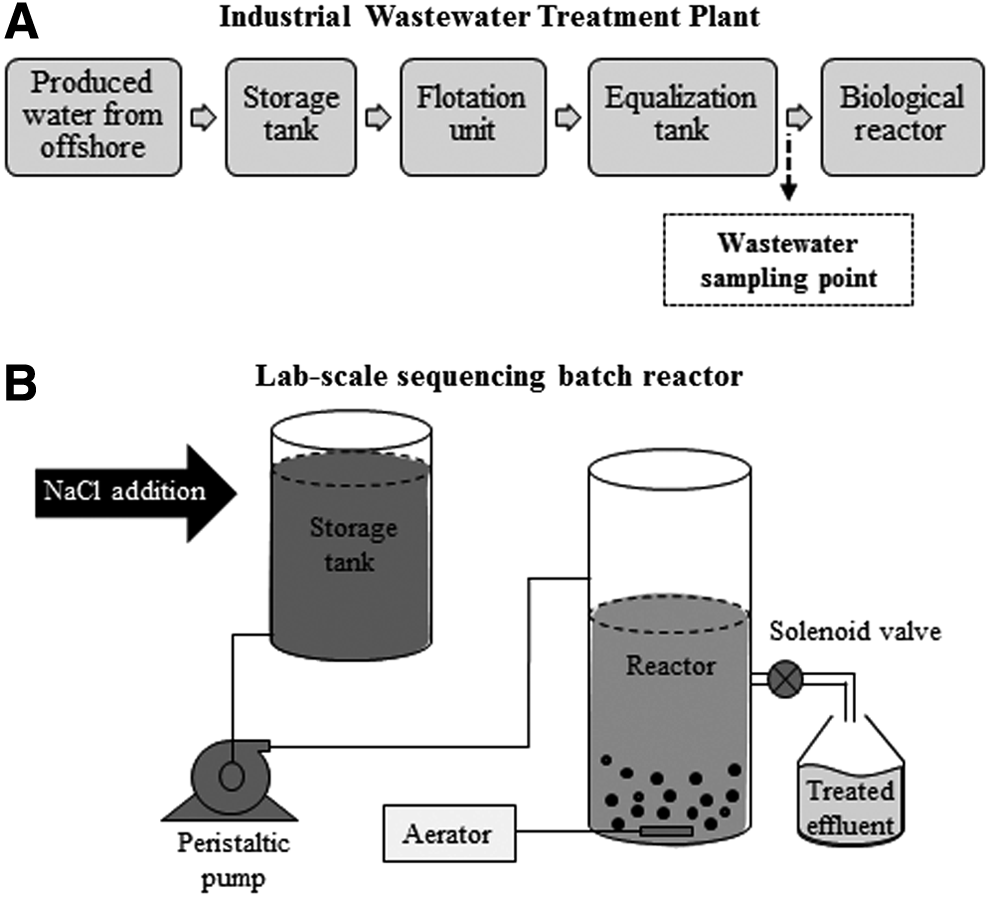
The wastewater under study consisted of produced water from oil extraction collected at a treatment plant located at a Petroleum Terminal in the Brazilian Coast. The treatment process in the Petroleum Terminal comprises a dissolved air flotation unit, where oil is separated from the water; an equalization tank, where pH is adjusted to 7 and sodium tripolyphosphate is dosed as a phosphorus source to ensure a COD:P ratio of 100:1; and three independent activated sludge reactors run in sequencing-batch mode with a hydraulic retention time of 8 h. A schematic representation of Industrial Wastewater Treatment Plant is shown in Fig. 1A. To better understand the effect of increasing salt concentrations on nitrification of the produced water arisen from the oil extraction activities, a more systematic laboratory-scale experiment was designed.
Schematic flow-diagram of the
The wastewater used in this study was collected downstream of the equalization tank (Fig. 1A). It was collected as eight samples of effluent (one sample per month). The wastewater was transported to the laboratory located at the Federal University of Vicosa (Vicosa, Minas Gerais, Brazil) and stored at 4°C until use (about 30 days), to maintain its original characteristics. The laboratory-scale experiments were conducted in two identical sequencing-batch reactors (SBRs) with 8 h cycle (Fig. 1B). Salt was artificially added to investigate its impact on the nitrification performance. The presalt production water can reach chloride concentration up to 200 g/L. Table 1 presents the average values obtained for several physicochemical parameters analyzed during the characterization of produced water collected over the entire experiment.
Both the raw and diluted waste stream composition are shown. The 1:2 dilution ratio was determined in a preliminary experiment, as will be explained further on.
COD, chemical oxygen demand; TDS, total dissolved solids; TSS, total suspended solids.
Preliminary experiments with produced water
Preliminary experiments were conducted to investigate the adaptation of microorganisms to the produced water. During ∼1 month, two identical laboratory-scale SBRs were fed with produced water. Sludge from the full-scale aerobic tanks (Fig. 1) was used as inoculum for the laboratory-scale SBRs. Due to operational problems, such as floc malformation, sludge washout, and microorganism growth inhibition (oxygen uptake rate extremely low), additional tests were conducted. A second round of experiments was completed; the raw wastewater was diluted to determine the minimum dilution that would enable adaptation of microorganisms within the reactor systems.
Distilled deionized water was used for dilution to keep only the constituents of the produced water without the addition of other organic and inorganic compounds. The following wastewater:distilled water ratios were used: 1:4, 1:3, 1:2, and 1:1. Raw undiluted wastewater was also used as a comparison and for confirmation of the results obtained in the previous experiments. Furthermore, two reactors were operated to confirm the reproducibility of the results.
Reactor setup and operating conditions
Experiments were carried out in two SBRs (R1 and R2), operated in parallel, with a volume of 1 L. The reactors were equipped with air diffusers for aeration and mixing and were inoculated with 500 mL of activated sludge from the full-scale activated sludge system (shown in Fig. 1). The laboratory-scale bioreactors were kept at 30°C and were operated in 8-h cycles, which consisted of 2.5 h of aerated feeding, 4.5 h of reaction under aerobic conditions, 55 min of sedimentation, and 5 min of effluent discharge. The pH in R1 and R2 was corrected to 6.5.
After sedimentation, 200 mL of the supernatant (treated effluent) was withdrawn from the reactors and the cycles were restarted. Therefore, the hydraulic retention time of each reactor was 40 h. The DO levels were always kept above 2 mg/L. In addition, 4 mg/L of phosphoric acid was added to the influent diluted wastewater to ensure sufficient phosphorus for microbial metabolism. No sludge was discharged intentionally.
Figure 2 shows a schematic representation of the experimental conditions applied in this study, which was divided in two stages. The nitrification potential was evaluated at different salinity levels. Three reactors (R1, R2, and R3) were operated in parallel. R1 and R2 were subjected to gradual increase of salt (NaCl) concentrations, whereas R3 acted as a control (no additional salt was added). The background salt concentration in R3 was 25 g/L. Salinity concentrations in R1 and R2 were increased by 5 g/L per week until nitrification inhibition was detected. Based on the prediction that biomass loss could occur due to salt addition, R1 received the extra load of salt first, while R2 received it after 1 week of operation. In this sense, salt addition was alternated between R1 and R2.

Flowchart showing the experimental conditions applied to each reactor. “X” refers to the maximum salt concentration under which no nitrification activity was observed in R1 and R2. R3 (control experiment) was not supplied with extra salt. R4 was operated to observe if nitrification occurred by other means than through biological nitrification.
The initial goal of this research was to reach a final NaCl concentration of 200 g/L, which is similar to the concentration expected in the Brazilian presalt produced water. A single aerated reactor (R4) containing no biomass was also operated to evaluate the removal of ammonium by other means than by biological nitrification (Fig. 2). Because ammonia volatilization is dependent on pH, the incoming wastewater pH was corrected to 6.5. Raw wastewater was used as feeding medium to this reactor. The pH, DO, ammonium, nitrite, and nitrate were monitored hourly for 8 h.
Analytical methods
Raw wastewater was characterized by means of the following parameters: chemical oxygen demand (COD), ammonium, nitrite, nitrate, color, turbidity, total suspended solids (TSS), total dissolved solids (TDS), pH, alkalinity, and salinity. The evaluation of nitrification performance over time was performed through the assessment of ammonium, nitrite, and nitrate concentrations in the input and output streams. Commercial analytical kits (Hach TNT 836 and 840) were used to evaluate the nitrate and nitrite concentrations, respectively. The remaining determinations were carried out according to the Standard Methods for the Examination of Water and Wastewater (APHA, 1998), as showed in Table 2.
Results and Discussion
Preliminary experiments with produced water
The first set of nitrification experiments with produced water from the Petroleum Terminal was conducted in two laboratory-scale SBRs (Fig. 3). In both reactors, which were operated under the same conditions, ammonium removal was observed to gradually increase from the beginning of the experiment until day 14. Concurrently, nitrate concentrations were observed to increase, confirming the occurrence of nitrification. Full ammonium removal was observed after the first 2 weeks of operation. However, from this period onward, operational problems such as sludge deflocculation occurred, leading to massive biomass washout. The sharp reduction in the concentration of volatile suspended solids observed from the beginning of the 3rd week onward coincided with the decrease in the ammonium removal efficiency. Consequently, less nitrate was observed in the effluent of the reactors. On day 28, no nitrate formation was noticed and the relatively low ammonium removal (%) was attributed to heterotrophic biomass growth.

The results therefore showed that, similar to what is observed in the industrial scale plant, the microorganisms in the laboratory-scale setup could not adapt well to the raw wastewater. It may also be possible that some substances present in the incoming wastewater inhibited the nitrification process. As the results obtained in the two reactors were practically the same, it seems that only 2 weeks of continuous reactor operation are enough to completely lose the nitrifying activity. In an attempt to observe if the constituents of the produced water were indeed provoking inhibition to nitrifying bacteria, the influent wastewater was diluted with pure distilled water. The pure distilled water was selected as the dilution medium to avoid any other interference to the laboratory-scale biological treatment than that caused by the produced water constituents. In this set of experiments, the rate dilution (i.e., wastewater:distilled water ratio) was gradually increased from 1:4 to undiluted raw wastewater.
Taking into account that nitrate is the main product of nitrification, its concentration was determined in the subsequent assays to evaluate the nitrification efficiency at different dilution ratios of the incoming wastewater. The effluent nitrate concentration increased as the ratio of influent:distilled water decreased from 1:4 to 1:1 (Fig. 4). This result was expected because a smaller dilution factor implies a greater concentration of ammonium in the influent, and, therefore, a greater amount of nitrate formed. This trend was clearly observed until day 28, in which a dilution factor of 1:1 was used. Afterward, a significant reduction in nitrate formation was observed as a result of the decreasing amount of ammonium that was oxidized by nitrifiers.

Nitrification assessment by the quantification of nitrate in the tests carried at different dilution rates of the produced water. Nitrate concentrations over time were measured in the influent (■) and effluent of R1 (•) and R2 (▲).
The concentration of TSS was measured throughout the entire experiment in which the dilution rate was varied. The average TSS concentrations for all dilution ratios were similar and varied from 3,500 mg/L in R1 and 2,500 mg/L in R2. However, a severe drop in the amount of TSS was observed in both reactors when they were fed with undiluted effluent. After 7 days of operation under these conditions, the TSS concentrations amounted to only 390 and 830 mg/L in R1 and R2, respectively. This corresponds to a decrease of 88% in R1 and 67% in R2. The sludge losses would probably be related to some toxic compound present in the effluent, although it is not proved in this research.
The significant washout of TSS from the reactors is possibly a consequence of biomass decay. Furthermore, the results obtained with undiluted wastewater were consistent with the previous results and stresses the difficulties encountered for establishing an effective nitrifying consortium with this particular waste stream. In fact, the nitrification process can be inhibited by several organic compounds, by ammonia when present in high concentrations, especially in the nonionized form (NH3), and by nitrous acid (HNO2) (Sheintuch et al., 1995; Carrera et al., 2004). Hydrogen sulfide, TDS, and petroleum hydrocarbons, in their individual or combined forms, were reported to be the possible causes of toxicity posed by produced waters from oil production (Stephenson, 1992). Gabardo (2007) found values in the range of 0.05–6.8 mg/L for sulfides, 4–251 mg/L for petroleum hydrocarbons, and 81–91 mg/L for TDS in a study on chemical and toxicological characteristics of produced waters discharged over 10 years along the Brazilian coast.
Nitrification performance under increasing salt concentrations
To determine the most appropriate conditions for the establishment of a nitrifying consortium capable of removing ammonium in high salinity, the nitrification potential was evaluated at different salinity levels. Taking into account the results obtained previously, the wastewater dilution ratio used in further experiments was chosen to be 1:2. The ammonium profiles in the two reactors (R1 and R2) subjected to gradual increase in the salt concentration for over 9 weeks are shown in Fig. 5. Overall, the ammonium concentrations in the influent of the reactors ranged from 21.8 to 50 mg/L, while the effluent ammonium concentrations were lower than 5 mg/L. The average ammonium removal efficiency was determined to be ∼86%.

Influent (■) and effluent (•) ammonium concentrations in R1
Ammonium concentrations in the influent and effluent of R1, as well as the ammonium removal efficiency at various levels of salinity, are shown in Fig. 5a. The initial salt concentration in the feeding of R1 was ∼25 g NaCl/L, whereas the concentration of ammonium ranged from 23.5 to 52.1 mg/L. At salt concentrations up to 100 g/L, ammonium was almost fully removed. However, when the salinity concentration reached 105 g NaCl/L, the ammonium removal percentage dropped to around 65%. At greater than 105 g NaCl/L, the percentage of ammonium removal gradually decreased. At 125 g/L of salt, nitrification was observed to be negligible. A similar behavior was observed in R2, in which the removal percentage remained nearly 100% at salt concentrations up to 100 g/L (Fig. 5b).
A decline in the efficiency was observed at salt concentrations of 70 and 75 g/L, when the ammonium removal was ∼50%. Such a drop in performance, however, was attributed to oxygen limitation caused by problems with the aeration device in this particular reactor. As already observed for the concurrent reactor (R1), ammonium removal efficiency decreased considerably when the salt content was increased to 105 g/L, reaching only 65%. From this concentration onward, the removal percentage gradually decreased until reaching values close to zero at salt concentrations of 125 g/L.
High salinity causes disruptions in biological systems due to the variation in the medium's ionic strength, resulting in plasmolysis of microorganisms and loss of metabolic activity (Uygur and Kargi, 2004). Nevertheless, this study showed that the microbial biomass within the system could well withstand considerably high salinity concentrations (up to 100 g/L), as indicated by the high ammonium removal efficiencies. The gradual adaptation of the nitrifying microorganisms to salt was shown to be a good strategy to select for high salt-tolerant organisms. Actually, the gradual adaptation of nitrifying bacteria to salt has been used by several researchers as a strategy to obtain high-ammonium removal efficiency at high salt concentrations.
Pansward and Anan (1999) found that acclimatization is an important factor in the nitrification of effluents with high concentrations of salt. These authors observed that nitrifying organisms show greater inhibition when subjected to shocks of high salinity. However, the nitrifying organisms were capable of adapting to high salinity levels when gradually acclimated to increasing salt levels over time. These authors also report that the microorganisms can recover from inhibition after such stressful condition. However, their study was limited to stress concentrations of 70 g/L NaCl. Moussa et al. (2006) did not observe a significant effect on the activity of nitrifying bacteria submitted to gradual salinity increase in sludge adapted to 10 g NaCl/L during 1 year. In both adapted and nonadapted sludge conditions, the salinity stress at 40 g NaCl/L was inhibited in 95% of the activity of ammonia and nitrite oxidizing bacteria.
Campos et al. (2002) were able to sustain nitrification efficiency of an activated sludge system fed with high ammonium concentrations and submitted to concentrations of 30.7 g NaCl/L or less. Above this concentration, the system began to accumulate ammonia at inhibitory concentrations, dramatically reducing the system efficiency due to the combined effect of high concentrations of salt and ammonia.
In the present study, the maximum salt concentration was almost twice that applied by Pansward and Anan (1999) and more than three times that used in the work conducted by Moussa et al. (2006). In this study, the concentration of salinity that caused complete nitrification inhibition was determined to be ∼125 g/L, which is much higher than those observed by Moussa et al. (2006) and Campos et al. (2002). Furthermore, the reactors were fed with produced water from an oil extraction company, whereas the aforementioned studies used synthetic medium prepared in laboratory (Sudarno et al., 2011; Aslan and Simsek, 2012).
Lefebvre et al. (2004) investigated how the nitrification process behaves at a salinity concentration of 120 g/L by inoculating halophilic bacteria and using as influent a wastewater from a tartaric acid production plant. In the current study, high ammonium removal rates were observed at similar salt concentration without using bioaugmentation of particular organisms. In fact, such performance was achieved by simply using sludge from the full-scale activated sludge reactors as inoculum, which was adapted to a high salinity environment. This specific biomass can be used to bioaugment reactors treating various types of industrial wastewater with high salt concentrations to enhance the nitrification potential.
It should be noted that, although the nitrifying activity of this particular biomass is hampered if it is subjected to the raw produced water under study on a long term basis, the results indicated that high nitrification performance could be achieved if the wastewater is diluted. In the full-scale industrial plant, the combination of produced water with other type of waste stream may be an alternative to achieve sufficient nitrification.
The percentage of ammonium removal in the control reactor (R3), in which salt concentration was kept constant (no extra salt was added), remained at the same level (around 95%) during the entire operation (4 weeks). Only minor oscillations in the system performance were observed during the operating period (Fig. 5c). This implies that high nitrifying activity was sustained on a long term basis at the same salt concentration (25 g/L).
To investigate whether ammonium removal was only attributed to biological activity of nitrifying bacteria and not to physical or chemical processes, an aerated reactor was operated without biomass. The percentage of ammonium removal and formation of nitrite and nitrate in R4 at different pH values ranging from 7 to 8 (normal operating conditions) is shown in Fig. 6. The results showed that the pH did not affect the removal of ammonium when it was kept at values below 8. The concentrations of ammonium, nitrite, and nitrate did not change in the reactor during 8 h of test. The ammonium concentration amounted to 106 mg/L, whereas nitrite and nitrate concentrations were below 0.5 and 5 mg/L, respectively.
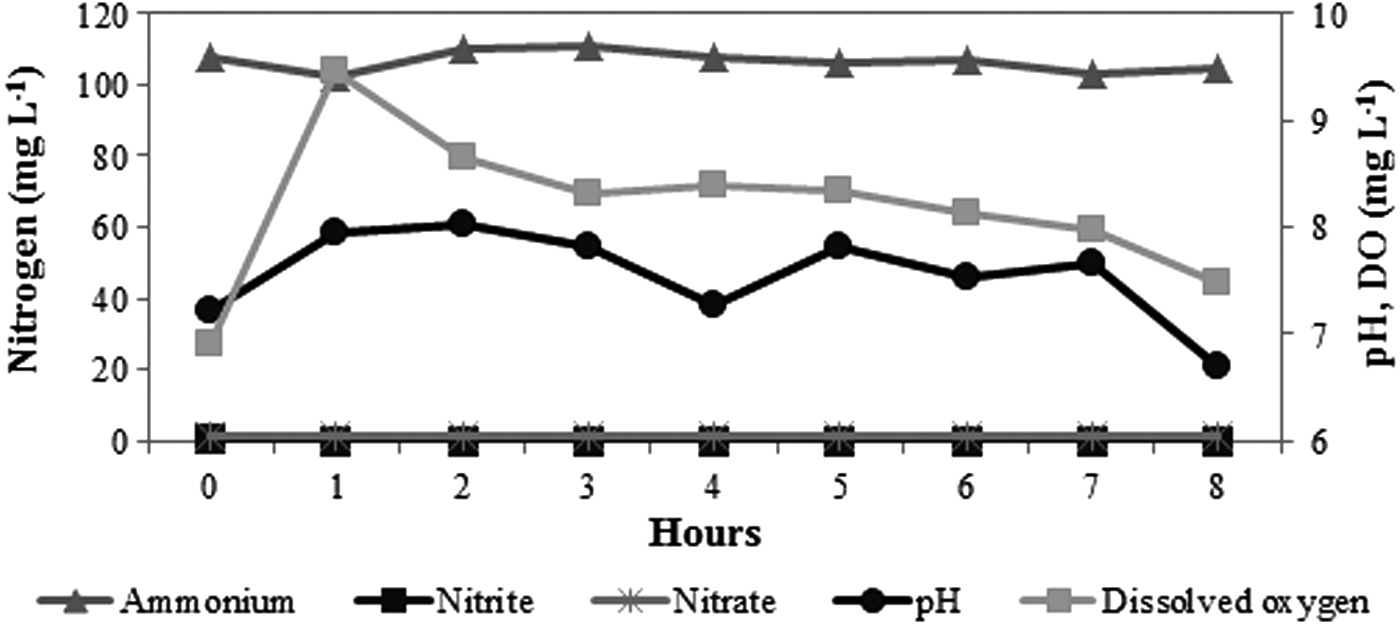
Experiment during which ammonium, nitrite, and nitrate concentrations were monitored during 8 h. No biomass was present inside the reactor. DO and pH over time are indicated in the right y-axis. DO, dissolved oxygen.
Conclusions
This study has stressed the difficulties in achieving high nitrification performance during the long-term treatment of raw produced water from an oil extraction platform. Nevertheless, when the wastewater was diluted, the negative impact of the compounds present in the wastewater on the nitrification process was minimized and high ammonium removal could then be achieved. After selecting the most appropriate dilution ratio (1:2), the SBRs operated in this study were capable of withstanding high salinity concentrations up to 100 g NaCl/L. Under these conditions, full ammonium removal was observed. For higher salt concentrations, nitrification performance gradually declined. Ammonium removal was observed to be negligible at 125 g NaCl/L, condition under which complete inhibition of nitrifiers occurred. Additional tests in an aerated system with no biomass and at the same pH levels observed under normal operating conditions of the reactors subjected to increasing salinity levels confirmed that ammonium removal was only attributed to biological activity of nitrifiers.
Footnotes
Acknowledgments
The authors are grateful for the financial and technical support of the Petrobras and the scholarship offered by CAPES.
Author Disclosure Statement
No competing financial interests exist.