




Abstract
Abstract
Urbanization results in an excessive release of wastewater and solid wastes into the environment. Reuse of fly ash, a coal combustion residue, in wastewater treatment is an example of using waste for waste treatment. In this study, thermally modified fly ash (TFA) was prepared by modifying raw coal fly ash using an environmentally friendly method. TFA was characterized via scanning electron microscope (SEM), X-ray diffraction (XRD), and X-ray fluorescence (XRF). Performance of TFA in the adsorption of Ni(II) and Cr(III) from an aqueous solution was also investigated. Results show that the specific surface area of TFA is 29.61 m2/g, which is nearly 30 times that of raw fly ash. New chemical groups, such as sodium silicate, sodium aluminum silicate, and calcium iron oxide, were generated on TFA compared with raw fly ash. Satisfactory correlation coefficients and relatively low chi-square analysis parameters between the experimental and predicted values of the Freundlich isotherm demonstrated that TFA adsorption of Ni(II) and Cr(II) was a multilayer chemical adsorption. Compared with the pseudo first-order model, the pseudo second-order kinetic model had higher correlation coefficients for both Ni(II) and Cr(II) adsorption by TFA. Equilibrium adsorption amounts of TFA for Ni(II) and Cr(II) were found to be 1.25 and 2.50 mg/g, respectively. Experimental values examined with intra-particle diffusion models show that there are two and three steps during the adsorption processes for Ni(II) and Cr(II), respectively. Thermodynamic results showed that adsorption processes were spontaneous for both Ni(II) and Cr(II) but were endothermic and exothermic, respectively. Desorption of TFA could be ignored. This article provides a basis for developing a new approach using an industrial solid waste for heavy metal removal from wastewater.
Introduction
I
Several technologies have been adopted for the removal of heavy metals, including Ni(II) and Cr(III), from aqueous solutions such as membrane separation (Pośpiech and Walkowiak, 2007), electrochemical treatment (Akbal and Camc, 2011), biological treatment (Jonathan et al., 2009), solvent extraction (Ramachandra and Neela, 2005), and adsorption (Taik-Nam and Choong, 2013; Li et al., 2015). Adsorption has received significant attention in recent years due to its high efficiency, simplicity of operation, and the eco-friendliness of adsorbent materials. In addition, adsorption has the additional advantage of applicability at very low concentrations (Mohanty et al., 2006).
The most widely used adsorption material in water or wastewater treatments is activated carbon. However, the high cost of this material is a disadvantage of the adsorption method. The applications of industrial and agricultural wastes in wastewater treatment, particularly the removal of metals, have been evaluated because of their many sources and low cost. Coal fly ash has been used in many studies as a potential low-cost heavy metal adsorbent (Puvvadi et al., 2011; Tiwari et al., 2012). The application of fly ash as an adsorbent for treating wastewater not only solves the problem of heavy metal removal but also recycles waste. More importantly, fly ash is readily available at little or no cost and hence, does not require a complicated regeneration process.
Although the adsorption capacity of raw fly ash is low, it can be improved via modification methods (Maria et al., 2012). An approach for improving the adsorption capacity of fly ash is to prepare a new adsorbent with the raw fly ash (Papandreou et al., 2011). Additionally, modification with chemical agents can form useful functional groups on the surface of fly ash. However, it may generate acidic or alkali liquid waste that may cause secondary pollution to the environment (Sarbak and Kramer-Wachowiak, 2002). Thus, an environmentally friendly method should be applied for the modification of fly ash.
In this study, a thermally modified fly ash (TFA) was obtained by calcining raw fly ash at a certain temperature. Efforts were then made to investigate the use of TFA as an adsorbent for the removal of Ni(II) and Cr(II) from aqueous solution. The adsorption equilibrium, kinetic, and thermodynamic models have been investigated to explain the possible mechanism of adsorption of the metals by TFA. This article may provide a basis for developing a new approach for utilization of an industrial solid waste in wastewater treatment.
Materials and Methods
Materials
Raw fly ash was obtained from the Yang Liuqing coal-burning power plant, Tianjin, China. Three steps were used to obtain the TFA. First, raw fly ash was sieved to yield particle sizes of no more than 74 μm and was completely dried at 105°C for 24 h. Second, fly ash was mixed with anhydrous sodium carbonate with a mass ratio of 3:1, and the mixture was calcined at 800°C for 2 h. Finally, TFA was obtained by grinding the products that were produced in the second step before cooling to room temperature.
Reagents
The chemicals nickelous nitrate (Ni(NO3)2
In total, exactly 0.4955 g of Ni(NO3)2
Equilibrium studies
In total, 0.20 g of TFA was mixed with 50 mL solutions of different Ni(II) or Cr (III) initial concentrations (1–100 mg/L). The mixtures were then shaken at a speed of 150 rpm for 120 min, and the resultant supernatants were withdrawn to determine the metal concentrations.
To optimize the design of the adsorption system, it is important to establish the most appropriate correlation for equilibrium conditions. According to different adsorption mechanisms, there are several different adsorption isotherms that are used for fitting experimental adsorption results. Among these, the Langmuir (1918), Freundlich (1907), and Dubinin et al. (1947) isotherms are widely used and are therefore applied in this study. The nonlinear forms of these isotherms are given as follows:
where Ce (mg/L) is the equilibrium concentration of Ni(II) or Cr(III); b (L/mg) is the Langmuir equilibrium constant related to the free energy or net enthalpy of adsorption (Mohan and Singh, 2002); qm (mg/g) is the maximum adsorption capacity at the isotherm temperature; KF ((mg)1−nLn/g) and n are the Freundlich equilibrium constants that indicate adsorption capacity and adsorption intensity, respectively; ɛ is the Polanyi potential that is equal to RT ln (1 + 1/Ce), where R (8.314 J/mol·K) is the gas constant; T (K) is the absolute temperature of the aqueous solution; and β (mol2/kJ2) is the D-R isotherm constant that is related to the mean free energy of adsorption per mole (E, kJ/mol) of the sorbate when it is transferred to the surface of the solid from infinity in the solution. The value of E can be calculated using the following relationship:
Kinetic studies
In total, 2.00 g TFA was mixed with 500 mL of either Ni(II) or Cr (III) solution with an initial concentration of 10 mg/L. The mixtures were then shaken at a speed of 150 rpm for different amounts of time. Supernatants (∼1 mL for each) were withdrawn at predetermined time intervals before the determination of metal concentrations.
To investigate the adsorption mechanism process, a nonlinearized pseudo first-order kinetic model and pseudo second-order kinetic model were applied and expressed as follows (Ho and McKay, 2000):
pseudo first-order kinetic model:
pseudo second-order kinetic model:
where t (min) is the contact time, k1 (1/min) and k2 (g/mg·min) are the adsorption rate constants, and qe and qt (mg/g) represent the amounts of metal uptake by TFA at equilibrium and time t, respectively.
In addition, the determination of the limiting step of the adsorption process is necessary for predicting the diffusion coefficient using a diffusion-based model. The possibility of intra-particle diffusion resistance that affects the adsorption was explored in this study using the intra-particle diffusion equation as follows (Delchet et al., 2012):
where, kid (mg/g·min1/2) is the intra-particle diffusion rate constant determined from the slope of the linear plot and C (mg/g) is the constant that indicates the boundary layer thickness.
Thermodynamic studies
In total, 0.20 g of TFA was mixed with 50 mL of either Ni(II) or Cr (III) solution with an initial concentration of 10 mg/L. The mixtures were then shaken at different temperatures (293, 303, and 313 K) at a speed of 150 rpm for 120 min. To determine the thermodynamic nature of the adsorption process, thermodynamic parameters were determined, namely, standard Gibbs free energy (ΔGo), standard enthalpy (ΔHo), and standard entropy (ΔSo) changes. The values of ΔHo and ΔSo can be calculated from the slope and intercept of the straight line obtained from plotting lnKd versus 1/T using the following equation:
where Kd (mL/g) is the distribution coefficient, which is a mass-weighted partition coefficient between the solid and liquid supernatant phases that reflects the selectivity for objective metal ions and can be calculated according to the formula:
where C0 (mg/L) is the initial concentration of Ni(II) or Cr(III), V (mL) is the volume of solution and m (g) is the mass of TFA used.
After obtaining the ΔHo and ΔSo values of the adsorption, the values of ΔGo at each temperature were calculated using the following well-known equation:
Analysis
A scanning electron microscope (model XL-30; Phillips, Netherlands) was used to characterize the morphology of TFA. The specific surface area of the sample was measured using a Mastersizer (model MSS; Malvern Instruments, Worcestershire, United Kingdom). The TFA crystalline structure was evaluated using X-ray diffraction (XRD) (model ISIS300, Oxford, United Kingdom). X-ray fluorescence (XRF) (model 1800, Shimadzu, Japan) was used for qualitative and quantitative analysis of TFA elements.
All of the samples were collected by filtering supernatants through a 0.45 μm mixed cellulose ester membrane and sufficiently diluted with pure water (below 1 mg/L) in 15 mL polypropylene tubes before Zeeman atomic adsorption spectrometry (180-80, Hitachi, Japan) analysis.
Each sample was analyzed three times, and the average value was obtained. The relative standard deviation (SD) of multiple measurements was less than 2%.
Quality assurance and quality control
All jars, conical flasks, and containers used in the experiments were prepared by soaking in a 5% HNO3 solution for 3 days before being double rinsed with deionized water and oven dried. To ensure reliability and to improve accuracy of the experimental data in this study, the adsorption experiments were conducted in duplicate with the mean ± SD reported.
Results and Discussion
Characterization of TFA
The microstructure of TFA is essential for its adsorption capacity. Figure 1 shows scanning electron microscope images of the fly ash before and after thermal modification. The raw fly ash (Fig. 1a) primarily consists of compact or hollow spheres of different sizes, and some unshaped fragments are ascribed to unburnt carbon. Additionally, micrographs indicate that the raw fly ash has low porosity. When fly ash undergoes high temperature roasting, the meltable substance in the fly ash melts and the spherical structure is destroyed, which increases the hole number of the fly ash. In addition, Fig. 1b shows that the surface and inner structure of fly ash particles become porous. The specific surface area of the TFA obtained from the N2 adsorption isotherms was found to be 29.61 m2/g, which was nearly 30 times that of the raw fly ash of 1.52 m2/g. This is attributed to unburnt carbon being incorporated into the bulk of the fly ash and onto the surface and its subsequent release, which leads to the formation of pores (Mishra et al., 2010). On the other hand, sodium carbonate could be melted under high temperature and converted into carbon dioxide gas, which promotes pore formation in fly ash during gas escape.

SEM micrograph of
The crystalline structure of TFA was evaluated via XRD and compared with the raw fly ash. It can be seen in Fig. 2 that sodium silicate, sodium aluminum silicate, potassium iron oxide, and calcium iron oxide were generated after the thermal treatment of raw fly ash. These new chemical groups may have a positive effect on the adsorption process, such as ion exchange between sodium or potassium and nickel or chromium (Hui et al., 2005).
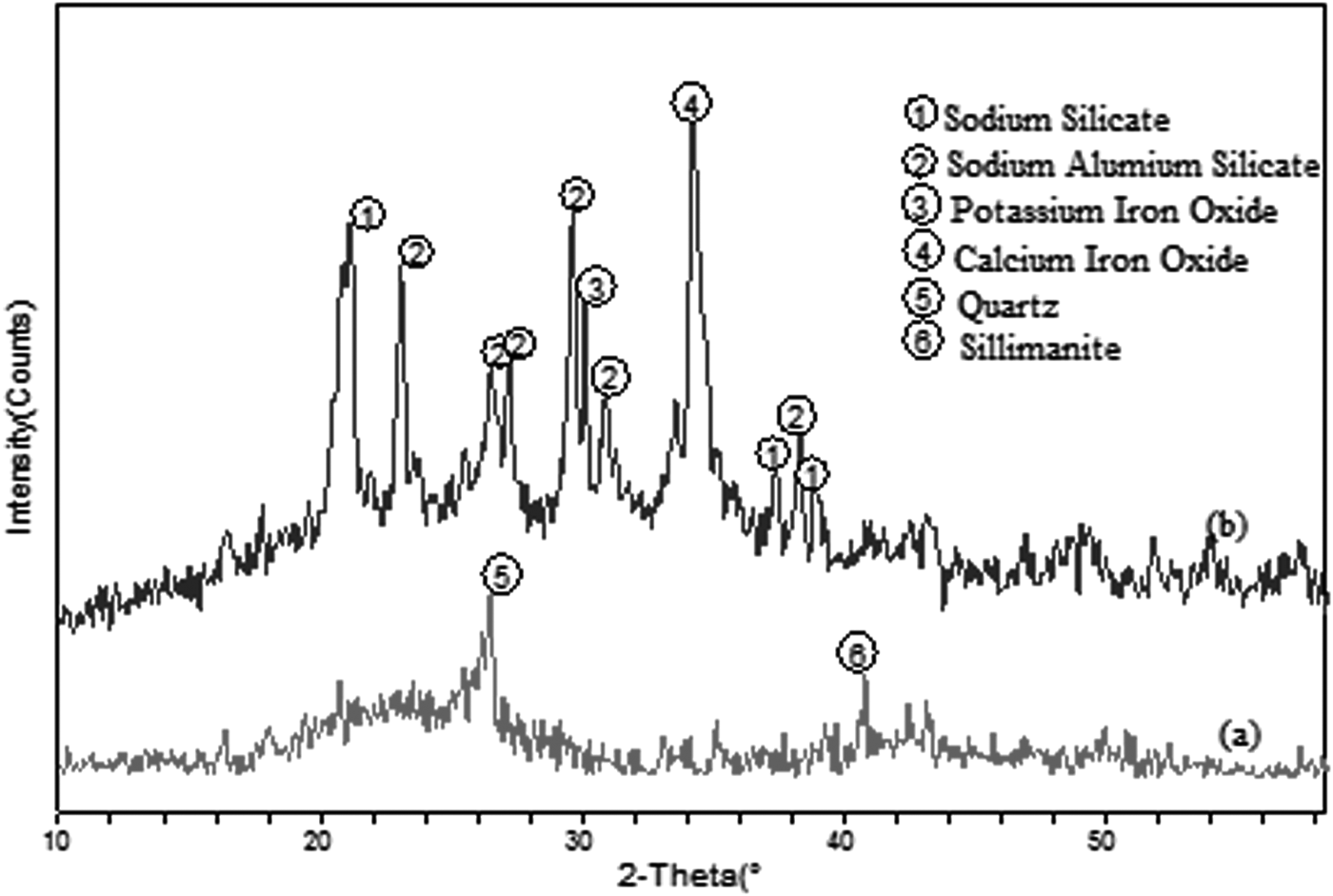
XRD data of
The elemental analysis of raw fly ash and TFA samples was carried out using an XRF analyzer, and the obtained results are presented in Supplementary Table S1. The major constituents of raw fly ash are the oxides, but their percentage decreases in the TFA. This is attributed to the formation of new chemical compounds with the relevant elements.
Equilibrium studies
Application of nonlinear Langmuir, Freundlich, and D-R isotherms for Ni(II) and Cr(III) adsorption on TFA are shown in Fig. 3. Both the Ni(II) and Cr(III) adsorption data fit well to the Freundlich and D-R isotherms and clearly deviated from the Langmuir isotherm. In addition, the chi-square (χ2) analysis was applied to estimate the degree of difference between the experimental data and the isotherm data, which is calculated using the following equation (Mirmohseni et al., 2012):
where,
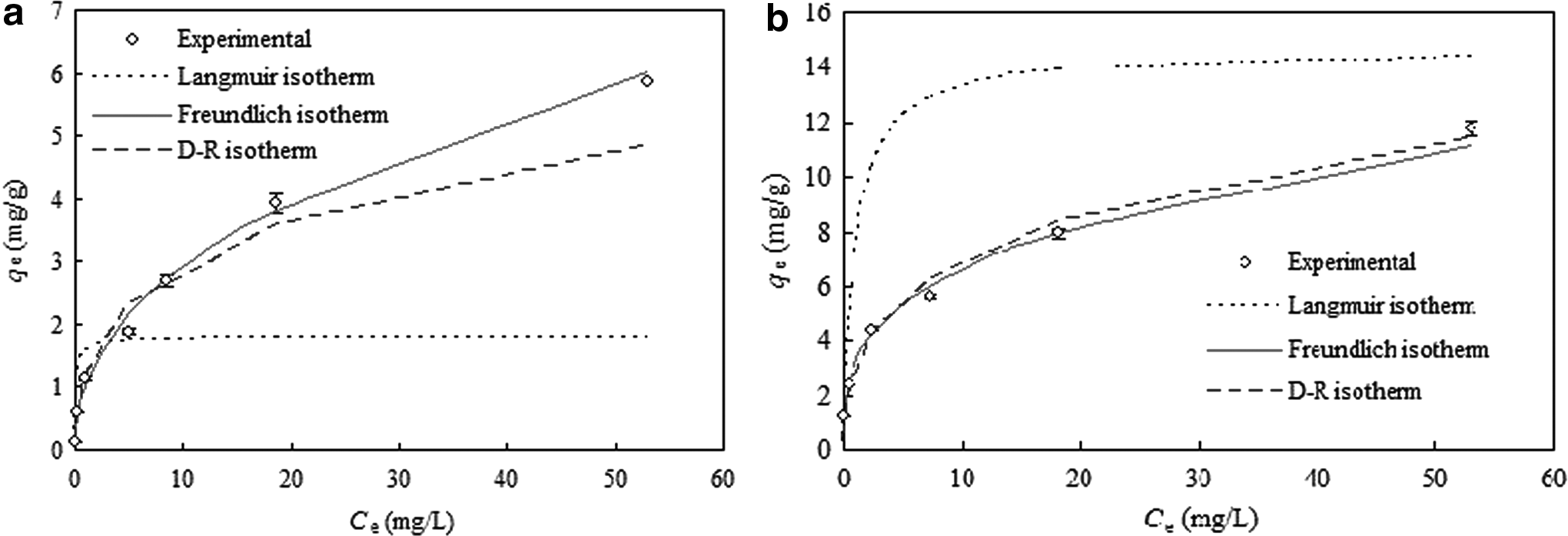
Nonlinear Langmuir (dot line), Freundlich (solid line), and D-R (dash line) isotherms of
Although the R2 values of the Freundlich and D-R adsorption isotherms were greater than 0.9 (Table 1), the χ2 values of the Freundlich isotherm were significantly smaller than those of the D-R isotherm. The results imply that both the Ni(II) and Cr(III) adsorption on TFA were multilayer adsorption rather than monolayer adsorption. The values of 1/n of less than 1 suggest that the adsorption processes were favorable. Furthermore, the E values calculated using formula (4) were 12.13 and 12.31 kJ/mol, which were between 8 and 16 kJ/mol, for Ni(II) and Cr(III) adsorption on TFA, respectively. These results indicate that ion exchange was the main adsorption mechanism in this study (Crittenden et al., 1999).
Kinetic studies
Relationships between adsorption quantity and contact time at different initial concentrations are shown in Supplementary Fig. S1. Although the adsorption amounts were higher when the initial concentrations of Ni(II) and Cr(III) were increased, the effluent concentrations after the adsorption were beyond the environmental limit. Thus, from the application point of view, the initial concentration of 10 mg/L was used in this study.
Figure 4 presents the application of kinetic models for metal ion adsorptions by TFA. Table 2 lists the sorption rate constants that are associated with pseudo first- and second-order kinetic models. Both Ni(II) and Cr (III) adsorption on TFA are rapid processes. The time needed to reach the adsorption equilibrium for Ni(II) and Cr (III) was 20 and 90 min, respectively (Fig. 4). The equilibrium uptake amounts of Ni(II) and Cr(III) were ∼1.2 and 2.5 mg/g, respectively, which were relatively lower than that of using zeolite synthesized by fly ash. For example, Alvarez-Ayuso et al. (2003) studied the sorption behavior of a synthetic zeolite NaP1 generated from hydrothermal alkaline activation of fly ash in the heavy metal treatment of wastewater. The equilibrium uptake amounts acquired for Ni2+ and Cr3+ were 20.1 and 43.6 mg/g, respectively. Hui et al. (2005) used zeolite 4A prepared from coal fly ash for the removal of Ni2+ and Cr3+, and the equilibrium uptake amounts were 9.5 and 35.6 mg/g, respectively. The reason is probably that cations, such as Na+ and K+, may be introduced into the structure of fly ash during the alkaline activation process. The ion exchange between Na+ on the zeolite and Ni2+ or Cr3+ in wastewater are essential for the removal of heavy metals. However, the drawback of the reuse of fly ash through this method is the generation of liquid waste, especially alkaline liquid waste, during the synthesis process, which may result in a secondary pollution of the environment. Therefore, TFA has a unique potential for reducing environmental impact when used for heavy metal wastewater treatment. In addition, because of the formation of a new chemical compound during the preparation of TFA, there is also an ion exchange effect during the adsorption process, which may be another reason why the Ni(II) and Cr(III) adsorption amounts increase.

Application of nonlinearized pseudo first (solid line) and second (dash line) order kinetic models for
Compared with the first-order model, the pseudo second-order kinetic model has higher correlation coefficients for TFA (Table 2). This suggests that both the Ni(II) and Cr(III) adsorption processes are based on chemisorption rather than on physisorption (Sočo and Kalembkiewicz, 2013).
Figure 5 shows the adsorption amount qt (mg/g) versus the square root of time. There are two and three linear regions on the curve for Ni(II) (Fig. 5a) and Cr(III) (Fig. 5b) as there are probably two and three steps during the adsorption processes, respectively (Damartzis et al., 2011). For Ni(II), the first linear region with a high slope signals an intra-particle diffusion step followed by a rapid external mass transfer, followed by a saturation step for the second. While for Cr(III), the first linear region signals a rapid external diffusion stage depicting macropore or interparticle diffusion, which differs from the second step, which is a gradual adsorption stage controlled by intra-particle (micropore) diffusion; the last step is a saturation stage.
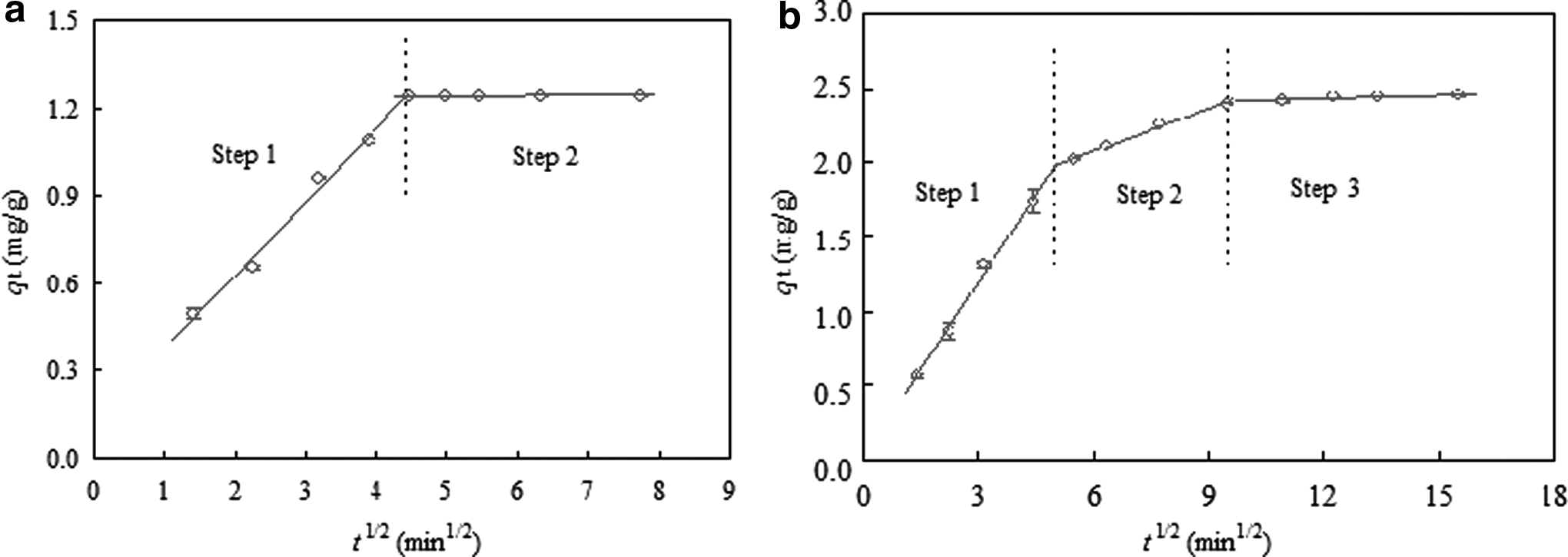
Intra-particle diffusion model of
Thermodynamic study
Plotting of lnKd versus 1/T produces straight lines for both Ni(II) and Cr(III) (Fig. 6) from which the ΔHo and ΔSo were determined using Equation (8). Furthermore, the ΔGo at each temperature was calculated using Equation (9), and the results are listed in Table 3.

Effect of solution temperature on distribution coefficient of Ni(II) and Cr(III) adsorption on TFA.
In Figure 6, it can be seen that the distribution coefficient of Ni(II) adsorption by TFA increases remarkably with an increase in temperature. This implies that high temperature was favorable for Ni(II) adsorption. However, Cr(III) showed a completely opposite trend. As shown in Table 3, the negative values of ΔGo for both the Ni(II) and Cr(III) adsorption at various temperatures indicate that the adsorption processes were spontaneous in nature. The higher negative values of ΔGo for the Ni(II) adsorption indicate that temperature elevation also increases the spontaneity (Nouri et al., 2007). The positive value of ΔHo shows that adsorption is an endothermic process. Similar results have been reported by Rajic for Ni(II) adsorption by natural zeolitic tuff (Rajic et al., 2010). The positive value of ΔSo corresponds to an increase in randomness at the solid/liquid interface during the adsorption of Ni(II) on TFA. The results are in agreement with those reported by Argun for the adsorption of Ni(II) by clinoptilolite (Argun, 2008). For the Cr(III) adsorption, the negative value of ΔHo suggests an exothermic process. Hence, the amount adsorbed at equilibrium must decrease with increasing temperature because ΔGo decreases with increasing temperature of the solution.
Desorption
Adsorption effected by Ni(II) or Cr(III) desorption. Therefore, a desorption test was carried out. First, 2.00 g of TFA was added to 500 mL of either Ni(II) or Cr(III) solution with an initial concentration of 10 mg/L, and the mixtures were stirred for 90 min. The mixtures were then kept quiescent for ∼6 h to ensure that the saturated adsorbent completely settled. Next, 450 mL of supernatant were removed to analyze the Ni(II) and Cr(III) concentrations, and 450 mL of ultrapure water were injected and stirred for 20 and 90 min for Ni(II) and Cr(III), respectively. The Ni(II) and Cr(III) concentrations after desorption were then analyzed. The experiments were carried out three times, and the average values of heavy metal masses of desorption and adsorption were 0.005 ± 0.0002 mg and 2.45 ± 0.06 mg for Ni(II) and 0.012 ± 0.002 mg and 4.96 ± 0.03 mg for Cr(III), respectively. The average ratio of the two values was 0.20% for Ni(II) and 0.24% for Cr(III), which indicated that desorption could be ignored.
Conclusion
A TFA with a higher specific surface area and porosity was obtained. The integrated analysis of adsorption of Ni(II) and Cr(III) from an aqueous solution on TFA was carried out. Good correlation coefficients and low χ2 values suggested that both Ni(II) and Cr(III) adsorption on TFA could be described by the Freundlich adsorption isotherm. The adsorption processes fitted well to the pseudo second-order kinetic model. The equilibrium uptake amounts were ∼1.25 and 2.50 mg/g for Ni(II) and Cr(III), respectively. The adsorption processes were spontaneous for both Ni(II) and Cr(III) but were endothermic and exothermic, respectively. The desorption of TFA could be ignored. Based on the conclusions in this study, the TFA adsorption process will be applied to the treatment of low concentration wastewater containing Ni(II) or Cr(III) in future studies.
Footnotes
Acknowledgments
The authors are grateful for financial support from the National Natural Science Foundation of China (No. 51608165), the Research Fund of Tianjin Key Laboratory of Aquatic Science and Technology (TJKLAST-ZD-2016-01), the Science and Technology Research Projects of Colleges and Universities of Hebei Province (QN2015122), the Science and Technology Correspondent Project of Tianjin City (15JCTPJC55900), and the Science and Technology Plan Projects of Hebei Province (15273631).
Author Disclosure Statement
No competing financial interests exist.
References
Supplementary Material
Please find the following supplemental material available below.
For Open Access articles published under a Creative Commons License, all supplemental material carries the same license as the article it is associated with.
For non-Open Access articles published, all supplemental material carries a non-exclusive license, and permission requests for re-use of supplemental material or any part of supplemental material shall be sent directly to the copyright owner as specified in the copyright notice associated with the article.
