




Abstract
Abstract
Dewatering of pulp and paper mill biosludge is challenging, and it can make up half of overall wastewater treatment costs. By harvesting energy provided by nature, freezing-thawing can notably alter the physical structure of sludge flocs, thereby influencing dewaterability and anaerobic digestibility. Samples of biosludge from three pulp and paper mills (sulfite, kraft, and semi-chemical pulping) as well as biosludge digestate (i.e., biosludge after anaerobic digestion) were subject to freeze-thaw treatment, and they were subsequently tested in terms of dewaterability by using a gravity filtration—crown press unit, and anaerobic digestibility by means of biochemical methane potential assays. Gravity filtrate from dewatering of freeze-thaw treated biosludge was also tested for anaerobic digestibility. Freeze-thaw treatment improved the dewaterability of biosludge mill samples to a larger extent than dewatering polymer. Treatment at −10°C before dewatering increased the dry solid content of the dewatering cake from 13% to 21% (sulfite mill), from 7% to 26% (kraft mill), from 10% to 20% (digestate after 35 days of digestion), and from 17% to 23% (digestate after 60 days of digestion). Biosludge from the semi-chemical pulping mill was only dewaterable after freeze-thaw treatment, which enabled a final cake solid content of 45%. In contrast, the anaerobic digestibility of biosludge and digestate improved, if at all, only to a relatively small extent. A strong improvement in digestibility was only observed in the case of gravity filtrate from dewatering of freeze-thaw treated biosludge (sulfite mill), where the specific biogas yield increased from 111 to 310 mL/g chemical oxygen demand added. Visual inspection on untreated and freeze-thaw treated biosludge confirmed the assumption that the strong effect on dewaterability was caused by irreversible compaction and dehydration of sludge particles. Evidence for widespread rupture of bacterial cells was not confirmed, which may explain the comparably small effect on anaerobic digestibility.
Introduction
T
Mill wastewater is typically treated in aerobic activated sludge processes that generate between 0.4 and 1.0 tons of biosludge per ton of chemical oxygen demand (COD) removal (Hagelqvist, 2013). In most cases, the biosludge is first dewatered and sent to landfill, incinerated for energy recovery, or land spreaded. In either case, biosludge handling is cost-intensive, making up to half of the total effluent treatment costs (Kantardjieff and Jones, 2000). Thickening and dewatering are key bottlenecks for biosludge handling and disposal (Mowla et al., 2013); therefore, numerous ways to improve these processes have been investigated, including physical (Benitez et al., 1994; Jing et al., 1999; Huan et al., 2009), chemical (Hartong et al., 2007; Liu et al., 2016; Song et al., 2016), and biological conditioning (Thomas et al., 1993; Ayol and Dental, 2005; Dursun et al., 2006).
Freezing-thawing has long been recognized as improving the dewaterability of biosludge. The highest dewaterability can be achieved when the biosludge is completely frozen at a slow rate, similar to naturally occurring temperatures (Vesilind and Martel, 1990; Smith and Vesilind, 1995; Parker and Collins, 1997). Shock freezing at a temperature of −80°C was much less effective (Wang et al., 2001). The underlying mechanisms of sludge alteration brought about by freezing-thawing are not completely understood. The dewatering effect seems to be caused by irreversible compression of sludge particles. As temperature is decreased, the progressing freezing front does not readily accept sludge particles within the ice lattice, because this would cause large defects in its crystal structure (Workman, 1954; Meyer and Wania, 2008). Therefore, sludge particles agglomerate and become trapped and compressed within the frozen matrix. The growing ice is continuously incorporating more water molecules into the lattice, thereby dehydrating trapped sludge particles.
According to Vesilind and Martel (1990), the most significant effect of freezing-thawing might be related to the freezing of the surface water of particles in the supra-colloidal size range (1–100 μm diameter). The supra-colloidal fraction has the largest influence on biosludge dewaterability, because those particles efficiently clog the sludge cake during dewatering, and they can significantly obstruct the flow of water (Karr and Keinath, 1978). The surface water prevents particles in this size range from agglomeration. Only at higher temperatures (>−30°C), the freezing rate is low enough that the ice matrix can efficiently extract surface water of supra-colloidals, which allows solid-solid contact and agglomeration of these particles. Then, attractive forces tend to hold the particles together, even after the sludge thaws (Vesilind and Martel, 1990). Tsang and Vesilind (1990) compared various dewatering methods with respect to the change in water distribution within the sludge. During gravity drainage, vacuum filtration, and centrifugation, the fraction of surface water of particles was not affected; whereas during freeze-thaw treatment, significant amounts of surface water were released. In their study, about 50% of surface water and interstitial water was removed; whereas free water was virtually absent after the treatment (Tsang and Vesilind, 1990). The strongest enhancement of dewaterability after freezing-thawing was observed in the case of inorganic sludge, such as alum water treatment sludge (Baskerville, 1971). Martel (1993) treated alum sludge with an initial solid content of 0.5% within a pilot-scale freezing bed, and achieved a solid content of 82% after draining.
Dewaterablility of municipal biosludge after freeze-thaw treatment has been investigated more extensively than pulp and paper mill biosluge. Only two studies were identified that have tested biosludge from pulp and paper mills (Parker and Collins, 1997; Kantardjieff and Jones, 2000). Parker and Collins (1997) treated biosludge from a sulfite pulping mill via freezing-thawing and tested the dewaterability by means of the specific resistance to filtration (SRF), where a lower SRF indicates improvement. Accordingly, freeze-thaw treatment at −5°C, −10°C, and −25°C decreased the SRF by one order of magnitude (from 1 × 10¹² to 1 × 10¹¹ m/kg). In the study from Kantardjieff and Jones (2000), freeze-thaw treatment of unspecified biosludge from a pulp and paper mill decreased the SRF from 3.3 × 10¹² to 4.2 × 10¹¹ m/kg. Also in this study, a pilot-scale plant, including an industrial freezing unit and a belt press, was tested in several pulp and paper mills. As a result, the cake solid content after dewatering was 29% for biosludge from a kraft mill and 25% for biosludge from a chemithermo-mechanical pulp mill.
The effect that freeze-thaw treatment has on the physical structure of biosludge suggests that it may also improve its anaerobic digestibility. Although anaerobic digestion of biosludge is a part of many municipal wastewater treatment plants, it is virtually not practiced in the pulp and paper industry. There is no previous study that has applied freezing-thawing on mill biosludge in this context; however, three studies were identified that have digested freeze-thaw treated sludge from municipal and industrial wastewater treatment plants (Wang et al., 1995; Jan et al., 2008; Montusiewicz et al., 2010). Wang et al. (1995) observed a 27% increase in methane generation after freeze-thaw treatment of municipal biosludge at −10°C. In the study conducted by Jan et al. (2008), biosludge from a bakery company was freeze-thaw treated at −17°C and, subsequently, anaerobically digested for 25 days. The COD removal was 30%, compared with only 18% in the case of untreated sludge. In Montusiewicz et al. (2010), a mixture of primary sludge and biosludge (60:40) was treated at −25°C and then digested. Although the specific biogas yield (mL/gVS added) and the volatile solids (VS) removal did not increase, the biogas yield in terms of mL/gVS removed increased by 1.5-fold. Also, freeze-thaw treatment increased the concentration of soluble COD (sCOD), on average, by more than two-fold.
Filtrate from gravity thickening and the pressate from belt or screw press dewatering contain significant amounts of COD and are usually returned to the head of the treatment system. An average pulp and paper mill generates filtrate/pressate, containing between 5 and 30 tons of COD per day. Therefore, it is of notable interest to investigate the anaerobic digestibility of this type of waste stream as well; all the more, the number of pulp and paper mills that have incorporated anaerobic pre-treatment into their wastewater treatment systems has doubled within the previous decade. To the knowledge of the authors, there is also no previously published study that has investigated the digestibility of dewatering filtrate/pressate.
Finally, it is clear that the concept of natural freezing-thawing of mill biosludge relies strongly on seasonal temperature changes. The treatment could reasonably be only applied on sludge generated during the cold season. However, the land space used for freeze-thaw treatment in the winter could be potentially used as a sludge drying bed during the summer (Martel, 1993; Hellström and Kvarnström, 1997).
The purpose of this study was to investigate various combinations of dewatering and anaerobic digestion of mill biosludge in combination with freeze-thaw treatment to harness the benefits of this method to its fullest. Also, by using a bench-scale crown press, being to some extent representative of full-scale belt press dewatering, a more realistic picture of the potential benefits of freezing-thawing would be possible. Dewatering tests included raw biosludge from three mills and anaerobically digested biosludge (digestate). Anaerobic digestibility tests used biosludge, digestate, and gravity filtrate from dewatering.
Experimental Protocols
Sampling and freezing-thawing
Waste activated sludge was sampled at three different pulp and paper mills and shipped to the University of Toronto, where it was stored in the refrigerator until processing. Mill A produces pulp from sulfite pulping and bleached chemi-thermomechanical pulping, as well as paper and board. Mill B produces hardwood and softwood kraft pulp, and Mill C produces pulp from neutral sulfite semi-chemical pulping and board paper.
Samples consisting of 1 L biosludge or digestate were frozen at −10°C in a portable freezer (refrigerator/freezer from Norcold), or at −18°C in a regular stand-up freezer. The freezing duration was 10 days. Afterward, the biosludge and digestate were allowed to thaw at +4°C in the refrigerator.
Dewatering
A laboratory simulation of an industrial belt press (Crown® press) was used to dewater the biosludge and digestate (Severin et al., 1998). This crown press consists of a gravity filtration unit and a pair of filter belts that are pulled against a static curved surface. The gravity filter and the filter belts were cut from full-scale press belt material. The filter fabric is a HF7-7040 white polyester belt in a 6 × 2 herringbone weave pattern (Clear Edge Filtration). During the experiments, a sample of 250 mL sludge or digestate was allowed to drain through the gravity filter for 10 min. The cake formed during gravity thickening was then transferred to the pressing area where a pressure schedule of 100, 150, and 200 lbs was used for all samples. Each pressure was sustained for 30 s followed by a fast release. Total suspended solids (TSS) in the gravity filtrate and total solids (TS) and VS of the gravity filtration cake and crown press dewatering cake were measured. Only the gravity filtrate from dewatering was preserved and, subsequently, tested for anaerobic digestibility, and not the pressate from crown pressing, because the latter was difficult to sample. Nevertheless, the gravity filtrate should be representative of the combined filtrate/pressate, because it contributes to 80–90% of the water that is removed during dewatering. No polymer or other dewatering aids were used for the freeze-thaw experiments in this study. All experiments were conducted in triplicate, and the results shown in this article were expressed as means ± standard deviation.
Solids and COD analyses
TS content was measured by determining the weight of a sample both before and after drying in an oven overnight at 104°C, whereas the VS content was determined by the weight loss of the sample (dried at 104°C) during high-temperature combustion (525°C) for 30 min. TSS concentrations were determined by filtration by using glass fiber filters from Whatman (934-AH) with a pore diameter of ∼1.5 μm. COD analyses were performed by applying the dichromate method (Jirka and Carter, 1975) and using a spectrophotometer (DR-3900 from Hach).
Biochemical methane potential assay
A biochemical methane potential (BMP) assay was conducted based on the recommendations from Owen et al. (1979) and Angelidaki et al. (2009). Granular seed sludge was taken from a full-scale anaerobic reactor at a sulfite pulp mill in Canada. The inoculum to substrate ratio for all tests was ∼1.0 (VS basis). All BMP assays included a positive control and a negative control. The positive control included glucose, acetate, propionate, and ethanol, and the associated cumulative biogas production curves (Supplementary Figs. S1–S4 in the Supplementary Data) refer to a healthy inoculum. The negative control contained only the inoculum but no wastewater. The 160 mL batch serum bottles contained a working volume of 75 mL consisting of a defined nutrient medium, inoculum, substrate, and water. All samples and controls were prepared and measured in triplicate, and the results are presented as means ± standard deviation. The batch cultures were incubated at 37°C and 50 rpm in a shaker throughout the assay period. The amount of produced biogas was measured with a lubricated 20 mL glass syringe. To determine the amount of biogas produced solely from the organic material in the wastewater, the amount of biogas produced in the negative control was subtracted. Supplementary Figures S1–S4 in the Supplementary Data show cumulative biogas production curves, and specific cumulative biogas production curves for the BMP assays.
Bench-scale sludge digester
Digestate was generated by anaerobically digesting biosludge from Mill A in a 10 L custom stainless steel batch anaerobic digester (Bioprocess Control). The reactor was loaded with thickened biosludge as well as with anaerobic granular sludge (inoculum) obtained from the aforementioned full-scale reactor. Two batches of biosludge were digested: one for the duration of 35 days and the other for the duration of 60 days. The resulting two types of digestate are referred to as 35 days digestate and 60 days digestate.
Scanning electron microscopy and particle-size analysis
Scanning electron microscopy (SEM) investigation was done with a general-purpose, thermal-type SEM (JSM-6610LV; Jeol Ltd.), which was equipped with an X-MaxN Silicon Drift Detector (Oxford Instruments). Samples of raw and freeze-thaw treated biosludge and digestate were oven-dried at 104°C, and they were, subsequently, coated with a thin layer of conducting material by using a sputter coater (SC7620; Quorum Technologies Ltd.).
Particle-size distribution was measured with a Malvern Mastersizer S that was equipped with a Large Volume Dispersion Unit (Malvern Instruments Ltd.). The instrument was capable of measuring particles up to an equivalent diameter of 900 μm. Only untreated biosludge and digestate were analyzed, because freeze-thaw treatment caused the formation of large agglomerates that were beyond the particle size that could be measured with the instrument.
Results and Discussion
Biosludge from three pulp and paper mills (Table 1) was freeze-thaw treated, and it was, subsequently, dewatered by using the bench-scale crown press. Biosludge from Mill A was first anaerobically digested, then freeze-thaw treated, and also tested for dewaterability. The three types of biosludge, the digestate, and the gravity filtrate from dewatering of freeze-thaw treated biosludge and digestate, were tested for anaerobic digestibility.
The values in parentheses are standard deviations from triplicate measurements.
ND, not determined.
Biosludge dewaterability
Figure 1A shows the TS content of the untreated and freeze-thaw treated biosludge after dewatering. These results show that freeze-thaw treatment increased the TS content of the crown press cake from 13.3 (±0.9)% (untreated biosludge) to 21.4 (±0.8)% (freeze-thaw treatment at −10°C) and 20.6 (±0.4)% (freeze-thaw treatment at −18°C) for biosludge from Mill A, and from 6.6 (±0.9)% to 25.8 (±1.7)% (−10°C) and 22.5 (±0.3)% (−18°C) in the case of Mill B. These results are similar to those from the study of Kantardjieff and Jones (2000), who dewatered freeze-thaw treated biosludge by means of a belt press. As for biosludge from Mill C, a cake was not formed during gravity filtration, because most of the sludge particles went through the gravity filter. The particle size of Mill C biosludge is relatively small (see Supplementary Fig. S5 in the Supplementary Data), and the high inorganic matter content (Table 1) likely caused a lack in cohesion among the sludge particles. However, after freezing-thawing and subsequent dewatering, the solid content was 45.2 (±0.6)% (−10°C) and 42.9 (±0.4)% (−18°C). Freezing-thawing also strongly improved the drainability of the sludge that was expressed as the TS content of the gravity filtration cake (Supplementary Fig. S6 in the Supplementary Data). The TS content increased from 3.4 (±0.1)% to 9.5 (±0.2)% (−10°C) and 9.8 (±0.2)% (−18°C) in the case of biosludge from Mill A, and from 4.0 (±0.1)% to 13.7 (±0.9)% (−10°C) and 12.4 (±0.2)% (−18°C) for biosludge Mill B. In the case of Mill C, the TS content of the gravity filtration cake was 29.3 (±0.1)% (−10°C) and 23.8 (±0.6)% (−18°C). Results indicate that freeze-thaw treatment at −10°C is slightly superior compared with treatment at −18°C, which is consistent with previous research (Vesilind and Martel, 1990).

The bench-scale crown press used for the experiments was designed to simulate an industrial belt press (Graham, 1998; Severin et al., 1998). The reported solid content of dewatered cakes from municipal biosludge after full-scale belt pressing ranges between 13% and 19% (Gonçalves et al., 2007), and typical polymer addition is 0.3% and 1.0% (dry weight basis). According to a pulp and paper mill survey conducted by Amberg (1984), belt press dewatering of mill biosludge results in cakes with a solid content of 13–16%, and the polymer addition can be well above 2%. Bouchard (2015) conducted numerous experiments with the same crown press and biosludge from Mill A. By adding 2.0% polymer, the TS content of the dewatered cake was 15–17%, matching well to a full-scale press (Bouchard, 2015). Also, crown press tests conducted with biosludge from Mill B and 2% cationic polymer (tests done for the polymers Axchem9645 and Zetag8185) resulted in a cake solid content of 14–15%. Again, no polymer was used for the freeze-thaw experiments in this study. It can, therefore, be concluded that freeze-thaw treatment has a stronger effect on belt press dewaterability of mill biosludge than the addition of polymer. It should be noted that the costs for polymer and other chemical dewatering aides at an average mill range between a few hundreds of thousand dollars and a few million dollars per year (Kenny et al., 1997; Kantardjieff and Jones, 2000).
In our experiments, freezing-thawing improved the dewaterability in two ways. Not only did the TS content of the dewatering cake increase but also the TSS concentration in the gravity filtrate decreased (Fig. 1B). The latter refers to the solids' capture rate during dewatering. Freeze-thaw treatment decreased the TSS concentration in the gravity filtrate from 1.90 (±0.09) g/L to 1.08 (±0.16) g/L (−10°C) and 1.28 (±0.08) g/L (−18°C) in the case of Mill A, and from 2.85 (±0.07) g/L to 1.63 (±0.29) g/L (−10°C) and 1.26 (±0.11) g/L (−18°C) in the case of Mill B. Because the bulk of the biosludge from Mill C passed through the gravity filter, the TSS concentration was almost as high as that of the raw biosludge. Even after freeze-thaw treatment, the TSS concentration in the filtrate was very high: 14.7 (±0.6) g/L (−10°C) and 15.1 (±0.9) g/L (−18°C) (Fig. 1).
Change in dewaterability brought about by freeze-thaw treatment may be influenced by the content of organic material in the biosludge, expressed with the ratio VS/TS (Table 1). By far, the highest TS content of the dewatering cake was attained with biosludge from Mill C, which contained the lowest percentage of organic matter (Table 1 and Supplementary Fig. S7 in the Supplementary Data).
Natural freezing in the winter would be followed by repeated freezing and thawing cycles during spring and thawing in the summer. This raises the question whether repeated freeze-thaw cycles might enhance the observed effects or not. Therefore, experiments were included where biosludge was exposed to several freeze-thaw cycles, followed by crown press dewatering. No significant difference could be observed between a single freeze-thaw cycle and two or three freeze-thaw cycles, respectively (Supplementary Fig. S8 in the Supplementary Data).
Digestate dewaterability
To produce digestate for the dewaterability tests, two different batches of biosludge from Mill A were anaerobically digested in a 10 L bench-scale digester: one for the duration of 35 days and the other for the duration of 60 days. Similar to biosludge, freeze-thaw treatment also substantially improved the dewaterability of the digestate. The TS content of the crown press cake increased from 9.7 (±0.3)% to 19.5 (±0.5)% (−10°C) and 21.2 (±0.4)% (−18°C) in the case of the 35 days digestate, and from 16.6 (±1.5)% to 23.4 (±0.1)% (−10°C) and 23.1 (±0.2)% (−18°C) for the 60 days digestate (Fig. 2A). Interestingly, the dewaterability of the untreated 60 days digestate is notably better than that of the untreated 35 days digestate. Seemingly, anaerobic digestion of only 35 days deteriorates the dewaterability, whereas digestion for a longer period (60 days) improves the dewaterability (Fig. 2). This phenomenon has been previously observed in a study where the drainability of poorly digested sludge deteriorated, whereas that of well-digested sludge improved (Rudolfs and Heukelekian, 1934).
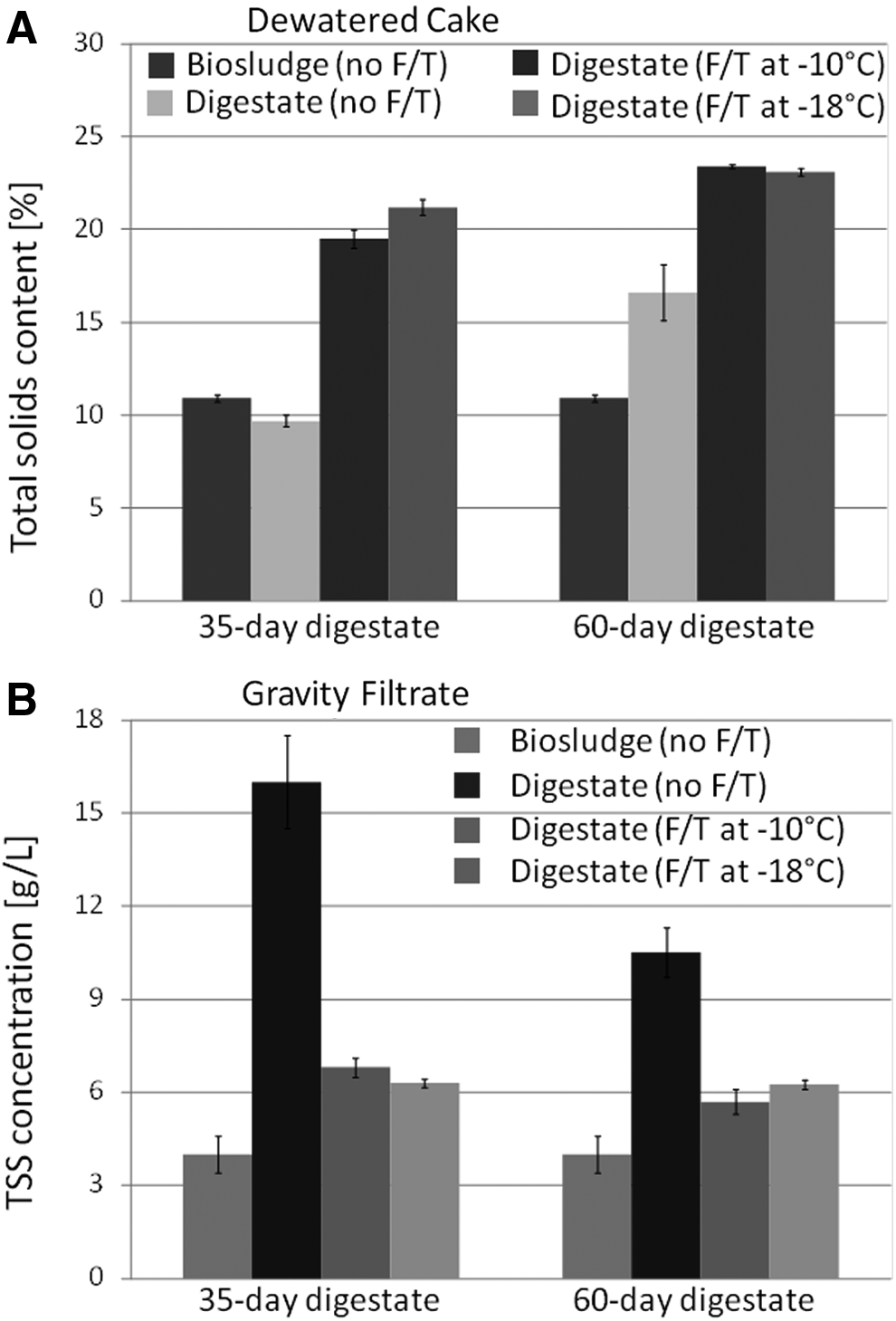
Anaerobic digestion has a negative effect on the solid retention during dewatering. TSS concentrations in the filtrate were much higher: 16.0 (±1.5) g/L (35 days digestate) and 10.5 (±0.8) g/L (60 days digestate)) than that of the raw sludge 4.0 (±0.6) g/L (Fig. 2). Although freezing-thawing improved the solid retention, TSS concentrations were still higher than that from the raw biosludge (Fig. 2B).
Anaerobic digestibility of biosludge and digestate
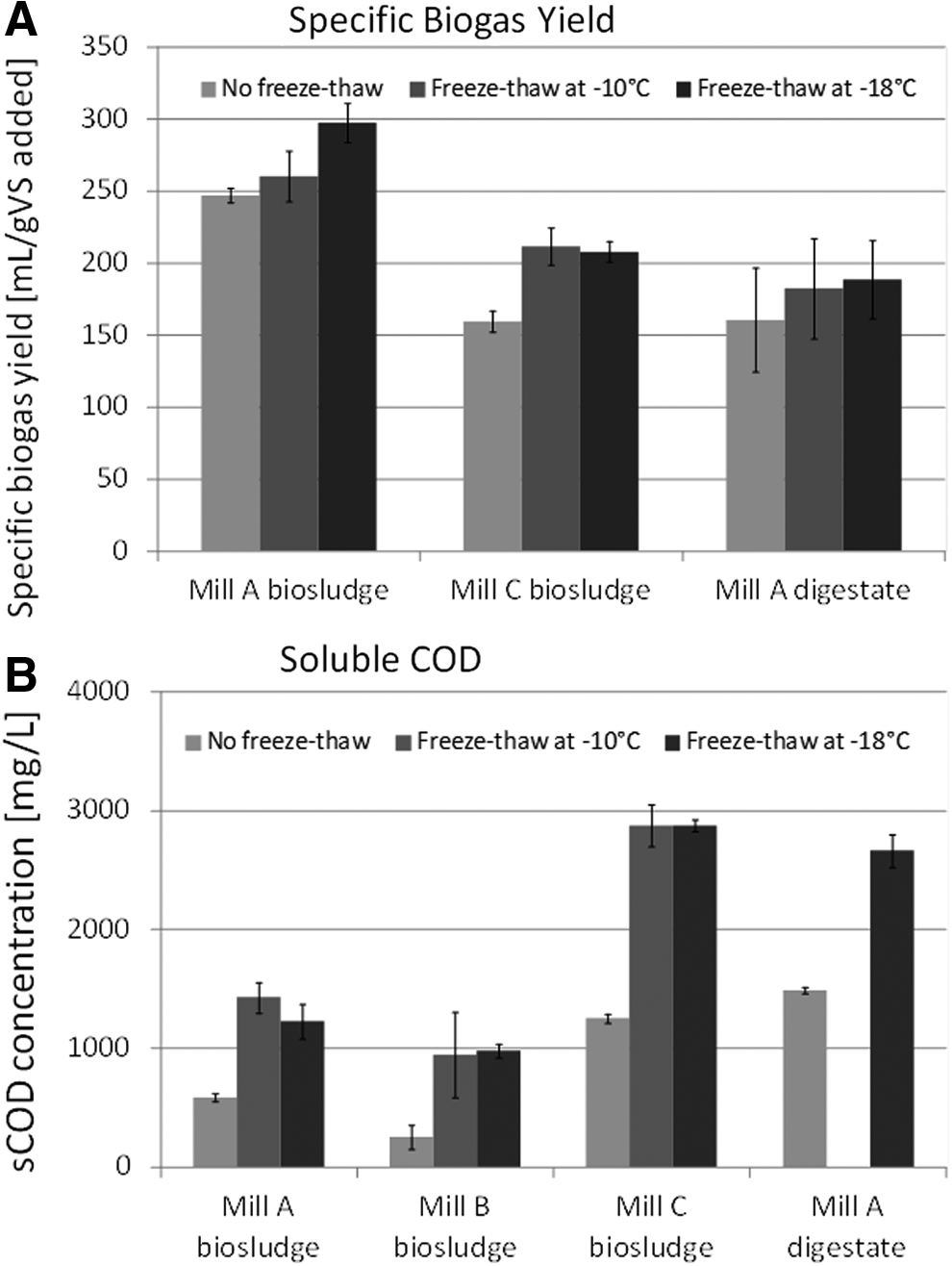
Untreated and freeze-thaw treated biosludge from three mills, as well as digestate from Mill A biosludge (35 days digestate), was anaerobically digested in BMP assay serum bottles for 52 days. As for biosludge from Mill A, a significant improvement in anaerobic digestibility could only be observed when freeze-thaw treated at −18°C (Fig. 3A). In this case, the specific biogas yield increased from 250 (±5) to 300 (±13) mL/gVS added. Results related to the biogas yield from Mill B biosludge are not presented in Fig. 3A, because the BMP detection limit according to Hansen et al. (2004) was too high to quantify the specific biogas yield (more details are provided in the Supplementary Data). An improvement in digestibility was also attained with sludge from Mill C, where the specific biogas yield increased from 160 (±7) to 212 (±13) and 208 (±7) mL/gVS added, after freeze-thaw treatment at −10°C and −18°C, respectively. In all cases, the specific biogas yield was below 300 mL/gVS added. Summarizing the results of previous studies that have applied various pretreatment methods to increase the digestibility of mill biosludge, and assuming average methane content in the biogas of 70%, in almost all cases the specific biogas yield did not exceed ∼300 mL/gVS added, either. Considering that the concentration ratio COD to VS of pulp and paper mill biosludge ranges between 1.4 and 1.9 (results from this study; Meyer and Edwards, 2014), more than 60% of the organic material in biosludge remains non-digestible, no matter what pretreatment method was applied. With respect to anaerobic digestion of digestate, no significant difference could be observed between untreated and freeze-thaw treated digestate (Fig. 3A). Although freezing-thawing doubled the concentration of sCOD (Fig. 3B), its contribution to the overall amount of COD contained in the sludge remains small (<10% for Mill A, <2% for Mill B, <15% for Mill C). The specific biogas yield for biosludge and digestate is presented in terms of mL/gVS added (Fig. 3), whereas that for gravity filtrate is presented in terms of mL/gCOD added (Fig. 4). The denominator VS was used for the sludge and digestate samples for better comparability with results from previous studies (see Meyer and Edwards, 2014 and refs therein). Also, measuring the COD of solid waste using standard methods is associated with relatively large uncertainties (Buffiere et al., 2006; Raposo et al., 2008).
Anaerobic digestibility of gravity filtrate from dewatering of freeze-thaw treated biosludge and digestate
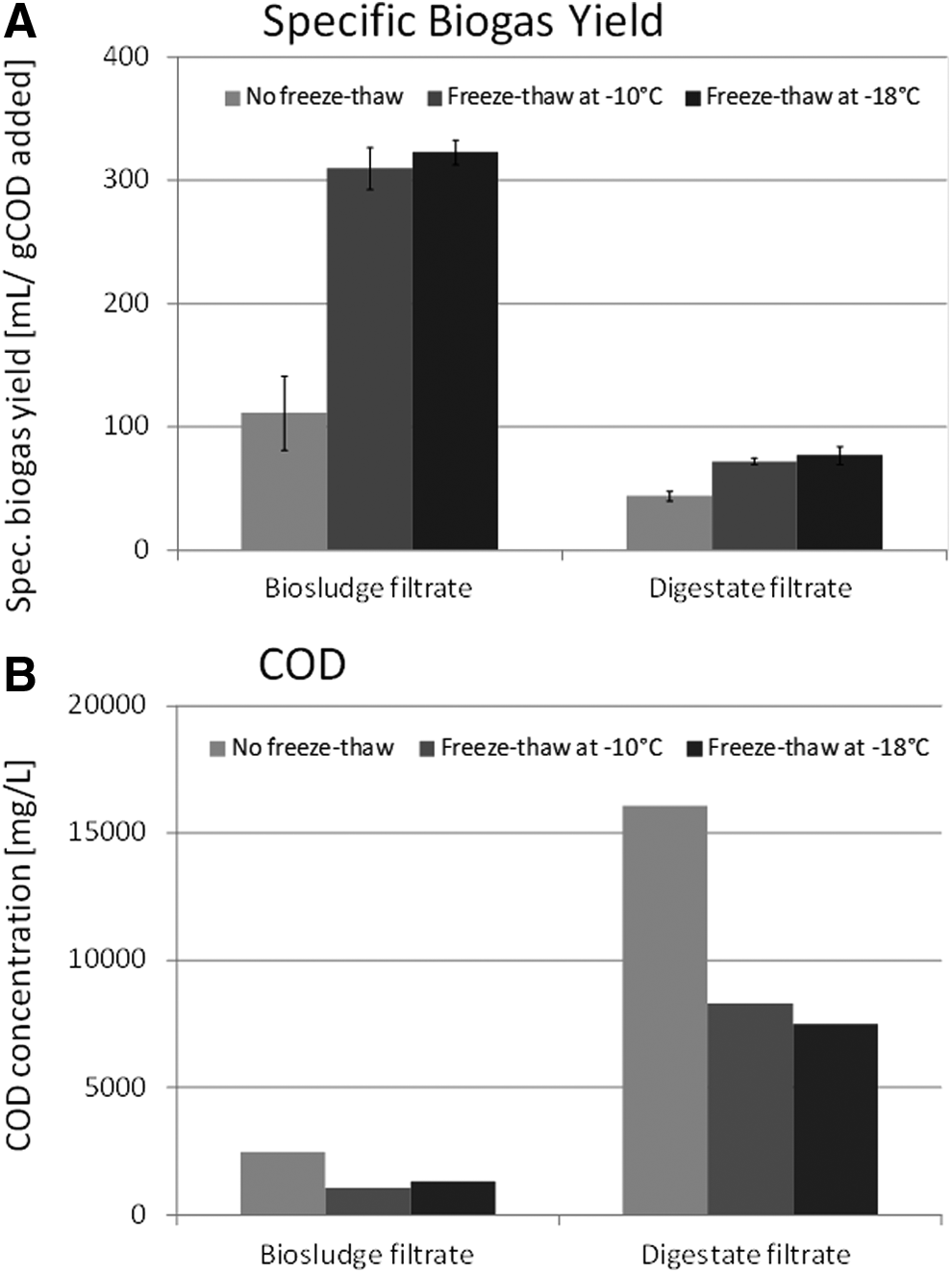
Gravity filtrate from dewatering of untreated and freeze-thaw treated biosludge and digestate from Mill A was tested in terms of anaerobic digestibility. The results of the BMP assay are presented for a digestion time of 26 days, because in most cases no significant biogas production was recorded for the period after that. Results show that the digestibility of the filtrate increases notably when biosludge was freeze-thaw treated before dewatering (Fig. 4A). In this case, the specific biogas yield increased from 111 (±30) mL/gCOD added (for untreated biosludge) to 310 (±17) mL/gCOD added (−10°C) and 323 (±10) mL/gCOD added (−18°C). This type of filtrate is relatively well digestible and may potentially be considered for anaerobic wastewater treatment in high-rate Upflow Anaerobic Sludge Blanket-type reactors. When the digestate was freeze-thaw treated before dewatering, the digestibility of the filtrate also increased. However, the specific biogas yield remained very low and did not exceed ∼80 mL/gCOD added (Fig. 4A).
COD concentrations in the gravity filtrates from the digestate were much higher than those from the biosludge (Fig. 4B). The 35 days digestate used for the experiment contained a larger fraction of relatively small particles (<50 μm diameter) than the raw biosludge (Supplementary Fig. S5 in the Supplementary Data). Parts of these COD-containing particles have passed through the gravity filter (Fig. 2B). Also, COD concentrations in the gravity filtrate from untreated biosludge and digestate were higher than in the filtrate from freeze-thaw treated biosludge and digestate (Fig. 4B), because the TSS concentrations were also higher in the filtrate from untreated biosludge and digestate (Figs. 1B and 2B).
Visual investigation on the effects of freeze-thaw treatment
A visual investigation was conducted to provide insight into the underlying mechanisms that cause the changes in dewaterability and digestibility during freezing-thawing. Figure 5 shows a photograph of biosludge from Mill A both before and after freezing-thawing. During freezing, sludge particles agglomerate and become dehydrated and irreversibly pressed, forming large (∼1 cm diameter) high-density flakes that settle rapidly. During gravity filtration of freeze-thaw treated sludge, the water was almost completely drained within less than one second. Also recognizable in Fig. 5B is the lack of suspended small particles within the water surrounding the sludge solids. During freezing-thawing, small particles are efficiently separated from the liquid phase and compressed together with large sludge flakes. On a microscopic scale (SEM), it is obvious that microorganisms in biosludge are embedded in a matrix consisting largely of extracellular polymeric substances (Zhang et al., 2014) (Fig. 6). After an initial freezing period during which the sludge flakes are formed, continued freezing of parts of the interstitial water and particle surface water leads to further dehydration of this matrix while creating numerous small ice pockets. After thawing and sample preparation for SEM, which involves drying at 104°C, these pockets turn into cavities at a size of 5–10 μm in diameter (Fig. 6d–f). This process appears to be irreversible, which leads to the assumption that repulsive forces caused by like-charged, hydrated particle surfaces are replaced by attractive forces due to particle dehydration.
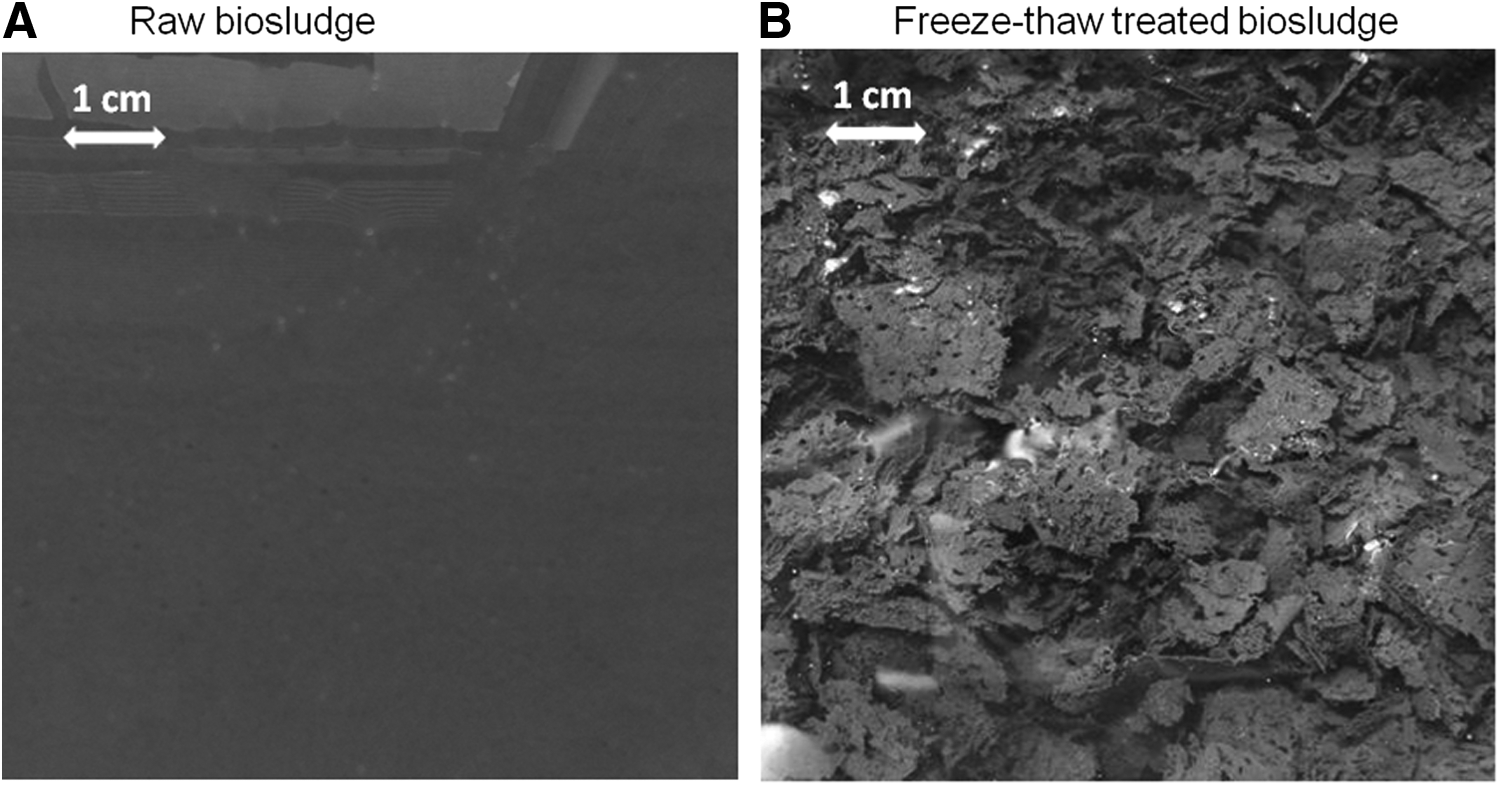
Images of biosludge from Mill A both before and after freeze-thaw treatment. Raw biosludge has a liquid and creamy consistency
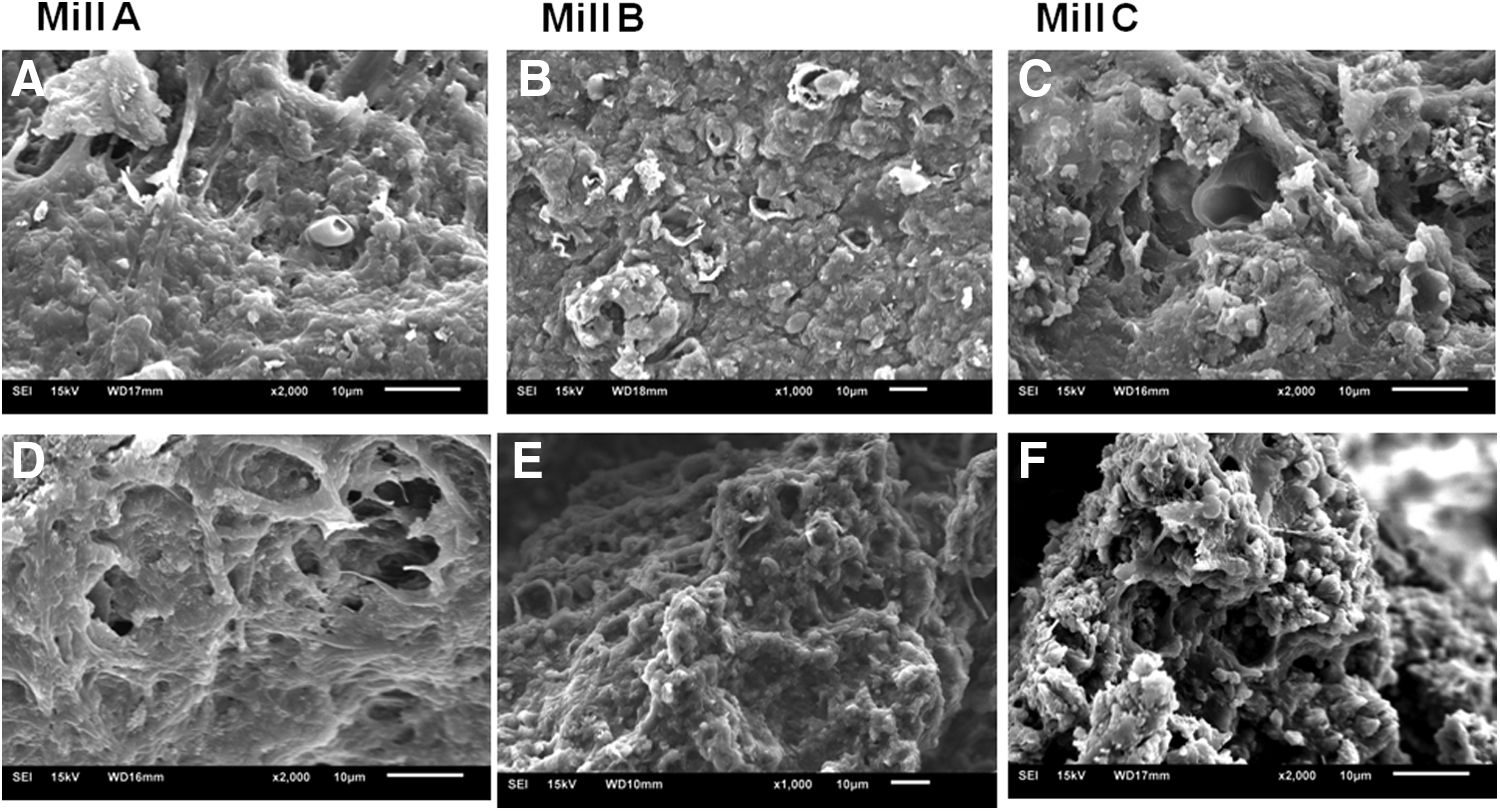
SEM images of biosludge from the three mills both before
Freezing of sludge water likely occurs at different stages. Free water surrounding the sludge flocs freezes first, whereas particulate matter becomes concentrated and compressed. Like particles, soluble ions are also not readily accepted within the growing ice lattice (Meyer and Wania, 2008), and, therefore, become concentrated together with particulate matter. A higher salt content within the remaining unfrozen sludge matrix leads to delayed freezing and freezing point depression. Several previous studies indicate that freezing of water still takes place when the temperature in the biosludge decreases from −20°C to −30°C (Toner et al., 1990; Vesilind and Martel, 1990; Smith and Vesilind, 1995). The SEM investigation shows no evidence for notable rupture of microbial cells, as illustrated in previous studies (Vergara et al., 2013; Newton et al., 2016), although freeze-thaw lysis has been a common method in life science to rupture cells and to release its content into solution. However, freeze-thaw lysis is usually being done at much lower temperatures while using dry ice or liquid nitrogen. Also, several freeze-melt cycles are necessary to efficiently rupture cell walls (Thermo Fisher Scientific, Inc., 2009).
Freezing at higher temperatures, as applied in this study, likely leads to high solute concentrations in the surface water surrounding the cells, which creates osmotic pressure followed by cell dehydration. On the other hand, freezing at low temperatures may lead to rapid freezing of water within cells before equilibration can occur (Silvares et al., 1975). Ice nucleation in cells and the generation of sharp ice crystals may rupture cell membranes and release intracellular material (Mazur, 1965). Cell lysis likely decreases the effectiveness of freeze-thaw treatment, because it produces smaller particles and, therefore, may increase the total solid surface area. The resulting increase in surface water content would decrease the dewaterability (Örmezi and Vesilind, 2001).
Potential for full-scale application of freeze-thaw dewatering in pulp and paper mills
Reports or studies on the application of freeze-thaw dewatering in pulp and paper mills could not be identified, although mills in Northern regions may be ideally suited to apply this method. Located often in rather isolated areas, mills are much less affected by space restrictions than municipal wastewater treatment plants. Modeling studies suggest that the majority of the territory in the United States and Canada is climatologically suited for freeze-thaw dewatering of sludge (Reed et al., 1986; Martel and Diener, 1991; Kinsley et al., 2012). Potential environmental problems relate to odor release, and the leaching of contaminated water into the ground. According to Martel and Diener (1991), odor can be kept at an acceptable minimum, if the meltwater is drained efficiently by means of draining pipes. Leaching of potential harmful substances into the ground can be prevented by applying lining underneath a gravel/sand bed (Hellström and Kvarnström, 1997), or an impermeable layer of clay (Penman and Van Es, 1973).
Freeze-thaw dewatering of sludge may be more cost effective than mechanical dewatering. According to Amberg (1984), operation and maintenance costs for conventional dewatering and disposal of pulp and paper mill sludge range from 24 to 73 $/t sludge (dry solids) (average costs: 51 $/t). On the other hand, by assuming an average mill generating 13 tons (dry solids) of biosludge per day (Dorica et al., 1999), estimated operation and maintenance costs for sludge dewatering on drying beds are 35–46 $/t (EPA, 1985). Costs required for drying beds are considered similar to the costs required for freeze-thaw dewatering beds (EPA, 1987). Although these numbers refer to costs that were prevalent in the 1980s, they should still be applicable when comparing relative operation and maintenance costs. It is worthwhile mentioning that freeze-thaw treatment can lead to a notably higher solid content than mechanical dewatering. Previous pilot-scale and field-scale tests indicate that a combination of freezing-thawing and drying beds can provide sludge with a solid content of 20–70%, mainly depending on the type of sludge, and the duration of freezing, thawing, and drying (Reed et al., 1986; Martel and Diener, 1991; Hellström and Kvarnström, 1997).
Summary
Freeze-thaw treatment at natural occurring temperatures increased the dewaterability of pulp and paper mill biosludge. Experiments with biosludge from three mills showed that the solid content of the dewatered cake after freeze-thawing ranged between 21% and 45%. By far, the strongest effect on dewaterability was observed for biosludge that is characterized by relatively low organic matter content and a small average particle size. Freeze-thaw treatment enhanced the dewaterability to a larger extent than what can be achieved by adding conventional dewatering aids, such as polymer.
Although freezing-thawing improves the dewaterability dramatically, the impact on anaerobic digestibility is comparably low. Only the digestibility of the gravity filtrate from dewatering of freeze-thaw treated biosludge substantially improved. In this case, the specific biogas yield increased from 111 (±30) mL/gCOD added to 310 (±17) (−10°C) and 323 (±10) (−18°C) mL/gCOD added. This filtrate could potentially be treated in an anaerobic wastewater treatment reactor.
There is no clear trend indicating that one of the two applied freezing temperatures (−10°C, −18°C) had a stronger effect, except in the case of biosludge dewaterability. In this case, treatment at −10°C seems to work slightly better than −18°C. Also, repeated freeze-melt cycles did not significantly improve the dewaterability compared with only one single freeze-thaw cycle.
Although most previous studies have investigated the effects of freeze-thaw treatment on municipal sludge, pulp and paper mills are often much more suited for the application of this method. Many mills are located in areas of higher latitudes with sufficiently low temperatures over the course of many months. Also, mills are much less affected by space restrictions than municipal wastewater treatment plants. Future applications in pulp and paper mills may require some degree of sludge thickening before freezing-thawing to facilitate sludge handling and also decrease the required space for the treatment. Therefore, future experimental studies should include freeze-thaw treatment of thickened biosludge.
Footnotes
Acknowledgments
The authors are grateful for funding from the Natural Sciences and Engineering Research Council of Canada (NSERC). They are also grateful for the help from their collaborators from three Canadian pulp and paper mills. They are indebted to Xian Meng Huang for providing the biosludge digestate.
Author Disclosure Statement
No competing financial interests exist.
References
Supplementary Material
Please find the following supplemental material available below.
For Open Access articles published under a Creative Commons License, all supplemental material carries the same license as the article it is associated with.
For non-Open Access articles published, all supplemental material carries a non-exclusive license, and permission requests for re-use of supplemental material or any part of supplemental material shall be sent directly to the copyright owner as specified in the copyright notice associated with the article.
