




Abstract
Abstract
Hydrodynamic cavitation systems have shown considerable promise for wastewater treatment. These systems are also used as a sludge pretreatment device to increase treatment efficiency of anaerobic sludge digestion systems. Although there are some literature related to disintegration of waste-activated sludge by hydrodynamic cavitation, effects of some operational variables in an orifice-based system, such as cavitation number and orifice diameter on sludge solubilization efficiency, are missing. In this study, waste-activated sludge that originated from a food processing facility was disintegrated mechanically on a laboratory scale using an orifice-based hydrodynamic cavitator. Use of NaOH, Ca(OH)2, and H2O2 together with hydrodynamic cavitation was also evaluated. Results showed that after 150 min of cavitation, disintegration degrees of 32% to 60% were obtained. Based on results, optimum cavitation number and orifice diameter selected for disintegration of waste-activated sludge were 0.2 and 3 mm, respectively. Enhanced solubilization was achieved in the case of hydrodynamic cavitation combined with chemical addition. The best results for the disintegration of solids and organic carbon release in terms of soluble chemical oxygen demand (SCOD) were obtained for the combined system of H2O2 addition with a dose of 20 mg/L and hydrodynamic cavitation. According to biochemical methane potential test (BMP) results, 20% to 89% higher biogas production was observed in disintegrated sludges comparing to raw sludge.
Introduction
A
The formation, growth, and subsequent collapse of cavitation bubbles in a liquid release high amounts of energy, causing physical and chemical effects. The physical effects include the production of shear forces and shock waves, whereas the chemical effects result in the generation of radicals (Machnicka et al., 2009).
Hydrodynamic cavitation and/or chemical-assisted hydrodynamic cavitation systems have shown considerable promise for wastewater treatment. Studies indicate that hydrodynamic cavitation has the potential to efficiently remove biorecalcitrant carbamazepine and diclofenac (Braeutigam et al., 2012; Bagal and Gogate, 2014a; Thanekar et al., 2018). Gogate and Bhosale (2013) indicated that efficient decolorization was obtained by the combined process of hydrodynamic cavitation and chemical oxidation for both orange acid-II and brilliant green dye effluents. Bethi et al. (2017) successfully applied a novel hybrid technique, hydrodynamic cavitation+hydrogel-packed bed adsorption, for the removal of crystal violet dye from aqueous solution.
In another study conducted by Chakinala et al. (2009), it was proven that the combination of hydrodynamic cavitation generated by an in-house built hydrocavitator and the advanced Fenton oxidation can be effectively used for treatment of real industrial wastewater samples. Barik and Gogate (2018) evaluated the utilization of hybrid treatment schemes involving advanced oxidation processes (AOPs) and hydrodynamic cavitation for 2,4,6-trichlorophenol degradation and suggested the combined treatment approach of hydrodynamic cavitation+O3+H2O2 as the most efficient approach for complete removal of the priority pollutant.
Hydrodynamic cavitation systems are also used in commercial scale applications. The patented technology, Ozonix®, utilizes the synergistic effects of ozone, hydrodynamic cavitation, acoustic cavitation, and electrochemical oxidation/precipitation. Gogate et al. (2014) indicated that Ozonix reactor resulted in an effective treatment of the frac water giving much better results compared to the chemical treatments.
Cavitation can also be combined with conventional biological sludge treatment to increase treatment efficiency. In hydrodynamic cavitation, large fluctuating pressures cause preexisting microscopic bubble nuclei in the liquid to grow explosively and collapse violently (Brennen, 2013). As the bubbles collapse, the interiors reach very high pressures and temperatures. Under such extreme conditions, water molecules dissociate into OH• and H• radicals. (Loraine, 2007) These OH• radicals then diffuse into the bulk liquid medium where they react with organic pollutants and oxidize/mineralize them (Padoley et al., 2012).
The magnitude of pressure impulses within the collapsing cavitation bubbles may reach up to a GPa (Montusiewicz et al., 2017). The result of these high-pressure implosions is the formation of intensive shockwaves, which create an extremely turbulent condition. The generation of local turbulence and liquid microcirculation in the reactor increases the rates of transport processes and, in addition, removes the mass transfer resistances in the heterogeneous system (Langone et al., 2015). Those destructive conditions produced by the implosion of cavitation bubbles formed on the surface can also cause reduction in particle size, thereby increasing the reactive surface area (Pandit, 2016).
Abrahamsson (2015) stated that after 2 min of hydrodynamic cavitation (8 bar), the mean fine particle size decreased from 489–1,344 to 277–381 nm (≤77% reduction) depending on the biomasses. Collapse of a cavitation bubble near the boundary of phase separation of a liquid–solid particle in suspension results in the breakup of the suspension particles and a dispersion process takes place (Sivakumar and Pandit, 2002). Due to the generation of those extreme conditions (shear stress, hot spots, highly reactive free radicals, and turbulence) associated with liquid circulation, the hydrodynamic cavitation process has been proven to be a valid solution in the field of activated sludge disintegration.
Hydrodynamic cavitation of activated sludge results in the destruction of extracellular polymeric substances, bacteria dispersion, and bacterial cell destruction, producing an increased dissolved organic matter concentration in the liquid part of the activated sludge (Sharma et al., 2008; Grübel and Machnicka, 2009; Grübel et al., 2014). Hydrodynamic cavitation helps in the disintegration of biomass aggregates and makes it more suitable for subsequent bacterial decomposition, possibly resulting in higher biogas yields during the anaerobic digestion process.
Recent studies apparently indicated that hydrodynamic cavitation is an efficient pretreatment strategy to enhance biogas production from waste-activated sludge as well as other wastes. In a study by Petkovsek et al. (2015), waste-activated sludge disintegration by a novel rotation generator of hydrodynamic cavitation was studied and an increased biogas production (12.7%) was reported. Habashi et al. (2017) evaluated the effects of hydrodynamic cavitation pretreatment on the co-digestion of oily wastewater and waste-activated sludge. It was observed that hydrodynamic cavitation improved the biogas production up to 43% at 22 days of hydraulic retention time.
The efficiency of hydrodynamic cavitation is related to the magnitude of pressures generated by the collapse of cavities depending on the operating conditions such as the diameter of the orifice and cavitation number (Vichare et al., 2000; Chanda, 2012). Therefore, it is important to identify the optimum operating conditions in sludge disintegration by hydrodynamic cavitation, which create a maximum cavitational yield. In this study, waste-activated sludge that originated from a food processing facility was disintegrated mechanically on the laboratory scale using an orifice-based hydrodynamic cavitator. To determine the optimum operation conditions for sludge disintegration, orifice plates with varying orifice diameters were used, and the cavitation process was operated at three different cavitation numbers (0.2, 0.5, and 0.8). The use of NaOH, CaOH2, and H2O2 together with hydrodynamic cavitation was also evaluated, and cavitational yields were compared.
Materials and Methods
Materials
Waste-activated sludge used in this study was sampled from a treatment plant of a food processing facility that treated wastewater at a flow rate of 5,500 m3/day in Bursa, Turkey. The sludge sample was taken at the beginning of the experiments and stored in a cold room before use. The characteristics of the sludge samples are provided in Table 1. Technical grade NaOH (99%), Ca(OH)2 (90%), and H2O2 (35%) were used in chemical-assisted hydrodynamic cavitation trials.
SCOD, soluble chemical oxygen demand; SS, suspended solids; TKN, total kjeldahl nitrogen; TCOD, total chemical oxygen demand; TS, total solids; VS, volatile solids; VSS, volatile suspended solid.
Experimental setup
The experimental setup for the hydrodynamic cavitation is shown in Fig. 1. The hydrodynamic cavitation setup consisted of a 25 L tank, a positive displacement pump (1.5 kW), and a cavitation device. Single-hole orifice plates with diameters of 3, 4, and 5 mm were used as cavitation devices. The diameter of the main line was 19 mm, and the discharge well was placed below the liquid level in the tank to avoid introducing air. The temperature was not controlled. The experimental setup for the hydrodynamic cavitation is shown in Fig. 1.
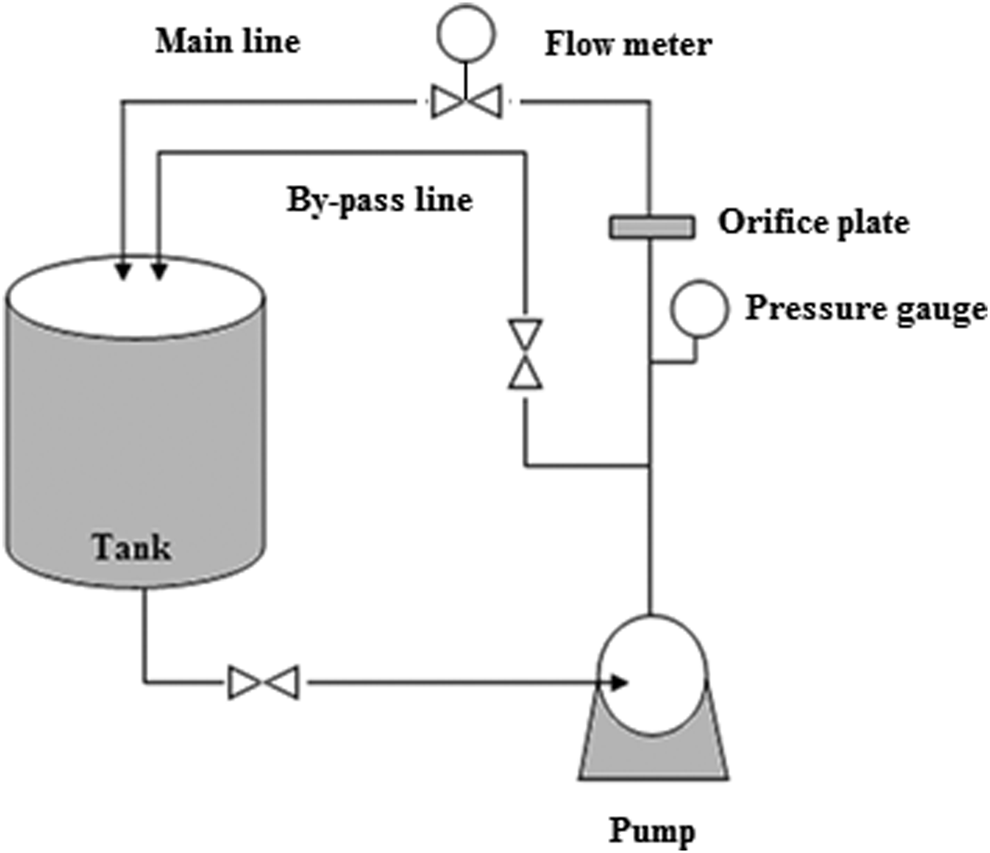
Schematic diagram of experimental configuration.
In the first stage of the study, sludge samples (10 L) were disintegrated by using single-hole orifice plates with diameters of 3, 4, and 5 mm. Under ideal condition, cavities are generated when Cv (cavitation number) is between 0.1 and 1, which can be obtained by adjusting the flow condition and reactor geometry (Bagal and Gogate, 2014b). Accordingly, in each trial, cavitation numbers were adjusted to 0.2, 0.5, and 0.8 by altering the inlet pressure. To change the velocity at the constriction, the flow rate was adjusted by opening/closing the valve in bypass line.
The cavitation number was calculated from the equation provided below (Gogate and Pandit, 2000):
where P2 is the recovered pressure downstream, Pv is the vapor pressure of the liquid, v0 is the velocity of the liquid at the orifice, and ρ is the density of the liquid. In these calculations, the atmospheric pressure was used as the recovered pressure.
Hydrodynamic cavitation experiments were run for 150 min, and the samples were collected from the tank at 0, 30, 60, 90, 120, and 150 min. According to the results of this stage, the optimum operation conditions with respect to the orifice diameter and cavitation number were determined.
In the second stage of the study, the effects of chemical-assisted (NaOH, Ca(OH)2, and H2O2) hydrodynamic cavitation were evaluated. For the NaOH-assisted trial, the pH of the waste-activated sludge (10 L) was adjusted to 9, 10, and 11 by adding an NaOH solution throughout the cavitation period of 150 min. The added amounts of NaOH to raise the pH to 9, 10, and 11 were 0.022 g NaOH/g dry solid, 0.035 g NaOH/g dry solid, and 0.057 g NaOH/g dry solid, respectively. Similar trials with Ca(OH)2 were also performed. The amounts of Ca(OH)2 required for pH 9, 10, and 11 were 0.112 g Ca(OH)2/g dry solid, 0.180 Ca(OH)2/g dry solid, and 0.255 Ca(OH)2/g dry solid, respectively.
In the case of H2O2-assisted experiments, 35% H2O2 solution was added to the sludge samples in cavitators externally at the beginning of the cavitation period with doses of 2.5, 5, 10, 20, and 30 mg/L, and then the mixtures were cavitated for 150 min. In chemical-assisted trials, the hydrodynamic cavitation system was run at optimum conditions, which were determined in the first stage of the study.
Chemical analysis
Chemical oxygen demand (COD) contents in the waste activated sludge were analyzed using the dichromate standard method (APHA, AWWA, and WEF, 1998). The soluble fractions of the sludge were obtained using centrifugation at 5,000 rpm for 10 min and subsequent filtration through membrane filters (0.45 μm pore size).
Disintegration degree, indicating the disintegration efficiency, is defined as a ratio of COD increase by mechanical disintegration in the sludge supernatant to the COD increase by alkaline hydrolyzation. The disintegration degrees (DD) was calculated according to the following equation (Müller, 2000):
where SCOD1 is the soluble COD concentration of the sludge after disintegration, SCOD2 is the soluble chemical oxygen demand (SCOD) concentration of the raw sludge, and SCOD3 is the SCOD concentration of the sludge after chemical disintegration. Chemical disintegration is performed by processing the sludge at 90°C for 10 min after the addition of NaOH. SCOD3 value, which was found experimentally for the sludge used in this study, was ∼2,900 mg/L. The DD values presented in the article were calculated according to this value.
Biochemical methane potential test
For assessing the efficiency of anaerobic digestibility and evaluating the biogas production, biochemical methane potential (BMP) test was carried out. BMP test was applied to both raw and disintegrated samples for comparison purpose. Anaerobic digested sludge collected from a digester, which was treating the waste water from a dairy processing in Bursa, was used as inoculum. Each sample was mixed in a 500 mL serum bottle with the anaerobic sludge, micronutrients, and buffer solutions. The substrate to inoculum ratio was equal to 0.5 g COD of substrate (raw or disintegrated sludge)/g volatile suspended solid of anaerobic inoculum (Boulanger et al., 2012; Us and Perendeci, 2012). Serum bottles were flushed with 25% CO2 and 75% N2 gas mixture, sealed and set on a mechanical shaker (130 rpm) in an incubator at 35°C.
Biogas volume was measured by liquid displacement and methane concentration in produced biogas was measured with gas chromatography (HP Agilent 7890A gas chromatograph equipped with a FID detector). To determine the produced methane volume per BMP bottle, the biogas volume was multiplied by the % of CH4 in the biogas as determined by GC-FID analysis. Thereafter, cumulative methane production was determined by converting mL of produced methane per bottle to mL methane per mg COD of substrate. The background methane production from the inoculum determined in blank assays with no substrate was subtracted from the methane production obtained in the substrate assays. BMP tests lasted 68 days and every batch experiment was duplicated.
Statistical analyses
In the first stage of the study, the data were subjected to a 2-way ANOVA for each orifice diameter to determine whether the selected cavitation numbers and cavitation time resulted in changes in the SCOD. In the second stage of the study, a 2-way ANOVA was conducted to test whether the chemical addition and time caused any variation in SCOD data for each of the chemical-assisted cavitation trials. Tukey's honest significant difference multiple comparison test was used to evaluate significant differences between means. All statistical calculations were performed using STATISTICA 10.0 software.
Results and Discussion
Determination of optimum orifice diameter and cavitation number
Figure 2 shows the variations of SCOD in the sludge samples disintegrated by hydrodynamic cavitation. An analysis of variance indicated that the main effects of the cavitation number and time on SCOD data were significant (p < 0.001, Table 2).

Variation of SCOD in sludge samples disintegrated by hydrodynamic cavitation. SCOD, soluble chemical oxygen demand.
MS, mean square.
Results presented in Fig. 2 clearly indicate that the cavitation device operated under different conditions achieved enhanced solubilization of the waste-activated sludge. An apparent increment in the SCOD values was observed over 150 min in all the conditions. In the case of an orifice diameter of 3 mm, the SCOD concentration of waste-activated sludge increased from 268–310 to 1,236–1,812 mg/L after a cavitation period of 150 min.
The maximum SCOD values were observed at a cavitation number (Cv) of 0.2 (p < 0.001). Although a similar variation trend was obtained in the case of an orifice diameter of 4 mm, the measured SCOD concentrations were generally much lower. After a cavitation period of 150 min, the SCOD values reached 1,155, 1,311, and 1,695 mg/L at cavitation numbers of 0.8, 0.5, and 0.2, respectively. When the orifice diameter of the orifice plate was 5 mm, lower SCOD values were obtained, and it was not possible to adjust the cavitation number to 0.2 with the power of the existing pump.
Under ideal conditions, the cavitation number should be less than or equal to 1 for cavity generation. For smaller cavitation numbers, the number of bubbles produced per unit time increases as well as the intensity of the cavitation process (Ozonek and Lenik, 2011). However, after a certain value, these cavities start coalescing with each other, resulting in the formation of a cavity cloud (chocked cavitation). In this situation, some of the energy produced by the collapse of the cavities is taken up by the neighboring cavities (Sawant et al., 2008). Therefore, the cavitation device must be operated between these two limits, that is, cavitation inception and choked cavitation to achieve the maximum effect (Badve et al., 2013).
Vichare et al. (2000) indicated that higher amounts of iodine were obtained from the decomposition of potassium iodide at a low cavitation number. According to Saharan et al. (2013), the optimum cavitation number ranged from 0.15 to 0.25 for the waste water treatment application. The optimum cavitation number in the study of Kuldeep and Saharan (2014) was obtained in the range of 0.10 to 0.20 (for the best cavitational activity). The results of this study similarly indicated that operating at a cavitation number of 0.2 is more efficient for the disintegration of waste-activated sludge.
Observed increment in the SCOD values (Fig. 2) also indicated that the diameter of constriction is another important factor that influenced the disintegration efficiency of waste-activated sludge. Conflicting results were obtained in previous studies regarding the effects of the diameter of constriction on the cavitation efficiency. Vichare et al. (2000) showed that the liberation of iodine decreases with an increase in the diameter of holes at a constant free area, whereas Sivakumar and Pandit (2002) have reported that the destruction of rhodamine B increases with an increase in hole diameter. Therefore, an optimization is required for the size of the holes depending on the required cavitation intensities for the target pollutant (Chanda, 2012).
The results of this study indicate that the SCOD values showed an increasing trend with decreasing orifice diameters. In general, better results with respect to SCOD were obtained when the orifice diameter was 3 mm. It is thought that with the smaller size of orifice, higher pressure could be attained, resulting in a more intense flow field being generated within the orifice, and hence higher hydrodynamic forces are encountered by the sludge particles, leading to greater solubilization. Similar observations were reported by other researchers investigating the optimization of hydrodynamic cavitation reactors.
In a study by Amin et al. (2010), the operating parameters in a hydrodynamic cavitation reactor was studied for maximizing the extent of hydroxyl radical generation. It is indicated that maximum upstream pressure could be attained with the smallest orifice area. The study also indicated that higher pressure resulted in an increase in the extent of hydroxyl radical production. In another study, the effect of orifice diameter and orifice length on the breakage of flowing protein precipitates was evaluated. The results showed that for a given mass flow rate, precipitates flowing through the smaller orifice experience more rapid disruption, and particles are reduced to a smaller size than particles flowing through the larger orifice (Zumaeta et al., 2008).
In our earlier trials, it was determined that using an orifice diameter of 2 mm was not suitable for the cavitation of waste-activated sludge from a food processing facility. The seeds of vegetables and fruits in the waste-activated sludge frequently plugged the orifice hole, which resulted in operational difficulties.
It is also clearly seen from Fig. 3 that higher disintegration degrees (DD) were observed in hydrodynamic cavitation trials with a cavitation number of 0.2 and an orifice diameter of 3 mm. After 150 min of cavitation, a DD of 60% was obtained in the case of a cavitation number of 0.2 and an orifice diameter of 3 mm, whereas significantly lower DD values (32% to 48%) were determined in the other trials (trials with cavitation numbers of 0.5 and 0.8 and with orifice diameters of 4 and 5 mm).
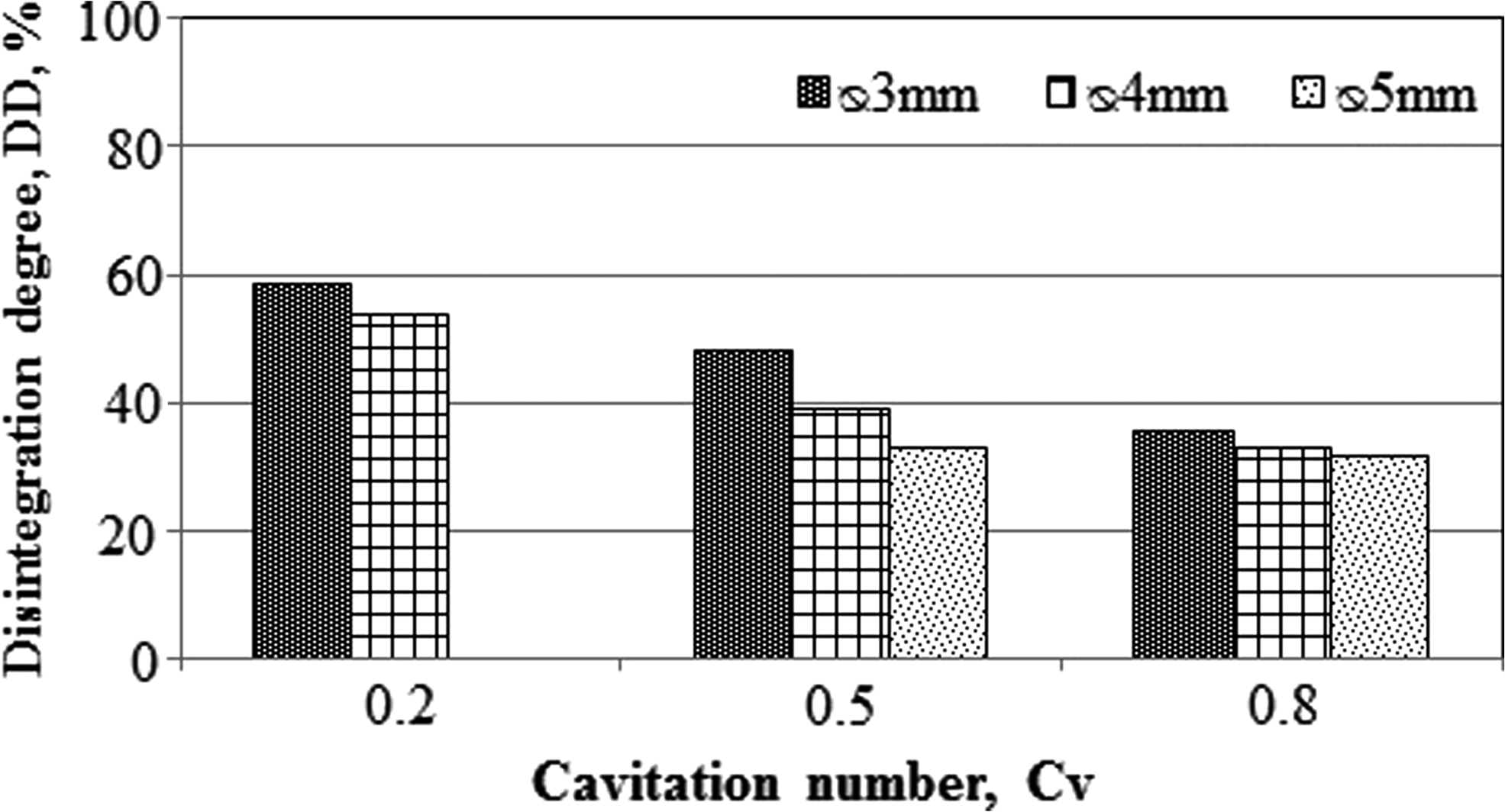
The calculated disintegration degrees (DD, %). DD, disintegration degrees.
Lee and Han (2013) obtained DD values of 11.52–23.67% for hydrodynamic cavitation with an orifice plate with 27 holes of 1 mm diameter. The reason for these lower percentages is probably the rather short disintegration time (20 min). Machnicka et al. (2009) used a hydrodynamic cavitation system with a 1.2 mm nozzle for activated sludge disintegration in their study. They found that the degree of disintegration changed from 14% after 15 min of disintegration to 54% after 90 min of disintegration.
For comparison, cavitational yields were used, which is defined as the quantity (SCOD) of the product formed per unit of supplied energy. Table 3 shows the values of the cavitational yields obtained for different operational conditions after 150 min of cavitation.
It can be clearly seen from the Table 3 that the cavitational yield value for the trial with the orifice diameter of 3 mm and cavitation number of 0.2 is apparently higher. In other words, a higher amount of SCOD was released per given amount of energy. Accordingly, the calculated cavitational yield values have conclusively proven the better efficacy of hydrodynamic cavitation with an orifice diameter of 3 mm and cavitation number of 0.2 values compared to those with higher orifice diameters and cavitation number values.
Consequently, the results revealed that it is important and necessary to operate hydrodynamic cavitation reactors at optimum conditions in terms of cavitation number and orifice diameter. Based on these results, optimum cavitation number and orifice diameter selected for the disintegration of waste-activated sludge from a food processing facility were 0.2 and 3 mm, respectively. Under these operation conditions (orifice diameter: 3 mm, Cv: 0.2, P: 6.3 bar, volumetric flow: 2.17 × 10⁻⁴ m3/s), the specific energy input for 30 min of cavitation (DD of 27.8%) was calculated as ∼1,500 kJ/kg total solids (TS). This may be accepted as a quite reasonable value for sludge disintegration.
Kavitha et al. (2014) studied a combined process involving thermochemical dispenser pretreatment and indicated that the mentioned method was found to be efficient at a specific energy consumption of 3360.94 kJ/kg TS, with the COD solubilization of 20%. On the other hand, ozone-aided disintegration processes offer less energy consumption as expected. In a study by Yukesh Kannah et al. (2017), an attempt has been made to enhance the biodegradability and minimize the operational cost of thermochemical pretreatment by combining it with ozonation. A solubilization of about 30.4% was achieved at an energy input of 141.02 kJ/kg TS and an ozone dosage of 0.0012 mg O3/mg SS through this combined thermo chemo ozone (TCO3) pretreatment.
Existing literature indicates that to attain a 20–25% disintegration degree in a hydrodynamic cavitator, the required specific energy input was 1,200–4,000 kJ/kg TS (Zubrawska-Sudol et al., 2010; Lee and Han, 2013). However, much more energy (10,400–60,000 kJ/kg TS) was required during the ultrasonic cavitation process for the same level of disintegration (Müller, 2000; Salsabil et al., 2009).
Evaluation of solubilization efficiency of chemical-assisted cavitation processes
The effects of chemical-assisted hydrodynamic cavitation on the SCOD values are indicated in Fig. 4. The SCOD values obtained in the added NaOH and cavitated sludge samples were significantly higher than those in only cavitated sludge (Fig. 2). Alkaline addition increases the sludge pH and creates a hypertonic environment in microbial cells. Cell membranes cannot withstand the resulting turgor pressure and so lost integrity (Tian et al., 2015).

Variation of SCOD in sludge samples disintegrated by chemical-assisted hydrodynamic cavitation.
The mechanism of alkaline disintegration induces swelling of particulate organic matters at a high pH, which makes the cellular substances more susceptible to the enzymatic attacks (Feng et al., 2009). Alkaline destroys floc structures and cell walls by hydroxyl anions. Extremely high pH causes natural shape losing of proteins, saponification of lipid, and hydrolysis of RNA (Racho, 2014). In a study conducted by Kim et al. (2003), alkaline disintegration was performed and various alkaline agents were used at pH 12. Their results showed that the SCOD concentrations were increased by 39.8%, 36.6%, 10.8%, and 15.3% for NaOH, KOH, Mg(OH)2, and Ca(OH)2, respectively.
Alkaline addition has often been combined with other disintegration methods to achieve a higher degree of disintegration (Kim et al., 2010). Tian et al. (2015) stated that the addition of NaOH to the ultrasonic cavitation process obviously induced synergistic disintegration. As the researchers remarked, addition of alkaline material possibly made the sludge structure more vulnerable to the mechanical disruption caused by ultrasound and enhanced the sonochemical effects of cavitation through the formation of radicals. Accordingly, the addition of NaOH together with hydrodynamic cavitation resulted in the enhanced solubilization of sludge. As shown in Table 2, the values of SCOD in NaOH added+cavitated sludge samples varied as a function of pH and time (p < 0.001).
Figure 4 indicated that the obtained SCOD values in the combined process of NaOH addition and hydrodynamic cavitation were rather similar for pH 9 and 10, whereas apparently higher values were obtained for a pH 11 (p < 0.001). The difference is especially more pronounced at 120 and 150 min of cavitation. The maximum SCOD values were observed after 150 min of reaction with the values of 2,210, 2,325, and 2,745 mg/L for pH 9, pH 10, and pH 11, respectively (Fig. 4). Lin et al. (1997) claimed that alkaline disintegration of waste-activated sludge with a dose in the range of 0.01 to 0.40 g NaOH/g of dry solids significantly increased the amount of solubilized organic matter. In our study, the addition of 0.057 g of NaOH/g dry solid (corresponding to a pH 11) showed the most effective solubilization in terms of SCOD.
In case of Ca(OH)2 addition, a similar trend was observed as the case of NaOH, with the exception that generally lower SCOD values were determined in Ca(OH)2 added+cavitated sludge (Fig. 4). It is known from the literature that pretreatment with NaOH resulted in a higher solubilization of COD compared to pretreatment with KOH, Ca(OH)2, and Mg(OH)2 (Penaud et al., 1999; Lee and Han, 2013). It is emphasized that the monobasic alkali reagent had a weaker ionic bond force than the dibasic alkali reagents, and hence, hydroxyl radicals were more easily formed by cavitation, and more radicals acted on the sludge.
Similarly, Uma Rani et al. (2012) evaluated the use of different alkalines (NaOH, KOH, and Ca(OH)2) in a combined alkaline and disperser pretreatment method and indicated that the best performance in terms of COD solubilization was obtained with NaOH. Kavitha et al. (2015) also underlined the improved efficiency of NaOH addition in a combinative sludge disintegration method. As indicated in Fig. 4, maximum SCOD values in CaOH2 added+cavitated sludge were observed after 150 min of cavitation with the values of 1,925, 2,088, and 2,224 mg/L, for pH 9, pH 10, and pH 11, respectively.
SCOD values for the combination of H2O2 addition and hydrodynamic cavitation varied depending on the amount of added H2O2 and time (p < 0.01). An increasing trend was observed with increasing time, and maximum SCOD values were observed at 150 min of cavitation with the values of 2,022–2,925 mg/L (Fig. 4). In this study, the best results for the disintegration of solids and organic carbon release in terms of SCOD were obtained for the combined system of H2O2 addition and hydrodynamic cavitation. The obtained result can be attributed to the enhanced formation of free radicals due to continuous dissociation of hydrogen peroxide under the cavitating conditions (Patil and Gogate, 2012).
H2O2 is a powerful oxidizing agent that destroys the cell walls of microorganisms, leading to the release of cytoplasm and the oxidation of many refractory organic compounds. Several studies have proven that the application of H2O2-assisted processes has been shown to be an efficient AOP for waste sludge disintegration (Wong et al., 2006; Kenge et al., 2009; Ya-Wei et al., 2015). As indicated in Fig. 4, the maximum yield with respect to SCOD was observed with an H2O2 dose of 20 mg/L. The addition of 30 mg/L H2O2 appeared to cause a mineralization that resulted in lower SCOD values in the sludge samples. Similar to this finding, Wang et al. (2009) reported that the rate of mineralization increased faster than those of solubilization at high H2O2 dosages.
Effect of disintegration on anaerobic biodegradability
To assess the anaerobic digestibility of disintegrated sludges and evaluate biogas production, the BMP assay was performed. Cumulative methane production was measured from biochemical methane potential test and is shown in Fig. 5. The accumulated methane production at the end of 68 days of the digestion period is nearly 100 mL for control sample, whereas apparently higher amounts were produced in case of all disintegrated sludges. Twenty percent to 89% higher methane production was observed for disintegrated sludges comparing to raw sludge. The methane content of biogas produced from control sample was 72.5%. Similar values (70–74%) were determined for disintegrated samples. The obtained results revealed that deflocculation of bacteria flocs by the mechanical and chemical effects of hydrodynamic cavitation seems to be beneficial in the subsequent anaerobic digestion process.
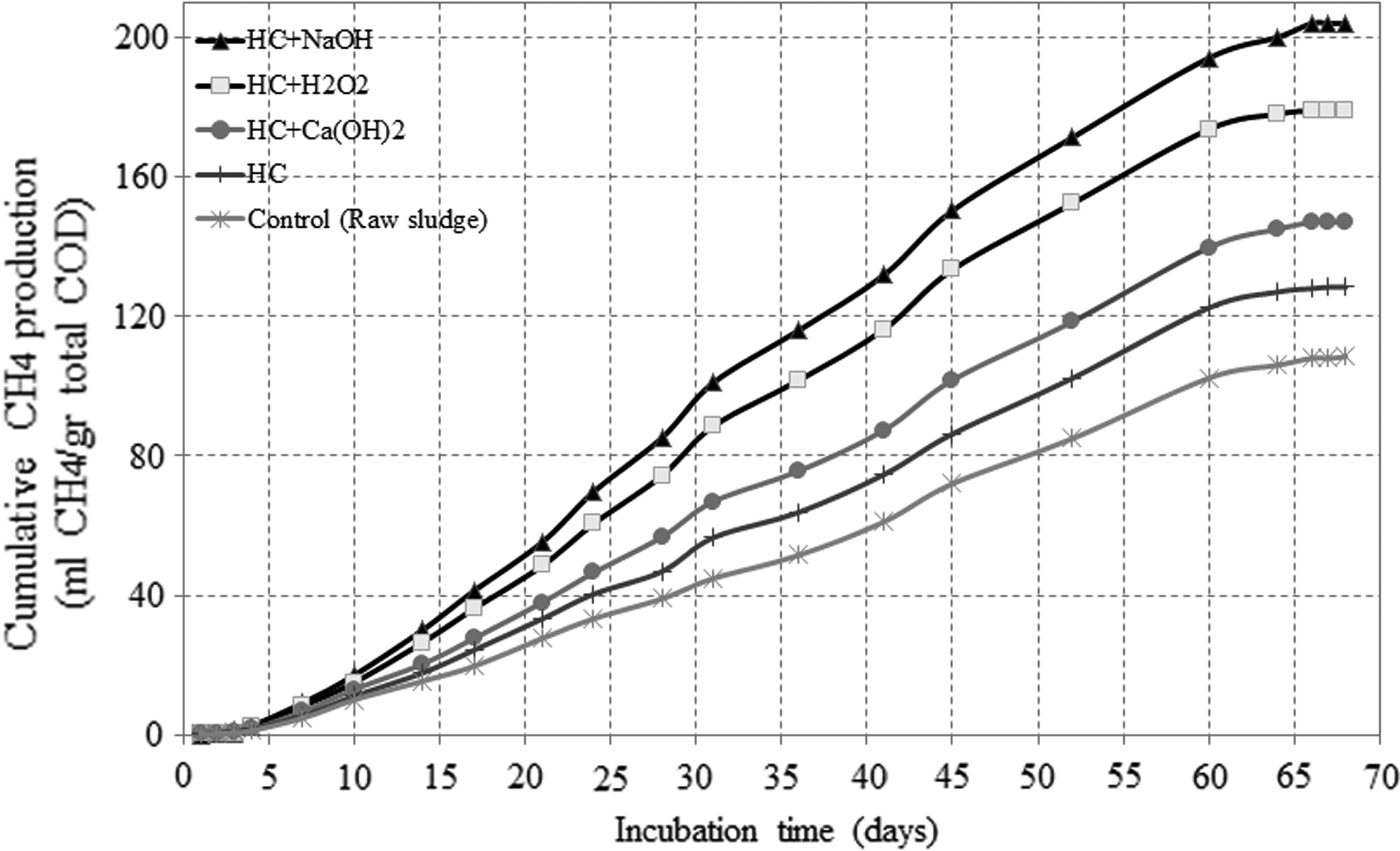
Cumulative methane production from raw and disintegrated sludge samples.
Abrahamsson (2015) evaluated the hydrodynamic cavitation as an innovative solution for anaerobic digestion of several substrates, including waste-activated sludge. It is reported that cavitated sludge showed a 25% increase in BMP value compared to untreated sludge. It is also indicated that a faster hydrolysis occurred in case of cavitated sludge. In a similar study conducted by Maeng (2010), an increase of methane production equal to 24% was obtained with waste-activated sludge treated by hydrodynamic cavitation.
The combined disintegration of H2O2+hydrodynamic cavitation showed higher SCOD release, but in case of methane production, the combined disintegration of NaOH+hydrodynamic cavitation showed better results. The pretreatment with H2O2 may result in the release of some toxic products/by-products, which is expected to cause an inhibition of anaerobic digestion process to some extent. Consequently, BMP results apparently indicated that the higher digestion efficiencies of the waste-activated sludge were obtained through hydrodynamic cavitation+NaOH (pH: 11) addition.
Conclusion
In accordance with obtained results, it can be concluded that besides its proven effectiveness in wastewater treatment, hydrodynamic cavitation is a promising technology for the pretreatment of waste-activated sludge. Results of this study apparently revealed that using an orifice-based hydrodynamic cavitation for the disintegration of waste-activated sludge from a food processing facility going into anaerobic digestion in a full-scale plant might improve the digestion efficiency, resulting in higher biogas yields. The following inferences and conclusions can be made from the overall evaluation of the study:
- By using hydrodynamic cavitation with orifice plates, solubilization of the waste-activated sludge was achieved, and disintegration degrees of 32% to 60% were obtained after 150 min of treatment under different operational conditions. - Based on the results of this study, the optimum cavitation number and orifice diameter selected for disintegration of waste-activated sludge from a food processing facility were 0.2 and 3 mm, respectively. Under these operation conditions, the specific energy input for 30 min of cavitation (DD of 27.8%) was calculated as ∼1,500 kJ/kg TS. - Enhanced solubilization was achieved in the case of hydrodynamic cavitation combined with NaOH, Ca(OH)2, and H2O2 addition. The best results of the disintegration of solids and organic carbon release in terms of SCOD were obtained for the combined system of H2O2 addition with a dose of 20 mg/L and hydrodynamic cavitation. The maximum solubilization efficiency of the alkaline-assisted processes was sequenced in the order of NaOH (pH: 11)+hydrodynamic cavitation>Ca(OH)2 (pH: 11)+hydrodynamic cavitation. - According to the results of BMP assay, higher methane production was obtained through hydrodynamic cavitation+NaOH (pH: 11). This finding clearly indicated that the efficiency of a disintegration method should be evaluated not only by solubilization effect but also by anaerobic digestibility tests.
Footnotes
Acknowledgment
This study was supported by the TUBITAK (The Scientific and Technological Research Council of Turkey) under Grant No. 114Y523.
Author Disclosure Statement
No competing financial interests exist.