




Abstract
Abstract
The role of soil properties for vegetation development during early spontaneous succession was studied in a limestone quarry Mokrá (south Moravia, Czech Republic). In particular, we would like to detect the soil environment features supporting the swards formation of expansive reed grass (Calamagrostis epigejos), which is able to arrest a succession process. Research was conducted along postmined quarry benches, where natural recovery took place. We examined water–air regime, soil organic carbon (SOC) content, total nitrogen content (Ntot), content of available calcium (Ca), magnesium (Mg), potassium (K), phosphorus (P), soil reaction (pH), and soil texture of soil samples collected separately from assemblages with abundant reed grass and without them, usually with the occurrence of tall oat grass (Arrhenatherum elatius). A multivariate statistical approach revealed the fact that soil texture, SOC, Ntot, and water–air regime were statistically significant for the vegetation types. Reed grass prefers fine grained soils with higher amount of clay and silt particles, whereas assemblages without abundant presence of this species settled coarse grained soils with higher sand or skeleton content. High SOC and Ntot values were also associated with sites covered with reed grass. Therefore, using these variables as a measure of recovery success in early succession might be a problem.
Introduction
S
According to Wiegleb and Felinks (2001), variables like pH, organic carbon, phosphate, and water capacities have an obvious effect on plant species composition of colonized postmined areas. Surrounding vegetation, macroclimate, soil moisture, and soil texture also strongly affect the successional trajectory (Prach and Řehounková, 2006).
Soil properties are also frequently used as a tool for evaluation of natural recovery potential. The soil organic matter content is a commonly used indicator (Lavelle et al., 1997; Frouz et al., 2001, 2006; Frouz and Nováková, 2005; Šourková et al., 2005; Chodak et al., 2009; Bodlák et al., 2012; Tropek et al., 2012; Bartuška et al., 2015). Soil organic carbon (SOC), Ntot, and potassium (K) usually increase according to succession age (Dana and Mota, 2006; Bodlák et al., 2012; Bartuška et al., 2015). On the other hand, the soil reaction (pH) and calcium (Ca) and sodium (Na) content showed even more decreasing tendency (Šourková et al., 2005; Frouz et al., 2008; Bodlák et al., 2012).
Physical soil properties also play a key role in soil formation processes and directly influence other soil features (Tischew and Lorenz, 2005). Surprising correlation was found by Bodlák et al., 2012, who found the negative correlation between SOC and fine grain and the positive correlation between SOC and coarse grain.
Specific landscape features resulting from mining activities are quarries. Quarrying completely changes site conditions, including relief, soil surface, and water regime. However, in the recent past they were perceived as scars in landscape; today they could be considered as a valuable landscape phenomenon increasing geodiversity and offering new habitats for rare and endangered species (Sádlo and Tichý, 2002; Chuman, 2006; Tropek et al., 2010). It is particularly limestone bedrock, where new habitats are of increasing importance. Succession on such localities results in heterogeneous mosaic of bare rocks, dry grasslands, ruderal vegetation, closed stands of shrubs and trees, water affected habitats, etc. Direction of succession process is usually shifted by habitat wetness (Novák and Prach, 2003; Trnková et al., 2010).
Potential risk for spontaneous development in quarries not only poses strong competitors like the reed grass (Calamagrostis epigejos) forming compact swards, but are also able to arrest a succession for a long time (Prach and Pyšek, 2001; Wiegleb and Felinks, 2001; Tischew and Kirmer, 2007). C. epigejos (CE) is a widespread tall clonal grass native to Eurasia, which can grow on various natural, seminatural, and also man-made habitats. It accepts incredibly wide range of site conditions, including draught on one side and water logging on the other side (Rebele and Lehmann, 2001). At limestone quarries it prefers fine grained material (Tichý, 2010).
In general, vegetation has an important effect on soil properties, especially as a source of organic matter, which is decomposed by microorganisms. The process of decomposition and/or mineralization is depended on C/N ratio of decomposed material and type of vegetation. In extreme conditions that postmined areas represent, the vegetation effect on evaporation, shading, and root soil stabilization is very important (White, 2006).
Our study aims to offer a new approach to the relationship between physical–chemical soil features and successional trajectories during early succession of vegetation at a limestone quarry. The main task was, whether it is possible to find thresholds of soil properties, which make soil substratum vulnerable to expansion of Calamagrosis epigejos.
Three basic hypotheses were stated: (1) Is there any causal relationship between presence of the reed grass and soil properties? (2) Does succession process result in decrease of pH and increase of SOC? (3) Can increasing content of organic matter be considered as a measure of restoration success? As a model area, a limestone quarry near the village of Mokrá (the south of Moravia, the Czech Republic) was selected.
Material and Methods
Study area
A limestone quarry Mokrá is situated ∼16 km NE from the city of Brno (the south of Moravia, the Czech Republic, see Fig. 1). Covering an area of 150 ha, it is among the largest limestone quarries in the Czech Republic. This quarry is still under mining process; however, several parts had already been out of operation. The forest reclamation, assisted succession, and spontaneous succession had been applied for recovery of those areas (Sekanina and Musilová, 2011).

Localization of the quarry Mokrá in the Czech Republic with marked sampling sites (Esri, 2016).
The quarry is located on the transition of the Moravian Karst and Drahany Upland. The quarry is divided into three parts. The eastern part is mainly formed by Culmian formation composed of clay schist, silt stone, sand stone, greywacke, and conglomerate. Central and western parts consist mainly of Devonian limestone (Sekanina and Musilová, 2011). The nearest surrounding is covered dominantly by forests; farmland is a minority. The studied area is located at an altitude of 300–400 m a. s. l. with an average temperature of 9.4
Sampling
The research was conducted in 2013–2016 on the naturally recovered quarry benches and foots of quarry benches, which had not been affected by mining activities for 10–30 years (for detailed information see Table 1).
The age of selected quarry benches was determined according to data provided by the mining company.
First, the preliminary botanical survey helped to distinguish species diversity and the main vegetation types. The most distinct assemblages were formed on the patches with favorable deeper soil profile, usually covered by swards of C. epigejos of various densities or by vegetation with the presence of Arrhenatherum elatius, less Hieracium pilosella, or Festuca rupicola. To be able to assess the causality between soil properties and vegetation we focused on such patches, where collecting of undisturbed soil samples was possible. Altogether, 14 sampling sites of 10 × 10 m (1–3 at each quarry bench) were selected (6 of them where reed grass reached abundance over 10%, 7 other vegetation types, mainly with the presence of tall oat grass). The last sampling site was the control plot located at the naturally seeded woody vegetation representing conditions of advanced successional stages.
Pedological survey
From each sampling site, six undisturbed soil samples (V = 100 cm3) and two mixed samples (500 g) were taken during autumn 2014 and spring 2015. Undisturbed soil samples were analyzed according to Zbíral et al. (2010); the samples were weighed in a fully water-saturated state, after drainage, and oven dried to constant weight. Soil particle density (Dp) was determined by a pycnometric method. Obtained values were used in calculations to determine soil water–air relationships, for example, capillary water (CW), water retention capacity (WRC), porosity (P), aeration (A), minimal aeration (ACW), soil mass wetness (w), and bulk density (Db). Particle soil analyses were performed according to Zbíral et al. (2011a). A fine earth fraction (particles smaller than 2 mm) was mixed with a dispersing agent [(NaPO3)6 + Na2CO3 + H2O], the suspension was heated to disaggregate soil particles. The determination of soil particle percentages was held by a pipetting method. The soil texture was evaluated according to a texture triangle diagram USDA. Mass fraction of gravel (solid particles ≥2 mm) was determined by wet sieving.
Calculations (according to Zbíral et al., 2010)
• mCW, mass of soil sample holding CW after 2 h of drainage • md, mass of oven-dried soil sample • V, volume of undisturbed soil sample • mWRC, mass of soil sample holding water after 24 h of drainage • md, mass of oven-dried soil sample • V, volume of undisturbed soil sample • md, mass of oven-dried soil sample • V, volume of undisturbed soil sample • Dp, soil particle density • Db, bulk density • mf, mass of fresh soil sample • md, mass of oven-dried soil sample • P, porosity • W, soil mass wetness • Dp, soil particle density • P, porosity • CW, capillary water
There are other soil properties included in this research, such as soil reaction (pH), SOC, total nitrogen (Ntot), and content of available Ca, Mg, P, and K. Active soil reaction (pH/H2O) and potentially exchangeable soil reaction (pH/KCl) were determined by a combined electrode pH meter according to Zbíral et al. (2010). SOC was analyzed by the wet acidified dichromate oxidation followed by spectrophotometric determination (Zbíral et al., 2011b). Total nitrogen (Ntot) was determined by soil sample mineralization according to Kjeldahl method, after distillation of ammonia, nitrogen was determined titrimetrically. Mehlich II method was followed to determine the content of available P, K, Mg, and Ca (Zbíral et al., 2010).
Obtained data were processed using the program STATISTICA 12. Data were investigated with respect to statistical peculiarities and basic assumptions were verified. The aim of these analyses consisted in revealing the degree of symmetry and kurtosis, detecting outlier values and validating data independence of selection, and verifying data normality. All statistical procedures and the subsequent graph drawings were conducted in accordance with Meloun and Militký (2006).
Phytosociological sampling
To understand better the relationship between soil environment and physiognomy of vegetation, the supplementary phytosociological survey was made in response to the soil sampling. In particular, our attempt was to examine whether any causal relationship between the presence of expansive reed grass (C. epigejos) and soil properties could be detected. Square phytosociological relevés of 1 m2 were recorded from the same sampling sites, where the undisturbed soil samples were taken. The percentage scale of abundance/dominance was used to quantify the coverage of tree, shrub, and herb layers. Obtained records were digitized using TURBOVEG (Hennekens and Schaminée, 2001) software; the data preparation for analysis was carried out in JUICE 7.0 (Tichý, 2002). Final data file involved 32 phytosociological relevés containing 65 taxa of vascular plants.
The relationship of herb layer and selected parameters of soil environment was analyzed using a multivariate analysis in CANOCO 4.5 (ter Braak and Šmilauer, 2002). Logarithmic transformation of all data and down-weighting of rare species were set in previous analyses. As the first step, a detrended correspondence analysis was processed. Due to the gradient length on the first canonical axis (5.89), the unimodal approach–canonical correspondence analysis (CCA) was selected for the testing of the effect of individual variables on the species composition (Hill's scaling, manual selection of variables, Monte Carlo test with 999 permutations). Graphic outputs of analyses were processed in CanoDraw 12.04 software.
Results and discussion
Preliminary botanical inventory
Overall 190 plant species of vascular plants were recorded within all studied quarry benches. The species richness along one bench ranged from 58 to 115 species. Thirty-five species were woody plants with coverage of up to 10%. Woody plants were usually represented by seeded trees and shrubs. Research plot number 6/1 consists of naturally seeded forest reaching the tree coverage of 60%.
Flora was relatively rich and showed high diversity of species. The coverage of herb layer ranged from 1% to 25% due to the substrate and relief characteristics and successional stage. Xerothermophilous and hydrophilic species were found together with nitrophytes and species not preferring the rich soils. Two endangered species protected by the Act No. 395/92 Coll. (Cephalathera damasonium and Cornus mas) and 20 species from the Czech red list of vascular plants (Grulich, 2012) were recorded. A critically endangered Gentianopsis cilliata can be found as the most interesting. The alien species occurrence (according to Pyšek et al., 2012) was also very high (17% of total plant species diversity). A. elatius and Melilotus albus represented the most common archaeophytes, Erigeron annuus, was the most common neophyte. The botanical results are summarized in Table 2.
Pedological analysis
Pedological analysis results show a normal distribution according to S–H test. A correlation analysis revealed a positive causal relationship between WRC and amount of clay and SOC. WRC, amount of sand and gravel show a negative correlation. The same relationship is seen in results of porosity (P). A statistically significant (α <0.05) relationship of following soil properties and the main vegetation types was found: CW, (F = 12.54; p = 0.0001), WRC (F = 13.44; p = 0.000005), minimal aeration (ACW) (F = 3.04; p = 0.041568), content of clay (F = 4.43; p = 009619), silt (F = 8.04; p = 0.000333), and sand (F = 7.26; p = 0.000657). The SOC content (F = 4.80; p = 0.006616) and nitrogen total content (Ntot) (F = 3.58; p = 0.023272) were also found having an obvious influence on dominant plant species (C. epigejos dominant and C. epigejos nondominant).
According to multivariate ANOVA, the vegetation is not supposed to be a cause of measured soil properties. The vegetation seems to be adapting to the soil properties or the vegetation type prefers a certain type of a habitat. This implies that selected soil properties are determinative of the vegetation type. Contents of available Ca, Mg, P, and K were found statistically significant for the sampling sites (α <0.05) and correspond to some degree with the transition of Devonian limestone to Culmian formation.
Reed grass (C. epigejos) dominance (CED) sampling sites show high WRC. CW exceeded 30% in most samples from the CED sampling sites. Reed grass nondominance (CEN) sample sites contained less than 30% of CW. Thus, the mentioned value of 30% could be considered as threshold for presence of CE swards in study area. Medium porosity with content of pores from 45% to 55% was found only at two CED sampling sites. All other sampling sites show low to middle, low, and very low porosity. Most of the CED sampling sites were of a very low minimal aeration. These samples contain less than 5% of pores, which are not able to hold water for longer time and pose soil air. These soils show low physiological depth, low intensity of humification, soil biota retardation, and susceptibility to water logging (White, 2006). Average values of these basic soil characteristics are listed in Table 3.
WRC, water retention capacity; P, porosity; ACW, minimal air capacity; CW, capillary water; CED, Calamagrostis epigejos dominance; CEN, Calamagrostis epigejos nondominance.
WRC was higher on CED sampling sites (Table 3). High ability of soil to hold water and to gradually provide it to plants corresponds with soil texture and soil organic matter. Clay and organic matter increases WRC, whereas coarse grained particles (sand, stone, and gravel content) have the opposite effect (White, 2006; Fig. 2).
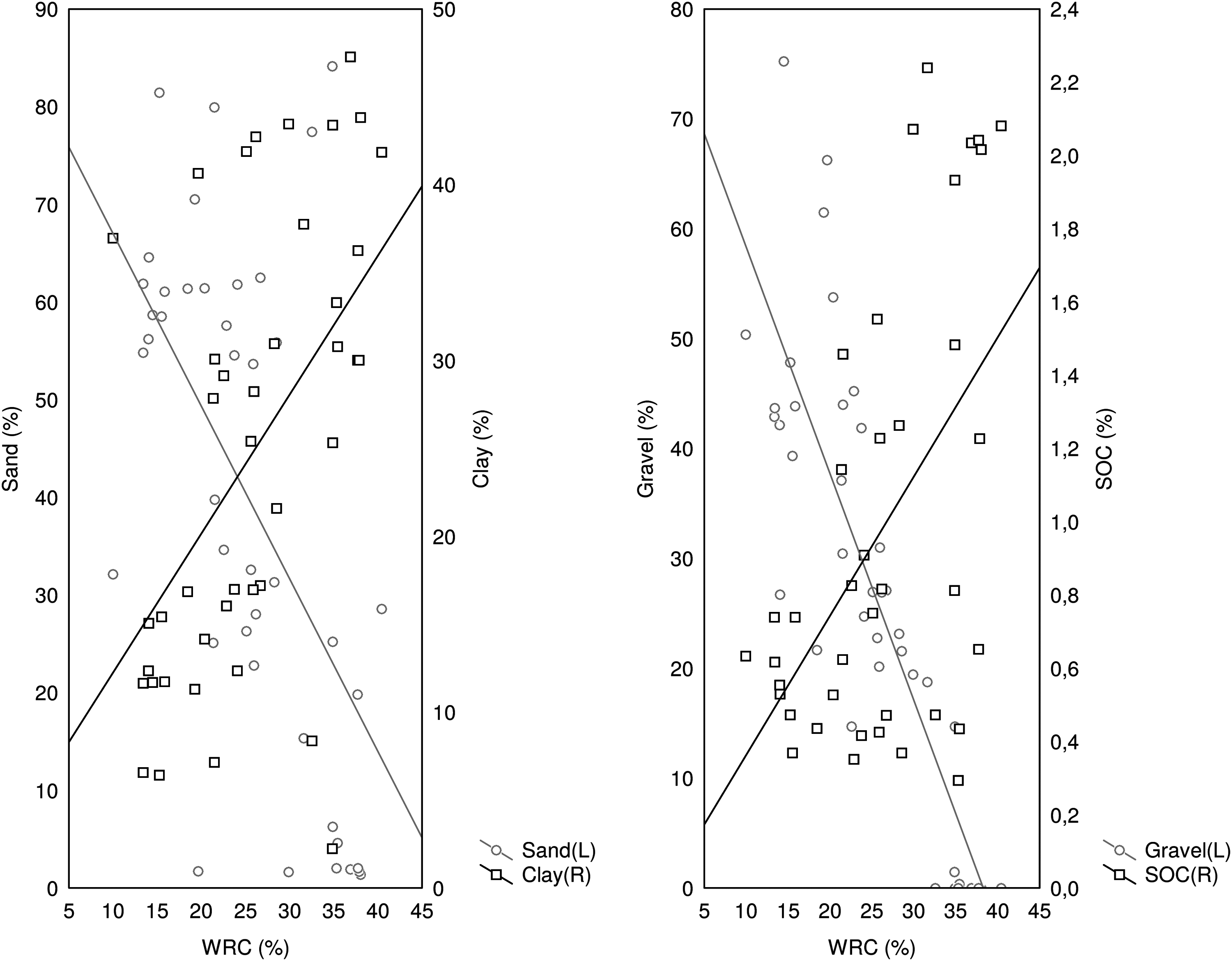
Relationship between WRC, amount of sand (0.05–2 mm), clay (≤0.002 mm), gravel (≥2 mm), and SOC.
The highest content of clay particles was found at the CED sampling sites. The lowest value was measured within naturally seeded forest, where the gravel content was the highest. CEN sampling sites show higher gravel content compared with the CED sampling sites. Measured values are summarized in Fig. 3.
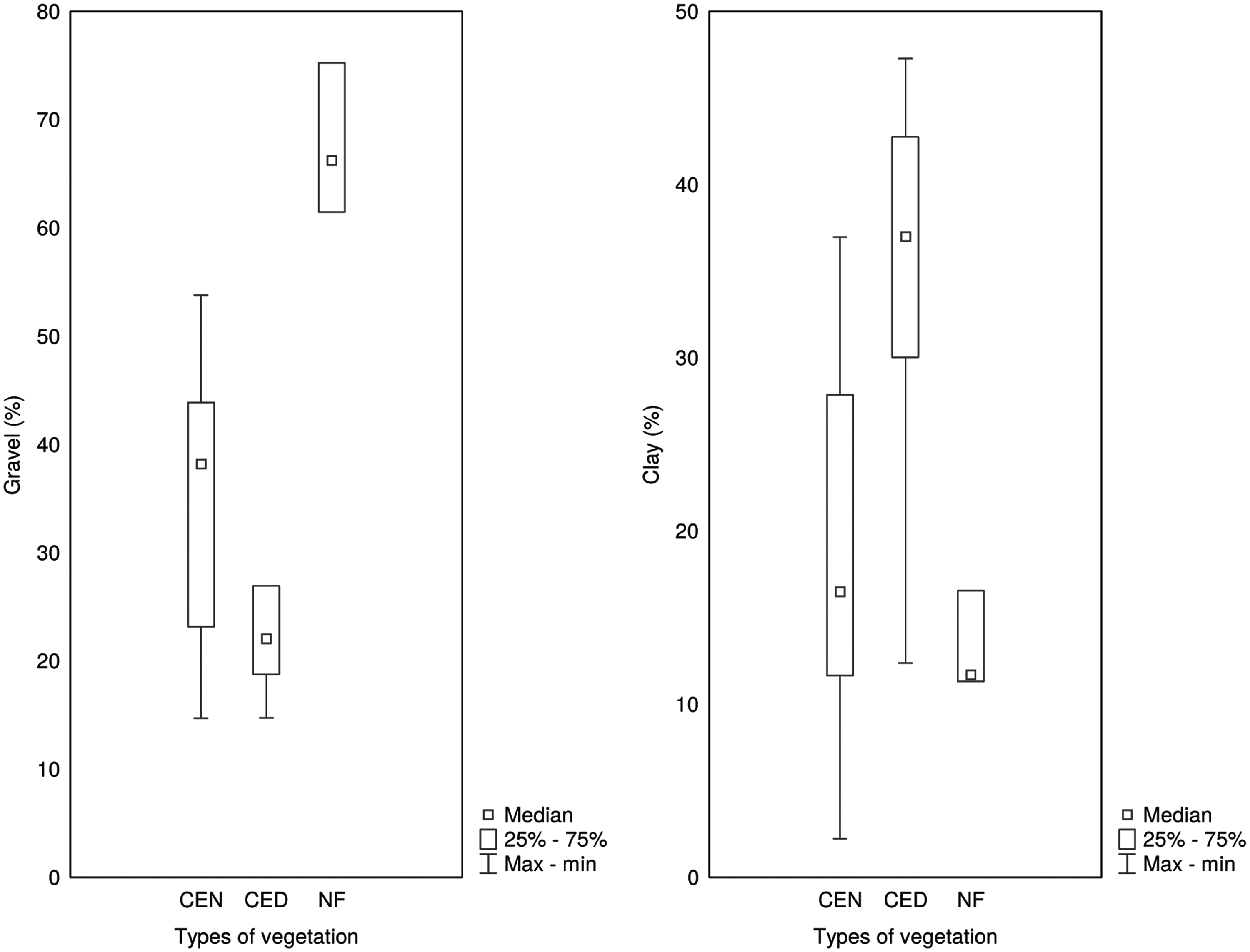
Average content and median values of gravel (≥2 mm) and clay particles (≤0.002 mm) for the vegetation types: CED, C. epigejos dominance; CEN, C. epigejos nondominance; NF, naturally seeded forest.
CEN sampling sites were usually included in sandy-rich texture classes–loamy sand and sandy loam. On the other hand, most CED sampling sites were included in clay-rich texture classes–silty clay loam, see Table 4. Texture differences are not so distinct in the eastern part of the quarry, where Devonian limestone transit to Culmian formation.
Soil reaction (pH) was relatively high and balanced, only small differences could be observed within samples from the eastern part of the quarry (sample sites 5/1, 5/2, 5/3, and 6/1), where the transition of Devonian limestone and Culmian formation occurs (Fig. 5).

Average values of potentially exchangeable soil reaction (pH/KCl).
Measured values of SOC varied from 0.42% to 2.08%. Most of CEN sample sites showed lower SOC content than CED sampling sites. Total nitrogen content showed the same trend. Naturally seeded forest contained the highest values of SOC and Ntot, which confirm increasing of soil organic matter with litter fall accumulation (White, 2006). Thus, soil organic matter especially SOC is a variable recommended for a recovery success evaluation (Lavelle et al., 1997; Frouz et al., 2001; Frouz and Nováková, 2005; Šourková et al., 2005; Chodak et al., 2009; Bodlák et al., 2012; Tropek et al., 2012; Bartuška et al., 2015). However, SOC content of naturally seeded forest is close to the SOC values of CED sampling sites (Fig. 6). Considering this fact, using SOC as a recovery success measure in early succession might be a problem.
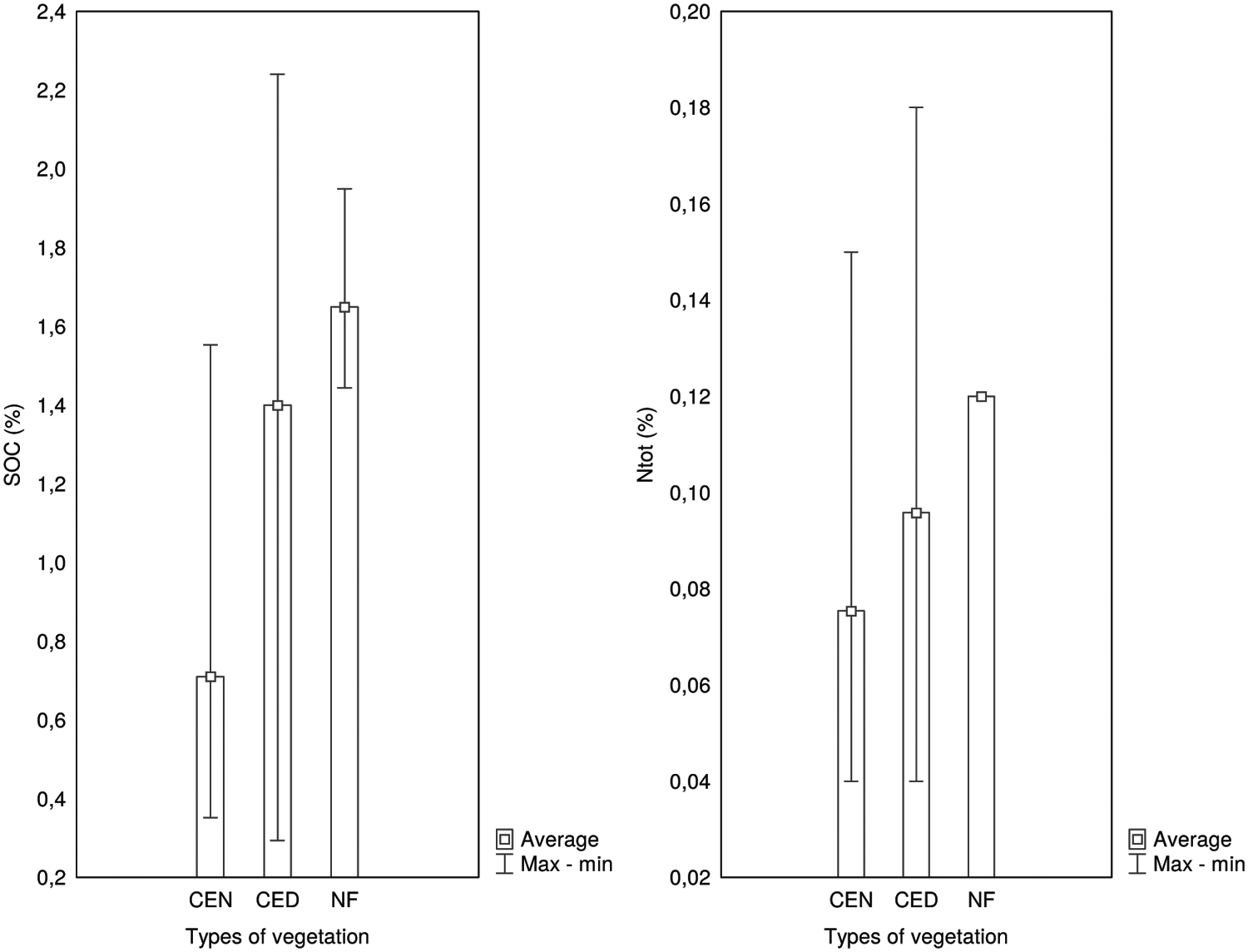
Average content of total nitrogen (Ntot) and SOC for the vegetation types: CED, C. epigejos dominance; CEN, C. epigejos nondominance; NF, naturally seeded forest.
According to results of Bartuška et al. (2015), Bodlák et al. (2012), and Dana and Mota, 2006, SOC is supposed to increase, whereas pH decreases with the age of spontaneous succession process. Our data show a slight increase of SOC, but pH increases as well (Fig. 7). The possible reason might be various bedrock transiting from alkaline limestone to less alkaline Culmian formation from the central to the eastern part of the quarry (Sekanina a Musilová, 2011).

SOC and soil reaction (pH) according to date of mining activities termination.
Average contents of Ca, Mg, P, and K are listed in Fig. 8. Studied areas situated in the eastern part of the quarry (number 5 and 6), where Devonian limestone transits to Culmian formation show the lowest amount of Ca. However, low Ca amount was also measured within a central open pit, especially quarry bench number two, where import of ex situ material is excluded, however, a small body of the Culmian formation is probable. The results show significant surplus of Ca often exceeding 40,000 mg/kg (Fig. 8).The content of available Mg was very high, significantly exceeding the limit value of 80 mg/kg. The highest values were measured within sampling sites 5/2 and 5/3, together with phosphorus. Values of soil reaction were the lowest on these sampling sites and together with Mg and P content refer to a different soil substrate (Culmian formation). The found status of available potassium shows a slight deficiency from values 30 mg/kg—sampling site 1/2, up to relatively high value 141 mg/kg—sampling site 2/1. The amount of available phosphorus was very low on most sampling sites (evaluation according to Vavříček, 2011).

Average contents of available Mg, Ca, K, and P within studied sampling site.
Results of multivariate analysis
The relationship between vegetation and measured soil properties was tested by means of CCA. Sampling sites were used as covariables, which also made specification of blocks of samples. Figure 4 shows an ordination biplot of CCA, where 31 vegetation samples and 5 significant environmental variables are displayed (Table 5).

Ordination biplot of CCA where phytosociological samples and significant environmental variables are displayed. Different centroids mark samples according to prevailing plant species: Grey squares–Calamagrostis epigejos, grey circles–mixed vegetation with low abundant Calamagrostis epigejos, white down-triangles–Arrhenatherum elatius, black circles–Hieracium sp. and white diamonds–mixed vegetation with Festuca rupicola. Significant environmental variables: SOC–soil organic carbon, WRC–water retention capacity, Ntot–total nitrogen, Sand–content of sand and Clay–content of clay.
SOC, soil organic carbon.
According to the environmental variables the centroids of relevés are cumulated to the several distinct clouds. Two most striking of them belong to the vegetation types with abundant C. epigejos (CE) and A. elatius (AE). It is obvious that AE type colonizes more sandy soils, whereas CE is more common on heavier soils with higher value of WRC, while exhibiting greater ecological valence. SOC and total amount of nitrogen are also more associated with assemblages of CE than ones with AE, however, this relation is not so clear (compared with soil texture). These findings are supported by results of pedological analyses (see in chapter 3.2). The other vegetation types are highly heterogeneous: mixed vegetation with low abundant CE appears to be transitional between CE and AE types, Festuca type is probably connected with nutrient-rich soils, and Hieracium type seems to be completely different than the others. For more proper evaluation of the three latter types of vegetation, a larger dataset is needed.
Conclusions
Pedological analysis revealed differences in properties of soils from determined vegetation types in the limestone quarry Mokrá. The reed grass tends to be the species preferring fine grained soils with higher amount of clay and silt particles. Moreover, similar pattern is seen in results of phytosociological relevés analyses. Lower content of gravel and high WRC with water logging susceptibility were also more connected with reed grass communities. Very low values of minimal aeration did not pose problems for reed grass growth. CEN vegetation type prevails on the coarse grained soils with higher content of sand or gravel. High SOC and Ntot values were detected on sampling sites, where the reed grass prevailed. This species is considered to be problematic for a spontaneous recovery, thus using these variables as a recovery success measure in early succession might be a problem.
Footnotes
Acknowledgments
This research was supported by grant from Iceland, Liechtenstein, and Norway, Project: Education and support of training in the area of forest ecosystems and conditions for preserving their diversity (Registration Number EHP-CZ02-OV-1-040-2015), and mining company Českomoravský cement, a.s. The authors thank Jitka Přichystalová for help with the language.
Author Disclosure Statement
No competing financial interests exist.