




Abstract
Abstract
Biofilm-based bioprocesses are increasingly used in wastewater treatment. Microbial adhesion constitutes the key step in stability of these depollution systems. For adhesion studies, physicochemical characterization of microbial cells and supports has proved to be of extreme importance. In this work, estimation of interaction between five yeast strains with a high potential for Cr (VI) removal using extended Derjaguin–Landau–Verwey and Overbeek (XDLVO) theory as a powerful predictive tool of adhesion was investigated. Predictions showed that wood husk could be a good support for the formation of tested yeast biofilm, beech and oak exhibit better properties than other wood species studied with 100% of potential for adhesion. From a thermodynamic point of view, pine and teak woods are not suitable for biofilm formation for all tested yeast strains, presenting positive values of free energy adhesion (ΔGXDLVO). Environmental scanning electronic microscopy (ESEM) and Matlab® image analysis confirmed that all tested yeast strains were able to adhere to pine wood and, except for Wickerhamomyces anomalus they were unable to adhere to oak wood. Adhesion experiments were found to be well related to the theoretical prediction. To our knowledge, this is the first study dealing with biofilm-mediated depollution from an adhesion point of view aiming to optimize the stability of the system. It allows expanding knowledge about adhesion phenomena of yeast strains on wooden surface and contributes to select the best biofilm-support combination that would be used in a performant biological system for chromium removal.
Introduction
O
The stability of the biofilm during its functional lifetime is a key factor for its application in a wastewater treatment process. It is essentially related to initial microbial attachment on substrates. Thus, an optimal maintain of biofilm adhesion may provide efficient degradation of hazardous substances in a wastewater treatment process. This step of biofilm formation is a complicated process, enhanced by multifactorial parameters especially physicochemical properties of both support material and microbial surfaces (Elabed et al., 2011).
In biofilm-based systems for wastewater treatment, many chemical materials have been used as support. The most frequently employed are granulated activated carbon (Quintelas et al., 2008), zeolite (Silva et al., 2008) and kaolin (Quintelas et al., 2009). These materials are especially employed for their depolluting activity. However, they represent the disadvantage of being expensive. Therefore, natural materials are gaining increasing attention. Wood husk is a natural support increasingly employed, because it is considered as safe, cheap, and eco-friendly. It also represents a natural source of cellulose for cell growth (Zainul Akmar et al., 2007). Very few works have dealt with interactions between fungal and bacterial adhesion on wood species and the different parameters enhancing the strength of cell-wood interactions (Elabed et al., 2011, 2013). On the other hand, the majority of studies on biofilm-mediated bioremediation are focusing on bacterial strains (Quintelas et al., 2008; Pan et al., 2014), nevertheless, yeast strains present a good efficiency in accumulation and/or biosorption of pollutants including heavy metals like chromium (Ksheminska et al., 2005; Bahafid et al., 2013). Thus, there is a clear need to study yeast attachment on wood surfaces to form a potential biofilm that can be used in bioprocesses for treating wastewater rich in chromium.
A fundamental understanding of interactions between yeast and substratum surface is of extreme importance for characterizing cell attachment to wood husk. Interactions related to cell attachment to a given surface can be classified into Lifshitz-van der Waals interactions, electrostatic interactions, and polar or Lewis acid–base interactions (electron-donor and electron-acceptor) (Gannon et al., 1991; Vernhet and Bellon, 1995).
Relevant works have shown that the interaction between microorganisms and the abiotic surfaces is of paramount importance in environmental systems (Grasso et al., 2002). In microbially mediated in situ pollutant degradation, these interactions are the key event that determines the microorganisms' migration in geological formation and consequently the efficacy of the pollutant removal (Grasso et al., 1996; Grasso and Smets, 1998).
Efficiency of in situ bioremediation of contaminated aquifers is often dependent on the ability of the effective transport of microorganisms to the contaminant site, where the propensity of cells adhesion to porous media surfaces is one of the affecting phenomena.
Physicochemical interactions between these two components have been reported to govern the adhesion phenomenon (Smets et al., 1999).
Biofilm systems are relatively recent; the most prominent question that researchers face is the determination of a stable state of the formed biofilm. For this reason many researchers' works have employed theoretical frameworks to describe and predict this stability and biofilm formation ability. Several theoretical models have been employed to predict microbial-surface interactions (Bos et al., 1999): (i) the thermodynamic approach considering the balance of interfacial free energies between the interacting surfaces (Güleç et al., 2006); (ii) the Derjaguin–Landau–Verwey and Overbeek (DLVO) theory was used to evaluate the total interaction energy between a spherical colloid (microbial cells) and the solid surface taking into account electrostatic repulsion and the van der Waals force (Bos et al., 1999); and (iii) the extended DLVO theory (XDLVO), as the acid–base (AB) interactions have been shown to be a major contributor in adhesion processes this theory has been developed by the addition of AB interactions, including both the electron-donating and electron-accepting energies.
Classic DLVO model has been extensively reported, however, it was found unable to fully describe biotic and abiotic colloidal behavior in aqueous media (Grasso et al., 2002). The XDLVO theory was the most substantial theory to explain the experimental findings of microbial adhesion (Elabed et al., 2011, 2013; Sadiki et al., 2015). In addition, this predictive tool takes into account the distance between cell and substratum surfaces (Bos et al., 1999). Currently, these models are employed to describe the attachment of microbial cells to surfaces in various environments. The application of these theoretical tools with experimental studies may give valuable insights into the adhesion step and the stability of the biofilm-mediated system (Van wey et al., 2011).
The prediction of microbial adhesion, using XDLVO, on different materials such as stainless steel (Nguyen et al., 2011), glass (Azeredo et al., 1999), and wood surfaces (Elabed et al., 2013) was previously documented. To our knowledge, yeast adhesion on wood surface has not been investigated.
A scrutiny of literature indicates a paucity of theoretical predictions based on XDLVO theory, aiming to choose the most suitable support for biofilm formation to be used in wastewater treatment process. This study is of extreme importance for the optimization of microbial adhesion, biofilm stability, and consequently wastewater treatment conditions.
Thus, this work is aimed to study theoretical and experimental ability of yeast cells to adhere to wood surface for the biofilm-mediated system using XDLVO theory. These yeast strains were reported to have a high chromium removal potential (Bahafid et al., 2013). This must have significance in the development of strategies to improve their adherence to this type of substratum to create an efficient biofilm with high performance in wastewater treatment processes.
Materials and Methods
Yeast strains and growing conditions
Five yeast strains Cyberlindnera fabianii, Wickerhamomyces anomalus, Candida tropicalis, Pichia fermentans, and Galactomyces geotrichum were used in this study. These strains were isolated from soil and wastewater samples heavily contaminated with chemical industrial effluents in Fez and were selected on the basis of their chromium resistance as reported by Bahafid et al. (2011). All studied yeast strains showed a high ability of removing chromium and were considered as excellent biosorbents. C. fabianii, W. anomalus, and C. tropicalis strains were reported to have a high chromium biosorption capacity (Bahafid et al., 2013). It is also the case for P. fermentans and G. geotrichum (not published data).
Yeast strains were seeded on yeast medium agar (1% peptone, 1% yeast extract, 2% glucose, and 1.5% agar) plates and incubated for 48 h at 30°C.
Cells preparation
Preparation of yeast strains suspension for cell surface contact angle measurements (CAM) was carried out following the protocol of Mohd-Al-Faisal et al. (2013) with slight modifications: 2 g of yeast strains was inoculated in yeast medium (YPG) (1% peptone, 1% yeast extract, and 2% glucose) and incubated at 30°C for 48 h where the log phase was attained.
Then, cells were harvested by centrifugation at 8,000 × g. Cell pellets were washed twice with KNO3 (0.1 M) and resuspended in the same buffer. At 550 nm, the cell density was adjusted at an absorbance of 0.450 that is equivalent to 1 × 10⁷ cells/mL (Mohd-Al-Faisal et al., 2013). Microscopic examination at log phase allowed the visualization of cells presenting characteristics of yeast.
Contact angle measurements
Hydrophobicity
To prepare microbial lawns suitable for CAM, microbial cells suspended in KNO3 (0.1 M) sterile solution were deposited on a cellulose acetate membrane filter (0.45 μm) by filtration of the suspension using negative pressure. Filters containing microorganisms (yeast cells ∼1 × 10⁷ cell/mm2) were placed to air dry for 30–60 min to obtain stable lawns for contact angles measurements. Contact angles were measured in triplicate with separately cultured microbes (Elabed et al., 2011).
According to Vogler's approach (Vogler, 1998), the value of water contact angle θW permits to evaluate the hydrophobicity of a surface qualitatively, a value higher than 65° indicate a hydrophobic surface, conversely a value lower than 65° allows classifying a surface as being hydrophilic qualitatively (Fig. 1A).

Schematic representation of contact angles measurement;
By contrast with this approach, Van Oss'approach appears to be more precise, it allows the determination of the absolute degree of hydrophobicity of a surface, which is calculated using formula Equation (1) (Van Oss et al., 1986).
In this approach, the degree of hydrophobicity of a given material (i) is expressed as the free energy of interaction between two identical surfaces immersed in water (ΔGiwi). If the interaction between two surfaces is stronger than the interaction between each surface with water (ΔGiwi <0), the surface is considered hydrophobic and conversely (ΔGiwi >0), the surface is considered hydrophilic.
where γiLW is Lifshitz-van der Waals component, γwLW is Lifshitz-van der Waals component of water, γi+ electron acceptor of a given material (i), γi− electron donor of a given material (i), γw+ electron acceptor of water, and γw− electron donor of water.
Surface tension components
Once the contact angles were measured, the Lifshitz-van der Waals (γLW) and acid-base (γAB) surface tension components were obtained by the three equation system from the application of the Young-Dupré equation to each probe liquid (Van Oss, 1996). By using three different liquids with known surface parameter values γlLW, γl+, and γl−, for example, water, formamide, and diiodomethane. The unknown surface tension components of a solid surface (γsLW, γs+, and γs−) or microbial surface (γLW, γ+, and γ−) can be estimated.
where θ is the measured contact angle and the subscripts (S) and (L) are solid surface and liquid phases, respectively. γLW is the Lifshitz-van der Waals component of the surface free energy, γ+ and γ− are the electron acceptor and electron donor parameters, respectively, of the Lewis acid-base component (γAB). The surface free energy is expressed as γS = γsLW + γSAB where
Wood species and surface characteristics
Surface free energy data concerning nine wood species (Alder, Hazel, Maple, beech, ash, oak, cedar, pine, and teak) were obtained from the literature. Table 1 presents the water, formamide, and diiodomethane contact angles on wood species. Except beech wood (γ− = 1.5 mJ/m2, γ+ = 9.1 mJ/m2) and oak wood (γ− = 0.3 mJ/m2, γ+ = 3.5 mJ/m2), all wood species are predominantly electron donor (high value of γ−) ranging from 3.10 to 59.3 mJ/m2 and presenting weak electron acceptors ranging from 0 to 2.43 mJ/m2.
nd, not determined.
Calculation of free energy adhesion of the yeast strains to wood species by extended DLVO theory
Classical DLVO theory (Hermansson, 1999) was the first successful effort to quantitatively describe colloidal stability interactions (Sharma and Hanumantha Rao, 2003).
In this theory, the interaction energy (ΔGDLVO) requires to bring a microorganism (m) into contact with a flat substratum surface (s) immersed in aqueous medium (l).
The net interaction energy was developed by balancing repulsive or attractive electrostatic energy (GEL) and Lifshitz-van der Waals attractive forces (GLW).
The total interaction or adhesion energy as a function of the separation distance (d) between a bacterium (sphere) and a substratum (flat plane) surface; it can be expressed as follows:
An extension of the DLVO theory (XDLVO) was suggested (Van Oss, 1996), in which the acid–base interaction (ΔGAB) was added to formulate the extended DLVO theory. The total interaction energy in this approach between microbial cell (m) and substratum (s) through water (w) is described as a balance between attractive Lifshitz-van der Waals force, repulsive or attractive electrostatic force, and acid–base interaction forces. It can be written as follows:
where
and
XDLVO predictions of the free energy of adhesion between yeast strains and wood species were investigated. The total free energy of interaction defined by the extended DLVO theory is the sum of the Lifshitz-van der Waals, electrostatic and acid–basic interactions as calculated from Equation (4). As reported by Gallardo-moreno et al. (2002) and Rijnaarts et al. (1999), the employment of a suspending liquid with high ionic strength (KNO3 0.1 M) allows the negligence of electrostatic interaction free energy ΔGEL.
Adhesion experiments
Adhesion experiments were realized following the protocol described by Elabed et al. (2013) with slight modifications. Ten cubic millimeters of yeast cells suspension containing 107–108 CFU/mL was incubated, for 48 h at 30°C, in a Petri dish containing wood species coupons singly. The wood coupons were then rinsed thrice with sterile distilled water to eliminate nonadherent cells and moved in a small Petri dish for scanning electron microscopy analysis.
Environmental scanning electron microscopy analysis
After the contact period, wood coupons were imaged by using environmental scanning electron microscopy (ESEM Quanta 200). All SEM images were then processed with Matlab® program to determine the adhesion percentage of microbial cells (Hamadi et al., 2005). Matlab software quantifies the experimental adhesion by calculating the ratio of the surface covered by microbial cells and the wood total surface. It is a useful software widely used for this adhesion quantification purpose (Elabed et al., 2012; Sadiki et al., 2015).
Results and Discussion
Cell surface characteristics
Cell surface hydrophobicity
There are different ways to obtain information about cell surface properties. The most commonly used methods are the microbial adhesion to hydrocarbon (MATH) method (Zhang et al., 2010) and CAM (Elabed et al., 2011). In this work, physicochemical characterization of the surfaces of five yeast strains was carried out by the measurement of contact angles of test liquids, using diiodométhane (θD), formamide (θF), and water (θW). Contact angle values θw, θF, θD, and the free energy of interaction between two surfaces immersed in water are listed in Table 2.
The results of hydrophobicity obtained are expressed qualitatively (θw) and quantitatively (in terms of ΔGiwi) (Table 2). Among the five yeast strains tested, four have positive values of the free energy of interaction ΔGiwi and thus classified as hydrophilic strains. C. fabianii is the only yeast strain showing a negative value of free energy of interaction, indicating that this strain is hydrophobic.
These findings agree with previous results of Mercier-Bonin et al. (2004) which describe hydrophilic behavior of Saccharomyces cerevisiae cells. It is also in agreement with results reported for other genera (Amaral and Lehocky, 2006).
Many studies have aimed to understand microbial cell surface properties. Correlation between yeast surface hydrophobicity and surface protein concentration have been previously suggested (Smit et al., 1992; Suzzi et al., 1994; Vichi et al., 2010), while no correlation was found with hydrocarbon compounds or polysaccharide concentrations (Dengis and Rouxhet, 1997).
It is noteworthy that the interest in yeasts cell surface hydrophobicity has been mainly focused on Candida species (Gallardo-moreno et al., 2004) and to a minor degree on S. cerevisiae (Vichi et al., 2010) due to their importance in pathology and biotechnology respectively. However, there is extreme evidence that cell surface hydrophobicity plays an important role in the environmental bioremediation applications.
Surface tension components
The Lifshitz-van der Waals (γLW) component, electron-donor (γ−) and electron-acceptor (γ+) parameters are presented in Table 2. Surfaces of all yeast strain appear to behave predominantly as electron donors/Lewis bases with high values of γ−ranging from 23.51 ± 1.30 to 60.14 ± 1.30 mJ/m2. The results show also that all strains are weak electron acceptors ranging from 0.55 ± 0.18 to 9.58 ± 0.75 mJ/m2. Our results are in agreements with a previous study presented by Van Der Mei et al. (1998) showing that microbial cell surfaces are electron-donating, while sometimes rare electron-accepting cell surfaces can be found (Van Der Mei et al., 1998). This was also in agreement with results reported by Mercier-Bonin et al. (2004) and Vichi et al. (2010) showing that S. cerevisiae cells are exhibiting a Lewis basic character.
The nature of chemical groups on the surface of microbial strains may explain the predominance of their electron-donor character. It was reported that this character can be attributed to the presence of the chemical groups negatively charged or neutral exposed on the surface. These groups are essentially carboxylate groups (COO−), amino groups (NH2), phosphate (PO4) groups from phospholipids, lipoproteins, and lipopolysaccharides, and (−SO3) groups from sulfur clusters (Briandet et al., 1999; Hamadi et al., 2004; Hamadi et al., 2008). For yeast strains, it was reported that yeast cells exhibit negatively charged surfaces due to the presence of phosphate groups in their cell wall (Vichi et al., 2010) as suggested earlier (Amory and Rouxet (1988). Previous Fourier transform infrared spectroscopy (FTIR) analysis of W. anomalus confirms the presence of phosphate groups on its cell surface (Bahafid et al., 2011).
Prediction of adhesion of the yeast strains to wood species by XDLVO theory
Very few studies on bacterial and fungal adhesion phenomena on wooden substratum have been reported (Elabed et al., 2012). To date, there is no information on yeast strains attachment on this type of substratum. Theoretical physicochemical models can successfully explain biofilm formation phenomena, since the main factors affecting microbial adhesion are physicochemical properties of microbial cell and support surfaces. Indeed, many works correlating the experimental adhesion of microbial cells visualized by ESEM with surface physicochemical characteristics were reported (Sadiki et al., 2015).
Application of these models to predict microbial adhesion to different materials has been reported. Nevertheless, very few works have proposed to employ XDLVO approach to study the interaction between the two components of the biofilm, to develop a new bioprocess for the treatment of wastewater.
XDLVO predictions of the free energy of adhesion between yeast strains and wood species are presented in Table 3. The positive values of the ΔGXDLVO indicate unfavorable adhesion or repulsion. On the opposite, attraction between two interacting surfaces occurs when the total energy values ΔGXDLVO are negative. In the present case, XDLVO predictions show that the adhesion is unfavorable between pine, teak, and all yeast strains tested with positive values of total free energy of adhesion. For pine wood, ΔGXDLVO values ranged from 0.42 to 23.43 mJ/m2 and for teak, values of ΔGXDLVO ranged from 10.37 to 44.61 mJ/m2. These results show that pine and teak wood should not be used as a support for biofilm formation for all yeast strains tested. On the opposite, alder, hazel, maple, oak, beech, ash, and cedar wood show favorable adhesion with different percentage of potentiality of adhesion. Percentage of adhesion of alder, hazel, maple, beech, ash, oak, and cedar wood are 80%, 60%, 80%, 100%, 80%, 100%, and 60% respectively (Fig. 2). Results show that beech and oak exhibit better properties than the other wood species studied. These wood species may be the most suitable to be used in a wastewater treatment process as a support for biofilm formation of the tested yeast strains. The combination beech wood-yeast strains exhibit negative ΔGXDLVO values, ranged from −10.91 to −33.27 mJ/m2. For oak wood, negative ΔGXDLVO values ranged from −9.76 to −36.55 mJ/m2.

Potentiality of theoretical adhesion of yeast strains on wood species.
Experimental adhesion of yeast species on wood species
To verify the applicability of XDLVO theory as a predictive physicochemical approach to study yeast cells adhesion to wood surface, ESEM was used to visualize the experiment adhesion after 48 h of contact period.
It is noteworthy that wood surface roughness parameter has not been fixed in this investigation. Indeed, the developing process is involving wood husk as biofilm support, which may present a wide variation in roughness. Furthermore, it was reported that roughness appears to be a minor factor influencing initial biofilm adhesion (Boulangé-Petermann et al., 1997; Bos et al., 1999).
Environmental scanning electron microscopy images show the experimental adhesion behavior of the yeast cells on oak wood (Fig. 3) presenting attractive interactions with all tested strains according to the XDLVO theory predictions by contrast to pine wood (Fig. 4), which was predicted to be repulsive for all tested yeast strains as indicated by positive values of ΔGXDLVO (Table 3).

Images of yeast strain cells adhered onto oak wood coupons, visualized by environmental scanning electron microscopy, after 48 h of contact period at 30°C.
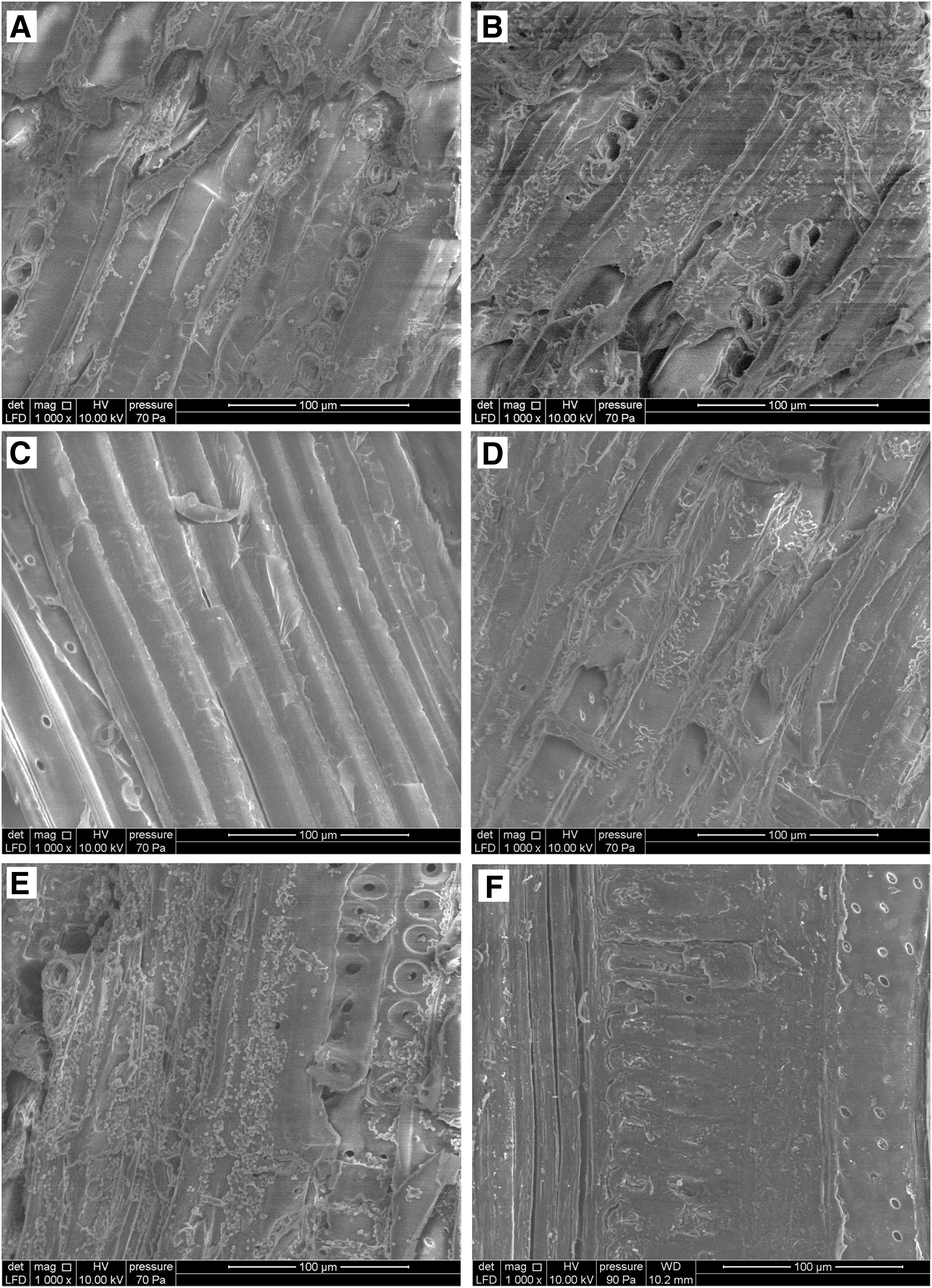
Images of yeast strain cells adhered onto pine wood coupons, visualized by environmental scanning electron microscopy, after 48 h of contact period at 30°C.
ESEM observations reveal the porous nature of wood substrata, with depressions and grooves on the surface conferring to wood its microbial attachment property (Zainul Akmar et al., 2007) and a large number of binding sites for chromium ions fixation (Figs. 3 and 4).
Obtained scanning electron microscopy (SEM) images show the yeast cells immobilized on the oak wood surfaces within a compact microbial layer where the adhering cells were distributed relatively uniformly across the entire wood surface (Fig. 3). Figure 3A and C shows that the adhering cells were deposited in aggregate forms within clumps. Microbial clumps are characteristic of hydrophobic substrata (Van Pelt et al., 1985).
Indeed, Matlab software showed high percentage values of adhesion ranging from 62.65% to 85.35%. For ESEM observation on pine wood, yeast strains were observed to be randomly dispersed on wood surface attached as single cells or pairs of cells (Fig. 4). Even though W. anomalus represented a relative important adhesion percentage compared to the other yeast strains tested, it can be seen that the microbial layer does not completely cover the wood surface (Fig. 4E).
Results of yeast experimental adhesion to pine surface according to the image analysis by the Matlab software program indicates low adhesion percentages ranging from 3.42% to 22.58% (Table 4). An exception was obtained with W. anomalus (Fig. 4E), which represents a relatively important percentage of experimental adhesion (32.02%) (Table 4) according to Matlab software analysis, despite the unfavorable theoretical adhesion obtained by XDLVO prediction tool.
In this investigation, a good relation between theoretical prediction using XDLVO theory and experimental yeast cells adhesion on wood surfaces was obtained (Fig. 5). Thus, a high degree of agreement was noted between theoretical and experimental results (r = 0.7901). Indeed, the experimental assay proves that all tested strains are able to adhere to oak wood with ΔGXDLVO < 0 and except W. anomalus, all tested strains are not able to adhere to pine wood (ΔGXDLVO > 0). Our findings corroborate with previous results (Hamadi et al., 2009; Elabed et al., 2013; Sadiki et al., 2015), which reported a good correlation between XDLVO results and experimental adhesion.
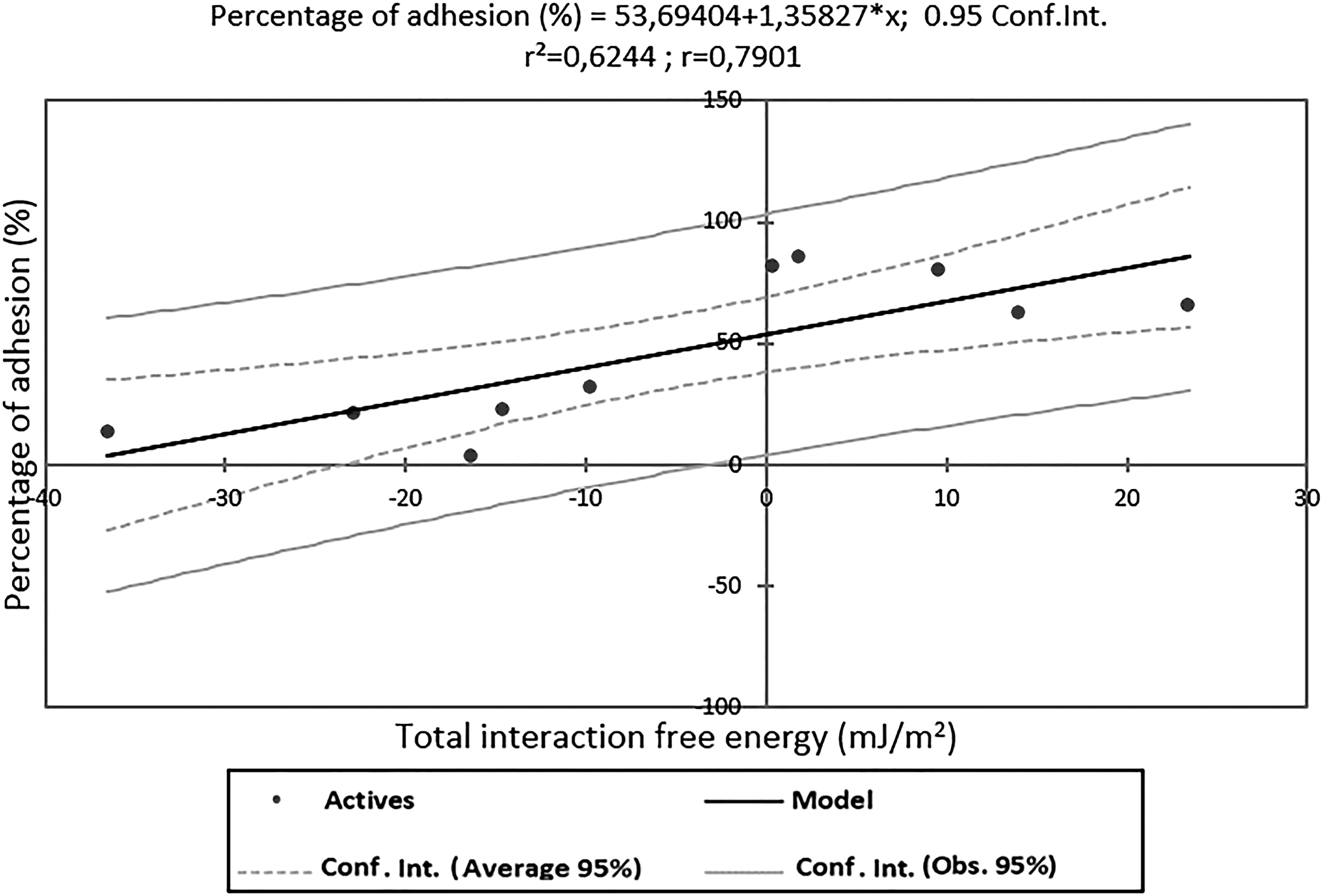
Relation between total interaction free energy and adhesion percentage of yeast strains.
In many works physicochemical models has succeeded to explain microbial adhesion visualized using ESEM results (Elabed et al., 2013; Sadiki et al., 2015). In fact, XDLVO approach proved to be more effective than other predictive tools (Sharma and Hanumantha Rao, 2003). However, microbial adhesion to surfaces is a very complex phenomenon due to the complex and heterogeneous surface composition, which may in some cases limit the applicability of surface theoretical predictive tools. Furthermore, it was reported that discrepancies between the XDLVO theoretical predictions and the experimental adhesion results may be attributed to additional interactions, non-DLVO forces, or parameters such as surface roughness, the complex chemical and morphologic structure of surfaces (Brant and Childress, 2002; Chin et al., 2002; Sharma and Hanumantha Rao, 2003).
Conclusion
The potential adhesion of five yeast strains on nine wood species was investigated employing extended DLVO approach. The results revealed that microbial adhesion on wooden substrata was essentially dependent on two factors, wood species and tested microorganisms. The results presented here demonstrate that the use of Matlab program to analyze the images obtained by SEM allows confirming the theoretical prediction of adhesion obtained using XDLVO tool. Results suggest that pine and teak wood are not suitable supports for tested yeast strains presenting positive values of ΔGXDLVO toward all tested strains and 0% of adhesion percentage toward all studied yeast strains. Beech and oak wood have better proprieties to be used as a support for tested yeast strains with 100% of adhesion percentage and negative ΔGXDLVO values. These combinations could form an efficient biofilm for chromium removal. These findings have important potential in the stability of the biofilm during its functional lifetime and its applicability in a wastewater treatment process.
Footnotes
Acknowledgments
The authors thankfully acknowledge the financial and scientific support of the Microbial Biotechnology Laboratory, Faculty of Sciences and Technology, SMBA University, Fez, Morocco.
Author Disclosure Statement
No competing financial interests exist.