




Abstract
Abstract
As a disinfection by-product with carcinogenic properties, bromate (BrO3−) concentration is limited to below 10 μg/L in water. In this work, activated carbon supported with ruthenium (Ru/AC) catalyst was prepared to reduce bromate, and its removal pathways were investigated comprehensively. By using Ru/AC catalyst, 200 μg/L bromate could be reduced to no more than 10 μg/L in a 2 h reaction under room temperature and neutral pH. Bromate reduction by Ru/AC conformed to the pseudo-first-order kinetics, during which initial bromate concentration, pH, temperature, and co-existed anions displayed significant effects on BrO3− removal efficiency. From a mass-balance analysis, bromate was deemed to be thoroughly reduced to bromide and oxygen by Ru/AC catalyst, and its removal pathways included two steps, that is, bromate was first adsorbed onto the Ru/AC surface, and then it was reduced to bromide by the synergistic function of RuO2 and AC. Experiments revealed that Ru/AC catalyst was effective in bromate reduction, as that bromate was reduced to bromide without any intermediate formation.
Introduction
B
Several techniques have been used in an attempt to remove bromate from water, including chemical reduction (Westerhoff, 2003; Xie and Shang, 2007; Lin and Lin, 2016), biological remediation (Hijnen et al., 1995; Downing and Nerenberg, 2007), photo-catalytic degradation (Siddiqui et al., 1996a; Noguchi et al., 2003; Huang et al., 2014), heterogeneous catalysis (Thakur et al., 2011; Restivo et al., 2015), and activated carbon (AC) filter (Siddiqui et al., 1996b; Hong et al., 2016). However, almost all technologies may encounter the problems of chemical addition or extra-reactor requirement, which constrained their practical application. As an original part of the ozonation-biological activated carbon (O3-BAC) process that has been used as a post-treatment process in water treatment plants, AC filter is deemed one of the most feasible technologies for real application (Butler et al., 2005; Ma et al., 2015). Some researchers found that AC filtration was effective for bromate control and played a role as a strong protective screen for bromate leakage into drinking water (Bao et al., 1999; Li et al., 2010). Nevertheless, the removal efficiency of bromate by AC filtration has to depend on the availability of ion-exchange sites on the AC, which would inevitably decrease after a long-term operation, and hence to inhibit the capability of bromate removal (Mari et al., 1999; Huang et al., 2004; Chen et al., 2012).
Recently, special attention was paid to noble metal catalysts for water treatment, due mainly to its high pollutant removal efficiency, low metal loading, and easy manipulation (Hurley and Shapley, 2007; Chen et al., 2010). Ru-based catalyst was suggested for effective bromate reduction in water systems. Dung et al. (1983) first found that dosing small amounts of RuO2 on TiO2 catalysts could result in a significant reduction of bromate and simultaneous generation of oxygen, and they also revealed that the bromate reduction pathways were related closely with solution pH. When pH was below 3, bromate would be reduced to bromine with cogeneration of oxygen, and a high pH greater than 3 could lead to a reduction of bromate to bromide (Dung et al., 1983). Meanwhile, by detecting the isotopic composition of oxygen element, they also figured out that the oxygen generated in the reaction mainly arises from water, other than from bromate molecules. Mills et al. (1987) reported that thermally activated RuO2·xH2O could function as the catalyst for water oxidation by strong oxidants as CeIV and BrO3−, during which BrO3− was reduced to Br−. Mills and Meadows (1995) then investigated the initial kinetics of bromate reduction with Ru-Adams catalyst by using an electrochemical model of heterogeneous redox catalysis, and they found that the initial kinetics were a function of bromate concentrations, temperature, and anions.
More recently, Thakur et al. (2011) reported that the Ru supported on carbon nanofiber catalysts (Ru loading of 2.3%) Ru/CNF had a good capability in bromate reduction, and addition of alcohols would enhance the stability of catalysts. Accordingly, they elucidated that bromate would be reduced to bromide by RuO2, which itself was oxidized to a higher oxidation state, and its reaction with alcohol would be recycled after being reduced, as the following Reactions (1) and (2):
Our previous work prepared an activated carbon supported with ruthenium (Ru/AC) catalyst, and after preparation condition optimization, this catalyst had stable catalytic activities in bromate removal, reflected by the fact that a cost-effective Ru/AC catalyst with Ru loading of 0.1 wt% was active for bromate reduction without extra reducing agents (Dong et al., 2012). Although the Ru/AC prepared was found to have a slightly lower activity in bromate reduction than Ru/CNF did, the AC supporter was believed to have its own merits, such as high surface area and porosity, variable surface functional groups, and high adsorption property. In addition, two prominent advantages over other supporters should be considered: One is that AC itself can play an important role as a reductant, whereas the other is easy recovery of noble metals from AC (Li et al., 2010). Thus, it is worthy to note that Ru/AC catalyst for bromate control in water is quite attractive to satisfy the increasingly stringent bromate standard. Based on the fact that there is a high feasibility of Ru/AC catalyst for bromate reduction in water treatment, this work aims at conducting a comparative study of the bromate removal efficiency and kinetics with virgin AC and Ru/AC catalyst, and hence of revealing its reductive pathways of bromate.
Materials and Methods
Preparation of catalyst
The Ru/AC catalyst was prepared by following the method of iso-volumetric co-impregnation, which was described in detail in a previous study (Dong et al., 2012). Coconut granular AC (Brunauer-Emmet-Teller [BET] surface area of 750 m2/g, mean size of 0.3 mm; Shanghai Activated Carbon Co. Ltd. China) was employed as the supportive materials, whereas RuCl3·3H2O (Johnson Matthey, Hong Kong, China) was used as the Ru precursor. For catalyst preparation, first, the virgin AC was impregnated in the precursor solution with Ru loadings of 0.1 wt.% for 48 h to make sure that Ru-based particles evenly deposited onto the AC surface. The preimpregnated AC particles were dried up at 110°C for 12 h, and then the dried AC particles were subject to calcination in a tubular furnace (KTF1200; Qianjin Furnace Equipment Co. Ltd. China) at 900°C for 3 h with a pure atmosphere of nitrogen gas. Afterward, the calcinated Ru/AC catalyst was rinsed carefully by distilled-deionized water (18 MΩ, Milli-Q) for three times to remove any impurities involved. Finally, the catalyst was dried thoroughly at 105°C at no less than 12 h for stabilization. In parallel, virgin AC that was used as a blank sample was subjected to the same calcinating procedure for experimental comparison.
Catalytic activity test
Catalytic activities of prepared Ru/AC catalyst were indicated by bromate reduction efficiency and rate, which were measured in series of batch tests. First, 15 mg Ru/AC catalyst was dosed gently into the glass flask containing 100 mL bromate solution with an average concentration of 1.56 μmol/L (equivalent to 200 μg/L) prepared with distilled-deionized water (Milli-Q). The flask was agitated at 180 rpm for 2 h at a constant temperature at 25°C in an orbital shaker (HZQ-F160A; Yiheng Instruments Co. Ltd. China). Effects of the operational conditions, including initial bromate concentration (from 0.39 to 3.9 μmol/L), initial solution pH (from 5.1 to 9.4), operational temperature (ranged from 288 to 315 K), and co-existed inorganic anions (including Cl−, Br−, NO3−, ClO3−, PO33−, CO32−, and SO42−), on bromate catalytic reduction rate by Ru/AC were carried out. On the completion of the reaction, the residue bromate concentration in the flask was measured, and specific bromate reduction rate and corresponding bromide yield rate were calculated.
The mass balance of bromine element was estimated by an elution test according to the method previously described (Kirisits et al., 2000). Both blank AC and Ru/AC particles were collected carefully after the bromate reduction test, and they were then washed thoroughly with distilled-deionized water (18 MΩ, Milli-Q) until there was neither any BrO3− nor Br− detected in the eluted water. The total content of BrO3− and Br− in the eluted water was measured separately.
Characterization of catalyst
Morphological properties of catalysts, including metal particle distribution and particle-size distribution, were observed by scanning electron microscopy (SEM) and energy-dispersive X-ray spectroscopy (EDS) elemental analysis on an electron probe microanalyzer (S-4700; Hitachi, Japan) at 15 kV and 15 Pa. The X-ray photoelectron spectra (XPS) were also employed to determine the active components of catalysts by using an X-ray photoelectron spectrometer (PHI-1800; Physical Electronics) that was equipped with an Al Kα radiation source generated at 14 kV and 35 mA. The pressure in the analysis chamber was less than 1 × 10⁻⁷ Pa. Spectra were recorded at a 90° take-off angle, during which the analyzed area was kept at about 700 μm2. The high-resolution region spectra were collected with 0.125 eV step and 20 eV pass energy. All binding energies were referenced to the C 1s line at 284.6 eV. Zeta potential of the sample was measured with a Zeta Potential Analyzer (Nano-ZS90, Malvern, United Kingdom), in which a 25 mg sample was dispersed in 100 mL deionized water and the pH was adjusted with either 0.1 mol/L NaOH or 0.1 mol/L HCl that was equilibrated for 48 h before measurement.
Analytical methods
Concentrations of BrO3−, Br−, Cl−, NO3−, NO2−, ClO3−, PO33−, CO32−, and SO42− ions were measured by an Ion Chromatograph (ICS-3000; Dionex) consisting of a conductivity detector, two AS19 analytical columns (2 × 250 mm), and an anion suppressor (ASRS Ultra, 2 mm). The mobile phase used was a 100 mmol/L KOH aqueous solution at a flow rate of 0.25 mL/min. pH was determined by a portable pH meter (Orion 3-Star Plus; Thermo Scientific). Dissolved oxygen of the solution was measured by a DO detector (YSI, DO200), and the solution pH and temperature were periodically monitored with a pH meter (Orion 3-Star Plus; Thermo Scientific).
Results and Discussion
Bromate reduction using Ru/AC catalyst
Bromate reduction and bromide generation
The prepared Ru/AC catalyst was characterized by using XPS, SEM, and EDS. It was found that the active component was RuO2 with a particle size around 100 nm and it was distributed evenly and homogeneously on the AC surface according to our previous work (Dong et al., 2012). The batch-scale experimental results displayed that Ru/AC catalyst had a distinct bromate reduction profile compared with that of the virgin AC. As for the bromate removal by virgin AC, the concentration of bromate decreased with a relatively high rate from initial 1.56 to 0.84 μmol/L in the first 40 min, which mainly resulted from the virgin AC adsorption. Afterward, the bromate reduction rate decelerated gradually, which was accompanied with a slight generation of bromide in solution. In contrast, the catalytic reduction reaction induced from Ru/AC catalyst resulted in a sharp decreasing profile in bromate concentration till almost all of the bromate was removed, whereas there was significant formation and accumulation of bromide whose concentration was consistently higher than that by using virgin AC. On the completion of bromate reduction, it is reasonable to believe that Ru/AC greatly promotes the reduction of bromate to bromide, as shown in Equation (3). Notwithstanding, due mainly to the involvement of AC and its adsorption capability, there was an asynchronous profile between the generation of bromide and the reduction of bromate throughout the reaction, suggesting that bromate and/or bromide would be adsorbed within AC.
Estimation of Br elemental mass balance
Series of eluting experiments were conducted to estimate the Br elements in catalysts and suspended solution, and the experimental results are displayed in Fig. 1. Considering that the Br species eluted from AC and Ru/AC comprised mainly of bromate and bromide, its mass balance could be described as Equation (4).

Mass balance of bromate reduction by Ru/AC catalyst. [Symbol: (TBr) represents the total moles of Br,  (BrO3−,D) and
  (Br−,D) represent the moles of BrO3− and Br− detected in treated water,
  (BrO3−,A) and
  (Br−,A) represent the moles of BrO3− and Br− adsorbed on the Ru/AC or AC. Reaction conditions: initial BrO3− concentration = 16.15 μmol/L; catalyst dosage = 0.4 g/L; initial solution pH = 7.1; contact time 2 h and T = 25°C]. AC, activated carbon; Ru/AC, AC supported with ruthenium.
MTBr—the total molar of Br element, μmol;
MBr−,E—the molar of Br− was adsorbed on the Ru/AC or AC, μmol.
MBr−, A—the molar of Br− was directly detected, μmol;
As more than 97% of the Br− could be recovered after eluting experiments, it was evidenced that bromide was the major end product of the bromate reaction by Ru/AC catalyst. The formed bromide was mainly distributed in the AC and suspended solution, and the corresponded portions were 42% and 55%, respectively. In contrast, on the virgin AC alone, only more than 30% of bromate was found to be reduced to bromide, and a large portion of formed bromide was prone to adsorb onto the AC surface. The eluting experimental result did also give direct evidence for the observed phenomena in the above section (Bromate reduction and bromide generation). Hence, it is argued that the degree of bromate reduction could be eventually improved by the aid of the catalytic reaction of RuO2, and almost all of the bromate is reduced to bromide without any intermediate product formation.
Oxygen production
Oxygen production during the reaction was examined by monitoring the changes of DO concentration in water solution, which would be useful to understand bromate removal paths by Ru/AC catalyst. It was expectedly found that DO concentration increased gradually from initially below 0.5 mg/L to a high level around 5.5 mg/L, with the bromate concentration that decreased from 0.18 to 0.07 mmol/L after a 2 h continuous reaction. This indicated that 1 mole bromate produced ∼1.36 mole oxygen in the Ru/AC catalytic reaction, affirming that the electron donor is oxygen, other than carbon.
Bromate reduction kinetics and its correlation with operational parameters
Reaction kinetics
A pseudo-first-order kinetic model has been successfully used to describe the removal of bromate (Mills and Meadows, 1995) by Ru-Adam catalyst, which was demonstrated in Equation (5).
Considering the boundary condition at the start of irradiation (t = 0), that is, [BrO3−]
t
= [BrO3−]0, and integration, Equation (5) could be changed to Equation (6):
A linear regression method was then used to fit the experimental results, and to derive the reaction kinetic coefficients by Equation (7):
where kobs is the observed apparent pseudo-first-order rate constant, [BrO3−] t is the concentration of bromate at reaction time t, and [BrO3−]0 is the initial concentration of bromate.
Figure 2 illustrated a clear linear correlation between ln(Ct/C0) and the reaction time induced by the prepared Ru/AC catalyst. The linear relationship between R2 > 0.99 and the kobs of 0.0228 min−1 was obtained, indicating that the bromate reduction with Ru/AC conformed well to the pseudo-first-order kinetic model. Thus, the kobs could be adopted for a reliable expression of the catalytic reduction of bromate, and to evaluate its correlation with experimental conditions and parameters (Table 1).

A plot of ln(Ct/C0) as function of time with bromate reduction rate constant “kobs” (initial BrO3− concentration = 1.56 μmol/L, initial solution pH = 7.1, and T = 25°C).
Effect of initial bromate concentrations
Effect of initial bromate concentration on the bromate reduction rate was investigated, and the results are shown in Fig. 3. The kobs values of bromate reduction by Ru/AC were 0.0468, 0.0264, 0.0228, and 0.0109 min−1 for initial bromate concentrations of 0.39, 0.78, 1.56, and 3.9 μmol/L, respectively. This continuous decrease of reduction rate constant with the increase of initial bromate concentration could be found in a batch reactor with either constant catalyst dose and varying initial pollutant concentration or vice versa, which has been addressed by some researchers (Bhatnagar et al., 2009; Wang et al., 2009). This is because the catalytic reaction essentially occurs on the catalyst surface and reactant adsorption is a prerequisite step. The total number of reactive sites on the AC surface is constant and will be occupied gradually with the increase of initial bromate concentration, which leads to the reduction of reduction rate.
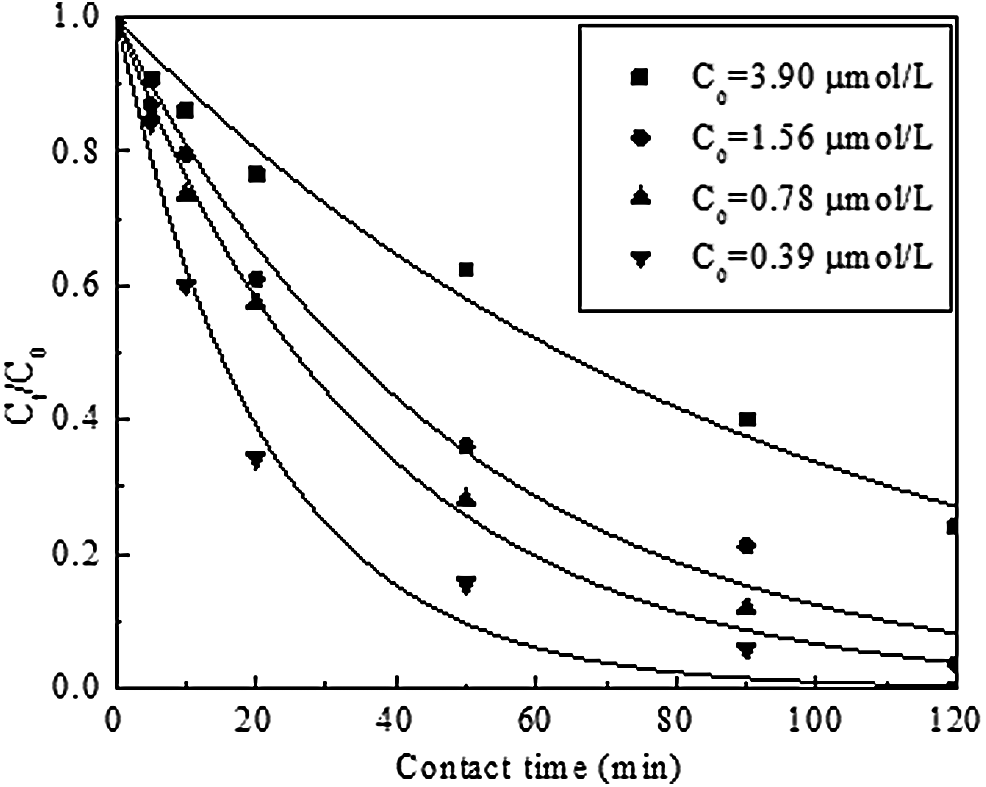
Effect of initial bromate concentration on bromate catalytic reduction by Ru/AC (initial solution pH = 7.1 and T = 25°C).
Effect of pH
Similar to the general catalytic reactions, solution pH is an important parameter controlling bromate reduction in water. Herein, a large pH range from 5.1 to 9.4 was selected to evaluate its effect on bromate reduction rate by Ru/AC catalyst. As shown in Fig. 4a, after a 90 min reaction, bromate reduction efficiency at pH 5.1, 6.9, 7.8, and 9.4 was 99%, 88%, 72%, and 47%, respectively. The plot of kobs versus pH represented a good exponential relationship (R2 = 0.999) [Fig. 4b and Eq. (8)], suggesting that a decrease in pH led to an increase of bromate reduction rate.

Effect of pH on bromate reduction by Ru/AC.
There were two possible reasons to explain the negative correlation of solution pH with bromate reduction rate by Ru/AC catalyst. First, solution pH had a close relationship with the redox potential of the bromate anion, which could be described by Equation (9), where the concentration of [H+] played an important role (Mussini et al., 1985; Mills and Meadows, 1995). Thus, the potential of bromate reduction to bromide is a pH-dependent reaction, and a low pH could elevate the rate of bromate reduction. Another possible reason may be related with the surface properties of the catalyst, which was influenced significantly by solution pH. As the isoelectric point pHIEP of Ru/AC was estimated to be around 5.4 (Supplementary Fig. S1), the surface charge of the prepared Ru/AC would be positive when the solution pH was kept below pHIEP, which could invoke an electrostatic attractive interaction between bromate ion and catalyst to facilitate bromate reduction. Conversely, this surface attachment potential inevitably began to decrease when the solution pH >5.4, since there was an electrostatic repulsion between the negatively charged Ru/AC surfaces and the bromate molecules, and it then resulted in suppressed bromate reduction.
Effect of temperature
Five operational temperatures, 288, 293, 298, 303, and 313 K, were maintained to investigate their influence on bromate reduction rate, and a clear positive impact between temperature and the bromate reduction rate was observed (Table 1 and Fig. 5a). Owing to that, the activation energy (Ea) calculated from the Arrhenius relationship with the rate constants obtained at the five temperatures was around 37.9 kJ/mol (Fig. 5b); hence, it was indicated that the bromate reduction was governed in a mode of a surface-mediated reaction.
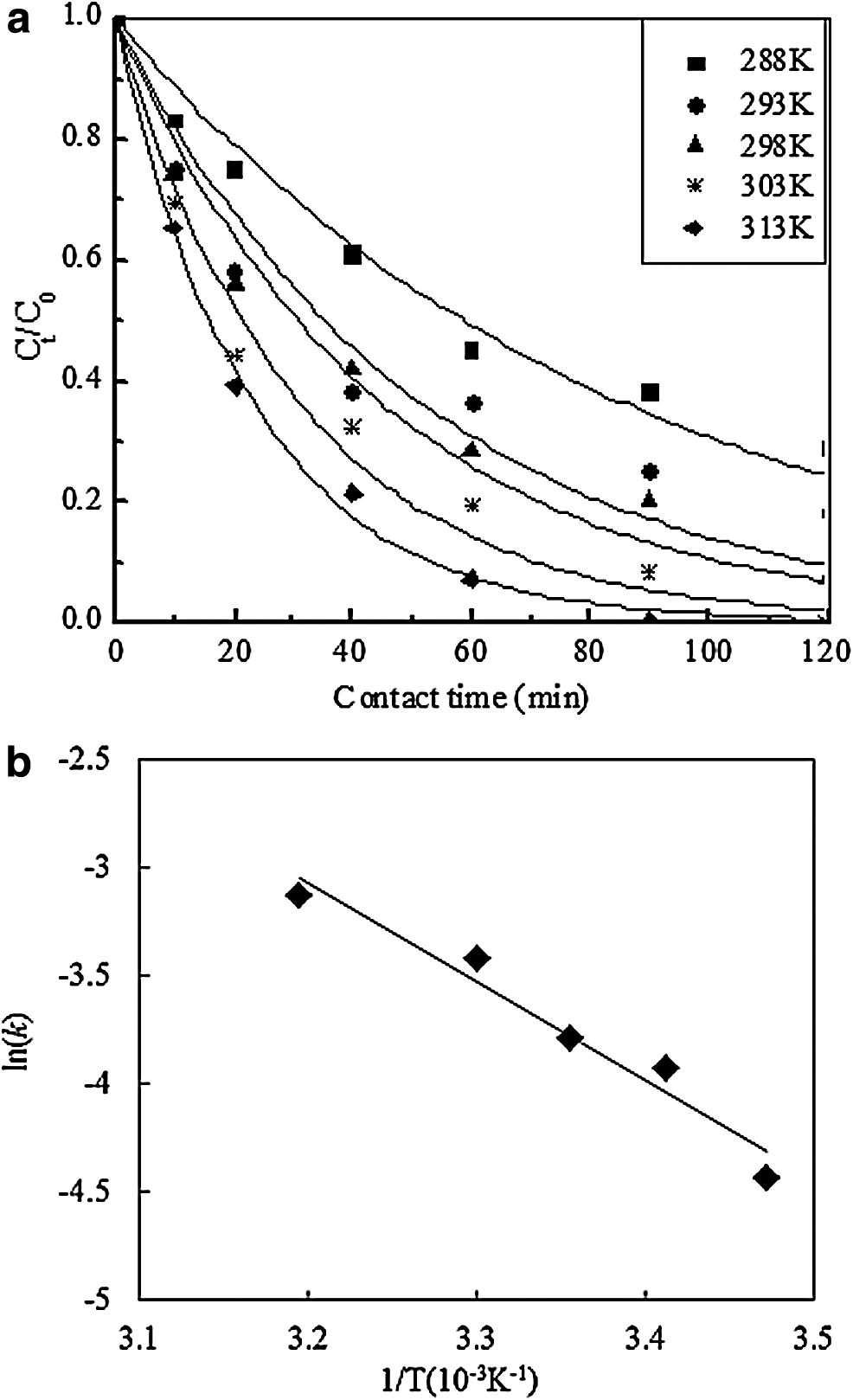
Effect of temperature on catalytic bromate reduction by Ru/AC.
Effect of co-existed anions
It is important to unveil the effect of co-existed anions that may present on the surface and groundwater onto bromate reduction rate. The rate constants kobs of bromate (initial concentration was kept at 1.56 μmol/L) reduction in the presence of common inorganic anions with various concentrations are illustrated in Fig. 6. A consistent suppression of bromate reduction was observed in the presence of inorganic anions. As for the catalytic reduction process of bromate, the effects of anions could be classified into three groups. First is the production-dominant species, especially bromide, which is the final reaction product of bromate. In this study, when 1.56, 15.6, and 156 μmol/L bromide ions were added during the reaction, the kobs values were 0.0228, 0.0203, and 0.0104 min−1, respectively (Supplementary Fig. S2), indicating that a low concentration of bromide ions had a limited inhibition on bromate reduction; however, a high concentration of bromide above 100 times than the bromate would significantly constrain the bromate reduction. Meanwhile, the large amount of co-existed bromide could also be adsorbed onto the surface and within the pores of AC preferentially to complete the active adsorption sites with bromate.

Corresponding kobs of bromate reduction in the presence of other common anions (initial BrO3− concentration = 1.56 μmol/L; initial pH = 7.1; temperature = 25°C).
Second, reduction-dominant species, such as nitrate and chlorate, impacted the bromate reduction rate, as their presence could inhibit the reduction rate of bromate kobs from 0.0228 to 0.0190 and 0.0181 min−1, respectively. Co-existed reduction-dominant ions may inhibit the direct interaction between bromate and active components of Ru/AC, and hence decrease the reduction rate of bromate. Finally, the adsorption-dominant species, such as chloride, phosphate, carbonate, and sulfate, may cause a competitive adsorption with bromate for the active catalyst surface. In this study, the rate constants kobs of adding chloride, phosphate, carbonate, and sulfate ions (15.6 μmol/L) decreased to 0.0180, 0.0155, 0.0145, and 0.0163 min−1, respectively (Table 1). The adsorption and accumulation of these anions at the AC-water interface always occupied the available active sites, thereby lowering the bromate removal efficiency (Xie and Shang, 2007; Bhatnagar et al., 2009). In addition, the declination of pH was also observed when adding carbonate or sulfate ions, implying that an effective reaction with the catalyst occurred.
To evaluate the inhibition extent of bromate reduction by different co-existed anions, the kobs of bromate reduction with the same anion concentrations (15.6 μmol/L) that was about 10 times that of the initial bromate concentration (1.56 μmol/L) is presented in Fig. 6. The kobs trends followed the order of SO42−<CO32−<PO33−<Cl−<ClO3−<NO3−<Br−. It could, thus, be concluded that the inhibition effect seemed to be related with the anion types at a certain level, and the inhibition effect of different types of anions on bromate reduction by Ru/AC is mainly ordered as adsorption-dominant species>reduction-dominant species>production-dominant species.
Pathway of bromate reduction by Ru/AC catalyst
Paths of bromate reduced by AC
The experimental results suggested that bromate reduction by the AC mainly includes two methods, that is, AC adsorption and AC chemical reduction. However, as only 1% bromate was eluted from AC, bromate removed by AC was mainly attributed to chemical reduction. It is known that AC had a relatively strong negative surface property that was capable of performing the reduction reaction of bromate directly, and converting bromate to bromide, which could be described by Equations (10) and (11) (Siddiqui et al., 1996b). Nonetheless, the bromate reduction capability of AC has to be dependent on the active sites within or on the AC, and a cease of bromate reduction may be due to the saturation of AC adsorption.
where
Paths of bromate catalytic reduction by Ru
Although bromate can be reduced to Br− on the AC surface, the experimental results indicated that the reduction of bromate decelerates and almost stops after a 1 h reaction, which illuminated the fact that surface reduction of bromate was limited due to the AC surface active sites occupation and saturation. Therefore, it was deduced that the high bromate reduction rate by Ru/AC catalyst was attributed mainly to the catalytic effect of RuO2.
Based on the result of oxygen production and mass balance of Br element, bromate reduction by RuO2 could be illustrated by Equation (12):
Dung et al. (1983) demonstrated that water is the source of the oxygen generated in the RuO2-catalyzed decomposition of bromate ion, and the mechanism could be formulated by Equations (13)–(15), whereas RuO2 particles are deemed to act as microelectrodes in the oxidation of water to oxygen.
For the catalytic mechanism of RuO2 for oxygen evolution, as it is easy to hydroxylate the oxide surface (Manyar et al., 2009), it is difficult to estimate S-OH or S-O that is an intermediate in the catalytic process. Thus, analysis of Ru 3d after the reaction was performed by using XPS, and the results are shown in Supplementary Fig. S3. It was found that a used catalyst Ru 3d5/2 binding energy shifted to 281.80 eV, indicating the presence of a higher oxidation state of Ru (Chan et al., 1997; Mun et al., 2007). A similar phenomenon was also reported by others who used the ruthenium catalyst (Thakur et al., 2011). Since a higher oxidation state of Ru has a high reaction activity and then decomposes readily to RuO2 at room temperature (Bockris, 1983), the catalytic mechanism of RuO2 for oxygen evolution can be given as Equations (19)–(21):
During the reduction of bromate by Ru/AC, oxygen is generated on the anode; the total reaction of oxygen generation is depicted in Equation (13); and synchronously, the decomposition of bromate could occur on the cathode, in which the produced electrons are provided to the conversion from bromate to bromide. The total reaction of bromate decomposition is then described by Equation (12).
The stability of the Ru/AC catalyst was evaluated by using a rapid small-scale column test (RSSCT). Supplementary Figure S4 compared the deactivation process of virgin AC and Ru/AC catalyst after a long-term examination. It was apparent that virgin AC had a relatively lower bromate removal capacity, which was reflected by the break-through of bromate concentration up to 10 μg/L after 1,372 bed volumes, whereas the corresponding bed volume of Ru/AC catalyst was as long as 12,000. Thus, it is reasonable to deduce that Ru/AC catalyst has a good stability for bromate reduction in water.
Synergic function to bromate reduction by Ru/AC
Considering the functions of AC and RuO2 as discussed earlier, the reduction of bromate by Ru/AC includes three paths, such as bromate adsorption to AC surface, chemical reduction by AC, and catalytic reduction by RuO2 (Fig. 7). The enhanced activity of the Ru/AC may result from a synergistic interaction between the RuO2 and AC. In one respect, AC adsorption is a key step before the reduction reaction, as it could improve bromate attachment onto the catalyst surface rapidly, and thus to accelerate the sequencing reaction. However, on the other hand, the Ru particle that is well dispersed on the AC could transform bromate into bromide thoroughly. Moreover, the Ru particle would also improve the chemical reduction ability of AC in the bromate reduction simultaneously. Thanks to these advantages, the Ru/AC catalyst exhibited excellent performance in the reduction of bromate under moderate treatment conditions, such as neutral pH, room temperature, and without any extra reducing agents dosage, in comparison with the research of Mills and Meadows (1995), in which the active Ru-Adams catalyst could work well in a solution pH and temperature at 4.0 and up to 60°C, respectively. Therefore, the Ru/AC in this work is quite attractive, and much more feasible for practical application for water treatment.
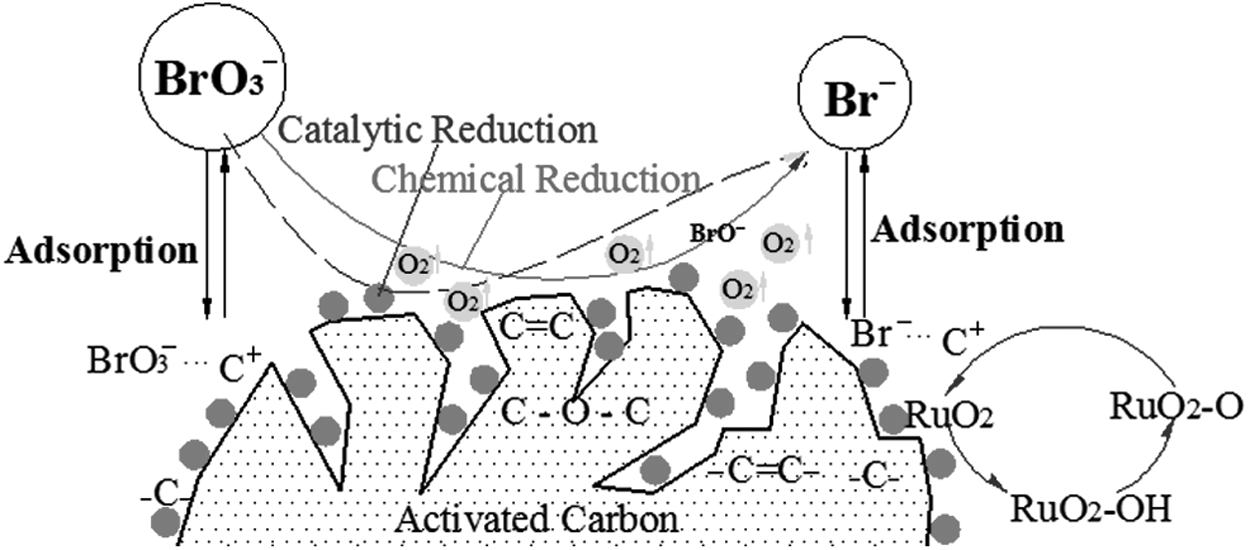
Schematic illustration of bromate reduction pathways by Ru/AC catalyst.
Conclusions
Catalytic reduction of bromate in water by Ru/AC catalysts was investigated to evaluate bromate reduction kinetics and to unveil its removal paths. The experimental results demonstrated that the prepared Ru/AC catalyst was effective for bromate reduction, and a maximum of 97% of bromate (the initial concentration of 1.56 μmol/L) could be reduced to bromide without any intermediate formation, under room temperature and neutral pH. The bromate reduction kinetics conformed well to the pseudo-first-order reaction, which was affected significantly by initial bromate concentration, solution pH, and co-existed anions. It was found that solution pH had a negative impact on bromate reduction rate constant, whereas the initial bromate concentration had a positive effect. The presence of inorganic anions suppressed bromate reduction rate. From the analysis of bromate reduction by AC, Ru, and Ru/AC, it was found that bromate reduction paths by Ru/AC include bromate adsorption to AC surface, chemical reduction by AC, and catalytic reduction by RuO2. Catalytic reduction of bromate occurred by RuO2 that acted as microelectrodes, where bromate was decomposed on the cathode accompanying the oxygen generation on the anode, during which the produced electrons could provide for bromate conversion to bromide.
Footnotes
Acknowledgments
This research was supported by grant Nos. 51608330, 51408149, and 51378316 from the National Natural Science Foundation of China and grants JCYJ20160406162038258 and JCYJ20170306145005061 from the Shenzhen Science and Technology Funding Project.
Author Disclosure Statement
No competing financial interests exist.
References
Supplementary Material
Please find the following supplemental material available below.
For Open Access articles published under a Creative Commons License, all supplemental material carries the same license as the article it is associated with.
For non-Open Access articles published, all supplemental material carries a non-exclusive license, and permission requests for re-use of supplemental material or any part of supplemental material shall be sent directly to the copyright owner as specified in the copyright notice associated with the article.
