




Abstract
Abstract
Influence of dissolved organic matter (DOM) on removal efficiency of phenanthrene and 1-naphthol by multiwalled carbon nanotubes (MWCNTs) was examined. A model DOM, succinic acid, did not reduce removal efficiency of phenanthrene and 1-naphthol by MWCNTs with varying outer diameters (ODs), due to its very low sorption to these sorbents and thus minimal influence on their surface properties. In contrast, humic acid (HA) introduction highly reduced their removal by MWCNTs. Molecular size and sorption strength of tested HAs by a given MWCNT generally followed the order: HA1 < HA4 < HA7. However, relative sorption reduction percentage of phenanthrene and 1-naphthol to a given MWCNT resulting from addition of HA1, HA4, or HA7 was comparable. This was because sorption strength of both phenanthrene and 1-naphthol by all HAs also followed the order: HA1 < HA4 < HA7. A greater number of phenanthrene or 1-naphthol molecules would be sorbed to MWCNTs with HA7 as compared to HA1 in the form of an hydrophobic organic contaminant (HOC)-HA complex in the bi-solute sorption systems. Great difference in sorption reduction of phenanthrene and 1-naphthol to MWCNTs induced by introduction of succinic acid or various HAs implied that chemical composition of DOMs greatly influenced their removal efficiency by MWCNTs. This study highlights that if MWCNTs can be used as a sorbent for HOC removal in the future, as its production cost will be considerably reduced, influence of DOMs on pollutant removal efficiency needs to be taken into consideration.
Introduction
D
Much work has been done to investigate the interaction mechanisms between HOCs and CNTs. However, single solute systems may not adequately represent the real environmental conditions because dissolved organic matter (DOM) is ubiquitous in the environment and it coexists with HOCs in most cases. The presence of DOMs and their interactions with CNTs would inevitably exert great influence on removal efficiency of HOCs by CNTs (Hyung et al., 2007; Wang et al., 2008). As reported, DOMs fouls activated carbons, thereby reducing their sorption capacity for HOCs (Narbaitz and Benedek, 1994; Kilduff et al., 1998; Kilduff and Wigton, 1999; Pelekani and Snoeyink, 2000). Influence of the pore size distribution of carbonaceous materials on competitive sorption behaviors of DOMs and HOCs toward four kinds of activated carbon fibers with dissimilar pore size distributions was investigated (Pelekani and Snoeyink, 2000). The authors found that molecular size of the coexisting DOM relative to the pore size distribution of the sorbents used determined whether and how methylene blue affected atrazine sorption.
A previous study indicated that, humic acid (HA) coating did not clearly reduce the removal efficiency of phenanthrene, naphthalene, and 1-naphthol by MWCNTs from aqueous phase, although sorption of these two compounds by the tested HA was much lower than that by MWCNTs and the coated amount of HA reached 85.5 mg/g (Wang et al., 2008). This implied that HA coating greatly changed the physical form and surface properties of MWCNTs. However, peptone coating dramatically reduced the removal efficiency of phenanthrene, naphthalene, and 1-naphthol by MWCNTs, because the introduced O-containing polar functionalities made the hydrophobic sorption sites at its surfaces much less accessible for HOC molecules. The surface area-normalized sorption amount of HAs by MWNTs (QSA) increased with increasing outer diameters (ODs) of MWNTs and decreasing polarity of the HAs. Furthermore, stabilization of MWCNTs increased with QSA, but the increase leveled off when QSA reached a threshold value that was far below the maximum QSA (Lin et al., 2012a). The surface-bound HA introduced oxygen-containing functionalities and negative charges to the MWCNTs, thereby greatly increasing Pb2+ sorption (Lin et al., 2012b). These findings revealed that interactions between MWCNTs and DOMs may influence the environmental behaviors of MWCNTs and their sorption for both organic and inorganic pollutants.
Although lipid and HA had different composition, preloading of these two kinds of DOMs to the wood-derived char consistently reduced its sorption for organic compounds, which was ascribed to the competitive sorption of DOMs with the tested compound and the pore blockage effect (Kwon and Pignatello, 2005; Pignatello et al., 2006). It is hypothesized that influence of the coexisting DOM on removal efficiency of HOCs by MWCNTs is dependent on the chemical composition of both the tested compound and DOM, and the ODs of MWCNTs. This is because DOM in surface waters is composed of polymerized materials such as fulvic, tannic, and HAs. The humic substances are generally polyelectrolytic macromolecules with molecular weight ranging from a few hundred for fulvic acid to tens of thousands for HA (Ferro-Garcia et al., 1998). Such effects could differ from those resulting from DOM coating because of the dissimilar initial conditions.
Based upon the discussion above, the key objectives of this study are to examine: (1) how the DOM properties affect removal efficiency of HOCs by MWCNTs through sorption and the associated mechanisms; (2) whether the presence of a given DOM may exert distinct impact on removal efficiency of organic contaminants with dissimilar composition by MWCNTs and the responsible mechanisms; and (3) influence of the OD of MWCNTs on removal efficiency of HOCs in the presence of DOMs.
Materials and Methods
DOM, organic contaminants, and MWCNTs
Three HA fractions isolated from a peat soil were used as DOMs. Due to much smaller molecular size and lower hydrophobicity of succinic acid relative to various HA fractions, it was also used as a kind of model DOM that was purchased from J&K. Details of HA extraction and purification are described elsewhere (Wang et al., 2011). Briefly, seven HA fractions were sequentially extracted from a peat soil collected from Amherst, Massachusetts using 0.1 M Na2P4O7 for the first six fractions and 0.1 M NaOH for the last one. The first and last fractions were labeled as HA1 and HA7, respectively. There should be little difference in composition between the fourth to sixth fractions, they were combined and marked as HA4 (Ghosh et al., 2010). The HA fractions were purified five times with a mixture of 0.1 M HCl and 0.3 M HF mainly to remove silicate minerals, and then rinsed five times with deionized water, freeze-dried, ground to pass through a 250 μm sieve, and stored for characterization and further study on impact of DOMs on removal efficiency of HOCs by MWCNTs. The relative molecular weight distribution of HA1, HA4, and HA7 was obtained with Size Exclusion Chromatography (SEC) (Fig. 1), and these HA fractions were used in our previous work (Wang et al., 2011).
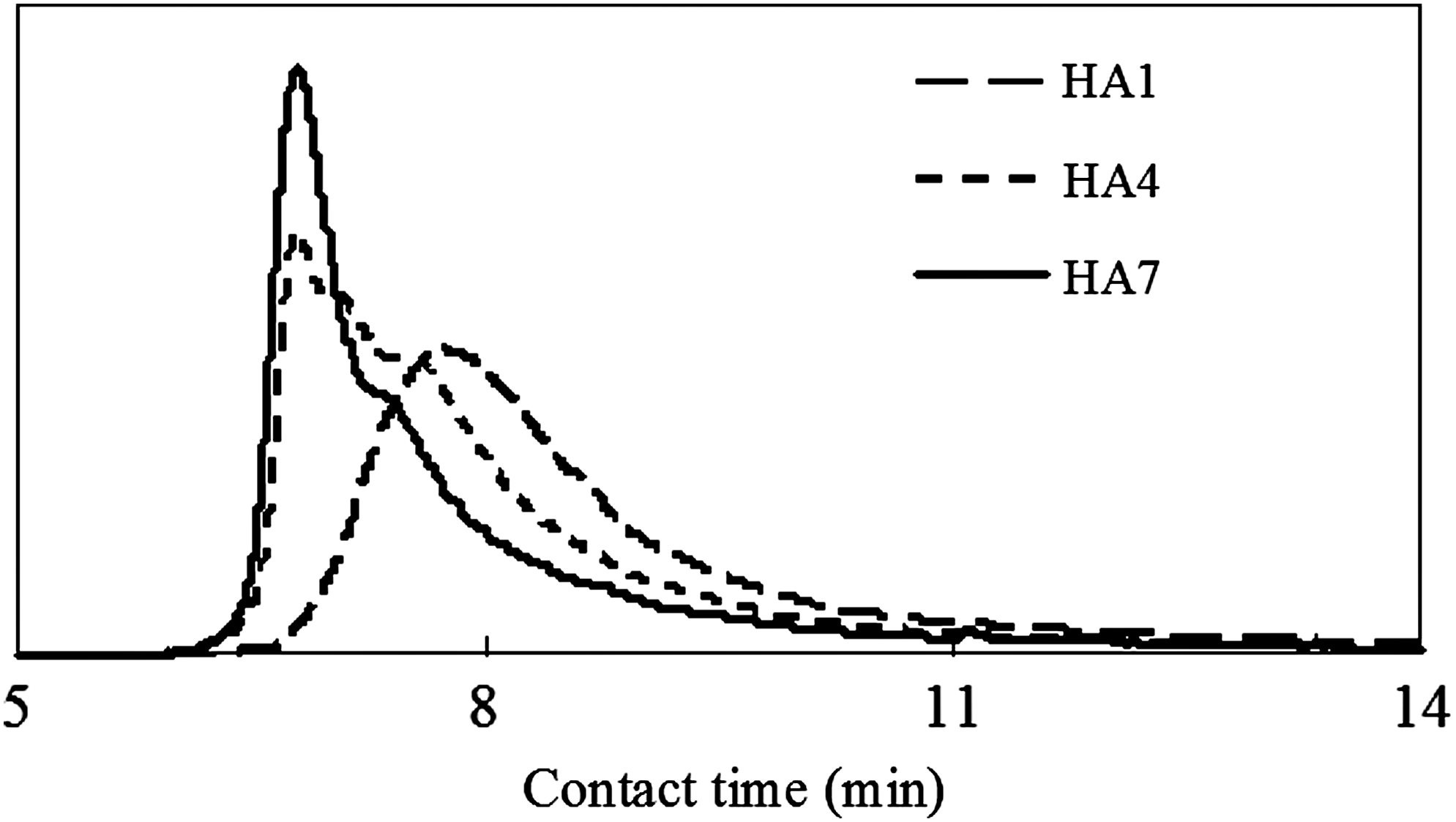
SEC chromatograms of HA1, HA4, and HA7. SEC, Size Exclusion Chromatography. HA, humic acid.
The 14C-labled and nonlabeled phenanthrene and 1-naphthol were purchased from Sigma-Aldrich Chemical Co.; they were used as the tested compounds in the bi-solute sorption systems containing both DOM and HOC. The logKow values of phenanthrene and 1-naphthol are respectively 4.46 and 2.7, and their molecular volumes are 169.5 and 133.6 Å3, respectively (Table 1) (Wang et al., 2008).
MW, molecular weight; Kow, octanol-water partitioning coefficient; Sw, water solubility; density; MV, molecular volume; pKa, negatively log-transformed acid dissociation constant.
The multiwalled carbon nanotubes MWCNT20, MWCNT40, MWCNT60, and MWCNT100 (here the numbers referred to the ODs) with purity >95% were purchased from Shenzhen Nano-Harbor Co. Ltd.; their ODs are 10–20, 20–40, 40–60 and 60–100 nm, respectively. Surface area, micropore volume, and a sum of meso- and macropore volume of MWCNT20 are 126 m2/g, 0.051 and 0.364 cm3/g, respectively. The corresponding values for MWCNT40, MWCNT60, and MWCNT100 are 86 m2/g, 0.034 and 0.285 cm3/g; 73 m2/g, 0.029 and 0.162 cm3/g; 58 m2/g, 0.023 and 0.114 cm3/g, respectively (Wang et al., 2009).
Single-solute sorption experiment
Sorption of HA1, HA4, and HA7 by MWCNTs of various ODs in single-solute systems has been studied (Wang et al., 2011). To compare the difference in impact of various coexisting DOMs on removal efficiency of phenanthrene and 1-naphthol by MWCNTs, sorption isotherms of succinic acid by various MWCNTs were established using a similar approach as that for sorption of the present study-used HAs by MWCNTs (Wang et al., 2011), and the final concentrations of succinic acid were measured with a fluorescence spectrophotometer (Supplementary Fig. S1 in the Supporting Information). As the pKa of succinic acid is 4.16 (Kang and Xing, 2007), succinic acid sorption was run at pH 3 to ensure that it was dominantly present in the molecular form in the aqueous phase.
Influence of DOM on HOC removal efficiency by MWCNTs
Competitive sorption experiments between phenanthrene or 1-naphthol with various HAs or succinic acid on MWCNTs were conducted to investigate influence of the coexisting DOM on HOC removal efficiency by MWCNTs. Such an experiment was conducted using a batch equilibration technique in screw cap vials with aluminum foil-Teflon liners. The HA stock solution was prepared by dissolving it with 0.1 M NaOH and its pH was adjusted to neutral to maintain HA in the aqueous phase mostly in the molecular form. Stock solution of succinic acid (pH = 3) was made with water. As DOMs in the competitive sorption systems were in the same form, influence of various DOMs on removal efficiency of phenanthrene or 1-naphthol by MWCNTs and the associated mechanisms can be well understood.
Stock solutions of 14C labeled phenanthrene and 1-naphthol and non-labeled phenanthrene were prepared by dissolving them in methanol, while that of non-labeled 1-naphthol was made in water. Initial concentrations of phenanthrene and 1-naphthol in the test solutions were constant (0.27 mg/L for phenanthrene and 60 mg/L for 1-naphthol), whereas that of DOM varied from 0 to 90 mg/L. Although the initial concentration of 1-naphthol was much higher than that of phenanthrene, it was 6.9% of its water solubility (866 mg/L). Methanol content in the test solutions was controlled below 0.1% by volume to minimize the cosolvent effect.
In the single-solute systems (Wang et al., 2009), solid-to-liquid ratios were adjusted to achieve 30–80% uptake of phenanthrene and 1-naphthol by MWCNTs at equilibrium, and the same ratios were used here. The solid-to-liquid ratios of MWCNTs used for competitive sorption experiments are listed in Supplementary Table S1 in the Supporting Information. Test solutions that contained the primary solute and HA, and 200 mg/L NaN3 to inhibit bioactivity, were sealed and placed on a shaker to mix for 1 h before adding to the vials containing a preweighed amount of MWCNTs until a minimum headspace was reached. All samples including blanks were run in duplicate and they were mixed for 5 days at room temperature (23°C ± 1°C) on a rotary shaker. After mixing, the vials were centrifuged at 3000 rpm for 1 h, and 1.8 mL of the supernatant was added to the scintillation cocktail (6 mL) for scintillation counting. The same method was used in a previous study, where the suspended MWCNTs were separated after centrifugation (Wang et al., 2009). This approach was also successfully employed to separate the HA-, peptone-, and α-phenylalanine-coated MWCNTs for determination of sorbate concentration in the aqueous phase (Wang et al., 2008). Furthermore, it needs to be noted that the presence of dissolved HA up to 80 mg organic carbon per liter did not affect scintillation counting of pyrene (Pan et al., 2007). Due to negligible mass loss of the primary solute in the bi-solute sorption systems containing both DOM and HOC, its uptake by MWCNTs was calculated by mass balance.
Results and Discussion
Influence of HA properties on HOC removal efficiency by MWCNTs
It was demonstrated that the presence of HA1 reduced sorption of phenanthrene and 1-naphthol by MWCNT20, MWCNT40, MWCNT60, and MWCNT100 (Wang et al., 2009). In this study, the succinic acid, HA4 and HA7 were further tested to see whether their presence would distinctly affect removal efficiency of these two compounds by MWCNTs and the associated mechanisms because these DOMs had quite different sorption strength by these sorbents (Wang et al., 2011). It was evident that different from all HAs, succinic acid did not suppress sorption of phenanthrene and 1-naphthol on MWCNTs with varying ODs (Figs. 2 and 3), due to its very small molecular volume and low sorption to these sorbents (Fig. 1 and Supplementary S1), which had minimal influence on surface properties of MWCNTs and the removal efficiency of these two primary solutes.

Comparison of 1-naphthol removal efficiency reduction by a given MWCNT induced by introduction of different DOMs. Succinic acid (⋄); HA1 (□); HA4 (Δ); HA7 (○). The y axis represents the ratio of 1-naphthol sorbed by MWCNTs in the presence of DOM to that in the absence of DOM at various initial DOM concentrations. DOM, dissolved organic matter; MWCNT, multiwalled carbon nanotubes.

Comparison of phenanthrene removal efficiency reduction by a given MWCNT induced by introduction of different DOMs. Succinic acid (⋄); HA1 (□); HA4 (Δ); HA7 (○). The y axis represents the ratio of phenanthrene sorbed by MWCNTs in the presence of DOM to that in the absence of DOM at various initial DOM concentrations.
Previous studies indicated that pore-filling played an important role in HOC sorption by black and activated carbons. For example, it was observed that a majority of sites on soot for HOC sorption were in pores (Rockne et al., 2000). It was further reported that the pores in activated carbon were dominant over its surface area for predicting HOC sorption (Karanfil and Kilduff, 1999). In the DOM-HOC competitive sorption systems, the smallest DOM molecules exhibited the strongest competition with 2-methylisoborneol on coal-based activated carbon (Newcombe et al., 1997). Compared to HA, the fulvic acid with smaller molecular size more strongly suppressed sorption of benzene to wood chars (Pignatello et al., 2006). However, it was documented in another study that DOM with larger molecular size more strongly suppressed sorption of atrazine to two activated carbon fibers with uniform pore structure (Pelekani and Snoeyink, 1999).
The difference in sorption suppression of HOCs to activated carbon and activated carbon fibers induced by the coexisting DOM can be attributed to two distinct mechanisms (i.e., pore blockage and direct competition for sorption sites), depending upon the relative molecular size of DOM and the primary solute and size of the entrance to the pores in these sorbents. Particularly, if pore size of the sorbent is large enough to accommodate both the primary solute and the coexisting compound molecules, they would be able to get into the pores and compete for high-energy sites, thus exhibiting direct site competition-dominant mechanism in pores and at the external surfaces. On the contrary, if pore size of sorbent is large enough to allow the primary solute molecules to enter but too small for the coexisting compound molecules, pore blockage would become the predominant mechanism controlling their competitive sorption behaviors.
As for MWCNTs, micropore-filling partly contributed to their sorption for HOCs. However, it was not a dominant mechanism regulating HOC sorption by MWCNTs (Yang et al., 2006; Wang et al., 2009). Micropore blockage resulting from DOM sorption and direct competition of DOM with the primary solute molecules for sites in micropores could thus not be a dominant factor governing their competition because surface area and a sum of meso- and macropore volume of MWCNTs substantially controlled their sorption for HOCs (Wang et al., 2010). Succinic acid was the most hydrophilic one among all coexisting DOMs tested, and consistently its sorption strength (Kd) to MWCNTs was 3–4 orders of magnitude lower than HA1, HA4, and HA7 (Supplementary Fig. S1) (Wang et al., 2011). Low sorption of succinic acid to a given MWCNT may not alter its surface properties and the succinic acid molecules sorbed to MWCNT surfaces would have the lowest steric hindrance to prevent phenanthrene and 1-naphthol molecules from approaching and further interacting with MWCNTs, thereby exhibiting the lowest direct site competition effect and facilitating sorption of the primary solute molecules. Due to small molecular size of succinic acid, its sorption may not deplete so many sites on individual MWCNTs' surfaces that were effective for HOC sorption in comparison with DOMs with larger molecular size such as HA1, HA4, or HA7. Furthermore, in the bi-solute sorption systems, the succinic acid remaining in the aqueous phase had the lowest partitioning for the primary solute, because of its lowest hydrophilic nature. The 1-naphthol and phenanthrene molecules would thus be preferentially sorbed to MWCNTs' surfaces. Therefore, the presence of succinic acid did not reduce removal efficiency of phenanthrene and 1-naphthol by all MWCNTs (Figs. 2 and 3).
Sorption strength of phenanthrene and 1-naphthol to individual MWCNTs was more strongly suppressed by HAs relative to succinic acid. Sorption of all HAs to a given MWCNT was expected to occupy a greater number of sites and more strongly prevent phenanthrene and 1-naphthol molecules from attaching to its surfaces as compared to succinic acid, thereby demonstrating higher steric hindrance effect because of their much larger molecular size and higher sorption to the MWCNT. Due to more hydrophobic nature of all HAs in comparison with succinic acid, a larger number of phenanthrene and 1-naphthol molecules would be retained in the aqueous phase, thereby more strongly reducing sorption strength of the primary solute to individual MWCNTs. Therefore, HA1, HA4, and HA7 more strongly reduced the removal efficiency of phenanthrene and 1-naphthol by MWCNT20, MWCNT40, MWCNT60, and MWCNT100 than succinic acid.
Molecular size and sorption of all tested HAs by a given MWCNT generally followed the order: HA1 < HA4 < HA7 (Wang et al., 2011). Theoretically, it was reasonable to expect that removal efficiency reduction of phenanthrene and 1-naphthol by a specific MWCNT resulting from HA addition should have followed the order: HA1 < HA4 < HA7, which was, however, inconsistent with our experimental observation indicating that the relative sorption reduction percentage of these two compounds to individual MWCNTs was comparable (Figs. 2 and 3). Further analysis showed that sorption of both phenanthrene and 1-naphthol by all HAs also followed the order: HA1 < HA4 < HA7 (Wang and Xing, 2007; Wang et al., 2011). This implied that a greater number of phenanthrene or 1-naphthol molecules would be sorbed to MWCNT surfaces with HA7 as compared to HA1 in the form of HOC-HA complex in the bi-solute sorption systems. Comparable removal efficiency reduction of phenanthrene or 1-naphthol by individual MWCNTs resulting from HA1, HA4, or HA7 addition suggested that the theoretically predicted higher removal efficiency reduction of these two primary solutes by MWCNTs induced by HA7 addition relative to HA1 was offset by higher sorption of phenanthrene or 1-naphthol to the sorbent in the form of HOC-HA complex for HA7 relative to HA1. It was reported that in the bi-solute sorption systems containing Cr3+ and gallic, tannic, or HA, uptake of Cr3+ by activated carbon was greatly suppressed as the concentration of these acids in the aqueous phase was low, which was attributed to the pore blockage effect induced by the acid sorbed to its surfaces. However, as the acid concentration was increased, sorption of Cr3+ consistently increased due to interactions between Cr3+ and the negatively charged unbound hydrophilic functional groups of the sorbed acid (Ferro-Garcia et al., 1998).
Influence of MWCNT ODs on HOC removal efficiency in the presence of DOM
Reduction in sorption of 1-naphthol to various MWCNTs resulting from addition of HA1, HA4, or HA7 tended to be more pronounced with an increase in their ODs, although Kd values of 1-naphthol by MWCNT40, MWCNT60, and MWCNT100 derived from half of its water solubility were respectively 425, 489, and 423 L/kg, lower than that by MWCNT20 (557 L/kg) (Fig. 4) (Wang et al., 2009). An increase in removal efficiency of 1-naphthol by MWCNTs with increasing ODs induced by the coexisting HA resulted from their surface area and porosity reduction, which reduced the sorption site numbers for 1-naphthol and HA sorption. In the single-solute systems, a sum of meso- and macropore volume and surface area-normalized Kd values of a given HA and 1-naphthol by various MWCNTs increased with increasing ODs (Wang et al., 2011), which could be another reason for an increase in their competitive sorption strength.
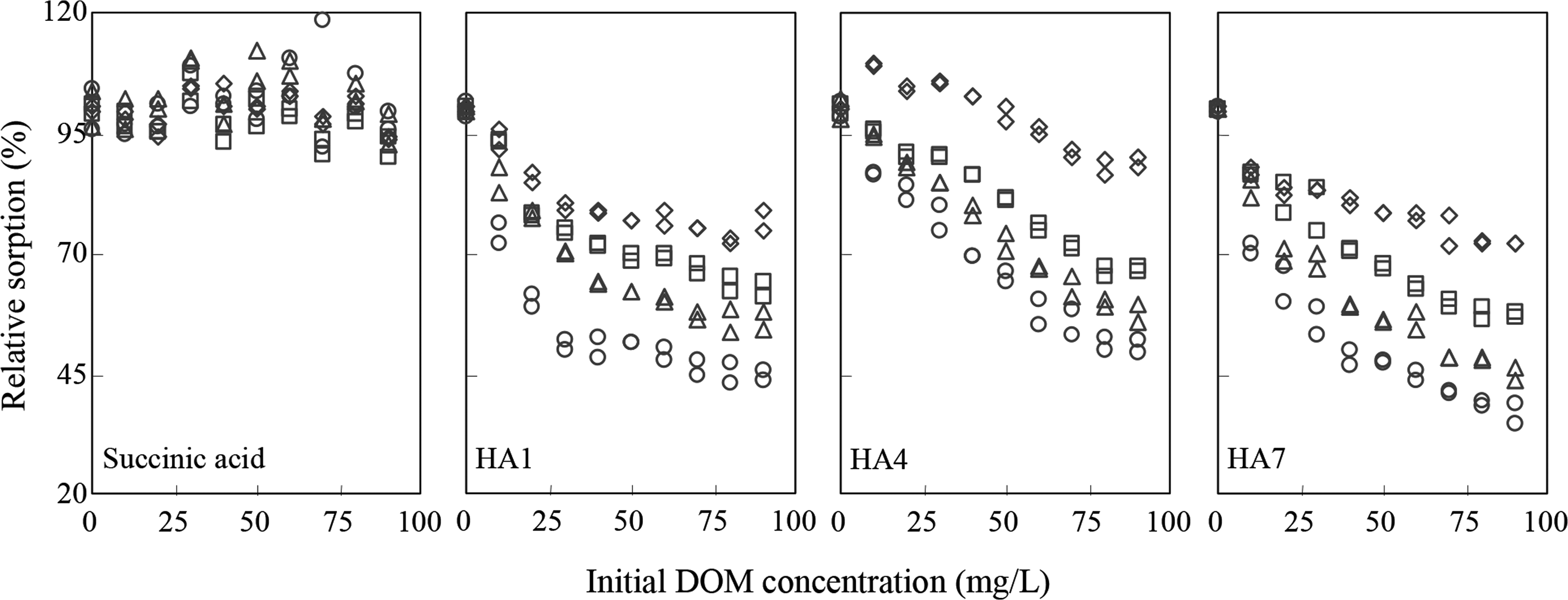
Comparison of removal efficiency reduction of 1-naphthol by MWCNTs with varying outer diameters resulting from DOM addition. MWCNT20 (⋄); MWCNT40 (□); MWCNT60 (Δ); MWCNT100 (○). The y axis represents the ratio of 1-naphthol sorbed by MWCNTs in the presence of DOM to that in the absence of DOM at various initial DOM concentrations.
Introduction of HA1, HA4, or HA7 resulted in approximately 29.3% (for HA1) and 36.6% (for HA4 and HA7) reduction in sorption strength of phenanthrene by MWCNT20, respectively (Fig. 5). Sorption of phenanthrene to MWCNT40, MWCNT60, and MWCNT100 was substantially reduced by 63–68% after a given HA was introduced (Fig. 5). The Kd values of phenanthrene by MWCNT40 and MWCNT60 derived from 0.5 Sw were comparable (36,900 and 37,100 L/kg), but higher than that by MWCNT100 (29,800 L/kg) in the single-solute sorption systems (Wang et al., 2009). However, no difference in removal efficiency reduction of phenanthrene by these MWCNTs resulting from addition of HA1, HA4, or HA7 was detected. This can be because MWCNTs with larger OD (e.g., MWCNT100) were more strongly dispersed by a given HA relative to those with smaller ODs (e.g., MWCNT40 and MWCNT60), as supported by the previous finding showing that in the presence of tannic acid (5 mg/L), dispersibility of MWCNTs was enhanced in the order: MWCNT20 < MWCNT40 < MWCNT60 < MWCNT100 (Lin and Xing, 2008). Dispersion of MWCNTs made a greater number of sorption sites on MWCNTs with larger ODs effective for phenanthrene sorption in contrast to those with smaller ODs, whereas they previously were inaccessible to this compound (Gai et al., 2011). It was also observed that the natural organic matter extracted from Suwannee River considerably enhanced suspension and stability of MWCNTs, and the individually dispersed MWCNTs were clearly detected from the suspension with the aid of microscopic analysis (Hyung et al., 2007). Competitive sorption behaviors of HA with three nonionic aromatic compounds (naphthalene, 1,3-dinitrobenzene, and 1,3,5-trinitrobenzene) on single-walled CNTs and graphite were compared (Chen et al., 2008). It was found that the presence of HA reduced sorption of these three compounds by 29–57% for the CNTs, whereas that for the graphite reached as high as 80–95%. The difference in sorption reduction of the tested compounds on these two sorbents resulting from HA introduction was ascribed to the fact that surface of the nonporous graphite was totally accessible for sorption of the tested compounds, whereas the CNTs readily formed aggregates with microporous interstices in the aqueous phase, which blocked the HA molecules with large molecular size from competing for sites with the contaminants of interest. Consistent with the experimental phenomenon as shown in the bi-solute sorption systems containing both DOM and HOC, sorption of trichloroethylene by activated carbon was significantly suppressed after preloading with humic substance, which was attributed to the molecular sieving effect and pore blockage mechanism, and competitive sorption of the sorbate molecules with the loaded humic substance (Kilduff and Wigton, 1999).

Comparison of removal efficiency reduction of phenanthrene by MWCNTs with varying outer diameters resulting from DOM addition. MWCNT20 (⋄); MWCNT40 (□); MWCNT60 (Δ); MWCNT100 (○). The y axis represents the ratio of phenanthrene sorbed by MWCNTs in the presence of DOM to that in the absence of DOM at various initial DOM concentrations.
Comparison of sorption suppression of phenanthrene and 1-naphthol to MWCNTs by DOM addition
Except for succinic acid, removal efficiency of phenanthrene by individual MWCNTs was more strongly affected by HA1, HA4, and HA7 in contrast to 1-naphthol (Figs. 2 and 3). Consistently, it was also reported that the presence of humic substances did not suppress sorption of benzene to wood char, and sorption reduction of benzene, naphthalene, and phenanthrene to a wood char resulting from humic substance introduction followed the order: benzene < naphthalene <phenanthrene, implying that removal efficiency of the organic compound with higher hydrophobicity and larger molecular volume by the tested wood char would be more strongly affected by humic substances (Pignatello et al., 2006). The authors inferred that the sites in pores of the char available for sorption of organic compound with relatively smaller molecular volume were located at the interior pores where HA molecules cannot enter. The sites in pores of the char for phenanthrene sorption mostly lie at the points close to the exterior where a fraction of HA molecules competed with this compound for these sites. Similarly, it was reported that sorption of a sorbate (i.e., asulam) with larger molecular size to a granular activated carbon was more strongly suppressed by the sorbed DOM than a compound (i.e., hymexazol) with smaller molecular size (Matsui et al., 2002). Sorption reduction of naphthalene, 1,3-dinitrobenzene or 1,3,5-trinitrobenzene induced by addition of a coal-derived HA on single-walled CNTs tended to be more pronounced with increasing molecular size of the studied organic compounds, which was speculated to be a result of the molecular sieving in microporous interstices formed by individual CNTs (Chen et al., 2008).
Sorption suppression of phenanthrene and 1-naphthol to individual MWCNTs resulting from addition of various HAs and that of the primary solutes (benzene, naphthalene and phenanthrene) to wood char caused by introduction of humic substances was contrary to the ordinary competition thermodynamic theory, which predicted that the more hydrophobic the primary solute was, the weaker the competition would be (Pignatello et al., 2006). Higher sorption suppression of phenanthrene by HA in contrast to 1-naphthol on MWCNTs can be attributed to its larger molecular size and higher hydrophobicity (Figs. 2 and 3 and Table 1). Particularly, compared to phenanthrene, a greater number of 1-naphthol molecules were able to penetrate into pores in MWCNTs in the single-solute systems due to its smaller molecular size. This was expected because a previous study demonstrated that the sorbates with four substituents (e.g., 1,2,3,5-tetramethylbenzene) and three substituents (e.g., 1,3,5-trichlorobenzene) had no access to a portion of pores in wood chars that were available for the lower substituted benzene compounds (Zhu et al., 2005). It could be that in the bi-solute systems containing both HOC and DOM, still a greater fraction of pores in MWCNTs were accessible for 1-naphthol than phenanthrene. Hence, the sorbed DOMs exhibited lower pore blockage effect on sorption of 1-naphthol to individual MWCNTs relative to phenanthrene. Due to larger molecular size of phenanthrene, it was more sterically restricted to access a portion of sites on MWCNTs that were available for 1-naphthol, thereby demonstrating higher competitive sorption strength with HA molecules for sites on MWCNTs. The partitioning coefficient of phenanthrene in DOM phase in the bi-solute sorption systems could be higher than 1-naphthol due to its more hydrophobic nature (Table 1), such that its sorption to MWCNTs was more strongly suppressed in contrast to 1-naphthol. Hence, the presence of HAs led to higher removal efficiency reduction of phenanthrene by individual MWCNTs in comparison with 1-naphthol (Figs. 2 and 3).
Conclusions
MWCNTs with various ODs had much lower sorption strength for succinic acid than peat soil-origin HAs due to its very hydrophilic nature. Consistently, the presence of succinic acid did not suppress sorption of phenanthrene and 1-naphthol to MWCNTs in the bi-solute systems. It was due to its very small molecular volume and low sorption strength to these sorbents, thus minimal influence on surface properties of the MWCNTs and sorption of these two primary solutes. Different from succinic acid, the presence of HAs substantially reduced sorption of phenanthrene and 1-naphthol by MWCNTs, noting the great impact of DOM on HOC removal by MWCNTs. Great difference in sorption reduction of phenanthrene and 1-naphthol by MWCNTs induced by addition of succinic acid or various HA fractions suggests that physicochemical properties (e.g., hydrophobicity and molecular size) of DOMs greatly influence HOC removal efficiency by MWCNTs. Reduction in removal efficiency of HOCs by MWCNTs resulting from addition of a specific DOM was also highly affected by their chemical composition. The DOM-induced removal efficiency reduction of a certain organic pollutant by MWCNTs with smaller ODs was less pronounced in comparison with those with larger ones.
Footnotes
Acknowledgments
This study was supported by the National Science Fund for Distinguished Young Scientist (41525005), the 973 Program (2014CB441104), National Natural Science Foundation of China (41271461, 41390240, 41130754, and 41629101), the National Key Project of Science and Technology (2012ZX07503-003-004), and 111 Program (B14001). We very much thank Dr. David Werner at Newcastle University for polishing the language of this article.
Author Disclosure Statement
No competing financial interests exist.
References
Supplementary Material
Please find the following supplemental material available below.
For Open Access articles published under a Creative Commons License, all supplemental material carries the same license as the article it is associated with.
For non-Open Access articles published, all supplemental material carries a non-exclusive license, and permission requests for re-use of supplemental material or any part of supplemental material shall be sent directly to the copyright owner as specified in the copyright notice associated with the article.
