




Abstract
Abstract
In this work, magnetic based activated carbon (MPSAC) was prepared via a simple one-step method in the presence of K2CO3 and Fe3O4 and further examined as an adsorbent for the removal of Pb(II). MPSAC possessed a well-developed porosity structure with a high surface area of 1,219 m2/g and contained rich carboxylic functional groups on the surface. It can be separated easily from a suspended system. The pHIEP value of MPSAC was notably lower than the pHPZC, suggesting that the negatively charged surface was largely distributed in the external area. Batch adsorption experiments were carried out by varying the initial pH, contact time, adsorbent dosage, initial Pb(II) concentration, and temperature of solution. Results show that adsorption of Pb(II) on MPSAC was dependent on contact time, solution pH, adsorbent dosage, initial Pb(II) concentration, and temperature, especially solution pH having strong effects at pH 2–4. Adsorption kinetic and equilibrium data were well described by the pseudo-second-order model and Langmuir isotherm with the maximum monolayer adsorption amounts of 146.20, 152.67, and 158.73 mg/g at 293, 303, and 313 K, respectively. Intra-particle diffusion mechanism was partially responsible for the adsorption. The thermodynamic study indicated that the adsorption was a spontaneous and endothermic process. Competitive adsorption showed that MPSAC has a good adsorption selectivity for removal of Pb(II) ion.
Introduction
W
Various methods have been proposed for the treatment of wastewater containing lead wastes such as chemical precipitation (González-Muñoz et al., 2006), electrochemical reduction (Liu et al., 2013), coagulation/flocculation (Pang et al. 2011), ion exchange (Mohandas et al., 2008), and adsorption (Wang et al., 2010; Cechinel et al., 2014). Among the methods cited earlier, adsorption is considered a promising technique due to its simplicity for design, easy operation, and insensitivity to toxic substances. At present, activated carbon is among the most widely used adsorbents, which is mostly due to its large surface area, porosity, high adsorption capacity, and specific surface chemistry. However, the major drawback for the use of activated carbon is its poor economic feasibility, which has resulted in a growing research interest in low-cost alternative precursors. Many researchers have successfully prepared activated carbon from agricultural by-products such as cornstalk lignin (Sun et al., 2010), waste tea (Gurten et al., 2012), groundnut hulls (Bello et al., 2012), sugarcane bagasse (Foo et al., 2013), chestnut shell (Demiral et al., 2014), and coconut shell (Silva-Medeiros et al., 2016).
In addition, the activated carbon adsorption process, specifically in the form of fine powder, often suffers from the separation problem from aqueous solution. Magnetic technology makes it possible to effectively separate and recover the spent activated carbon. Hence, the preparation and application of magnetic activated carbon have recently attracted much attention (Liu et al., 2014; Faulconer et al., 2012; Lompe et al., 2016; Han et al., 2015; Fu et al., 2016; Trakal et al., 2016).
Peanut shell, an agricultural solid waste that is abundantly available in China, can reach 4.4 million tons per year, most of which is discarded or burned off in stacks, causing resource dissipation and environmental pollution (Li et al., 2010a, 2010b). Therefore, in this study, the magnetic peanut shell based activated carbon (MPSAC) was prepared via a simple one-step method in the presence of K2CO3 and Fe3O4 and further examined as an adsorbent for the removal of Pb(II). Its structure and surface properties were characterized by scanning electron microscopy (SEM), X-ray diffraction (XRD), Fourier transform infrared spectroscopy (FTIR), Boehm titration method, Brunauer-Emmett-Teller (BET) surface area analysis, vibrating sample magnetometer, pHZPC, and zeta potential. The influence of operating parameters, such as pH, contact time, adsorbent dosage, initial Pb(II) concentration, and temperature of solution on Pb(II) adsorption, were investigated in batch mode. The kinetic and equilibrium aspects of the Pb(II) adsorption were conducted to understand the mechanism of Pb(II) adsorption onto MPSAC. In addition, competitive adsorption of Pb(II), Cd(II), and Ni(II) ions in a ternary system was studied to evaluate the adsorption selectivity of MPSAC for the removal of Pb(II).
Materials and Methods
Materials
Peanut shell precursor collected from a local agricultural market in Chengdu, Sichuan province of China, was first washed with deionized water for several times, and it was then dried in an oven at 110°C for 24 h. The dried sample was ground with a grinder, sieved into an average particle size of less than 1.0 mm, and finally stored in an airtight container for further experimentation.
All reagents used were of analytical grade. Ferrosoferric oxide (Fe3O4) used as the magnetic additive was supplied by Shanghai Shanhai Gongxue No. 3 Experiment Factory. Anhydrous potassium carbonate (K2CO3) used as the chemical activating agent was received from Chengdu Kelong Chemical Co., Ltd. Pb(NO3)2 used as the adsorbate was supplied by Chengdu Jinshan Chemical Co., Ltd.
Preparation of MPSAC
The procedure used to prepare the MPSAC was referred to in our previous work (Zhang et al., 2015). Briefly, 10 g of dried peanut shell was mixed by stirring with a suspension solution of K2CO3 (5 g) and Fe3O4 (0.5 g) at room temperature, and it was dried at 110°C for 24 h. The product was precarbonized at 300°C for 1 h, and it was then activated at 750°C for 1.5 h. After cooling, the activated sample was washed with deionized water until the pH of the filtrate was about 7–8, and it was dried at 110°C for 12 h to obtain MPSAC.
Characterization studies
Surface morphology of MPSAC was observed by using scanning electron microscopy (SEM). A Quanta 200 SEM (FEI Com, Holland) with a 20 kV excitation voltage was used. The XRD pattern of MPSAC was collected by Diffractometer X'Pert Pro (Panalytical, Holland) using Cu Ka radiation (λ = 0.15418 nm) operated at 40 kV and 25 mA. A scan was performed in the 2θ range from 5 to 85°.
Textural characterization of MPSAC was carried out by N2 adsorption at 77 K using a Tristar II 3020 surface area and a pore size analyzer (Micromeritics Instruments). The BET surface area was calculated by the BET equation. The magnetic measurement was carried out at room temperature with a vibrating sample magnetometer (JDAW-2000; Changchun Yingpu Magneto-Electric Corp., China).
Surface functional groups of the MPSAC were detected by Fourier transform infrared spectroscopy (FTIR, Nicolet 5700; Thermo). The spectrum was recorded from 400 and 4,000 cm−1 at a resolution of 4 cm−1 by using an FT-IR spectrophotometer.
Quantities of the surface functional groups were measured by the Boehm titration method (Goertzen et al., 2010); 0.1 g of MPSAC was added to a series of flasks containing 25 mL of 0.05 M NaOH, Na2CO3, NaHCO3, and HCl solutions. These flasks were then sealed and shaken for 24 h at room temperature. Then, the solutions were filtered and 10 mL of each solution was titrated with 0.05 M HCl or NaOH. The amount of acidic groups was determined based on the assumptions that NaOH neutralizes carboxylic, lactonic, and phenolic groups; Na2CO3 neutralizes carboxylic and lactonic groups; and NaHCO3 neutralizes only carboxylic groups. The number of basic sites was calculated from the amount of HCl that reacted with the MPSAC.
The pH at the point of zero charge (pHPZC) was determined by the batch equilibrium technique: 0.05 g of MPSAC was suspended in 50 mL of 0.01 M NaCl solution. The initial pH of solution was adjusted to predefined values from 1.0 to 10.0 with 0.1 M HCl and 0.1 M NaOH. The suspension was allowed to equilibrate at 150 rpm in a shaker at 298 K for 24 h. The final pH was recorded by using a pH meter. The pHPZC was obtained according to the point of initial pH equal to final pH.
Zeta potential of MPSAC was measured with Zetasizer 3000 HSa (Malvern Ltd): 0.05 g MPSAC was put in 50 mL of 0.01 M NaCl solution. The pH of the suspensions was adjusted between 1.0 and 10.0 with 0.1 M HCl and 0.1 M NaOH. Thereafter, the zeta potential and final pH of the suspensions were measured. The pH value at which the zeta potential equals zero is the isoelectric point (pHIEP).
Batch adsorption experiments
A stock solution of 1,000 mg/L Pb(II) was prepared from Pb(NO3)2. Experimental solutions of the desired concentration were obtained by further dilution. The batch adsorption experiments were undertaken in a series of Erlenmeyer flasks (100 mL). A predefined amount of MPSAC (0.01–0.08 g) was placed into 50 mL Pb(II) solution with different initial concentrations (40–200 mg/L). The mixture was agitated at the given temperature (293, 303, and 313 K) for a different time (0.25–24 h) in a constant temperature oscillator at 120 rpm. The desired pH (1–10) was adjusted by using 1 M NaOH and 1 M HCl. At the end of each adsorption batch, the adsorbent was separated by a filter with a 0.45 μm nylon membrane. The residual Pb(II) in the solution was determined by an atomic adsorption spectrophotometer (Hitachi Z-5000, Japan). The removal percentage of Pb(II), η(%), and the adsorption amount, q, of MPSAC were calculated according to Equations (1) and (2), respectively:
where q is the amount of Pb(II) taken up by MPSAC (mg/g), C0 and Cf (mg/L) are the initial and final concentrations of Pb(II) in solution, respectively, m (g) is the adsorbent mass, and V (L) is the volume of Pb(II) solution. All adsorption experiments were conducted in triplicate, and the results were averaged.
Lead precipitation test
The lead precipitation assay was performed with 50 mL of 100 mg/L Pb(II) solution by varying the pH from 1.0 to 10.0. The pH-adjusted solutions were left to stand for 24 h at ambient temperature. After this period, the samples were filtered and the liquid phase was analyzed for residual Pb(II) concentration.
Competitive adsorption study
Competitive adsorption of Pb(II), Cu(II), and Ni(II) ions onto MPSAC was conducted in a ternary system with an initial concentration of 70 mg/L for each metal ion at pH 5. At the same time, the individual adsorption of three metal ions under equilibrium conditions was investigated in a single system.
Results and Discussion
Characterization of MPSAC
MPSAC was found to have a well-developed porosity structure that was composed of micro-, meso-, and macropores; a high surface area of 1,219 m2/g; and saturation magnetization of 5.61 emu/g contributed mainly from Fe3C in our previous work (Zhang et al., 2015). It can be separated by an ordinary magnet as shown in Fig. 1b. It should be noted that the MPSAC particles were clearly attracted to the magnet in the test tube.

Magnetization curve
The FTIR spectrum can provide beneficial information about the functional group distributions in the prepared carbon. The FTIR spectrum of MPSAC is demonstrated in Fig. 2. The broad absorption band located around 3,454 cm−1 corresponds to the O–H stretching vibration. The absorption peak that appeared at 1,623 cm−1 is ascribed to the C═O stretching vibration. The band at 1,454 cm−1 is attributed to the C═C stretch of polycyclic aromatic hydrocarbons, O–H deformation vibration in carboxyl groups, or C–H bending vibration. The strong absorption in the region around 1,100 cm−1 is due to various C–O bonds such as those in ethers, phenols, and esters.

FTIR spectrum of MPSAC. FTIR, Fourier transform infrared spectroscopy.
The surface chemistry of carbon materials is commonly determined by the acidity and basicity of their functional groups. Based on the known volume of used acid or base in Boehm titration analysis, the different kinds of functional groups on the surface of MPSAC can be quantitatively calculated. Results showed that the amount of carboxyls, phenols, lactones, and basic groups are 0.656, 0.074, 0.044, and 0.967 mmol/g, respectively. Hence, the total acidic groups were lesser than the total basic groups. This result was expected as high activation temperature favored low acidity (Guo and Rockstraw, 2007). In addition, it could be related to the chemical activation by K2CO3, which led to a reduction in the acidic groups on the surface.
The pHPZC represents the net total (external and internal) surface charge of activated carbon. It depends on the chemical and electronic properties of the functional groups on the surface of activated carbon. To the best of our knowledge, different pHPZC values of activated carbon have been reported in the literature (Partlan et al., 2016). In this study, the MPSAC shows a basic pHPZC of approximately 8.1 (Fig. 3). A good correlation can be found between the pHPZC and oxygen content of the MPSAC. A similar result has been reported by Bastami and Entezari (2012).
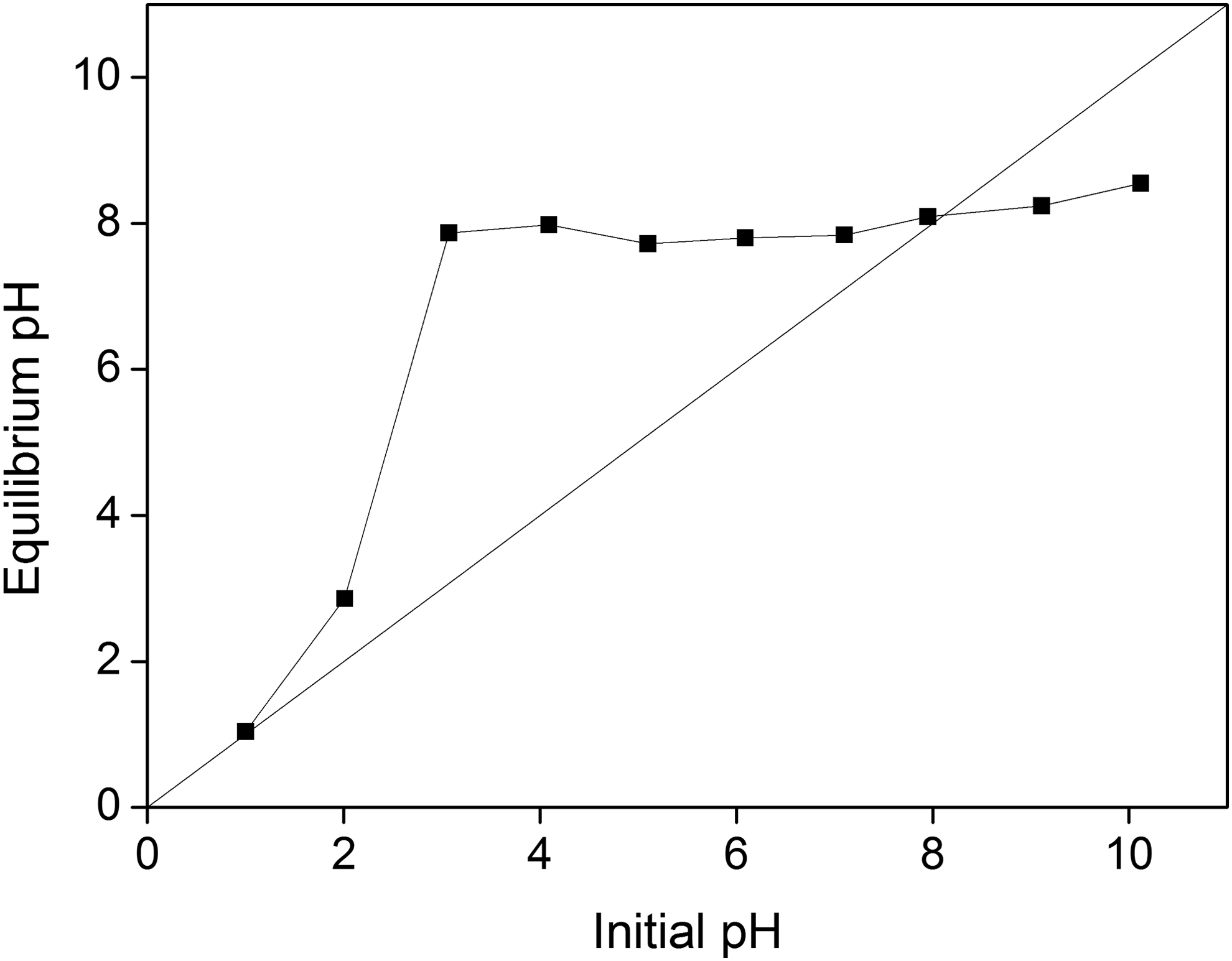
Curve of pH at point of zero charge (pHPCZ).
Compared with pHPZC, pHIEP represents the external surface charge of activated carbon. Activated carbon is amphoteric in nature due to the various functional groups on its surfaces and the presence of a π electron system for generating the properties of Lewis basic, which was significant for influencing the pHIEP of carbon materials (Chingombe et al., 2005). Figure 4 shows the zeta potential of MPSAC as a function of pH. The zeta potential of MPSAC decreased from 0.5 to −11.3 mV as the equilibrium pH value increased from 1.1 to 10.1. Based on zeta potential measurements, the pHIEP value was observed at 1.9. The difference between pHPZC and pHIEP lies in the definition of potential-determining ions. When surface charge is contributed solely from H+ and OH−, the point of pH where the net surface charge is zero is pHIEP. When the surface charge is contributed from other cations and anions in addition to H+ and OH−, the point of pH where the net surface charge is zero is termed pHZPC. The difference between pHZPC and pHIEP can give an indication of the surface charge distribution of the porous adsorbent. Positive values would indicate a more negatively charged external surface than the interior surface and vice versa for negative values (Menéndez et al., 1995). In this work, the pHPZC value was notably higher than the pHIEP, suggesting that more acidic functional groups were on the external surface of MPSAC than its interior surface, and the negatively charged surface was largely distributed in the external area.
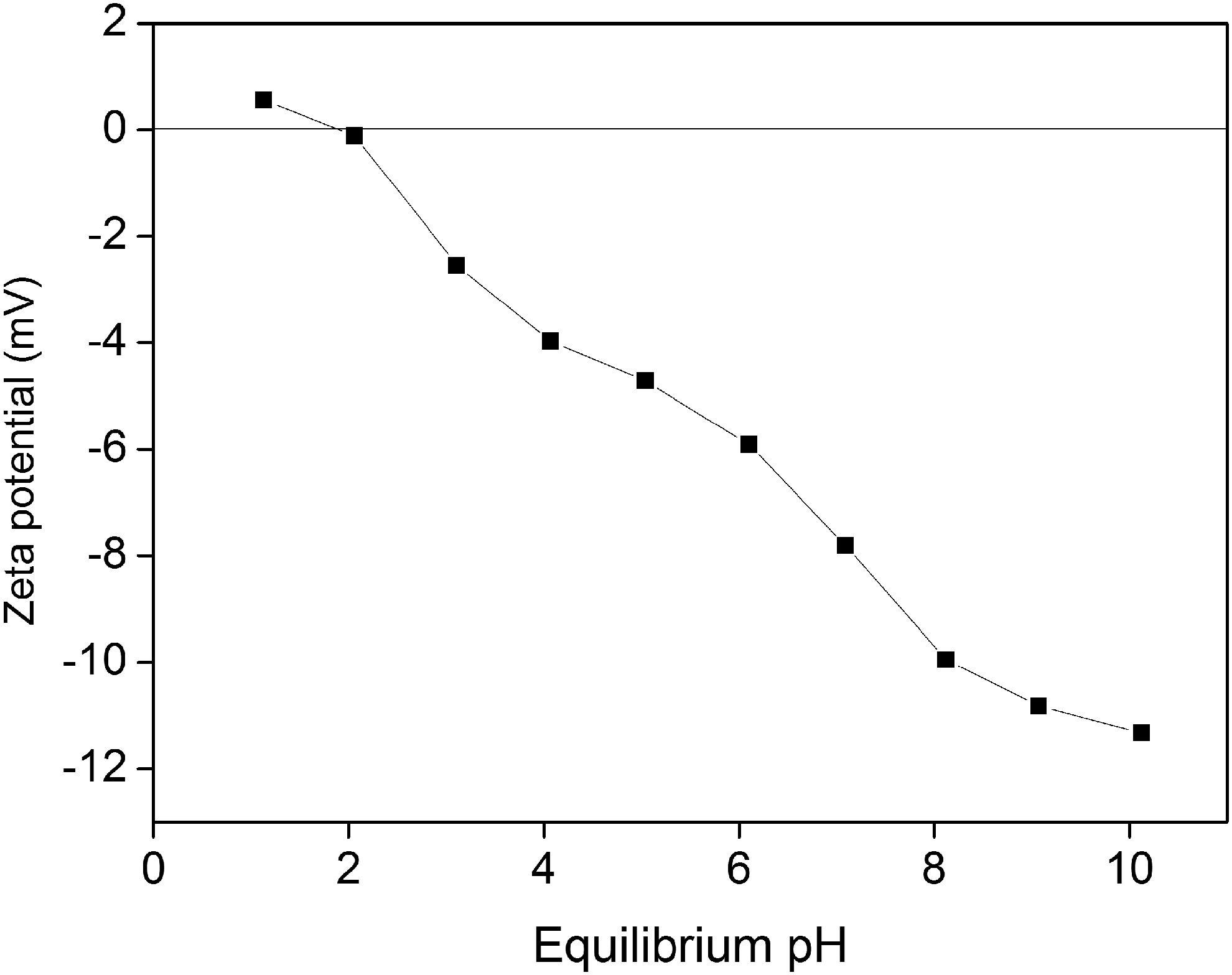
Zeta potential of MPSAC.
Effect of contact time
To determine the equilibrium time of Pb(II) adsorption, contact time was varied from 0.25 to 24 h with pH 5, initial Pb(II) concentrations of 100, 150, and 200 mg/L, MPSAC dosage of 1 g/L, and temperature of 293 K. Figure 5a illustrates the effect of contact time on the Pb(II) adsorption. It can be observed that the removal of Pb(II) on MPSAC increased sharply during the first 3 h for all the initial concentrations, then gradually slowed down, and finally reached the equilibrium. The variation was due to the plentiful surface sites available and the relatively high concentration gradient initially. After a lapse of time, it was difficult to occupy the remaining vacant surface sites due to the repulsion between solute molecules in the solid and bulk phases (Ibrahim et al., 2010). In addition, the time taken to reach equilibrium improved with increasing the initial Pb(II) concentration, which was 8 and 14 h for initial Pb(II) concentrations of 100 and 200 mg/L, respectively. A similar result was also reported by Huang et al. (2014). This behavior was connected with the competitive diffusion process of Pb(II) through the micro channel and pores. It could block the inlet of the channel on the surface and prevent the Pb(II) from passing deeply inside the activated carbon for the higher initial Pb(II) concentrations, thereby increasing the equilibrium time. According to the results obtained, a contact time of 14 h was selected for the rest of the batch experiments to make sure that adsorption equilibrium was reached.
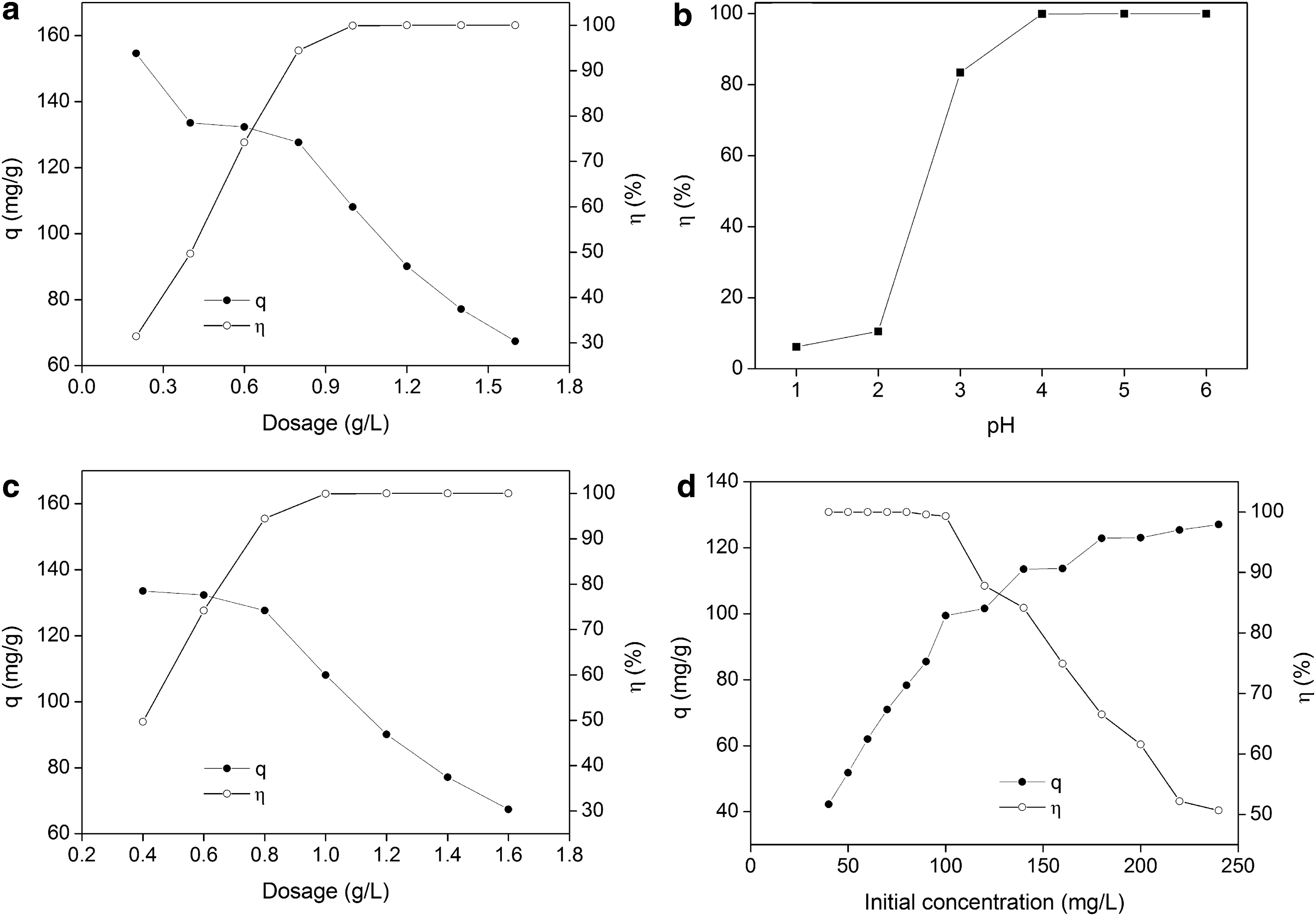
Effect of experimental factors on adsorption of Pb(II) on MPSAC,
Effect of initial pH
The pH of solution plays a significant role in the uptake of heavy metals, since it not only affects the speciation of the adsorbate in solution but also determines the surface charge of the adsorbent and the degree of ionization of the surface functional groups. Figure 5b demonstrates the Pb(II) removal on MPSAC over a pH range from 1.0 to 6.0 at an initial Pb(II) concentration of 100 mg/L, contact time of 14 h, and temperature of 293 K. At pH< 2.0, the removal percentage of Pb(II) was very low. It could be due to two reasons: electrostatic repulsion of the Pb2+ ions by the positively charged surface and proton exclusion or proton completion for surface sites. With increasing pH from 2.0 to 3.0, the removal of Pb(II) sharply increased from 10.51% to 83.42%, which can be explained by the electrostatic interaction between the negative charge surface of MPSAC and Pb(II) ions. At pH 4, Pb(II) adsorption reached 99.89%. Hence, the adsorption of Pb(II) on MPSAC was highly pH dependent for a pH of 1–4, and it can give good results at pH 4–6.
In contrast, the precipitation of lead only occurred at a pH greater than six according to the lead precipitation curve obtained in the test (Supplementary Fig. S1). It was in accord with the speciation diagram of lead that showed that the dominant Pb(II) species remained as Pb2+ ions until the pH was up to 6, and at pH> 6 the species such as Pb(OH)+, Pb3(OH)42+, and Pb(OH)2 were produced (Machida et al., 2005). Hence, the interference due to lead precipitation can be neglected because the pH selected was 5.0 during the subsequent adsorption experiments with MPSAC.
Effect of MPSAC dosage
Effect of adsorbent dosage on Pb(II) uptake was performed by changing the adsorbent dosage from 0.2 to 1.6 g/L at pH 5, initial Pb(II) concentration of 100 mg/L, contact time of 14 h, and temperature of 293 K. As shown in Fig. 5c, the removal percentage of Pb(II) was found to improve rapidly from 31.46% to 99.94% with an increase in the MPSAC dosage from 0.2 to 1 g/L, and it then remained 100% above 1.2 g/L. This can be explained due to the fact that the higher the dosage of adsorbent in the solution, the greater the availability of exchangeable sites for metal ions (Babel and Kurniawan, 2004). Compared with the removal trend of Pb(II), the adsorption amount of MPSAC continuously decreased from 154.61 to 67.39 mg/g, with the adsorbent dosage increasing from 0.2 to 1.6 g/L. The main reason is that the adsorption sites were excessive for the adsorption at a high adsorbent dosage. Besides, a higher adsorbent dosage enhances the probability of collision between adsorbent particles, and therefore creates particle aggregation, leading to a decline in the total surface area and an increase in diffusion path length, both of which contribute to the decrease of adsorption (Semerjian, 2010).
Effect of initial Pb(II) concentration
Effect of initial concentration on adsorption of Pb(II) was investigated by changing C0 from 40 to 240 mg/L at pH 5, contact time of 14 h, MPSAC dosage of 1 g/L, and temperature of 293 K. The result is depicted in Fig. 5d. It is obvious that the removal of Pb(II) was dependent on initial Pb(II) concentrations. With increasing the initial concentrations from 40 to 240 mg/L, the removal percentage of Pb(II) decreased from 100% to 50.67%. It is due to the fact that the total available adsorption sites of adsorbent with fixed dosage were insufficient when high Pb(II) concentrations were used. On the contrary, the actual amount of Pb(II) ions adsorbed per unit mass of MPSAC improved from 42.28 to 127.03 mg/g with an increase in initial concentration. This is because the initial heavy metals concentration provides an important driving force to overcome the mass transfer resistance of heavy metal ions between the aqueous and solid phases, and, therefore, a higher initial metal concentration will enhance the adsorption capacity (Ibrahim et al., 2010).
Adsorption kinetic study
To examine the rate of the adsorption process and the potential rate-controlling step, the pseudo-first-order and pseudo-second-order as well as intra-particle diffusion models were used.
The pseudo-first-order kinetics model was expressed by Equation (3):
where k1 (h−1) is the pseudo-first-order rate constant; qe and qt (both in mg/g) indicate the amount of Pb(II) adsorbed per unit mass of adsorbent at equilibrium and time t (h), respectively.
The pseudo-second-order kinetics model was described by Equation (4):
where k2 (g/mg- h) is the pseudo-second-order rate constant; qe and qt (both in mg/g) indicate the amount of Pb(II) adsorbed per unit mass of adsorbent at equilibrium and time t (h), respectively.
The mathematical formula for the intra-particle diffusion model can be considered as Equation (5):
where ki (mg/g h0.5) is the intra-particle diffusion rate constant, and C (mg/g) is the constant that is determined by the thickness of the boundary layer; the larger the value of C, the greater the thickness of the boundary layer.
The linear fitting curves are shown in Fig. 6, and the relevant kinetic parameters are listed in Table 1. It can be seen that although the pseudo-first-order kinetics model gave high correlation coefficients (R2 > 0.98), the adsorption amount estimated had a very large deviation relative to experimental results. Comparatively speaking, the pseudo-second-order model, with R2 > 0.99 for all initial Pb(II) concentrations and good agreement between calculated and experimental values, was better able to describe the kinetics of Pb(II) adsorption. Therefore, the chemisorption might be the rate-limiting step of the adsorption process. Our results agreed with those reported in the literature (Wang et al., 2010; Demiral et al., 2014).
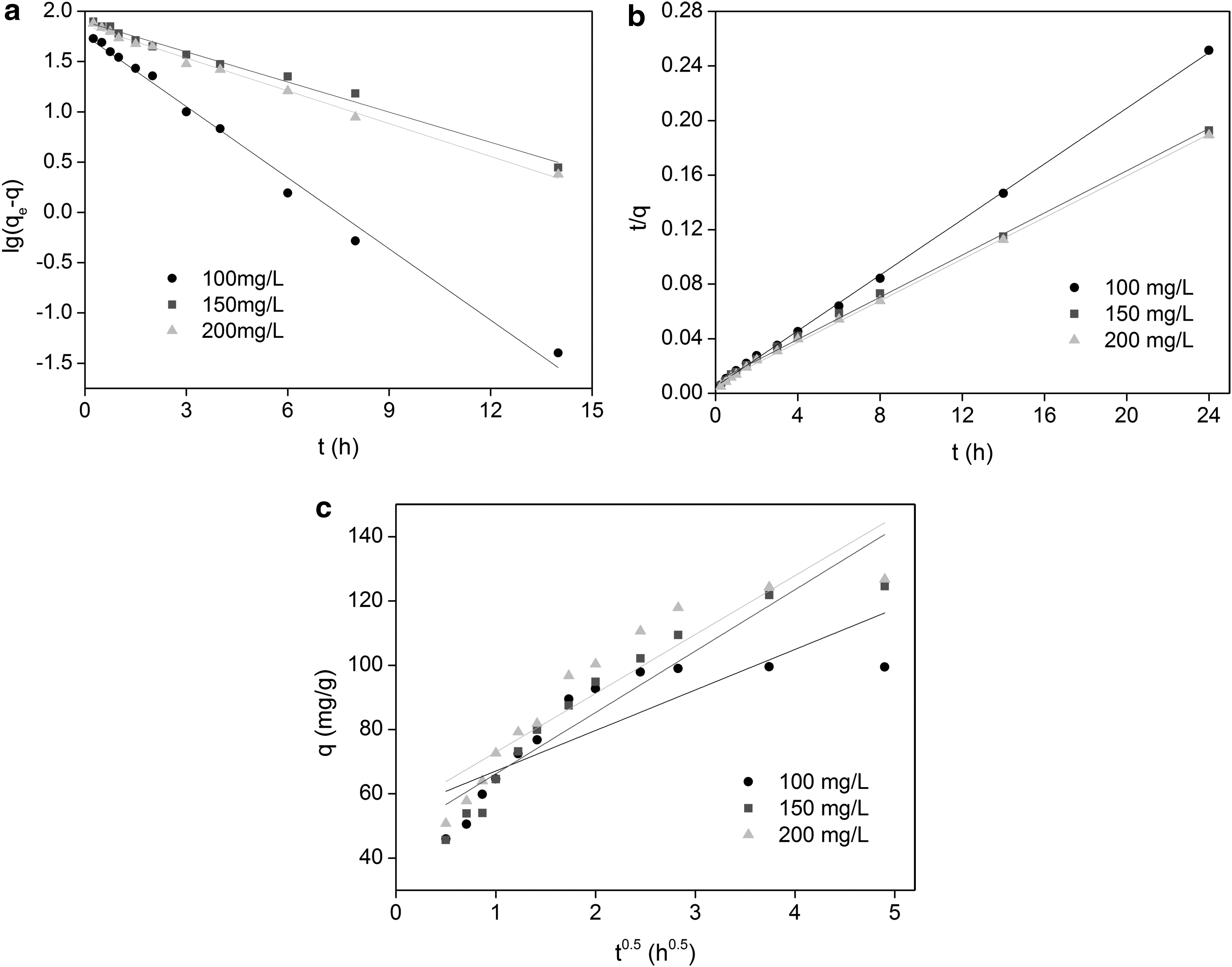
Linear kinetic plots of Pb(II) adsorption on MPSAC at initial Pb(II) concentrations of 100, 150, and 200 mg/g
In the case of the intra-particle diffusion model, the line intercepts did not pass through the origin as shown in Fig. 6c, which suggested that the intra-particle diffusion was part of the adsorption but not the only rate-controlling step. Meanwhile, all correlation coefficients were less than 0.90, which further implied that the adsorption of Pb(II) on MPSAC was a complex process involving two or more steps. The first steep portion might be attributed to external surface adsorption, and the intermediate linear portion was the gradual layer adsorption stage, where the intra-particle diffusion became the rate-limiting step.
Adsorption isotherm study
In this study, equilibrium adsorption experiments were performed by varying the initial Pb(II) concentration from 100 to 240 mg/L at different temperatures (293, 303, and 313 K) while keeping pH constant at 5, contact time of 14 h, and an MPSAC dosage of 1 g/L. The equilibrium data were analyzed by Langmuir and Freundlich isotherm models, respectively. The Langmuir isotherm presumes that adsorption occurs on the homogeneous surface of an adsorbent in addition to several other assumptions such as monolayer coverage and nonspecificity, as shown in Equation (6):
where KL (L/mg) is the Langmuir equilibrium constant, Qmax (mg/g) is the maximum monolayer uptake capacity of the adsorbent, and Ce (mg/L) is the Pb(II) concentration at the equilibrium.
The Freundlich isotherm is described by Equation (7), which considers the possibility of surface heterogeneity of an adsorbent:
where KF (mg1−1/nL1/n/g) is the Freundlich equilibrium constant and 1/n gives a measure of the intensity of adsorption.
Two linear fitting curves are shown in Fig. 7, and the relevant parameters are presented in Table 2. Based on the linear regression correlation coefficients (R2) summarized in Table 2, it can be seen that the Langmuir model (R2 > 0.999) gave a better fit to the experimental data compared with the Freundlich model (R2 < 0.945). This suggests that the adsorption sites on the surface of MPSAC are homogenous and the adsorption of Pb(II) is a monolayer phenomenon. The maximum monolayer adsorption amounts estimated by the Langmuir model were 143.88, 153.67, and 158.73 mg/g at the temperatures of 293, 303, and 313 K, respectively, which were higher than those of many other adsorbents reported in literature (Table 3), suggesting that MPSAC was a highly efficient Pb-adsorbent for wastewater treatment.

Linear adsorption isotherms for adsorption of Pb(II) onto MPSAC at different temperatures
Thermodynamic study
To improve our understanding of the adsorption mechanism, the thermodynamic parameters, including Gibbs free energy change (ΔG°), enthalpy change (ΔH°), and entropy change (ΔS°), were calculated by using Equations (8)–(10):
where R is the ideal gas constant (8.314J/[mol·K]), T is the temperature in Kelvin, and K0 (L/mol) is the adsorption equilibrium constant.
The ΔH° and ΔS° were determined from the slope and intercept of the linear plot of lnK0 versus 1/T (Supplementary Fig. S2a), respectively, and the results are listed in Table 4. The positive ΔH° confirms the endothermic nature of adsorption, which was also supported by the increase of Pb(II) uptake with the rise in temperature (Supplementary Fig. S2b). The positive ΔS° suggests the increase of randomness at the solid/solution interface during the adsorption process. The ΔG° at the temperatures of 293, 303, and 313K were calculated as −31.491, −33.652, and −36.128 kJ/mol, respectively. The negative ΔG° reveals the spontaneous nature of the Pb(II) adsorption process.
Competitive adsorption of heavy metal ions
The adsorption characteristics of single and multisolute systems would be different because coexisting components compete to obtain the adsorption sites on the adsorbent. In this study, the removal percentages of Pb(II), Cu(II), and Ni(II) ions obtained were 100%, 78.52%, and 33.17% in a single system, respectively. Figure 8 shows the influence of contact time on the removal of three metal ions in the ternary system. It can be found that the removal percentage followed the order Pb(II) > Cu(II) > Ni(II), and the removal of Pb(II) was superior to that of the other ions in the competitive adsorption process. Further, the adsorption of Cu(II) and Ni(II) onto MPSAC was greatly affected as the system changed from a single to a ternary system, and the decrease in removal percentage reached 43.18% and 28.96%, respectively. Hence, MPSAC has a good adsorption selectivity for the removal of Pb(II). The same trend was observed for Fu et al. (2016). The tendency could be explained on the basis of metal ions properties such as atomic weight, ionic radii, electronegativity, and hydrolysis constants (Prasher et al., 2004; Sheela and Nayaka, 2012; Praveen and Vijayaraghavan, 2015).
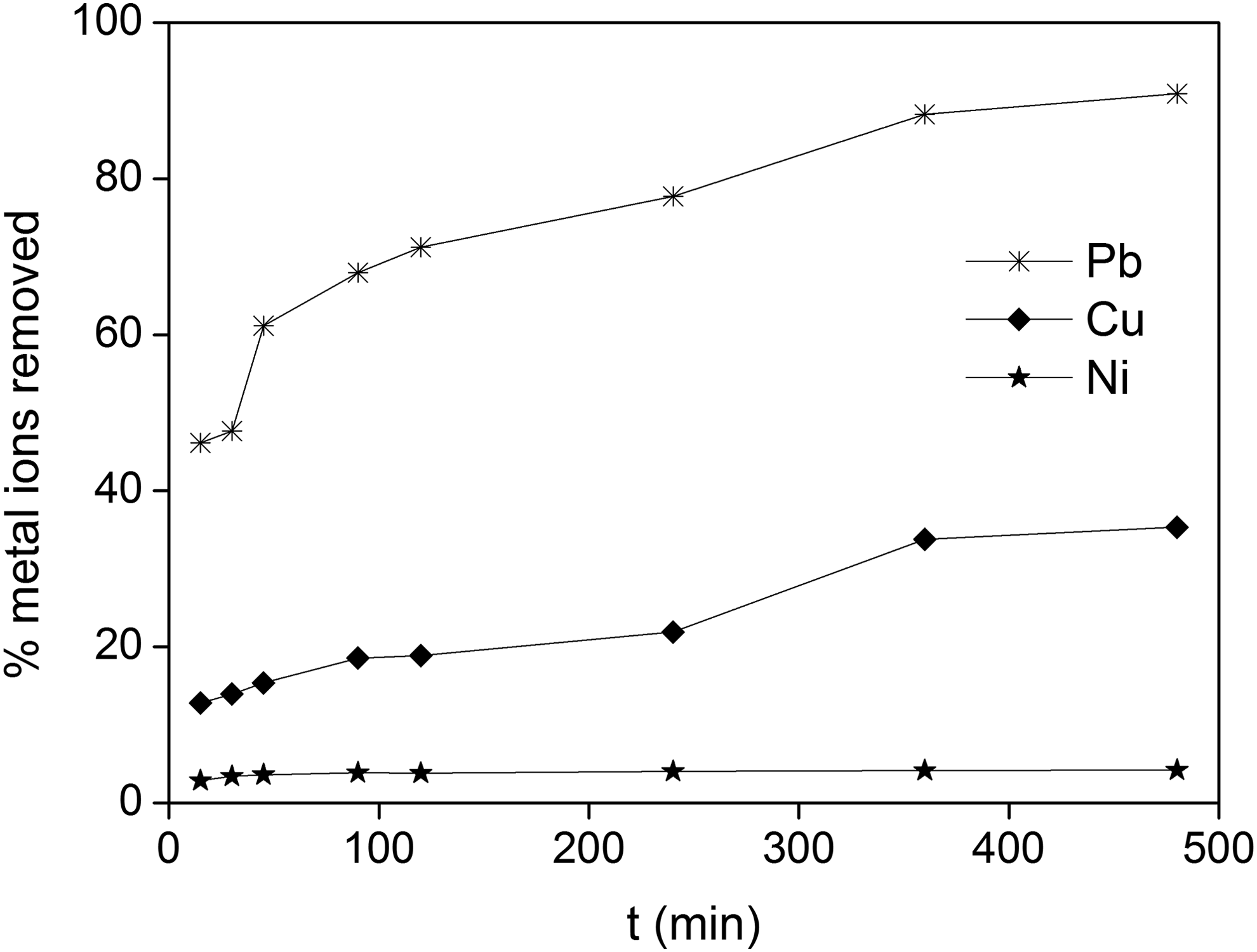
Effect of contact time on adsorption of Pb(II), Cu(II), and Ni(II) in a ternary system.
Movement of metals with a higher atomic weight can generate higher momentum energy, which may promote the biosorption of the metal by increasing the probability of effective collision between the metal and the biosorbent surface (Sag et al., 2002). In this study, the atomic weight is in the order of Pb (207.2) > Cu (63.5) > Ni (58.7). By contrast, their hydrated ionic radii decrease in the order of Cu2+ (4.19 Å) > Ni2+ (4.04 Å) > Pb2+ (4.01 Å) (Nightingale, 1959; Kadirvelu et al., 2008). Since Pb(II) ions have the smallest hydrated ionic radii, it is possible that with fewer weakly bonded water molecules they tend to move faster to the potential adsorption sites, when compared with the cations with higher hydrated ionic radii (Sheela et al., 2012). In the case of electronegativity, the reported effect is a stronger attraction due to the higher electronegativity (Tarley et al., 2004). The electronegativity of the three ions mentioned earlier decreases in the order of Pb (2.33) > Ni (1.91) > Cu (1.9) (Praveen and Vijayaraghavan, 2015). In addition, this selectivity sequence could be assigned with the hydrolysis constant values of three metal ions. The hydrolyzed metal ion (MOH+) is strongly adsorbed than free metal cations (Sheela and Nayaka, 2012). Hence, the preferential uptake of Pb(II) ions by MPSAC is related to its lowest pH of hydrolysis.
Conclusion
We have shown that MPSAC is an effective adsorbent for the Pb(II) removal from aqueous solutions. The MPSAC possessed a well-developed porosity structure with a high surface area of 1,219 m2/g and contained rich carboxylic functional groups on the surface. It can be separated easily from a suspended system by using an ordinary magnet. The pHIEP value of MPSAC was notably lower than the pHPZC, suggesting that the negatively charged surface was largely distributed in the external area. The adsorption of Pb(II) on MPSAC was dependent on contact time, solution pH, adsorbent dosage, initial Pb(II) concentration, and temperature. The pseudo-second-order kinetic equation was better in interpreting the kinetics of Pb(II) adsorption, suggesting that chemisorption might be the rate-limiting step of the adsorption process. Meanwhile, the intra-particle diffusion mechanism was partially responsible for the adsorption. The equilibrium data obtained at different temperatures had a better fit to the Langmuir isotherm, and the estimated maximum monolayer adsorption amounts were 146.20, 152.67, and 158.73 mg/g at 293, 303, and 313 K, respectively. Thermodynamic analysis indicated that the adsorption was a spontaneous and endothermic process. Competitive adsorption results of Pb(II), Cu(II), and Ni(II) ions showed that the MPSAC had a good adsorption selectivity for the Pb(II) removal.
Footnotes
Acknowledgments
This work was financially supported by the National Natural Science Foundation of China (51303151), the Science & Technology Pillar Program of Sichuan Province (2015GZ0230, 2016GZ0222), and the Fundamental Research Funds for the Central Universities (2682014CX011).
Author Disclosure Statement
No competing financial interests exist.
References
Supplementary Material
Please find the following supplemental material available below.
For Open Access articles published under a Creative Commons License, all supplemental material carries the same license as the article it is associated with.
For non-Open Access articles published, all supplemental material carries a non-exclusive license, and permission requests for re-use of supplemental material or any part of supplemental material shall be sent directly to the copyright owner as specified in the copyright notice associated with the article.
