




Abstract
Abstract
Organometallic compounds added to organic compounds are sometimes found in contaminated sites. An organometallic compound is considered a dense nonaqueous phase liquid (DNAPL); thus, applying conventional surfactant-enhanced aqueous-based remediation may not be effective. Consequently, density-modified displacement (DMD), which is a surfactant-based remediation approach that decreases the density contrast between the remedial solution and the mobilized nonaqueous phase liquid (NAPL) through butanol (BuOH) partitioning, has been introduced. This approach converts a DNAPL into a light NAPL (LNAPL). Partitioning of each component during DMD is a vital variable in achieving efficient remediation. This study aimed to determine the effect of dibutyltin dichloride (DBT) on the distribution of each component between the aqueous phase and NAPL during the treatment process. DBT behaved as a polar organic compound and increased the polarity of the NAPL. When compared to the experiment with perchloroethylene (PCE) alone, presence of DBT increased partitioning of BuOH and the anionic surfactant from the aqueous phase to the NAPL. Moreover, presence of the anionic surfactant in the NAPL combined with a negligible level of aqueous surfactant at equilibrium in the system appeared to increase the partitioning of BuOH into the NAPL. This study's finding can be applied to the DMD technique. It can be expected that, by adding a proper polar/ionic organic compound or surfactant, the aqueous BuOH can be adequately reduced, thereby easing the transformation of the DNAPL into an LNAPL at the turning point in the DMD process.
Introduction
O
High amounts of organotin compounds have been used in a variety of applications, resulting in their extensive distribution in the environment (RPA, 2003). Organotin contamination has been detected in coastal areas (Basheer et al., 2002; Cao et al., 2009; Jadhav et al., 2009; de Castro et al., 2012). In addition, TEL emissions containing lead are still found on airport fuel terminals, bulk plants-aviation gasoline, bulk plants-leaded racing, and other nonroad vehicle gasoline, and spills from fuel loading, transfer, storage, and fueling (US EPA, 1999a). Several TEL production plants have also proved to be contaminated both in soil and groundwater (US EPA, 1999a).
Organometallic compounds have been added into other organic phases to improve performance (e.g., gasoline, biocide, pesticide, and wood preservative) (RPA, 2003). When the surfactant-based remediation approach is applied for such contaminants, all components (organometallic compounds, solvent and surfactants) must be considered to achieve efficiency of the contaminant removal. In addition, organometallic compounds can dissolve or degrade into many forms, both nonionic and ionic, and their speciation may change due to changing pH. For instance, TEL is a nonpersistent compound that degrades in the environment to other forms of organolead that are much more persistent, eventually forming stable inorganic lead (Rhue et al., 1992).
TEL is a hydrophobic compound with very low water solubility, but is highly soluble in hydrophobic solvents (Feldhake and Stevens, 1963), resulting in its tendency to adsorb to soil material. On the other hand, ionic ethyl-lead species such as triethyl lead and diethyl lead, including many decomposition products, are not soluble in hydrophobic solvents, but are slightly or highly soluble in water (Feldhake and Stevens, 1963). The form of organotins also varies; their aqueous dissolution form could be altered by the dissociation reaction, depending on the solution pH.
The form and effect of these organometallic compounds are essential considerations for remediation proposes. The removal of gasoline containing TEL (nonionic form) from a packed soil column using a surfactant solution was demonstrated in Ouyang et al. (1996). TEL was washed from soil and equipment (Leser and Wingrave, 2000), and different surfactant formulas with the same hydrophilic–lipophilic balance had similar washing efficiencies. The solubilization behavior of dibutyltin dichloride (DBT) was observed by Damrongsiri et al. (2010) using a mixture of DBT and perchloroethylene (PCE). The solubilization behavior of DBT was comparable to that of a polar organic compound (Damrongsiri et al., 2010). The removal of a DBT-PCE mixture was investigated in a column experiment and the results showed that the general solubilization pattern for PCE was governed by a rate-limiting mechanism (Damrongsiri et al., 2014). However, the concentration of DBT in the effluent was only a fraction of its solubilization capacity.
The sorption of DBT onto the sand surface was likely because of limited solubilization of DBT by the surfactant micelles. The DBT sorption was presumed to arise from the electrostatic interaction between the cationic form of DBT and the negative surface charge of sand. Nevertheless, Damrongsiri et al. (2014) also demonstrated that a large amount of DBT could be removed when the trapped DBT-PCE mixture was mobilized. This phenomenon may be explained by the removal of the absorbable organometallic compound by mobilization with the organic solvent. Thus, mobilization of contaminants induced by the proper surfactant solution may be the key to removing organometallic compounds, which have a high adsorption potential, onto aquifer materials.
From the viewpoint of surfactant-enhanced mobilization, the nonaqueous phase liquid (NAPL) contaminant is released from the soil pores by lowering the interfacial tension between the aqueous and NAPL phases (West and Harwell, 1992; Pennell et al., 1996). The mobilization mechanism is considered more efficient in terms of removal than the solubilization mechanism (Dwarakanath et al., 1999; Shiau et al., 2000) because the NAPL does not need to be solubilized into the surfactant solution, but is instead liberated as its own phase. In this mechanism, the trapped NAPL can be removed in just a few pore volumes (Dwarakanath et al., 1999; Shiau et al., 2000). However, if the trapped oil is a dense NAPL (DNAPL), the released DNAPL will move downward and further spread the contaminant, potentially into zones that were not previously contaminated (Sabatini et al., 2000).
Density-modified displacement (DMD) is an approach to prevent downward migration during the surfactant-based remediation of DNAPL by using a partitioning alcohol (e.g., butanol) to reduce the density contrast between the flooding solution and the dense contaminant (e.g., tetrachloroethylene or PCE), followed by flushing with a surfactant solution to displace the density-modified contaminant by the mobilization mechanism (Ramsburg and Pennell, 2002a, 2002b; Ramsburg et al., 2003, 2004). Several studies have attempted to find a suitable procedure to enhance the treatment efficiency of DMD.
The partitioning behavior of n-butanol (BuOH) into DNAPLs such as PCE was observed by Kibbey et al. (2002) that an aqueous surfactant decreases the partitioning of BuOH into the PCE and chlorobenzene phases. They reveal that this phenomenon requires a higher aqueous BuOH concentration to make the BuOH containing NAPL reach the desired density. Ramsburg and Pennell (2002a) demonstrated a successful density conversion and immiscible displacement in a laboratory-scale experiment using the DMD method with chlorobenzene and trichlorobenzene in a two-dimensional cell. The removal of PCE by the DMD approach using BuOH delivery was demonstrated in a series of studies (Ramsburg et al., 2003, 2004). Among these studies, the partitioning of BuOH into the target NAPL was primarily significant. In some cases, the target contaminant (e.g., PCE) could be excessively swollen, as mentioned in the study by Damrongsiri et al. (2013). The complicated partitioning of each component in the system (i.e., BuOH, surfactant, PCE, and water) was the cause of the undesirable result.
Every component in the system can alter the partitioning equilibrium. The aqueous surfactant increased the partitioning of BuOH into the aqueous phase, resulting in a higher aqueous BuOH concentration required to alter the density of the NAPL phase (Kibbey et al., 2002; Damrongsiri et al., 2013). The BuOH in the NAPL encouraged the partitioning of the aqueous surfactant into the NAPL. The surfactant that partitions into the NAPL enhances solubilization of water into the NAPL as well. The combined effect of salt in the aqueous phase and BuOH in the NAPL is the major key that drives the surfactant to the NAPL; consequently, a large amount of water is solubilized into the NAPL, causing an excessively swollen NAPL (Damrongsiri et al., 2013). The density of the turning point (from sinking NAPL or DNAPL to nonsinking NAPL or light NAPL [LNAPL]) is ∼1 g/mL; therefore, the surfactant and water exert a tiny effect on the alteration because their densities are ∼1 g/mL (Kibbey et al., 2002; Damrongsiri et al., 2013).
To apply the DMD approach to an organometallic compound containing oil, the impact of the organometallic compound on NAPL properties should be understood before the application. In this study, as in past resarch (Damrongsiri et al., 2013), DBT was selected as a surrogate of organometallic compounds (e.g., TEL) due to the fact that it has similar properties and is much safer to work with. This study focused on the effect of DBT on the partitioning trend of each component (surfactant, BuOH, and NAPL) that may occur during the application of DMD process.
Methodology
Chemicals
Anionic surfactants used in this study were sodium dihexyl sulfosuccinate (SDHS; Fluka) and monoalkyl diphenyloxide disulfonates (C16DPDS; Dow Chemical). PCE (Ajax Finechem), DBT (Sigma–Aldrich), and BuOH (LAB-SCAN) used in this research were of analytical grade. The density of PCE, DBT, and BuOH are 1.62, 1.40, and 0.81 g/mL, respectively. DBT–PCE, the mixed oils used in this study, was combined at a molar ratio of 0.038:0.962. This ratio was applied in the series of our study, in keeping with our previous study (Damrongsiri et al., 2010). Analytical grade dodecyl trimethyl ammonium bromide (Nanjing Robiot) and dichloromethane (CARLO ERBA) were used to quantify the anionic surfactants. Dimidium bromide-disulfine (VWR) was applied as an indicator. All chemicals were used without further purification. Deionized (DI) water (15 MΩ) was used throughout the experiments.
Measurements
Density of the solutions was measured by a density meter (DMA35; Anton Paar). The anionic surfactants were measured as the total concentration using a titration method (Liu et al., 2004). A total of 1 mL of sample was added to an Erlenmeyer flask with 10 mL of indicator stock solution, 15 mL of dichloromethane, and 25 mL of DI water, and was titrated with a 5 mM of dodecyltrimethylammonium bromide (DTAB) solution. The titrant was added 0.1 mL at a time and waited 20 s for color development (equivalent to sensitivity of 380 mg/L or 0.04%). The dense phase was pink at the beginning, turned gray at the endpoint, and turned blue when the titration went beyond the endpoint.
The concentration of BuOH and PCE was measured by gas chromatography (GC; Clarus 500; Perkin–Elmer) with a flame ionization detector connected to a headspace autosampler (Turbomatrix 40; Perkin–Elmer); nitrogen gas was used as the carrier gas. The sample volume of 100 μL was equilibrated by the headspace autosampler at 50°C for 30 min before being injected into the GC system. The oven temperature was held at 50°C for 3 min and increased to 80°C within another 3 min. Peaks were observed at 3.6 and 5.7 min for BuOH and PCE, respectively. DBT was measured as the total tin in the solution (Hargreaves et al., 2004). The samples were digested in a microwave digester (Ethos pro; Milestone) before being measured for their tin contents by inductively coupled plasma-optical emission spectroscopy (Vista-MPX; Varian).
Methods
Partitioning curves of BuOH
The partitioning of BuOH between water and NAPLs (PCE and DBT-PCE mixture) was assessed in a batch experiment. The experiment was conducted by mixing the NAPLs with BuOH at various BuOH:NAPL weight ratios. Then, the equal volumes (7 mL) of water and BuOH-NAPL mixtures were filled into a glass tube (15 mL) with a screw cap, which was gently mixed and allowed to equilibrate for 1 day. The aqueous BuOH was then measured by GC, and the BuOH in the psuedo-NAPL was calculated by subtracting the aqueous BuOH from the initial mass as the volume of both phases was considered unchanged. The aqueous BuOH concentration was plotted against the BuOH:NAPL weight fraction.
Partitioning behavior of BuOH, PCE, DBT, and surfactant
This experiment was designed to observe the distribution of surfactant, BuOH, PCE, and DBT between the aqueous and NAPLs to examine the effect of DBT on the partitioning behavior of each component in the system. NaCl was also introduced in the two sets of experiments to observe the effect of salt in the same manner as in the study by Damrongsiri et al. (2013).
Equal volumes (7 mL) of surfactant solution and NAPL were mixed together in a glass tube (15 mL) with a screw cap, which was allowed to equilibrate for 1 day. Then, the samples were centrifuged to separate the aqueous and NAPL, which were then collected for measurement. A mixture of DBT and PCE at a molar ratio of 0.038:0.962 was applied. The DBT-PCE mixture was mixed with BuOH at varying weight ratios (2:1, 1:1, 1:2, 1:4, and 1:6). The surfactant solutions used in this experiment consisted of 3.6 wt% SDHS and 0.4 wt% C16DPDS (proper surfactant for DBT-PCE mixture; Damrongsiri et al., 2010), both with and without 2 wt% NaCl. The term “the surfactant” used in the Results section was referred to this mixed surfactant. The initial volume ratios of the surfactant aqueous solution and NAPL mixture applied in this experiment were 1:1 and 4:1, respectively. The density of each phase was measured and the concentrations of BuOH, PCE, and the surfactant were quantified. The amount of water in each phase was determined by calculating the density, volume, and concentration of the other compounds.
Results
Partitioning of BuOH between water and NAPL (without surfactant)
A simple partitioning experiment was carried out to observe the effect of DBT on the partitioning of BuOH. Figure 1 shows the partitioning result of BuOH between water and PCE and between water and the DBT-PCE mixture. The BuOH:PCE weight ratio that resulted in a density of 1 g/mL was calculated to be 0.62:0.38, whereas that for BuOH:PCE-DBT was 0.57:0.43. These weight ratios of BuOH in NAPL were known as the “turning point” (mixing ratio where NAPL turned or switched buoyancy from more dense to less dense than water) and they were marked on the x-axis of each plotted result. BuOH in NAPL weight fractions greater than this value will produce an LNAPL. The corresponding aqueous BuOH concentrations at turning point were 68 and 62 g/L for the experiments with BuOH:PCE and BuOH:DBT-PCE, respectively. Therefore, if a BuOH solution with a concentration greater than 68 g/L is continuously flowing through the trapped PCE, the composition of the trapped oil would ultimately have a BuOH weight fraction of more than 0.62, which would be lighter than the corresponding aqueous phase (and also in the same manner as the DBT-PCE mixture). The resulting curve of the experiment with DBT-PCE was lower than the experiment with PCE, indicating that BuOH could partition to the DBT-PCE better than into the PCE, which was possibly induced by the higher polarity of DBT. Also, this work tried to explain this behavior to gain better understanding when surfactant enhanced aquifer remediation (SEAR) and density modification approached are applied for organometallic remediation.

Partition curve of BuOH between water and PCE (•), and between water and DBT-PCE mixture (o). BuOH, n-butanol; DBT, dibutyltin dichloride; PCE, perchloroethylene.
Partitioning behavior of BuOH, PCE, DBT, and surfactant in equilibrium of surfactant solution and density-modified NAPL
Effects of BuOH, PCE, and surfactant on the partitioning of these materials between the aqueous phase and NAPL were discussed in our previous study (Damrongsiri et al., 2013) and will be briefly summarized here. The aqueous anionic surfactant increases the partitioning of BuOH into the aqueous phase, resulting in a higher amount of aqueous BuOH required to alter the density of the NAPL. The BuOH in the NAPL increases the partitioning of the anionic surfactant to the NAPL. The anionic surfactant that partitioned from the aqueous phase into BuOH containing NAPL dramatically introduces water into the NAPL phase. The combined effect of salt in the aqueous phase and BuOH in the NAPL draws the surfactant from the aqueous phase to the NAPL; as the consequence, a large amount of water is solubilized into the NAPL, resulting in an excessively swollen NAPL (Damrongsiri et al., 2013). However, the BuOH rather than the surfactant or water is the key to the alteration of DNAPL to LNAPL (Kibbey et al., 2002; Damrongsiri et al., 2013).
Partitioning of PCE and DBT into the aqueous phase
The overall partitioning results are displayed in Fig. 2. The experimental results were sorted into four conditions: A, B, C, and D, with varying surfactant/NAPL volume ratios (4:1 and 1:1) and salt level (no salt and 2 wt% salt). Among the aqueous-phase compositions, the amount of PCE responded only to the presence of aqueous surfactant in system A; thus, this aqueous PCE was related to micellar solubilization. However, these concentrations of surfactant were smaller than the critical micellar concentration, indicating that the solubilization was rather small, which was not observed for DBT on this fractional scale. Moreover, the cosolvent effect due to BuOH (Ladaa et al., 2001) and the solubility of PCE (250 mg/L; Sabatini et al., 2000) and DBT (135 mg/L; Damrongsiri et al., 2010) were also negligible in weight fraction units. The negligible level of aqueous surfactant at equilibrium resulted in a miniscule amount of PCE and DBT in the aqueous phase. This result is similar to a previous study (Damrongsiri et al., 2013) using PCE as the DNAPL, which found that aqueous PCE directly varied with the aqueous surfactant concentration, while the aqueous BuOH concentration (<10 wt%) did not exhibit a significant cosolvent effect.
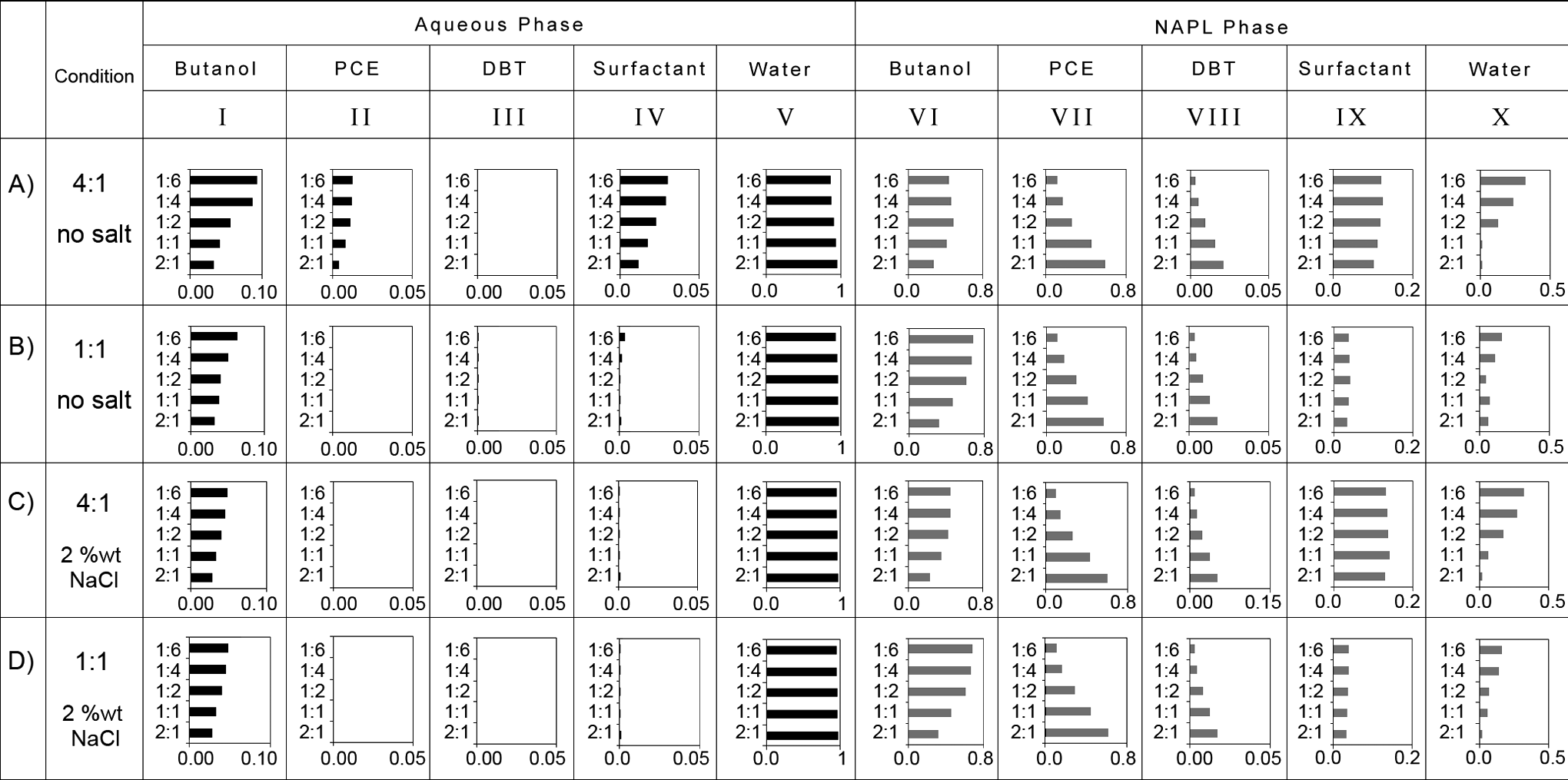
Weight fractions of BuOH, PCE, DBT, and the surfactant at the equilibrium of various initial PCE-DBT mixtures. The BuOH ratio under various conditions: A, B, C, and D, which are the initial NAPL:BuOH ratios, with 4:1 and 1:1 representing the volume ratio of the surfactant solution to NAPL without salt and with 2 wt% NaCl, respectively. The x-axis represents the weight fraction of each chemical and the bar graphs on the y-axis represent each system with different DBT-PCE: BuOH ratios. NAPL, nonaqueous phase liquid.
Partitioning of surfactant to the NAPL
Although the partitioning of the anionic surfactant to the PCE was negligible (Rosen and Kunjappu, 2004; Zhao et al., 2007), the dramatic partitioning of the anionic surfactant to the mixture of BuOH and PCE was demonstrated in previous studies (Damrongsiri et al., 2013; Talawat et al., 2013) and this study. The surfactant partitioning increases with increasing amounts of BuOH in the NAPL, which can be interpreted that, the higher the polarity of the NAPL, the higher the partitioning of the surfactant.
In systems with added salt, almost all the anionic surfactants partitioned into BuOH containing NAPL, which is consistent with results of our previous study (Damrongsiri et al., 2013). The reason for this behavior was from the salting-out effect that causes the nonionic structure (tail part of the surfactant) to become less soluble in the high ionic aqueous solution (the salty aqueous solution) and hence dispelled to BuOH containing NAPL.
In the experiment using a 4:1 surfactant solution:NAPL volume ratio, the NAPL surfactant was obviously higher than in the experiment using a 1:1 volume ratio (Fig. 2) because the larger volume of surfactant corresponded to a greater mass of surfactant that nearly entirely partitioned into the NAPL phase.
The experiment with no added salt produced a different result from our previous study. The amount of surfactant that partitioned into a DBT containing NAPL was larger than that into the NAPL without DBT in our previous study (Damrongsiri et al., 2013). This can be explained by the fact that in this study, the NAPL containing DBT behaves similar to polar organic compounds. Consequently, the polarity of DBT containing NAPL is higher than that without DBT and results in the greater partitioning of surfactant into DBT-containing NAPL.
Partitioning of BuOH between aqueous phase and NAPL
The partitioning of BuOH between the aqueous phase and PCE was observed by Kibbey et al. (2002); the partitioning of BuOH into an aqueous phase (without surfactant) increased with an increasing amount of the BuOH fraction in the NAPL with a nonlinear tendency (nonideal mixing rule). Previous research (Kibbey et al., 2002; Damrongsiri et al., 2013) demonstrated that the aqueous surfactant increases the partitioning of BuOH into the aqueous phase, resulting in additional aqueous BuOH required to reach the designated fraction of BuOH in NAPL (to achieve the designated density). However, in the condition A, the weight fraction of butanol and the surfactant in aqueous phase is correlated. It is found that higher partitioning of butanol results in more surfactant remaining in the aqueous solution. This finding is different from those found in Damrongsiri et al. (2013) that the surfactant is still remained at high weight fraction even low butanol partition into the aqueous phase.
Furthermore, a significant finding different from the previous work is that the weight fraction of BuOH and surfactant in the pseudo-NAPL in this study was higher (while fraction of surfactant and BuOH in aqueous phase in this study was lower) than in the PCE-only NAPL, as in the previous study (Damrongsiri et al., 2013).
Partition of water to NAPL
The partition of water to initial NAPL correlated to the BuOH fraction in the initial NAPL (Conditions B and D in Table 1), which is called pseudo-NAPL (in this study). The greater partition of water to the pseudo-NAPL was observed with an increasing fraction of surfactant in NAPL (condition A and C in Table 1). This result was similar to the previous study (Damrongsiri et al., 2013). However, the fraction of water in NAPL in this study was much higher up to 30% in some systems, that is, systems in the conditions A and C. This larger water fraction in the pseudo-NAPL was related to the greater fraction of BuOH and the surfactant in the pseudo-NAPL. Their partitioning was induced by DBT content in the initial NAPL as described earlier.
Systems A to D represent the experiments that used surfactant solutions of 3.6 wt% SDHS, 0.4 wt% C16DPDS, and the DBT-PCE mixture as the NAPL; the systems E to H represent the experiments that used surfactant solutions of 3 wt% SDHS, 1 wt% sodium dioctyl sulfosuccinate, and PCE as the NAPL.
W mean water for A, B, E, and F, and sum of water and NaCl for C, D, G, and H.
BuOH, n-butanol; DBT, dibutyltin dichloride; NAPL, nonaqueous phase liquid; PCE, perchloroethylene; SDHS, sodium dihexyl sulfosuccinate; SFT, surfactant.
Discussion
Due to the initial NAPL:BuOH weight ratio of the NAPL in this batch experiment varying from 2:1 to 1:6, the equilibrium result of each system yields pseudo-NAPLs that behave both as DNAPL (below the turning point) and LNAPL (above the turning point). The turning point at which the density of the aqueous phase equaled the density of the NAPL phase can be calculated by interpolating between these data, as presented in Table 1. The density at the turning point is close to 1 g/mL, similar to our previous study (Damrongsiri et al., 2013), because the contents of BuOH, PCE, DBT, or surfactant in the aqueous phase are very low.
The presence of DBT in PCE effects on the partition behavior of each compound during DMD approach was found to correlate with each other. The weight fraction of each composition in both aqueous phase and pseudo-NAPL of this study compared with those of a previous study (Damrongsiri et al., 2013) is given in Table 1. Based on these results, it can be seen that DBT increases the partition of surfactant to PCE and hence results in less BuOH being dispelled to the aqueous phase. It is believed that an increasing polarity of a system from DBT content governs this partition behavior. However, in the similar system, but with salt addition (the conditions C & G and the conditions D & H), the effect of DBT was overwhelmed by NaCl, which has much higher polarity than DBT. As a consequence, the presence of DBT did not significantly impact the system containing salt.
An important finding shown in Table 1 is that the required aqueous BuOH of the conditions A, B, C, D, G, and H was lower than the result in the Partitioning of BuOH Between Water and NAPL (Without Surfactant) section (the systems without surfactant). Thus, it is implied that the surfactant in the NAPL increased the partitioning of BuOH to the pseudo-NAPL. This effect may be weaker than the effect of the aqueous surfactant in increasing the BuOH partitioning into the aqueous phase; however, it was exhibited when the aqueous surfactant concentration at equilibrium was at a negligible level, while the NAPL surfactant concentration was high.
DBT demonstrated a strong polarity effect (in the system without NaCl) even when its fraction was less than 4% by mole. Its polar organic compound behavior was also noted in our previous study (Damrongsiri et al., 2010). This is attributed to its asymmetric structure and its ionic forms. The pKa2 of DBT is reported to be about 7 (Hoch et al., 2003), which is in the form of DBT(OH)+ and DBT(OH)2 at experimental pH (neutral pH). This finding points out that the addition of high polar or ionic organic compound may help to enhance partition of BuOH to dense contaminated oil, which improves the DMD practice.
In this study, the presence of surfactant and DBT in NAPL is beneficial to the partition of BuOH into NAPL. However, a large amount of surfactant in the NAPL dissolved a noteworthy amount of water into NAPL and produced a pseudo-NAPL (Table 1). Even water (density of water is 1 g/mL) could decrease the density of DNAPL (e.g., density of PCE is 1.62 g/mL); however, because the density of aqueous phases at turning point was generally close to 1 g/mL, the dissolved water in NAPL cannot sufficiently alter the density of DNAPL to lower than the density of responded aqueous phase (BuOH is necessary to achieve neutral buoyancy). Thus, the dissolution of water into NAPL should be avoided to minimize the wastewater volume.
Conclusions
The effect of DBT, an organometallic compound in the NAPL, was observed on the partitioning of studied anionic surfactants (SDHS and C16DPDS) and BuOH. The DBT enhanced partitioning of BuOH from water to a DBT-PCE mixture. The partitioning of the surfactant from the aqueous phase to the DBT containing NAPL was significantly magnified due to the combined effect of polarity of DBT and greater fraction of BuOH in the initial NAPL that resulted in higher polarity of the NAPL.
While previous studies (Kibbey et al., 2002; Damrongsiri et al., 2013) show that aqueous anionic surfactants increase the partitioning of BuOH to the aqueous phase, this study reveals that a high anionic surfactant concentration in the NAPL increases the partitioning of BuOH into the NAPL (in a negligible level of aqueous surfactant at equilibrium).
In conclusion, the presence of DBT in PCE as an NAPL directly increases the partitioning of BuOH and surfactant into the NAPL. The surfactant in the aqueous phase plays an important role on the partitioning of BuOH into the pseudo-NAPL, which lowers the amount of aqueous BuOH required to reach the turning point.
Based on this study, a small fraction of polar/ionic organic compound could greatly alter partition behavior of all compounds in a system. This research finding raises further ideas about ways to reduce required aqueous BuOH to make the partitioned DNAPL become LNAPL by the addition of proper polar/ionic organic compound or proper selected surfactant, which will greatly enhance the partition of BuOH to NAPL phase that would greatly develop the processing of DMD.
Footnotes
Acknowledgments
This study was funded by the DuPont Chemical Co.; Research Program: Remediation Technologies for Petroleum Contamination, the Centre of Excellence on Hazardous Substance Management (HSM); and The Ratchadaphiseksomphot Endowment Fund in a Post-doctoral Fellowship, Chulalongkorn University. Their support is gratefully acknowledged.
Author Disclosure Statement
No competing financial interests exist.