




Abstract
Abstract
NiFe-layered double hydroxides (LDHs) with four different interlayer anions (NiFe-X-LDH, X = Cl−, NO3−, SO42−, and CO32−) were synthesized by a coprecipitation method. Their adsorption performance for methyl orange (MO) was first studied. It is found that the interlayer anions strongly affect the adsorption capacity, and adsorption amount of NiFe-X-LDH follows the order CO32−<SO42−<NO3−<Cl−, indicating that NiFe-Cl-LDH possesses the best MO adsorption property. Thus, effects of pH, solution temperature, contact time, and initial MO concentration on MO adsorption behavior of NiFe-Cl-LDH were further investigated systematically. It shows that the adsorbent presents good performance within the pH range of 5 to 6 and the adsorption capacity increases with the solution temperature. Thermodynamic data indicate that adsorption is spontaneous and endothermic. Weber's intraparticle diffusion model reveals that the adsorption includes two processes: external surface adsorption and intraparticle diffusion. Adsorption isotherm data are well fitted with the Langmuir model and the pseudo-second-order model, and the maximum MO adsorption capacity of NiFe-Cl-LDH is 769.23 mg/g, which is larger than some classical LDHs. In addition, the NiFe-Cl-LDH also exhibits high adsorption performance for Cr (VI) (60.24 mg/g) and As (III) (68.49 mg/g). Results show that NiFe-Cl-LDH is a promising material for separation of pollutants from aqueous solutions.
Introduction
A
Layered double hydroxide (LDH), also known as anionic clay or hydrotalcite-like compound, is widely used as an adsorbent (Reichle, 1986). It can be represented by the general formula [M1−x2+M x 3+(OH)2]x+(An−) x/n ·mH2O, where M2+(Ca2+, Mg2+, Zn2+, Co2+, Ni2+, Cu2+, and Mn2+) and M3+(Al3+, Cr3+, Fe3+, Co3+, and Mn3+) are, respectively, divalent and trivalent metal cations; An− is an interlayer anion (CO32−, SO42−, NO3−, Cl−, OH−, etc.); x is the molar ratio of trivalent cations, M3+/(M2++M3+), with values ranges from 0.2 to 0.33, and m is the number of interlayer water (Li, 2010). The layered structure of LDHs comprised positively charged hydroxide sheets and interlayer anions (Seron and Delorme, 2008). This characteristic structure promotes LDHs to have forceful capacity to absorb anions in aqueous solutions. The adsorption capacity of LDHs was usually evaluated by using organic azo-dye methyl orange (MO), Cr (VI), and As (III) as model pollutants. Among different types of LDHs, the most studied are some aluminum-based ones. For example, the ZnAl-LDH and MgAl-LDH were reported to have a maximum MO removal capacity of 181.9 mg/g and 148.3 mg/g (Ni et al., 2007; Ai et al., 2011), respectively, and Monash and Pugazhenthi, 2014 illustrated that NiAl-LDH can reach up to 186.58 mg/g (Monash and Pugazhenthi, 2014). The MgAl-LDH was found to remove Cr (VI) with a capacity of 105 mg/g (Li et al., 2009) and As (V) with a capacity of 8.141 mg/g (Duan et al., 2016). However, the presence of Al is harmful to human health to some content (Ferreira et al., 2004). The iron-based LDHs appear as very promising candidates; typically, NiFe-LDH is reported to be a classical material in electrocatalysis (Gong and Dai, 2015). To the best of our knowledge, only a few articles have reported the removal of MO by NiFe-LDH. In our previous work, the removal performance of NiFe-NO3-LDH with different Ni/Fe mole ratios has been discussed, and indicated that the saturated adsorption capacity of Ni4Fe1-NO3-LDH is 205.76 mg/g for MO and 26.78 mg/g for Cr (VI) (Lu et al., 2016). It is reported that the starting interlayer anion also has a great influence on adsorption capacity of LDH (Li et al., 2005); so it is necessary to explore the effect of intercalated anion on the MO adsorption of NiFe-LDH and obtain the best NiFe-based LDH adsorbent material.
In this work, NiFe-X-LDH with four different interlayer anions (X = Cl−, NO3−, SO42−, and CO32−) were synthesized by a facile coprecipitation method and the influence of the interlayer anions on the MO adsorption capacity was compared. Then, the adsorption behavior of NiFe-Cl-LDH for MO was further investigated under various parameters such as solution pH, temperature, contact time, and initial MO concentration. In addition, the adsorption of Cr (VI) and As (III) was also studied. The adsorption isotherms model and the kinetic models were used to estimate the adsorption characteristics. Finally, the thermodynamic process and adsorption mechanism were also analyzed.
Experimental Section
Preparation of NiFe-LDH
In our previous work, we have found that NiFe-NO3-LDH can get the best MO adsorption capacity when the Ni/Fe mole ratio is 4:1 (Lu et al., 2016). So in this work, the Ni2+/Fe3+ molar ratio is designed as 4:1 for the four kinds of NiFe-X-LDH with different interlayer anions (X = Cl−, NO3−, SO42−, and CO32−). Ni4Fe1-X-LDH was prepared by a facile coprecipitation route under nitrogen atmosphere. First, three groups of 20.0 mL solutions containing NiCl2·6H2O, Ni(NO3)2·6H2O, NiSO4·6H2O (99%; Aladdi, Shanghai, China) were prepared. Then, the above obtained solutions were, respectively, added into three groups of vigorously stirred ammonia solutions (100.0 mL, 0.5 M) drop by drop. Ni4Fe1-CO3-LDH was synthesized with 20.0 mL Ni-Fe-mixed nitrate and urea (100.0 mL, 2 M), after which, the suspensions were stirred at 338K for 18 h. Finally, the obtained product was centrifuged and washed thoroughly with deionized water. The ultimate product (Ni4Fe1-X-LDH sample) was dried in a vacuum oven at 338K, grounded, and stored in a glass container. The characterization methods are demonstrated in the Supplementary Data.
Adsorption experiments
MO (C14H14N3O3SNa, >80.0%) was purchased from Chongqing Chuandong Chemical (Group) Co., Ltd. Ni4Fe1-X-LDH powder of 0.02 g was added into MO aqueous solutions (100 mL) with concentrations of 20–200 mg/L, and the temperature and pH were maintained at 303 ± lK and 5.5 ± 0.1. The 5 mL of mixture was withdrawn and centrifuged to obtain the supernatant liquor after stirring for a selected time (from 0 min to 4 h). The obtained solutions were analyzed by UV-visible spectrophotometer (UV-3600 Shimadzu, Japan) at 464 nm. For Cr (VI) adsorption, the initial concentration of K2Cr2O7 ranged from 1 to 19 mg/L. In the adsorption of AsO2−, the initial concentration of NaAsO2 ranged from 1 to 30 mg/L. The residual Cr (VI) and As (III) concentration in the solution were measured by inductively coupled plasma spectroscopy (ICP).
Equilibrium adsorption capacity onto the NiFe-LDH was calculated by using the following equation:
where C0, Ct, and Ce are the initial, time t, equilibrium concentrations of solution; V (L) is the volume of solution; and m is the mass of the NiFe-LDH.
Effect of pH on adsorption was measured by adding 0.02 g Ni4Fe1-Cl-LDH in 100 mL MO solution (80 mg/L) with different pH values. The pH of MO solution was initially adjusted with 1 M HCl or 1 M NaOH. The effect of temperature on the adsorption process was evaluated at 303–333K (pH = 5.5 ± 0.1). The rest of steps were similar to those described above. Adsorption experiments were replicated at each tested condition and average values were reported.
Results and Discussion
Characterization of the as-prepared NiFe-LDHs
Figure 1A shows that all the patterns display three intense peaks at low 2θ angle corresponding to diffraction of planes (003), (006), and (012) (Xu and Zeng, 2001). The peak at 60° is attributed to (110) plane. These sharp and symmetric peaks suggest that the synthesized LDHs have the typical hydrotalcite-like structures. Table A1 shows the calculated lattice parameters (c = d (003), a = 2d (110)) (Bookin and Drits, 1993) of the as-synthesized Ni4Fe1-X-LDH. The d spacing values (d003) and lattice parameters of these LDHs agree well with those reported by other literatures (Cavani et al., 1991; Clause et al., 1993). The energy dispersive spectrometer (EDS) analysis (Fig. A1) confirm the presence and homogeneous distribution of Ni, Fe, Cl and O in the as-prepared NiFe-Cl-LDH sample. Chemical analyses of the divalent and trivalent metal compositions were assessed by using ICP. The results show that the Ni/Fe mole ratios of Ni4Fe1-X-LDH (X = Cl−, NO3−, SO42−, and CO32−) are 4.0, 4.2, 3.8, and 4.3, respectively, which conforms to the expected ratios of 4.

XRD patterns
Fourier transform infrared spectroscopy (FT-IR) spectrums of Ni4Fe1-X-LDHs are shown in Fig. 1B. The two characteristic peaks at 3,448 cm−1 (the stretching vibration of O-H) and 1,636 cm−1 (the bending vibration of O-H) appear in all four samples (Xing et al., 2008). In addition, the peaks in the range of 500–900 cm−1 are assigned to the lattice vibration modes of metal-oxygen and metal-oxygen-metal (M-O-M) (Sun et al., 2006). The absorption bands in the FT-IR spectra could confirm that these synthesized samples are typical LDH materials (Rives, 2001). Concerning the interlayer anion, the sharp bands observed at 1,357 cm−1, 1,384 cm−1, and 1,100 cm−1 are due to the asymmetric stretching mode of CO32−, NO3-, and SO42−, respectively (Yi et al., 2011; Yang et al., 2013). The band of Cl− in the interlayer of NiFe-Cl-LDH is not reflected from the FT-IR spectra, while the existence of Cl− can be proven by X-ray photoelectron spectroscopy (XPS) spectra of Ni4Fe1-Cl-LDH (as shown in the following part).
From the XPS survey spectra (Fig. 2a), the five different major peaks at 855.96, 708.72, 531.37, 284.80, and 198.32 eV are corresponding to Ni 2p3/2, Fe 2p3/2, O 1s, C 1s, and Cl 2p3/2, respectively. The peak of Cl 2p (Fig. 2b) is decomposed in two doublets (2p3/2-2p1/2) at 198.61 and 199.55 eV, indicating that the chloride ions exist in the sample. In Fig. 2c, there are two peaks at 873.41 and 880.16 eV, which are attributed to Ni 2p1/2 and its shake-up satellites. The bonding energies at 855.72 eV and 861.70 eV are assigned to Ni 2p3/2 and its shake-up satellites. These results indicate that the nickel ions maintain the divalent state (Liang et al., 2009). According to Fig. 2d, the bonding energies of Fe 2p at 721.76 eV (2p1/2) and 708.72 eV (2p3/2) are assigned to Fe (III) (Ma et al., 2015).
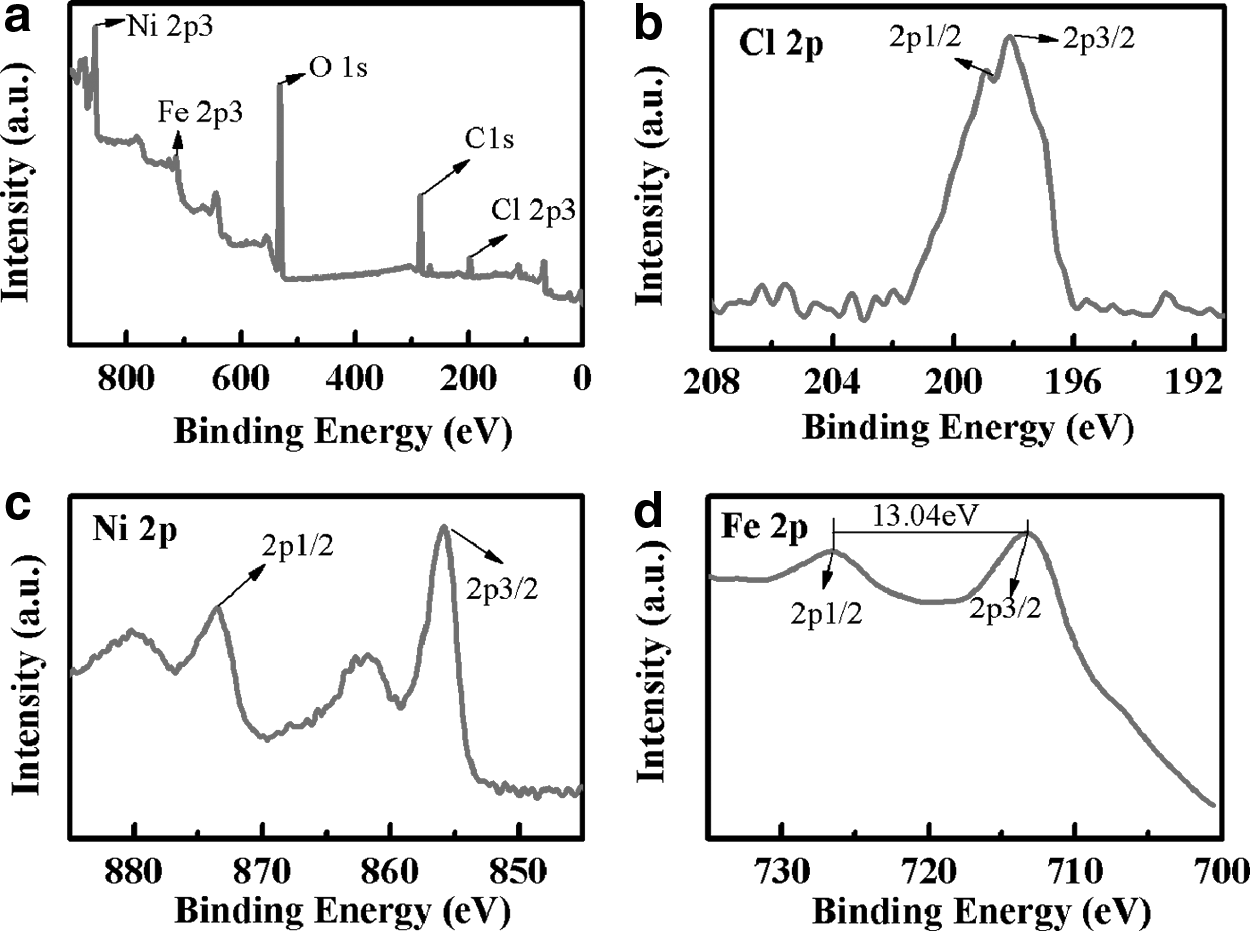
XPS survey spectra
Figure 3 shows the N2 adsorption–desorption isotherms and the corresponding pore size distributions of Ni4Fe1-X-LDHs (X = Cl−, NO3−, SO42−, and CO32−). According to the International Union of Pure and Applied Chemistry (IUPAC) classification, the shapes of the isotherms are type IV, indicating that the as-prepared Ni4Fe1-X-LDHs are typical mesoporous materials (Yan et al., 2015). The hysteresis loops of desorption in Fig. 3a are associated with type H3, revealing that the pores are emblematic for aggregates of plate-like particles giving rise to slit-shaped (Zhou et al., 2011). The pore size distribution of Ni4Fe1-X-LDH was displayed in Fig. 3b. It can be seen that the pore size of four samples ranges from 3 to 10 nm, and the pore size was most located in about 3.3, 3.6, 4.0, and 6.2 nm for Ni4Fe1-Cl-LDH, Ni4Fe1-NO3-LDH, Ni4Fe1-SO4-LDH, and Ni4Fe1-CO3-LDH respectively. In addition, more and larger open pores obviously exist in Ni4Fe1-CO3-LDH compared with other three samples. The pore structure parameters of Ni4Fe1-X-LDHs are listed in Table 1. It reveals that the Brunauer-Emmett-Teller (BET) surface area data of four samples have the following order: Ni4Fe1-SO4<Ni4Fe1-Cl<Ni4Fe1-NO3<Ni4Fe1-CO3, which is consistent with the relationship of the total pore volume. The average pore diameter is 3.3508, 3.6090, 3.9430, and 6.2354 nm for Ni4Fe1-Cl-LDH, Ni4Fe1-NO3-LDH, Ni4Fe1-SO4-LDH, and Ni4Fe1-CO3-LDH, respectively.
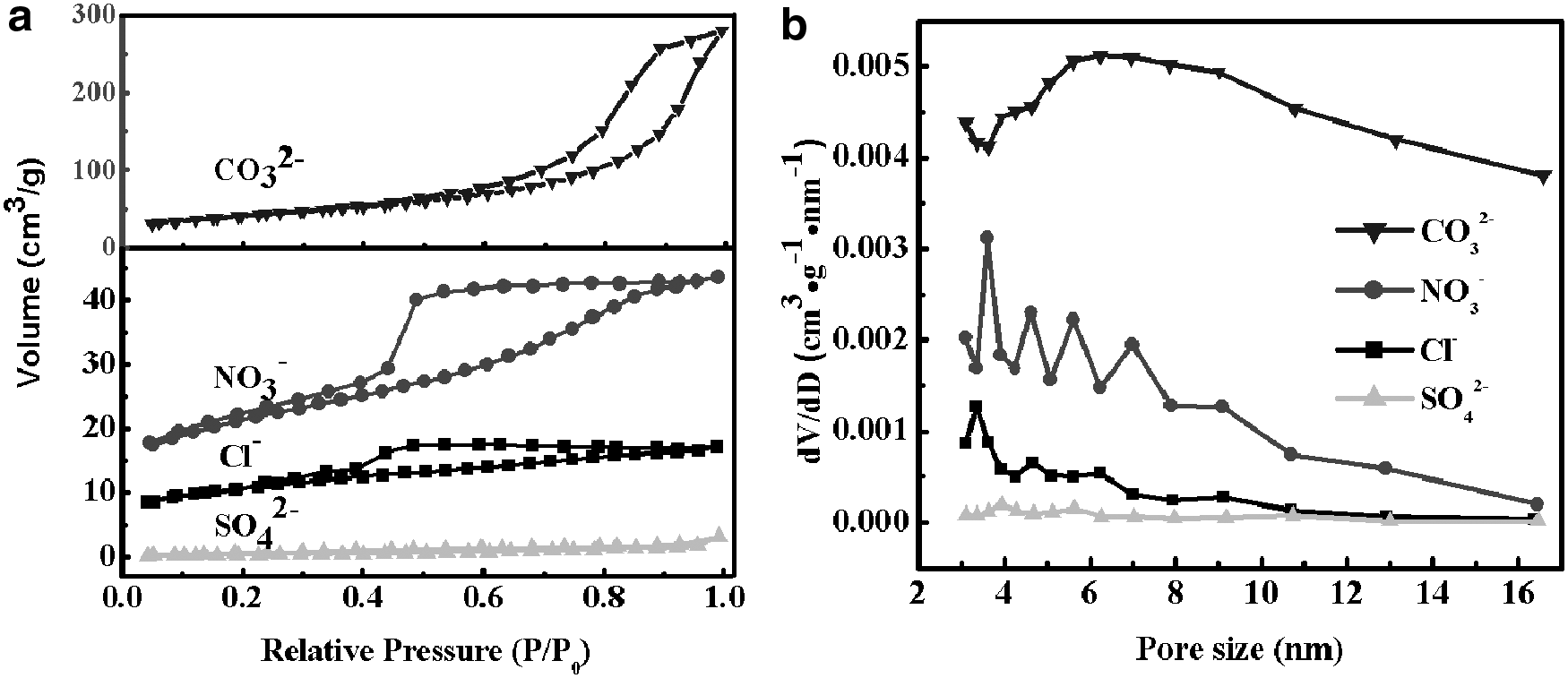
N2 adsorption–desorption isotherms
BET, Brunauer-Emmett-Teller; LDH, layered double hydroxide.
Adsorption behavior of MO
Influence of the starting interlayer anion on adsorption
MO was chosen as a model dye to investigate the effect of different interlayer anions on the adsorption capacity of NiFe-LDH. As shown in Fig. 4a and Fig. A2, the adsorption percentages of Ni4Fe1-Cl-LDH, Ni4Fe1-NO3-LDH, and Ni4Fe1-SO4-LDH at different MO initial concentration increased rapidly in the initial 5 min, and then slowed progressively until it reached equilibrium after about 2 h, while the adsorption of Ni4Fe1-CO3-LDH appeared desorption phenomenon after 10 min. The high adsorption rate within the initial 5 min is attributed to the adequate free adsorptive sites of exterior surface, and the remaining vacant adsorption sites are difficult to be available because of the repulsive forces between the solute molecules on the solid and bulk phases (Lin et al., 2015). As shown in Fig. 4b, it is apparent that the maximum adsorbed percentage on NiFe-Cl-LDH is higher compared with other NiFe-X-LDHs at the same initial MO concentration. According to the analysis result of structure parameters (Table 1), the average pore diameters of four samples were larger than the size of MO (obverse tropism 1.54 × 0.48 nm, end tropism 1.54 × 0.28 nm, and side tropism 0.48 × 0.28 nm) (Ni et al., 2007), therefore MO molecules could further enter the pores of adsorbent. Although the Ni4Fe1-CO3-LDH sample has the largest surface area, the presence of open larger pores causes the capillary condensation to hardly occur, meanwhile the carbonate anions could hinder the anion exchange with MO (Li et al., 2005), both of which lead to poor adsorption and desorption. The lower percentage of MO removal by Ni4Fe1-SO4-LDH is attributed to small surface area that brings about less free adsorptive sites of exterior surface. As for adsorptive property of NiFe-Cl-LDH superior to NiFe-NO3-LDH, the reason may be due to excellent ability of anion exchange (Li et al., 2005). Hence, to get higher adsorption capacities for MO, Ni4Fe1-Cl-LDH was selected to be the adsorbent in the subsequent research.

Effect of solution pH and temperature
The experiments to observe the effect of the solution pH on the MO adsorption were conducted in the pH range of 2–9.5. As illustrated in Fig. 5a, the adsorption amount remains stable in the range of pH 5–6. Then, the maximum adsorption amount decreases gradually with pH value increasing, indicating that high pH is not in favor of the adsorption for MO due to the competitive adsorption with OH−. When the pH is maintained above 7.5, the decrease degree becomes weak on account of the dissolution of LDHs (Zaghouane-Boudiaf et al., 2012). In addition, the MO adsorption decreases as the pH change from 5 to 2, this phenomenon can be explained by the structure destroy of LDHs at low pH (Ni et al., 2007). However, a slow downward trend at pH <3.46 can be attributed to the dissolution of MO (Zaghouane-Boudiaf et al., 2012). According to the above discussion, the optimal pH is about 5–6.
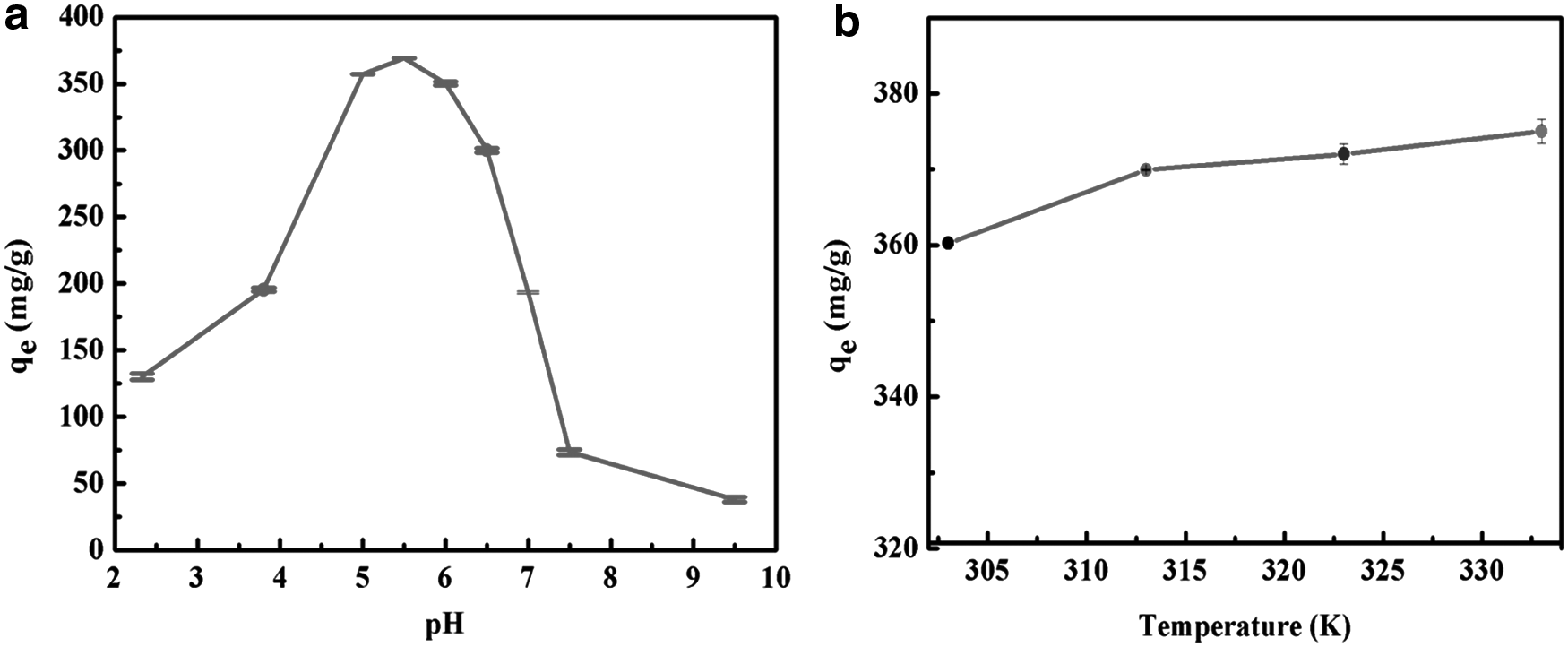
Effect of solution pH (T = 303 ± 1K)
The temperature has also a significant impact on the MO adsorption. The interrelated adsorption was investigated by using 80 mg/L of MO solutions and 20 mg of adsorbent at the temperature range of 303–333K. Figure 5b displays the adsorption curves of MO with different temperatures. It can be observed that the adsorption amount of MO by NiFe-Cl-LDH increases with increasing temperature, indicating that the adsorption reaction is endothermic in nature (Mittal et al., 2007). To explicitly understand the reaction, the thermodynamic parameters such as Gibbs free energy change ΔG°, standard enthalpy ΔH°, and standard entropy ΔS° were further studied in the adsorption process. The interrelated thermodynamic parameters were calculated using the following equations (Watkins et al., 2006):
where R (8.314 J/(mol·K)) is the ideal gas constant, T is the temperature (K), and Kd is the distribution coefficient. ΔH° and ΔS° were calculated from the slope and intercept of the plot of lnKd versus 1/T using Eq. (4) and the results are shown in Table A2. The negative values of ΔG° decreased from −9.6075 to −11.9533 kJ/mol with temperatures rising, indicating the spontaneous nature of MO adsorption. The positive value of ΔS° suggests the increased randomness at the solid/solution interface during the adsorption process, and the positive value of ΔH° confirms the endothermic nature of MO adsorption (Zaghouane-Boudiaf et al., 2012). These results can account for the increase in MO adsorption amount with the temperature.
Effect of initial MO concentrations
Based on the optimized conditions, a series of adsorption experiments with different concentration was carried out at 303K, pH 5.5, and the adsorbent mass was fixed at 0.02 g. From Fig. 6a, it can be acquired that the removal rate of five different concentrations of MO are almost identical in the initial 5 min. This adsorption process could be considered to occur on the exterior surface with the same free adsorptive sites. Moreover, the adsorption amount for MO increases with initial concentration increasing. The high initial concentration can enhance the driving force, which can overcome the transfer resistance of the dye between the aqueous phases and solid phases (Ai et al., 2011). As shown in Fig. 6b, the adsorption percentage of Ni4Fe1-Cl-LDH can almost reach 100% for 20–40 mg/L MO after just 20 min. Hence, NiFe-Cl-LDH can be used as an excellent adsorbent for the removal of MO.
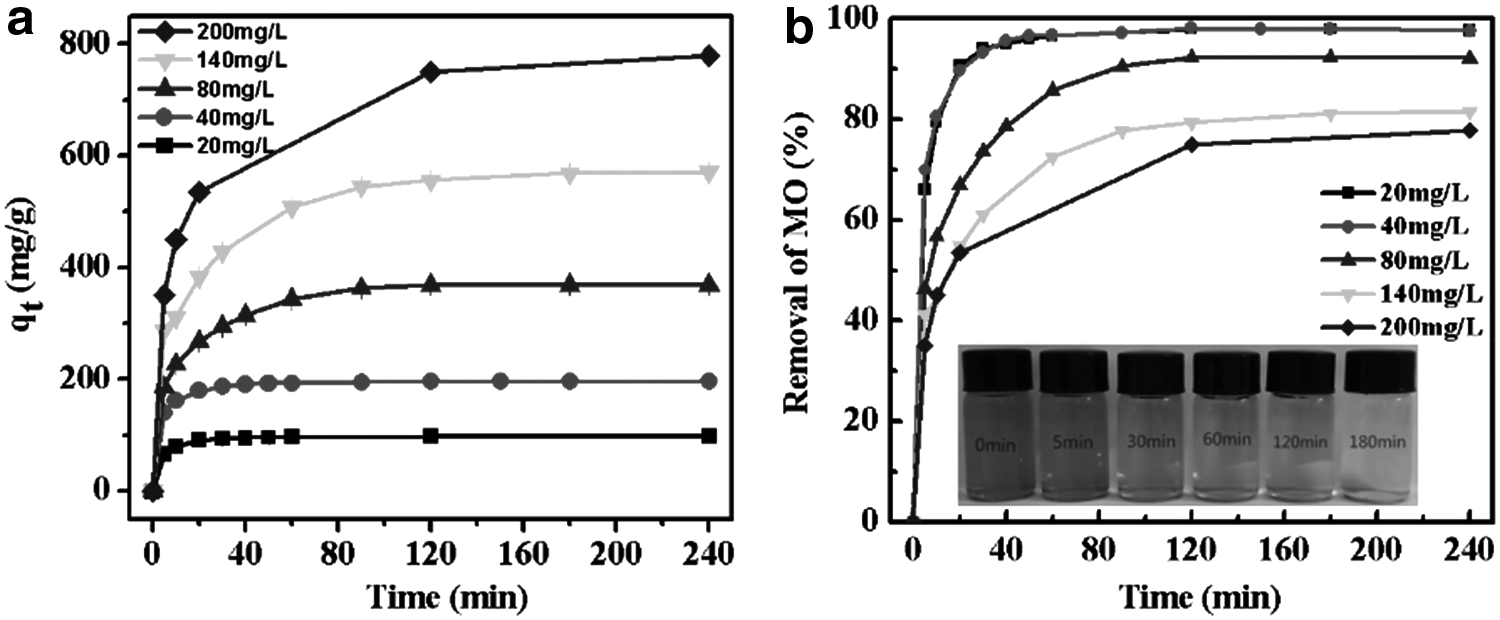
Time dependent of MO adsorption amount
Adsorption isotherms and adsorption kinetics
Generally, adsorption isotherm is carried out to estimate the distribution of adsorbed molecules between the liquid phase and solid phase in equilibrium adsorption condition. Two well-known models are evaluated, including the Langmuir adsorption isotherm based on the assumption of monolayer adsorption and the Freundlich adsorption isotherm derived by assuming a heterogeneous surface during the adsorption process (Chen et al., 2012). In this work, the five different concentrations of MO dye were applied to explore the adsorption isotherms of MO on NiFe-Cl-LDH, and the adsorption data were further fitted with Langmuir [Eq. (6)] and Freundlich [Eq. (7)] isotherm models (Freundlich, 1907; Langmuir, 1916).
where qe (mg/g) is the amount of MO adsorbed at equilibrium, qm (mg/g) is the theoretical maximum monolayer adsorption capacity, Ce (mg/L) is the equilibrium MO concentration, and KL, n, KF, B, and AT are the adsorption equilibrium constants. Figure 7 shows the correlation coefficient of Langmuir model and Freundlich model is 0.9916 and 0.9057, respectively. This result suggests that the adsorption of MO onto the Ni4Fe1-LDH fits the Langmuir isotherm well, which further illustrated that monolayer adsorption may play a leading role in dispelling MO by Ni4Fe1-Cl-LDH. As essential features of the Langmuir isotherm model, the value RL

Adsorption isotherms of MO adsorption on Ni4Fe1-Cl-LDH by
To estimate the possible detailed characteristics of the adsorption process, pseudo-first-order

To further identify the adsorption kinetic mechanism, the kinetic data were further analyzed by Weber's intraparticle diffusion model, which can be described as
Adsorption behavior of Cr2O7− and AsO2−
High adsorptive capacity of NiFe-Cl-LDH was also reflected in the Cr (VI) and As (III) adsorption. Figure 9 reveals that the removal percentage is up to 100% for 0–4 mg/L of Cr2O7−, 80% for 0–5 mg/L of AsO2−, and both of the adsorptive amounts can reach 60 mg/g. Based on the correlation coefficients (Figs. A3 and A4), the equilibrium adsorption data fit the Langmuir isotherm better. It is reasonable to deduce that NiFe-Cl-LDH possesses a homogeneous distribution of active sites on the layer surface. In addition, the theoretical Langmuir maximum adsorption capacity (60.24 mg/g for Cr and 68.49 mg/g for As) was in accordance with the experimental data (60.14 mg/g for Cr and 60.08 mg/g for As). The excellent adsorption capacity means that NiFe-Cl-LDH has great potential for application in heavy metal ion removal from wastewater.
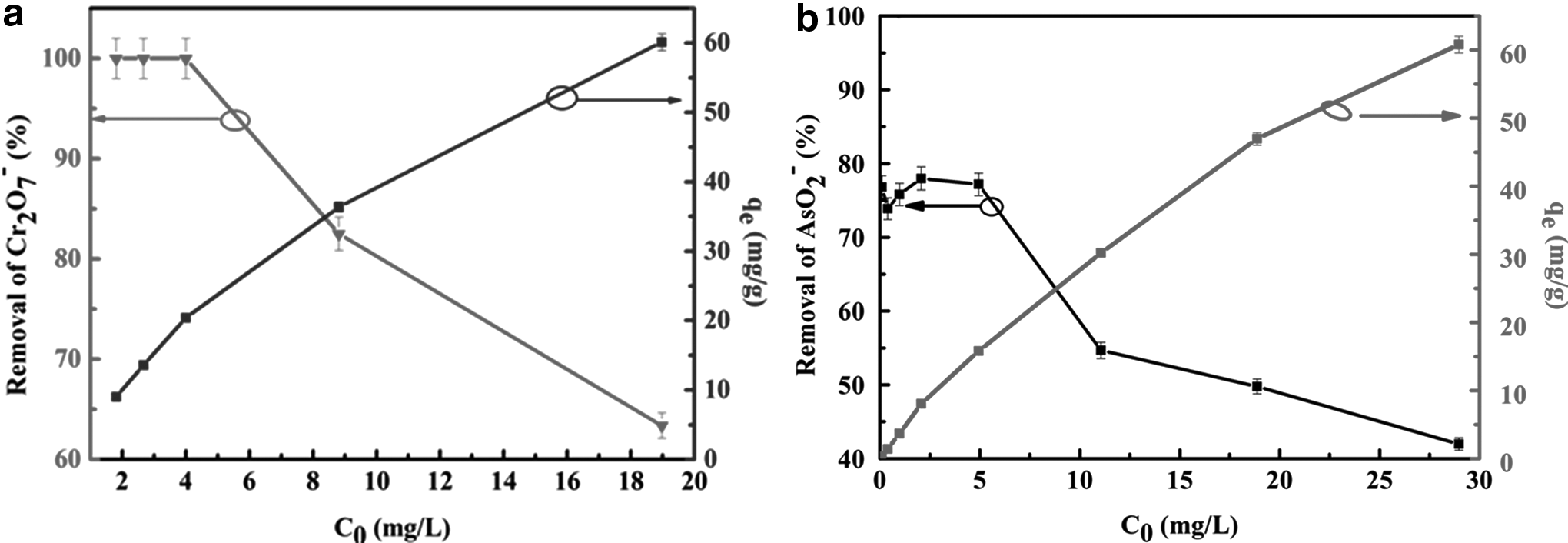
Removal percentage and removal amount of Cr2O7−
Fitting parameters of the pseudo-first-order and pseudo-second-order kinetic models are counted in Tables A4 and A5. The correlation coefficients (R2) for pseudo-second-order model is higher than that of pseudo-first-order model, and the calculated adsorption data are close to the experimental one from the pseudo-second-order kinetics, which reveal that the adsorption is mainly controlled by the chemical adsorption process.
Conclusion
In summary, we found that different interlayer anions strongly affected the adsorption capacity of LDH for MO, and the adsorption capacity follows the order NiFe-Cl-LDH>NiFe-NO3-LDH>NiFe-SO4-LDH>NiFe-CO3-LDH. The adsorption amount attains to an optimal value at pH 5–6 and the removal ratio of MO tends to increase with the reaction temperature. The thermodynamic data indicate that the adsorption is spontaneous and endothermic, while the kinetic data and isotherm data declare that the adsorption is chemisorption and mainly monolayer adsorption. The monolayer equilibrium capacity of NiFe-Cl-LDH is 769.23 mg/g for MO, 60.24 mg/g for Cr (VI), and 68.49 mg/g for As (III). The investigation of the synthetic LDHs with different interlayer anions to remove MO, Cr (VI), and As (III) is inventive, and these results offer a valuable reference for the application of LDH in the future.
Footnotes
Acknowledgments
This work was financially supported by SKLMT-ZZKT-2017M15, SKLMT-KFKT-201419, and SKLM-ZZKT-2015Z16, National High Technology Research and Development Program of China “863 Plan” (Grant No. 2015AA034801), NSFC (Grant Nos. 1154401, 11374359, 11304405), the Nature Science Foundation of Chongqing (Grant Nos. cstc2015jcyjA50035 and cstc2015jcyjA1660), the Fundamental Research Funds for the Central Universities (Grant Nos. 106112017CDJQJ328839, 106112016CDJZR288805, and 106112015CDJXY300002) and the Sharing Fund of Large-scale Equipment of Chongqing University (Grant Nos. 201606150016, 201606150017, and 201606150056).
Author Disclosure Statement
No competing financial interests exist.
References
Supplementary Material
Please find the following supplemental material available below.
For Open Access articles published under a Creative Commons License, all supplemental material carries the same license as the article it is associated with.
For non-Open Access articles published, all supplemental material carries a non-exclusive license, and permission requests for re-use of supplemental material or any part of supplemental material shall be sent directly to the copyright owner as specified in the copyright notice associated with the article.
