




Abstract
Abstract
Removal of TiO2 nanoparticles (NPs) from water by coagulation and microfiltration (MF) was investigated at various ionic species and strengths. Appropriate coagulant doses were determined based on the Derjaguin-Landau-Verwey-Overbeek (DLVO) theory, and coagulation with ferric chloride (FeCl3) at 0.1–0.2 mM or poly-aluminum chloride (PACl; [Al2(OH)nCl6-n]m) at 0.2–0.4 mM improved removal of TiO2 NPs to more than 90%, and, simultaneously, turbidity was significantly reduced. Using 0.2 mM FeCl3 as a coagulant, the mean particle size of suspended TiO2 NPs decreased from 145 to 43 nm after coagulation and sedimentation as a result of effective floc formation. Microfiltration (nominal pore size: 0.45 μm and 0.10 μm) of uncoagulated TiO2 NP suspensions produced lower NP concentrations in the filtrate than that in the filtrate of pre-coagulated water. This is because pre-coagulation and settling removed large NPs in the feed water that reduce the number of smaller particles than the pore sizes by clogging or blocking membrane pores. Results suggest that removal of NPs by coagulation/sedimentation followed by membrane filtration may be less efficient than direct membrane filtration. Addition of salts (NaCl 0.3–15 mM or CaCl2 0.1–5 mM) to TiO2 NP suspensions before coagulation led to significant reduction (0.28–0.47 mg/L) of TiO2 concentrations in supernatant after sedimentation. Phosphate addition (0.01, 0.1, and 1.0 mM) increased TiO2 NP concentration after FeCl3 or PACl coagulation and settling, but TiO2 NP removal rate by MF was improved by phosphate addition except for filtering TiO2 NP suspension with 1.0 mM phosphate by a 0.45 μm membrane.
Introduction
E
There is concern regarding the potential for TiO2 NP released into the environment to harm human health (Luo et al., 2014; Shakeel et al., 2016), and TiO2 NP concentrations in surface waters in the United States have been estimated at 24.5 μg/L (Gottschalk et al., 2009). The proportion of TiO2 NPs from total global production expected to enter waste water treatment plants is assumed to be large, with Keller et al. (2013) suggesting they account for 54% of total production. In addition, TiO2 NPs have been detected in wastewater treatment plant effluents and in biosolids, demonstrating both the ability of NPs to be released into water sources in significant quantities and the inability of water treatment processes to remove them (Kiser et al., 2009; Westerhoff et al., 2013). However, most studies conducted to date have focused on the removal of NPs via conventional waste water treatment, which consists of a tandem process consisting of coagulation/flocculation/sedimentation (C/F/S). While some researchers have achieved high levels of NP removal (Kinsinger et al., 2015; Sousa et al., 2017), metal breakthrough in the effluent of these studies remains a concern, particularly since the level of contaminants that can cause harm to humans is not known.
Taking the precautionary principle in health effects, and considering that the amount of NPs and their associated ions released is only expected to increase over the coming years (Klaine et al., 2008), the development of practical methods for efficient NP removal remains an important consideration. In addition, the complex interactions of the factors that can influence NP removal in water treatment processes, such as water type, pH, the presence of natural organic matter (NOM), and coagulant type (Hwang et al., 2008; Hackenberg et al., 2010; Honda et al., 2014), are still not completely understood, and further research is required in this area. Moreover, the size, surface properties, and concentrations of NPs can also affect their removal during water treatment (Limbach et al., 2008; Brar et al., 2010; Yao et al., 2014).
Wang et al. (2013) used an initial TiO2 NP concentration of 30 mg/L and found that polyferric sulfate as coagulant at 0.3 mM can achieve high removal rates (∼84%) with less pH reduction. Chalew et al. (2013) studied the removal efficiencies of various NPs at an initial concentration of 1 mg/L by the conventional treatment processes and found that the removal rates of TiO2 NPs were between 92% and 97%. The removal efficiency of TiO2 is affected by myriad factors such as the presence of NOM. For example, the removal efficiencies of TiO2 NPs were found to be lower in tap water containing 3 mg/L of total organic carbon (TOC) than in buffered nanopure water for the same alum dosage (Zhang et al., 2008).
In addition to conventional water treatment utilizing C/F/S, advanced water treatment using low-pressure membrane (LPM) filtration has increased in popularity in recent years (Huang et al., 2009). In fact, to the best of our knowledge, there is only one report in the literature investigating the effects of membrane filtration on simulated NP removal filtration experiments (Chalew et al., 2013). In their study, waters taken from different sources were spiked with 1 mg/L TiO2 NPs, achieving removal rates of 56–100% and 96–100% for microfiltration (MF) and ultrafiltration, respectively. However, in this study, filtration was conducted using both coagulated and uncoagulated, that is, control, TiO2 NPs in feed waters, which was assumed to be simulating C/F/S combined with membrane filtration as a surrogate of sand filtration. This is important, because the efficiency of filtration depends on the NP size, which will vary depending on coagulation and flocculation processes. These processes, in turn, are greatly affected by the operating conditions, such as the coagulant and water matrix. Hence, filtration from a fresh batch of untreated NPs is unlikely to yield the same results as that achieved after water treatment by C/F/S. Therefore, this study was conducted to gain further insights into simulated advanced water treatments consisting of C/F/S in conjunction with membrane filtration, and to make comparisons with direct filtration of untreated TiO2 NP suspensions. This was because it is important to report that, while flocculated NPs could be settled down and removed by the C/F/S process, a small fraction of the suspended NPs remaining in the supernatant might be more difficult to be removed by a subsequent MF process, compared to filtering uncoagulated water. We also investigated the change in particle size distribution in C/F/S experiments with ferric chloride (FeCl3) as a coagulant. Finally, the effects of various salts (NaCl, CaCl2, and K2HPO4) on TiO2 NP removal by coagulation, sedimentation, and MF were studied.
Materials and Methods
Preparation of TiO2 NP suspensions
TiO2 NPs were purchased from Sigma Aldrich Co., LLC (Saint Louis, MO). The as-received TiO2 NPs were in a powdered form. To prepare the TiO2 suspensions, 50 mg of TiO2 was added to 500 mL Milli-Q water, sonicated at 150 W for 30 min, and then diluted to different concentrations by adding Milli-Q water in different solutions. Solutions of NaHCO3 (50 mM), FeCl3 (50 mM), and poly-aluminum chloride (PACl) (99 mM PACl as Al) ([Al2(OH)nCl6-n]m) (1 ≤ n ≤ 5, m ≤ 10) were separately prepared.
Preparation of NaCl, CaCl2, and phosphate solutions for TiO2 NP removal by jar tests
Salt solutions were prepared as follows. An accurate amount of NaCl (5.844 g) or CaCl2 (11.098 g) was dissolved in 100 mL of Milli-Q water, forming 1 M solutions. A stock solution of the phosphate solution was then prepared with anhydrous K2HPO4 (Kishida Chemical Co., Ltd.) and then diluted eight times to 125 mM. For the experiment with added phosphate, 100 mL of a 125 mg/L TiO2 suspension was transferred to a flask and diluted to 500 mL with 1.25 mM phosphate, forming a suspension with final concentrations of 25 mg/L TiO2 and 1 mM phosphate. The mixture was then vigorously stirred for 12 h to ensure the equilibrium adsorption of phosphate on TiO2. The NaCl and CaCl2 solutions used in the jar tests were prepared using the same method.
Jar tests for determining removal efficiencies
NaHCO3 (0.3 mmol/L for 0.1 mM FeCl3 or 0.6 mmol/L for 0.2 mM FeCl3) was added to the TiO2 NP solution (300 mL; 25 mg/L) before addition of coagulant to neutralize acid released and maintain the solution pH within optimum levels. The coagulant doses (FeCl3 0.1 or 0.2 mM and PACl 0.2 or 0.4 mM) were determined by preliminary experiments. For jar tests with added salts, 1 mL of 50 mM FeCl3 was added into 500 mL of TiO2 NP suspension to produce 0.1 mM Fe as coagulant. Rapid mixing at 200 rpm with a mechanical stirrer was conducted for 2 min, followed by slow mixing at 30 rpm for 30 min, after which the aggregated flocs were allowed to undergo sedimentation for 30 min. Triplicate samples were taken for water quality (residual turbidity) and TiO2 NP measurements (TiO2 NP concentration, mean particle size), as well as the zeta potential of the solution at each of the following stages: before coagulant addition, after rapid mixing, and after sedimentation.
Membrane filtration removal efficiency experiments
The stirred filtration unit with a capacity of 50 mL (Amicon 8050; Millipore Corp., Billerica, MA) was used in the membrane filtration experiments. Two hydrophilic polyvinylidene difluoride (PVDF) filters with the same diameter of 47 mm, but different pore sizes of 0.10 μm (VVLP04700) and 0.45 μm (HVLP04700), were purchased from Millipore Corp. Approximately 50 mL of feed water was pressured into a cylindrical container with the membrane on the bottom. The periphery of a membrane (47 mm in diameter) was cut to make it into 45 mm in diameter so as to be fitted in the filter housing. The first and last 10 mL of filtered water were discarded; thus, around 30 mL of filtered water was collected after filtration.
Analytical methods
Particle size distribution was evaluated by NP tracking analysis (LM10; NanoSight, United Kingdom) to measure NPs larger than 10 nm. The surface charge of the NPs was measured using an ELS SF-8000 particle size analyzer (OTSUKA Electronics, Japan).
Concentration of TiO2 NPs in suspension (1–25 mg/L) was measured using a turbidity meter (2100Q; HACH). For concentrations lower than 1 mg/L, the data were analyzed with more sensitive instrumentation, namely, inductively coupled plasma-mass spectrometry (ICP-MS) (7500; Agilent). Accurate determination of NP concentrations in previous studies has often been hampered by a lack of such sensitive instruments (Zhang et al., 2008).
Liquid and solid samples were digested using the HNO3/H2SO4 acid digestion method for Ti as described by Standard Method 3030 G for water and wastewater analysis (APHA, 2005), which was also used in other studies (Kiser et al., 2009). All solutions were heated to 160°C for 10 min, held for 5 min, and then slowly heated to 175°C over 7 min, where they were held for 10 min. Following digestion, all solutions were diluted to 50 mL with Milli-Q water. The performance of the microwave acid digestion was tested using triplicate 1000 μg/L Ti solutions diluted from Ti standard solution following the same steps as for the TiO2 NP samples. The solution was digested in the microwave and then diluted to 50 mL with Milli-Q water. The results showed that the analyzed concentration was 997.97 ± 8.15 μg/L (n = 3), indicating that loss and interference during microwave digestion were negligible (recovered mass was 99.8%).
The detection limit of this method is 0.36 μg/L (Ti) by measuring seven samples with a concentration of 1 μg/L diluted from a standard solution, which is similar to the detection limit of 0.35 μg/L obtained in previous research using HCl/HNO3 digestion (Chalew et al., 2013).
Results and Discussion
TiO2 NP removal efficiency by coagulation
Derjaguin-Landau-Verwey-Overbeek (DLVO) theory explains the tendency of colloids to agglomerate or remain discrete by forming a net interaction energy curve, and the height of the barrier indicates how stable the system is (Trefalt et al., 2014). The addition of 0.1–0.2 mM FeCl3 or 0.2–0.4 mM Al (III) (PACl) as coagulants to a mixture of TiO2 NPs led to disappearance of the energy barrier present in the NPs dissolved in Milli-Q water (Fig. 1; left and right side, respectively), suggesting that coagulant addition at these concentrations was effective for particle destabilization and agglomeration.

Derjaguin-Landau-Verwey-Overbeek (DLVO) interaction energy after dosing with FeCl3 (left) and PACl (right) as coagulant. PACl, poly-aluminum chloride; FeCl3, ferric chloride.
Having determined appropriate doses of coagulants based on the DLVO theory, we investigated the effects of these two coagulants (FeCl3 and PACl) on solution turbidity, TiO2 NP concentration, mean NP size, and zeta potential (Figs. 2a–d and 3a–d, respectively) at three different stages: before addition of coagulant, after rapid mixing (coagulation), and after settling (sedimentation). TiO2 NPs can be removed through coagulation if they are enmeshed by flocs as they settle out of the water in a process called sweep flocculation (Crittenden et al., 2005). Alternatively, coagulants added to the water may affect the stability of TiO2 NPs by producing positively charged hydrolytic species (Al3+, Fe3+, etc.) that neutralize negative surface charges on NPs (Westerhoff et al., 2011), resulting in greater NP aggregation because electrostatic repulsion between negatively charged particles is mitigated (Petosa et al., 2010).

Parameter changes during jar test (n = 3) (FeCl3 as coagulant). Values with bars indicate mean and standard deviation. *Not quantified.

Parameter changes during jar test (n = 3) (PACl as coagulant). *Not quantified.
An approximate measure of the extent to which the TiO2 NPs have been removed can be achieved by monitoring the turbidity level. Indeed, optimal coagulant doses are often determined based on the turbidity level, which is used as a surrogate for NOM reduction. The turbidity before the addition of the iron coagulant (Fig. 2a) was nearly the same in all the experimental conditions between 92 and 96 nephelometric turbidity unit (NTU), only depending on the concentration of NaHCO3 added initially. The turbidity decreased significantly after sedimentation with FeCl3 as coagulant, with a 98–99% reduction being achieved, while the turbidity reduction was much lower (26%) in the control experiments (Fig. 2a). The mean particle size varies as NPs aggregate into larger flocs and is an indicator of the level of aggregation. Even after rapid mixing, the particle size did not change much in the control experiment (Fig. 2c). These findings indicate that rapid mixing in the absence of coagulant does not lead to coagulation and, therefore, TiO2 NPs are stable in Milli-Q water. However, when 0.2 mM FeCl3 was used, the particle size increased significantly after rapid mixing in a process in which stabilized NPs aggregated together to form larger flocs that eventually settled and precipitated during the sedimentation process. Thus, the remaining amount of colloidal material left in the suspensions after the sedimentation was very small, with a turbidity level of only 1–2% of that before the addition of coagulant. Following sedimentation, only small negatively charged particles that were not neutralized by the positively charged coagulant [Fe(III)] and which did not aggregate into flocs remained, leading to a reduction in the mean particle size in this stage. In the jar test with 0.1 mM Fe, the zeta potential changed to slightly positive after rapid mixing and then to slightly negative after sedimentation (Fig. 2d). These results indicated that the surface charge of TiO2 NPs became positive in response to addition of excess coagulant, but that those particles with an overall negative charge, which did not bind to the coagulant, remained suspended after sedimentation. Despite this, the energy barrier remained unaffected, so that the attractive forces between particles became dominant. However, when 0.2 mM Fe was used, the zeta potential remained positive after sedimentation. Considering the lower TiO2 NP concentration achieved with 0.2 mM Fe, these results indicate that, to neutralize negatively charged TiO2 NPs, an excess amount of coagulant must be added, making the average zeta potential positive after sedimentation.
The trend in turbidity with the addition of PACl (Fig. 3a) was the same as that of FeCl3, indicating that the addition of either FeCl3 or PACl effectively removed TiO2 NPs from aqueous solutions. However, there are some differences between these two coagulants. The particle size was larger with PACl at 0.2 mM than with FeCl3 at the same concentration (Fig. 3c). Moreover, a negative zeta potential was observed after sedimentation with both 0.1 mM FeCl3 and 0.2 mM PACl, in contrast to 0.2 mM FeCl3, where a positive zeta potential was observed (Fig. 3d). However, for 0.4 mM PACl, the charge was positive. These results indicated that, at the same dose, FeCl3 leads to greater neutralization of the surface charge than PACl. In addition, the slightly lower pH observed for both concentrations of FeCl3 than PACl might have resulted in a slightly higher surface charge on the TiO2 NPs (Figs. 2d and 3d). This means that there is no significant difference in coagulation capacity between FeCl3 and PACl at 0.2 mM. The difference in particle sizes after rapid mixing and settling is affected by the rates of aggregation and settling. Since we were not able to measure these two factors separately, we cannot show each of these two rates. However, it is postulated that, in addition to the interaction energy as estimated by DLVO in Fig. 1, aggregate/floc size and density influence the rate of aggregation. As iron is heavier than aluminum, it is postulated that iron aggregate could settle more rapidly than aluminum aggregate.
Figure 4 shows the changes in the particle size distribution during the course of the coagulation experiment with 0.2 mM FeCl3. Before the coagulant was added, the TiO2 NPs were monodispersed, showing a unimodal distribution with a single peak at 145 nm (Fig. 4a). After the rapid mixing stage during which coagulation occurred, the peak at 145 nm disappeared, while a multimodal distribution appeared with three other peaks, at 338, 424, and 699 nm. These findings are in agreement with the results of Domingos et al. (2010), who also reported multimodality during the aggregation process. This increase in particle size is indicative of TiO2 NPs gradually coagulating to form larger aggregates. Following sedimentation, larger aggregates precipitated out of the solution, leaving behind smaller unaggregated clusters dissolved in the mixture, and the mean particle size decreased to 43 nm, which was lower than that before coagulant addition (145 nm). After coagulation, a total of 4 × 10⁶ particles/mL were detected in solution, which was about 6.6% of the total particle number before the addition of 0.2 mM FeCl3.

Particle size distribution change during the jar test.
As flocs settled in solution and the aggregate size increased, the density decreased. During this process, larger aggregates may be less densely packed than smaller ones, and there may be void volumes between the smaller aggregates.
TiO2 NP removal by coagulation and membrane filtration
In past studies, TiO2 NPs produced a higher removal rate than other species such as Zn and Ag NPs. One study demonstrated that TiO2 NPs could be removed via C/F/S processes with a 3–8% breakthrough (92–97% removal rate) (Chalew et al., 2013), while another study showed the NPs could be eliminated with an 84% removal rate (Wang et al., 2013). In our study, we obtained the removal rates of 80–90%, which further confirms the ability of C/F/S processes to remove a large proportion of TiO2 NPs.
To the best of our knowledge, the only study conducted to date that has investigated the effects of membrane filtration on NP removal has been carried out by Chalew et al. (2013); however, their study did not consider the effects of membrane filtration when carried out as part of a tandem process following C/F/S. Even though conventional treatment has been determined to be effective for the elimination of NPs with large removal rates, there is a concern that the resulting concentrations might still be high enough to harm aquatic life (Chalew et al., 2013); in addition, such concentrations could still potentially be harmful to humans. Therefore, considering that NP use and release into aquatic systems are expected to increase over the coming years, there is a need to improve conventional water treatment processes (C/F/S) to maximize the removal of potentially hazardous NPs.
To further understand the removal of NPs through advanced water treatment by LPM filtration (Huang et al., 2009), we passed a series of (untreated) TiO2 solutions ranging in concentration from 0.2 to 25 mg/L through a 0.45 μm PVDF MF membrane. Following filtration, the TiO2 NP concentrations decreased to 17–121 μg/L, and the removal efficiencies in all cases were over 90% (Fig. 5), although a slight increase in the removal rate was observed when the feed water concentration increased.
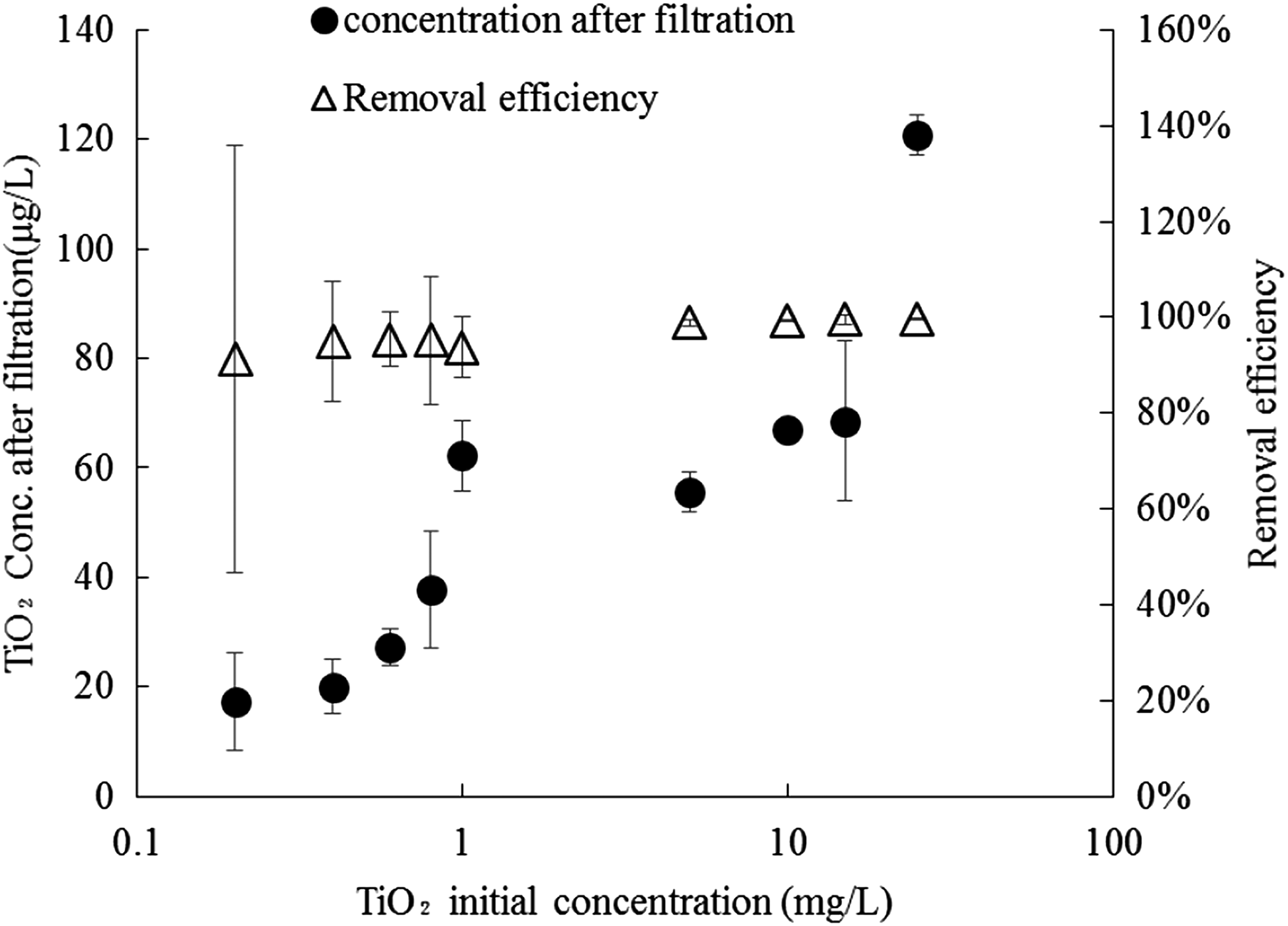
Removal efficiency of different concentrations of TiO2 filtered by 0.45 μm polyvinylidene difluoride membrane (n = 3).
To gain further insight into the viability of LPM filtration for practical applications in advanced water treatment, solutions treated by C/F/S with 0.1 mM FeCl3 were passed through 0.45 μm PVDF and 0.1 μm PVDF filters, and the concentrations of the resulting filtrate were determined by ICP-MS. These results were compared to those of analogous experiments in which 25 mg/L of untreated TiO2 particles was used (Table 1). Two factors contributed to the overall concentration found in the filtrate, the size of the NPs that come in contact with the membrane filter and the total concentration of the initial solution. As shown in Fig. 4, there is a considerable reduction in NP size after C/F/S (from 145 nm before treatment with 0.2 mM FeCl3 to 43 nm after sedimentation). Hence, beyond a certain pore size, particles may become too small to be filtered by the membrane; therefore, membranes with appropriate pore sizes need to be chosen.
After treating 25 mg/L TiO2 with 0.1 mM FeCl3.
FeCl3, ferric chloride; PVDF, polyvinylidene difluoride.
The concentration of prefiltrated solution can have an unexpected effect in the filtrate concentration at sufficiently high NP concentrations. Hence, after filtering the solutions at the same initial concentration of 25 mg/L through a 0.45 μm MF membrane, the TiO2 NP concentrations in filtrate were 120.8 ± 3.5 μg/L for the uncoagulated solution and 160.3 ± 19.8 μg/L for the C/F/S-treated solution. This result could be ascribed to two factors; namely, differences in sizes of suspended particles and concentrations of TiO2 NP in coagulated and uncoagulated solutions that were fed to the membrane. As mentioned above, suspended particles in the feed water after coagulation/sedimentation were small enough to pass through the MF membrane, resulting in a filtrate with a greater concentration of smaller sized TiO2 NP particles. Moreover, particles in the uncoagulated feed water had sizes greater than the MF membrane pores and thus could block the membrane pores, making particles smaller than the membrane pores unable to pass through the pores. In addition, the uncoagulated feed water had higher concentrations of NPs than coagulated ones and thus prone to cause clog. This mechanism is estimated to lead to a reduction in the number of particles in the filtrate. On the contrary, the coagulated solutions had smaller NP sizes with much lower initial NP concentrations, making it difficult to block the membrane pores; accordingly, the smaller particles than the membrane pores passed through the membrane.
These results suggest that at high TiO2 NP concentrations (25 mg/L), TiO2 removal by C/F/S might be less efficient than direct filtration through a membrane because of the smaller particle sizes and much lower initial concentrations of solutions subjected to treatment. However, such high concentrations of NPs would not be encountered in practice in large-scale water treatment plants; therefore, it is reasonable to assume that under actual concentrations found in water, removal of NPs by conventional C/F/S in tandem with membrane filtration may be less efficient than using membrane filtration alone (Table 1).
Effects of NaCl and CaCl2 on removal efficiency by coagulation
The existence of NaCl and CaCl2 in solution has been shown to enhance the aggregation of TiO2 NPs. Figure 6 shows the effects of ions (i.e., NaCl and CaCl2) on the removal efficiency of TiO2 NPs by 0.1 mM FeCl3.
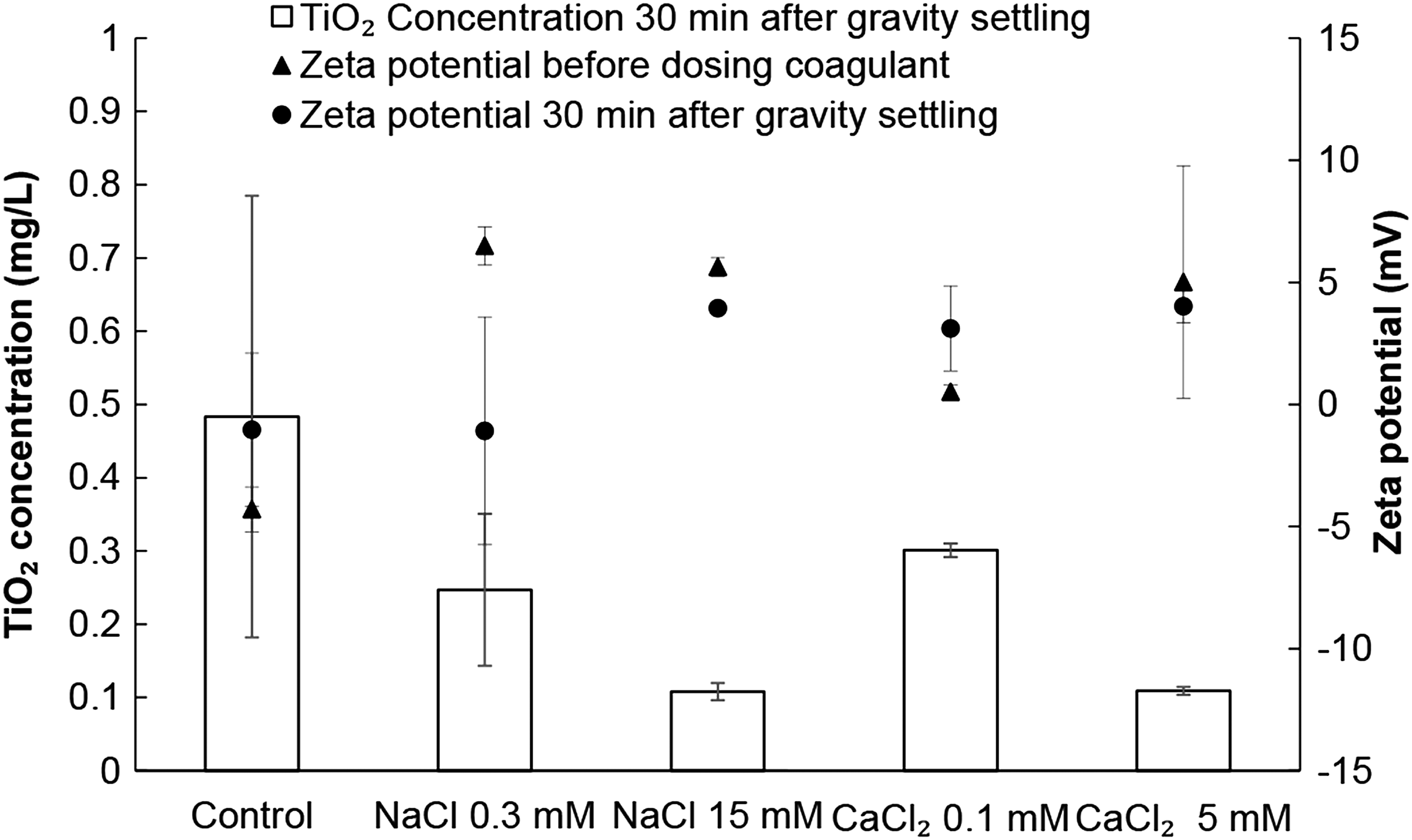
Comparison of TiO2 concentration in supernatant and zeta potential change before dosing coagulant and 30 min after gravity settling (FeCl3 0.1 mM).
With the addition of NaCl or CaCl2 into a solution containing an initial TiO2 NP concentration of 25 mg/L, the final TiO2 NP concentrations after sedimentation were all lower than under control conditions and <1 mg/L (Fig. 6; Table 2). These results mirror those obtained by Chalew et al. (2013), who achieved turbidity values of 2–4 after coagulation. Although these values were slightly higher than those observed in the present study, they used water from natural sources that contained more types of ions than were evaluated in the present study.
Overall, it can be concluded that the addition of NaCl and CaCl2 before coagulation led to greater destabilization of TiO2 NPs, resulting in greater particle aggregation, floc formation and sedimentation, and therefore reduced final NP concentrations. These findings are in accordance with those of a study by Wang et al. (2013), who found that increased ionic strengths led to enhancement of the coagulation effect. In the present study, addition of NaCl or CaCl2 resulted in modest reductions in NP concentrations after sedimentation, suggesting that the effects of increased ionic strength are likely complex, probably depending on a variety of other factors such as water type, pH, and TOC.
Effects of phosphate on removal efficiency by coagulation and membrane filtration
There is evidence that phosphate anions can be attached onto the surface of TiO2 NPs by multisite adsorption, affecting particle stability (Kang et al., 2011). Based on these findings, it is likely that phosphate addition would affect particle aggregation and therefore the removal rate of TiO2 NPs.
To investigate the effects of phosphate addition on the TiO2 NP removal rate, a series of experiments were conducted with 0.1 mM FeCl3 as the coagulant and phosphate in concentrations of 0 (control experiment), 0.01, 0.1, and 1 mM (Table 2). Figure 7 shows the corresponding concentrations after sedimentation in the presence and absence of membrane filtration with 0.45 and 0.10 μM PVDF membrane filters. Phosphate was found to have a clear inhibitory effect on NP removal, with greater concentrations leading to smaller NP removal levels after sedimentation. Use of 0.45 and 0.10 μM PVDF membrane filters led to significant reductions in NP concentrations compared to unfiltered supernatant solutions. With the 0.10 μM filter, the amount removed increased gradually with increasing phosphate concentrations, from 74.3% in the control experiment up 96.7% in response to a phosphate concentration of 1 mM (Table 3). Passing the supernatant through a 0.45 μM filter led to significant reductions at phosphate concentrations of 0.01 and 0.1 mM (82.1% and 88.9%, respectively), although the reductions at 0 and 1 mM were lower (44.7% and 41.1%, respectively). These results suggest that the factors influencing NP removal by PO43− addition are multifold and complex. Specifically:

TiO2 concentrations after gravity settling and filtration (FeCl3 0.1 mM) (n = 3).
Data are taken from Fig. 7. FeCl3 0.1 mM.
(1) PO43− can absorb onto TiO2 NPs, contributing further to the negative charge of the particles and facilitating electrostatic repulsion between the NPs.
(2) PO43− can bind to and neutralize positively charged Fe-hydroxide species, effectively eliminating the capacity of such iron species to act as coagulants.
(3) As the TiO2-NP concentration increases in the supernatant after sedimentation with increasing phosphate concentrations, removal of the NPs during membrane filtration could increase at sufficiently high concentrations as a result of pore clogging.
Based on these mechanisms, the results from Fig. 7 and Table 3 could be interpreted as follows:
(1) The lower NP removal rates exhibited in the control experiment with both membrane filters suggest that coagulation in the absence of phosphate leads to smaller particle sizes. (2) The effect of PO4 addition at low dosages, that is, 0.01 and 0.1 mM, is not obvious in the TiO2 NP concentrations after membrane filtration because PO4 prevents aggregation of TiO2 NPs at low concentration by rendering TiO2 NP surface negatively charged. At a high concentration of PO4 (1 mM), TiO2 NP concentrations increased significantly both after coagulation/sedimentation and after membrane filtration. This may be because an increased ionic strength by high concentration of PO4 overwhelmed the dispersing effects of PO4, which promoted aggregation of TiO2 NP. As a result, there remained very few large TiO2 NPs that can clog/block the membrane pores to prevent passage of small TiO2 NPs through the membrane pores. The reaction between Fe (III) and PO43− is very rapid (completed in <1 s), and may be considered instantaneous (Parsons and Berry, 2004). The increase in supernatant NP concentration with increasing phosphate concentration suggests that phosphate can act as an inhibitor of the coagulant, with a possible mechanism occurring via the fast adsorption of the anion to Fe-hydroxide species. The sharp increase in NP concentration after sedimentation between phosphate concentrations of 0.1 and 1 mM (Fig. 7) indicates that the inhibitory process may be particularly potent after the 1 mM level.
Experiments were conducted to determine the effects of PO43− addition on NP removal via PACl as the coagulating agent (Fig. 8; Table 2). The results showed that, comparatively, there was a much weaker effect on the level of NPs remaining after sedimentation relative to the experiments with FeCl3 (Fig. 7). When compared to the control experiment, the concentration of NPs after sedimentation decreased at 0.01 mM PO43−, while it increased after filtration using 0.45 μm filters in the 0.01 mM and 1.0 mM PO43− experiments. However, the differences between the runs (both filtered and unfiltered) with added phosphate and the control experiments were not statistically significant; therefore, clear trends could not be established.
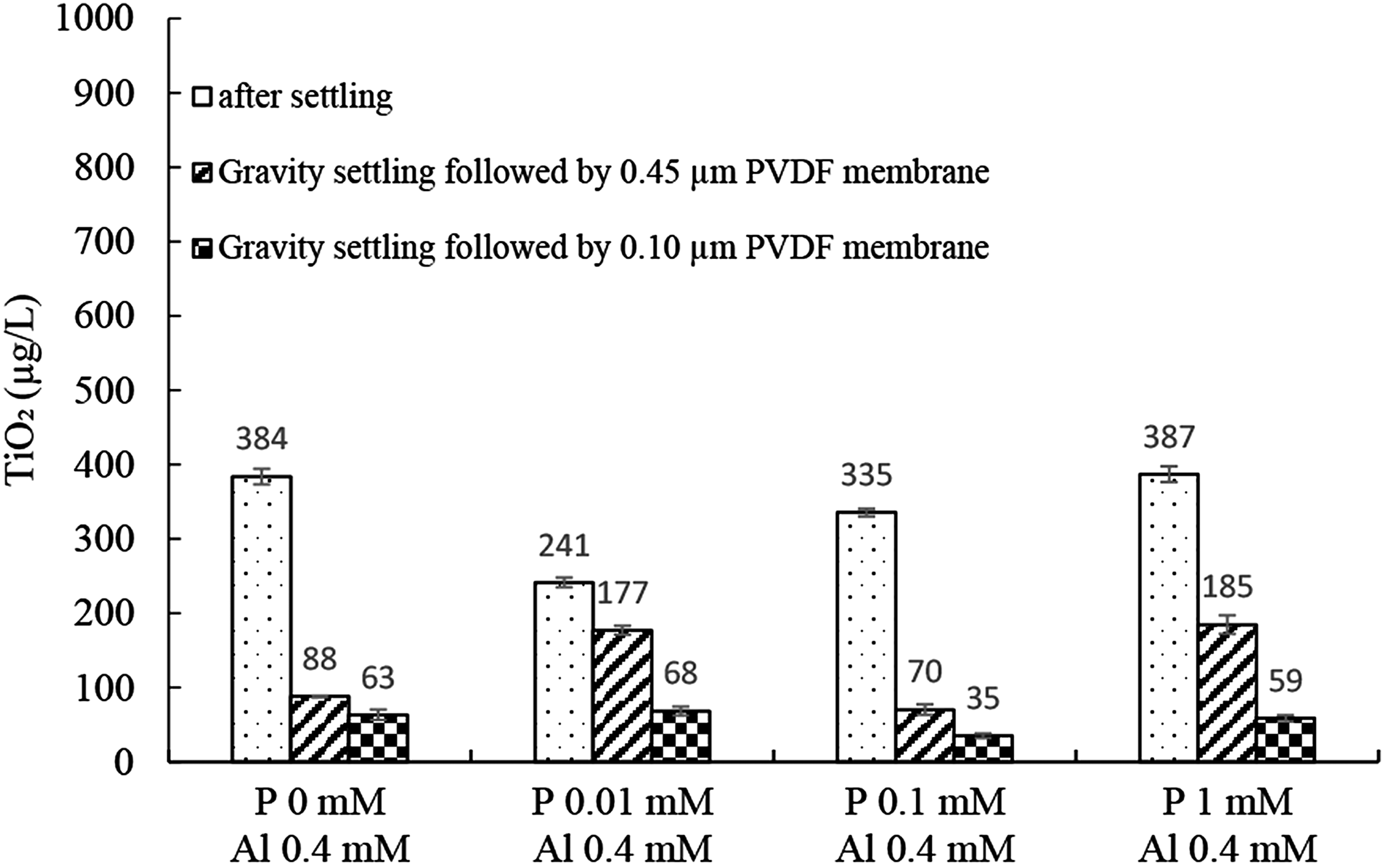
TiO2 concentrations after gravity settling and filtration (PACl 0.4 mM as Al) (n = 3).
When FeCl3 was used as coagulant, addition of phosphate at 0–0.1 mM to the mixture led to a steady reduction in the removal rate, although the decrease was much more pronounced at the highest concentration of 1 mM. In a previous experiment investigating the stability of TiO2 NPs, phosphate at 1 mM was determined to be capable of stabilizing the NPs (Kang et al., 2011), indicating that similar concentrations of phosphate can hinder the coagulation process. Satisfactory removal of NPs was achieved with the 0.45 μm PVDF filter, except in the control experiment and at the highest phosphate concentration. It should be noted that a concentration of 1 mM using the 0.1 μm filter still yielded 174 μg/L TiO2 NPs in the filtrate, which was the highest content of any experiment with this filter. Based on these findings, it is reasonable to assume that, apart from any possible iron hydroxide/phosphate interactions, higher phosphate concentrations could have a stabilizing effect on the NPs and lead to larger amounts of smaller sized particles being formed.
Ability of phosphate to interact with iron oxides has been widely documented, but reports of the performance of aluminum for phosphate removal are much rarer (Valsami-Jones, 2004). This may suggest that iron can form more stable complexes with ions such as phosphate in water. Even though iron remains an efficient precipitant for phosphorus, complexation with other species, such as NOM present in water (Weng et al., 2012), could still affect the overall sedimentation process.
Conclusions
More than 90% of TiO2 NPs was removed from a solution with an initial concentration of 25 mg/L by coagulation and sedimentation when FeCl3 and PACl were used as coagulants. The coagulant doses were sufficient to eliminate the energy barrier required for particle aggregation, as determined by DLVO models. However, it was determined that the minimum dose of coagulant required to induce the desired change in particle size distribution after the coagulation process was 0.1 mM FeCl3 or 0.2 mM PACl. At the same molar concentration (0.2 mM), FeCl3 showed better removal efficiency of TiO2 NPs than PACl. The changes in zeta potential observed with FeCl3 and PACl as coagulants appear to be in conformity with this result. When FeCl3 was used as a coagulant, the zeta potential changed from negative before the addition of coagulant to slightly positive after sedimentation; however, when PACl was used the values remained negative during these processes.
The addition of salts (NaCl and CaCl2) at concentrations ranging from 0.1 to 15 mM led to modest reductions in NP concentrations after sedimentation, which is in accordance with previous reports showing that increased ionic strengths lead to a reduction in particle concentrations. When FeCl3 was used as a coagulant, higher phosphate concentrations led to increasingly higher supernatant concentrations after sedimentation, although use of 0.45 or 0.10 μm filters still led to lower concentrations than under control conditions. Use of the 0.10 μm filter with the same coagulant led to greater NP removal rates as phosphate concentration increased, while no clear pattern was established with the 0.45 μm filter. When PACl was used as the coagulant in the absence of a filtration device, there was no significant difference between treatment with phosphate and the control. After passing treated (C/F/S) or untreated TiO2 NP suspensions through 0.45, 0.1, or 0.05 μm membrane filters, the untreated filtrates were found to have a lower NP concentration compared to the filtrated supernatant after sedimentation. These findings suggest that floc formation after C/F/S leads to a concomitant increase in the concentration of small particles in the supernatant, yielding higher filtrate concentrations.
Overall, the results indicate that, in addition to the concentration and type of coagulant used for C/F/S processes, other factors that should be considered when predicting TiO2 NP removal levels are the presence and concentration of ions in source water such as Na+, Ca2+, and PO43−. Therefore, there could also potentially be a seasonal effect on removal rates of NPs because of variations in ion concentrations, which may depend on seasonal precipitation.
Footnotes
Acknowledgments
The authors thank Mr. Kazuyoshi Fujimura for his technical assistance with the measurements of physical properties in the TiO2 NPs. This study was supported by a Grant-in-Aid for Scientific Research (#26303013) by the Japan Society for the Promotion of Science (JSPS). The author, C.Z., is thankful for the joint program provided by the China Scholarship Council (CSC, 2009617060) and financial support from the Japanese government (Monbukagakusho: MEXT) scholarship.
Author Disclosure Statement
No competing financial interests exist.