




Abstract
Abstract
To investigate the effects of porous media and ornamental plants on pollutant removal in vertical subsurface flow constructed wetlands (CWs), 24 microcosm systems were tested from March to August 2015. Twelve microcosms contained porous river rock (PRR) and 12 contained tepezil (TZ) as the porous medium; 3 U of each porous medium were planted with Typha spp. (P1), three were planted with Zantedeschia aethiopica (P2), three were planted with Alpinia purpurata (P3), and three were unplanted. The hydraulic retention time of all of the units was 3 days. Rural community wastewater was treated in wetland microcosms. Several water quality parameters were evaluated at the inlet and outlet units. Main findings of this study reveal that both porous media were efficient in the pollutant removal. Removal efficiency showed dependence on ornamental plant types. P-PO4, BOD5, and N-NO3 were reduced by more than 40%, 80%, and 40%, respectively, in P1 and P2. Relative growth rates of aerial, root, and total biomass were positively correlated with the P-PO4 removal efficiency. According to these results, this study suggests the use of ornamental plant production for wastewater treatment and for improving aesthetic systems and public acceptance. This study also recommends the use of PRR and TZ as porous media materials in the design of new CWs. The selection will depend on abundance of material in the study area.
Introduction
W
Some studies have shown that CWs that use plants present higher removal efficiencies than unplanted systems. Olguín et al. (2008) reported the removal efficiencies of chemical oxygen demand, BOD5, and total Kjeldahl nitrogen (TKN) in diluted sugarcane molasses to be 80.2%, 87.3%, and 76.1%, respectively, in CW planted with Pontederia sagittata, while in unplanted CWs, the removal efficiencies for the same chemical parameters were 40.1%, 60.9%, and 55.5%, respectively. Similarly Rodríguez and Brisson (2015) found 97% and 91% removal efficiencies of total nitrogen and total phosphorous, respectively, in planted mesocosms (Phragmites australis), while in unplanted experiments, the removal efficiency was 53% for total nitrogen and 61% for total phosphorous.
In tropical and subtropical regions, the vegetation types most commonly used in CWs are P. australis (Common reed), species of the genera Typha (e.g., latifolia, angustifolia, domingensis, orientalis, and glauca) and Scirpus (e.g., lacustris, validus, californicus, and acutus) (Vymazal, 2011). However, there are also local ornamental plants that still need to be evaluated in regard to their ability to remove pollutants; ornamental plants represent a potentially profitable alternative for rural communities in developing countries, whereas wastewater treatment usually represents a large proportion of the municipal budget (Belmont et al., 2004; Zurita et al., 2006; Hernández, 2016). Another important element to be considered in CW design is porous media selection. Some CWs are filled with expensive materials, such as zeolite (Ríos et al., 2007; Shuib et al., 2011). Most rural communities in developing countries live in harsh conditions; consequently, the use of locally sourced materials is a sound and affordable alternative for these communities. The main goal of this study was to examine the effects of different ornamental plants that have economic potential on pollutant removal and to evaluate the influence of locally sourced porous media on plant growth, as well as pollutant removal to optimize the CW design characteristics.
Data and Methods
Study area
Experimental wetlands were constructed in the rural locality of Pastorías (Municipality of Actopan), Veracruz, Mexico (−96o57′08″N and 19o.55′83″S), where wastewater to be treated is directly pumped from a community sewer (620 people). Three different ornamental plant genera were used: Typha spp., Alpinia purpurata, and Zantedeschia aethiopica. Twelve ornamental plant species of Typha spp., A. purpurata, and Z. aethiopica were collected in riparian and creek zones near the study area. Porous river rocks (PRRs) and tepezil (TZ; inert mineral with fine grain, light weight, and low cost) were the two different types of porous media used. PR was collected from the riparian zone of the local river (Topiltepec). T-S porous media was collected from residues of building material supplied by members of the community. The porosities of PR and T-S were 50% and 40%, respectively. Both porous media have good porous surface areas and average diameters of 1.5 cm.
Design of subsurface vertical flow wetland microcosms
Wastewater was coarsely screened and subsequently stored in a 1.1 m3 plastic tank, which was continuously stirred to avoid sedimentation of solids. Microcosms were constructed in cylindrical plastic containers (0.36 m high and 0.29 m diameter). A uniform porous media layer was used; the water level was kept 0.06 m below the media surface to give a water depth of 0.30 m. Twenty-four microcosms were analyzed, 12 of which contained PR, and the remaining 12 were filled with T-S as a porous medium. The microcosms in the porous media were numbered Typha spp. 1, 2, and 3; A. purpurata 1, 2, and 3; Z. aethiopica 1, 2, and 3; and control (unplanted) 1, 2, and 3. One vegetation specie was planted in each microcosm with flora. All the microcosms were operated in downflow continuous-flow system, 3 days of hydraulic retention time, and 4 cm/day of hydraulic loading rate.
Physical and chemical parameters
Microcosms were monitored every 15 days from March to August 2015 to determine their efficiency of pollutant removal. The measured water quality parameters were biochemical oxygen demand (BOD5), nitrates (N-NO3), and phosphates (P-PO4). Analyses were carried out according to Standard Methods (APHA, 2005). Other parameters as TKN or ammonia were only analyzed four times during the study (data not shown), and those were observed in minimum values (<0.4 mg/L). Water samples were collected from the influent and effluent of vertical CW. The pollutant removal (Em) from flowing water through the wetlands was calculated from Equation (1) (Cui et al., 2010): Em = ((C i – C e )/C i ) × 100%, where C i is the influent pollutant concentration (mg/L), and C e is the pollutant concentration in the effluent (mg/L).
Redox potential (Eh) within the wetlands was monitored weekly during the study using platinum electrodes, one calomel reference electrode (Corning 476340), and a digital multimeter (Mastech, MAS830L). The electrodes were inserted in two perforated plastic tubes (15 mm diameter) installed vertically in each microcosm, 0.1 m away from each other. Total solids, electrical conductivity (EC), pH, and water temperature were measured with a YSI 550 multiparameter instrument at each microcosm.
Plant growth
Individual plant height and stem diameter were measured every 15 days with a tape and Vernier caliper, respectively. For Typha spp. plants, the diameter of the basal part of leaves was considered. At the end of the experiment, all plants were harvested and separated individually into root and aerial biomass; they were then washed and dried to obtain constant weight according to Hernández et al. (2014). The relative growth rates (RGR) were calculated as described by Youssef (2002).
Statistical analyses
All statistical analyses were performed using SPSS 20 software for Windows (version 14.0; SPSS, Inc., Chicago, IL). The significant differences between plants and porous media in pollutant removal were analyzed using two-way analysis of variance followed by least significant difference (LSD) tests (at α = 0.05 level). The values are presented as the mean ± standard error.
Results and Discussion
Wastewater quality
Characteristics of the wastewater systems are presented in Table 1. The pH during the experimental period was between 7.2 and 7.7. Dissolved oxygen (DO) showed an average measured value of 1.0 ± 0.2 mg/L at the influent and increased from 2.0 to 3.6 in planted microcosms. The EC of soil affects the ability of plants and microbes to process waste material flowing into a CW. In this study, EC varied between 1013 and 1303 μS/cm, which is the optimum range for a growth medium. The water temperature was between 18°C and 20°C. The total suspended solids (TSS) average concentration in the influent was 211 ± 16 mg/L, whereas in planted microcosms TSS ranged between 143 and 174 mg/L and 184 to 193 mg/L of TSS were observed in unplanted microcosms. The redox potential varied in the wetland microcosms according to the planted and unplanted systems, reaching values of up to 300 mV in the most superficial areas and near the roots of the plants, related with the oxygen supply of the rhizosphere zone, while in unplanted systems, the values of Eh were slightly less oxidized (between 212 and 218 mV) than in microcosms with vegetation.
Values are given as the average ± standard error (n = 36);
DO, dissolved oxygen; EC, electrical conductivity; ND, not determined; PR, porous river rock; T, tepezil.
Plant height, RGR, and biomass changes
Individual plant height changed with time (Fig. 1a). Typha spp. had higher growth than other species and reached their maximum plant height in August in both porous media (PR: 2.2 m and T-S: 1.7 m). Z. aethiopica showed lower increments in height than Typha spp. both in PRR media (only 14 cm from March to August) and in TZ media (11 cm). A. purpurata plants required a large period of time (March to June) to adapt to the new growth environment in the microcosm systems, but from June to August, their height remained stable (10.5 cm in T-S and 6 cm in PR). The stem diameter (Fig. 1b) trends were similar to the observed height changes. The differences in vegetation growth were related to the pH conditions. According to USEPA (2000), the optimal pH range for Typha spp. development is between 3.0 and 8.5, and the optimal pH range for A. purpurata is between 6.0 and 6.8 (Kobayashi et al., 2007). For CW with Z. aethiopica healthy plants, Zurita et al. (2008) measured values close to pH 7. It is possible that Typha spp. and Z. aethiopica could have developed and propagated more vigorously because the pH values in the microcosms were within their optimal ranges. Conversely, A. purpurata did not show optimal growth, possibly due to the high pH values in the microcosms. It is likely that a longer period of adaptation is required for A. purpurata.
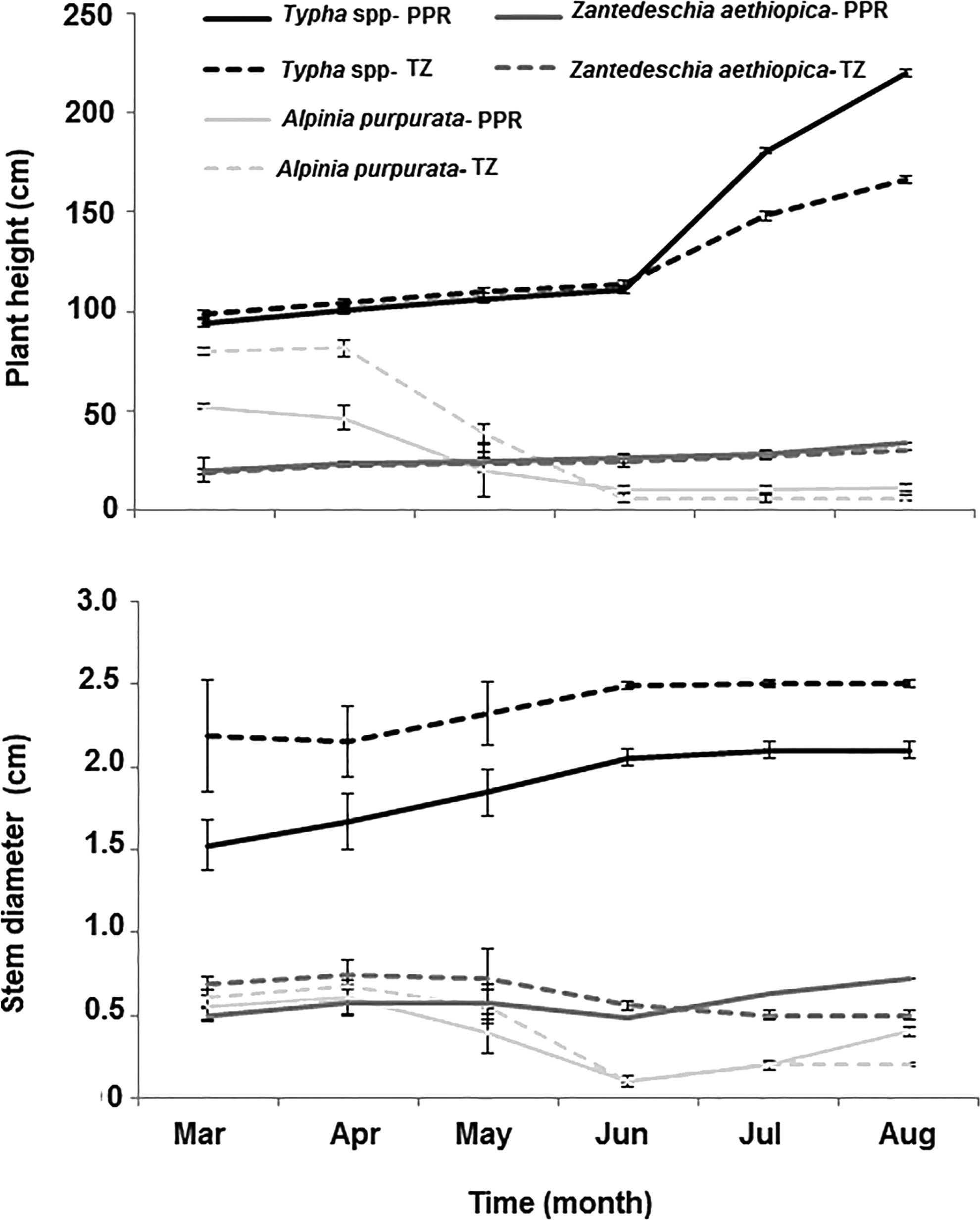
Plant height and stem diameter changes with time.
Regarding biomass, the porous media did not have a significant effect on above or below ground biomass production (p = 0.071; Fig. 2) nor RGR (p = 0.694; Fig. 3). However, there was a significant effect in biomass between different plants (p = 0.001) and RGR (p = 0.029). For example, Typha spp. showed higher aerial and below ground biomass productivity than Z. aethiopica and A. purpurata. In addition to determining general appearance, RGR can be used to confirm plant growth situations. Similar to biomass, for this measure, RGR was lower in Z. aethiopica and A. purpurata than in Typha spp. The survival rate is one of the most important conditions for selecting CW plants (Liu et al., 2012), and the presence of different ornamental plants in CWs contributes to the aesthetic appearance of the system and creates an attractive alternative for wastewater gardens.

Effects of substrate media and plant species on biomass production of different ornamental vegetation. Values are given as the average ± standard error. Different letters indicate significant differences (p < 0.05), letter “a” are values higher than “b” values. PRR, porous river rock; TZ, tepezil.

Effects of substrate media and plant species on relative growth rate of different ornamental vegetation. Values are given as the average ± standard error. Different letters indicate significant differences (p < 0.05), letter “a” are values higher than “b” values.
Nutrient removal
Table 2 summarizes the water quality parameters in the microcosm influents and effluents and gives the mean removal percentages for the wetland microcosms. The mean influent concentrations for aqueous BOD5, N-NO3, and P-PO4 were 117.49, 8.88, and 9.51 mg/L, respectively. The corresponding mean outflow concentrations were 32.12, 6.01, and 6.25 mg/L. Such concentrations are equivalent to 72.7%, 31.4%, and 34.3%, respectively. The tested porous media have the same effect on pollutant removal (p > 0.05), and both porous media show important features for selection in future wetland designs. Both porous media are cheaper than other typical porous media used in CWs as zeolite or tezontle, whose cost typically ranges from 100 to 300 dollars/m3 (Marín-Muñiz, 2016), while PRR can be collected in riverine zones, and TZ can be used from construction waste material and would not mean an extra cost. Besides, in studies using zeolite or tezontle, some authors (Shuib et al., 2011; Wen et al., 2012; Zurita and White, 2014) showed that the removal of nitrogen compounds (30–70%) and biochemical oxygen demand (40–90%) is similar to the one found in this study using PRR or TZ. While for phosphorous compounds, Shuib et al. (2011) reported inefficiency in removal of the nutrient when they used zeolite as substrate in CW. Regarding the plant effect on pollutant removal, there was a significant difference in the removal of BOD5 (p = 0.04), N-NO3 (p = 0.001), and P-PO4 (p = 0.001). Typha spp. microcosms had higher removal rates for N-NO3 (≥59%), followed by Z. aethiopica (≥33%), A. purpurata microcosms, and unplanted systems (≥18%). Considering the redox values measured (near to 300 mV; Table 1), such N-NO3 removal is related with biological denitrification processes (Szögi et al., 2004) that transform nitrate into nitrogen gas in Eh range from +100 to +300 mV; this process is highly active in CWs for wastewater treatment. These Eh value and removal efficiencies were favored in microcosm with vegetation with more biomass production (Typha spp. and Z. aethiopica species); this is also related to the uptake of the nutrients by the plants. The BOD5 inflow concentrations were at least threefold higher than the EPA recommended level (30 mg/L); in this study, using the CW, such concentration decreased. The BOD5 percent removal efficiency was significantly lower in unplanted and A. purpurata (∼65% both systems) than in Typha spp. and Z. aethiopica treatments (∼85%). These removals are related to the well growth of Typha spp. and Z. aethiopica; it is likely that the plant roots provide a more effective settling medium that gravel filter alone, besides increasing attachment surface area and food sources for the microbial population efficiencies. The removal efficiencies are within the range of those reported in the literature (50–92%) (Karathanasis et al., 2003; Vymazal and Kröpfelová, 2009; Zhang et al., 2015). The P-PO4 removal efficiency was significantly higher in microcosms planted with Typha spp. (≥56%) and Z. aethiopica (≥39%) than in unplanted systems (between 18% and 21%). However, in the case of A. purpurata (between 20% and 21%), no significant difference was found in comparison to the unplanted system. It is possible that Typha spp. and Z. aethiopica could have developed and propagated well because the pH, EC media, and temperature in the system were all within the optimal range. By contrast, the situation was not optimal for A. purpurata, as described above. In general terms, the pollutant removal was significantly higher in planted wetland microcosms (17–83%) than in the unplanted (18–62%) control microcosms (p > 0.05). It is reported that planted wetlands outperform unplanted controls mainly because the rhizosphere acts as a base for microorganism communities (Olguín et al., 2008; Vymazal, 2011); the root zone provides surface area for microbial attachment and the release of gas and exudates as carbon creates aerobic niches and increases aerobic degradation (Shelef et al., 2013). This situation is related to the redox potential data (Table 1), for which we observed less reduced values in planted microcosms than in unplanted systems; such values suggest that the main removal mechanism for nitrogen is through denitrification. Besides, it's also important to consider that N and P are macronutrients for both plants and microorganisms; thus a certain amount of N and P could serve for biomass synthesis, and thus, it's expected higher removal in planted microcosms than in unplanted controls (due to both presence of the plant and all the positive effects highlighted on biodegradation). Other routes of nitrogen removal in CW systems that include partial nitrification–denitrification, anammox, and Canon process need to be evaluated to know the complete panorama on nitrogen removal in CW as described by Saeed and Sun (2012).
Values are given as the average ± standard error (n = 36); different letters indicate significant differences between the columns at the 5% significance level. PR, porous river rock; T-S, tepezil.
Regarding the low-removal efficiency of A. purpurata, we believe that it was influenced by the adaptation time. However, it is important to consider a longer period of study for this species because of the medicinal properties of its essential oils and its use in cosmetic industries (Victórico, 2011).
Correlations between removal efficiency and plant growth are shown in Table 3. The P-PO4 removal efficiency was positively correlated (p ≤ 0.05) with the RGR and the root, aerial, and total biomass. The corresponding correlation coefficients were 0.555, 0.502, 0.623, and 0.574, respectively. The removal efficiencies of N-NO3 and BOD5 were not correlated with the RGR or the root, aerial, or total biomass (p ≥ 0.05). As expected, the root, aerial, and total biomass were highly correlated with RGR. Biomass vegetation was an important factor in P-PO4 removal in CWs with both porous media used in this study. Similarly, another study showed that media obtained from river beds were excellent in regard to their efficiency of P-PO4 removal (Akratos and Tsihrintzis, 2007). Thus, it is important to consider the use of PR and T-S porous media in the future design of CWs for removing contaminants and improving sustainability, which is a human aspiration that can begin with individual, local, national, and global efforts (Contreras and Morandín, 2016).
Level of statistical significance: p ≤ 0.05.
Level of statistical significance: p ≤ 0.01.
RGR, relative growth rates.
Conclusion
Results of this study showed the efficiency of ornamental plants (Typha spp. and Z. aethiopica) in CW systems for pollutant removal, as well as the feasibility of producing ornamental flowers with high market value, representing an economic and ecological alternative for rural communities. The results of this study suggest that species such as A. purpurata require longer periods of evaluation due to slow adaptation to CW conditions. Accordingly, both types of porous media (TZ and PRRs) are suitable for pollutant removal in CWs and are appropriate supports for plant growth; thus, their use could be convenient in future CW designs.
Footnotes
Acknowledgments
This study was funded by the Mexican National Council for Science and Technology CONACYT through the postdoctoral scholarship. The authors thank Luis Omar Vargas, Laady Sinaí G, and Felisa Jácome for their help in the field work.
Author Disclosure Statement
No competing financial interests exist.