




Abstract
Abstract
Amitrole (3-amino-1H-1,2,4-triazole or aminotriazole) is a widely employed herbicide with strong estrogenic activity that can lead to abnormalities of the thyroid gland and cause mutations. Photocatalytic degradation conditions of amitrole in titanium dioxide (TiO2)-suspended solution were optimized under sunlight irradiation. The effect of various factors, such as photocatalyst loading, initial substrate concentration, temperature, pH, sunlight intensity, and irradiation time on the photocatalytic degradation of amitrole, was investigated. Photocatalytic degradation under sunlight irradiation was very effective for amitrole solution. The primary photocatalytic decomposition reaction followed a pseudo-first-order kinetic law, according to the Langmuir–Hinshelwood model. The activation energy (Ea) was estimated to be 6.73 kJ/mol. Nitrate (NO3−) and ammonium (NH4+) ions were detected as end inorganic products. Triazole was identified as the intermediate product. Solar photocatalytic degradation treatment for the wastewater including amitrole is simple, easily handled, and low cost. Therefore, since artificial lamp devices, for example, Hg-Xe lamp, are particularly expensive in local and poor areas, the proposed technique is a very powerful method for treatment of wastewater including amitrole in those areas.
Introduction
A
Since absorption spectrum of amitrole does not overlap with solar emission spectrum, it is stable to photodegradation under nature-relevant conditions. Direct ultraviolet (UV) photolysis (254 nm, low-pressure mercury lamp) of amitrole was shown to be ineffective, owing to its low molar absorption (Orellana-Garcia et al., 2014). Catastini et al. (2004) described the photochemical degradation of amitrole from aqueous solutions at pH 3.4, using iron(III) aqua complexes under solar and UV radiation, and the complete removal was achieved at 10 h of irradiation. Therefore, in the method of photo-Fenton remediation, there were disadvantages because the treatment was only used in an acidic area. On the other hand, the photocatalytic treatment can be applied into wide pH ranges (Watanabe et al., 2005; Andersen et al., 2013; Álvarez et al., 2016).
Much attention has been focused, in the past three decades, on the photocatalytic degradation of organic pollutants with titanium dioxide (TiO2) in aqueous suspension solution under UV irradiation (Ong et al., 2014). In this process, the TiO2 semiconductors are excited with UV light of wavelengths <380 nm to form conduction band electrons (e−) and valance band holes (h+), which are capable of initiating the photocatalytic oxidation and reduction reactions, respectively. Because the UV light accounts for only a small fraction (4%) of solar energy compared with visible light (42%), the shift in the optical response of TiO2 from the UV to visible spectrum range will have a positive effect (Andersen et al., 2013). The noble metal loading onto TiO2 has been widely investigated for visible light responsible photocatalysts (Hua et al., 2014). However, the noble metal loading will make the prepared photocatalyst expensive. On the other hand, the photocatalytic remediation of environmental pollution on bare TiO2 in water under sunlight irradiation by using the UV range, that is, a small fraction of solar light, is possible, although it takes long time for the photocatalytic treatment.
Among the large variety of pesticides degraded by photocatalysis, the degradation of several organic compounds containing nitrogen rings has been successfully performed: tebuconazole (Calza et al., 2002), triazolidine (Guillard et al., 2002), amitrole, 3,5-diamino 1H-1,2,4 triazole, 1H-1,2,4 triazole (Watanabe et al., 2005), thiabendazole (Calza et al., 2003), pyridazine, pyrimidine, pyrazine (Horikoshi and Hidaka, 2001), and pyrimethanil (Aguera et al., 2000). A study has reported the photocatalytic degradation of amitrole using an artificial light source such as an Hg-Xe lamp (Watanabe et al., 2005; Andersen et al., 2013; Álvarez et al., 2016). The artificial lamp device is particularly expensive in the local and undeveloped areas. There is little information on the photocatalytic degradation of amitrole in water with TiO2 under sunlight illumination. Therefore, we have investigated the photocatalytic remediation of amitrole in aqueous solution (Kaneco et al., 2012). In the photocatalytic degradation system, amitrole could be degraded in aqueous TiO2 dispersion under sunlight illumination. However, the optimum solar photocatalytic degradation conditions of amitrole in the aqueous TiO2 suspension were not investigated in the initial experiments.
In this work, the optimal conditions for photocatalytic degradation of amitrole in water with TiO2 were studied, and the final degradation product was determined to evaluate the mineralization of amitrole. On the basis of the evidence of data, the kinetics and mineralization were discussed.
Materials and Methods
The amitrole used in this study was purchased from Wako Pure Chemical Industries, Ltd. (high-performance liquid chromatography [HPLC] grade >98%, pesticide residue analysis). Amitrole aqueous solutions were prepared with ultrapure water, which was purified by an ultrapure water system (Advantec MFS, Inc., Tokyo, Japan) resulting in a resistivity >18 MΩ cm. A 30 mL aqueous solution containing 20 mg/L amitrole was put into a Pyrex reaction vessel (50 mL capacity). TiO2 powder (anatase, purity 99.9%, diameter 230 nm, and surface area 8.7 m2/g, Wako Pure Chemical Industries, Ltd.) (Supplementary Fig. S1) was added to the solution to produce a concentration of 6.7 mg/mL. The pH of the solution was 9.0. The temperature was kept constant at 25–85°C with a water bath. The detailed experimental conditions are shown in Table 1. The TiO2 suspension containing amitrole was irradiated under sunlight illumination. In this case, the short UV radiation (λ < 300 nm) was filtered out by the vessel wall. The intensity of light was measured by a UV radio meter (UVR-400; Iuchi Co., Osaka, Japan). The variations of sunlight intensity for 60 min were <10%.
TiO2, titanium dioxide.
After the illumination, the amount of amitrole in the aqueous solution was measured using an HPLC equipped with a Hitachi L-4000 UV optical detector and a separation column RSpak DE-413L (SHOWA DENKO K.K). The elution was monitored at 210 nm. The eluent used was a mixed solvent of acetonitrile and water (7/3, v/v). The flow rate of the mobile phase was 0.7 mL/min.
Intermediate products were extracted by means of solid-phase extraction. The extraction disk (C18 disk; 3M Empore) was placed in the conventional filtration apparatus and washed with 10 mL of solvent mixture, dichloromethane and ethyl acetate (1:1), 10 mL of methanol, and 10 mL of ultrapure water. Then, the sample was percolated through the disk with a flow rate of 5 mL/min under vacuum. The compounds trapped in the disk were collected by using 4 × 5 mL of solvent mixture, dichloromethane and ethyl acetate (1:1), as eluting system. The fractions were evaporated under a gentle stream of nitrogen to 50 μL into conical vials, and 1 μL was injected into a gas chromatography and mass spectrometry (GC-MS) instrument in splitless mode. For the analysis of intermediate products, a Shimadzu Gas Chromatograph and Mass Spectrometry (GC-MS 5050A) equipped with an HP-5 capillary column (30 m × 0.25 mm internal diameter) was used at the following chromatographic conditions: injector temperature 270°C, column temperature program 40, 40–200°C (5°C/min), 200–210°C (1°C/min), 210–270°C (20°C/min), and 270°C (3 min). Helium was used as the carrier gas at 1.5 mL/min. The interface was kept at 270°C. Qualitative analyses were performed in the electron-impact (EI) mode, at 70 eV using the full scan mode.
Chemical oxygen demand (COD) in the sample solution was measured by potassium permanganate acidic method [Japanese Industrial Standard (JIS), 2003]. The formation of ammonium (NH4+) and nitrate (NO3−) ions was measured by ion chromatography.
Results and Discussion
In the primary experiments (Kaneco et al., 2012), the complete disappearance of amitrole was observed in <3 h, working with moderate amounts of TiO2 (6.7 g/L) under sunlight illumination. Since it was found that the solar photocatalytic purification of water containing amitrole was possible in TiO2 aqueous suspensions, the degradation parameters were individually optimized in this study, because the parameters containing photocatalyst dosages, initial substrate concentration, temperature, initial pH, and light intensity, seem to be independent of each other.
Effect of photocatalyst dosages
The amount of catalyst is one of the main parameters for the degradation studies. To avoid the use of excess catalyst, it is necessary to find out the optimum loading for efficient removal of amitrole molecule. Several authors have investigated the reaction rate as a function of catalyst loading in photocatalytic degradation process (Subash et al., 2012, 2013a,b; Krishnakumar and Swaminathan, 2012). The effect of the catalyst amount on the photocatalytic degradation has been carried out in the range of 0–300 mg (10 g/L) of the catalyst for 30 mL of solution. The results are shown in Fig. 1. The degradation efficiency increased with increasing the amounts up to 200 mg (6.7 g/L), and then the efficiency was nearly flat. The increase in the efficiency seems to be due to the increase in the total surface area, namely number of active sites available for the photocatalytic reaction, as the dosage of photocatalyst increased. However, when TiO2 was overdosed, the number of active sites on the TiO2 surface may become almost constant because of the decreased light penetration, the increased light scattering, and the loss in surface area occasioned by agglomeration (particle–particle interactions) at high solid concentration (Wong and Chu, 2003). Therefore, 200 mg (6.7 g/L) of TiO2 was selected as the optimal amount of photocatalyst for the sequential experiments.
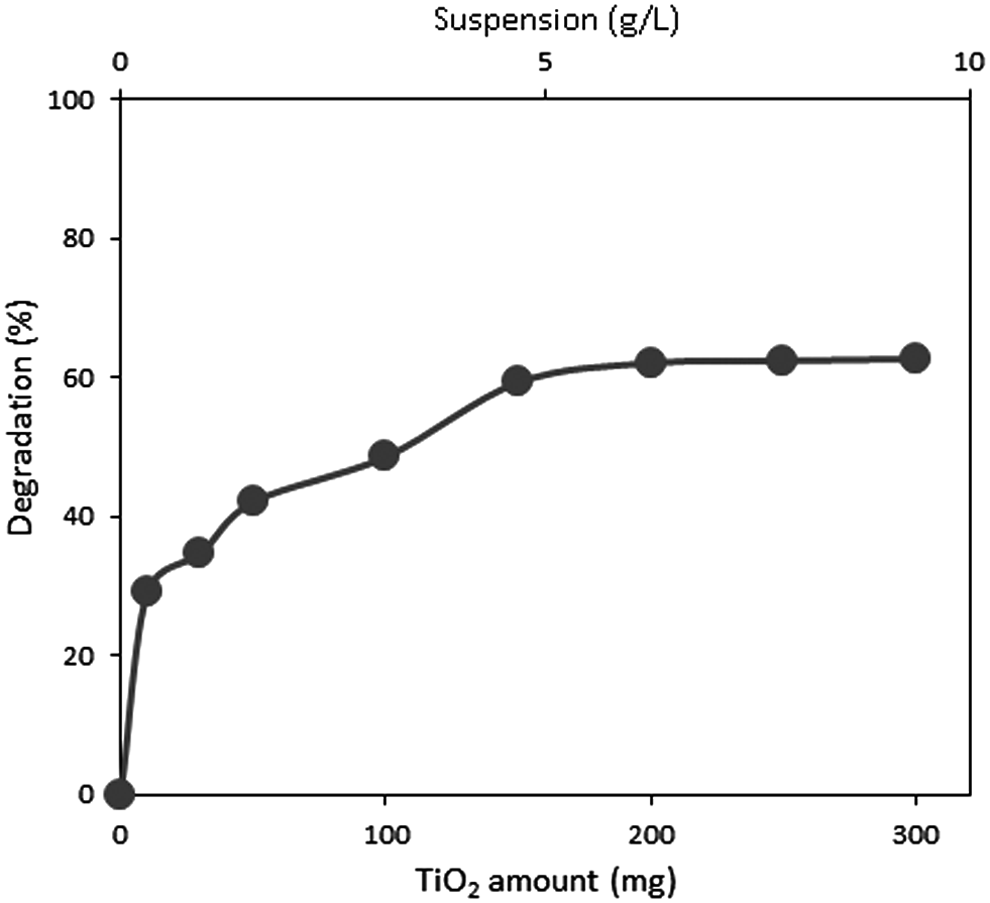
Effect of TiO2 amount on solar photocatalytic degradation of amitrole in water. Amitrole: 20 mg/L; irradiation time: 30 min; light intensity: 1.6 mW/cm2; temperature: 25°C; pH: 9. TiO2, titanium dioxide.
Effect of initial substrate concentration
It is very important, from the application point of view, to study the dependence of the photocatalytic degradation on the substrate concentration. The effect of initial substrate concentrations on the solar photocatalytic decomposition using TiO2 was investigated, and the results are given in Fig. 2. It is found that with increasing initial substrate concentrations, the degradation efficiency decreased gradually (Kaneco et al., 2006, 2009). In this study, 20 mg/L amitrole solution was used for evaluating the solar photocatalytic degradation, in view of the practical wastewater with high concentration of amitrole.
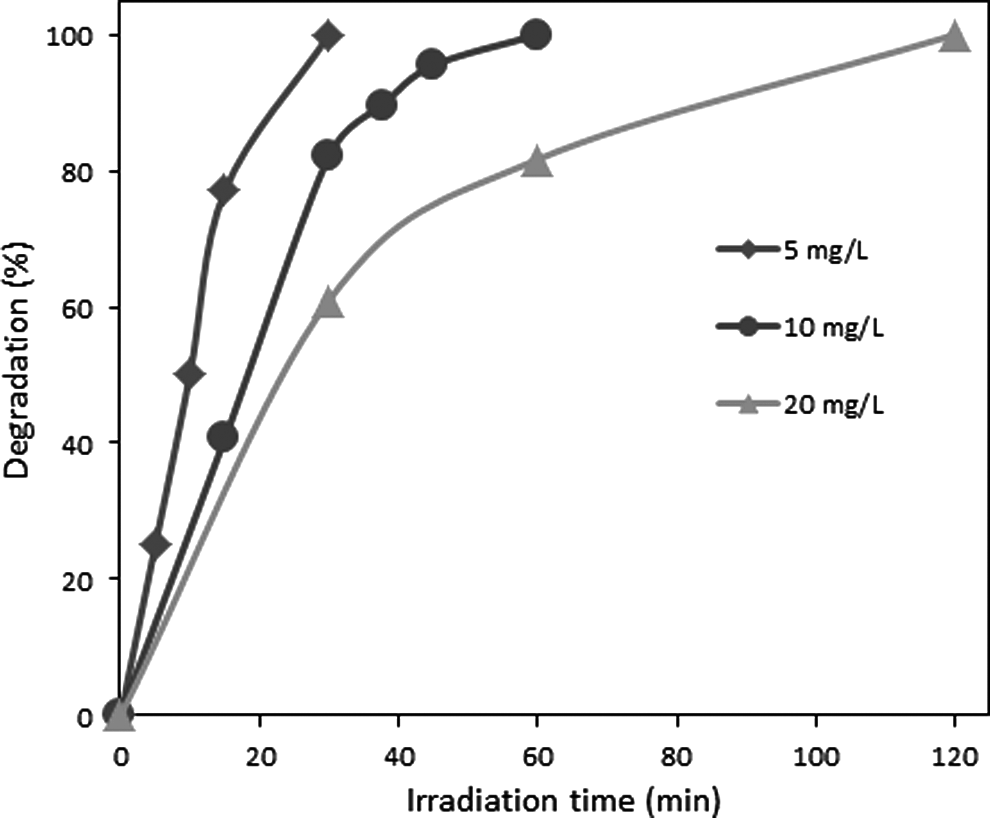
Effect of initial substrate concentration on solar photocatalytic degradation of amitrole in water using TiO2. TiO2: 200 mg; amitrole: 5–20 mg/L; light intensity: 1.6 mW/cm2; temperature: 25°C; pH: 9.
Effect of temperature
Little information on the temperature effect on the photocatalytic degradation of pollutants in water with TiO2 has been presented (Kaneco et al., 2006, 2009). Therefore, the effect of temperature on the solar photocatalytic degradation of amitrole in water using TiO2 was investigated in the range of 5–85°C. The results are shown in Fig. 3. The degradation efficiency of amitrole gradually increased as the temperature increased. In the photocatalytic degradation of imazaquin in an aqueous suspension of TiO2 (Garcia and Takashima, 2003), the effect of temperature was studied in the range 20–40°C, and the rate constants increased with increasing temperature. Ishiki et al. (2005) have investigated the photocatalytic degradation of imazethapyr herbicide at the TiO2/H2O interface. In their works, the temperature effect was studied using a suspension between 20°C and 40°C, and the herbicide was more easily degraded at lower temperatures in the TiO2 suspension, due to the decrease in the physisorption between the TiO2 surface and the imazethapyr molecules. By plotting the natural logarithm of the rate constant as a function of reciprocal absolute temperature, a linear behavior was obtained in the temperatures below about 60°C with the correlation coefficient 0.96, as drawn in the insert figure in Fig. 3. The activation energy (Ea) was relatively low and was estimated to become 6.73 kJ/mol. It was reported that, in the TiO2 photocatalytic degradation of benzene (Wu et al., 2005), naphthalene (Lair et al., 2008), imazaquin (Garcia and Takashima, 2003), and chloramphenicol (Chatzitakis et al., 2008), the activation energy (Ea) was 3.2, 22, 24.8, and 33 kJ/mol, respectively. Since the photoactivation process is irrelevant to thermal activation, the activation energy found is only apparent. Consequently, all subsequent illuminations were performed at 25°C, because of the operating cost for the photodegradation system.

Effect of temperature on solar photocatalytic degradation of amitrole in water using TiO2. Inset figure: plot of Ln(k) versus 1/T. TiO2: 200 mg; amitrole: 20 mg/L; light intensity: 1.6 mW/cm2; irradiation time: 60 min; pH: 9.
Effect of initial pH
Amphoteric behavior of most semiconductor oxides influences the surface charge of the photocatalyst. Therefore, the role of initial pH on the degradation efficiency of amitrole was investigated in the pH range 1.8–11, as shown in Fig. 4. It is found that the degradation efficiency increased with an increase in pH up to 5.4. Then, the degradation efficiency of amitrole gradually decreased as the pH increased. The zero point charge (zpc) pHzpc of TiO2 particles is around 6 (Yang et al., 2001). TiO2 surface is positively charged in acidic media (pH <6), whereas it is negatively charged under an alkaline condition (pH >6). Generally, the pH changes can have a significant result not only on the mode of adsorption of the amitrole substrate on TiO2 surface but also on the selectivity of the photodegradative reaction occurring on the particle surface since redox reactions are very sensitive to changes in the surface potential (Kahn et al., 1986). In acidic media (pH <4) and alkaline media (pH >10), the nonpolar amitrole may be scarcely adsorbed onto the TiO2 surface, and in neutral condition (4 < pH < 10), the adsorption can occur easily. Consequently, pH 9 was selected for the optimal experimental conditions, because of the unnecessary chemical treatment, including neutralization process.

Effect of initial pH on solar photocatalytic degradation of amitrole in water using TiO2. TiO2: 200 mg; amitrole: 20 mg/L; irradiation time: 60 min; light intensity: 1.6 mW/cm2; temperature: 25°C.
Effect of light intensity
Influence of light intensity on the solar photocatalytic destruction of amitrole in water with TiO2 was studied, as illustrated in Fig. 5. The degradation experiments were performed during different periods of time with various light intensities on sunny and cloudy days. The degradation efficiency increased rapidly with increase in the light intensity up to 0.53 mW/cm2 and then, the efficiency increased gradually. Since the catalyst powders are suspended in a stirred solution, the light intensity will affect the degree of absorption of light by the catalyst surface. Ollis (1991) reviewed the effect of light intensity on the kinetics of photocatalysis and stated that (1) at low light intensities, the rate would increase linearly with an increasing light intensity; (2) at intermediate light intensities, the rate would depend on the square root of the light intensity; and (3) at high light intensities, the rate is independent of light intensity. Therefore, the results obtained in the solar photocatalytic degradation of amitrole in aqueous TiO2 suspension were reasonable.

Effect of light intensity on solar photocatalytic degradation of amitrole in water using TiO2. TiO2: 200 mg; amitrole: 20 mg/L; irradiation time: 60 min; temperature: 25°C; pH: 9.
Kinetic analysis
Heterogeneous photocatalytic degradation of amitrole with TiO2 obeys apparently pseudo-first-order kinetics at a low initial substrate concentration, and the rate expression (r) is given by the following equation:
where k is the pseudo-first-order rate constant.
Integration of the above equation in the limit of C = C0 at t = 0, with C being the equilibrium concentration of the bulk solution gives the following equation:
where C0 is the equilibrium concentration of amitrole and Ct is the concentration at time t. The primary degradation reaction is estimated to follow a pseudo-first-order kinetic law, according to Equation (2). To confirm the speculation, Ln(C0/Ct) was plotted as a function of illumination time. A linear relationship between amitrole concentration and irradiation time has been observed for solar light degradation as shown in Fig. 6. The values of rate constants have been determined from the slope. As shown in Table 2, the rate constant values k (min−1) decreased with an increasing amitrole concentration, when other parameters were kept unchanged. Therefore, the degradation reaction was pseudo-first order in the tested amitrole concentration ranges. Álvarez et al. (2016) have reported the photocatalytic degradation of amitrole (25 mg/L) with TiO2 under a medium pressure mercury vapor lamp, and the rate constant value k was 0.0289 min−1. In this work, the rate constant values (0.029–0.087 min−1) were the same or better compared with that obtained by Álvarez et al. (2016). The detailed discussion for the reaction rate constant (mg/[L·min]) and the adsorption coefficient of reactant (L/mg) has been described in the Supplementary Data with Fig. S2.

Plot of Ln(C/C0) versus irradiation time. TiO2: 200 mg; amitrole: 5–20 mg/L; light intensity: 1.6 mW/cm2; temperature: 25°C; pH: 9.
Intermediate product and photodegradation mechanism
Intermediate products formed in the solar photocatalytic degradation of amitrole in the aqueous TiO2 suspension for 30 min investigated by GC-MS analysis. One product was identified by the molecular ion and mass fragment peak. The intermediate product from amitrole exhibited a peak at m/z = 69 by the loss of the amino group, corresponding to triazole that is explained by the characteristic cleavage of the C–N bond.
In the photodegradative process with TiO2 particulates, the absorption of light with an energy greater than 3.2 eV (wavelengths below 387 nm) generates electron/hole pairs that upon separation yield conduction band electrons, and valence band holes is given by Equation (3) (Horikoshi et al., 1998). Migration of these carriers to the surface in competition with a variety of other decay channels leads to trapping of the holes by OH− groups or by H2O to produce •OH radicals, which is expressed by Equation (4), and trapping of the electrons by TiIV and/or by the ubiquitous oxygen molecules at the particle surface to yield the superoxide radical anion, •O2−, which forms the hydroperoxide radical •OOH on protonation, is shown by Equation (5).
Transformation products
Mineralization rate is a very important parameter since wastewater mineralization is the main goal of the treatment irrespective of the configuration. Oh and Jenks (2004) have recently reported that apparently, cyanuric acid can be photodegraded in fluorinated-TiO2 aqueous dispersions at low pH values and by the Fenton process. The mineralization of amitrole that appeared after a 25-h irradiation period is shown in Fig. 7. It is found that in the photocatalyzed mineralization of the endocrine disruptor amitrole in TiO2-based photocatalysis, about 25% of the nitrogen was converted to NH4+ and NO3− ions. The remaining 75% nitrogen indicates that only the NH2 group is converted to NH4+ and NO3− ions, and no cleavage happens in the amitrole ring. The remaining 75% nitrogen load remains in the nondegradable organic intermediates produced under the experimental conditions.

Formation of ions in solar photocatalytic degradation of amitrole in water using TiO2. TiO2: 200 mg; amitrole: 20 mg/L; light intensity: 1.6 mW/cm2; temperature: 25°C; pH: 9.
Formation of intermediate species triazole and 5-hydroxy-amitrole was converted to the urazole byproducts, as illustrated in Fig. 8. The COD test is widely used as an effective technique to measure the organic strength of wastewater. The test allows the measurement of waste in terms of the total quantity of oxygen required for the oxidation of organic matter to CO2 and water (Jain and Shirkarwar, 2008). In this study, the amitrole solution (30 mL) and 200 mg of TiO2 were taken in the reactor and exposed to sunlight for 20 h. During the irradiation period, the COD values of initial and treated amitrole solutions were measured. From the results, the COD was almost constant over the irradiation period. Watanabe et al. (2005) have described that after cleavage of the triazole ring, the various intermediate fragments recombine to yield a ring-expanded triazine intermediate, which slowly degrades to give the refractory cyanuric acid, during the photocatalyzed mineralization of amitrole at UV-irradiated TiO2/H2O interfaces. In this work, cyanuric acid may be formed during the photocatalytic degradation of amitrole in water with TiO2.

Proposed solar photocatalytic degradation pathway of amitrole.
Conclusions
Optimization of solar photocatalytic degradation conditions of amitrole in water using TiO2 was investigated. Typical optimum degradation conditions were as follows: photocatalyst loading: 6.7 g/L, temperature: 25°C, and pH: 9. The kinetic behavior was described in terms of the Langmuir–Hinshelwood model. The activation energy (Ea) was estimated to become 6.73 kJ/mol. NO3− and NH4+ ions were detected as the end products. Triazole was identified as the intermediate product. Since the artificial lamp device for photocatalytic degradation is particularly expensive in the nonexclusive areas, the solar photocatalytic degradation technology developed may be available in those areas.
Footnotes
Acknowledgments
The present research was partly supported by Grant-in-Aid for Scientific Research (C) 15K00602 from the Ministry of Education, Culture, Sports, Science, and Technology of Japan. All experiments were conducted at Mie University. Any opinions, findings, conclusions, or recommendations expressed in this article are those of the authors and do not necessarily reflect the view of the supporting organizations.
Author Disclosure Statement
No competing financial interests exist.
References
Supplementary Material
Please find the following supplemental material available below.
For Open Access articles published under a Creative Commons License, all supplemental material carries the same license as the article it is associated with.
For non-Open Access articles published, all supplemental material carries a non-exclusive license, and permission requests for re-use of supplemental material or any part of supplemental material shall be sent directly to the copyright owner as specified in the copyright notice associated with the article.
