




Abstract
Abstract
For utilizing of multifunctional catalysts in the photocatalytic systems, V2O5 nanopowders with addition of different metal oxides were prepared by a facile solid-state dispersion method, and then characterized by Brunauer–Emmett–Teller (BET), X-ray powder diffraction, UV–vis diffuse reflectance spectroscopy, scanning electron microscopy, and Fourier transform infrared spectra. Photocatalytic activities of catalysts were evaluated by degradation of bisphenol A (BPA). Degradation rates of BPA and its mineralization effectiveness were analyzed by high performance liquid chromatography (HPLC) and total organic carbon (TOC) measurements. The 50 wt% Bi2O3–V2O5 showed a total degradation (100%) of BPA and almost total TOC removal value (98%) in 45 min. Results indicated that activity of pure V2O5 could be increased by doping of second metal oxides. Optimum operation conditions were designated by changing the reaction parameters such as light source, presence of peroxide, and catalyst type. Improvements of surface hydroxyl group frequency and the chemical interaction between two metal oxides were presumed to enhanced activity.
Introduction
B
BPA is one of the chemicals with high production capacity, which was produced more than 2.2 million tons in 2009 (Hammad et al., 2015). On the other hand, there is an increasing interest in effective remediation technologies to remove BPA from contaminated waters because of being reported to cause not only strongly estrogenic endocrine-disrupting effect, but also toxicological risk. From recent studies, researchers have found EDCs (endocrine-disrupting chemicals) in drinking water, surface waters, and wastewaters (Wang et al., 2005). Thus, the development of environmentally friendly methods for removal of BPA has become one of the most relevant issues in the field of reaching the clean water.
To detoxify BPA, various methods have been developed, such as physical adsorption (Dong et al., 2010), chemical oxidation (Katsumata et al., 2013), and biological treatments (Xie et al., 2011). Among these methods, photocatalytic oxidation is attracting widespread attention because of its high activity, high mineralization efficiency, and low toxicity and cost. In most of the studies about photodegradation of BPA, the initial concentration of BPA, the dosage of photocatalyst, and pH of the reaction solution, are generally conceived as the parameters affecting the photodegradation efficiency (Ahmed et al., 2011). To optimize the use of solar energy and reduce the costs and energy consumption for photocatalytic water treatment, we need efficient photocatalysts that are capable of absorbing UV or visible light. Oxide-based semiconductors (i.e., TiO2, Bi2O3) in the photocatalytic degradation of the contaminants have been considerably used for decades. However, two main shortcomings impede the practical application of TiO2 for the pollution control, the large band gap energy and its poor quantum efficiency. Thus, the development and executing of new photocatalysts with high light utilization is a necessity.
Binary metal oxides are a combination of metal oxide solid catalysts that can be derived from various types of metals from the periodic groups, such as alkali metal, alkaline earth metal, transition metal, rare earth metal, or noble metal. Mixing of the oxides can produce new crystallographic phases with rather different properties than the original oxides. The use of mixed oxides in these technological fields, including lithium secondary batteries, methanation, and gas sensors (Xie et al., 2014), is an attractive way to produce materials with superior properties than the single components. The use of binary metal oxides as photocatalysts has been made widely for decades because of the fact that the morphological properties of the individual oxides can be changed due to the formation of new sites in the interface between the components, or by the incorporation of one oxide into the lattice of the other (Cho et al., 2008). Gao et al. (2010) and Li et al. (2007) have published results on the photocatalytic system with ZrO2/TiO2 and Al2O3/Fe2O3 as catalysts. They found that the photodegradation rates of BPA were enhanced three times by the addition of ZrO2 and Al2O3 in comparison with bare TiO2. They also found that this enhancement was attributed to gradually increasing shift of the conduction bands with increasing metal oxide contents, so resulting in a stronger reduction power of photogenerated electrons and promoting the improved photocatalytic activity. In addition, Ibrahim (2015) used a facile impregnation method to prepare ZnO/ZrO2 mixed oxide coupled with various ZnO dosage (0, 10, 30, 50, 70 wt%), and investigated the photocatalytic activity in terms of quantitative determination of the active oxidative species (•OH) produced on the surface of binary oxide. The result showed that addition of ZnO to ZrO2 decreased the electron–hole recombination and increased the rate of OH radical formation.
Among the various oxide-based semiconductors, vanadium pentoxide is expected to serve as an efficient photocatalyst because of its short band gap energy (∼2.3 eV), and can be used as a semiconductor-type photocatalyst for the photocatalytic degradation of water pollutants (Aslam et al., 2015). However, it is a promising way for the use of V2O5 as an effective heterogeneous catalyst for photocatalytic degradation of organic pollutants, there is very little report in the literature. The reason for this can be due to the average solubility of vanadium pentoxide in the aqueous medium. To overcome this deficiency, it can be a reasonable way to use vanadium pentoxide in the binary oxide structure (Cha et al., 2014). Additionally, the photocatalytic degradation studies of BPA with the vanadium containing binary oxide have not been done so far in literature.
In the current study, MxOy–V2O5 (M: Ti, Zn, Zr, Bi) photocatalysts with various loading of the metal oxides were synthesized by a facile solid-state dispersion method, and their photocatalytic activities to degrade BPA under UV irradiation were investigated. The main aim of this study was to explain the effect of reaction parameters, including the metal oxide percentage and the presence of peroxide on the photooxidation of BPA. A further aim was to determine the variation in the total organic carbon (TOC) and in the BPA degradation byproducts during these photocatalytic experiments. Moreover, the relationships between the catalyst morphologies and the photocatalytic activities were also investigated by using various characterization techniques (X-ray diffraction [XRD], Fourier transform infrared [FTIR], scanning electron microscope [SEM], and diffuse reflectance spectroscopy [DRS]).
Experimental
Materials
Precursors used in this study were commercially on hand and used without further purification treatment as follows: bismuth (III) nitrate pentahydrate (98%; Alfa Aesar Company), vanadium pentoxide (extra pure; Merck), zinc nitrate hexahydrate (98%; ACROS Organics), zircon (IV) oxynitrate hydrate (≥99%; ACROS Organics), and titanium tetrachloride (99%; Merck Company). The other chemicals, including nitric acid (65%), ethanol (absolute), methanol (for HPLC, ≥99%), ammonia solution (25% in water), and sodium hydroxide (97%) were all purchased from Merck company. Moreover, Degussa p25 was used as a reference catalyst (consisting of 75% anatase and 25% rutile with a specific BET surface area of 50 m2/g and primary particle size of 20 nm).
Synthesis methods of catalysts
Synthesis of pure metal oxides
Bi2O3 catalyst was synthesized by using a facile coprecipitation method. About 0.94 g Bi(NO3)3·5H2O and 0.8 g NaOH were separately dissolved in 10 mL 1.12 M nitric acid (65%) solution and deionized water, respectively. The resulting solutions were stirred magnetically for 15 min at room temperature. Hereafter, 0.2 M sodium hydroxide solution was added dropwise into the bismuth (III) nitrate solution (until pH value reached at 11) and stirred for 2 h at 75°C to obtain a uniform yellowish mixture. The precipitate was filtered, washed with distilled water and absolute ethanol several times, dried in a furnace at 80°C for 2 h, and calcined in an air oven at 450°C for 2 h.
ZnO and ZrO2 nanopowders were also prepared by coprecipitation method. An appropriate amount of zinc nitrate hexahydrate and zirconium (IV) oxynitrate hydrate was dissolved in deionized hot water and the resulting solutions were heated up to 65°C, separately. These mixtures were precipitated by adding ammonia solution (25 wt%) dropwise, until pH values reached at 10. The resultant solutions were stirred magnetically for 2 h at 65°C. After that, the solutions were irradiated under 500 W microwave for 3 min. The precipitate was then filtered, washed with deionized water, and dried at 100°C for 20 h and then calcined at 500°C for 5 h.
TiO2 powders were easily prepared by using a sol–gel method. An amount of 1.5 mL titanium tetrachloride was slowly added dropwise into absolute ethanol (15 mL) at room temperature. HCl gas was largely exhausted during the mixing process to form the sol solution. The obtained transparent-yellow solution was gelatinized for several days to form a sol–gel. The resulting gel was dried in an oven at 105°C for 1 day, ground to obtain a fine powder, and calcined at 600°C for 4 h.
Synthesis of binary metal oxides
Novel binary oxide catalysts were prepared by solid-state dispersion method. In this method, the solid powders of metal oxides (Bi2O3, TiO2, ZrO2, and ZnO) and V2O5 were first mixed at a certain weight percentage and ground to form a uniform mixture using absolute ethanol in an agate mortar. Samples prepared by this method were dried at 110°C for 90 min and calcined at 450°C for 6 h. The resultant binary oxide was ground at a constant vibration rate of 300 rpm for 15 min in a Retsch MM 200 vibrant ball milling device.
Characterization of catalyst
Powder XRD patterns of the prepared samples were obtained using a Rigaku D/Max-2200 Diffractometer with CuKα (λ = 1.540 Å) radiation. Samples were scanned from 10° to 80° (2θ) at a rate of 2°/min. The sizes of the crystalline domains were calculated using the Scherrer equation, t = Cλ/βcosθ, where λ is the X-ray wavelength (Å), β is the full width at half maximum, θ is the Bragg angle, C is a factor that depends on the crystallite shape (taken to be 0.94), and t is the crystallite size (Å).
Morphologies and size distributions of the photocatalysts were determined using SEM (JEOL/JSM-6335F).
The BET surface areas of the samples were determined by nitrogen adsorption–desorption isotherm measurement at 77 K (Quantachrome Inst.). The samples were degassed at 200°C for 4 h before actual measurements.
Samples for FTIR spectroscopy were prepared as KBr pellets. Approximately 0.1% to 1.0% sample was well mixed into 200 to 250 mg fine KBr powder and then finely pulverized. All spectra were recorded at a 4 cm−1 resolution and 100 scans were performed. The surface OH groups of the photocatalysts were detected by FTIR spectroscopy (PerkinElmer Precisely Spectrum One).
UV-visible (UV-vis) DRS was performed using a UV-vis spectrophotometer (Shimadzu UV-3600), with BaSO4 as the reference.
Photoluminescence (PL) measurement was carried out on a fluorescence spectrophotometer (Agilent Technologies Cary Eclipse) using a Xenon lamp as the excitation source at room temperature. The sample was dispersed in ethanol using ultrasonic bath and the excitation wavelength used in PL measurement was 530 nm.
Photocatalytic measurement
Photocatalytic activities of the as-prepared samples were evaluated by the decomposition of BPA under UV-vis and visible light irradiation at the natural pH value and room temperature. In every photocatalytic experiment, 100 mg of catalyst was typically dispersed in 50 mL BPA solution of initial concentration of 25 mg/L under magnetic stirring.
BPA photodegradation runs were executed with a three-necked quartz batch flask of cylindrical shape. LUZCHEM LZC-5 photoreactor was used in all experiments. The light sources used were 16 W UV-B lamp (LUZCHEM LZC-UVB) and 125 W high-pressure Hg lamp. The spectral irradiance of the UV lamp is from 303 to 578 nm and the illumination distance is 18 cm from the target. The light intensity of UV lamp used for degradation experiments was recorded with a visible power meter (Smart Sensor–AR823). Before the irradiation experiments, the solution was stirred for 60 min in dark to ensure good adsorption equilibrium between the catalyst and the solution. During the irradiation for 45 min, the BPA solution was taken at certain intervals and filtered by means of a PTFE filter (pore size 0.45 μm). The filtrate was also used for TOC measurement with a TOC-V, Shimadzu equipment. The concentration of BPA and products were analyzed by HPLC equipped with C-18 column. The mobile phase used in HPLC consisted of a mixture of acetonitrile/water (60/40, v/v) and was fed into the column at a flow rate of 1 mL/min.
To handle the reusability issue of the catalyst, after separating it through centrifugation, the recovered catalyst was used with fresh dye solutions. All the experimental parameters were kept constant and the experiments were repeated for five sets of fresh dye solutions.
Results and Discussion
BET (Brunauer–Emmett–Teller) surface area
Specific BET surface areas of the samples calcined at 450°C are shown in Table 1 with a range between 2 and 45 m2/g. As clearly seen from Table 1, the addition of second metal oxide on V2O5 decreases the specific surface area of the catalyst, except for ZrO2, but this cannot fairly explain the changed activity because the reaction rate has been normalized with respect to the surface area. It can be seen that an increase in the Bi2O3 content up to 50 wt% Bi2O3–V2O5 leads to an increase in the specific surface area, indicating that the loaded Bi2O3 nanoparticles are well dispersed on the V2O5 support without significant agglomeration during the solid-state dispersion step. The changes in photocatalytic activity are probably because of chemical changes on the catalyst surface. The deterioration of the photocatalytic activities is obviously the presence of ZnO and ZrO2 due to the interaction with the support resulting in the particle aggregation and the poor distribution of active sites.
BET, Brunauer–Emmett–Teller; SBET, BET surface area.
XRD analysis
Figure 1 shows the XRD patterns of commercial V2O5 powder and the metal oxide doped catalysts prepared by using solid-state dispersion method. The obtained diffractograms belonging to the pure metal oxides are well matched compared with standard JCPDS card numbers, but the deviation from the standard is observed in all the synthesized binary compounds. This is not mainly assigned to a shift in the crystalline phase or structure but more likely a change in the lattice constants because of the high percentage of doping material (Cormal et al., 2004).

XRD patterns of prepared binary oxides and pure V2O5. XRD, X-ray diffraction.
As shown from the typical XRD pattern of V2O5, three intense peaks with 2θ° at 20.32°(010), 26.24°(101), and 31.11°(400) were observed due to the high crystallinity and well matched with the diffraction patterns of a pure orthorhombic V2O5 crystalline phase (JCPDS Card No. 89-0612). In general, the diffraction patterns of all prepared catalysts consisted of a mixture of two components used in our preparation method without any impurities. This can be verified from Fig. 1 considering that these binary catalysts in MxOy–V2O5 form have two different crystalline phases, being monoclinic phase α-Bi2O3 (JCPDS Card No. 41-1449), anatase phase TiO2 (JCPDS Card No. 89-4921), hexagonal phase ZnO (JCPDS Card No. 36-1451), and tetragonal phase ZrO2 (JCPDS Card No. 33-1483) along with orthorhombic V2O5. However, 50 wt% Bi2O3–V2O5 catalyst has also a third crystalline phase, which is consisting of three diffraction peaks with 2θ° at 18.7°, 28.8°, and 39.9° accounting for the diffraction patterns of (011), (121), and (211), of the monoclinic phase of BiVO4 (JCPDS Card No. 14-0688). The phase relationship in Bi2O3–V2O5 is pretty sophisticated due to the possibility of the presence of a solid solution in the binary system (Lv et al., 2014).
Utilizing the Scherrer's equations (d = 0.94λ/βcosθ), the crystallite sizes of the binary compound were averagely estimated by determining the main characteristic peaks and the results are listed in Table 1. It is clearly seen that the crystallite sizes of the samples range from 32 to 43. Moreover, the percentages of BiVO4 and Bi2O3 crystalline contents in Bi2O3–V2O5 structure were calculated by dividing the characteristic peak intensities of BiVO4 and Bi2O3 into all nonamorphous peak intensities, and were ∼15% and 42%, respectively.
Optical analysis
UV-vis DRS was used to determine the light absorption characteristics of the prepared binary compounds. For pure V2O5, the optical band gap width Eg is about 2.35 eV, which gives an absorption threshold at 528 nm. The absorption origin of V2O5 is the excitation of electrons from O 2p orbitals of O2−, the valence band, to empty 3d orbital of V5+ forming the conduction band of V2O5 (Aslam et al., 2015). The steep shape of the obtained spectrum showed that the visible light adsorption was because of the band gap transition between the metal oxide and V2O5 (Zhang et al., 2009). The effect of the metal oxide doping on the light absorption capability of V2O5 was illustrated in Fig. 2. To evaluate the optical reflectance, the wavelengths of the prepared binary metal oxides are a range between 200 and 550 nm, which indicates the reasonable adsorption in the visible light region in addition to strong UV light region. Band gap energies of the binary compounds were calculated from the UV-Vis spectra by using Tauc Plot [(hνα)1/n = A(hν − Eg)], which was edited with Kubelka–Munk function (Rosendo and Gómez, 2012) and the results are listed in Table 1. One can see that the addition of metal oxides on V2O5 powder could not significantly shift the optical band gap width Eg. It can be because the optical properties of the samples were not affected by the quantum size, which is a consequence of the extent of the electron delocalization. On the other hand, the band gap energies of all prepared mixed oxides were quite close to each other, but there is one different point in the 50Bi2O3–V2O5 catalyst in that it has three separate oxide mixtures in the structure. Thus, its band gap energy can be affected by this distinct situation.
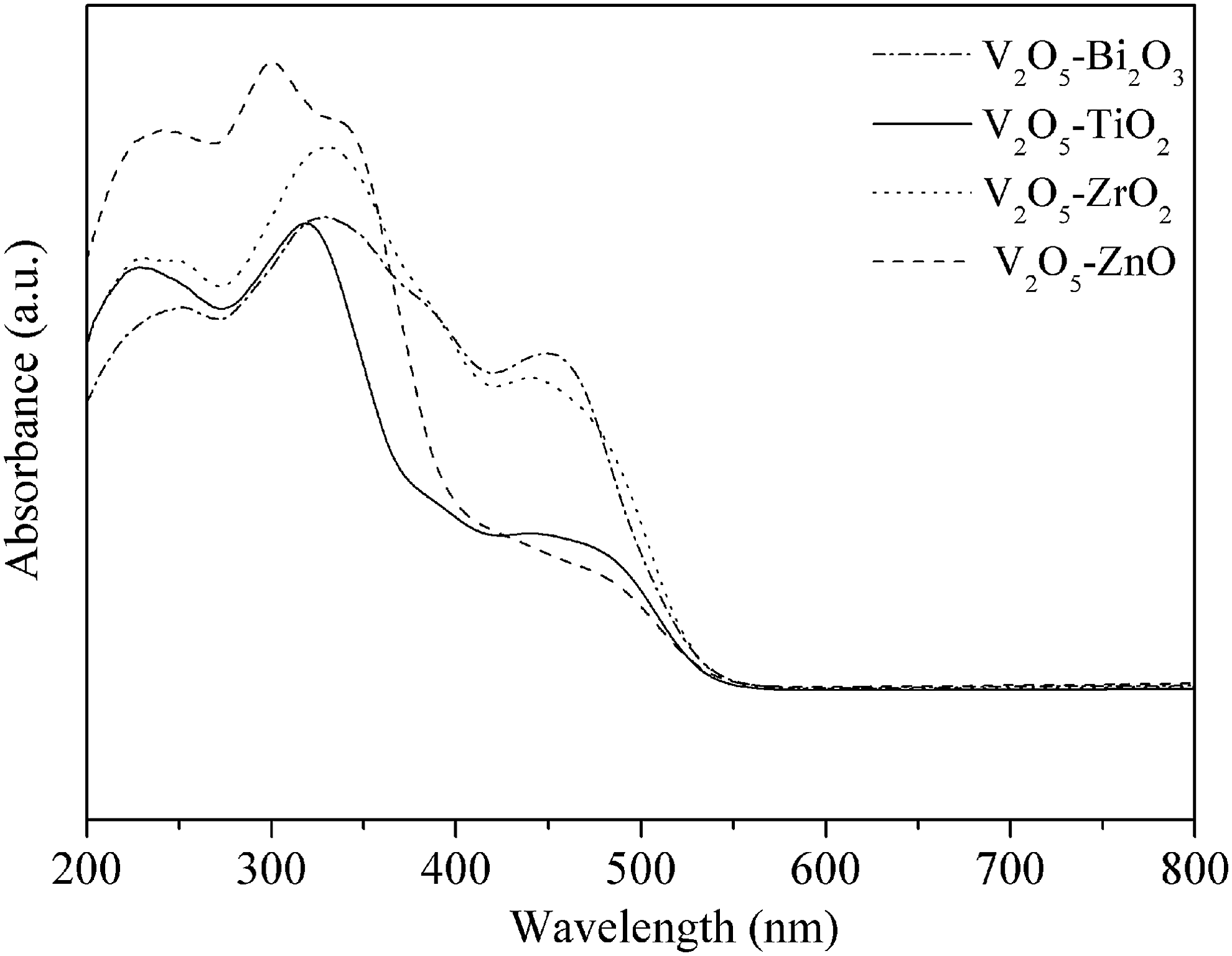
UV-vis diffuse reflectance spectra of binary metal oxides.
Figure 3 shows the PL spectra of V2O5-TiO2, (50V2O5-TiO2)-cetyltrimethylammonium bromide (CTAB), (50V2O5-TiO2)-hexadecyltrimethylammonium bromide (HTAB) , and (50V2O5-TiO2)-polyvinyl alcohol (PVA) (Liqiang et al., 2006). The PL emission is the result of the separation and recombination of excited electrons and holes. The lower PL intensity implies the decrease in recombination, thus possibly higher photocatalytic activity (Liu et al., 2007). As shown in Fig. 3, the PL spectra of 50V2O5—Bi2O3 photocatalyst showed the lower intensity. This result can be explained in that PL spectra of nano-sized semiconductor materials are greatly influenced by changing metal oxide surface structures, such as defects and oxygen vacancies. In our study, it is obviously seen that the four binary metal oxides showed similar signal curve and shape, but the possible distinction can be that they provide faster transport of charge carriers by improving the separation of photogenerated electron–hole pairs. The obtained result from PL spectra is also in good agreement with activity results.
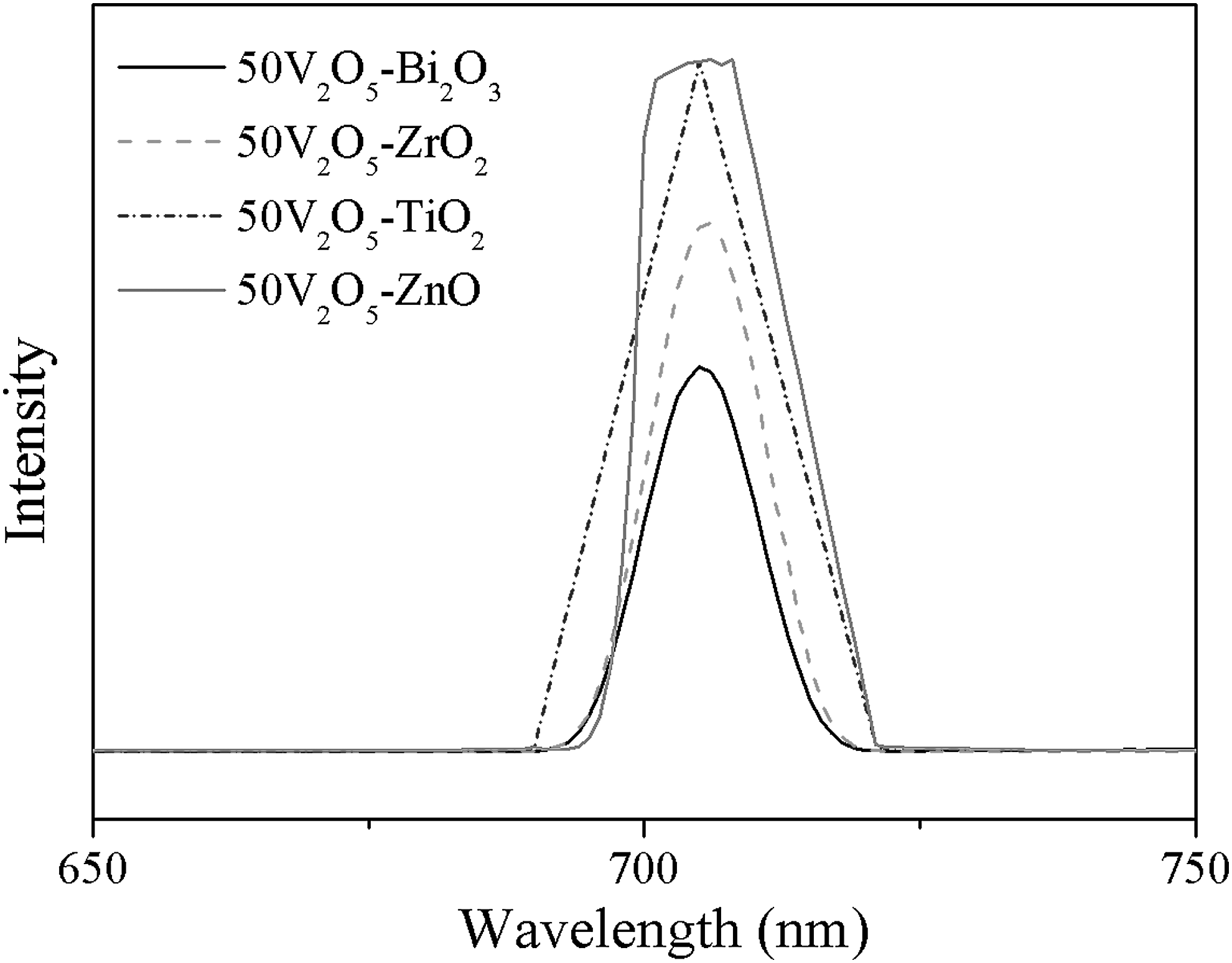
Photoluminescence spectrum of powders.
SEM analysis
SEM micrographs shown in Fig. 4 gave us more apprehension to the microstructure and morphology of the binary metal oxides. From Fig. 4a–d, we can see that 50 wt% V2O5–MxOy (M: Bi, Ti, Zn, Zr) particles exhibit irregular polyhedron-sheet binary morphologies and nonuniform diameters and shapes. In the SEM images, the obtained nanosheets can be assigned to orthorhombic V2O5. It is clearly seen from Fig. 4a that the particles formed in the nanorod shape can be assigned to monoclinic phase BiVO4, which has been proven that the photocatalytic activity in the UV region in addition to visible light region and the micrograph of Bi2O3–V2O5 sample consisted of the mixture of macro and meso structures and the agglomeration was not observed. In Fig. 4b, TiO2–V2O5 sample showed some microparticles randomly dispersed on the macrostructure. Figure 4c and d showed a similar content that two samples have an irregular particle distribution and agglomeration in their morphologies. These results are also in good agreement with XRD results. The average particle sizes of the samples were calculated to be between 24 and 46 nm. It is well known that smaller particle size with good distribution on the catalysts' surface provides more active sites and is more suitable for photocatalytic reaction (Guo et al., 2010). The activity order is in good agreement with the photocatalytic activity test results.
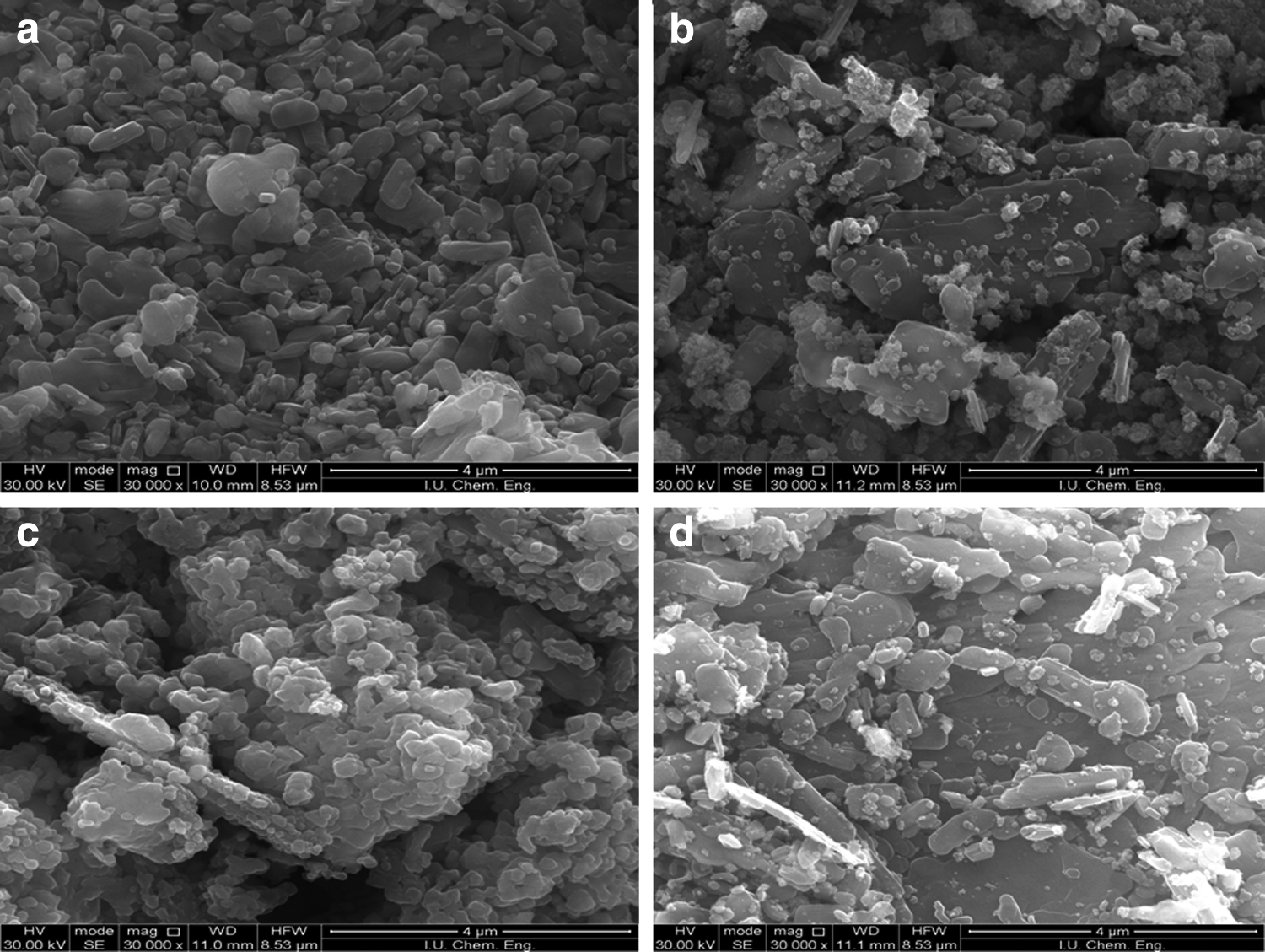
SEM images of
FTIR spectroscopy analysis
Infrared spectroscopy technology is used to detect the presence of functional groups such as hydroxyl radical (•OH) adsorbed on the surface of synthesized nanoparticles. In the photocatalytic degradation experiments, the surface OH groups can not only embrace the photogenerated holes to form hydroxyl radical (•OH), but also serve as active sites for the adsorption of reactants (Cao et al., 1999).
Figure 5 shows the FTIR transmittance spectra from 4,000 to 400 cm−1 for various binary compounds. The FTIR absorption bands at 3,432 and 1,625 cm−1 were appointed to the structural vibration of ν (O-H) groups and to the stretching vibration of δ(H2O) groups for all catalysts, respectively. Additionally, the intensive signals at around 1,400 cm−1 for all catalysts were attributed to the absorption of nonbridging O-H groups (Ivanova et al., 2010). Unlike the others, Bi2O3–V2O5 sample also showed different absorption bands at around 2,920 cm−1 corresponding to -OH stretching peak. These absorption bands may indicate that the sample has a hygroscopic character (Ghosh and Chaudhuri, 1987). The O–V–O stretching band at 844 cm−1 and the V–O stretching vibration band at 1,016 cm−1 verify the pure orthorhombic phase V2O5, which is in good agreement with other characterization methods. The low absorption band at around 850 cm−1 seemed in FTIR spectra of Bi2O3–V2O5 is the stretching vibration of Bi–O bonds in BiO6 octahedral units (Zhang et al., 2006). It also revealed that the spectra of Bi–O–V linkage showed a broad signal at 739 cm−1, which was confirmed by XRD and SEM results. The Ti–O–Ti bending vibration at 420–650 cm−1 confirmed the formation of anatase TiO2 for TiO2–V2O5. For the ZrO2–V2O5 samples, the absorption band around 600 cm−1 appeared on a shoulder on the characteristic tetragonal ZrO2 (del Monte et al., 2000), and compared with pure ZrO2, 50 wt% ZrO2–V2O5 has the same band, which indicated that the structure of ZrO2 did not change after doped on V2O5. IR spectra of 50 wt% ZnO samples of V2O5 showed a characteristic broad signal at around 477 cm−1, which could be assigned to the pure ZnO phase. The heavy bands' vibration with small intensities at around 3,750 and 1,600 cm−1 indicates that traces of organic impurities adsorbed on the surface of the catalysts.
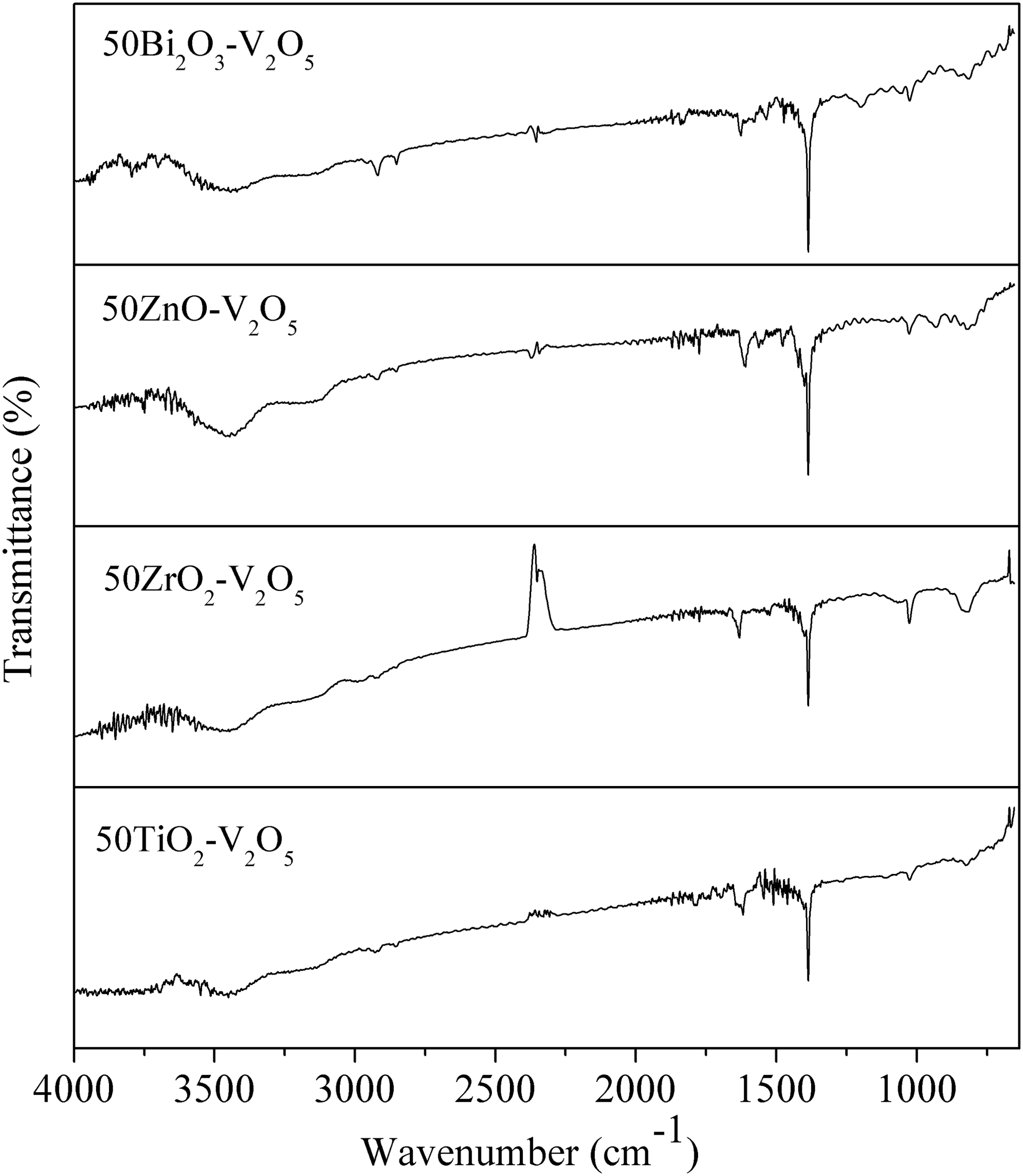
FTIR spectra of V2O5 particles prepared with different metal oxides. FTIR, Fourier transform infrared.
Evaluation of photocatalytic activities
The catalytic activities for photocatalytic degradation of BPA over prepared binary metal oxides were investigated in the presence of a trace of hydrogen peroxide under the optimized conditions. The results were compared with Degussa p25, which has proven the catalytic activity under ultraviolet illumination with 3.2 eV band gap energy.
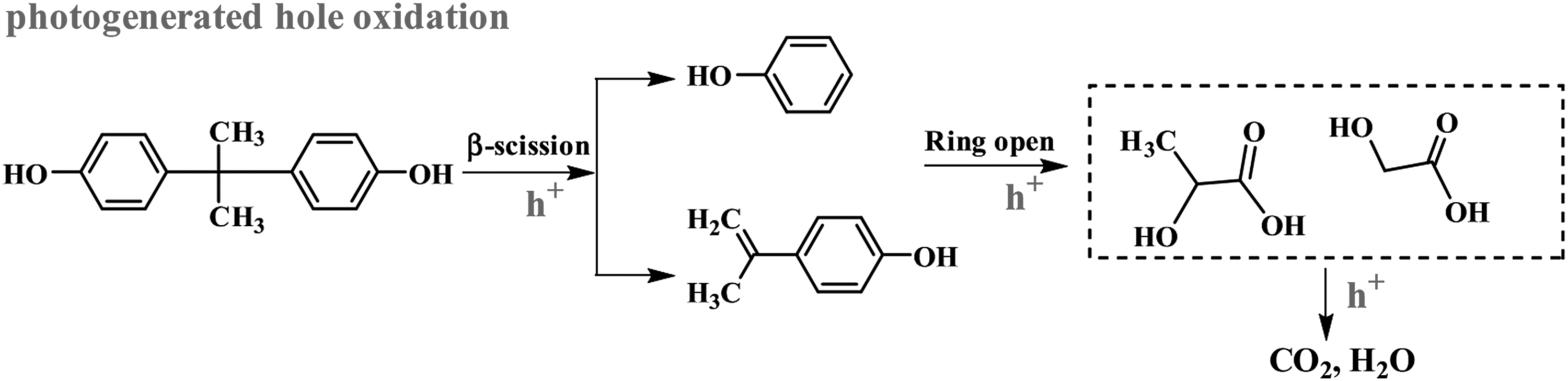
To investigate the effect of doping metal oxide on the photocatalytic activity of vanadium pentoxide in BPA degradation, four sets of experiments were carried out in aqueous BPA suspension with an initial concentration of 25 mg/L and 2 g/L of catalyst under UV-B illumination and each experiment lasted for 45 min. The obtained data from photocatalytic experiments are shown in Table 1. From the obtained result in Table 1, there is a controversy of mechanism over whether photocatalytic degradation proceeds by means of photon-generated h+, e−, •OH, •O2−, or H2O2. In this study, we aim to investigate the roles of these reactive and oxidative species in the photocatalytic BPA degradation, and photooxidation processes in the presence of a UV light-driven B photocatalysts, various metal oxides doped V2O5. For the photodegradation of BPA, the reaction primarily occurs on the photocatalyst surface with the assistance of surface-bounded reactive species (h+, •OHs, and •O2−), whereas the catalyst surface can be inactivated by diffusing reactive oxidative species, such as •OHb and H2O2, without the direct contact with the photocatalyst. The diffusing H2O2 plays the most important role in the photocatalytic oxidation, which can be produced both by the coupling of •OHb in bulk solution and •OHs on the surface of photocatalyst at the valence band. The proposed degradation mechanism is shown in Fig. 6. According to this mechanism, the degradation pathway of BPA is mainly composed of the singlet oxygen oxidation.
Reaction mechanism.
The effect of different light sources (Hg lamb, UV-B) on the photodegradation of BPA over 50Bi2O3–V2O5 catalyst was studied. Under UV-B illumination, BPA was more effectively degraded to its byproduct and carboxylic acids. It is clearly seen that the complete degradation (%100) of BPA could be achieved in 45 min, whereas only %75 conversion reached under Hg lamb illumination. Moreover, we also studied in various processes to determine the effects of adsorption (without the light exposure) with addition of H2O2, photolysis under UV-B light (no catalyst), and the degradation of BPA in the absence of H2O2 on the photocatalytic activity of 50Bi2O3–V2O5, and the results of these comparative studies are showed in Fig. 7. From the obtained degradation curves versus time, one can see that 32% and 71% of BPA could be removed for photolysis and adsorption studies, respectively, after 45 min reaction. It is probably the reason that the main operating forces for the BPA adsorption are the hydrophobic interactions and π–π interactions between the binary metal oxide particles and the aromatic rings of the BPA molecules. The effect of the presence of initial H2O2 concentration (0.3 mL) on the degradation of BPA was investigated without H2O2 under UV light illumination, and the degradation efficiency of BPA could only reach 44%. The improved photocatalytic activity of the binary metal oxides in the presence of H2O2 is referred to form the reactive radical intermediates (•OH) from the oxidants by reaction with photogenerated electrons (Yao et al., 2004).

Comparison of photolysis, photocatalysis, and adsorption studies of BPA with 50Bi2O3–V2O5. BPA, bisphenol A.
Performance of Bi2O3–V2O5 catalysts with a series of different Bi2O3 loadings (10, 50, 90) was also studied to understand the influence of loading on the catalytic activity of binary oxide catalyst. According to these results, the 50 wt% Bi2O3–V2O5 showed the highest degradation percentage of BPA (100%), but when the percentage of the doped Bi2O3 was increased to 90 wt%, the degradation efficiency of BPA was slightly decreased by 94%. Also, BPA degradation decreases from 94% to 86% when the 10 wt% Bi2O3 is mixed with V2O5. It can be explained that when we used a low percentage in doping rate, the heterostructures on Bi2O3–V2O5 surface can be slightly formed, resulting in the poor photocatalytic activity. While the doping rates exceed 50 wt%, the overall distance between trapping carriers is reduced, so that the recombination of electrons and holes increases, thus the photocatalytic activity is decreased (Liu et al., 2015).
Photocatalytic degradation percentages of BPA for four prepared binary samples and pure V2O5 and Bi2O3 under the optimal operation condition were listed in Table 1 and the obtained degradation curves of BPA concentration (C/C0) versus time were plotted in Fig. 8a. The photocatalytic degradation rates of the BPA in 45 min with the binary metal oxides are sorted in descending order: 50Bi2O3–V2O5 (∼100%), 50TiO2–V2O5 (∼94%), 50ZrO2–V2O5 (∼73%), and 50ZnO–V2O5 (∼50%). Obviously, 50Bi2O3/V2O5 is the most active photocatalyst for the degradation of BPA. These results are indicating that adsorbed •OH radicals on the catalysts were extremely involved in the photodegradation of BPA. A slight difference in the efficiency during the photocatalytic degradation of BPA could be clarified by means of free •OH radicals that were to a small extent involved in the process of photodegradation (Chen et al., 2005).

Photocatalytic activities of the binary metal oxide samples under UV irradiation
Figure 8b exhibited the TOC concentration of BPA by four novel binary oxides under UV light irradiation. It is clearly seen that TOC removal value for BPA solution after photodegradation experiment by 50V2O5–Bi2O3 was totally higher than other binary oxides. The mineralization efficiencies of BPA by using 50Bi2O3–V2O5, 50TiO2–V2O5, 50ZrO2–V2O5, and 50ZnO–V2O5 were 98%, 85%, 68%, and 63%, respectively. These results are indicating that reaction byproducts are formed and not totally degraded at the end of this experiment with BPA, except for 50Bi2O3–V2O5 (there was only a slight amount of byproducts).
In addition, the reusability of the 50V2O5–Bi2O3 catalysts was studied on fresh dye samples (five trials). 50V2O5–Bi2O3, when used for the first time, could degrade 98.51% BPA, with a small change (to 94.35%) in the efficiency when used five times. This decrease in the efficiency for 50V2O5–Bi2O3 catalyst resulted probably from the photocorrosion effect.
The obtained photocatalytic activity result showed that not only the crystallinity, surface area, band gap, and surface OH group of catalyst but also the chemical interactions between V2O5 and Bi2O3 in the binary structure effect the photocatalytic degradation rate of BPA. Unlike the other prepared binary metal oxide catalysts, 50Bi2O3–V2O5 only showed the third phase as BiVO4, which was clarified in detail with XRD and SEM analysis. Probably as a result of this different interaction, 50Bi2O3–V2O5 provided the maximum activity to degrade the BPA in 45 min.
Shin et al. (2000) investigated the behavior of lattice oxygen in mixtures of V2O5 and Bi2O3. Physical mixtures of Bi2O3–V2O5 were prepared by facile mixing the two oxides in a mortar in different mole ratios (V:Bi = 1:4, 1:1, and 4:1 mole ratio). They inferred that the promoted evolution of lattice oxygen by the interaction between V2O5 and Bi2O3 provided the phase transformation of the oxides, and by means of this synergic effect between two oxides, the catalytic activity increased in the oxidation reactions. Additionally, they recognized that when the calcination temperature was increased up to 500°C, binary oxide (BiVO4) was formed in a small amount. This is in good agreement with our results.
According to a heterogeneous photocatalytic reaction process, the photocatalytic degradation rate of BPA at the liquid–solid interface can be defined by the Langmuir–Hinshelwood kinetic model (Xu and Langford, 2000):
where r0 is the initial rate [mg/(L·min)], kr is the intrinsic rate constant [mg/(L·min)], Ka represents the Langmuir adsorption constant (L/mg), and C is the concentration of BPA (mg/L). The relationship can be adapted pretty well with Langmuir–Hinshelwood kinetics, demonstrating that the photocatalytic degradation of BPA by the binary metal oxides is a surface-mediated catalytic reaction. As shown in Table 1, the kr value for BPA degradation under UV-B illumination by 50 wt% Bi2O3–V2O5 is the highest value (2.77 mg/L.min) among the other binary oxides. Additionally, it is significant to know that there are no catalysts having a higher value for the adsorption constant (Kads) of BPA than 50Bi2O3–V2O5 (0.916 L/mg), indicating that 50Bi2O3–V2O5 has the highest affinity on BPA and can readily catalyze the photodegradation of BPA under UV light illumination.
To determine the degradation products of BPA, HPLC analysis was performed in the same time intervals with photocatalytic oxidation of BPA. In the photocatalytic degradation of BPA with metal oxides, various byproducts such as phenol, p-hydroquinone, p-isopropenylphenol, p-hydroxybenzaldehyde, and 4-hydroxyphenyl-2-propanol are among the most common intermediate products (Horikoshi et al., 2004). In our experiment performed with 50Bi2O3–V2O5, phenol, hydroquinone (4-hydroxyphenol), and ring-opening products (others) were detected as the main intermediate products and the concentration variation curves of these products are shown in Fig. 9a. The concentrations of phenol and hydroquinone increased to 2.11 and 2.55 mg/L until the first 10–15 min, and afterward decreased to 0.22 and 1.66 mg/L, respectively. Besides, the ring-opening products were a high concentration in 50Bi2O3–V2O5 system. On the other hand, when we used pure V2O5, the concentrations of ring-opening products (others) decreased while the concentrations of phenol and hydroquinone were increasing in reaction time (Fig. 9b). In this content, we can say that the addition of Bi2O3 on pure V2O5 enhanced the selectivity toward further degradable product (others) and changed the reaction mechanism. These results demonstrated a good agreement with TOC measurements. These observed intermediates were probably further oxidized through ring-rupturing reactions into aliphatic compounds containing formic acid, acetic acid, and butyric acid (Horikoshi et al., 2004). Eventually, the mineralization reactions of these aliphatic compounds to carbon dioxide and H2O also occurred by means of a chemical reaction that removes a COOH (carboxyl group) and translates with a proton (decarboxylation).

Concentration profiles for degradation products of BPA with
These results may also indicate that the photochemical degradation reaction plays a crucial role for the degradation of BPA under these optimal conditions. A difference in electron or hole energy levels between the two oxides could lead to increase in the charge separation, which would result in an increase in photocatalytic reaction rates. Further morphological studies are deemed necessary to define the degradation rate enhancement mechanism accurately.
Conclusion
It is clearly concluded that the binary metal oxides synthesized with solid state dispersion methods showed a good photocatalytic activity under UV-vis light irradiation. The photons of the UV-vis light induce the surface defects in the metal oxide doped V2O5 particles which conduct as an excited electron trap and transfer centers for the generation of superoxide anion radicals playing a crucial role for the degradation of BPA.
BPA degradation percentages under the optimal conditions are sorted in descending order: 50Bi2O3–V2O5 (∼100%), 50TiO2–V2O5 (∼94%), 50ZrO2–V2O5 (∼73%), and 50ZnO–V2O5 (∼50%) in 45 min. From the activity result, the degradation rate of BPA with these binary oxide crystals illustrated that the particle size and distribution play an important role through decreasing the surface area and increasing the available surface active sites. As mentioned previously, these deductions were also confirmed by SEM, BET, and XRD analyses.
Furthermore, 50 wt% Bi2O3–V2O5 catalysts showed the highest BPA degradation reaction rate [2.77 mg/(L·min)] and TOC removal value (∼98%), which is a measurement of mineralization effectiveness. This highest activity of Bi2O3–V2O5 could be attributed to be formed V–O–Bi (BiVO4) as a result of chemical interaction between V2O5 and Bi2O3.
Eventually, to use the binary metal oxides in the photocatalytic degradation of phenolic compounds may increase the catalytic activity. In conclusion, we can say that among the other parameters (the crystallinity, surface area, band gap, and surface OH group of catalyst) affected the photocatalytic activity, and chemical interaction between two metal oxides has a high importance in the binary oxide under our experimental conditions.
Footnotes
Acknowledgment
This work was supported by the Scientific Research Projects Coordination Unit of Istanbul University.
Author Disclosure Statement
No competing financial interests exist.