




Abstract
Abstract
To develop a technology for the degradation of the toxic and refractory pollutants contained in landfill leachate reverse osmosis (RO) concentrate, a γ-Al2O3/O3 system was set up in this study. Landfill leachate RO concentrate was rejected from RO of biologically pretreated raw landfill leachate. First, its key operational parameters, including γ-Al2O3 dosage, ozone dosage, reaction temperature, treatment time, and initial pH value, were optimized through single-factor experiments. Under the optimal conditions, the chemical oxygen demand (COD) (70%) and color (100%) removal efficiencies could be obtained by the γ-Al2O3/O3 process. Meanwhile, the ratio of biochemical oxygen demand (BOD5) to COD (B/C ratio) was enhanced from 0.01 to 0.2, which suggests that its biodegradability was improved to some extent. Decomposition or transformation of organic pollutants in landfill leachate RO concentrate was analyzed by ultraviolet-visible spectroscopy, excitation–emission matrix fluorescence spectroscopy, and fourier transform infrared (FTIR) spectroscopy. Furthermore, the synergetic effect between ozone and alumina was investigated. Collectively, these analyses suggest that γ-Al2O3/O3 process will be a promising technology for the treatment of landfill leachate RO concentrate if the problem of the desorption of pollutants could be solved economically.
Introduction
L
Plenty of treatment technologies, including physical–chemical process (Chu et al., 2015; Kattel et al., 2016; Silva et al., 2016, 2017; Jung et al., 2017; Kattel and Dulova, 2017) and biological treatment (Ahmed and Lan, 2012; Chys et al., 2015; Syron et al., 2015), has been investigated to treat the landfill leachate. Biological processes are commonly used to treat landfill leachate due to its low cost. However, biological processes may not be effective enough to treat the refractory and hazardous organic contaminants contained in landfill leachate (Fernandes et al., 2015).
As a result, membrane filtration technologies, including membrane bioreactor, nanofiltration (NF), and reverse osmosis (RO), as a main posttreatment step in leachate treatment, seem to be one of the most promising and efficient methods for the treatment of landfill leachate (Renou et al., 2008; Hasar et al., 2009; Wang et al., 2014; Zayen et al., 2016). However, the generation of toxic and biorefractory landfill leachate RO concentrate was the major problem of these processes. Therefore, proper treatment of landfill leachate RO concentrate is helpful to avoid the secondary pollution of the above processes (i.e., NF and RO).
Currently, many physicochemical methods, including noncatalytic wet oxidation (Oulego et al., 2015), electrochemical advanced oxidation process (Moreira et al., 2016), photo-Fenton (Barndõk et al., 2016), Fenton process (Gupta et al., 2014), activated carbon adsorption (Kurniawan and Lo, 2009), Fenton-like process (Martins et al., 2012), microwave-enhanced persulfate oxidation (Chou et al., 2015), were proposed for the treatment of the recalcitrant pollutants contained in wastewater.
To degrade the toxic and refractory pollutants contained in landfill leachate RO concentrate, many methods have been investigated, such as solidification/stabilization process (Hunce et al., 2012), Fenton process (Wu et al., 2011), electro-peroxone process (Li et al., 2013), electrochemical oxidation (Zhou et al., 2016), and anodic oxidation combined with electro-Fenton processes (Labiadh et al., 2016). However, these processes suffer the limit of high cost or low efficiency.
In recent years ozonation has been applied widely in the oxidation treatment of landfill leachate (Bila et al., 2005; Ntampou et al., 2006; Chys et al., 2015; Oloibiri et al., 2015; Amaral-Silva et al., 2016). However, Jung and his colleagues had found that Fenton oxidation exhibited a better treatment performance than ozonation due to the production of unselective and more active oxidants [i.e., hydroxyl radicals (HO•)], and O3 tended selectively reacted with the organics in landfill leachate (Jung et al., 2017). Compared with ozone (E0 = 2.07 V), HO• is a stronger oxidant (E0 = 2.33 V) (Kasprzyk-Hordern et al., 2003).
Furthermore, the catalytic ozonation with the catalyst (e.g., Al2O3, FeOOH, MnO2, CeO2) was developed to enhance the oxidation capacity of ozonation (Nawrocki and Kasprzyk-Hordern, 2010). In other words, ozone can be decomposed into the reactive oxygen species (ROS), including O• and HO• on the surface of the catalyst. For example, Vittenet et al. reported the involvement of HO• during catalytic ozonation with γ-Al2O3 for the treatment of 2,4-dimethylphenol (2,4-DMP), and its total organic carbon removal was 32% higher than single ozonation process under the operational condition: 2,4-DMP0 = 50 mg/L, γ-Al2O3 dosage = 2 g/L, O3 flow rate = 40 L/h, treatment time = 5 h, volume of solution = 1.5 L (Vittenet et al., 2015).
According to the previous reports, possibility reaction mechanism of γ-Al2O3/O3 process has been proposed. On the one hand, γ-Al2O3 was able to adsorb ozone and to decompose it into free radicals by interacting with the hydroxyl groups of the materials (Vittenet et al., 2015). Compared with ozone, free radicals are unselective and more active oxidants. On the other hand, some pollutants were adsorbed on the surface of γ-Al2O3 then attacked by the adsorbed ozone directly (Qi et al., 2013). Therefore, the catalytic ozonation with γ-Al2O3 may have a better treatment efficiency for the landfill leachate RO concentrate compared with ozonation.
In this study, a catalytic ozonation with γ-Al2O3 was set up to decompose the toxic and refractory organics in landfill leachate RO concentrate. First, the key operational parameters (e.g., γ-Al2O3 dosage, O3 dosage, initial pH, reaction temperature, and treatment time) were optimized through single-factor experiments. Furthermore, two control processes (i.e., γ-Al2O3 alone and O3 alone) were set up to confirm the high treatment efficiency of catalytic ozonation with γ-Al2O3. Meanwhile, ultraviolet-visible (UV-vis), excitation–emission matrix (EEM), fourier transform infrared (FTIR) spectra, and B/C ratio were used to evaluate the degradation of the organic pollutants in landfill leachate RO concentrate and its improvement of biodegradability. Finally, the operational life and catalytic mechanism of γ-Al2O3 were investigated thoroughly.
Experimental Protocols
Reagents
γ-Al2O3 particles from Chengdu Kelong chemical reagent factory were used in the experiment, whose diameter was ∼50 μm and Brunner–Emmet–Teller (BET) surface area was about 172.7 m2/g. The pHpzc of γ-Al2O3 was about 8.5. All the chemicals used in the experiment were analytical grades. Deionized water was used throughout the whole experiment process.
Landfill leachate RO concentrate
Landfill leachate RO concentrate used in this study was obtained from an old landfill site (over 10 years) located in southwest China, which was rejected from RO of biologically pretreated landfill leachate (chemical oxygen demand [COD] = 372 mg/L). Its environmental characterizations are shown in Table 1.
BOD5, biochemical oxygen demand; COD, chemical oxygen demand.
Batch experiments
During the γ-Al2O3/O3 treatment system, the key effect factors, such as γ-Al2O3 dosage, ozone dosage, and initial pH of landfill leachate RO concentrate, were investigated thoroughly through batch experiments.
In each batch experiment, 300 mL landfill leachate RO concentrate with different adjusted initial pH (3.0–10.0), alumina powders (0–50.0 g/L) were added in a 500 mL flat bottom beaker, and the reaction solution was stirred by a mechanical stirrer with a speed of 300 r/min. Simultaneously, ozone gas was generated onsite from pure compressed dry oxygen (99.9%, v/v) by a laboratory model ozone generator (10 g/h; Chengdu Yifeng Co., Ltd., China) and continuously dispersed into the reacting solution through a gas diffuser. And the concentration of the generated ozone was about 53.88 mg/L. After the treatment process of 30 min, the solution samples were withdrawn and filtered through a polytetrafluoroethylene (PTFE) syringe filter disc (0.45 μm); some of the samples were diluted by deionized water if necessary.
Finally, COD, UV-vis, and EEM spectra of the samples were measured, respectively. All experiments were carried out in triplicate.
Analytical methods
Transition metal ions and chloride contained in landfill leachate RO concentrate were determinated by inductively coupled plasma mass spectrometry (ICP-MS) (NexION 300X; Perkin Elmer) and ICS-90 (Daian, China), respectively. COD and biochemical oxygen demand (BOD5) were determined using COD analyzer (Lianhua, China) and BOD5 analyzer (OxiTop IS12, WTW, Germany), respectively. The initial pH and the pH of the effluent were measured by pHS-3C meter (Rex, China).
The UV-vis spectra (Shimadzu, Japan) of the influent and effluent were carried out in 10 mm quartz cuvettes, and the UV-vis spectra were recorded from 190 to 450 nm using deionized water as blank. The EEM spectra were measured by a luminescence spectrometry (F-7000 spectrophotometer, Hitachi, Japan), and the EEM spectra were collected with the corresponding scanning emission spectra from 200 to 550 nm at 5 nm increments by varying the excitation wavelength from 200 to 400 nm at 5 nm sampling intervals. The excitation and emission slits were kept at 10 nm, and the scanning speed was set at 1,200 nm/min (Ren et al., 2016).
Meanwhile, all samples were filtered and diluted 100 times by ultrapure water before the analysis of EEM fluorescence spectroscopy. FTIR was used to assess the differences in general functional groups of organics that exist in the influent and effluent of landfill leachate RO concentrate, as well as on the surface of γ-Al2O3. Samples were dried and grinded with KBr in a motor with 1:100 rations. The power mixture was compressed into tablet under 10 t force for 1 min. And each sample was scanned four times between the wavelengths of 4,000–500 cm−1 using a Nicolet 6700 FTIR spectrometer (Ren et al., 2016). Colority of the samples was measured using dilution ratio method. Ozone concentration was measured by the iodometric method (Xiong et al., 2016b).
The alkalinity and bicarbonate of the landfill leachate RO concentrate were measured by chemical method of analysis. The BET surface area of γ-Al2O3 was detected by a surface area analyzer (ASAP 2020; Micromeritics). The pHpzc of γ-Al2O3 was determined by mass titration method as described by Ikhlaq (Ikhlaq et al., 2012).
Results and Discussion
Influence of operational parameters on performance in γ-Al2O3/O3 system
Effects of γ-Al2O3 dosage on COD removal
Batch experiments were conducted on a condition that different dosages of γ-Al2O3 were used to treat 300 mL landfill leachate RO concentrate with the initial pH (7.3) and 16.5 mg/min of O3 for 30 min at temperature 30°C.
As shown in the Fig. 1a, the COD removal efficiency of landfill leachate RO concentrate was enhanced from 28% to 60% with the increasing of γ-Al2O3 dosage from 0 to 50 g/L. However, the γ-Al2O3 dosage was not a limited factor when it reached 50 g/L. For example, when γ-Al2O3 dosage was further increased to 80 g/L, only 62% of COD removal efficiency was obtained. The increase of γ-Al2O3 dosage would increase its total surface area and number of active sites, which could improve its adsorption and catalytic capacity. Thus the rapid increase of COD removal was mainly attributed to the combined action of adsorption and catalytic ozonation.

Effects of γ-Al2O3 dosage
The similar results have been found by Vittenet and his colleagues when catalytic ozonation with γ-Al2O3 was used to degrade the refractory organics in water (Vittenet et al., 2015). Thus the γ-Al2O3 dosage of 50 g/L was chosen in the following experiments.
In addition, Fig. 1a also shows that all the effluent pH values of the batch experiments with different γ-Al2O3 dosage (0–80 g/L) were similar to their initial pH (=7.3) after 30 min treatment. The results suggest that accumulation of the organic acids as intermediates did not occur after 30 min treatment (Kasprzyk-Hordern et al., 2003; Zhao et al., 2008; Nawrocki and Kasprzyk-Hordern, 2010). The generated organic acids might be further decomposed rapidly or adsorbed by γ-Al2O3. The carboxylates can be adsorbed and accumulated on γ-Al2O3, which could decrease its Al-OH basic sites and catalytic activity (Pocostales et al., 2011; Vittenet et al., 2015).
Effects of O3 dosage on COD removal
Since the consumption of ozone was a crucial parameter for the operating cost and treatment efficiency, it is necessary to optimize O3 dosage. Figure 1b shows that the COD removal efficiency increased rapidly from 27% to 70% with the increasing of O3 dosage from 0 to 22 mg/min and then it elevated slowly when O3 dosage exceeded 22 mg/min. An increase of ozone concentration could improve the generation of HO•, which could accelerate the decomposition of the pollutants in landfill leachate RO concentrate. Meanwhile, the pollutants can also be transformed directly by the ozone. Nevertheless, the degradation of the pollutants was dominantly controlled by the rate of chemical reaction when the ozone concentration in the liquid phase approached its maximum value at a fixed temperature (Ruan et al., 2010).
According to the previous research (Xiong et al., 2016a), we can obtain the general concentration of dissolved ozone indirectly based on COD removal efficiency. Figure 1b shows that the COD removal efficiency remained unchanged when the O3 dosage is above 33 mg/min. That is to say, the dissolved ozone in solution was almost saturated when the O3 dosage is above 33 mg/min. The further increase of ozone dosage (>22 mg/min) had no significant contribution to the degradation of pollutants. Therefore, the ozone dosage of 22 mg/min was chosen in the subsequent experiments from the economical strategy and practical point of view.
Effects of initial pH on COD removal
Figure 1c shows that the COD removal efficiency (∼70%) was maintained when the initial pH increased from 3.0 to 7.3, but it dropped to 57% rapidly when the initial pH reached 10.0. In γ-Al2O3/O3 system, contributions to the COD removal efficiency came from following parts: (I) the ozonation effect in aqueous solution, (II) reactions between the ozone and organic compounds after they were adsorbed on the surface of γ-Al2O3 and became concentrated (Qi et al., 2013), and (III) the γ-Al2O3 adsorption effect of the oxidation by-products produced by ozone in aqueous solution (Aboussaoud et al., 2014). It is well known that the presence of OH− ions in water leads to ozone decomposition and generation of HO•, which then reacts with organics in a nonselective way (Ikhlaq et al., 2012).
Therefore, the contribution to COD removal efficiency of part (I) was improved to some extent with the increasing of pH. Pollutants occur in the landfill leachate RO concentrate and the intermediates from ozonation process contain many carboxyl groups. Under alkaline condition, these carboxyl groups are under carboxylate form. Carboxylates can hardly be adsorbed on the surface of γ-Al2O3, which is fully populated with OH− ions when the pH of solution is above its pHPZC (∼8.5) (Ikhlaq et al., 2012). Therefore, the contributions to COD removal efficiency of part (II) and part (III) were reduced strongly. At last, the total COD removal efficiency decreased when the pH is above γ-Al2O3 pHPZC during γ-Al2O3/O3 process.
Meanwhile, some constituents of the landfill leachate RO concentrate had scavenging effects, such as CO32−, HCO3− (Vicente et al., 2011; Zhao et al., 2016). Under neutral or acidic condition, the solution contained less or little CO32−, HCO3−, so the γ-Al2O3/O3 system could accumulate more HO• and obtain a better COD removal efficiency. Therefore, the initial pH 7.3 without any adjustments was chosen in the subsequent experiments from the economical strategy and practical point of view.
Effects of reaction temperature on COD removal
Experiments were carried out with different reaction temperatures (i.e., 20–70°C). Figure 1d shows that the high COD removal efficiency (∼69%) was maintained when the reaction temperature was between 20°C and 60°C, while it dropped rapidly to 58% when the reaction temperature reached 70°C. The phenomenon is attributed to two reverse factors of the reaction temperature in catalytic ozonation process.
First, high activation energy of diffusion-controlled or chemical-controlled reactions could be overcome when the treatment process was carried out under the higher operating temperature (Lien and Zhang, 2007). In other words, the high reaction temperature usually could facilitate the chemical reactions, which enhance the degradation efficiency of pollutants (Ahn et al., 2008). Second, the increasing reaction temperature would also lead to a decrease of ozone solubility in aqueous phase of the catalytic ozonation process and then impair the COD removal efficiency. The above two opposite effects compete with each other with the increase of reaction temperature.
However, the dominant reaction mechanism was controlled by the second factor when the temperature reached 70°C, which resulted in the decrease of treatment efficiency. Consequently, the room temperature (30°C) was chosen in the following experiments from the economical point of view.
Effects of treatment time on COD removal
The landfill leachate RO concentrate was treated for 120 min by γ-Al2O3/O3 process in this experiment. Figure 1e shows that the COD removal efficiency reached 70% only after 30 min treatment. However, the COD removal efficiency just reached 86% at the cost of fourfold treatment time and ozone dosage. Since the fourfold treatment time would cause much more treatment cost, the optimal treatment time should be 30 min.
Control experiments
To compare the effects of three processes (γ-Al2O3 adsorption, O3 oxidation alone, and the combination of γ-Al2O3 and O3), three control experiments and a sequential treatability experiment were conducted under the above optimal conditions (COD0 = 1,317.5 mg/L, γ-Al2O3 dosage of 50 g/L, O3 dosage of 22 mg/min, initial pH of landfill leachate RO concentrate without any adjustments, reaction temperature of 30°C, and the treatment time of 30 min) in triplicate. The sequential treatability experiment was that first treated landfill leachate RO concentrate with γ-Al2O3 alone and then ozonized the γ-Al2O3 treated effluent.
Degradation of the pollutants and its improvement of biodegradability
Figure 2a shows that the COD removal efficiency obtained by γ-Al2O3/O3 process (70%) was higher compared with γ-Al2O3 (27%) and O3 (48%). The COD removal efficiency of the sequential treatability experiment was 70%, which is equal to γ-Al2O3/O3 process. It could be illustrated that the removal efficiency by O3 alone was enhanced by transition metal ions originally contained in landfill leachate RO concentrate.
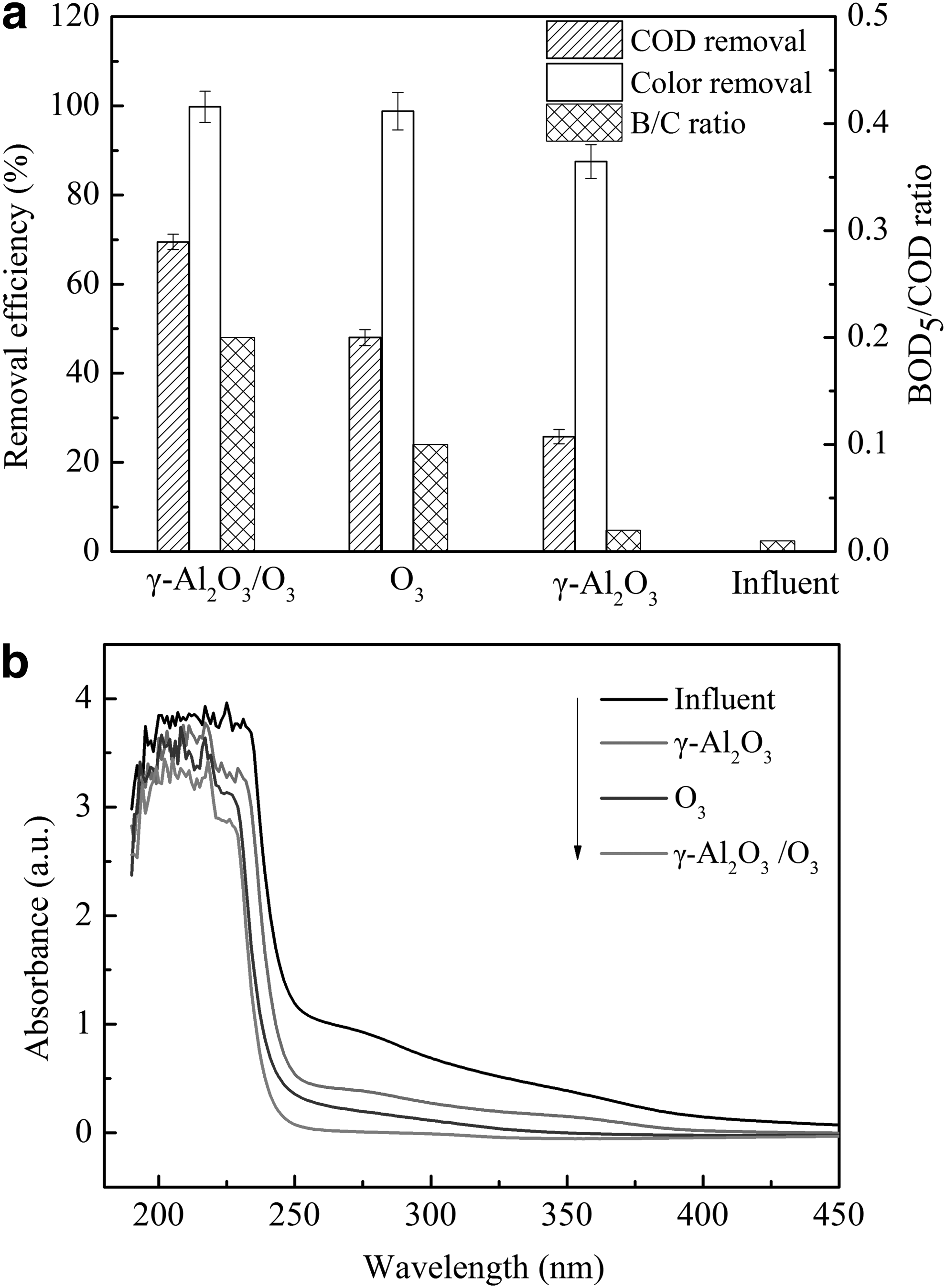
COD removal and color removal efficiencies, BOD5/COD ratios
Transition metal ions of Co2+, Ni2+, Cu2+, Zn2+, Fe2+, Cd2+, Cr3+ in landfill leachate RO concentrate were determinated by ICP-MS and the concentrations of them are as shown in Table 1. The effect of transition metal ions on catalysis of ozone was studied in previous literatures (Kasprzyk-Hordern et al., 2003). Furthermore, the adsorption COD of γ-Al2O3 alone process was 356 mg/L, which also had contribution to the removal of the pollutants.
Recalcitrant matter transformation could be determined by analyzing color changes during the treatment. The initial dark brown color of the landfill leachate RO concentrate, which can be attributed to the presence of humic substances, became light yellow or even colorless by γ-Al2O3 process, γ-Al2O3/O3, and O3 process, respectively. In addition, Fig. 2a shows the color removal efficiencies obtained by γ-Al2O3/O3 process (100%), O3 alone (99%), γ-Al2O3 alone (88%), which suggested that the decolorization of landfill leachate RO concentrate was primarily attributed to the combination of ozone oxidation and adsorption of γ-Al2O3. Within a short time, ozone could directly attack the carbon-double bonds in the chromophoric and product compounds like aliphatic acids, ketones, and aldehydes, which are colorless, thus increase the color removal efficiencies (Ntampou et al., 2006).
Figure 2a shows that the B/C ratio was increased from 0.01 to 0.2 after 30 min treatment by γ-Al2O3/O3 process under the optimal conditions, which was higher compared with O3 alone (0.1) and γ-Al2O3 alone (0.02). The result indicates that the toxic and refractory pollutants in landfill leachate RO concentrate could be effectively degraded or transformed by γ-Al2O3/O3 process, and its biodegradability was improved to some extent, which could facilitate the subsequent biological treatment. Meanwhile, the higher B/C ratio (0.2) obtained by γ-Al2O3/O3 process was mainly attributed to the catalytic action of γ-Al2O3 and transition metal ions originally contained in landfill leachate for the decomposition of ozone.
UV-vis analysis
After 30 min treatment under the optimal conditions, the changes in UV-vis absorbance characteristics of influent and effluents by the γ-Al2O3/O3 process and two control experiments from 190 to 450 nm are shown in Fig. 2b. With regard to the UV-vis spectrum of the landfill leachate RO concentrate, the absorbance peaks at the wavelength of about 190 nm can be assigned to the C═O or —OH. The strong peaks between 220 and 230 nm represent the C═C conjugated bond. Meanwhile, the weaker adsorption intensities above 255 nm are related to C═C aromatic group (Mecozzi et al., 2009).
Figure 2b shows that all the adsorption peaks (190–450 nm) of the three effluents were reduced to some extent, but the intensity of the adsorption between 250 and 450 nm has decreased to 0 in the γ-Al2O3/O3 system, which suggests that almost all the aromatics were adsorbed, decomposed, or transformed. Therefore, the residual peaks located between 190 and 250 nm probably due to the by-products (i.e., aldehydes, ketones, and esters) after the decomposition and transformation of the aromatic pollutants (Xu et al., 2008). In addition, the intensity of all the peaks for the effluent of the γ-Al2O3/O3 system was much lower compared with the two control experiments. The results also confirm that the γ-Al2O3/O3 system had a higher treatment efficiency for the landfill leachate RO concentrate.
EEM spectral analyses
EEM fluorescence spectroscopy is a rapid and sensitive technique for the analysis of dissolved organic matter, and it had been used to detect the transformations of aromatic pollutants in previous works (Shao et al., 2009; Wu et al., 2012; Xi et al., 2012).
Figure 3 shows the EEM spectra of the influent and effluents of the γ-Al2O3/O3 process and two control experiments. Their fluorescence parameters and total fluorescence intensities are listed in Table 2. Three peaks were identified for the landfill leachate RO concentrate; peak A (λex/λem = 320/405 nm), peak B (λex/λem = 275/410 nm), and peak C (λex/λem = 250/450 nm) are attributed to biorefractory humic-like materials (He et al., 2011; Xi et al., 2012). Peak D (λex/λem = 225/327 nm) fell in the region defined by shorter excitation wavelength (<250 nm), and shorter emission wavelength (<350 nm) is related to the aromatic protein region (Shao et al., 2009).
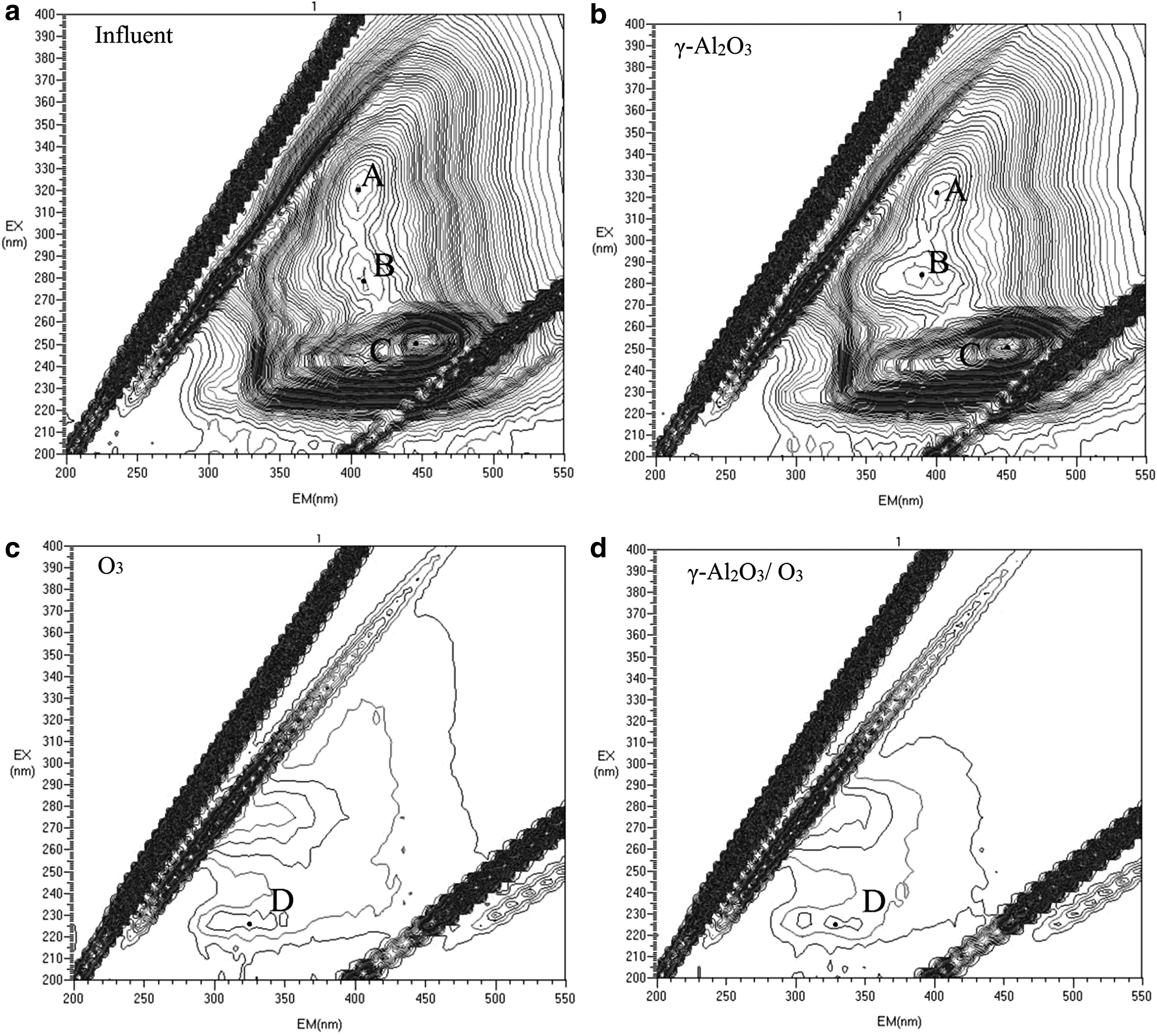
Excitation–emission matrix spectra of the influent
ITotal = IA+ IB+ IC+ ID, COD0 = 1,317.5 mg/L, γ-Al2O3 dosage = 50 g/L, O3 dosage = 22 mg/min, initial pH = 7.3, reaction temperature = 30°C, treatment time = 30 min.
As shown in Table 2, the total fluorescence intensity removal efficiency (14%) was obtained in γ-Al2O3 alone process. Meanwhile, the intensities of peak A, peak B, and peak C were decreased to some extent and no new peaks appeared. The results confirm that the γ-Al2O3 shows the ability of adsorption in γ-Al2O3 alone process. As shown in Fig. 3c, d, three initial peaks disappeared and a new peak named peak D appeared after the treatment by ozone alone or the γ-Al2O3/O3 process.
According to Table 2, the fluorescence intensity removal efficiencies by O3 process (98%) and γ-Al2O3/O3 process (98%) were obtained, which suggested that both of them had great abilities for the removal of fluorescence compounds. According to the previous work, it can be proposed that the fluorescence compounds could be degraded by destructing conjugated structure of the pollutants (He et al., 2011). Because landfill leachate RO concentrate contains transition metal ions (i.e., Co2+, Ni2+, Cu2+), an all-right fluorescence intensity removal efficiency could be obtained by O3 process without γ-Al2O3.
FTIR spectra analysis
Figure 4 shows the FTIR spectrum of the landfill leachate RO concentrate. According to prior literatures (Hua et al., 2013; Yang et al., 2015; Lenz et al., 2016; Li et al., 2016), these absorbance bands could be interpreted as follows: the board and intense band at 3,435 cm−1 is due to the O—H stretching of hydroxyl and carboxyl groups and the N—H stretching of amide.

FTIR spectra of 500–4,000 cm−1 region of influent
The methyl/methylene C—H stretching bands typically appeared around 2,930–2,734 cm−1, and the band at 2,395 cm−1 might be associated with bonds of C≡N, N═C═O, and N═C═S; the sharp peak at 1,763 cm−1 was attributed to the carboxylic acids of the humic substances; the band at 1,643 cm−1 corresponded to aromatic rings (the typical C═C skeleton vibration in conjugated aromatic systems); the broad and particularly intense band at 1,384 cm−1 was attributed to NO2 stretch vibration of nitrite, which revealed the high nitrogen concentration contained in the landfill leachate RO concentrate; the band at 1,267 cm−1 can be attributed to the amino groups (C—N stretching vibration) and oxygenated groups (C—O and C—O—C stretching of carboxylic acids, phenols, aromatic and unsaturated ethers); the characteristic band at 1,109 cm−1 was C—O groups of alcohols; and the bands at 824 and 863 cm−1 could be assigned to the substituted benzene.
As shown in Fig. 4, intensities of the main bands at 1,100 cm−1–1,170 cm−1 were decreased obviously and band at 1,267 cm−1 disappeared completely. Meanwhile, the band intensity ratio between bands around 1,385 cm−1 and 1,763 cm−1 increased from 27.4 (A2/A1) to 56.7 (B2/B1). The results reveal that the benzene ring had been opened, and some pollutants were transformed or decomposed. In addition, it could be observed that the band at 863 cm−1 almost disappeared, which suggests that nitrogen and aromatic compounds were transformed or decomposed.
Reuse of γ-Al2O3 in successive ozonation reactions
To investigate the durability of γ-Al2O3 during ozonation, the γ-Al2O3 had been reused in five successive runs with and without ozone under the same operational conditions. As shown in Fig. 5a, the COD removal efficiencies progressively decreased during the continuous runs of γ-Al2O3 alone, and it was decreased from 29% to 10% after five successive runs. The results suggest that the adsorption capacity of γ-Al2O3 would be decreased after recycling utilization.
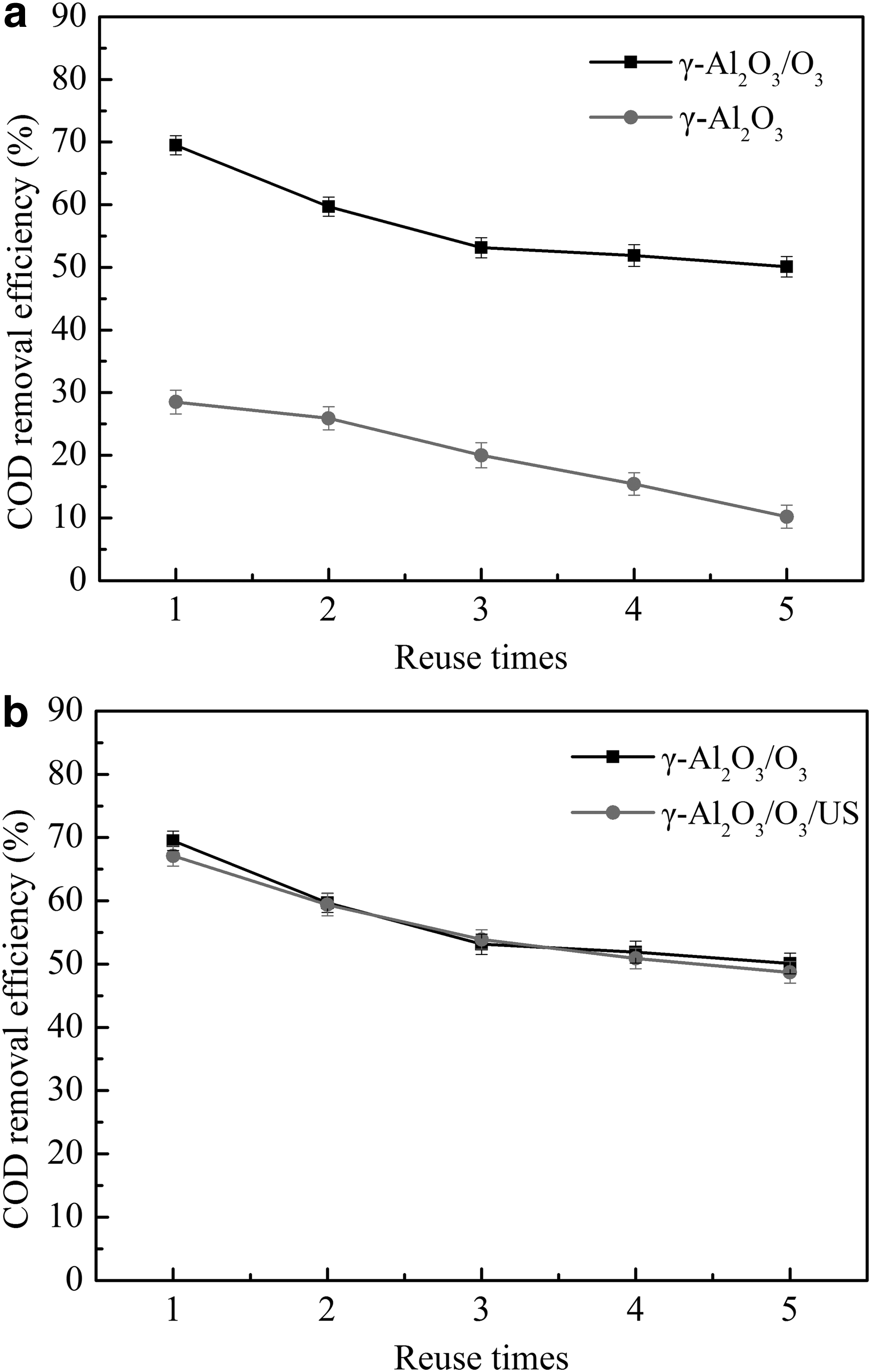
Reuse times of γ-Al2O3 in the γ-Al2O3/O3, γ-Al2O3 alone processes
In the γ-Al2O3/O3 process, the COD removal efficiencies decreased rapidly from 70% to 53% after three runs and then it was maintained at about 50% in the subsequent treatment batches. The results might be explained that some pollutants or their intermediates adsorbed on the surface of γ-Al2O3/O3 were hard to be mineralized completely or desorbed easily in the γ-Al2O3/O3 process, which would occupy the catalytic activity sites of γ-Al2O3/O3 to inhibit the catalytic decomposition of ozone. Thus, the treatment efficiency of the γ-Al2O3/O3 process would be decreased after three batch experiments.
In the previous work, it was reported that the pollutants deposited on the surface of Zero-valent iron (ZVI) particles could be removed rapidly by ultrasonic irradiation. So, the ZVI particles could maintain their surface activity (Hung et al., 2000; Lai et al., 2013). To solve the above problem, therefore, the ultrasonic irradiation was used to intensify the γ-Al2O3/O3 process.
However, Fig. 5(b) shows that the treatment efficiency of the γ-Al2O3/O3 process was not improved in the presence of ultrasonic irradiation. The results suggest that the pollutants or their intermediates adsorbed on the surface of γ-Al2O3/O3 could also not be desorbed by the ultrasonic irradiation. Furthermore, the adsorption of the organic compounds by γ-Al2O3 might occur through a ligand exchange with Al-OH groups forming Al-O(CO)R groups (Vittenet et al., 2015). Therefore, the strong adsorption of γ-Al2O3 for some compounds would decrease its catalytic sites and limit the treatment efficiency of the γ-Al2O3/O3 process.
Regeneration of γ-Al2O3
As shown in Fig. 6, the ratio of band intensity between bands around 1,638 cm−1 and 2,929 cm−1 of the γ-Al2O3 of γ-Al2O3 alone process (A2/A1 = 11.9) is close to that of landfill leachate RO concentrate (9.6). Therefore, we can conclude that initial pollutants were adsorbed on the γ-Al2O3 surface directly in γ-Al2O3 alone process. However, the ratio of the γ-Al2O3 of γ-Al2O3/O3 process (B2/B1 = 24.8) is much higher compared with landfill leachate RO concentrate (9.6). The result further confirms that the intermediates from ozonation process in aqueous solution were adsorbed on the surface of γ-Al2O3 in the γ-Al2O3/O3 process. Meanwhile, some pollutants were adsorbed on the surface of γ-Al2O3 then attacked by ozone and the generated ROS from the decomposition of ozone.
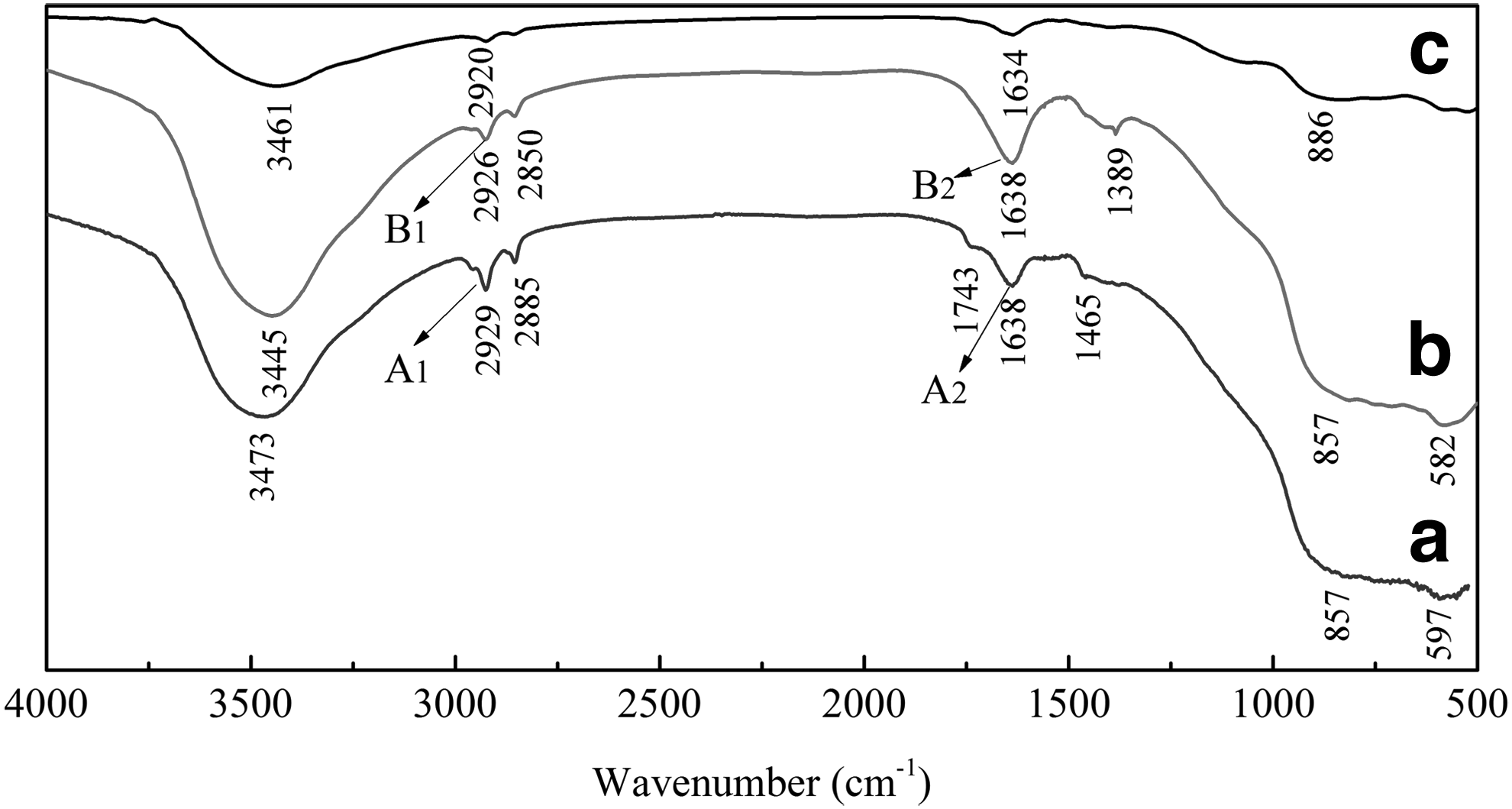
FTIR spectra of 500–4,000 cm−1 region of the reproduced γ-Al2O3 (calcined under 500°C for 2 h) after three times reuse in γ-Al2O3/O3 process
After three runs of ozonation, γ-Al2O3 particles were removed from the solution and dried at 75°C then calcined at 500°C for 2 h. The same dosage (50 g/L) of calcined γ-Al2O3 was used in another ozonation experiment and showed a similar COD removal efficiency (70%) to the unused γ-Al2O3 (70%). The result suggests that a calcination at 500°C can remove the adsorbed pollutants on the surface of γ-Al2O3 completely realizing regeneration of γ-Al2O3. However, the high cost of this regeneration method limits the application of γ-Al2O3 to catalyzing ozonation for the treatment of landfill leachate RO concentrate.
Summaries
In this study, the landfill leachate RO concentrate was treated by γ-Al2O3/O3 process, and the optimal operational parameters (γ-Al2O3 dosage of 50 g/L, ozone dosage of 22 mg/min, initial pH of 7.3, reaction temperature of 30°C, treatment time of 30 min) were obtained in this study. Under the optimal conditions, the γ-Al2O3/O3 system reached 70% COD and 100% color removal efficiencies. Meanwhile, B/C ratio was enhanced from 0.01 to 0.2, which suggests that its biodegradability was improved to some extent. In addition, the treatment ability of γ-Al2O3/O3 process was higher than other two control experiments, and the superiority of this process was further confirmed by the analysis results of UV-vis, EEM, and FTIR spectra. Subsequently, we found that the intermediates of pollutants were absorbed on the surface of γ-Al2O3 in the γ-Al2O3/O3 process.
At the same time, some pollutants were adsorbed on the surface of γ-Al2O3 then degraded by ozone and the generated ROS from the decomposition of ozone. Finally, calcination was confirmed to be an effective method for the regeneration of γ-Al2O3 but the high cost might limit its wider application. If the desorption of pollutants from γ-Al2O3 could be obtained economically, then, γ-Al2O3/O3 process will be a promising technology for the treatment of landfill leachate RO concentrate.
Footnotes
Acknowledgments
The authors acknowledge the financial support from Funds for Innovation and Entrepreneurship Training for College Students (Sichuan University) and Science and Technology Project of Sichuan Province (2016JY0154).
Author Disclosure Statement
No competing financial interests exist.