Reaction kinetics and effect of various parameters such as concentration of nitric oxide (NO) and oxidative absorbent, initial pH, and temperature were critically examined and compared for acidic sodium hypochlorite and sodium chlorite solutions. Absorption of NO into acidic NaOCl solution was found first order with respect to both NO and NaOCl. NO absorption reached the maximum value when the initial pH of NaOCl solution was 5.5. The preexponential frequency factor “A” and activation energy “Ea” were found to be 7.96 × 10¹¹ L/mol/s and 28.15 kJ/mol, respectively. Absorption of NO into aqueous NaClO2 solution was found to be second order with respect to NO and first order with respect to NaClO2. NO absorption decreased with increasing pH value. The activation energy and preexponential frequency factor were found to be 46.48 kJ/mol and 10.41 × 10¹¹ L2/mol2/s, respectively. Nitrogen oxides (NOx) removal efficiency, optimum pH, rate constant, and activation energy of these oxidative absorbents were investigated and compared to check the suitability of the absorbent for the commercial use.
Introduction
Combustion of fossil fuels in the stationary sources such as power plants, chemical plants, incinerators, and boilers leads to the emission of several acidic gases. Among them, sulfur oxides (SOx) and nitrogen oxides (NOx) are the most pervasive air pollutants. The emission of SOx and NOx is a major environmental concern because of their hazardous effects on human health and the ecosystems. NOx are particularly responsible for atmospheric ozone depletion, smog, and visibility problems (Brogen et al., 1997). Technologies for removal of sulfur oxides have attained an advanced stage of development; however, it is not so in the case of controlling NOx emission. More than 90% of NOx emitted from industries consist of nitric oxide (NO), which is relatively inert. Therefore, an efficient technology for the reduction of NOx emissions from both stationary and mobile sources is the need of the hour.
Absorption of NO into aqueous solutions of various oxidative absorbents has been quite an effective technique for controlling NOx emissions. Wet scrubbing process for the removal of SO2 currently dominates the market; so a minor adjustment in it for the simultaneous removal of SO2 and NOx may prove a more compact and cost-effective technology for the future. NOx removal in the wet scrubbing is quite complicated due to numerous parallel and consecutive reactions occurring in the solution phase. The inert nature of NO has posed a persistent problem. Moreover, solubility of NO decreases with increasing temperature and is independent of pH over a wide range. The low solubility of NO in aqueous solution appreciably increases the liquid phase resistance to mass transfer.
In majority of cases, additives are mixed into a wet scrubber to first convert the relatively inert and water insoluble NO to fairly soluble NO2, which can be further absorbed by a suitable reagent. Absorption of NO can be carried out either by using a strong oxidative absorbent or by complex forming reagents. Wet scrubbing is one of the most widely used technologies in the chemical industry for decades and successfully used for simultaneous removal of several acidic gases. Literature survey reveals that aqueous solutions of a variety of oxidative absorbents such as hydrogen peroxide (Baveja et al., 1979; Zhao et al., 2014), peracid (Littlejohn and Chang, 1990), organic tertiary hydroperoxides (Perlmutter et al., 1993), sodium hypochlorite (Deshwal and Kundu, 2015), sodium chlorite (Sada et al., 1978, 1979; Brogen et al., 1997, 1998; Chu et al., 2001; Lee et al., 2005), KMnO4 (Sada et al., 1977; Chu et al., 1998), chlorine dioxide (Jin et al., 2006; Deshwal et al., 2008), and sodium humate (Zhao et al., 2015a) have been used in the removal of NOx from the flue gas. NaClO2 assisted by some other reagents like NaBr or H2O2 has been used to preoxidize SO2 and NO, which were later absorbed in alkaline solution and achieved excellent removal efficiencies (Zhao et al., 2015b, 2016). A mixture of NaClO2 and NaOCl has been reported to absorb SO2 and NO efficiently (Zhao et al., 2010).
In the past, several authors investigated the reaction kinetics of removal of NOx using different oxidizing agents. The absorption of NO in aqueous alkaline solutions of NaClO2 has been found second order with respect to NO and first order with respect to NaClO2 (Sada et al., 1978; Brogen et al., 1998). The reaction kinetics of oxidation of NO in aqueous H2O2 solutions has been investigated and reaction was found first order with respect to both NO and H2O2 (Baveja et al., 1979).
Recently, the combined removal of SO2 and NO from simulated gas stream by NaOCl has been examined and observed 100% SO2 and 92% NO removal efficiencies, respectively (Mondal and Chelluboyana, 2013). The absorption of NO using sodium hypochlorite as the oxidative absorbent has also been studied by Chen et al. (2005).
Both sodium chlorite as well as sodium hypochlorite have high oxidizing ability in an acidic medium and can be used as an effective additive for NOx control in wet flue gas desulfurization scrubber. Both of them are poor oxidants in an alkaline medium compared to an acidic medium. It is because of a decrease in reduction potential with an increase in pH of solution. That is why, they are more effective for NO oxidation in an acidic medium compared to an alkaline medium.
With this view, we attempted to investigate the effect of various operating variables on NOx removal efficiency using acidic solutions of these reagents. Comparison of reaction kinetics particularly rate constants, activation energies, and removal efficiencies have been made for these oxidants to find the suitability for the NOx removal.
Experimental
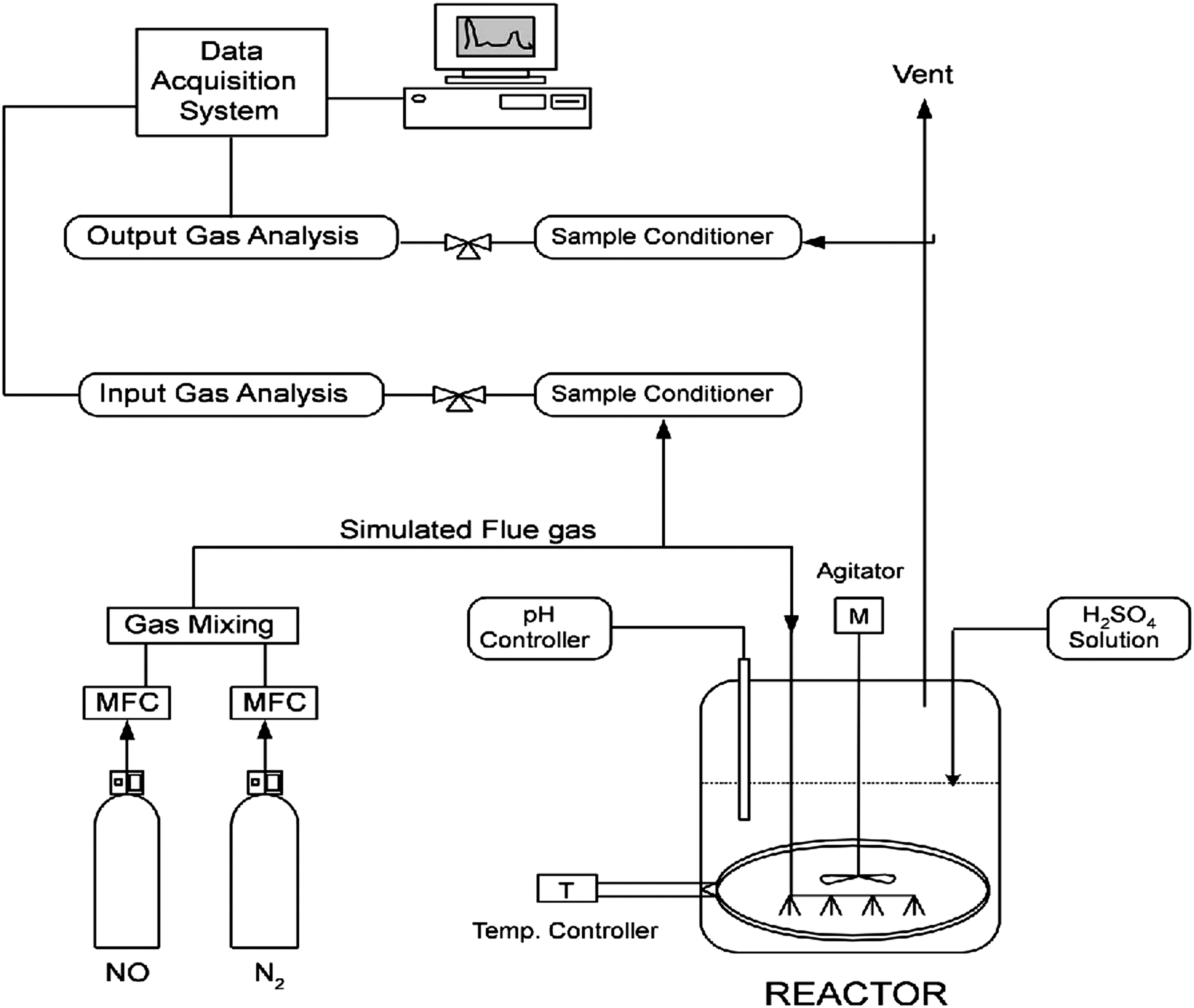
The reaction kinetics for NOx removal was carried out in a laboratory-scale stirred tank reaction. A schematic diagram of the experimental system is shown in Fig. 1. The flue gas treatment unit included a simulated flue gas supply system, a bubbling reactor, a pH control system, and the data acquisition system.
Schematic diagram of experimental apparatus.
Simulated flue gas was obtained by the controlled mixing of NO and N2 using mass flow controllers. The reactor is made up of acrylic material. The inner diameter and height of the reactor are 15 and 45 cm, respectively. The solution was continuously stirred by a mechanical agitator with a speed of around 250 rpm. The temperature of the bubbling reactor was controlled within ±0.1°C. Initial pH of the solution was adjusted by the addition of H2SO4 solution. The inlet and outlet NOx concentrations are analyzed using the NOx analyzer (Chemiluminiscent type, Model: 42C; Thermo Environmental Instruments) after removing the moisture in the sample conditioner.
Reaction between NO and sodium hypochlorite
The reaction between NO and acidic sodium hypochlorite solution takes place in various steps as follows (Deshwal and Kundu, 2015):
\documentclass{aastex}\usepackage{amsbsy}\usepackage{amsfonts}\usepackage{amssymb}\usepackage{bm}\usepackage{mathrsfs}\usepackage{pifont}\usepackage{stmaryrd}\usepackage{textcomp}\usepackage{portland, xspace}\usepackage{amsmath, amsxtra}\usepackage{upgreek}\pagestyle{empty}\DeclareMathSizes{10}{9}{7}{6}\begin{document}
\begin{align*}
{ \rm{NO }} + { \rm{ NaOCl }} \to { \rm{ N}}{{ \rm{O}}_2} + { \rm{ NaCl}}\ \left( {{ \rm{oxidation}}} \right)
\end{align*}
\end{document}\documentclass{aastex}\usepackage{amsbsy}\usepackage{amsfonts}\usepackage{amssymb}\usepackage{bm}\usepackage{mathrsfs}\usepackage{pifont}\usepackage{stmaryrd}\usepackage{textcomp}\usepackage{portland, xspace}\usepackage{amsmath, amsxtra}\usepackage{upgreek}\pagestyle{empty}\DeclareMathSizes{10}{9}{7}{6}\begin{document}
\begin{align*}
2{ \rm{N}}{{ \rm{O}}_2} + { \rm{ }}{{ \rm{H}}_2}{ \rm{O }} + { \rm{ NaOCl }} \to { \rm{ }}2{ \rm{HN}}{{ \rm{O}}_3} + { \rm{ NaCl}}\ \left( {{ \rm{absorption}}} \right)
\end{align*}
\end{document}
From the above steps, the overall reaction may be written as follows:
\documentclass{aastex}\usepackage{amsbsy}\usepackage{amsfonts}\usepackage{amssymb}\usepackage{bm}\usepackage{mathrsfs}\usepackage{pifont}\usepackage{stmaryrd}\usepackage{textcomp}\usepackage{portland, xspace}\usepackage{amsmath, amsxtra}\usepackage{upgreek}\pagestyle{empty}\DeclareMathSizes{10}{9}{7}{6}\begin{document}
\begin{align*}
2{ \rm{NO }} + { \rm{ }}3{ \rm{NaOCl }} + { \rm{ }}{{ \rm{H}}_2}{ \rm{O }} \to { \rm{ }}2{ \rm{HN}}{{ \rm{O}}_3} + { \rm{ }}3{ \rm{NaCl}} \tag{1}
\end{align*}
\end{document}
Reaction between NO and sodium chlorite
The reaction between NO and acidic sodium chlorite solution takes place in various steps as follows:
\documentclass{aastex}\usepackage{amsbsy}\usepackage{amsfonts}\usepackage{amssymb}\usepackage{bm}\usepackage{mathrsfs}\usepackage{pifont}\usepackage{stmaryrd}\usepackage{textcomp}\usepackage{portland, xspace}\usepackage{amsmath, amsxtra}\usepackage{upgreek}\pagestyle{empty}\DeclareMathSizes{10}{9}{7}{6}\begin{document}
\begin{align*}
2{ \rm{NO }} + { \rm{ NaCl}}{{ \rm{O}}_2} \to { \rm{ }}2{ \rm{N}}{{ \rm{O}}_2} + { \rm{ NaCl}} \left( {{ \rm{oxidation}}} \right)
\end{align*}
\end{document}\documentclass{aastex}\usepackage{amsbsy}\usepackage{amsfonts}\usepackage{amssymb}\usepackage{bm}\usepackage{mathrsfs}\usepackage{pifont}\usepackage{stmaryrd}\usepackage{textcomp}\usepackage{portland, xspace}\usepackage{amsmath, amsxtra}\usepackage{upgreek}\pagestyle{empty}\DeclareMathSizes{10}{9}{7}{6}\begin{document}
\begin{align*}
4{ \rm{N}}{{ \rm{O}}_2} + { \rm{ NaCl}}{{ \rm{O}}_2} + { \rm{ }}2{{ \rm{H}}_2}{ \rm{O }} \to { \rm{ }}4{ \rm{HN}}{{ \rm{O}}_3} + { \rm{ NaCl}}\ \left( {{ \rm{absorption}}} \right)
\end{align*}
\end{document}
From the above steps, the overall reaction may be written as follows:
\documentclass{aastex}\usepackage{amsbsy}\usepackage{amsfonts}\usepackage{amssymb}\usepackage{bm}\usepackage{mathrsfs}\usepackage{pifont}\usepackage{stmaryrd}\usepackage{textcomp}\usepackage{portland, xspace}\usepackage{amsmath, amsxtra}\usepackage{upgreek}\pagestyle{empty}\DeclareMathSizes{10}{9}{7}{6}\begin{document}
\begin{align*}
4{ \rm{NO }} + { \rm{ }}3{ \rm{NaCl}}{{ \rm{O}}_2} + { \rm{ }}2{{ \rm{H}}_2}{ \rm{O }} \to { \rm{ }}4{ \rm{HN}}{{ \rm{O}}_3} + { \rm{ }}3{ \rm{NaCl}} \tag{2}
\end{align*}
\end{document}
Moreover, in acidic condition, NaClO2 decomposes into ClO2 gas. It can further oxidize NO into NO2 which is subsequently absorbed into scrubbing solution as follows (Deshwal and Lee, 2009):
\documentclass{aastex}\usepackage{amsbsy}\usepackage{amsfonts}\usepackage{amssymb}\usepackage{bm}\usepackage{mathrsfs}\usepackage{pifont}\usepackage{stmaryrd}\usepackage{textcomp}\usepackage{portland, xspace}\usepackage{amsmath, amsxtra}\usepackage{upgreek}\pagestyle{empty}\DeclareMathSizes{10}{9}{7}{6}\begin{document}
\begin{align*}
5{ \rm{NO}} + 2{ \rm{Cl}}{{ \rm{O}}_2} + {{ \rm{H}}_2}{ \rm{O}} \to 5{ \rm{N}}{{ \rm{O}}_2} + 2{ \rm{HCl}} \ \left( {{ \rm{oxidation}}} \right)
\end{align*}
\end{document}\documentclass{aastex}\usepackage{amsbsy}\usepackage{amsfonts}\usepackage{amssymb}\usepackage{bm}\usepackage{mathrsfs}\usepackage{pifont}\usepackage{stmaryrd}\usepackage{textcomp}\usepackage{portland, xspace}\usepackage{amsmath, amsxtra}\usepackage{upgreek}\pagestyle{empty}\DeclareMathSizes{10}{9}{7}{6}\begin{document}
\begin{align*}
5{ \rm{N}}{{ \rm{O}}_2} + { \rm{Cl}}{{ \rm{O}}_2} + 3{{ \rm{H}}_2}{ \rm{O}} \to 5{ \rm{HN}}{{ \rm{O}}_3} + { \rm{HCl }}\ \left( {{ \rm{absorption}}} \right)
\end{align*}
\end{document}
From the above steps, the overall reaction may be written as follows:
\documentclass{aastex}\usepackage{amsbsy}\usepackage{amsfonts}\usepackage{amssymb}\usepackage{bm}\usepackage{mathrsfs}\usepackage{pifont}\usepackage{stmaryrd}\usepackage{textcomp}\usepackage{portland, xspace}\usepackage{amsmath, amsxtra}\usepackage{upgreek}\pagestyle{empty}\DeclareMathSizes{10}{9}{7}{6}\begin{document}
\begin{align*}
5{ \rm{NO}} + 3{ \rm{Cl}}{{ \rm{O}}_2} + 4{{ \rm{H}}_2}{ \rm{O}} \to 5{ \rm{HN}}{{ \rm{O}}_3} + 3{ \rm{HCl}} \tag{3}
\end{align*}
\end{document}
Reaction kinetics
Absorption rate of NO (RNO) into the acidic solution of an oxidative absorbent can be expressed by the following equation:
\documentclass{aastex}\usepackage{amsbsy}\usepackage{amsfonts}\usepackage{amssymb}\usepackage{bm}\usepackage{mathrsfs}\usepackage{pifont}\usepackage{stmaryrd}\usepackage{textcomp}\usepackage{portland, xspace}\usepackage{amsmath, amsxtra}\usepackage{upgreek}\pagestyle{empty}\DeclareMathSizes{10}{9}{7}{6}\begin{document}
\begin{align*}
{R_{NO}} = {k_G} ( {p_{NO , b}} - {p_{NO , i}} ) = E{K_L} ( {C_{NO , i}} - {C_{NO , b}} ) \tag{4}
\end{align*}
\end{document}
Here, \documentclass{aastex}\usepackage{amsbsy}\usepackage{amsfonts}\usepackage{amssymb}\usepackage{bm}\usepackage{mathrsfs}\usepackage{pifont}\usepackage{stmaryrd}\usepackage{textcomp}\usepackage{portland, xspace}\usepackage{amsmath, amsxtra}\usepackage{upgreek}\pagestyle{empty}\DeclareMathSizes{10}{9}{7}{6}\begin{document}
$${k_{ \rm{G}}}$$
\end{document} and \documentclass{aastex}\usepackage{amsbsy}\usepackage{amsfonts}\usepackage{amssymb}\usepackage{bm}\usepackage{mathrsfs}\usepackage{pifont}\usepackage{stmaryrd}\usepackage{textcomp}\usepackage{portland, xspace}\usepackage{amsmath, amsxtra}\usepackage{upgreek}\pagestyle{empty}\DeclareMathSizes{10}{9}{7}{6}\begin{document}
$${k_{ \rm{L}}}$$
\end{document} in Equation (4) are the gas phase and liquid phase mass transfer coefficients, respectively, and E is the enhancement factor. The magnitude of \documentclass{aastex}\usepackage{amsbsy}\usepackage{amsfonts}\usepackage{amssymb}\usepackage{bm}\usepackage{mathrsfs}\usepackage{pifont}\usepackage{stmaryrd}\usepackage{textcomp}\usepackage{portland, xspace}\usepackage{amsmath, amsxtra}\usepackage{upgreek}\pagestyle{empty}\DeclareMathSizes{10}{9}{7}{6}\begin{document}
$${k_{ \rm{G}}}$$
\end{document} and \documentclass{aastex}\usepackage{amsbsy}\usepackage{amsfonts}\usepackage{amssymb}\usepackage{bm}\usepackage{mathrsfs}\usepackage{pifont}\usepackage{stmaryrd}\usepackage{textcomp}\usepackage{portland, xspace}\usepackage{amsmath, amsxtra}\usepackage{upgreek}\pagestyle{empty}\DeclareMathSizes{10}{9}{7}{6}\begin{document}
$${k_{ \rm{L}}}$$
\end{document} can be obtained by using the method as described by Deshwal and Lee (2009). Partial pressure of NO at interface, that is, \documentclass{aastex}\usepackage{amsbsy}\usepackage{amsfonts}\usepackage{amssymb}\usepackage{bm}\usepackage{mathrsfs}\usepackage{pifont}\usepackage{stmaryrd}\usepackage{textcomp}\usepackage{portland, xspace}\usepackage{amsmath, amsxtra}\usepackage{upgreek}\pagestyle{empty}\DeclareMathSizes{10}{9}{7}{6}\begin{document}
$${p_{{ \rm{NO , i}}}}$$
\end{document} can be calculated by using Henry's law:
\documentclass{aastex}\usepackage{amsbsy}\usepackage{amsfonts}\usepackage{amssymb}\usepackage{bm}\usepackage{mathrsfs}\usepackage{pifont}\usepackage{stmaryrd}\usepackage{textcomp}\usepackage{portland, xspace}\usepackage{amsmath, amsxtra}\usepackage{upgreek}\pagestyle{empty}\DeclareMathSizes{10}{9}{7}{6}\begin{document}
\begin{align*}
{{ \rm{p}}_{NO , i}}{ \rm{ = }}{{ \rm{H}}_{NO}}{{ \rm{C}}_{NO , i}} \tag{5}
\end{align*}
\end{document}
Here, \documentclass{aastex}\usepackage{amsbsy}\usepackage{amsfonts}\usepackage{amssymb}\usepackage{bm}\usepackage{mathrsfs}\usepackage{pifont}\usepackage{stmaryrd}\usepackage{textcomp}\usepackage{portland, xspace}\usepackage{amsmath, amsxtra}\usepackage{upgreek}\pagestyle{empty}\DeclareMathSizes{10}{9}{7}{6}\begin{document}
$${{ \rm{C}}_{NO , i}}$$
\end{document} is the interfacial concentration of NO in the aqueous scrubbing solution. The rate of reaction between NO and acidic scrubbing solution is assumed to be mth order with respect to NO and nth order with respect to the oxidative absorbent (O.A.). Thus, the absorption rate of NO into aqueous scrubbing solution could be expressed by the gas–liquid mass transfer theory as proposed by Danckwerts (1970):
\documentclass{aastex}\usepackage{amsbsy}\usepackage{amsfonts}\usepackage{amssymb}\usepackage{bm}\usepackage{mathrsfs}\usepackage{pifont}\usepackage{stmaryrd}\usepackage{textcomp}\usepackage{portland, xspace}\usepackage{amsmath, amsxtra}\usepackage{upgreek}\pagestyle{empty}\DeclareMathSizes{10}{9}{7}{6}\begin{document}
\begin{align*}
R_ {NO} = \sqrt{\left(\frac{2}{ m + 1 } \right)
\times k _{(m + n )} \times D_{NO} \times C_{NO, i}^{m + 1} \times C_{O.A}^{n}} \tag{6}
\end{align*}
\end{document}
where \documentclass{aastex}\usepackage{amsbsy}\usepackage{amsfonts}\usepackage{amssymb}\usepackage{bm}\usepackage{mathrsfs}\usepackage{pifont}\usepackage{stmaryrd}\usepackage{textcomp}\usepackage{portland, xspace}\usepackage{amsmath, amsxtra}\usepackage{upgreek}\pagestyle{empty}\DeclareMathSizes{10}{9}{7}{6}\begin{document}
$${D_{{ \rm{NO}}}}$$
\end{document} is the diffusion coefficient of NO, which can be calculated from the Wilke-Chang equation (Bird et al., 1960).
After determining the value of m and n, the rate constant \documentclass{aastex}\usepackage{amsbsy}\usepackage{amsfonts}\usepackage{amssymb}\usepackage{bm}\usepackage{mathrsfs}\usepackage{pifont}\usepackage{stmaryrd}\usepackage{textcomp}\usepackage{portland, xspace}\usepackage{amsmath, amsxtra}\usepackage{upgreek}\pagestyle{empty}\DeclareMathSizes{10}{9}{7}{6}\begin{document}
$${{ \rm{k}}_{ ( { \rm{m}} + { \rm{n ) }}}}$$
\end{document} can be calculated from Equation (6). The rate constants were calculated at various temperatures ranging from 298 to 328 K and then, activation energy “Ea” and preexponential frequency factor “A” were obtained from the Arrhenius Equation.
Results and Discussion
Reaction kinetics of absorption of NO in acidic NaOCl solution
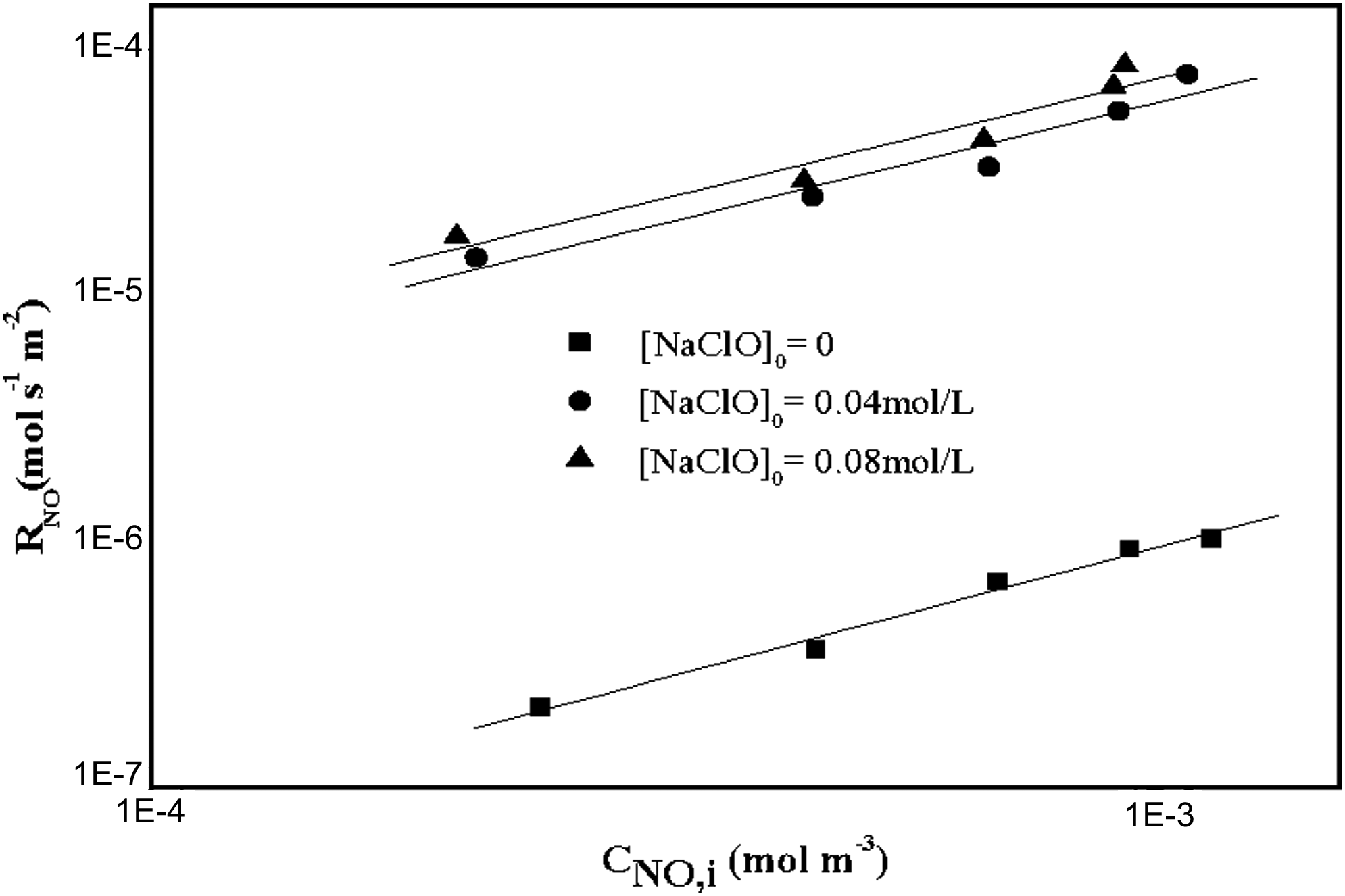
The absorption rate of NO into acidic sodium hypochlorite solution was calculated by Equation (6). Absorption rate increased with the increasing gas–liquid interfacial NO concentrations (CNO,i) as shown in Fig. 2. It is obvious that there is a linear relationship between \documentclass{aastex}\usepackage{amsbsy}\usepackage{amsfonts}\usepackage{amssymb}\usepackage{bm}\usepackage{mathrsfs}\usepackage{pifont}\usepackage{stmaryrd}\usepackage{textcomp}\usepackage{portland, xspace}\usepackage{amsmath, amsxtra}\usepackage{upgreek}\pagestyle{empty}\DeclareMathSizes{10}{9}{7}{6}\begin{document}
$${log} {R_{{ \rm{NO}}}}$$
\end{document} and \documentclass{aastex}\usepackage{amsbsy}\usepackage{amsfonts}\usepackage{amssymb}\usepackage{bm}\usepackage{mathrsfs}\usepackage{pifont}\usepackage{stmaryrd}\usepackage{textcomp}\usepackage{portland, xspace}\usepackage{amsmath, amsxtra}\usepackage{upgreek}\pagestyle{empty}\DeclareMathSizes{10}{9}{7}{6}\begin{document}
$${log} {C_{{ \rm{NO , i}}}}$$
\end{document} and the average slope of these lines is found close to 1; thus, the order of reaction with respect to concentration of NO, that is, m comes out nearly 1.
Effect of gas-liquid NO concentrations on its absorption rate at pH = 6.0 at 328 K. NO, nitric oxide.
Figure 3 shows the effect of NaOCl concentration on NO absorption rate. There is again a linear relationship between \documentclass{aastex}\usepackage{amsbsy}\usepackage{amsfonts}\usepackage{amssymb}\usepackage{bm}\usepackage{mathrsfs}\usepackage{pifont}\usepackage{stmaryrd}\usepackage{textcomp}\usepackage{portland, xspace}\usepackage{amsmath, amsxtra}\usepackage{upgreek}\pagestyle{empty}\DeclareMathSizes{10}{9}{7}{6}\begin{document}
$$\log {{ \rm{R}}_{NO}}$$
\end{document} and \documentclass{aastex}\usepackage{amsbsy}\usepackage{amsfonts}\usepackage{amssymb}\usepackage{bm}\usepackage{mathrsfs}\usepackage{pifont}\usepackage{stmaryrd}\usepackage{textcomp}\usepackage{portland, xspace}\usepackage{amsmath, amsxtra}\usepackage{upgreek}\pagestyle{empty}\DeclareMathSizes{10}{9}{7}{6}\begin{document}
$$\log {{ \rm{C}}_{NaOCl , i}}$$
\end{document}. The slope of this line is about 0.5, that is, n/2 = 0.5; so the reaction followed first-order kinetics with respect to concentration of NaOCl.
Effect of NaOCl concentrations on NO absorption rate at 328 K, pH = 6.0, and \documentclass{aastex}\usepackage{amsbsy}\usepackage{amsfonts}\usepackage{amssymb}\usepackage{bm}\usepackage{mathrsfs}\usepackage{pifont}\usepackage{stmaryrd}\usepackage{textcomp}\usepackage{portland, xspace}\usepackage{amsmath, amsxtra}\usepackage{upgreek}\pagestyle{empty}\DeclareMathSizes{10}{9}{7}{6}\begin{document}
$${{ \rm{C}}_{NO , i}}$$
\end{document} = 8.58 × 10⁻⁷ mol/L, respectively.
The effect of initial pH on NO absorption rate is presented in Fig. 4. Initial pH of the solution was varied from 4 to 7. NO absorption rate increased with the increasing pH value and reached maximum value at pH 5.5, thereafter it decreased with increasing pH value. It is due to the fact that the reduction potential decreases with increasing pH value, the oxidizing ability of NaOCl solution decreases, and consequently, the NO absorption rate decreased too.
Effect of initial pH value on NO absorption rate at 328 K and CNO,0 = 800 ppm.
The value of rate constants were calculated at various temperatures ranging from 298 to 328 K and then, graph was plotted between logk versus 1/T. The activation energy and preexponential frequency factor were obtained from slope and intercept of the Arrhenius plot using the logarithm form of Arrhenius Equation as follows (Deshwal and Kundu, 2015):
\documentclass{aastex}\usepackage{amsbsy}\usepackage{amsfonts}\usepackage{amssymb}\usepackage{bm}\usepackage{mathrsfs}\usepackage{pifont}\usepackage{stmaryrd}\usepackage{textcomp}\usepackage{portland, xspace}\usepackage{amsmath, amsxtra}\usepackage{upgreek}\pagestyle{empty}\DeclareMathSizes{10}{9}{7}{6}\begin{document}
\begin{align*}
{log} \ k = \log A - {{E_a}} \over {\it {2.303RT}} \tag{7}
\end{align*}
\end{document}
Activation energy “Ea” and preexponential frequency factor “A” were found to be 28.15 kJ/mol and 7.96 × 10¹¹ L/mol/s, respectively.
Reaction kinetics of absorption of NO in aqueous NaClO2 solution
Absorption rate of NO into acidic sodium chlorite solution also increased with the increasing gas–liquid interfacial NO concentrations. Again, there was a linear relationship between \documentclass{aastex}\usepackage{amsbsy}\usepackage{amsfonts}\usepackage{amssymb}\usepackage{bm}\usepackage{mathrsfs}\usepackage{pifont}\usepackage{stmaryrd}\usepackage{textcomp}\usepackage{portland, xspace}\usepackage{amsmath, amsxtra}\usepackage{upgreek}\pagestyle{empty}\DeclareMathSizes{10}{9}{7}{6}\begin{document}
$${\rm log} \ {R_{{ \rm{NO}}}}$$
\end{document} and \documentclass{aastex}\usepackage{amsbsy}\usepackage{amsfonts}\usepackage{amssymb}\usepackage{bm}\usepackage{mathrsfs}\usepackage{pifont}\usepackage{stmaryrd}\usepackage{textcomp}\usepackage{portland, xspace}\usepackage{amsmath, amsxtra}\usepackage{upgreek}\pagestyle{empty}\DeclareMathSizes{10}{9}{7}{6}\begin{document}
$${\rm log} \ {C_{{ \rm{No , i}}}}$$
\end{document} as presented in Fig. 5 and the reaction is found second order with respect to concentration of NO in the fast reaction regime.
Effect of gas-liquid NO concentrations on its absorption rate at pH = 6.0 at 328 K.
Figure 6 shows the effect of NaClO2 concentration on NO absorption rate. There is a linear relationship between \documentclass{aastex}\usepackage{amsbsy}\usepackage{amsfonts}\usepackage{amssymb}\usepackage{bm}\usepackage{mathrsfs}\usepackage{pifont}\usepackage{stmaryrd}\usepackage{textcomp}\usepackage{portland, xspace}\usepackage{amsmath, amsxtra}\usepackage{upgreek}\pagestyle{empty}\DeclareMathSizes{10}{9}{7}{6}\begin{document}
$${\rm log} \ {{ \rm{R}}_{NO}}$$
\end{document} and \documentclass{aastex}\usepackage{amsbsy}\usepackage{amsfonts}\usepackage{amssymb}\usepackage{bm}\usepackage{mathrsfs}\usepackage{pifont}\usepackage{stmaryrd}\usepackage{textcomp}\usepackage{portland, xspace}\usepackage{amsmath, amsxtra}\usepackage{upgreek}\pagestyle{empty}\DeclareMathSizes{10}{9}{7}{6}\begin{document}
$${\rm log} \ {C_{NaCl{O_2} , i}}$$
\end{document}. The slope of this line is about 0.5, that is, n/2 = 0.5; so the reaction followed first-order kinetics with respect to concentration of NaClO2.
Effect of NaClO2 concentrations on NO absorption rate at 328 K, pH = 6.0, and \documentclass{aastex}\usepackage{amsbsy}\usepackage{amsfonts}\usepackage{amssymb}\usepackage{bm}\usepackage{mathrsfs}\usepackage{pifont}\usepackage{stmaryrd}\usepackage{textcomp}\usepackage{portland, xspace}\usepackage{amsmath, amsxtra}\usepackage{upgreek}\pagestyle{empty}\DeclareMathSizes{10}{9}{7}{6}\begin{document}
$${{ \rm{C}}_{NO , i}}$$
\end{document} = 8.58 × 10⁻⁷ mol/L, respectively.
Putting the value of order of reaction of NO and NaClO2, the absorption rate under the fast-reaction regime can be expressed by the following equation:
\documentclass{aastex}\usepackage{amsbsy}\usepackage{amsfonts}\usepackage{amssymb}\usepackage{bm}\usepackage{mathrsfs}\usepackage{pifont}\usepackage{stmaryrd}\usepackage{textcomp}\usepackage{portland, xspace}\usepackage{amsmath, amsxtra}\usepackage{upgreek}\pagestyle{empty}\DeclareMathSizes{10}{9}{7}{6}\begin{document}
\begin{align*}
{R_{NO}} = \sqrt {{k_3} \times {D_{NO}} \times C_{NO , i}^{\it 2} \times {C_{NaCl{O_2}}}} \tag{8}
\end{align*}
\end{document}
Experiments were performed to investigate the oxidative power of NaClO2 at different pH values. Almost 100% oxidation of NO occurred at a pH ≤3.5. It suggests that sodium chlorite has high oxidative ability at lower pH values. Figure 7 depicts the variation in NOx removal efficiency with pH at input NO concentrations of 760 ppm. NOx removal is about 50% at a pH ≤3.5 and it decreased with the increasing pH values.
NOx removal at different pH (NaClO2 = 0.05 M, T = 45°C). NOx, nitrogen oxides.
NOx removal using acidic sodium chlorite involves a complex combination of reactions, wherein both chlorite as well as chlorine-dioxide act as oxidative absorbents. At low pH, sodium chlorite decomposes to yield chloride dioxide that has an additive effect and thus better NOx removal efficiency at lower pH. As the pH increases, the reduction potential as well as the oxidizing ability of NaClO2 decrease. It also slows down the decomposition of sodium chlorite, thereby decreasing the NO removal efficiency due to less formation of ClO2 gas.
The rate constant “k” was calculated from Equation (6) and found to be 4.135 × 10⁴ L2/mol2/s at 328 K. The value of rate constants was obtained at various temperatures ranging from 298 to 328 K and graph was plotted between log k versus \documentclass{aastex}\usepackage{amsbsy}\usepackage{amsfonts}\usepackage{amssymb}\usepackage{bm}\usepackage{mathrsfs}\usepackage{pifont}\usepackage{stmaryrd}\usepackage{textcomp}\usepackage{portland, xspace}\usepackage{amsmath, amsxtra}\usepackage{upgreek}\pagestyle{empty}\DeclareMathSizes{10}{9}{7}{6}\begin{document}
$$ \frac { 1 } { T } $$
\end{document}. The activation energy “Ea” and preexponential frequency factor “A” were obtained from Arrhenius plot as shown in Fig. 8 and the values were found to be 46.106 kJ/mol and 10.23 × 10¹¹ L2/mol2/s, respectively.
Arrhenius plot.
Comparing standard reduction potentials of chlorite and hypochlorite ions
Both hypochlorite as well as chlorite ions are potential oxidative absorbents for controlling NOx emission. As the standard reduction potentials (E°) of both have nearly same values, they have nearly the same oxidizing ability. The standard reduction potentials of hypochlorite as well as chlorite ions along with reaction in acidic as well as alkaline medium are given in Table 1. It is noteworthy here that, both are better oxidizing agents in an acidic medium compared to an alkaline medium. It is due to higher value of reduction potentials in an acidic medium.
Standard Reduction Potentials of Hypochlorite and Chlorite Ion in Acidic and Alkaline Medium
It is evident from the Equation (11) that the reduction potential will decrease with increasing pH value. It will eventually decrease the oxidizing ability of both the hypochlorite as well as chlorite ions, leading to a decrease in the absorption rate of NO. This fact is also supported by our experimental data.
Both hypochlorite as well as chlorite ions have nearly same oxidizing ability; therefore, suitability of the oxidant can only be decided by considering other factors like availability, cost, storage, stability, solubility, and hazardous nature of the substance.
Anhydrous sodium hypochlorite is highly unstable and shock sensitive (Bretherick, 1975). It decomposes violently on heating or friction. Aqueous solution of sodium hypochlorite undergoes disproportionation into sodium chloride and sodium chlorate. Light speeds up the decomposition of sodium hypochlorite solutions. These solutions should be stored in closed bottles, away from any chlorine corrosion susceptible materials. Sodium hypochlorite reacts with acids and yields chlorine gas at pH <2; however, it is almost undissociated at pH >4. Sodium hypochlorite is more stable in an alkaline medium, but the oxidizing ability is poor.
Sodium chlorite, when dry, is a fire or explosion hazard if contaminated with combustible material. Contamination of sodium chlorite with incompatible materials such as dirt, organic matter, oxidizers, reducing agents, chemicals, soap products, solvents, acids, and paint products is dangerous.
Both sodium hypochlorite and sodium chlorite are highly soluble in water and efficient oxidant (Lide, 2005). Sodium chlorite is relatively more stable, easily available, and less hazardous. Moreover, consumption of sodium chlorite to oxidize one mole of NO is lesser as can be viewed from the stoichiometry of the Equations (1) and (2). In an acidic medium, sodium chlorite is a preferred contender as it has better NO removal efficiency under the similar conditions as the chlorine dioxide formed by decomposition of sodium chlorite also assists in NO oxidation.
Both the above oxidants do not yield any secondary pollutants in the spent solution as they are ultimately converted into NaCl. Sodium chlorite decomposes into chlorine dioxide in an acidic medium, which is again highly reactive and an efficient oxidant for NO, and finally converts into chloride ions.
Strong oxidizers like sodium hypochlorite and sodium chlorite are capable of forming explosive mixtures when mixed with combustible, organic, or easily oxidized materials. Small amounts of impurities when introduced into the container may cause a fire or explosion. An acidic medium provides a more conducive environment for corrosion of the equipment. However, both of them have poor oxidizing ability in an alkaline medium; thus, investigation of various optimum parameters for the efficient removal of SO2 and NO is highly desirable so that rational utilization of oxidant can be done.
Conclusion
Absorption of NO into acidic NaOCl solution was found to be first order with respect to both NO and NaOCl. NO absorption reached the maximum value when the initial pH of NaOCl solution is taken 5.5. The preexponential frequency factor and the activation energy were found to be 7.96 × 10¹¹ L/mol/s and 28.15 kJ/mol, respectively.
Absorption of NO into acidic NaClO2 solution was found to be second order with respect to NO and first order with respect to NaClO2. Almost 100% oxidation of NO occurred at a pH ≤3.5. NO absorption decreased with increasing pH. The activation energy “Ea” and preexponential frequency factor “A” were found to be 46.48 kJ/mol and 10.41 × 10¹¹ L2/mol2/s, respectively.
Sodium chlorite showed better performance at pH ≤3.5. However, sodium hypochlorite showed maximum NOx removal efficiency at pH of ∼5.5. The lower value of activation energy suggests that NOx absorption rate will be faster in acidic sodium hypochlorite solution. In view of above data, it is concluded that both hypochlorite as well as chlorite are potential oxidative absorbent for controlling NOx emission. The choice of reagent depends on their availability, cost, storage, stability, solubility, and hazardous nature of the substance.
Sodium chlorite is relatively more stable, easily available, and less hazardous. Moreover, consumption of sodium chlorite to oxidize one mole of NO is lesser and NO removal efficiency is better. Therefore, sodium chlorite is a preferred candidate for NO removal in an acidic medium.
Footnotes
Author Disclosure Statement
No competing financial interests exist.
Nomenclature
References
1.
BavejaK.K., Subba RaoD., and SarkarM.K. (1979). Kinetics of absorption of nitric oxide in hydrogen peroxide solutions. J. Chem. Eng. Jpn., 12, 322.
2.
BirdR.B., StewartW.E., and LightfootE.N. (1960). Transport Phenomena. New York: Wiley, p. 510.
3.
BretherickL. (1975). Handbook of Reactive Chemical Hazards (7th ed.). London: Butterworths, vol. 1, p. 1433.
4.
BrogenC., KarlssonH.T., and BjerleI. (1997). Absorption of NO in an alkaline solution of KMnO4. J. Chem. Eng. Technol., 20, 396.
5.
BrogenC., KarlssonH.T., and BjerleI. (1998). Absorption of NO in an aqueous solution of NaClO2. J. Chem. Eng. Technol., 21, 61.
6.
ChenL., HsuC., and YangC. (2005). Oxidation and absorption of nitric oxide in a packed tower with sodium hypochlorite aqueous solutions. Environ. Prog., 24, 279.
7.
ChuH., ChienT.W., and TwuB.W. (2001). The absorption kinetics of NO in NaClO2/NaOH solutions. J. Hazard. Mater. B84, 241.
8.
ChuH., LiS.Y., and ChienT.W. (1998). The absorption kinetics of NO from flue gas in a stirred tank reactor with KMnO4/NaOH solutions. J. Environ. Sci. Health, A33, 801.
9.
CottonF.A., and WilkinsonG. (1988). Advanced Inorganic Chemistry (5th ed.). New York: Wiley—Interscience, p. 564.
10.
DanckwertsP.V. (1970). Gas-Liquid Reactions. New York: McGraw-Hill, Ch. I, p. 18.
11.
DeshwalB.R., JinD.S., LeeS.H., MoonS.H., JungS.H., and LeeH.K. (2008). Removal of NO from flue has by aqueous chlorine-dioxide scrubbing solution in a lab-scale bubbling reactor. J. Hazard. Mater., 150, 649.
12.
DeshwalB.R., and KunduN. (2015). Reaction kinetics of oxidative absorption of nitric oxide into sodium hypochlorite solution. Int. J. Adv. Res. Sci. Technol., 4, 313.
13.
DeshwalB.R., and LeeH.K. (2009). Mass transfer in the absorption of SO2 and NOx using aqueous euchlorine scrubbing solution. J. Environ. Sci., 21, 155.
14.
JinD.S., DeshwalB.R., ParkY.S., and LeeH.K. (2006). Simultaneous removal of SO2 and NO by wet scrubbing using aqueous chlorine dioxide solution. J. Hazard. Mater. B135, 412.
15.
LeeH.K., DeshwalB.R., and YooK.S. (2005). Simultaneous removal of SO2 and NO by sodium chlorite solution in wetted-wall column. Korean J. Chem. Eng., 22, 208.
16.
LideD.R. (2005). CRC Handbook of Chemistry and Physics (86th ed.). Boca Raton, FL: CRC Press, Taylor & Francis, Ch. 4, p. 85.
17.
LittlejohnD., and ChangS. (1990). Removal of NOx and SO2 from flue gas by per acid solution. J. Ind. Eng. Chem. Res., 29, 1420.
18.
MondalM.K., and ChelluboyanaV.R. (2013). New experimental results of combined SO2 and NO removal from simulated gas stream by NaClO as low-cost absorbent. Chem. Eng. J., 217, 48.
19.
PerlmutterH., AoH., and ShawH. (1993). Absorption of NO promoted by strong oxidizing agent: 1. Organic tertiary hydro peroxides in n-hexadecane. J. Environ. Sci. Technol., 27, 128.
20.
SadaE., KumazawaH., HayakawaN., KudoI., and KondoT. (1977). Absorption of NO in aqueous solutions of KMnO4. Chem. Eng. Sci., 32, 1171.
21.
SadaE., KumazawaH., KudoI., and KondoT. (1978). Absorption of NO in aqueous mixed solutions of NaClO2 and NaOH. Chem. Eng. Sci., 33, 315.
22.
SadaE., KumazawaH., KudoI., and KondoT. (1979). Absorption of lean NOx in aqueous solutions of NaClO2 and NaOH. Ind. Eng. Chem. Proc. Des. Dev., 18, 275.
23.
ZhaoY., GuoT.X., ChenZ.Y., and DuY.R. (2010). Simultaneous removal of SO2 and NO using M/NaClO2 complex absorbent. Chem. Eng. J., 160, 42.
24.
ZhaoY., HaoR., and QiM. (2015a). Integrative process of preoxidation and absorption for simultaneous removal of SO2, NO and Hg0. Chem. Eng. J., 269, 159.
25.
ZhaoY., HaoR., WangT., and YangC. (2015b). Follow-up research for integrative process of pre-oxidation and post-absorption cleaning flue gas: Absorption of NO2, NO and SO2. Chem. Eng. J., 273, 55.
26.
ZhaoY., HaoR., YuanB., and JiangJ. (2016). Simultaneous removal of SO2, NO and Hg0 through an integrative process utilizing a cost-effective complex oxidant. J. Hazard. Mater., 301, 74.
27.
ZhaoY., HaoR., ZhangP., and ZhouS. (2014). Integrative process for simultaneous removal of SO2, NO utilizing a vapourized H2O2/Na2S2O8. Energy Fuels, 28, 6502.