




Abstract
Abstract
A superhydrophobic CeO2-modified kapok fiber (SCMKF) was fabricated using CeO2 and octadecyltrimethoxysilane (OTMS) by a simple chemical deposition method. Scanning electron microscopy, Fourier-transform infrared spectroscopy, X-ray photoelectron microscopy, and the wetting behavior of water and oil on the surface were conducted to confirm the formation of CeO2 nanoparticles and the combination of OTMS with the surface. The SCMKF had the superhydrophobicity and good sorption capacity. The contact angle of raw kapok fiber (RKF) was 114.7°, however, that of SCMKF exceeded 150°. Oil absorption capacities of SCMKF for diesel oil, soybean oil, and lubricating oil were 48.65, 58.17, and 62.57 g/g, increased by 76.5%, 51.9%, and 51.9%, respectively, compared with RKF. Sorption of SCMKF could be well described by pseudo second-order kinetics. The SCMKF could reach the adsorption saturation within 3 min. After eight cycles, the oil sorption capacities of SCMKF decreased, but they were still much higher than those of RKF. The SCMKF showed good performance in the separation of oil–water mixture. It is a promising material for cleaning oil spill.
Introduction
R
Kapok trees grow in Asia, Africa, and South America (Zheng et al., 2015); they are also planted widely in China. Kapok fiber has great advantages being used as oil absorbent because of its extensive sources, low cost, high loft, unique hollow structure, and high biodegradability. However, the kapok fiber surface contains rich hydrophilic group (hydroxyl) (Wang et al., 2012a). Therefore, how to construct a superhydrophobic surface becomes the key to separate oil from water.
Superhydrophobicity refers to the contact angle of water on solid surface and exceeds 150° (Lee et al., 2016). The superhydrophobic surface has attracted the attention of many scholars in recent years (Xue et al., 2015). In nature, many biological surfaces exist by the superhydrophobic phenomenon, for example, lotus, butterflies, spiders, lizards, etc. (Genzer and Marmur 2008). The researchers adopted these biomimetic schemes to design and fabricate superhydrophobic surfaces. The superhydrophobic surface could be generated by constructing micro- or nanostructures (roughness) and decreasing surface energy (Deng et al., 2012).
Some researchers (Gao et al., 2013; Richard et al., 2013) reported that inorganic nanoparticles had been introduced onto the surface of solid to improve roughness and thus improve hydrophobic properties. The inorganic nanoparticles, including SiO2 (Wang et al., 2012a), TiO2 (Gao et al., 2013), ZnO (Richard et al., 2013), etc., were often used to modify surface. Xu et al. (2011) fabricated superhydrophobic cotton fabrics using silica nanoparticles and subsequent hydrophobization with hexadecyltrimethoxysilane (HDTMS). The resulting cotton fabrics showed excellent water repellency with a water contact angle (WCA) of 151.9° for a 5 μL water droplet and a water shedding angle of 13° for a 15 μL water droplet. Zhang et al. (2016) developed superhydrophobic/superoleophilic corn straw fibers through depositing hollow spherical ZnO particles on the surface of fibers and subsequently modifying with HDTMS. After modification, the corn straw fibers possessed remarkable stability and enhanced absorption capacity.
Ceria (CeO2), a kind of cheap rare earth oxide, was used broadly in optical communications, catalysis, medical diagnosis, solar cell, etc. due to its excellent physical and chemical properties (Yin et al., 2012; Ouyang et al., 2013). Compared with SiO2, CeO2 not only possessed the advantages of nanomaterials, but also had high chemical activity, strong redox ability, and variable coordination. Ishizaki and Saito (2010) created a superhydrophobic surface by depositing CeO2 on a magnesium alloy and then covering with fluoroalkylsilane (FAS). The FAS-coated CeO2 film had a superhydrophobic property (the static contact angle was >150°). Duan et al. (2011) treated cotton fabrics with CeO2 and then modified with dodecafluoroheptylpropyltrimethoxysilane. The modified cotton surface exhibited robust superhydrophobicity and excellent ultraviolet protection simultaneously.
In this article, kapok fiber with superhydrophobicity and superoleophilicity were successfully fabricated by coating with CeO2 and subsequent modification with octadecyltrimethoxysilane (OTMS).
Experimental
Materials
Kapok was purchased from Shanghai Pan-Da Co., Ltd. (China). Anhydrous ethanol, methanol, cerium nitrate hexahydrate, sodium hydroxide, glacial acetic acid, and 95% ethanol were all analytically pure and from Sinopharm Chemical Reagent Co., Ltd. Sodium chlorite (80%) and OTMS (90%) were purchased from Aladdin Reagent Co., Ltd. Diesel was bought from Sinopec Gas Station. Soybean oil is the Sea Lion Brand and lubricating oil is 100# vacuum pump oil (Shanghai Ha Si Tai Lubricating Oil Co., Ltd.). The densities and viscosities of the oils are presented in Table 1.
Preparation process
Preparation of NaClO2-treated kapok fiber
There is a wax layer on the surface of raw kapok fiber (RKF). Four grams of RKF was added into 300 mL of NaClO2 solution (0.5%, w/w), then acetic acid was added to adjust pH to 4.5 (Wang et al., 2012b). The RKF was treated in this solution for 1 h at room temperature. After reaction, the RKF was washed to neutral with deionized water and dried in a vacuum drying chamber.
Preparation of CeO2-coated and OTMS-modified kapok fiber
One gram of NaClO2-treated kapok fiber (NTKF) was added into 100 mL 0.05 mol·L−1 alcohol solution of cerous nitrate and stirred for 20 min. Five milliliters of 0.1 mol·L−1 alcohol solution of sodium hydroxide was added dropwise to the above solution under the condition of continuously stirring. After stirring for 4 h, the product was washed twice with methanol and hot water, respectively, and dried in oven at 60°C. The CeO2-coated kapok fiber was immersed into 95% alcohol solution of OTMS (2%, w/w) (containing 0.5 mL of acetic acid) and reacted for 12 h. After reaction, the product was washed by anhydrous ethanol and then filtered by vacuum suction filtration. The final product was obtained after drying in oven at 80°C.
Characterization
Change of functional groups was recorded by Fourier-transform infrared (FTIR) spectroscopy (Thermo Fisher FTIR spectrometer) using KBr pellets. The surface morphology was examined by scanning electron microscopy (SEM; SU-1510; Hitachi, Ltd.). The contact angle was determined by OCA-30 contact angle meter (Data Physics Co.). The volume of the water or diesel droplet used was 8 μL. The WCAs were taken at about 3 min. The X-ray diffraction (XRD; D/max-2200; Rigaku Co.) was used to characterize the structure and size of crystal. The diffractometer was equipped with a Cu Kα radiation source (40 kV, 250 mA). The elements in valence and chemical composition of sample were investigated using an X-ray photoelectron microscopy (XPS) spectrometer (Escalab-250Xi; Thermo Fisher Scientific Co.) with monochromatic Al Kα radiation source (0-1100ev).
Measurements of oil sorption capacity
Two-hundred milliliters of distilled water was mixed with 20 g of weathered oil to form an oil/water mixture. Around 0.1 g of dried superhydrophobic CeO2-modified kapok fiber (SCMKF) was placed on an oily stainless steel mesh (a known weight) and immersed into oil at room temperature. The mesh was taken out from the oil and wiped with filter paper to remove excess oil from the bottom of the mesh. The oil absorption process was repeated at various predetermined time intervals. The oil sorption capacity was calculated based on the following Equation (1):
Where, Q is the oil sorption capacity of the sorbents (g/g), W2 is the weight of the sorbents after absorption (g), W1 is the initial weight of the sorbents (g).
Batch adsorption experiments
Oil adsorption on SCMKF was first conducted at various time intervals (0–10 min) with oil concentration of 200 g/L, to investigate the change of oil sorption capacities with the adsorption time.
To understand better the adsorption process, two typical kinetic equations were used to fit the experimental data, and the equations were as follows (Zheng et al., 2012):
Where, qt is the amount adsorbed (g/g) at time t (minutes). The other parameters are different kinetics constants, which can be determined by nonlinear regression of the experimental data.
Reusability
Around 0.1 g of dried SCMKF was placed on a stainless steel mesh and was immersed in enough oil at room temperature for 15 min. Then the mesh was taken out from the oil and drained for 5 min, and excess oil on the bottom of the mesh was removed with filter paper. The weight of SCMKF-absorbed oil was written down. Then the material was put into the centrifuge to separate oil. After separation, the SCMKF was weighed again. The procedure was repeated for eight cycles.
Results and Discussion
Fabrication process of SCMKF
Natural kapok fiber surface is very smooth and hydrophobic. This is due to a layer of wax covering on the surface of fiber. The content of wax is about 0.9% of the fiber and its existence is a disadvantage to keep oil. To make the kapok fiber surface exposed more to hydroxyl group to facilitate the modification, sodium chlorite was used to remove the wax. The NTKF was coated with CeO2 nanoparticles to generate a rough surface and reduce the surface energy (Fig. 1). The oxygen on the CeO2 surface and —OH on fiber surface generated a hydrogen bond.
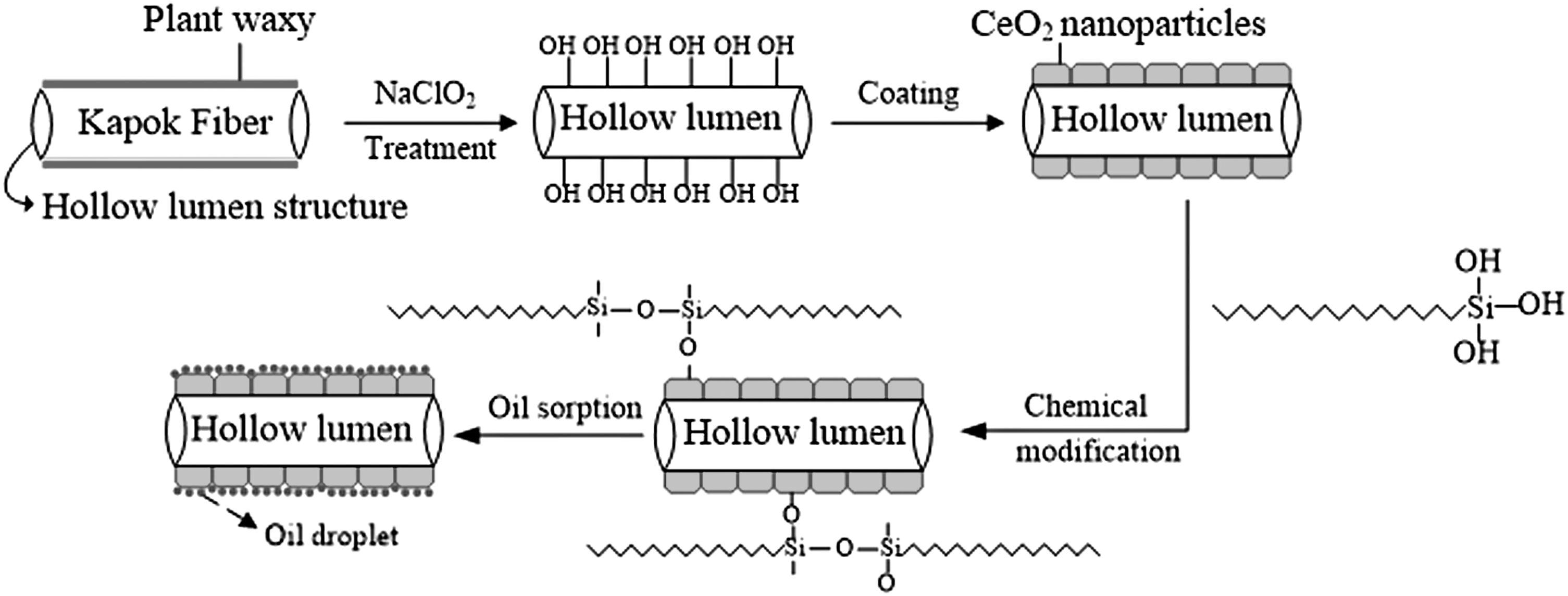
Schematic representation of coating with CeO2 and hydrolysis of OTMS on kapok fiber surface. OTMS, octadecyltrimethoxysilane.
Finally, OTMS was used to further reduce the surface energy and achieve the superhydrophobicity. When OTMS compounded with 95% alcohol, it hydrolyzed to yield a large amount of Si—OH in the presence of acetic acid. Si—OH would react with C—OH in kapok fiber or Si—OH in OTMS to generate C—O—Si bond or Si—O—Si bond. Long-chain alkyl at the outside enhanced the lipophilicity and hydrophobicity.
Morphology analysis
Surface roughness is an important factor to affect the hydrophobicity of material surface. SEM is usually used to observe the morphology of the surface. The RKF has a thin wall, hollow lumen, and smooth surface (Fig. 2a). The surface morphology has changed after CeO2 coating (Fig. 2b). There are many irregular convexes on the surface. The convexes led to the roughness of surface, and eventually led to the enhanced hydrophobicity.

SEM images of
XRD analysis
XRD spectra of RKF and SCMKF are shown in Fig. 2c. It can be seen that the major diffraction peaks of kapok fiber appear in the position of 2θ close to 16° (101) and 22° (002). However, a new diffraction peak appeared in the position of 2θ close to 30° in the SCMKF sample. The peak was generated by the CeO2 on the surface. The crystallinities, according to Segal method, were 40.13% and 23.15% for RKF and SCMKF separately. The crystallinity of kapok fiber decreased after CeO2 and OTMS modification. RKF has high crystallinity, and molecules arrange closely. The decreased crystallinity implied that CeO2 and OTMS reacted with the groups of the kapok fiber surface, which destroyed the regularity of the surface molecules.
FTIR spectra
FTIR spectra of RKF and SCMKF are shown in Fig. 2d. They showed a number of characteristic absorbance peaks. There was a strong and broad peak at 3,408 cm−1, which was assigned to stretching vibration peak of surface O-H. The intensity of the peak O-H decreased obviously in SCMKF compared with that in RKF. For SCMKF, the intensity of absorption peaks at 2,921 cm−1 (C—H stretching vibration) and 1,751 cm−1 (C═O stretching vibration) decreased. New peaks at 1,058 cm−1 (Si—O stretching vibration) generated. However, the peak overlapped with the peak at 1,053 cm−1 (C—O stretching vibration) (Shateri-Khalilabad and Yazdanshenas, 2013). The peak of Ce—O stretching vibration should appear at 558 cm−1 (Duan et al., 2011). The peak overlapped completely with C—O bending vibration at 610 cm−1 (González et al., 2015). XPS was chosen to further prove the combination of CeO2 and OTMS with kapok fiber.
XPS analysis
XPS survey spectra of RKF and SCMKF are shown in Fig. 3. The kapok fiber was mainly composed of carbon and oxygen. It was observed that the C1s and O1s were detected for RKF surface (Fig. 3a). Compared with RKF, Si2p, Ce3d, and Ce4d were also detected for SCMKF surface (Fig. 3a). The Si2p peak at 103.2 eV was attributed to Si atom in Si—O bond. The high-resolution XPS spectra for Ce3d and O1s provided insight into XPS information. The spectrum of Ce3d decomposed into eight component peaks. The peaks of v1 and u1 were ascribed to Ce3+, and the other peaks were attributed to Ce4+ (Burroughs et al., 1976). This indicated that Ce element mainly existed in the form of CeO2, and the result was in good agreement with the report by Zeng et al. (2014). The spectrum of O1s for SCMKF decomposed into two component peaks. The binding energies of 529.4 and 531.3 eV were attributed to Ce—O—Ce and Ce—O—H (Zhang et al., 2014), respectively. This suggested that CeO2 combines with kapok fiber by hydrogen bonds.

Contact angles
Contact angle was used to measure the degree of attraction of the liquid for kapok fiber. Figure 4 shows the water/oil contact angles on RKF, NTKF, and SCMKF surfaces. The contact angle of RKF was 114.7° (Fig. 4). The contact angle increased a little (about 8.7°) after being treated by NaClO2 (Fig. 4b). However, the contact angle measurements revealed that SCMKF showed superhydrophobic and superoleophilic properties (Fig. 4c–f). The apparent WCA of SCMKF exceeded 150° (Fig. 4c). Diesel showed complete wetting within 0.36 s. The WCA of NTKF slightly increased due to the increased surface roughness caused by wrinkles and grooves (Wang et al., 2012b). Coating with CeO2 further increased surface roughness. In addition, OTMS modifying decreased the surface energy. These two factors generated a superhydrophobic surface and were also beneficial for oil absorption.
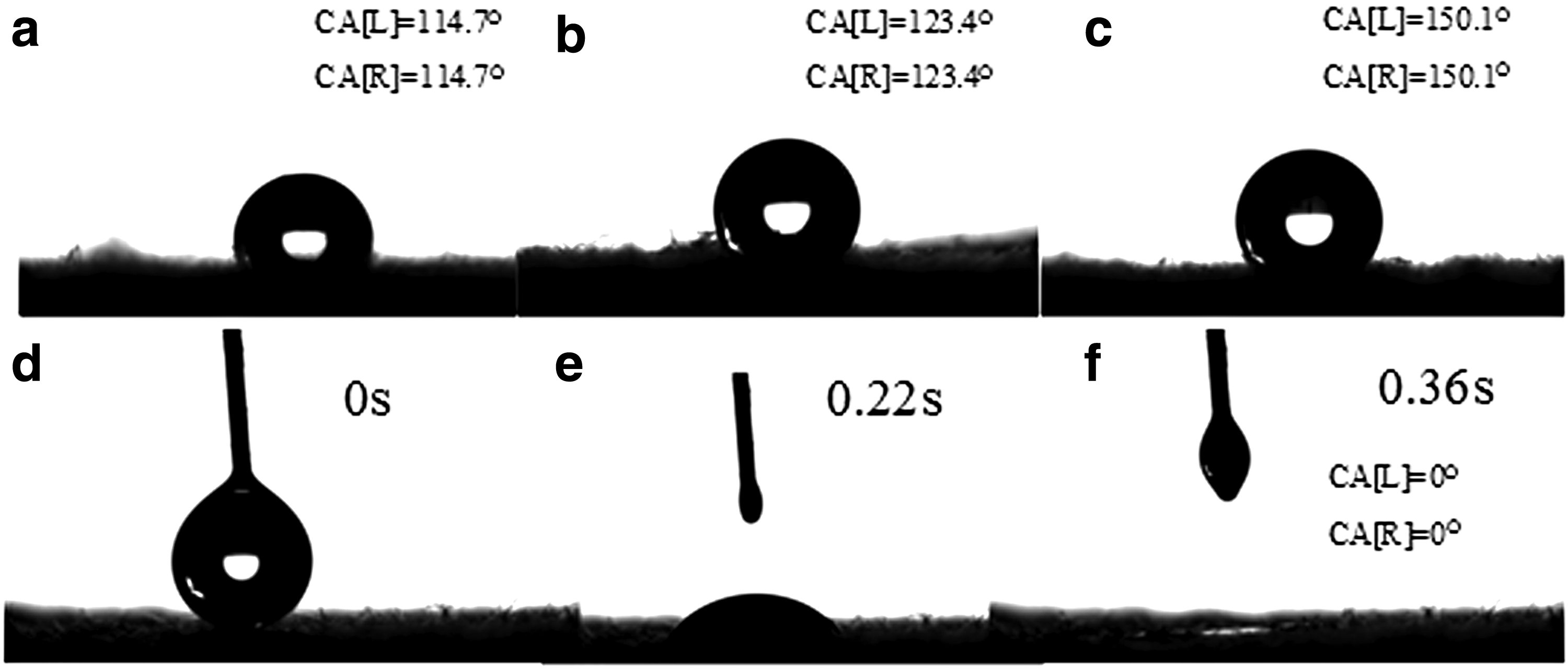
Contact angles for
Sorption properties
Oil sorption behaviors of RKF, NTKF, and SCMKF for diesel, soybean oil, and lubricating oil are shown in Fig. 5a. It was observed that the oil sorption capacities of SCMKF for diesel, soybean oil, and lubricating oil were 48.65, 58.17, and 62.57 g/g, respectively. The oil sorption capacities of NTKF for these oils were 32.44, 43.60, and 49.17 g/g, respectively. Compared with RKF, the sorption capacities of SCMKF for diesel, soybean oil, and lubricating oil increased by 76.5%, 51.9%, and 51.9%, respectively. This indicated that coating with CeO2 and modifying by OTMS generated a more superior oil sorption kapok fiber. Wang et al. (2012a) fabricated superhydrophobic and oleophilic kapok fiber by SiO2 and hydrolyzed dodecyltrimethoxysilane, the oil sorption capacity of the coated fiber for diesel and soybean oil increased by 46.6% and 20.2%, respectively. They also coated the kapok fiber with the mixture of polybutylmethacrylate and SiO2, the growth rate of oil sorption capacity for diesel and soybean oil reached 99.7% and 65.0%, respectively (Wang et al., 2013). The growth rate of oil sorption capacity of the SCMKF is situated between these two materials.

Sorption capacity expressed with mass ratio was mainly influenced by the viscosity of oils. The oils with high viscosity had excellent adherence effect onto the fiber surface (Wu et al., 2012). Fabricating a roughness surface could enhance the oleophilicity of materials due to the capillary effect (Wenzel, 1936). The oils with low viscosity were easier to escape from the smooth surface of kapok fiber, and the fabrication of roughness on the surface could enhance the adhesion force between the oils and the fiber surface. Therefore, the roughness surface could make the kapok fiber have a certain oil holding capacity.
The fast sorption rate is one of the important factors to be an efficient oil sorbent. The changing process of the sorption capacity with contact time is displayed in Fig. 5b. It can be seen that the sorption capacity increased quickly at first 30 s, then it grew slowly, and reached the highest value at 3 min. So the whole process included two stages, one was the fast rising stage at the very beginning of absorption and the other was the slowly rising stage. The high sorption rate indicated the capillary rise (Meng et al., 2015). This meant that the oil penetrated into the pores by capillary action. The slowly rising stage indicated that the diffusion process occurred.
Sorption kinetics of SCMKF was analyzed based on pseudo first-order kinetics equation and the pseudo second-order kinetics equation. The fitting parameters are presented in Table 2. The experimental data conformed to the second-order kinetics (R2 = 0.999). The theoretical equilibrium sorption capacities obtained by fitting the pseudo second-order kinetic were very close to the experimental values.
Reusability
To investigate the reusability of SCMKF for oil removal, the oil sorption experiments were repeated. The oil was collected from oil-soaked SCMKF by centrifugation. Figure 6 shows the sorption reusability of SCMKF.
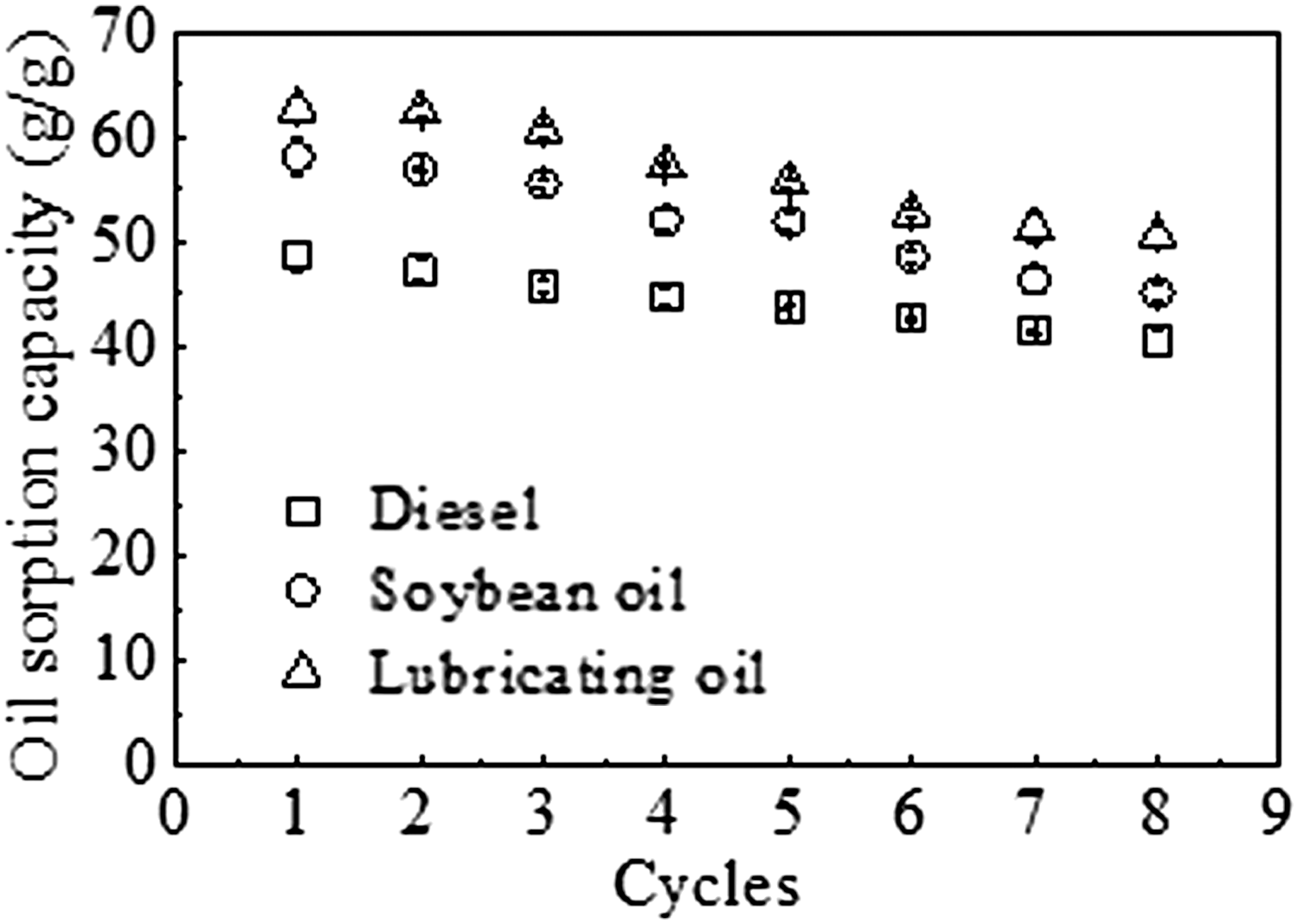
Sorption reusability of superhydrophobic CeO2-modified kapok fiber.
Oil sorption capacities of SCMKF for diesel, soybean oil, and lubricating oil continued to decrease with the cycle times increasing. After eight cycles, the oil sorption capacities of SCMKF for diesel, soybean oil, and lubricating oil decreased from 48.65, 58.17, and 62.57 g/g to 40.49, 45.17, and 50.53 g/g, respectively. The oil can not only be absorbed on the surface of the fiber, but also be stored in the lumen of the kapok fiber (Sun et al., 2011). Although most of oil was separated from SCMKF by centrifugation, some of the oil was also trapped in the lumen. Therefore, the oil sorption capacities of SCMKF decreased after reutilization.
Conclusions
A superhydrophobic surface was fabricated on kapok fiber using CeO2 coating and OTMS modifying. The formation of CeO2 on the kapok fiber surface constructed rough protuberances. The modification of kapok fiber surface by OTMS generated low surface energy. After modification, the kapok fiber had both superhydrophobic and superoleophilic properties simultaneously, and it also exhibited higher sorption capacity. The materials were low cost and the fabrication process was simple. The SCMKF also possessed good usability and stable hydrophobicity. Therefore, the SCMKF will play an important role in oil spill clean-up and oil–water separation.
Footnotes
Acknowledgments
This work was funded by the National Natural Science Foundation of China (Grant Nos. 21677093 and 41373097), Key Laboratory of Water Environment, and Marine Biological Resources Protection of Zhejiang Province (Grant No. KF201503).
Author Disclosure Statement
No competing financial interests exist.