




Abstract
Abstract
Because of the large amounts of iron and aluminum in red mud, which is a by-product of the alumina industry, aluminum and iron can be extracted by HCl or H2SO4 to produce inorganic flocculants. However, residues produced by acid leaching pose environmental problems. In this study, a slow-release mineral fertilizer K2MgSi3O8 is prepared at 1,000°C for 2 h by sintering the flocculant by-product based on red mud. The main mineral in the fertilizer is K2MgSi3O8, with an irregular blocky morphology. In distilled water, 0.50 mol/L HCl, and 20 g/L citric acid, the dissolution rates of K2O are 13.13%, 96.36%, and 81.46% and those of MgO are 2.03%, 70.94%, and 66.03%, respectively. Cumulative release values of K2O and MgO are 6.98% and 0.01% on the first day and 56.12% and 1.70% after 28 days, and the slow-release rates satisfy the Chinese standard for slow-release fertilizers. Hence, the mineral fertilizer K2MgSi3O8 based on the by-product of red mud is a potential slow-release fertilizer.
Introduction
T
Red mud is the waste product of caustic digestion of bauxite during extraction of alumina. For every ton of alumina produced, approximately one to two tons (dry weight) of bauxite residues are generated. The corrosive nature of red mud and large quantities (90 million tons yearly worldwide) cause significant ecological and environmental problems. Red mud is rich in iron and aluminum, which can be extracted HCl or H2SO4 to produce inorganic flocculant (Lu et al., 2011, 2014; Wang et al., 2014). Although the residues from red mud produced by acid leaching pose environmental problems, they are potential raw materials for the slow-release mineral fertilizer K2MgSi3O8. In this study, K2MgSi3O8 is prepared with the acid-leached residues from red mud, brucite, and K2CO3 by solid-phase sintering and the solubility and slow-release properties are investigated systematically.
Experimental Details
Materials
The red mud was provided by Shandong Weiqiao Aluminum and Electricity Co., Ltd. (Shandong, China). The polymeric aluminum iron flocculant was prepared with the red mud and 27% industrial waste HCl by Shandong Jingtai Co., Ltd. The production flow chart is shown in Fig. 1. The filtrate was the raw liquid of the flocculant. The acid-leached residue was washed with 500 mL water three times to obtain the raw materials as the silicon source. The acid-leached residue of red mud was designated as ALR. Brucite was supplied by Kuandian Brucite Factory (Liaoning, China), and the main chemical composition is listed in Table 1. The other reagents in this study were of analytical grade.

Production flow chart of acid-leached residue of red mud.
ALR, acid-leached residue of red mud.
Preparation of K2MgSi3O8 mineral fertilizer
ALR, brucite, and K2CO3 (the mass ratio 6.53:1.00:2.10) were mixed with the stoichiometric ratio of K2MgSi3O8 and placed in an alumina crucible. The sintering reaction proceeded in a muffle furnace (Ajeon Heating Industrial Co., Korea). The synthesis flow chart of K2MgSi3O8 mineral fertilizer using ALR, brucite, and K2CO3 is shown in Fig. 2. To determine the optimal conditions, the sintering temperature was studied based on thermogravimetric (TG) data of the mixture of ALR, brucite, and K2CO3. The optimal sample was designated RMF. The main reaction is as follows:
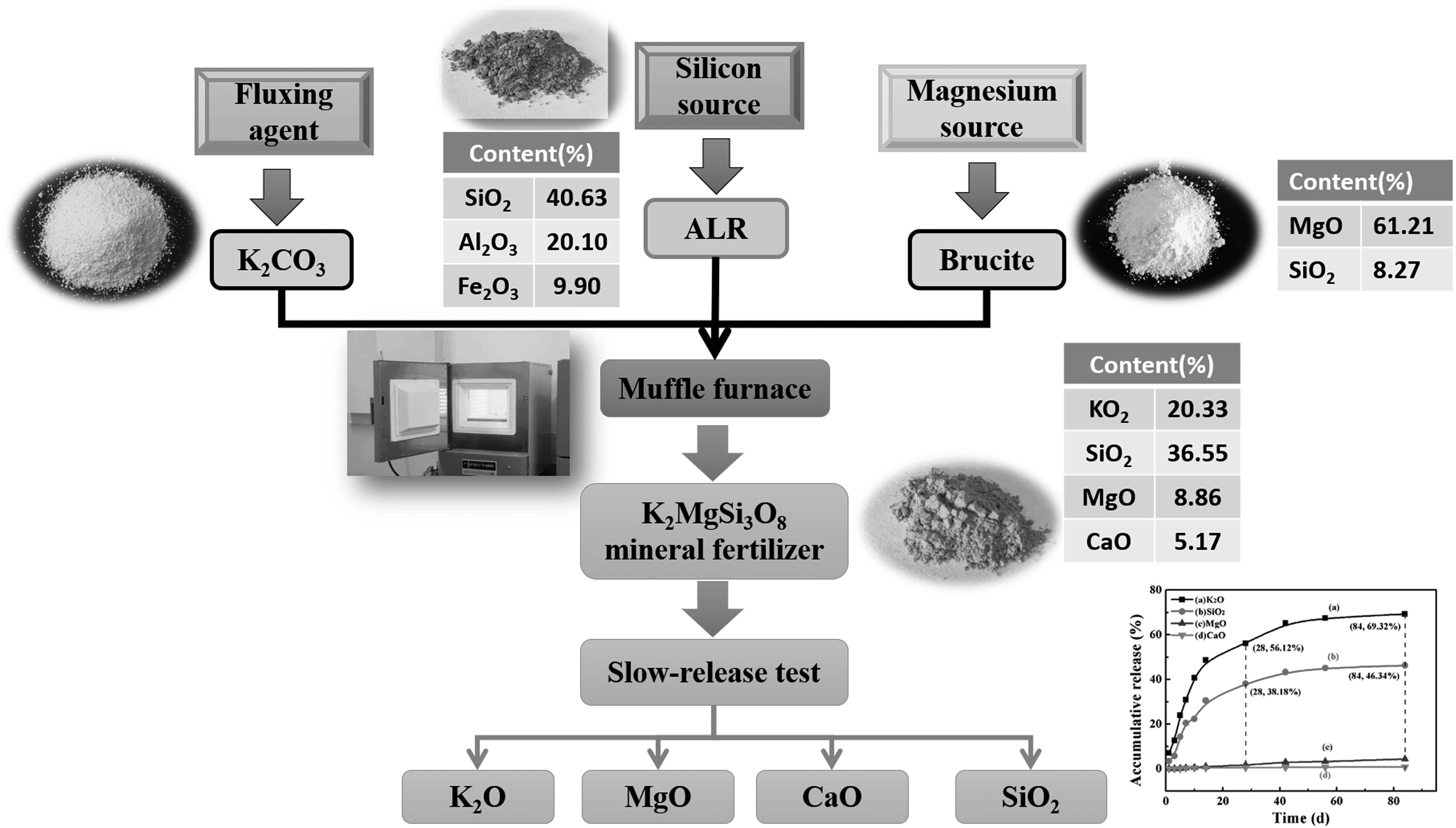
Synthesis flow chart of K2MgSi3O8 mineral fertilizer using ALR, brucite, and K2CO3.
Characterization
Chemical composition and mineral components of ALR, brucite, and mineral fertilizer samples were determined by X-ray fluorescence (XRF) and X-ray diffraction (XRD). Thermal decomposition of the mixture of ALR, brucite, and K2CO3 was monitored by TG differential thermal analysis. Scanning electron microscopy (SEM), Fourier-transform infrared spectroscopy, and N2 adsorption were performed to characterize the structure and morphology of the samples.
Solubility and release properties
Solubility of the samples was measured according to the protocols of the Chinese chemical industry standard of calcium magnesium potassium phosphate fertilizers (HG 2598-94), the Chinese agricultural standard of soil amendment—Determination of calcium, magnesium, and silicon content (NY/T 2272-2012), and soil amendment—Determination of phosphorus and potassium content (NY/T 2273-2012). One hundred fifty milliliters of 0.50 mol/L HCl and 20 g/L citric acid (28–30°C) were added, respectively, to a 250 mL volumetric flask, which was shaken in a digital water bath oscillator for 80 min at 180 rpm. The sample was filtered; the concentrations of K, Mg, and Si in the filtrate were determined measured by inductively coupled plasma optical emission spectroscopy (ICP-OES); and the content of K2O, MgO, and SiO2 can be got by further calculation.
The nutrient release was investigated according to the Chinese national standard of slow-release fertilizer protocol (GB 23348-2009). Ten gram of the sample was put in a nylon mesh bag, added to 200 mL of distilled water in a 250 mL volumetric flask, and held at 25°C in the biochemical incubator. It was filtered after 24 h and at 3, 5, 7, 10, 14, 28, 42, 56, and 84 days. The concentrations of K, Mg, and Si in the filtrate were also determined measured by ICP-OES and the contents of K2O, MgO, and SiO2 are further calculated.
Results and Discussion
Preparation of RMF
The TG curve of the mixture of ALR, brucite, and K2CO3 is presented in Fig. 3. It reveals four weight losses of 8.64%, 3.04%, 5.85%, and 15.45% at 160°C, 257°C, 377°C, and 910°C, respectively. The first and second stages arise from elimination of physically adsorbed water and interlayer water. The third weight loss of 5.85% at 377°C is caused by decomposition of Mg(OH)2 in brucite, and the fourth stage stems from the decomposition of K2CO3 and the crystallization of K2MgSi3O8. The main weight loss is observed between 800°C and 1,000°C during which the RMF reaction occurs. Hence, sintering is performed between 800°C and 1,000°C for 2 h.
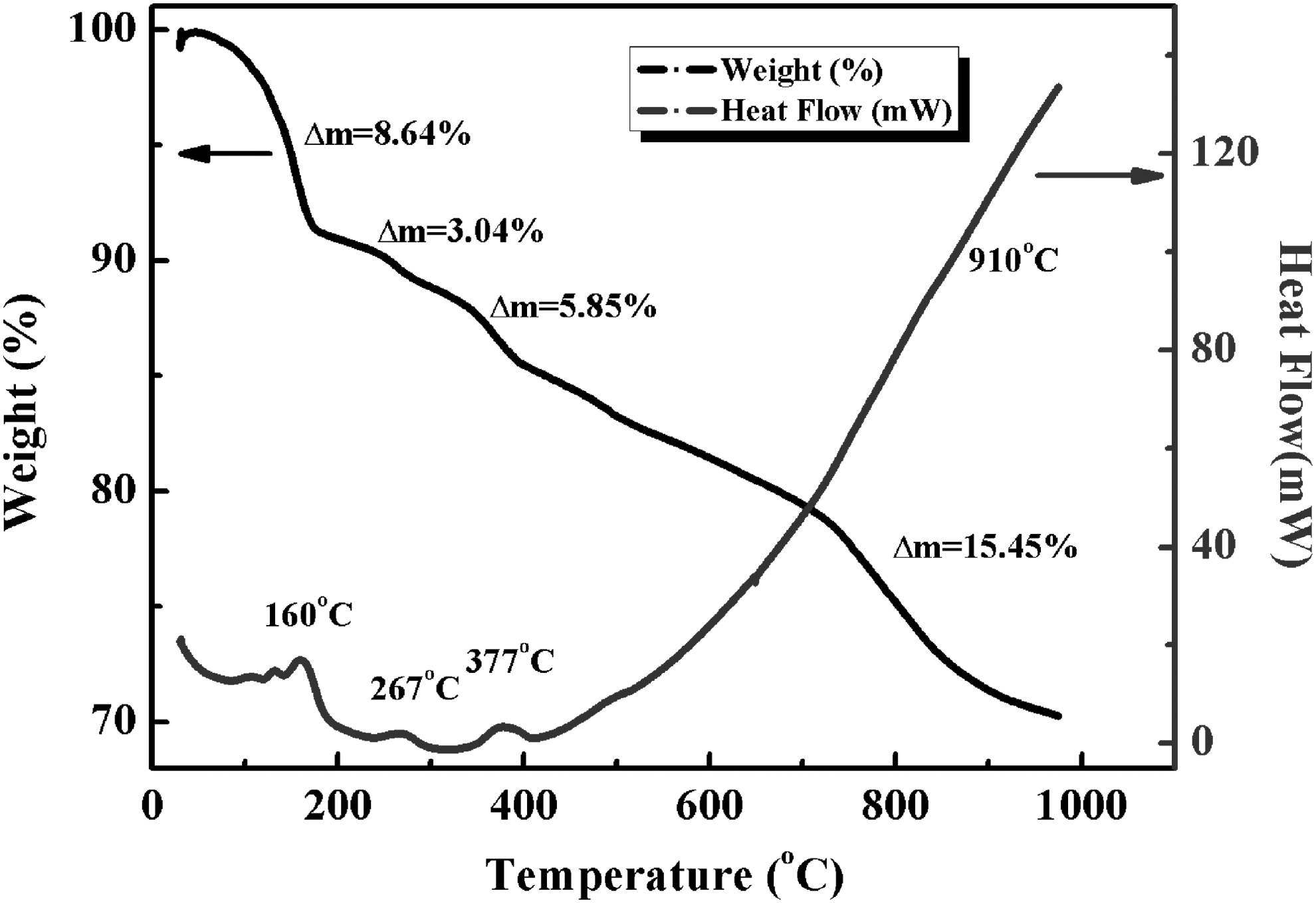
TG-DTG results of mixture of ALR, brucite, and K2CO3. TG-DTG, thermogravimetric-derivative thermogravimetry.
XRD patterns of the mineral fertilizers prepared at different sintering temperature for 2 h are depicted in Fig. 4. The main mineral phases in the mixture of ALR, brucite, and K2CO3 are anatase (TiO2, PDF 21-1272), brucite [Mg(OH)2, PDF 07-0239], and boehmite [AlO(OH), PDF 21-1307]. When the sintering temperature is 800°C, the main characteristic peak is anatase (TiO2, PDF 21-1272), indicating that most of the materials are amorphous. The main characteristic peaks (21.03°, 27.7°, 28.76°, and 33.92°) of K2MgSi3O8 (PDF 10-0030) begin to appear at a sintering temperature of 900°C, and the intensity increases with temperature from 900°C to 1,000°C (Ma et al., 2016). When the sintering temperature is 1,050°C, the peaks of the main by-product KAlO2 (PDF 02-0897) appear and they are not conducive to the formation of the main mineral phase K2MgSi3O8. Moreover, the higher is the temperature, the higher is the production cost. Therefore, 1,000°C is selected as the sintering temperature in subsequent experiments.
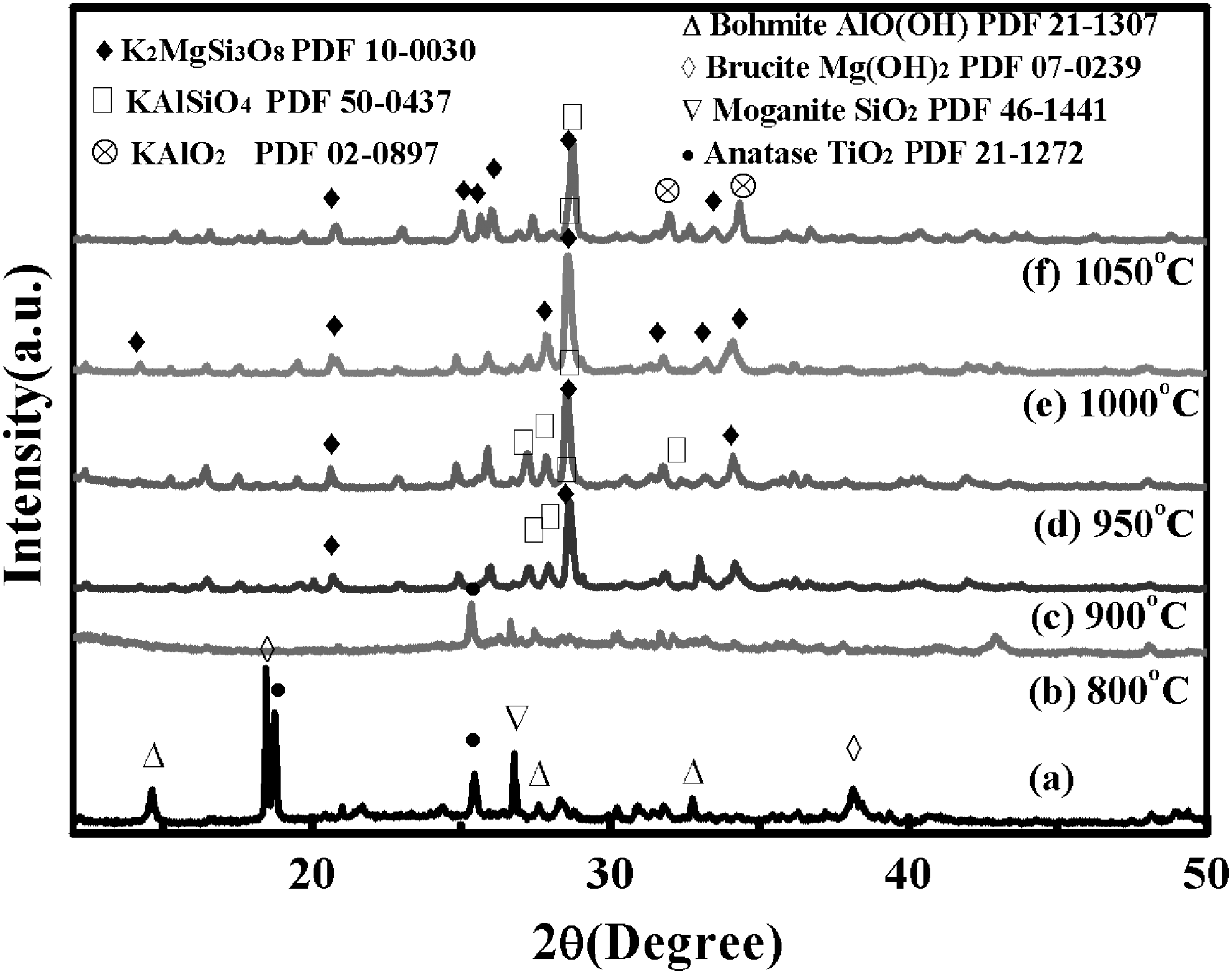
XRD patterns of mineral fertilizers prepared at different sintering temperature. XRD, X-ray diffraction.
Solubility of RMF
Chemical composition of RMF determined by XRF is shown in Table 2. The concentration of SiO2, K2O, and MgO is 36.55%, 20.33%, and 9.86%, respectively. The K:Mg:Si molar ratio of 1.76:1.00:2.49 is close to the theoretical ratio of K2MgSi3O8 (2:1:3).
The solubility of RMF in distilled water, 0.5 mol/L HCl, and 20 g/L citric acid solution is determined and the concentrations of K+, Mg2+, Si4+, Ca2+, and Al3+ in the filtrate measured by ICP-OES are summarized in Table 3. The solubility in HCl and citric acid is higher than that in distilled water, and the extracted concentrations of K2O, MgO, SiO2, and CaO in 0.50 mol/L HCl are larger than those in 20 g/L citric acid because the pH of 0.50 mol/L HCl (pH = 0.3) is smaller than that of 20 g/L citric acid (pH = 2.0), indicating that RMF is a citrate-soluble fertilizer with potentially desirable release properties. The weight losses (%) of RMF of 79.53% and 65.38% in 0.50 mol/L HCl and 20 g/L citric acid are larger than those in distilled water.
Characterization of RMF
XRD patterns of RMF and RMF in 0.50 mol/L HCl are shown in Fig. 5. After treatment in 0.50 mol/L HCl, the diffraction peaks of K2MgSi3O8 and KAlSiO4 disappear, suggesting that they dissolve or decompose in the solution. The XRD results of the residue in 0.50 mol/L HCl show that the main mineral phases are Fe3Ti3O10 and Mg2SiO4 produced by the sintering process.

XRD patterns of (a) RMF and (b) RMF in 0.50 mol/L HCl.
The SEM images of the RMF and RMF in 0.50 mol/L HCl are displayed in Fig. 6. Figure 6a and b shows that RMF was smoother granular edge before treatment in 0.50 mol/L HCl (Fig. 6c, d). There were many holes on the surface of the RMF particles after the 0.50 mol/L HCl treatment, indicating that some of the particles dissolve. The surface area of RMF after the 0.50 mol/L HCl treatment increases from 45.40 to 73.40 m2/g and the porosity goes up from 4.00% to 13.00%, as shown in Table 4.
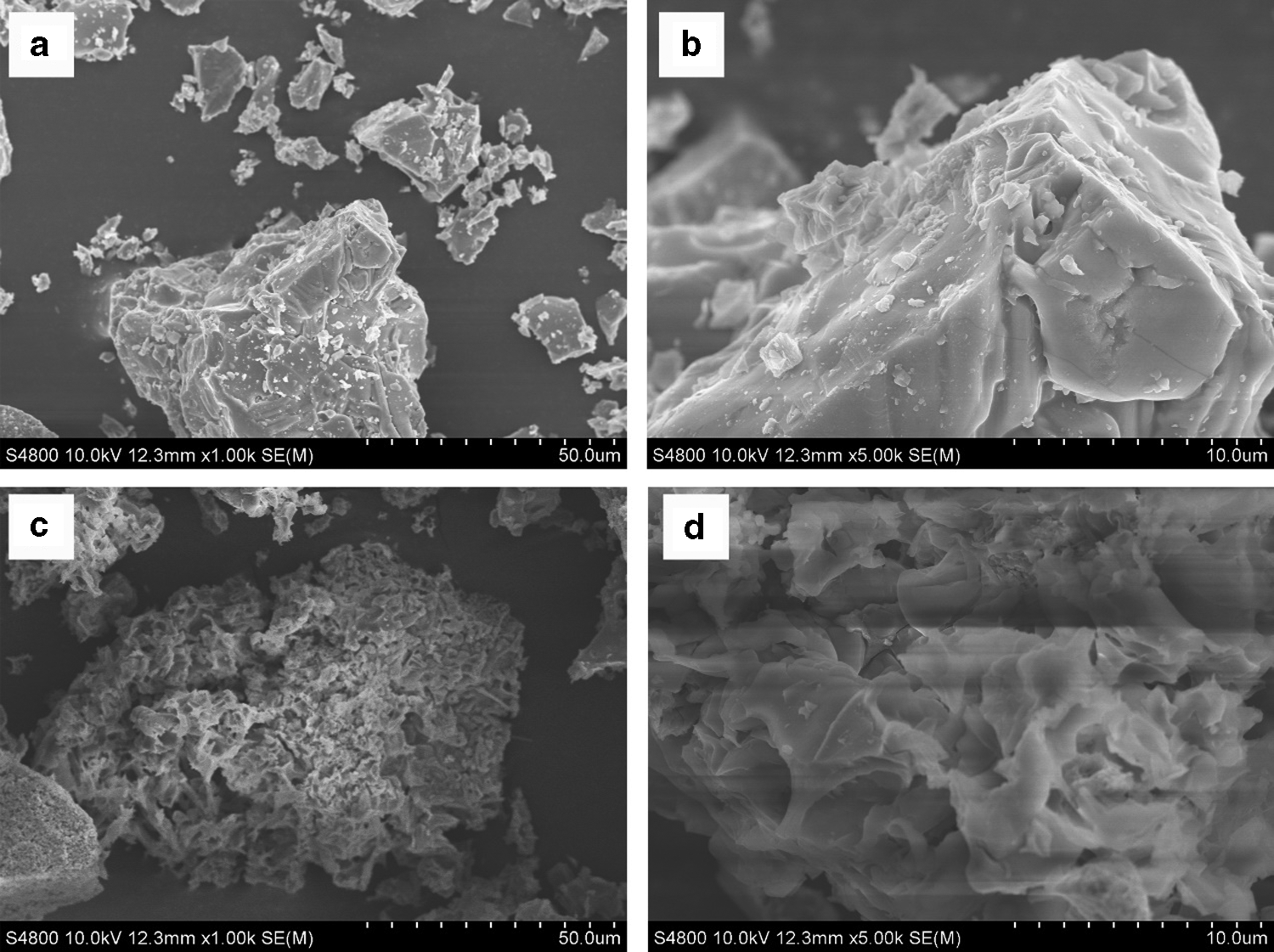
SEM images:
BET, specific surface area.
Release properties of RMF
In accordance with the Chinese national standard for slow-release fertilizers (GB 23348-2009), 10 g of RMF is put in a nylon mesh bag and added to 200 mL of distilled water in a 250 mL volumetric flask. At time points of 24 h as well as 3, 5, 7, 10, 14, and 28 days, the filtrates were analyzed by ICP-OES. The cumulative release amounts (%) of SiO2 and K2O are calculated based on Equation (2):
where i stands for K2O, MgO, SiO2, CaO, and Al2O3; ci (g/mL) is the concentration of component i in the filtrate; V is 250 mL; and m (g) and wi (%) are the content of component I in the optimal sample. Fig. 7 shows that the cumulative releases of K2O, SiO2, MgO, and CaO are 6.98%, 3.44%, 0.01%, and 0.02%, respectively, on the first day and increase with time, reaching 56.12% K2O, 38.18% SiO2, 1.70% MgO, and 0.50% CaO, respectively, after 28 days. After 84 days, the cumulative releases reach 69.32% K2O, 46.34% SiO2, 4.40% MgO, and 0.73% CaO. The cumulative releases of K2O and SiO2 increase obviously but that of SiO2 increases more slowly than K2O. Conversely, the cumulative releases of MgO and CaO are close to equilibrium, with little release of MgO and CaO. The reason is that the solution of RMF is alkaline and Mg and Ca form precipitation. SiO2 and K2O in RMF dissolve in distilled water and the cumulative release is less than 80% after 28 days, thereby satisfying the Chinese national standard for slow-release fertilizers.
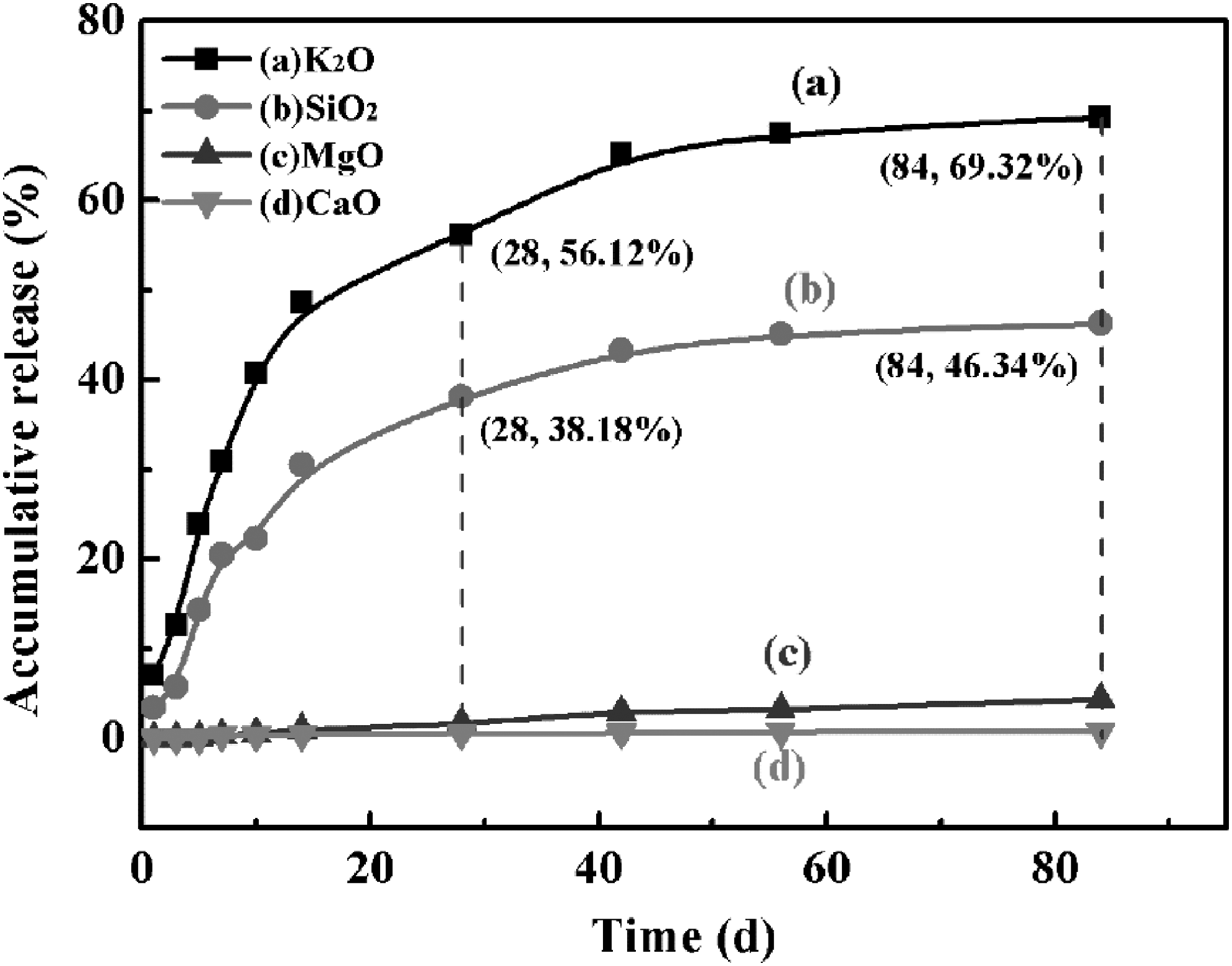
Cumulative release of K2O, MgO, SiO2, and CaO in RMF.
Heavy metal dissolution
Amounts of heavy metals in solid wastes affect the application. Table 5 shows the heavy metal concentration in RMF after 84 days in water and 0.5 mol/L HCl. The heavy metal contents are considerably smaller than the Chinese fertilizer standard. After 84 days in water, the concentrations of Hg, As, Cd, Pd, and Cr in the liquid are 0.0021, 2.045, 0.0032, 0.008, and 1.23 mg/kg, respectively, and the dissolution rates are 16.15%, 24.84%, 1.78%, 0.73%, and 5%, respectively. The dissolution rates of heavy metals are quite small and so, they do not affect crops.
Cost analysis
Total production cost of fertilizer is obtained in Table 6 by analyzing the raw material price and labor cost. The total cost of fertilizer of RMF is 1,554 CNY/t with available nutrient composition SiO2 = 13.00%, CaO = 1.80%, MgO = 6.28%, and K2O = 19.59%. However, the prices of calcium magnesium potassium fertilizer (SiO2 ≥ 20.00%, CaO ≥20.00%, MgO ≥6.00%, K2O ≥ 7.00%) and soil conditioner (SiO2 ≥ 22.00%, CaO ≥23.00%, MgO ≥9.00%, K2O ≥ 6.00%) in the market are 4,200 CNY/t and 4,000 CNY/t, respectively. The cost of RMF is much lower than that of calcium magnesium potassium fertilizer and soil conditioner in the market, and it has broad application prospects.
Conclusion
The slow-release mineral fertilizer K2MgSi3O8 is prepared with the acid-leached residue of red mud, brucite, and K2CO3 by solid-phase sintering at 1,000°C for 2 h. The mineral fertilizer is a citrate-soluble fertilizer and the extraction of K2O, MgO, SiO2, CaO, and Al2O3 in 0.50 mol/L HCl is larger than that in 20 g/L citric acid. The cumulative releases of K2O and MgO are 6.98% and 0.01% on the first day and 56.12% and 1.70% after 28 days, indicating that the slow-release property satisfies the Chinese national standard of slow-release fertilizers. The dissolution rates of Hg, As, Cd, Pd, and Cr in 0.50 mol/L HCl are 0.0021, 2.045, 0.0032, 0.008, and 1.23 mg/kg, respectively, and indicate minimal influence on the quality of crops.
Compared with the mineral fertilizer in the market, the cost of RMF is much lower and indicates that it has broad application prospects.
Footnotes
Acknowledgments
This work was supported by the National Science-Technology Support Plan Projects [No. 2014BAC31B01], the National High Technology Research and Development Program of China [863 Program, No. 2012AA06A109], and the City University of Hong Kong Applied Research Grant (ARG) No. 9667122 and Strategic Research Grant (SRG) No. 7004644.
Author Disclosure Statement
No competing financial interests exist.