




Abstract
Abstract
This study investigated the influence of organic wastewater contaminants (OWCs) on the aggregation of nanoparticle titanium dioxide (n-TiO2) because aggregation experiments are important to obtain fundamental information about the potential fate of n-TiO2 in environmental systems. Aggregation experiments showed that surface modification of n-TiO2 such as different aggregation behaviors and changes of zeta potentials was clearly influenced by the adsorption of OWCs based on t-test results. Largest diameter changes of n-TiO2 were observed by chlorothalonil (359 nm) at 0 h and alachlor (436 nm) at 12 h, while smallest diameter changes of n-TiO2 were observed by cyanazine (84 nm) at 0 h and butylate (53 nm) at 12 h. The most significant zeta potential changes of n-TiO2 were observed by pendimethalin and butylate with −15.2 mV at 0 h and with −16.7 mV and −17.1 mV at 12 h, respectively. These results may demonstrate insights into the microscopic and/or molecular interaction between n-TiO2 and OWCs that result in surface modification of n-TiO2. Thus, we developed quantitative structure–activity relationships (QSARs) between n-TiO2 aggregation rate kinetics and representative seven descriptors of OWCs including pKa, Solubility (Cw), log Kow, molecular weight, polar surface area (P.S.A.), molar volume, and # of H Bond Donor (# of H.B.D.). The developed QSARs showed that experimental n-TiO2 aggregation rate kinetics were strongly related to seven descriptors of all OWCs except for butylate. Particularly, some polarity descriptors such as Cw, log Kow, P.S.A., and # of H.B.D. seem to have influences on the developed QSARs. Therefore, our developed QSARs for n-TiO2 aggregation rate kinetics according to seven descriptors of OWCs provide solid information to the general nanoparticle (NP) researches and significant insights about the effects of emerging OWCs on microscopic and/or molecular interaction with NPs, which would demonstrate the roles of physicochemical descriptors of OWCs on n-TiO2 aggregation.
Introduction
A
Once nanoparticles (NPs) enter the aquatic environment, factors such as aqueous pH, ionic strength (IS), and organic compounds such as natural organic matter (NOM) influence NPs stability causing aggregate or disaggregate of NPs by adsorption processes (Guzman et al., 2006; Domingos et al., 2009; French et al., 2009; Solovitch et al., 2010; Godinez et al., 2013). Many studies have demonstrated that NOM can strongly influence stability of NPs (Domingos et al., 2009; Thio et al., 2011; Chen et al., 2012). Domingos et al. (2009) presented that increased aggregates of n-TiO2 occurred with fulvic acid concentration 1.0 mg/L, while decreased aggregate of n-TiO2 occurred with fulvic acid concentration >1.0 mg/L for IS of 0.1 M and pH 8. In case of emerging organic contaminants, little information has been known, a recent study reported that 17β-estradiol (E2) altered the stability of n-TiO2 in concentration ranging from 0.1 to 3 mg/L in specific IS conditions at 20 mM NaCl and 2 mM CaCl2 at pH 7 (Lee et al., 2015). Particularly, they demonstrated that steric repulsion by adsorption of E2 enhanced stability of n-TiO2 causing decreases of particle distribution accordance with the E2 concentration increases in 10 mM NaCl at pH 7.
In WWTP effluent, it is likely that NPs are co-released with trace organic compounds such as NOM and organic acids, thus there is potential for these compounds to influence on NPs stability by adsorption (Domingos et al., 2009; Thio et al., 2011; Chen et al., 2012; Lee et al., 2015, 2016). Our previous studies have showed the aggregation of n-TiO2 in the presence of organic compounds (e.g., 17β-estradiol [E2] and/or NOM) under various IS conditions and have demonstrated the obvious effects of E2 on the n-TiO2 aggregation and transport of aggregated n-TiO2 in porous media (Lee et al., 2015, 2016). In addition, decreased aggregation of n-TiO2 was reported by the adsorption of NOM (Domingos et al., 2009; Thio et al., 2011), serum and albumin protein (Allouni et al., 2009) due to steric repulsion of those organic contaminants adsorption on the surface of n-TiO2. Despite this evidence that OWCs having high affinity can influence surface modification of n-TiO2, however, there is limited information regarding the effects of OWCs on the stability and mobility of n-TiO2 in environment.
Particularly, municipal wastewater effluents have contained various organic wastewater contaminants (OWCs) such as pharmaceuticals, steroids, and pesticides as these compounds are not completely removed during wastewater treatment processes and released into receiving waters, which would be persistence and occurrence in environment (Heberer, 2002; Kolpin et al., 2002; Auriol et al., 2006; Yu et al., 2006; Liu et al., 2009; Richardson, 2009; Pal et al., 2010). A study reported the detection of some OWCs including pharmaceuticals (ibuprofen), pesticides (lincomycin), and steroids (E1, E2, and EE2) in effluents up to 1,000, 730, 112, 200, and 831 ng/L, respectively (Kolpin et al., 2002). As a result, it has reported that some pharmaceuticals such as lincomycin and ibuprofen were observed up to 644 and 16,886 ng/L in surface water, respectively. In some cases steroids such as estrone (E1), 17β-estradiol (E2), and 17α-ethinylestradiol (EE2) were observed up to 22, 2.1, and 0.5 ng/L in surface water, respectively (Boleda et al., 2014; Meffe and de Bustamante, 2014). Some pesticides such as azithromycin, atrazine, alachlor, cyanazine, pendimethalin, butylate, and chlorothalonil, were also observed up to 569, 2,800, 440, 5,100, 57.4, 83, and 228 ng/L in surface water, respectively (Chen et al., 2002; Reilly et al., 2012; Boleda et al., 2014; Meffe and de Bustamante, 2014). Based on the reports of target OWCs in surface water, our study selected 12 OWCs to investigate the interaction with n-TiO2 because those OWCs would be able to influence NP stability by adsorption.
Quantitative structure–activity relationships (QSARs) based on multi-linear regression (MLR) models have been used to reveal the biological, chemical, or physical activity of a chemical compound according to its physicochemical characteristics (Brasquet et al., 1999; Puzyn et al., 2009; Chau and Yap, 2012). Previous studies have predicted the sorption coefficient, Koc of organic chemical compounds on soils or sediments by applying MRL QSARs (Gramatica et al., 2000; Doucette, 2003; Sathyamoorthy and Ramsburg, 2013)_ENREF_28. In addition, QSARs have been developed to predict biological toxicity based on physical characteristics of NPs (Puzyn et al., 2009, 2011; Fourches et al., 2010; Chau and Yap, 2012). Recently, linear regression models have been developed between the aggregation rate of nanoparticle ZnS (n-ZnS) and properties of NOM such as molecular weight and carboxyl (% dissolved organic carbon [DOC]) under various IS and DOC concentrations (Deonarine et al., 2011). Because n-TiO2 can coexist with OWCs in wastewater effluents, it is possible to being different sorption processes between n-TiO2 and OWCs having different molecular properties. Thus, n-TiO2 aggregation may be strongly influenced by OWCs and it may need to investigate the relationships between n-TiO2 aggregation behaviors and all possible properties of OWCs to understand the fate of n-TiO2 in environment.
To date, there has been no attempt to develop QSAR models for NPs aggregation after OWCs adsorption, this study has provided new insights on the effects of OWCs on NP microscopic (such as aggregation) and/or molecular behaviors in environment by developing predictive QSAR models between NPs aggregation rate kinetics and physicochemical descriptors of OWCs. Therefore, this study may indeed benefit the general NP fate and mobility researches in environment.
Experimental Protocols
Chemical reagents
n-TiO2 (Rutile) in powder form was purchased from Nanostructured and Amorphous Material, Inc. (Los Alamos, NM) with an average particle size of 10 × 40 nm, 98% purity, specific surface area of 160 m2/g, and coated with <5% SiO2. Particularly, 12 representative OWCs were considered in this study due to the occurrence and persistence of those contaminants in various environments (Solomon et al., 1996; Konstantinou and Albanis, 2004; Ramesh and Maheswari, 2004; Lynch et al., 2006; Kemper, 2008; Swarcewicz and Gregorczyk, 2012; Petrie et al., 2015). The molecular structures and relevant decriptors of OWCs of interests, including pharmaceuticals (ibuprofen [Fluka], azithromycin [Fluka], and lincomycin [ICN Biomedicals, Inc.]), pesticides (alachlor [Fluka], butylate [Fluka], pendimethaline [Fluka], atrazine [Fluka], chlorthalonil [Riedel-de Haen], and cyanazine [Fluka]), and steroids (17β-estradiol [Aldrich], estrone [Aldrich], and 17α-ethinylestradiol [Sigma-Aldrich]), are provided in Table 1.
OWC, organic wastewater contaminant; M.W.., molecular weight, P.S.A. polar surface area; M.V., molar volume; # H.B.D., # of H Bond Donor; N/A, not available.
Preparation of n-TiO2 suspensions with OWCs
n-TiO2 suspensions were prepared as described in French et al. (2009), Chen et al. (2011), and Lee et al. (2015) with procedure modifications. All n-TiO2 suspensions were prepared in Milli-Q water (18.0 MΩ-cm; Barnstead Nanopure System). About 0.3 mg of n-TiO2 was placed in 300 mL of 2 mM CaCl2 in a 500 mL glass flask resulting in a final n-TiO2 concentration of 1 mg/L; these n-TiO2 suspensions were immediately stirred using a magnetic stir-plate for 30 s followed by sonication in an ultrasonic water bath (FS 60, 100 W, 42 kHz; Fisher Scientific, Pittsburg, PA) for 1 h to obtain a homogeneous suspension. After sonication, the flask was cooled to 25°C and 0.01 M NaOH was added to adjust pH to 7 ± 0.1 and each OWC was separately spiked into the n-TiO2 suspensions from a stock solution in methanol or Milli-Q water. A stock solution was prepared by <1% (v/v) to n-TiO2 suspensions. The final concentration of methanol was kept <1% (v/v) to minimize the potential for cosolvent effects on n-TiO2 aggregation. The final concentration of each OWC in the n-TiO2 suspensions was 0.2 mg/L. Here, we fixed the concentration of n-TiO2 and all OWCs with 1 and 0.2 mg/L, respectively even though those concentrations are higher than concentrations in actual environment because we considered the possible presence ratio between total suspended concentrations and representative OWCs concentration in effluent and surface waters that ranged from 0.0003 to 9.9 based on the information in our “Introduction” section.
Measurements of n-TiO2 particle size and zeta potential
Aggregation measurements were conducted at 0 and 12 h to analyze aggregation sizes and zeta potential of n-TiO2/OWC suspensions. For a representative sample collection, 3 mL aliquot was very carefully taken from n-TiO2/OWC suspension by pipetting after vigorously shaking n-TiO2/OWC suspension for seconds and n-TiO2 aggregation particle size was measured by using a 90Plus particle size analyzer (Brookhaven Instruments Corporation, Holtsville, NY) based on dynamic light scattering (DLS). Measured particle size represents the effective diameter of NPs calculated for spherical particles from the Stokes-Einstein equation based on the translational diffusion coefficient, which is intensity weighted. Therefore, each effective diameter of NPs was an intensity-weighted hydrodynamic diameter from accumulated autocorrelation function. The mean diameter was calculated by the sum of these effective diameters divided by N runs (three runs in our experiments and 1 min per one run). Zeta potential of n-TiO2 was measured by ZetaPALS (Brookhaven Instruments Corporation) using phase analysis light scattering technique to measure the electrophoretic mobility according to the Smoluchowski equation that converted mobility to the zeta potential of n-TiO2. During the aggregation experiments, the flask containing the n-TiO2 suspension with each OWC was covered with aluminum foil to prevent photo-degradation or photocatalytic degradation of the OWC by light and incubated in a dark chamber at room temperature.
To determine the rates of change in hydrodynamic diameter, the fast aggregated n-TiO2 was measured before adding OWCs, shortly after (9 min) adding OWCs, and the slow aggregated n-TiO2 was measured at an extended period (12 h) after adding OWCs. An aggregation rate kinetic (k
t
) was estimated by applying an aggregation kinetic equation published in previous studies (Mylon et al., 2004; Chen and Elimelech, 2006);
where kt is the aggregation rate kinetic at time t, ΔDH(t) is the difference between n-TiO2 hydrodynamic diameter at time t and before adding OWCs, N0 is the concentration of n-TiO2, and, Δt is the time duration. Two time points, t = 9 min and 12 h, were only evaluated to represent the diameter change at the beginning and after an extended time duration that represent the aggregation rate kinetic of k1 and k2, respectively, which would demonstrate the fast aggregation and slow aggregation of n-TiO2 in the presence of OWCs. For the convenience of discussion, the early time point (9 min) is denoted as 0 h in the “Discussion” section.
QSARs for aggregation of n-TiO2 by OWC molecular descriptors
QSARs for predicting the aggregation of n-TiO2 based on the OWC molecular descriptors were developed by using two different MLR models in MATLAB (R2015a). In model 1 (using fitlm function in MATLAB), it was developed with the following seven descriptors of OWCs: pKa, solubility (Cw), log Kow, molecular weight (M.W.), polar surface area (P.S.A.), molar volume (M.V.), and # of H Bond Donor (# of H.B.D.). In model 2 (using stepwiselm function in MATLAB), it was developed by forward and backward stepwise regression approaches by removing or adding OWCs descriptors in the model until its descriptors were satisfied with p-value <0.05.
Results and Discussion
Zeta potentials of n-TiO2 in presence of OWCs
We measured the zeta potential of n-TiO2 in the presence of OWCs to determine how n-TiO2 surface charge is influenced by the adsorption of OWCs. The statistical significance of OWCs on zeta potential of n-TiO2 at both 0 and 12 hr was evaluated using one-tailed Student's t-test assuming unequal variance (α = 0.05). Some OWCs such as azithromycin, ibupropen, chlorothalonil, alachlor, pendimethalin, and butylate resulted in statistically significant changes in the average zeta potential of n-TiO2 when compared to control with no OWCs at 0 h. At 12 h, some other OWCs estrone, 17β-estradiol, chlorothalonil, atrazine, pendimethalin, and butylate showed statistically significant changes in the average zeta potential of n-TiO2 when compared to control with no OWCs (Fig. 1). Particularly, OWCs satisfying with Student's t-test results have common functional groups of alkanes (R–CH3) or hydroxyl (R–OH) except of chlorothalonil that are likely to provide a unique molecular to interact with hydroxylated n-TiO2 aggregate surface (Table 1).
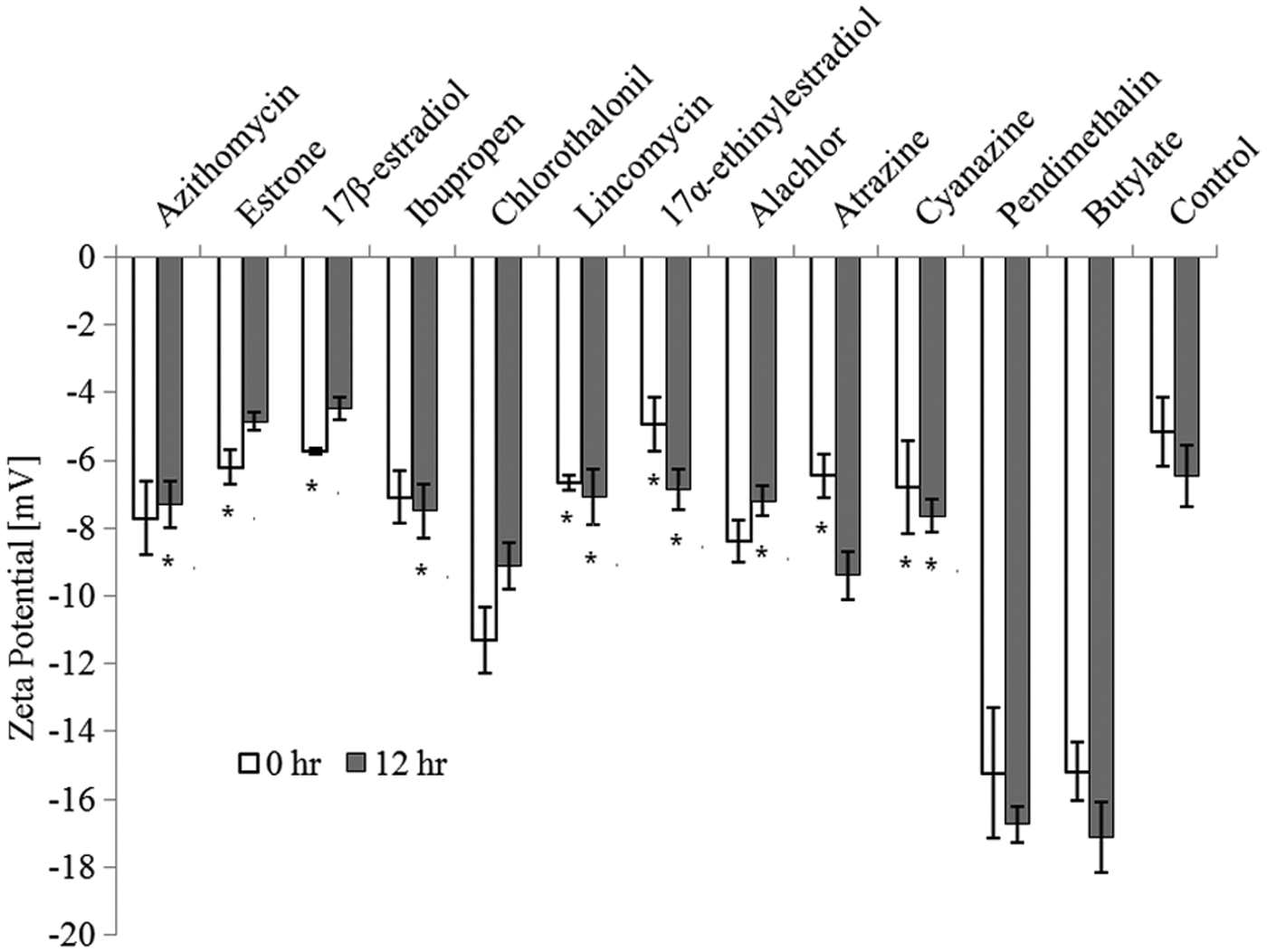
Zeta potential changes of n-TiO2 in presence of OWCs (0.2 mg/L) and in absence of OWCs (control) in 2 mM CaCl2 solution with pH 7 at 0 and 12 h. The mark of “*” presents the unsatisfied t-test results for the zeta potential changes. OWC, organic wastewater contaminant; n-TiO2, nanoparticle titanium dioxide.
Adsorption tendency of OWCs is typically determined by sorption property of OWCs based on log Kow that can be considered to the tendency of the chemical to partition with particulate phase. Chemicals with <1.0 may be considered relatively hydrophilic, while chemicals with >4 may be considered very hydrophobic. The log Kow values of above OWCs ranged from 3.05 (chlorothalonil) to 5.18 (pendimethalin) and ranged from 2.61 (atrazine) to 5.18 (pendimethalin) in the t-test results at 0 and 12 h, respectively. These results demonstrated that those OWCs are able to easily partition on n-TiO2 aggregate surfaces due to higher hydrophobicity, which may influence surface charge of n-TiO2. Particularly, pendimethalin and butylate having higher log Kow values of 5.18 and 4.15, respectively than other OWCs are very hydrophobic. As a result, these two OWCs could be more easily sorbed onto the n-TiO2 aggregate surfaces and presumably the most negative surface charge changes are likely dominated by strong steric repulsion from pendimethalin and butylate adsorption.
The average zeta potential of n-TiO2 was −5.2 mV (σ = ±1.0) at 0 h in the absence of OWCs, while the average zeta potential of n-TiO2 showed more negative in the presence of some OWCs such as azithromycin (−7.7 mV), ibupropen (−7.1 mV), and alachlor (−8.4 mV). Particularly, the significant changes in zeta potential at 0 h were observed in the presence of chlorothalonil (−11.3 mV), butylate (−15.2 mV), and pendimethalin (−15.2 mV) based on t-test results (Fig. 1). In addition, the zeta potential of n-TiO2 showed less negative in the presence of estrone (−4.9 mV) and 17β-estradiol (−4.5 mV), while more negative zeta potentials were observed in the presence of chlorothalonil (−9.1 mV) and atrazine (−9.4 mV) at 12 h. Moreover, the most negative zeta potentials were observed in the presence of pendimethalin (−16.7 mV) and butylate (−17.1 mV) (Fig. 1). These results showed clearly that the surface charge changes of n-TiO2 were influenced by the adsorption of OWCs, which is consistent with prior studies (Domingos et al., 2009; Thio et al., 2011; Zhu et al., 2014). A few studies have reported increased stability of n-TiO2 due to steric repulsion by the adsorption of organic contaminants (Pettibone et al., 2008; Joo et al., 2009; Mudunkotuwa and Grassian, 2010). A recent study demonstrated that the surface modification of n-TiO2 by adsorption of critic acid resulted in more negative zeta potential changes at pH 6, which showed the effects of citric acid molecular properties on increasing stability of n-TiO2 due to increased repulsive force (Mudunkotuwa and Grassian, 2010). In addition, a study showed the possibility of functional groups such as nonpolar carbon rings in 17β-estradiol on binding with the n-TiO2 aggregate surfaces due to the presence of uncharged surface heterogeneity in n-TiO2 (Lee et al., 2015).
Our results of zeta potential changes between at 0 and at 12 h in the presence of OWCs illustrated continuous interaction occurring between reactive n-TiO2 surface heterogeneity and OWCs in time series. Moreover, the variation in our observed zeta potentials of n-TiO2 with OWCs supported that unique properties of each OWC may play a key role on the surface modification of n-TiO2 in the aspect of molecular interaction between n-TiO2 surfaces and OWCs descriptors.
Aggregation behaviors of n-TiO2 in presence of OWCs
The aggregation behaviors of n-TiO2 in the presence of OWCs were presented by the average hydrodynamic diameters obtained from DLS measurements between 0 (fast aggregation) and 12 h (slow aggregation). The statistical significances of OWCs on average hydrodynamic diameters of n-TiO2 at both 0 and 12 h were evaluated by one-tailed Student's t-test assuming unequal variance (α = 0.05). We observed that most of OWCs resulted in statistically significant changes in average hydrodynamic diameters of n-TiO2 except for butylate (at 12 h) comparing to a control in the absence of OWCs, which showed the clear impact of OWCs adsorption on different n-TiO2 aggregates.
The differences in hydrodynamic diameters of n-TiO2 (Δ diameter) between in the presence and in the absence of each OWC at 0 and 12 h were shown in Fig. 2 and it presented that our target OWCs significantly affected the average hydrodynamic diameter changes of n-TiO2. The average hydrodynamic diameter changes of n-TiO2 in the absence of OWC were 381 nm for 0 h and 736 nm for 12 h that demonstrated the n-TiO2 self-aggregation during times that may show the maximum hydrodynamic diameter changes of n-TiO2 because our previous study showed the average hydrodynamic diameter of n-TiO2 with 757 nm for 12 h in the same water chemistry conditions (only the concentration of n-TiO2 is different with having 5 mg/L) (Lee et al., 2015). The largest Δ diameter (359 nm) was observed by chlorothalonil at the fast aggregation of n-TiO2 (at 0 h), while the largest Δ diameter was observed by alachlor with 436 nm at the slow aggregation of n-TiO2 (at 12 h). Particularly, we observed that Δ diameter changes (173 nm) of n-TiO2 with butylate were larger than Δ diameter changes (135 nm) of n-TiO2 in the presence of 17α-ethinylestradiol even though the zeta potential (−15.2 mV) in butylate was higher than the zeta potential (−4.9 mV) in 17α-ethinylestradiol at 0 h, which was the opposite results according to DLVO theory (Fig. 2). Δ diameter changes of n-TiO2 decreased from 174 at 0 h nm to 53 nm at 12 h in the presence of butylate, however, Δ diameter changes of n-TiO2 in the presence of pendimethalin increased from 153 nm at 0 h and 264 nm at 12 h even though the zeta potentials were similar between two OWCs. These results were in contrast with previous studies that increased zeta potential by adsorption of organic contaminants caused increases on repulsive electrostatic and steric repulsions, which resulted in increased stability of n-TiO2 (Domingos et al., 2009; Mudunkotuwa and Grassian, 2010; Chen et al., 2012; Lee et al., 2015). However, our results may implicate that molecular properties of OWCs have strongly influenced the interaction with n-TiO2 surfaces that resulted in different surface modification. Few studies reported the adsorption effects of organic compounds on the aggregation of n-TiO2, however, some limited studies demonstrated different aggregation of n-TiO2 by adsorption of oxalic acid and critic acid (Pettibone et al., 2008; Mudunkotuwa and Grassian, 2010). Particularly, Pettibone et al. (2008) demonstrated that the adsorption of oxalic acid on the surface of n-TiO2 occurred because of the carboxylate group in oxalic acid and they implicated the role of specific physicochemical properties of contaminants on the aggregation of n-TiO2. Therefore, our aggregation results could be explained by the effects of different affinities, unique physicochemical properties, and different functional groups of OWCs.
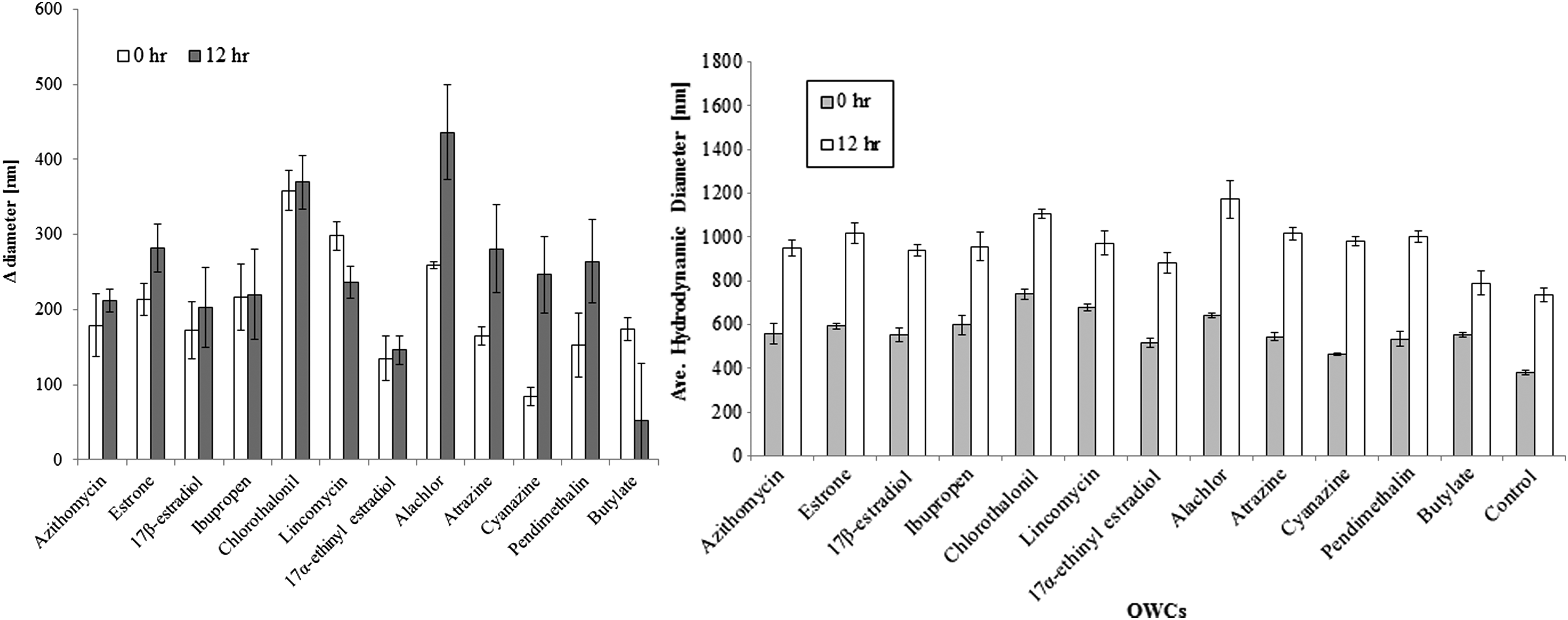
Diameter changes (Δ diameter) of n-TiO2 in presence of OWCs (0.2 mg/L) and in absence of OWCs (control) in 2 mM CaCl2 solution with pH 7 at 0 and 12 h. The mark of “*” presents the unsatisfied t-test result for the diameter changes.
From our aggregation experimental results, we determined n-TiO2 aggregation rate kinetics between 0 and 12 h by using Equation (1). The aggregation rate kinetics of n-TiO2 (k1 and k2 for 0 and 12 h, respectively) were shown in Fig. 3. At 0 h, the largest k1 was observed in chlorothalonil (39.852 nm · L/[min · mg]), while the smallest k1 was observed in cyanazine (9.374 nm · L/[min · mg]). After 12 h, the biggest k2 was observed in alachlor (0.606 nm · L/[min · mg]), while the smallest k2 was observed in butylate (0.073 nm · L/[min · mg]), which is the same results of Δ diameter in Fig. 2. Particularly, the aggregation rate kinetics between k1 and k2 among OWCs showed the r2 values of 0.89 and 0.88, respectively. These observations suggested that the aggregation behavior of n-TiO2 is strongly influenced by the adsorption of each OWC having unique physicochemical properties. In addition, the aggregation rate kinetics of n-TiO2 between 0 and 12 h showed differences, demonstrating that interaction time influenced on the n-TiO2 aggregation with OWCs in environmental systems.

Aggregation rate kinetics: k1 for 0 h
QSARs for n-TiO2 aggregation rate kinetics by OWCs descriptors
MLR was used to develop QSARs for predicting n-TiO2 aggregation rate kinetics with seven descriptors of OWCs by MATLAB. Particularly, we developed QSARs for k2 that may present the actual aggregation behaviors by slow interaction of n-TiO2 with each OWC for 12 hr and the model 1 developed for k2 was as follows:
For model 1, we observed positive coefficients for Cw and M.W., indicating that these properties can increase aggregation kinetics. Particularly, the two descriptors of Cw and M.W. may influence each other in the QSAR because the solubility of a compound tends to decrease with increasing M.W. according to Raoult's law in ideal conditions (Chiou, 2003). Other descriptors such as logKow, P.S.A. and # of H.B.D. are likely to relate with the polarity of OWCs inducing chemical reactivity (Su et al., 2012). Particularly, larger log Kow and # of H.B.D. would result in less polar OWCs and could react with nonpolar surface areas n-TiO2. In this QSAR, pKa and M.V. had little effect on n-TiO2 aggregation.
In addition, the model 2 developed for k2 at 12 h was as follows:
For model 2, we observed that n-TiO2 aggregation rate kinetics were related with four descriptors: pKa, logKow, M.W., and # of H.B.D.. In both QSAR models, increased n-TiO2 aggregation rates were likely related with M.W. of OWCs due to positive values, while other descriptors had negative values that may affect decreased n-TiO2 aggregation. The log Kow values of OWCs were related with the solubility, thus as the value of log Kow decreases, it presents that the solubility increases in aqueous phase. The other descriptors, pKa and # of H.B.D., present the polarity of OWCs that can induce chemical reactivity between n-TiO2/OWCs. In addition, an organic compound having less acidic or small hydrogen bond donors would be less polar (Henriksen et al., 2005; Borges et al., 2017), therefore the polarity of OWCs depending on pKa and/or # of H Bond Donors may play a key role on the aggregation of n-TiO2. From the developed QSARs (model [2] and [3]), scatter plots between the developed QSARs versus the experimental aggregation rate kinetics were shown with a reference line in Figs. 4 and 5. The majority of the OWCs were located near the reference line with the exception of butylate that is likely related with the t-test results of diameter changes of n-TiO2 in the presence of OWCs, which may demonstrate the meaning of considering statistical significances on the diameter changes of n-TiO2 to develop more predictive QSARs.

Relationship between observed k2 and developed k2 from the model 1.

Relationship between observed k2 and developed k2 from the model 2.
In QSAR results, developed QSARs showed the good relationships between descriptors of OWCs and n-TiO2 aggregation rates kinetics, however, the QSARs still remain unknown results on which one model is better than the other model for prediction on n-TiO2 aggregation. However, our QSAR results push the boundaries on the general NP researches by providing some insights on the effects of OWCs on NP microscopic behavior such as aggregation in environment and moreover suggesting roles of OWCs physicochemical descriptors on NP molecular-level interaction processes in time series. Therefore, when our developed QSARs are applied to other OWCs, it should be limited to some OWCs having similar functional groups such as alkanes (R–CH3) or hydroxyl (R–OH).
Summary
This study clearly demonstrated the fast (at 0 h) and slow interaction (at 12 h) between n-TiO2 and OWCs resulting in statistically significant changes of average hydrodynamic diameter of n-TiO2 by adsorption of all OWCs except for butylate (at 12 h) according to the Student's t-test results. However, we only observed statistically significant changes of zeta potential of n-TiO2 in the presence of some OWCs at both 0 and 12 h based on the Student's t-test results. From the n-TiO2 aggregation results in the presence of OWCs, we developed MLR QSARs for prediction of n-TiO2 aggregation rate kinetics with seven descriptors of OWCs and developed QSARs showed a good relationship with experimental n-TiO2 aggregation rate kinetics in all OWCs (satisfying with t-test) except for butylate (unsatisfying with t-test). Particularly, our developed QSARs are more likely to relate with polarity descriptors such as Cw, log Kow, P.S.A., and # of H.B.D. and it may demonstrate the physicochemical interaction processes occurring between charged n-TiO2 surfaces and polarity descriptors of OWCs over times. However, surface complexity of n-TiO2 can interact with not only polarity descriptors but also nonpolarity descriptors of OWCs that may implicate to consider all possible descriptors of OWCs to develop more predictive QSARs. In addition, n-TiO2 aggregation behavior would strongly be influenced by surrounding water chemistry conditions such as pH, IS, and concentration of organic contaminants, therefore there is limitation to use our developed QSARs to predict n-TiO2 aggregation in different environmental conditions. Moreover, it requires to investigate other potential descriptors that can affect aggregation of n-TiO2 in future research.
Footnotes
Acknowledgment
This research was supported in part by the Center for Nanohybrid Functional Materials (NSF-EPS-1004094).
Author Disclosure Statement
No competing financial interests exist.