




Abstract
Abstract
Adsorption is a promising method for removing heavy metal ions from wastewater. Primary amine groups can coordinate with most of heavy metal ions to form coordination compounds; therefore, materials with primary amine groups have been employed to adsorb heavy metal ions. Water-dispersible two-dimensional (2D) materials, reduced graphene oxide (RGO) containing primary amine groups, could be a good adsorbent for adsorbing heavy metal ions. In this article, aminoethyl RGO (AERGO) was synthesized by grafting aminoethyl groups on RGO, which contains a lot of hydroxyl groups on its surfaces. The maximum adsorption capacities of AERGO (per gram) were obtained for Pb(II), Ni(II), Cu(II), Co(II), and Zn(II) to be 173.6, 46.2, 58.6, 41.2, and 54.4 mg, respectively. Adsorption equilibrium time values of studied heavy metal ions on AERGO were measured to be less than 20 min. After four times adsorption/desorption of ions on AERGO, removal efficiencies of regenerated AERGO for Pb(II), Ni(II), Cu(II), Co(II), and Zn(II) were 99.6%, 99.6%, 98.0%, 98.0%, and 98.6%, respectively. AERGO materials exhibited thermo, acid, and basic stabilities. Therefore, AERGO would be an effective and reusable adsorbent for removal of heavy metal ions from wastewater. Adsorption mechanism of AERGO for heavy metal ions was suggested.
Introduction
W
Adsorption is a promising method for removing heavy metal ions from wastewater due to its high removal efficiency, convenient procedure, and recyclable adsorbents (Chen et al., 2017; Ferreira et al., 2017; Wang et al., 2017). Numerous adsorbents, such as resin (Bhatt and Shah, 2015; Li et al., 2015), inorganic materials (Ansari et al., 2015; Dwairi, 2017), and activated carbon (AC) (Imamoglu et al., 2015; Elkady et al., 2016), have been employed for heavy metal ion removal in wastewater. The maximum adsorption capacities of functionalized AC derived from hazelnut husk (HHPCAC) (Imamoglu et al., 2015), zeolites (Ansari et al., 2015), and salicylic acid–formaldehyde–catechol (SFC) terpolymeric resin (Bhatt and Shah, 2015) for Pb(II) have been reported to be 109.9, 461.6, and 192.9 mg (per gram of adsorbent), respectively. They exhibited high adsorption capacities. However, the reported equilibrium time values were in the range from 2 to 20 h. In general, an adsorbent that may be applied for removal of heavy metal ions in flowing water should quickly adsorb the heavy metal ions. Thus, developing an efficient adsorbent with short equilibrium time would be interesting.
Graphene and its derivatives are 2D materials (Song et al., 2017; Zheng et al., 2017). Heavy metal ions would easily accumulate at their surfaces if these materials were added in an aqueous solution containing heavy metal ions. One way to improve the absorbance capacitance is to increase hydrophilic groups on the surfaces of adsorbent. Materials containing primary amine groups can adsorb heavy metal ions since these materials form coordination compounds through the amine functional groups to heavy metal ions (Pan et al., 2016). Reduced graphene oxide (RGO) and its derivatives functionalized with primary amine groups can be considered worthy hydrophilic group-containing materials for heavy metal ion removal.
In this article, treated RGO materials with enhanced hydroxyl groups were synthesized to improve its hydrophilicity. Aminoethyl groups were grafted on the RGO for effectively adsorbing heavy metal ions. Structure of the aminoethyl RGO (AERGO) was characterized by Fourier transform infrared (FT-IR), scanning electron microscopy (SEM), and X-ray diffraction (XRD). Its thermostability was studied by thermogravimetric analyses (TGA). Experimental results show that the maximum adsorption capacities of the AERGO for Pb(II), Ni(II), Cu(II), Co(II), and Zn(II) were 173.6, 46.2, 58.6, 41.2, and 54.4 mg/g, respectively. Equilibrium time of AERGO adsorbing heavy metal ions was not more than 20 min. After the AERGO was, respectively, added into aqueous solutions of Pb(NO3)2, Ni(NO3)2, Cu(NO3)2, Co(NO3)2, and Zn(NO3)2 to adsorb heavy metal ions, these heavy metal ions in water would not be detected by an atomic fluorescence spectrometer. After four times adsorption/desorption of ions on AERGO, removal efficiencies of the fourth regenerated AERGO for Pb(II), Ni(II), Cu(II), Co(II), and Zn(II) were 99.6%, 99.6%, 98.0%, 98.0%, and 98.6%, respectively. Concentrations of Cu(II) and Zn(II) can meet quality standard for groundwater of grade III (GB/T 14848, 2017) after AERGO was added into wastewater. Therefore, AERGO would be a stable, effective, and reusable adsorbent for removing heavy metal ions from the flowing wastewater. Adsorption mechanism of AERGO for heavy metal ions was suggested.
Experimental Protocols
Materials and equipment
Natural flake graphite (99.0%, 400 mesh) was bought from Qingdao Guangyao Graphite Co. Ltd. All other chemicals were bought from Sigma-Aldrich. All chemicals weren't purified before they were used. Surface morphological images were taken by a SEM (SU1510; Hitachi, Japan) with gold coating. Powder XRD (XRD-6100; Shimadzu, Japan) was performed at room temperature using Ni-filtered Cu Kα radiation (λ = 1.541Å). The step speed was 5 deg/min. The scan range was 5–50°. FT-IR spectra were recorded on a Thermo Fisher Nicolet IS 5 spectrometer (USA) in KBr pellets. Elemental analysis (EA) was performed on a Vario EL III element analyzer (Germany). TGA of GO, RGO, and AERGO were carried out on a Mettler-Toledo TGA/DSC 1/1100 SF instrument (Switzerland). Concentrations of heavy metal ions in aqueous solutions were detected using a 3510 atomic absorption spectrophotometer (China). The pH values were detected by Leici PHS-25 apparatus (China).
Synthetic methods
Synthetic routes of GO, RGO, and AERGO are shown in Fig. 1.

Synthetic route of AERGO. AERGO, aminoethyl reduced graphene oxide.
Synthesis of GO
Synthetic method of GO was similar to that in a literature (Zhang et al., 2016). FT-IR spectrum of GO was in accordance with that in a literature (Zhang et al., 2016). Molar ratio of C to O atoms is 1.30.
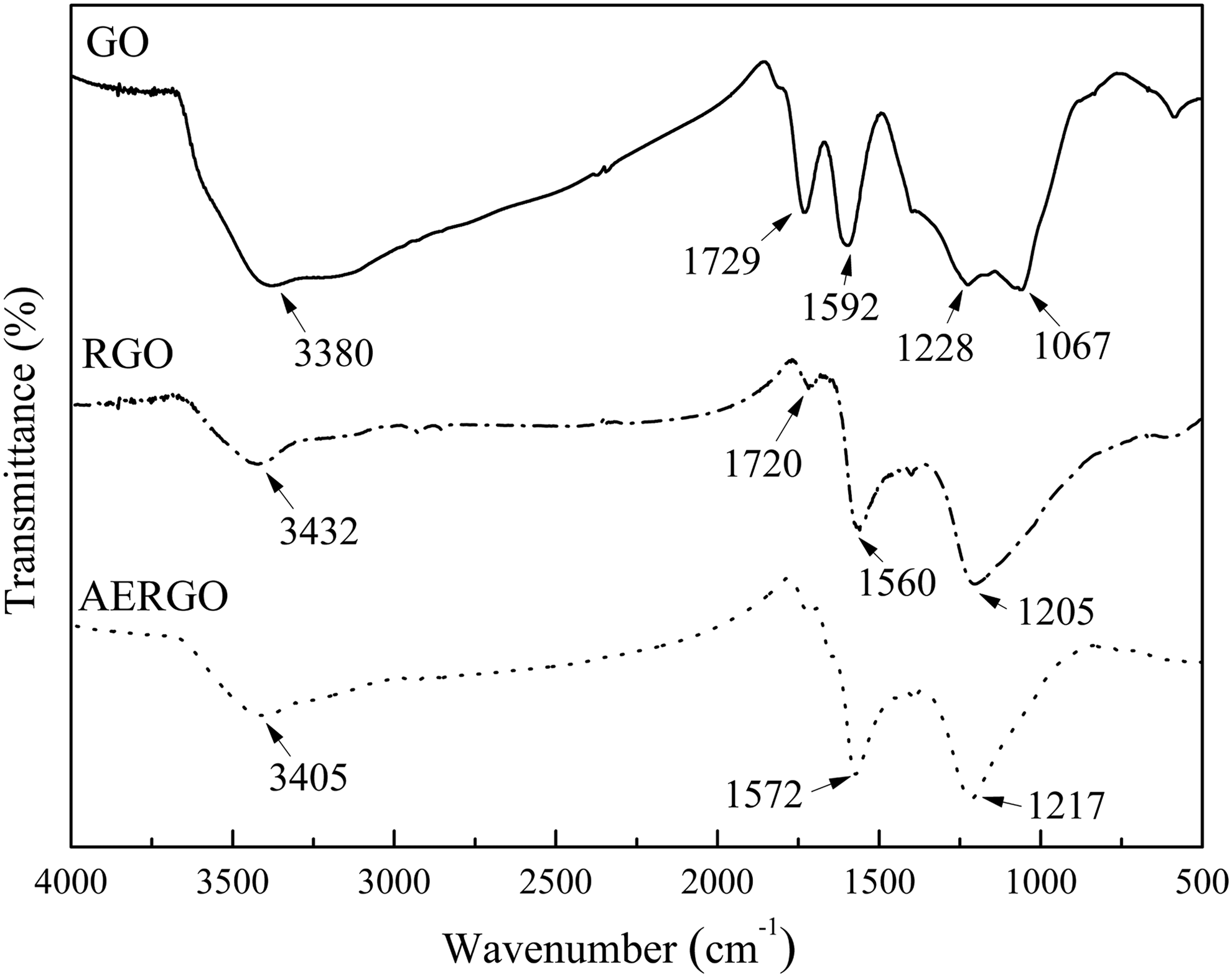
FT-IR (KBr): υ = 3,380 (O−H), 1,729 (C = O), 1,592 (C = C), and 1,228 and 1,067 (C−O) cm−1.
Synthesis of RGO
GO (0.20 g) was added into water (200 mL) and dispersed by ultrasonication for 2 h to give a suspension. Na2CO3 was added to the suspension to adjust the pH value (pH = 10.0). After (NH4)2S2O3 (2.5 g, 17 mmol) was added to the above suspension, the reaction mixture was heated up to 80°C and stirred for 12 h. Then, the reaction mixture was cooled to room temperature and filtered. Solid was washed by water (50 mL × 4) and methanol (10 mL × 4) to give black cake. The cake was dried in a vacuum drying oven at 60°C for 12 h to give a black powder (0.11 g). Molar ratio of C to O atoms is 2.78.
FT-IR (KBr): υ = 3,432 (O−H), 1,560 (C = C), and 1,205 (C−O) cm−1. Elem. Anal. (RGO) Found: C, 63.94; H, 1.96; O, 30.66.
Synthesis of AERGO
AERGO was synthesized by a modified method (Zhang, 2007). RGO (0.10 g) was added into dry N,N-dimethylformamide (DMF, 50 mL) and dispersed by ultrasonication for 1.5 h to give a suspension. Two bromoethylamine hydrobromide (3.08 g, 15 mmol) and Na2CO3 (0.80 g 7.5 mmol) were added into dry DMF (15 mL). Then, solid was separated to give a solution. After the solution and K2CO3 (0.84 g, 6 mmol) were added to the above suspension, the reaction mixture was heated to 100°C and stirred for 48 h. Then, the reaction mixture was cooled to room temperature and filtered. Solid was washed by water (50 mL × 4) and methanol (10 mL × 4) to give black cake. The cake was dried in a vacuum drying oven at 60°C for 18 h to give a black powder, AERGO (0.11 g). Molar ratios of C to O, C to N, and O to N atoms are 3.99, 12.99, and 3.26, respectively.
FT-IR (KBr): υ = 3,405 (N−H), 1,572 (C = C), and 1,217 (C−O) cm−1. Elem. Anal. (AERGO) Found: C, 68.48; H, 2.46; O, 22.91; N, 6.15.
Stability of AERGO in water
AERGO (60 mg) in water (300 mL) was ultrasonicated with an ultrasonic cleaner (100 W) for 10 min to give a suspension. Air was led in the suspension for 30 min. Then, the suspension was equally divided into three parts in three volumetric flasks (100 mL), which were named Samples 1, 2, and 3. Samples were left to stand in a fume cupboard. After 30 min, Sample 1 was filtered to give insoluble matter. The matter was dried in a vacuum drying oven at 60°C for 18 h to give a black powder (19.4 mg). After 10 days, Sample 2 was treated by the same procedure to give a black powder (19.5 mg). After 67 days, Sample 3 was treated by the same procedure to give a black powder (19.3 mg). The three black powers were characterized by FT-IR.
Adsorption experiment
The pH values of all solutions were adjusted by NaOH or HNO3 solution (0.1 M). Experimental temperature is 25°C. AERGO was added, respectively, into aqueous solutions of Pb(NO3)2, Ni(NO3)2·6H2O, Cu(NO3)2, Co(NO3)2·6H2O, or Zn(NO3)2·6H2O in distilled water. These aqueous suspensions were stirred for 12 h to obtain adsorption equilibrium. Then, the mixtures were filtered. Concentrations of heavy metal ions in filtrate were detected by an atomic adsorption spectrometer.
Adsorption of AERGO for heavy metal ions under different pH values
The pH values of solutions containing Pb(II) or Cu(II) ions were adjusted to 2.0, 3.0, 3.5, 4.0, 4.5, 5.0, or 5.5. Similarly, pH values of Ni(II), Co(II), or Zn(II) solutions were adjusted to 2.0, 3.0, 3.5, 4.0, 4.5, 5.0, 5.5, 6.0, 6.5, or 7.0. AERGO (5.0 mg) was added respectively into aqueous solutions (25 mL) of Pb(NO3)2 (0.80 mg), Ni(NO3)2·6H2O (2.48 mg), Cu(NO3)2 (1.47 mg), Co(NO3)2·6H2O (2.47 mg), or Zn(NO3)2·6H2O (2.27 mg) in distilled water, in which the concentration of heavy metal ion Pb(II), Cu(II), Ni(II), Co(II), or Zn(II) is 20 mg/L, and dispersed by ultrasonication for 10 min to give suspensions.
Kinetic study on adsorption of AERGO for heavy metal ions
The kinetic study was performed to observe the effect of the reaction time on adsorption of AERGO for heavy metal ions. AERGO (20.0 mg) was, respectively, added into solutions of Pb(II) (200 mg/L), Ni(II) (40 mg/L), Cu(II) (40 mg/L), Co(II) (40 mg/L), and Zn(II) (40 mg/L) in distilled water (100 mL). The pH values of suspensions of Pb(II), Ni(II), Cu(II), Co(II), and Zn(II) were adjusted, respectively, to 5.5, 5.5, 5.5, 6.0, and 6.0. The suspensions were filtered immediately to separate AERGO from aqueous solutions when adsorption times were 0.5, 1, 2, 3, 5, 10, 20, 30, 50, 70, 90, 120, and 150 min, respectively.
The equilibrium adsorption capacity (qe, mg/g) and the adsorption capacity at time t (qt, mg/g) were calculated according to Eqs. (1) and (2):
where C0, Ce, Ct, V, and m are initial concentration (mg/L), equilibrium concentration (mg/L), concentration at time t (mg/L) of heavy metal ion in solution, solution volume (L), and mass of adsorbent (g), respectively.
Equilibrium study on adsorption of AERGO for heavy metal ions
The equilibrium study was conducted to investigate the effect of equilibrium concentration of heavy metal ions on the equilibrium adsorption capacity of AERGO. AERGO (5 mg) was added into a heavy metal ion solution (25 mL). Initial concentration values of solutions containing every heavy metal ions were 5, 10, 20, 30, 40, 50, 70, and 100 mg/L. The pH values of the solutions containing heavy metal ions were adjusted, respectively, to 5.5, 5.5, 5.5, 6.0, or 6.0.
Application of AERGO in wastewater treatment
Water was taken from the Qunying river, which flows through Nanjing University of Informational Science and Technology, and filtered to remove insoluble matter. Concentrations of heavy metal ions in the filtrate were detected by an atomic adsorption spectrometer. The filtrate mainly contained Cu(II) (0.95 mg/L) and Zn(II) (1.33 mg/L). To research application of AERGO in wastewater treatment, Cu(NO3)2 and Zn(NO3)2·6H2O were added into the filtrate to prepare an aqueous solution containing Cu(II) (C0 = 5.0 mg/L) and Zn(II) (C0 = 5.0 mg/L) ions to simulate wastewater. The pH value of the solution was adjusted to 5.5.
Recyclability
AERGO (5.0 mg) was added, respectively, to Pb(II), Ni(II), Cu(II), Co(II), and Zn(II) solutions (50 mL and 5 mg/L) and stirred for 30 min. Initial pH values of solutions of Pb(II), Ni(II), Cu(II), Co(II), and Zn(II) were 5.5, 5.5, 5.5, 6.0, and 6.0, respectively. After these heavy metal ions adsorbed on AERGO were desorbed by HCl solution (0.01 M, 50 mL) for 30 min and collected, AERGO was regenerated and washed with HCl solution (0.01 M, 5 mL × 3), NaOH solution (0.01 M, 5 mL × 3), distilled water (5 mL × 3), and ethanol (1 mL × 3), and dried in a vacuum drying oven at 60°C for 12 h. The regenerated AERGO was then used for repeated adsorption/desorption experiments as described above.
Results and Discussion
Structure of AERGO
Groups on surfaces of RGO and AERGO
FT-IR spectra of GO, RGO, and AERGO are shown in Fig. 2.
FT-IR spectra of GO, RGO, and AERGO. FT-IR, Fourier transform infrared.
In FT-IR spectrum of GO, a broad and strong absorption peak located at 3,382 cm−1 is O-H stretching vibration mode due to hydroxyl and carboxyl groups on surfaces of GO. Absorption peaks located at 1,729, 1,228, 1,067, and 1,592 cm−1 are C = O, C-O, and C-O-C and C = C stretching vibration modes, respectively, due to carboxyl, hydroxyl, and epoxide groups on surfaces of GO, and double bonds of GO. In FT-IR spectrum of RGO, a broad absorption peak located at 3,432 cm−1 is O-H stretching vibration mode due to hydroxyl groups on surfaces of RGO. A weak absorption peak located at 1,720 cm−1 is C = O stretching vibration mode due to carboxyl groups on surfaces of RGO. It shows that most of C = O groups have been reduced. Absorption peaks located at 1,205 and 1,560 cm−1 are C-O and C = C stretching vibration modes, respectively, due to hydroxyl groups on surfaces of RGO and double bonds at RGO. There is no absorption peak located at 1,067 cm−1 (C-O-C) due to reduction reactions of epoxide groups to give OH groups. Therefore, most of oxygen-containing functional groups on surfaces of the RGO materials are hydroxyl groups. This RGO with a lot of hydrophilic groups is obviously different with other RGO materials; therefore, the RGO materials would be easily dispersed in water to adsorb heavy metal ions in water. In FT-IR spectrum of AERGO, a broad absorption peak located at 3,405 cm−1 is O-H stretching vibration mode due to hydroxyl groups on surfaces of RGO. According to EA data of AERGO, 69.9% of hydroxyl groups did not react with 2-bromoethylamine. It shows that there are many hydrophilic groups on surfaces of AERGO; therefore, the AERGO materials would be easily dispersed in water to adsorb heavy metal ions in water. Absorption peaks located at 1,572 and 1,217 cm−1 are C = C and C-O stretching vibration modes, respectively. Therefore, AERGO could be a water-dispersible adsorbent due to its hydrophilicity and insolubility in water.
Surface images and distances between two adjacent particles
SEM images and XRD curves of RGO and AERGO are shown in Fig. 3.

SEM images and XRD spectra of RGO and AERGO. SEM, scanning electron microscopy. XRD, X-ray diffraction.
RGO and AERGO exhibited disorder structures (Fig. 3). At XRD curve of the RGO, a broad diffraction peak is located at 2θ = 23.8°, corresponding to interlayer distance of 0.37 nm. At XRD curve of AERGO, a broad diffraction peak is located at 2θ = 23.9°, corresponding to interlayer distance of 0.37 nm. It would be attributed to the fact that some interlayer distances between two adjacent RGO particles persisted, because a part of RGO particles were not grafted by aminoethyl moieties. According to EA data of AERGO, only 30.1% of hydroxyl groups reacted with 2-bromoethylamine. Another peak is located at 2θ < 3.0°; therefore, some interlayer distance between two adjacent AERGO particles would be larger than 2.9 nm due to aminoethyl moieties expanding the interlayer distances. Compared with the RGO, the interlayer distance between two AERGO sheets was big due to introduction of aminoethyl moieties on the RGO surfaces. AERGO exhibited a disorder structure. After grafting reaction, aggregation structures of AERGO sheets were further disordered. It would be attributed to the fact that aminoethyl moieties on the AERGO surfaces prevented aggregation of AERGO sheets. SEM images of RGO and AERGO were in accordance with their XRD curves.
Thermodynamic and long-term stabilities
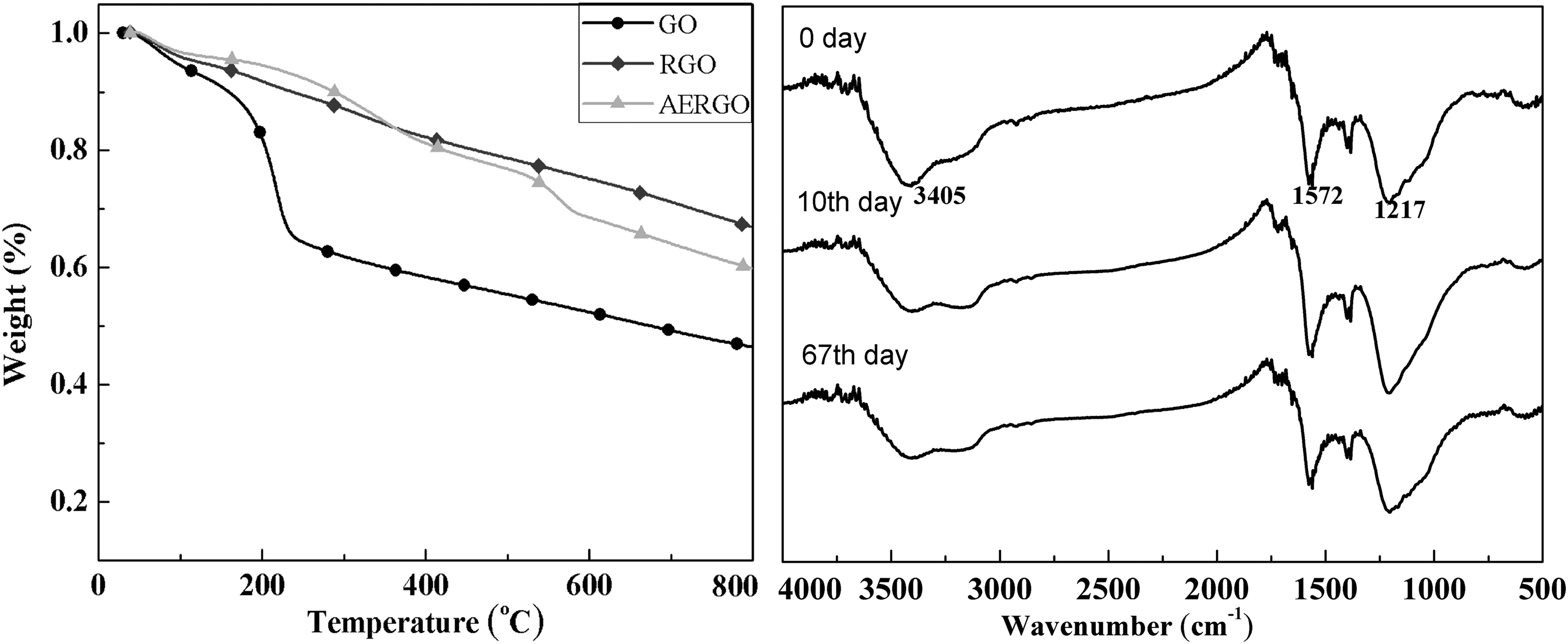
TGA curves of RGO and AERGO and spectra of AERGO dispersed in water for 0, 10, and 67 days are shown in Fig. 4.
TGA curves of RGO and AERGO and FT-IR spectra of AERGO dispersed in water for 0, 10, and 67 days. TGA, thermogravimetric analyses.
When temperature increased from 25°C to 100°C, GO lost 5.4 wt% of its weight due to evaporation of adsorbed water. When temperature increased from 100°C to 160°C, GO lost 4.7 wt% of its weight due to intramolecular dehydration. When temperature increased from 160°C to 245°C, GO lost 26.1 wt% of its weight due to decarboxylation and dehydration (Compton et al., 2010). When temperature increased from 245°C to 800°C, GO lost 17.7 wt% of its weight due to breaking of carbon skeleton (Compton et al., 2010). When temperature increased from 25°C to 100°C, RGO lost 4.7 wt% of its weight due to evaporation of adsorbed water. When temperature increased from 100°C to 800°C, RGO lost 25.5 wt% of its weight due to decarboxylation, dehydration, and breaking of carbon skeleton (Compton et al., 2010). When temperature increased from 25°C to 100°C, AERGO lost 3.0 wt% of its weight due to evaporation of adsorbed water (Compton et al., 2010). When temperature increased from 100°C to 245°C, AERGO lost 5.0 wt% of its weight due to intramolecular dehydration. When temperature increased from 500°C to 550°C, AERGO lost 6.6 wt% of the weight due to deamination. Therefore, AERGO exhibited good thermal stability compared with GO.
In the right part of Fig. 4, FT-IR spectra of AERGO dispersed in water for 10 and 67 days are similar with spectra of AERGO. It suggests that AERGO would be stable in water. It is due to the fact that there are many hydrophilic groups on surfaces of AERGO. Electronegativity of oxygen or nitrogen element is larger compared with carbon element; therefore, carbon atom at AERGO would be electron deficient. AERGO would be oxidized difficultly in water.
Adsorption of AERGO for heavy metal ions
Effect of pH on adsorption of AERGO for heavy metal ions
Adsorption capacities of AERGO for Pb(II), Ni(II), Cu(II), Co(II), and Zn(II) are shown in Fig. 5.

Effect of pH values on adsorption capacity of AERGO.
Adsorption capacities of AERGO for Pb(II), Ni(II), and Cu(II) increased, respectively, from 13.4 to 79.4, 4.1 to 32.0, and 9.6 to 36.2 mg/g, with pH values increasing from 2 to 5.5. Pb(II) and Cu(II) would be deposited by OH− when pH value is higher than 5.5. Adsorption capacities of AERGO for Ni(II) did not increase, obviously, with increasing pH values when pH is higher than 5.5. Adsorption capacities of AERGO for Co(II) and Zn(II) increased, respectively, from 6.9 to 31.2 and 1.5 to 32.6 mg/g, when pH values increased from 2 to 6.0. Adsorption capacities of AERGO for Co(II) and Zn(II) did not increase, obviously, with pH values increasing from 6.0 to 7.0. Therefore, pH values of solution of Pb(II), Ni(II), Cu(II), Co(II), and Zn(II) were 5.5, 5.5, 5.5, 6.0, and 6.0, respectively, for determining adsorption capacities of AERGO.
Adsorption kinetics
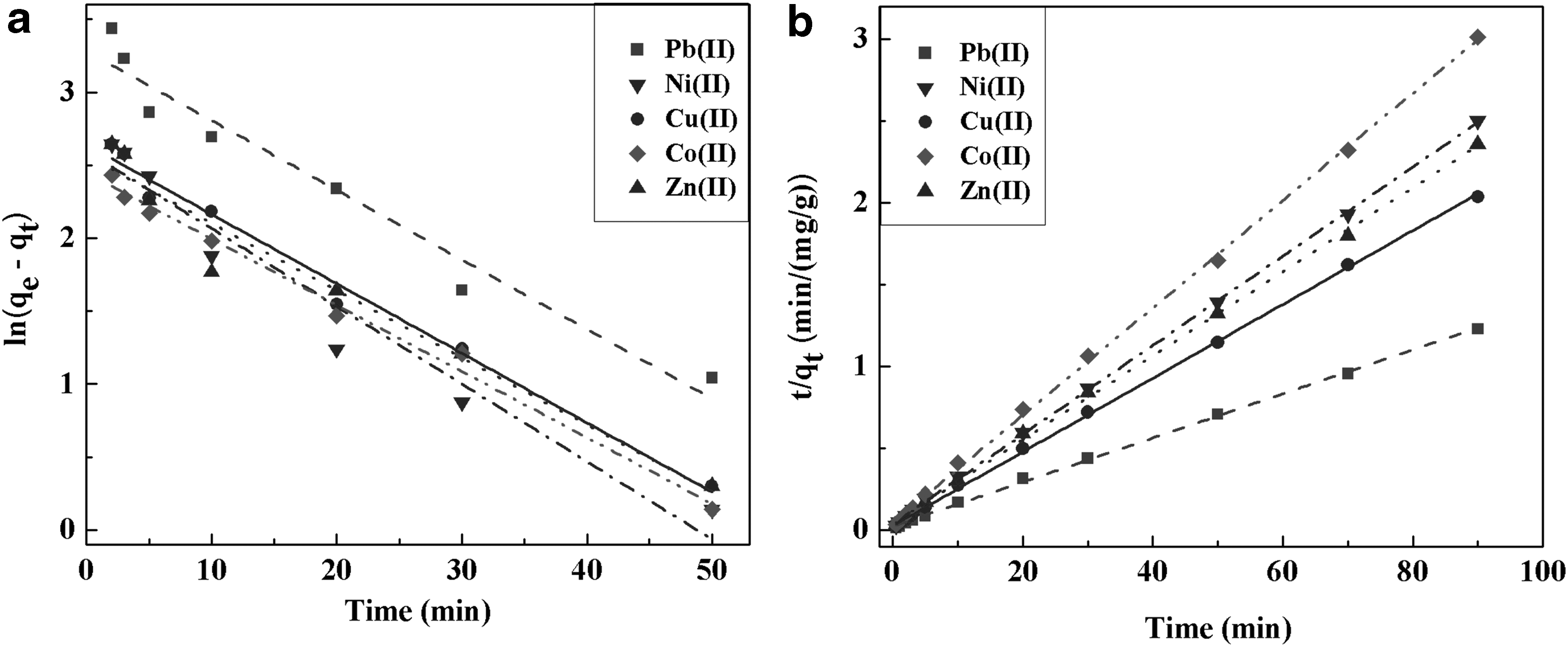
The pseudo-first- and second-order kinetic rate equations are expressed as Eqs. (3) and (4):
where k1 (min−1) and k2 (g/[mg·min]) are the pseudo-first-order and pseudo-second-order kinetic rate constants, respectively.
In Fig. 6, the pseudo-second-order kinetic models were appropriate for study of AERGO adsorbing Pb(II), Ni(II), Cu(II), Co(II), and Zn(II) compared with the pseudo-first-order kinetic models. Therefore, adsorption of AERGO for heavy metal ions was investigated by the pseudo-second-order kinetic model.
Pseudo-first-order
Kinetic parameters of AERGO adsorbing heavy metal ions are listed in Table 1.
K
Correlation coefficient (R2) values of the pseudo-second-order model are higher than those of the pseudo-first-order model.
Effect of adsorption time on adsorption capacities of AERGO
Effect of adsorption time on adsorption capacities of AERGO for Pb(II), Ni(II), Cu(II), Co(II), or Zn(II) is shown in Fig. 7.

Effect of adsorption time on adsorption capacity of AERGO for Pb(II), Ni(II), Cu(II), Co(II), or Zn(II).
Adsorption capacities of AERGO for Pb(II), Ni(II), Cu(II), Co(II), and Zn(II) increased sharply during the initial 3 min. The adsorption capacities did not increase, obviously, after 10 min. Therefore, rates of AERGO adsorbing Pb(II), Ni(II), Cu(II), Co(II), and Zn(II) were fast.
Adsorption capacities (q) of AERGO for heavy metal ions in the initial 0.5 min are collected in Table 2.
Adsorption capacities of EDAGO for Pb(II), Ni(II), Cu(II), Co(II), and Zn(II) in the initial 0.5 min were 49.3%, 41.3%, 46.5%, 47.2%, and 42.8% of the qe values, respectively. After grafting reaction, there are a lot of amino groups on the AERGO surfaces. Therefore, AERGO might rapidly and easily adsorb heavy metal ions in wastewater due to good internal diffusion without resistance (Sun et al., 2014). A desired adsorbent that can efficiently remove heavy metal ions from flowing water should exhibit fast adsorption rate and high adsorption capacity. Fast adsorption rate of AERGO would result in short hydraulic retention time. Therefore, AERGO might fast adsorb heavy metal ions in flowing wastewater.
Equilibrium isotherm model analyses
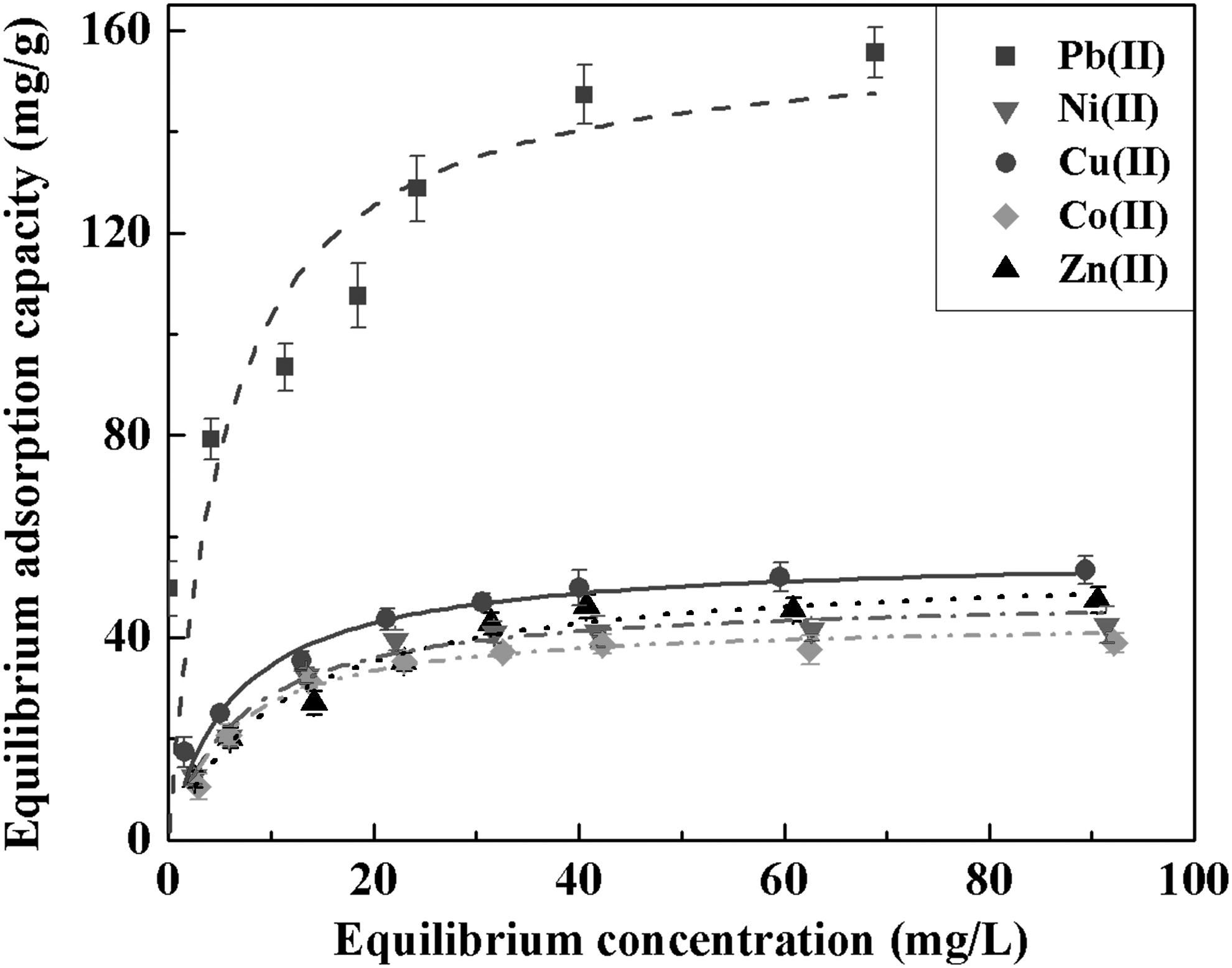
Relationship between equilibrium concentration of heavy metal ions and equilibrium adsorption capacity of AERGO is shown in Fig. 8.
Relationship between equilibrium concentration of heavy metal ions and equilibrium adsorption capacity of AERGO.
In Fig. 8, the equilibrium adsorption capacity of AERGO for heavy metal ions increased sharply with increasing equilibrium concentration of heavy metal ions, when concentration of heavy metal ions was thinner than 20 mg/L, while the equilibrium adsorption capacity of AERGO for heavy metal ions increased slowly with increasing equilibrium concentration of heavy metal ions, when concentration of heavy metal ions was larger than 20 mg/L. The equilibrium adsorption capacity of AERGO for Pb(II) was bigger than that for Ni(II), Cu(II), Co(II), and Zn(II).
Adsorption capacities of AERGO for Pb(II), Ni(II), Cu(II), Co(II), and Zn(II) were fitted by Langmuir and Freundlich adsorption isotherm models (Zhang et al., 2014) [Eqs. (5) and (6)].
where qe (mg/g), Ce (mg/L), qmax (mg/g), n, K1, and Kf are equilibrium adsorption capacity, equilibrium concentration, the maximum adsorption capacity, adsorption intensity, Langmuir constant related to the binding site affinity, and Freundlich constant related to the adsorption capacity, respectively.
In Fig. 9, compared with Freundlich isotherm models, Langmuir isotherm models are appropriate for fitting adsorption data of EDAGO for Pb(II), Ni(II), Cu(II), Co(II), and Zn(II).

Langmuir
Parameters of adsorption isotherm are collected in Table 3.
Values of correlation coefficients (R2) for the Langmuir model are higher than those for the Freundlich model, therefore, the Langmuir model would be used to study adsorption of AERGO for Pb(II), Ni(II), Cu(II), Co(II) and Zn(II). According to the Langmuir isotherm model, the qmax values of AERGO for Pb(II), Ni(II), Cu(II), Co(II) and Zn(II) were 173.6, 46.2, 58.6, 41.2, and 54.4 mg/g, respectively.
Adsorption capacity of AERGO for Pb(II) was the largest among the five heavy metal ions. It would be attributed to four reasons. First, Pb(II) has large atomic weight compared with Ni(II), Cu(II), Co(II), or Zn(II) ions. Second, electronegativity of Pb(II) (2.33) is larger compared with Ni(II) (1.91), Cu(II) (1.90), Co(II) (1.65), or Zn(II) (1.65). Third, Pb(II) is a strong Lewis acid compared with Ni(II), Cu(II), Co(II), or Zn(II); therefore, coordination bonds between Pb(II) and amino groups would be stronger than those between Ni(II), Cu(II), Co(II), or Zn(II) and amino groups. At last, the ionic radius of Pb(II) (1.20 Å) is bigger compared with Ni(II) (0.72 Å), Cu(II) (0.72 Å), Co(II) (0.74 Å), or Zn(II) (0.74 Å); therefore, primary amino groups at AERGO could easily coordinate with Pb(II) to form stable complexes.
Application of AERGO in wastewater treatment
Removal efficiencies of AERGO for Cu(II) and Zn(II) are collected in Table 4.
Concentration of AERGO in wastewater.
Equilibrium concentration of heavy metal ions after adsorption.
Re values were calculated by this method: Re = (1–Ce/C0) × 100%.
AERGO, aminoethyl reduced graphene oxide.
When concentration of AERGO in wastewater was 0.4 g/L, removal efficiencies of AERGO for Cu(II) and Zn(II) were 82.4% and 30.2%, respectively. Concentration of Cu(II) (0.88 mg/L) would meet quality standard for groundwater of grade III (GB/T 14848, 2017) ([Cu2+] <1.00 mg/L) after AERGO adsorbed Cu2+ in wastewater. When concentration of AERGO in wastewater was 0.80 g/L, the removal efficiency of AERGO for Cu(II) was 99.7%. When concentration of AERGO in wastewater was 1.2 g/L, the removal efficiency of AERGO for Zn(II) was 87.0%. The concentrations of Zn(II) (0.65 mg/L) would meet quality standard for groundwater of grade III ([Zn(II)] <1.00 mg/L) after AERGO adsorbed Zn(II) in wastewater. Therefore, AERGO would be a potential adsorbent for removing heavy metal ions from flowing wastewater.
Comparison of AERGO with popular adsorbents
The qmax values, adsorption equilibrium times, and removal efficiencies of AERGO and popular adsorbents for Pb(II) are collected in Table 5.
T
Equilibrium time of adsorbent for Pb(II).
Removal efficiency of adsorbent for Pb(II).
ACs, activated carbons; HHPCAC, functionalized AC derived from hazelnut husk; LXR, lignin xanthate resin; MEDCS, magnetic ethylenediaminetetraacetic acid-chitosan; NZ, NaX zeolite; PGC, polyaniline grafted chitosan; SFC, salicylic acid–formaldehyde–catechol.
The qmax value of AERGO (173.6 mg/g) for Pb(II) was bigger than those of a HHPCAC (109.9 mg/g), polyaniline grafted chitosan (PGC) (16.1 mg/g), and lignin xanthate resin (LXR) (64.9 mg/g). The qmax value of AERGO (173.6 mg/g) for Pb(II) is close to that of SFC resin (192.9 mg/g) and ACs (188.7 mg/g). The qmax value of AERGO for Pb(II) is smaller than those of nano-NaX zeolite (NZ) (461.6 mg/g) and magnetic ethylenediaminetetraacetic acid-chitosan (MEDCS) (213.4 mg/g). The small qmax value of AERGO would be attributed to low mole fraction of primary amino groups according to element analysis values (N, 6.15%). The equilibrium time of EDAGO (20 min) adsorbing Pb(II) was shorter than those of HHPCAC (1,200 min), ACs (120 min), NZ (120 min), MEDCS (240 min), PGC (70 min) and SFC resin (720 mg/g), and LXR (90 min). The short equilibrium time of AERGO for Pb(II) could be attributed to the fact that primary amine groups on the surface coordinated easily with Pb(II) (Pan et al., 2016; Chen et al., 2017). Moreover, heavy metal ions may quickly arrive onto surface of AERGO due to its 2D structure. In addition, AERGO would be easily dispersed in aqueous solution due to hydrophilicity of the primary amino and hydroxyl groups (Das et al., 2010; Xu et al., 2013).
Recyclability
FT-IR spectra and removal efficiencies of regenerated AERGO for Pb(II), Ni(II), Cu(II), Co(II), and Zn(II) are shown in Fig. 10.
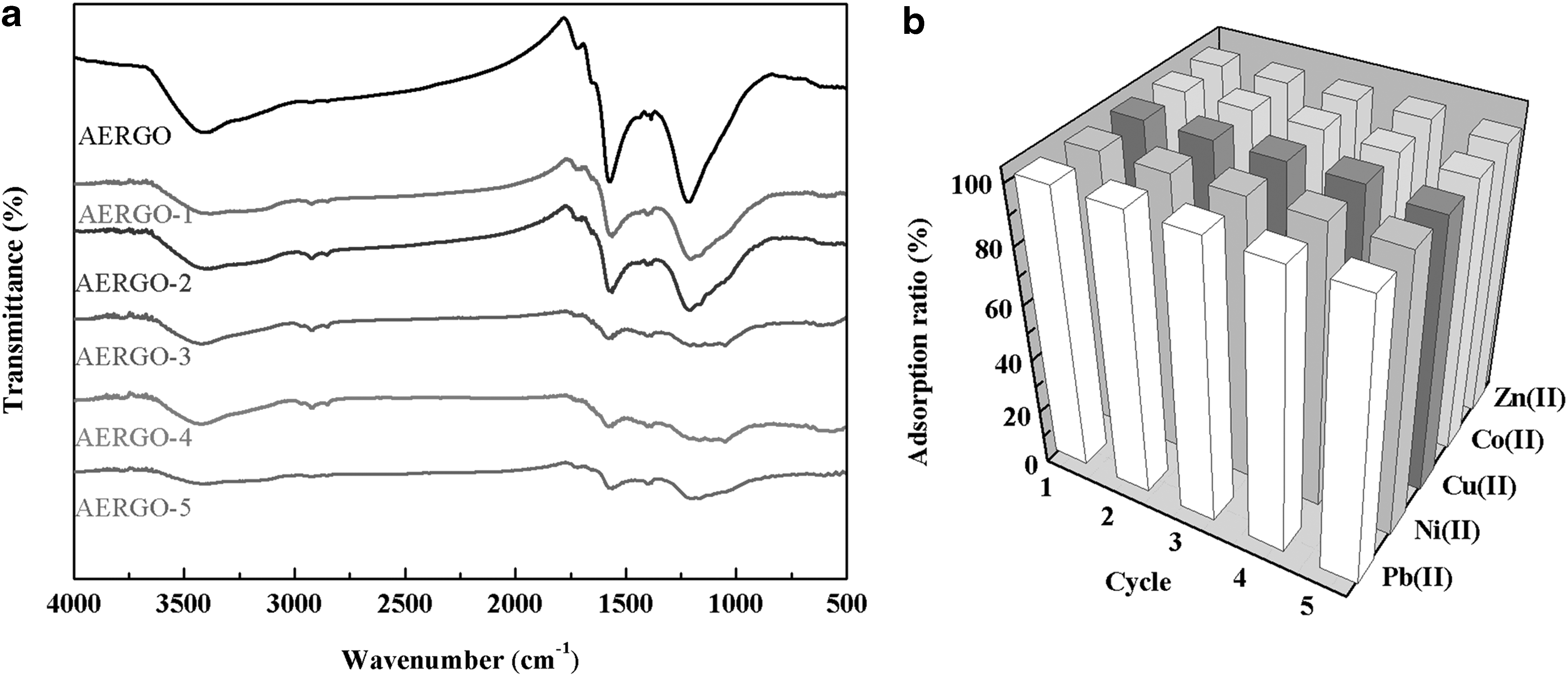
FT-IR spectra
Stability and reusability of AERGO were studied by adsorption and desorption of AERGO for Pb(II), Ni(II), Cu(II), Co(II), and Zn(II). The FT-IR spectra of regenerated AERGO are shown in Fig. 10a. Characteristic peaks of the functional groups at regenerated AERGO are same as that at AERGO. It suggests that AERGO would be a stable and reusable adsorbent. Removal efficiencies of the fourth regenerated AERGO for Pb(II), Ni(II), Cu(II), Co(II), and Zn(II) were 99.6%, 99.6%, 98.0%, 98.0% and 98.6%, respectively, when regenerated EDAGO, which was the fourth recycled adsorbent, was used to adsorb these heavy ions (Fig. 10b). Therefore, AERGO would be a stable and reusable absorbent for heavy metal ions in wastewater.
Adsorption mechanism of AERGO for heavy metal ions
In general, unoccupied orbitals of heavy metal ions may accept lone-pair electrons of primary amino groups to form coordination bonds (Cabaniss, 2011). Adsorption mechanism of AERGO for Pb(II) ions is shown in Fig. 11.

Adsorption mechanism of AERGO for heavy metal ions.
Two amino groups on AERGO surface may coordinate with a heavy metal ion in an aqueous solution. Each amino group on AERGO surface has one lone electron pair. Unoccupied orbitals of heavy metal ions may accept lone-pair electrons of amino groups to form complexes (Cabaniss, 2011). Therefore, heavy metal ions would be adsorbed on AERGO surfaces.
In an acidic aqueous solution, AERGO accepts H+ ions to give protonated AERGO, which would not coordinate with heavy metal ions. Molar concentration of primary amino groups at AERGO surfaces would decrease with lowering pH value. Moreover, protonation of primary amino groups would result in a strong electrostatic repulsion between a protonated amino group and a heavy metal ion (Hokkanen et al., 2014). Therefore, the adsorption capacity of AERGO would decrease with lowering pH value. When hydrochloric acid was added into an aqueous suspension of AERGO with adsorbed heavy metal ions, the heavy metal ions would be desorbed. Then, the AERGO may be regenerated after an aqueous NaOH solution was added into the above suspension. Therefore, AERGO is a reusable adsorbent.
Conclusion
An efficient adsorbent, AERGO, was synthesized by grafting aminoethyl groups on functionalized RGO. The maximum adsorption capacities of the AERGO for Pb(II), Ni(II), Cu(II), Co(II), and Zn(II) were measured to be 173.6, 46.2, 58.6, 41.2, and 54.4 mg/g, respectively. The adsorption equilibrium time of AERGO for all heavy metal ions was less than 20 min. The Pb(II), Ni(II), Cu(II), Co(II), and Zn(II) ions were not detected after addition of AERGO. After four times adsorption/desorption of ions on AERGO, the removal efficiencies of AERGO for Pb(II), Ni(II), Cu(II), Co(II), and Zn(II) were obtained to be 99.6%, 99.6%, 98.0%, 98.0%, and 98.6%, respectively. After the addition of AERGO into the wastewater containing Cu(II) and Zn(II) ions, concentrations of Cu(II) and Zn(II) reached below the standard concentration for groundwater of grade III. Adsorption mechanism of heavy metal ions on AERGO has been suggested. As the results showed, AERGO is a quick, effective, and reusable adsorbent for removing heavy metal ions from wastewater.
Footnotes
Acknowledgment
This work was supported by Scientific Research Foundation for Returned Scholars from Ministry of Education of China (2013S010), National Natural Science Foundation of China (Grant No. 11305091). Six talent peaks project in Jiangsu Province (R2015 L12). We thank Dr. Mohammad Etesami (Case Western Reserve University) for his checking and revising the language of this article.
Author Disclosure Statement
All the authors have no conflict of interest.