




Abstract
Abstract
This investigation focused on the affect that food-grade (FG) titanium dioxide (TiO2) nanoparticles (NPs), commonly found in consumer products, can have on the instrumental biological process of degrading household waste in septic systems. Microbial communities are instrumental in the sustainability of natural and engineered environments by degrading organic matter to products easily removed by other organisms. Wastewater treatment is one such engineered environment, where large-scale facilities use activated sludge and other processes to reduce organic matter and waste reintroduced into water systems. TiO2 NPs represent a commonly detected contaminant in the wastewater influent reaching treatment facilities. However, while influence of TiO2 NPs in large-scale, multistage treatment operations has been well studied, decentralized septic systems, utilized in 25% of U.S. homes, are neglected. Unlike centralized water treatment facilities, septic system function is entirely dependent on the health of the microbial community. Thus, this study focused on characterization of the septic system's microbial community and water quality in response when exposed to a common consumer product, FG TiO2, and an extensively researched NP, industrial-grade (IG) TiO2. Notably, FG and IG TiO2 exposure resulted in distinct responses in select microbial and effluent quality parameters. In addition, a more diverse microbial community composition developed during FG TiO2 exposures, indicating that FG TiO2 may alter microbial relationships affecting anaerobic digestion efficiency. Results indicate that nano-FG TiO2 may cause considerable changes to microbial function in septic systems and that understanding downstream effects requires studying ecologically relevant forms of NPs.
Introduction
E
Challenges associated with NP removal in conventional treatment systems make decentralized wastewater treatment applications (e.g., septic systems) an area of concern. A septic tank is an anaerobic digester driven by microbial degradation of organic compounds before release of waste stream into groundwater systems (Canter and Knox, 1985). Insufficient maintenance and monitoring lead to septic system overloading and failure (EPA, 2011; Taylor et al., 2015). Previous investigations of industrial-grade (IG) forms of nano-TiO2 revealed potential cyto- and genotoxic effects to mammals (Jani et al., 1994; Trouiller et al., 2009) and aquatic organisms (Zhang et al., 2007), suggesting this nanomaterial is potentially detrimental to the microbial environment within the septic treatment system. In addition, conventional WWTPs possess the added benefit of periodic biomass removal that extracts a fraction of NPs, whereas septic systems are likely to accumulate bound NPs due to longer biomass retention times (Canter and Knox, 1985; Withers et al., 2014). Extended contact periods between NPs and biomass, as well as with microbial communities, influence bioavailability of nutrients for bacteria and subsequently alter solution conditions of the biological system (Habimana et al., 2011; Peulen and Wilkinson, 2011; Sahle-Demessie and Tadesse, 2011). Thus, NP presence becomes an additional hazard to this waste treatment method and downstream ecological processes.
The need to design experiments using environmentally relevant forms of nanomaterials was recognized in that, although IG TiO2 has been more commonly used in environmental impact studies (Weir et al., 2012; Yang et al., 2014), food-grade (FG) TiO2 is more likely to be present in aquatic and wastewater environments (Weir et al., 2012). Previous investigations have demonstrated that environmentally relevant NP parameters such as elemental composition, crystal structure, size, and surface composition were observed to be notably different between the two TiO2 types in low ionic strength solutions (Yang et al., 2014). Yang et al. (2014) determined primary particle sizes to be 100% nano (<100 nm) for IG and 30% for FG TiO2. Differences in crystal structure were also observed in that IG TiO2 was found comprising a compound crystal structure of anatase (75%) and rutile (25%), while FG was determined to be solely anatase (>98%). In addition, a phosphate coating, presumably for stability, was associated with FG particles, and more readily adsorbed cationic dyes than IG, which lacked a coating of any sort (Yang et al., 2014).
Differences were also observed between food and IG TiO2 systemic effects in high ionic strength solutions containing sugars and proteins consistent with colonic waste as the model organic material (Waller et al., 2017). FG exhibited a remarkably stable particle size (∼300 nm) across changing pH (4–8) in both low and high ionic strength solutions (10 and 190 mM, respectively), while IG was far more susceptible to aggregation (e.g., ∼900 nm at pH 6, 10 mM KCl). Microbial compositional differences were also noted as FG TiO2 prevented a Proteobacteria to Firmicutes community shift observed during the control, whereas IG exposures merely slowed the process. These studies clarified that differences in environmentally relevant NP parameters, observed under ideal conditions, could also cause an impact in more complex solutions (Shen et al., 2009; Zhang et al., 2012). Whether the differences between the two types of TiO2 NPs could affect the wastewater microbial community to the extent to influence treatment efficiency (e.g., septic tank performance) remains to be investigated.
This study aimed to address this gap in knowledge. Specifically, an in vitro, laboratory-scale model human colon provided a consistent material (both in microbial community and constituents of fecal matter) for subsequent introduction into a laboratory-scale model septic system (Marcus et al., 2013; Taylor et al., 2015). Microbial phenotype, community structure, and effluent quality were indicators of system performance and perturbations from food and IG TiO2 NP exposure. Microbial phenotype focused on biofilm-related parameters such as hydrophobicity and extracellular polymeric substance (EPS) production. Microbial community composition mapped changes to community structure via 16S ribosomal RNA (rRNA) sequencing, and effluent quality monitored degradation of organic matter and system acidic buffering capacity. This study elucidates whether engineered modifications of the model nanomaterial (TiO2) cause dissimilar behaviors under complex conditions found in wastewater systems.
Experimental Protocols
Experimental design
Experiments were conducted using previously described bench-scale model reactors of a human colon and septic tank (Marcus et al., 2013; Taylor et al., 2015; Waller et al., 2017). Fecal material introduced to the septic tank was produced using a model colon described in detail elsewhere (Marcus et al., 2013). Briefly, the model septic system is a scaled down model of an actual septic tank containing primary and secondary sedimentation chambers of 144 and 72 L, respectively (Fig. 1). Experimental runs comprised 3 consecutive weeks of a baseline control phase (no NP introduction), followed by a 3-week exposure phase to the particular TiO2 NP (FG or IG), and a 3-week recovery phase (no NP introduction) to monitor the persistence of any perturbations resulting from NP exposure. A 3-week period was selected for each of these phases as it mimics the retention time of effluent in an actual septic system (EPA, 2002). The colon medium, containing simple salts, proteins, and carbohydrates, was fed through the colon reactor to produce the fecal matter used in these experiments (Marcus et al., 2013). During the exposure phase, TiO2 NPs were added to the colon medium at the start of the exposure phase to use “aged” rather than pristine TiO2.
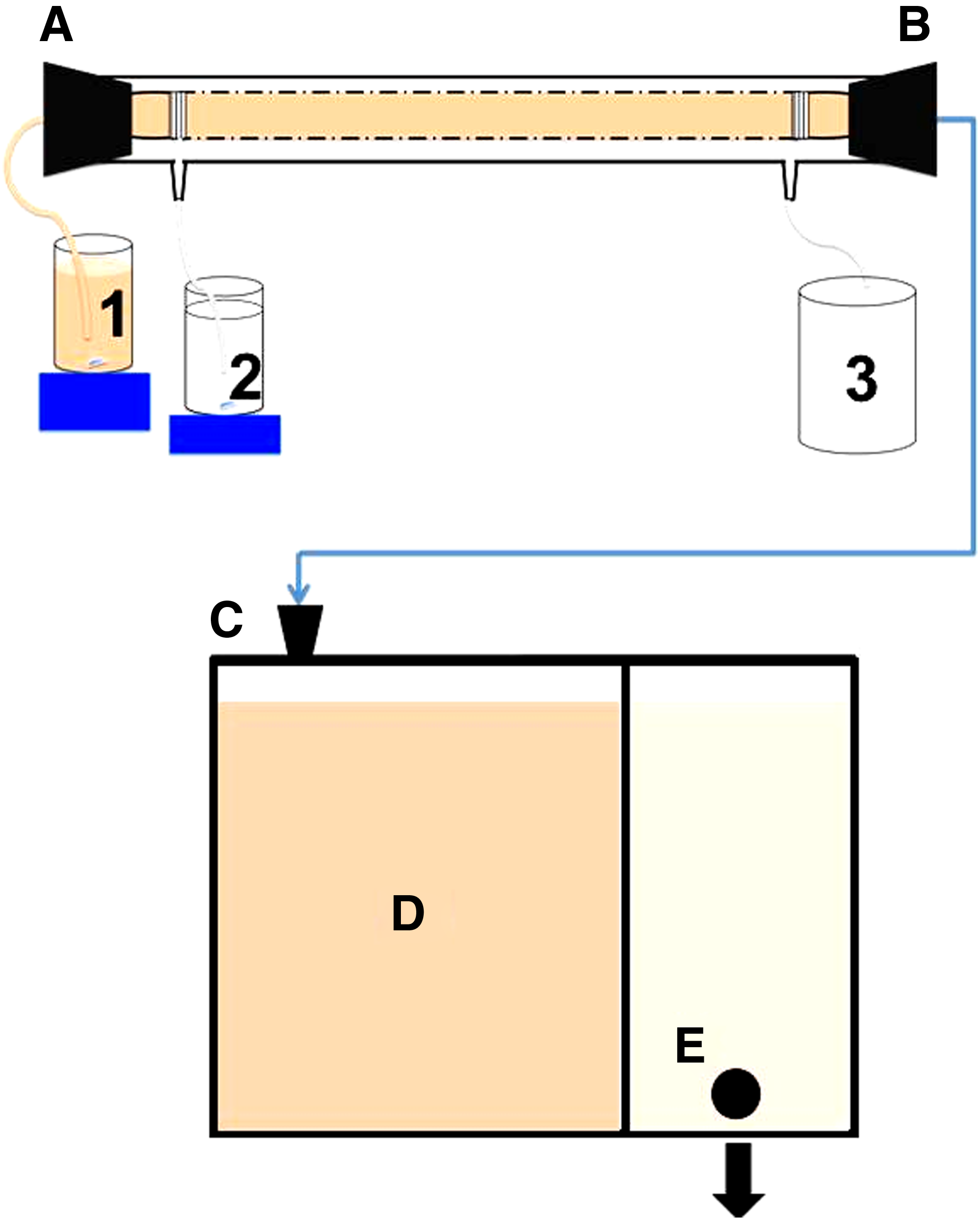
Schematic of the model colon and septic systems. Points A and B represent entry and exit from colon reactor, respectively. Points C and E represent entry and exit locations from septic system. Point D is the primary chamber of the septic system. The colon is inoculated with the microbial community and colon medium (Point 1) cycles from A to B (6 h). Nanoparticles are introduced into the intestinal media at Point 1 three times per day for the duration of the exposure conditions (weeks 2–4). Colonic waste is removed from the colon (Point B) and introduced with graywater to the septic system (Point C). Characterization is performed on the effluent samples (Point E).
Fecal matter was collected from the model colon (100 mL) at equal intervals three times per day and immediately transferred into the model septic tank along with 71 mL of gray water (5× concentrated) and 5,079 mL of Millipore water to simulate flushing. Gray water accounts for wastewater inputs from household sources other than fecal material containing, per liter, 20 mg humic acid, 50 mg kaolin, 50 mg cellulose, 0.5 mM CaCl2, 10 mM NaCl, and 1 mM NaHCO3 per liter at pH 8 (Nghiem et al., 2006).
Twice weekly, samples for characterizing the microbial community and wastewater quality were collected from secondary effluent obtained from the base of the septic tank's secondary chamber. Results presented are normalized by the average of the baseline values (recorded over 3 weeks) to indicate any measurable change from the initial control values. The control values are referred to as “Week 1” throughout the remainder of the article.
TiO2 particle selection and characterization
FG and IG TiO2 were utilized in this study. These NPs were selected based on FG TiO2 being the most likely type to reach wastewater treatment facilities from pharmaceuticals and personal care products, while IG is more commonly utilized in environmental fate and toxicity studies (Weir et al., 2012). FG particles are commercially available nanomaterials (provided by Arizona State University) and IG NPs were acquired from Sigma-Aldrich (Aeroxide TiO2 P25; Evonik Degussa Corporation, Essen, DE). FG particles were reported to be 122 ± 48 nm in primary size, having a >95% anatase crystal structure, and also with an inorganic phosphate coating (Yang et al., 2014). IG NPs have been well characterized previously with a primary particle size of 21 nm, a compound crystal structure of 75% anatase to 25% rutile, and no presence of an engineered surface coating (Yang et al., 2014; Waller et al., 2017). TiO2 exposure concentration (36 mg TiO2 per day) was based on average daily consumption estimates for an adult of 0.45 mg/kg of body weight (Weir et al., 2012), assuming an 80 kg adult male (Walpole et al., 2012).
Phenotypic characterization
Microbial community characterization was performed on bacteria extracted from the secondary chamber septic tank effluent, representing what would otherwise be introduced into a leach field and groundwater system in an actual system. Cell suspensions that were collected were both washed in triplicate and suspended in 10 mM KCl using a centrifuge (Eppendorf 5804R, Hamburg, DE) operated at 3,700 g for 15 min. Electrophoretic mobility (EPM) was quantified to approximate the relative surface potential (ZetaPALS, Holtsville, NY) of the microbial community. Relative hydrophobicity was determined by the microbial adhesion to hydrocarbon test (MATH) using n-dodecane as the model hydrocarbon. Relative hydrophobicity uses partitioning to quantify the relative presence of nonpolar functional groups at the microbial surface. Microbial EPS were quantified using the freeze-dry method and the bound sugar and protein (s/p) ratios were colorimetrically determined (sugar: 480 nm; protein: 500 nm) with an ultraviolet-visible spectrophotometer (Shimadzu Bio-Mini, Kyoto, Japan) (Gong et al., 2009). Microbial characterization methods are described in more detail in previous work (Waller et al., 2017).
Microbial community sequencing
Microbial community DNA sequencing allowed the characterization of the baseline structure and any measurable changes to the septic system microbial community resulting from the introduction of the nano-TiO2 particles. On the first day of each experimental week, 240 mL samples of secondary chamber effluent were centrifuged at 3,700 g and resuspended in 4 mL of 10 mM KCl. Subsequently, microbial cells were sampled from 1 mL aliquots of the secondary effluent and the DNA was extracted using the MoBio PowerFecal® DNA Isolation Kit (Carlsbad, CA) according to the manufacturer's protocols. Extracted DNA was stored in a −80°C freezer until shipped to Research and Testing Laboratories (Lubbock, TX) for 16S rRNA sequencing. Universal primers 515F (GTGCCAGCMGCCGCGGTAA) and 806R (GGACTACHVGGGTWTCTAAT) were used to obtain data regarding bacteria and archaea compositions.
Septic system function
Monitoring septic system function was achieved by measuring specific water quality parameters (Rice et al., 2012). Water quality parameters tested included alkalinity, pH, total dissolved solids (TDS), as well as representative volatile fatty acids (VFAs); these tests were performed in accordance with standard methods (Rice et al., 2012). Samples were tested immediately after being collected from the secondary septic tank chamber effluent twice weekly. Electronic probes were used for determining TDS (YSI 3200 Conductivity Instrument Model No. 3200 115V; YSI, Yellow Springs, OH) and pH (Thermo Scientific Orion Star A214, Waltham, MA). Quantification of representative VFA (acetic, propionic, and butyric acids) concentration utilized a previously published method (Venema et al., 2003; Taylor et al., 2015). Briefly, samples were centrifuged at 12,000 × rpm for 5 min before a 50 μL effluent aliquot was mixed with 650 mL internal standard, by mass ratio, 20 g of formic acid, 80 g of Millipore water, 434 g of methanol, and 200 mg 2-ethyl butyric acid. VFA concentrations were calculated using gas chromatography with a flame ionization detector (Agilent, Santa Clara, CA) via peak integration under flame ionization curve and fitted to the respective calibration curves.
Statistical analysis
Statistical significance was determined between the baseline conditions (control week 1) and each individual exposure week (2, 3, or 4), as well as each individual recovery week (5, 6, or 7) by Student's t-test. In addition, repeated measures analysis of variance (ANOVA) was used to determine statistical significance in weekly changes of microbial relative abundance. An alpha value of 0.05 (p < 0.05) indicated statistically significant differences resulted from the introduction of FG or IG TiO2 NPs for both Student's t-test and ANOVA. In addition, three separate correlative analyses were performed to identify potentially less obvious, but significant trends (p < 0.01) between weekly microbial compositional trends for (1) IG exposure, (2) FG exposure, and (3) all phenotypic parameters for both FG and IG exposures combined.
Results
Septic system function
Parameters measured as indicators of effluent quality are presented in Figs. 2–5; error bars indicate standard deviation of triplicate measurements. Baseline conditions comprise data points from the 3 weeks of baseline averaged to reflect a standard week to simplify the analysis of TiO2 exposure. Exposure and recovery weeks are normalized by the baseline values. TDS are a measurement that could be used to quantify the ionic content of the effluent providing an indicator of the fate and transport of wastewater compounds. FG introduction essentially had no effect on TDS (Fig. 2C). Conversely, TDS declined greatly during IG introduction, falling progressively each week to 49.2% ± 2.0% of the initial value by the end of the exposure phase (Fig. 2C). TDS rose for both TiO2 exposure conditions during the recovery phase as a delayed response with FG reaching 16.7% ± 11.0% above baseline conditions while IG only recovered to 66.7% ± 0.0% of its initial levels. IG exposures result in a significant pulse-like, possibly persistent, decrease of effluent TDS, while FG appears to have little effect during the exposure phase.

Weekly averages of
Normalized weekly averages of SCFA for
Microbial community fingerprint, IG:

Weekly averages of
Alkalinity measures the septic system's capacity to resist changes in pH from acid produced during anaerobic, microbial metabolism and it provides an indicator of the system's acidic buffering capacity. Neither TiO2 exposure caused major changes in pH, meaning acid presence never exceeded the system's buffering capacity (FG: 4.0% ± 3.0% rise; IG: 4.3% ± 1.0% decrease) (Fig. 2A). Inversely related system alkalinity trends were observed between FG exposure, which resulted in 10.8% ± 5.0% increase, and IG exposure, which caused a 19.5% ± 3.0% decrease (Fig. 2B). Alkalinity in the FG recovery phase increased an additional 36.5% ± 15.0% above initial showing persistent effects as IG recovery phase returned within 4.8% ± 8.0% of its initial value. These results demonstrate that IG exposures result in a nonpersistent increase in alkalinity consumption, associated with greater acid content, whereas FG appears to have little effect.
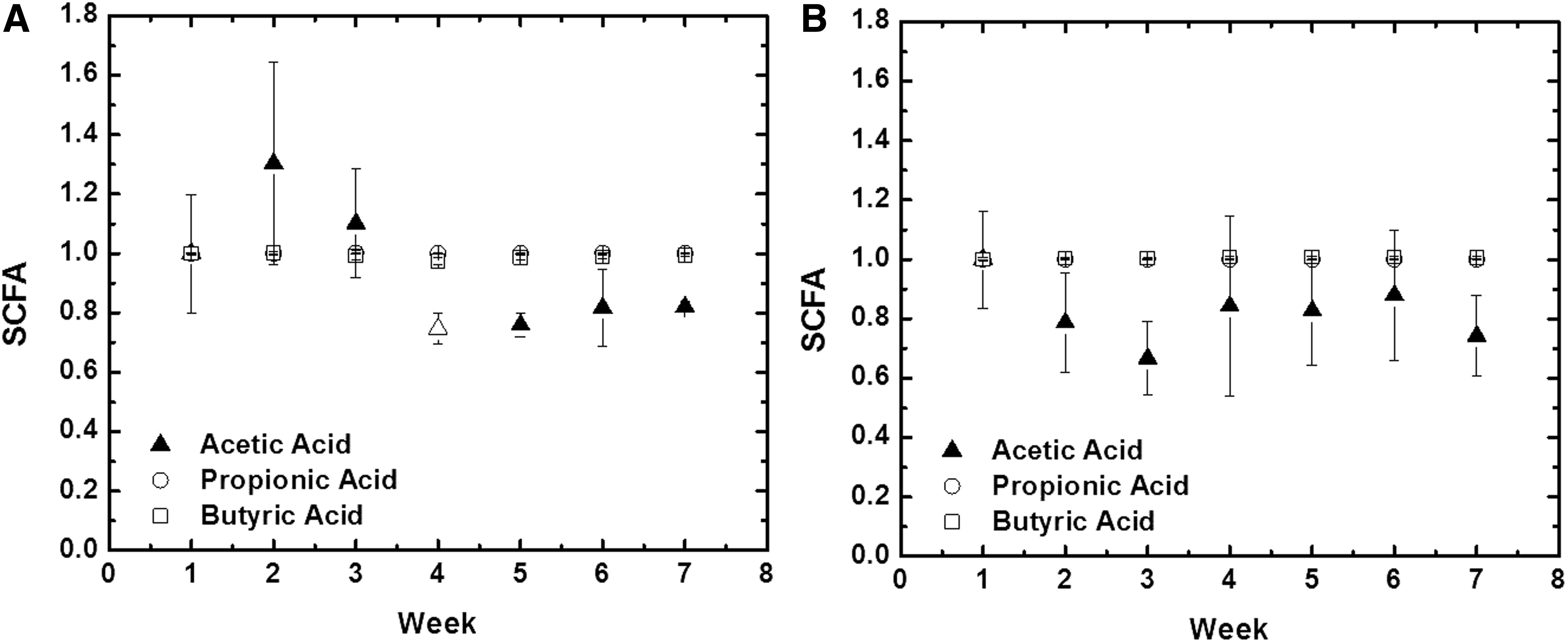
VFAs are intermediate products of anaerobic digestion related to the mineralization of organic compounds. Interestingly, propionic and butyric acid did not deviate from initial, baseline conditions during both FG and IG TiO2 exposures (Fig. 3). Acetic acid, however, drops to a minimum of 66.7% ± 13% of initial conditions before ending the FG exposure phase at 16.7% ± 30.0% of the baseline value (Fig. 3B). The inverse is observed with IG exposures resulting in a 30.3% ± 30.0% increase above the initial conditions before plunging 74.3% ± 13.0% of the baseline conditions by the end of the exposure phase (Fig. 3A). Acetic acid levels of both TiO2 exposure scenarios remain below initial conditions during the recovery phase never fully returning to baseline values. IG exposures may serve to stimulate acetic acid production while FG may stall production, although both systems appear to reach a new equilibrium in the recovery phase below the initial system conditions.
Microbial community composition
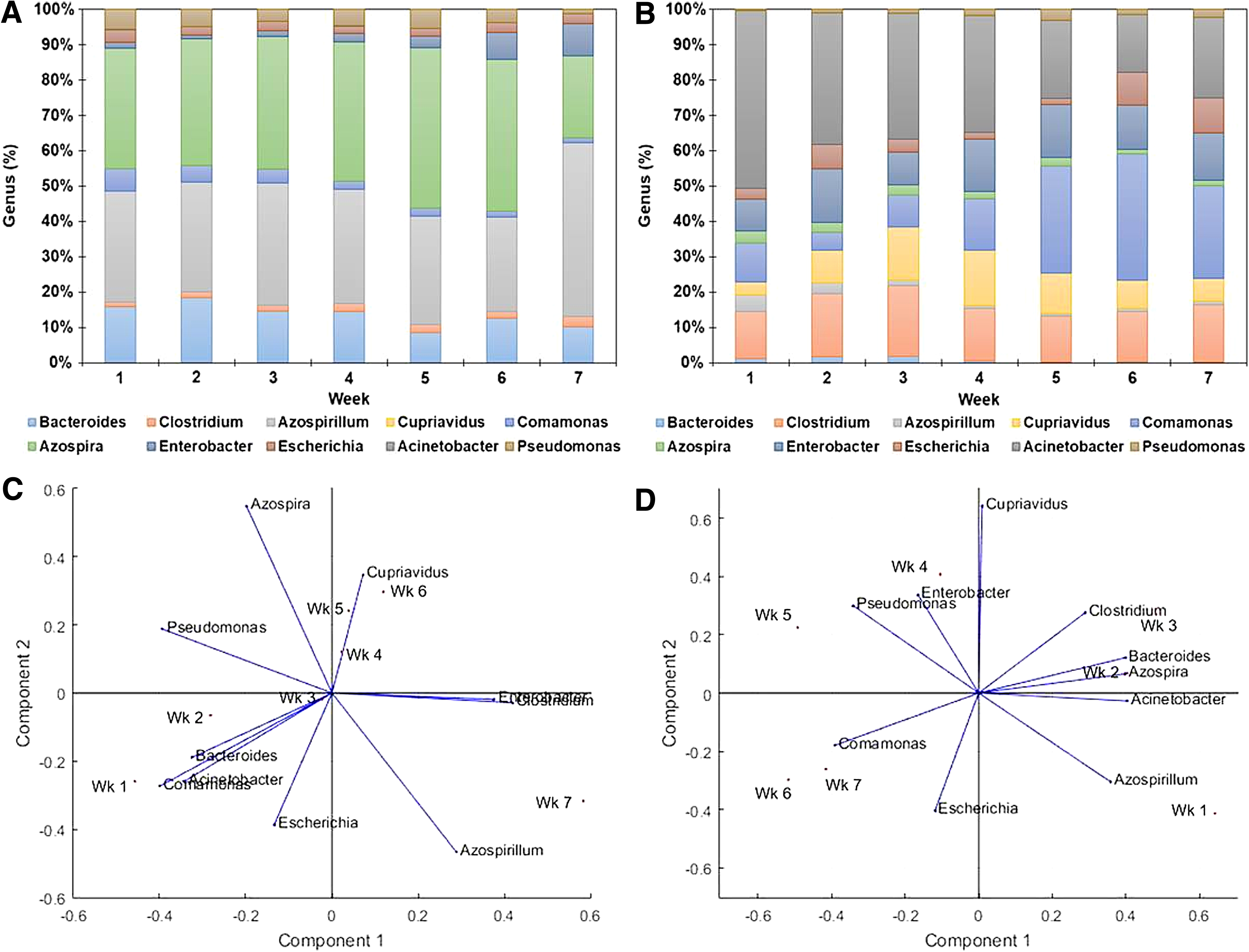
The microbial community composition was determined using pyrosequencing and indicates relative abundance based on reads (Fig. 4). Initial baseline conditions for each separate run were similar at the phyla level (Proteobacteria dominant, FG: 83% and IG: 75%), diverging as the taxa level decreased toward genera. Dominant genera comprising the Proteobacteria phylum are as follows: Acinetobacter, Comamonas, Enterobacter, Azospirillum, Azospira, and Pseudomonas. Clostridium and Bacteroidetes are the dominant genera from the Firmicutes and Bacteroides phyla, respectively. Relative abundance of each genera accounts for 80% and 79% of the initial sequenced microbial community for FG and IG runs, respectively. The genus of the FG's initial microbial population was composed of Acinetobacter (47.6%), Clostridium (12.6%), Comamonas (10.5%), Enterobacter (8.4%), and Azospirillum (4.4%) (Fig. 4B). IG's initial microbial population comprised Azospira (31%), Azospirillum (28.6%), Bacteroides (8.4%), Comamonas (5.6%), and Pseudomonas (5.2%) (Fig. 4A).
Introduction of FG particles to the microbial community quickly caused Acinetobacter to decrease 13.9% (33.7% relative abundance) during the 1st week of exposure before falling further to 17.9% relative abundance during the recovery phase (Fig. 4B). Enterobacter and Comamonas, conversely, became more prevalent during exposure phase increasing 5.1% (13.6% relative abundance) and 2.8% (13.3% relative abundance), respectively, before Comamonas increased further to 20.5% relative abundance in the recovery phase. IG introduction had little effect on the relative abundance of the Azospira and Azospirillum dominant community resulting in a 3% increase (34% relative abundance) and 0.7% decrease (27.9% relative abundance), respectively, at the end of IG exposure phase (Fig. 4A). Inversely related trends developed as Azospira was then reduced 13.4% (20.6% relative abundance) during the recovery phase, while Azospirillum increased 15.8% (43.7% relative abundance). IG exposure conditions were more conducive to the nitrogen fixing genera of Azospira and Azospirillum, while FG presence was detrimental to the relative quantity of Acinetobacter. Changes in relative abundance recorded resulting from both exposure scenarios were statistically significant (p < 0.05) as determined by repeated measures ANOVA.
Phenotypic characterization
EPM quantifies the stability of the microbial community based on interactions between the microbial surface and solution conditions. Increases in EPM reflect a more stable and therefore more mobile microbial community (Marcus et al., 2013), which also is associated with reduced biofilm presence. The FG exposure phase resulted in a 15.1% ± 11.0% increase of microbial community EPM (Fig. 5A). The increased mobility is persistent as EPM remained 9.2% ± 3.0% above the initial baseline conditions. Microbial EPM increased in the first 2 weeks of IG TiO2 exposures, although with large variability 8.0% ± 8.0%, before initial conditions redeveloping by the end of the recovery phase (Fig. 5A). While both communities exposed to TiO2 particles exhibit greater mobility, the IG-exposed community recovers to initial conditions as the FG-exposed community has more persistent effects, suggesting a decreased biofilm presence.
Relative hydrophobicity provides insight into the presence of nonpolar molecules at the microbial surface, a process usually associated with the development of biofilm (Marcus et al., 2012). FG exposure resulted in a decrease to 83.0% ± 17% of initial relative hydrophobicity before rising to 28.1% ± 10% by the end of the recovery phase (Fig. 5B). Conversely, microbial hydrophobicity increased 61.6% ± 8.6% during the IG exposure phase (Fig. 5B). The increased hydrophobicity persisted through the recovery phase with final values of 1.7% ± 0.7%, although large variability was observed. Greater biofilm production is expected from the IG-exposed community than FG based on the increased and sustained hydrophobicity.
Sugar to protein ratio (s/p ratio) compares the sugar and protein content of EPS as an approximation of biofilm production where an increased s/p ratio indicates greater tendency for biofilm development (Marcotte et al., 2007). Microbial community exposure to both IG and FG TiO2 NPs caused increased s/p ratios of 9.0% ± 11% and 29.8% ± 11.0%, respectively, above the initial conditions (Fig. 5C). Signs of recovery were evident during the IG recovery phase as values decreased to 87.8% ± 17.0% of the initial conditions, whereas the s/p ratio during FG recovery remained 9.9% ± 10.0% above the initial (Fig. 5C). Findings suggest both TiO2 NP-exposed communities exhibit biofilm forming trends with FG exposure effects more persistent. The IG-exposed community reflects an adaptive and robust nature indicating an ability to withstand changing system conditions.
Discussion
Septic system function
Previous research has suggested that the risk of anthropogenic environmental damage from emerging contaminants is minimized when waste degradation remains optimal and the septic system remains balanced (Canter and Knox, 1985). Septic systems are microbially driven anaerobic digesters that are failure prone due to both acute and chronic contaminant loadings (EPA, 2002). Monitoring key septic system metrics such as VFA production, alkalinity, pH, and TDS aids in understanding system performance by quantifying acid production, system acid buffering capacity, and ionic strength of the treated effluent (Rice et al., 2012). In this study, notable differences in septic tank effluent quality trends suggest that FG and IG TiO2 exposure each had a unique effect on septic system function.
VFAs—acetic, propionic, and butyric acids—are intermediate products of anaerobic digestion that indicate the mineralization efficacy of organic wastewater compounds. Acetic acid, notably, accounts for up to half of the VFAs introduced into the waste system (Rios-Covian et al., 2016). Interestingly, IG and FG exposures caused inverse trends in acetic acid levels in the first 2 weeks of the exposure phase (Fig. 3). Acetic acid levels immediately decreased to 66.7% ± 13% of the initial level during FG exposures, while rising 30.3% ± 30% during the initial IG exposure. Acetate is an essential substrate in methane production from anaerobic digestion (Blaut, 1994; Bitton, 2005) meaning its variation between TiO2 exposures reflects distinct influences to the complete mineralization of organic matter. In addition, it was observed that neither TiO2 exposure had a significant effect on butyric and propionic acid levels. Acetate presence has the capacity to hinder the degradation of propionic and butyric acids (Kaspar and Wuhrmann, 1978; Ahring and Westermann, 1988) potentially reflecting a more significant mechanism than solely the TiO2 presence governing the conversion of these two fatty acids. It is inferred that the initial IG introduction may boost mineralization by increasing acetic acid levels, although ultimately both exposures result in reduced quantities and the potential for hindered septic system function over the long term.
IG and FG TiO2 exposures also resulted in dissimilar responses to septic system's acidic buffering capacity. Sudden or extreme changes in system pH can disrupt anaerobic digestion by inhibiting pH-sensitive microbes (e.g., methanogens), highlighting the need for conditions to remain balanced and consistent (Bitton, 2005; Taylor et al., 2015). Alkalinity consumption by acid production as pH remained constant during IG exposures demonstrated increased effluent acidity, although the levels did not exceed the system limits (Fig. 2A, B). Acetic acid increases observed during the IG exposure phase support the observation that acidity was indeed greater than initial conditions (Fig. 3A). The septic system exposed to IG TiO2 demonstrates continued operation with increased acidity, yet a resilient, robust nature as system effects were nonpersistent. Interestingly, however, rising alkalinity accompanying a slight pH increase during FG exposures, continuing into the recovery phase, reflects an alternate response than during the IG run. An unexpected decrease in acetic acid production (Fig. 3B) indicates FG exposures may inhibit earlier stages of anaerobic digestion such as hydrolysis, acidogenesis, and acetogenesis (Bitton, 2005). It is well understood that NPs in biological systems develop organic coatings and associate with biomass (Cedervall et al., 2007; Lynch and Dawson, 2008; Kiser et al., 2010; Tong et al., 2010; Westerhoff et al., 2011, 2013; Ikuma et al., 2015), allowing the possibility for reducing bioavailability of anaerobic bacterial substrates.
Major differences in the quantity of TDS reveal ionic strength as another effluent quality parameter that varied by which form of TiO2 the septic system was exposed to. TDS values plunged in the 1st week (week 2) of IG exposures before rising again during the recovery phase (Fig. 5C). Lower TDS reflect improved water quality and result from biological activity such as ion uptake by the microbial community (Bian et al., 2011), as well as sedimentation from wastewater flocs (Bian et al., 2011; Crittenden et al., 2012). However, wastewater biomass and bacteria that remain in suspension would possess greater stability and are likely to travel further on release from the system (Zita and Hermansson, 1994; Chowdhury et al., 2012). FG TiO2 presence, conversely, caused little deviation in TDS and even increased above initial values during system recovery. IG TiO2 has been shown to have much larger aggregate sizes compared with FG in both simple and complex media (Waller et al., 2017) and therefore may provide a binding surface for charged biomass to form colloids with greater probability of settling out of suspension (Westerhoff et al., 2011, 2013; Mu et al., 2014). Effectively, it can be stated that improved water quality resulted from IG exposure, although suspended particles may be stabilized, while FG had negligible or detrimental effect on system TDS and effluent quality as a result.
Septic effluent microbial community composition
Wastewater microbial communities drive biological treatment processes by efficiently degrading organic compounds in raw sewage (Ye and Zhang, 2013). Microbial communities are complex compositions maintaining symbiotic relationships that influence factors associated with process control and system optimization (Cydzik-Kwiatkowska and Zielińska, 2016). Figure 4A and B displays a graphical representation of microbial community genera percentage from the baseline community (week 1) for IG and FG exposure runs through exposure and recovery, respectively. At the phylum level, the microbial communities are quite similar with both being Proteobacteria dominant (FG: 83% and IG: 75%). This microbial composition agrees with prior studies of septic systems (Tomaras et al., 2009; Marcus et al., 2013; Taylor et al., 2015), as well as communities present in full-scale wastewater treatment samples (Ye and Zhang, 2013; Cydzik-Kwiatkowska and Zielińska, 2016). However, composition at the genera taxa rank shows differences in the initial community as IG comprised largely Azospira (31%) and Azospirillum (28%), while FG is dominated by Acinetobacter (50%). This difference in community composition may result from biofilm growth as microbes existing within an EPS matrix experience a complex “micro-niche” facilitating homeostasis and a nutrient circulatory system (Costerton et al., 1995), the balance of which influences the genera that thrive. In addition, factors such as competition, microbial dispersal from growth and death, or mixing as influent enters the system can further cause compositional heterogeneity (Cydzik-Kwiatkowska and Zielińska, 2016).
TiO2 exposure to these respective baseline communities caused notably different responses to microbial community compositions. IG TiO2 introduction (Fig. 4A, weeks 2–4) effectively caused no change on the denitrifiers Azospira and Azospirillum. Denitrifiers play a critical role in completing the mineralization of organic matter in biological treatment systems (Chen et al., 2014) making their presence ideal for optimum wastewater treatment. Azospira and Azospirillum persistence indicates IG TiO2 exposure may facilitate denitrifier activity. Partial support for this is seen with surges in acetic acid observed in the first 2 weeks of particle introduction, reflecting an increased presence of nutrients, while decreases in TDS suggest mineralization of VFAs existing as organic anions (Nugent et al., 2001).
FG TiO2 exposure, conversely, considerably affected Acinetobacter (decreasing 16% to comprise 30% of community) simultaneously as Enterobacter and Comamonas gained larger footholds in the community (14% and 13%, respectively). Comamonas increased further (7%) in the recovery phase, perhaps better able to persist with a less dominant Acinetobacter presence. During anaerobic digestion, acetic acid is metabolized by acidogenic and acetogenic bacteria before conversion to methane and carbon dioxide (Bitton, 2005). It is important to note that limitations exist in identifying the exact genera responsible as acetogen is a term broadly applied across taxonomic rankings (Berg et al., 2010; Schuchmann and Muller, 2016). Clostridium species are understood to play a major role in metabolizing acetic acid (Winter and Wolfe, 1979; Bitton, 2005) although their relative abundance remained unchanged in this study for either TiO2 exposure condition. Microbial concentration was an additional possibility as reduced concentration, for example, could also correspond to lower metabolite concentration (Bitton, 2005; Taylor et al., 2015), yet this would not necessarily indicate the exact impact of TiO2 particle presence, whether beneficial or detrimental. However, microbial concentration remained between 1 and 5 × 10⁸ for both experimental conditions suggesting concentration not be the driver of changes in acetic acid levels.
Interestingly, Acinetobacter has been shown to exhibit antibiotic resistance and the ability to metabolize acetate in anaerobic wastewater (Kim et al., 1997) indicating FG TiO2 may interfere with factors aiding Acinetobacter resilience and this particular metabolic pathway. Changes in Comamonas relative abundance correspond with acetic acid variation during both exposure scenarios suggesting as another possible mechanism to describe acetic acid variance. Comamonas represents one of many heterotrophic nitrifying genera capable of consuming ammonia, although autotrophs may be more ideal under anaerobic conditions (Cydzik-Kwiatkowska and Zielińska, 2016). Symbiotic relationships that develop between bacteria ideally provide the microbial communities' robust qualities, making them resilient under dynamic conditions (Arumugam et al., 2011); however, FG TiO2 presence appears detrimental to the adaptive nature of the microbial community. Water quality findings of the current study support that the wastewater treatment efficiency is impaired (Figs. 2 and 3) during FG exposures. Interestingly, Acinetobacter has been shown to exhibit antibiotic resistance and the ability to metabolize acetate in anaerobic wastewater (Kim et al., 1997) indicating FG TiO2 may interfere with factors aiding Acinetobacter resilience and this particular metabolic pathway. Ultimately, while IG had little effect on a primarily denitrifying dominant community, FG exposure enabled a shift to a more diverse community that exhibited less than ideal functionality for wastewater treatment.
Phenotypic characterization
Exposure of the wastewater microbial community to FG and IG TiO2 resulted in changes to the microbial phenotype capable of influencing biofilm production. Quantifying the ratio of sugar and protein (s/p) in the EPS in this study aided the prediction of the possibility of biofilm formation (Eboigbodin and Biggs, 2008), while microbial hydrophobicity and EPM served as qualitative indicators of biofilm development around the microbial cell surface (Schafer et al., 1998; Marcus et al., 2013; Waller et al., 2017). Inversely related trends of biofilm formation are expected to develop between FG- and IG-exposed microbial communities based on microbial hydrophobicity, EPM, and s/p ratios, with elevated levels expected from the IG-exposed community (Fig. 5). Interestingly, although the FG-exposed microbial community became more hydrophilic during exposure, persistent hydrophobic trends developed for both communities by the end of the recovery phases. Hydrophilic bacteria have a tendency to exist in a planktonic state (Costerton et al., 1995; Flemming and Wingender, 2010) indicating a more mobile microbial community developed during FG exposure conditions (Fig. 5A).
Delayed surges in hydrophobicity may indicate microbial community acclimation to starvation conditions brought on by FG TiO2 NP exposure, where a dense biofilm may have been detrimental to community survival (Flemming and Wingender, 2010). Increases in microbial biofilm production from IG TiO2 NP exposures may prove beneficial to the microbial community as a filter network trapping organic molecules and essential ions while, ideally, excluding deleterious substances (Ikuma et al., 2015). In addition, increased biomass may also be beneficial to water quality as greater surface area is available for adsorption and sedimentation of organic (Cedervall et al., 2007; Kiser et al., 2010; Ikuma et al., 2015) and inorganic compounds (Westerhoff et al., 2011, 2013), including IG TiO2 NPs, ultimately leading to NP removal from effluent streams (Cedervall et al., 2007; Lynch and Dawson, 2008; Kiser et al., 2010; Tong et al., 2010; Westerhoff et al., 2011, 2013; Ikuma et al., 2015). Whereas biomass produced in full-scale treatment operations is periodically removed, the biomass—and NPs (Taylor et al., 2016)—accumulates in the sedimentation chamber of a septic system making long-term exposure studies an area deserving further research.
Principal component and correlation analyses
Septic system response to the exposures of FG and IG TiO2 was elucidated statistically using principal component analysis (PCA) and correlation analyses. Observations presented represent correlations between testing parameters resulting from systematic changes and not necessarily “cause and effect” relationships. PCA describing weekly variations in relative abundance of the microbial community genera is presented for IG and FG exposure runs in Fig. 4C and D, respectively.
Both types of TiO2 showed substantial impact on the microbial community within the septic tank as presented above in the results, and the significance of this impact can be evaluated using PCA. As principal component (PC) 1 reflects the component containing the majority of variation, it can be said that TiO2 exposure resulted in persistent changes in the dynamics of the microbial community (Fig. 4C, D). Relative microbial abundance shifts at the onset of IG exposure along PC 1 (60% of variation) reflect changes in the composition of the less abundant genera of the system (Fig. 4C). Although the dominant members shown in Fig. 4C (Azospira and Azospirillum) maintain a system balance and function, variations in less dominant genera are observed during the IG exposure, indicating that NP presence does influence community structure. The large variation observed between weeks 1 and 7 along PC 1 reflects that the final community varied considerably from the original population. This suggests the establishment of a new “normal” in the community after IG TiO2 exposure, potentially with different dynamics and roles in the anaerobic system.
Persistent changes in community dynamics from FG TiO2 exposure were elucidated by variance along PC 1 (58% of the variation). Relative abundance of Acinetobacter was strongly linked with variance with respect to PC 1 between initial conditions and the FG TiO2 exposure and recovery phases (Fig. 4B, D). Interestingly, the less abundant genera remained stable in the presence of FG TiO2 before an inverse trend developed in the third exposure week (week 4) (Fig. 4D). As such, a considerable shift in the final community structure is supported by the minimal variance along PC 1 in FG recovery weeks (5, 6, and 7) in agreement with trends shown in Fig. 4B. Water quality findings substantiate that changes in the symbiotic relationships naturally present and required for effective WWT are not disrupted during IG exposures, whereas waste treatment capacity is impaired after FG exposure.
Septic system response to TiO2 exposure was further evaluated using the statistical correlations between weeks using microbial composition, water quality, and phenotypic parameters (Table 1). In addition, correlations between all testing parameters were also evaluated (Table 2). Weekly correlation data support water quality and phenotypic findings that septic system exposure to IG TiO2 alters system conditions based on strong correlations observed between the initial conditions (week 1) and the first IG exposure week (r = 0.9, p < 0.01) before correlation is lost in the remaining exposure weeks (Table 1). This reflects that systematic changes (i.e., introduction of IG TiO2) affect weeks 1 and 2 proportionally; whereas inversely related trends had developed during the recovery phase (week 7, r = −0.59, p < 0.01), indicating that statistically significant conditions in the septic system developed after IG TiO2 exposure. Weekly correlation data reflect that FG TiO2 exposure resulted in statistically significant systemic changes in microbial genera and phenotypic trends as observed by negative correlations (r = −0.59, p < 0.01) between initial conditions and the FG recovery phase (weeks 5, 6, and 7). Essentially, FG TiO2 exposure facilitated changes in septic system conditions capable of diminishing treatment capacity as determined by water quality findings.
p < 0.01.
TiO2, titanium dioxide.
p < 0.01.
EPM, electrophoretic mobility; s/p, sugar to protein; TDS, total dissolved solids; TSS, total suspended solids.
Correlation analysis of water quality and phenotypic parameters provides useful analysis of system operation and function. Parameters were combined from both FG and IG TiO2 exposures to highlight strong relationships (i.e., pH and alkalinity) that existed between both NP exposure scenarios to substantiate the accuracy of findings and system operation. Analyzing all of the data for NP exposure (both FG and IG) can indicate that exposure to NPs creates substantial system changes. Strong correlation between turbidity and the total suspended solids (r = 0.87, p < 0.01) aligns with relationships well known in literature (Crittenden et al., 2012) helping to validate that the correlation analysis and supporting systems were operating properly. Notably, a strong positive correlation was also observed between pH and acetic acid (r = 0.71, p < 0.01), while strongly negative correlations were observed between alkalinity and acetic acid (r = −0.87, p < 0.01), as well as pH and alkalinity (r = −0.59, p < 0.01). Intuition suggests opposite trends would exist between pH and acetic acid concentration; however, the proportionality between the two is clarified by the inverse relationships demonstrated with acetic acid and alkalinity, as well as pH and alkalinity (Crittenden et al., 2012). These correlations reflect the dynamic nature of the system and emphasize the significance of alkalinity in anaerobic digestion, allowing chemical reactions to occur while maintaining system pH. Although FG and IG TiO2 influences microbial composition, phenotypic, and water quality parameters, consistent responses to the perturbation and capacity of the system to recover highlight the robust nature of the microbial community and septic systems in general.
Summary
Historically, failing septic systems have been detrimental to groundwater quality when excessive nutrient loading and contaminants have been introduced into the system. Monitoring the effects of emerging contaminants (e.g., engineered nanomaterials) in decentralized systems is just as relevant as effects in centralized WWTPs as both have immediate environmental implications. As waste degradation in septic systems is an anaerobic, microbially driven process, potential impacts from nanomaterials to the microbial community must be characterized to understand potential causes of failure and downstream ecological effects from FG TiO2 NP presence.
Notable differences were observed in microbial phenotype and genera composition, as well as septic system function from the introduction of FG and IG TiO2 to the wastewater treatment system. Acute exposure of the septic microbial community to FG and IG TiO2 particles ultimately resulted in inversely related tendencies for biofilm development. IG exposure lead to increased production of biofilm, while FG exposure lead to reduced biofilm production. In addition, exposure of the septic system to IG TiO2 particles had minimal effect on the composition of the denitrifying-dominant microbial community, while the FG exposures shifted the community structure to genera of mixed functionality, which is less effective at wastewater treatment. Finally, septic effluent water quality may benefit in the short term from IG TiO2 exposures by facilitating VFA production, whereas exposure to FG NPs may be detrimental to anaerobic digestion by interference in organic matter mineralization.
Valuable insight has been gained from this study concerning a need to focus on monitoring and controlling of nanomaterials used in food and consumer products. It has been shown the wastewater microbial communities in a representative septic system are affected by FG TiO2 nanomaterial presence, although more research is needed to further assess permeation through groundwater after waste treatment. While nanomaterials may not directly affect human health, there exists the risk of unexpected ecological impacts occurring downstream of the initial consumer applications.
Footnotes
Acknowledgments
We thank the following individuals for their assistance with this work: A. Taylor, A. Coyoca, D. Novoa, I. Irianto, C. Acurio and S. Lara. Funding from the National Science Foundation (NSF), Environmental Protection Agency (EPA), and Department of Education supported this study. T.W. was supported by both the Department of Education (Graduate Assistance in Areas of National Need, Grant No. P200A130127) and the NSF IGERT: WaterSENSE—Water Social, Engineering, and Natural Sciences Engagement Program (Grant No. 1144635). S.L.W., participation and work, more broadly, was also funded through the UC-CEIN (University of California Center for Environmental Implications of Nanotechnology), which is supported by the NSF and the EPA under Cooperative Agreement Number DBI 0830117. Any opinions, findings, and conclusions or recommendations expressed in this material are those of the author(s) and do not necessarily reflect the views of the NSF or the EPA. This work has not been subjected to EPA review and no official endorsement should be inferred.
Author Disclosure Statement
No competing financial interests exist.