




Abstract
Abstract
In this study, a novel three-stage filler-based waterfall aeration grooves biofilm reactor (WAGBR) was designed to treat decentralized wastewater. This reactor is suitable for rural areas of China for its low cost and easy maintenance, and it can be used for treating wastewaters of different qualities and volumes. Chemical oxygen demand (COD), nitrogen removal efficiency, and the microbial community structure were evaluated in different stages of the WAGBR for 50 days. Results obtained for each stage were compared with those of other stages. COD and ammonium nitrogen (NH3-N) removal efficiency remained at ∼80% after 20 days and three stages played different roles in removal of specific pollutant. High-throughput sequencing was used to investigate composition of the microbial community in the treatment system. The microbial richness of stage 1 was higher than that of stage 2 and it indicated that the raw wastewater had a higher biodegradability after stage 1. Microbial diversity in the stage 1 and stage 2 was similar to each other, but was much higher than that in stage 3. Major classes present were Alphaproteobacteria (average abundance of 21.7%), Betaproteobacteria (20.8%), Gammaproteobacteria (12.2%), Sphingobacteriia (9.5%), Cytophagia (8.0%), Acidobacteria_Gp4 (6.3%), Acidobacteria_Gp3 (6.0%), Flavobacteriia (2.9%), Deltaproteobacteria (2.6%), ML635J-21 (2.1%), Saprospirae (1.8%), and Bacteroidia (1.2%). These results could provide important guidance for the use of decentralized wastewater treatment systems in rural areas of China.
Introduction
I
Microbial communities play a very important role in the performance of the reactor, and thus, it is necessary to know the structure and diversity of microbial communities to be used for associated reactors. Researchers use several methods to study microbes in wastewater, including fluorescence in situ hybridization (Paungfoo et al., 2007), denaturing gradient gel electrophoresis (Boon et al., 2002; Ma et al., 2003), and high-throughput sequencing (Cai and Zhang, 2013; Bai et al., 2014; Lu and Lu, 2014).
In our previous work, chemical oxygen demand (COD) and nitrogen removal in this kind of biofilm reactor operated at different COD/TN ratios, organic loading rates, and flow rates have been studied (Pu et al., 2016). At a COD/TN ratio of 10 and an organic loading rate of 25 g/(m2·d), the COD and NH3-N removal efficiency reached its highest value, and at a COD/TN ratio of 14 and an organic loading rate of 15 g/(m2·d), the treatment of COD and NH3-N was seen to be the worst. The hydraulic loading rate for this reactor has been studied, and results of these experiments show that the efficiency of treatment increases with increasing internal cycle rate, however, the biofilm attached in the carrier can be washed off at internal cycle rates above 2.2 L/min after the start-up period. Furthermore, the COD, nitrogen removal efficiency, and the microbial communities in a novel waterfall biofilm reactor with activated sludge were studied (Wang et al., 2016). However, the artificial start-up strategy of adding activated sludge is not convenient and the biological materials used in reactors are expensive in the rural areas of China.
Melamine foam, which is one of the lightest foams, currently has a fully opened three-dimensional grid structure with an aspect ratio of 10 to 20 and an open porosity of over 99% (Kino et al., 2009). It is very cheap and is usually used in architecture. A high opening rate three-dimensional grid structure gives it higher stability and aging resistance than other thermoplastic materials usually used in wastewater treatment, such as polyethylene, polystyrene, and the low degree of crosslinking polyurethane materials (Jaouen et al., 2008). Thus, melamine foam has the potential to be used for wastewater treatment.
In this study, a novel three-stage WAGBR with melamine foam as fillers was designed, which is cheap and easy to operate. The WAGBR does not require forced aeration in the waterfall and the grooves with suspended filler are anoxic units. As the effluent from the anoxic units drops into the next plate, the energy consumption is reduced and the sludge recycling is rendered unnecessary. To enhance the performance in the treatment of the most challenging wastewater at a COD/TN ratio of 14 and an organic loading rate of 15 g/(m2·d), the three-stage system was applied. Also, these grooves are designed to prevent the biofilm from being washed off at the internal cycle rate of 3 L/min.
The overall performance of WAGBR was studied, and the microbial community at different stages was investigated using high-throughput sequencing. This study aimed to gain a better understanding of the mechanisms responsible for the performance and microbial communities of the WAGBR at different stages and to apply them for optimal control and management strategies for the WAGBR system.
Experimental protocols
System setup and operation
The novel WAGBR configuration is shown in Fig. 1. The effective volume of the lower water tank was 50 L. The main part of the system is the 18 layers of inclined plates carried by a steel hob. The material of the inclined plates was plastic and the suspended filler, which was melamine foam, was put in the grooves as a carrier. Each inclined plate was 34(length) × 31(width) × 3(depth) cm with 32 grooves, each groove was 56(length) × 38(width) × 28(depth) mm, and the grooves were perpendicular to the plate. The slope of the inclined plates was 10° and the distance drop between two inclined plates was 7.5 cm. In each stage, wastewater in lower tank was pumped to the higher tank, which then moved by gravity to pass over the surface of the inclined plates and down to the lower tank. At the same time, some wastewater was pumped into the next stage. For this reactor, we adopted continuous inflow mode and natural start-up strategy. After 20 days of operation, a steady state was obtained and a compact biofilm was formed on the suspended fillers.

Schematic of three-stage waterfall aeration grooves biofilm reactor.
Characteristics of wastewater
Composition of the synthetic wastewater was referred from previous studies. Glucose was the only source of organic carbon, and the influent medium consisted of (NH4)2SO4, K2HPO4, KH2PO4, CaCl2·H2O, MgSO4·7H2O, FeSO4, and trace elements in solution (Third et al., 2001). The operating conditions were kept consistent with those of the start-up phase at a COD/TN ratio of 14 and an organic loading rate of 15 g/(m2·d) (COD, NH3-N, TN, TP, temperature, pH, inflow rate, and internal cycle rate were 1,200 mg/L, 85 mg/L, 85 mg/L, 25 mg/L, 25–28°C, 7 ± 0.3, and 50 mL/min, and 3 L/min, respectively) (Wang et al., 2016).
Analytical methods
Wastewater samples were collected from the place where wastewater drops from the inclined plate to the next one and well-mixed reactor contents from each tank. The COD was analyzed according to the Chinese State Environmental Protection Agency (CSEPA) standard methods (HJ/T399-2007). Ammonium, nitrate, and nitrite concentrations were measured using an ultraviolet spectrophotometer (UV2700; Shimadzu, Japan). The dissolved oxygen, temperature, and pH were measured using a portable dissolved oxygen meter with a temperature readout (HQ30d; HACH, Loveland, CO) and a digital pH meter (A221; Thermo, Waltham, MA), respectively. The biofilm samples were freeze-dried and metal sputter coated before acquiring images.
Biomass sample collection and DNA extraction
Biofilm samples for the analysis of the microbial community were collected on the 30th day of operation time when the system was in the period of stable operation. A total of 21 biofilms were collected from the system, including the biofilms from each plate in different heights of stage 1 and stage 2 reactor (marked as S1-P1 to S1-P9 and S2-P1 to S2-P9) and the biofilms in the upper, middle, and lower parts of the stage 3 reactor (marked as S3-P1 to S3-P3).
DNA from different samples was extracted using the MicroElute Genomic DNA Kit (D3096-01; Omega, Inc.) according to the manufacturer's instructions. The reagent that was designed to isolate DNA from trace amounts of sample has been shown to be effective for the isolation of DNA from most bacteria. Sample blanks consisted of unused swabs processed through the DNA extraction procedure and tested to contain no 16S amplicons. The total DNA was eluted in 50 μL of elution buffer by a modification of the procedure described by the manufacturer (QIAGEN) and stored at −80°C until measurement in the PCR by Vazyme Biotech Co., Ltd. (Nan Jing, Jiangsu Province, China).
PCR amplification and bacterial 16S rDNA sequencing
The bacterial primers 338F (5′-ACTCCTACGGGAGGCAGCAG-3′) and 806R (5′-GGACTACHVGGGTWTCTAAT-3′) were used to amplify the V3–V4 region of the 16S rRNA gene (Wang et al., 2017). The PCR amplicons were purified using paramagnetic bead technology for MiSeq pyrosequencing. Subsequently, a composite sequencing library was constructed, and it was sent for 2 × 300 bp paired-end sequencing on the Illumina MiSeq platform. After sequencing, the bar codes and primers were removed, the low-quality reads were removed too, and the paired-end reads were overlapped to assemble the final tag sequences using a flash program. The operational taxonomic units (OTUs) were defined as having >97% similarity of the clustered sequences by Cluster Database at High Identity with Tolerance (CD-HIT) (Fu et al., 2012). Raw MiSeq sequencing data have been deposited to the NCBI sequence read archive (SRA) database with accession number SRP115862.
RDP (Ribosomal Database Project) classifier with a confidence threshold of 80% was used to assign representative sequences to taxonomic classifications (Wang et al., 2007). The alpha diversity included observed OTUs, Shannon and Simpson index, and Chao 1. The observed OTUs are a metric for the count of unique OTUs found in the sample. The Shannon and Simpson indexes represent the community diversity, and the Chao 1 indicates species richness.
Results and Discussion
Performance of WAGBR system
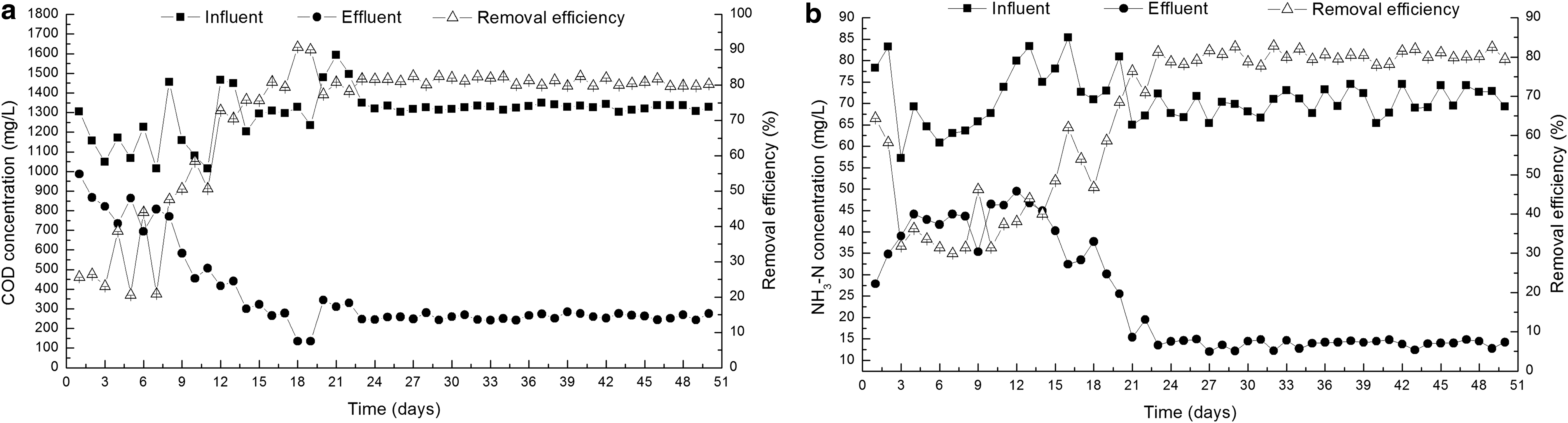
Performance of the WAGBR system was examined over 50 days. After 20 days start-up period, the WAGBR system ran over 30 days in stable continuous operation. The removal efficiency for COD and NH3-N is shown in Fig. 2.
Removal efficiency for COD
The system showed a remarkable ability to remove COD and NH3-N from wastewater, even though these pollutants were in an extremely high concentration in the influent at a COD/TN ratio of 14 and an organic loading rate of 15 g/(m2·d). After 20 days, the COD removal efficiency became steady at around 80%. A perfect state of ∼80% NH3-N removal efficiency was obtained after 20 days with <20 mg/L NH3-N concentration in the effluent, as the nitrobacteria need a relative long time to reach stable growth. The ability to remove NH3-N with a high efficiency might be the characteristic of the biofilm adhered on the filler at different depths. A steady pollutant removal efficiency indicated that the biofilm is stable and has not been washed down.
Although the removal efficiency of the WAGBR for the most challengeable influent is lower than that for MBR, which has a COD and NH3-N removal efficiency of 90% while treating decentralized wastewater, the WAGBR has a significant advantage in unit project investment and operation cost (Davies et al., 1998; Verrecht et al., 2012). The unit investment of three-stage WAGBR system is 900 renminbi (RMB), including 600 RMB for the steel construction, 100 RMB for the inclined plates, 20 RMB for the melamine foam, and 180 RMB for the pumps (20 W). The operation cost is only that required for electricity without the need for replacing filler and man power. The low organic loading rate may contribute to the insufficient biomass, which is the main part of WAGBR (Sánchez et al., 2005; Kim et al., 2010). Wheat bran can be used as a melamine foam modifier as an additional carbon source to biofilm, and it is easily available in rural areas of China. Future research will focus on the use of wheat bran and other locally available resources.
Each stage of the system showed different removal abilities for different pollutants in Fig. 3.

Removal ability for different pollutants in the three stages.
In the stabilization time, relatively stable removal efficiency and effluent concentration of different pollutants were obtained for stage 1, stage 2, and stage 3, as well as for the plates in each stage. Almost 60% of COD was removed in stage 1, 15% of COD was removed in stage 2, and less than 2% of COD was removed in stage 3. For the removal of NH3-N, stage 1 and stage 2 manifested a stable removal efficiency throughout the stable operating period, and the stage 3 was the primary unit for NH3-N removal. In stage 1 and stage 2, the NO2−-N was not accumulated as NH3-N was efficiently transformed to NO3−-N. However, in stage 3, NO2−-N accumulated at a high level, but the NO3−-N concentration was relatively less than that in stage 1 and stage 2. This indicates that stage 3 had a higher performance for the removal of NH3-N transformed to NO2−-N. This high overall performance of COD and NH3-N removal can be attributed to the application of three-stage reactors. Three-stage reactors were also reported to be more stable and robust in treating wastewater (Seunggu et al., 2010).
Although there are some fluctuations of pollutant concentration in some instant moments that may come from the microbial changes, the whole stable effluent and high removal efficiency of COD and NH3-N indicate that the WAGBR system has a high performance in treating wastewater. In addition, the WAGBR system can be changed at different stages or at stages in accordance with different characteristics of wastewater or different influent loads. The microorganisms in the bioreactors could utilize the organic and inorganic compounds in the wastewater as nutrients. Meanwhile, the discrepancy in the ability of each reactor for removing pollutant depended on the species and composition of the microorganisms in the reactors (Zhu et al., 2017). Therefore, the shift in the profile of the microbial community and the representative microbial taxa present at different stages are a significant field of study.
Shifts in the microbial community structures
Diversity of microbial community revealed by high-throughput sequencing
Species accumulation curves are widely used to determine the adequacy of sampling and species richness estimates. It is an effective tool for describing the increase in species as the amount of sample increases, and investigating the species composition of the sample and predicting the abundance of species in the sample. Figure 4 indicates that the results represented the majority of bacterial 16S rRNA sequences present in each sample.

Species accumulation curve.
The microbial communities of the 21 biofilms were analyzed by Illumina high-throughput sequencing, and the statistical analysis based on the OTUs clustered from the pyrosequencing reads is shown in Table 1.
OTUs, operational taxonomic units.
The richness and diversity of the microbial population in the plate samples did not differ significantly in each stage; however, the difference between stages was significant. The number of OTUs was higher in stage 2 in each plate than that in stage 1. Same trend was observed for Chao 1, and it indicated that the microbial richness of stage 2 was higher than that of stage 1, and the raw wastewater had a higher biodegradability after stage 1. In addition, the Shannon diversity indexes of the microbial population in the stage 1 and stage 2 were similar to each other, but were much higher than that in stage 3. The high concentration of pollutant loading in this study is the decisive factor for the diversity of microbial population. The inlets begin at stage 1 and stage 2, where higher diversity of the microbial community was accompanied by higher concentrations of pollutants.
Taxonomic composition of the microbial community
The relative abundance of all the classes in the bacterial communities is shown in Fig. 5. Forty-three dominant classes were present in all samples, and the OTUs of unclassified classes only accounted for a small proportion of the total OTUs. Thus, the taxonomic analysis was able to represent the real profile of the microbial community in the system. The major classes (with abundance >1% were considered) were Alphaproteobacteria (21.7% on average), Betaproteobacteria (20.8%), Gammaproteobacteria (12.2%), Sphingobacteriia (9.5%), Cytophagia (8.0%), Acidobacteria_Gp4 (6.3%), Acidobacteria_Gp3 (6.0%), Flavobacteriia (2.9%), Deltaproteobacteria (2.6%), ML635J-21 (2.1%), Saprospirae (1.8%), and Bacteroidia (1.2%).

Taxonomic composition of microbial community at class level revealed by pyrosequencing of 16S rRNA fragments.
Results revealed that the stages and plates differed from one another in the structure of their microbial communities; for example, the Betaproteobacteria were abundant in all samples of stage 1 but decreased step by step in stage 2 and stage 3. Finally, the Betaproteobacteria were less than 5% of the total populations in samples from the stage 3. By contrast, the Cytophagia had a higher distribution in samples from stage 3 than in those from stage 1 and stage 2. Similar results were obtained for ML635J-21. Furthermore, the Sphingobacteriia and the Acidobacteria_Gp4 were abundant in stage 2, but rarely distributed in stage 1 and stage 3, especially the Acidobacteria Gp4 were less than 1% in stage 3. Few microbial communities from different stages and plates also had relatively similar distribution, such as the Alphaproteobacteria and the Gammaproteobacteria.
Results also indicated that the distribution of microbial communities differed not only between stages but even between different plates within a given stage. Bacteroidia were detected in stage 1, but their abundance declined dramatically in the lower parts of plates and they were rarely found in other stages. Sphingobacteriia account for a larger proportion in S1-P6 than other plates in stage 1, and that may the reason lower NO−3—N accumulated in S1-P6. Previous works reported that hydrogenotrophic denitrifying class Sphingobacteriia participated in the nitrate removal process in an MBR (Chen et al., 2015). In addition, the abundance of Acidobacteria_Gp3 gently increased from S1-P1 to S1-P9, remained the highest in stage 2, and declined sharply in stage 3.
Considering the treatment efficiency for pollutants, the analysis of the microbial community suggested that Betaproteobacteria may be the main players in the degradation of organic pollutants, since almost 60% of the COD was removed in stage 1. Proteobacteria has been widely reported as the dominant bacteria in municipal wastewater and activated sludge (Baudišová et al., 2012). In addition, the Alphaproteobacteria and Gammaproteobacteria showed strong positive correlations with the organic carbons in coastal surface sediments, and Sphingobacteriia were important in the degradation of biopolymer sedimentary organic matter (Sinkko et al., 2013). Alphaproteobacteria and Gammaproteobacteria were abundant in each stage, and therefore, the whole system showed a high removal efficiency for COD. Also, previous studies revealed that Betaproteobacteria play a critical role in degradation of organic matter in sewage treatment plants (Zhang et al., 2007). The proportion of Betaproteobacteria was declined with stages, and that may come from the low inlet concentration of COD in stage 2 and stage 3.
ML635J-21, which is one of the cyanobacteria, assimilated most of the nutrients from wastewater through photosynthesis. Thus, stage 3 had a higher performance of NH3-N removal than stage 1 and stage 2 (Dodds, 2003). Acidobacteria_Gp3 and Acidobacteria_Gp4 were rarely reported in wastewater treatment plant. The G-bacteria belonging to Acidobacteria in a dairy wastewater treatment plant showed that the cells had little polyphosphate, but it might be too early to draw the conclusion that they are glycogen-accumulating organisms (Ahn et al., 2008). However, they would contribute to the denitrification because there are no NO−2—N and NH−3–N accumulated in stage 1 and stage 2 and they nearly disappear when NO−2—N increased in stage 3. Sphingobacteriia and Cytophagia were found in a prototype OMEGA photobioreactor after addition of exogenous nutrients and during mariculture wastewater treatment (Lu et al., 2012; Carney et al., 2014). Sphingobacteriia and Cytophagia have also been reported to lyse green algae, which play a very important role in the NH3-N removal (Coder and Starr, 1978; Cole, 1982). Sphingobacteriia and Cytophagia account for larger proportions in stage 2 and stage 3 and that may be the reason why stage 2 and stage 3 have high removal efficiency of NH3-N. Previous studies of bacterial ecology in wastewater treatment systems mainly detected the same major classes, although their relative abundances were different. Also, the microbial changes led to changes in different pollutant concentrations.
Conclusion
A fuel-efficient, stable, novel three-stage WAGBR for the treatment of most challengeable wastewater was designed, and the degradation efficiency and characteristics of its microbial community were investigated at different stages. The results revealed that the three-stage WAGBR system has a better performance for COD and NH3-N removal than the single-stage system. The filler, melamine foam, can be modified for the lower organic loading rate wastewater in further work. The different abilities of pollutants in different stages were compared, and the analysis of high-throughput sequencing data indicated that the microbial communities were highly dependent on the habitat and conditions of each stage, and affected the whole function of the system. The results for the low-cost, easy-maintenance, and effective WAGBR designed in the study could provide important guidance for the use of decentralized wastewater treatment systems in rural areas of China.
Footnotes
Acknowledgment
This work was supported by the National Key Technology R&D Program during the 12th Five-Year Plan Period [“Research and Demonstration of the Key Technology of the Infrastructural Improvement and Functional Extension of the Traditional Village” (NO: 2014BAL06B02)].
Author Disclosure Statement
No competing financial interests exist.