




Abstract
Abstract
In this study, the high-reactive Co/Al2O3-EPM (prepared by electroless plating method) were used for catalytic ozonation. On account of the powerless degradation of small molecule acid by ozone alone, succinic acid (SA), a kind of small molecule acid, was selected as the simulated pollutant to evaluate the performance of Co/Al2O3-EPM in Co/Al2O3-EPM/O3 system. First, several key preparation parameters of Co/Al2O3-EPM and operational parameters in Co/Al2O3-EPM/O3 system for SA removal were optimized. The maximum SA removal (100%) and the total organic carbon (TOC) removal (66.9%) were obtained under the optimal conditions. Second, the superior performance of Co/Al2O3-EPM/O3 system for SA removal was confirmed by four control experiments (i.e., Co/Al2O3-EPM alone, O3 alone, Co/Al2O3-IM alone, and Co/Al2O3-IM/O3 systems). The conversion and mineralization of SA were investigated by high-performance liquid chromatography and TOC analyzer, respectively. The stability of different systems was evaluated by cobalt leaching in the effluent. Besides, X-ray diffraction, Fourier transform infrared, scanning electron microscopy, energy dispersive X-ray spectroscopy, X-ray photoelectron spectroscopy, and Brunauer-Emmett-Teller were used to analyze the characteristics of Co/Al2O3-EPM and Co/Al2O3-IM (prepared via impregnation method). The results show that Co/Al2O3-EPM had a more uniform and dense cobalt film than Co/Al2O3-IM. In addition, in the Co/Al2O3-EPM/O3 system, quenching experiments were conducted, and the dynamic concentration of HO• in the bulk solution was detected. Finally, a possible reaction mechanism for SA degradation in Co/Al2O3-EPM/O3 system was proposed. In brief, all results suggest that Co/Al2O3-EPM is a promising catalyst with high catalytic activity and strong stability for ozone decomposition.
Introduction
F
Nevertheless, the degradation efficiency of organics by ozone alone is not satisfactory because ozone itself can hardly degrade refractory contaminants completely. If catalysts were added in ozonation processes, ozone would be decomposed to produce free radicals such as HO•, which has a stronger oxidizing property and can improve the efficiency of ozone oxidation (Kasprzyk-Hordern et al., 2003). Although homogeneous catalysis and heterogeneous catalysis of ozone can both greatly improve ozonation processes, homogeneous catalytic ozonation is limited because of secondary pollution to the environment (Álvarez et al., 2007).
Therefore, heterogeneous catalytic ozonation, on account of the segregative characteristic, has caught much more attention in industrial wastewater treatment. Many studies of heterogeneous catalytic ozonation have been conducted in recent years. So far, there are a lot of effective solid catalysts used in ozonation system. Especially, metal supported catalysts for ozonation become more popular among researchers (Kasprzyk-Hordern et al., 2003).
In previous studies, most researchers used the impregnation method (IM), deposition method, melt method, ion exchange method, and other methods to prepare a variety of loading type catalysts, aiming to achieve high removal efficiency in industrial wastewater (Beltrán et al., 2002; Kowalczyk et al., 2017; Majeed et al., 2017; Sanjana et al., 2017). Among them, IM is one of the most popular methods due to its simple operation. However, in some cases, the catalysts produced by IM show bad repeatability and rapid deactivation due to unstable properties (Trovarelli, 2002). How to improve catalyst catalytic activity and stability are intricate problems.
Electroless plating method (EPM), also known as autocatalytic plating, is a plating technology without impressed current (Ren and Lai, 2016). Namely, several redox reactions carry through in the aqueous solution without the external electrical power (Guo et al., 2017). The process depends on the presence of reducing agents. For example, sodium hypophosphite monohydrate (NaH2PO2·H2O), as a reducing agent, can deposit metal from the bath onto support surface (Aal et al., 2008; Wang et al., 2011; Islam et al., 2012). Although this method has been widely used in aerospace and automotive industry (Tsai et al., 2007) and printed circuit board industry (Wu and Sha, 2009) owing to its strong hardness of surface, strong corrosion resistance, and high bonding force between the plating film and support substrates, few studies evaluate the performance of catalyst prepared by EPM in wastewater treatment.
Cobalt oxides are p-type oxides with the ability to adsorb oxygen and yield electron-rich adsorbed species (i.e., −O− and −O2−) (Dhandapani and Oyama, 1997). In some literatures, researchers have confirmed that cobalt-based catalyst is an appropriate material for catalytic ozonation. For example, Álvarez et al. (2007) found Co/Al2O3 catalyst prepared by IM can accelerate the decomposition of ozone and largely increase the removal rate of pyruvate. Besides, Xu et al. (2016) studied degradation of bezafibrate by catalytic ozonation system and found cobalt doped red mud catalyst (Co/RM) has an excellent capacity to aid ozone generate HO•.
In this study, to overcome the defects of catalysts prepared by IM, EPM, a relative new way, was used to synthesize Co/Al2O3 (Co/Al2O3-EPM) for heterogeneous catalytic ozonation. Further, succinic acid (SA), a raw material being difficult to be degraded by ozone alone, was selected as the model pollutant to evaluate the activity of the Co/Al2O3-EPM in Co/Al2O3-EPM/O3 system. The main aims of this work were to (i) optimize several preparation parameters of Co/Al2O3-EPM and key operational parameters in Co/Al2O3-EPM/O3 system; (ii) investigate the different properties between Co/Al2O3-EPM and Co/Al2O3-IM (Co/Al2O3 prepared by IM) and prove superior performance of Co/Al2O3-EPM for the decomposition of ozone; and (iii) investigate the reaction mechanism for SA removal in Co/Al2O3-EPM/O3 system.
Materials and Methods
Reagents
Details about the main reagents are presented in the Supplementary Data.
Catalyst preparation
Two kinds of Co/Al2O3 samples were prepared by different synthetic methods, that is, the new electroless plating method and the conventional IM.
(i) electroless plating method: Al2O3 particle and cobalt sulfate heptahydrate (CoSO4·7H2O) were the main raw materials for the formation of Co/Al2O3. The particle size of Al2O3 was about 50 mm. Before plating, chloride sensitization and palladium chloride activation pretreatments must be done for the formation of active sites and ensure that the extra-thin cobalt film successfully loads on the Al2O3 (Qi et al., 2017). The sensitization, activation, and plating baths formulas are summed up in Supplementary Table S1. The concrete operating procedures were described in our previous study (Ren and Lai, 2016). The cobalt concentration in plating bath before and after use was detected by inductively coupled plasma-mass spectroscopy (ICP-MS), respectively. Finally, the obtained concentration difference in plating bath before and after use was the amount of cobalt loaded on the Al2O3. The samples were separated from plating baths and then were calcined by muffle furnace with desired temperature (300–1,200°C) and time (0.5–4.0 hours).
To distinguish the two kinds of catalyst, the nomenclature is used as follows: X°C-Co/Al2O3-Y, where X represents the calcination temperature and Y stands for the synthetic method. Therefore, Co/Al2O3-EPM is the catalyst prepared by electroless plating method, while Co/Al2O3-IM is the catalyst prepared by IM.
Experiment procedure
SA powder was simply dissolved in deionized water to prepare SA stock solution (200 mg/L). The whole reaction time is 120 minutes. For each run, 300 mL of SA solution was poured into t500 mL glass beaker. The catalytic ozonation reaction was initiated by the addition of catalysts and ozone. The ozone was produced by the ozone generator, and its flow rate was controlled by the rotor flow meter. During the reaction, the solution was stirred continuously at 300 rpm by a mechanical stirrer, and temperature inside the reactor was kept at 20°C ± 1°C by water batch heating. Then, the samples, taken out and filtered through a PTFE syringe filter disc (0.45 μm) at predetermined intervals, were analyzed by high-performance liquid chromatography (HPLC), total organic carbon (TOC) analyzer and ICP-MS. Necessarily, excess tert-butyl alcohol (TBA) and sodium thiosulfate (NaS2O3) were added into samples to scavenge HO• and residual O3.
The experiment included three aspects: first, to investigate the performance of Co/Al2O3-EPM for ozonolysis, several preparation parameters (i.e., calcination temperature, calcination time, and cobalt loads) of Co/Al2O3-EPM were optimized. Then, some significant operational parameters (i.e., initial pH value, ozone flow rate and Co/Al2O3 dosage) on SA removal in Co/Al2O3-EPM/O3 system were also optimized. Besides, four control experiments with Co/Al2O3-EPM alone, O3 alone, Co/Al2O3-IM alone, and Co/Al2O3-IM/O3 systems were set up. The SA removal, TOC removal and cobalt leaching in different systems were detected respectively to confirm the superiority of Co/Al2O3-EPM/O3 system.
Also, characterizations of Co/Al2O3-EPM and Co/Al2O3-IM were evaluated by X-ray diffraction (XRD), Fourier transform infrared (FTIR), scanning electron microscopy (SEM), energy dispersive X-ray spectroscopy (EDS), X-ray photoelectron spectroscopy (XPS), and Brunauer-Emmett-Teller (BET), respectively. In addition, the quenching tests were conducted, and the dynamic amount of HO• was quantified in Co/Al2O3-EPM/O3 system.
Analytical method
The detail analytical methods in this study are presented in the Supplementary Data.
Quantification of HO• in aqueous solution
The dynamic concentration of HO• in aqueous solution was detected by HPLC, which was explained in previous literatures (Lindsey and Tarr, 2000; Sung et al., 2006; Wang et al., 2014). In this study, excess (1 g/L) benzoic acid (BA) was added into deionized water, and then appropriate amount of catalyst and O3 was injected to initiate the reaction. At predetermined intervals, 2-mL samples were taken out and filter through a PTFE syringe filter disc (0.45 μm). Meanwhile, TBA and NaS2O3 were immediately added into sample to scavenge free radical and O3. In literature, it was reported that HO• can rapidly react with BA (KHO•+BA = 4.2 × 10⁹ M−1 s−1) and form p-hydroxybenzoic acid (p-HBA) (Lindsey and Tarr, 2000). The p-HBA can be used as a probe for HO• because per mole p-HBA is corresponding with 5.8 mole HO• (Lindsey and Tarr, 2000).
The dynamic changes of p-HBA in the reaction process were analyzed by reversed-phase HPLC chromatography system (Agilent USA) equipped with the Eclipse XDB C-18 (5 μm, 4.6 × 250 mm) column and an absorbance detection system set at 265 nm. The binary phases were (A) water with 0.1% H3PO4 and (B) acetonitrile, and the eluent was A and B (60:40, v/v) with a flow rate of 1.0 mL/min. The concentration of p-HBA during the treatment process can be calculated out by standard curve of p-HBA (not shown). Finally, the concentration of HO• in the reaction process can be obtained according to stoichiometric ratio.
Results and Discussion
Optimization of preparation parameters
To optimize the preparation parameters of Co/Al2O3-EPM and investigate its performance in Co/Al2O3-EPM/O3 system, three single-factor experiments about preparation parameters were carried out. The SA removal and cobalt leaching were used to evaluate the performance of Co/Al2O3-EPM. Also, XRD and Fourier transform infrared (FTIR) were used to identify the active species on the Co/Al2O3-EPM.
Effects of the calcination temperature
Effect of calcination temperature on the performance of Co/Al2O3-EPM was evaluated in Co/Al2O3-EPM/O3 system. Figure 1a shows that the SA removal efficiency is reduced (from 100% to 18.0%) with the increase of calcination temperature (from 300°C to 1,200°C). Specifically, SA can be completely removed only when the calcination temperature is comparatively low (i.e., below 800°C). However, the SA removal efficiency is obviously decreased (53.9%, 32.4% and 18.0%, respectively) when the calcination temperature is above 800°C (1,000°C, 1,100°C, and 1,200°C, respectively). In literature, it was reported that different calcination temperature may lead to the formation of different active species on Co/Al2O3 (Kasprzyk-Hordern et al., 2003). Therefore, XRD and FTIR were used to identify the active species of Co/Al2O3-EPM at different calcination temperature.

Effects of
Supplementary Figure S1a shows that all the Co/Al2O3-EPM catalysts have the same compounds composition (including Al2O3, Co3O4 and CoAl2O4) except 1,200°C-Co/Al2O3-EPM. No obvious characteristic diffraction peaks of Co3O4 and CoAl2O4 are detected in 1,200°C-Co/Al2O3-EPM. Presumably, the cobalt plated on the surface of Al2O3 drops off and the residual constituent is α-Al2O3 when the calcination temperature is 1,200°C. The similar result was also obtained by Horváth et al. (2017) who found that the cobalt loading decreases with the increase of Co/Al2O3 calcination temperature. Since the standard peaks of Co3O4 and CoAl2O4 have the almost same diffraction peak positions (Wang and Chen, 1991; Busca et al., 1992; Chokkaram et al., 1997), it is hard to distinguishing them through XRD patterns. Thus, FTIR was used to further discern Co3O4 and CoAl2O4 (Ji et al., 2000).
Supplementary Figure S1b shows the FTIR spectra of Co/Al2O3-EPM prepared at different calcination temperature (i.e., 300°C, 500°C, 800°C, 1,000°C, 1,200°C). All catalysts except the 1,200°C-Co/Al2O3-EPM display two strong distinct peaks in the scope of 700–500 cm−1 wavenumber, which are the typical Co–O bond vibrations according to previous study (Ji et al., 2000). The peaks locating at around 665 and 573 cm−1 are attributed to Co3O4 (Rygh et al., 2000). The peaks locating at 675 and 561 cm−1 are attributed to CoAl2O4 (Busca et al., 1992) as well. The results suggest that Co3O4 is the active specie at the lower calcination temperature (300–800°C), while CoAl2O4 is the active specie at the higher calcination temperature (1,000°C). In literature, it is reported that the catalytic activity of Co3O4 is better than other cobalt-oxides matters in catalytic ozonation system (Álvarez et al., 2007).
Further, Supplementary Fig. S2a shows that cobalt leaching in effluent increases rapidly with the decreased calcination temperature. Specially, the extremely high cobalt leaching (91.62 mg/L) is found in 300°C-Co/Al2O3-EPM/O3 system. Besides, when the calcination temperature is at 400°C, 500°C, and 600°C, the cobalt leaching was 5.75, 3.10, and 2.69 mg/L, respectively. Only calcination temperature ≥800°C, the cobalt leaching in effluent is below 1 mg/L. Besides, wastewater discharge standard of China regulates that the concentration of cobalt in the wastewater must be controlled in 1 mg/L (Wang et al., 2017). Combined the data about the SA removal and cobalt leaching in different Co/Al2O3-EPM/O3 systems, 800°C should be selected as the optimal calcination temperature in the following experiments.
Effects of the calcination time
Calcination time of Co/Al2O3-EPM may influence the species of cobalt oxides. Therefore, effect of calcination time on the performance of Co/Al2O3-EPM was evaluated in Co/Al2O3-EPM/O3 system. Figure 1b shows that SA removal ascends (from 33.1% to 100%) when the calcination time increases from 0.5 to 2.0 hours and then it descends (from 100% to 41.5%) with the further increased calcination time (from 2.0 to 4.0 hours). The different performance of Co/Al2O3-EPM may reveal that the species of cobalt oxides is vital in catalytic ozonation system.
The phenomenon may get a reasonable explanation as follows: (i) The short calcination time (<2.0 hours) leads to inadequate oxidation of cobalt, which may result in the formation of low-active components such as CoO. (ii) Overlong calcination time (>2.0 hours) causes cobalt layer to fall off from Al2O3 carrier because of different expansion coefficient between Co and Al2O3 (Thieme and Rüssel, 2014; Hirata et al., 2016). Only the appropriate calcination time (i.e., 2.0 hours) is in favor of the formation of Co3O4. Therefore, 2.0 hours was chosen as the optimal time of calcination in following experiments.
Effects of the cobalt loads
The content of cobalt oxide may effectively influence the Co/Al2O3 catalytic activity for ozonation. Therefore, the effect of cobalt loads on the performance of Co/Al2O3-EPM was evaluated in Co/Al2O3-EPM/O3 system. The cobalt loads are controlled by the concentration of CoSO4·7H2O in the plating bath, which could be quantified by ICP-MS. When the concentration of CoSO4·7H2O changes, the cobalt loads on the Co/Al2O3-EPM will change. In this study, the concentration of CoSO4·7H2O in the plating bath varied from 2.8 to 25.2 g/L, which caused the cobalt loads on the Co/Al2O3-EPM to change from 2% to 18 wt%.
According to Fig. 1c, SA removal increases (from 67.6% to 100%) with the increase of cobalt loads (2% to 18 wt%). To be specific, the SA can be removed absolutely in 120 minutes reaction when the cobalt loads are above 10 wt%. It is worth noting that, regardless of cobalt loading, the removal rate of SA is very high in the early stage of reaction (about the first 15 minutes). In literature, it was reported that if catalysts had high adsorption capacity, the pollutants would be degraded rapidly in the early stage of the reaction (Munoz et al., 2016). Thus, the adsorption capacity of 800°C-Co/Al2O3-EPM cannot be neglected. The data of adsorption experiment are displayed in Fig. 1d, which suggest that the adsorption capacity of 800°C-Co/Al2O3-EPM drops (approximately attained 51.5%, 37.5%, 25.1%, 15.1%, 7.1%, and 3.1%, respectively) with increased content of cobalt (2, 6, 10, 12, 16, and 18 wt%). The results illustrate that cobalt layer wrapping on the Al2O3 may result in the decrease of pore sizes, which inhibits the adsorption capacity of 800°C-Co/Al2O3-EPM.
In addition, Supplementary Fig. S2b shows that cobalt leaching in the effluent is over 1 mg/L (2.73, 10.16, and 13.21 mg/L, respectively) when the cobalt load is above 10 wt% (12, 16, and 18 wt%, respectively). Although increase of cobalt loads would produce more catalytic sites for ozonolysis (Gruttadauria et al., 2007), the excessive cobalt loads might cause excessive dissolution of cobalt ions in aqueous solution. Thus, the homogeneous catalysis would be as a dominant way to degrade organic pollutant (Beltrán et al., 2003a). Further, high cobalt leaching in the effluent causes serious secondary pollution of environment. From the three aspects that have been discussed above, the 10 wt% cobalt loads of 800°C-Co/Al2O3-EPM was selected as the optimal metal loads in the following experiments.
Optimization of operational parameters
The crucial operating parameters in Co/Al2O3-EPM/O3 system are also very vital for the SA degradation. Thus, effects of initial pH value, ozone flow rate, and 800°C-Co/Al2O3-EPM dosage on SA removal in 800°C-Co/Al2O3-EPM/O3 system were investigated, respectively.
Effects of the initial pH value
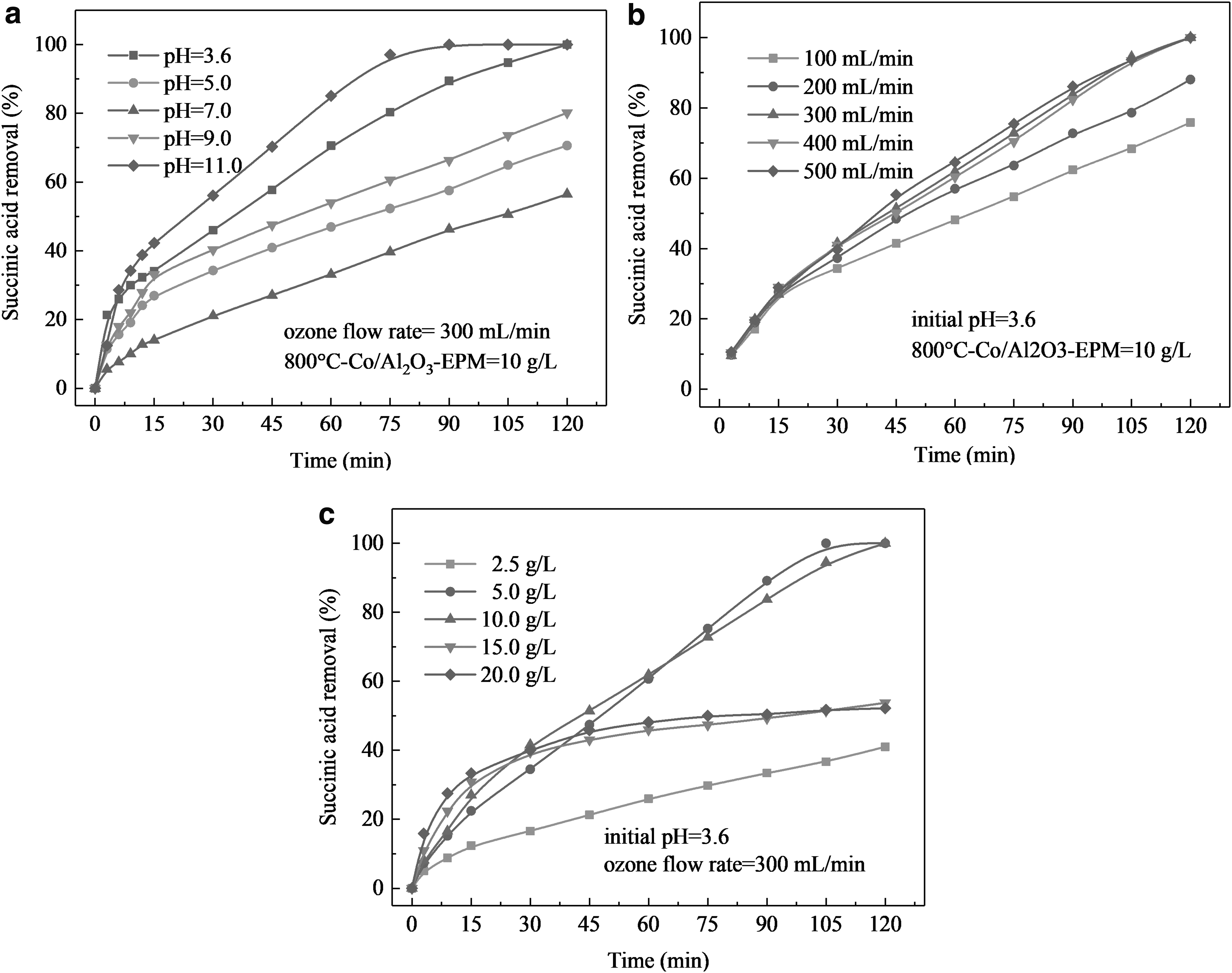
Figure 2a shows the effect of initial pH (from 3.6 to 11.0) on SA removal in 800°C-Co/Al2O3-EPM/O3 system. It is noted that the SA removal efficiency varies with the changes of initial pH values. SA removal efficiency attains 100% at the initial pH of 3.6 or 11.0. However, the SA removal efficiency only reaches 70.6%, 56.5%, and 80.1% at the initial pH of 5.0, 7.0, and 9.0, respectively. It is well known that ozonation reaction follows different mechanism at different pH value. In literature, it was reported that decomposition rate of ozone in water is accelerated with the increase of pH value (Staehelin and Hoigne, 1985; von Gunten, 2003; Jung et al., 2017). As shown in Equations (1)–(3), HO• can be produced largely under alkaline conditions to react with pollutants nonselectively (Westerhoff et al., 1997).
Effects of
Further, pH value determines the surface properties of catalysts. As seen in Supplementary Fig. S3, the pHzpc of 800°C-Co/Al2O3-EPM is about 7.2. The surface of catalyst is in neutral state at the pH ≈ pHzpc. Besides, when the pH is not around the pHzpc, the surface of 800°C-Co/Al2O3-EPM is protonated (pH < pHzpc) or deprotonated (pH > pHzpc) (Ikhlaq et al., 2012). Specifically, at alkali pH, the 800°C-Co/Al2O3-EPM is deprotonated, which could enhance the electrostatic interaction between 800°C-Co/Al2O3-EPM and O3. Therefore, 800°C-Co/Al2O3-EPM/O3 system shows the good efficiency for SA degradation at the initial pH of 11.0. Besides, at the initial pH of 3.6, the 800°C-Co/Al2O3-EPM is protonated and the carboxyl group in SA is negatively charged. Thus, SA can be largely adsorbed on the surface of 800°C-Co/Al2O3-EPM and then further to be degraded.
Further, Supplementary Fig. S4a shows cobalt leaching in effluent at different initial pH value. The cobalt leaching is all below 1 mg/L (0.91, 0.66, 0.55, 0.39, and 0.21 mg/L, respectively) with the variation of initial pH value. Although the 800°C-Co/Al2O3-EPM/O3 system shows the best performance on SA removal at the initial pH of 11.0, the reagent cost is high because of pH adjustment. In addition, the pH value in effluent is close to neutral condition (about 6.2) when initial pH is not adjusted (i.e., initial pH 3.6). Therefore, the initial pH at 3.6 was selected as the optimal initial pH in the following experiments.
Effects of ozone flow rate
The effect of ozone flow rate on SA removal is depicted in Fig. 2b. The removal of SA increases from 75.8% to 100.0% by increasing ozone flow rate from 100 to 300 mL/min. However, SA degradation efficiency almost stays unchanged when ozone flow rate further increases (>300 mL/min). The phenomenon suggests that mass transfer rate of ozone in aqueous solution rises with the increase of ozone concentration when the ozone flow rate is below 300 mL/min, which ultimately facilitates catalytic ozonation process.
Similar results were also reported by Beltran et al. (2002) who found that oxalic acid degradation increases with the ozone concentration increases from 7 to 55 mg/L in TiO2 catalytic ozonation system. Whereas, Pan et al. (2012) deem that ozone concentration in the liquid phase will approach its maximum value, if ozone flow rate reaches a certain point. Thus, in this study, ozone concentration in the water may reach the saturation point at the 300 mL/min ozone flow rate. Therefore, 300 mL/min was selected as the optimal ozone flow rate in the following experiments.
Effects of the 800°C-Co/Al2O3-EPM dosage
The effect of 800°C-Co/Al2O3-EPM dosage on SA removal is depicted in Fig. 2c. It can be seen that SA removal rises from 41.0% to 100.0% with the increased 800°C-Co/Al2O3-EPM dosage (from 2.5 to 5.0 g/L). The result indicates that active sites increase with the increased catalyst dosage. However, SA removal decreases rapidly when 800°C-Co/Al2O3-EPM further increases from 5.0 to 20 g/L. In literatures, it was found that volumetric liquid side mass transfer coefficient (kLa) will decline with the increased catalyst dose (Ferreira et al., 2010). Therefore, gas–liquid mass transfer may be affected by the amount of 800°C-Co/Al2O3-EPM, thereby inhibiting the reaction between HO• and SA. Also, the increased 800°C-Co/Al2O3-EPM may generate excessive HO•, which will either recombine to create peroxide [Eq. (4)] or consume ozone to produce HO2• [Eq. (5)] (Ahmadi et al., 2017).
Moreover, Supplementary Fig. S4b shows that the cobalt leaching increases (from 0.51 to 3.56 mg/L) with the increased 800°C-Co/Al2O3-EPM dosage (from 2.5 to 20.0 mg/L). It can be explained that sufficient contact between 800°C-Co/Al2O3-EPM and SA make the corrosion of 800°C-Co/Al2O3-EPM more serious. Beltrán et al. (2003b) found the similar result in their previous study. In summary, considering the maximum removal efficiency of SA and the cobalt leaching in the solution, 5.0 g/L of catalyst was selected as the optimum dosage and used in all the following experiments.
Control experiment
To validate the better performance of 800°C-Co/Al2O3-EPM/O3 system, four control experiments (i.e., 800°C-Co/Al2O3-EPM alone, O3 alone, 800°C-Co/Al2O3-IM alone, and 800°C-Co/Al2O3-IM/O3 systems) under optimal conditions were set up.
Figure 3a shows that SA removal obtained in 800°C-Co/Al2O3-EPM/O3 system (100% after 120 minutes treatment) is much higher than other systems. However, at the early stage of the reaction, higher SA removal rate is obtained by 800°C-Co/Al2O3-IM/O3 system. This result can be illustrated as that the adsorption capacity of 800°C-Co/Al2O3-IM is better than 800°C-Co/Al2O3-EPM. The data of BET surface area, pore volume, and average pore of 800°C-Co/Al2O3-EPM and 800°C-Co/Al2O3-IM were depicted in Supplementary Table S2, respectively. It is clear that the pore size of 800°C-Co/Al2O3-IM (8.43 nm) is bigger than the 800°C-Co/Al2O3-EPM (8.18 nm). Similar result was found by Xue et al. (2017) who found that catalysts with larger pore size could promote the adsorption of thiophene compounds. Further, it is clear that only 5.5% SA was removed in O3 alone system.

Effect of different systems on
All the phenomena suggest that small molecule acid can hardly be removed by ozone alone. Besides, the catalytic capacity of 800°C-Co/Al2O3-EPM for catalytic ozonation is much better than that of 800°C-Co/Al2O3-IM.
Figure 3b reveals TOC removal in 800°C-Co/Al2O3-EPM/O3 and 800°C-Co/Al2O3-IM/O3 system after 60 and 120 minutes reaction, respectively. The mineralization efficiency of SA in different system follows the same trend as SA removal. In the 800°C-Co/Al2O3-EPM/O3 system, TOC removal (53.5% and 66.9%) is higher than that of the 800°C-Co/Al2O3-IM/O3 system (35.5% and 41.8%). However, the mineralization degree is lower than SA removal, indicating that there may be the formation of some intermediates. However, in this study, we failed to identify the SA degradation intermediates by HPLC-MS. It could be investigated carefully in the further study. In addition, cobalt leaching (5.67 mg/L) in the effluent of 800°C-Co/Al2O3-IM/O3 system is seven times as much as that (0.80 mg/L) of 800°C-Co/Al2O3-EPM/O3 system.
Above all, all the results suggest that stability and catalytic activity of 800°C-Co/Al2O3-EPM is much better than 800°C-Co/Al2O3-IM.
Characterization of two kinds of Co/Al2O3 catalysts
To further investigate the active species, surface morphology, and elementary composition of 800°C-Co/Al2O3-EPM and 800°C-Co/Al2O3-IM, the XRD, XPS, FTIR, SEM and EDS of two kinds of catalysts were detected, comparatively.
XRD, FTIR, and XPS analysis
The above experimental results show that different cobalt-based compound causes different catalytic activity and stability of Co/Al2O3-EPM. For the further contrastive study on the performance of 800°C-Co/Al2O3-EPM and 800°C-Co/Al2O3-IM, cobalt forms on the catalyst carrier were detected by XRD, FTIR, XPS.
Figure 4a shows the XRD patterns of the 800°C-Co/Al2O3-EPM and the 800°C-Co/Al2O3-IM. The results indicate the two catalysts have a similar diffraction peak, which corresponds to CoAl2O4 or Co3O4 (Wang and Chen, 1991; Busca et al., 1992; Chokkaram et al., 1997). The crystallite size of Co3O4 or CoAl2O4 can be calculated via the Scherrer equation [Eq. (6)], where D represents the crystallite size, β is the full width at half maximum of the diffraction peak, K is a constant (0.89), θ is the Bragg angle, and λ is the X-ray wavelength (0.15418 nm).
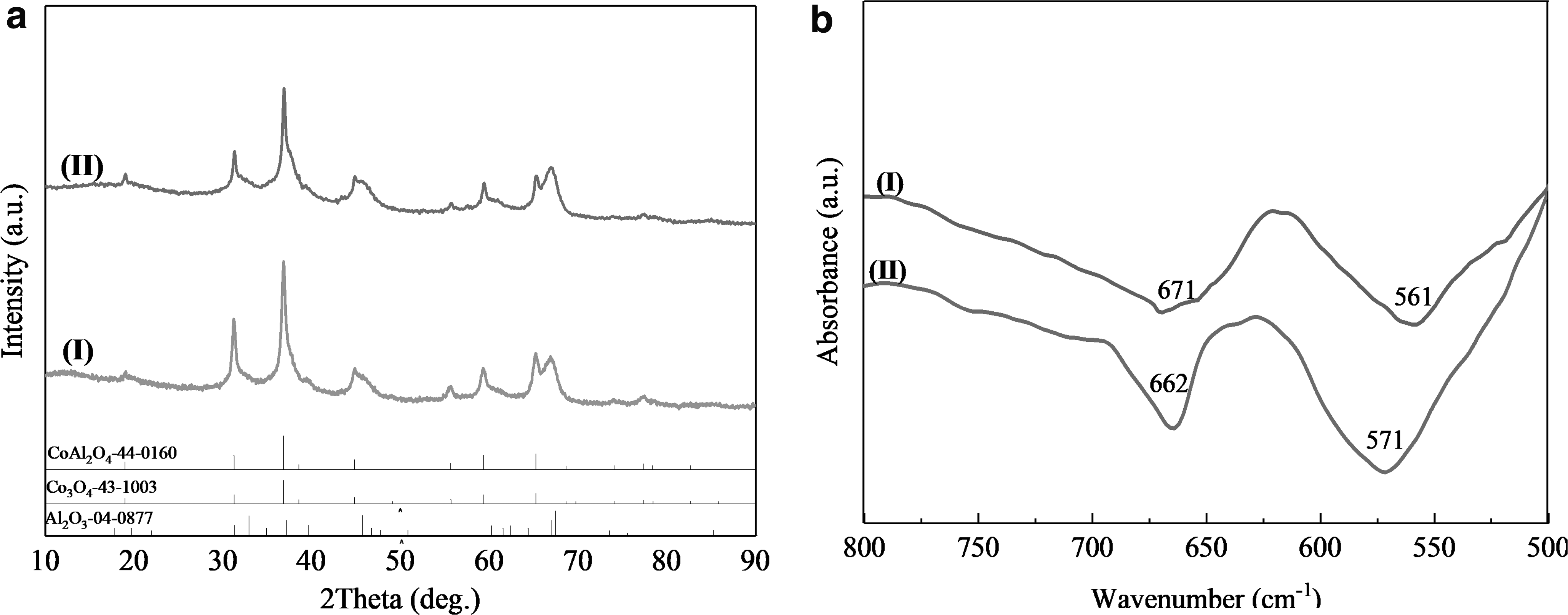
After calculation, the crystallite size of active species on the 800°C-Co/Al2O3-EPM and 800°C-Co/Al2O3-IM is 18.1 and 20.2 nm, respectively. In literature, it was reported that smaller crystallite size of active species may have better catalytic activity compared to larger crystallite size of catalyst (Manjunathan et al., 2015). Therefore, 800°C-Co/Al2O3-EPM may have better performance than 800°C-Co/Al2O3-IM. Because it is hard to distinguishing CoAl2O4 and Co3O4 through XRD patterns, 800°C-Co/Al2O3-EPM and 800°C-Co/Al2O3-IM were further detected by FTIR.
FTIR spectra of 800°C-Co/Al2O3-EPM and 800°C-Co/Al2O3-IM are shown in Fig. 4b. In the scope of 700–500 cm−1 wavenumber, 800°C-Co/Al2O3-IM catalyst has two strong peaks at 662 and 571 cm−1 wavenumbers, while 800°C-Co/Al2O3-EPM catalyst has two strong peaks at 671 and 561 cm−1 wavenumbers. According to the analysis in Effects of the Calcination Temperature section, it can be concluded that cobalt-based compound on 800°C-Co/Al2O3-EPM is Co3O4 and cobalt-based compound on 800°C-Co/Al2O3-IM is CoAl2O4. Therefore, the 800°C-Co/Al2O3-EPM has better catalytic activity than the 800°C-Co/Al2O3-IM.
Figure 5 displays the photoelectron spectra of Al 2p, Co 2p, and O 1s of two kinds of catalysts. The number of (i) and (ii) represents the 800°C-Co/Al2O3-EPM and the 800°C-Co/Al2O3-IM, respectively. The corresponding binding energies data of some Co-containing compounds found in literature are also presented in Supplementary Table S3 (Wang and Chen, 1991).
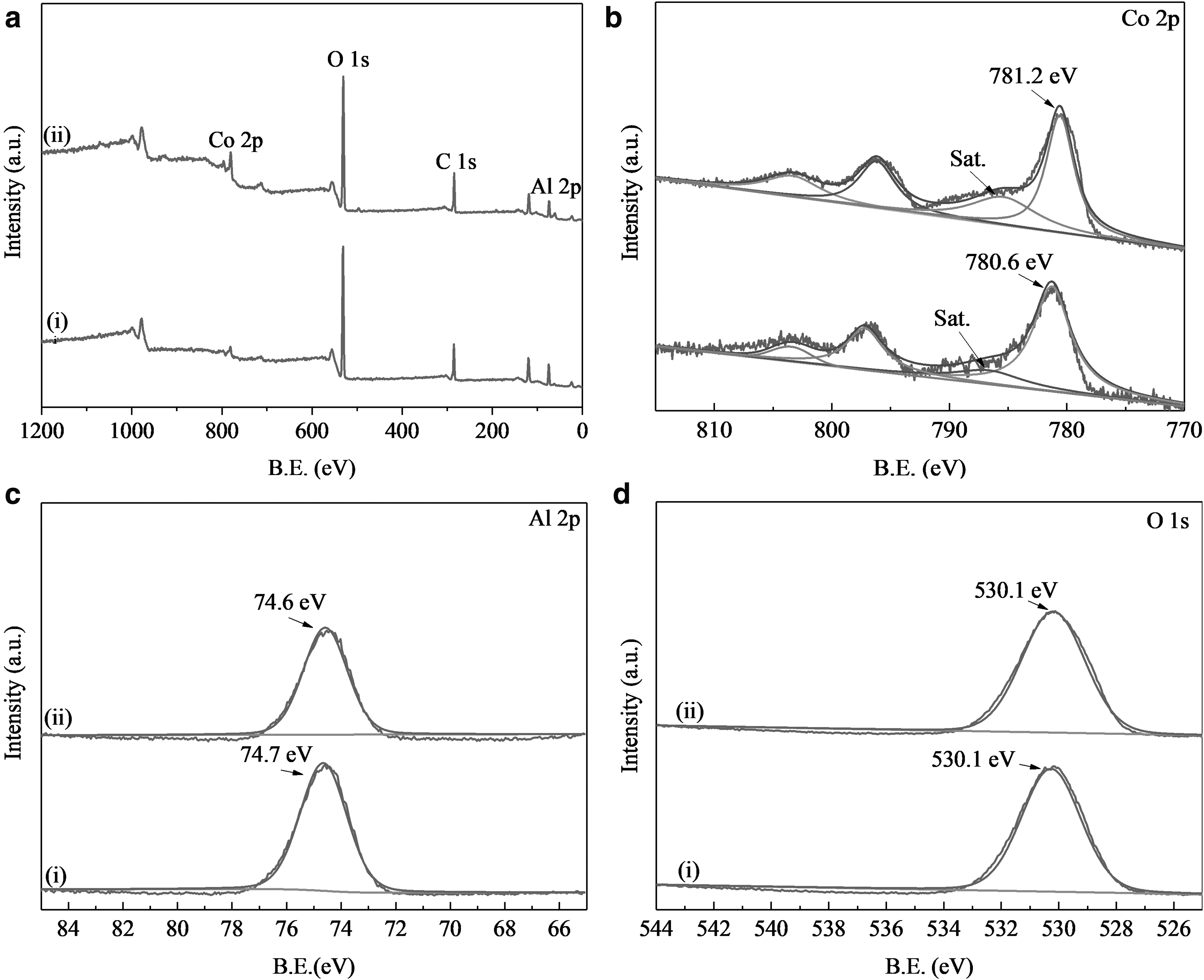
As shown in Fig. 5, XPS analytical results of two kinds of catalysts on Al 2p, and O 1s binding energies are the same. Al 2p binding energy of 800°C-Co/Al2O3-EPM and 800°C-Co/Al2O3-IM is 74.6 and 74.7 eV, respectively, indicating that Al is Al (III) species (Kasprzyk-Hordern et al., 2003). The peak at 529.7–530.1 eV corresponds to lattice oxygen indicating O 1s component at 530.1 eV is O2− (Zsoldos and Guczi, 1993; Piumetti et al., 2015).
In addition, for 800°C-Co/Al2O3-EPM, the Co 2p3/2 spectrum is at 780.6 eV, which proves that the surface cobalt oxide corresponds to Co3O4 or CoO, whereas, for 800°C-Co/Al2O3-IM, Co 2p3/2 component is at 781.2 eV manifesting that the cobalt is largely presented as CoAl2O4 (Wang and Chen, 1991). Further, according to the Supplementary Table S3, the shake-up satellite peak of (i) is weak, indicating that the species on 800°C-Co/Al2O3-EPM is Co3O4 rather than CoO. The result is highly consistent with the previous studies, which reported that Co3O4 has a weak shake-up satellite peak, while CoO has a strong shake-up satellite peak (Kasprzyk-Hordern et al., 2003; Lv et al., 2012; Horváth et al., 2017). Therefore, under the same calcination time and cobalt loads, the catalytic activity of 800°C-Co/Al2O3-EPM is much better than that of 800°C-Co/Al2O3-EPM.
SEM analysis
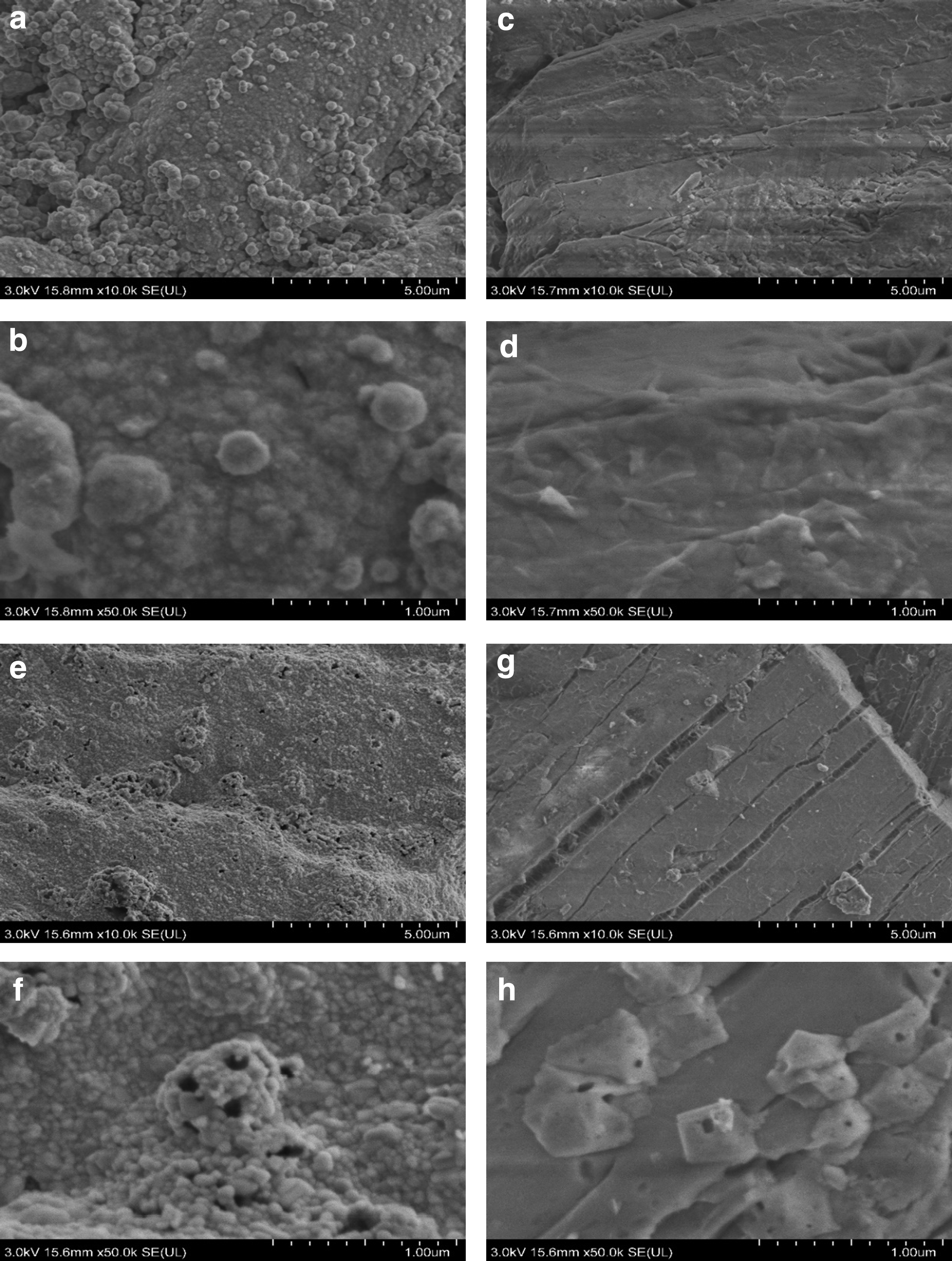
Figure 6 shows the SEM images of Co/Al2O3-IM and Co/Al2O3-EPM. The different prepared methods have significant differences on Co/Al2O3 catalysts morphology. Figures 6a–d, respectively, present SEM images of Co/Al2O3-IM and Co/Al2O3-EPM before calcination. Cobalt film deposited on the surface of Co/Al2O3-EPM is dense, shipshape, and ball-like. Besides, particles of cobalt are nanoscale, which can increase the active sites to a great extent. Nonetheless, cobalt layer on Co/Al2O3-IM cannot be seen before calcination because the precursor of cobalt oxides is cobaltiferous salt.
SEM images of
In addition, SEM images of 800°C-Co/Al2O3-IM and 800°C-Co/Al2O3-EPM (i.e., after calcination) are also revealed in Fig. 6e–h. It is clear that cobalt oxide film is still shipshape deposited on the 800°C-Co/Al2O3-EPM, while lumpy and bulky cobalt oxide particles is nonuniformly deposited on the 800°C-Co/Al2O3-IM.
The results suggest that the cobalt layer on the 800°C-Co/Al2O3-EPM is well dispersive, which will increase the active sites for ozone decomposition. In addition, for 800°C-Co/Al2O3-IM, cracks and holes are both found in cobalt oxide particles and Al2O3 substrate. But for 800°C-Co/Al2O3-EPM, cracks and holes are only found in cobalt oxide film. In literature, it was reported that transverse drawing stress of crack tip is not enough to the expansion at high temperature, which makes material have cracks and holes after calcination (Krautgasser et al., 2016).
SEM-EDS analysis
Supplementary Figure S5 shows elemental composition of 800°C-Co/Al2O3-EPM and 800°C-Co/Al2O3-IM through SEM-EDS. Supplementary Figures S5a–a′ and b–b′ show that raw 800°C-Co/Al2O3-EPM catalyst has higher content of cobalt (10.11 wt%) than 800°C-Co/Al2O3-IM (7.46 wt%). Supplementary Figures S5c–c′ and d–d′ show that there is a slight loss of cobalt in both kinds of catalysts (800°C-Co/Al2O3-EPM with 9.28 wt% Co and 800°C-Co/Al2O3-IM with 4.78 wt% Co) after 120 minutes reaction. But the amount of cobalt loss in 800°C-Co/Al2O3-EPM is obviously lower than that in 800°C-Co/Al2O3-IM.
The results manifest that 800°C-Co/Al2O3-EPM has the firmly stuck interaction between cobalt layer and the support, which hardly makes the cobalt film fall off from the Al2O3 in both calcining and reaction process. However, due to the weak adhesion between cobalt-based matter and Al2O3, 800°C-Co/Al2O3-IM has serious abscission in not only the calcined process, but also the reaction process. As a result, the concentration of cobalt ions in the solution of 800°C-Co/Al2O3-IM system is larger than 800°C-Co/Al2O3-EPM system.
EDS-mapping analysis
Supplementary Figure S6 shows the EDS-mapping images of 800°C-Co/Al2O3-EPM and 800°C-Co/Al2O3-IM. Supplementary Figures S6a–d show that almost no Al element is detected while Co element distributes equably on the surface of 800°C-Co/Al2O3-EPM. This is because the uniform cobalt layer closely wraps around Al2O3. On the contrary, Al element is easy to be observed on the catalyst, but only a small quantity of Co element is observed on 800°C-Co/Al2O3-IM catalyst. The result suggests that 800°C-Co/Al2O3-EPM catalyst has more dense and uniform cobalt particles on the carrier than 800°C-Co/Al2O3-EPM. Therefore, the catalytic capacity of 800°C-Co/Al2O3-EPM is much stronger than that of 800°C-Co/Al2O3-IM.
Possible reaction mechanisms
Radical scavenging experiment
In literature, inorganic ions (HCO3−, CO32−, H2PO4−, and HPO42−) and alcohols (tertiary butanol, methyl alcohol, and isopropanol) can act as HO• scavengers to hinder the catalytic activity of catalyst in heterogeneous ozonation systems (Sui et al., 2010; Fischbacher et al., 2013). Generally, alcohols are usually used to quench HO• in the aqueous solution. Meanwhile, inorganic ions were easily adsorbed on the catalyst surface to substitute for surface hydroxyl groups. Thus, inorganic ions were usually used to identify the existence of surface hydroxyl groups. To study the contribution of HO• on SA removal in the Co/Al2O3-EPM/O3 system, excess (50 mM) TBA and phosphate (KH2PO4) were used as quenchers in Co/Al2O3-EPM/O3 system.
Figure 7a shows that SA removal efficiency decreases from 100% to 67.3% in the presence of TBA. Meanwhile, SA removal efficiency decreases from 100% to 26.5% with the addition of KH2PO4. In brief, SA removal efficiency hindered by KH2PO4 is more obvious than by TBA. The results suggest that surface hydroxyl groups on the surface of 800°C-Co/Al2O3-EPM play an important role for reactive radical generation and SA removal.

Specifically, a large proportion of HO• may be formed on the surface of 800°C-Co/Al2O3-EPM due to the interaction between the surface hydroxyl groups and ozone [Eqs. (7)–(9)]. However, after addition of KH2PO4, H2PO4− occupies large surface-active site of catalyst leading to the decrease of surface hydroxyl groups, finally, resulting in poisoning of the surface sites. The similar finding was also confirmed by Pi et al. (2003) that phosphate has a strong affinity on the surface of CuO/Al2O3 to substitute for surface hydroxyl groups, and then significantly reduces the catalytic activity of CuO/Al2O3 on oxalic acid degradation in ozonation system.
In addition, a part of HO• in liquid phase may come from solid–liquid mass transfer or homogeneous catalysis. Therefore, the addition of TBA also has some inhibiting effect on SA removal.
Quantification of dynamic HO• concentration
To further confirm the existence and contribution of HO• in 800°C-Co/Al2O3-EPM/O3 system, the HO• generated during the treatment process in 800°C-Co/Al2O3-EPM/O3 and O3 alone systems was quantified by HPLC. The concentration of HO• based on this method is obtained via stoichiometric ratio between HO• and p-HBA. Besides, this method is particularly regarded as p-HBA cannot adsorb strongly on the surface of 800°C-Co/Al2O3-EPM (Sung et al., 2006).
Seen from Fig. 7b, in O3 alone system, the concentration of HO• during the reaction process is very low and almost unchanged in the whole reaction process. However, the amount of HO• raises during the whole treatment process in 800°C-Co/Al2O3-EPM/O3 system demonstrating the generation of HO• might be significantly influenced by the reaction time. Above all, the result manifests that there is indeed a true catalysis for ozone decomposition and HO• radical is an important factor for the SA removal in 800°C-Co/Al2O3-EPM/O3 system.
Reaction mechanism
According to the above mentioned analysis, there would be four pathways for SA removal in 800°C-Co/Al2O3-EPM/O3 system, and the reaction mechanisms were illustrated in detail as follows (Fig. 8):
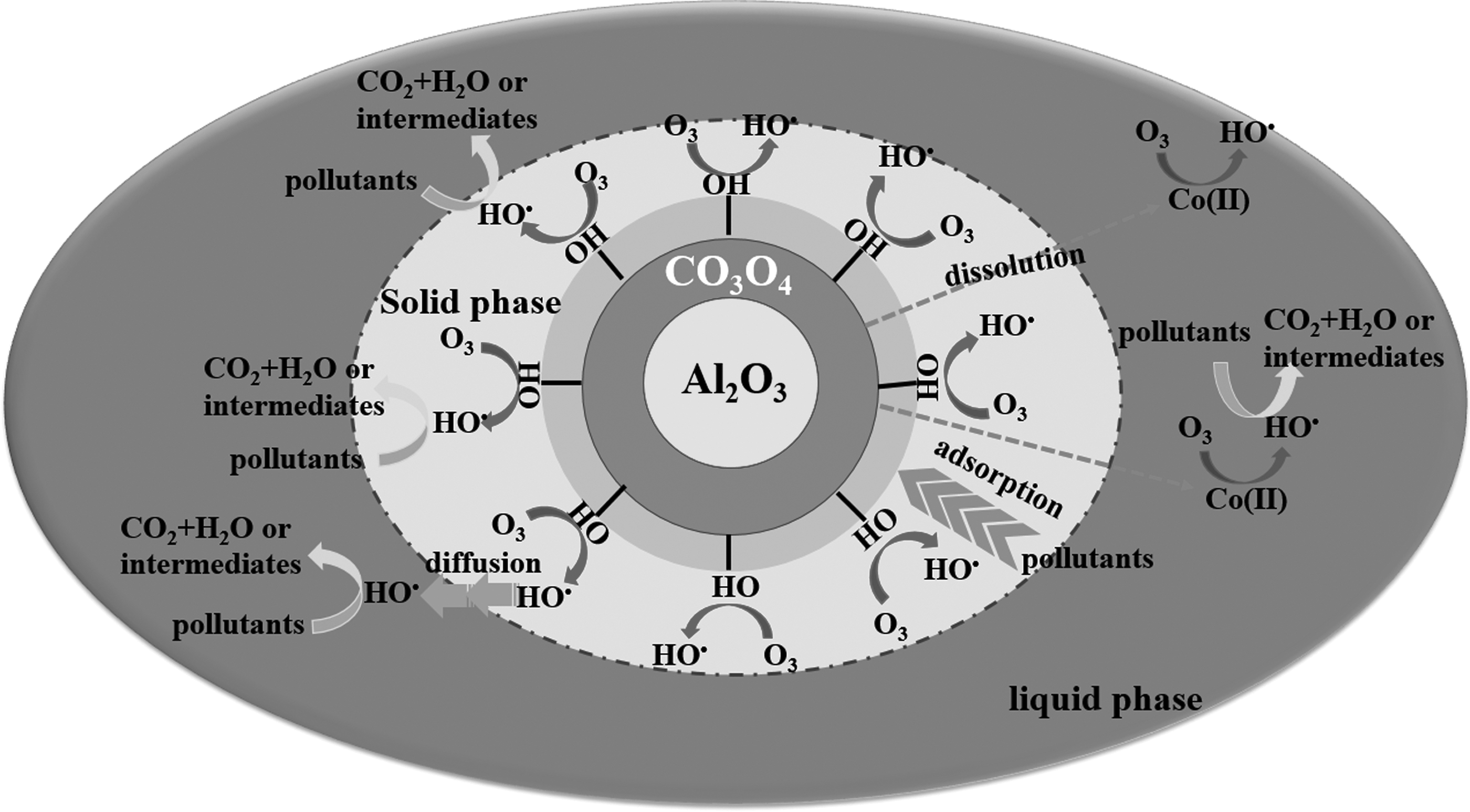
Reaction mechanism for succinic acid removal in 800°C-Co/Al2O3-EPM/O3 system.
Direct oxidation
From the control experiments, the SA removal efficiency is 5.5% after 120 minutes treatment process in O3 alone system. Therefore, it could be concluded that a small part of SA could be directly removed by ozone molecules.
Heterogeneous oxidation
The experimental results show that there is a catalytic reaction in 800°C-Co/Al2O3-EPM/O3 system to promote the degradation of SA. Specifically, when ozone molecules are adsorbed on the surface of 800°C-Co/Al2O3-EPM, it can interact with surface hydroxyl groups, causing HO• generated on the surface of catalyst. In other words, SA could be removed in situ. In addition, heterogenous oxidation is an intricate process. In this system, the heterogenous oxidation process also contains following mechanisms: (i) SA is adsorbed on the surface of 800°C-Co/Al2O3-EPM and then further be removed directly by gaseous or aqueous ozone; (ii) SA and O3 are both adsorbed on the surface of 800°C-Co/Al2O3-EPM before reacting with each other, and then they interact on the surface of 800°C-Co/Al2O3-EPM.
Homogeneous oxidation
In 800°C-Co/Al2O3-EPM/O3 system, the amount of cobalt leaching and HO• are detected, which illustrated that a part of HO• could be formed by the reaction between dissolved cobalt and O3. In other words, there is a homogeneous oxidation process for SA degradation.
Adsorption
In the 800°C-Co/Al2O3-EPM alone system, the SA could be removed by 14.5%, suggesting that the absorption effect cannot be ignored.
Conclusions
This work mainly focuses on preparing a new type of catalyst, that is, Co/Al2O3-EPM, to study its catalytic activity for ozone decomposition. First, several single-factor experiments were conducted to optimize the preparation parameters of Co/Al2O3-EPM. Also, some key operational parameters in 800°C-Co/Al2O3-EPM/O3 system for SA removal were also optimized. Under the optimal conditions (i.e., plating time = 10 minutes, calcination temperature = 800°C, calcination time = 2.0 hours, cobalt loads = 10 wt%, initial pH 3.6, ozone flow rate = 300 mL/min, and catalyst dosage = 5.0 g/L), the Co/Al2O3-EPM shows the optimal catalytic activity and stability for SA removal.
Then, through control experiment, 800°C-Co/Al2O3-EPM catalyst showed better performance than 800°C-Co/Al2O3-IM according to the SA and TOC removal. Further, according to the analysis of BET, SEM, EDS, EDS-mapping, XRD, FTIR, and XPS, the 800°C-Co/Al2O3-EPM catalyst not only shows more uniform scatter degree of cobalt but also generates higher catalytic activity matter (i.e., Co3O4) than the 800°C-Co/Al2O3-IM catalyst. Besides, the data of cobalt leaching in two systems confirms the fact that the stability of 800°C-Co/Al2O3-EPM is better than 800°C-Co/Al2O3-IM.
In addition, quenching tests and the measurement of dynamic HO• concentration in the 800°C-Co/Al2O3-EPM/O3 system suggest that the surface hydroxyl groups play an important role for SA removal and there is indeed a true catalysis for ozone decomposition. In brief, all the results indicate the new type of catalyst, Co/Al2O3-EPM, has a better catalytic activity for catalytic ozonation than Co/Al2O3-IM. Therefore, new Co/Al2O3-EPM should be used as a promising catalyst for the catalytic ozonation in the field of wastewater treatment.
Footnotes
Acknowledgments
The authors acknowledge the financial support from Fundamental Research Funds for the Central Universities (No. 2015SCU04A09) and Science and Technology Project of Sichuan Province (2016JY0154).
Author Disclosure Statement
No competing financial interests exist.
References
Supplementary Material
Please find the following supplemental material available below.
For Open Access articles published under a Creative Commons License, all supplemental material carries the same license as the article it is associated with.
For non-Open Access articles published, all supplemental material carries a non-exclusive license, and permission requests for re-use of supplemental material or any part of supplemental material shall be sent directly to the copyright owner as specified in the copyright notice associated with the article.
