




Abstract
Abstract
Scanning electron microscopy and energy dispersive X-ray analysis (SEM/EDS), a technique not routinely used to detect radiation, was used to identify radioactive particulate matter in house and environmental dust. The study focused on elements that are necessarily radioactive, including thorium, plutonium, americium, and uranium. Seventy-nine dust and 31 soil and sediment samples were collected from the Hanford Nuclear Reservation, Los Alamos National Laboratory, the former Rocky Flats Plant in Colorado, and from homes of workers or abutters of these nuclear facilities. Dusts containing percent levels of uranium, plutonium, americium, and both mineral and metallic thorium were detected outside of radiation-controlled areas. These radioactive dusts are a potential source of internal radiation exposure to nuclear site workers, or to their families via secondary contamination. Uranium and thorium-containing particles were fingerprinted as either natural minerals or processed industrial particles, based on elemental composition of the microparticles. Activities of individual uranium-, thorium-, or plutonium-bearing dust particles varied by five orders of magnitude, ranging from <0.005 mBq (millibecquerel) to 2,270 mBq. Hanford workplace dusts also had up to 564 ± 24 Bq/kg of137Cs. SEM/EDS techniques reliably detected environmental radioactivity in samples that had barely detectable results by gamma spectrometry. The technique was able to definitively show that thorium, plutonium, and uranium from nuclear facilities could be found in general population settings outside of radiation protection zones.
Introduction
T
From 1964 to 1970, 457 tons of thorium were processed and irradiated in Hanford's nuclear reactors. Thorium solutions were formed through the nitration of thorium monazite ores (Tew, 1968). The Hanford Reservation also has a history of releases of thorium into the environment (GEC, 1954; HAPO, 1954; Hanford, 1965a, 1967b; Parker, 1965; Eaves et al., 1979; Gerber and Michele, 2007; Bharadwaj and Das, 2013). Thorium is both an industrial material and a naturally occurring primordial radionuclide; therefore, some component of thorium in workplace dusts may be naturally occurring 232Th. The decades of nuclear operations at Hanford, WA, Los Alamos, NM, and the former Rocky Flats Plant in Colorado have resulted in complex environmental movements of radioactive material, including radioactive dusts and sediments (National Research Council, 2001).
Scanning electron microscopy coupled with energy dispersive X-ray analysis (SEM/EDS) measures the chemical composition of individual dust particles. Identifying the size and composition of an individual particle allows estimation of the activity and of the actual dose which that particle may exert. Size and composition data can also help model the biological fate of inhaled or ingested radioactive particles.
A series of analyses, gamma spectroscopy, autoradiographic analyses, and SEM/EDS, was used to identify radioactively hot microscopic particles in dust samples. Together these methods distinguished radioactive microparticles with naturally occurring versus industrial radioactivity in dusts (NERL, 2002). Autoradiography and SEM/EDS can detect radioactive particles if the particles have an elemental composition that includes 0.2% (by mass percent) or more of uranium, thorium, plutonium, americium, or other X-ray backscatter-detectable elements that have radioactive isotopes. Most of the particles described contain uranium or thorium. These two radioactive elements can be found as both industrial and as naturally occurring primordial radionuclides (IUPAC, 2015). Radioactive microparticles are sometimes referred to as “hot” particles, although this usage typically refers to high-activity nuclear fuel particles. According to the US Nuclear Regulatory Commission, a “‘hot particle’ means a discrete radioactive fragment that is insoluble in water and is less than 1 mm in any dimension” (US NRC 1990).
Materials and Methods
Seventy-nine dusts were collected from the Hanford Nuclear Reservation in Washington, the former Rocky Flats Plant in Colorado, and the Los Alamos National Laboratory in New Mexico. Fourteen of the dusts came from the facilities themselves. Fifty-four of the dusts came from workers' and neighbors' homes near the three nuclear facilities. Dust from control homes was collected from 11 houses in Yakima, WA, which is 100 km to the WNW of Richland, WA, where Hanford is located. Hanford worker homes were generally from within the Tri-Cities area of Washington State, including Pasco, Richland, and Kennewick. Control and worker house dusts came from free-standing suburban single and multifamily homes.
At the former Rocky Flats facility, dust samples were collected from crawl spaces in a home located on the eastern edge of the former facility. The home was built before the opening of the Rocky Flats Plant.
Additional comparison samples were collected from the Midnite Uranium Mine in Wellpinit, WA. Control site: A source of thorium monazites and natural uranium oxides is found in the mining community of Wellpinit, WA, which lies on the Spokane River, a tributary to the Columbia River. The uranium mine site lies 278 river miles upstream of Hanford. This location is part of the Nation of the Spokane Tribe of Indians. Six dust and sediment samples were collected from the Midnight Mine at Wellpinit, and SEM/EDS results were compared with the results found for sediments in the Hanford Reach of the Columbia River. The purpose of this collection was to provide confirmed examples of naturally occurring radioactive microparticles for comparison against possible anthropogenic uranium- and thorium-bearing particles potentially found at the Hanford Reservation. The elemental composition of the standards was determined by SEM/EDS to match against any radioactive microparticles detected in samples. SEM/EDS was not used as a mineral identification method, but as a means of determining elemental composition and semiquantitative analysis of particles to aid in discriminating between radioactive microparticles of natural versus industrial origin.
Dust samples consisting of house and workplace dusts, car engine filters, and HVAC filters were collected for analyses. These samples were collected from workers or abutters of the nuclear facilities. All samples were double-bagged in polyethylene Ziplock® bags, with identifying information attached. Sample and data tracking were done using a Microsoft Excel® spreadsheet. All samples were tracked using a unique identification number. Chain of custody documentation was maintained for all samples, including samples that were analyzed at commercial laboratories. US EPA Contract Laboratory Program procedures were followed by each commercial laboratory (US EPA, 2015a). Workplace and house dusts were collected using similar procedures from HVAC system filters and from commercial or residential vacuum cleaner bags. Wherever possible, the entire vacuum cleaner bag was collected for sampling. Bulk dust and soil samples were air dried at ambient temperatures before analyses. Sample collection was done on a mass basis, rather than a loading (mass to measured area) basis. Bulk dust, vacuum cleaner bag contents, and soil samples were screened to pass a #100 ASTM standard brass sieve (passing 150 μm particles and smaller). Animal hairs, if present, were manually removed. Brass sieves were triple rinsed with deionized (Nanopure®) water after Alconox® and water washing and then air dried before reuse. The complete sampling method and analysis method are also published elsewhere (Kaltofen and Bergendahl, 2010).
Sample analyses proceeded by use of gamma spectrometry, and SEM/EDS analysis of individual particles. Radioactive microparticles in environmental samples were isolated from bulk samples using a Robinson detector or using 7-day autoradiographs. Autoradiographs provide important information on the number, intensity, and exact filter media location of radioactive particles. The filter media that had positive gamma spectrometry results were mounted in a single layer onto double sided adhesive paper sheets. These sheets with dusts were then attached to 3 mm thick copper plates. Vehicle and HVAC air filters were prepared by cutting the filter media from their frames, and mounting the filter media on 3 mm thick copper plates. A sheet of blue-sensitive X-ray film was sandwiched with the mounted filters, and exposed in a dark photographer's box for seven days. The autoradiographs used MidSci® classic blue autoradiography film BX and D76 processing. Any particles isolated were photographed and analyzed by SEM/EDS analysis, which was used to determine elemental compositions, including the radioactive elements uranium, thorium, plutonium, and americium.
Eight to twelve examples of potentially radioactive microparticles were individually isolated and studied for each dust sample. Individual radioactive microparticle activities were analyzed and calculated from SEM/EDS apparent volume and composition data. Volumes were calculated based on the magnitude of the measured minimum and maximum diameters of particles, as described by the US Environmental Protection Agency (US EPA, 2002b). Total thorium activities for 10-g bulk samples were measured using standardized gross NaI(Tl) gamma spectral measurements in a well detector configuration. 134Cs and 137Cs were measured for this study, with detection limits of 10 Bq/kg for both isotopes.
Gamma photon analyses used a Spectrum Technologies NaI(Tl) 1.75 × 2″ (or inch) detector with 0.7 (17 mm) × 1.5 (38 mm) well and a 1K MCA. Beta and alpha counts were performed using a Ludlum Model 3030 two-channel counter with a 6.2 cm2 planchet. The counting efficiency for 662 keV was found to be 30% determined using a certified calibrated source supplied by Eckert & Ziegler Isotope Products, manufactured and certified on September 12, 2011, with 1.484 kBq of 137Cs. The collection and evaluation of the gamma spectra were performed using the EG&G MAESTRO software package. The average counting time was 36,000s. Samples with evident uranium or thorium peaks or activities more than 1σ above the sample set mean were selected for SEM/EDS analyses. All particles were mounted as a monolayer on a 25 mm OD Ted Pella, Inc., PELCO® tape tab-covered aluminum SEM stub. If necessary to improve particle conductivity, the samples were carbon- or gold-coated before SEM/EDS analysis. SEM/EDS testing used a Bruker® X-Flash® Peltier-cooled silicon drift detector. The electron beam current was 0.60 nA, accelerated at a voltage of <0.5–60 keV. Particles were categorized as radioactive if SEM/EDS analyses showed that they had a composition that included at least 0.5% by mass of uranium, thorium, plutonium, or americium. This percentage is at least two times the lower limit of detection for the detector for each of these nuclides. The activity (in mBq per particle) of individual discrete particles was determined from size and the percent composition of any radioactive isotopes detected. Elements with both stable and unstable isotopes, such as cesium, were ignored in determining particle activities.
Error bars for single-rate counts were presumed to be the square root of counts per unit time, and error rates for multiple counts for a given sample were set equal to twice the standard deviation. Total thorium data were also produced by alpha spectroscopy at a certified commercial laboratory (Eberline Analytical of Oak Ridge, TN or General Electric Walter Miltz Laboratory in NJ) as a quality control measure.
An absorbed dose can be quantitatively determined for the ingestion or inhalation of an individual particle if the amount of radionuclide in Bq (intake) is known. This intake is a function of particle composition, size, and isotopic-specific activities. The dose is the product of the intake times and the appropriate dose conversion factor (DCF), D = I × DCF (ICRP, 2017). In this study, the number of radioactively “hot” particles per gram of dusts and their estimated activities were determined, rather than the Bq per gram of dust or cubic meter of air. Intake would be the product of the grams of dust inhaled or ingested and the sum of activities of radioactive microparticles per gram of dust (I = Weight (g) × Bq/g). US EPA exposure factors for US adult dust inhalation and ingestion are 0.48 and 30 mg/day, respectively (US EPA, 2011c). For inhalation of dust with a given radioactive microparticle contamination rate, the daily dose becomes (0.48 mg/day) × (mBq/g) × DCF. Dose for a single particle is simply the particle activity in mBq times the appropriate DCF (French, 2013).
Results and Discussion
A total of 161 radioactive microparticles were isolated, photographed, and analyzed for elemental composition from 15 of the bulk samples analyzed in this study. These 15 samples demonstrated the presence of uranium or thorium by gamma spectroscopy (Table 1), or had activities one standard deviation or more above the mean activity of workplace or worker residence samples (>100 Bq/kg). Approximately 100 mg of sample were examined from each bulk sample, giving an average detection rate of about 107 radioactive microparticles per gram of material tested. This result is not representative of environmental conditions given that the samples were selected from a larger sample set for their higher measured activities. Examples of radioactive microparticles detected during this study are listed (Table 1) showing the particles' composition, size, and activity in mBq per particle. The specific particles listed in Table 1 were selected to show the full range of activities among the radioactive microparticles detected. Calculated activities were compared with activities of micron-sized particles of plutonium oxide (Tamplin and Cochran, 1975), and results agreed within eleven percent (11%).
Types of radioactive particles detected
The most commonly detected types (157/161) of radioactive microparticles in Hanford's industrial dust samples were processed uranium oxides (Fig. 1), followed by thorium-phosphorus-rare earth (Th-P-REE) and thorium-metal particles (particles with Th plus Fe, Cu, Pb, but not P or rare earths). The remaining radioactive microparticles (4/161) contained plutonium and/or americium.

SEM/EDS data and microphotograph for uranium oxide (UO2) processed at Hanford Reservation. SEM/EDS, Scanning electron microscopy and energy dispersive X-ray analysis.
All (14/14) radioactive microparticles found at the Hanford Tank Farms were Th-P-REE type. Metallic thorium particles were found at Hanford (Fig. 2–containing up to 98% thorium by normalized weight) and in a Hanford worker's home (Fig. 3). The R2 value between house dust and Hanford thoriated particles, based on average percent metal and radioisotope composition, was 1.00, versus an R2 value of 0.26 between the house dust thoriated particle percent compositions and the set of uranium-containing Hanford dusts. The SEM/EDS spectra for the metallic thorium particles lack the distinctive phosphorus-rare earth SEM/EDS spectrum seen in 100% of the naturally occurring thorium monazite mineral particles (Fig. 4) found in the standard material from the uranium mine. The presence of thorium in metallic versus monazite form implies an industrial origin for the metallic thorium, although the forms were not distinguishable (of course) by gamma spectrometry.
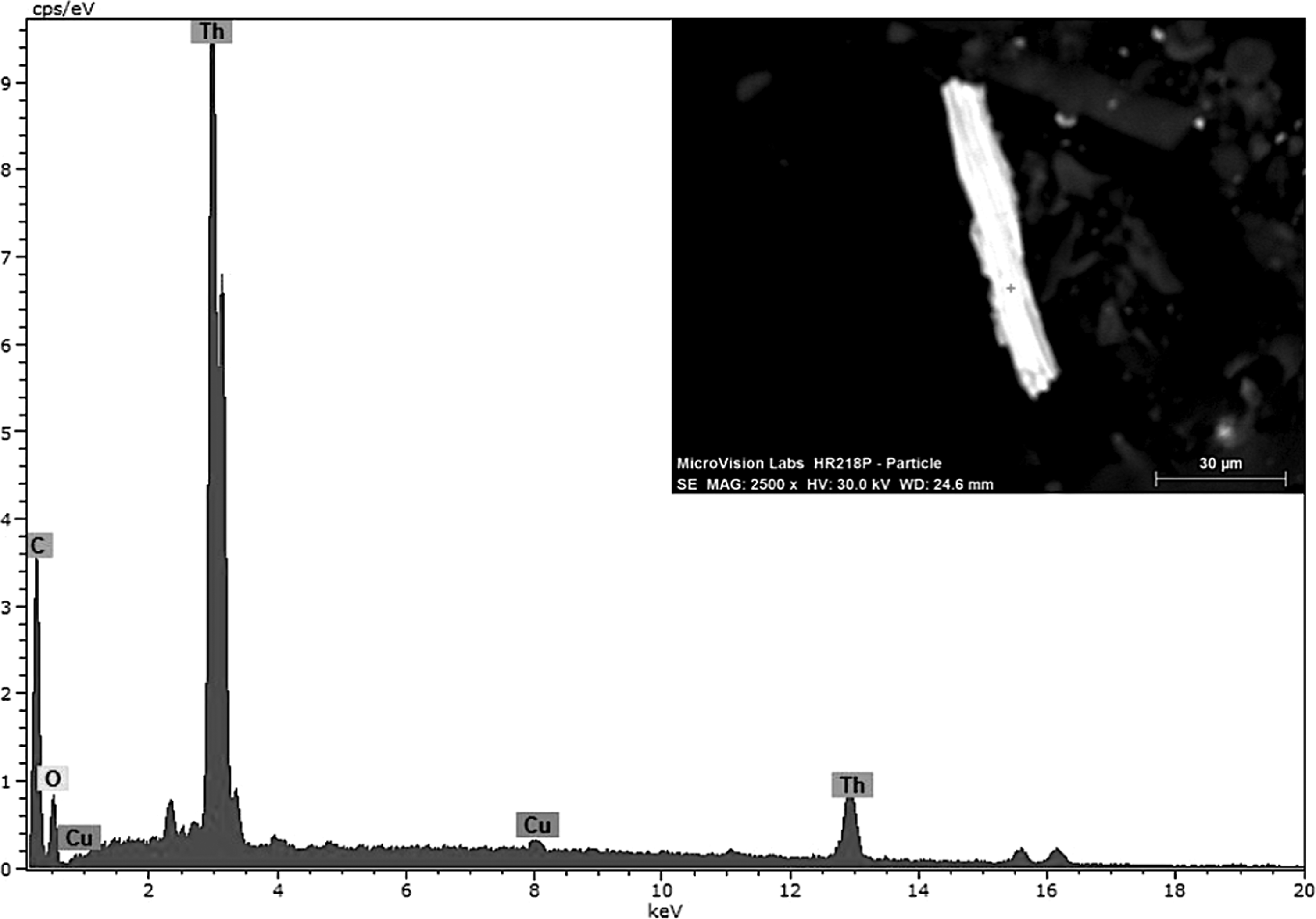
SEM/EDS data and microphotograph for Hanford Reservation dust particle composed of 98.2% thorium. Cylinder dimensions are 60 × 8 μm.

SEM/EDS data and microphotograph for a 15% thorium radioactive microparticle in Hanford tank farm worker's house dust.
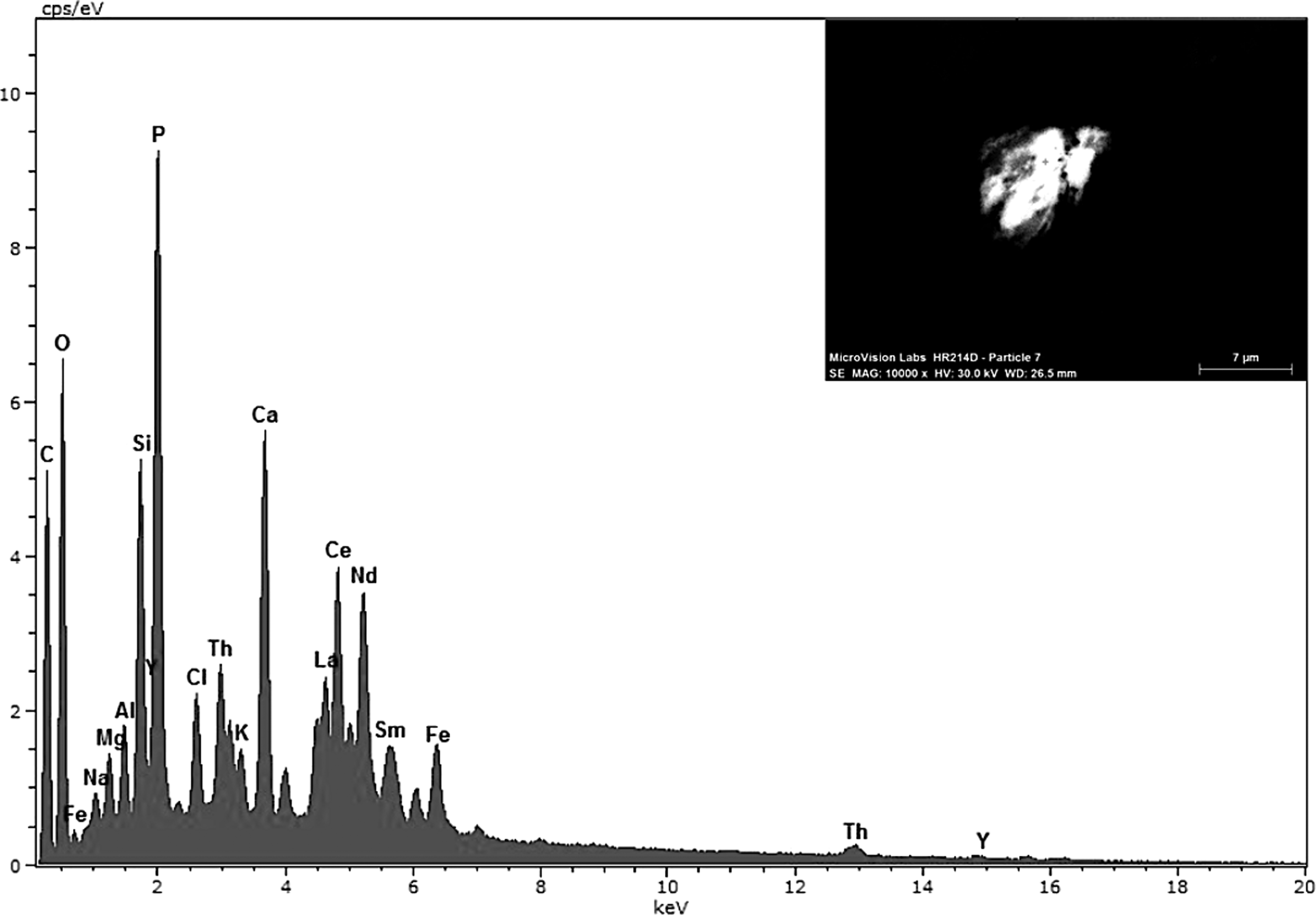
SEM/EDS data and microphotograph for Hanford Reservation High-Level Waste Tank Farm, employee change trailer HVAC dust containing 7.1% thorium.
In workers' homes, the most commonly encountered radioactive microparticles consisted of Th-P-REE particles, thorium metal particles, and other nonP-REE uranium/thorium particles (Figs. 3 and 5). Plutonium dust particles were identified in the Rocky Flats, CO, house dust samples (a 4.5 μm particle with 2% Am and <1% Pu), in the automobile air filter of a Hanford worker (a 4-μm particle with 0.8% Pu), and in outdoor dusts at Los Alamos, NM, (a 4-μm particle with 2.1% Pu and a 55-μm particle with 0.1% Pu). No plutonium particles were detected in control house dusts. No plutonium particles were found in soil and bedrock samples collected in control samples from the mountainous area at Eldorado Canyon State Park, 5.5 km northwest of the former Rocky Flats Plant. Th-P-REE particles were detected in the control samples at Eldorado Canyon near Rocky Flats, so any detection of Th-P-REE in house dusts adjacent to the former plant site would have been unremarkable.
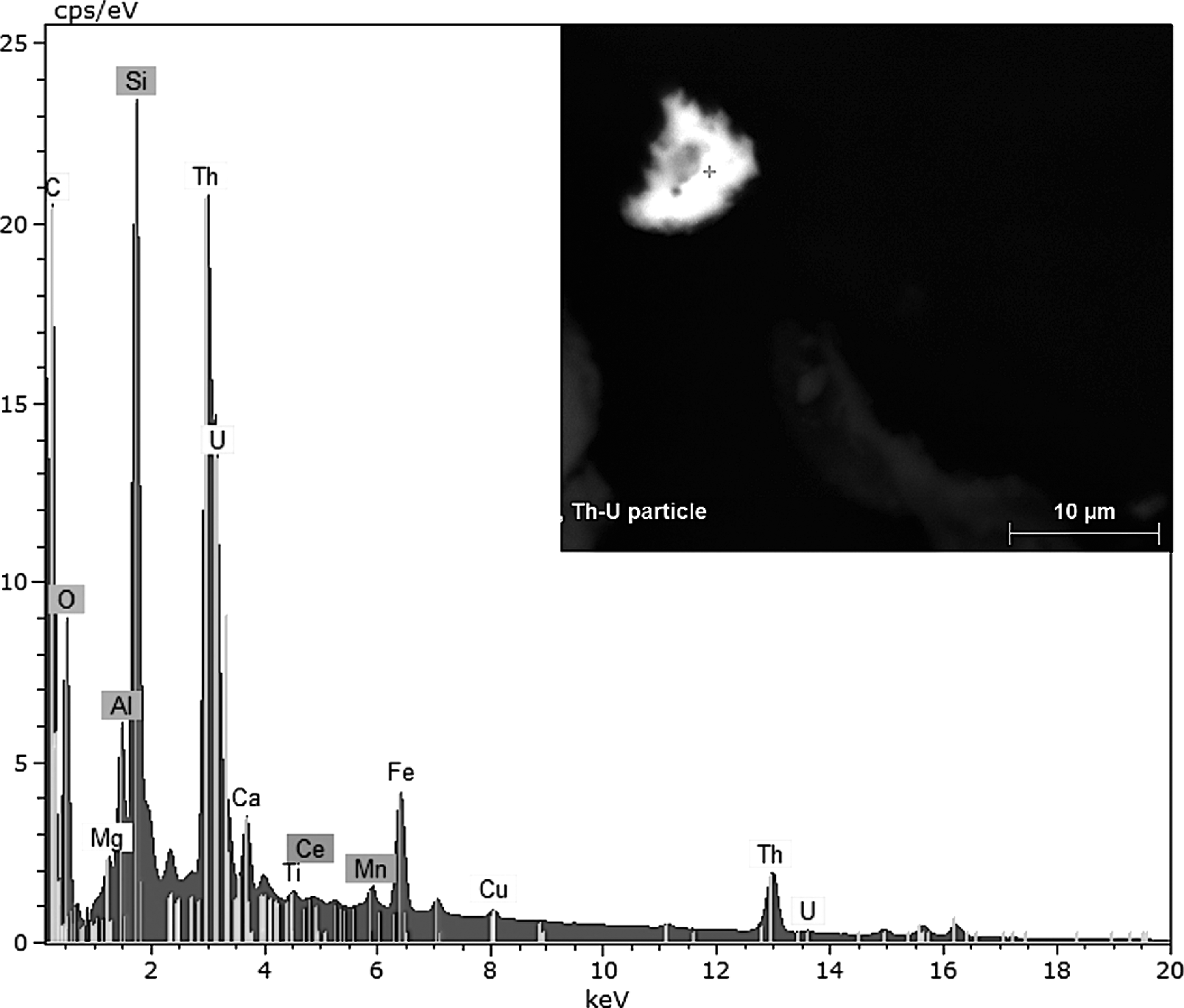
SEM/EDS data and microphotograph for Hanford worker's garage dust particle, containing C 31.7%, Th 24.8%, O 20.8%, U 8.4%, Si 7.8%, Fe 2.5%, and Al 1.9%.
Hot particles detected in this study had a wide range of sizes, activities and compositions. Some of the radioactive particles detected in this study were small enough to be inhaled into the lungs where they could deliver radioactive energy to tissues. This is particularly important for particles less than 5 μm in size that tend to be retained in the lungs. Activities of individual uranium-, thorium-, or plutonium-bearing dust particles varied by greater than five orders of magnitude, ranging from 0.0002 to 2,270 mBq. Importantly, these four elements are all alpha particle emitters. The short (<0.5 mm in tissue) range of alpha particles makes internal alpha emission a more significant health concern than a similar eternal dose (NIST, 2015).
Gross activities of house dusts
Gross sample activities varied over a much smaller numerical range. The mean thorium activity of 53 nuclear worker house dust samples was 60 ± 45 Bq/kg (75% relative standard deviation, range = 6–248 Bq/kg). For 14 workplace dusts, the mean thorium activity was 85 ± 29 Bq/kg (34% RSD, range = 47–143 Bq/kg). For 12 control house dusts, the mean was 19 ± 10. Bq/kg (53% RSD, range = 3–34 Bq/kg). The mean thorium activity of Hanford workplace dusts was two standard deviations higher than for the mean of dusts from control homes. Three of the four highest thorium activities in dusts came from Hanford worker house dust samples (141, 195 and 248 Bq/kg). Two of these three samples were from older “A” style homes built for Hanford workers in Richland, WA. The third home was a newer suburban single-family home owned as a primary residence by a Hanford tank farm worker. The home was located outside of the Tri-Cities area (Pasco, Kennewick, and Richland). One of the four highest thorium activities in dusts came from a Hanford workplace dust sample (143 Bq/kg). This workplace dust sample was collected from a utility trailer used at the former Fast Flux Test Facility at Hanford.
Hanford workplace dusts also contained up to 564 ± 24 Bq/kg of137Cs, but this isotope was not identified in any particles from Hanford workplace or worker home dust samples. Similarly, Hanford worker house dusts contained up to 88 ± 9 Bq/kg of137Cs. The 137Cs activity in 60 out of 65 (92%) worker house dust samples was below the study's detection limit of 10 Bq/kg. These results suggest that 137Cs may be more uniformly distributed in the dust samples, or be transported by a different environmental pathway, than were uranium, thorium, and plutonium. No 134Cs was detected in studied dusts, despite finding detectable (>10 Bq/kg) amounts of the longer-lived 137Cs isotope in 5 of 65 (8%) Hanford-related dust samples. The failure to detect any 134Cs makes it unlikely that the 137Cs detected in dusts is related to contaminants released from the accidents in Fukushima, Japan. Despite the swifter decay of 134Cs compared with 137Cs, any remaining 134Cs of Japanese origin would have been detectable in this study (Kaltofen and Gundersen, 2017).
Distinguishing natural versus industrial thorium
One of the more interesting results was that the SEM/EDS spectra clearly delineated particles into thoriated particles with phosphorus and rare earth elements, and thoriated particles containing only metals. The metallic or high-purity oxide forms of thoriated particles were found only in the workplace or in workers' homes. Samples with natural origins (uncontaminated outdoor soils and a uranium mine) would be expected to contain native monazite or aluminosilicate forms of uranium and thorium. The radioactive microparticles from these samples had elemental compositions of the Th-P-REE form or uranium compositions consistent with common uranium minerals. The metallic particles were composed primarily of lead, iron, copper and thorium; with traces of elements found in aluminosilicate minerals common to house dusts. This composition did not occur in the naturally occurring monazite standard materials. The SEM/EDS data for metallic (nonP-REE) uranium and thorium-bearing particles in the workers' house dusts are the evidence that these particles were of industrial rather than natural origin. The Pu and Am in house dusts were, of course, of industrial rather than natural origin.
A dust sample taken from a Hanford worker's automobile engine filter contained a uranium-based radioactive microparticle. This sample was positive for uranium and its decay products by gamma spectrometry. The radioactive microparticle also contained plutonium at 0.8% by mass based on SEM/EDS data. Cesium a major fission product element (found as 134Cs or 137Cs) that is associated with nuclear fallout (Cizdziel et al., 1998) or spent fuel wastes was not detectable in this particle. The absence of radioactive cesium and the presence of plutonium at close to 1% composition likely indicates an industrial origin for this radioactive microparticle. The bulk sample was negative for plutonium by gamma spectrometry. In this case, SEM/EDS was a more sensitive discriminator of low level plutonium activity than gamma spectrometry. The SEM method requires only a single radioactive microparticle to get a valid detection, whereas gamma spectrometry requires that the entire bulk sample exceed its instrument limit of detection.
Interestingly, Th-P-REE particles were found in HVAC system dusts collected from the Hanford Tank Farm support areas, and in homes of the tank farm's workers. While the Th-P-REE particles in Hanford Tank Farm dust can potentially be due to background conditions, control home dust samples that were collected in the same manner and time as the worker samples (Yakima, WA, n = 12) did not contain Th-P-REE particles. Investigators at Hanford have also routinely experimented with monazite materials as a means of immobilizing samples of Hanford's HLW and LLW (Donald 2010). Th-P-REE found at the Hanford Tank Farm, cannot necessarily be assumed to be of natural origin.
These data suggest that the origin of the Th-P-REE at worker homes is potentially at least, in part, from incidental workplace to home transport of fugitive radioactive particles. Samples with natural thorium-monazites versus nonTh-P-REE particles from Hanford-sourced dust particles had gamma photon energy-spectra that were unresolvable by sodium iodide spectrometry. The only gamma-spectral resolvable differences were due to the presence of industrial isotopes such as 137Cs in some Hanford-related dusts. The origins of the thorium at Hanford or in workers' homes (natural vs. industrial) could not be determined by gamma spectroscopy. Fallout particles from the 2011 Fukushima Daiichi reactor accidents could potentially have impacted the Hanford Reservation. This fallout originally contained roughly equal activities of 134Cs and 137Cs (Kato et al., 2011). Any contaminated dusts from Japan would still contain a significant amount of 134Cs compared with 137Cs levels, however, no 134Cs was detected (<0.1 Bq/kg) in any sample from Hanford, Los Alamos or the former Rocky Flats facility.
One Hanford worker's home had multiple examples of spherical radioactive microparticles composed of thorium, Th-P-REE, and iron-thorium alloy. Spherical particles are often produced from high-temperature process such as pyrolysis or welding (MicroLabNW 2007; US DOT, 2015). Welding can create thorium particles through the use of consumable tungsten electrodes containing up to 5% thorium (Radnor, 2016). The samples containing thoriated particles identified in this study did not have tungsten detectable by SEM/EDS; making welding fumes an unlikely source of the thorium found in this study's dust samples. The spherical rather than amorphous or crystalline shape of these particles provides morphological evidence that the particle is of industrial origin. Nuclear detonations and the meltdowns at three Japanese reactors in 2011 were also likely to produce spherical radioactive particles (Kaltofen, 2015). These Hanford samples, however, were collected outside of the major fallout plume locations from nuclear test detonations. A key isotope (134Cs) related to Fukushima-related fallout particles (Adachi et al., 2013) was absent in samples. This makes it less likely that any radioactive particles related to potential recent global fallout were present in this sample set.
Summarizing, the thorium-containing radioactive particles detected outside of radiation-controlled areas are likely from Hanford operations for the following reasons. Particles were detected with >98% pure metallic thorium that does not occur naturally. Some particles were spherical in shape, suggesting a pyrolytic source. Tungsten was not present in thoriated particles, ruling out welding particles as a source. Further, no welders' homes were tested for this study. Lacking signs of fission products, particle compositions were inconsistent with nuclear fallout. Thoriated particles also contained industrial metals such as copper, lead, and uranium; but did not have mineralogic components such as calcium or phosphorus related to monazites. Similar thoriated particles, including thorium monazites in dusts from Hanford's high-level waste tank farms, were found in Hanford workplace dusts and in Hanford workers' homes. Hanford's declassified documentation supports extensive use of throated materials in this workplace.
Conclusions
Dusts in this study contained radioactive particles of uranium, thorium, plutonium, and americium. This study found monazites, uranium mineral, and Th-P-REE particles that were likely of natural origin and industrial (plutonium-containing, metallic or metal oxide) radioactive microparticles.
Dust in the homes of workers and neighbors of Hanford, Los Alamos, and the former Rocky Flats nuclear facility contained radioactive microparticles connected to these sites. This creates potential radiation exposures outside of radiological protection zones. Given the small respirable size of these radioactive microparticles, they are a potential source of internal exposure from inhalation or ingestion.
SEM/EDS coupled with gamma spectroscopy and autoradiography proved a useful technique for distinguishing the origins of particulate-based radioisotopes that have both industrial and natural sources. Micron-sized radioactive industrial particles were detected in samples that had gross activity levels that were near background. This is an especially useful tool for nuclides, such as uranium and thorium, which have both natural and industrial sources. SEM/EDS distinguished metallic (more likely industrial) versus mineral (more likely natural or mining-related) forms of these elements by determining the complete elemental composition of each particle.
Footnotes
Acknowledgments
Sampling and literature search support came from the Confederated Tribes and Bands of the Yakama Nation; Tom Carpenter, Esq., Liz Mattson, and Jackie Yeh of Hanford Challenge; and the Spokane Tribe of Indians, Wellpinit, WA. Funding for this study was received from Jeff Ubois and the John D. and Catherine T. MacArthur Foundation; The Lambert Firm, PLC, of New Orleans, LA; Hanford Challenge; the Bullitt Foundation of Seattle, WA; and the Cynthia and George Mitchell Foundation of Austin, TX.
Author Disclosure Statement
No competing financial interests exist.