




Abstract
Abstract
Degradation of perchlorate was investigated using acclimated active sludge with acetate or pyruvate as the electron donor in sequencing batch mode. Perchlorate degraded with either of the two electron donors and the Michaelis-Menten model fit the experimental data well. The kinetic parameters qmax and Ks for acetate were 6.56–7.68 (mg ClO4−/(gVSS·h)) and 9.92–23.19 (mg/L), respectively, which were higher than the corresponding values for pyruvate (6.31–6.41 (mg ClO4−/(gVSS·h) and 3.54–22.29 (mg/L)). To reduce the same amount of perchlorate, the required dosage of acetate and the secondary pollution were lower compared with pyruvate, indicating that acetate was more suitable for the heterotrophic reduction of perchlorate. The highest reaction rate was reached at pH 7.0 for acetate and at pH 8.0 for pyruvate. Coexisting nitrate had a significant negative effect on perchlorate reduction. Moreover, high-throughput sequencing method revealed that Dechloromonas was the predominant perchlorate-reducing bacteria (PRB) with either acetate or pyruvate as the electron donor. These results offered helpful hints for heterotrophic perchlorate reduction process with different electron donors.
Introduction
P
Common methods for removing perchlorate include adsorption, ion exchange (Gu et al., 2007), reverse osmosis (Urbansky and Schock, 1999), and anaerobic biological treatment (Matos et al., 2006). However, physical technologies can produce high-salinity wastewater and require further remediation (Srinivasan et al., 2009). Also, chemical reactions are required to take place under carefully controlled conditions. These drawbacks limit the large-scale applications of physical and chemical methods for perchlorate removal. In contrast, biological treatment, which relies on ubiquitously existing perchlorate-reducing bacteria (PRB), can utilize perchlorate as an electron acceptor and reduce it into chlorate, then chlorite, and finally harmless chloride (Xu et al., 2003; Coates and Achenbach, 2004). The biotransformation process requires eight electron equivalents per mole of ClO4−. During wastewater treatment, various electron donors, including lactate (Shrout and Parkin, 2006), hydrogen (Nerenberg et al., 2002; Zhao et al., 2013; Ontiveros-Valencia et al., 2014), sulfur (Gao et al., 2016; Wan et al., 2017), and Fe0 (Yu et al., 2006; Liang et al., 2015), have been added to drive the bacterial perchlorate reduction. Several heterotrophic perchlorate-degradation processes reported in anaerobic bioremediation (Wang et al., 2008). Shrout et al. (2006) found that electron donor, oxygen, and redox potential have a significant influence on the perchlorate degradation, and Wang et al. (2008) revealed that perchlorate removal rates with acetate as electron donor reached a maximum at pH 7.0. However, the optimal operating conditions with different electron donors have not been thoroughly investigated yet.
In recent years, high-throughput sequencing has been used to provide taxonomic identification based on DNA samples (Antwi et al., 2017), which has enabled the rapid and cost-effective profiling of complex microbial communities in different samples of microflora (Zhang et al., 2012; Shaw et al., 2014). However, studies of this kind on heterotrophic PRB are still limited.
This study has three specific objectives: (1) to assess the influence of two different electron donors (acetate and pyruvate) on the kinetics of heterotrophic perchlorate reduction process; (2) to explore the factors affecting perchlorate removal efficiency (such as electron donor dosage, pH, and coexisting nitrate); and (3) to elucidate the microbial community shift during acclimation process by high-throughput sequencing method.
Materials and Methods
Activated sludge inoculation and acclimation
Inoculated sludge in this study was obtained from the anoxic stage of A2/O (anaerobic–anaerobic–anoxic) section in Wulongkou wastewater plant, Zhengzhou, Henan province, China. The sludge was mixed and centrifuged at 4,000 rpm for 5 min, then washed twice, and diluted with basal medium having the following composition: 0.74 g/L CH3COO− or 0.87 g/L CH3COCOO−, 1.08 g/L NaHCO3, 0.17 g/L NH4HCO3, 0.11 g/L K2HPO4, 0.03 g/L MgCl2·6H2O, and 0.4 mL/L trace mineral solution. The trace mineral solution contained (per liter) 50 mg H3BO3, 2,720 mg FeCl3·6H2O, 50 mg ZnCl2·H2O, 490 mg MnCl2·4H2O, 110 mg NiCl2·6H2O, 2,000 mg CoCl2·6H2O, and 110 mg CuCl2·2H2O. The initial perchlorate concentration was 250 mg/L. The pH remained near neutral without adjustments. The bacteria acclimation was conducted in a conical flask containing 500 mL sludge suspension within an anaerobic chamber with an N2 headspace. All bottles were incubated at 30°C in the dark on a shaker table at 200 rpm. As soon as perchlorate degradation was completed (concentration <0.5 mg/L), the sludge suspension was separated by centrifugation and the supernatant was replaced with basal medium for the next acclimation cycle. This operation was repeated for more than 10 cycles.
Kinetics analysis
The Michaelis-Menten model and Zero-order model were used to fit the kinetics data:
Where t is the reaction time (h); S0 and S are the perchlorate concentrations at the beginning of the experiment and at time t (mg/L), respectively; qmax is the maximum specific substrate utilization rate (mg ClO4−/(gVSS·h)); Ks is the half saturation constant (mg/L); X is the biomass concentration (gVSS/L); and K0 is the specific perchlorate reduction rate (mg ClO4−/(gVSS·h)).
Single factor control experiment
Degradation of perchlorate was carried out in 250 mL sealed flasks filled with 200 mL acclimated sludge suspension described above in a sequencing batch mode. All bottles were sparged with N2 gas to maintain anaerobic conditions and then incubated at 30°C in the dark on a shaker table at 200 rpm. All conditions were tested in triplicate unless otherwise indicated, and the statistical data are shown in Figs. 1–4.
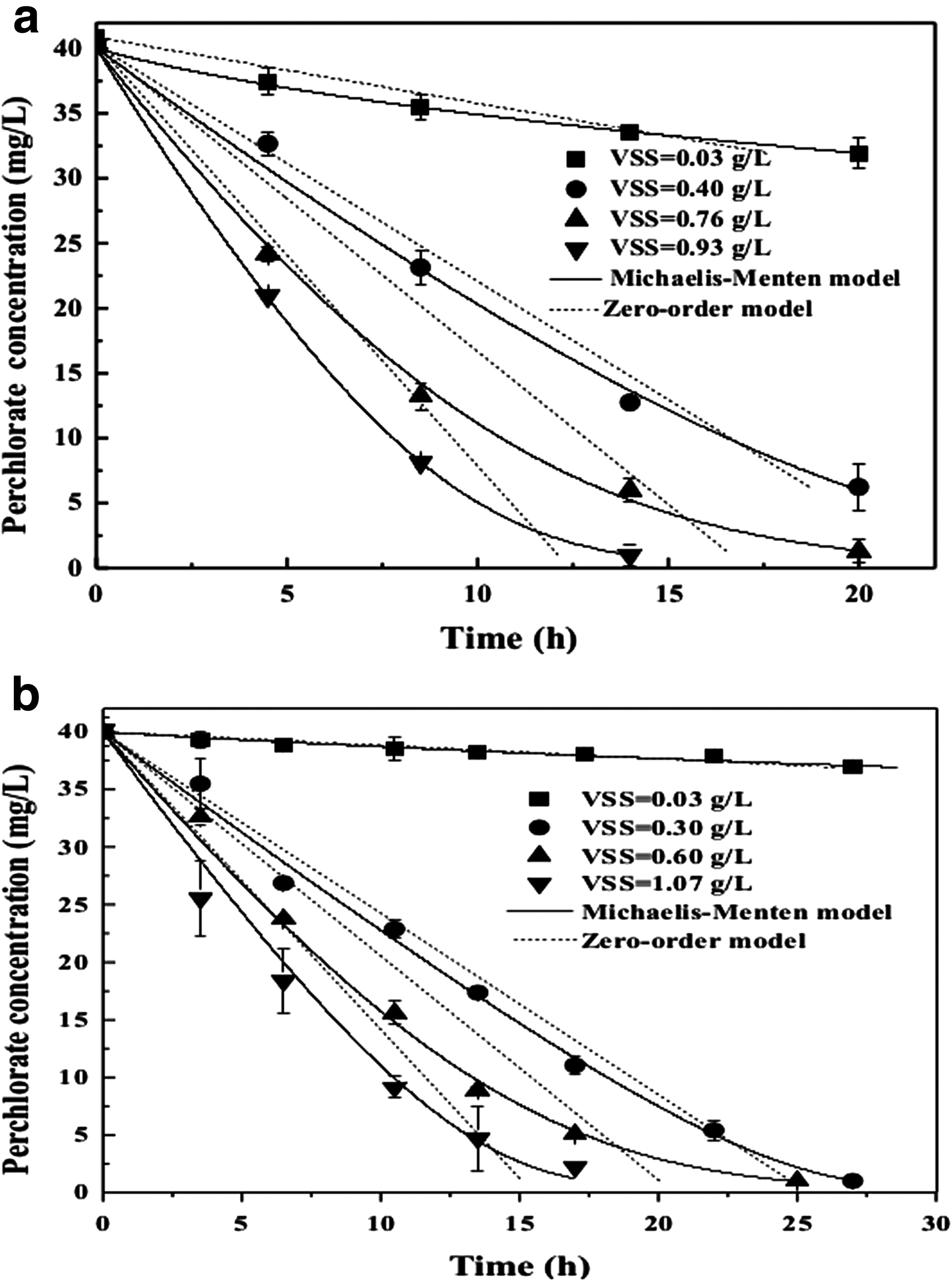
Perchlorate reduction kinetics fitted by Michaelis-Menten model and Zero-order model.

Reduction of perchlorate by heterotrophic reduction processes. The evolution of ClO4−:
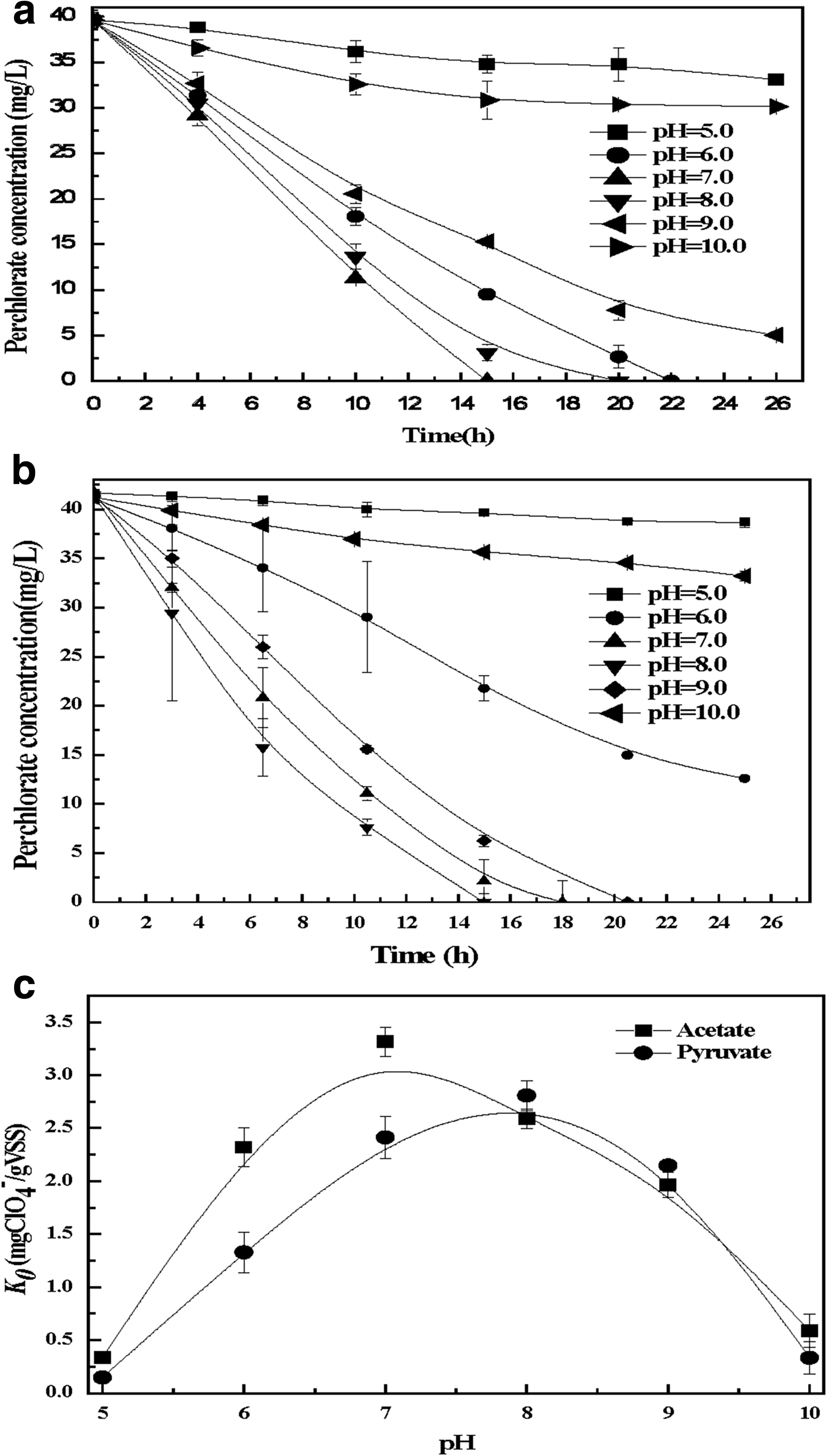
pH effect on the microbial perchlorate reduction per unit mass of biomass:
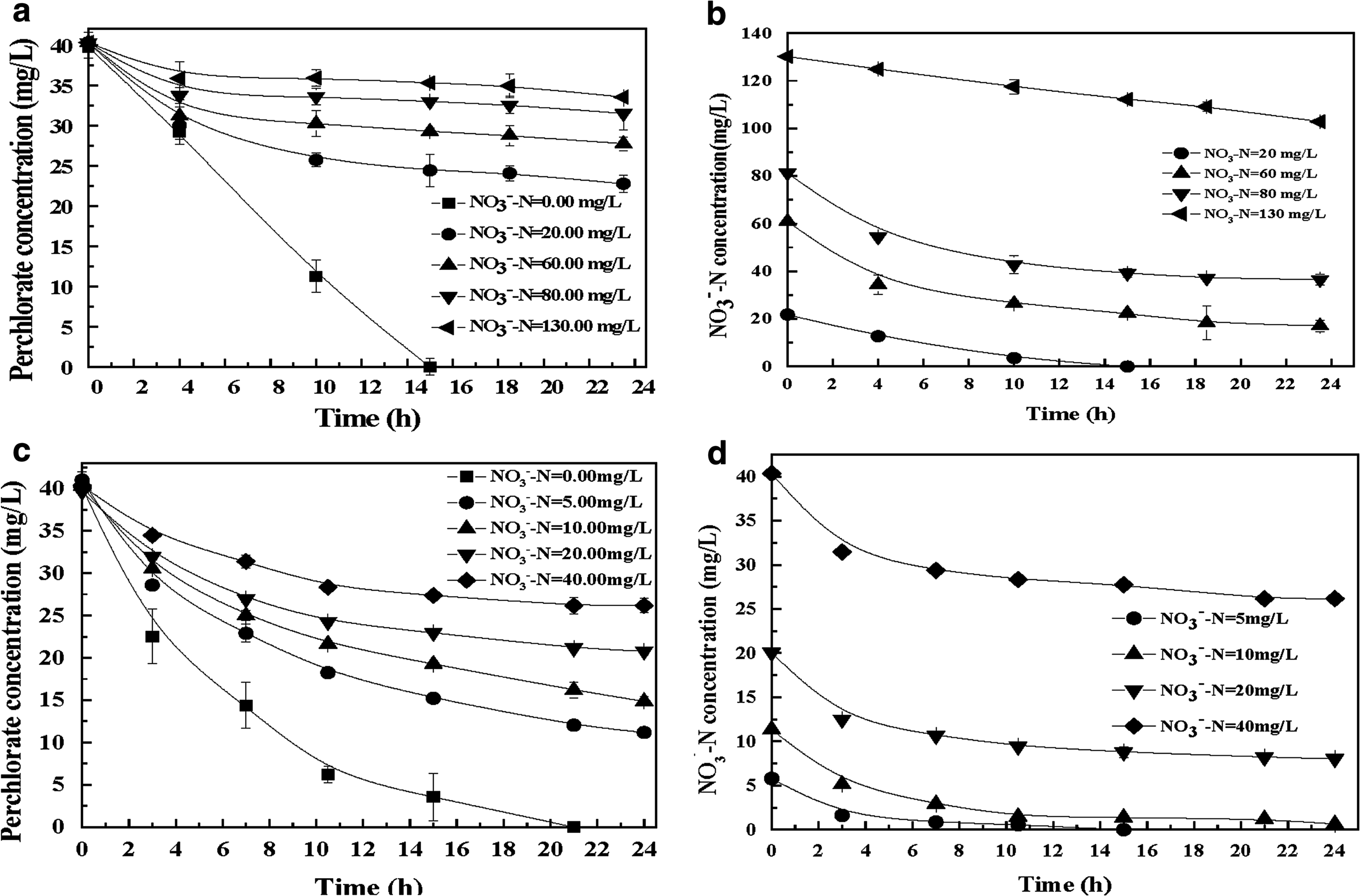
Effect of coexisting nitrate on perchlorate reduction:
Electron donor dosages
The initial perchlorate concentration was 40 mg/L, and the theoretical dosages of electron donors based on Eq. (3) and (4) were 23.68 mg/L for acetate and 27.97 mg/L for pyruvate. The perchlorate degradation was tested at five different initial electron donor (acetate or pyruvate) dosages that were 0, 1, 2, 3, and 5-folds of the theoretical values, respectively. The residual acetate and pyruvate were monitored as NPOC (Non-Purgeable Organic Carbon) after the perchlorate reduction was stable.
pH
Perchlorate reduction with acetate or pyruvate as electron donor was observed at pH ranging from 5.0 to 10.0. The initial pH was adjusted with 0.1 M HCl and 0.1 M NaOH. Low concentration phosphate buffer was used to maintain the pH in the systems.
Coexisting nitrate
Electron donor dosages were 118.40 mg/L for acetate and 139.85 mg/L for pyruvate. The initial perchlorate concentration was fixed at 40 mg/L, and the concentrations of coexisting nitrate ranged from 0 to 130 mg-N/L.
Analytical methods
Samples were collected from the sealed flasks and filtered through a 0.45 μm filter before analysis. Analysis for perchlorate was performed using an ICS-600 ion chromatograph (Thermo-Fisher, CA) equipped with an AS-16 chromatographic column and AS-16 pre-column, with an eluent concentration of 25 mM KOH and flow rate of 1.0 mL/min. The sample loop was 10 μL and method detection limit was 0.05 mg/L. According to Standard Methods for the Examination of Water and Wastewater (APHA, 1995), nitrate was analyzed using the UV spectrophotometric screening method (TU-1900; Persee, China). The pH was measured with a HACH Q30d instrument. Dry Sludge mass was determined according to Standard Methods for the Examination of Water and Wastewater. NPOC was analyzed using a TOC-LCPN system (Shimadzu, Japan).
DNA extraction and high-throughput sequencing
Two groups of sludge samples were collected. Group 1# included the inoculated sludge and acclimated sludge (with acetate as the electron donor) at the end of 3rd and 10th cycles (denoted as Control, A-3, and A-10) respectively. Group 2# included Control, P-3, and P-10 samples, which were similar to those in Group 1# except using pyruvate as the electron donor. The samples were immediately stored at 4°C. DNA extraction and PCR procedures were performed according to our previous study (Wan et al., 2016). All DNA samples were sent in ice containers for sequencing (Sangon, China) by Illumina Miseq 2 × 300 platform using a PE 300 strategy.
Results and Discussion
Microorganism acclimation
At the beginning of acclimation process, perchlorate was reduced from 250 to <0.5 mg/L in less than 3 days (Supplementary Fig. S1). The system was spiked with perchlorate and stable perchlorate degradation was observed. After completion of 10 cycles, the time required to reduce the same concentration of perchlorate was shortened to 1 day, and the acclimation was completed.
Kinetics analysis
Kinetic parameters are important tools for understanding the pollutant removal process. Experiments were carried out to investigate the reduction kinetics at different activated sludge concentrations using either acetate or pyruvate as electron donor. The biomass concentration was measured on the basis of the volatile suspended solids (VSS).
Figure 1 presents the perchlorate concentration as a function of reaction time with different biomass concentrations and electron donors. At the initial stage, sufficient amount of electron donor was supplied (118.40 mg/L of acetate or 139.85 mg/L of pyruvate). Table 1 lists the calculated parameters and correlation coefficients. The correlation coefficients for the Michaelis-Menten model ranged from 0.947 to 0.999, higher than those of the Zero-order model, suggesting that the former described the perchlorate reduction process better.
VSS, volatile suspended solids.
The Michaelis-Menten model reflects the relationship between reaction rate and pollutant concentration during the enzyme-catalyzed reaction. When acetate was used as the electron donor, qmax was 6.56–7.68 (mg ClO4−/(gVSS·h)) and Ks was 9.92–23.19 (mg/L). With pyruvate as the electron donor, qmax and Ks were 6.31–6.41 (mg ClO4−/(gVSS·h)) and 3.54–22.29 (mg/L), respectively. These results indicate that acetate was a better electron donor during heterotrophic perchlorate reduction process. In the catabolism of acetate and pyruvate through tricarboxylic acid (TCA) cycle, both of them need to be converted into acetyl-CoA first. The oxidative decarboxylation of pyruvate is a rate-limiting step, while acetate can be directly activated into acetyl-CoA (Kornberg, 1966; Gottschalk, 1986). This may be one explanation for the higher utilization efficiency of acetate than pyruvate.
Several researchers have also studied the kinetics of perchlorate reduction using different electron donors in recent years and some of their findings are summarized in Table 2. The kinetics parameters are affected by factors such as temperature, pH, electron donor, and the bacteria involved. Although the relative importance of each factor during the perchlorate reduction process is undetermined, these data can offer helpful information for the design of biological treatment systems.
Effect of electron donor dosages
Sufficient amount of electron donor is supposed to promote perchlorate reduction, but excessive dosage would remain in water and cause secondary pollution (Srinivasan et al., 2009). As shown in Fig. 2, perchlorate degradation rate increased constantly with the initial acetate concentration in the range of 0 to 71.04 mg/L. When acetate concentration went up to 118.4 mg/L, the degradation rate stopped further increasing, and the corresponding degradation curve was basically overlapped with that of 71.04 mg/L. In Fig. 2b, it can be seen that NPOC concentration was only 3.32 mg/L with acetate dosages up to 71.04 mg/L, while NPOC reached 14.49 mg/L when acetate dosage was 118.4 mg/L, suggesting that at this point acetate was overdosed and led to secondary pollution in the treated water. Based on these findings, the calculated optimal CH3COO−/ClO4− (m/m) ratio was 1.78.
Figures 2c, d present the changes in ClO4− and NPOC concentrations with pyruvate as the electron donor. Similar to the acetate results, perchlorate degradation rate increased constantly with pyruvate concentration up to 83.93 mg/L. When pyruvate dosage was 139.85 mg/L, degradation rate did not improve further and residual NPOC was 11.42 mg/L, which indicated that electron donor dosage was excessive and caused secondary pollution. The optimal pyruvate dosage was 83.93 mg/L (the corresponding CH3COCOO−/ClO4− ratio was 2.09) and the residual NPOC (7.29 mg/L) was slightly higher than that of acetate.
When the electron donors were calculated as chemical oxygen demand (COD), the optimal ratio for acetate was 1.93 COD/ClO4− (1 mg acetate = 1.09 mg COD) and for pyruvate was 2.73 COD/ClO4− (1 mg pyruvate = 1.31 mg COD). The corresponding optimal reduction rates (in 14 h) were 3.05 and 2.92 mg ClO4−/(gVSS·h), respectively. To reduce the same amount of perchlorate, the required dosage and secondary pollution for acetate were both lower than those for pyruvate, indicating that acetate was more suitable for perchlorate heterotrophic reduction.
Effect of pH on microbial perchlorate reduction
Wang et al. (2008) reported that pH has a great influence on the rate of microbial perchlorate reduction. Figure 3 shows that perchlorate removal rates per unit biomass were significantly different at various pH values. The perchlorate reduction rate (K0) within 15 h was calculated using Zero-order kinetics model to further elucidate the effect of initial pH (Fig. 3c). The rate peaked at pH 7.0 using acetate as electron donor; while using pyruvate, the optimal pH was 8.0. These findings were consistent with most of the previous reports for both pure and mixed PRB (Wang et al., 2008). In addition, the max value of K0 was 3.32 mg ClO4−/(gVSS·h) for acetate versus 2.42 mg ClO4−/(gVSS·h) for pyruvate, which confirmed that acetate was a more efficient electron donor than pyruvate in perchlorate degradation.
Effect of coexisting nitrate
Nitrate is a typical co-contaminant with concentrations several orders of magnitude greater than the level of perchlorate. Previous studies suggested that nitrate degradation occurs simultaneously with perchlorate degradation during bio-reduction process (Zhao et al., 2013). The PRB can utilize NO3− and ClO4− as electron acceptors under anoxic conditions (Xu et al., 2003; Matos et al., 2006).
As shown in Fig. 4a, b, the coexisting nitrate severely impaired perchlorate reduction with acetate as the electron donor. Without coexisting nitrate, the perchlorate could be completely degraded (<0.05 mg/L) in 15 h. However, the first 15 h removal efficiency dropped to only 39.48% with 20 mg/L of nitrate coexisting initially. In contrast, more than 99.89% of coexisting nitrate was reduced at the same time. With the increase of coexisting nitrate concentration, perchlorate removal rate continuously decreased. When 40 mg/L perchlorate coexisted with 60, 80, and 130 mg/L of nitrate, only 27.48%, 18.20%, and 12.47% of perchlorate was reduced in 15 h, respectively. Moreover, Fig. 4b shows that 63.27%, 51.82%, and 13.84% of nitrate was degraded simultaneously.
Due to the obvious inhabitation effect of coexisting nitrate, the pyruvate experiment only examined perchlorate degradation at nitrate concentrations ranging from 0 to 40 mg/L. Similarly, the removal rate of perchlorate decreased continually as the concentration of coexisting nitrate increased. With no nitrate added, only 3.51 mg/L perchlorate remained over 15 h. But when 20 mg/L nitrate initially coexisted, there was still 23.04 mg/L perchlorate left after the same time interval; meanwhile, 56.21% of nitrate was reduced.
Other studies also noted the inhibition effect of coexisting nitrate on autotrophic perchlorate degradation (Zhao et al., 2013; Wan et al., 2016). Despite the higher redox potential of perchlorate than nitrate, the tetrahedral structure of perchlorate where the central chlorine atom is surrounded by four oxygen atoms causes higher activation energy, which counteracts the advantage of perchlorate in electron donor competing with nitrate.
Microbial community structure analysis
Two groups of samples were analyzed using high-throughput sequencing to reveal bacterial compositions in activated sludge. After quality filtration, over 25,000 effective sequences were obtained from each sample. The number of operational taxonomic units (OTUs), Shannon, Chao 1, ACE, * and coverage values were calculated for each sample, as shown in Table 3. The coverage all exceeded 91%, indicating that majority of OTUs were detected. The sequencing depth was sufficient to represent the full diversity of the samples. Chao 1 and ACE indices are both positively related to microbial richness. Two groups of samples from the 3rd and 10th cycles showed higher richness levels than the Control, indicating that their biodiversity increased. Compared with municipal wastewater, the electron donors and other nutrients during acclimation were more than sufficient. Moreover, acetate and pyruvate are small molecule carbon sources and easier for bacteria to utilize. Thus, some bacteria that were below the detection limit in Control grew and began to be detected afterward. The Shannon index shows positive correlation with the diversity in bacterial community. Since bacteria that could not survive in the presence of perchlorate were washed out, the Shannon indices of A-10 and P-10 were the lowest in both two groups (Supplementary Fig. S2).
OTUs, operational taxonomic units.
Figure 5 shows the bacterial taxonomic identification of sequences from the two groups of samples at phylum and genus levels. Although the two groups of sludge were acclimated with different electron donors, the phylum level analysis indicated that they had similar microbial community structures. Protebacteria, Chloroflexi, and Bacteroidetes were dominant, and together they accounted for more than 60% of the microbial consortium. The most abundant phylum was Proteobacteria with the proportion above 25% in both groups. Previous studies have shown that Proteobacteria is the dominant phylum in pharmaceuticals, pet food, industrial wastewater treatment plants, and sewage (Wang et al., 2012; Ibarbalz et al., 2013; Yan et al., 2017). Moreover, Proteobacteria was found to be predominant in various municipal wastewater treatment bioreactors that were used for the perchlorate degradation process (Wan et al., 2016, 2017).

Taxonomic classification of the bacterial communities at
Genus level analysis provides an in-depth understanding of the microbial community. Figure 5b summarizes the relative abundances of the most highly represented genus (>1%). The results showed that Dechloromonas, Longilinea, Levilinea, Caldilinea, and Bellilinea were efficiently enriched in the two groups, especially Dechloromonas. After acclimation, the abundances of Dechloromonas were 2.55% (A-3), 9.59% (A-10), 1.88% (P-3), and 16.21% (P-10), respectively, which were much higher than Control (0.26%). Dechloromonas is a gram-negative bacterium in the family Rhodocyclales of β-Proteobacteria. In 2010, Vigliotta et al. (2010) reported that Dechloromonas was the dominant PRB enriched with acetate as the single carbon source from the activated sludge of a highly perchlorate-polluted river. The augment of Dechloromonas may be one reason for the increase in perchlorate reduction rate during the acclimation processes. Other bacterial communities with higher abundance such as Longilinea, Bellilinea, and Levilinea were reported to involve in protein degradation, organic acid formation from metabolized carbohydrates, and acetate oxidation (Yamada et al., 2006, 2007).
Conclusions
Acclimated active sludge could efficiently degrade perchlorate with either acetate or pyruvate as electron donor. The Michaelis-Menten equation well described the perchlorate reduction process, and the higher qmax of acetate indicated that it was more favorable for PRB. The optimal CH3COO−/ClO4− and CH3COCOO−/ClO4− (m/m) ratios were 1.78 and 2.09, respectively. The optimum pH for perchlorate reduction was 7.0 with acetate and 8.0 with pyruvate. The tested active sludge could simultaneously utilize perchlorate and nitrate as electron accepters, but the coexisting nitrate severely inhibited perchlorate reduction. The bacterial community structures of both groups shifted as acclimation process prolonged, and Dechloromonas was found to be the dominant PRB with either of the two electron donors.
Footnotes
Acknowledgments
This work was supported by National Natural Science Foundation of China (Grant No. 51208179 and 51508517) and Research Fund of Tianjin Key Laboratory of Aquatic Science and Technology (TJKLAST-ZD-2016-03).
Author Disclosure Statement
No competing financial interests exist.
References
Supplementary Material
Please find the following supplemental material available below.
For Open Access articles published under a Creative Commons License, all supplemental material carries the same license as the article it is associated with.
For non-Open Access articles published, all supplemental material carries a non-exclusive license, and permission requests for re-use of supplemental material or any part of supplemental material shall be sent directly to the copyright owner as specified in the copyright notice associated with the article.
