




Abstract
Abstract
Nitrogen (N) removal efficiency through denitrification is usually not ideal and stable in biofilter systems due to the deficiency of organic carbon supply and difficulty of formation of anaerobic status, which could be enhanced by regulating the inflow carbon/nitrogen ratio (C/N), outflow water level, retention time, and addition of plant detritus through the pilot-scale stormwater biofilter study. Removal efficiency of ammonium (NH4+-N), soluble reactive phosphorus (SRP), and total phosphorus (34–90%) was significantly higher than that of nitrate (NO3−-N), dissolved total nitrogen (DTN), and total nitrogen (TN) (9–25%) in the biofilter systems. The addition of plant detritus (especially herbaceous plant) in biofilter systems can enhance the nitrogen (N) and phosphorus (P) removal efficiency by >24%. Through further regulation of inflow C/N, retention time, and outflow water level to promote denitrification, removal efficiency of NO3−-N, DTN, and TN was significantly enhanced and reached up to 83%, 68%, and 73% on average, respectively. However, P leaching increased due to SRP release from iron-bound P caused by anoxia. In the overall consideration of N and P removal, optimized inflow C/N, retention time, and outflow water level are estimated as 10–30, 1–2 h, and 20–40 cm, respectively, which makes a crucial contribution to simultaneous N and P removal.
Introduction
E
Although plants have been considered to be the main way of nutrient removal in the vegetated filters (Glaister et al., 2014), the removal efficiency is not stable in plants because of their various types, their different stages of growth, and so on (Read et al., 2008; Payne et al., 2014). Importantly, it must cost much time, labor and money to regularly harvest. On the contrary, even though the death of the plants can indirectly provide microbial organic carbon to the system, their residues are left in the system surface and then their decomposition will seriously run off with the rain erosion (Schnoor et al., 1995; Salt et al., 1998). Hence compared with the vegetated filter, the efficiency of the direct addition of the plant residues into the system must be much higher, which could ensure the continuous supply of organic carbon and not run off (Hsieh and Davis, 2005). Therefore, it is vital to develop an efficient nonvegetated filter.
However, the removal efficiency of NO3−-N in stormwater biofilters has been found to be challenging, especially in nonvegetated biofilters (Hunt et al., 2006; Blecken et al., 2010). Thus, low impact treatment measure to remove NO3−-N from stormwater runoff before it enters receiving waters would be extremely beneficial. As we know, the removal of NO3−-N is closely associated with denitrification, which used organic carbon as prior electronic donor and carbon source on anoxic condition. And the addition of plant detritus is to produce organic carbon, provide electron transfer donor for denitrifying bacteria, and promote denitrification. Hence, a series of key parameters in biofilters have been designed and studied to promote denitrification.
For example, the introduction of saturated zone in the filter, combined with a carbon source, has been suggested and successfully tested (Zinger et al., 2007; Zhang et al., 2011; Afrooz and Boehm, 2017; Wu et al., 2017). In the presence of a saturated zone, plants grown in Skye sand had a significantly higher specific root length, surface area, and volume than plants grown in loamy sand. These root traits also correlated strongly with nutrient removal, suggesting that use of Skye sand in biofilters would be advantageous for nutrient removal (Glaister et al., 2017). The choice of plant species may have marked effects on biofilter effectiveness (Read et al., 2008). The combined Iris pseudacorus and Zoysia matrella group performed more efficiently than individual Z. matrella systems in the removal of total phosphorus (TP), NH4+-N, and NO3−-N (Wu et al., 2017). The natural organic carbon and bioaugmentation of microbial population, which promoted denitrification, can jointly stimulate the NO3−-N removal efficiency (Chang et al., 2016; Zhou et al., 2016). The depth of media layers was indicated as at least 0.75 m to facilitate nitrogen removal (Wu et al., 2017). Vegetation selection is critical to performance for nitrogen removal (e.g., Carex appressa and Melaleuca ericifolia performed significantly better than other tested species), while phosphorus removal was consistently very high in system with sandy loam filter media (Bratieres et al., 2008). In addition, the retention time (Christianson et al., 2015) and hydrodynamic condition (Hatt et al., 2009) were identified to enable improved NO3−-N removal.
Obviously, little research has been done on the comprehensive optimization and quantification of various parameters for promoting denitrification of large-scale stormwater biofilters. Most important, when taking into account the promotion of NO3−-N removal through denitrification, the P leaching and dissimilatory nitrate reduction to ammonium (DNRA) due to the change of redox condition and carbon/nitrogen ratio (C/N) are not to be ignored. Hence, to improve greatly the efficiency and economy of simultaneous N and P removal, the optimization of important parameters favoring N or P removal seems to be more necessary and crucial.
In this study, 12 pilot-scale biofilter systems were constructed with each area 50 m2 in Dawei town of Hefei city, China. To promote the simultaneous N and P removal efficiency, the optimized natural organic carbon source in matrix, inflow C/N, retention time, and outflow water level were studied and selected. The following questions will be addressed: (1) What are the effects on N and P removal by adding different types of plant detritus, and the mechanisms? (2) What are the optimal inflow C/N ratio, retention time, and outflow water level, and what are the mechanisms? and (3) Whether N and P simultaneous removal conflict, how to solve?
Materials and Methods
Experimental setup
Twelve pilot-scale nonvegetation biofilter systems were constructed by concrete, with an inner length, width, and height of 7,800, 6,300, and 1,800 mm, respectively. The inner wall and bottom of these structures were treated with waterproof material and covered by impermeable membrane to prevent water from infiltrating between different systems. The biofilter systems consisted of five layers, and the bottom layer is 100 mm fine gravel, along with a 100 mm deep coarse sand transition layer, 100 mm deep medium sand transition layer, and 100 mm deep plant detritus layer, and the top layer is 1,100 mm filter layer consisted of sandy loam (Fig. 1) (Zinger et al., 2013; Zhou et al., 2016).
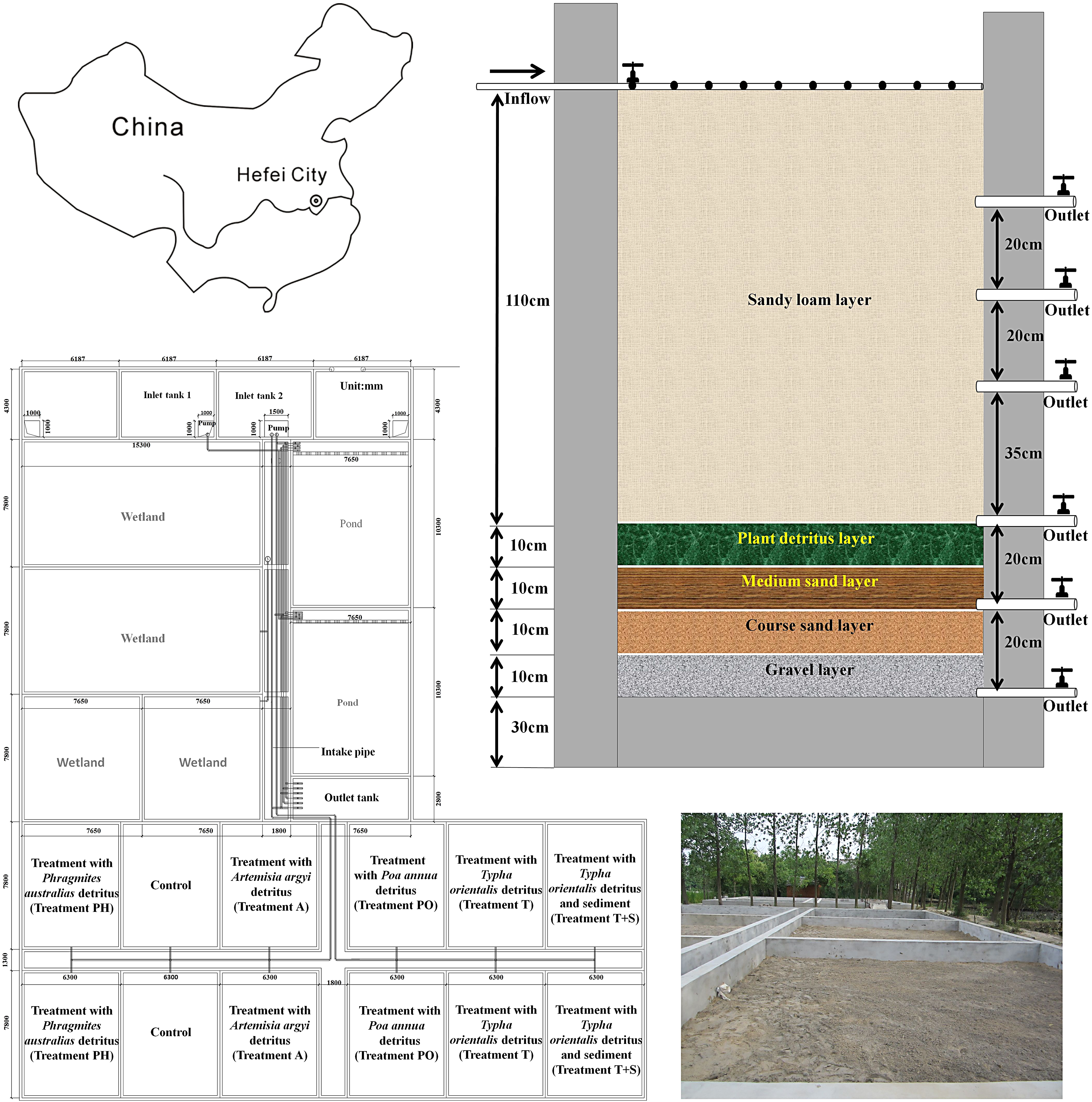
Experimental design and construction details of stormwater biofilter systems.
The 12 biofilter systems were divided into six groups of duplicates, based on the different plant detritus material, which were expected to provide different organic carbon source for denitrification (Fig. 1). The plant detritus included were Artemisia argyi H. (System A), Poa annua L. (System PO), Phragmites australias Trin. (System PH), Typha orientalis Presl (System T), as well as control (System C). The last treatment was T. orientalis Presl with sediment of Lake Chaohu (System T+S), the latter of which was proved to be able to introduce nitrifiers and denitrifiers as bioaugmentation (Zhou et al., 2016). The reason these vegetations were selected is that they are very common and easily obtained and enormously collected in the local area. In a word, these vegetations without a little economic value could be brought into use and create value. The addition of sediments from Lake Chaohu into the biofilter systems was started after sufficiently mixing it with other materials, whose purpose is not the P adsorption but providing the denitrifying bacterial communities. Because of the high diversity of denitrifying bacteria in the sediments from LakeChaohu, the denitrification rate is higher. That is to say, sediments from Lake Chaohu can effectively strengthen the denitrification effect, which is characterized by black viscous deposits.
Experimental procedure and sampling
After construction, the biofilter systems were allowed 3 months establishing time (settling of filter media, establishing of biofilms and systems stability) before sampling started. During establishment, the inflow water of the system ran 6 h every day from 8 AM to 2 PM with a volume of 60 m3/h as planned, which was continuous but intermittent and resulted in a daily dry–wet–dry cycle process for the system. Therefore, strictly speaking, the system was not always wet but in the dry–wet alternation. Because the system has to continuously deal with stormwater from a storage pool with a pump, and the treatment effect must be monitored long term and verified, it must be watered every day. The storage pool was located in the underground and constructed by concrete, and primarily received stormwater runoff from the surrounding area.
Artificial stormwater was prepared by adding the required amount of chemicals (KH2PO4, NH4Cl, and KNO3) to inlet tank with river water from Weixi River through pump (60 m3/h) to achieve the target pollutant concentrations (the final concentration was 0.83–1.12 mg/L P for PO43−-P, 0.98–1.25 mg/L N for NH4+-N, and 1.23–1.54 mg/L N for NO3−-N). Then the stormwater was applied to established systems to run every day for 10 months. For the first month, all systems were operated on the conditions of no inflow carbon, no retention time, and the bottom layer outlet to test the effect of carbon quality in matrix on nutrient removal. Then, the effect of inflow C/N ratio on nutrient removal was studied by adding different amounts of glucose to inlet tank for 3 months. The C/N ratio was adjusted to 10:1, 20:1, 30:1, 40:1, and 50:1. The effect of retention time, which is from the time water begins to flow into the system from the inlet to the time water begins to discharge from the outlet, on nutrient removal was studied for 3 months. The system we designed with the outflow water switch can control the retention time for any period of time, which is close to an hour, because it must spend at least an hour from the beginning to the water discharge. At the end of the residence time, turn on the switch to begin to release the water. So the retention time we detected was 1, 2, 4, 8, and 15 h.
The effect of outflow water level on nutrient removal was studied for 3 months. The outlet water level was designed as 20, 40, 75, 95, and 115 cm (Fig. 1). The purpose of this design is to really create the anaerobic saturated zone or submerged zone at the bottom of the biofilter systems, which can enhance the denitrification rate of the bottom layer to enhance the denitrification effect. Every treatment mentioned above (in total 15 treatments) was run for 18 days and sampled every 3 days to get six sets of data. Water samples were taken from the influent and effluent of each system. After the experiment of carbon quality, C/N ratio, retention time, and water level, particle samples between sandy loam and plant detritus layer were collected for the measurement of the phosphorus fraction and sorption parameters as well as the rates of nitrification and denitrification, respectively.
N and P analysis
Influent and effluent samples of all treatments in each system were tested every 3 days for NH4+-N, NO3−-N, dissolved total nitrogen (DTN), total nitrogen (TN), soluble reactive phosphorus (SRP), and TP. Water was filtered through a 0.45 μm cellulose acetate membrane for soluble nutrients preparation. All the measurements followed national standards (APHA, 2012).
Phosphorus adsorption isotherms and phosphorus fraction
Particle samples in top layer were dried and ground to pass through 0.25 mm sieve. One gram of dry, sieved soil was incubated with 20 mL of 0.01 M KCl containing 0, 0.1, 0.5, 1, 5, 10, 50, and 100 mg P/L, as KH2PO4 in centrifuge tubes. Tubes were shaken for 24 h, centrifuged at 3,000 rpm for 10 min, and filtered through a 0.45 μm cellulose acetate membrane. Filtrates were detected for SRP. Phosphate that disappeared from the solution was considered to have been adsorbed by soils. The experiment was conducted at a temperature of 25°C (James et al., 1992). The sorption capacity at equilibrium was calculated as Equation (1):
where Se is the P sorption capacity at equilibrium (mg P/kg), V is the sample volume (mL), C0 is the initial P concentration (mg P/L), Ce is the aqueous P concentration at equilibrium (mg P/L), and m is the adsorbent amount (kg).
Data obtained were fitted to Langmuir adsorption isotherm Equation (2) (Sakadevan and Bavor, 1998):
where Smax is the maximum adsorbed concentration (mg P/kg), and KL is the Langmuir equilibrium constant (L/mg P).
Sediment P fractionation was carried out according to Golterman (1996). This method groups sediment P into iron-bound P (Fe(OOH)∼P), calcium-bound P (CaCO3∼P), acid-soluble organic P (ASOP), and hot NaOH-extractable organic P (Palk). Fe(OOH)∼P is the main constituent form of phosphorus in the experimental particulate matter, which was mainly affected by the redox conditions. The P from Fe(OOH)∼P is more likely to be released under the strict anaerobic environment, while that from CaCO3∼P is more likely to be affected by pH. ASOP is mainly organic phosphorus, which is mainly affected by microbial decomposition, whereas Palk is a kind of refractory phosphorus, which is difficult to decompose in general.
Determination of potential nitrification rate and potential denitrification rate
The particles were washed by phosphate buffer to extract biofilm (Huang et al., 2013), which was used to measure potential nitrification rate (PNR) and potential denitrification rate (PDR). The PNR was measured according to the shaken-slurry method (Fan et al., 2011). Slurry containing 3 g of biofilm pellet, 100 mL of phosphate buffer (1 mM, pH 7.4), and 0.5 mL of (NH4)2SO4 (0.25 M) was incubated on an orbital shaker (180 rpm) at 25°C for 24 h. Subsamples (5 mL) of the slurry were taken at 1, 4, 10, 16, and 24 h after the start of the incubation. The subsamples were used for the analyses of NO2−-N and NO3−-N. The PNR was calculated as NO2−-N and NO3−-N production per unit time.
Meanwhile, the PDR was measured based on the denitrifying enzyme activity (DEA) Assay (Jha and Minagawa, 2013). In brief, 5 g of biofilm pellet was moved to a special tailor-made borosilicate glass media bottle with 20 mL DEA solution (7 mM KNO3, 3 mM glucose, and 5 mM chloramphenicol), oxygen was purged out from each bottle by continuously pumping helium, and acetylene was added to reach a final concentration of 10%. Sample bottles were placed on orbital shaker and shaken (125 r/min) in dark at 25°C. Gas samples were taken out at 0, 0.5, 1, 1.5, and 2 h for N2O measurement using gas chromatograph. The PDR calculated as the slope of the best fit curve in the N2O concentration against time plot.
Statistical analysis
Correlation analyses and Pearson's test were performed using the SPSS 18.0 package (SPSS, Chicago, IL), with a value of 0.05 selected for significance.
Results and Discussion
Effect of organic carbon quality on nutrient removal
The effluent quality of biofilter systems got stable until the third month, and the final efficiencies of N and P removal among the treatments were decided according to the average value (with six sets of data for each treatment) as shown in Figs. 2, 3, and 4. Generally speaking, significantly higher (p < 0.01) NH4+-N, SRP, and TP removal efficiency (34–90%) was recorded in all systems, compared with NO3−-N, DTN, and TN (9–25%, Fig. 2), indicating weak denitrification ability.

Comparison of effect of different inflow C/N ratios on NH4+-N, NO3-N, DTN, TN, SRP, and TP removal efficiency in different treatment systems (System C: Control; System A: Artemisia argyi H.; System PO: Poa annua L.; System PH: Phragmites australias Trin.; System T: Typha orientalis Presl; System T+S: T. orientalis Presl and sediment of Lake Chaohu). C/N, carbon/nitrogen ratio; DTN, dissolved total nitrogen; SRP, soluble reactive phosphorus; TN, total nitrogen; TP, total phosphorus.

Comparison of effect of different retention time on NH4+-N, NO3-N, DTN, TN, SRP, and TP removal efficiency in different treatment systems.

Comparison of effect of different outflow water levels on NH4+-N, NO3-N, DTN, TN, SRP, and TP removal efficiency in different treatment systems.
On the condition of no inflow organic carbon input, compared with control, the addition of organic plant detritus can significantly promote the NO3−-N, DTN, and TN removal efficiency, especially in System A, System PO, and System T + S (>20%, p < 0.05, Fig. 2). This was matched with significantly higher PNR and PDR during organic carbon quality experiment (p < 0.01, Fig. 5). In a Swedish wastewater treatment wetland, denitrifying bacteria were more favored by Elodea canadensis detritus than by detritus from the emergent plant species (such as Typha latifolia and Phragmites australis). This should be attributed to lower C/N, suggesting that E. canadensis provided more organic material of high quality to support heterotrophic organisms (Bastviken et al., 2005). This can explain why in this study the N removal efficiency was higher in systems with herbaceous plant than in those with emergent plants. In addition, the addition of sediments in eutrophic lake can act as bioaugmentation to fuel nitrification–denitrification activity (Zhou et al., 2016), which was consistent with higher N removal efficiency in System T + S in this study. Hence, on the condition of anaerobic status and denitrifying bacterial community, an additional carbon source included in the systems as an electron donor to facilitate denitrification should be necessary (Zinger et al., 2007). It should be addressed for continuous organic supply, such as sugarcane mulch, bark chips, and plant detritus, which seems warranted.
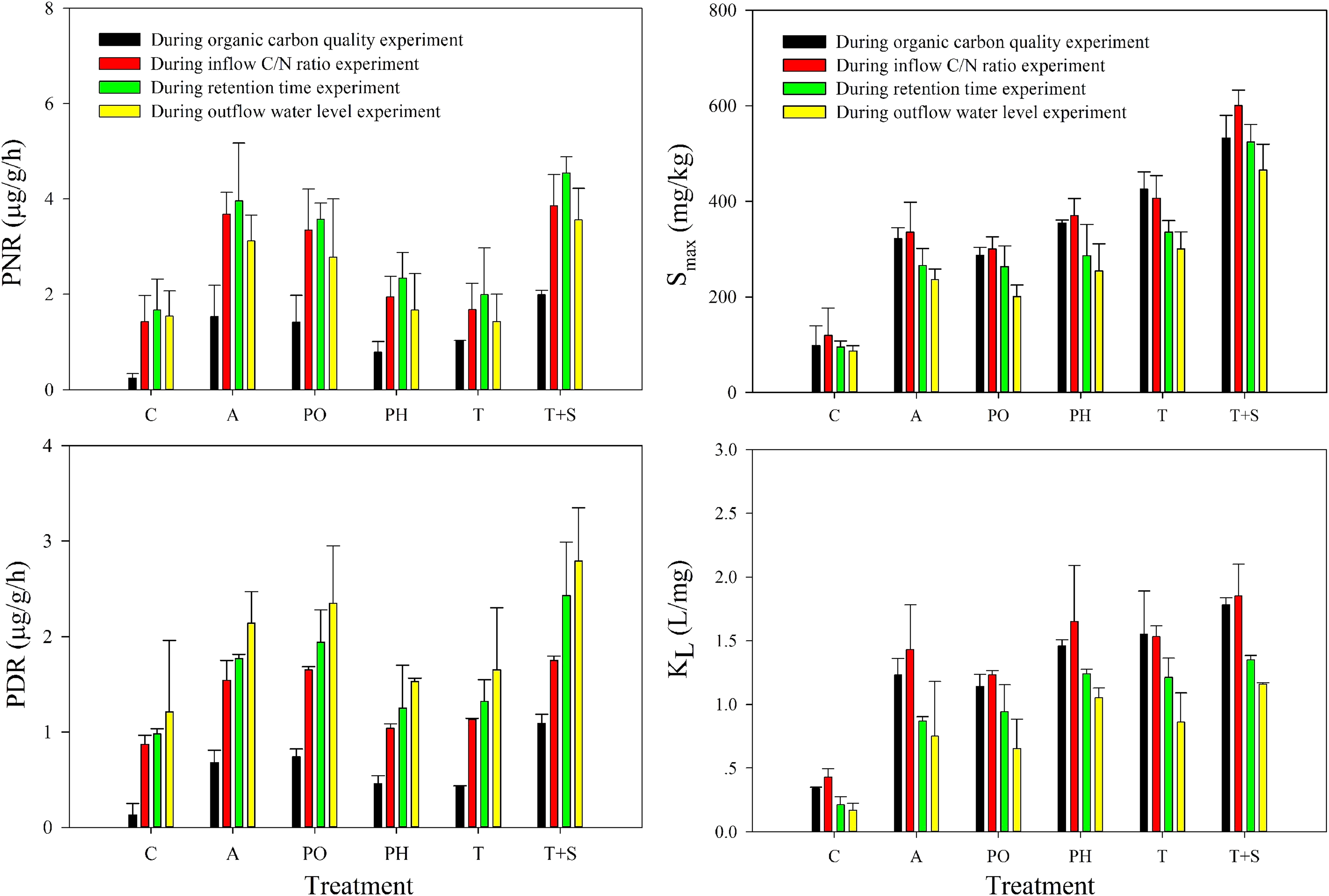
Comparison of PNR, PDR, Smax, and KL of particles during different experimental phases in different treatment systems. PDR, potential denitrification rate; PNR, potential nitrification rate.
The SRP and TP removal efficiency was also significantly stimulated to reach >40% by plant detritus, especially System T + S (>80%, p < 0.05, Fig. 2). From the point P fractionation, during organic carbon quality experiment, Fe(OOH)∼P and CaCO3∼P content in systems with plant detritus was significantly higher (p < 0.01) than that of control (Fig. 6), which was corresponding with higher Smax and KL values of the particle (Fig. 5). It was worthy to note that ASOP content was the main fraction in systems with plant detritus, especially System T + S (Fig. 6 and Table 1). Thus, it was deduced that the addition of plant detritus facilitated the P sorption and microbial utilization. The organic plant residues in the native and chemically modified forms have been used as biosorbents to remove P from aqueous solutions through increasing adsorption sites (Feizi and Jalali, 2016; Yu et al., 2016). On the contrary, the available organic carbon produced by the decomposition of plant detritus favored the activity and growth of PAOs, which made a major contribution to enhanced biological phosphorus removal (Carvalheira et al., 2014; Zhou et al., 2016).
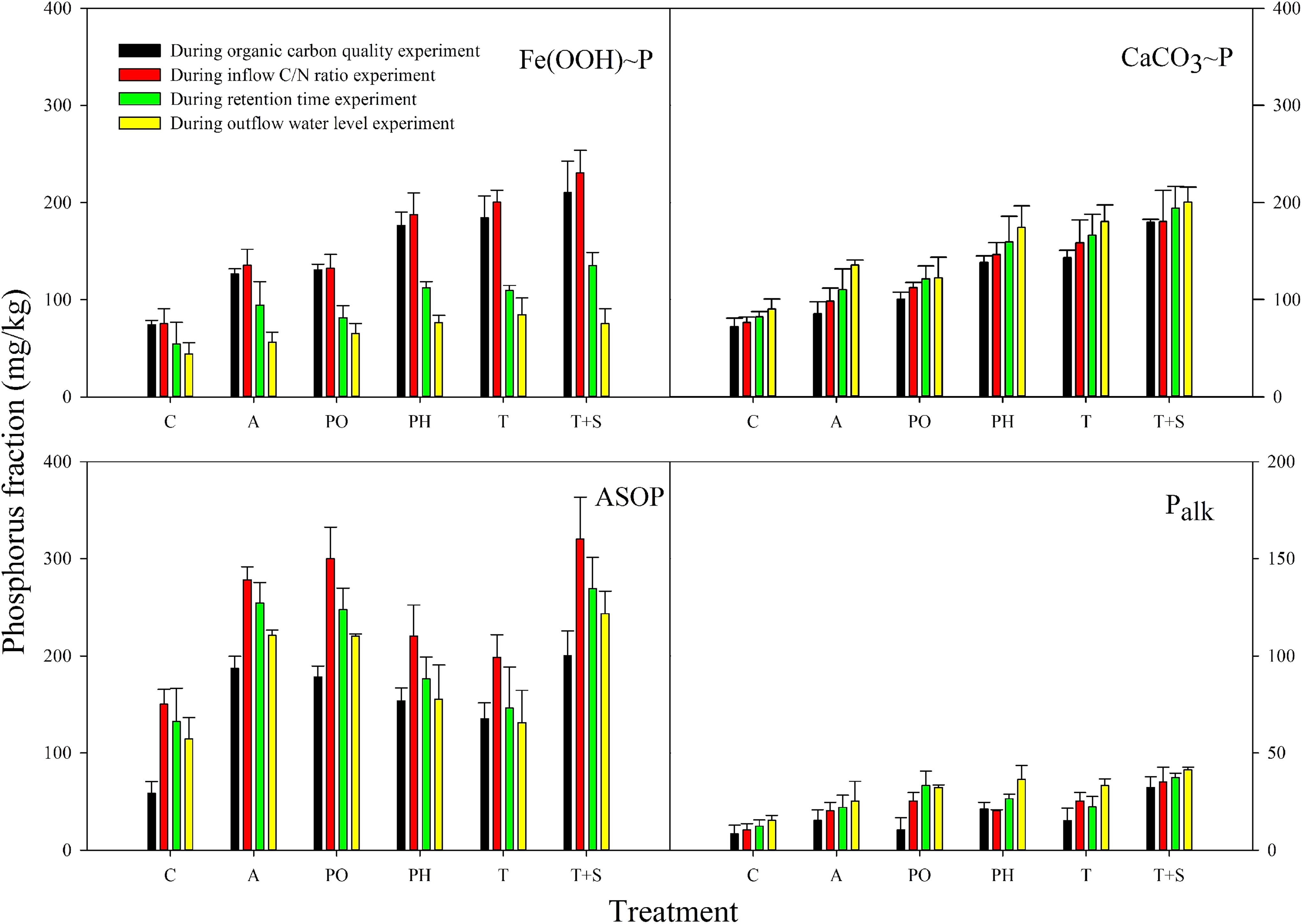
Comparison of phosphorus fraction of particles during different experimental phases in different treatment systems. ASOP, acid-soluble organic P.
Comparison of Values of Smax and KL During Different Experiments
C/N, carbon/nitrogen ratio.
Effect of inflow organic carbon quantity on nutrient removal
Effect of inflow C/N ratio adjusted through adding the different amounts of organic carbon (glucose) on nutrient removal was studied. Obviously, the increase of inflow C/N ratio significantly boosted all forms of nitrogen removal in varying degrees, especially the NO3−-N, DTN, and TN removal in System A, System PO, and System T + S (p < 0.01, Fig. 2). The highest NO3−-N, DTN, and TN removal efficiency was found at C/N ratio 50:1 in System T + S (72%, 25% for no organic carbon), in System T + S (56%, 30% for no organic carbon), and in System A (50%, 21% for no organic carbon), respectively. It is indicated that the input of labile organic carbon provided a large number of reaction substrates for denitrification, accelerating denitrification process in terms of high PDR in all systems measured during C/N ratio experiment compared with no inflow organic carbon in this study (Fig. 5). When C/N ratio was >30:1, the degree of N removal efficiency promotion began to drop down (Fig. 2), and excess organic carbon would run off from the system. The moderate organic carbon content favored denitrification, yet a surplus of available organic carbon easily led to DNRA outcompeting denitrification (Kraft et al., 2014; van den Berg et al., 2015). So, it was suggested that the optimal C/N ratio should be designed to no more than 30:1 in biofilter systems.
Addition of organic carbon also increased the SRP and TP removal efficiency; however, the effect was limited and not significant (p > 0.05, Fig. 2). The glucose with simple molecular structure hardly provided effective adsorption sites for P sorption, resulting in the similar Fe(OOH)∼P, CaCO3∼P, Smax and KL with and without inflow organic carbon in all systems (Figs. 5 and 6, Table 1). However, the slight rise of ASOP content after C/N ratio experiment in all systems should be attributed to the increase of activity and growth of PAOs induced by organic carbon (Fig. 6). The biological assimilation of P was mainly attributed to the normal growth of microorganism biomass, which was easily limited by nutrients like carbon rather than their activity on the P absorption (Frison et al., 2015). This was responsible for the promotion of P removal efficiency when inflow organic carbon was input.
Effect of retention time on nutrient removal
Extension of retention time significantly enhanced the NO3−-N, DTN, and TN removal efficiency, especially in System A, System PO, and System T + S (p < 0.01). In System T+S, on the condition of retention time 15 h, the NO3−-N, DTN, and TN removal efficiency reached the maximum value (80%, 66%, and 64%, respectively), which were correspondingly raised 3.16, 2.24, and 2.73 times as against no retention time (Fig. 3). The higher N removal efficiency in System T + S could be explained by the higher PNR and PDR during retention time experiment (Fig. 5). The longer the retention time, the higher NO3−-N, DTN, and TN removal efficiency (Fig. 3). When retention time was >5 h, the effect of retention time on N removal efficiency was not significant (p > 0.05, Fig. 3). Usually, with increasing retention time, the nitrogen removal efficiency would be enhanced, while, if retention time was too long, the treatment efficiency would decrease and the treatment cost would increase (Guo et al., 2016; He et al., 2016). Moreover, the increase of retention time decreased microbial activity (ammonium oxidation rate, nitrite oxidation rate, and nitrate reduction rate) and microbial community (Wang et al., 2015), which could finally influence the N removal efficiency. Thus, taking into account the N removal, the optimal retention time should be set as no more than 5 h.
Increase of retention time gently enhanced the SRP and TP removal efficiency to reach a peak at 2 h, and then began to decline in all systems except for System T + S with completely negative effect (Fig. 3). This can be explained by the decrease of microbial activity and Fe(OOH)∼P release. As mentioned above, the increase of retention time decreased microbial activity including PAOs, which directly restricted the biological phosphorus removal (Chan et al., 2017). In addition, the long retention time facilitated the formation of anaerobic status (Ziganshin et al., 2016), which further accelerated the SRP release from Fe(OOH)∼P (Muller et al., 2016). All these explanations can be proved by the decreasing Fe(OOH)∼P, ASOP, and KL value in all systems during retention time experiment, compared with inflow C/N ratio experiment (Figs. 5 and 6, Table 1). Thus, in combination with N and P removal, it was strongly recommended to design retention time as 2–5 h to reach the maximum nutrient removal efficiency and economic benefit ratio.
Effect of outflow water level on nutrient removal
Effect of outflow water level on nutrient removal was similar to retention time. Under outflow water level 20 cm conditions, the NO3−-N, DTN, and TN removal efficiency achieve a significant improvement in all systems, especially T + S (p < 0.01), compared with that of 0 cm. When outflow water level continued to increase from 20 to 115 cm, the NO3−-N, DTN, and TN removal efficiency did not make great change, except for slight decline at 115 cm in all systems. The highest NO3−-N, DTN, and TN removal efficiency was all observed in System T + S at 75 cm, which, respectively, reached 83%, 68%, and 73% with at least threefold promotion compared with 0 cm (Fig. 4). In addition, when outflow water level was >40 cm, the NH4+-N removal efficiency began to decline greatly (Fig. 4). While aerobic nitrification occurs usually in the well-drained filter media, anaerobic denitrification is often lacking. The introduction of saturated or anaerobic zone through raising outflow water level can effectively enhance anaerobic denitrification and weaken the nitrification (Zinger et al., 2013). That is why in this study, during the outflow water level experiment, the PDR increased and PNR decreased significantly (p < 0.01), compared with those observed during organic carbon quality experiment (Fig. 5).
The SRP and TP removal efficiency exhibited a peak at outflow water level 20 cm in all systems (Fig. 4). The high outflow water level restricted the P removal efficiency, which was associated with the decrease of microbial activity and Fe(OOH)∼P release caused by the formation of anaerobic status. The explanation of the mechanism was the same as that for retention time mentioned above. The decline of Fe(OOH)∼P, ASOP, Smax, and KL further proved this explanation (Figs. 5 and 6, Table 1). Accordingly, the outflow water level should be set as 20–40 cm in the overall consideration of nitrification, denitrification, and P leaching.
The practice for the biofilter system
First, according to the results, nonvegetated biofilter systems could greatly promote the effect of denitrification and N removal by regulating the outflow water level, C/N ratio, adding the plant detritus and retention time and so on. So it is recommended to add the plant detritus into the middle and lower layers of the system. In addition, it could be gradually accumulated in the system for the vegetated system after the plant dies. But they are mostly gathered in the surface layer and cannot offer for the lower layer. According to the comprehensive and coordinated regulation of the C/N ratio of the inflow water and that of the plant detritus in the system, the appropriate C/N ratio can be effectively controlled and lead to the efficient removal of N.
Conclusions
In constructed stormwater biofilter, the N and P removal efficiency was significantly enhanced by the herbaceous plant detritus or sediments from eutrophic lake in matrix as a whole. It is suggested that an addition of certain amount of plant detritus into the filter systems would promote the denitrification to accelerate the N-removal as an economic and effective way. Importantly, compared with N (except for NH4+-N), the removal efficiency of P, such as SRP and TP, was significantly higher. In addition, N removal was mainly facilitated by the promotion of denitrification by regulating inflow C/N, retention time, and outflow water level, while P leaching occurred due to SRP release from Fe(OOH)∼P and decrease of microbial activity. Hence, the simultaneous removal efficiency of N and P was able to be improved by means of optimizing the inflow C/N ratio, retention time, and outflow water level.
Footnotes
Acknowledgments
This work was supported by the grants from the National Natural Science Foundation of China (41877381; 41573110), the Major Science and Technology Program for Water Pollution Control and Treatment (2017ZX07603), and the State Key Laboratory of Freshwater Ecology and Biotechnology (2016FBZ07).
Author Disclosure Statement
No competing financial interests exist.