




Abstract
Abstract
Biochar (BC) continues to gain considerable interest for remediating metal-contaminated soils. A laboratory incubation study was conducted to evaluate the comparative efficiency of rapeseed residue and rice straw BCs pyrolyzed at 300°C and 550°C for lead (Pb) and copper (Cu) immobilization in naturally contaminated soil, which was not reported earlier. X-ray diffraction, scanning electron microscopy, and fourier-transform infrared (FT-IR) analysis were performed to study the nature of the BCs. Effectiveness of the amendments for Pb and Cu immobilization was assessed using a modified community bureau of reference extraction procedure, single extraction with CaCl2, and the toxicity characteristic leaching procedure, respectively. Amending the soil with RS550 significantly decreased the acid-extractable portions of Pb and Cu by 63.30% and 66%, respectively, whereas the residual (stable) fractions of Pb and Cu were increased by 40.31% and 52.98%, respectively. Immobilized metals were mainly transformed to the reducible fractions. High reductions in the bioavailable phase of Pb (97.13%) and Cu (93.71%) were recorded, while Pb and Cu solubility were reduced by 92.62% and Cu 72.55%, respectively. Affinity of BCs toward Pb and Cu was enhanced due to the increased negativity with increasing pH, as described by zeta potential and cation exchange capacity, which is one of the mechanisms of Pb and Cu immobilization. BCs produced at high temperature efficiently immobilized Pb and Cu compared to low-temperature BCs. These findings suggested that rapeseed residue and rice straw BCs could be used as Pb and Cu stabilizers in contaminated agricultural soils.
Introduction
S
Amending the contaminated soils with a wide range of organic and inorganic materials is one of the major strategies to reduce the mobility of toxic metals in soil. Among the available amendments, organic materials efficiently detoxify metal impacts on the soil-plant system, due to their biological origin and less pretreatment before their application (Park et al., 2011). China produces a large number of crop residues such as rice straw and rapeseed residues annually, which can be effectively used for producing biochar (BC). BC is a porous carbonaceous solid produced from the thermal conversion of organic materials in a pyrolysis process. BC offers favorable immobilization properties due to its ample organic/active functional groups, inorganic minerals, microporous structure, high pH, surface area, cation exchange capacity (CEC), and C content (Ahmad et al., 2016). It has been observed that BC reduces the risk of contaminants entering the food chain by binding and/or precipitation in the soil (Uchimiya et al., 2012). However, the potential of BC as an amendment is determined by its physicochemical properties, which change with the feedstock and production conditions (Cantrell et al., 2012). Pyrolysis temperature plays a significant role, both in production and determining the nature of the BC (Yuan et al., 2013). To date, various studies have been conducted for immobilizing heavy metals using BCs derived from different feedstocks, such as soybean stover and pine needle (Ahmad et al., 2016), animal manure (Cantrell et al., 2012), bamboo and rice straw (Lu et al., 2014), sewage sludge (Yuan et al., 2013), and wood material (Kloss et al., 2012).
Numerous studies have confirmed the effective immobilization of heavy metals using BC. Ahmad et al. (2016) incorporated BCs made from soybean and pine needle to shooting range contaminated soil and concluded that soybean BCs decreased Pb (88%) and Cu (87%) more efficiently than pine needle BCs. They linked the reduction in mobility with the formation of chloropyromorphite and hydroxylpyromorphite precipitates. Rizwan et al. (2016) found that pyrolytic and nonpyrolytic rice and castor straws effectively immobilized Pb and Cu in the artificially contaminated soil. A considerable decline in NH4NO3-extractable Pb and Cu by 94% and 89% was reported in the soil treated with chicken manure BC at 5% (w/w), whereas the reduction by green-waste BC observed was 37% and 30%, respectively (Park et al., 2011). Bamboo and rice straw BCs immobilized Cd, Pb, Cu, and Zn in naturally co-contaminated, moderately acidic soil (Lu et al., 2014). Likewise, Fellet et al. (2011) applied orchard prune BC at the rate of 10% and found that the bioavailability of Pb, Cd, and Zn was diminished by 38%, 90%, and 24%, respectively. A study conducted by Jiang et al. (2012) showed that rice straw BC substantially decreased the acid-soluble fractions of Pb, Cu, and Cd, whereas the residual and stable fractions of these metals increased accordingly, thereby enhanced immobilizing efficiency. Uchimiya et al. (2011) correlated the Pb and Cu immobilization in weathered, acidic soil directly with oxygen functional groups of BCs.
Keeping all these facts in mind, we carefully designed this study to investigate the influence of rapeseed residue-derived BCs and rice straw BCs on Pb and Cu immobilization in the naturally contaminated soil. The effect of rapeseed residue and rice straw BCs produced at pyrolysis temperatures used in this study to immobilize Pb and Cu in naturally contaminated soil is rarely documented, while the effect of rice straw BCs produced at temperatures used in this study to stabilize these metals is not widely reported (Rosales et al., 2017). Moreover, the comparative studies regarding Pb and Cu immobilization by rapeseed residue and rice straw BCs in naturally contaminated soil are not reported. We hypothesize that rapeseed residue and rice straw BCs have different effects on the immobilization of Pb and Cu in moderately acidic soil. The outcomes of the study are expected to provide a base for further exploration of Pb and Cu immobilization mechanisms by these materials in contaminated soils.
Materials and Methods
Soil sample collection, characterization, and analysis
The soil was collected from a paddy field near lead mining site at a depth of 0–20 cm located in Linxiang city, Hunan province, China (29°31′19″N, 113°31′52″E). The rice rapeseed was rotationally cultivated in the soil. The soil was air-dried and passed through a 2-mm sieve before the proposed study. The physicochemical properties of soil were as follows: silt 48%, sand 36%, and clay 16%, as determined by the pipette method (Gee et al., 1986). Soil pH (6.02) and electrical conductivity (EC) 0.35 mS/cm were determined in soil/water (w/v) ratio of 1:2.5 and 1:5, respectively. Soil CEC was 8.65 (cmol(c)/kg), which was determined in triplicate by the NH4OAC (pH 7.0) (Hendershot et al., 2008) method. Soil organic matter (OM) content was 26.74 g·kg−1, which was determined by wet oxidation with H2SO4–K2Cr2O7 digestion method (Soil Science Society of China, 1999). The concentration of soil available phosphorus was 41.73 mg·kg−1, which was extracted by 0.5 M NaHCO3 (Olsen et al., 1954). The concentration of total Pb and Cu in the naturally contaminated soil was determined by digesting the soil samples with standard aqua regia (Soil Science Society of China, 1999), by atomic adsorption spectrophotometer (AAS, Agilent AA-240FS). The concentration of total Pb and Cu was 742.35 and 149.55 mg·kg−1, respectively, whereas the total Cd and Zn contents were 5.66 and 762 mg·kg−1, respectively, which exceed the permissible limits in Chinese farmland soils. Permissible limits of Pb and Cu in China are 250 and 50 mg·kg−1, respectively, in farmland class II soils (pH <6.5), according to regulatory limits set by National Environmental Protection Bureau (1995). The zeta potential of the control and amended soil particles was determined by the method as described by Jiang et al. (2012), with the pH adjusted within the range 3.5–6.5, using NaOH or HCl. For zeta potential measurement, samples from each treatment in triplicate were prepared. The zeta potential was then measured with a Zetasizer Nano series (Brookhaven Instruments, New York, NY).
BC preparation and characterization
Rapeseed residue (stalk, leaves, and pods) and rice straw were used to produce BCs in this study. Both materials were collected from the Huazhong Agricultural University Campus, Wuhan, China (30°28′N, 114°21′E). The raw materials were milled before BC production, and heated in the absence of oxygen. The pyrolysis device was a muffle furnace fitted with a digital temperature regulator. For pyrolysis, the temperature was gradually increased to 300°C and 550°C at a rate of 20°C min−1. After heating both materials for 3 h, the resultant BC samples were cooled down and sieved through a mesh size of <1 mm. Finally, the BCs produced from rapeseed residue at 300°C and 550°C were named as RP300 and RP550, while those produced at same temperature from rice straw were named RS300 and RS550, respectively, and packed into airtight jars. Physical and chemical properties of the resultant BCs were determined without further treatment.
The pH of the BCs was measured in 1:10 solid/water (w/v) ratio. CEC of the BCs was determined in triplicate using the ammonium acetate (pH 7.0) method (Hendershot et al., 2008). The elemental composition of the BCs was determined by the elemental analyzer (EA3000, Italy). The mobile matter, ash content, and moisture content were determined according to ASTM D1762-84 (ASTM, 1989) procedure. The yield of BCs was estimated by the following equation: Production rate (%) = (MBiochar/MStraw) × 100, where MBiochar and MStraw are the mass of the BC and its feedstock, respectively. The specific surface areas of the BCs were determined by the BET-N2 method with a Surface Area Analyzer (Quantachrome Instrument, Boynton Beach, FL). FT-IR spectroscopy was employed to study the spectral characteristics of BCs by a VERTEX 70, scanning within range of 4,000–500 cm−1 at a resolution of 4 cm−1. The broad-band assignment and stretching frequencies were assigned according to references (Chen and Chen, 2009; Yuan et al., 2011; Wu et al., 2013; Jindo et al., 2014). Surface morphology and mineral composition of the studied BCs were investigated using scanning electron microscopy (SEM) and computer-controlled X-ray diffractometer (BRUKER D8 ADVANCE, Germany), respectively.
Incubation experiment
One hundred grams of the soil samples were mixed with BCs in polythene cups. Treatments used in the experiment were (1) control, (2) RS300 2%, (3) RS300 5%, (4) RS550 2%, (5) RS550 5%, (6) RP300 2%, (7) RP300 5%, (8) RP550 2%, and (9) RP550 5% (w/w), respectively. All the treatments were performed in three replicates. After thoroughly mixing soil and BC, all the mixtures were moistened to 70% of the field water-holding capacity of the soil using deionized water. The cups were covered with plastic sheets, and small holes were made to minimize moisture loss and allow gas exchange. All the samples were then incubated at 25°C in an incubation room in the dark for 70 days. The cups were weighed every 3 days to maintain the intended moisture level during the whole experiment. At the end of incubation, the soil samples were air-dried again and ground for further analysis.
Pb and Cu fractionation and bioavailability
European community bureau of reference (BCR) sequential extraction method was applied to study Pb and Cu fractionation as described by Rauret et al. (1999), and modified by Jiang et al. (2012). The four fractions are classified as acid soluble, which was extracted by 0.11 mol L−1 acetic acid, and reducible (bound to iron/manganese), extracted with hydroxylamine hydrochloride (0.5 mol L−1). The oxidizable fraction (bound to OM and sulfides) was extracted by heating the samples twice at 85°C, containing 5 mL H2O2 (30%), each for 1 h, and the samples were then allowed to cool down. After cooling the mixtures, 1 mol L−1 NH4OAc was added and shaken for 16 h. The residual fraction was digested with HCl–HNO3–HClO4.
Two single extraction procedures were used to assess the influence of the amendments on Pb and Cu solubility and bioavailability. Metals solubility was evaluated by a USEPA 1311 (1992) toxicity characteristic leaching procedure (TCLP). Two different buffered acidic leaching extraction fluids are used for TCLP depending on the alkalinity and the buffering capacity of the wastes. As described in the TCLP, extraction fluid 1 (5.7 mL glacial CH3CH2OOH and 64.3 mL 1 N NaOH diluted in 1 L water, with pH adjusted to 4.93) was used if the soil pH was <5.0, otherwise extraction fluid 2 (5.7 mL of glacial acetic acid diluted to 1 L), whose concentration was 0.1 M glacial acetic acid with pH adjusted to 2.88, was used. The pH value of the extracting solution was adjusted with 1 mol L−1 HNO3 and 1 mol L−1 NaOH. Therefore the extraction fluid 2 was used in this study as the pH of the soil was >5.0 (Fig. 4). Briefly, 1.00 g of soil sample from each treatment in triplicate was mixed with 20 mL of 0.1 M glacial acetic acid in 50 mL polycarbonate centrifuge tube, shaken for 18 h on end-over-end, and then centrifuged at 4,000 rpm for 20 min. The resultant solution was filtered through quantitative filter paper and analyzed for Pb and Cu using AAS model (Agilent AA-240FS).
The bioavailable metal concentration of Pb and Cu was assessed by CaCl2 extraction, as suggested by Houba et al. (2000), in a 50 mL centrifuge tubes. Two grams of soil from each treatment in triplicate was mixed with 20 mL of 0.01 M CaCl2 solution. The mixtures were then centrifuged, and the suspensions were filtered through a 0.22 μm pore size Millipore filter. The concentration of Pb and Cu in the filtrates was determined by AAS model (Agilent AA-240FS).
Statistical analysis
Means and standard deviations of the studied parameters were calculated by Microsoft Excel 2013, while analysis of variance and Duncan multiple range test at (p < 0.05) were performed to analyze the data using SPSS (20.0).
Results and Discussion
BC characteristics
Table 1 represents the proximate and ultimate analysis of the BCs. The great variations in physicochemical properties were observed for the BCs, as a function of feedstock and pyrolysis temperature. Elevated pH values were observed at the high pyrolysis temperature (550°C) for both feedstocks compared to the lower pyrolysis temperature (300°C), with the highest pH value (10.58) for RS 550°C. The pH of the studied BCs >9.0 indicated that they could increase the soil pH, thus favoring heavy metal immobilization. Increase in pH could be linked with the separation of alkali salts from organic material, as well as high ash and carbonate contents. Generally, the high ash content of the BC results in the increased pH of the BC as reported by Jindo et al. (2014). The results obtained in this study showed that compared to low-temperature BCs, RS550 and RP550 had high pH due to their increased ash contents. Furthermore, higher pH of BCs is due to the reduction of acidic functional groups and the volatilization of inorganic constituents during the pyrolysis at high temperatures (Yuan et al., 2011; Zhang et al., 2015; Ahmad et al., 2016).
Characteristics of Biochars Produced from Rapeseed Residue (RP300 and RP550) and Rice Straw (RS300 and RS550)
1:10 biochar/water ratio.
Elemental composition.
Ratio of oxygen and hydrogen to carbon.
The term “mobile matter” reflects noncarbonized portion in BC. It can be lost by leaching into the soil or by digestion by soil microbes, but it is not likely to be released as a gas. Therefore, instead of using the term “volatile matter,” the analogous term “mobile matter” is used in BC (McLaughlin, 2010). Low mobile matter, char yield, and high ash contents were observed for BCs produced at high temperature (550°C) compared to 300°C. Low char yield and mobile mater are associated with the loss of volatile matter from the feedstock, and decomposition of hemicellulose, cellulose, and lignin components with increasing the pyrolysis temperature. These results are in line with Ahmad et al. (2016). Beside pyrolysis temperature, yield and mobile matter also vary with the feedstock. Feedstock with high lignin content is expected to give high char yield and mobile matter, which decompose much slowly than cellulose (Giudicianni et al., 2013). High pyrolysis temperature results in increased accumulation of inorganic constituents and OM combustion residue, which consequently led to increased ash content in BCs produced at high temperature (RS550 and RP550) compared to low-temperature BCs.
Total C content of BCs increased with increasing pyrolysis temperature, with a maximum value of 58.77% in RS550, followed by 55.46% in RP550, and 49.72% in RS300, respectively. On the other hand, the total H, O, and N contents decreased gradually with increasing pyrolysis temperature. The greater carbon content of BCs produced at higher temperature is due to the increased carbonization at peak temperature (Ahmad et al., 2012). Furthermore, loss in the volatile matter with increasing temperature also results in carbon enrichment as documented by Cantrell et al. (2012). Consequently, RS550 and RP550 had high C content compared to RS300 and RP300, respectively, while the remaining elements (H, N, and O) showed a decreasing trend with increasing pyrolysis temperature, indicating a loss of H- and O- functional groups, along with volatile matter at peak temperatures (Cantrell et al., 2012; Yuan et al., 2014; Toptas et al., 2016). Elemental composition (C, H, N, and O) of BCs also varied with feedstock type, with noticeable variations observed in these elements in rice straw compared to rapeseed residue at given temperatures, depending on the organic structure and composition of biomass.
Rice straw and rapeseed residue BCs pyrolyzed at 550°C exhibited higher surface area (32.51 and 18.35 m2·g−1, respectively) compared to RS300°C and RP300°C (8.13 and 6.96 m2 g−1, respectively). High surface areas in RS550 and RP550 could be ascribed to development of micropores and mesopores in BCs resulting from loss of volatile matter, and aliphatic alkyl and ester group destruction, and exposure of the aromatic core of lignin, whereas, the low surface area was observed in the low-temperature BCs due to the pore clogging and least destruction of the original structures in the feedstock. Likewise, BET surface area also varied with the feedstock. Rice straw BCs showed the higher surface area compared to rapeseed residue BCs, generally, which could be related to low contents of ash in rapeseed residue. These results are in line with Chen and Chen (2009), Ahmad et al. (2016), and Klasson et al. (2014).
Fourier-transform infrared (FT-IR) spectroscopy provides information about chemical composition and surface functional groups of BC samples. In this study, FT-IR spectra (Fig. 1) showed the peaks for RS300 at 877, 1,440, and 3,033 cm−1, which were attributed to C–H, CH2, and C–H, respectively, whereas, the peaks at 1,326 and 1,378 cm−1 were observed in RS550 and RS300, which were attributed to the C = C group. Several other functional groups were identified at both pyrolysis temperature such as Si-O-Si, Si-O, C-H, P-O, C = C, and CH2, which were attributed to the wave number 457, 779, 1,090, 1,611, 2,928, and 2,360 cm−1, respectively. Likewise, relatively broad peaks at 457 and 779 cm−1 were observed in rice straw BCs compared to rapeseed residue BCs. Similarly, in case of RP300, CH and C–H were assigned to 779 and 3,033 cm−1, respectively. Peaks at 3,300 cm−1 in RS550 and RP550 indicated the presence of OH group, whereas CH2 functional group was found at 2,928 cm−1 in RS550 and RP550, respectively. Several common functional groups were also present on the BC surface, including P–O, C–H, CH2, and COOH that were present at peaks 1,090, 2,360, and 1,611 cm−1, respectively.
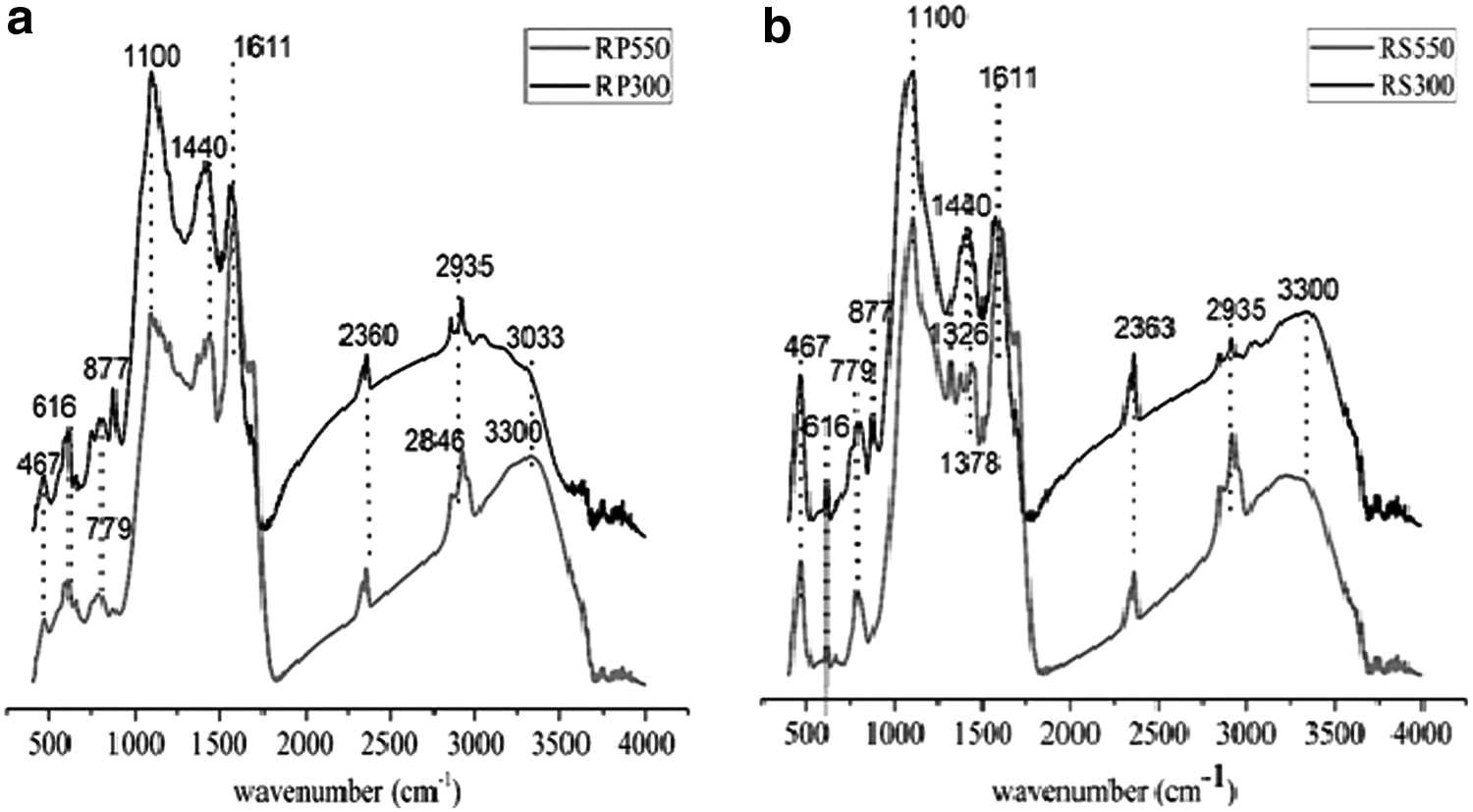
Fourier-transform infrared spectra of rapeseed residue biochars
SEM analysis is used to study the surface morphology of the materials. SEM images of the used BCs revealed a porous structure at 300°C and 550°C, respectively (Fig. 2). Rice straw BCs produced at both 300°C and 550°C were relatively more porous compared to rapeseed residue BCs (RP300 and RP550). Overall, due to drastic rupture of the feedstock surface, a more disintegrated structure was observed for BCs produced at high temperature (RS550 and RP550).

Scanning electron microscopy images of biochar RS300
Slight differences in mineral composition were observed for all the BCs as shown by X-ray diffraction analysis (Fig. 3). Peaks at 28° and 41° in both RS300 and RP300 showed the presence of sylvite (KCl). For RS550, however, the sharp peaks for sylvite and dolomite CaMg(CO3)2 at 30° were observed. A relatively broad peak at 20–24° in RP300 shows the cellulose structure of feedstock, which disappeared in RP550 with increasing pyrolysis temperature. The peak at 31° was attributed to dolomite, which was not found in rest of the BC samples. Relatively small peaks at 27° and 50° were assigned to quartz (SiO2) and calcite (CaCO3), respectively. Concluding, sylvite was a dominant crystalline phase with a small amount of dolomite, calcite, and quartz. These results are in agreement with Yuan et al. (2011). Overall, pyrolysis temperature and feedstock had a pronounced effect on BC properties, and consequently would be expected to have variable effects on heavy metal immobilization.
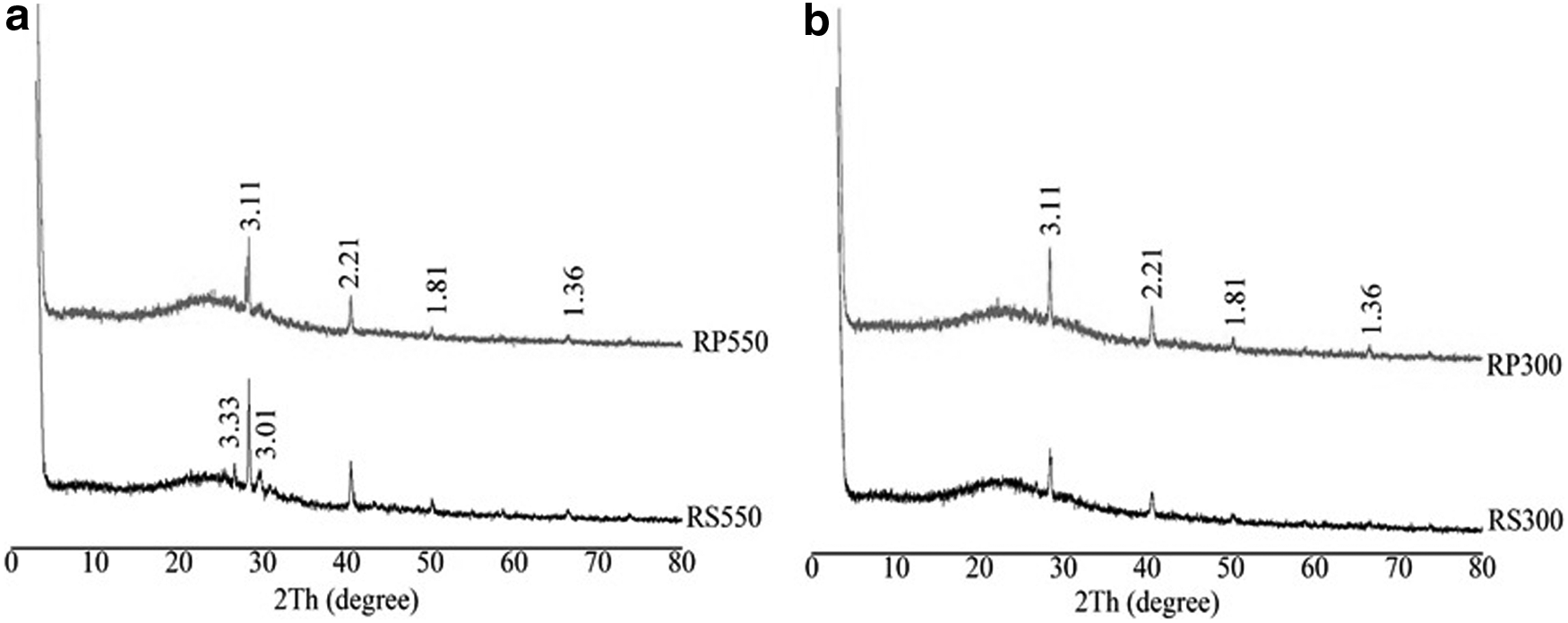
X-ray diffraction patterns of rice straw and rapeseed residue biochar produced at 550°C
Changes in the properties of the amended soil
Application of BCs markedly altered soil physicochemical properties. A consistent increase in the pH was observed in the soil amended with 5% RS550, followed by 5% RP550 treatment, while all the other treatments only slightly increased soil pH. When compared with the control, a maximum increase in soil pH from 6.02–7.72 was observed in soil amended with 5% RS550 BC (Fig. 4). As discussed earlier, increase in the pH is due to the alkaline nature of BCs, ash content, and liming effect of BCs and the effect of such amendments are more evident in the moderately acidic soils. BCs contain substantial amounts of alkaline and alkaline earth metals (K+, Ca+, Mg+, and Na+), and subsequent transformation and dissolution of these bases into oxides, hydroxides, and carbonates during pyrolysis tend to increase the soil pH. Compared with rice straw BCs (RS300 and RS550), a relatively low pH increasing efficacy in soil pH after the addition of rapeseed residue BC might be ascribed to the low ash content (mineral constituents) in rapeseed residue BCs (RP300 and RP550). Similar results were documented by Cantrell et al. (2012). Mechanisms by which heavy metals are stabilized in the soil are mainly associated with high soil pH, as a result of adding alkaline materials to the soil. These results are in agreement with some reports (Lu et al., 2014; Ahmad et al., 2016; Rizwan et al., 2016). A similar trend was observed in the soil EC, which significantly increased with increasing pyrolysis temperature and rates of application (Table 2). The highest value for EC was recorded in 5% RS550 treatment (0.89 mS/cm), followed by the 5% RP550 treatment (0.76 mS/cm), due to various amounts of dissolvable materials in the original feedstocks (Khan et al., 2015). The other treatments were also equally effective in increasing soil EC compared to control (0.35 mS/cm).
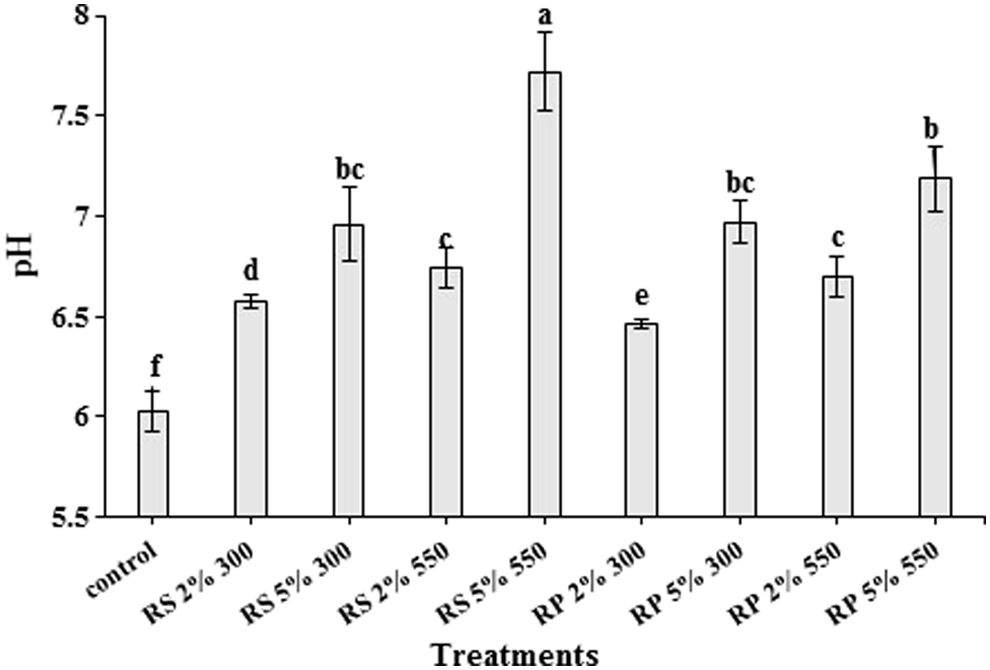
Changes in soil pH after addition of biochar. Error bars are the SD of the mean (n = 3) with letters (a–f) showing significant differences between experimental treatments at p < 0.05. SD, standard deviation.
Effect of Applied Biochars on Soil Electrical Conductivity and Cation Exchange Capacity
Different letters (a–f) show significant differences between experimental treatments at p < 0.05.
Remarkable increases in the soil CEC were observed, which ranged from 8.65 cmol(c)/kg in the control to 8.92 cmol(c)/kg in the soil incubated with 2% RP300, 13.75 cmol(c)/kg in 5% RS550, and 12.52 cmol(c)/kg in 5% RP550, respectively (Table 2). This increment could be attributed to the presence of oxygen-containing functional groups on BC surface, which have high affinity for divalent cations such as Pb, Cu, and Zn and thus play a key role in the formation of complexes. Furthermore, BCs contain appreciable amounts of inorganic constituents (K+, Ca+, and Mg+), which are released into the soil solution, thereby promoting soil CEC and providing readily available nutrients for plant growth. Variation and low CEC of the soil received low doses of BCs (2%); particularly, rapeseed residue BCs might be due to the low concentration of base cations such as Mg+ and K+ in the original biomass. Similar results were reported in the studies conducted by Cely et al. (2015), Uchimiya et al. (2010), and Houben et al. (2013).
All BCs carried negative surface charge, which was confirmed by the negative zeta potential values for the given feedstocks at all pHs. Zeta potentials of soil particles ranged from −9.53 mV at pH 3.5 in 2% RS300 to a maximum value of −34.83 mV at pH 6.5 in 5% RS550, while values of zeta potential for RP BCs at pH 3.5 were −13.06 mV in the 2% RP300 treatment and −31.36 mV at pH 6.5 in the 5% RP550 treatment (Fig. 5). Values of zeta potential for rice straw BC-amended soil were more negative than rapeseed residue BCs, because of OH-containing functional groups (Fig. 1). The quantity of negatively charged functional groups on BC surface increases with increasing pH, due to increased deprotonation of the functional groups at higher pH. These findings are in line with Samsuri et al. (2014) and Jiang et al. (2012). In the light of these results, that is, increased values of pH, CEC, and zeta potential, a boost in immobilization and fixation of heavy metals could be expected.
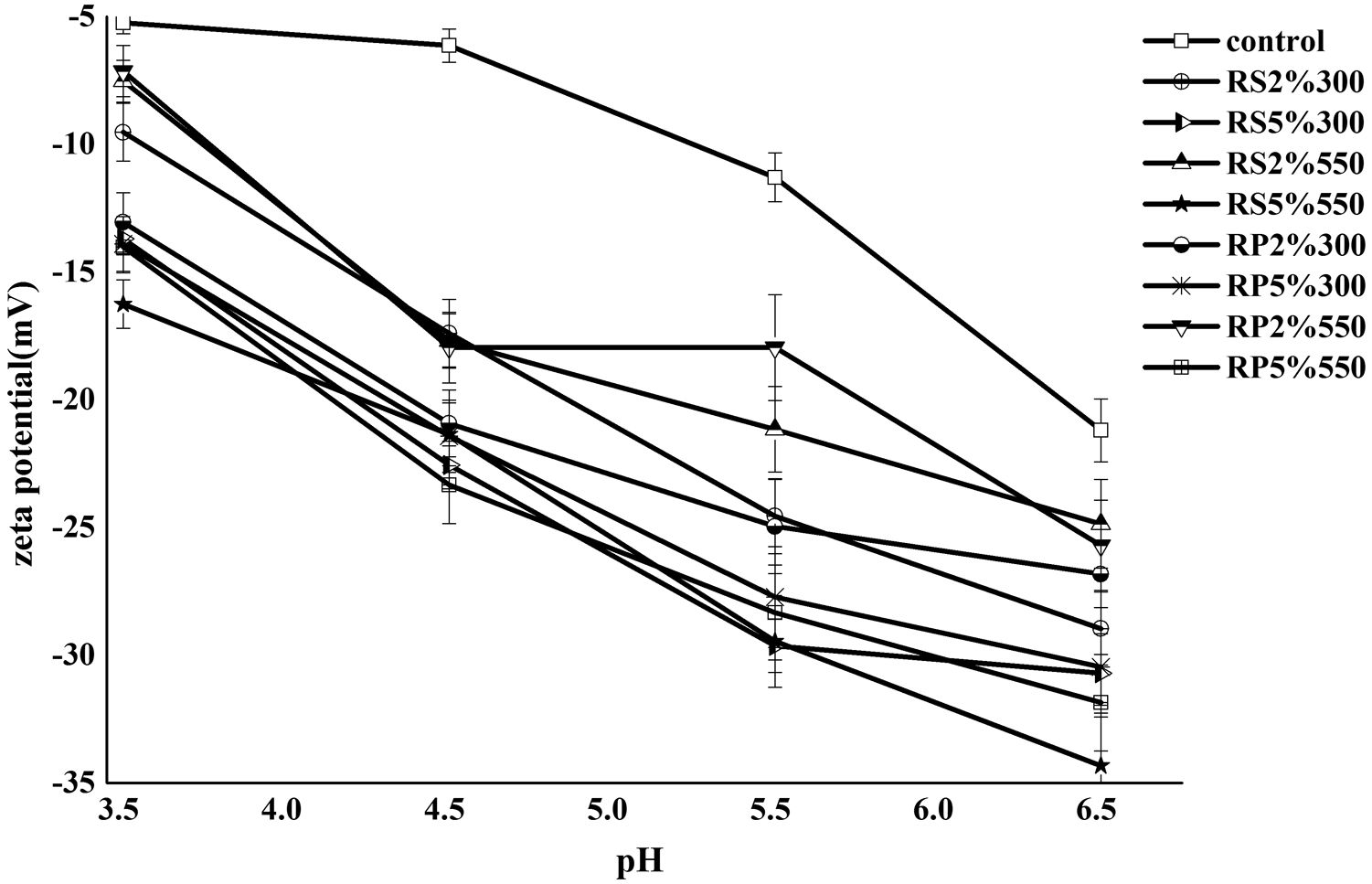
Variations in zeta potential of biochar-amended soils at pH values 3.5–6.5. Error bars are the standard deviation of the mean (n = 3).
Pb and Cu fractionation
Application of BCs modified the concentration of Pb and Cu in various fractions. The BCR sequential extraction results showed that all the treatments affected Pb and Cu concentrations in various soil fractions, as shown in Figs. 6 and 7. The acid-extractable/exchangeable fraction was substantially reduced by the rice straw BCs compared to rapeseed residue BCs. The acid-extractable Pb was reduced by 19.67% in 2% RS300 to 39.47% in 5% RS300, whereas RP300 BCs reduced the acid-extractable Cu by a maximum of 35.23% in 5% RP300. The greatest decrease in acid-extractable fraction was recorded when the soil was amended with 5% RS550 and RP550, which was in the range of 68.87% and 66.71% for Pb and Cu, respectively.

Pb fractionation after amending soil with biochars. Error bars are the SD of the mean (n = 3) with letters (a–e) showing significant differences between experimental treatments at p < 0.05.
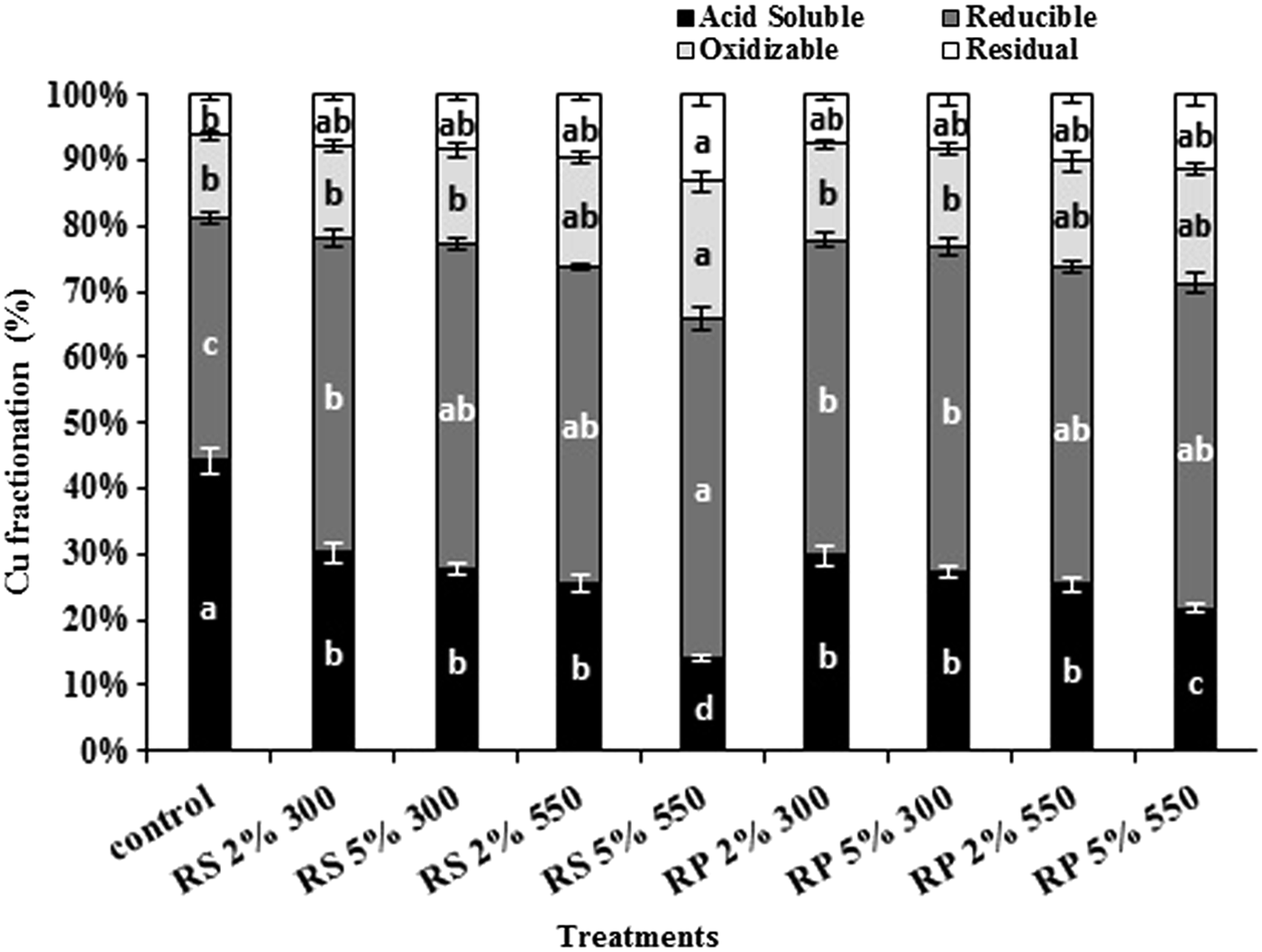
Cu fractionation after amending soil with biochars. Error bars are the SD of the mean (n = 3) with letters (a–e) showing significant differences between experimental treatments at p < 0.05.
When compared the concentration (mass) of Pb and Cu in the acid-soluble fractions, the concentration of Pb in the acid-soluble fraction was reduced from 124 mg·kg−1 in control to 88.6 and 99.53 mg·kg−1 in the soils amended with 5% of RS300 and RP300, respectively. A significant reduction (38.47 mg·kg −1) in the acid-soluble fraction was observed in 5% RS550 treatment, whereas the addition of 5% RP550 reduced the acid-soluble fraction to 60.82 mg·kg−1 compared to control. Likewise, the addition of 5% RP300 and RS300 reduced the Cu concentration in the acid-soluble fraction from 61.4 mg·kg−1 in control to 35.65 and 38.28 mg·kg−1, respectively. Amending the soils with 5% RS550 significantly decreased the Cu concentration to 20.16 mg·kg−1, while 5% RP550 reduced the acid-soluble fraction to 31.24 mg·kg−1 compared to control. Application of BCs at 2%, particularly RS300 and RP300, had no significant effects in reducing the concentration of Pb and Cu in the acid-soluble fractions. The observed reduction in the acid-soluble fraction could be attributed to the high pH of the soil treated with the BCs. Increased pH values of the BCs result in increased hydrolysis of metal cations, subsequently leading to the formation of Pb and Cu oxy(hydroxides) precipitate formation, which is one of the mechanisms of metals stabilization as stated by Jiang et al. (2012). Formation of stable chloropyromorphite and hydroxylpyromorphite precipitates also results in the decreased concentration of metals in the acid-soluble fraction, as documented by Ahmad et al. (2016). Furthermore, the activity of free metals decreases at high pH; therefore, the increased values of pH might have led to the decreased activity of free metals, thereby reducing the available fraction of Pb and Cu.
Immobilized Pb and Cu were mostly transformed into reducible fractions. Both RS550 and RP550 performed efficiently to increase the reducible phase of Pb and Cu by 21.80% and 32.18%, respectively, supported by the remaining treatments, compared to control. Increase in reducible forms could be attributed to the Fe content of BCs, which may act as an adsorbent in specific adsorption, as well as free Fe oxides that act as an adsorbent in nonelectrostatic adsorption. Similar results were reported by many researchers (Jiang et al., 2012; Rizwan et al., 2016; Ahmad et al., 2017; Fang et al., 2016). OM, as well as CEC, could also contribute to increasing reducible fraction of metals as reported by Mohamed et al. (2015).
When compared to control, the addition of 5% RS550 significantly increased the oxidizable portion of Pb and Cu by 17.25% and 43.70%, while 5% RP550 accounted for 6.85% and 30.20% increase, respectively. The residual fractions of Pb and Cu in the soil amended with 5% RS550 were significantly increased by 26.94% and 54.68%, respectively, while the other treatments slightly increased the residual fraction. BCs contain various organic functional groups with which complexation of Pb and Cu is common, and therefore oxidizable and residual fractions could be increased. Increase in the fraction bound to OM (oxidizable) could also increase due to the OM content of BCs. All the added BCs transformed the mobile and available forms of Pb and Cu to geochemically stable residual forms, thereby the metal bioavailability and activity were decreased. The residual fractions of the metals were less affected by the addition of BCs compared to the other three fractions, which could be attributed to the relatively short incubation time. These results are in line with Liang et al. (2014), Wuana et al. (2013), and Jiang et al. (2012).
Soil pH and CEC mainly contributed to Pb and Cu immobilization in this study. Soil pH has a great influence on heavy metal fractionation by controlling their dissolution and precipitation reaction, and regulating pH-dependent exchange sites (Adriano et al., 2004). Likewise, cation exchange between exchangeable Ca and Mg on BC surface and heavy metals lead to the formation of complexes. The activity of free metals tends to decrease with increase in pH; thus, the acid-soluble and available Pb and Cu fractions were reduced. The adsorbed metals move in a stern layer of soil colloids, and this occurs because only cations interfering the stern layer of soil particle could cause a change in zeta potential, and adsorbed metal cations would make surface charge less negative. Accordingly, these metals can enter back the bulk solution and could be more concentrated in acidic soils. As a result, metal immobilization could be reduced in field conditions. Therefore BCs and metal interactions should be further evaluated in actual field conditions. Pb and Cu chelation by OM have also been reported (Wu et al., 2013; Rizwan et al., 2016).
TCLP evaluation of effect of BCs on Pb and Cu solubility
The TCLP test is extensively used for evaluating leachability/solubility of heavy metals in soils, due to its relative rapidity, simplicity, and cheap cost (Cao et al., 2011). Both Pb and Cu contents in the untreated soil were higher than the crucial limits (5 mg/L), set by USEPA 1311 (1992). The concentration of TCLP-extractable Pb and Cu markedly decreased with the application of BCs (Fig. 8). Among all the treatments compared to the control, 5% RS550 was the most effective in decreasing the TCLP-extractable Pb and Cu concentrations by 92.62% and 72.55%, respectively, followed by 5% RP550, which accounted for 69.67% (Pb) and 62.24% (Cu), respectively. These results suggest that BCs have the potential to reduce the concentration of Pb and Cu. Increased alkalinity (high pH) of BCs due to carbonates might be responsible for the reduction in solubility and leaching toxicity by adsorption and precipitation. Pb and Cu are generally considered to form complexes with oxygen-containing functional groups (–COOH), thus reducing the solubility of metals. Also, the negative surface charge of BCs facilitates attraction of cationic metal ions, thereby fixing the metals. Similar results were reported by Wu et al. (2013), Lu et al. (2014), and Qiu et al. (2009). Although the Pb and Cu reduction (6.3 mg and 9.5 mg/L) in the 5% RS550 treatment, and 25.9 and 13.1 mg/L in the 5% RP550 treatment was still slightly above the permissible limits, it can be reduced even far below the critical limits by increasing application rate of BCs. Overall reduction in Pb and Cu concentration followed the order RS550>RP550>RS300>RP300>> control.
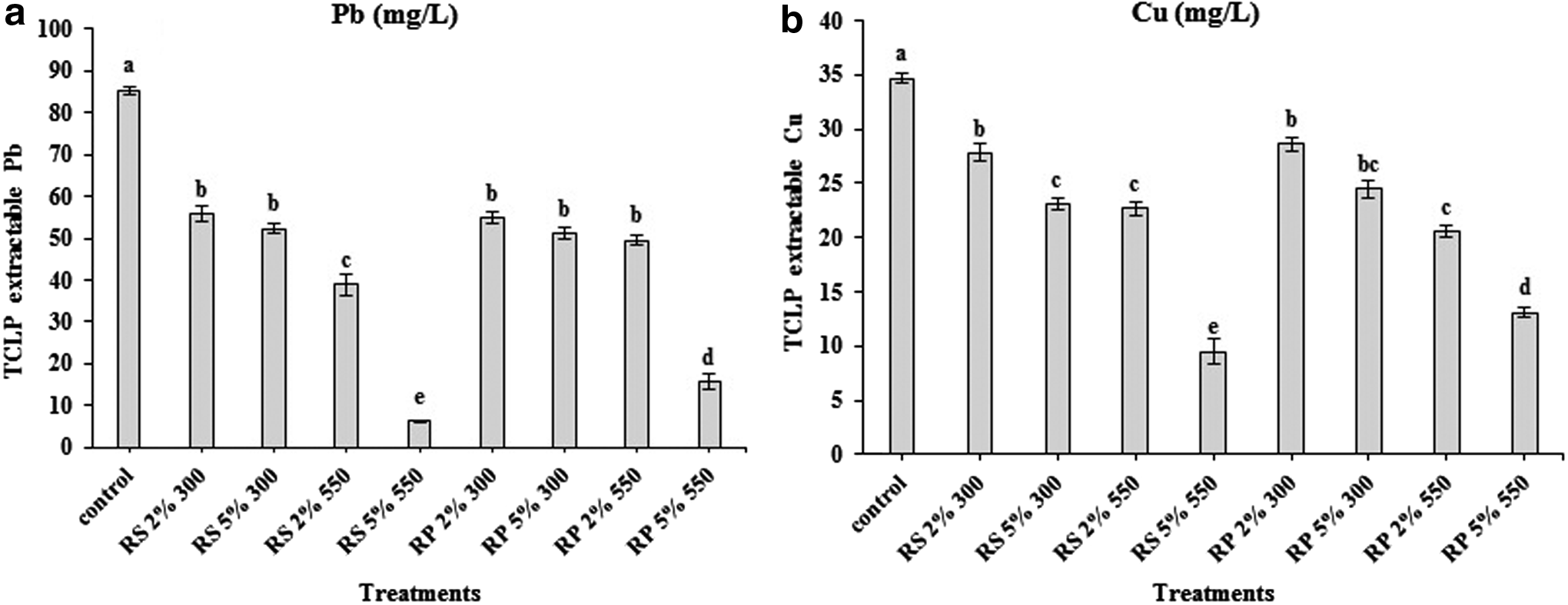
Effect of amendments on concentration of TCLP-extractable Pb
Influence of BCs on Pb and Cu bioavailability
CaCl2-extractable metals, which are related to the bioavailability of contaminants to soil organisms (Houba et al., 2000), also decreased after the addition of BCs. The concentration of CaCl2-extractable Pb and Cu in control soils was 5.93 and 3.69 mg·kg−1, respectively. Almost all the treatments reduced CaCl2-extractable Pb and Cu, indicating a decrease in metal availability (Fig. 9). A substantial decrease in the Pb and Cu concentration was observed in the soil amended with 5% RS550 and 5% RP550, respectively. BCs showed a relatively greater affinity for Pb compared to Cu. The concentration of CaCl2 extractable Pb was decreased by 97.13%, and 93.71%, while Cu concentration was reduced by 94.71%, and 92.14% in the treatments 5% RS550 and 5% RP550 respectively. Similarly, Pb was also decreased by 74.86% in 5% RS300 treatment and Cu by 88.18% in 2% RP550 treatment.

Effect of amendments on concentration of CaCl2-extractable Pb
BCs produced at high temperature tend to increase soil pH than BCs generated at low temperatures, and the bioavailability of heavy metals is mainly associated with soil pH (Houben et al., 2013). Therefore, in this study, a significant reduction in the concentration of bioavailable Pb and Cu could be related to the high pH observed in soil amended with rice straw BCs, supported by rapeseed BCs. Jiang et al. (2012) concluded that specific surface adsorption of Pb and Cu was enhanced by adding BCs, confirmed by zeta potential variations. Cations adsorption by organic and clay minerals can be classified into specific and nonspecific. The specific adsorption exhibits the adsorption of heavy metals in the internal layer forming coordination bonds to the surface, while nonspecific adsorption refers to adsorption of heavy metals by simple coulombic interaction in the diffuse electric double layer (Bolan et al., 1999). Pb and Cu might be immobilized by both specific and non-specific adsorption, as reported by Jiang et al. (2012), Samsuri et al. (2014), and Uchimiya et al. (2011b). Furthermore, greater O/C molar ratio could also contribute in reducing the solubility and bioavailability (Uchimiya et al., 2011).
Rice straw BCs prepared at high temperature compared to rapeseed residue BCs due to their favorable immobilization properties, such as increased pH, negative charge, surface area, and mineral composition, made it a promising stabilization amendment. Mineral components in BCs (Fig. 3) further play an important role in precipitating metals, thereby immobilizing Pb and Cu. Similar results were reported by Ahmad et al. (2012) and Cantrell et al. (2012), whereas, due to their low pH, surface area, and other related properties, low-temperature BCs (RS300 and RP300) marginally immobilized Pb and Cu. The applied BCs substantially reduced the mobile forms of soil Pb and Cu and increased the remaining three fractions. Consequently, both, soil Pb and Cu were efficiently immobilized in this study.
Conclusion
BCs from rapeseed residue and rice straw produced at 300°C and 550°C significantly influenced soil properties. Increased values of pH led to the increased negative surface charge, confirmed by decreasing zeta potential and high CEC in the amended soil. Addition of BCs transformed the available fractions of Pb and Cu into stable fractions. BCs generated at 550°C were more efficient for reducing the mobility of the metals compared to BCs produced at 300°C. We suggest that rice straw BC produced at 550°C has higher potential to immobilize heavy metals than rapeseed residue BC, and to revitalize and ameliorate contaminated soils. Furthermore, BCs should be used under field conditions to immobilize heavy metals, with controlled engineered pyrolysis conditions for its optimum performance, and to avoid the adverse effects on the soil environment.
Footnotes
Acknowledgments
This study was financially supported by Natural Science Foundation of China (Grant No. 41371470) and National Sci-Tech Support Plan (Grant No. 2015BAD05B02).
Author Disclosure Statement
No competing financial interests exist.