




Abstract
Abstract
The exposure of humans to different concentrations of pesticides is a serious phenomenon. Some organochlorine pesticides (OCPs) have been found to be mutinous; they remain in the environment for a long time. This study monitors OCP (17 compounds) concentrations in three agricultural drainage water sources never been monitored for OCP residues, at Kafr El-Sheikh governorate, Egypt. Numerous bacteria were found to significantly degrade different pesticide compounds. Findings of this study included isolation and identification of Paenibacillus sp. strain 10 for the remarkable capability of OCP degradation. Paenibacillus sp. with active gradients in broth culture, incubated for 2 weeks, showed great efficiency in biodegradation of OCPs, ranging between 24.4% and 98% (and sometimes as high as 100%). Paenibacillus sp. could be further scaled up to be introduced as a cleanup process for contaminated matrices in the area under study and other polluted sites.
Introduction
L
Some organochlorine pesticides (OCPs) such as DDT and Dieldrin have been found to be mutinous, remaining in the environment, and are known to accumulate into food chains decades after their application to soil (Kannan et al., 1994). Pesticides that are neither adsorbed on clay minerals and soil particles nor absorbed by plants and animals can infiltrate to aquatic environments and penetrate the aquatic food chain. Such environmental transference can cause a violation of different environmental components (Mansour, 2008).
Exposure of humans to different concentrations of pesticides in Egypt is a serious phenomenon, still affecting farmers, workers, and supervisors, especially in the field of agricultural applications of pesticides in the cotton fields for more than once during the season (Mansour, 2008). Ezzat et al. (2005) discovered that 62% of 236 subjects with hepatocellular carcinoma were exposed to pesticides at either urban or rural homes. Attia (2005) performed a comparison at Kafr El-Sheikh Governorate, Egypt, included 240 persons between pesticides handlers and other laborers outside the agricultural field, and found that pesticides handlers exhibited weakness of reproductive ability of males and kidney and liver function deterioration. Recently, usage of many of these compounds has been banned in America, Europe, and various countries around the world and has been replaced by other chemical compounds with a higher safety level and a shorter half-life time.
Several studies have tried to get rid of residues of these compounds in different ways, including chemical, physical, and biological techniques. The microbe-assisted degradation of pesticide residues is still believed to be a safe, cost-effective, and promising process. Traditional isolation methods, involving enrichment culture and plating techniques, have been used to isolate various microbes able to degrade pesticides in pure cultures (Aislabie and Lloyd-Jones, 1995). The degradation of pesticides in situ is usually achieved by a consortium of microbes rather than a single species (Pickup, 1991). Different genetic studies of pesticide degrading bacteria focused on cloning and characterization of specific enzymes involved in pesticide degradation (Sayler et al., 1990).
Biodegradation of pesticides has been studied under aerobic and anaerobic conditions. However, degradation of some pesticides may proceed under alternating aerobic–anaerobic conditions (Aislabie and Lloyd-Jones, 1995). Numerous bacteria were found to be able to co-metabolically metabolize DDT by dechlorination to DDD under anaerobic conditions (MacRae, 1989). In irrigated agricultural soils, significantly reduced DDT levels have been detected; this may be due to the enhanced activity of anaerobic bacteria in wet soils (Boul et al., 1994). The metabolic fate of pesticides is dependent on abiotic factors (temperature, moisture, soil pH, etc.), microbial community, pesticide characteristics, and biological and chemical reactions (Kazemi et al., 2012).
Multiple studies used different microorganisms to get rid of various types of pesticides; Massoud et al. (2008) tested biodegradation of metalaxyl by different bacterial isolates and proved that bacterial isolates showed high ability in metalaxyl degradation, which might be a step toward detoxification of many biologically active pesticide compounds, and thus provide a major technique for destroying significant toxicants. Derbalah and Belal (2008) studied biodegradation of cymoxanil and showed no toxicity of cymoxanil in the aqueous media after 28 days of treatment with Pseudomonas sp. (EB11) strain, and the disintegration of cymoxanil was mainly related to the degradation by the tested strains. Derbalah et al. (2008) informed that Pseudomonas sp. (EB1) achieved high efficient biodegradation of famoxadone and only slight famoxadone toxicity was found in aqueous media after 28 days of treatment.
The problem of accumulation of persistent pesticide compounds in soils might be attributed to the fact that the soil microorganisms are not capable of the degradation process of many pesticide compounds to such sufficient rates needed to prevent soil and water pollution. Therefore, everyone could imagine the necessity of using microorganisms isolated from the same aquatic and terrestrial environments monitored for pesticide residues for the biodegradation of these compounds to preserve the health of humans and animals. The use of microorganisms in the degradation process of pesticide residues is cost-effective with consideration to other physical and chemical processes, which might be used for the same purpose.
The aims of this study are to estimate OCP residues in some sources of agricultural drainage water in Kafr El-Sheikh governorate, Egypt, isolating microorganisms that have the ability to break down pesticides and get rid of their residues in water, screening the most effective strains with regard to OCP biodegradation, identification of these microorganisms on the basis of morphological and biochemical characteristics as well as 16S rRNA sequencing, and the practical application of the obtained microorganisms to articulate their capability of degrading different types of pesticides.
Materials and Methods
Sampling and sampling sites
Agriculture drainage water samples were collected during April–July 2017 from three agricultural drains, including the Ruwaynah drain, Drain No. 7 and Kitchener drain, all located in Kafr El-Sheikh Governorate, Egypt. Samples were taken manually 30 cm under the surface of the water and transferred to the laboratory in icebox according to method of USEPA (1995). Table 1 showed sampling sites' locations and coordinates.
Chemicals
Tested pesticide active ingredients are HCH-delta, endosulfan sulfate, HCH-alpha, HCH-gamma (lindane), heptachlor, aldrin, HCH-beta, heptachlor epoxide, endosulfan I, 4,4′-DDE, dieldrin, endrin, 4,4′-DDD, endosulfan II, 4,4′-DDT, endrin aldehyde, and methoxychlor, and were supplied by Varian Company.
Sample preparation
Two liters of water samples in cleaned, sterilized, and solvent-washed glass bottles from each site was collected and transferred to the laboratory in an ice container. One liter of each sample was filtered through fiberglass filter to remove turbidity and debris, and stored at 4°C before extraction. The other liter of each sample was injected with a concentration of 0.025 μg/L of chlorinated pesticide standard, then marked, and incubated at 30°C for 1 month. Samples were tested the same way for detecting the pesticide biodegradation percentages after incubation.
Media
Minimal medium as mineral salt liquid (MSL), minimal medium as mineral salt agar medium, and nutrient agar medium were used as enrichment media throughout this study as described by Brunner et al. (1980).
Extraction procedure
One liter of each water sample was transferred into a separatory funnel and 60 mL dichloromethane was added. The separatory funnel was shaken vigorously for about 2 min with periodic venting to release excess pressure. The organic layer was allowed to separate for 10 min and was collected into a 250 mL flask. The extraction procedure was repeated twice. The combined extract was percolated through an anhydrous sodium sulfate column. The dried extract was evaporated using a rotary evaporator adjusted at 65–70°C until the volume reached 1–2 mL. A volume of 5–10 mL of n-Hexane was added to the extract; then the final extract was evaporated again using the rotary evaporator until the volume reached 1 mL. The walls of the concentrator tube were rinsed with n-Hexane, while adjusting the volume to 5.0 mL. The extract was transferred to an appropriate-sized TFE-fluorocarbon-sealed screw-cap vial and stored, refrigerated at 4°C, until analysis by gas chromatograph–electron capture detector (GC-ECD). This method was used according to USEPA (1995).
Gas chromatograph–electron capture detector
Residues of the monitored pesticides were analyzed by using a GC model (Varian CP3800) equipped with an ECD for detection of chlorinated pesticides.
Isolation by enrichment culture
Enrichment cultures of microorganisms capable of degrading chlorinated pesticides were established from water samples of agricultural drainage water. Water samples were collected from three agricultural drains within Kafr El-Sheikh governorate, Egypt, and were previously tested for detecting chlorinated pesticide concentrations. A volume of 10 mL of each sample was suspended in 90 mL sterilized mineral salt medium in 500-mL bottle containing (100 μg/L) of chlorinated pesticide standard as a sole source of carbon, and then incubated at 30°C and 150 r/min for 30 days. After that, a volume of 10 mL of the cultures was transferred into fresh 90 mL MSL medium containing the same concentration of chlorinated pesticides. This procedure was repeated four times. Dilution series were prepared after the final time from the enrichment culture in glass tube containing 9 mL MSL medium up to 1 × 10⁻⁶, and then a volume of 100 μL of it was spread on plates of MSL medium+chlorinated pesticides (100 μg/L) using drigalisky triangle. The plates were sealed in polyethylene bags, then incubated at 30°C for 7 days and monitored for the appearance of colonies. Single colonies growing on these diluted plates were isolated by picking the colonies using sterile inoculation needle and were further purified by the standard spatial streaking on complex agar media for bacterial isolate (Derbalah and Belal, 2008; Derbalah et al., 2008; Massoud et al., 2008).
Identification
The efficient, selected OCP degrading bacterium was identified on the basis of morphological and biochemical characters and 16S rRNA.
Morphological and cultural characterization of the selected isolate
Bacterial isolates were examined for their cell shape, motility studies, and gram reaction.
Cell shape
Purified cultures at log phase after 72 h were microscopically examined for the cell morphological characters.
Motility
The 72-h grown isolates were microscopically examined using cavity slide for bacterial motility.
Gram reaction
Gram staining was carried out as mentioned by Rangaswami and Bagyaraj (1993).
Biochemical characterization of the selective isolates
Oxidase test
The isolate was streaked on trypticase soy agar medium and incubated at 37°C for 48 h (Cappuccino and Sherman, 1996). After the incubation period, 2–3 drops of 1% of P-aminodimethylaniline oxalate solution were added on the streaked area and the plates were observed for the color change from pink to maroon, and finally to purple within 30 s, indicating a positive reaction.
Catalase activity
A loopful of 24-h old culture of isolate was transferred to a glass test tube containing 0.5 mL distilled water and mixed thoroughly with 0.5 mL of 3% hydrogen peroxide solution and observed for effervescence (Gerhardt et al., 1981).
Urease test
Urease test was performed on 5 mL of urea broth (20 g/L) in test tubes containing phenol red (0.012 g/L), pH 6.8 as the pH indicator (Cappuccino and Sherman, 1996). The cultures were transferred into the sterilized urea broth and incubated for 24 h. The development of red color indicates a positive reaction.
Citrate utilization test
The selective isolate was inoculated into test tubes having Simmons citrate agar medium and incubated for 48 h at 35°C (Seeley and Vandemark, 1981). Simmons citrate agar contains citrate as only carbon and energy source. The presence of growth and change of color from green to blue due to pH change indicated positive reaction.
Indole production
The isolate was inoculated into sterilized glucose tryptone broth in test tubes (Seeley and Vandemark, 1981). After 48 h of incubation, 0.3 mL of Kovac's reagent was added and mixed well. The reddening of the alcohol layer within few minutes indicates indole production.
Gelatin liquefaction
Nutrient gelatin media were inoculated with 24-h pure culture and incubated for 24 h at 20°C (Woodland, 2004). Gelatin liquefaction is observed by any liquefaction that occurs in media.
Starch hydrolysis
Starch agar medium was inoculated with selected bacterium, incubated for 3–5 days, and then flooded with dilute iodine solution (Collins et al., 1995). Hydrolysis is indicated by clear zones around the growth. Unchanged starch gives a blue color.
Molecular characterization of the selective isolate by polymerase chain reaction
The most efficient bacterial isolate in OCP degradation was identified using 16S rRNA as described by Boye et al. (1999). DNA was extracted using protocol of GeneJet genomic DNA, purified, and polymerase chain reaction (PCR) was made by using Maxima Hot Start PCR Master Mix (Thermo).
Results and Discussion
We present analysis of 17 OCP residues in water samples collected from three agricultural drains in Kafr El-Sheikh governorate, Egypt, including Ruwaynah drain, Drain No. 7 and Kitchener drain. Studied compounds included hexachlorocyclohexane (HCH-alpha, HCH,-beta, HCH-gamma, and HCH-delta), cyclodiene (aldrin, dieldrin, endrin, endrin aldehyde, heptachlor, heptachlor epoxide, endosulfan I, endosulfan II, and endosulfan sulfate), and diphenyl aliphatic chlorinated pesticides (4,4′-DDE, 4,4′-DDD, 4,4′-DDT, and methoxychlor). Samples showed variable values of OCP concentrations, where concentrations of OCPs in water samples varied from 0.00 to 0.0237 μg/L; the highest value recorded was 0.0237 μg/L for 4,4′-DDT in Ruwaynah drain, while other points showed absence of HCH-delta, 4,4′-DDD, and methoxychlor in Drain No. 7, and absence of endosulfan I in Kitchener drain. Table 2 and Fig. 1 show concentrations (μg/L) of chlorinated pesticides in surface water samples collected from three sites of agricultural drainage. Similar results of OCP residues in aquatic habitats were presented by Ashry et al. (2006). Figures 2–4 showed chromatograms of OCP residues in water samples of Ruwaynah drain, Drain No. 7, and Kitchener drain, respectively.
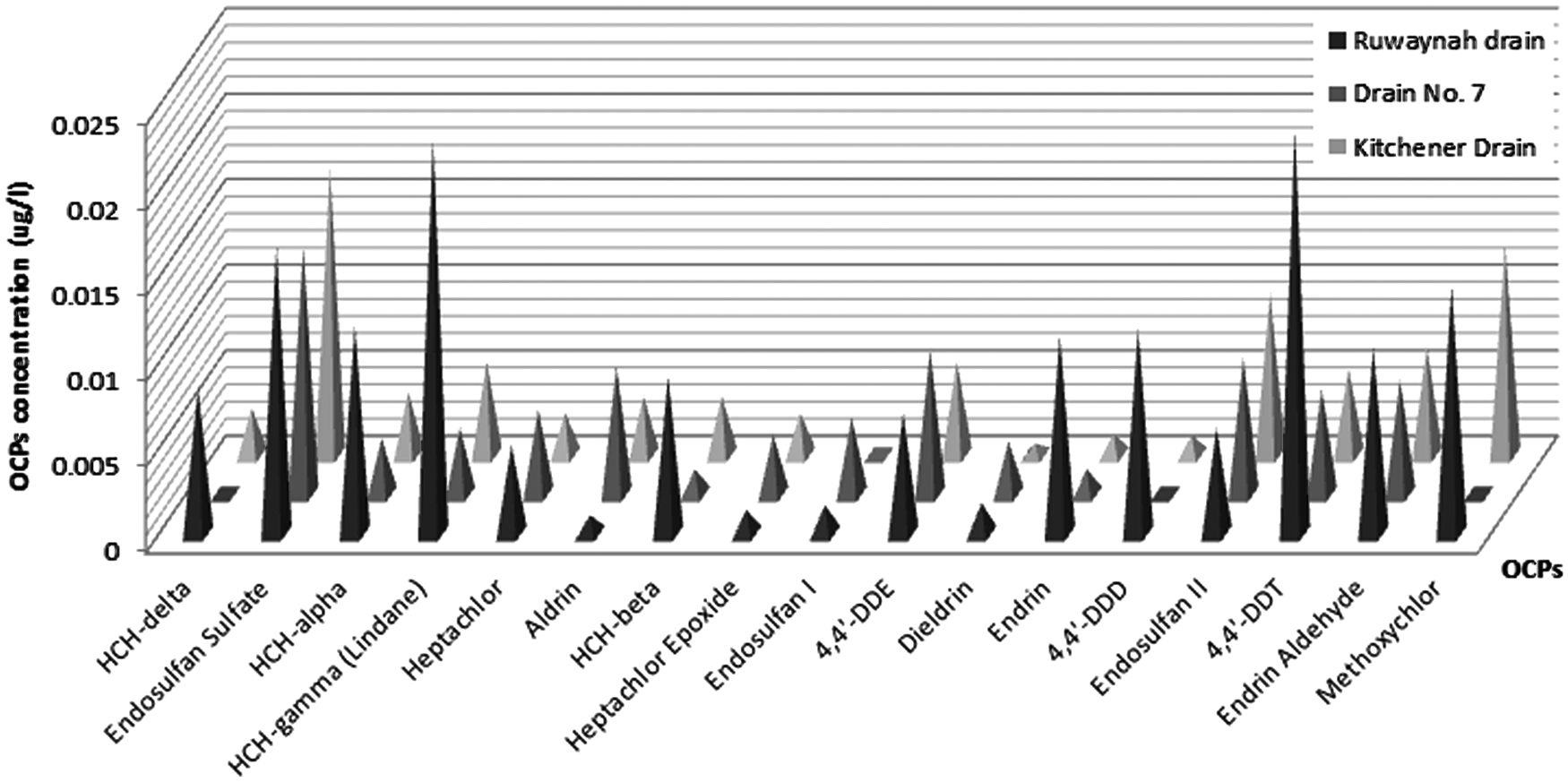
Concentration (μg/L) of chlorinated pesticides in surface water samples collected from three sites of agricultural drainage.

GC/ECD chromatogram of OCP residues for surface water sample of Ruwaynah drain. GC-ECD, gas chromatograph–electron capture detector; OCP, organochlorine pesticide.
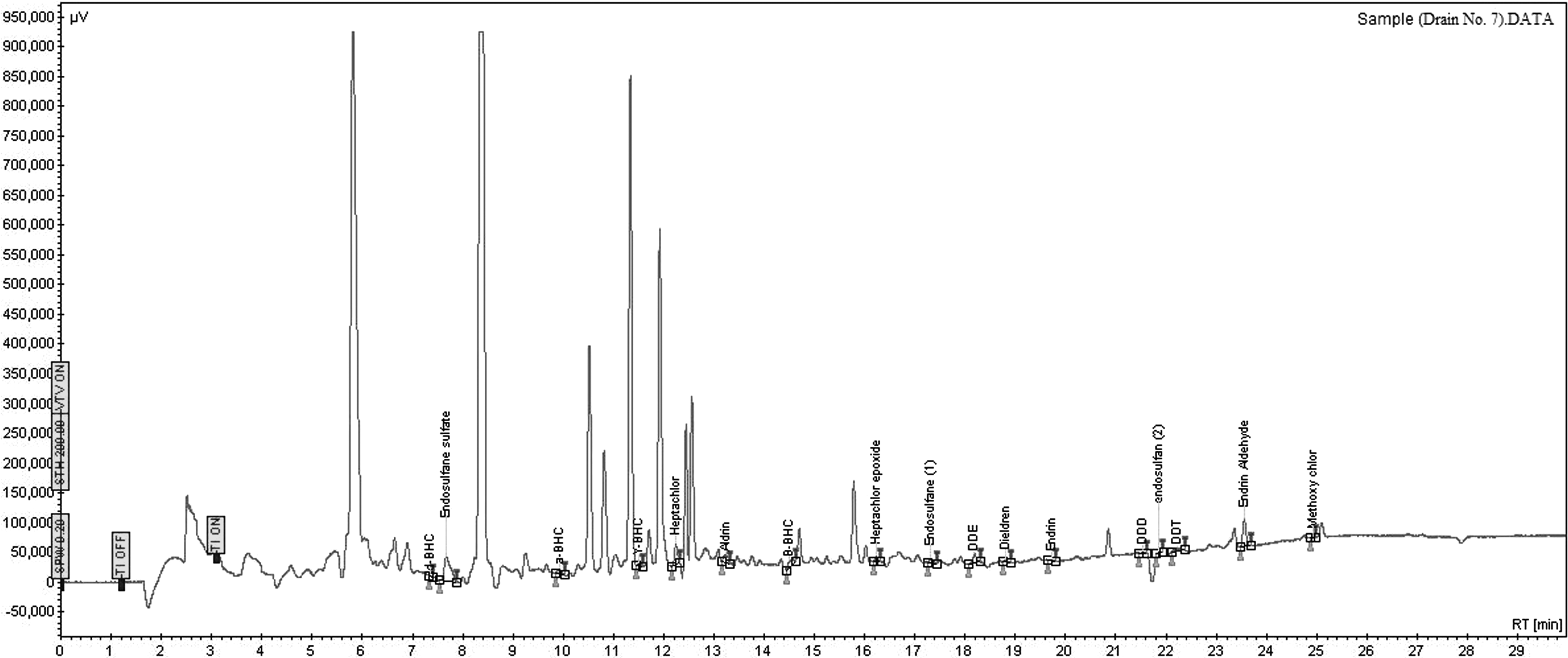
GC/ECD chromatogram of OCP residues for surface water sample of Drain No. 7.
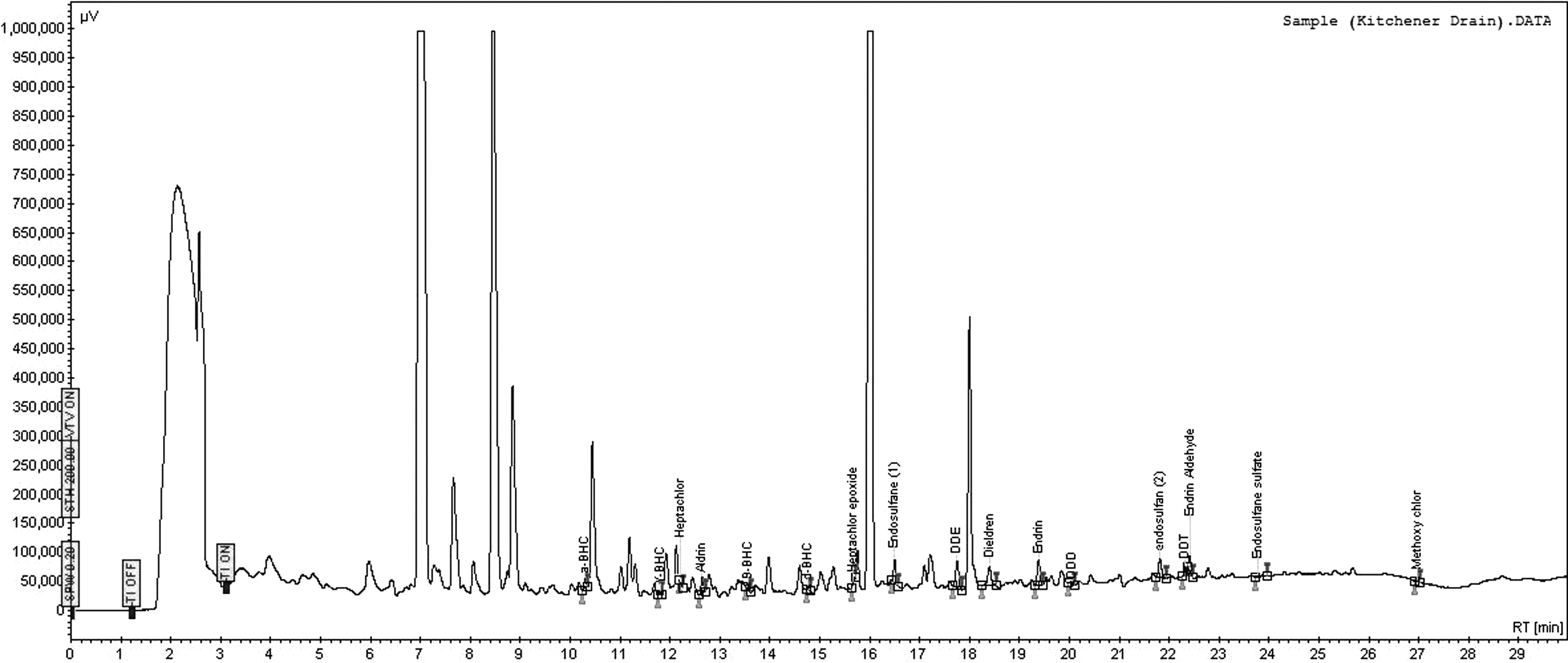
GC/ECD chromatogram of OCP residues for surface water sample of Kitchener drain.
MDL: 0.001 ng/L.
MDL, minimum detection limit; OCP, organochlorine pesticide.
Hexachlorocyclohexanes are polyhalogenated organic compounds consisting of a six-carbon ring with one chlorine and one hydrogen attached to each carbon, and there are many isomers for this structure, differing by the stereochemistry of the individual chlorine substituents on the cyclohexane. They are considered the least persistent OCPs. They are of particular interest and importance because they bioaccumulate in humans and have many toxic and carcinogenic effects. Depending on the average rate of participation of different isomers, they could be organized as follows: gamma-HCH > alpha-HCH > beta-HCH > delta-HCH; therefore it could be concluded that gamma isomer is the most common and persistent isomer of hexachlorocyclohexanes in water samples of the studied agricultural drains. The highest concentration 0.0231 μg/L of gamma-HCH was recorded at Ruwaynah drain, while Drain No. 7 and Kitchener drain recorded 0.0039 and 0.0055 μg/L, respectively. Similar results were given by El-Bouraie et al. (2011) and El-Barbary et al. (2011).
ΣCyclodienes are a group of pesticides derived from hexachlorocyclopentadiene with a chlorinated methylene group forming a bridge across a six-membered carbon ring, including aldrin, dieldrin, endrin, endrin aldehyde, heptachlor, heptachlor epoxide, methoxychlor, endosulfan I, II, and endosulfan sulfate. Aldrin and dieldrin are recognized as persistent OCPs that have serious environmental effects. They are toxic to higher organisms, causing considerable negative effects, including endocrine system disruption in birds and mammals, interfere with sex hormones causing reproductive ability ailment of males, and might cause cancer in humans (Purnomo, 2017). Concentration of Σcyclodienes varied from 0.0011 to 0.0168 μg/L at Ruwaynah drain, from 0.00 to 0.0145 μg/L at Drain No. 7, and Kitchener drain recorded values ranging between 0.00 and 0.0168 μg/L, similar results were given by El-Bouraie et al. (2011). It was remarkable that endosulfan sulfate showed the highest concentrations among other cyclodienes in the three sites, reflecting the fact that it had either been used until a very short period of time or is still in use, even though it has been prohibited to be used in many countries around the world. Other cause of the elevated concentrations of endosulfan sulfate might be attributed to the breakdown of endosulfan to endosulfan sulfate, endosulfan diol, and endosulfan furan, all of which have structures similar to the parent compound and, according to the EPA, “are also of toxicological concern”. The estimated half-lives for the combined toxic residues (endosulfan plus endosulfan sulfate) range from roughly 9 months to 6 years. The EPA concluded that these compounds are very persistent, have relatively high potential to bioaccumulate in fish, also are toxic to amphibians, and low levels have been found to kill tadpoles (USEPA, 2002; Relyea, 2009). Endosulfan sulfate is not classifiable as a human carcinogen according to the American Conference of Governmental for Industrial Hygienists (2008), despite its deleterious impact on environment and mammals. Endrin is an alicyclic chlorinated hydrocarbon and is rapidly converted to the epoxide form (endrin aldehyde). The presence of concentrations of endrin recorded in water samples from the studied sites means that either there is a renewal source of endrin or endrin was used recently. Endrin concentrations were recorded as 0.0116, 0.0015, and 0.0013 μg/L for Ruwaynah drain, Drain No. 7, and Kitchener drain, respectively. Similar findings and assumptions were given by El-Bouraie et al. (2011).
Concentration of ΣDDTs (DDT and its metabolites: DDE and DDD) showed variable values. Concentrations of 4,4′-DDE were recorded as 0.0071, 0.0085, and 0.0055 μg/L at Ruwaynah drain, Drain No. 7, and Kitchener drain, respectively, while concentrations of 4,4′-DDD were recorded as 0.012, 0.00, and 0.0012 μg/L at Ruwaynah drain, Drain No. 7, and Kitchener drain, respectively; 4,4′-DDT concentrations were recorded as 0.0237, 0.0062, and 0.0051 μg/L at Ruwaynah drain, Drain No. 7, and Kitchener drain respectively. In the environment, DDT can be degraded by solar radiation or metabolized by organisms. Dehydrochlorination of DDT resulted in DDE as a metabolite (Picer, 2000); therefore, it could be accepted that the recorded values of 4,4′-DDE concentrations were higher than those for 4,4′-DDT concentrations at Drain No. 7 and Kitchener drain as well. The 4,4′-DDE is the most dominant pesticide, followed by 4,4′-DDT and then 4,4′-DDD at Drain No. 7 and Kitchener drain as well. Ruwaynah drain showed the highest recorded values for 4,4′-DDT, 4,4′-DDE, and 4,4′-DDD, which indicate the continuation of DDT usage in this area, despite the fact that it is forbidden to be used in many countries around the world. Other reasons might be related to the intensive use of DDT and its metabolites (DDE and DDD) during past years; therefore, it is still detected with the metabolites (DDE and DDD) in different concentrations, (Ashry et al., 2006; Massoud et al., 2008; El-Barbary et al., 2011; El-Bouraie et al., 2011).
Isolation by enrichment culture
A total of 10 morphologically different microorganisms capable of degrading chlorinated pesticides were isolated from the three sources that had been described previously. Figure 5 illustrates images of complex growth of pesticides degrading bacteria on plates of MSL medium + chlorinated pesticides (100 μg/L). The results compiled in Table 3 illustrate numbers, codes, and sources of the 10 microorganisms that were isolated and marked for their abilities to degrade chlorinated pesticides.
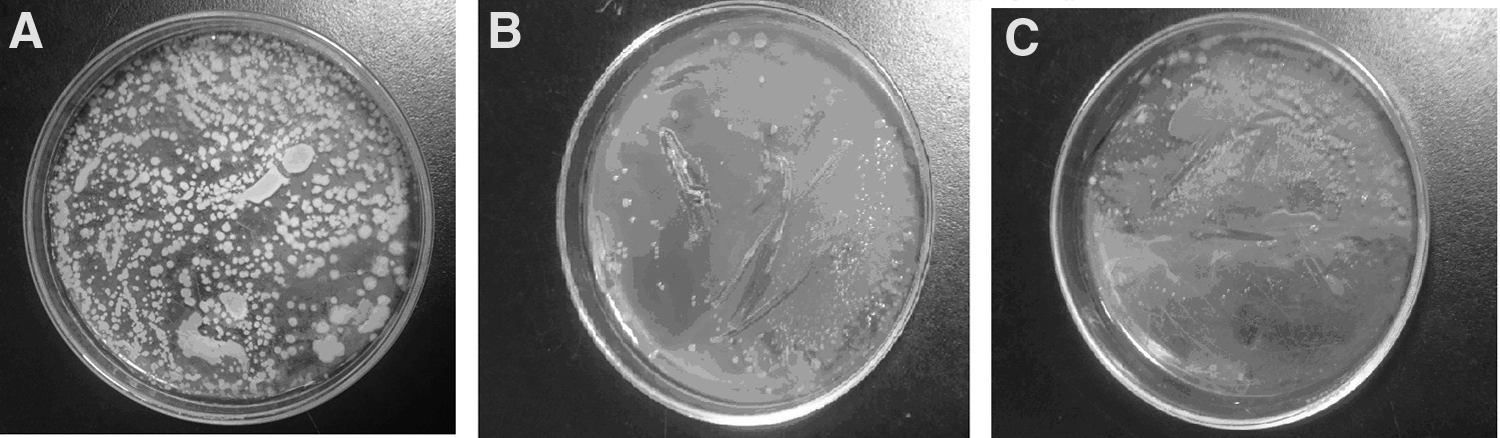
Initial screening of chlorinated pesticide degrading bacteria;
Screening of chlorinated pesticide degrading bacterial isolates using the viable count technique
A total of 10 morphologically different chlorinated pesticide degrading bacterial isolates were obtained (Table 3). The isolated colonies were tested for their ability to grow in MSL medium containing (100 μg/L) of the chlorinated pesticide standard. One treatment contained the medium as well as pesticide standard, while the other contained the medium and the isolate as a control (no pesticides). The cultures were shaken at 150 r/min and 30°C for 14 days. Screening of bacterial isolates that had the greater capability of degrading chlorinated pesticides was carried out depending on the viable count of bacterial isolates. Serial dilution tubes up to 1 × 10⁻⁶ were prepared from each culture and then a volume of 100 μL of each tube was spread on plates of plate count agar medium using a sterilized drigalisky triangle. Plates were further incubated at 30°C for 2 days, where the viable count of each strain was counted using a colony counter. Table 4 represents the viable count of bacterial isolates that have the capability to biodegrade chlorinated pesticides. Bacterial strain 10 showed the highest count. Single colonies of the selected bacterial isolate (strain 10) grown on these plates (and are most capable of degrading chlorinated pesticides) were isolated by picking the colonies using a sterile needle, and then inoculated into fresh plates and slants for identification purposes (Derbalah and Belal, 2008; Derbalah et al., 2008; Massoud et al., 2008)
Identification of efficient pesticide degrading bacterial isolates
Cultural, morphological, and physiological properties of the most efficient pesticide degrading bacterial isolates were studied to identify the organism according to Bergey's manual of systematic bacteriology (1984), Zhang et al. (2013), Guo et al. (2012), Bahamdain et al. (2015). Strain 10 was found to be gram positive, motile, rod shaped with glossy and convex surface and milky white in color, Table 5, and give positive results for oxidase, catalase, urease, and hydrolysis of starch, while giving negative results for citrate utilization, indole production, and gelatin liquefaction, Table 6.
It could be concluded that the bacterial isolate (strain 10) is identical to those known for Paenibacillus sp. by comparing the data given in Tables 5 and 6 to those reported elsewhere (Bergey's manual of systematic bacteriology, 1984; Guo et al., 2012; Zhang et al., 2013; Bahamdain et al., 2015).
According to the 16S rRNA analysis (Boye et al., 1999), the phylogenetic tree of the pesticides degrading bacterial isolate (strain 10) and related bacterial species based on the 16S rRNA sequence is provided in Fig. 6. It can be clearly seen that Paenibacillus sp. (strain 10) was included in the genus Paenibacillus and closely related to several Paenibacillus species.

Phylogenetic dendrogram obtained by distance matrix analysis of 16S rRNA sequences, showing the position of strain Paenibacillus sp. (strain 10) among phylogenetic neighbors. The scale bar indicates 0.02 substitutions per nucleotide position.
Biodegradation capability of Paenibacillus sp. strain 10
A volume of 1,000 mL of MSL medium containing (25 μg/L) of the chlorinated pesticide standard was prepared, tested for OCP concentrations (initial concentrations of OCPs are 25 μg/L for each compound), and then inoculated with 1 mL of culture containing 4 × 10⁶ cfu/mL to study the biodegradation of OCPs in aquatic system by means of Paenibacillus sp. strain 10. The culture was further incubated at 30°C for 14 days. Following incubation, the culture was tested the same way for detecting pesticide concentrations levels. Previous steps were repeated for conducting a duplicate experiment and then average and standard deviation were calculated for detecting biodegradation percentages. Another volume of the same medium (labeled as a control), containing the same concentration of OCPs, was incubated without being inoculated for detecting whether degradation of OCPs was due to the microbial activity or a result of other factors such as absorption into biomass. Table 7 shows initial OCP concentrations, OCP concentrations in Paenibacillus sp. cultures after incubation period, and the average and the standard deviation of the OCP concentrations levels following incubation period.
MDL: 0.001 ng/L.
Degradation of OCPs was distinctly observed following incubation for most compounds. In fact, the degradation percentage reached 100% for aldrin, endosulfan I, and endosulfan II. Most compounds showed that degradation ranged between 24.4% and 98%. The lowest degradation rate was recorded for methoxychlor. Concentrations of the control experiment showed that OCPs are persistent compounds and their residues are not affected by the incubation period (14 days), and the degradation was due to bacterial activity and not other factors. Degradation of OCPs is attributed to the existence of Paenibacillus sp. in the culture, which is characterized by the capability of OCP biodegradation and utilization of these compounds as carbon source, as discussed by Massoud et al. (2008), Derbalah and Belal (2008), and Derbalah et al. (2008). Recorded biodegradation percentage of endrin showed negative value, indicating the absence of endrin degrading capability with regard to Paenibacillus sp. (strain 10); high concentration of endrin in sample after the incubation period might be attributed to either the breakdown of other isomers or the existence of some microorganisms that had the ability to degrade dieldrin and aldrin to some metabolic compounds such as endrin, where Purnomo (2017) reviewed such possibilities. Figure 7 represented OCP biodegradation percentages (defined by average of OCP concentrations in cultures) by Paenibacillus sp. strain 10.

OCP biodegradation percentages by Paenibacillus sp. strain.
Results of this study indicated that agricultural drainage water sources in Kafr El-Sheikh governorate represented by Ruwaynah drain, Drain No. 7, and Kitchener drain were polluted with chlorinated pesticide residues in varying concentrations. Pesticides can have serious consequences for fertile soil, considering their toxic and carcinogenic effect on living organisms. Many previous and current studies have attempted to use different methods to reduce the impact of pesticides and attempt to eliminate pesticide residues in the environment. Chemical, biological, and enzymatic processes were designed to extirpate pesticide residues from terrestrial and aquatic environments, and among these processes, biodegradation has proved to be a cost-effective and thermodynamically affordable process. The findings of this study illustrate one bacterial strain isolated from agricultural drainage water and identified according to their morphological and biochemical characteristics, and 16S rRNA proves to possess promising capabilities on chlorinated pesticide biodegradation. This isolated bacterial strain was identified as Paenibacillus sp. (strain 10). Similar findings were reported by Karpouzas et al. (2005) who used an enrichment culture technique for isolation of bacterial strains having the ability of degrading the nematicide known as cadusafos. Chen et al. (2012) showed that isolated endophytic bacteria belonging to the genus Paenibacillus can achieve relatively high rates of pesticide degradation. Rani et al. (2017) indicated that bacterial strain IITISM08 degraded aldrin (79%), lindane (68%), and endosulfan (51%) at a concentration of 50 μg/mL1. The strain IITISM08 was identified using 16S rDNA gene sequencing as Paenibacillus sp. (IITISM08), and proved that Paenibacillus sp. strain IITISM08 can be used as plant growth-promoting candidate even under OCP-stressed condition. Similar results and findings were obtained by Derbalah and Belal (2008).
Conclusion
Three agricultural drainage water sources in Kafr El-Sheikh governorate, Egypt, were tested for OCP existence and proved to contain different pesticide concentration levels. Biodegradation of OCPs was distinctly observed using different bacterial isolates in aqueous media. Paenibacillus sp. strain was isolated from agricultural drainage water samples, characterized, identified by means of morphological and biochemical characteristics and 16S rRNA, and tested for the ability of OCP biodegradation. Paenibacillus sp. with active gradients in broth culture incubated for 2 weeks showed enhanced biodegradation for the OCPs tested, ranging between 24.4% and 98% and upwards to 100% in some circumstances. This study recommends the use of Paenibacillus sp. and potentially other biological methods for the safe breakdown of OCPs found in agricultural wastewater before discharge to rivers or before reaching surface water. Isolated strain Paenibacillus sp. could be further scaled up to be introduced as a cleanup process for contaminated matrices in the area under study and other polluted sites, as the biological degradation of pesticide residues provides a more functional, cost-effective, and thermodynamically affordable process to get rid of such hazardous residues.
Footnotes
Author Disclosure Statement
No competing financial interests exist.