




Abstract
Abstract
In this study, a microscale Fe0 (mFe0)/H2O2/O3 process was set up to degrade 2,4-dinitrophenol (DNP) in aqueous solution. First, key operating parameters including initial solution pH, mFe0 dosage, O3 flow rate, and H2O2 dosage on Chemical Oxygen Demand (COD) removal efficiency were optimized through single-factor experiments. Under optimal conditions, COD removal efficiency reached 80.2%, and Biochemical Oxygen Demand (BOD5)/COD (B/C) ratio was elevated from 0 to 0.61 after 15 min treatment. Moreover, compared with control experiments (i.e., mFe0, O3, H2O2, mFe0/O3, mFe0/H2O2, O3/H2O2, mFe0/H2O2/O2), the mFe0/H2O2/O3 process exerted better performance for degradation of DNP in aqueous solution due to the strong synergistic effect between mFe0, H2O2, and O3. In addition, degradation and transformation of DNP were also analyzed. Finally, a reaction mechanism of mFe0/H2O2/O3 process was proposed. It can be concluded that efficient mFe0/H2O2/O3 process mainly resulted from the combination effects of heterogeneous and homogeneous catalytic ozonation process, Fenton and Fenton-like oxidation process, and direct oxidation process by O3. Therefore, the mFe0/H2O2/O3 process could be proposed as a high-efficient treatment technology for removal of toxic refractory DNP from wastewater.
Introduction
A
DNP has been identified as priority pollution agent by the United States Environmental Protection Agency (USEPA), and the recommend restriction on the concentration in natural water is below 10 ng/L (Pillai and Gupta, 2015). Due to its low-molecular weight and high toxicity, it is resistant to biological degradation and can be hardly destroyed by conventional technologies for wastewater treatment (Wang et al., 2010a). If wastewaters containing DNP were released into environment, it would pose a severe threat to humans and wildlife.
Over the past decade, the advanced oxidation processes (AOPs), such as Fenton's reagent (Wei et al., 2013), electro-Fenton process (Zhu et al., 2011), photocatalytic oxidation (Zhang et al., 2017a), ozonation process (Nawrocki and Kasprzyk-Hordern, 2010; Zhang et al., 2017b), and zero-valent iron (ZVI, Fe0)/air process (Xiong et al., 2015), have been commonly recognized as the potential alternative techniques for the degradation of toxic and/or refractory pollutants in water and wastewater based on the generation of hydroxyl radical (HO•, E0 = 2.8 V).
Many researches about the treatment processes of DNP have been reported in the literatures, such as photocatalytic oxidation (Shiraishi et al., 2015; Zhang et al., 2016; Cai et al., 2017; Chen et al., 2017), photo-assisted Fenton oxidation (Wang et al., 2010a), and electrochemical oxidation (Pillai and Gupta, 2015). However, the application of these processes is still limited due to the operating cost or treatment efficiency. Hence, it is necessary to develop a more cost-effective, robust, and feasible treatment method to degrade DNP before it was discharged into the environment.
As an inexpensive, widely available, and environmental friendly reactive metal, Fe0 has typically been used for the treatment of toxic and refractory pollutants contained in groundwater or wastewater (Lee et al., 2013; Liu et al., 2013; Gong et al., 2015; Zhang et al., 2017c). The degradation/removal of pollutants by Fe0 is mainly attributed to the common effect of oxidation, reduction, coprecipitation, adsorption, and others (Yoon et al., 2011; Bautitz et al., 2012). Recently, there has been a growing interest in Fe0-mediated AOPs using microscale Fe0 (mFe0) particles for the treatment of toxic and refractory pollutants; mFe0/air, mFe0/O3, mFe0/H2O2, and mFe0/persulfate (PS) were developed and extensively reported in the literatures (Hussain et al., 2012; Martins et al., 2012; Xiong et al., 2015; Xiong et al., 2016a).
These are physicochemical processes based on the generation of HO• or sulfate free radical (SO4•−, E0 = 2.6 V), which has strong oxidation capacity and could degrade refractory organic pollutants efficiently. Meanwhile, ozone-based AOPs such as Fe0/O3, Fe2+/O3, O3/H2O2, and O3/UV also have been widely investigated and proven to be an efficient method for toxic and refractory wastewater treatment (Zeng et al., 2012; Qi et al., 2016; Xiong et al., 2016a; Srithep and Phattarapattamawong, 2017; Ji et al., 2018).
In our previous studies, we also found synergistic effects between mFe0 and O3 in removal of refractory pollutants (Xiong et al., 2016b). In mFe0/O3 system, ozone can be directly reduced by Fe0 and the generated iron ions could catalyze the ozone decomposition and generate more radicals. In particular, the organic acids generated in the decomposition of pollutants by direct ozonation or catalytic ozonation process also could accelerate the iron corrosion, which could facilitate the catalytic ozonation process in return (Nawrocki and Kasprzyk-Hordern, 2010; Wang and Bai, 2017). The stoichiometric reactions for catalytic ozonation by Fe0 and its corrosion products are expressed in Equations (1)–(6) (Beltrán et al., 2005; Xiong et al., 2016a; Xiong et al., 2016b; Wang and Bai, 2017).
On the basis of Fe0-based AOPs (e.g., Fe0/H2O2, Fe0/O3) and ozone-based AOPs (e.g., Fe0/O3, O3/H2O2), in this study, an mFe0/H2O2/O3 process was set up to further improve the treatment efficiency of DNP through their synergistic effects. First, effects of key operating parameters including initial solution pH value, mFe0 dosage, O3 flow rate, and H2O2 dosage on the Chemical Oxygen Demand (COD) removal efficiency of DNP in aqueous solution were optimized through single-factor experiments. Then, the control experiments were set up to investigate the synergistic effects and the superiority of mFe0/H2O2/O3 process. Moreover, the degradation and transformation of DNP were analyzed according to the present literatures and analytic data of COD, B/C ratio, UV-Vis spectra, and transformation of nitrogen. Finally, a possible reaction mechanism of the mFe0/H2O2/O3 process was discussed thoroughly. The aim of this work was to assess the feasibility of mFe0/H2O2/O3 process on the degradation of DNP, which is a kind of typical toxic and refractory pollutant.
Materials and Methods
Chemicals
DNP (99%), hydrogen peroxide (H2O2, 30% w/v), mFe0, sodium hydroxide, and sulfuric acid were purchased from Chengdu Kelong Chemical Reagent Factory. All chemicals used in the experiment were of analytical grade and used as received without further purification. Deionized water was used throughout the whole experiment process.
Experimental procedure
DNP aqueous solution (500 mg/L) was prepared by simple dissolution in deionized water. Its pH, COD, Biochemical Oxygen Demand (BOD5), and BOD5/COD (B/C) ratio were 3.3 ± 0.1 mg/L, 595 ± 5 mg/L, 0 mg/L, and 0, respectively. These characteristics suggest that it is hard to be treated directly through the conventional processes. Batch degradation experiments of DNP were carried out in a 500-mL flat bottom beaker. Ozone was produced onsite from pure oxygen through an ozone generator, and the inlet concentration of ozone was about 46 mg/L. In each batch experiment, 300 mL DNP was placed in a 500-mL beaker, meanwhile the desired mFe0 and H2O2 dosages were added into the beaker, and the reaction solution was stirred by a mechanical stirrer with a speed of 300 rpm. Simultaneously, O3 with a desired flow rate was continuously dispersed into the reaction solution through a gas diffuser.
To confirm the superiority of mFe0/H2O2/O3 process and the synergistic effect between mFe0, H2O2, and O3, seven control experiments were set up: (a) mFe0, (b) H2O2, (c) O3, (d) mFe0/O3, (e) mFe0/H2O2, (f) O3/H2O2, and (g) mFe0/H2O2/O2. And other operating conditions of control experiments were in accordance with the optimal conditions of the mFe0/H2O2/O3 process. In particular, mFe0 dosage of (a) mFe0, (d) mFe0/O3, and (e) mFe0/H2O2 was same to that of the mFe0/H2O2/O3 system. H2O2 dosage of (c) H2O2, (e) mFe0/H2O2, and (f) O3/H2O2 was same to that of the mFe0/H2O2/O3 system. O3 and O2 flow rate of (c) O3, (d) mFe0/O3, (f) O3/H2O2, and (g) mFe0/H2O2/O2 was same to that of the mFe0/H2O2/O3 system.
The samples were withdrawn at predetermined time intervals and diluted by deionized water and filtered through a poly tetra fluoroethylene (PTFE) syringe filter disc (0.45 μm). And then, the COD, BOD5, total iron ion concentration, and H2O2 utilization of the samples were measured.
The whole experiment process was performed at a running temperature of 25 ± 1°C by heating in water bath. Water samples were withdrawn at regular intervals and filtered by using a 0.45-μm one-off syringe filter. Solution pH was precisely adjusted by H2SO4 and NaOH in all reactions for the comparison. All the experiments were conducted in triplicate, and the error bar represented the standard deviation of the replicate experimental data.
Analytical method
Surface morphology and elementary composition of fresh and reacted mFe0 particles and flocculation formed by the mFe0/H2O2/O3 process were observed by scanning electron microscopy (SEM, JSM-7500F; JEOL Ltd., Japan) and energy-dispersive spectrometry (EDS; Oxford Instruments). On the basis of the elemental composition analysis, its compound composition was further investigated by X-ray diffraction (XRD; PANalytic B.V., Holland). X-ray photoelectron spectroscopy (XPS, AXIS Ultra DLD; Kratos Co., United Kingdom) was used to identify the chemical states of Fe and O on the surface of reacted mFe0 of the mFe0/H2O2/O3 process. The UV-Vis absorption spectra of the effluent samples were performed in 10-mm quartz cuvettes by UV-Vis spectrophotometer (Shimazu, Japan), and the UV-Vis spectra were recorded from 190 to 500 nm using distilled water as blank.
The total iron ion leaching was detected with phenanthroline spectrophotometry (UV1700; Shimazu, Japan). The iodometric method was used to monitor the gas ozone concentration (Roth and Sullivan, 2002). The concentration of H2O2 was analyzed using potassium titanium(IV) oxalate spectrophotometric method (Sellers, 1980). The generated NO2− and NO3− were analyzed using an ion chromatography (IC, ICS1100; Dionex). BOD5, COD, and pH of the samples were measured by BOD5 analyzer (OxiTop IS12; WTW, Germany), COD rapid analyzer (Lianhua, China), and PHS-3C meter (Rex, China), respectively.
Results and Discussion
Optimization of operation parameters
To obtain optimal conditions, effects of key operating parameters including initial solution pH value, mFe0 dosage, O3 flow rate, and H2O2 dosage on the COD removal efficiency of DNP in aqueous solution were optimized through single-factor experiment. In addition, variations of the effluent pH also were monitored carefully during the experiment process.
Effect of initial solution pH
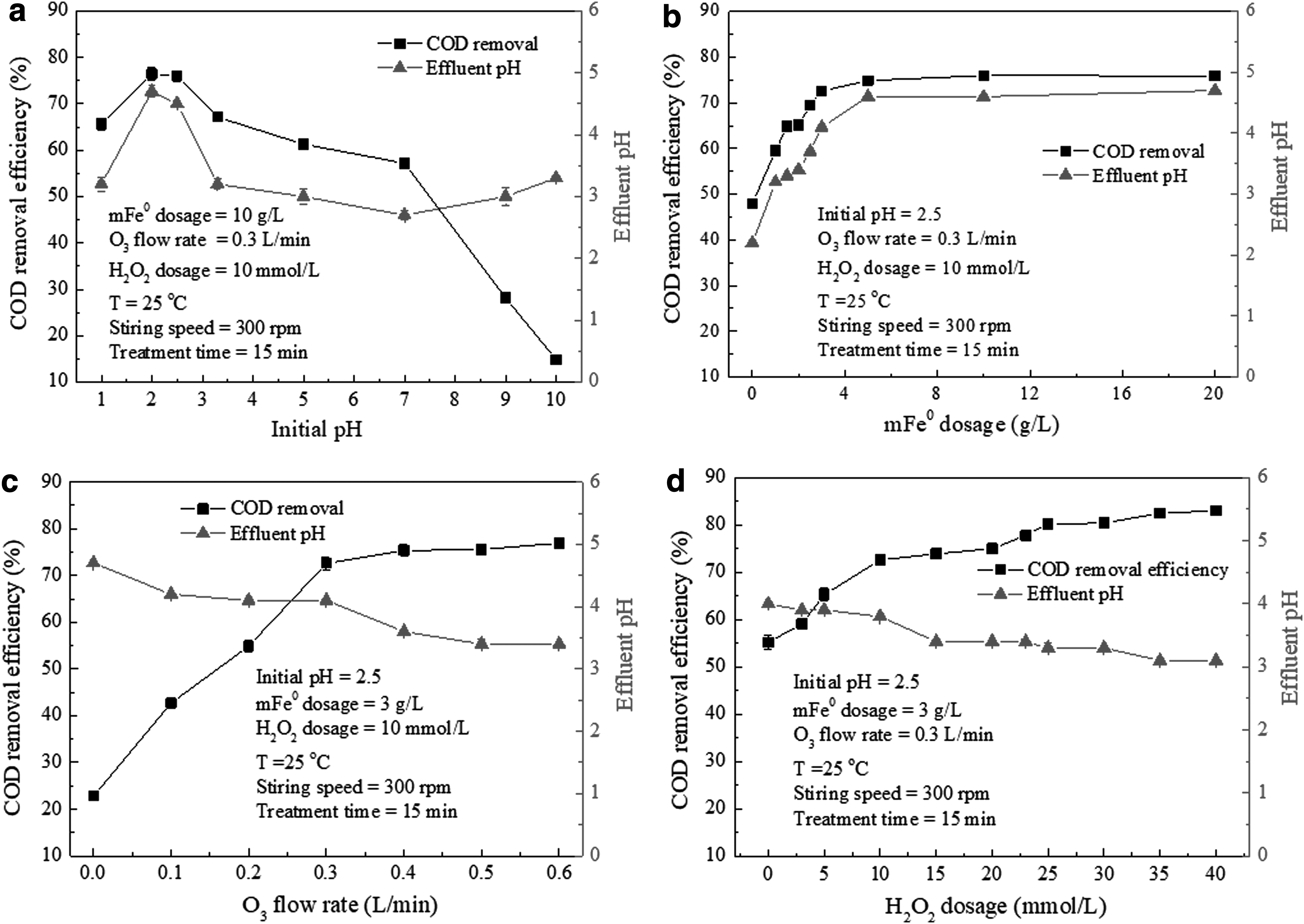
It is well known that solution pH value has significant influence on catalytic ozonation and Fenton and Fenton-like oxidation process (Remya and Lin, 2011; Martins et al., 2012; Pan et al., 2012; Wang and Bai, 2017). Therefore, it is quite important to investigate the effect of initial solution pH on the COD removal efficiency of DNP aqueous solution by the mFe0/H2O2/O3 process. As shown in Fig. 1a, the COD removal efficiency remarkably enhanced from 14.9% to 57.2% when the initial solution pH deceased from 10.0 to 7.0, and then, it gradually increased to 76.4% when the initial solution pH decreased to 2.0.
Effect of
The solution pH is an important parameter for mFe0 process because the lower solution pH can significantly accelerate iron corrosion rate and generate more corrosion products (e.g., Fe2+, Fe3+). These corrosion products can catalyze ozone decomposition [Eqs. (2)–(6)] and take part in the Fenton reaction [Eq. (8)] to generate enough HO•, consequently result in higher COD removal efficiency of DNP aqueous solution in the mFe0/H2O2/O3 process. In addition, the lower solution pH can also facilitate the formation of Fenton-like reaction under oxic condition [Eqs. (7) and (8)], which further improve the COD removal efficiency. With the increase of initial solution pH, Fenton reaction and catalytic ozonation processes by Fe2+/Fe3+ were gradually inhibited due to the decrease of iron corrosion rate.
Fenton-like reaction was also inhibited due to the decrease of H+ concentration. Therefore, a satisfied COD removal efficiency cannot be obtained in neutral and alkaline conditions. It is well known that the increase of solution pH can accelerate ozone decomposition to generate HO• [Eq. (9)] (Zhao et al., 2017). However, a converse variation trend appeared because HO• produced by ozone decomposition did not play a leading role in the mFe0/H2O2/O3 process. Therefore, the higher COD removal efficiency can be attained in lower initial solution pH. However, when the initial solution pH was below 2.0, the COD removal efficiency has a significant drop (Fig. 1a).
The COD removal efficiency at extremely low solution pH is undesirable, which can be explained from the following four aspects: (i) the excess H+ ions can act as HO• radical scavenger (Zeng et al., 2012); (ii) the lower pH could yield the excess Fe2+ that also can act as HO• radical scavenger (Song et al., 2016); (iii) the excess H+ ions would react with H2O2 to form H3O2+, leading to an improved stability of H2O2 and weaken the COD removal efficiency (Bokare and Choi, 2014); and (iv) the excess H+ ions could restrain the decomposition of ozone (Kasprzyk-Hordern et al., 2003). As a result, the optimal initial solution pH of 2.5 was selected to optimize the following parameters.
In addition, Fig. 1a also shows the effect of initial solution pH on the effluent pH. In particular, the effluent pH was higher than the initial solution pH when the initial solution pH was below 3.3. On the contrary, the effluent pH was lower than the initial solution pH when the initial solution pH was above 3.3. The results can be explained from the following two aspects: (i) the catalytic ozonation process and Fenton and Fenton-like reaction could be limited seriously under the neutral or alkaline condition; thus, the sole ozonation and O3/H2O2 process might play a leading role in the degradation of pollutants. The acidic intermediates (e.g., carboxylic acids) might be generated during the sole ozonation and O3/H2O2 process due to the inefficient oxidation, which decreased the pH of reaction solution. (ii) Under acidic condition, H+ ions could be rapidly consumed by mFe0, consequently result in the increased of effluent pH (Son et al., 2009).
Effect of mFe0 dosage
Figure 1b shows the effect of mFe0 dosage on COD removal efficiency by the mFe0/H2O2/O3 process. It is apparent that the lower COD removal efficiency (47.9%) was obtained after 15 min treatment by the O3/H2O2 process without mFe0, whereas it was improved from 47.9% to 72.6% with the increase of mFe0 dosage from 0 to 3 g/L, and then, it would not be further significantly enhanced when the mFe0 dosage was above 3 g/L.
The results can be explained from the following two aspects: (i) the increase of mFe0 dosage could facilitate the formation of iron corrosion products; a large amount of mFe0 and its corrosion products can enhance the utilization rate of O3 and catalyze the decomposition of O3 to generate enough stronger oxidants (i.e., HO• and O•) that can easily decompose pollutants in reaction solution (Sui et al., 2010; Hussain et al., 2012; Chen et al., 2016; Oh et al., 2016). In addition, mFe0 and its corrosion products can also take part in Fenton or Fenton-like reaction and produce more HO•, resulting in the higher COD removal efficiency. (ii) Further increase of mFe0 dosage had no significant contribution to COD removal efficiency because the activators (i.e., H2O2 and O3) might become the limited factor when the excessive mFe0 was added to reaction solution. Therefore, the optimal mFe0 dosage of 3.0 g/L was selected to carry out the following experiments.
Figure 1a also shows the effect of mFe0 dosage on the effluent pH. The effluent pH of the mFe0/H2O2/O3 process gradually increased to 4.6 with the increase of mFe0 dosage from 0 to 5 g/L, and then, it would not be further significantly enhanced when the mFe0 dosage was above 5 g/L. The results indicate that the H+ ions could be rapidly consumed by mFe0 when a few of mFe0 powders were added in this treatment system. With the increase of mFe0 dosage, the accumulated acids and H+ could be consumed gradually and generate a plenty iron corrosion products, which could increase the effluent pH.
Effect of O3 flow rate
Effect of O3 flow rate on the COD removal efficiency by the mFe0/H2O2/O3 process is shown in Fig. 1c. It is apparent that the mFe0/H2O2 process without O3 only led to 22.8% of COD removal efficiency. It suggests that the mFe0/H2O2 process is a relatively inefficient process for pollutants degradation. It could also be observed from Fig. 1c that COD removal efficiency increased rapidly from 22.8% to 72.6% when O3 flow rate elevated from 0 to 0.3 L/min after 15 min treatment by the mFe0/H2O2/O3 process. And then, the COD removal did not further significantly improve when the O3 flow rate was further increased to 0.6 L/min.
The results can be explained from the following three aspects: (i) the increase of O3 flow rate would improve the amount of dissolved ozone in reaction solution when O3 flow rate was below 0.3 L/min, which facilitate the catalytic ozonation process. More HO• would be generated when more O3 was introduced into the reaction solution, resulting in higher COD removal efficiency. (ii) The generated gas contained O3 and O2 because ozone was produced onsite from dry O2 through an ozone generator. Increasing the aeration rate also would increase the amount of O2 in reaction solution, which would facilitate Fenton-like reaction to further improve the COD removal efficiency. (iii) The further increase of ozone flow rate (>0.3 L/min) had no significant contribution to COD removal because the O3 and O2 concentrations in the liquid phase had approached to saturation at a fixed temperature (Pan et al., 2012). Thus, the ozone flow rate of 0.3 L/min was selected as the optimal value in the follow-up study.
In addition, Fig. 1c also shows that the effluent pH of the mFe0/H2O2/O3 process decreased gradually from 4.7 to 3.6 when O3 flow rate increased from 0 to 0.4 L/min, and then, it did not further significantly decrease when the O3 flow rate was above 0.4 L/min. With the increase of O3 flow rate, the mFe0/O3/H2O2 process might accumulate more organic acids, which led to the decrease of effluent pH.
Effect of H2O2 dosage
Figure 1d shows the effect of H2O2 dosage on COD removal efficiency by the mFe0/H2O2/O3 process. The COD removal efficiency rapidly increased from 55.2% to 80.2% with an increase of H2O2 dosage from 0 to 25 mmol/L. And then, it did not further increase when H2O2 dosage was above 25 mmol/L. The results indicate that COD removal efficiency was significantly influenced by H2O2 dosage.
It can be explained from the following two aspects: (i) higher H2O2 dosage in reaction solution was beneficial for the Fenton reaction and O3/H2O2 process to generate HO• that accounted for the obvious enhancement of COD removal efficiency (Safarzadeh-Amiri, 2001; Segura et al., 2012; Medellin-Castillo et al., 2013; Fukuchi et al., 2014). (ii) The further increase of H2O2 dosage had no significant contribution to COD removal because other activators might become the limited factor when the excessive H2O2 was added in reaction solution. Therefore, 40 mmol/L of H2O2 dosage was selected as the optimal H2O2 dosage.
In addition, Fig. 1d also shows that the effluent pH (3.1–4.0) of the mFe0/H2O2/O3 process was not affected significantly by the different H2O2 dosage (0–40 mmol/L). Their effluent pH only decreased a little (4.0–3.1) with the increase of H2O2 dosage from 0 to 40 mmol/L.
Finally, the optimal operating parameters including initial pH (2.5), mFe0 dosage (3.0 g/L), O3 flow rate (0.3 L/min), and H2O2 dosage (25 mmol/L) were obtained according to the above semibatch experiments.
Control experiments
To evaluate the advantage of mFe0/O3/H2O2 process and the synergetic effect between mFe0, H2O2, and O3, seven control experiments including (a) mFe0, (b) H2O2, (c) O3, (d) mFe0/O3, (e) mFe0/H2O2, (f) O3/H2O2, and (g) mFe0/H2O2/O2 processes were carried out under the same conditions (i.e., initial pH of 2.5, mFe0 dosage of 3.0 g/L, O3 flow rate of 0.3 L/min, O2 flow rate of 0.3 L/min, H2O2 dosage of 25 mmol/L, and treatment time of 15 min). According to Equations (3), (4), (6), (13), and (15), O2 would be generated during the catalytic ozonation process. Meanwhile, the gas dispersed into the reaction solution contained O3 and O2. Therefore, the mFe0/H2O2/O2 process was used to evaluate the contribution of O2 in the mFe0/H2O2/O3 process.
The performance of mFe0/H2O2/O3 process and control experiments were investigated comparatively through analyzing the COD removal efficiency and total iron ion concentration (i.e., Fe2+, Fe3+, and flocculent precipitate) in different reaction times, biodegradability improvement, and H2O2 utilization.
COD removal during the treatment process
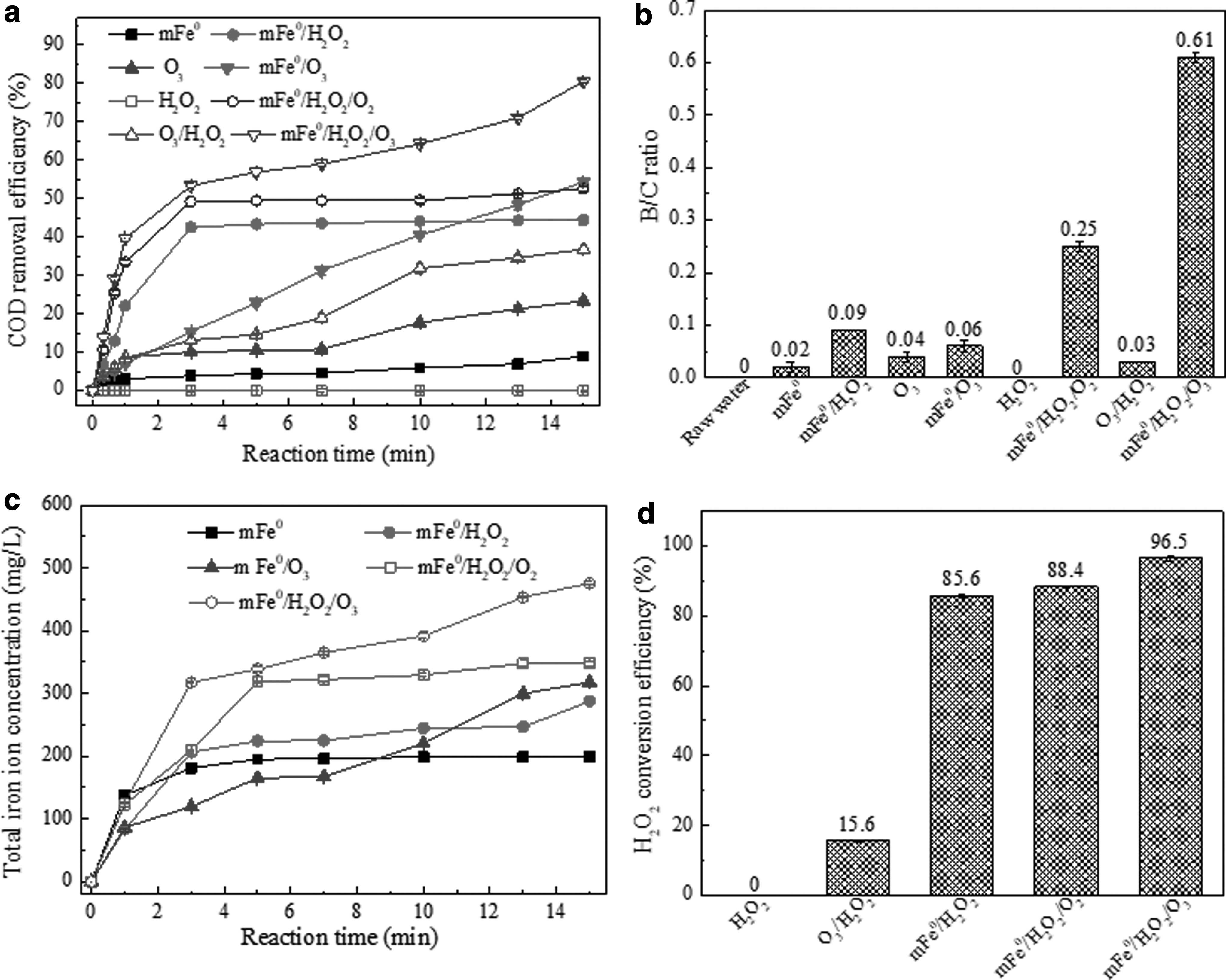
Variation of COD removal efficiency with reaction time in the eight different experiments was shown in Fig. 2a. It is clear that all the COD removal efficiencies obtained by the mFe0/H2O2/O3 process were much higher than those of seven control experiments during 15 min treatment. The sequence of COD removal efficiency after 15 min treatment process in the different systems follow the trend that mFe0/H2O2/O3 (80.2%) > mFe0/O3 (54.4%) > mFe0/H2O2/O2 (52.6%) > mFe0/H2O2 (44.6%) > O3/H2O2 (36.8%) > sole O3 (23.3%) > mFe0 (9.0%) > H2O2 (0%). It can be concluded that DNP was rarely oxidized by H2O2 due to the limited oxidation capability of H2O2 (Eθ = 1.78 V).
COD removal efficiency
The COD removal efficiency of the mFe0/H2O2/O2 process was higher than that of the mFe0/H2O2 process, which indicates that O2 has contribution to COD removal in the mFe0/H2O2/O3 process due to the formation of Fenton-like reaction [Eqs. (7) and (8)]. In particular, the sum (32.3%) of COD removal efficiencies of processes by mFe0, H2O2, and O3 alone was much lower than that (80.2%) obtained by the mFe0/H2O2/O3 process. Furthermore, the sum (54.4%, 66.9%, and 44.8%, respectively) of COD removal efficiencies of mFe0/O3 and sole H2O2 process, mFe0/H2O2 and sole O3 process, O3/H2O2 and sole mFe0 process was also lower than that (80.2%) obtained by the mFe0/H2O2/O3 process. The results can confirm that there is extremely strong synergetic effect between mFe0, H2O2, and O3 in the degradation of DNP.
Biodegradability
Figure 2b shows the B/C ratios of the raw DNP solution, effluent of mFe0/H2O2/O3 process, and seven different control experiments. Ordinarily, the wastewater is considered to be biodegradable when its B/C ratio is higher than 0.30. With a B/C ratio of 0, the DNP wastewater was clearly biorefractory. After the 15 min treatment process, the sequence of B/C ratios obtained by the different processes are as follows: mFe0/H2O2/O3 (0.61) > mFe0/H2O2/O2 (0.25) > mFe0/H2O2 (0.09) > mFe0/O3 (0.06) > O3 (0.04) > O3/H2O2 (0.03) > mFe0 (0.02) > H2O2 (0).
The B/C ratio of the effluent of mFe0/H2O2/O3 process was much higher than that of seven control experiments. In particular, only the B/C ratio of the effluent of mFe0/H2O2/O3 process was higher than 0.30. The results indicate that DNP could be effectively degraded or transformed by mFe0/H2O2/O3 process, and its biodegradability was improved significantly. It also further indicates that there was a strong synergistic reaction in the mFe0/H2O2/O3 process.
Total iron ion concentration
Figure 2c shows the variation of total iron ions (i.e., Fe2+, Fe3+, and flocculent precipitate) concentration in reaction solution during 15 min treatment process by the different treatment processes. It is clear that O3, O2, and H2O2 have considerable abilities to promote iron corrosion and facilitate the releasing of iron ions during the treatment of DNP. In addition, the total iron ions concentrations of mFe0/H2O2/O3 process were much higher than those of mFe0/H2O2/O2 process, mFe0/H2O2 process, mFe0/O3 process, and mFe0 process during 15 min treatment. In particular, it can be observed that the total iron ions concentration in the mFe0/H2O2/O3 process rapidly increased to about 475.6 mg/L after 15 min treatment, which was much higher than that of the mFe0/H2O2/O2 process (about 347.9 mg/L), mFe0/H2O2 process (about 287.1 mg/L), mFe0/O3 process (about 317.6 mg/L), and mFe0 process (about 199.3 mg/L).
The corrosion products could facilitate the generation of HO• by catalytic ozonation and formation of the Fenton reaction. The results suggest that the corrosion of mFe0 could be improved remarkably by the combination O3, O2, and H2O2, which results in higher reaction reactivity of mFe0/H2O2/O3 process. In addition, because of the variation of solution pH was lower than 3.5 during the 15 min treatment of mFe0/H2O2/O3 process, the generation of flocculent precipitate after treatment by the mFe0/H2O2/O3 process was very few. Furthermore, it will not cause secondary pollution in the environment and could be dealt with promptly and safely by landfill disposal, iron making, and steelmaking.
The utilization of H2O2
Figure 2d shows the H2O2 utilization by different treatment processes after 15 min treatment. The sequence of H2O2 utilization in the different systems follow the trend that mFe0/H2O2/O3 (96.5%) > mFe0/H2O2/O2 (88.4%) > mFe0/H2O2 (85.6%) > O3/H2O2 (15.6%) > H2O2 (0). It is clear that the H2O2 conversion efficiency by the mFe0/H2O2/O3 process after 15 min treatment was higher than those of the mFe0/H2O2 process, mFe0/H2O2/O2 process, O3/H2O2 process, and sole H2O2 process. In addition, H2O2 can also be formed through Equation (7). Therefore, the H2O2 consumption of mFe0/H2O2/O3 and mFe0/H2O2/O2 processes includes the added and generated H2O2. It further indicates that H2O2 can have higher conversion efficiency in the mFe0/H2O2/O3 process.
UV-Vis spectral analysis and transformation of nitrogen
Figure 3a shows the real-time UV-Vis absorption spectra changes of DNP in aqueous solution during the mFe0/H2O2/O3 process under the optimal conditions. The UV-Vis absorbance peak of influent was detected from 190 to 500 nm, which shows that the UV characteristic absorbance peak of DNP was mainly at 212 nm and 260 nm. In particular, the absorption peaks at 212 and 260 nm disappeared only after 1 min treatment. And then, the absorbance decreased progressively following the 14 min treatment. The results indicate that the mFe0/H2O2/O3 process has a higher efficiency to degrade DNP, which shows that the COD removal efficiency can reach 39.7% (Fig. 2 a) only after 1 min treatment.
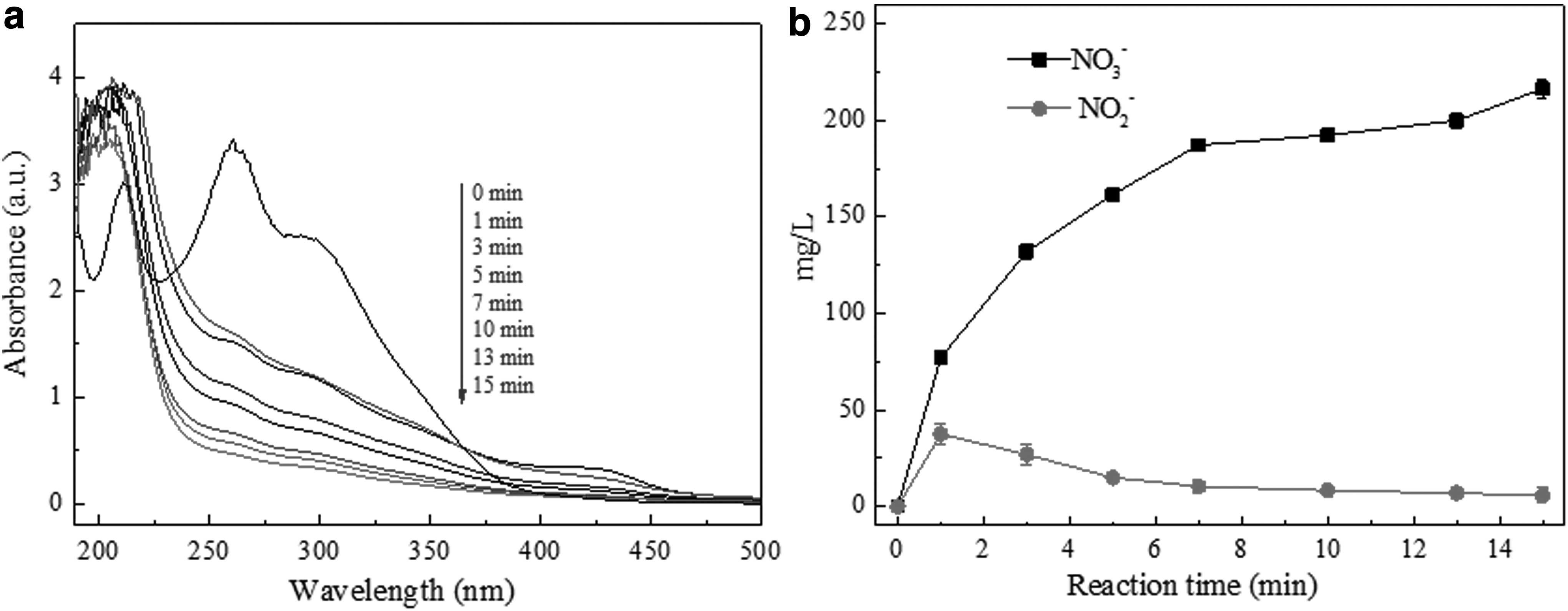
In addition, the generated NO2− and NO3− concentration variation during 15 min treatment by the mFe0/H2O2/O3 process under the optimal treatment conditions was analyzed by IC. Figure 3b shows that NO2− concentration increased rapidly to the maximum (i.e., 37.4 mg/L) after 1 min treatment, and then, it gradually decreased to 5.6 mg/L after 15 min treatment. However, NO3− concentration gradually increased quickly to 216.4 mg/L after 15 min treatment. In addition, it can be calculated that the sum (i.e., 50.5 mg/L) of nitrate nitrogen (NO3-N) and nitrite nitrogen (NO2-N) in the effluent was lower than the theoretical nitrogen concentration (i.e., 76.5 mg/L) of 500 mg/L DNP aqueous solution. The results indicate that the main organic nitrogen of DNP was oxidized into NO2− and NO3−, and the other organic nitrogen might be transferred into N2, N2O, or the smaller molecular organic nitrogen.
Possible reaction mechanism of mFe0/H2O2/O3 process
SEM-EDS analysis of the mFe0 particles and generated flocculation
To investigate the possible reaction mechanism of mFe0/H2O2/O3 process, the surface characteristics of fresh and reacted mFe0 particles and generated flocculation in mFe0/H2O2/O3 process under optimal conditions were observed by SEM and EDS, respectively (Fig. 4). It could be observed from Fig. 4a and b that the morphology of fresh mFe0 particle was sponginess and smoothing, and only Fe was detected by EDS on the surface of fresh mFe0 particle. The results indicate that there was no iron oxide on the surface of fresh mFe0 particles. After the 15 min treatment by the mFe0/H2O2/O3 process, it could be observed from Fig. 4c and d that two elements on the surface of mFe0 particles include Fe (77.39%, w/w) and O (22.61%, w/w), which suggests that some iron corrosion products deposited or adsorbed on the surface of mFe0 particles.

Scanning electron microscopy and energy-dispersive spectrometry spectra of
According to prior reports, the iron oxides could be composed of several materials (Fe3O4, Fe2O3, FeOOH, etc.), which could proceed the catalytic ozonation and Fenton-like reaction (Guo, 2010; Sui et al., 2010; Lv et al., 2012; Xu and Wang, 2012; Bing et al., 2015). In addition, the generated flocculation was also analyzed by SEM and EDS. From Fig. 4e and (f), it was observed that the major component elements of flocculation were O (40.3% w/w) and Fe (56.9% w/w), which suggests the generation of iron hydroxide.
XRD analysis
On the basis of SEM-EDS analysis, the fresh and reacted mFe0 particles and generated flocculation in the mFe0/H2O2/O3 process were further analyzed by XRD. Figure 5 shows the XRD patterns of fresh and reacted mFe0 particles and generated flocculation. It can be observed from Fig. 5 that the reacted mFe0 particles after 15 min treatment show similar XRD patterns as that of fresh mFe0 particles. No visible crystalline peak was detected for iron oxide in all lines, which indicates the iron oxide on the surface of mFe0 is amorphous. In addition, the peak intensity was weak after the reaction of mFe0 particles, which may be due to iron oxide formed on its surface. Since Fe0 is a kind of moderate reduction metal, O3/O2 might react with Fe0 and resulted in the formation of iron oxide on the surface of Fe0 particles.
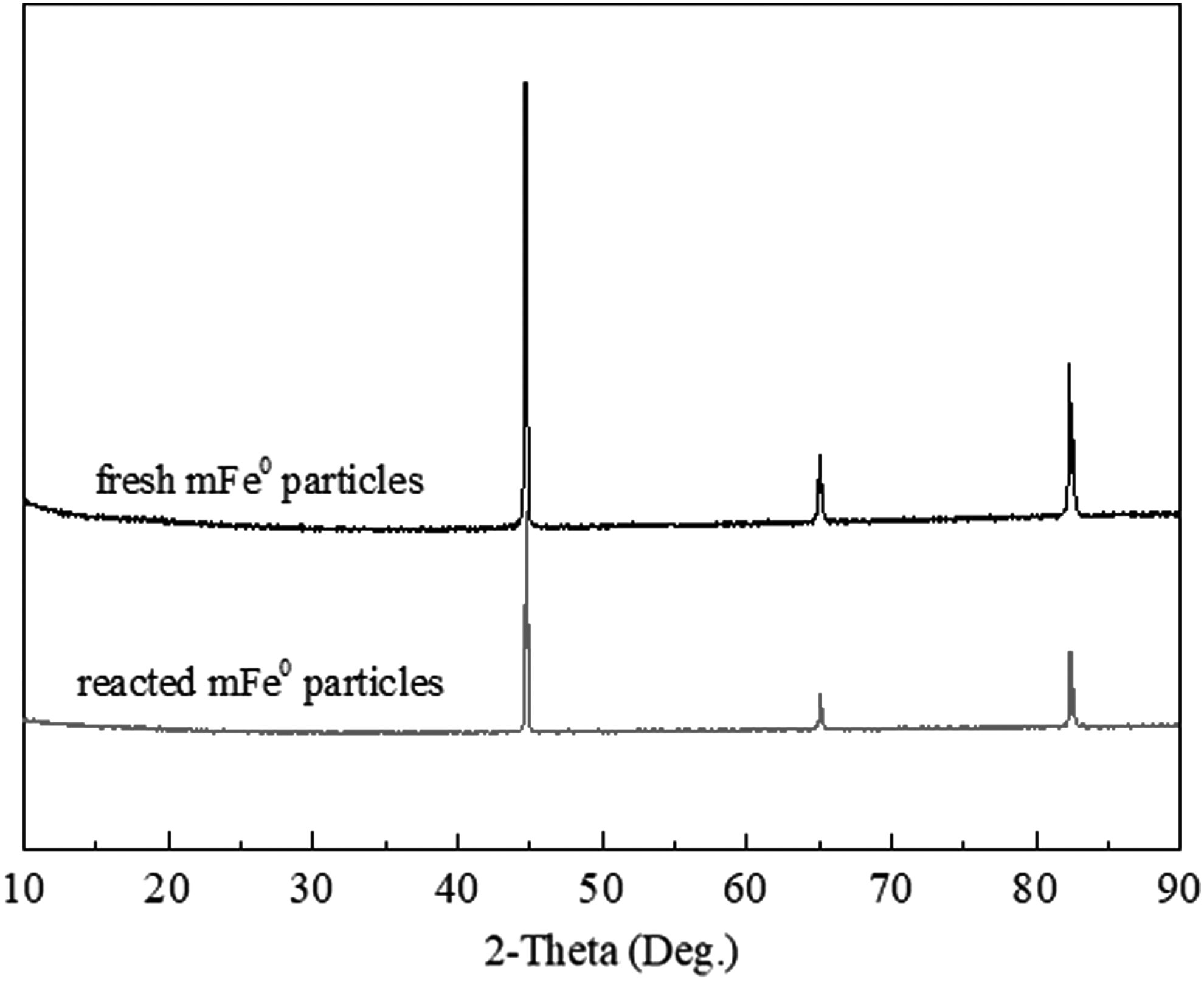
X-ray diffraction pattern of fresh and reacted mFe0 particles by the mFe0/H2O2/O3 process.
XPS analysis
To further investigate the material composition on the surface of reacted mFe0 particles, the chemical state of Fe and O of mFe0 particles after the mFe0/H2O2/O3 treatment was analyzed by XPS, and the results are shown in Fig. 6. In Fig. 6a, the survey scan of mFe0 particles reveals the presence of Fe 2p, O 1s, and C 1s. C1s peak (284.6 eV) was used to calibrate the acquired spectra. All XPS core level spectra were fitted using the Shirley background.
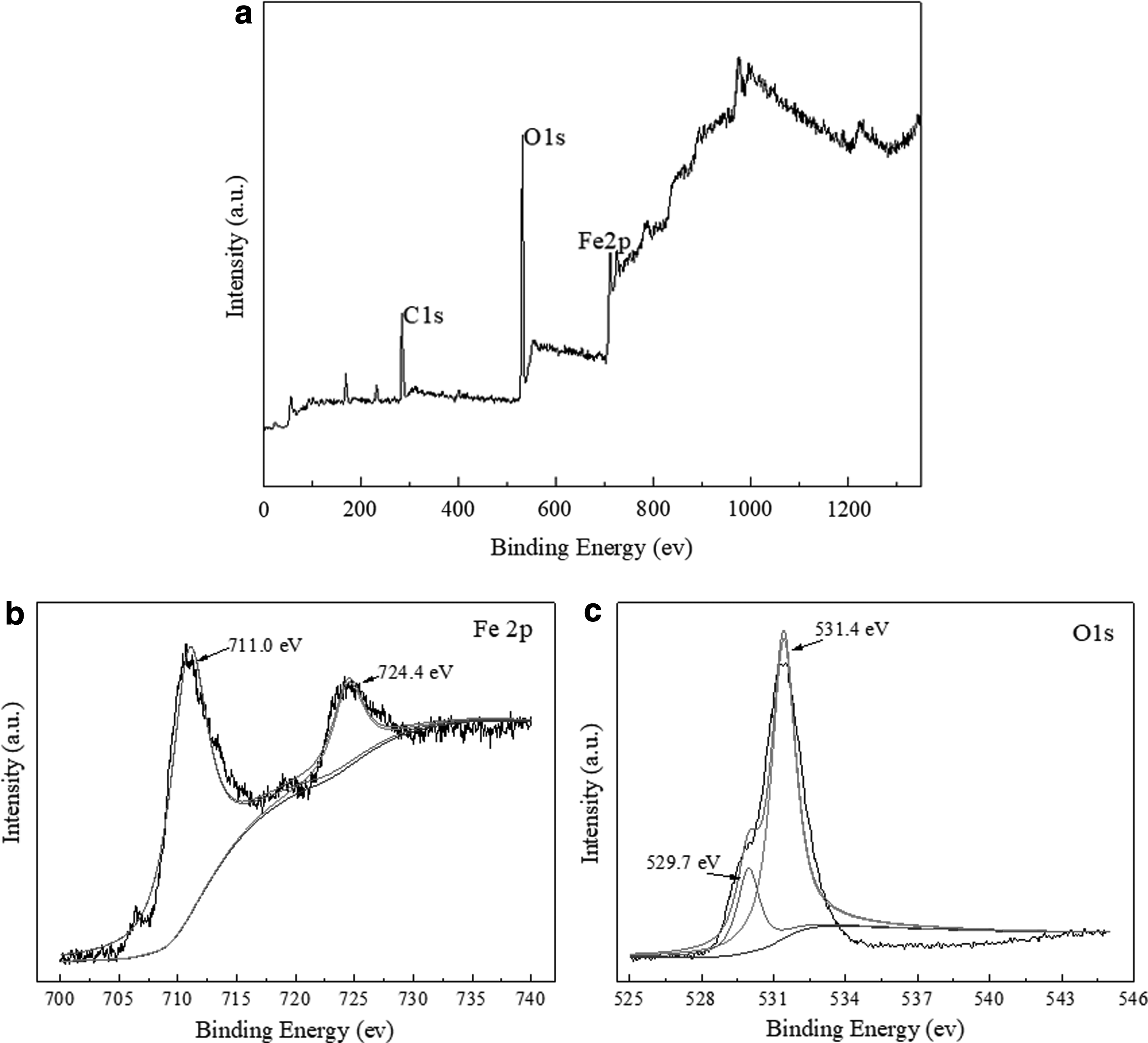
X-ray photoelectron spectroscopy spectra of reacted mFe0 particles by the mFe0/H2O2/O3 process:
Figure 6b shows the XPS survey scan of Fe 2p in reacted mFe0 particles. The binding energies at 710.0–720.0 eV and 720.0–735.0 eV regions can be attributed to Fe 2p3/2 and Fe 2p1/2, respectively. The high-intensity binding peaks at 710.8 and 724.2 eV correspond to Fe3+ state of iron oxides (Zhang et al., 2012; Ji et al., 2017). Thus, the observed Fe 2p XPS spectra proved the existence of Fe2O3 generated on the surface of reacted mFe0 particles. In addition, the high-resolution scan of the O 1s core level is depicted in Fig. 6c. The spectrum shows the presence of two peaks at 529.7 and 531.4 eV. According to the literatures, the peak at 529.7–530.1 eV corresponds to O2−, and the peak at 531.1–531.7 eV can be attributed to surface-adsorbed oxygen species (i.e., O22−, O−, OH−) (Luo et al., 2008; Guo et al., 2010).
Mechanism
According to above analysis data and the present literatures, possible reaction mechanisms and synergistic effects of the mFe0/H2O2/O3 process were illustrated in the following sections (Fig. 7).

Proposed reaction mechanism of mFe0/H2O2/O3 process.
Reaction mechanisms between Fe0 and O3
Since the standard oxidation reduction potential of O3 can reach up to 2.07 mv, Fe0 might be directly oxidized by O3 and generated Fe2+/Fe3+ [Eqs. (1) and (2)] (Xiong et al., 2016a). In addition, in acidic environment, H+ ions also would accelerate remarkably the iron corrosion rate and generated a plenty of Fe2+/Fe3+. Moreover, the DNP in aqueous solution was easy to be oxidized by single O3 process (Fig. 2a) and transformed to small-molecule organic acids, which would also accelerate the iron corrosion rate. The generation of Fe2+/Fe3+ can effectively catalyze ozonation and generate a plenty of radicals to degrade pollutants [Eqs. (2)–(6)].
Meanwhile, according to the analysis results of SEM-EDS, XRD, and XPS, it was proposed that iron oxides (i.e., Fe2O3) were generated on the surface of mFe0 particles. It is well known that Fe2O3 also could catalyze the decomposition of O3 and generate the radicals to degrade pollutants. For example, Trapido et al. (2005) reported that Fe2O3 can effectively catalyze ozonation m-DNB at pH 3.0. Beltran et al. (2005) also found that the ozonation of oxalic acid in aqueous solution using Fe2O3/Al2O3 as catalyst can significantly improve the degradation efficiency of oxalic acid. Therefore, a typical mutual promotion did exist between O3 and Fe0.
Reaction mechanisms between Fe0 and H2O2
The generated corrosion products of Fe0 (e.g., Fe2+ and Fe2O3) can take part in the Fenton or Fenton-like reaction to generate a plenty of HO•, enhancing the treatment efficiency of mFe0/H2O2/O3 process (Guo et al., 2010; Bokare and Choi, 2014). In addition, the H2O2 could also be generated by the reaction between O2 and Fe0 in the acidic environment, and then, it reacts with Fe2+ and generates HO•, which can nonselectively oxidize or mineralize the organic pollutants [Eqs. (7)–(8)] (Wang et al., 2010b). Moreover, a part of nascent Fe3+ can react with Fe0 to generate Fe2+, which take part in the Fenton reaction [Eq. (10)], thus further improve the treatment efficiency of mFe0/H2O2/O3 process.
Reaction mechanisms between O3 and H2O2
The reaction of O3 and H2O2 can accelerate the decomposition of O3 and generate radicals to degrade pollutants. The reaction equations are listed in Equations (11)–(16) (Safarzadeh-Amiri, 2001; Medellin-Castillo et al., 2013).
Reusability of mFe0 in the reaction system
To evaluate the reuse potential of mFe0 in the mFe0/H2O2/O3 process, the reusability of mFe0 was investigated by conducting five successive experiments under the same optimal conditions. At the end of each cycle, the mFe0 powders were recovered through magnetic separation and drying, and then, they were reused with compensation of the mass loss for the next cycle. As shown in Fig. 8, the COD removal efficiencies were all above 78% in each cycle, and no obvious decline was observed after five cycles, which manifest the approving recyclability of mFe0.
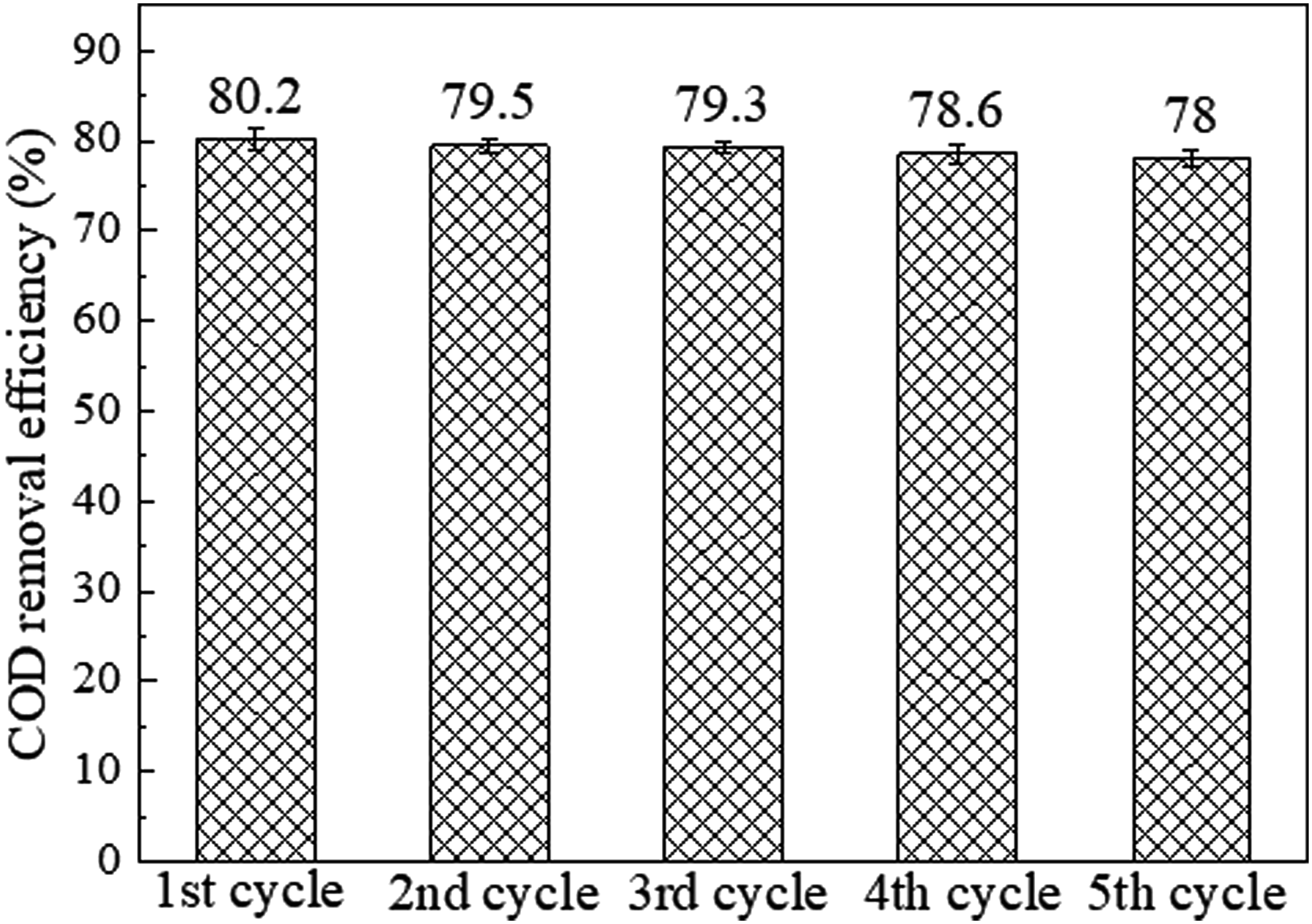
COD removal for five successive mFe0/H2O2/O3 process.
Conclusion
In this study, the mFe0/H2O2/O3 process was developed to degrade DNP in aqueous solution. First, the optimal operation parameters (i.e., initial pH of 2.5, mFe0 dosage of 3.0 g/L, O3 flow rate of 0.3 L/min, and H2O2 dosage of 25 mmol/L) of the mFe0/H2O2/O3 process were observed by semibatch experiments. In this condition, COD removal efficiency reached 80.2% and was much higher than those of the mFe0/O3 process (54.4%), mFe0/H2O2/O2 process (52.6%), mFe0/H2O2 process (44.6%), O3/H2O2 process (36.8%), sole O3 process (23.3%), sole mFe0 process (9.0%), and sole H2O2 process (0%). The results indicate that high treatment efficiency of the mFe0/H2O2/O3 process was mainly attributed to the synergetic effects between mFe0, H2O2, and O3. Meanwhile, the B/C ratio was elevated from 0.25 to 0.61 after 15 min treatment by the mFe0/H2O2/O3 process, which indicated the significant improvement of biodegradability. According to the literatures and analysis data of SEM-EDS, XRD, and XPS, finally, the possible reaction mechanisms of the mFe0/H2O2/O3 process was proposed, which consist of four parts: (i) catalytic ozonation by Fe0 and its corrosion products, (ii) Fenton and Fenton-like reaction to degrade pollutants, (iii) direct oxidation by sole O3 process, and (iv) the generated radicals by O3/H2O2 process to degrade pollutants. Therefore, the mFe0/H2O2/O3 process can be considered as an effective, robust, and feasible treatment method to degrade DNP in aqueous solution.
Footnotes
Author Disclosure Statement
No competing financial interests exist.