




Abstract
Abstract
Pervious concrete pavement systems can provide a transportation surface and stormwater management, in addition to other benefits. In cold climates, pavement systems may be subjected to deicers that may cause deterioration in the pervious concrete layer. Chemical impacts of magnesium chloride on pervious concrete were investigated. Magnesium chloride deicer treatments, with tap water and sodium chloride as controls, were applied weekly to laboratory specimens for a period of 4 months. Specimens were made with basalt aggregate and ordinary Portland cement (OPC) or a combination of OPC and 25% fly ash. Specimen ages ranged from 8 years to a few months and were tested in an ambient or cold (4°C) laboratory. The specimen mass change, influent and effluent volumes, masses, and calcium ion concentrations were recorded weekly. Magnesium ions may exchange with calcium ions in the hydrated cement paste based on complexation stability constants with hydroxides, possibly impacting strength and durability. Specimens treated with magnesium chloride experienced a greater calcium concentration increase from influent to effluent than the controls. OPC specimens tended to leach ∼20–30% more calcium than the fly ash specimens which supports the ion exchange hypothesis. Older OPC specimens had lower calcium effluent concentrations than the newer specimens, implying more resistance to chemical attack since the additional carbonate species in the older specimens are less favorable to magnesium complexation than the hydroxide species. Chemical interactions presented show that the cement-paste matrix is being chemically altered by the magnesium chloride deicer.
Introduction
P
Utilizing pervious concrete in cold climates provides many benefits as described previously, but the pavement surface may be impacted by deicing chemicals. There is evidence that deicing chemicals can negatively impact the strength and durability of concrete pavements by degrading the aggregate bonding and cement paste matrix (Copuroglu and Schlangen, 2007; Darwin et al., 2008; Sutter et al., 2008; Haselbach, 2017). One of the main chemicals of concern, investigated in this research, is magnesium chloride (MgCl2). The mechanism of deterioration of magnesium chloride treated pervious concrete is suspected to be based on aquatic chemistry principles, with the hydroxide species in the concrete preferred by the magnesium ion compared to the calcium in the concrete, and the subsequent formation of a magnesium hydroxide precipitate (Stumm and Morgan, 1996).
Previous studies on the effects of deicing chemicals on traditional concrete pavement indicate that damage to the material correlates with deicing treatments. Jain et al. (2011) studied the impacts of MgCl2 on concrete specimens. The specimens exposed to MgCl2 gained mass continuously over the course of the experiment, possibly implying internal precipitation of magnesium hydroxide, as the magnesium ion has a lower atomic mass than the calcium ion that it might exchange with. Traditional concrete specimens were subjected to weekly exposures of magnesium chloride over a 2-year period at both high and low molal solution concentrations in testing by Darwin et al. (2008). The MgCl2 specimens experienced reductions in strength at both concentrations implying that the deicer is impacting the hydrated cement in the concrete, which might be explained by an ion exchange of calcium with magnesium.
Sutter et al. (2008) investigated the effects of MgCl2 on traditional concrete pavements based on field observations and observed a loss of strength, increased permeability, expansion, and cracking. The lower the concentrations of the chemical, the less of an impact observed. Mortar specimens at three different molal solution concentrations were also studied by Sutter et al. (2008). Petrographic analysis indicated that expansive magnesium oxychloride formed with the use of MgCl2. An increase in length on length change bars, microcracks, and significant loss in compressive strength in the mortar cubes was observed. Their work also points to other mechanisms related to the chloride ion.
Dang et al. (2016) performed tests on laboratory prepared specimens with and without various sealers to determine the sealers effectiveness in protection from detrimental impacts of NaCl and MgCl2 deicers. The specimens were soaked in deicing solutions and underwent wet–dry and then freeze–thaw test cycles in these solutions. The control specimen showed significant scaling for the NaCl treatment but little or no scaling with the MgCl2 solutions. Neither deicer showed a significant impact on compressive strength, except for the NaCl specimens toward the end of the testing cycles due to scaling. The NaCl specimens lost up to 30% of their mass by the end of the 15 cycles, while MgCl2 gained 1% mass. Split tensile testing was performed and showed a decrease in strength for the MgCl2 treated specimens but little change for the NaCl specimens. The results point to a possible mass gain due to internal precipitation of magnesium hydroxide as hypothesized and complex impacts on strength.
Freeze–thaw research has been performed on pervious concrete (Mata, 2008; Kevern et al., 2010; Wu et al., 2016), and some of those studies included deicing chemical treatments. Tsang et al. (2016) published on developing a freeze–thaw test method for pervious concrete using deicing chemicals and found that the performance ranked best to worst as follows: MgCl2, urea, CaCl2, and NaCl, but did not separate out the chemical from the physical impacts.
Impacts of magnesium chloride on pervious concrete from an aquatic chemistry perspective were investigated by isolating the chemical mechanism by which the deicing chemicals may be affecting the strength of the pervious concrete. If a simple ion exchange is occurring between the magnesium ions in the deicer solution and the calcium ions in the hydrated cement within the concrete, the specimen mass should decrease due to the atomic weight of magnesium being 24.3 compared to the atomic weight of calcium, 40.1. However, Jain et al. (2011) showed that the concrete specimens exposed to a MgCl2 solution experienced a mass gain but only after many wetting/drying cycles. Lee et al. (2000) found that traditional concrete specimens exposed to wet/dry cycles of magnesium chloride deicers exhibited internal formations of brucite (Mg(OH)2) and magnesium silicate hydrates implying an ion exchange or internal surface complexation. Thus, an increase in mass might indicate internal precipitation. In addition, previous research shows that pervious concrete is effective in the removal of dissolved zinc and copper, 80–91% and 77–87% removal efficiency, respectively, of the divalent metals in just minutes, which suggests that the dissolved metal magnesium may be removed from a solution exposed to the concrete as well, supporting the hypothesis that an ion exchange may also occur (Haselbach et al., 2014b).
The sources of strength in ordinary Portland cement (OPC) are calcium-based compounds. OPC is composed of tricalcium silicate, dicalcium silicate, tricalcium aluminate, and tetracalcium aluminoferrite. These compounds become a bonding agent in the presence of water by producing a hard mass, which acts as the cement paste.
Environmental conditions might affect how the concrete pavements behave when subjected to deicing chemical treatments. Exposure to air changes the properties of the concrete due to carbonation. Carbonation occurs over time when atmospheric carbon dioxide reacts with hydrated species in the cement paste, forming carbonated species and increasing density (Neville, 1975). The addition of the carbonate ion in the concrete might also impact the equilibrium of the various ions from the magnesium chloride deicer.
Table 1 shows the stability constants (betas) for the formation of the various applicable complexes and solids from the metals (calcium and magnesium) and the ligands (hydroxide or carbonate). The magnesium ion in the magnesium chloride deicer is preferred to the calcium ion with respect to the hydroxide ion ligand, while not preferred with respect to the carbonate ion based on stability constants (Stumm and Morgan, 1996). The preference for complexation of magnesium with hydroxides may cause deterioration due to calcium leaching and magnesium hydroxide precipitate forming within the pervious concrete, particularly in specimens that are not highly carbonated. The calcium silicates are the two main cementitious compounds in the cement (Neville, 1975). If calcium leaching from the cement occurs when exposed to magnesium, the strength of the concrete can be negatively impacted. There is evidence that the strength deteriorates in traditional concrete when exposed to these deicing agents. Due to the large surface area of pervious concrete the chemicals impacts are likely worse than in traditional concrete (Lee et al., 2000; Darwin et al., 2008; Sutter et al., 2008; Jain et al., 2011).
The objective of this research is to evaluate the chemical impacts of deicers, specifically magnesium chloride, through the aqueous phase based on a draft testing protocol specific to pervious concrete that mimics winter conditions. It was hypothesized that the magnesium ion in the magnesium chloride deicer prefers the hydroxide species in the concrete and will remain in internal pores by exchanging with the calcium ion and/or precipitating magnesium hydroxide. A greater mass gain in the magnesium chloride treated specimens compared to control treatments may be indicative of an exchange occurring and internal precipitation of magnesium hydroxide. In addition, less carbonated pervious concrete might be more susceptible to chemical attack due to the available calcium hydroxides that have not yet been converted to calcium carbonate. The protocol was performed on specimens with varying mix designs and ages to investigate those effects, if any, on the resistance of pervious concrete to chemical attacks. Chemical testing was used to analyze the effluent calcium concentration and observe possible calcium leaching from the specimens throughout the testing period.
Independent variables to be considered include specimen age, composition, and environmental temperature. Significant carbonation was expected to have occurred in the older specimens due to their age and exposure to atmospheric carbon dioxide. Specimens were made with either OPC or with a 25% fly ash substitution. The fly ash used has ∼72% less calcium than the OPC; therefore, less calcium is expected to be available to exchange with the magnesium ion in those specimens (Haselbach and Thomle, 2014). The testing protocol can be simplified if the procedure can be performed under ambient laboratory conditions due to increased temperature resulting in increased reaction rate, but calcium carbonate is more soluble under colder conditions therefore both scenarios were investigated (Snoeyink and Jenkins, 1980).
Experimental Protocols
The same protocol was used as in a parallel study with a calcium chloride deicer with the addition of testing of the influent and effluent for calcium ion concentrations to detect leaching of calcium ion by the magnesium ion (Haselbach et al., 2018). The specimens were made in either 2008 or 2016. The specimens made in 2008 are considered “carbonated” due to the significant time allowed for carbonation to occur over an 8-year period. The specimens made in 2016 are considered “noncarbonated” as they were made a few months before the experiment (Dyer, 2014). The pervious concrete mix design contained 3/8′′–1/2′′ basalt aggregate, tap water, and either ordinary Portland type I cement (OPC) or a combination of OPC and 25% low calcium Type F fly ash replacement. The production of the specimens imitated field installation compaction techniques to obtain a vertical porosity distribution (Haselbach and Freeman, 2006; Delatte et al., 2009). The specimens were ∼7′′ in height and 4′′ in diameter. The specimen molds were 4′′ by 8′′, filled with the fresh concrete, and then surface compacted ∼10% to obtain a porosity in the range of 22–25%. The porosity was verified by ASTM C1754 (2012). The molds were capped and allowed to cure for 7 days in the ambient laboratory.
Experiments were carried out in both an ambient laboratory and a cold laboratory. The ambient room temperature was between 20°C and 22°C, and the cold room temperature was kept at between 3.8°C and 4.2°C. Each specimen was subjected to either magnesium chloride or one of the controls: sodium chloride or water. The labeling system developed includes four letters and one number. The first letter designates if the experiments were carried out in the ambient (H) or cold (C) laboratory. The second letter designates treatment by water (W), sodium chloride (S), or magnesium chloride (M). The third letter describes if the specimen was made with OPC (O) or OPC and 25% fly ash replacement (F), and the fourth letter indicates the age of the specimen, noncarbonated (N) or carbonated (C) specimens.
Ambient laboratory conditions
Four ON, two OC, two FN, and two FC specimens were tested in the ambient room for each deicing treatment. The average temperature in the room was 21°C. The specimens were shrink-wrapped to form a column and mounted on a beaker stand. A 3% by mass deicing solution was prepared for sodium chloride and magnesium chloride. The 3% solution aimed to simulate a 30% deicing solution diluted by rain or stormwater and then reconcentrated within the specimens due to evaporation between treatments. A composite influent solution was prepared in each of the 17 total weeks for each treatment. Two hundred milliliter of the appropriate solution, or tap water, was poured onto the individual specimens. Tap water was used in all but 4 weeks of the experiment. In those 4 weeks deionized water was utilized to analyze the effects of the water on the effluent. Tap water is a better substitute for stormwater than deionized water as the pH and mineral content is similar from its sources in the ground or streams (Collins, 2007; Eriksson et al., 2007; Genc-Fuhram et al., 2007). The influent permeated through and dripped into a beaker below for 10 min. The solution exiting the specimen was considered the effluent solution. The individual effluents of each specimen type were combined into a composite effluent for further chemical analysis. After collecting the effluent, the specimens were set aside to dry for ∼1 week until the next deicing application.
Volumes of the individual specimen influent and effluents were recorded each week, and the specimen masses were recorded beginning in the fifth week of the experiment. Composite samples of the influent and effluent solutions were set aside each week. One sample was analyzed for pH. The other sample was set aside and refrigerated for future chemical analysis to determine the calcium ion concentration.
Cold laboratory conditions
Experiments under cold conditions were carried out continuously in a walk-in cooler, similarly to the ambient room but with fewer specimen and deicer types. Four ON and two OC specimens were tested for each deicer. The same deicing treatments, except for sodium chloride, were performed on the cold room specimens. The deicing solutions were cooled to 4°C before application. The same data that were collected in the ambient room were collected in the cold room. The individual influent and effluent volumes and masses were recorded, and the pH and calcium ion concentration was recorded for the composite influent and effluent solutions. The testing arrangement used for both the ambient and cold room is pictured in Fig. 1.
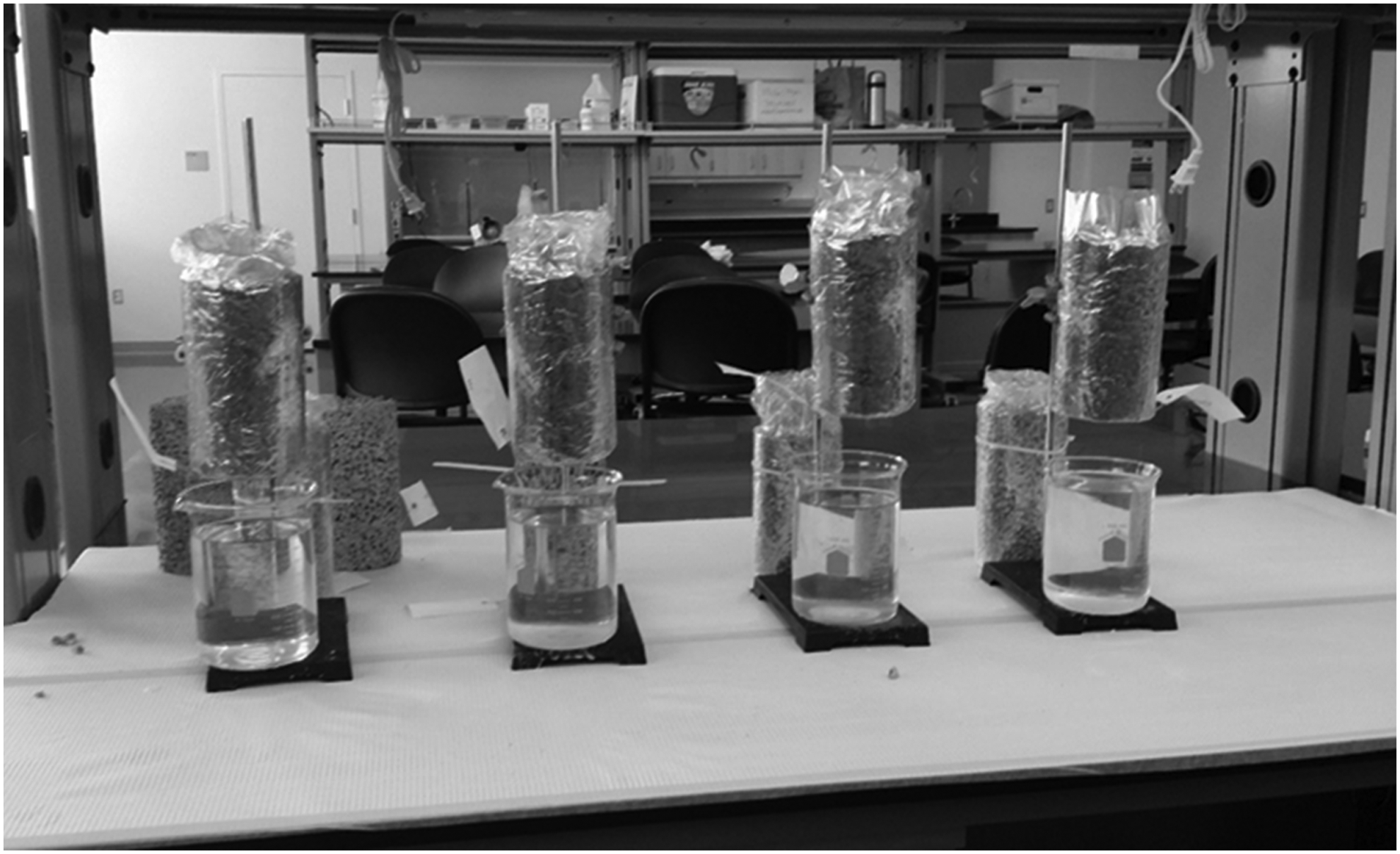
Experimental procedure setup. Specimens are shrink-wrapped and placed on a beaker stand above a 1 L beaker that collects the effluents.
Results
Calcium ion concentration (mg/L) of the composite influent deicer solutions and the composite effluent solutions was analyzed weekly for each deicer application in both the ambient and cold room using the Seal AQ400 Discrete Analyzer method number UKAS-590-A. The concentration change, or the difference between the effluent concentration and the influent concentration, may be indicative of calcium absorption or leaching. The calcium ion concentration change over the final 9 weeks of the experiment in the ambient room is shown in Figs. 2 and 3. Figure 2 shows the concentration change for the control specimens and specimens treated with magnesium chloride made with OPC, both noncarbonated and carbonated. Figure 3 shows the change in the specimens made with a combination of OPC and fly ash. The calcium ion concentration is considered from week 9 to 17 because the protocol for testing for the calcium ion had not been established for all deicer applications in weeks 1–8. However, testing in the latter weeks indicates that the concentration change was negligible earlier in the experiment. Figure 4 shows the calcium ion concentration change for the control specimens and the specimens treated with magnesium chloride under cold laboratory conditions made with OPC, carbonated and noncarbonated. The concentration change was evaluated for all weeks in the cold room since only tap water was used, and the protocol for evaluating the calcium concentrations was already setup.

Change in calcium ion concentration from influent to effluent for OPC specimens in the ambient laboratory. The difference of calcium concentration, in mg/L, for the deicer solution influent versus effluent for specimens in the ambient room (H), treated with water (W), sodium chloride (S), or magnesium chloride (M), made with OPC (O) and noncarbonated (N) or carbonated (C).
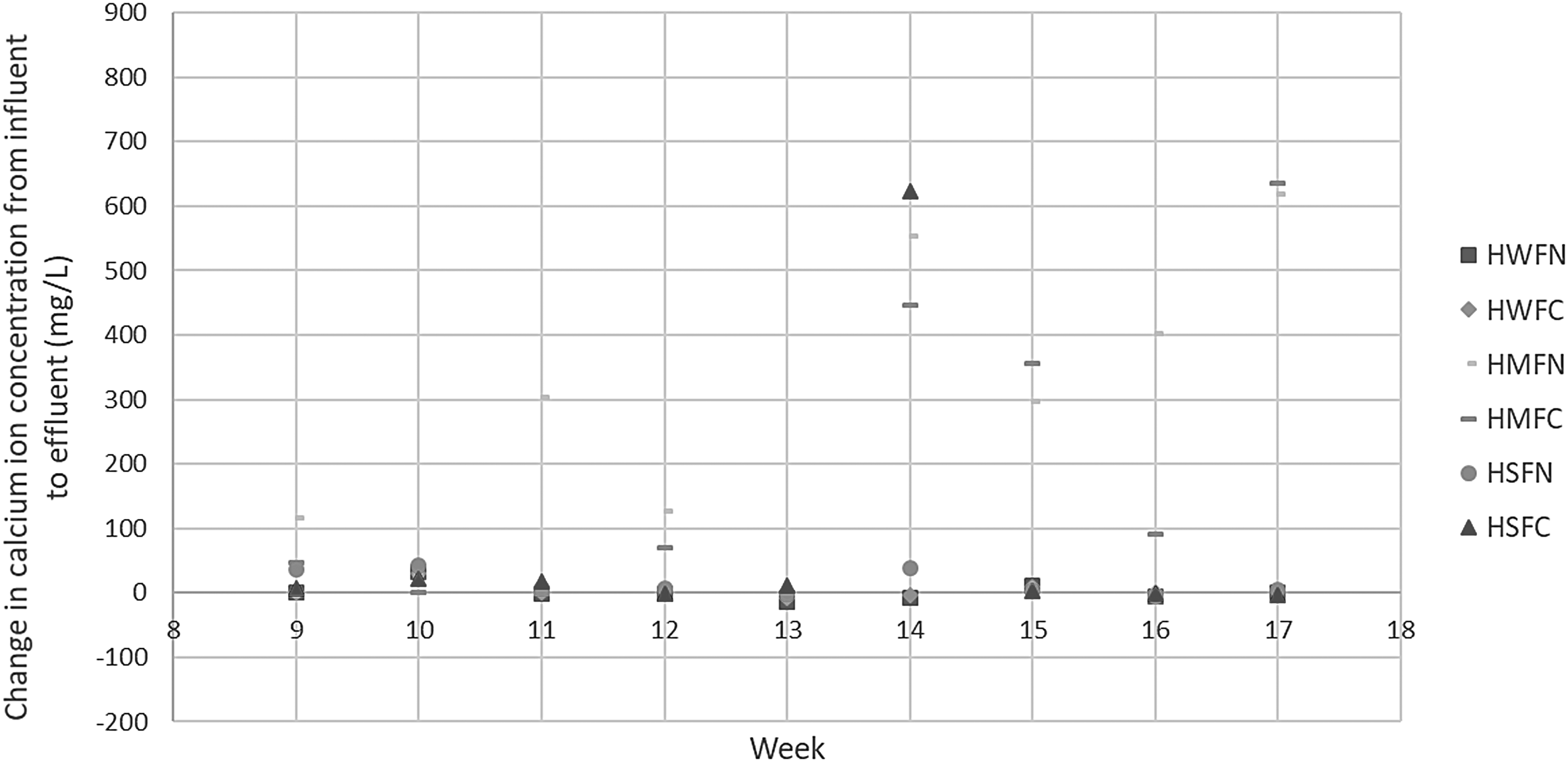
Change in calcium ion concentration from influent to effluent for OPC plus fly ash specimens in the ambient laboratory. The difference of calcium concentration, in mg/L, for the deicer solution influent versus effluent for specimens in the ambient room (H), treated with water (W), sodium chloride (S), or magnesium chloride (M), made with OPC and 25% low calcium Type F fly ash (F) and noncarbonated (N) or carbonated (C).
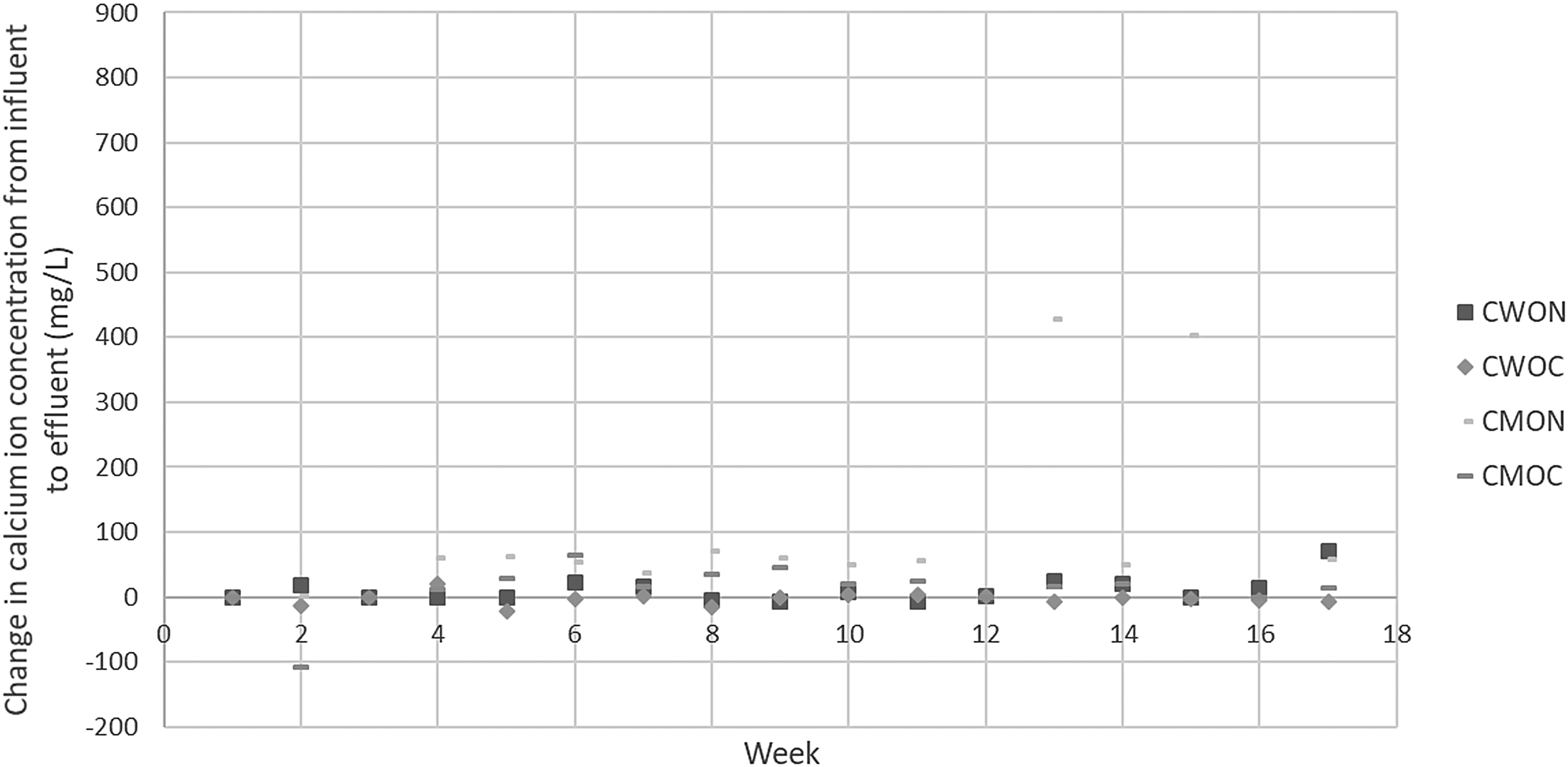
Change in calcium ion concentration from influent to effluent for OPC specimens in the cold room. The difference of calcium concentration, in mg/L, for the deicer solution influent versus effluent for specimens in the cold room (C), treated with water (W), sodium chloride (S), or magnesium chloride (M), made with OPC (O) and noncarbonated (N) or carbonated (C).
For the magnesium treated specimens in the ambient room, the total calcium ion concentration changes between the influents and the effluents are shown in Table 2. The specimens made with OPC experienced ∼20% more calcium leaching than those made with the fly ash substitution. Noncarbonated specimens experienced ∼32% more calcium leaching than the carbonated specimens.
OPC, ordinary Portland cement.
Figures 5 and 6 show the mass gain of the specimens over the 4-month (17 weeks) testing period for the noncarbonated and carbonated specimens, respectively, in the ambient laboratory. The magnesium chloride treated specimens gained the most mass of all the treatments for both the noncarbonated and the carbonated specimens, regardless of whether made with OPC only or 25% fly ash. The noncarbonated specimens cannot be directly compared to the carbonated ones as the specimens were normalized to initial masses taken at different times (the older specimens had been air-dried for years, while the newer specimen masses were taken shortly after curing and may have still had free water within).
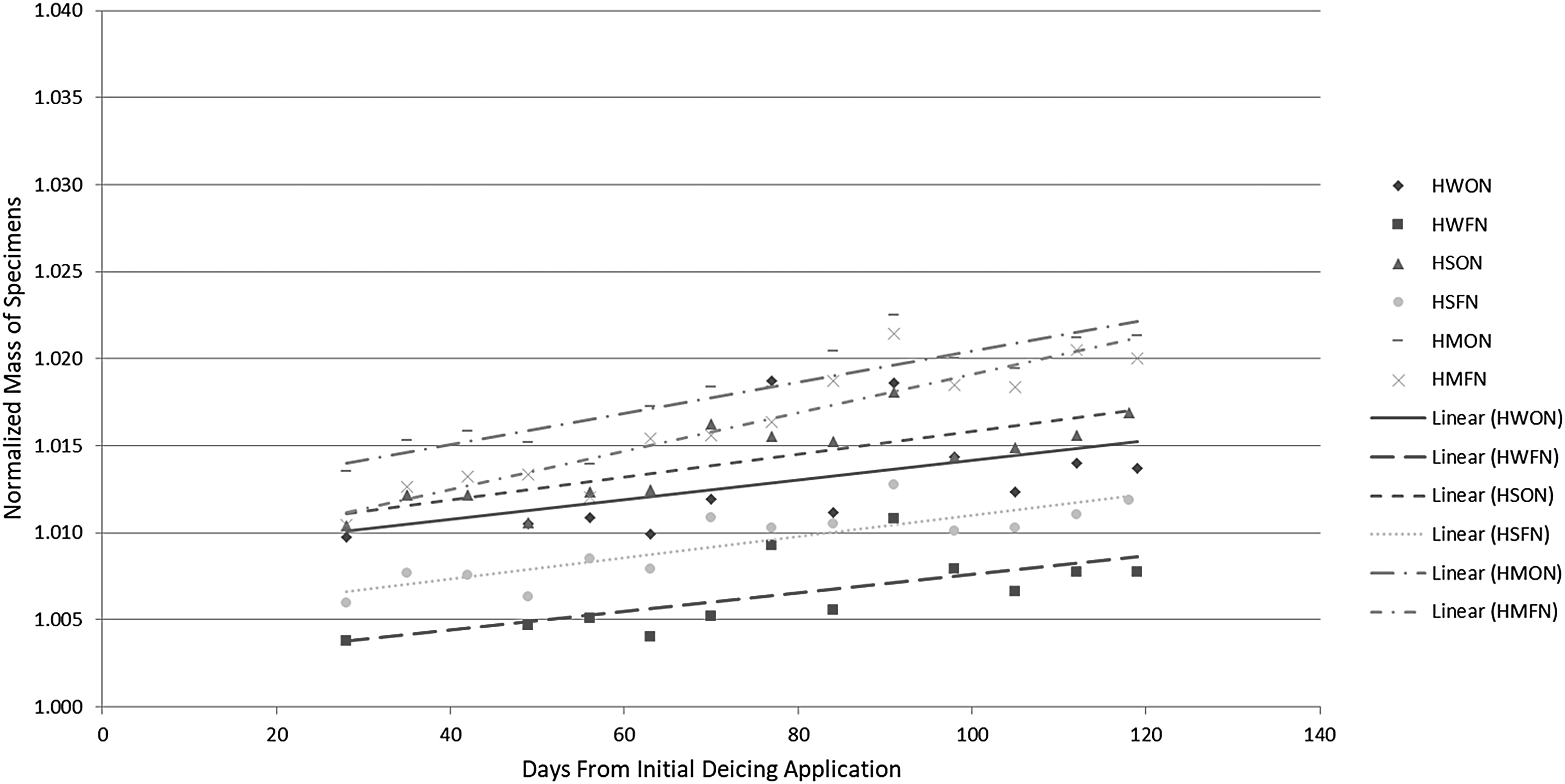
Normalized mass of noncarbonated specimens. For specimens in the ambient room (H), treated with water (W), sodium chloride (S), or magnesium chloride (M) and made with OPC (O) or OPC and 25% low calcium Type F fly ash (F).
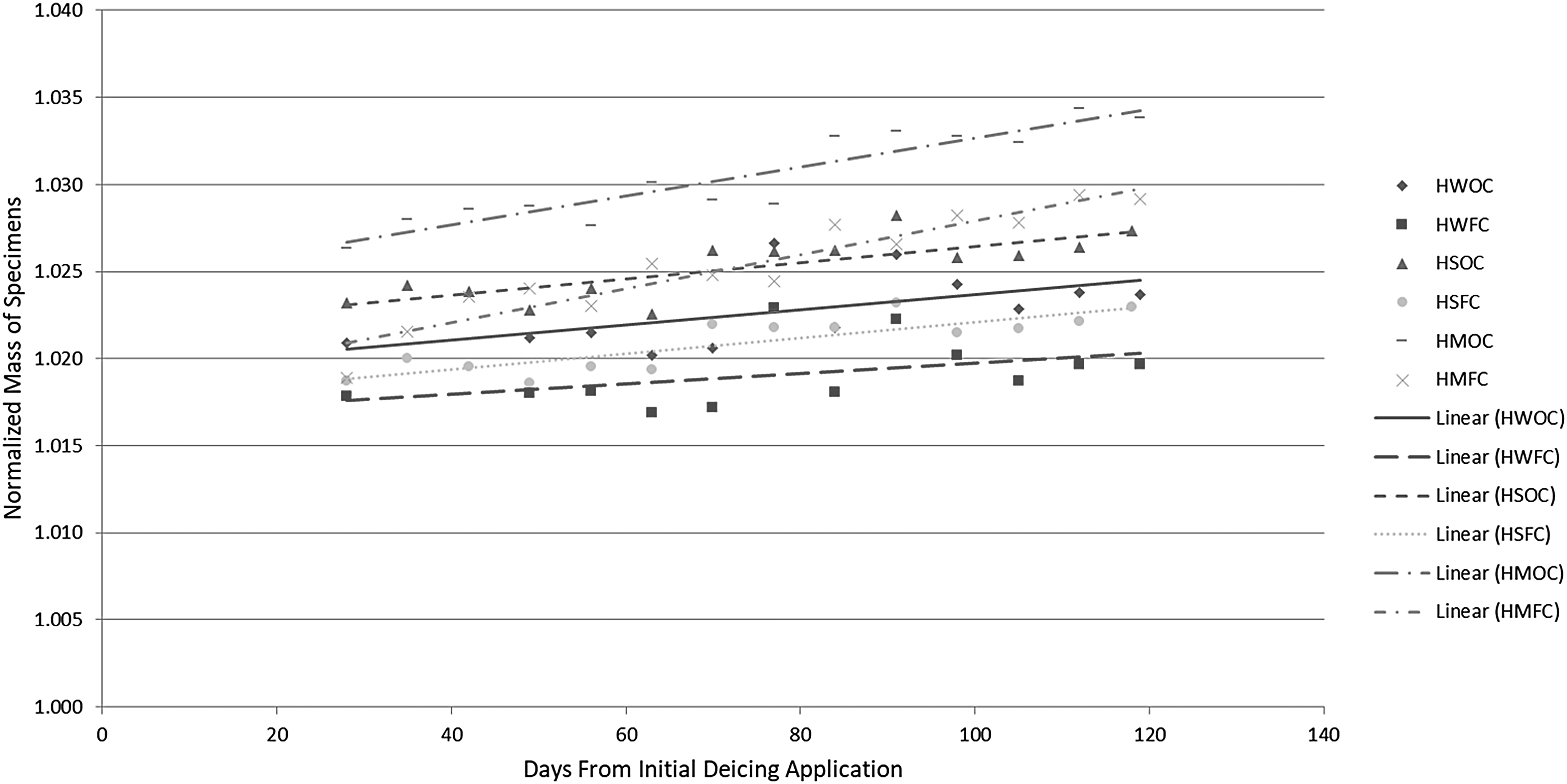
Normalized mass of carbonated specimens. For specimens in the ambient room (H), treated with water (W), sodium chloride (S), or magnesium chloride (M) and made with OPC (O) or OPC and 25% low calcium Type F fly ash (F).
Discussion
The initial hypothesis suggested that the magnesium ion in the magnesium chloride deicer would be preferred to the calcium ion by the hydroxide species in the cement paste matrix. The magnesium ion, once diffused into the internal voids in the specimen, might exchange with the calcium ion and precipitate magnesium hydroxide within its structure. Both an increase in calcium ion concentration from the influent to the effluent solution and a mass gain within the specimen are thought to be indicative of this exchange and subsequent internal precipitation, respectively.
As can be seen in Figs. 2 and 3, in the ambient laboratory, the analysis of the calcium ion concentration from influent to effluent shows a 0% increase between influent and effluent concentrations occurred for the water treated in week 9 and a 3% increase in week 17. A similar trend was observed with the sodium chloride treatment, except for outliers in week 14, most likely due to a small cement flake in the effluent or laboratory error. However, the magnesium chloride treated specimens experienced a 400% increase in calcium ion concentration from influent to effluent in week 9 and a 761% increase in week 17. For the magnesium treatment, the noncarbonated OPC specimens experienced a greater increase in calcium ion concentration from influent to effluent compared to the carbonated OPC specimens. This supports the complexation values in Table 1, with magnesium having a much higher preference for hydroxides than calcium, but a smaller preference for the carbonates. Therefore, more leaching is expected in the noncarbonated specimens.
Based on the data presented in Table 2, the ratio of calcium leaching in OPC specimens compared to OPC plus 25% low calcium Type F fly ash replacement is consistent with ∼20% less calcium existing within the cement paste to begin with. The consistency of the ratios supports the hypothesis that an ion exchange is occurring and that the ligands in the concrete prefer the magnesium ion to the calcium ion proportionate to the amount of calcium available for exchange.
Table 2 also shows the differences in the overall effluent concentrations due to carbonation and the different preferences for the hydroxide and carbonate ligands as indicated in the values of the stability constants in Table 1. The noncarbonated specimens have more hydroxides available for magnesium hydroxide formation due to less carbonation having occurred, and the fly ash specimens have less calcium available within the specimen. The larger increases in the calcium ion concentration from the influent to effluent for the noncarbonated specimens versus the carbonated specimens, both with and without fly ash, imply a correlation to the availability of the hydroxide ligand. The consistency of the decrease in calcium in the effluent due to carbonation as seen in the last column of Table 2, regardless of the mix design, aids in validating the hypothesis.
Specimen mass gains over time in Figs. 5 and 6 suggest that a precipitate is forming in the internal voids in the specimens. The specimens made with just OPC show a greater mass gain than those made with the fly ash substitution suggesting that the available calcium in the cement paste may affect the mass gain of the specimen. The two controls, water and sodium chloride, exhibit a similar mass gain to each other only, while both the magnesium treated specimens made with just OPC and those made with a 25% fly ash substitution show a greater mass gain overall.
Future testing is recommended to determine if the chemical changes impact the strength and durability of pervious concrete. Previous studies on traditional concrete indicate that strength may be reduced (Sutter et al., 2008; Darwin et al., 2008). In addition, further testing should be performed in an ambient temperature laboratory as the results in Fig. 4 for the cold room imply slower kinetics in the reactions compared to the results in Figs. 2 and 3 for the ambient temperature room.
Summaries
Previous studies on traditional concrete indicate that magnesium chloride might impact durability of traditional concrete. Many of these studies also included freeze–thaw, physical, impacts. Therefore, it was assumed that magnesium chloride would also impact pervious concrete, especially since the chemicals would readily flow deep into the pervious concrete matrix due to its high porosity and interconnected pores. This experiment sought to investigate possible chemical impacts, hypothesizing that there would be a chemical deterioration and possibly pore precipitation due to complexation theory. Specifically, it was hypothesized that the magnesium ion in the magnesium chloride prefers the hydroxide species in the concrete and will remain in the internal pores of the concrete by exchanging with the calcium ion and/or precipitating magnesium hydroxide. The less carbonated species would be more susceptible to chemical attack as carbonate species tend to favor the calcium ion.
An increase in calcium ion concentration from influent to effluent over the 17-week testing period was greatest for the magnesium chloride treated specimens supporting the hypothesis that the magnesium ion is preferred by the ligands in the cement paste and may be exchanging with the calcium ion. The greater mass gain for the magnesium chloride treated specimens compared to the two controls is also indicative of the exchange occurring with the hydroxide ion and then possibly internal precipitation of Mg(OH)2. The amount of calcium leached from the OPC and 25% fly ash compared to the OPC only specimens is proportional to the amount of calcium existing within the cement paste before treatment, which would be expected if an ion exchange is occurring and is proportional to the availability of those cations.
The results support the hypotheses that a chemical exchange is occurring and that the changes can be explained by stability constants for the formation of complexes and precipitates. Further studies on the strength or durability impacts of the chemical changes are recommended.
Footnotes
Acknowledgments
The authors thank Quinn Langfitt and Sarah Pate for assisting with this research and the Northwest Advanced Renewable Alliance who partially funded Ms. Pate. In addition, the authors thank the Ready Mix Concrete Research and Education Foundation for funding this research. Source of Work: Washington State University and Lamar University.
Author Disclosure Statement
No competing financial interest exists.