




Abstract
The present work is devoted to the synthesis of a novel photocatalyst of TiO2/Ag3PO4/bentonite composite and its utilization for degradation of methylene blue (MB) in aqueous solution under visible light irradiation. The synthesized catalyst was characterized by X-ray diffraction, Fourier transform infrared spectroscopy, field emission scanning electron microscopy, Brunauer-Emmett-Teller method and energy-dispersive X-ray techniques. Degradation conditions were optimized as pH of 7, catalyst loading of 0.1 g, initial MB concentration of 50 mg/L at room temperature with composition weight ratio of TiO2:Ag3PO4:bentonite corresponding to 1:0.15:1, respectively. Results indicated that photocatalytic activity of this material was significantly improved due to the combination of advantages of its components. Kinetics of degradation process fitted well with a pseudo first-order model. A possible degradation mechanism was proposed and analyzed in detail. In addition, recycling study demonstrated a high stability of the catalyst over five continuous cycles of MB degradation.
Introduction
D
Since the concept of photocatalysis has come into being, in chemistry it refers to the reactions that occur under the simultaneous interaction of light and a catalyst; therein light is a trigger factor to initiate the reaction. After being excited by light, the catalyst creates electron–hole pairs for electron exchange between its surface and adsorbed substances through semiconductor bridges. It then accelerates photochemical process through a series of oxidation-reducing reactions (Dionysios et al., 2016).
TiO2 is one of the most promising photocatalysts that has attracted great attention from scientific community because of its chemical inertness, eco-friendly nature, and high photocatalytic activity by means of a high degradation efficiency of organic pollutants under light exposure (Mishra et al., 2017). TiO2 with a band-gap of around 3.2 eV has good properties in charge transport and photo-electronic generation, supporting the formation process of reactive oxygen species in an aqueous medium such as hydroxyl radicals OH• and superoxide anions
To use visible light in the photocatalytic process of TiO2, many metals such as Ag, Ni, Au, and Pt (Vasilaki et al., 2015), nonmetals such as N and C (Gar Alalm et al., 2016; Islam et al., 2016; Miao et al., 2016; Khalid et al., 2017), and other inorganic substances such as Cu2O, AgCl, and Ag3PO4 (Qi et al., 2014; Fu et al., 2015) were utilized to modify TiO2 to enhance its photocatalytic ability. Among these additives, Ag3PO4—a perspective photocatalyst with a relatively narrow band-gap (2.36–2.43 eV)—can coordinate with TiO2 in oxygen evolution from water for degradation of organic pollutants under visible light irradiation with wavelength λ < 530 nm (Yi et al., 2010; Ma et al., 2013; Dong et al., 2016). Indeed, numerous studies (Li et al., 2014; Eswar et al., 2015; Yang et al., 2015; Du et al., 2017; Shao et al., 2017) related to the synthesis of Ag3PO4/TiO2 composites for photocatalytic degradation of industrial pollutants have been reported. The results of these studies demonstrated that the combination of TiO2 and Ag3PO4 led to the formation of the more photostable Ag3PO4/TiO2 composite whose photocatalytic properties are superior to those of individual components due to the special photocatalytic mechanism of the new combined structures (Yao et al., 2012; Shao et al., 2017).
Another aspect related to the large surface area of small-sized particles, especially nanoparticles, is expected to be beneficial for photocatalytic reactions that mostly occur on the surface of the catalysts (Kamat, 1993). However, the nanoparticles could be aggregated quickly into micrometer-sized particles in aqueous solutions, thus reducing their photocatalytic activity and hindering their practical applications. In addition, as the particle size decreases to nanoscale, it is difficult to separate them from the reaction systems. To improve this situation, catalyst particles can immobilize on appropriate supports or combine with some adsorbents as carriers (Ma et al., 2013). This combination has several advantages: (i) the photocatalyst nanoparticles immobilized on an adsorbent carrier can help avoid their aggregation into micro-sized particles, ensuring the large specific surface area of photocatalyst nanoparticles; (ii) adsorbent can absorb or drag adsorbate molecules toward photocatalyst sites and therefore improve photocatalytic efficiency; (iii) harmful intermediates and by-products deriving from the photocatalytic reaction can be observed by the adsorbent, reducing secondary damage to the environment (Lin et al., 2012).
Among these catalyst carriers, bentonite is one of the most promising candidates. Bentonite—an abundant clay mineral on the earth—is widely used as excellent adsorbent for removal of various pollutants from wastewater due to its cheapness, worldwide availability, chemical stability, high specific surface areas, good adsorption capacity, and environmental friendliness. In the role of catalyst carriers, many studies have shown that the use of bentonite as adsorbent catalyst carrier for Ag3PO4 (Ma et al., 2013, 2016a, 2016b) or TiO2 (Zhang et al., 2015; Cao et al., 2016) can significantly improve the degradation rate of pollutants as compared to the case of using naked Ag3PO4 or TiO2. However, the combination of Ag3PO4, TiO2, and bentonite for photocatalysis degradation of pollutants has not been studied.
In this regard, the aim of this work was to synthesize Ag3PO4/TiO2/bentonite composite and study its photocatalytic potential of degradation of a model organic pollutant, methylene blue (MB) dye, under visible light irradiation. The effect of various parameters such as catalyst loading, pH, and initial concentration of the MB dye on degradation was determined. The mechanism of enhanced photocatalytic activity of Ag3PO4/TiO2/bentonite photocatalysts was also analyzed.
Materials and Methods
Materials
MB (C16H18N3SCl · 3H2O, 98.5%), silver nitrate (AgNO3, ≥99.0%), and sodium phosphate dodecahydrate (Na3PO4·12H2O, ≥98%) were purchased from Shenlong Chemical Co. Ltd. (China). Titan dioxide Degussa P25 (TiO2 P25) with purity of 99.9% and particle size 20 nm was supplied by Evonik Degussa (Germany). All the chemicals were reagent grade and used without any further purification. Natural bentonite was collected from mineral clay source at Binhthuan province in Vietnam and then activated through the procedures described by Nadez̆da and Jovan (1991). The activated bentonite sample was pulverized and filtered through a 100-mesh sieve. Double-distilled water was used as solvent for washing samples and preparing all necessary MB solutions.
Preparation of catalysts
Ag3PO4 was prepared from 0.12 M Na3PO4 and 0.1 M AgNO3 by co-precipitation method at room temperature with continuous stirring for 7 h. After a smooth yellow precipitate appeared, the pH of suspension was adjusted up to 8 by adding 0.5 M Na3PO4 solution. The solid yellow powder of Ag3PO4 was then accurately washed with double-distilled water till neutral pH, separated by vacuum filtration, dried at 80°C for 5 h, and calcined at 500°C for 5 h.
TiO2/Ag3PO4/bentonite (TAB) composite was prepared by wet impregnation method at room temperature. Different amount of as-synthesized Ag3PO4 was placed in 150 mL beakers containing 50 mL double-distilled water and stirred for 1 h with an electromagnetic stirrer. A 25 mL suspension containing 1 g activated bentonite was then added and continuously stirred for 1 h. Next, 25 mL suspension containing 1 g of TiO2 was dropped to the mixture and stirred for 24 h. The slightly orange solid was then separated by vacuum filtration, dried at 80°C for 5 h, and calcined at 500°C for 5 h.
Preparation of TiO2/bentonite, Ag3PO4/bentonite, and TiO2/Ag3PO4 composites used as reference samples in the present work was also carried out through the procedures similar to those of TAB.
Characterization of materials
Phase composition and structure of the synthesized materials were detected by X-ray powder diffraction on a Bruker D2 PHARSER diffractometer with CuKα radiation at a wavelength of λ = 1.5406 Å, accelerating voltage of 40 kV, current stream of 40 mA, scan angle of 10°–80°, and scanning speed of 0.03°/s. Morphology of the samples was examined using a FE-SEM S4800 HITACHI scanning electron microscope with an accelerating voltage of 10.0 kV. The elemental analysis was carried out on an energy-dispersive X-ray (EDX) Micro Analyzer H-7593 (Horiba, Japan). The presence of functional groups in the samples was analyzed by Fourier transform infrared absorption spectrometry (FTIR) on Bruker Tensor 37 FTIR (Germany) by KBr disk method with scanning wavenumber ranging from 4000 to 500 cm−1. The UV-Vis diffuse reflectance spectra of the prepared photocatalysts were recorded on a Shimadzu UV-2450 UV-Vis spectrophotometer in the wavelength range of 200–700 nm using BaSO4 as the reference. Specific surface areas of the samples were measured on a Micromeritics TriStar 3020 sorptometer (Micromeritics, Atlanta, GA) using the Brunauer, Emmett, and Teller (BET) method.
Photocatalytic dye degradation study
Photocatalytic degradation experiments were carried out in a 150 mL beaker by mixing 0.1 g of catalyst with 100 mL MB solution using a stirrer at 150 rpm under visible light irradiation from a 250 W halogen lamp (HLX 64653; Osram, Germany, wavelength range 300–800 nm) equipped with a 420 nm cut-off filter. A lamp was located 20 cm above the center of solution to achieve an irradiation intensity of about 300 mW/cm2 (measured using a solar power meter; Tenmars-TM-206; United Kingdom) in the wavelength range from 420 to 560 nm). A thermostatic water-bath was employed to keep the reaction temperature at the desired value. The MB solutions of different concentrations were obtained by using a stock solution of 100 mg/L, which was prepared by dissolving MB powder into double-distilled water. The 0.1 M NaOH or 0.1 M HCl solutions were used to adjust the initial pH of MB solutions to a desired value. After a certain time interval, the catalyst was removed by centrifugation and then the remaining MB concentration in each beaker was determined by UV-Vis method using an UV-VIS GENESYS 20 spectrophotometer at the wavelength of 665 nm. Factors affecting the degradation of MB, such as initial pH, time to degradation, composition weight ratio, catalyst dosage, and initial MB concentration, were examined. All experiments were repeated at least three times, and all data presented here were taken from the average of these repeating experiments.
Photocatalytic stability of the catalysts was evaluated by checking the photocatalytic degradation efficiency of MB in the five consecutive cycles, each cycle lasting for 60 min. After each cycle, the photocatalyst (0.1 g) was centrifuged and washed thoroughly with distilled water and then fresh MB solution (100 mL, 50 mg/L, pH of 7) was added again for the next cycling run.
Results and Discussion
Characterization of photocatalysts
Figure 1 shows XRD patterns and FTIR spectra of the synthesized TAB catalyst and its components used for the synthesis. As shown in Fig. 1A the obtained XRD patterns of TiO2 P25 and Ag3PO4 are in good accordance with the XRD reference database (JCPDS cards no. 21-1272 and 70-0702), respectively. For TAB catalyst, XRD pattern contains all characteristic peaks of TiO2, bentonite, and Ag3PO4, confirming the presence of crystal phases in the prepared catalyst. In addition, the well-defined peaks observed for TAB catalyst indicate that the crystalline structure of catalyst components was well maintained. The presence of characteristic functional groups for TAB catalyst and the used components of TiO2 P25, bentonite, and Ag3PO4 is also confirmed by FTIR spectra presented in Fig. 1B. For TiO2 P25, the broad band centered at 3,428/cm and a small peak at 1,627/cm can be attributed to O–H stretching vibrations and bending modes, respectively, with varying interactions between them and TiO2 (Erdem et al., 2001; Mohamed et al., 2016). The indicated hydroxyl groups originated from water molecules adsorbed on TiO2 surface.

X-ray diffraction patterns
It should be note that superficial OH groups play a leading role in photocatalytic activity of TiO2 (Liao et al., 2012). For bentonite, a deep valley with two small peaks that appeared at 3,621 and 3,416/cm was related to H–O–H and –OH stretching vibrations of adsorbed water (Ma et al., 2013). Besides, two weak peaks detected at 1,615 and 1,428/cm were assigned to H2O bending modes and intrinsic C–O vibrations of carbonate, respectively (Lu et al., 2000). It should be noted that the peak of 1,428/cm for bentonite was also detected for the synthesized TAB. A strong band centered at 1,009/cm as well as other peaks observed at lower wavenumbers were associated with stretching vibrations of Si–O–Si bonds always found in phyllosilicate minerals (Ma et al., 2013).
In the case of Ag3PO4 similar as that mentioned above for TiO2 and bentonite, the strong adsorption band from 3,500 to 2,700/cm and a small peak at 1,668/cm are also related to O–H stretching and H–O–H bending vibrations of residual water, respectively (Dhanabal et al., 2015). A strong peak observed at 1,047/cm is attributed to molecular vibrations of PO43−. Overall, the broad adsorption band of about 3,600–2,700/cm and characteristic peaks at 1,627/cm for TiO2, 1,428 and 1,615/cm for bentonite, and 1,668/cm for Ag3PO4 remained the same as in the synthesized TAB catalyst, once again confirming the presence of residual water in catalyst samples. Furthermore, another peak at 1,038/cm for TAB samples (Fig. 1B) can be related to the indicated stretching vibrations of Si–O–Si and molecular vibrations of PO43− as well.
Morphology of Ag3PO4, bentonite, TiO2, and TAB catalyst is presented in Fig. 2. As shown in Fig. 2A, Ag3PO4 consists of non-uniform near-spherical grains with the diameter varying from 0.2 to 2 μm as reported in literature (Li et al., 2015; Dong et al., 2016) for pristine Ag3PO4. Bentonite is cohesive material composed of micro-sized agglomerates (Fig. 2B). It can be also seen that bentonite contains pores, which play an important role in its adsorption ability toward various kinds of adsorbates. TiO2 grew into uniform spherical shape with diameter 50 nm (Fig. 2C). For the synthesized TAB samples as shown in Fig. 2D with scale bar of 1 μm, Ag3PO4 grains were surrounded by TiO2 grains of smaller sizes. Bentonite with largest grain size was covered by the indicated Ag3PO4/TiO2 compound. The BET analysis indicated that the specific surface area of TAB catalyst slightly decreased (57.5 m2/g) as compared to those of small TiO2 particles with 74.7 m2/g (Table 1).
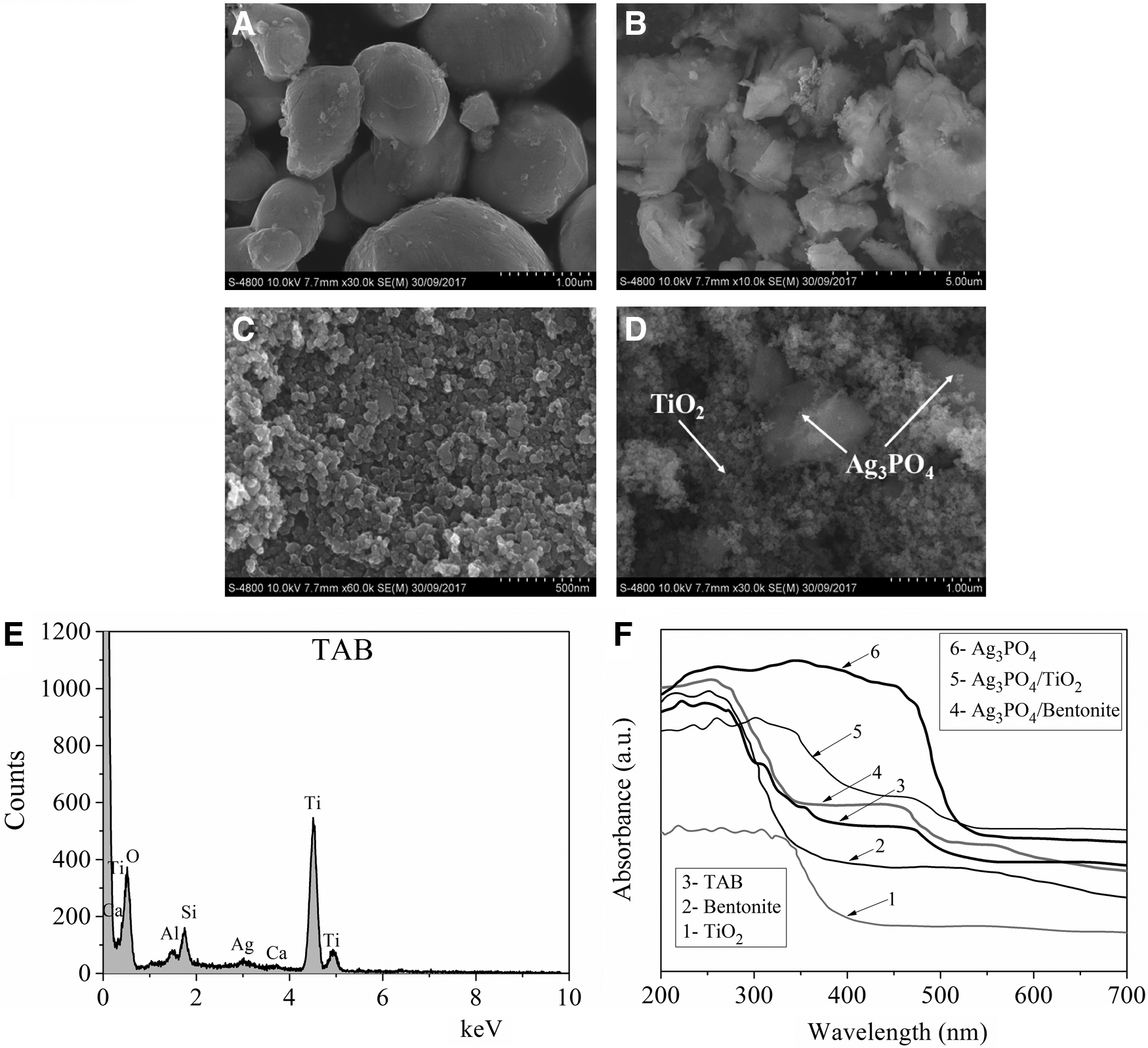
Scanning electron microscopy images of Ag3PO4
TAB, TiO2/Ag3PO4/bentonite; BET, Brunauer, Emmett, and Teller.
The elemental composition analysis (Fig. 2E) indicated that the synthesized TAB catalyst contained main elements of catalyst components, such as Ti, O, Ag, P, Si, Ca, for which Si, as mentioned above, is a characteristic element of phyllosilicate minerals contained in bentonite. Thus, the presence of silicon and calcium elements was inevitable. Totally, the characterization studies using XRD, FTIR, EDX, and morphology analysis confirmed successful synthesis of TAB catalyst ready for MB degradation.
Figure 2F shows the UV-Vis diffuse reflectance spectra of TiO2, bentonite, Ag3PO4, Ag3PO4/TiO2, Ag3PO4/bentonite, and TAB. As shown in Fig. 2F, TiO2 and bentonite can mainly absorb energy in the UV region only, while the bare Ag3PO4 exhibits a higher absorption intensity in both UV and visible light regions with a strong absorption band at wavelengths shorter than ∼530 nm. Bentonite shows little absorption toward visible light. Besides, the combination of TiO2 and bentonite with Ag3PO4 improved their absorption intensity in visible region in the range of wavelengths shorter than ∼500 and ∼530 nm for Ag3PO4/TiO2 and Ag3PO4/bentonite, respectively. In the case of TAB composite, both UV and visible light absorption was detected. The UV and visible-light absorption regions might be related to the presence of TiO2 and Ag3PO4 in the TAB, respectively. The obtained results indicated that the TAB composite could be used for visible light photocatalytic reactions.
Comparison of catalysts, kinetics, and degradation mechanism
To clarify the photocatalytic activity of TAB catalyst, a comparative study on photocatalytic degradation of MB by TAB catalyst and various catalysts composed of components such as TiO2, Ag3PO4, TiO2/Ag3PO4, TiO2/bentonite, and Ag3PO4/bentonite was conducted. The experimental conditions were established at pH of 7, initial MB concentration of 50 mg/L, and catalyst loading of 0.1 g at room temperature. The experiments were carried out for 90 min in the dark and 130 min under visible light irradiation. The ratio of TiO2:Ag3PO4:bentonite for all the used catalysts was set as 1:0.15:1. The obtained results are shown in Fig. 3A.
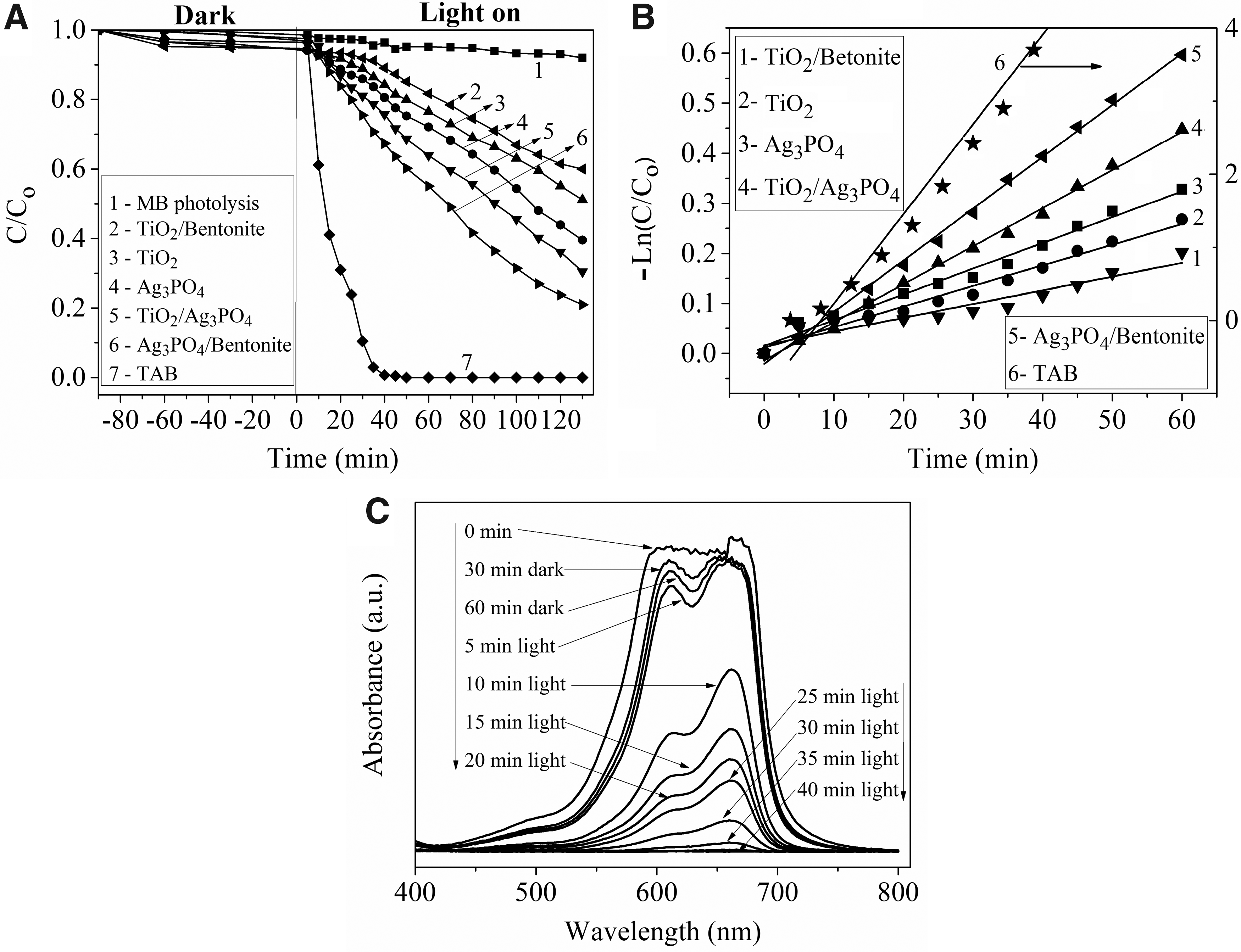
Photocatalytic degradation of MB by TAB catalyst and various catalysts composed of its components in the dark and under visible light irradiation
It is obvious from Fig. 3A that the change in MB concentration in the dark was quite small for all the used catalysts. Under light irradiation, degradation of MB sharply increased. For MB degradation using TAB catalyst, MB was completely degraded after a contact time of 40 min. Based on the degradation rates as shown in Fig. 3A, the photocatalytic activities of the used catalysts followed the order: without catalysts < TiO2/bentonite < TiO2 < Ag3PO4 < TiO2/Ag3PO4 < Ag3PO4/bentonite < TAB. The observed order can be explained as follows. Without catalysts, the MB removal efficiency was negligible due to the absence of photocatalytic degradation. In the presence of TiO2/bentonite as a catalyst, the degradation process was significantly improved (curve 2, Fig. 3A). The lower efficiency of TiO2/bentonite as compared to those of pristine TiO2 can be explained by the lower overall mass of TiO2 in TiO2/bentonite composite than that of TiO2 alone, enhancing the formation rate of •OH radicals (Laysandra et al., 2018). In addition, this behavior might be related to the effect of light attenuation due to adsorption or scattering by bentonite, obstructing the light reaching TiO2 surface.
Next, the stronger photocatalytic activity observed for Ag3PO4 than those of TiO2 was obviously associated with the lower band gap (2.36–2.43 eV) of Ag3PO4 as compared to 3.1 eV of TiO2. Moreover, as reported in literature (Du et al., 2017), the photocatalytic activity of Ag3PO4 can be improved by its combination with TiO2 (TiO2/Ag3PO4) because TiO2 particles inhibit recombination of photogenerated electron–hole pairs, indicating the observed order of Ag3PO4 < TiO2/Ag3PO4 for their photocatalytic activities as mentioned above. The next potential catalyst is Ag3PO4/bentonite with higher photocatalytic activity than that of TiO2/Ag3PO4. It can be attributed to negative charges placed on bentonite surface (Mekhamer, 2010; Ma et al., 2013). Indeed, cationic MB molecules could be attracted to the negatively charged bentonite surface where Ag3PO4 particles take place and therefore degradation process occurred faster. Finally, the highest photocatalytic activity was obtained for the synthesized composite of TAB. Based on the above explanations, the synthesized catalyst took all advantages of its components. In this case, bentonite is used as a carrier to immobilize Ag3PO4 and TiO2 to avoid their aggregation into micro-sized particles. Besides, along with the attraction ability towards cationic MB molecules as mentioned above, bentonite can be utilized as an adsorbent by itself. The component of TiO2 plays an important role not only as photocatalyst but also as a barrier inhibiting the recombination of photogenerated charge carriers. The nature of this recombination inhibition will be clarified by the degradation mechanism given below.
Results as presented in Fig. 3A can be presented using the pseudo first-order model, called the Langmuir-Hinshelwood model, to quantitatively study the kinetics of MB degradation results, according the following equation (Li et al., 2015):
where C (mg/L) is MB concentration at any time during degradation process, C0 (mg/L) is initial MB concentration, and k is kinetic constant (min−1). The obtained results with kinetic constants for different catalysts are shown in Fig. 3B and Table 2. It can be seen in Table 2 that the calculated regression coefficients are between 0.9376 and 0.9923; so the pseudo first-order kinetic model can be used to describe the MB degradation process. It should be noted that the pseudo first-order kinetic model also well described the kinetics of photocatalytic degradation of azo dyes using heterogeneous catalysts such as Ag3PO4 and Ag3PO4/TiO2 under visible light irradiation (Dai et al., 2014; Jing et al., 2014; Li et al., 2014; Eswar et al., 2015).
The process of photocatalytic degradation of MB using TAB composite was visually presented by UV-Vis spectra of MB solution as shown in Fig. 3C. The results indicated that the absorbance of major absorption band slightly decreased in the dark and rapidly faded after about 5 min under light irradiation. Within the first 5 min under light, MB concentration changed very little. The possible reason for relatively low degradation rate at this stage might be related to a high concentration of MB molecules adsorbed around active sites, resulting in the limitation of light transmission to TAB surface. The more the active sites evacuated, the stronger the light transmission that took place to accelerate degradation process. After 40 min, the adsorption band faded completely, suggesting that MB structure was thoroughly destroyed.
According to our experimental results, a possible degradation mechanism toward MB by TAB catalyst under visible light irradiation is proposed (Fig. 4) as follows. When light turned on, photogenerated electrons could be excited and transferred from VB of Ag3PO4 and TiO2 to their CB. During this process, holes (h+) were generated in the VBs. After that the electrons and holes quickly transferred from CB of TiO2 and VB of Ag3PO4 to CB of Ag3PO4 and TiO2 due to the more positive potential of CB and VB for Ag3PO4 as compared to that of TiO2, that is, the charge separation of photogenerated carriers formed. In other words, the combination of TiO2 and Ag3PO4 can inhibit the recombination of charge carriers and therefore enhance the photocatalytic activity of TAB catalyst. At the same time, the MB degradation rate by TAB catalyst could be also enhanced by the participation of bentonite in the composite as follows. First of all, the cationic MB molecules were accumulated on the negatively charged bentonite surface until they fully covered the surface by a positive layer and therefore inhibited other MB molecules from reaching the surface. Then this positive layer was degraded by Ag3PO4/TiO2, and the bentonite surface was partially liberated, allowing other MB molecules to transfer to active sites of Ag3PO4 and TiO2. The described stages repeated until MB was completely degraded. The MB degradation process occurring with the participation of electrons at CB of Ag3PO4 and holes at VB of TiO2 can be described in more detail by the following reactions (Yang et al., 2015):
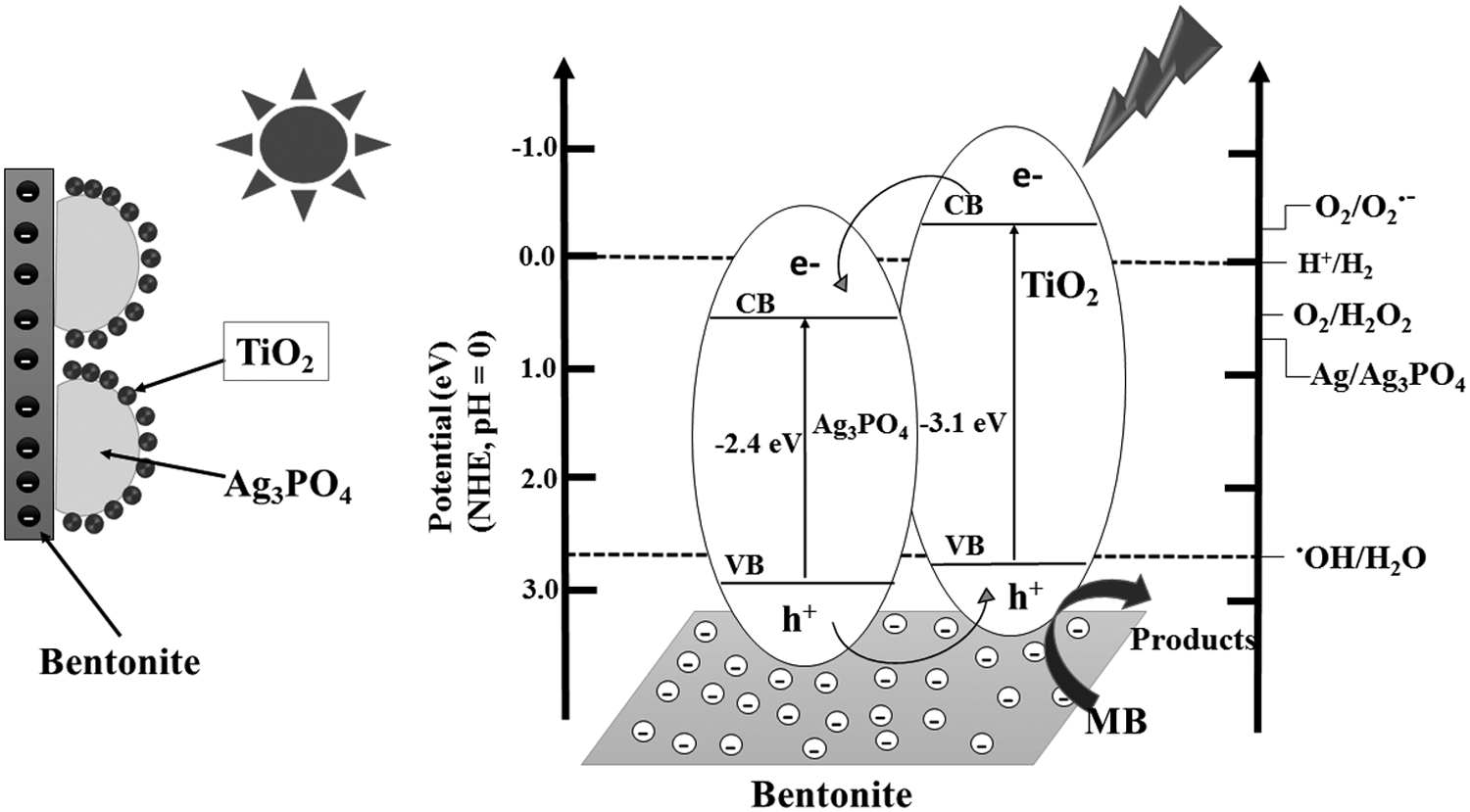
Schematic of photocatalytic mechanism using TAB catalyst.
Effect of composition weight ratio
The composition weight ratio is an important factor by means of adjusting the number of active sites as well as their distribution in a composite catalyst. The experiments for effect of composition weight ratio on MB degradation efficiency were carried out under pH of 7, initial MB concentration of 50 mg/L, and catalyst loading of 0.1 g at room temperature for 60 min in the dark and 130 min under light irradiation. The composition weight was chosen with different ratios corresponding to the order of TiO2:Ag3PO4:bentonite as shown in Fig. 5A.

Effects of composition weight ratio
The obtained results showed that under visible light irradiation, by increasing the composition weight ratio of Ag3PO4 from 0.05 to 0.15 at the early stage of degradation process, photocatalytic degradation efficiency of MB increased. With a further increase in composition weight ratio of Ag3PO4, the degradation efficiency decreased. It can be related to the fact that by increasing composition weight ratio of Ag3PO4, the amount of mass of TiO2 and bentonite components decreased, resulting in a rise in recombination of photogenerated charge carriers (Du et al., 2017) and a reduction in cationic MB molecules transferring to the bentonite surface, respectively. In the dark, the degradation of MB was not significant as compared to those with light exposure. In other words, MB removal process controlled by adsorption mechanism in darkness was weak as compared to those by degradation mechanism. The composition weight ratio of TiO2:Ag3PO4:bentonite as 1:0.15:1 was chosen for further experiments in the present work.
Effect of catalyst dosage
Determination of an optimal catalyst dosage is necessary to optimize degradation process in practice. The experimental conditions were set at initial MB concentration of 50 mg/L at room temperature and pH of 7 for 90 min in the dark and 130 min under light irradiation using TAB catalyst in the ratio of 1:0.15:1. The results are presented in Fig. 5B. According to the obtained results, an increase in catalyst loading up to 0.1 g made a significant increase in degradation efficiency, which reached saturation after 40 min of contact time with 0.1 g catalyst. A further addition of catalyst slightly improved degradation rate. The reason for that may be related to shielding catalysts from light exposure due to a relatively high catalyst loading. Therefore, 0.1 g of TAB catalyst was enough to completely degrade in a short time (<40 min) and was chosen as an optimal dosage for other experiments.
Effect of initial pH
Influence of pH on photocatalytic activity of catalysts for photodegradation of azo dyes is another important factor related to the surface charge properties of a photocatalyst. In the present work, the role of pH was studied at different values from 3 to 11. The other optimal experimental conditions were established as mentioned above.
In the dark, as was found for the TAB catalyst, the degradation efficiency could be negligible. Under visible light irradiation we saw that the TAB catalyst could effectively work in a wide range of pH from 3 to 11, in which the neutral pH of 7 gave the highest degradation efficiency (Fig. 5C). A deviation from this value was not favorable for MB degradation by TAB catalyst. The reason might be related to the fact that at acidic conditions (pH <7), bentonite surface could be surrounded by positive charges of H+ and, therefore, repels cationic MB molecules, inhibiting them from reaching active sites of TiO2 and Ag3PO4 on bentonite surface. At alkaline conditions (pH > 7), the nature is the same by means of electrostatic interactions, but the situation is different. In this case, the cationic MB molecules might be covered by negative charges, which repel the negatively charged bentonite surface. As compared to the literature for related catalysts, the obtained optimal pH of 7 could be reasonable. For example, a study on degradation of MB by TiO2 nanosized particles (Dariani et al., 2016) indicated that MB photodegradation increased with increasing pH value from 3 up to 11, that is, degradation process could occur in a wide range of pH under both medium and basic conditions. The optimal pH of 7 was chosen for other experiments.
Effect of initial MB concentration
Effect of initial MB concentration on its degradation using TAB catalyst was evaluated in the range of 25–100 mg/L under optimal experimental conditions. According the results shown in Fig. 5D, in darkness where the adsorption process could play a leading role, the MB concentration changed very little. When the light came on, the degradation efficiency strongly depended on the initial MB concentration. At the smallest initial MB concentration of 25 mg/L, MB was completely degraded after 20 min. Besides, the degradation rate decreased by about two times after increasing initial MB concentration up to 50 mg/L. At higher MB concentrations, the process took longer with a big drop in degradation rate. This phenomenon may be related to the fact that with increasing concentration of MB, the amount of MB molecules concentrated around the active sites increased, inhibiting the penetration of light to the surface of TAB, resulting in a decrease in the generation of relative amount of •OH and
Evaluation of stability and recyclability of catalyst composites
Stability and recyclability are important criteria and should not be underestimated when evaluating the potential of a catalyst for its practical applications. For TAB catalyst, the recycling tests were carried out under optimal conditions in five continuous cycles. Each cycle lasted 60 min, the time for completely degrading 50 mg/L of MB solution. It is obvious from Fig. 6A that photocatalytic activity of TAB catalyst changed very little (about 10%) during recycling process. The high stability of TAB catalyst was also confirmed by XRD patterns before and after five continuous cycles (Fig. 6B). XRD of TAB catalyst after MB degradation remained almost unchanged regardless of a slight decrease in the intensity observed for all of the peaks.
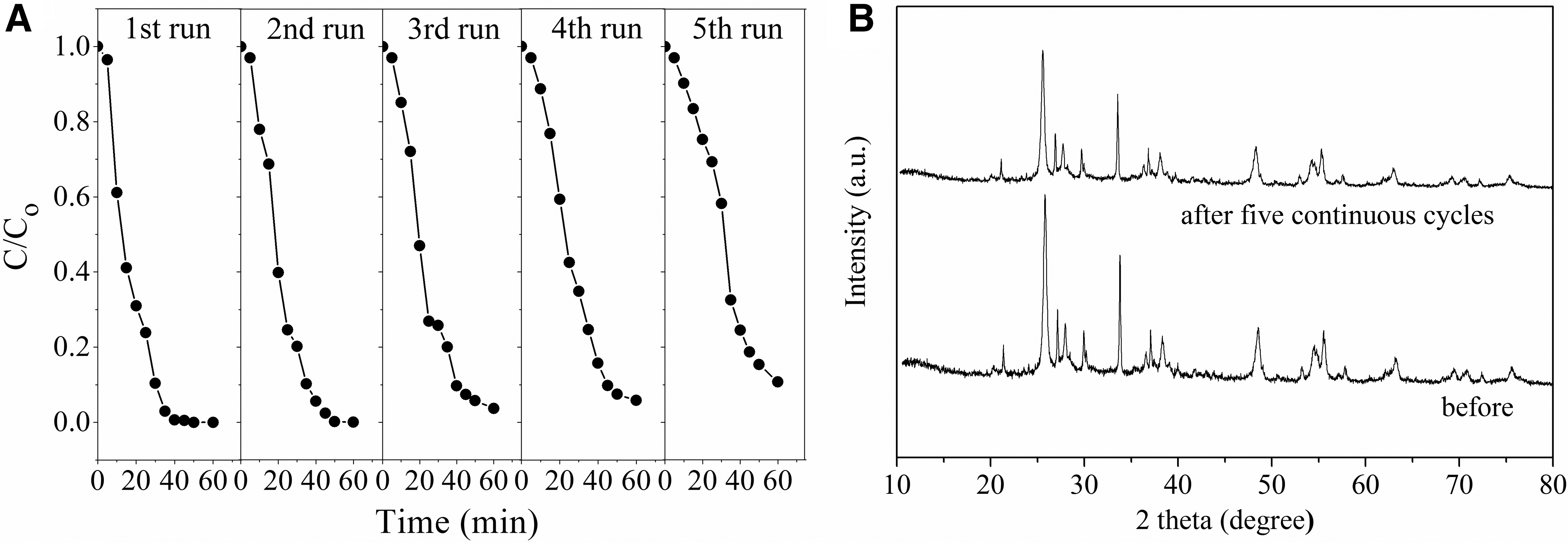
Photocatalytic activity reduction
Conclusions
In this study, a novel photocatalyst of TiO2, Ag3PO4, and bentonite was synthesized and utilized for degradation of MB in aqueous solutions under visible light irradiation. The degradation conditions were optimized as pH of 7, catalyst loading of 0.1 g, initial MB concentration of 50 mg/L at room temperature with composition weight ratio of TiO2:Ag3PO4:bentonite corresponding to 1:0.15:1. The kinetics of degradation process was described by the pseudo first-order model. The comparison of photocatalytic activities between different catalysts exhibited that the composite catalyst of TiO2/Ag3PO4/bentonite could take advantages from its composition and showed a higher photocatalytic activity. A possible degradation mechanism was proposed based on the attraction of cationic MB molecules by negatively charged bentonite to the active sites of Ag3PO4 and TiO2 on bentonite surface where the photodegradation of MB took place, as well as by charge separation inhibiting the recombination of charge carriers of the TiO2/Ag3PO4 system. In addition, recycling study demonstrated that the synthesized catalyst was stable and can be used circularly. Overall, the positive results suggested that TAB can be expected as a promising heterogeneous photocatalyst for degradation of MB in industrial wastewater.
Footnotes
Author Disclosure Statement
Authors confirmed that there are no actual or potential conflicts of interest including any financial, personal or other relationships with other people or organizations that could inappropriately influence the work.