




Abstract
Abstract
This article is aimed to find an effective method to decompose high-concentration N,N-dimethylacetamide (DMAC) in aqueous solution, which is widely used in chemical industry. Thermal activation persulfate/Fenton/thermal system (PS/Fenton/thermal system) was studied for this purpose. Effects of persulfate (PS) dosage, H2O2 dosage, [H2O2]/[Fe2+] molar ratio, and reaction temperature on degradation of DMAC in aqueous solution by PS/Fenton/thermal system were studied through single-factor experiment and response surface methodology. Results revealed that the DMAC and Chemical Oxygen Demand (COD) removal efficiencies by PS/Fenton/thermal system (96.5%/35.7%) were much higher than PS/Fenton, Fenton/thermal, PS/thermal, PS, Fenton, and heating systems (i.e., 59.6%/24.8%, 55.3%/20.14%, 9.9%/5.2%, 0.6%/0.3%, 0.2/0, and 0/0). High removal efficiency of the high-concentration DMAC mainly resulted from the synergistic effect of the PS/Fenton/thermal system, and the degradation mechanism was illustrated. In addition, according to the concentration of intermediates detected by high performance liquid chromatography, it can be seen that demethylation of DMAC in PS/Fenton/thermal system was facilitated by SO4·− and HO·, and decomposition pathway of DMAC was proposed. As a result, this work shows that the PS/Fenton/thermal system can be suggested as a high-efficiency process for treating high concentration DMAC-contained wastewater.
Introduction
N
Among AOPs, Fenton has been widely used for degradation of organic pollutants due to its high reaction rates and friendly and nonselective oxidation because of the fact that HO· [Eq. (1)] can decompose most organic contaminants in water (Li et al., 2013a; Epold et al., 2015; Wang et al., 2016). Fenton and varied Fenton-like reactions, such as UV/Fenton (Li et al., 2013a), US/Fenton (Li et al., 2013b), and Electro-Fenton (Cruz-Rizo et al., 2017), have been widely studied and used for wastewater treatment.
Recently, persulfate (PS) has attracted rising attention for in situ chemical oxidation, due to its well stability in the long-distance transport (Qi et al., 2014) and sustainability in solution in case of successive cycles in batch media (Ghauch et al., 2013). In addition, sulfate radical (SO4·−, Eθ = 2.60 V) produced by activating PS is also a strong oxidizing agent. The activations used for the generation of SO4·− are heating [Eq. (2)] (Tan et al., 2012), photolysis (Zhang et al., 2016), ultrasonic (Yang et al., 2015), transition metal ions [Eq. (3)] (Liang et al., 2013; Rao et al., 2014) or zero-valent iron (Li et al., 2015), and iron based system like bimetallic and trimetallic system (Ayoub and Ghauch, 2014).
To combine the main benefits of PS and Fenton system, the joint PS/Fenton system is proposed to degrade DMAC in aqueous solution, which is activated through heating (PS/Fenton/thermal system). PS/Fenton system has been studied in previous works for other kinds of wastewater (Epold et al., 2015; Expósito et al., 2016), with the following advantages: (1) Fenton reaction requires the solution pH value in range of 2.5–4.0 to prevent ferrous ions from precipitating (Jiang et al., 2010) and PS can provide acid environment for Fenton reaction. (2) The Fe3+ that forms in Fe2+-activated PS process [Eq. (3)] is stable without H2O2, which leads to the terminating of the activation reaction (Epold et al., 2015). However, H2O2 can consume the Fe3+ that forms in Fenton process [Eq. (4)] and make the reaction continuously.
In this study, removal of high concentration DMAC in aqueous solution by PS/Fenton/thermal system was investigated intensively. Effects of persulfate (PS) dosage, H2O2 dosage, H2O2/Fe2+ molar ratios, and reaction temperature on the degradation of DMAC in aqueous solution by the PS/Fenton/thermal system were studied through single-factor experiment and response surface methodology (RSM). In addition, the synergistic effect of PS/Fenton/thermal system was also studied by the control experiments. Finally, the decomposition pathway of DMAC by the PS/Fenton/thermal system was analyzed using high performance liquid chromatography (HPLC).
Materials and Methods
Materials
All of the chemicals used in the experiments were at least of analytical grade, and all solutions were prepared with deionized water. N,N-dimethylacetamide (DMAC, 99%), ferrous sulfate (FeSO4·7H2O), phosphoric acid (H3PO4), sodium persulfate (PS), sulfuric acid (H2SO4), sodium hydroxide (NaOH), and 30% w/v hydrogen peroxide (H2O2) were purchased from Chengdu Kelong chemical reagent factory (Chengdu, China). DMAC, N-methyl-N-hydroxymethylacetamide, N-methylacetamide, N-hydroxymethylacetamide, acetamide (AC), acetic acid, acetonitrile, and methyl alcohol of HPLC grade were purchased from Chengdu Kelong chemical reagent factory. Other chemicals used in the experiment were of analytical grade.
Experimental procedures
DMAC stock solution (5,000 ± 100 mg/L) was prepared by the dilution of analytical grade DMAC with deionized water. In each experiment, 300 mL DMAC aqueous solution was added into a 500 mL beaker. Quantitative PS, FeSO4·7H2O, and H2O2 were added into the solution simultaneously. Initial pH of the reaction mixture was adjusted to 3.0 ± 0.1 with 0.01 M H2SO4/NaOH solution. All experiments were performed under constant stirring speed (250 rpm) by a mechanical stirrer and maintained at a designed temperature by water bath heating. Besides, the samples were adjusted to pH 8.5–9.0 and filtered through a 0.45 μm filter membrane.
In this study, the key treatment parameters (e.g., PS dosage, H2O2 dosage, [H2O2]/[Fe2+] molar ratios, and reaction temperature) were investigated thoroughly by classical single-factor batch experiments and RSM batch experiments. RSM is an efficient and flexible experimental design technique used for analyzing and modeling the effects of variables and their responses (Li et al., 2017b). Compared to classical single-factor method, RSM is a cost-effective technology and can provide the interaction between the variables. Central composite design (CCD), one of the standard RSM designs, was chosen to obtain the optimal parameters. The software Design-Expert 8.0.6 was used to design the experiments of DMAC degradation in the PS/Fenton/thermal system. The range of experimental variables investigated in RSM of this study was selected according to the results of single-factor experiments. The four factor-five level CCD was carried to obtain economically optimum conditions for DMAC removal. Furthermore, to confirm the synergistic effects in PS/Fenton/thermal system for DMAC removal, six control experiments were set up, PS/Fenton, Fenton/thermal, PS/thermal, PS, Fenton, and heating system. In all six experiments, they had the same experimental conditions with optimum conditions of PS/Fenton/thermal system.
Analytical methods
The pH value and Chemical Oxygen Demand (COD) of the influent and effluent were determined using pHS-3C meter (Rex, China) and COD analyzer (Lianhua, China), respectively. UV absorption spectra of the samples were determined in 10 mm quartz cuvettes, and the spectra were recorded from 190 to 300 nm. The concentration of the organic contaminants in the aqueous phase was achieved by reversed-phase high performance liquid chromatography (HPLC; Agilent) with the Eclipse XDB C-18 column (5 μm, 4.6 × 250 mm). The column was eluted with a mixture containing (A) water with 0.1% H3PO4, (B) methyl alcohol, and (C) 10% acetonitrile. The eluent was A, B, and C (70%:20%:10%, v/v/v) with a flow rate of 0.8 mL/min at 30°C. Detection was performed using a G1365MWD UV detector set at 204 nm. The residual S2O82− and H2O2 concentration in all of the experiments was determined based on the methods of Li et al. (2017a).
Results and discussion
Parameter optimization (single factor experiments)
Effect of PS dosage
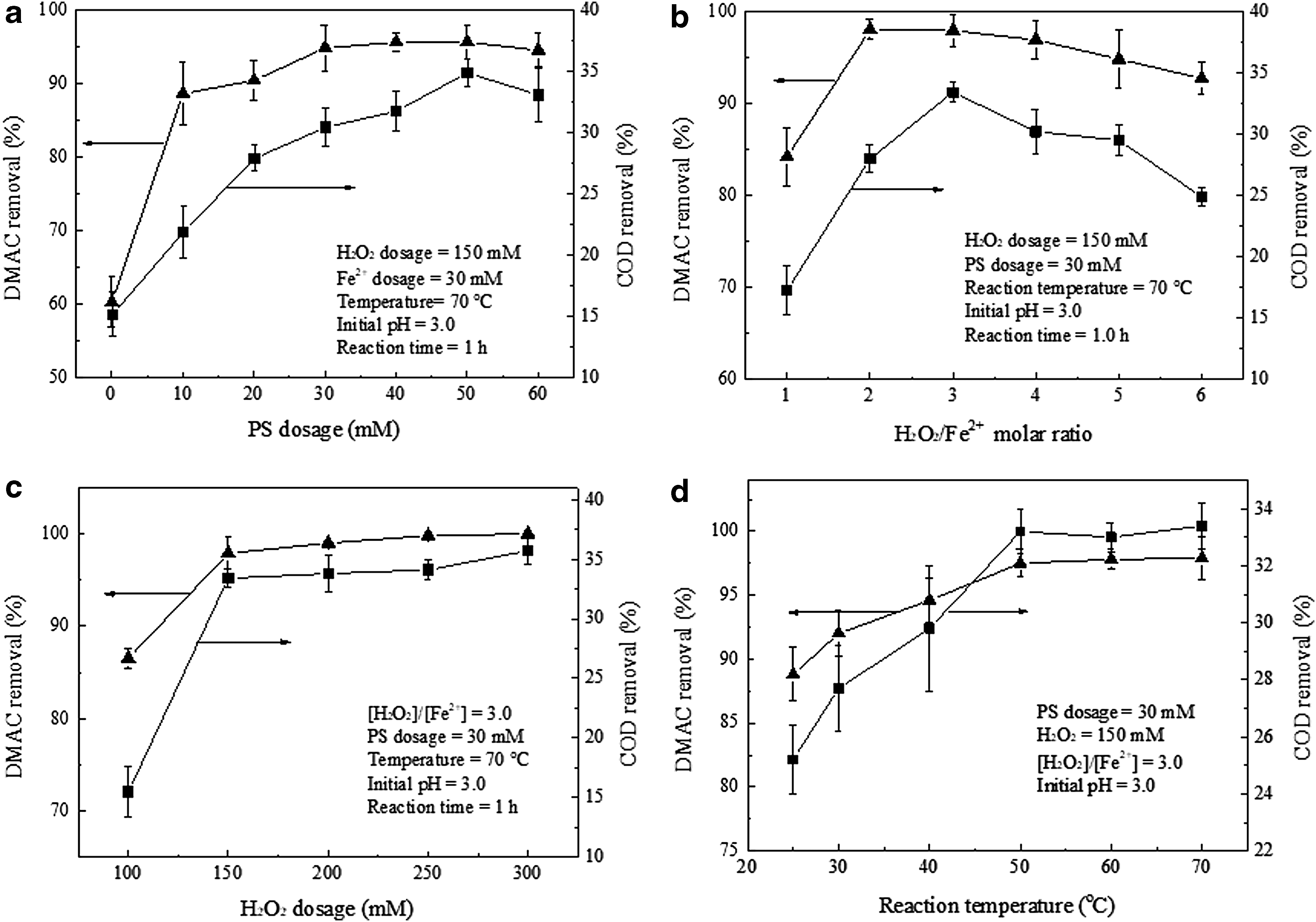
The PS is an indispensable constituent of the PS/Fenton/thermal system, thus playing an important role in DMAC degradation. Therefore, the effect of different initial PS dosages (0, 10, 20, 30, 40, 50, 60 mM) on the DMAC and COD removal efficiency of DMAC aqueous solution was investigated at first (Fig. 1a). The other operation conditions were H2O2 dosage of 150 mM, Fe2+ dosage of 30 mM, initial pH of 3.0, reaction temperature of 70°C, and reaction time of 60 min.
Single factor experiments: Effects of
It is observed that an appropriately higher dosage of PS favors the removal efficiency of DMAC and COD by PS/Fenton/thermal system. In particular, when the initial PS dosage was increased from 0 to 30 mM, the DMAC removal efficiency increased from 79.9% to 94.8%, and COD removal efficiency increased from 15.3% to 29.5%. The result can be explained that when PS dosage was below quantitative value, the amount of sulfate radicals increases with the increasing of PS dosage [Eq. (3)] (Xiong et al., 2014). However, the incremental rate of DMAC and COD removal efficiency slowed down slightly when PS dosage was 30–50 mM, and DMAC and COD removal efficiencies were reduced when PS dosage was higher than 50 mM due to the consumption of SO4·− by excess PS or SO4·− [Eqs. (5) and (6)] (Yang et al., 2011; Li et al., 2017b). Therefore, the optimal PS dosage of 30 mM was selected to optimize other operation parameters in the subsequent experiments.
Effect of H2O2 to Fe2+ molar ratio
The dosage of H2O2 was fixed at 150 mM, and the molar ratio of H2O2 to Fe2+ changed with the different ferrous sulfate dosages. Effects of [H2O2]/[Fe2+] molar ratio (1.0, 2.0, 3.0, 4.0, 5.0, 6.0) on DMAC and COD removal efficiency of DMAC wastewater by PS/Fenton/thermal system were evaluated (Fig. 1b). The other operation conditions were PS dosage of 30 mM, initial pH of 3.0, reaction temperature of 70°C, and reaction time of 60 min.
Figure 1b illustrates that the maximum DMAC and COD removal were observed to be 97.9% and 33.4% at [H2O2]/[Fe2+] molar ratio of 3.0. DMAC and COD removal decreased when the [H2O2]/[Fe2+] molar ratio was >3.0. These phenomena can be explained from two aspects: (1) with enough H2O2 and Fe2+, sufficient hydroxyl radicals would be generated [Eq. (1)], which could enhance the oxidation capacity of PS/Fenton/thermal system; (2) when H2O2 or Fe2+ is excessive, however, one or more of side reaction would occur [Eqs. (4) and (7)–(8)] (Li et al., 2013b). Moreover, excessive Fe2+ competes with DMAC and intermediate for HO· and SO4·− (Dai et al., 2012; Han et al., 2015; Wang et al., 2016), while low concentration of Fe2+ is not sufficient to catalyze PS and H2O2, causing that PS and H2O2 can't be fully utilized. Therefore, the optimal [H2O2]/[Fe2+] molar ratio of 3.0 was selected in the sequential experiments to investigate the effects of H2O2 dosage and reaction temperature.
Effect of H2O2 dosage
Since dosage of H2O2 can affect the treatment efficiency of Fenton system (Westphal et al., 2013), batch experiments were setup and performed on a condition that different initial H2O2 dosages (100, 150, 200, 250, and 300 mM) were used to treat 5,000 mg/L of DMAC stock solutions. The other operation conditions were PS dosage of 30 mM, [H2O2]/[Fe2+] molar ratio of 3.0, initial pH of 3.0, reaction temperature of 70°C, and reaction time of 60 min. Figure 1c shows DMAC and COD removal efficiencies with different H2O2 dosages.
It is clear that the removal efficiencies of DMAC and COD increased obviously with the increase of H2O2 dosage from 100 to 150 mM, while the removal efficiency did not increase continuously after the H2O2 dosage was more than 150 mM in the PS/Fenton/thermal system. What's more, a H2O2 dosage of 150 mM to be optimum with 97.9% DMAC removal and 33.4% COD removal. In single Fenton system, however, H2O2 could be a scavenger of HO· [Eq. (8)] and a decrease in organics removal would happen as the H2O2 dosage is increased (Padoley et al., 2011). The results can be explained from two aspects as follows: (1) HO· would be produced with increasing H2O2 dosage [Eq. (1)], which could enhance the oxidation capacity of PS/Fenton/thermal system; and (2) the HO· scavenging of H2O2 was inconspicuous due to the synergistic effect in the PS/Fenton/thermal system. Finally, the H2O2 dosage of 150 mM was gained as the optimum.
Effect of reaction temperature
Thermal activation of PS and heating assisted Fenton system have been excellent choices for the organic removal (Yang et al., 2009; Qi et al., 2014). Furthermore, thermal activated PS system can produce SO4·− directly and HO· indirectly [Eqs. (2) and (10)] (Ghauch et al., 2012). The effect of the reaction temperature on DMAC and COD removal efficiency in the PS/Fenton/thermal system was surveyed at six different temperatures (25, 30, 40, 50, 60, 70°C) under PS dosage of 30 mM, H2O2 dosage of 150 mM, and [H2O2]/[Fe2+] molar ratio of 3.0. From Fig. 1d, it is apparent that DMAC and COD removal efficiency increased obviously with the increase of temperature and reached the maximum at the reaction temperature of 50°C. Especially, this phenomenon was remarkable at the reaction temperature of over 40°C. However, a further increase of reaction temperature to 70°C did not increase the DMAC and COD removal efficiency. The results can be illustrated from three aspects as follows: (1) higher temperature could enhance the efficiency of mass transport and main reactions in PS/Fenton/thermal system [Eqs. (1)–(4) and (10)]; (2) PS can be activated at the temperature up 40°C (Qi et al., 2014); (3) meanwhile, the increasing of reaction temperature could promote the side reactions [Eqs. (5)–(9)] in PS/Fenton/thermal system at the same time. Therefore, 50°C is taken for the optimal temperature. However, in heat-activated PS system, 50°C was not enough to secure good degradation yield (Tan et al., 2012; Ghauch et al., 2015). That is why improving the process in the presence of Fenton reagent is a good alternative despite addition of chemicals.
Parameter optimization using RSM
RSM was used for analyzing the correlation between the variables (four parameters, for example, PS dosage, H2O2 dosage, the molar ratio of H2O2 to Fe2+, and reaction temperature) and the response (DMAC removal efficiency) for PS/Fenton/thermal system. The variation range of the parameters was gained from the single-factor experiments. To assess interactive relationships between independent variables and the response, regression calculations are performed by Design Expert software to fit all of the polynomial models to the CCD results in the PS/Fenton/thermal system. CCD experimental design and the result of the experimental matrix are showed in Table 1. After the stepwise model fitting by the software, a quadratic model for DMAC removal efficiency in the PS/Fenton/thermal system was selected as the most appropriate one and was expressed by Equation (11), as a simultaneous function of PS dosage (A), H2O2 dosage (B), [H2O2]/[Fe2+] (C), and reaction temperature (D).
DMAC, N,N-dimethylacetamide.
Analysis of variance result for the model is shown in Table 2. The model F-value (along with p-value) is 58.94 (<0.0001), which indicates that the quadratic model is significant and gives a good prediction of the experimental data (Li et al., 2017b). The “lack of fit F-value” (along with p-value) is 2.13 (0.2087), implying that the lack of fit is not significant, and the calculated response surface represents the true shape of the surface (Li et al., 2017b). Besides, the “Adeq precision” is 29.376, suggesting that the model has an adequate signal-to-noise ratio (>4). The value of R2 is 0.9820, which reflects that there is a good relationship between the observed values and the predicted values to a certain extent (Zhou et al., 2016).
Cor total, corrected total; PRESS, prediction error square sum; PS, persulfate.
To understand the interaction of the variables, 3D response surfaces of the RSM are drawn as a function of two factors (Fig. 2), holding all other factors at the center levels. As the model established and optimized, it was found that interactive relationships between H2O2 and PS, PS and reaction temperature, H2O2 and reaction temperature, and H2O2 and [H2O2]/[Fe2+] molar ratio were well described for the PS/Fenton/thermal system. Figure 2a reflects the interactive relationship between H2O2 and PS. During the optimization studies, it was found that DMAC removal efficiency increases with increasing dosage of H2O2 and PS. In addition, DMAC removal efficiency increases more sharply when H2O2 dosage increases, compared with that of PS. This behavior also illustrates that H2O2 plays an important role in the PS/Fenton/thermal system. Figure 2b shows the interactive relationship between reaction temperature and PS. It can be seen that DMAC removal efficiency would increase with the augment of PS dosage and temperature. An approximate optimal dosage ratio of [PS dosage]/[temperature] is observed. Figure 2c indicates the interactive relationship between H2O2 and temperature, which indicates that suitable high temperature and high H2O2 dosage are conducive to DMAC removal efficiency. Figure 2d shows the interactive relationship between H2O2 and [H2O2]/[Fe2+] molar ratio. It is obvious that H2O2 dosage played a more important role than [H2O2]/[Fe2+] molar ratio in the PS/Fenton/thermal system.

RSM: effects of interactive relationships between
The four parameters were set as “in range” due to their CCD levels. Targeting an expected DMAC removal efficiency of 100%, the optimal conditions (i.e., PS dosage of 21.3 mM, H2O2 dosage of 152.7 mM, [H2O2]/[Fe2+] molar ratio of 3.2, and reaction temperature of 40.6°C) were predicted according to the RSM model. The duplicate experiment with the optimized conditions was carried out to examine the validity of the predictions, and the 96.5% DMAC removal, 35.7% COD removal, and 0.4 of BOD5/COD were obtained.
Comparative study of PS/Fenton/thermal system
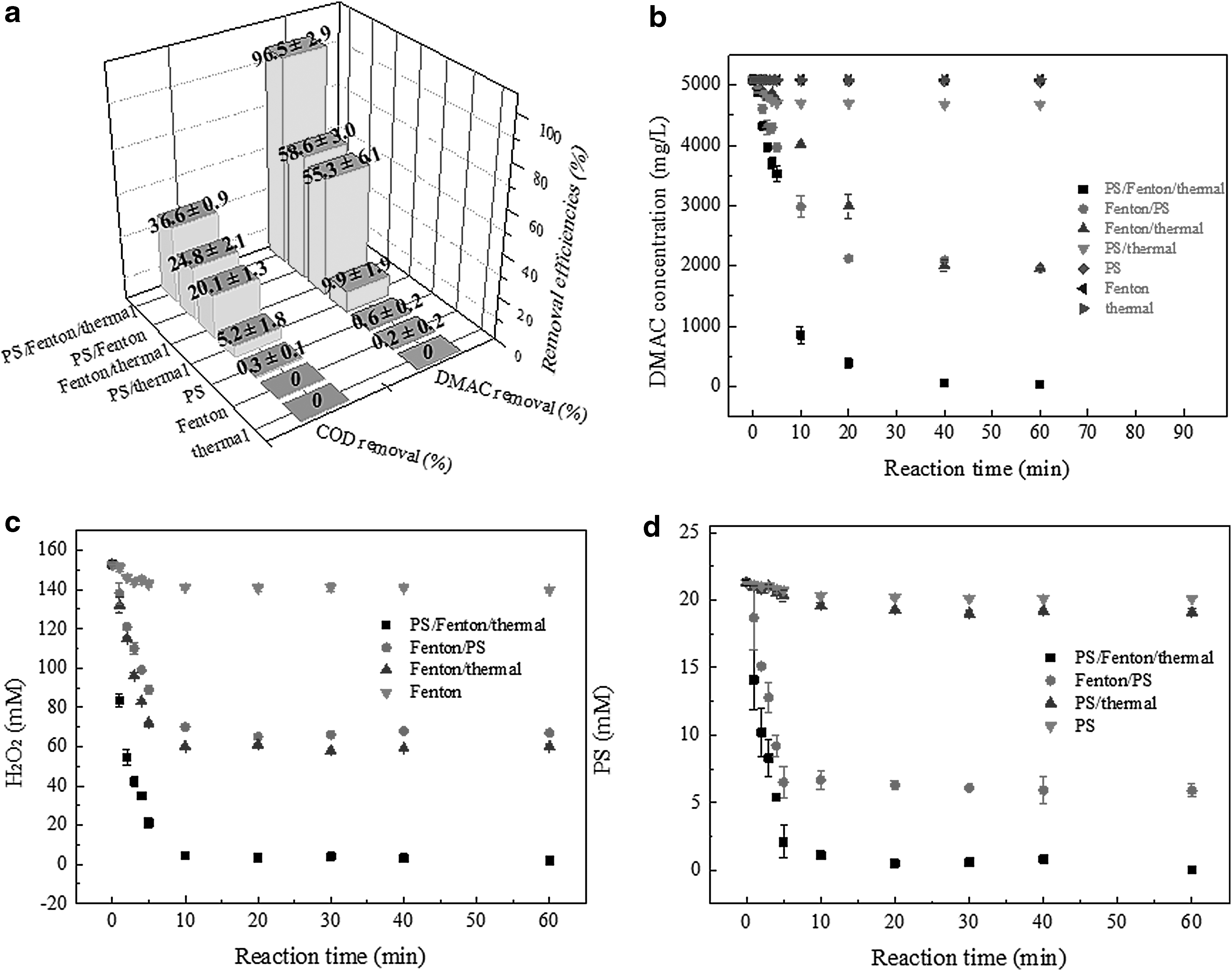
To evaluate the superiority and synergetic effect of the PS/Fenton/thermal system, six control experiments, including (1) PS/Fenton, (2) Fenton/thermal, (3) PS thermal, (4) PS, (5) Fenton, and (6) heating, were setup under the optimal conditions of PS/Fenton/thermal system (i.e., PS dosage of 21.3 mM, H2O2 dosage of 152.7 mM, [H2O2]/[Fe2+] molar ratio of 3.2, and reaction temperature of 40.6°C).
As shown in Fig. 3a, DMAC removal efficiencies of 96.5%, 59.6%, 55.3%, 9.9%, 0.6%, 0.2, and 0 were obtained by PS/Fenton/thermal, PS/Fenton, Fenton/thermal, PS/thermal, PS, Fenton, and heating systems, respectively. Moreover, COD removal efficiencies of 35.7%, 24.8%, 20.1%, 5.2%, 0.3%, 0, and 0 were obtained by the seven systems. Especially, DMAC and COD removal efficiencies were very low in single system (i.e., PS, Fenton, or heating system). In addition, DMAC removal efficiency (96.5%) obtained by the PS/Fenton/thermal system was much higher than the sum of PS/Fenton and heating systems, Fenton/thermal and PS systems, or PS/thermal and Fenton systems. Simultaneously, COD removal efficiencies had the similar tendency. In general, the synergetic effect of the PS/Fenton/thermal system played a leading role in degradation of DMAC in aqueous solution. According to DMAC, H2O2, and PS concentration changes (Fig. 3b–d) during the seven different treatment processes, it can be seen that the concentration of H2O2 and PS in Fenton or PS and PS/thermal system had little change during the whole treatment processes. The results are in accordance with DMAC removal efficiencies of the systems.
DMAC and COD removal efficiencies
Changes in UV absorbance characteristics of the influent and effluent of PS/Fenton/thermal, PS/Fenton, Fenton/thermal, PS/thermal, PS, Fenton, and heating systems from 190 to 300 nm are shown in Fig. 4. The broad peak between 190 and 250 nm is mainly attributed to the n-π* transition of acylamino and acetic acid or σ-σ* transition of methyl (Zhu, 2005). As shown in Fig. 4, the broad peak between 190 and 250 nm of effluent of the PS/Fenton/thermal system dropped rapidly with respect to the influent. Compared with the effluent of the six control systems, it is clear that the peak intensity of the effluent of PS/Fenton/thermal system was much lower. The results suggest that amides were relatively easier to be decomposed by PS/Fenton/thermal system. This behavior accords with the results of DMAC and COD removal efficiencies.
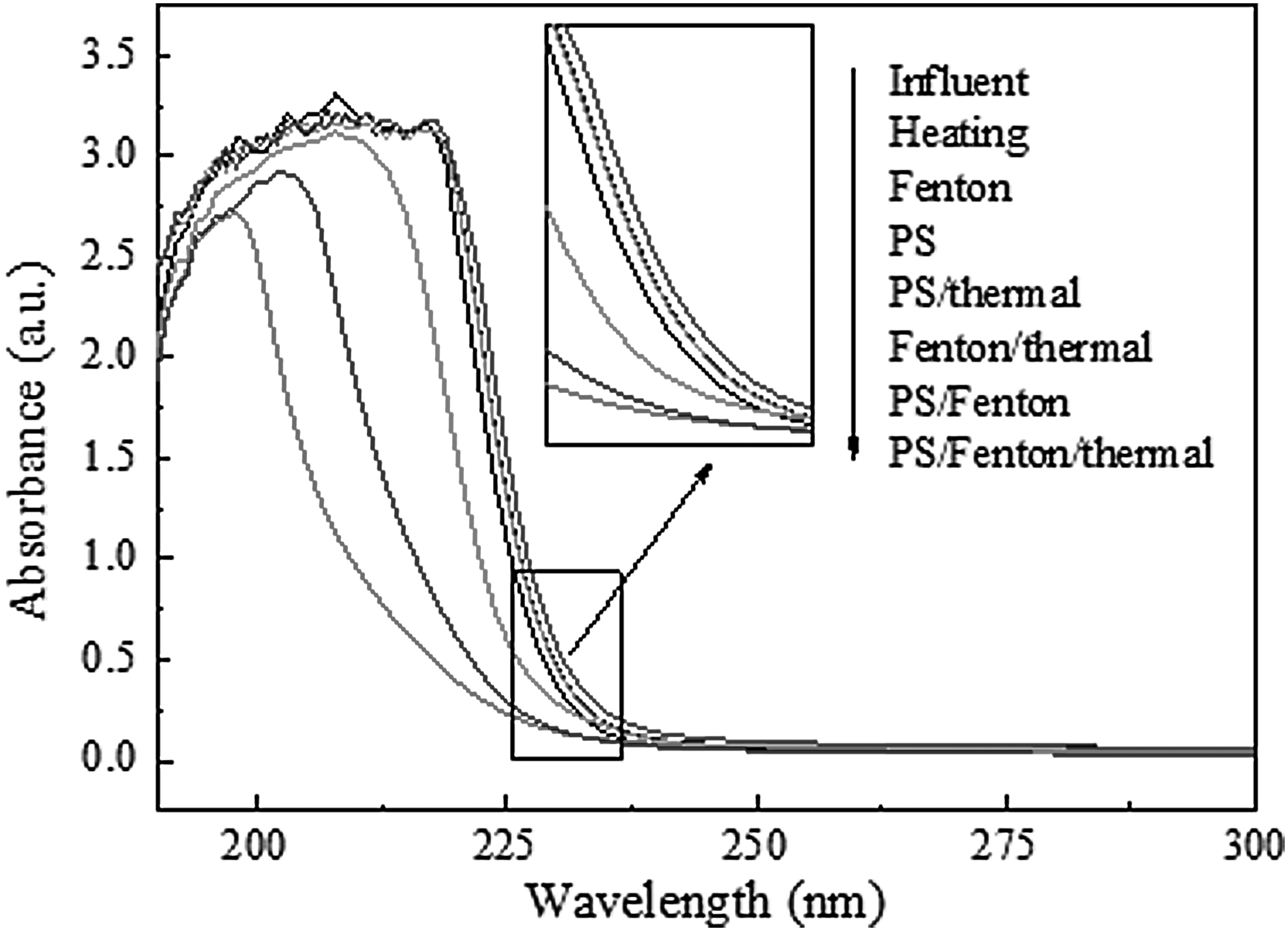
UV spectra of the PS/Fenton/thermal treatment process and the control systems under the optimal conditions (H2O2 dosage of 152.7 mM, PS dosage of 21.3 mM, [H2O2]/[Fe2+] molar ratio of 3.2, and reaction temperature of 40.6°C).
Mechanism of synergistic effect of PS/Fenton/thermal system
According to the analysis results of DMAC removal efficiencies, COD removal efficiencies, and UV spectra, it can be seen that there is a strong synergistic effect in the PS/Fenton/thermal system. The synergy in this system is illustrated in Fig. 5.
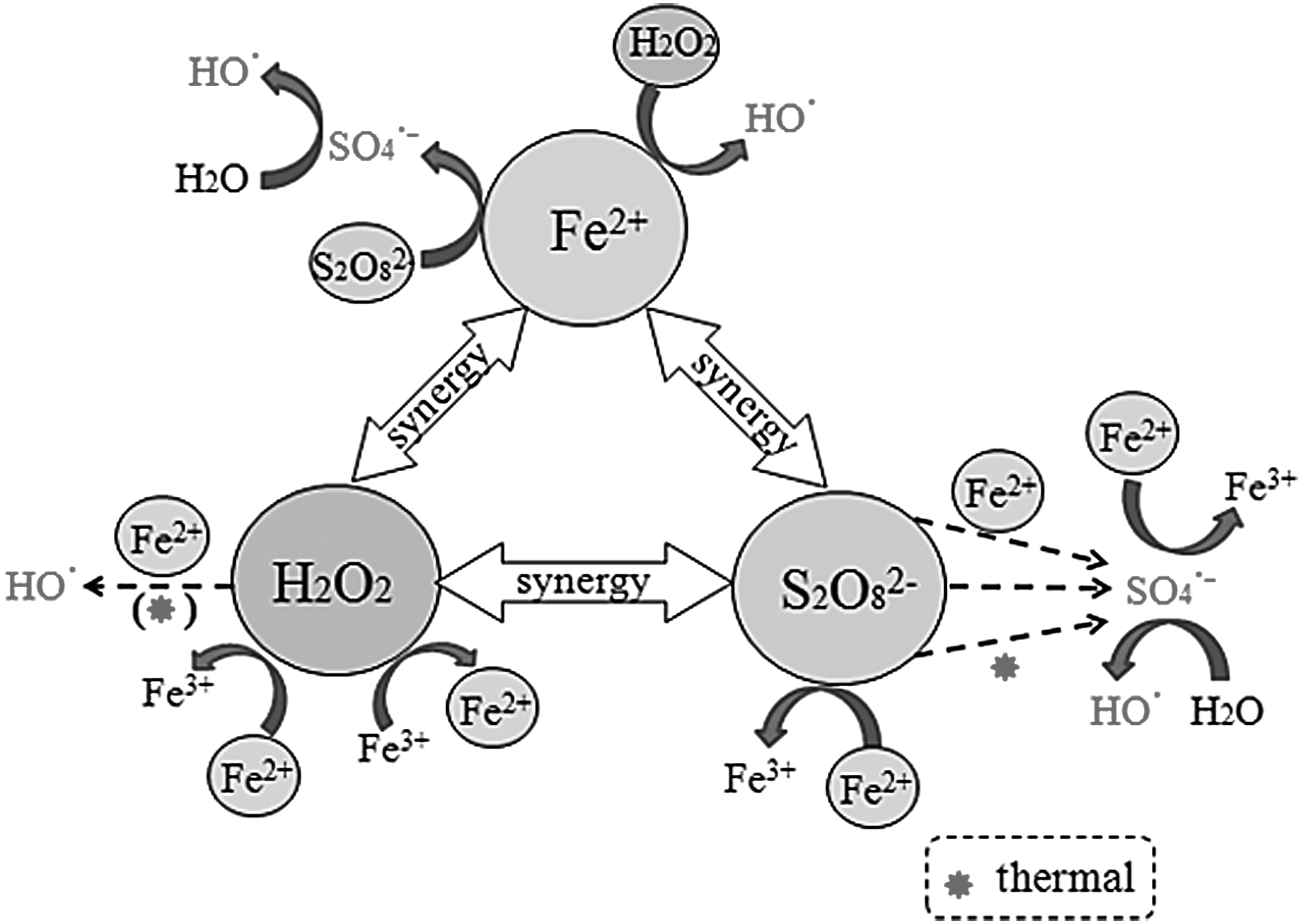
Synergistic effect of the PS/Fenton/thermal system.
The addition of Fe2+ would catalyze H2O2 to produce HO· and catalyze PS to produce SO4·− (Oh et al., 2009; Yan et al., 2013). For example, Fig. 1b demonstrates that the DMAC and COD removal efficiencies increase when the amount of Fe2+ is increased. The result indicates that Fe2+ has the ability to increase the production of SO4·− and HO· by catalyzing PS and H2O2. Moreover, synergy between PS and Fenton systems could be found in degradation of DMAC by the PS/Fenton/thermal system. Figure 3 shows that only 0.6% of the DMAC was removed in single PS system, and 0.2% of the DMAC was removed in single Fenton system. However, 59.6% of DMAC was removed in PS/Fenton system. Meanwhile, DMAC removal efficiency of PS/Fenton/thermal (96.5%) was much higher than PS/thermal (9.9%) and Fenton/thermal (55.3%). The results demonstrate that Fe2+ of the Fenton system can enhance production of SO4·− [Eq. (3)], and PS can promote Fenton system for the DMAC removal. In addition, heat could accelerate the synergistic effect between PS and Fenton system by activating PS and Fenton for the production of SO4·− and HO· (Tan et al., 2012). What's more, higher temperature results in the higher mass transfer rates simultaneously.
Proposed degradation pathway of DMAC
To investigate thoroughly the DMAC degradation pathway in the PS/Fenton/thermal treatment process, variation of DMAC and intermediates under the optimal conditions (i.e., H2O2 dosage of 152.7 mM, PS dosage of 21.3 mM, [H2O2]/[Fe2+] molar ratio of 3.2, and reaction temperature of 40.6°C) was detected by HPLC analysis. Concentration of DMAC, N-methyl-N-hydroxymethylacetamide, N-methylacetamide, N-hydroxymethylacetamide, acetamide, and acetic acid over the duration of the treatment within 60 min is shown in Fig. 6. It is observed that concentration of DMAC reduced to 391.7 mg/L in the first 20 min. Meanwhile, concentration of N-methyl-N-hydroxymethylacetamide, N-methylacetamide, N-hydroxymethylacetamide, acetamide, and acetic acid increased to 1502.8, 134.5, 1149.3, 1622.1, and 41.6 mg/L rapidly. It can be concluded that SO4·− and HO· can facilitate demethylation of DMAC quickly in PS/Fenton/thermal system.

Concentration of DMAC and the intermediates with the reaction time. Experimental conditions: H2O2 dosage of 152.7 mM, PS dosage of 21.3 mM, [H2O2]/[Fe2+] molar ratio of 3.2, and reaction temperature of 40.6°C.
We were able to propose, in the case of DMAC in PS/Fenton/thermal system, a possible decomposition pathway base on HPLC characterization and evolution of intermediates (Fig. 7). The primary steps involved the hydroxylation of methyl group connected to nitrogen atom [-CH3(N)] by HO· and further demethylation by SO4·− and HO·. For example, -CH3(N) of DMAC was attacked by HO· which led to the formation of -CH2OH. DMAC was degraded to N-methyl-N-hydroxymethylacetamide at the same time. Then, SO4·− and HO· reacted with -CH2OH, and N-methyl-N-hydroxymethylacetamide was degraded to N-methylacetamide. Group -CH3(N) of N-methylacetamide could be attracted by SO4·−, and HO· together with N-methylacetamide was degraded to AC. Moreover, only 35.7% COD removal efficiency was obtained after 60 min treatment by the PS/Fenton/thermal system, which proved that only a part of DMAC could be mineralized. In addition, there was only a little acetic acid detected by HPLC analysis. The phenomenon can be explained that deamination of AC was difficult by SO4·− and HO· in PS/Fenton/thermal system or mineralization of acetic acid was very fast.

Proposed reaction pathway for the degradation of DMAC by PS/Fenton/thermal treatment process.
Conclusions
A PS/Fenton/thermal system was developed to decompose the DMAC in aqueous solution. Single-factor experiment and RSM were used to optimize the main experimental parameters, and the optimal conditions (i.e., H2O2 dosage of 152.7 mM, PS dosage of 21.3 mM, [H2O2/Fe2+] molar ratio of 3.2, and reaction temperature of 40.6°C) were obtained. DMAC and COD removal efficiencies (i.e., 96.5%/35.7%) obtained by the PS/Fenton/thermal system were much higher than those of PS/Fenton, Fenton/thermal, PS/thermal, PS, Fenton, and heating systems (i.e., 59.6%/24.8%, 55.3%/20.14%, 9.9%/5.2%, 0.6%/0.3%, 0.2/0, and 0/0), which confirm the superiority and synergy of the PS/Fenton/thermal system. Furthermore, the analysis of UV spectra of influent and effluent in the seven systems further confirms a strong synergistic effect in the PS/Fenton/thermal system, which plays a leading role in the degradation of DMAC in aqueous solution. In addition, according to the concentration of the intermediates detected by HPLC, DMAC was degraded to N-methyl-N-hydroxymethylacetamide, N-methylacetamide, N-hydroxymethylacetamide, acetamide, and acetic acid; meanwhile, it can also identify that hydroxylation and demethylation of DMAC in the PS/Fenton/thermal system were rapid. As a result, the PS/Fenton/thermal system with strong synergistic effect could be a potential technology for pretreatment of high concentration DMAC contained wastewater.
Footnotes
Acknowledgment
The authors gratefully acknowledge the financial support of the Fundamental Research Funds for the Central Universities (No. 2015SCU04A09).
Author Disclosure Statement
No competing financial interests exist.